The significance of collaboration is continuously increasing alongside the growing complexity and interdependency in construction projects. In this regard, collaboration is regarded as a crucial element for success in construction projects, especially complex ones. Therefore, collaboration has become a significant research topic in recent years. Despite this increasing interest, our understanding of collaboration in construction is primarily limited to practical aspects, including processes, professional roles, delivery models and procurement structures. Consequently, there is a noticeable lack of a theoretical foundation for collaboration within this domain. To address this gap, this study aims to explore characteristics of collaboration in construction, identify indicators of those characteristics and then use both of them as a basis for developing a theory of collaboration in construction.
A systematic literature review was conducted, followed by content and thematic analysis of extracted data. The results of the content analysis were further analyzed using an abductive approach to develop the theory.
The study presents a theory of collaboration in construction that answers six core questions (what, why, how, when, where and who) expected of a theory. Additionally, it reveals characteristics of collaboration and its indicators.
This study enhances theoretical understanding of collaboration in construction by providing a structured foundation for future research and practical applications. The findings could aid efforts to establish a basis for measuring and improving collaboration within the industry.
Introduction
Construction projects serve as crucial drivers of societal and economic development, influencing industries, communities, and overall economic growth. Effective collaboration has become essential for ensuring the success of these projects as their complexity grows (Deep et al., 2021; Engebø et al., 2020; Han et al., 2018). Over the past decades, innovative strategies have emerged to enhance teamwork, streamline communication, and improve project results (Pe-Mora et al., 2001).
Construction projects are not just technical endeavors; they are fundamentally human-centered (Deep et al., 2021). They are conceived, executed, and ultimately utilized by people. Individuals play various roles throughout the project life cycle, contributing to both the development and the operation of these projects. The essence of a construction project is shaped by its connections to people, making human relationships a crucial aspect of project success (Deep et al., 2021; Engebø et al., 2020; Mollaoglu et al., 2021).
The key role of people in construction projects and their interdependency, both individually and organizationally, underscores the importance of collaboration. In its simplest form, collaboration is usually understood as working together (Daget and Zhang, 2023). Hence, collaboration is seen as an essential element for project success, given the diverse range of stakeholders involved (e.g. owners, contractors, and designers). However, insufficient collaboration can lead to misaligned goals, ineffective communication, and inefficiencies. To address these challenges, the construction industry has introduced collaborative project delivery models, such as alliance and lean project delivery, which have received positive feedback (Moradi et al., 2024a). While Collaboration is critical, its level and effectiveness can vary significantly across projects and stakeholders.
Despite the growing emphasis on collaboration in construction, much of the current discourse and frameworks continue to be practice-oriented (Moradi et al., 2024b). They primarily focus on processes, professional roles, and procurement models. Nevertheless, a solid theoretical foundation for collaboration in this field is still lacking. This research aims to bridge this gap by identifying and conceptualizing the essential components of collaboration. This will enhance the overall theoretical understanding of collaborative dynamics in construction projects.
The absence of a dedicated collaboration theory has resulted in vague definitions of collaboration. These definitions often overlap with related concepts such as cooperation and coordination (Moradi and Klakegg, 2024a, b; Nwajei et al., 2022). Consequently, the distinct characteristics of collaboration. The roles within collaborative construction approaches and the levels of collaboration remain unclear in construction management. This theoretical ambiguity hinders the development of structured methods. It also impedes assessment methodologies designed to enhance collaboration in the field. This study aims to establish a comprehensive and precise theory of collaboration in construction. To achieve this, the study aims to answer the following questions:
What are the characteristics of collaboration in construction?
What are the indicators of collaboration characteristics in construction?
What is the theory of collaboration in construction?
This article is structured into four sections. The first section provides the theoretical background, followed by the methodology presentation in the second section. The third section presents and discusses the research findings. Finally, the paper concludes by drawing insights from the findings.
Theoretical background
Definition
Previous research has offered several definitions of collaboration (e.g. Moradi and Kähkönen, 2024; Pirayesh et al., 2015; Su et al., 2017). While these definitions provide valuable perspectives, they vary in scope and often fail to capture the comprehensive and dynamic nature of collaboration. Meads and Ashcroft (2005) emphasized that collaboration occurs when individuals communicate and work together to achieve shared goals. Similarly, Hughes et al. (2012) and Himes (1995) describe collaboration as a long-term partnership between two or more organizations. This partnership aims to achieve specific business objectives by optimizing the resources of each participant. These alliances are typically founded on trust, shared goals, and a mutual understanding of expectations and values. However, these definitions still lack a fully comprehensive perspective. Collaboration is interpreted differently across disciplines, making it difficult to establish a universally accepted definition (Himes, 1995). Moreover, while collaboration can be conceptualized as both a state (reflecting the degree of collaboration at a given time) and a process (the ongoing interaction among actors), many definitions focus exclusively on one aspect. Collaboration also occurs at multiple levels, individual, team, and organizational, but many existing definitions do not adequately reflect these interconnections (Moradi and Klakegg, 2024a). A further challenge lies in the disconnect between academic and practitioner perspectives: industry professionals often conflate collaboration with cooperation and coordination, whereas academic literature tends to treat them as distinct concepts. Furthermore, while collaboration encompasses elements such as trust, communication, and shared goals, many definitions overlook critical challenges, including power imbalances and conflicting interests. Thus, despite the contributions of prior work, current definitions do not fully address the evolving, context-specific, and multidimensional nature of collaboration in construction projects (Moradi and Klakegg, 2024b).
Previous research
The recognized importance of collaboration in construction projects has led to an increasing volume of research in recent years. A holistic review of the literature reveals that prior research has concentrated on five key themes: (1) challenges and barriers to collaboration, (2) collaboration across the supply chain, (3) the relationship between collaboration and innovation, (4) enablers and success factors of collaboration, and (5) defining and understanding collaboration. The studies representing each theme are discussed in the following subsections.
Challenges and barriers in collaboration
The challenges and barriers to collaboration within the construction industry are multifaceted and deeply rooted in both industry structures and stakeholder behavior. According to Oraee et al. (2022), the lack of a unified approach to collaboration, such as through BIM-based construction. This is exacerbated by an overemphasis on technology, often at the expense of recognizing the critical role of people and their interactions. This issue is further compounded by unclear contractual arrangements, liability concerns, disputes over intellectual property, and data ownership challenges. All of these undermine team members’ willingness to collaborate (Oraee et al., 2022). Moreover, stakeholders frequently lack a shared vision and mutual trust, which inhibits open communication and the effective transfer of knowledge. Resistance to change from traditional working methods presents another significant barrier. Communication problems and incompatible organizational cultures further complicate collaboration efforts, collectively creating substantial obstacles to adopting more collaborative practices (Yap and Lim, 2023). Emuze and Smallwood (2014) note that the industry’s emphasis on short-term goals and a price-oriented approach also hinders collaboration, particularly when coupled with inadequate mechanisms for problem-solving among project partners. Given the central role of contracts in the construction sector, af Hällström et al. (2024) highlight the complex interplay between formal contractual frameworks and informal relationships. They argue that prioritizing one over the other may disrupt the balance necessary for successful collaboration, potentially resulting in failures or stalemates. Finally, Nwajei et al. (2022) point out that a lack of alignment between project strategies, functions, and tools can render even well-designed collaborative systems ineffective.
Collaboration across the supply chain
Studies within this theme have examined the relationship between collaboration and supply chain performance in the construction industry. Meng (2013) observed that the industry has gradually shifted away from traditional adversarial relationships towards more collaborative supply chain models. Supply chain integration and collaboration are increasingly recognized as strategies for enhancing performance by fostering relationships and aligning activities between upstream and downstream actors. This alignment aims to improve the efficiency and quality of production processes (Koolwijk et al., 2018). Savolainen et al. (2018) found that collaborative practices can significantly enhance productivity and quality within construction projects. Nevertheless, the construction supply chain is still considered deficient due to persistent collaboration gaps (Ali Shaikh et al., 2020; Faris et al., 2024).
Collaboration and innovation
The combined forces of innovation and collaboration are key drivers of progress in the construction sector. Collaboration enables the effective development and implementation of innovations, while innovation creates new opportunities for collaborative endeavors. According to Han et al. (2018), innovation is essential for executing complex projects, which require the integration of expertise from all involved parties and intense collaboration within networks.
Furthermore, collaborative innovation efforts and the use of Building Information Modeling (BIM) are recognized as critical for enhancing innovation capacity in the construction supply chain (Qiao et al., 2021; Tang et al., 2018; Zhan et al., 2023). Cheng et al. (2023) argue that knowledge exchange, enhanced through the application of BIM, enables project participants to access valuable information resources, thereby improving competitive advantage. In addition, inter-organizational collaboration is vital for innovation in sustainable construction, as the project network increasingly replaces rigid organizational structures with more dynamic, systemic forms (Zhang et al., 2020b; Zhao et al., 2015). By improving processes, involving stakeholders, and leveraging digital technologies, collaboration contributes to better project management. It also streamlines information flow, reduced transaction time, greater transparency, delivers faster, and results in lower costs; all of which support innovation (Merschbrock and Munkvold, 2015).
Collaboration enablers and success factors
A variety of factors influence the success of collaboration in the construction industry. According to Deep et al. (2021), trust, commitment, and reliability are essential enablers of collaboration in construction projects. Prioritizing these elements in project execution decisions can significantly enhance both collaboration and overall productivity. Knowledge exchange also plays a central role in collaborative efforts, facilitating performance assessment and continuous improvement (Staykova and Underwood, 2017). In addition, team integration is a critical enabler, particularly for the implementation of joint risk management strategies. This includes practices such as stakeholder engagement, alignment of goals, team-building activities, and contractual flexibility. These outcomes can be achieved through the diffusion of collaborative values at both strategic and operational levels (Marinelli and Salopek, 2020; Mollaoglu et al., 2021). Daget and Zhang (2023) found that strong collaboration among contractors, designers, and manufacturers contributes positively to efficiency in industrialized construction projects. Furthermore, effective collaboration supports the creation of mutually beneficial relationships (Faris et al., 2022), enables joint rule-setting, and facilitates seamless cooperation among geographically dispersed project teams (Chowdhury et al., 2021). Finally, Patel et al. (2012) and Pe-Mora et al., 2001 propose seven categories of factors that must be considered to enhance collaborative design and engineering activities. These include: context, support mechanisms, tasks, interaction processes, team dynamics, individual characteristics, and overarching environmental factors.
Defining and understanding collaboration
Despite the availability of numerous definitions, some researchers argue that these definitions are either inadequate or inapplicable to the complex realities of construction projects. Prior research highlights both the lack of a clear, unified definition and the broad diversity of interpretations surrounding the concept of collaboration (Gomes and Tzortzopoulos, 2020). Gomes and Tzortzopoulos (2020) note that the term “collaboration” is widely used but often remains conceptually vague and formless. Hughes et al. (2012) found that collaboration is frequently used as an umbrella term encompassing partnering, alliancing, and joint ventures. Each of these is more specifically defined, yet a comprehensive and structured delineation of collaboration itself is often missing. Understanding these nuances is critical, as the success of collaboration frequently depends on acknowledging its different interpretations. A clear and shared definition supports better project outcomes by facilitating the transfer of best practices and reducing ambiguity. Conversely, a lack of clarity may lead to misunderstandings that hinder effective teamwork and compromise project success (London and Pablo, 2017; Ren et al., 2013).
Methodology
Research design
This study employed a Grounded Theory (GT) strategy with an abductive approach to construct a theory of collaboration in construction. GT facilitates an iterative, data-driven process, allowing theory to emerge from empirical observations. Abduction, on the other hand, refines theoretical insights by integrating empirical findings with existing literature (Saunders et al., 2019). By combining Grounded Theory with an abductive approach, the study ensures that theory development is not limited by preconceived notions. This allows insights to arise from the data and refines these insights as new data is collected and analyzed (Saunders et al., 2019).
The study follows three key phases:
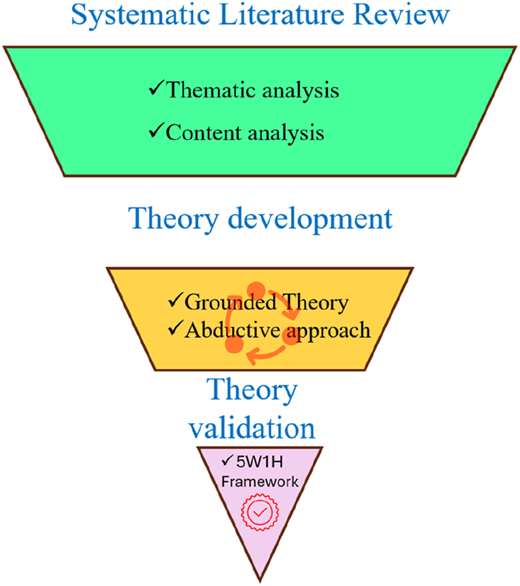
A Systematic Literature Review (SLR) to synthesize prior research, identify knowledge gaps, and establish a conceptual foundation through thematic and content analysis;
Complementary analysis and theory development, where GT principles guide further analysis of data without predefined assumptions, while abduction iteratively refines emerging insights to reach a specific theory; and
Theory validation using the 5W1H framework, systematically assessing key aspects of collaboration (who, what, when, where, why, and how) to ensure the theory’s internal consistency, relevance, and applicability. This structured, iterative process results in a comprehensive and methodologically robust theory. Figure 1 illustrates the overall research process.
Systematic literature review
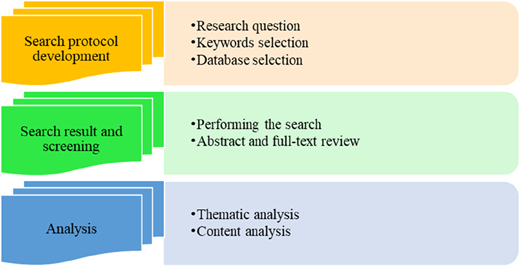
A systematic literature review is a structured and comprehensive method for critically analyzing existing knowledge about a specific research question or topic (Saunders et al., 2019). It is essential for advancing theory by identifying established theoretical frameworks, revealing gaps, and shaping research design (Saunders et al., 2019). This study employs this method to answer its questions. The conducted SLR was performed in three steps: Search protocol development, search results and screening, and analysis. This structured approach ensures that all relevant studies are systematically identified and analyzed, thereby contributing to the comprehensive development of collaboration theory. Figure 2 illustrates the overall SLR process.
Search protocol development
The search for relevant studies was completed in September 2024. Seven keywords were used in the search, including variations of “Collaboration” (see Appendix A for the complete list). Scopus was selected as the search database because it is a comprehensive source that indexes a wide range of highly regarded journals in construction management. The search was limited to studies published in English. Appendix contains the complete list of keywords, detailed search queries, and the number of results retrieved from each search.
Search results and screening
Appendix A shows that the search strategy employed a variety of filters, as shown in the advanced query column. The search was conducted without a specified time frame to ensure a comprehensive collection of the identified studies. This search resulted in the identification of 163 studies. Subsequently, the abstracts and full texts of these 163 studies were reviewed, and 58 studies were determined to be out of scope due to repetition and/or irrelevant content to collaboration in construction. The purposive approach to locating relevant studies was complemented by a snowball sampling method. Through this, a supplementary search was performed by meticulously examining the content and references of key articles to guarantee a thorough review of the pertinent literature. This in-depth analysis helps uncover and include relevant studies directly related to the core themes and findings, thereby enhancing the breadth and depth of the analysis.
Analysis
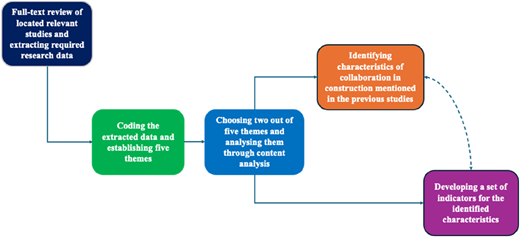
The extracted data from the relevant studies were analyzed through thematic and content analysis methods to identify key themes in collaboration research. Thematic analysis began with coding the extracted research data (i.e. findings from the reviewed studies). The coding process was data-driven, allowing concepts to emerge without imposing predefined theoretical assumptions. Conceptually relevant codes were then grouped into five overarching themes: “Challenges and barriers in Collaboration”, “Collaboration across the supply chain”, “Collaboration and innovation”, “Collaboration enablers and success factors”, and “Defining and understanding Collaboration”. Among the established themes, two of them (“Defining and understanding Collaboration” and “Collaboration enablers and success factors”) were found highly relevant to this study’s objective and therefore, were further analyzed using content analysis. This resulted in discovering characteristics of collaboration in construction and their frequency of appearance in the literature. In addition, indicators of those characteristics were identified as the complementary result of the content analysis, providing empirical grounding for theory development. Indicators of collaboration characteristics were selected based on their emergence in the literature and their alignment with construction management practices. Only those indicators that demonstrated clear relevance to construction management were included in the framework, based on the identified characteristics. The progression from characteristics to indicators followed an abductive logic (Saunders et al., 2019): recurring patterns were compared and refined concerning established conceptual frameworks in construction studies. This iterative process ensured that the indicators were both empirically grounded and theoretically coherent. The process of transforming themes into characteristics and indicators is shown in Figure 3.
The resulting indicators support theory construction and are designed to function as diagnostic tools for evaluating collaboration throughout the construction project life cycle. These indicators enable project teams to assess the level of collaboration at various stages, offering a tangible framework for real-time monitoring and improvement. By selecting indicators closely related to construction practices, the study ensures that the emerging theory is both theoretically rigorous and practically applicable.
Theory development
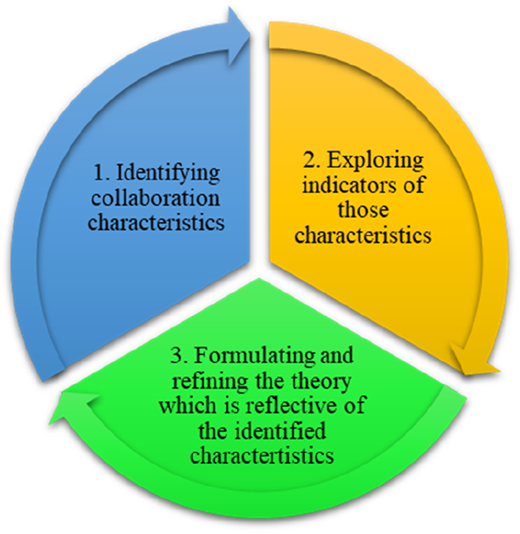
The study adopted a Grounded Theory strategy to develop a theory of collaboration in construction, incorporating an abductive approach to iteratively refine emerging insights. The collaboration theory was developed through an iterative process (see Figure 4), building on previous research (e.g. Moradi and Klakegg, 2024a, b) as well as characteristics and indicators that were identified in this study as a result of the conducted thematic and content analysis. This theory progressed through successive refinements, merging empirical insights with established conceptualizations. The abductive approach facilitated iterative adjustments, ensuring emerging concepts remained grounded and relevant. The iterative nature of this process enables ongoing refinement of the theory, ensuring it stays relevant and rooted in real-world practices.
Theory validation
After formulating the theory of collaboration in construction, the 5W1H framework (Who, What, When, Where, Why, and How) was applied to assess its completeness and relevance. This validation ensured that the definition comprehensively addressed key aspects of collaboration in construction projects. By systematically evaluating the definition against these six fundamental questions, the study ensured that the developed collaboration theory was both conceptually sound and practically applicable to construction management (Saunders et al., 2019).
Results
This section presents the study’s findings in three parts: (1) characteristics of collaboration, (2) Indicators of collaboration characteristics, which offer measurable aspects of these characteristics, and (3) a theory of collaboration, integrating these insights into a cohesive framework. This approach connects theoretical concepts with practical applications.
Characteristics of collaboration in construction
The content analysis identified seven key characteristics of collaboration in construction, each focusing on distinct aspects that contribute to effective teamwork. These characteristics, derived from recurring themes in prior research (e.g. Deep et al., 2021; Moradi and Klakegg, 2024a, b; Yap and Lim, 2023) and their alignment with construction management practices, provide a more structured understanding of collaboration. Rather than offering a broad definition, these characteristics emphasize specific, empirically grounded elements crucial for collaborative dynamics in construction projects. Together, they establish a foundation for developing a more targeted collaboration theory. Table 1 also contains a brief explanation of each characteristic.
Indicators of collaboration characteristics
Table 2 presents 44 indicators of collaboration characteristics. These indicators are quantitative measures and observational insights, reflecting various aspects of collaboration in construction management. While each indicator corresponds to a specific aspect of construction practices, notable commonalities highlight Collaboration’s complex and multifaceted nature. To support the practical application. Table 2 also includes a brief description of each indicator, providing measurable and observable aspects that enhance the assessment of collaboration in construction projects.
Theory of collaboration in construction
This study developed a theory of collaboration in construction, building on previous definitions and conceptualizations in the literature (e.g. Han et al., 2018; Moradi and Klakegg, 2024a, b), and identified characteristics and indicators in this study. The following statement presents the theory of collaboration in construction:
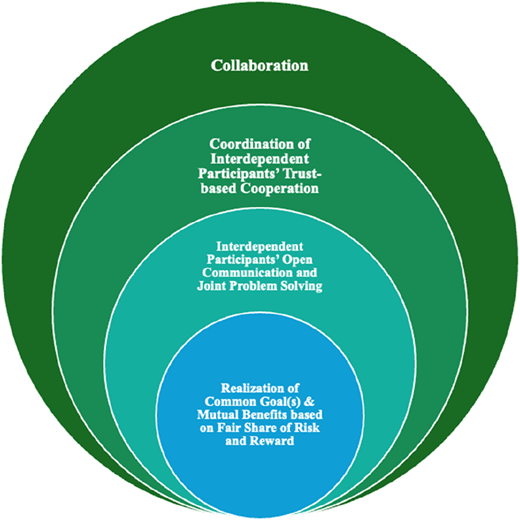
Collaboration in construction projects happens when the realization of common goal(s) and mutual benefit(s) drives coordination of interdependent participants’ trust-based cooperation.
In further details, this theory explains collaboration in construction projects as a phenomenon in which interdependent stakeholders work together with mutual trust, open communication, and a fair share of risk-reward to jointly solve-problems and realize common goals through information, knowledge, and resource sharing (i.e. cooperation), which is enabled by structured facilitation (i.e. coordination). This theory posits that collaboration in construction is a multifaceted process defined by several dimensions. These dimensions are discussed here through the lens of six questions (see Table 3), which every theory is expected to answer as an indication of its validity. The process (What) involves establishing a foundation of mutual trust, open communication, and fair risk-reward sharing that supports effective problem-solving and goal attainment. The underlying purpose (Why) is to enable stakeholders to collectively overcome challenges and achieve shared objectives. The means (How) are realized through cooperation, via the exchange of information, knowledge, and resources, and coordination through structured facilitation of interdependent stakeholders’ joint efforts. The theory further specifies that this collaborative process becomes particularly vital when complex problems arise, or shared resources must be leveraged (When); in environments where interdependent stakeholders converge (Where); and is driven by these very stakeholders (Who). Collectively, these dimensions form a robust theory that systematically addresses the essential questions concerning collaboration in construction.
Finally, Figure 5 provides a visual representation of the developed theory of collaboration in construction.
Discussion
Wrap-up of findings
This study explored the nature of collaboration in construction through a structured methodology that includes a Systematic Literature Review (SLR), thematic and content analysis, Grounded Theory, and abductive reasoning. The findings were organized into three interrelated groups: the characteristics of collaboration in construction, the indicators of those characteristics, and the resultant theory (Deep et al., 2021; Han et al., 2018; Moradi and Klakegg, 2024a, b; Yap and Lim, 2023).
The seven core characteristics of collaboration, mutual trust, open communication, shared risk and reward, joint problem-solving, common goals, cooperation, and coordination, offer a refined and structured lens for understanding and evaluating collaboration in the construction industry. While prior research acknowledges these elements in relation to collaborative project delivery models (e.g. alliance, partnering, lean project delivery), this study advances the field by clearly distinguishing them as separate traits and establishing their measurability. Each factor is treated as an independent yet interconnected aspect of collaborative performance. In addition, this study emphasizes collaboration as a managerial and relational process applicable to various collaborative or traditional project delivery models. It examines the key characteristics and indicators that define collaboration, irrespective of the contractual framework employed. This distinction clarifies that our theory can be applied across different project settings, offering a broader and more transferable foundation for understanding and evaluating collaboration in construction.
A theory must be measurable to support testing, objective application, cross-context comparison, and practical implementation. By operationalizing collaboration through 44 carefully developed indicators, this study provides a more granular understanding of each characteristic. These indicators function not only as analytical tools but also as a bridge between the theory’s core components and the qualitative research approach. Furthermore, they serve as practical diagnostic instruments, enabling project teams to monitor the level of collaboration throughout the project life cycle.
In practice, these indicators can be applied through structured surveys, expert scoring, case studies, or analysis of project documents. They can also aid in developing performance metrics for benchmarking collaboration across different projects or organizations. Future empirical research should test these tools in real-world contexts to assess their usability. In contrast to broader qualitative models, this theory presents a structured, testable framework for real-world application.
A significant contribution of this study lies in addressing the longstanding lack of a unified definition of collaboration theory within the construction sector. The term is often conflated with cooperation or coordination, leading to conceptual ambiguity and inconsistent implementation. This theory resolves that issue by offering a clear and empirically grounded definition of collaboration, articulated through seven core characteristics and their supporting indicators. As such, it provides a shared vocabulary for industry professionals and transforms collaboration from a vague notion into a manageable, assessable, and actionable process, ultimately enhancing stakeholder alignment and improving project outcomes.
Despite the contributions of this research, several limitations remain. The systematic literature review (SLR) utilized a certain number of keywords and Scopus as the database for locating relevant studies. It also restricted the language of research to English. These factors may have limited the identification of additional relevant studies. Additionally, while the 5W1H framework has internally validated the theory, further empirical testing, such as case studies or expert interviews, is required to confirm its external validity across various construction contexts. Future research should further refine the theory and evaluate its relevance across different types of construction projects, regulatory contexts, and collaboration measurement, thereby increasing its generalizability and enhancing its practical impact.
Implications for theory
This study advances the theoretical development of collaboration in construction by providing a structured and comprehensive model based on empirical findings. Utilizing the 5W1H framework, the study defines collaboration through seven core characteristics and supports them with 44 measurable indicators. This integrated approach transcends broad definitions, offering a concrete, testable foundation for future research. The close relationship between characteristics and indicators enhances the theory’s practical relevance and equips researchers with tools to measure collaboration in empirical studies. Consequently, the proposed framework bridges the gap between theory and practice, facilitating more accurate evaluation and modeling of collaborative behavior in construction projects.
Implications for practice
This research has practical implications for real-world construction projects. The developed theory of collaboration, along with its characteristics and indicators, empowers project managers to better understand and manage stakeholders’ collaboration. This enables the identification of areas that require improvement. Furthermore, the results of this study provide a solid foundation for developing a methodology to measure and enhance the level of collaboration in construction projects.
Conclusions
This study discovered characteristics of collaboration in construction and their associated indicators, based on which a theory was developed. Accordingly, the main conclusions of this study regarding collaboration in construction projects are as follows:
Collaboration in construction happens when the realization of common goal(s) and mutual benefit(s) drives coordination of interdependent participants’ trust-based cooperation.
Without common goal(s), mutual benefit(s), and transparency, it is very unlikely to be able to start and continue a constructive collaboration.
Cooperation and coordination are two main components of collaboration.
The core characteristics of collaboration include a common goal, fair distribution of risk and reward, joint problem-solving, cooperation through the sharing of information, knowledge, and resources, mutual trust, open communication, and structured facilitation (coordination).
This research contributes to both theory and practice in construction management by exploring characteristics of collaboration and indicators of those characteristics and developing a theory of collaboration in construction accordingly. However, the literature review was limited by selecting specific keywords and databases, which may have reduced the range of sources consulted. Therefore, readers should consider these limitations when assessing the study’s scope and the generalizability of its findings.
This study did not involve any human participants or animals. No AI-based tools were used for drafting, summarizing, or refining this manuscript.
Appendix
Keywords, search queries, and search results
| Keywords | Database | Advanced query | No. Articles | Out of scope |
|---|---|---|---|---|
| Collaboration in construction | Scopus | TITLE (Collaboration AND in AND construction) AND (LIMIT-TO (EXACTKEYWORD, “Construction Industry”) OR LIMIT-TO (EXACTKEYWORD, “Collaboration”) OR LIMIT-TO (EXACTKEYWORD, “Project Management”) OR LIMIT-TO (EXACTKEYWORD, “Construction Projects”) OR LIMIT-TO (EXACTKEYWORD, “Construction”) OR LIMIT-TO (EXACTKEYWORD, “Construction Management”) OR LIMIT-TO (EXACTKEYWORD, “Lean Construction”)) AND (LIMIT-TO (SUBJAREA, “ENGI”)) AND (LIMIT-TO (DOCTYPE, “ar”)) AND (LIMIT-TO (SRCTYPE, “j”)) AND (LIMIT-TO (LANGUAGE, “English”)) | 54 | 16 |
| Collaborative construction | Scopus | TITLE (collaborative AND construction) AND (LIMIT-TO (EXACTKEYWORD, “Construction Industry”) OR LIMIT-TO (EXACTKEYWORD, “Project Management”) OR LIMIT-TO (EXACTKEYWORD, “Collaborative Construction”) OR LIMIT-TO (EXACTKEYWORD, “Knowledge Management”) OR LIMIT-TO (EXACTKEYWORD, “Collaborative Learning”) OR LIMIT-TO (EXACTKEYWORD, “Collaboration”) OR LIMIT-TO (EXACTKEYWORD, “Construction”) OR LIMIT-TO (EXACTKEYWORD, “Construction Projects”) OR LIMIT-TO (EXACTKEYWORD, “Construction Management”) OR LIMIT-TO (EXACTKEYWORD, “Collaborative Management”)) AND (LIMIT-TO (SUBJAREA, “ENGI”)) AND (LIMIT-TO (DOCTYPE, “ar”)) AND (LIMIT-TO (LANGUAGE, “English”)) AND (LIMIT-TO (SRCTYPE, “j”)) | 102 | 41 |
| Collaborative project delivery | Scopus | TITLE (collaborative AND project AND delivery) AND (LIMIT-TO (EXACTKEYWORD, “Construction Industry”) OR LIMIT-TO (EXACTKEYWORD, “Project Management”) OR LIMIT-TO (EXACTKEYWORD, “Collaborative Construction”) OR LIMIT-TO (EXACTKEYWORD, “Collaboration”) OR LIMIT-TO (EXACTKEYWORD, “Construction”) OR LIMIT-TO (EXACTKEYWORD, “Construction Projects”) OR LIMIT-TO (EXACTKEYWORD, “Construction Management”) OR LIMIT-TO (EXACTKEYWORD, “Civil Engineering”) OR LIMIT-TO (EXACTKEYWORD, “Project Delivery”) OR LIMIT-TO (EXACTKEYWORD, “Project Collaboration”)) AND (LIMIT-TO (SUBJAREA, “ENGI”)) AND (LIMIT-TO (DOCTYPE, “ar”)) AND (LIMIT-TO (SRCTYPE, “j”)) AND (LIMIT-TO (LANGUAGE, “English”)) | 6 | 0 |
| Collaboration indicators | Scopus | TITLE (Collaboration AND indicators) AND (LIMIT-TO (EXACTKEYWORD, “Measurement”) OR LIMIT-TO (EXACTKEYWORD, “Cooperative Behavior”) OR LIMIT-TO (EXACTKEYWORD, “Cooperation”) OR LIMIT-TO (EXACTKEYWORD, “Collaboration”)) AND (LIMIT-TO (SUBJAREA, “ENGI”)) AND (LIMIT-TO (DOCTYPE, “ar”)) AND (LIMIT-TO (LANGUAGE, “English”)) | 1 | 1 |
| Total | 163 | 58 | ||