Socio-economic and political situations in a country significantly impact employment conditions across all sectors, placing employee well-being at risk during challenging times. This study aims to investigate work-related stress, coping strategies and their impact on the well-being of construction professionals in Sri Lanka amidst the ongoing economic crisis.
A questionnaire survey was conducted among professionals employed by builders in major cities in Sri Lanka to assess their contemporary work stressors, mental health status and coping methods. A total of 105 usable responses were collected and analysed using statistical techniques such as t-tests, ANOVA and Pearson correlation.
The study reveals that construction professionals in Sri Lanka experience moderate levels of stress and anxiety, primarily driven by five key stressors: time pressure, long work hours, excessive workload, insufficient pay and work-life imbalance. Among the professionals, technical officers are the most affected, followed by quantity surveyors and project managers. Additionally, employees in larger organisations experience higher levels of stress. Despite severe work stressors and economic challenges, including high inflation, the mental well-being of professionals remains only moderately affected, attributed to their consistent use of positive coping strategies such as spirituality, planful action and positive reappraisal.
The findings have significant practical implications. Construction organisations should adopt tailored strategies to address identified stressors, such as implementing flexible work schedules, optimising workloads and providing adequate pay scales. Policies promoting work-life balance and supporting family and personal time can help foster a healthier work environment. Furthermore, professional development programs focusing on positive coping strategies, such as psychological training and peer support, can mitigate stress. Occupational health and safety authorities should recognise work stress as a critical health issue and integrate its management into regulations, encouraging socially responsible practices.
1. Introduction
The construction industry is a cornerstone of global economic development, contributing significantly to infrastructure, job creation, and national productivity. In Sri Lanka, this sector is particularly vital, accounting for 6–8% of the national GDP and providing employment for 5–6% of the workforce (Jeewananda et al., 2023). However, despite its economic importance, the industry is characterised by high levels of stress among construction professionals, which poses significant risks to their mental health and overall well-being (Zhang et al., 2023; Sarhan et al., 2024). This is further reinforced by statistical evidence from the 2020 global survey of 2,081 construction industry professionals, which reported high levels of mental health challenges. According to the survey, 97% experienced stress, 87% suffered from anxiety, and 70% reported depression within the past 12 months. Additionally, 96% faced fatigue, 95% struggled with poor concentration, 91% felt overwhelmed, and 86% experienced low self-confidence (Gunasekara et al., 2022). These figures highlight the widespread prevalence of mental health issues among construction professionals, emphasising the need for targeted interventions to address occupational stress in the industry.
While much of the research on work-related stress has focused on developed nations, less attention has been paid to the construction industry in developing countries, particularly in Sri Lanka. Studies have shown that stress levels in the construction sector are on the rise globally, driven by rapid urbanisation, increased demand for infrastructure, and socio-economic pressures (Seth et al., 2021). However, the impact of such stressors in the Sri Lankan context remains underexplored, particularly considering the socio-political and economic challenges the country has faced in recent years, including a severe economic crisis and the effects of the COVID-19 pandemic (Weerakoon et al., 2023; Fernando and Gunarathna, 2023). These external factors are likely to exacerbate existing stressors and affect the mental health of construction workers in unique ways, warranting a closer examination.
Prior studies in Sri Lanka have predominantly focused on the economic aspects of the construction industry, such as infrastructure development and labour market trends (Jeewananda et al., 2023; De Silva et al., 2023). However, the psychological well-being of construction professionals has received comparatively less attention. Existing literature has acknowledged the detrimental effects of economic crises on mental health, particularly in developing countries (Matthias and Jayasinghe, 2022). Still, studies on the specific stressors construction professionals face in Sri Lanka during the crises remain sparse. This gap in the literature highlights the need for more focused research on the mental health challenges faced by construction workers in the country, especially under the current economic conditions.
This study seeks to fill this gap by investigating the key work stressors, psychological well-being, and coping strategies among construction professionals in Sri Lanka. The research aims to quantify the prevalence of work-related stressors, assess the mental health outcomes associated with these stressors, and examine the coping mechanisms employed by workers in the face of the socio-economic challenges. Additionally, the study will explore how personal and organisational characteristics—such as occupation, age, and organisational size—affect the relationship between work stress and psychological well-being. By employing a quantitative research design, including a structured questionnaire survey administered to construction professionals, the study will rank stressors and coping strategies and analyse their relationships with mental health outcomes.
The significance of this study lies in its potential to provide valuable insights into the psychological health of construction professionals in Sri Lanka, contributing to the global discourse on work stress in the construction industry. By identifying the specific stressors and coping strategies relevant to Sri Lankan workers, this research aims to inform the development of targeted interventions and strategies to mitigate work-related stress and promote mental health in the sector. Furthermore, the findings will serve as a foundation for future research on the subject, particularly in developing countries with similar socio-economic conditions.
The paper begins with an introduction justifying the purpose of the study. Secondly, the literature review explores workplace stressors, coping mechanisms, and occupational health concerns. Thirdly, the methodology describes the questionnaire survey and statistical analyses conducted. Fourthly, the findings section explains key stressors and variations across job roles. Fifthly, the Discussion analyses these findings, highlighting practical implications, recommending strategies to mitigate work stress and advocating for policy integration to support worker well-being. Finally, the paper concludes by summarising the key contributions and identifying future research directions.
2. Work stress in the construction industry
Work stress in construction is a critical issue due to the industry’s fast-paced, high-risk, and deadline-driven nature. The demand-control-support model (Karasek and Theorell, 1990) suggests that work stress arises when high job demands are not matched with adequate control or support mechanisms. In construction, these stressors are particularly pronounced due to irregular work hours, physically demanding tasks, and job insecurity (Wu et al., 2025; Zhao et al., 2020). Unlike general occupational stress, construction-related stress is characterised by project-based employment, which leads to job instability and financial uncertainty (Manivannan et al., 2022); high-risk working conditions, which increase anxiety and fear of workplace accidents (Dodanwala et al., 2021); and complex stakeholder coordination, which requires effective communication under tight deadlines (Bowen et al., 2021).
Several researchers argue that moderate stress can enhance focus and motivation, aligning with the Yerkes-Dodson Law, which suggests an optimal level of stress improves performance (Bowen et al., 2013). However, prolonged exposure to high-stress levels leads to burnout, mental health issues, and reduced efficiency (Leung et al., 2016). The variability in stress response across different job roles and personal resilience levels highlights the need for further research on individualised coping mechanisms.
2.1 Causes of work stress in construction
The causes of work stress in construction can be categorised into organisational, job-related, and personal factors, each interacting to influence worker well-being.
2.1.1 Organisational factors
The structure and culture of construction organisations play a significant role in work stress. High workloads and unrealistic deadlines are common in the industry, leading to excessive overtime and fatigue (Sethuraman et al., 2021). Contract-based employment creates job insecurity, causing financial instability and chronic stress among workers (Manivannan et al., 2022). Poor leadership and ineffective communication further increase workplace tension, with studies linking authoritarian management styles to heightened stress. In developing countries, these challenges are magnified due to informal employment practices, lack of enforcement of labour laws, and limited access to worker protection mechanisms. For example, in parts of Asia and Africa, casual labourers often face sudden job termination without compensation, increasing financial strain and uncertainty (Ibem et al., 2011).
2.1.2 Job-related factors
Construction workers are exposed to physical and environmental hazards, which increase anxiety and fear of workplace accidents (Saikala and Selvarani, 2015). Many projects involve working at heights, using heavy machinery, and handling hazardous materials, making safety concerns a persistent stressor. Additionally, the adoption of new technologies—while aimed at improving efficiency—has created stress among workers unfamiliar with digital tools and automation (Oladinrin et al., 2014). Another key stressor is regulatory compliance pressure, as construction professionals must adhere to evolving safety and environmental regulations, increasing their administrative workload (Bowen et al., 2021). In developing nations, the lack of stringent enforcement of safety regulations means that workers often operate under unsafe conditions, contributing to higher accident rates and stress levels (Jung et al., 2020).
2.1.3 Personal factors
Work-life imbalance is a critical issue in construction, as irregular schedules and site-based work requirements limit personal and family time (Leung et al., 2015). Stress responses also vary based on psychological resilience, with emotionally resilient workers exhibiting better stress management than others (Amankwah et al., 2015). Additionally, workers with strong social support networks, whether from colleagues or family, report lower stress levels (Priya et al., 2023). However, in low-income settings, particularly in developing countries, workers often migrate to cities for employment, leaving behind social support structures and increasing feelings of isolation and stress.
2.2 Effects of work stress
Hampton et al. (2019) classified the impacts of work stress into several clusters, including consequences for physical status, interpersonal relationships, work performance, emotional well-being, and clinical disorders. Bowen et al. (2021) studied the effects under three main categories: physiological, psychological, and sociological. Ibem et al. (2011) also identified economic consequences.
2.2.1 Physical and psychological health impacts
Chronic work stress in construction leads to severe psychological and physical health issues. Anxiety and depression are prevalent among construction workers, with studies confirming that occupational stress significantly contributes to mental health disorders (De Silva et al., 2017; Dodanwala et al., 2021). Sleep disorders and chronic fatigue are also common due to long hours and demanding schedules (Bowen et al., 2013). A range of negative effects were reported by other researchers too, including heart disease, high blood pressure, increased use of alcohol and drugs, memory loss and confusion, digestive problems, feelings of powerlessness, frequent sickness, headaches, depression, anxiety, and impact on family and personal relationships (De Silva et al., 2017; Hampton et al., 2019; Wu et al., 2025).
Despite the known health risks, many workers, particularly in developing countries, lack access to mental health services or workplace wellness programs. Stigma around mental health in some cultures also prevents workers from seeking professional help, worsening their conditions (Sethuraman et al., 2021).
2.2.2 Impact on work performance
Work stress has a direct impact on workplace safety, with stressed workers more prone to accidents due to impaired decision-making and decreased attention (Jung et al., 2020). High stress levels also lead to reduced safety compliance, as overworked employees may take shortcuts to meet deadlines, increasing the likelihood of workplace injuries (Sethuraman et al., 2021).
The relationship between stress and performance remains debated. Some research suggests that experienced workers develop coping strategies that mitigate stress-related performance decline (Hampton et al., 2019). However, other studies indicate that chronic stress consistently reduces efficiency, regardless of experience (Leung et al., 2016). However, Bowen et al. (2021) argued that work satisfaction, and abilities to setting goals and priorities can be affected by chronic work stress. Work stress can cause frequent mistakes, reduced attention, diminished interest in work, and impact on family and personal life (De Silva et al., 2017; Hampton et al., 2019; Wu et al., 2025). Interpersonal relationships in the workplace can be affected by conflict with teams and supervisors (Bowen et al., 2021).
2.2.3 Economic and organisational consequences
High-stress levels contribute to employee turnover, increasing recruitment and training costs for construction firms (Ibem et al., 2011). In addition, stress-induced absenteeism and reduced productivity create financial losses for businesses, though empirical data on the exact economic impact remains limited (Bowen et al., 2013). Developing countries face additional economic pressures, as labour shortages and high attrition rates disrupt project timelines and increase costs. Many construction firms in these regions lack formal employee support programs, making stress-related turnover an even more significant challenge (Manivannan et al., 2022).
2.3 Stress management strategies
Strategies to manage work stress should occur at both individual and organisational levels.
2.3.1 Individual coping mechanisms
Individuals adopt positive and/or negative coping methods to manage stressful circumstances. While positive coping helps curtail the negative consequences of stress, negative coping aggravates it.
Common positive coping strategies include engaging in physical activities such as leisure pursuits, rest, exercise, yoga, and mindfulness practices. Psychological approaches like problem-solving, positive reappraisal, meditation, and discussions that encourage thought-sharing and self-reflection also help alleviate stress (Amankwah et al., 2015). Social coping mechanisms, including peer support, mentorship, and strong family interactions, are crucial in managing workplace stress (Priya et al., 2023). Sethuraman et al. (2021) found that construction professionals often struggle to balance work and family life, leading to strained relationships. They suggested that reducing stress could be achieved by prioritising quality time with family through shared daily activities, social gatherings, and recreational outings. Priya et al. (2023) supported this by recommending work-life balance (WLB) practices, such as flexible work arrangements and designated personal time, to improve well-being. Additionally, cognitive coping strategies such as problem-solving and positive reappraisal—where individuals reframe challenges as opportunities for growth—can help professionals manage stress more effectively. Spirituality and religious practices, including prayer and meditation, provide emotional support and resilience, particularly in difficult times. However, WLB initiatives remain underdeveloped in many developing countries and face implementation challenges without supportive workplace policies and structures (Dodanwala et al., 2021).
One prevalent negative coping behaviour in the construction industry is substance abuse, particularly excessive alcohol consumption and smoking, which are often used as temporary stress relief mechanisms but contribute to long-term health issues (Bowen et al., 2013). Studies have also highlighted the growing concern about stimulant and drug use to cope with fatigue and workload pressures, especially among workers engaged in night shifts or high-intensity projects (Flannery et al., 2019). Additionally, avoidance coping, where individuals ignore or deny stressors rather than addressing them, has been linked to increased psychological distress and burnout (Leung et al., 2015). Construction professionals experiencing chronic stress may also exhibit aggressive behaviour or withdrawal from social interactions, negatively impacting teamwork and workplace relationships (Sethuraman et al., 2021). These negative coping mechanisms not only deteriorate workers' mental and physical health but also increase safety risks and reduce overall job performance.
2.3.2 Organisational interventions
Workplace initiatives like mental health programs, stress management workshops, and employer-supported counselling services improve employee well-being. Anandh and Gunasekaran (2018) suggested that organisations should offer training and awareness programs to reduce occupational stress. These programs could educate employees on identifying stressors, understanding their consequences, and implementing preventive measures while promoting stress reduction techniques such as family and organisational unit meetings. Sethuraman et al. (2021) also stressed that mental health awareness programs are another essential intervention, though they remain largely absent in many construction firms, particularly in developing countries. Dodanwala et al. (2021) noted that most human resource training programs in the Sri Lankan construction industry focus primarily on project outcomes and basic performance factors; however, they should also incorporate conflict resolution and stress management strategies to create a more supportive workplace. Amankwah et al. (2015) recommended providing employees with greater autonomy, clear responsibilities, increased remuneration, addressing staff shortages, and conducting stress management programs as key strategies to mitigate workplace stress. Moreover, employers can reduce workplace stress by implementing flexible work arrangements, such as remote work options and staggered shifts, which improve work-life balance (Anandh and Gunasekaran, 2018).
2.4 Research gaps
Despite growing research on work stress in construction, several gaps remain unaddressed in developing countries, particularly in the context of the Sri Lankan construction industry. The literature identifies various work stressors, their effects, and coping strategies. However, the prevalence and nature of these stressors vary across countries, influenced by socio-cultural and economic factors and industry norms. Understanding the specific conditions of the Sri Lankan construction industry is essential for developing targeted measures to mitigate work stress and its negative impact on individuals and organisations. Furthermore, recent events like the pandemic and economic crisis may have altered work stressors and intensified stress levels. Comprehending these dynamic patterns is crucial for developing sustainable prevention and control measures. Finally, research should investigate intersectionality in work stress, considering factors such as gender, organisation size, and job roles, particularly in developing countries where worker experiences may differ significantly. Addressing these gaps will enable the construction industry, policymakers, and employers in Sri Lanka to develop more effective strategies for mitigating work stress and improving worker well-being.
3. Research method
3.1 Research approach
This study aimed to assess the significance of identified work stressors, measure their mental health impacts, and examine the relationships between work stressors, coping mechanisms, and mental health outcomes in the construction industry. Establishing relationships between variables requires systematic data collection, analysis, and interpretation. Given this need, a quantitative research approach was adopted, as it enables objective measurement and statistical analysis of stressors and coping mechanisms. Prior studies on similar topics have also relied on quantitative methods to analyse stress factors and coping strategies among construction professionals (Zhang et al., 2023; Priya et al., 2023; Manivannan et al., 2022; Jung et al., 2020). A quantitative approach is particularly valuable in the construction sector, where structured surveys and statistical models allow for a comprehensive analysis of work stressor patterns and trends across different demographics, job roles, and organisational contexts.
3.2 Data collection method
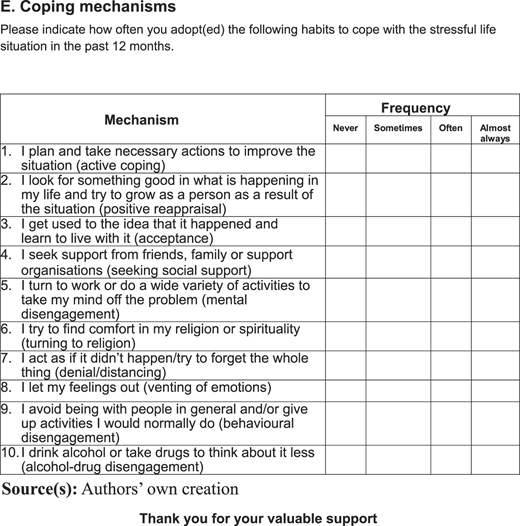
A questionnaire survey was employed to collect primary data from professionals in the Sri Lankan construction industry, including project managers, engineers, quantity surveyors, and technical officers. The questionnaire was developed based on insights from the literature review and was structured into five sections:
- (1)
Background information – Collected demographic and professional details.
- (2)
Perceived job stressors – Assessed stressors related to workplace conditions.
- (3)
Personal life stressors – Evaluated non-work-related stress factors.
- (4)
Stress coping methods – Examined strategies used to manage stress.
- (5)
Mental well-being assessment – Measured mental well-being using the Depression, Anxiety, and Stress Scale (DASS-8) that Ali et al. (2022) developed.
Except for background information, responses were recorded using a four-point Likert scale ranging from “never” to “almost always,” with numerical values assigned as follows: 0 = never, 1 = sometimes, 2 = often, and 3 = almost always. This approach has been widely utilised in similar studies (Zhang et al., 2023; Kamardeen, 2022; Sunindijo and Kamardeen, 2017; Kamardeen and Sunindijo, 2017). A copy of the questionnaire is provided in the Appendix.
3.3 Sample selection and survey administration
Determining an appropriate sample size is crucial for ensuring the validity and reliability of study findings. Louanglath (2017) recommend minimum sample size of 30–200 for social science research that collects Likert scale responses. Bartlett et al. (2001) proposed the following formula for determining the minimum sample size:
where: n = sample size; t = value for selected alpha level of 0.025 in each tail (1.96); s = estimated variance deviation of the scale; and d = acceptable margin of error.
This study's alpha level was set at 0.05 (5% margin of error). Using a four-point scale with a midpoint of 1.50, the estimated variance deviation was calculated as 1.0. Applying the formula, the minimum required sample size was determined to be 96 participants.
The survey targeted Sri Lanka’s construction industry professionals, ensuring inclusivity across age, experience, and gender. Bowen et al. (2021) claimed that construction professionals who work in construction organisations experience unfavourable psychological status and more work stress than those who work for consultancy organisations. Therefore, data collection occurred from April to July 2024, focusing on construction organisations in major cities such as Colombo, Kandy, Ampara, and Batticaloa. These cities were selected based on their economic significance, high construction activity, workforce size, and diversity of projects. Prior research indicates that work stress varies significantly based on urban environments, job intensity, and economic pressures (Zhang et al., 2023; Priya et al., 2023).
Ten large construction projects were selected to provide a diverse and representative sample of professionals, including employees from subcontractors and main contractors. Since the construction professionals are mainly project-based, it was decided to collect data by visiting project sites. After seeking permission from the organisation, the researcher distributed hard copies of the questionnaire. A purposive sampling technique was used to select participants actively working on the selected projects, ensuring that the study focused on individuals with direct experience of work-related stress. The questionnaire collection process involved revisiting the sites to retrieve completed surveys. This method ensured a high response rate while allowing for clarifications if needed. Respondents were instructed not to include personal identifiers on the survey forms to ensure anonymity and confidentiality. Although participants were known to the researcher at the time of distribution, responses were collected anonymously and stored securely, ensuring compliance with ethical research standards. This process aligns with anonymity practices in interview-based research, where participant identities may be known, but responses remain confidential. A total of 108 professionals participated in the survey. However, three responses were incomplete and excluded, resulting in a final dataset of 105 valid responses—exceeding the required minimum sample size.
3.4 Bias mitigation and data reliability
To address potential bias in manual data collection, ensure reliability, and maintain confidentiality, several measures were taken. Permission was obtained from construction firms to distribute surveys at project sites, ensuring accessibility to relevant participants. The questionnaire was carefully designed with clear, neutral, and structured questions to minimise response bias. Participation was entirely voluntary, with anonymity and confidentiality guaranteed to encourage honest responses. Surveys were manually distributed and collected to verify participant eligibility and maximise response rates. Finally, findings were triangulated with previous research to validate trends and identify discrepancies, enhancing the study’s overall credibility.
3.5 Participant profile
Table 1 presents the demographic and professional characteristics of survey participants. Quantity surveyors constituted the largest group (38%), followed by technical officers (25%). Nearly half of the respondents had 1–5 years of experience, with professionals having less than one year and 6–10 years of experience equally represented (one-fifth each). The construction industry’s male dominance was reflected in the sample, with female participants comprising only 11%. The majority of participants (86%) were aged 21–40, and over half worked in large organisations with more than 200 employees. Notably, 90% were from the private sector. A concerning trend was observed in work hours, as nearly two-thirds of respondents reported working all seven days, with almost half working 51–60 h per week and 13% exceeding 61 h per week—raising significant concerns about work-life balance and well-being in Sri Lanka’s construction industry.
3.6 Data analysis techniques
To analyse the collected data, multiple statistical techniques were employed:
- (1)
Mean and standard deviation: These measures of central tendency and dispersion are fundamental for summarising and understanding the data distribution related to stressors, coping methods, and psychological conditions. They provide insights into the average trends and variability within the sample (Field, 2018).
- (2)
One-sample t-test: This technique is appropriate for comparing the sample's central tendency against a fixed mean value to determine whether the observed sample mean significantly differs from the benchmark (Pallant, 2020). This comparison helps contextualise the stressor levels and psychological conditions against expected or theoretical norms.
- (3)
One-way ANOVA: This technique is well-suited for analysing variations in experiences of stressors, coping strategies, and psychological conditions based on differing personal and organisational characteristics (e.g. age, role, or company type). ANOVA identifies statistically significant differences across multiple groups, enhancing the understanding of subgroup dynamics within the sample (Howell, 2012).
- (4)
Correlation analysis: Examining psychological health through correlation is justified as it identifies the strength and direction of relationships between variables, such as stressors, coping methods, and mental health outcomes. This approach is commonly used in psychological research to understand interdependencies (Tabachnick and Fidell, 2019).
4. Findings
This study extends existing research on work stress among Sri Lankan construction professionals by statistically evaluating the significant work stressors, personal stressors, coping mechanisms, and their relationships with mental health outcomes. Prior research in Sri Lanka, such as Senaratne and Rasagopalasingham (2016), De Silva et al., (2017), Dodanwala et al. (2021) and Hemachandra and Thayaparan (2022), primarily identified broad stress factors at an organisational level, focusing on management interventions to reduce stress. However, this study provides a more comprehensive and data-driven analysis by incorporating:
- (1)
Statistical validation of key stressors through hypothesis testing.
- (2)
Personal stressors that influence work-related stress.
- (3)
Individual coping strategies and their effectiveness.
- (4)
Occupational and organisational differences in stress levels through ANOVA tests.
- (5)
Correlation between stressors, coping strategies, and psychological distress.
These new contributions provide evidence-based insights for Sri Lankan construction stakeholders to develop more targeted interventions for stress management.
4.1 Work stressors
Descriptive statistics were calculated to analyse the central tendency of the data related to work stressors among construction professionals. Subsequently, a one-sample t-test was performed to determine whether the mean values of stressors significantly differed from a hypothesised population mean value of 1.5, representing the midpoint of the Likert scale used in the survey. Table 2 presents the results, with stressors ranked according to their mean values. Unlike previous Sri Lankan studies that qualitatively identified broad work stressors, this research quantifies the significance of each stressor and its impact on construction professionals. The findings confirm that:
- (1)
The top four work stressors with mean ratings exceeding 1.5 were high time pressure, long workdays/weeks, excessive workload, and insufficient pay, which are the most significant stressors.
- (2)
Only high time pressure and long workdays/weeks were statistically significant (p < 0.05), reinforcing the critical role of work schedules in stress development.
These findings build on international literature that highlights overwork as a dominant stress factor in construction (Bowen et al., 2021) while adding new insights specific to Sri Lanka’s construction sector. Insufficient pay as a key stressor also reflects economic challenges and wage structures in developing economies.
4.2 Personal stressors
Although previous research in Sri Lanka has focused primarily on organisational work stressors, this study integrates personal stressors into the analysis. Table 3 presents the t-test results for personal stressors interfacing with work stressors among construction professionals in Sri Lanka. The findings indicate that:
- (1)
Of the six personal stressors analysed, only one stressor exceeded the Likert scale midpoint of 1.5, but it was not statistically significant (p > 0.05).
- (2)
Work-life balance remains a significant concern, aligning with broader research on the impact of long work hours on family life in construction.
This study uniquely identifies how personal factors intersect with work stress in Sri Lanka. Notably, the top-ranked personal stressor aligns with the top three work stressors, highlighting work-life balance challenges faced by construction professionals in Sri Lanka. The presence of family-related stress suggests that interventions must go beyond workplace adjustments and consider broader work-life policies.
4.3 Coping methods
A significant contribution of this study is the detailed examination of individual coping mechanisms. Unlike past Sri Lankan research that emphasised organisational solutions, this study evaluates positive and negative individual coping strategies. The findings (Table 4) indicate that:
- (1)
The most frequently used coping strategies are spirituality (seeking comfort in faith/religion), familiarity (to get used to the situation), planful action (strategic problem-solving), and positive reappraisal (reframing challenges optimistically).
- (2)
Spirituality emerged as the top coping strategy, reflecting cultural influences unique to Sri Lanka.
- (3)
Negative coping methods, such as alcohol use and social withdrawal, were reported but with lower frequency.
These findings provide a new perspective by emphasising individual resilience strategies. In contrast, studies in Western countries tend to highlight counselling and employer-driven interventions, suggesting that Sri Lankan professionals rely more on personal and cultural mechanisms for managing stress.
4.4 Psychological health of construction professionals
The psychological health of construction professionals in Sri Lanka was evaluated using the DASS-8 scale, which comprises eight indicators: two measuring stress, three assessing anxiety, and three gauging depression. The scale also provides severity level thresholds for stress, anxiety, and depression based on the ratings. Table 5 presents the mean ratings for stress, anxiety, and depression among construction professionals in Sri Lanka, along with the corresponding severity ranges as per the DASS-8 scale (Ali et al., 2022). This study contributes new evidence on mental health outcomes in Sri Lanka’s construction sector.
- (1)
Moderate levels of stress and anxiety were observed among construction professionals.
- (2)
Depression levels were at the upper-normal range, suggesting hidden mental health risks among them.
This study is one of the first in Sri Lanka to quantitatively assess mental health severity levels in construction professionals. Previous research focused primarily on stressors without assessing psychological consequences. The results highlight the urgent need for mental health support programs in the Sri Lankan construction industry.
4.5 Individual and organisational variations in stress levels
Previous studies on work stress delineated that stress experiences differ from one person to another based on gender, age, occupation, work arrangement, and industry (Bowen et al., 2021). Therefore, One-Way ANOVA tests were conducted to determine whether statistically significant differences exist in psychological symptoms across various occupations and organisational sizes among construction professionals in Sri Lanka. Table 6 presents the results, highlighting any variations in stress, anxiety, and depression levels among the surveyed groups.
The one-way ANOVA results provide novel insights by evaluating stress variations across different occupations, organisational sizes, and age groups:
- (1)
Technical officers experience significantly higher anxiety and depression levels compared to engineers and project managers.
- (2)
Project managers report the highest stress levels, likely due to decision-making pressures.
- (3)
Employees in large organisations experience the highest stress and anxiety levels, reflecting higher job demands and corporate pressure.
- (4)
Professionals aged 31–40 report the highest levels of stress, anxiety, and depression, possibly due to work-life balance struggles and career advancement pressures.
These findings expand previous research by highlighting job-specific and organisational differences in stress experiences. This evidence suggests that stress management strategies should be tailored based on job role and organisational context rather than a one-size-fits-all approach.
4.6 Correlation analysis
Correlation analysis was performed to identify the work stressors, personal stressors and coping methods significantly associated with the mental health outcomes of construction professionals in Sri Lanka. The results are shown in Table 7. This study provides a more nuanced understanding of the relationships that:
- (1)
Work stressors such as excessive workload, high time pressure, long work hours, poor work environment and skill-task mismatch have statistically significantly positive correlation with stress, anxiety, and depression.
- (2)
Personal stressors (lack of family time, poorly functioning home environment) also contribute to psychological distress.
- (3)
Positive coping strategies such as planful action and spirituality have a protective effect, reducing mental health symptoms.
- (4)
Negative coping strategies (alcohol use, social withdrawal) are positively correlated with stress, anxiety, and depression, exacerbating mental health issues.
These findings go beyond previous research in Sri Lanka, which primarily focused on organisational factors, by demonstrating how individual coping behaviours impact mental health outcomes.
4.7 Linking ANOVA and correlation results
The ANOVA analysis reveals that technical officers experience significantly higher levels of anxiety and depression compared to engineers, quantity surveyors, and project managers (p < 0.05). Correlation analysis highlights that factors such as excessive workload, high time pressure, long workdays/weeks, task-skill mismatch, job insecurity, and poor work environments have statistically significant positive correlations with anxiety and depression. Integrating ANOVA and correlation findings can offer a deeper understanding of why certain professionals are more vulnerable to stress-related disorders.
- (1)
Technical officers report the highest levels of anxiety and depression, likely due to exposure to high workloads, long work hours, and job insecurity.
- (2)
Project managers experience the highest stress levels, reflecting high-pressure decision-making.
- (3)
Large organisational structures contribute to increased stress and anxiety, suggesting that corporate policies may need to be revised to address mental health concerns.
- (4)
Younger professionals (aged 31–40) face the greatest psychological distress, likely due to work-family conflicts and career pressure.
- (5)
Technical officers and young professionals may underutilise adaptive coping strategies like planful problem-solving while being more inclined toward maladaptive behaviours such as alcohol/drug intake and social withdrawal, exacerbating their vulnerability to anxiety and depression.
5. Discussion and theoretical contributions
This study examined work stressors, coping mechanisms, and psychological well-being among Sri Lankan construction professionals. It extends existing research by integrating occupational stress variations, coping mechanisms, and mental health outcomes using a systematic, quantitative approach. Prior Sri Lankan studies have primarily focused on organisational interventions for stress reduction (Senaratne and Rasagopalasingham, 2016; De Silva et al., 2017; Dodanwala et al., 2021; Hemachandra and Thayaparan, 2022), whereas this study uniquely highlights the interplay between work-related and personal stressors, the role of individual coping strategies, and their impact on psychological well-being. Moreover, this study quantitatively assessed stressor and mental health severity levels with a large dataset, while previous studies were qualitative with limited respondents.
5.1 Theoretical contributions
This research makes significant theoretical contributions to the fields of occupational stress, construction management, and work-life balance theory.
5.1.1 Advancing theoretical models of work stress in construction
Existing work stress models (e.g. Karasek, 1979; Siegrist, 1996) emphasise workload, job control, and support as primary stress determinants. However, this study reveals that economic and personal life stressors (e.g. financial strain and a lack of family time) are equally critical in the context of a developing economy. While models like the Person-Environment Fit Theory (French et al., 1982) suggest that stress arises when job demands exceed individual capabilities, this study finds that job conditions, salary concerns, and organisational size also significantly influence stress levels, extending the applicability of stress theories to emerging economies.
Figure 1 illustrates a new high-level stress model, integrating insights from existing stress theories and findings from this study. The model posits that job strain arises from four interconnected stress factors: high job demands, insufficient job resources to meet those demands, mismatched job rewards, and unfavourable socio-economic conditions. Effective coping strategies help mitigate strain, whereas maladaptive coping can exacerbate stress, leading to poor psychological health.
5.1.2 Integrating work and personal stressors in construction stress research
Traditional construction stress research focuses on workplace stressors (Bowen et al., 2021; Sunindijo and Kamardeen, 2017). This study expands the theoretical scope by demonstrating that personal life stressors, such as family conflicts and poor home environments, significantly correlate with anxiety and depression. This supports and extends work-life conflict theories (Greenhaus and Beutell, 1985) by showing how construction professionals in Sri Lanka struggle with work-life balance due to extreme job demands and financial pressures.
Furthermore, while studies in Western contexts emphasise employer-led well-being programs, this study finds that Sri Lankan professionals rely on personal coping mechanisms (e.g. spirituality, problem-solving), with limited formal workplace support. This calls for an expansion of Stress Management Theory (Lazarus and Folkman, 1984) to include cultural and socio-economic factors influencing coping strategy selection.
5.1.3 Occupational and organisational variations in stress responses
This study is among the first in Sri Lanka to quantitatively assess stress variation across different construction occupations and organisational sizes. It builds on role stress theories (Kahn et al., 1964) by demonstrating that technical officers experience significantly higher levels of anxiety and depression than engineers or managers, likely due to high job demands and limited autonomy. This challenges the conventional wisdom that higher-ranking professionals face greater stress (Jung et al., 2020), suggesting that stress intensity may be more role-dependent than hierarchy-dependent in construction work environments.
Moreover, the finding that employees in larger construction firms report higher stress and anxiety contradicts research from developed economies, where larger firms tend to provide better support structures (Bowen et al., 2021). This suggests that organisational size alone is not a protective factor unless accompanied by adequate well-being initiatives, refining theories on workplace stressors.
5.1.4 Cultural dimensions of coping strategies
Most coping theories assume rational, problem-focused strategies as the most effective (Lazarus and Folkman, 1984). However, this study shows that Sri Lankan construction professionals rely heavily on spirituality as a primary coping mechanism, a finding consistent with cultural stress adaptation theories (Ahmed et al., 2022). Unlike Western settings, where cognitive behavioural approaches dominate, spirituality serves as a resilience factor in South Asian work cultures. This highlights the need for culturally responsive stress management models that incorporate non-Western coping paradigms.
Additionally, the study finds that alcohol use and social withdrawal are linked to higher stress, anxiety, and depression, reinforcing global research on maladaptive coping. However, the stronger association of alcohol use with stress in Sri Lanka suggests that in developing economies, where formal stress interventions are scarce, professionals may turn to socially accepted but harmful coping mechanisms. This insight contributes to addiction and workplace stress theories by illustrating how occupational cultures shape coping behaviour.
5.2 Practical implications for the construction industry
These theoretical contributions translate into critical industry-wide implications:
- (1)
Redefining stress intervention strategies – Sri Lankan firms must expand beyond workplace-focused stress interventions to include personal stress factors and economic pressures in their well-being programs.
- (2)
Role-specific stress management – Since technical officers face higher anxiety and depression, customised mental health support for mid-level professionals is essential.
- (3)
Culturally appropriate stress relief programs – Given the high reliance on spirituality, construction firms can integrate mindfulness and faith-based wellness initiatives alongside standard stress management training.
- (4)
Work-life integration policies – Organisations should address family-related stressors through flexible work arrangements, childcare support, and workload redistribution to mitigate work-life imbalance.
- (5)
Interventions for maladaptive coping – Employers should reduce reliance on harmful stress relief behaviours (e.g. alcohol use) by offering structured wellness programs and promoting healthy social coping mechanisms.
6. Conclusions
Sri Lanka has been facing its worst economic crisis since 2019, severely impacting the construction industry's operations. Several interconnected events, including the Easter bomb attacks, the COVID-19 pandemic, and the country's ongoing economic and political instability, have exacerbated the psychological health challenges faced by construction professionals. This study investigated the current state of work stressors, coping strategies, and their relationship with well-being among construction professionals in Sri Lanka amidst these crises.
The study identifies five key stressors: time pressure, long working hours, excessive workload, insufficient pay, and poor work-life balance. Notably, it highlights work-life balance as a significant stressor for Sri Lankan construction professionals—an issue not emphasised in previous studies. The findings reveal that technical officers experience the highest levels of anxiety and depression among the professions studied. Despite these challenges, professionals predominantly adopt four positive coping strategies: spirituality, familiarity, planful action, and positive reappraisal, to mitigate the long-term impacts on their health and well-being.
The findings provide valuable insights for individuals, construction organisations, and occupational health and safety (OHS) authorities to maintain a healthy workforce. Professionals should engage in physical and leisure activities, rest, psychological training, and peer support for stress management. Organisations should optimise workloads, allow more flexible work hours, limit weekly working hours to a maximum of 40, improve pay, address staff shortages, and provide stress management programs. Hosting family events and offering family-oriented benefits could also reduce stress. OHS authorities should include work stress in regulations as a critical health and safety hazard and ensure organisations adopt socially responsible practices.
6.1 Limitations and future directions
While this study provides valuable insights into the work stressors, coping mechanisms, and psychological health of construction professionals in Sri Lanka, several limitations must be acknowledged.
First, the study primarily relied on self-reported survey data, which is susceptible to social desirability bias and recall bias. Participants may have underreported or overreported stress levels and coping behaviours based on their perceptions or willingness to disclose personal struggles. Future research could complement self-reports with objective measures, such as physiological stress indicators (e.g. heart rate variability, cortisol levels) or structured clinical assessments to validate psychological well-being outcomes.
Second, the research adopted a cross-sectional design, capturing data at a single point in time. This limits the ability to establish causal relationships between work stressors, coping mechanisms, and mental health outcomes. Longitudinal studies tracking stress and coping patterns over time would provide a more robust understanding of how stressors evolve and how professionals adapt their coping strategies in response to industry challenges.
Third, the study focused exclusively on construction professionals working in large-scale projects within selected urban locations. This limits generalisability to professionals in small and medium-sized enterprises (SMEs), rural areas, and informal construction sectors, where working conditions, stressors, and coping resources may differ significantly. Future research should explore stress dynamics across different project scales, geographic regions, and employment types to capture a more comprehensive picture of occupational stress in Sri Lanka’s construction industry.
Fourth, while the study explored individual coping mechanisms, it did not examine in detail the role of organisational support systems, such as employer-provided mental health programs, work flexibility policies, or industry-wide stress management initiatives. Future research should investigate how organisational interventions and leadership practices influence stress management and whether they mitigate or exacerbate psychological distress among professionals.
Finally, the study did not consider gender-specific or cultural influences in depth. The construction industry in Sri Lanka remains male-dominated, and stress experiences may vary based on gendered workplace expectations, discrimination, or differential access to coping resources. Future research should incorporate intersectional analyses, examining how factors such as gender, ethnicity, socio-economic status, and family responsibilities interact with work stress and mental health outcomes.
Addressing these limitations through more diverse samples, mixed-method approaches, and longitudinal research designs will contribute to a more comprehensive and actionable understanding of occupational stress in Sri Lanka’s construction sector.
This study received research ethics approval from the Research Ethics Committee of the Faculty of Arts and Culture, South Eastern University of Sri Lanka (No: FAC/R/2024/003).
References
Appendix