This study aims to investigate how globally identified construction delay factors can be translated into a framework that accurately reflects Australian project conditions. It aims to develop a validated set of delay risks by integrating systematic evidence synthesis with expert elicitation and optimisation-based consensus analysis.
A systematic literature review consolidated 103 global delay factors, refined to 55 using a relevance-based filtering approach. Semi-structured interviews with senior Australian practitioners were conducted to assess contextual severity. Inter-rater agreement was measured using Kendall's Coefficient of Concordance (W), and a Genetic Algorithm (GA) was applied to optimise expert weighting and maximise consensus reliability, producing a statistically robust prioritisation.
The optimisation process achieved strong expert agreement and generated a refined set of delay risks tailored to Australian project conditions. The most influential delays stem from governance and design-related issues, including late owner decisions, documentation delays, unclear drawings, and coordination challenges, alongside labour constraints and subcontractor performance. Cross-validation and triangulation with recent Australian studies confirmed the stability and contextual relevance of the final framework.
The 22-factor framework provides practitioners with a clear basis for identifying and prioritising delay risks within Australian projects. By guiding planning and design decisions, it helps reduce schedule uncertainty and improve the predictability of project delivery.
This research advances construction risk analysis by introducing an optimisation-enhanced localisation method that integrates global evidence, expert judgement, and evolutionary algorithms to produce a validated delay risk framework for Australia. The combined use of GA-based expert weighting and Kendall's W strengthens consensus reliability and offers a transparent methodological innovation to the field.
1. Introduction
The construction industry plays a pivotal role in driving economic growth and enabling social development by delivering the infrastructure and built environments that support modern societies (Cucoş and Ţurcan, 2025). Yet, despite its significance, the sector continues to face chronic performance challenges, with project delays standing out as one of the most persistent and costly. Schedule overruns frequently lead to substantial financial losses, contractual disputes, reputational damage, and diminished stakeholder confidence (Fauzan et al., 2025; Ogunmakinde et al., 2025). Over the past 2 decades, researchers have sought to address this issue by identifying and analysing the causes of delays across a variety of project types, including residential, commercial, infrastructure, and transportation developments (Chidambaram et al., 2012; Derakhshanfar et al., 2021; Shah, 2016). These studies have produced extensive lists of risk factors, such as contractor performance, payment delays, design changes, and approval bottlenecks, that contribute to time overruns and project underperformance (Al-Kilidar and Hasib, 2021).
Despite this growing body of research, the existing literature remains highly fragmented and predominantly context-specific, with most studies focussed on single countries, project types, or procurement settings (Fashina et al., 2021; Khan and Gul, 2017; Muneeswaran et al., 2020; Rauzana and Dharma, 2022; Salem and Suleiman, 2020). Consequently, the transferability of global knowledge into different regional contexts is often limited. Risk factors that are critical in one setting may not manifest with the same frequency, severity, or interaction effects in another. Understanding how globally recognised delay causes translate into specific industry contexts, and how their relative importance changes when assessed locally remains underexplored (Al Saeedi and Karim, 2022; Ghafoor et al., 2025; Purushothaman et al., 2024; Tafazzoli and Shrestha, 2017).
This gap is particularly evident in the Australian construction industry, which has received comparatively limited attention in global delay research. Australia's industry is shaped by a unique combination of factors, including a highly regulated procurement environment, complex subcontracting structures, and distinctive project delivery models (Al-Kilidar and Hasib, 2021; Kabirifar et al., 2021; Zagia et al., 2023). These contextual characteristics influence both the prevalence and impact of delay risks, underscoring the need for a localised framework rather than reliance on global typologies. However, few studies have systematically adapted international evidence to the Australian context or assessed how expert perceptions of delay risk vary within this environment.
To address this limitation, the present study adopts an expert-elicitation approach enhanced by a Genetic Algorithm (GA) to localise global construction delay risk factors to the Australian context. The GA was incorporated to optimise the selection and weighting of expert inputs, thereby maximising the internal consistency of the dataset (Motamedi Sedeh et al., 2021). Using Kendall's Coefficient of Concordance (W) as the optimisation criterion, the approach ensures a more reliable and representative synthesis of expert opinions. This methodological innovation strengthens the robustness of consensus measurement without altering the qualitative nature of expert judgement. Specifically, the research pursues three objectives:
To synthesise and refine a comprehensive set of delay risk factors from the international literature.
To validate and contextualise these risks through semi-structured interviews with senior Australian construction professionals.
To quantify expert consensus and prioritise the most locally material risks using Kendall's W and GA-based optimisation.
Theoretically, this study advances the literature on construction delays by demonstrating how global risk evidence can be translated into a robust, context-specific framework. Practically, it delivers a prioritised set of delay risk factors tailored to the Australian construction environment, equipping project managers, policymakers, and contractors with more precise tools for risk identification, prioritisation, and mitigation. The remainder of this paper is structured as follows: Section 2 reviews the literature, Section 3 details the methodology, Section 4 presents results and validation, followed by discussion (Section 5) and conclusions (Section 6).
2. Literature review
2.1 Global research on construction delay factors
Construction project delays remain a major challenge for the global construction industry, reflecting the growing complexity of projects and the interaction of managerial, technical, financial, and environmental factors (Gondia et al., 2020; Vahedi Nikbakht et al., 2024). Numerous studies across different countries and project types have identified both universal and context-specific causes of delay tors (Carvalho et al., 2021; Durdyev and Hosseini, 2020; Islam and Trigunarsyah, 2017; Mbala et al., 2018; Romzi and Ing, 2022; Zidane and Andersen, 2018).
Examination reveals that the relative significance of delay factors varies considerably between countries and project types. In developing regions such as Southeast Asia, Sub-Saharan Africa, and the Middle East, studies frequently emphasise contractor financing problems, delayed payments, and bureaucratic approval procedures as dominant causes (Al Saeedi and Karim, 2022; Mejía et al., 2020; Selcuk et al., 2024; Wuala and Rarasati, 2020). In contrast, investigations in developed economies—including the United Kingdom, Australia, and Singapore, tend to highlight design complexity, coordination failures, and scope changes as the main contributors (Ayudhya, 2011; Hamid and Waterman, 2018; Shah, 2016; Shebob et al., 2012). Although poor planning and ineffective communication appear universally, their relative impact depends on national procurement systems, market maturity, and regulatory environments (Gamil et al., 2019; Purushothaman et al., 2024). To overcome the fragmentation of single-country studies, researchers have increasingly undertaken meta-analyses and global syntheses to consolidate evidence and identify recurring delay categories (Latif et al., 2023; Pipaliya Sagarkumar, n.d.). These reviews collectively confirm that while certain risks—such as financial instability or inefficient planning—are globally recurrent, others are shaped by institutional and environmental conditions (Al-Gheth and Ishak, 2020; Derakhshanfar et al., 2019; Soliman, 2017).
Despite these global syntheses, an enduring limitation remains: global frequency does not equate to local significance (Ramli et al., 2018). Delay factors identified across multiple countries may not reflect the priorities or conditions of a particular national industry. For example, political instability and import dependency, prominent in emerging economies, have limited relevance in Australia, where coordination inefficiencies, design complexity, and subcontractor management dominate (Al-Kilidar and Hasib, 2021; Sepasgozar et al., 2019). Consequently, there is a growing methodological demand to localise global findings—adapting international evidence to reflect the realities of local regulatory, organisational, and climatic conditions.
2.2 Previous studies on construction delays in the Australian context
Although several international reviews have comprehensively examined delay causes, only a limited number of studies have focussed specifically on the Australian construction industry. Existing Australian research highlights factors such as poor coordination between stakeholders, delayed approvals, labour shortages, and contractual disputes as recurring contributors to schedule overruns (Derakhshanfar et al., 2019; Doloi, 2013; Shah, 2016; Wong and Vimonsatit, 2012; Zagia et al., 2023). However, these studies are typically narrow in scope, concentrating on particular project types, such as infrastructure or building works, or on a limited number of stakeholders.
Although several studies have examined delay causes within the Australian construction industry, their findings remain largely isolated and do not collectively provide a coherent understanding of delay risks. As summarised in Table 1, these works offer useful observations on specific issues but have been conducted independently, without linking their results to the broader international evidence base on construction delays. This disconnect makes it difficult to determine how global delay factors apply within the Australian regulatory and operational environment. Accordingly, there remains a need for a structured approach that explicitly connects international findings with local industry realities.
Collectively, the existing studies offer valuable insights, yet they stop short of producing a unified or standardised framework of delay risks tailored to Australian conditions. None systematically examine how globally recognised delay factors should be interpreted, prioritised, or adapted for the Australian context through a formal expert-elicitation process. Moreover, previous works have not employed quantitative reliability checks or optimisation techniques to enhance the robustness of expert judgements. To address these gaps, the present study builds on the global synthesis by Zagia et al. (2025) and applies a structured localisation method, strengthened by expert validation and Genetic Algorithm optimisation, to produce an empirically grounded, Australian-specific delay risk framework.
2.3 Methodological developments: from expert consensus to optimisation-based elicitation
Beyond content-specific delay research, a growing body of methodological literature has explored how expert judgement can be elicited and validated for complex decision problems in project management and construction risk analysis. Expert elicitation is widely recognised as a systematic approach for quantifying subjective knowledge when empirical data are scarce or uncertain, particularly in project management and risk analysis (Colson and Cooke, 2018).
In such studies, statistical measures such as Kendall's Coefficient of Concordance (W) are used to assess inter-expert reliability and consensus (Sim and Wright, 2005). Kendall's Coefficient of Concordance (W) is a statistical measure specifically designed to assess agreement and consensus for ordinal values, such as multiple experts' rankings of entities. Specifically, W provides researchers a way to systematically evaluate how consistently experts rank or order objects, making it particularly useful in scenarios requiring inter-rater reliability assessment (Hallgren, 2012).
Traditional consensus approaches, such as the Delphi method, while widely used, suffer from several critical issues (Hsu and Sandford, 2007). They rely on iterative rounds of feedback to gradually converge toward agreement. However, these methods are time-consuming, potentially biased by group influence, and limited in their ability to identify optimal expert subsets that yield the most internally consistent results (Barbosa et al., 2014). Group influence can introduce systematic biases, potentially skewing consensus (Abels et al., 2023). To overcome these limitations, recent research has integrated metaheuristic and evolutionary optimisation algorithms, such as the Genetic Algorithm (GA), to enhance consensus reliability and reduce noise in multi-expert datasets (Monga et al., 2022; Yab et al., 2022).
GAs mimic natural selection processes – selection, crossover, and mutation – to iteratively improve candidate solutions in complex, multidimensional search spaces (Deb, 1998; Waysi et al., 2025). Within expert-elicitation contexts, they can identify combinations of experts and weighting schemes that maximise statistical agreement metrics, thereby producing more coherent and representative consensus outcomes. This integration of optimisation and expert judgement has proven effective in fields such as risk prioritisation, sustainability assessment, and safety management (Ray et al., 2020; Waysi et al., 2025), but remains underutilised in construction delay research.
By embedding a GA within the consensus analysis process, the present study contributes methodologically by introducing an evolutionary optimisation framework for expert weighting and panel reliability improvement. This hybrid approach bridges qualitative elicitation and quantitative optimisation, allowing the localisation of global delay risk factors to be performed with higher statistical confidence and transparency.
3. Methodology
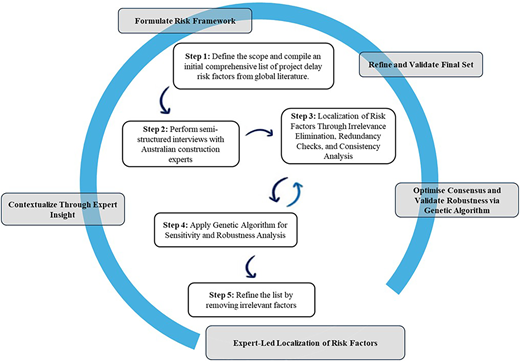
This research follows a structured process to identify, validate, and localise delay risk factors for the Australian construction industry. Figure 1 summarises the sequential stages—from global evidence synthesis to expert elicitation, optimisation, and validation.
The process begins with an extensive literature review, where a broad range of global risk factors were identified. This initial step laid the groundwork for further refinement and validation through semi-structured expert interviews, conducted with professionals in the Australian construction industry. The University Human Research Ethics Committee (UHREC) approved the interviews (approval no. LR 2024–7852-19920), ensuring compliance with ethical standards regarding participant consent, confidentiality, and data handling.
3.1 Selection of factors for expert evaluation
The research process commenced with a systematic literature review (SLR) conducted in accordance with the PRISMA framework. The search strategy employed the Boolean expression: (“project*” OR “construction”) AND (“delay” OR “time overrun”) AND (“factor*” OR “cause*” OR “rank*” OR “prioritiz*” OR “scor*”) as presented in Zagia et al. (2025).
The initial database search yielded over 21,000 records, which were progressively refined through title restriction, publication year (>2010), document type, and language filters, resulting in a substantially reduced set of studies. After duplicate removal, snowballing, and full-text screening, a total of 92 relevant articles were ultimately included in the final synthesis.
From these selected studies, 103 distinct delay factors were initially extracted as presented in Zagia et al. (2025). However, presenting all factors in expert interviews was deemed impractical and cognitively burdensome. Given that expert elicitation relies on cognitive judgement rather than mechanical rating, an overly long list of risk factors can reduce the reliability and depth of responses (Hallowell and Gambatese, 2010; Linstone and Turoff, 2002).
To minimise cognitive load and ensure that experts focussed on the most influential risks, a selection criterion grounded in the Pareto principle, which posits that approximately 80% of delays are caused by 20% of factors, was applied. Instead of extracting only the top 20% of highly ranked factors from each study, the top 40% was collected and integrated to form an initial consolidated list of significant factors for subsequent evaluation based on the literature. So, instead of considering all factors reported in each paper and then integrating them, the top 40% of factors from each study, based on their reported ranks, were extracted. These top factors from all studies were then merged into a consolidated taxonomy, where duplicate or semantically equivalent factors were unified by the authors under a single label, based on the most commonly used title in the papers. During this consolidation, reliability checks were applied to ensure that the merged factors accurately reflected the sources. The individual lists were then integrated across all studies to form a consolidated set of factors. This process resulted in a manageable and balanced list of 55 factors that captured the most influential and contextually important risks, while avoiding overrepresentation of less relevant or infrequent factors. This broader inclusion range ensured that moderately frequent, yet contextually important risks were not excluded prematurely, producing a balanced and cognitively manageable list for expert evaluation.
3.2 Expert selection and sampling strategy
A purposive sampling strategy was adopted to recruit experts with substantial professional experience and domain knowledge in the Australian construction industry. The potential respondents were identified based on their professional profile on LinkedIn. To be eligible, individuals were required to (1) have at least five years of work experience in the Australian construction sector and (2) currently hold, or have recently held, a senior project delivery role such as project manager, risk manager, or construction planning/scheduling lead. Identified candidates were then contacted individually and invited to participate.
The panel captured a breadth of experience: more than half of the participants had between five and ten years of industry practice, while the remainder had over ten years' experience on large-scale infrastructure, public-sector, or transportation projects. This ensured that the judgements elicited reflected both technical depth and direct familiarity with the types of high-value, delay-sensitive projects that shape the Australian market. The recruitment process was therefore designed not only to ensure technical competence, but also to incorporate a diversity of organisational perspectives and project contexts. Table 2 summarises the demographic and professional characteristics of the expert panel.
The final sample was determined based on methodological suitability rather than statistical representativeness. In expert-elicitation studies, panel adequacy is judged by the depth and relevance of expertise rather than size, as the aim is to obtain informed and defensible judgements from qualified professionals. Prior methodological work in construction management indicates that expert panels of approximately 8–16 participants are typically sufficient to achieve stable consensus when participants are highly qualified (Hallowell and Gambatese, 2010; Morgan, 2014). Accordingly, the inclusion of 11 senior practitioners with extensive industry experience was considered appropriate to ensure diversity of perspectives and achieve data saturation.
3.3 Data collection: semi-structured interview
Semi-structured interviews were chosen as the primary data collection method to balance structure with flexibility. A pre-designed interview protocol guided the discussions while experts were encouraged to elaborate on factors, provide contextual insights, and identify emerging issues specific to the Australian construction environment. Interviews were conducted between March and July 2024, each lasting approximately 60–90 min.
During the interviews, experts were presented with the list of 55 risk factors and asked to assess each factor's severity (i.e. its impact on project delays) in the Australian context using a five-point Likert scale from “Very High” to “Very Low”. The semi-structured interview data and rating sheets were first compiled into a master dataset. Each of the 55 identified risk factors was listed as a separate row, and individual expert ratings were recorded across columns corresponding to each participant. The ratings, initially expressed qualitatively, were coded based on the following scheme into numerical values to facilitate quantitative analysis and statistical computation.
Very High (VH) = 5, High (H) = 4, Medium (M) = 3, Low (L) = 2, Very Low (VL) = 1, Deleted (Irrelevant) = 0.
This conversion allowed direct comparison between expert judgements and enabled subsequent calculation of agreement metrics, descriptive statistics, and prioritisation analyses. The data were cross-checked for consistency and accuracy before moving to the analytical stage.
3.4 Data analysis and factor refinement
The primary challenge in analysing expert-elicited data lies in ensuring that the aggregated results reliably reflect consistent and informed judgements, while minimising the influence of noisy or inconsistent responses (Hossan et al., 2025). Variability in expert response may arise from differences in experience, interpretation of risk factors, or subjective judgement, which can reduce overall agreement and compromise the robustness of the results Although existing approaches such as iterative consensus methods (Delphi) or equal-weight aggregation, attempt to address this issue, they often rely on simplifying assumptions, may be resource-intensive, and do not explicitly identify or mitigate unreliable inputs (Hohmann et al., 2025; Motamedisedeh et al., 2023). To address these challenges, a Genetic Algorithm (GA) is employed.
GA is an evolutionary optimisation technique inspired by the process of natural selection. It operates through mechanisms analogous to biological evolution, including selection, crossover, and mutation, to progressively improve candidate solutions (Calache et al., 2022). In this research, the GA was employed to optimise the selection of expert subsets from the collected dataset and to estimate the corresponding weights assigned to each expert. Each individual in the GA population represents a potential solution and its fitness generally reflects the quality or optimality of that solution with respect to the defined objective function. GAs are particularly suitable for this problem because of their ability to efficiently search large, non-linear, and combinatorial solution spaces without requiring gradient information.
In this context, the GA is implemented such that each solution is represented by a vector of expert weights, where a value of zero indicates that an expert is not selected, and positive values correspond to selected experts. These weights are subsequently normalised and used for further evaluation, including the calculation of consistency, which forms the basis of the fitness function in this study. To ensure that all selected experts contribute meaningfully to the aggregated outcome and to avoid the results being disproportionately influenced by any single expert, a bounded weight range is considered for the selected experts. Without this constraint, the optimisation process tends to assign excessively large weights to a single expert while marginalising others. The introduction of this constraint enhances the stability and fairness of the weighting scheme, while maintaining the robustness of the final results. Based on the defined process, the weights of experts are iteratively modified through GA operations (selection, crossover, and mutation) to determine the weights of experts to achieve the optimal level of internal consistency among the selected experts.
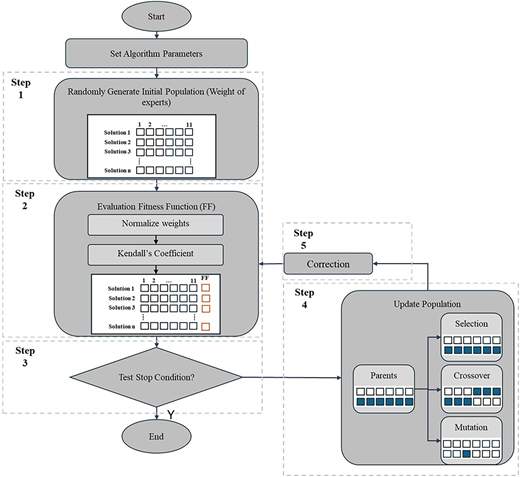
The detailed process of using GA is presented as follows; however, before initiating the model, the model parameters including the minimum allowable number of experts (m1) out of all the experts (m) within any subset, the valid range for expert weights before normalisation [a,b], the mutation rate, the population size, and the maximum number of generations to be executed, must be defined by the user. These parameter values were selected based on preliminary tests that balanced convergence speed and solution stability. After defining the parameters, the GA can be run based on the following steps:
Step 1: Initialisation
The GA begins by generating an initial population of candidate solutions. Each individual in the population represents a vector of weights, including one value for each expert, with the number of genes equal to the total number of experts. In the initial population, each weight is randomly assigned within the defined range [a,b], where the ratio b/a indicates the maximum potential influence of a single expert on the aggregated result relative to any other expert (Billhardt et al., 2002). Then, to exclude a subset of experts, a random integer is generated within the range . Subsequently, experts are randomly selected, and their corresponding weights are set to zero.
Step 2: Evaluation (Using Kendall's Coefficient of Concordance)
Each individual is evaluated for its fitness using Kendall's Coefficient of Concordance (W), which measures the degree of agreement among experts in their rating of delay factors. Kendall's Coefficient of Concordance (W) is a non-parametric statistic widely used for this purpose for ordinal data when experts are required to rank or rate a set of items on an ordinal scale (Gampa and Jyosyula, 2023; Gearhart et al., 2013; Marozzi, 2014). It quantifies the extent to which multiple raters provide consistent orderings of items, thereby reflecting how strongly they agree on the relative importance or severity of each factor.
Kendall's Coefficient of Concordance is used in this research as it provides a rigorous, quantitative measure of agreement among multiple experts evaluating a set of ordinal variables (Betensky and Finkelstein, 1999; Franceschini and Maisano, 2021). In this study, experts rated 55 risk factors using a Likert scale, which inherently produces ordinal data and may include tied values. Kendall's W is specifically designed to handle such ordinal data and, with tie corrections, can accurately account for multiple factors receiving identical ratings (Teles, 2012). Furthermore, the weighted version of Kendall's W allows the relative influence of each expert to be incorporated, reflecting differences in expertise or reliability, and it is also adoptable by GA algorithm as presented in Shbikat and Bwaliez (2025). This combination of robustness to ties, suitability for ordinal ratings, and adaptability to expert weighting ensures that the measure captures both the consistency and the relative impact of expert judgements. Consequently, Kendall's W provides a methodologically sound and interpretable metric to assess consensus, making it the most appropriate choice for evaluating inter-expert agreement in this study. The computation involves the following steps.
Normalising the weights
In the initial step, the defined weights by each solution are normalised by dividing each weight by the total sum of weights to ensure that the sum of weights for each individual equals one. So the weight of expert j is vj, which .
Calculate weighted rate per factor ().
Considering that the rating assigned to factor i by expert j using a Likert scale is denoted as , based on the method presented in (Mahmoudi et al., 2022), the total rating for factor i, represented by , is calculated based on Equation (1).
Compute dispersion ().
Based on (Mahmoudi et al., 2022), the statistic , which measures the deviation of the summed ranks from perfect consensus, is computed using Equation (2), where denotes the mean of .
Calculate Kendall's W.
Based on the literature (Mahmoudi et al., 2022), when the collected data are ranked without ties, Kendall's is calculated using Equation (3). However, in this study, since the data include ties, Kendall's is computed using Equation (4).
In Equation (4), denotes the total number of ties associated with expert , and is computed using Equation (5). In Equation (5), represents the number of tied responses provided by the expert for attribute .
The Equation (4) provides a robust and reproducible measure of inter-expert consistency, even when multiple criteria receive identical Likert ratings, and it is in the range:
: perfect agreement (all raters rate factors the same)
: no agreement (completely random ratings).
Step 3: Stop Condition
In this step, the stop condition is checked after each generation: the algorithm terminates if there is no significant change in the weights over the last n iterations, or if the maximum number of iterations has been reached. If neither condition is met, the GA proceeds to the next step by creating the next generation, repeating fitness evaluation and population updating. Once terminated, the algorithm outputs the best subset of experts and their normalised weights, corresponding to the highest Kendall's W and representing the most consistent and reliable expert panel for evaluating delay factors.
Step 4: Update Population and Stop Condition
After evaluating fitness, the GA enters the population updating phase, which integrates selection, crossover, and mutation as follows:
Selection: Based on the computed fitness values, the GA selects a subset of high-performing individuals to serve as parents for the next generation. In this study, roulette wheel selection is used, favouring individuals with higher Kendall's W scores, thereby increasing the probability that solutions with stronger expert agreement will propagate to subsequent generations.
Crossover: The crossover operation combines pairs of parent solutions (the weight of experts before normalisation) to produce new offspring. Portions of the expert-weight vectors from two parents are exchanged, generating new individuals that inherit characteristics from both parents. This recombination promotes diversity within the population and allows the algorithm to explore new regions of the solution space that may yield higher consensus.
Mutation: To prevent premature convergence and maintain genetic diversity, mutation is applied with a small probability (mutation rate). This operation randomly alters one to three expert weights (randomly selected) in a solution. For each expert, a random value is generated. If this value is less than , the expert weight is replaced by a randomly generated value within the range ; otherwise, the weight is set to zero. After mutation, the weights are re-normalised to ensure that the sum of the vector remains equal to one, preserving the relative importance of all experts in the subset.
Step 5: Correction and continuing the loop
After updating the population, there is a possibility of generating invalid solutions, where the number of selected experts falls below the minimum allowable threshold. In this step, a validity check is applied to each updated individual. For those that do not satisfy the minimum requirement, experts with zero weights are randomly selected one by one, and their weights are reassigned to random values within the range until a valid solution is obtained. Once all updated individuals meet the validity criteria, the algorithm proceeds to step 2, where the fitness value of each individual is evaluated.
The genetic algorithm (GA) framework illustrated in Figure 2 outlines the optimisation process applied to refine expert weighting and enhance overall consensus reliability. An initial population, representing different combinations of expert weights, is randomly generated and evaluated through a fitness function (FF) based on Kendall's Coefficient of Concordance (W). This coefficient quantifies the degree of agreement among experts' ratings, serving as the optimisation criterion. The final output provides the optimised expert weight distribution corresponding to the highest agreement level, ensuring that the retained set of experts contributes to a statistically consistent and representative rating of delay risk factors.
4. Results
4.1 Final localised list of delay risk factors
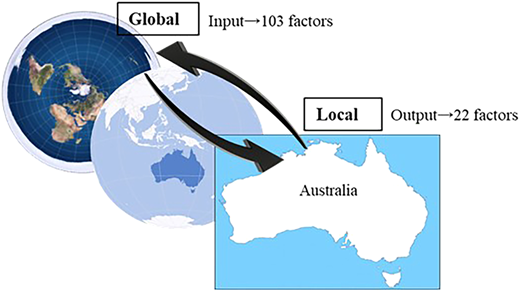
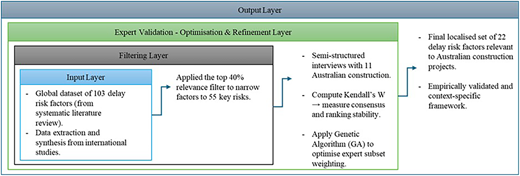
Figures 3 and 4 present illustrate the systematic localisation pathway conceptually. Global evidence is first consolidated, then filtered, and subjected to contextual validation by senior Australian practitioners, to reflect the realities of the Australian construction sector, before being reduced to a set of locally material, decision-relevant risks. This translation is critical because risk factors that are prominent in one context may manifest differently, or with varying levels of significance, in another.
This structured localisation process is the core contribution of the study: it demonstrates how internationally accumulated knowledge can be translated into a concise, defensible, and industry-aligned delay risk framework for a specific national market.
Figure 4 further elaborates on this process by breaking it down into four key layers. The Input Layer represents the foundational stage, where 103 globally identified risk factors were collected through a systematic literature review conducted in our previous study. This layer is managed in Microsoft Excel using Power Query (Motamedisedeh, 2024, 2025). The Filtering Layer refines this list by applying a relevance criterion (the 40% rule), reducing the pool to 55 factors most frequently cited in the literature. These shortlisted risks then move into the expert validation layer, where semi-structured interviews with senior Australian practitioners provide contextual assessment and severity scoring. This layer is crucial for aligning the global evidence with local industry realities.
The GA was employed to identify the subset of experts whose judgements exhibited the highest level of internal consistency. The GA input parameters are considered as: a total of 11 experts (), a minimum acceptable subset of 7 experts (), and a weight range for each expert before normalisation of . The mutation rate = 5% and crossover rate = 80% were set to ensure a balance between exploration and convergence, while the population size and the maximum number of generations were chosen to provide sufficient search capacity and stability of the solutions.
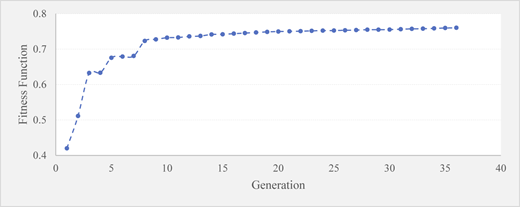
The algorithm was terminated after 36 generations, with an initial population size of 200 and starting weights assigned to all experts. The fitness function, representing the consistency of expert judgements as measured by Kendall's Coefficient of Concordance (W), increased from 0.4 in the initial generation to 0.76 at termination, indicating a high level of consensus among the selected experts. The convergence process across generations is illustrated in Figure 5.
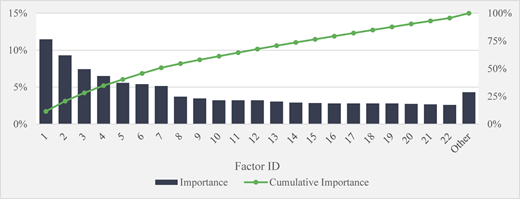
After determining the optimal expert weights that achieved the highest consistency, the average of their responses for each factor was calculated to represent the importance score of that factor. Subsequently, the relative importance of each factor was computed as a proportion of the total importance across all factors, and the factors were ranked in descending order based on these values. A threshold of 95% cumulative relative importance was then applied to identify the most influential factors (Sensitivity analysis showed that slightly lower or higher thresholds would minimally change the shortlist, demonstrating its stability). Based on this criterion, 22 factors were found to account for 95% of the total relative importance, as illustrated in Figure 6. The list of factors along with their corresponding identification numbers (IDs) is provided in Table 3. These factors represent the most significant causes of schedule overruns when viewed through the lens of local industry conditions, regulatory frameworks, procurement practices, and project delivery models. They cover a broad spectrum of risk domains and together form a comprehensive picture of the delay landscape specific to Australia.
4.2 Validation by simulation
To validate the robustness of the results, a cross-validation procedure was applied to the expert weights. In this procedure, the weights assigned to each expert were randomly adjusted by up to ±20% of their original weight, and the top-ranked factors accounting for 95% of the cumulative relative importance were re-identified. This simulation was repeated 1,000 times, each time with randomly perturbed expert weights, to assess the stability of the factor selection. Based on the outcomes, the percentage of times that each factor appeared in the shortlisted set was calculated and is presented in Table 3. The results indicate that nearly all factors consistently appeared in the shortlisted set across the simulations, confirming that these factors represent the most important parameters and demonstrating the robustness and validity of the proposed approach.
The high recurrence of all factors, most appearing in 98–100% of simulations, confirms that the final localised risk set is highly stable, and that perturbations to expert weights do not materially alter the composition of the top-ranked delay factors.
4.3 External validation of the localised framework through literature triangulation
To assess the contextual validity of the final 22 localised delay risk factors, the results were cross-checked against recent Australian studies on construction delays. These comparisons provide empirical triangulation and indicate that the localised factors derived through expert elicitation are both representative of current Australian practice and consistent with independently reported sources of delay in the national construction sector.
In this study, the finalised delay risk factors were cross-validated through data-source triangulation – comparing with Derakhshanfar et al. (2021), Al-Kilidar and Hasib (2021), and Basak et al. (2019). As shown in Table 4, several of the delay factors identified in this study align with those reported in previous Australian research, which provides external support for the credibility of the findings. However, unlike earlier studies that list delay causes independently, the present research systematically connects global evidence with Australian industry practice and validates the resulting factors through expert consensus and optimisation.
4.4 How to use in practice
The 22 localised delay risk factors identified in this study provide a practical resource for stakeholders across the Australian construction industry, including project managers, contractors, consultants, procurement bodies, and policymakers. These factors can guide decision-making by highlighting the most critical sources of delay, enabling stakeholders to prioritise their attention and resources on areas that are most likely to impact project schedules.
In practice, the framework can be applied in three key stages. First, during project planning and early design, stakeholders can use the identified factors as a diagnostic checklist to systematically assess potential sources of delay. This enables early identification of high-risk areas, such as design completeness, decision-making processes, and coordination challenges, before they propagate into later project phases. Second, during procurement and contract development, the factors can inform contractor selection criteria, risk allocation strategies, and contract provisions, ensuring that critical delay drivers are explicitly addressed. Third, during project execution and monitoring, the framework can be integrated into risk registers and progress reviews to continuously track and manage high-impact delay risks.
The framework is particularly suited for use in structured risk assessment workshops, where project teams collectively evaluate the relevance and severity of each factor within a specific project context. By focussing on the most influential risks, the approach supports more targeted mitigation strategies, efficient allocation of resources, and improved coordination among stakeholders.
At a strategic level, procurement bodies and policymakers can use the findings to identify recurring systemic issues, such as delays in approvals, design coordination deficiencies, or governance-related bottlenecks and implement targeted improvements in regulatory processes and industry practices. Overall, the framework translates empirical evidence into an actionable and adaptable tool, supporting more proactive, consistent, and evidence-based management of delays in Australian construction projects.
5. Discussion
The localised framework developed in this study shows that the most influential sources of delay in Australian construction projects originate primarily in upstream governance and design processes rather than in isolated on-site execution issues. Several of the highest-ranked factors, including late owner decisions, delays in design documentation, unclear drawings, and scope changes, align with the patterns identified by earlier Australian research that emphasised decision-making bottlenecks and documentation deficiencies as major contributors to schedule overruns (Derakhshanfar et al., 2019; Zou et al., 2006). These findings underline the importance of high-quality front-end planning, timely approvals, and effective design coordination in shaping downstream project performance.
A second key insight is the multi-dimensional and interconnected nature of delay risks. Governance-related issues interact with resource pressures such as labour shortages and variable productivity, as well as stakeholder-interface factors including subcontractor performance and coordination challenges. (Al-Kilidar and Hasib, 2021). Studies such as Basak et al. (2018) similarly observed that delay mechanisms arise from interactions across managerial, technical, and organisational domains. For example, an incomplete design decision can amplify labour inefficiencies or trigger rework during execution, producing cumulative schedule impacts. This reinforces the understanding that delays typically emerge from overlapping processes across planning, procurement, and construction phases rather than from a single isolated cause.
The third contribution concerns the practical implications for delay mitigation and project leadership. Because many influential delay drivers originate early in the project lifecycle, effective governance, proactive design management, and clear change-control procedures are essential for improving schedule performance. Strengthening project definition at the outset, clarifying requirements, and ensuring design completeness before mobilisation can significantly reduce downstream disruption, a point supported in previous work on project governance and design readiness in Australian contexts (Shah, 2016; Wong and Vimonsatit, 2012). Furthermore, integrated risk management across stakeholder groups, including owners, consultants, contractors, and subcontractors, is required to address the cross-functional nature of delay pathways identified in this study.
Overall, the results demonstrate that schedule performance in Australia is shaped by a combination of governance quality, resource capability, and stakeholder alignment. The localised framework therefore provides practitioners with an evidence-based tool for prioritising mitigation efforts in areas where interventions can have the strongest influence, particularly during planning and design phases where early decisions exert significant effects on project outcomes.
6. Limitation and future research
The current analysis focussed on identifying and validating key delay factors but did not perform quantitative ranking beyond their relative importance. Future research could therefore extend this framework by developing statistical or multi-criteria decision-making models to assign explicit weightings or ranking scores to each delay factor, enabling prioritisation across project phases or stakeholder groups.
The study also examined factors independently, whereas real-world delays often emerge from interdependent mechanisms involving governance, design, procurement, and construction interfaces. Future studies should employ system dynamics or structural equation modelling to capture causal pathways and feedback effects among the identified risks. Integrating this approach with observed project-performance data, such as actual schedule deviations or cost impacts, would enhance empirical robustness and enable calibration of expert-derived rankings against measurable outcomes.
Additionally, the expert panel in this research primarily consisted of project managers, with limited representation from other stakeholder groups. This composition may introduce bias, as certain perspectives on delay factors could be underrepresented. Future studies should consider including a broader range of stakeholders, such as subcontractors, designers, clients, planners, and regulatory authorities, to ensure a more balanced and comprehensive assessment of delay risks.
Furthermore, applying the localisation framework to specific project sectors (e.g. infrastructure, residential, or resource projects) and comparing findings across regions would reveal contextual variations in risk salience. Finally, embedding this framework into digital project-management environments, including 4D BIM and AI-based analytics, could support dynamic ranking and real-time monitoring of delay risks, transforming it from a diagnostic model into a predictive and decision-support tool for proactive project control.
7. Conclusion
This study developed a localised framework of delay risk factors tailored to the Australian construction industry by integrating systematic literature synthesis, expert elicitation, and optimisation through a Genetic Algorithm guided by Kendall's Coefficient of Concordance. Through this approach, 22 delay factors were identified as the most influential within the Australian regulatory, organisational, and operational context.
The methodological contribution of the study lies in demonstrating how global evidence can be adapted to national contexts through a structured localisation process that incorporates both qualitative expert judgement and quantitative optimisation. The use of the Genetic Algorithm improved the internal consistency of expert input and provided a transparent procedure for deriving reliable risk priorities. In addition, the study illustrates how optimisation techniques can be effectively combined with ordinal expert data to enhance the robustness and reproducibility of decision-making frameworks.
Practically, the findings offer project managers, consultants, policymakers, and contractors an evidence-based reference for identifying and prioritising delay risks. The framework can support more informed decision-making during planning, design, procurement, and execution by directing attention to those risks that have the greatest potential to affect schedule performance in Australia. For project managers and contractors, the results enable more proactive risk mitigation and improved schedule control. For procurement bodies, the identified factors can inform tender evaluation, contract structuring, and risk allocation strategies. For government policymakers and regulators, the findings provide evidence-based insights to support improvements in approval processes, regulatory frameworks, and industry governance aimed at reducing systemic causes of delay.
This study also highlights several directions for future research. The proposed GA-enhanced localisation framework can be extended to other national contexts to examine how delay risk profiles vary across different regulatory and market environments. Furthermore, future studies could apply this approach to specific sectors such as infrastructure, residential, or commercial construction, where risk characteristics may differ significantly.
Moreover, there is significant potential to integrate the proposed framework with digital project management tools. For example, incorporating the prioritised delay factors into 4D Building Information Modelling (4D BIM) environments could enable dynamic simulation of schedule risks and enhanced visualisation of delay impacts, thereby improving real-time decision-making and project monitoring.
In conclusion, this study not only provides a validated set of localised delay risk factors for the Australian construction industry but also offers a flexible and extensible methodological framework that supports more reliable, data-driven decision-making in construction project management.
Ethical statement
This research received ethical approval from the University Human Research Ethics Committee (UHREC) under approval number LR 2024-7852-19920. All participants were informed about the purpose of the study before participation, and informed consent was obtained from all interviewees. Participant confidentiality and anonymity were maintained throughout the research process in accordance with the approved ethical protocol.
AI generative
The authors confirm that no artificial intelligence (AI)-based tools were used in the drafting, analysis, or preparation of this manuscript.
The authors would like to thank the industry professionals who generously contributed their time and expertise to participate in the interviews conducted for this study. Their insights and professional experience were essential for validating and contextualising the delay risk factors within the Australian construction industry.