Industrialized construction has brought about expectations of improved productivity in the construction industry. However, the lack of a commonly accepted definition has created confusion regarding the types of development covered by the industrialized construction umbrella. These inconsistent definitions convoluted the discussion on this phenomenon. This study aims to clarify the definition of industrialized construction through a systematic literature review.
This systematic literature review was conducted according to PRISMA principles. Records were gathered from Scopus and Web of Science. Following the scientometric analysis, content analysis was conducted according to the template analysis approach.
The analysis of 121 articles revealed four main themes related to industrialized construction: 1) the construction concept, 2) construction methodologies, 3) systematization, rationalization and automatization and 4) societal and industrial change processes. Definitions of industrialized construction can be analyzed with seven clusters: 1) prefabrication, 2) standardization, 3) sector, 4) integration, 5) manufacturing practices, 6) technological investment and 7) none. Based on the content analysis, the proposed definition is: industrialized construction is the adoption of practices that minimize project-specific work in construction from the start of the design to the end of the building’s life cycle.
This study proposes a definition for industrialized construction following content analysis of broadly sampled literature. The proposed definition can provide a basis on which developments in the construction industry can be reflected.
Introduction
The construction industry has faced greater productivity challenges than many other sectors, partly because industrialization has progressed rapidly in other industries. The focus on cost, quality, and time, together with lean methods, have led to productivity improvements in various industries. The balance between quality and productivity has enabled the application of lean methods beyond the manufacturing industry. (Heizer et al., 2020) In construction, fragmentation and project-specific work have been identified as the main factors hindering overall development. Contrary to the project-oriented nature of the work, research has revealed promising avenues for industrialized construction (IC) (Annunen and Haapasalo, 2023).
Construction work is undergoing significant changes owing to Industry 4.0, which brings new technologies to construction; and digitalization, altering the nature of knowledge work. Concurrently, the sustainability is a growing global concern. Organizations’ strategies and current statuses must also be evaluated to support the adoption of new production technologies introduced by Industry 4.0 (Das et al., 2023). In addition to the adoption of new production technologies, developments in digitalized construction have been considered part of the IC (Attouri et al., 2022). Advancements in digital technologies, such as Building Information Modeling (BIM), have been used to evaluate life cycle costs and environmental impacts, enabling a more accurate evaluation of options (Sajid et al., 2024).
The construction industry is normative, and has traditionally been strongly regulated. While development within the industry has been modest, governments worldwide have established programs to drive development of the construction industry (Pekuri et al., 2015). The names of these programs, such as modern methods of construction (MMC) and industrialized building system (IBS) have influenced the development of the construction industry in the program’s region and the discussions surrounding. The different concepts used when discussing the development of the construction industry have fragmented this discussion.
There have been various suggestions for defining IC. Views range from none that are applicable and broadly accepted (Attouri et al., 2022) to IC as an umbrella term for prefabricated construction (Kedir et al., 2023b) and integration of construction production (Höök and Stehn, 2008). The variety of views discussed regarding IC also complicates the conversation; if a viewpoint is not communicated, a reader may interpret the paper from a very different perspective. The differing terminology has also fragmented the discussion in academic literature, reflecting the regional names of the programs.
While there have been previous literature reviews on IC, most have focused on specific aspects such as resource efficiency (Kedir and Hall, 2021), individual materials (De Araujo et al., 2023), and technologies (Khan et al., 2023a, b; Ter Haar et al., 2023). When reviewing from a specific viewpoint, a more general definition of IC is provided from a narrow viewpoint of the review target. Various views on business and project aspects have also been reviewed (Khan et al., 2023a, b; Saad et al., 2023; Zairul, 2021) along with health and safety considerations (Fagbenro et al., 2023). More broadly oriented reviews have been conducted. For example, Costa et al. (2023) focused on a conceptual framework for construction industrialization, whereas Du et al. (2023) covered prefabricated construction from a lean manufacturing viewpoint. While these reviews were more broadly oriented, the definition of IC was not their focus. When construction industry experts were interviewed on industrialization, such as Attouri et al. (2022), their responses focused on individual aspects of IC, such as prefabrication. In case-oriented approaches, the focus naturally forms around the viewpoint of the case, as in the case presented by Kedir et al. (2022).
This study aims to provide a definition of IC that can be utilized in various contexts to unify diverse approaches to industrialization across different types of construction. A two-phase strategy was adopted to cover a broader range of views, with the first objective being to conduct a scientometric analysis of literature. Scientometric analysis of the literature provides insight into where and by whom the discussion has been conducted, examining publications from the perspectives of publication years, journals, keywords, and authors. In the second phase, the objective was to gather definitions and descriptions from the literature and form them into a proposed definition. Template analysis was used for content analysis to gather definitions and to form themes. The articles’ definitions and descriptions of IC were gathered through template analysis and organized based on these themes.
These objectives aid in covering IC from a broad perspective and forming a definition of IC. This definition also supports the evaluation of future developments related to IC in the construction industry.
Methods and materials
A systematic literature review (SLR) was chosen because of its ability to synthesize previous knowledge. The literature provides a heterogeneous basis upon which to gather definitions and analyze the researched phenomena. (Page et al., 2021) Expert opinions were gathered during earlier reviews; for example, by Attouri et al. (2022). This has resulted in inconclusive findings due to the heterogeneity of the answers, or alternatively, a very homogenous view, equating industrialization with prefabrication.
An overview of the study process is presented in Figure 1. The SLR followed the PRISMA principles (Page et al., 2021), with a detailed breakdown presented in Figure 2. The scientometric analysis concluded the first phase. Template analysis, as outlined by King and Brooks (2017), was used for data synthesis and content analysis during the second phase of the study.
 The flowchart illustrates the research process of a study with six sequential steps. Step 1 involves initial searches using Scopus and Web of Science. Step 2 focuses on gathering and filtering the literature, with details presented in Figure 2. Step 3 includes scientometric analysis and keyword co-occurrence. Step 4 involves the development of themes, preliminary coding during the filtering steps, and refinement reflected on the keyword co-occurrence. Step 5 entails data extraction using the template from Table 3. Step 6 includes clustering of the definitions and thematic analysis of the definitions and descriptions.
Research process of this study
The flowchart illustrates the research process of a study with six sequential steps. Step 1 involves initial searches using Scopus and Web of Science. Step 2 focuses on gathering and filtering the literature, with details presented in Figure 2. Step 3 includes scientometric analysis and keyword co-occurrence. Step 4 involves the development of themes, preliminary coding during the filtering steps, and refinement reflected on the keyword co-occurrence. Step 5 entails data extraction using the template from Table 3. Step 6 includes clustering of the definitions and thematic analysis of the definitions and descriptions.Research process of this study
 The flowchart begins with studies from databases Scopus and Web of Science. It then filters references based on language, article type, keywords, and retractions. Merged records are checked for duplicates. Records are screened, excluding studies based on title and abstract. Records sought for retrieval are assessed for eligibility, with further exclusions based on content. Bibliometric analysis is conducted, followed by a thematic analysis sample selection.
Sample gathering and filtering process
The flowchart begins with studies from databases Scopus and Web of Science. It then filters references based on language, article type, keywords, and retractions. Merged records are checked for duplicates. Records are screened, excluding studies based on title and abstract. Records sought for retrieval are assessed for eligibility, with further exclusions based on content. Bibliometric analysis is conducted, followed by a thematic analysis sample selection.Sample gathering and filtering process
Gathering and filtering the literature
A search query was formed using a two-step approach. An initial [Industrial* AND construction] search was conducted to refine the search terms and form the eventual quarry. The search terms from the reviews in the initial search results were gathered to form the basis of the query. The query ((Industrial* OR Prefabricat* OR “Modern Methods of” OR Off*Site) AND (Construction OR Building* OR Housing)) was run on the titles and keywords of the articles. The searches were filtered into journal-published articles and reviews in English. The results were not filtered based on the publication year range. The filtering and screening steps are illustrated in Figure 2.
Table 1 presents the inclusion and exclusion criteria for title screening. Abstracts were checked against the same criteria if their titles were unclear. For abstract filtering, the abstracts were read to determine whether the article discussed IC or one of the variants listed by Attouri et al. (2022). For this consideration, construction, housing, and building were treated interchangeably. In the full-text examinations, the introductions and conclusions were examined for IC and variations, such as industrialization or industrialized house building in wording. If the results were indecisive, the other sections of the article were skimmed for clarification.
Scientometric analysis
Scientometric analysis was performed using the VOSviewer. The Semantic Scholar database API was used for the data based on the DOIs provided.
For keyword co-occurrence analysis, exports from the search databases were used. Key ideas of articles are represented in the chosen keywords and can provide ways to examine the closeness of the keywords (Li et al., 2016). VOSviewer was used for keyword clustering, with fractional weight calculation. Keywords related to research methodology (e.g. “case study”) and location (e.g. “China”) were removed from the analysis, and keywords referring to the same concepts (e.g. “IBS” and “industrial building systems”) were merged to examine how the topics have been researched, following the example of Hosseini et al. (2018).
Sampling for content analysis
Clustering for sampling was conducted without requirements for the number of appearances or belonging to the top range of keyword connectivity. The clusters were reviewed for IC-related phrasings, such as the “industrialization of construction”, which formed the clusters used for the final sampling. If at least one in five of a paper’s keywords were part of a cluster, including IC-related keywords, the paper was moved to a thematic analysis.
Development of themes for template analysis
Preliminary coding was conducted alongside the filtering process outlined by King and Brooks (2017). The themes were clustered based on the preliminary coding preformed during title and abstract filtering and refined during the full-text examinations. The filtered clusters were reviewed and refined against the clusters formed during the scientometric analysis. Themes and short descriptions are presented in Table 2.
Coding the papers and the analysis
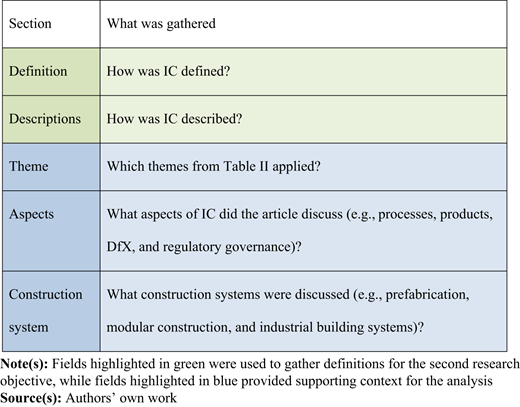
The template in Table 3 was used to gather data from the sample papers. Additionally, notes on the construction systems, methods, and different aspects of the IC were gathered to conduct the analysis. These were expanded during the final analysis to encompass the full depth of data. If an article did not have any definitions or descriptions, it was left blank without approximation.
The template analysis steps were repeated on the gathered definitions and descriptions, independently from the themes formed based on the full texts. Table 4 presents the clusters formed and the short descriptions used for the analysis.
Clusters of definitions and descriptions
| Cluster | Cluster focus |
|---|---|
| Prefabrication | A synonym or umbrella term for prefabrication or offsite construction |
| Standardization | The standardization of operations to control production and support the adaptation of technical advancements |
| Sector | A strategy that is adopted by a sector in the construction industry |
| Integration | The integration of processes and resources of the construction |
| Manufacturing practices adoption | The adoption of practices from the manufacturing industry |
| Technological investment | A technological investment with a focus on the mechanization of construction work |
| None | No agreed-upon definition due to its ambiguous nature |
Note(s): The cluster focus highlights the differentiating factors between the clusters
Source(s): Authors’ own work
Results
Scientometric analysis results
Articles, journals and authors’
The number of publications per year was below 20 until 2019. Since then, the number of publications has grown, as shown in Figure 3. The number of publications archived in Web of Science has increased compared to that in Scopus.
 A bar graph compares the number of publications per year from 1996 to 2024. The horizontal axis represents the years, ranging from 1996 to 2024. The vertical axis represents the number of publications, ranging from 0 to 80. The graph includes two data series: one in green representing Web of Science and one in blue representing Scopus. The bars are grouped vertically for each year. From 1996 to 2019, the number of publications per year was below 20. Since 2019, there has been a significant increase in the number of publications. In 2020, the number of publications was around 20. In 2021, the number of publications increased to around 40. In 2022, the number of publications peaked at around 70. In 2023, the number of publications slightly decreased to around 60. In 2024, the number of publications is projected to be around 10. The graph indicates a notable growth in publications starting from 2019.
Distribution of articles by year. Only one article was published each year in 1996, 1997, and 2003, resulting in an invisible bar
A bar graph compares the number of publications per year from 1996 to 2024. The horizontal axis represents the years, ranging from 1996 to 2024. The vertical axis represents the number of publications, ranging from 0 to 80. The graph includes two data series: one in green representing Web of Science and one in blue representing Scopus. The bars are grouped vertically for each year. From 1996 to 2019, the number of publications per year was below 20. Since 2019, there has been a significant increase in the number of publications. In 2020, the number of publications was around 20. In 2021, the number of publications increased to around 40. In 2022, the number of publications peaked at around 70. In 2023, the number of publications slightly decreased to around 60. In 2024, the number of publications is projected to be around 10. The graph indicates a notable growth in publications starting from 2019.Distribution of articles by year. Only one article was published each year in 1996, 1997, and 2003, resulting in an invisible bar
When comparing the top ten journals based on article count, different metrics highlight different top journals depending on the metric. Sustainability had the largest number of publications in the sample, with 33 articles. From the citation count and normalized citation point of view, Automation in Construction is at the top. A breakdown of the top ten journals is presented in Appendix Table A1.
Top ten journals in the sample by document count
| Journal | Documents | Percentage | Citations | Norm. citations | Avg. pub. year |
|---|---|---|---|---|---|
| sustainability | 33 | 96% | 604 | 2,639 | 2020,9 |
| buildings | 30 | 87% | 479 | 2,517 | 2021,4 |
| automation in construction | 15 | 44% | 848 | 3,216 | 2021,3 |
| construction innovation | 13 | 38% | 91 | 467 | 2021,7 |
| engineering construction and architectural management | 13 | 38% | 156 | 880 | 2020,9 |
| journal of cleaner production | 8 | 23% | 591 | 1,202 | 2019,5 |
| international journal of environmental research and public health | 7 | 20% | 99 | 522 | 2020,7 |
| applied sciences | 5 | 15% | 114 | 511 | 2021,4 |
| construction management and economics | 5 | 15% | 85 | 386 | 2021,8 |
| sustainable cities and society | 4 | 12% | 117 | 488 | 2019,8 |
Note(s): Citation count based on SemanticScholar. Percentage calculated as share from all of the articles
Source(s): Authors’ own work
Table 5 presents the top five articles by citations. Semantic Scholar was selected as a database, as it provided a way to examine citations across Web of Science and Scopus through VOSviewer equally. The most cited article was by Gann (1996) with 444 citations. The top five articles were published before 2019, corresponding to an increase in the number of publications in the sample.
Top five articles based on citations
| Reference | Title | Year | Citations |
|---|---|---|---|
| Gann (1996) | Construction as a manufacturing process? Similarities and differences between industrialized housing and car production in Japan | 1996 | 444 |
| Hosseini et al. (2018) | Critical evaluation of off-site construction research: A scientometric analysis | 2018 | 430 |
| Kamali and Hewage (2016) | Life cycle performance of modular buildings: A critical review | 2016 | 410 |
| Hong et al. (2018) | Barriers to promoting prefabricated construction in China: A cost-benefit analysis | 2018 | 341 |
| Jaillon and Poon (2009) | The evolution of prefabricated residential building systems in Hong Kong: A review of the public and the private sector | 2009 | 324 |
Note(s): Citation counts based on SemanticScholar
Source(s): Authors’ own work
The top author, based on citations, was Hong Kong Polytechnic’s G. Shen, with 16 publications and 1,104 citations. Shen was also one of the authors of the Hong et al. (2018) article, the fourth most cited article in the sample. Following Shen was D. Gann, who had written the most cited article in the sample. It should be noted that for authors with older articles, normalized citations are skewed due to the lower number of comparison articles in the sample. Top ten authors are presented in Table A2 of the Appendix.
Top ten authors based on citations
| Author | Documents | Citations | Norm. citations | Avg. pub. year |
|---|---|---|---|---|
| G. Shen | 16 | 1,104 | 20,5637 | 2019,3 |
| D. Gann | 2 | 666 | 2 | 1999,5 |
| Jingke Hong | 5 | 608 | 95,075 | 2018,6 |
| Igor Martek | 3 | 507 | 63,467 | 2019 |
| Zhengdao Li | 2 | 506 | 58,085 | 2016 |
| C. Poon | 2 | 495 | 33,963 | 2009,5 |
| L. Jaillon | 2 | 495 | 33,963 | 2009,5 |
| J. Goulding | 4 | 492 | 53,297 | 2013 |
| Xiaodong Li | 5 | 487 | 70,494 | 2018,6 |
| W. Nadim | 3 | 477 | 50,333 | 2011 |
Note(s): Citation counts from SemanticScholar
Source(s): Authors’ own work
Keyword co-occurrence analysis
The results for keyword co-occurrence analysis are presented in Figure 4 and tabled in Appendix Table A3. A larger circle in the graph signifies higher occurrences of the keyword. The top two keywords arose from the mandatory inclusion by search. The average publication year skews younger with higher occurrence counts, which aligns with the growing number of papers in later years in Figure 3.
 A network diagram showing the relationships between the top 30 keywords. The keywords are represented as nodes connected by lines indicating their co-occurrence. Keywords such as construction industry, construction, prefabrication, and sustainability are prominently featured and interconnected with other related terms.
Co-occurrence map for the top 30 keywords
A network diagram showing the relationships between the top 30 keywords. The keywords are represented as nodes connected by lines indicating their co-occurrence. Keywords such as construction industry, construction, prefabrication, and sustainability are prominently featured and interconnected with other related terms.Co-occurrence map for the top 30 keywords
Top 30 keywords from the sample
| Keyword | Cluster | Occurrences | Average publication year |
|---|---|---|---|
| construction industry | 1 | 141 | 2017,7 |
| construction | 5 | 104 | 2019,6 |
| off-site construction | 2 | 75 | 2020,9 |
| prefabrication | 2 | 75 | 2019,1 |
| building information model | 4 | 60 | 2020,6 |
| industrialized construction | 4 | 43 | 2020,1 |
| design | 2 | 39 | 2020,8 |
| management | 2 | 39 | 2020,7 |
| prefabricated construction | 3 | 38 | 2020,3 |
| performance | 2 | 37 | 2020,0 |
| sustainability | 6 | 37 | 2019,4 |
| industrialization | 1 | 36 | 2016,9 |
| barriers | 2 | 34 | 2021,1 |
| industry 4.0 | 4 | 33 | 2019,8 |
| buildings | 2 | 32 | 2020,1 |
| housing | 1 | 32 | 2018,7 |
| life cycle analysis | 3 | 32 | 2014,2 |
| modular construction | 2 | 30 | 2019,9 |
| prefabricated building | 5 | 26 | 2021,4 |
| industrialized building | 1 | 24 | 2018,8 |
| architectural design | 1 | 23 | 2020,1 |
| sustainable development | 3 | 23 | 2019,1 |
| technologies | 2 | 21 | 2020,1 |
| manufacture | 1 | 19 | 2018,7 |
| off-site manufacturing | 1 | 19 | 2018,7 |
| project management | 1 | 19 | 2017,4 |
| building industry | 1 | 16 | 2018,8 |
| carbon | 3 | 15 | 2020,4 |
| building | 1 | 14 | 2021,1 |
| carbon emission | 3 | 14 | 2018,6 |
Source(s): Authors’ own work
The following top ten keywords represent various aspects related to developments in the construction industry. The construction industry shares its cluster with project management and manufacturing-related keywords. Conversely, off-site construction and prefabrication are connected to tasks and roles in construction, such as management and design. This is reflected in the template analysis, where prefabrication is separated from the adoption of manufacturing practices. Performance and barriers belong to the same cluster. Digital technologies and new production technologies, such as BIM, share a cluster with Industry 4.0 and industrialized construction. Industrialization is connected to the construction industry, along with manufacturing, design, and architectural design. Sustainability belongs to a different cluster than life cycle analysis and sustainable development, with the later having a stronger connection to prefabricated construction. The average paper publication years shifted from 2014 for life cycle analysis to 2019 for sustainability, highlighting the shifting priorities in research when examining sustainability topics.
Themes of the articles
The themes were developed during the filtering and keyword co-occurrence stages. Each theme is briefly described in Table 2, and the coupling of the themes is presented in Table 6, except for one article with three couplings, which had concept, methodology, and change themes. Themes most often appeared on their own, except for those referring to a concept, as they were more often combined with other themes.
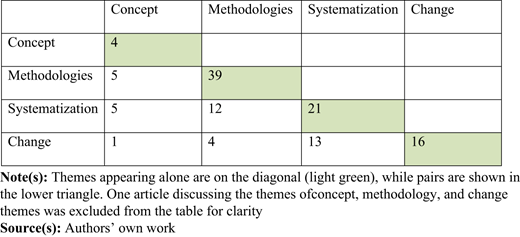
In the narrowest view, IC was used as a synonym for construction concepts. These concepts included factory and manufactured construction, as well as more recent and specific construction techniques, such as prefabricated prefinished volumetric construction (PPVC). Most commonly, the construction technologies referred to were prefabrication, precasting, and factory construction. These technologies were typically discussed in the context of offsite construction. The definition groups presented with the method theme were prefabrication, manufacturing industry practices, standardization, sector, and none.
From a construction methodology perspective, IC was used as a synonym for a broader term to describe construction. These terms included “industrial building systems”, “modular construction”, and “offsite construction”. Methodologies comprised the most common theme. The same definition groups were shared within the method theme but with the addition of an integration view on the definitions. Definitions were most commonly oriented towards prefabrication.
Systematization, rationalization, and standardization emerged from a focus on reorganizing construction and related processes. The focal area was typically systematizing the construction process, either by increasing the utilization of prefabrication or by developing systematic processes to handle, for example, supply chain management. This was the second most common theme. Alongside the development of processes, technology development and mechanization of the work emerged as a definition group in connection with the systematization theme.
The final approach toward industrialization emerged from the perspective of the change process in the construction industry and, more generally, broader societal change through expanding industrialization and urbanization. This was the third most common theme. The change view was present in all the definition groups, except from none, but the technology views had less emphasis than those in the systematization group.
Definitions and descriptions
The ways IC was defined and described are grouped by the clusters presented in Table 4. For each cluster, definitions are presented in the first paragraph, with the following sections covering the descriptions.
Prefabrication
IC is used as a synonym or umbrella term for prefabrication or offsite construction. Prefabrication and offsite construction have been positioned as a degree of construction industrialization (Jaillon and Poon, 2009; Jonsson and Rudberg, 2014; Liu et al., 2019; Marinelli et al., 2022) or as a direct synonym (Hong et al., 2018; Nahmens et al., 2012). Alternatively, the defining trait of the definitions is utilizing a controlled manufacturing environment as a part of IC (Rostami et al., 2013; Sánchez-Garrido et al., 2023; Yao et al., 2020). IC also supports the development of prefabrication (Brege et al., 2014; Shi et al., 2022).
Prefabrication has been described as one of the core elements of IC (Du et al., 2019; Eriksson et al., 2014). It has been noted as one of the starting points of IC (Ofori-Kuragu and Osei-Kyei, 2021) and the technology of IC (Tian and Spatari, 2022; Wang et al., 2018). Current trends in construction have pushed the industry to reduce onsite operations (Nozawa and Komiyama, 2021; Rostami et al., 2013), shaping how industrialization influences construction.
Prefabrication can also be approached from a factory-oriented production point of view (Barlow et al., 2003; Kedir et al., 2022; Loss et al., 2016), where house components are prefabricated in a factory environment to simplify the construction process (Bildsten, 2014; Du et al., 2019; Sánchez-Garrido et al., 2023). This simplification provides more control over production at factories and on-site (Ekanayake et al., 2022a). The components can be produced without knowing the specific project in which they will be utilized (Zhang et al., 2014). Increasing the degree of prefabrication may not always provide the desired results on the business front, depending on the product mixture and customization requirements (Jonsson and Rudberg, 2014).
The prefabrication level varies based on the chosen technical approach. Modular construction is an umbrella method (Pervez et al., 2021) ranging from panelized modules to volumetric modules encompassing sections of a building (Marinelli et al., 2022), with PPVC as one of the farthest forms, as the finishes, fixtures, and fittings are carried out at the factory (Wuni and Shen, 2020).
Standardization
Focus on standardized processes and products separates standardization cluster from prefabrication. The standardization of operations provides control and supports various technical advancements, such as robotics, ICT, and automation (Luna-Tintos et al., 2020). IC is also defined as the streamlining or rationalization of construction operations (Ekanayake et al., 2021b; Yashiro, 2014). Standardization also provides the basis for continuous improvement (Andersson and Lessing, 2020). The roots of standardization efforts can be traced back to lean methods (Bergstrom and Stehn, 2005).
The standardization and repetition of products, processes, and methods are described among the core elements of IC (Yashiro, 2014). Systematization and reproduction are used to improve productivity (Heesbeen and Prieto, 2020). They can also advance onsite industrialization and simplify a project’s logistics and design (Ofori-Kuragu and Osei-Kyei, 2021), alongside the systematization of onsite work (Wuni and Shen, 2020). Standardization is one of the prerequisites for the utilization of prefabrication and for developing industrialized practices in construction (Zhang et al., 2014). However, the production process can also be standardized by utilizing prefabricated components (Li et al., 2022a). This move in production also represents a higher specialization of the work to support repetition (Rubio-Romero et al., 2014), extending to design standardization (Hongxiong and Yue, 2022).
Standardization supports the systematic gathering of data from production for continuous improvement (Andersson and Lessing, 2020). This underlying continuous improvement reduces the complexity of the construction through standardization strategies for products and processes (Larsson et al., 2014). Developing capabilities during the product development process forms the basis for continuous improvement. Establishing responsible owners is paramount for ensuring systematic process implementation and continuous improvement. (Annunen and Haapasalo, 2023)
Sector
Alternatively, IC can be defined as a strategy adopted by the construction industry sector. The strategy is described as transitioning from a project-centered approach to a product-based organization. While prefabrication and standardization are mentioned, the focus is on the company’s decision to adopt the strategy over these aspects. (Grenzfurtner et al., 2022; Nahmens and Ikuma, 2009; Viking and Lidelöw, 2015)
As a construction industry sector, IC can be described through its market share and state (Du et al., 2022). Vertical integration throughout the sector is one of the defining traits of IC (Popovic et al., 2022). From the whole chain’s perspective, a long-term collaboration between the participants supports value creation (Pasquire et al., 2011). Challenges in integration can be traced back to individual firms’ optimization of results over value generation for all participants (Lennartsson and Björnfot, 2010).
The IC sector has replaced parts of traditional construction using prefabrication and building systems (Liu et al., 2022; Nikolic, 2018), with varying degrees of industrialization and maturity of practices (Hong et al., 2018; Wang et al., 2022b). The industrialization level has also been used to describe the prefabrication level (Zhang et al., 2021), though there are other ways to measure industrialization as well (Zhang et al., 2017). Higher levels of prefabrication increase the level of control (Lennartsson and Björnfot, 2010). Higher control supports more reliable and faster delivery times (Brege et al., 2014). The IC sector has been described as utilizing manufactured elements, moving companies toward production orientation from the more traditional project orientation in the construction industry (Persson et al., 2009; Popovic et al., 2022). This strategy favors a make-to-order model, where repetition provides benefits (Johnsson and Meiling, 2009).
Various names have been used to describe IC, depending on the specifics of the adopted technical system. In Malaysia, IBS concerns mass-produced construction systems on or off-site, alongside the logistics required and coordination, planning, and integration (Azman et al., 2013). It can be utilized to describe production modes specific to how a company operates (Viana et al., 2022). Adopting higher levels of IBS has also been noted to require industrialization (Hassan and Beshara, 2019). In Britain, modern methods of construction cover developments in the construction industry. Industrialization can be seen either as a regional name for the phenomenon in Finland, Sweden, and Denmark (Sánchez-Garrido et al., 2023) or as an integral part of modern methods of construction (Li et al., 2022b).
Integration
An alternative view of IC is the integration of processes and resources for construction (Li et al., 2020). The integrative approach was contrasted with the prefabrication point of view (Stehn and Jimenez, 2023) and traditional construction’s fragmented and decentralized operations (Wang et al., 2020). The core integrates various concepts, from prefabrication to robotics and reproduction (Larsson et al., 2014; Wuni et al., 2022). It can also be viewed as the integration of responsibility for the overall process (Höök and Stehn, 2008; Meiling et al., 2014).
The integration of different aspects of a business is one of the traits used to distinguish IC from traditional construction operations. Integration can be examined through various aspects of businesses, such as processes (Roy et al., 2005; Wernicke et al., 2019), products (Bahrami and Zeinali, 2023; Johnsson and Meiling, 2009), their combination (Annunen and Haapasalo, 2023; Li, 2020), or alongside supply chain management and partnerships (Bildsten, 2014; Kedir et al., 2023a). Additionally, closer partnerships and supplier relations (Attouri et al., 2022; Yashiro, 2014), vertical integration (Popovic et al., 2022), alongside the integration and division of labor between the site and prefabrication (Goh and Loosemore, 2017; Stehn and Jimenez, 2023), have been used to describe IC. Integration may not permeate an entire organization, creating an interface between its project and industrially oriented sections (Popovic et al., 2022). The driver for integration can arise from technological innovations in products and processes (Annunen and Haapasalo, 2023; Bildsten, 2014), robotics and mechanization (Attouri et al., 2022), and digitalization (Bahrami and Zeinali, 2023).
Adaptation of manufacturing industry practices
The adoption of manufacturing practices in construction has also been directly used to define of IC as well (Goh and Loosemore, 2017; Uusitalo and Lavikka, 2020). These practices have been combined with prefabrication, standardization, mechanization, and scientific management methods (Jiang et al., 2018; Li et al., 2020).
IC has been described through adapting practices and operational modes from manufacturing (Gann, 1996; Martínez et al., 2013; Mullens, 2008). Design for manufacturing has also been highlighted as a trait of IC (Gee and Brown, 2022). While the relationship is close to prefabrication and it overlaps in some cases (Ekanayake et al., 2022a), the separation stems from a focus on processes in construction outside prefabrication (Eriksson et al., 2014). Shifting the view away from the pilot mode of operations has been a key practice in IC (Toivonen et al., 2021).
Technological investment
Technological investment and construction mechanization are often the sole core principles surrounding the definitions of IC (Heesbeen and Prieto, 2020; Martinez et al., 2008). The focus has been on on-site mechanization (Rostami et al., 2013) and standardization (Ginigaddara et al., 2022b).
Mechanization, robots, and technological advancements have been drivers of the construction industry’s industrialization. Machines and technology replace human skills and labor (Ginigaddara et al., 2022a; Martínez et al., 2013). Higher levels of mechanization and robotics have been used to describe the evolution of prefabrication in IC (De Araujo et al., 2023; Jaillon and Poon, 2010) or as a measure of the industrialization (Daget and Zhang, 2019; Li, 2023). However, the difference stems from the positioning of production technology from a prefabrication-focused view. Adaptation can happen both on-site and off-site (Attouri et al., 2022; Rosarius and De Soto, 2021). These developments can target both management and production, starting from new construction systems (Marinelli et al., 2022; Pervez et al., 2021), or new ways of utilizing materials (Svajlenka and Kozlovska, 2020). The division between types of development can also lead to confusion when developments co-occur, such as with CLT (De Araujo et al., 2023).
Management informatization (Hongxiong and Yue, 2022), digitalization, and BIM (Attouri et al., 2022) have been highlighted as some of the technological changes outside building techniques that are part of industrialization. Data should be maintained within one system to ensure quality and be accessible to all relevant stakeholders (Annunen and Haapasalo, 2023). Version control of the process data reflects product variations, as the solutions are configured for individual projects (Roy et al., 2005).
None
Outside the aforementioned groups is the view that IC has no agreed-upon definition. Bildsten (2014) and Attouri et al. (2022) highlighted that the ambiguous nature of IC results in various interpretations of the definition. Yashiro noted that some reports have definitions but that no overarching definition has been found (Yashiro, 2014). These papers also often shared other definitions to cover the views they had examined.
Discussion and contributions
In the seven clusters of definitions and descriptions, as presented in Table 7, one of the focal areas is how work and effort are distributed across construction projects. Prefabrication tackles this by moving the production of a building away from the site to manufacturing facilities, which has resulted in it being used as a measure of IC (Sánchez-Garrido et al., 2023). Standardization and prefabrication support one another (Li et al., 2022a; Zhang et al., 2014). Both developments support further work specialization (Rubio-Romero et al., 2014). Adopting a strategy for these developments forms a sector that can be compared to the traditional construction sector (Luna-Tintos et al., 2020). Integration of the different aspects of production forms the basis for IC (Larsson et al., 2014). Integration can stem from different drivers, such as adopting practices from the manufacturing industry and technological advancements. In a similar vein, mechanization supports the physical work carried out, while digitalization changes the nature of knowledge-based work (Attouri et al., 2022; Martínez et al., 2013). Development of the technology also supports evaluating the impact of the building throughout out its life cycle at earlier stages (Sajid et al., 2024). As such, we propose the following definition of IC:
Industrialized construction is adopting practices that minimize project-specific work in construction from the start of the design to the end of the building’s life cycle.
Definition and description from clustering with references
| Definitions and descriptions of IC | References | ||
|---|---|---|---|
| Prefabrication | Definitions | IC is a synonym or umbrella term for prefabrication or offsite construction | Cao et al. (2015), Hong et al. (2018), Nahmens et al. (2012) |
| The ratio of prefabrication or offsite construction describes the level of industrialization | Aquino and Branco (2020), Daget and Zhang (2019), Ekanayake et al. (2022a), Forsythe and Sepasgozar (2019), Jaillon and Poon (2009), Johnsson and Meiling (2009), Jonsson and Rudberg (2014), Liu et al. (2019, 2020), Marinelli et al. (2022) | ||
| Utilization of a controlled manufacturing environment is also used as a definition, where IC is defined as factory or manufactured construction | Ji et al. (2017), Jin et al. (2021b), Kamali and Hewage (2016), Rostami et al. (2013), Sánchez-Garrido et al. (2023), van Oorschot et al. (2021), Vestin et al. (2021), Yao et al. (2020), Zhang et al. (2014) | ||
| IC supports developing prefabrication | Azman et al. (2013), Brege et al. (2014), Shi et al. (2022) | ||
| Descriptions | IC has been noted as one of industrialization’s core elements and starting points | Du et al. (2019), Eriksson et al. (2014), Jonsson and Rudberg (2014), Li et al. (2014), Ofori-Kuragu and Osei-Kyei (2021), Stehn and Jimenez (2023), Teng et al. (2017), Wang et al. (2022b) | |
| Precast elements were one of the first forms of IC. | Ekanayake et al. (2021b) | ||
| Prefabrication is also referred to as the technology that IC utilizes | Du et al. (2021), Tian and Spatari (2022), Wang et al. (2018), Yuan et al. (2021) | ||
| The push to reduce onsite operations increases the usage of prefabrication | Ekanayake et al. (2021a), Li (2020), Nozawa and Komiyama (2021), Rostami et al. (2013), Rubio-Romero et al. (2014) | ||
| It is also considered to simplify construction by providing more control in manufacturing and on site | Bildsten (2014), Du et al. (2019), Ekanayake et al. (2022a), Nozawa and Komiyama (2021), Sánchez-Garrido et al. (2023) | ||
| IC can also be approached as factory-oriented production | Barlow et al. (2003), Hofman et al. (2009), Kedir et al. (2022), Li et al. (2022a), Loss et al. (2016), Ma et al. (2021), Wang et al. (2022a) | ||
| Project specifications may not be required before fabrication | Zhang et al. (2014) | ||
| IC ranges from precast elements to integrating technical components into a module | Marinelli et al. (2022), Pervez et al. (2021), Wuni and Shen (2020), Zhou (2021) | ||
| Standardization | Definitions | IC is the standardization of products and processes | Kedir et al. (2023b) |
| Standardization provides control and support for the adoption of technologies in management and production | Attouri et al. (2022), Ginigaddara et al. (2022b), Kedir and Hall (2021), Luna-Tintos et al. (2020) | ||
| Streamlining, rationalizing, or using stencils to systematize operations are also used as definitions of IC. | Ekanayake et al. (2021b), Eriksson et al. (2014), Rostami et al. (2013), Yashiro (2014) | ||
| Continuous improvement uses standardization as a basis for development in IC. | Andersson and Lessing (2020), Attouri et al. (2022), Bergstrom and Stehn (2005) | ||
| Descriptions | The standardization of products, processes, and methods provides possibilities for repetition | Eriksson et al. (2014), Heesbeen and Prieto (2020), Meiling et al. (2014), Yashiro (2014) | |
| Onsite IC is supported by standardization | Ofori-Kuragu and Osei-Kyei (2021) | ||
| Sustainability can be systematically applied through IC. | Du et al. (2021) | ||
| IC is the standardization of production in construction | Nozawa and Komiyama (2021) | ||
| Standardization is one of the prerequisites for prefabrication | Zhang et al. (2014) | ||
| While prefabrication can also support standardization | Li et al. (2022a) | ||
| Repetition and standardization provide support for the specialization of work tasks | Rubio-Romero et al. (2014), Wang et al. (2018) | ||
| Standardization of design is one of the key qualities of IC. | Hongxiong and Yue (2022) | ||
| Systemizing site works ensures that benefits are implemented | Wuni and Shen (2020) | ||
| Information-flow standardization can utilize technologies that have been developed for other purposes | Ezzeddine and García de Soto (2021) | ||
| The chosen IC approach impacts how the approach toward customization needs to be considered | Grenzfurtner et al. (2023) | ||
| IC supports systematic data gathering for continuous improvement through standardization | Andersson and Lessing (2020) | ||
| Continuous improvement can reduce complexity | Larsson et al. (2014) | ||
| Systematic product development provides a basis for continuous improvement and standardized data | Annunen and Haapasalo (2023) | ||
| Sector | Definitions | IC is a construction industry sector that has adopted an industrialized strategy. The strategic transformation from project-centric organizations to product-based ones is at the core of IC. Prefabrication and standardization are often mentioned as being at the core of the strategy | Grenzfurtner et al. (2022, 2023), Hu et al. (2019), Kedir et al. (2023a), Nahmens and Ikuma (2009), Popovic et al. (2022), Viking and Lidelöw (2015) |
| Descriptions | IC represents a sector with its own market share and state | Du et al. (2022) | |
| IC presents solutions and companies competing with traditional construction | Čuš-Babič et al. (2014), Liu et al. (2022), Luna-Tintos et al. (2020), Nikolic (2018), Zhu et al. (2018) | ||
| The change moves companies more toward production orientation over project orientation | Persson et al. (2009), Popovic et al. (2022), Viana et al. (2022) | ||
| The sector is characterized by vertical integration and longer-term relations between partners | Pasquire et al. (2011), Popovic et al. (2022) | ||
| There are varying degrees of IC with various maturity levels | Ginigaddara et al. (2022b), Hassan and Beshara (2019), Hong et al. (2018), Wang et al. (2022b) | ||
| Different approaches are often measured based on prefabrication level | Sánchez-Garrido et al. (2023), Zhang et al. (2021) | ||
| Although there are alternative ways to measure IC. | Zhang et al. (2017) | ||
| The production of buildings has higher control in IC. | Lennartsson and Björnfot (2010) | ||
| The control supports faster deliveries for IC. | Brege et al. (2014) | ||
| The competing solutions require different business practices, such as changes in risk management | Ekanayake et al. (2022b), Ji et al. (2022), Lennartsson and Björnfot (2010) | ||
| IC strategy favors the Make to Order-model | Johnsson and Meiling (2009) | ||
| Various regional names describe IC depending on the technical details | Attouri et al. (2022), Azman et al. (2013), Li et al. (2022b), Sánchez-Garrido et al. (2023) | ||
| Integration | Definitions | IC is the integration of processes and resources for construction | Larsson et al. (2014), Li et al. (2020), Qi et al. (2020), Teng et al. (2017), Wang et al. (2018), Wuni et al. (2022) |
| The focus is on integrating different aspects, from fragmented operations to responsibilities | Höök and Stehn (2008), Meiling et al. (2014), Wang et al. (2020) | ||
| Integration is also highlighted in contrast to the simple utilization of prefabrication | Stehn and Jimenez (2023) | ||
| Descriptions | IC has been described as the integration of construction processes | Bergstrom and Stehn (2005), Bergström and Stehn (2005), Jin et al. (2022), Li et al. (2022a), Roy et al. (2005), Wernicke et al. (2019) | |
| Focusing on product solutions | Bahrami and Zeinali (2023), Johnsson and Meiling (2009), Zhang et al. (2014) | ||
| Combining process views with product solutions | Annunen and Haapasalo (2023), Kedir et al. (2023b), Li (2020), Popovic et al. (2022) | ||
| Alongside supply chain considerations | Bildsten (2014), Kedir et al. (2023a), Lessing and Brege (2018), Teng et al. (2017) | ||
| With longer-term partnerships in the value chain | Attouri et al. (2022), Yashiro (2014) | ||
| Vertical integration of the value chain under one | Popovic et al. (2022) | ||
| IC also changes the share of labor between on site and prefabrication | Goh and Loosemore (2017), Stehn and Jimenez (2023) | ||
| IC emphasizes companies’ interfaces between their project-oriented and industrialized sections | Popovic et al. (2022) | ||
| Technical innovations can be drivers for integration | Annunen and Haapasalo (2023), Bildsten (2014) | ||
| These innovations can be robotics and mechanization | Attouri et al. (2022) | ||
| Or digital technologies and digitalization targeting information work | Annunen and Haapasalo (2023), Attouri et al. (2022), Bahrami and Zeinali (2023), Jin et al. (2022) | ||
| Manufacturing practice adoption | Definitions | IC is the adoption of practices from the manufacturing industry. The definitions focus on the sources of these practices | Goh and Loosemore (2017), Hao et al. (2020), Jalali Yazdi et al. (2021), Jin et al. (2021a), Kedir et al. (2022), Mohsen et al. (2022), Rener et al. (2023), Uusitalo and Lavikka (2020) |
| These practices include prefabrication, standardization, mechanization, and scientific management methods | Jiang et al. (2018), Li et al. (2020) | ||
| Descriptions | IC is adapting practices and operational modes from the manufacturing industry | Gann (1996), Martínez et al. (2013), Mullens (2008) | |
| The goal for operations is shifting away from pilot mode | Toivonen et al. (2021) | ||
| The manufacturing views are shared with prefabrication | Ekanayake et al. (2022a) | ||
| The production process focus is separated from prefabrication | Blismas et al. (2010), Eriksson et al. (2014) | ||
| DfMA is characteristic of IC in comparison to traditional construction | Gee and Brown (2022) | ||
| Technological investment | Definitions | IC is a technological investment with a focus on the mechanization of construction work | Attouri et al. (2022), Heesbeen and Prieto (2020), Martinez et al. (2008), Ofori-Kuragu and Osei-Kyei (2021), Saleh and Alalouch (2020) |
| The technology can be adopted on or off site | Rostami et al. (2013) | ||
| The changes to company operations often move the focus toward larger markets | Attouri et al. (2022), Heesbeen and Prieto (2020) | ||
| The technology also supports standardization | Ginigaddara et al. (2022b) | ||
| Description | Mechanization levels and robotics have been used to measure IC. | De Araujo et al. (2023), Jaillon and Poon (2010), Teng et al. (2017) | |
| Or directly as the level of IC. | Daget and Zhang (2019), Li (2023) | ||
| At the core, the goal is to reduce human skills and labor through the utilization of technology | Forsythe and Sepasgozar (2019), Ginigaddara et al. (2022a), Martínez et al. (2013) | ||
| Technology adaptation has an impact both on and off site in different ways | Attouri et al. (2022), Rosarius and De Soto (2021) | ||
| This can impact both management and production through the development of construction systems | De Araujo et al. (2023), Marinelli et al. (2022), Pervez et al. (2021), Svajlenka and Kozlovska (2020) | ||
| Management informatization is one of the ways | Hongxiong and Yue (2022) | ||
| Digitalization and BIM shape as well | Attouri et al. (2022) | ||
| It has been noted that moving construction under one roof will not provide all the benefits alone; it changes in every part | Nahmens and Ikuma (2009) | ||
| When examining information systems, usability and information quality are key considerations | Bahrami and Zeinali (2023) | ||
| The data should be maintained within one system to ensure security and accessibility | Annunen and Haapasalo (2023) | ||
| Version control must ensure correct variants are found on current and earlier projects | Roy et al. (2005) | ||
| None | IC has no agreed-upon definition in the literature due to its ambiguous nature | Attouri et al. (2022), Bildsten (2014) | |
| There is no overarching definition | Yashiro (2014) |
Source(s): Authors’ own work
One of the more commonly utilized definition came from Richard (2005). In his model, industrialization begins with from prefabrication and advances to reproducing solutions. Similarly, Nahmens and Ikuma (2009) noted that transferring construction away from the site toward a covered space while keeping the traditional construction process will not provide the full benefits. On the other hand, adapting standardized designs and practices without prefabrication can ease logistics (Ofori-Kuragu and Osei-Kyei, 2021). These findings support the definition of IC from a starting point other than the utilization of prefabrication. Andersson and Lessing (2020) utilized a definition from Lessing’s earlier works, in which IC is defined through continuous improvement at every phase of construction, supported by a systematized approach to processes and building systems.
The examination of the business model in the reviewed articles was mainly oriented toward strategic positioning and technological considerations arising from enhanced control of the production process through prefabricated construction and the development of digital systems. Andersson and Lessing (2020) examined the offering, market position, and operational platform in their theoretical framework of the business model. As Pekuri et al. (2015) noted, differentiating business models can be one of the bases for competition. It is possible to examine the orientation of operations through a business interface between its industrialized practices and the construction site’s project-based nature (Popovic et al., 2022). This interface is evident when examining the operational platform, but the separation is less prevalent when examining the other two dimensions of offering and market position. Even in a project-specific environment, such as building extension projects, understanding the technology and engaging in recurring partnerships support the creation of knowledge for value delivery, which in turn aids in the proposition and capture of value (Holtström et al., 2024).
As the technological view of industrialization highlights increased control, the business model takes a different form from that of the traditional construction industry. How this business model has been shaped was examined by Lessing and Berge (2018), who suggest that shaping gains another form depending on the technological approach the company adopts toward industrialization. This technology is oriented towards larger markets (Attouri et al., 2022). In addition to technological views, project selection also needs to be considered to ensure that the selected projects can be carried out effectively (Pekuri et al., 2015). With the proposed definition, this is highlighted even further, as incorrect project selection can increase the project-specific work needed. It should also be noted that not all of the competencies for the transition toward IC need to be internal to an organization, but reliable external support can aid in the transition (Zhou et al., 2023).
From a theoretical point of view, the suggested definition provides a way to establish the relationship between advanced construction methods and IC. As the focus is on the work carried out, achieving this goal is independent of the technology utilized. This aligns with the definitions Richard (2005) and Lessing’s earlier works, as presented by Andersson and Lessing (2020), proposed, with one key difference. As project orientation is often viewed as an integrated aspect of the construction industry, positioning IC within it provides one way to reflect on advancements in practices, both academically and managerially.
From a managerial point of view, this article provides a definition that can be utilized when discussing IC. To industrialize construction, broader changes need to be implemented rather than just utilizing prefabrication or standardizing project management practices. Examining an organization’s relationship to industrialization from a thematic view also highlights how many different angles can provide insight and potentially show approaches that can support the organization.
Conclusion
Fragmentation of the construction industry has been broadly discussed in the literature along the horizontal, vertical, and longitudinal axes in the projects. Industrialized construction has been offered as a solution to this fragmentation. According to our SLR we propose a definition from the project-specific work minimization viewpoint. Industrialized construction extends beyond the initial construction and design phase to include maintenance and potential demolition. By adopting a more full life cycle-oriented viewpoint, longer-term environmental and economic sustainability considerations are not forgotten.
The key conclusions of our SLR can be summarized as follows:
Industrialized construction can be defined through minimizing project-specific work in construction from the start of the design to the end of the building’s life cycle.
Defining IC has been approached from seven viewpoints, including the notion that there is no broadly accepted definition Utilizing prefabrication and standardization, describing the sector through an industrialized strategy, integrating different links of the value chain, moving away from pilot mode operations by adopting manufacturing industry practices, as well as adopting technology to reduce both manual and knowledge-based work, have been used to define industrialized construction.
The articles analyzed approached industrialization from four perspectives, ranging from specific construction methods to changes encompassing the entire industry and society at large. The difference between the scales of the themes highlights the systemic and broad change industrialization has on construction.
The proposed definitions and thematic analysis provide a foundation for the future development of industrialized construction. By separating industrialized construction from the technologies utilized, examining new paradigms like Industry 4.0’s impact on the practices in industrialized construction becomes clearer. Alongside these technological changes, environmental concerns have gained rising emphasis. Comparing different solution options is supported by the reproducibility of solutions in industrialized construction.
There are limitations to this review. A snowball search strategy could have enabled a more in-depth exploration of some of the themes. Including conference papers or grey literature from the industry could have impacted the distribution of themes and viewpoints. It could have also supported evaluating the most pressing matters from the industry viewpoint.
Further work should be carried out in the domain as well, examining challenges facing the industry throughout the entire value chain, considering customers, regulatory bodies, and those who live in the constructed environment. These ecosystem examinations should also consider the various types of construction, such as housing, hospitals, and infrastructure.
Funding: This work was supported by the Business Finland for Project Sustainable Industrial Construction and Simulation (Grant no. 7637/31/2021).
References
Appendix
Inclusion and exclusion criteria for each filtering phase
| Phase | Inclusion and exclusion criteria |
|---|---|
| Title | Inclusion: Is the title related to modern construction? Practices before the 1920s’ were considered historical practices and excluded from the review Exclusion: Is the title focused on the development of industrial properties? Titles focusing on zoning and development of industrial zones were excluded Exclusion: Is the focus on project management practices within construction? |
| Abstract | Inclusion: Does the abstract mention IC or one of the alternatives? Alternatives include Modular construction, Modern methods of construction, Off-site construction/production/manufacturing, industrialized housing/building system and prefabricated construction |
| Full text | Does the article mention IC in the introduction or conclusion? If the article does not mention, for example, industrial, industrialization or industrialized construction, it is excluded |
| Keywords | Is at least one in five of the keywords from the keyword clusters? |
Source(s): Authors’ own work
Themes developed from the literature for template analysis
| Theme | Theme description and focal concept |
|---|---|
| Concept | Industrialization is a specific construction concept, such as factory or manufacturing-based construction. The focus is on singular construction methods, such as prefinished prefabricated volumetric construction |
| Methodologies | IC is a synonym for broader construction models, such as prefabrication or modular construction. It is also used as an umbrella term for multiple construction methodologies. The focus is on the overarching role of industrialization rather than individual methods or technologies |
| Systematization | Industrialization is grouped with rationalization, standardization, and systematization in the construction industry. The focus is on a practice or technology implemented in the construction industry |
| Change | Industrialization is described as a change process in the construction industry alongside the broader industrialization of society. The focus is on change on a larger scale than individual organizations, teams, or projects |
Source(s): Authors’ own work