

Dealing with underperformance
Article Type: Rewards From: Strategic HR Review, Volume 9, Issue 4
Short case studies and research papers that demonstrate best practice in rewards
Organizations need to help managers to raise their game when it comes to having difficult conversations with poor performers. Three quarters of managers(76 percent) responding to Roffey Park’s 13th annual survey of organizational life, The Management Agenda 2010, say that the economic climate has had a “negative” or “very negative” impact on their organizations. This represents an increase of nearly a fifth (18 percent)over the previous year’s survey. Budget cuts and redundancies have meant that there is just less slack in the system when it comes to covering for underperforming employees, teams or functions. Performance management, more than ever before, is something organizations cannot afford to ignore.
More successful organizations manage performance better
In this current recession, we are seeing that effective performance management is linked not only with organizational success but also with the reputation of leaders and of HR. Could this be one of the keys to success or failure in these testing times?
In our analysis of responses to The Management Agenda 2010 survey we looked at some of the factors that distinguish the highest performing organizations from the rest. Managers in organizations that were successfully delivering on their strategic plan were more confident about tackling underperformance and felt that performance management was better overall. They also had more resources at their disposal for dealing with performance management and more influence over targets and objectives, development opportunities, promotions and salary.
What is more, managers from organizations that dealt effectively with underperformance had more positive views of both their leadership and the HR function. They rated their leaders higher and felt that HR added more value and was more influential, proactive, strategic, credible and customer focused than those in organizations where tackling underperformance was not as effective.
Room for improvement
Yet, despite its importance as we begin to climb out of recession, 40 percent of managers in our survey said that underperformance was not tackled at all well in their organizations. This is more than double the number who ticked this box between 2007 and 2009. A further 52 percent of managers said that it was only tackled somewhat well. That leaves only 8 percent of managers in this year’s survey reporting that this is an issue their organizations deal with very well. It may be that the effects of the recession are throwing underperformance into sharper relief; what was acceptable in good times no longer meets the mark.
Collateral damage
Additional research is showing how failure to tackle underperformance directly affects employee engagement levels. Roffey Park’s focus group work with front line employees in a range of organizations has shown how many managers, instead of tackling underperformance, are taking the easy way out and allocating to willing workers the tasks left undone by their colleagues. This leaves good workers feeling exploited and resentful. Their trust in their employer is eroded and they feel unfairly treated, with no incentive to perform well, based on the belief that “the more work you do, the more you get given”.
Why aren’t managers tackling underperformance?
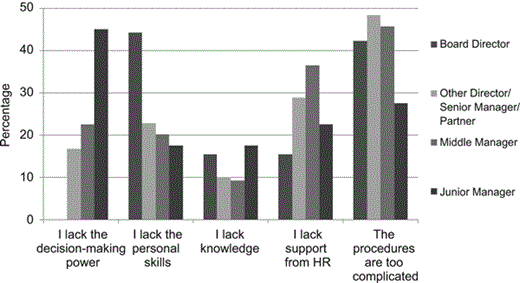
We asked managers responding to our survey how confident they feel to tackle underperformance. Only three percent said they were not confident, with over half (55 percent) reporting that they were very confident and a further 41 percent that they were somewhat confident. When asked what affected their confidence, the most common reasons were that procedures are too complicated (44 percent) and that support from HR was lacking (29 percent). A quarter (24 percent) thought they lacked the necessary personal skills, a fifth (19 percent)that they lacked the power to make decisions and a tenth (11 percent) that they lacked knowledge.
A number of other barriers to dealing with underperformance emerged from responses to open questions in the survey. Some referred to organizational culture, saying it was biased against confronting poor performers. Others felt they lacked support from more senior managers. Some felt they were personally ill-suited to managing performance, mentioning a dislike of conflict or a lack of assertiveness. Others worried about damaging their relationships with employees.
It may be no coincidence that 70 percent of managers responding to The Management Agenda 2010 survey say they feel under pressure (up from 59 percent last year). It takes time to deal properly with performance issues. Managers have told us that, when under pressure, it is sometimes quicker and easier to ignore underperformers and either allocate the work to others or do it yourself.
What helps managers to deal with poor performers?
It’s clear from our findings that managers need not only the personal skills to deal with underperformance but they also gain confidence from clear processes and a supportive organizational culture led by senior management and HR.
Confidence to confront poor performers increases with seniority. Only a third(36 percent) of junior managers reported that they were very confident compared to half (48 percent) of middle managers and three fifths of directors, senior managers and partners (63 percent) and board directors (60 percent).
This correlation between seniority and confidence seems to relate to the level of influence enjoyed by more senior managers. Junior managers are most likely to attribute their lack of confidence in tackling underperformance to their lack of decision-making power (see Figure 1).
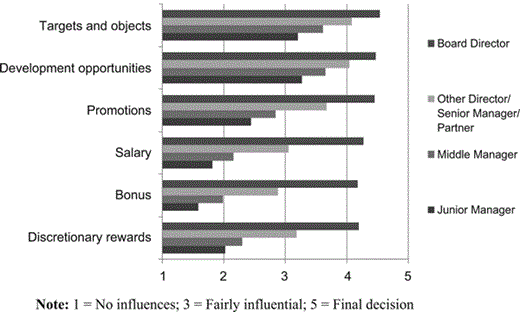
While most managers (92 percent) say that they are at least fairly influential in setting targets and objectives for their team and in relation to their development opportunities, a much smaller proportion report that they have influence over pay and bonuses. Nearly half (48 percent) report that they have little or no influence over bonuses, 44 percent have little or no influence over salaries and 39 percent little or no influence over discretionary awards.
As you would expect, the level of control managers have over their teams increases with seniority. As Figure 2 shows, we found strong relationships between role level and different aspects of influence. The greatest differences in control between senior and junior managers occur in relation to financial decisions such as setting salaries or awarding bonuses or discretionary payments. While one would expect salaries to be set according to a company-wide policy, organizations may be depriving managers of a key performance management tool if they have no influence over discretionary awards or bonuses.
Training and development for managers
In response to the recession we are seeing some of the country’s leading business schools change their MBA curricula, significantly increasing their emphasis on people management skills. Developers are recognizing that leading an engaged and productive workforce is the key to survival and growth, but perhaps organizations have yet to acknowledge that investment in learning and development is essential in building leadership and management capability.
Of the training and development interventions we asked about, it seems that coaching and mentoring are most influential in increasing managers’confidence in dealing with poor performance. More than three fifths of managers who had participated in coaching or mentoring (63 percent and 64 percent,respectively) were very confident in dealing with underperformance, compared to half of those who had not (51 percent for coaching and 53 percent for mentoring).
One in five managers, however, reported that their organizations have invested less in staff and leadership development over the last year. Maintaining investment in learning and development is particularly important in lean times when organizations need to do more with less. They need maximum performance from often scaled down workforces and this means skilling them to perform and manage effectively.
Learning and development can play a key role in helping managers to get better at dealing with poor performance, either directly through addressing skills deficits or by providing managers with the skills and confidence to address it.
Making performance management part of the culture
When seas are rough the temptation is to grip the tiller harder. But by giving managers more control and influence over rewards, helping them to develop skills and confidence and supporting them by developing a culture in which performance management is accepted and expected, you will be navigating into safer waters, where you can indeed do more with less.
The Management Agenda 2010 was carried out between July and September 2009 and surveyed 950 managers representing all levels from junior managers to board directors. They worked in a wide range of organizations, from small local companies to global multinationals and across the public and private sectors. In total, 93 percent were based in the UK. For a full copy of report, go to www.roffeypark.com/research
Jo Hennessy and Liz FinneyRoffey Park Institute
About the authors
Jo Hennessy is director of research at Roffey Park Institute and oversees Roffey Park’s extensive research agenda. A chartered occupational psychologist, she is personally involved in leading Roffey Park’s ongoing research into the transformational effects of enlightenment at work and a new study into senior leadership and employee engagement. Jo Hennessy can be contacted at: jo.hennessy@roffeypark.com
Liz Finney is a senior researcher at Roffey Park Institute in Sussex. Her recent publications include research on HR business partnering and the evaluation of OD interventions. She has conducted research in client organizations on topics including leadership and management competencies,employee engagement and development program evaluation.

