

Growing your HR brand
Article Type: HR at work From: Strategic HR Review, Volume 9, Issue 4
Short case studies and research papers that demonstrate best practice in HR
Jon Younger and Christine CleemannJon Younger is based at RBL Group and Christine Cleemann is based at RBL Group and Copenhagen Business School.
After many years, General Electric continues to have an advantaged position in attracting new customers, investors and partners, and recruiting top candidates for employment (Kiley, 2009). Well-managed brands such as GE differentiate by promising and delivering value to customers and stakeholders. But, while brands develop slowly, they quickly erode if violated. Exxon Mobil’s reputation has still not fully recovered from the Valdez oil spill disaster and management’s perceived arrogance. While Shell and BP are among the best 100 global brands, Exxon Mobil is absent despite stronger performance (Kiley, 2009).
As companies have brands, so do teams and individuals. This brief paper offers practical guidance to HR leaders and their teams on identifying their HR brand, assessing its clarity and quality, aligning practices and making it stick. It is based on our consulting and executive educational work with a wide variety of global clients including AXA, British Airways, Deutsche Post/DHL,Duke Energy, Getronics/KPN, Glaxo Smith Kline, ING, A.P. Moller-Maersk, Mars,Nokia, Novartis, PepsiCo, Pfizer, Procter and Gamble, Teva Pharmaceuticals,Takeda Pharmaceuticals, Wal-Mart and others.
HR as a brand
If a well-tended brand promises and delivers value, the starting-point is clarity of ambition. At RBL Group we call this “unity of identity”,the consistent experience we will provide our business partners and stakeholders(Ulrich and Smallwood, 2007). Stated differently, how do we want to be known?For example, the Mars HR ambition is to be the “co-pilot” (with finance) to the business head; PepsiCo HR brands itself similarly. Nokia HR defines its role as strategy partner, while Microsoft HR promises to attract and develop superior talent, and Goldman Sachs emphasizes outstanding execution. By contrast, when the ambition of HR to create value is not clear, or HR does not align ambition with action, or HR leaders feel powerless to enact their ambition, HR typically defaults into administrative, operational work. Not surprisingly, when HR cannot articulate how it adds significant value, or do so,it becomes a candidate for downsizing or outsourcing.
Elements of a strong HR brand
Our work with these and other companies points out that growing a powerful HR brand depends on four factors: ambition, agility, agency and alignment (thanks also to RBL partner Dave Ulrich for advice on this framework). Ambition is clarity of vision and purpose, and its congruence with the needs of the business. Agility is the competence and skill of the HR team to execute the ambition. Agency reflects line management support for HR’s ambition. Lastly, alignment refers to how well HR processes and measures actualize the brand. The survey in Table I, recently developed by us, offers a quick test of HR brand efficacy.
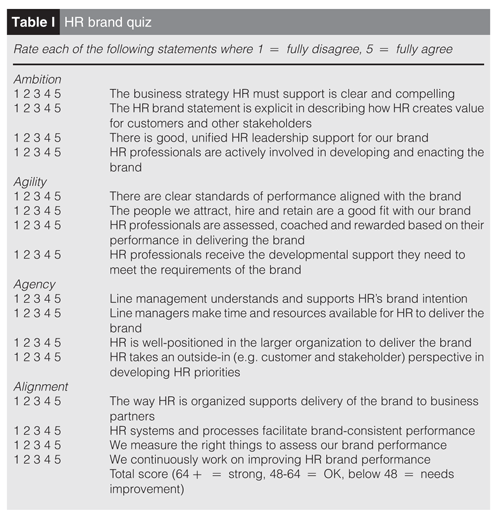
Table I HR brand quiz
How well defined is the HR brand?
In assessing your HR brand, the following considerations are helpful:
Clear and succinct. Your HR brand should pass the “elevator”test and be describable in less than 25 words or 10 seconds.
Relevance. Do business partners and key stakeholders see the brand as relevant to them in meeting their goals? Would customers recognize the HR brand as meaningful and important to the ability of the business to meet their needs? If not, reconsider.
So that… A good HR brand reflects a measurable, observable result. Is the business purpose clear? HR brands are most powerful when the end result is understood. HR understands it is a business partner… “so that the business anticipates and exceeds customer needs” or “so that the business is an innovation leader”.
Commitment. A good brand is a determined ambition, a commitment and not a wish or aspiration. If not worth fighting for when challenged, it is not the heartfelt ambition that defines a real brand.
Stretch but realistic. A strong brand statement is realistic but not easily won; it is credible but challenging. Stretch is good but within the bounds of what is achievable.
Measurable. How will you know if HR is living its brand? If the team cannot define the brand in measurable terms, keep working on it.
Making it stick
There are several things an HR leader or leadership team can do to more fully deliver the HR brand:
Demonstrate credible activism. What brands a team is what it does and how it does it. The RBL/Michigan global HR competency study points out the importance of credible activism (Ulrich et al., 2008). Is HR working on the right priorities, in the right way? Do HR leaders and professionals build relationships of trust with line business partners? How proactive is HR in consistently delivering the brand to business partners. Does the HR team take real initiative and accountability in the view of line management?
Create and reinforce opportunities to live the brand. Brand performance matures when opportunity combines with practice and discipline(Gladwell, 2008). Kellogg HR leaders start each quarterly meeting with a review of the business environment and company sales and financial results. HR leader Kathleen-Wilson Thompson points out that they do so to send a strong message throughout HR that “operating as a business partner” is a deeply held commitment. At Getronics, the Dutch high tech company, HR head Joanne Uijen-Zwueste ensures that the HR brand is reinforced through investment in the skills HR professionals need to contribute to business performance.
Find brand mentors to help along the way. The career stages research points out the importance of mentors (Dalton and Thompson, 1986;Younger and Sandholtz, 1997). We encourage HR leaders and teams to cast a wide net seeking help in implementing their brand. For example, Shelley Seifert, HR head of NCC, a leading US regional bank, brought in demographers from the Hudson Institute to better identify staffing and training implications of changing consumer banking customer demographics.
Seek feedback. The most helpful feedback is brand-relevant. Be specific about the information that the team will find most helpful. Use 360-degree feedback tools but also ongoing discussion with trusted business partners, colleagues and key stakeholders. One question we particularly like is:“Are HR actions and priorities in line with what our customers would want them to be?” Even more helpful, consider testing HR priorities with real customers.
Address derailers. A derailer is a behavioral or cultural tendency that impedes performance. Living the brand requires HR teams to regularly ask:“What is inhibiting our HR brand performance now? What are the likely or foreseeable obstacles to continuously improving our brand performance in future?”
Have a 30/365 plan. Making the brand stick requires a plan. After assessing derailers, clearly define short- and longer-term targets for improvement. We recommend an annual plan as well as an emphasis on what Shubhro Mitra, an Asia HR executive at AXA Insurance, calls the “small things,”improvements that can be planned and implemented within 30 days.
Communicate. Finally, it is essential to be explicit and proactive in communicating the HR brand ambition broadly, with line managers and stakeholders. A clear statement of brand makes targeted feedback easier, and aids the alignment of ambition and action. If they don’t line up, the brand will erode fast.
Aligning the HR brand
HR is a department in transition from administrative utility to business partner. Creating greater value for the business starts with a clear point of view – a well-defined and communicated ambition – of how HR will contribute. That point of view best begins with an “outside-in”perspective on the business strategy and what it means for customer growth and satisfaction. When the HR brand is aligned with investment and action, HR plays a critical role in organizational capability and performance.
About the authors
Jon Younger is a principal of RBL Group and leads the firm’s strategic HR practice. He is co-author of HR Competencies (Ulrich et al.,2008), HR Transformation (Ulrich et al., 2009) and many articles on HR, talent and career development and strategy implementation. He writes a weekly blog on HR executive topics called the “Human Element”for the Huffington Post (www.huffingtonpost.com/jon-younger). Jon Younger can be contacted at:jyounger@rbl.net
Christine Cleemann is a faculty partner of RBL and an assistant professor of HR strategy at the Copenhagen Business School where she researches HR strategies and implications for organizational impact and self-leadership practices. An important area of emphasis for her is integrating business and philosophy.

