
Skip to Main Content
Purpose

Previous research examining the association between brand value and sustainability has largely focused on corporate sustainability efforts measured through environmental, social and governance indices, rather than on customer perceptions of those efforts. Within the brand value chain framework, customer perceptions of brand actions are key to generating financial brand value. However, prior research focus on sustainability performance has overlooked the crucial role of customer perceptions in shaping brand value. To address this gap, this study aims to explore the effects of customer-perceived sustainability on brand value. Furthermore, this study examines the drivers (mediators) that explain the impact of customer-perceived sustainability on brand value and the variables that determine a higher or lower impact (moderators).

Design/methodology/approach

Using brand value data from Interbrand, and customer perception data from Brand Finance’s Brand Equity Monitor, a global panel-based survey with more than 150,000 respondents, the authors conducted mediation and moderation analyses to test their hypotheses.

Findings

The analysis shows that customer perceived sustainability has a positive impact on brand value. Furthermore, the findings suggest that perceived quality mediates this effect. The findings provide clarity for brand managers on how sustainability affects financial brand value and emphasize the importance of linking sustainability commercial communications to product performance to increase brand value.

Originality/value

Among the growing body of literature that explores the link between sustainability and brand value, to the best of the authors’ knowledge, this study is the first to focus specifically on perceptions of sustainability rather than sustainability actions.

Sustainability has increasingly become a significant driver of consumer purchasing decisions, particularly among younger generations (Eitelwein and Paquet, 2021; Ishaq, 2021). A recent study shows that younger consumers are willing to pay more for sustainable products (Goedertier et al., 2024). These changes in customer expectations and preferences have made sustainability a strategic imperative for marketing executives (Brown, 2021). Marketing professionals are expected to address the sustainability challenge by understanding its role as a demand driver and incorporating sustainability criteria into brand positioning, product development and promotional tactics (Kim et al., 2024; White et al., 2025). At the same time, they are tasked with demonstrating the effectiveness of such investments, particularly considering the challenging global economic conditions we are currently facing (Gartner, 2023; Papadas et al., 2024). This requires linking brand sustainability investment to business outcomes (Gibbs, 2023). In this context, financial brand value emerges as the optimal metric for marketing executives to justify investments in brand sustainability initiatives and to demonstrate their long-term effects (Brand Finance, 2024; Calder, 2020).

In fact, one of the main factors motivating corporations to incorporate sustainability considerations into product design is to improve brand value (Küçüksayraç, 2015). However, according to the brand value chain framework, for sustainability efforts to positively impact brand value, customers must first be aware and favorably view these efforts (Keller and Lehmann, 2003; Moratis, 2018; Pomering and Dolnicar, 2009). This is why companies invest in communication to create awareness about their sustainable offerings (Acuti et al., 2022).

However, communicating a company’s sustainability efforts does not always lead to a positive customer response. Academic research shows contradictory findings regarding the impact of perceived sustainability on customer response, particularly on perceived quality, which is the key perceptual driver of brand value (de Oliveira et al., 2015). Some studies show that perceived sustainability positively influences perceived quality (De Los Salmones et al., 2005; Marín-García et al., 2020), whereas others find a negative effect, particularly in utilitarian categories (Luchs et al., 2010; Newman et al., 2014; Skard et al., 2020). Regardless of the nature of this impact, according to the brand value chain framework, changes in quality perceptions lead to changes in brand value (de Oliveira et al., 2015; Swaminathan et al., 2022). These findings point to a significant (albeit indirect) effect of perceived sustainability on brand value.

Despite the recognized significance of perceived sustainability in generating (or destroying) brand value, there is a notable dearth of academic literature delving into the specific impact of sustainability perceptions on the financial value of brands.

Most prior studies have specifically examined the association between brand value and corporate sustainability performance measured through environmental, social and governance (ESG) indices, which identify the impact of business activity on the planet (Alcaide González et al., 2020; Harjoto and Salas, 2017; Ke et al., 2023; Loh and Tan, 2020; Melo and Galan, 2011; Pope and Kim, 2021; Rahman et al., 2019; Torres et al., 2012; El Zein et al., 2020). As a result, this focus has inadvertently overlooked the crucial role of customer sustainability perceptions in shaping brand value. Furthermore, these studies have not delved into the mechanisms that explain the impact of sustainability, perceived or otherwise, on the financial value of brands.

In fact, according to Kinnunen et al. (2022), a comprehensive investigation of the link between customer-perceived sustainability and brand value is missing. In a similar vein, Nguyen et al. (2015) highlight the need to quantify said impact.

We advocate the integration of customers’ perceptions of sustainability in brand valuation as an indispensable element to augment the corporate perspective on the impact of brand sustainability. Furthermore, contradictory findings on the effect of perceived sustainability on perceived quality, a key driver of brand value, and the fact that this effect depends on the product category, underscore the need to consider perceived quality and product category as crucial mechanisms in the sustainability–brand value relationship.

To this end, the purpose of this research is threefold:

  1. to investigate how customer-perceived sustainability affects brand value;

  2. to understand the mechanism that explains this relationship, specifically by exploring how perceived sustainability impacts brand value through changes in quality perceptions; and

  3. to investigate the moderating role of product category (hedonic vs utilitarian) in the relationship between customer-perceived sustainability and brand value.

This study makes several important contributions to the literature. First, it sheds light on the relationship between customer-perceived sustainability and brand value, in contrast to prior studies based on sustainability performance. Second, we explore the mechanism through which sustainability influences brand value, identifying perceived quality as a key mediating factor. This approach builds on but goes beyond prior research, which has typically treated sustainability as a standalone construct without fully examining the pathways through which it impacts financial brand value.

Using brand value data from Interbrand, and customer perception data from a Brand Finance survey, our analysis shows that perceived quality mediates the effect of perceived sustainability on brand value. This highlights the importance of linking sustainability commercial communications and advertising to product or service performance.

The structure of this article is as follows: We begin by discussing prior literature and proposing hypotheses in Section 2. In Section 3, we describe the methodology, sample, sources of secondary data used to test the hypotheses and how different variables were measured and specify the moderated mediation model. Next, we show our empirical findings in Section 4. We discuss our results, their implications, limitations and further research opportunities in Sections 5 and 6.

Existing research exploring the connection between sustainability and brand value exhibits two main problems.

First, findings on the link between sustainability and brand value are often contradictory, with different scholars differing about the nature, strength, and sign of the association between both constructs. While some authors find a positive association between sustainability and brand value (Alcaide González et al., 2020; Harjoto and Salas, 2017; Loh and Tan, 2020; Melo and Galan, 2011; Pope and Kim, 2021; Rahman et al., 2019; Torres et al., 2012; El Zein et al., 2020), others find an inverted U-shaped relationship (Qi et al., 2021) or no association between them (First and Khetriwal, 2010). More strikingly, Nguyen et al. (2015) found a negative correlation between both constructs. These mixed results suggest that the effect of sustainability on brand value may not be straightforward and may depend on the presence of moderating or mediating variables that influence the relationship. Despite this, no research has examined the mechanisms underlying the impact of sustainability on brand value.

Second, existing research exploring the connection between sustainability and brand value tends to concentrate primarily on firms’ sustainability actions rather than perceptions (see Table 1).

However, as the brand value chain framework suggests, the financial value of brands depends, to a great extent, not only on what companies do, but also on how customers perceive and react to these actions (Calder, 2020; Gupta and Zeithaml, 2006). Within this framework, positive customer responses to sustainability actions, such as improved perceived sustainability, enhance brand value, while negative responses diminish it (Keller and Lehmann, 2003; Swaminathan et al., 2022).

In line with this framework, we define customer-perceived sustainability as the set of perceptions in a customer’s mind regarding a brand’s ESG commitment and performance (Berg et al., 2022; Chiang et al., 2022; Gidwani, 2013; Kim and Choi, 2022; Rathee and Milfeld, 2023; Sahin et al., 2022).

The effects of overall customer-perceived sustainability and each one of its dimensions on customer response have been extensively studied. However, its potential to directly influence brand value has received far less attention. From the reviewed literature, only one study (Nguyen et al., 2015) has examined this relationship, reporting a negative association between perceived sustainability and brand value. These findings suggest that consumers may not always value companies’ sustainability efforts and that such efforts could even negatively impact brand value. Although these results are based on a limited sample and specific industries, they underscore the need to further explore the link between perceived sustainability and brand value. This is particularly important given the inconsistency of Nguyen et al.’s findings with studies showing a positive association between firms’ sustainability actions and brand value (cf. Table 1) and the brand value chain framework, within which positive customer responses to sustainability actions enhance brand value (Keller and Lehmann, 2003; Swaminathan et al., 2022).

To address this gap, we propose the following hypothesis:

H1.

Perceived sustainability has a positive effect on brand value.

While research on the direct link between perceived sustainability and brand value is limited, its effects on customer response have been widely studied. However, the findings regarding whether perceived sustainability is more likely to have a positive or negative effect on customer response remain inconclusive (Kunz et al., 2021).

This divergence of findings invites consideration of the underlying mechanisms that explain the impact of sustainability on brand value. Notably, extant literature on the link between sustainability and brand value has not explored the role of mediators in this relationship. However, prior research examining the link between perceived sustainability and customer response has shown that consumers often perceive a trade-off between sustainability and quality, especially in categories in which product functionality and strength are key attributes (Luchs et al., 2010, 2012). These results suggest that perceived quality may be the underlying mechanism explaining the differing findings regarding the effect of perceived sustainability on customer response. This is particularly relevant for brand value creation, as perceived quality has been found to be the most relevant perceptual driver of brand value (de Oliveira et al., 2015). Therefore, we focus on perceived quality as a potential mediator in the relationship between perceived sustainability and brand value.

Before exploring the role of perceived quality as a mediator in the relationship between perceived sustainability and brand value, we need to define what this concept means. Perceived quality is defined as a consumer’s assessment of a product’s excellence or superior performance (Zeithaml, 1988) and is regarded as a variable impacting brand value (Liu et al., 2014).

Two groups of authors found contradictory results regarding the association of perceived sustainability and perceived quality.

The first group of authors found that consumers considered sustainable products to be of lower quality and less effective than their regular counterparts (Lin and Chang, 2012; Luchs et al., 2010; Luchs and Kumar, 2017; Newman et al., 2014; Visser et al., 2018; Wood et al., 2018). This effect may be due to a compensatory inference process, where consumers assume that improving product sustainability comes at the expense of worsening product performance or quality (Newman et al., 2014). For example, Raghunathan et al. (2006) showed that more consumers perceive more sustainable and healthier food options as less tasty. In other words, consumers think of resource allocation as a zero-sum game, in which there is a trade-off between product sustainability and quality (Wood et al., 2018). According to these authors, sustainability per se, not associated with product performance leads to poorer consumer evaluations (Gershoff and Frels, 2015). These lay theories of consumer inference making suggest that perceived sustainability leads to poorer quality perceptions.

Another group of authors found a positive association between perceived sustainability and perceived quality. Yang and Basile (2019) showed that companies perceived as having robust governance procedures and fostering positive employee relationships, may also be seen as providing good quality products. In the same vein, early studies on the link between sustainability and customer response found that superior product quality improves customer response to perceived ethical firm behavior (Folkes and Kamins, 1999). Bodur et al. (2014) demonstrated that sustainability-related attributes improve perceived quality when they align with the expected category benefits.

Signaling theory can help explain the theorized positive mediating effect of perceived quality between perceived sustainability and customer response. Fisman et al. (2006) explained that sustainability initiatives may signal product quality and concern for customers in highly competitive markets with low differentiation where quality is difficult to observe, thereby generating trust with customers. For these authors, sustainability actions can serve as a signaling mechanism, suggesting that a firm’s products are reliable and that the company can be trusted to deliver high quality in areas where consumers cannot easily verify quality before purchase. In turn, improved quality perceptions, the authors explain, lead to higher returns. Similarly, Bardos et al. (2020) found that sustainability initiatives signal product quality and indirectly have a positive impact on firm value reducing firm-level systematic risk. Based on the signaling theory, if perceived sustainability leads to positive quality inferences, and improved quality perceptions, in turn, have a positive impact on the risk and return profile of a brand, then, improved perceived sustainability is likely to increase brand value. This suggests that perceived quality is a mediating mechanism between perceived sustainability and brand value.

Drawing from both consumer inference-making and signaling theories, we propose that perceived sustainability impacts perceived quality. Following the brand value chain framework, we further suggest that perceived quality, in turn, impacts brand value. This is, we propose perceived quality as a mediator of the relationship between perceived sustainability and brand value:

H2.

The effect of perceived sustainability on brand value is mediated by perceived quality.

The impact of customer-perceived sustainability on perceived quality has been found to be moderated by the hedonic versus utilitarian nature of the product category (Kim and Choi, 2022; Lin and Chang, 2012; Luchs et al., 2010; Luchs and Kumar, 2017; Montoro-Rios et al., 2008; Newman et al., 2014; Skard et al., 2020). Hedonic product categories are those in which consumer experience is paramount, while utilitarian categories are driven primarily by functionality (Valenti et al., 2023; Voss et al., 2003).

Findings from prior studies indicate that customer-perceived sustainability has a stronger impact on perceived quality in hedonic categories than in utilitarian ones (Kim and Choi, 2022; Lin and Chang, 2012; Luchs et al., 2010; Luchs and Kumar, 2017; Skard et al., 2020).

In utilitarian categories, enhancing sustainability perceptions can undermine quality-related brand associations. This is aligned with the findings of Luchs et al. (2010), who described the detrimental effect of customer-perceived sustainability on customer response in categories in which superior functional performance is crucial for consumers, such as laundry detergent, automobile tires and liquid hand sanitizer. Similarly, Skard et al. (2020) found that in strength-dependent product categories, consumers infer lower functional product quality when the product exhibits a green attribute.

This effect, known as “sustainability liability”, is particularly harmful in categories such as food (Raghunathan et al., 2006), detergent (Montoro-Rios et al., 2008), home appliances (Visser et al., 2018), hand sanitizers, car tires (Luchs et al., 2010) and sophisticated products that are highly elaborate or technological (Herédia-Colaço and Coelho do Vale, 2018). In these categories, consumers are less likely to trade off utilitarian value or functional performance for sustainability (Luchs and Kumar, 2017).

Drawing on the “sustainability liability” theory, we suggest that the type of product category (hedonic vs utilitarian) moderates the mediating effect of perceived quality on the relationship between perceived sustainability and brand value. By influencing perceived quality, the type of category can strengthen or weaken the relationship between perceived sustainability and brand value. In hedonic categories, perceived sustainability is likely to have a positive impact on perceived quality. The impact of perceived sustainability on perceived quality in utilitarian categories is likely to be negative. Therefore, the type of category will influence the strength of the indirect link between perceived sustainability and brand value via perceived quality. Accordingly, we formulate the following moderating mediating relationship:

H3.

The category in which the brand operates moderates the mediating effect of perceived quality on the relationship between perceived sustainability and brand value.

The research framework, based on the proposed hypotheses, is presented in Figure 1.

To explore the relationship between perceived sustainability and brand value, we obtained data from two separate databases to ensure independent observations.

We obtained brand value data from the 2023 “Best Global Brands” brand value ranking by Interbrand, an international brand consultancy with a legacy spanning over 50 years, renowned for pioneering brand valuation (Haigh, 1994). Every year since 2001, Interbrand has published a list of the top 100 most valuable brands. From the 2023 most valuable brands list, we obtained the brand values estimated by Interbrand for 100 brands. The sample includes brands owned by some of the world’s largest companies, with an average Enterprise Value of $178.26 bn (as of December 31, 2022).

Brand Finance, the leading independent brand valuation consultancy, provided us with perceptual data on customer-perceived sustainability and quality for those brands in the Interbrand list. The data provided by Brand Finance is obtained via their “Global Brand Equity Monitor” survey, which is conducted annually among 150,000+ respondents in 38 countries and 31 sectors and tracks more than 4,500 brands (Brand Finance, 2023). The fieldwork was conducted from August to September 2022. This study covers a wide range of brand equity metrics, including perceived commitment to sustainability and perceived quality.

Once we obtained the two bodies of data, we matched the brand values estimated by Interbrand with Brand Finance’s perceptual data. The sample with complete data for the sustainability variable included 69 brands across 13 industries and 14 countries. Among the brands included in our sample, 49% are American, 10% German, 10% Japanese and 6% French. Regarding sectors, 22% of the brands included in our sample are technology brands, followed by automotive brands (19%), financial services brands (14%) and media brands (10%).

Statistical analysis was performed using IBM® SPSS® Statistics version 27.0.1.0. and Jamovi version 2.3.38.

3.2.1 Dependent variable: brand value.

There are three well-known brand value rankings which are published annually and have been used by academics in their empirical research: Interbrand’s Best Global Brands, Brand Finance’s Global 500 and Kantar’s Brand Z Most Valuable Global Brands. In our study, brand value estimates were obtained from the 2023 “Best Global Brands” list published by Interbrand.

We discarded Kantar’s Brand Z Most Valuable Brands as a source of brand value estimates, given that this method is not certified by ISO 10668, which is a global standard setting guidelines for brand valuations exercises. Interbrand was our database of choice for sourcing brand value estimates because it is the most widely used in empirical studies on brand valuation.

We compiled the data set manually from Interbrand’s 2023 Best Global Brands report. In this report, Interbrand describes their methodology, which is compliant with the requirements of ISO 10668, a brand valuation standard which specifies the key principles that brand valuers must adhere to when conducting a brand valuation (Brand Finance, 2010). Their methodology is based on three key pillars: the financial performance of the brand, the role of the brand in the purchase decision and the brand strength relative to competitors (Interbrand, 2023).

3.2.2 Key independent variables.

To operationalize customer-perceived sustainability and customer-perceived quality, we used Brand Finance data obtained from their Global Brand Equity Monitor survey.

Brand Finance measures its customer-perceived sustainability score as the strength of a brand’s sustainability associations by asking respondents how much effort they think a particular brand is making to protect the environment and support communities and wider societies. The customer-perceived sustainability score is measured through a five-point Likert scale, where the maximum score represents “A leader in Sustainability” and the minimum score represents a brand that makes “no real effort to be a sustainable business”.

The mediating variable, customer-perceived quality, is based on clients’ ratings of a brand’s products and services compared to its competitors. This was assessed by asking customers to rate the brand’s quality on a five-point Likert scale.

Industry was measured as utilitarian and non-utilitarian classifications assigned by the authors based on Voss et al. (2003) and Sloot and Verhoef (2002).

Table 2 shows the variable descriptions, measurement and sources.

3.2.3 Moderated mediation model.

To test the theoretical model illustrated in Figure 1, we ran a moderated mediation analysis using the PROCESS macro for SPSS (Hayes, 2013).

This model investigates the effect of perceived sustainability on brand value through perceived quality, as well as the effect of perceived sustainability on perceived quality (as moderated by the category type).

The moderated mediation analysis (Model 7) was based on 5,000 bootstrap samples using 95% confidence intervals. Perceived sustainability was used as the independent variable (X), perceived quality as the mediator (M) and brand value as the dependent variable (Y). Category (W) was used as a moderator of the relationship between perceived sustainability and perceived quality.

Table 3 presents the summary statistics of the research variables. The average brand value is $38.62bn, with a median of $15.14bn.

Brands in our sample have an average perceived quality score of 3.74 and an average perceived sustainability score of 3.36, indicating that customers perceive these brands slightly better in terms of quality than sustainability.

Table 4 presents the correlation coefficients between the dependent variable (brand value from Interbrand) and the independent variables (perceived quality and perceived sustainability from Brand Finance).

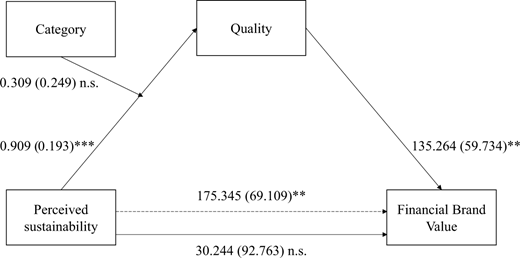
We began by running a simple regression of perceived sustainability on brand value which shows that perceived sustainability has a positive and significant effect on brand value (coeff = 175.34, t = 2.537, p = 0.014) when the mediator (perceived quality) is not accounted for. This result supports H1.

Next, we used Hayes’s SPSS PROCESS macro to run the moderated mediation model using Model 7. The results of the analysis are presented in Tables 5 and 6, respectively. The analysis indicates that, once the mediator (perceived quality) is introduced, the direct effect of perceived sustainability on brand value becomes insignificant (coeff = 30.244, t = 0.326, p = 0.745). This suggests that perceived quality fully mediates the relationship between perceived sustainability and brand value.

Moreover, the data analysis revealed a significant positive indirect effect of perceived sustainability on brand value through perceived quality, thus supporting H2. Table 6 shows that the indirect effect of perceived sustainability on brand value through perceived quality is significant at different levels of the moderator “type of category”. For utilitarian categories, the indirect effect is 164.742 with a 95% bootstrap confidence interval of [13.858, 406.223], whereas for hedonic categories, the indirect effect is 122.963 with a 95% bootstrap confidence interval of [9.932, 405.894]. Both conditional indirect effects are significant, suggesting that the indirect effect of perceived sustainability on brand value through perceived quality is significant for any type of category, utilitarian or hedonic.

Furthermore, the results in Table 5, show that the direct effect of perceived sustainability on perceived quality is not moderated by category type (coeff = 0.309, t = 1.240, p = 0.220). Therefore, H3 is not supported.

In short, the indirect effect of perceived sustainability on brand value through perceived quality is significant for brands operating in both hedonic and utilitarian categories. However, the strength of this indirect effect does not vary significantly across utilitarian or hedonic categories.

The hypotheses testing results are reported in Table 6 and Figure 2.

In this study, we used brand value data sourced from Interbrand and perceptual brand metrics obtained from Brand Finance to explore the relationship between perceived sustainability and brand value. We also delved into the factors that both mediate and moderate this relationship.

Our findings suggest that perceived sustainability has an indirect effect mediated by its impact on perceived quality. In addition, we found that perceived sustainability significantly predicts perceived quality. In the following paragraphs, we discuss theoretical contributions and managerial implications.

Our study makes significant contributions to the literature on sustainability and brand valuation. First, it adds a new perspective to the existing literature by shifting the focus from sustainability actions to sustainability perceptions and how they impact brand value. Previous studies have focused exclusively on firm’s sustainability commitment and performance and their effect on brand value. Although Chen (2010) identified the effect of perceived sustainability on customer response, they did not identify its effect on financial brand value. This is a key contribution of our study, which acquires relevance in a business environment in which marketing spend is scrutinized and cut back. Our findings clarify not only the customer response to perceived sustainability, but also how this response translates into actual financial brand value. To explain this impact, our study assessed the indirect effect of perceived sustainability on brand value via perceived quality. To the best of our knowledge, the mediating role of perceived quality in the relationship between perceived sustainability and brand value has not yet been studied. We broaden the perspective on the impact of perceived sustainability on customer response via perceived quality, understanding whether this impact translates into enhanced brand value. Sustainability affects brand growth and value, not only through actions but also via perceptions. This study sheds light on the role of sustainability perceptions in shaping brand value. Therefore, we contribute to the current knowledge on sustainability and brand value in the literature.

Second, we looked at the type of category as a moderator of the relationship between perceived sustainability and perceived quality. Our results contradict prior literature, as we found that the type of category does not significantly moderate the impact of perceived sustainability on perceived quality or the indirect effect of perceived sustainability on brand value (Luchs et al., 2010; Luchs and Kumar, 2017). While prior studies have found that sustainability has stronger effects in hedonic categories in terms of consumer response, we found that the positive impact of perceived sustainability seems to be stronger for brands operating in utilitarian categories, but this moderating effect is not significant. One plausible explanation for this that given the global inflationary pressures and the fact that sustainability has become widespread, it is now being communicated in ways that are linked to product performance such as “more efficient”, “lasts longer” or “better value for money” (Economist Impact, 2024; LEK, 2024). Therefore, independent of the category, most sustainable communications are increasingly linked to product performance and specific client benefits.

Another possible explanation for the absence of a moderating effect of category type can be found in recently published literature. While early studies proposed a “sustainability liability” effect dependent on the type of category (Luchs et al., 2010), more recent studies indicate that this effect has disappeared over time (Möller and Herm, 2021). This could explain why we found no difference in the indirect effect of sustainability on brand value between hedonic and utilitarian categories.

This research contributes to a better understanding of the relationship between overall perceived sustainability and brand value, as well as the factors underlying such relationship. Prior literature has explored the link between sustainability activities (measured through ESG indices) and brand value. We broaden this perspective by considering the effects of perceived sustainability on brand value. This finding is key to understanding the role of sustainability communications in creating brand value.

Our results provide guidance to managers in terms of when and how to communicate product sustainability. If perceived sustainability cannot be credibly linked to product performance, it may be best not to focus product positioning and promotion around sustainability, because it may destroy brand value. On the contrary, if perceived sustainability can be linked to product performance such that it has a positive effect on perceived quality, managers should emphasize the sustainable qualities of their products without fear of hurting customer response and negatively impacting brand value.

As a way of example, Stanley Cups, a blockbuster in the USA, is positioned on durability. Although this trait makes it inherently sustainable, and consumers understand this link, the focus of the message is on durability, which is more closely tied to quality and provides a clear benefit for clients. Another example comes from professional and logistic services, where a provider’s sustainability performance helps its clients with their own compliance. In general, in this type of utilitarian categories, there is more opportunity to link inherently functional attributes to sustainability.

Findings from recent research might help understand why it is important for managers to link sustainability to quality and highlight similarities with traditional non-sustainable products.

Florack et al. (2021) found that consumers perceive the differentiating attributes between classic and healthier or more sustainable products to be negative, while most shared attributes are perceived to be positive.

Importantly, consumers form expectations of product quality based on those attributes that distinguish it from existing products. This is, they rely on the negative aspects of the sustainable offers to form expectations on quality. Therefore, from a communications standpoint, it is recommendable to lead with points of parity with traditional categories rather than with sustainability. Instead of using sustainability as a stand-alone differentiating attribute, it should always be linked to quality and how it enhances product performance.

Findings from other studies suggest similar communication strategies when it comes to marketing sustainable offers. Skard et al. (2020) suggest that it is crucial to directly link sustainability-related attributes to the product’s core function for sustainability to have a positive effect on perceived quality. If sustainability-related attributes are only loosely connected to the core function, their positive impact may be weakened or even turn negative.

Table 7 summarizes the research conclusions and implications.

Our research presents several limitations. First, the study has considered the indirect impact of overall perceived sustainability on brand value via perceived quality. Future research may examine the impact of each sustainability dimension, namely environmental, social and governance, on brand value.

Besides this, it would be interesting to study the impact of specific demographic variables (such as age, gender or income). In addition, studying more granular sectors as a moderating variable in the relationship perceived sustainability and brand value can shed more light on sectors in which perceived sustainability may have a significant impact on brand value. Recent research suggests that the importance of sustainability varies by sector, and it can be very important for certain professional services such as IT services as it has a positive effect on perceived supply risk (Brand Finance, 2024; Han and Lee, 2021). With a sample with a bigger representation of each sector, the moderating role of industry could be further explored.

Third, our sample is limited to global brands and to one year (2023). Therefore, there is an opportunity to explore the evolution of the relationship between perceived sustainability and brand value over time and for smaller and regional brands.

Fourth, there is an opportunity to study the impact of sustainability perceptions from stakeholder groups other than customers on brand value.

In addition, further research could explore whether the effects of perceived sustainability on brand value vary by geography. Differences in cultural attitudes toward sustainability, economic development levels, or local regulatory frameworks could provide valuable insights into how sustainability perceptions are formed and their differential impacts on brand value across regions.

Finally, future research could explore broader strategic elements influencing the perceived sustainability–brand value connection, such as corporate purpose. Investigating how a clearly articulated corporate purpose shapes perceptions of sustainability and its subsequent impact on brand value could provide valuable insights into the mechanisms driving consumer trust and loyalty. In addition, corporate purpose could be analyzed in terms of its alignment with sustainability communication and organizational actions, shedding light on its role in mitigating the risks of perceived greenwashing.

The authors express their gratitude to Brand Finance for providing access to their 2022 Global Brand Equity Monitor data.

Declaration of conflict of interest: The corresponding author states that she is on a leave of absence from her employment contract with Brand Finance, a company that may be affected by the research reported in this paper. The rest of the authors have no known conflict of interest to disclose.

Acuti
,
D.
,
Pizzetti
,
M.
and
Dolnicar
,
S.
(
2022
), “
When sustainability backfires: a review on the unintended negative side-effects of product and service sustainability on consumer behavior
”,
Psychology and Marketing
, Vol.
39
No.
10
.
Alcaide González
,
M.Á.
,
De La Poza Plaza
,
E.
and
Guadalajara Olmeda
,
N.
(
2020
), “
The impact of corporate social responsibility transparency on the financial performance, brand value, and sustainability level of IT companies
”,
Corporate Social Responsibility and Environmental Management
, Vol.
27
No.
2
, pp.
642
-
654
.
Bardos
,
K.S.
,
Ertugrul
,
M.
and
Gao
,
L.S.
(
2020
), “
Corporate social responsibility, product market perception, and firm value
”,
Journal of Corporate Finance
, Vol.
62
.
Berg
,
F.
,
Kölbel
,
J.F.
and
Rigobon
,
R.
(
2022
), “
Aggregate confusion: the divergence of ESG ratings
”,
Review of Finance
, Vol.
26
No.
6
, pp.
1315
-
1344
.
Bodur
,
H.O.
,
Gao
,
T.
and
Grohmann
,
B.
(
2014
), “
The ethical attribute stigma: understanding when ethical attributes improve consumer responses to product evaluations
”,
Journal of Business Ethics
, Vol.
122
No.
1
, pp.
167
-
177
.
Bouvain
,
P.
,
Baumann
,
C.
and
Lundmark
,
E.
(
2013
), “
Corporate social responsibility in financial services: a comparison of Chinese and East Asian banks vis-à-vis American banks
”,
International Journal of Bank Marketing
, Vol.
31
No.
6
, pp.
420
-
439
.
Brand Finance
(
2010
), “
ISO 10668 – New international standard on brand valuation
”,
8 October
,
available at:
https://brandfinance.com/press-releases/iso-10668-new-international-standard-on-brand-valuation (
accessed
23 June 2024).
Brand Finance
(
2023
), “
Brand finance global brand equity monitor (GBEM) information and methodology
”.
Brand Finance
(
2024
), “
Sustainability perceptions index 2024
”.
Brown
,
M.
(
2021
), “
Sustainability as a strategic imperative
”,
Supply Chain Management Review
, pp.
50
-
54
.
Calder
,
B.J.
(
2020
), “
Brands: an integrated marketing, finance, and societal perspective
”,
Foundations and Trends® in Marketing
, Vol.
14
No.
4
, pp.
237
-
316
.
Chen
,
Y.S.
(
2010
), “
The drivers of green brand equity: green brand image, green satisfaction, and green trust
”,
Journal of Business Ethics
, Vol.
93
No.
2
, pp.
307
-
319
.
Chiang
,
H.T.
,
Lin
,
Y.C.
and
Chen
,
W.W.
(
2022
), “
Does family business affect the relationship between corporate social responsibility and brand value? A study in different industry Taiwan
”,
Asia Pacific Management Review
, Vol.
27
No.
1
, pp.
28
-
39
.
De Los Salmones
,
M.D.M.G.
,
Crespo
,
A.H.
and
Del Bosque
,
I.R.
(
2005
), “
Influence of corporate social responsibility on loyalty and valuation of services
”,
Journal of Business Ethics
, Vol.
61
No.
4
, pp.
369
-
385
.
de Oliveira
,
M.O.R.
,
Silveira
,
C.S.
and
Luce
,
F.B.
(
2015
), “
Brand equity estimation model
”,
Journal of Business Research
, Vol.
68
No.
12
, pp.
2560
-
2568
.
Economist Impact
(
2024
), “
How can companies create more conscious consumers?
”,
Economist Impact.
Eitelwein
,
O.
and
Paquet
,
S.
(
2021
), “
Greenwashing won’t wash – the new sustainability imperative
”.
El Zein
,
S.A.
,
Consolacion-Segura
,
C.
and
Huertas-Garcia
,
R.
(
2020
), “
The role of sustainability in brand equity value in the financial sector
”,
Sustainability
, Vol.
12
No.
1
, pp.
254
-
273
.
First
,
I.
and
Khetriwal
,
D.S.
(
2010
), “
Exploring the relationship between environmental orientation and brand value: is there fire or only smoke?
”,
Business Strategy and the Environment
, Vol.
19
No.
2
, pp.
90
-
103
.
Fisman
,
R.
,
Nair
,
V.B.
,
Allen
,
F.
,
Morck
,
R.
,
Roberts
,
M.
and
Stein
,
J.
(
2006
), “
A model of corporate philanthropy
”.
Florack
,
A.
,
Koch
,
T.
,
Haasova
,
S.
,
Kunz
,
S.
and
Alves
,
H.
(
2021
), “
The differentiation principle: why consumers often neglect positive attributes of novel food products
”,
Journal of Consumer Psychology
, Vol.
31
No.
4
, pp.
684
-
705
.
Folkes
,
V.S.
and
Kamins
,
M.A.
(
1999
), “
Effects of information about firms’ ethical and unethical actions on consumers’ attitudes
”,
Journal of Consumer Psychology
, Vol.
8
No.
3
.
Gartner
(
2023
), “
CFO perspective on the 2023 CEO survey
”.
Gershoff
,
A.D.
and
Frels
,
J.K.
(
2015
), “
What makes it green? The role of centrality of green attributes in evaluations of the greenness of products
”.
Gibbs
,
I.
(
2023
), “
Marketing leaders must tackle the measurement crisis to solve the effectiveness crisis
”,
The Drum, 30 May
.
Gidwani
,
B.
(
2013
), “
The link between brand value and sustainability
”.
Goedertier
,
F.
,
Weijters
,
B.
and
Van den Bergh
,
J.
(
2024
), “
Are consumers equally willing to pay more for brands that aim for sustainability, positive societal contribution, and inclusivity as for brands that are perceived as exclusive? generational, gender, and country differences
”,
Sustainability
, Vol.
16
No.
9
, p.
3879
.
Gupta
,
S.
and
Zeithaml
,
V.
(
2006
), “
Customer metrics and their impact on financial performance
”,
Marketing Science
, Vol.
25
No.
6
, pp.
718
-
739
.
Haigh
,
D.
(
1994
),
Strategic Control of Marketing Finance
,
Financial Times Pitman Publishing
,
London
.
Han
,
S.L.
and
Lee
,
J.W.
(
2021
), “
Does corporate social responsibility matter even in the B2B market? Effect of B2B CSR on customer trust
”,
Industrial Marketing Management
, Vol.
93
, pp.
115
-
123
.
Harjoto
,
M.A.
and
Salas
,
J.
(
2017
), “
Strategic and institutional sustainability: corporate social responsibility, brand value, and interbrand listing
”,
Journal of Product and Brand Management Ltd
, Vol.
26
No.
6
, pp.
545
-
558
.
Hayes
,
A.F.
(
2013
),
Introduction to Mediation, Moderation, and Conditional Process Analysis : A Regression-Based Approach
, (3rd ed.)
The Guilford Press
,
New York, NY
.
Herédia-Colaço
,
V.
and
Coelho do Vale
,
R.
(
2018
), “
Seize the day or save the world? The importance of ethical claims and product nature congruity
”,
Journal of Business Ethics
, Vol.
152
No.
3
, pp.
783
-
801
.
Interbrand
(
2023
), “
Best global brands 2023
”.
Ishaq
,
M.I.
(
2021
), “
Multidimensional green brand equity: a cross-cultural scale development and validation study
”,
International Journal of Market Research
, Vol.
63
No.
5
, pp.
560
-
575
.
Ke
,
D.
,
Jia
,
X.
,
Li
,
Y.
and
Wang
,
P.
(
2023
), “
Corporate social responsibility, brand value and corporate governance: new evidence from a 3SLS model
”,
Chinese Management Studies
, Vol.
18
No.
3
.
Keller
,
K.L.
and
Lehmann
,
D.R.
(
2003
), “
How do brands create value? Value emerges through a unique chain of events
”,
Marketing Management
, pp.
26
-
31
.
Kim
,
Y.M.
,
Bendle
,
N.T.
,
Hulland
,
J.
and
Pfarrer
,
M.D.
(
2024
), “
Corporate sustainability research in marketing: mapping progress and broadening our perspective
”,
Journal of the Academy of Marketing Science
, Vol.
52
No.
5
.
Kim
,
Y.
and
Choi
,
S.M.
(
2022
), “
When bad becomes good: the role of congruence and product type in the CSR initiatives of stigmatized industries
”,
Sustainability (Switzerland)
, Vol.
14
No.
13
.
Kinnunen
,
J.
,
Saunila
,
M.
,
Ukko
,
J.
and
Rantanen
,
H.
(
2022
), “
Strategic sustainability in the construction industry: impacts on sustainability performance and brand
”,
Journal of Cleaner Production
, Vol.
368
.
Küçüksayraç
,
E.
(
2015
), “
Design for sustainability in companies: strategies, drivers and needs of Turkey’s best performing businesses
”,
Journal of Cleaner Production
, Vol.
106
, pp.
455
-
465
.
Kunz
,
S.
,
Florack
,
A.
,
Campuzano
,
I.
and
Alves
,
H.
(
2021
), “
The sustainability liability revisited: positive versus negative differentiation of novel products by sustainability attributes
”,
Appetite
, Vol.
167
.
LEK
(
2024
), “
Creating value through sustainability: understanding evolving consumer choices across customer and product segments global consumer sustainability survey 2024
”.
Lin
,
Y.-L.
and
Chang
,
C.A.
(
2012
), “
Double standard: the role of environmental consciousness in green product usage
”,
Journal of Marketing
, Vol.
76
No.
5
, pp.
125
-
134
.
Lin
,
W.L.
,
Ho
,
J.A.
,
Sambasivan
,
M.
,
Yip
,
N.
and
Mohamed
,
A.B.
(
2021
), “
Influence of green innovation strategy on brand value: the role of marketing capability and R&D intensity
”,
Technological Forecasting and Social Change
, Vol.
171
.
Liu
,
M.T.
,
Wong
,
I.A.
,
Shi
,
G.
,
Chu
,
R.
and
Brock
,
J.L.
(
2014
), “
The impact of corporate social responsibility (CSR) performance and perceived brand quality on customer-based brand preference
”,
Journal of Services Marketing
, Vol.
28
No.
3
, pp.
181
-
194
.
Loh
,
L.
and
Tan
,
S.
(
2020
), “
Impact of sustainability reporting on brand value: an examination of 100 leading brands in Singapore
”,
Sustainability
, Vol.
12
No.
18
.
Luchs
,
M.G.
and
Kumar
,
M.
(
2017
), “
‘Yes, but this other one looks better/works better’: how do consumers respond to trade-offs between sustainability and other valued attributes?
”,
Journal of Business Ethics
, Vol.
140
No.
3
, pp.
567
-
584
.
Luchs
,
M.G.
,
Brower
,
J.
and
Chitturi
,
R.
(
2012
), “
Product choice and the importance of aesthetic design given the emotion-laden trade-off between sustainability and functional performance
”,
Journal of Product Innovation Management
, Vol.
29
No.
6
, pp.
903
-
916
.
Luchs
,
M.G.
,
Naylor
,
R.W.
,
Irwin
,
J.R.
and
Raghunathan
,
R.
(
2010
), “
The sustainability liability: potential negative effects of ethicality on product preference
”,
Journal of Marketing
, Vol.
74
No.
5
.
Ma
,
D.
,
Lv
,
B.
,
Liu
,
Y.
,
Liu
,
S.
and
Li
,
X.
(
2023
), “
Brand premium and carbon information disclosure strategy: evidence from China listed companies
”,
Sustainability
, Vol.
15
No.
6
, p.
5240
.
Marín-García
,
A.
,
Gil-Saura
,
I.
and
Ruíz-Molina
,
M.E.
(
2020
), “
How do innovation and sustainability contribute to generate retail equity? Evidence from Spanish retailing
”,
Journal of Product and Brand Management
, Vol.
29
No.
5
, pp.
601
-
615
.
Melo
,
T.
and
Galan
,
J.I.
(
2011
), “
Effects of corporate social responsibility on brand value
”,
Journal of Brand Management
, Vol.
18
No.
6
, pp.
423
-
437
.
Möller
,
J.
and
Herm
,
S.
(
2021
), “
Perceptions of green user entrepreneurs’ performance—is sustainability an asset or a liability for innovators?
”,
Sustainability (Switzerland)
, Vol.
13
No.
6
.
Montoro-Rios
,
F.J.
,
Luque-Martínez
,
T.
and
Rodríguez-Molina
,
M.
(
2008
), “
How green should you be: can environmental associations enhance brand performance?
”,
Journal of Advertising Research
, Vol.
48
No.
4
, pp.
547
-
563
.
Moratis
,
L.
(
2018
), “
Signalling responsibility? Applying signalling theory to the ISO 26000 standard for social responsibility
”,
Sustainability (Switzerland)
, Vol.
10
No.
11
.
Newman
,
G.E.
,
Gorlin
,
M.
and
Dhar
,
R.
(
2014
), “
When going green backfires: how firm intentions shape the evaluation of socially beneficial product enhancements
”,
Journal of Consumer Research
, Vol.
41
No.
3
, pp.
823
-
839
.
Nguyen
,
T.D.
,
Dadzie
,
C.
,
Davari
,
A.
and
Guzman
,
F.
(
2015
), “
Intellectual capital through the eyes of the consumer
”,
Journal of Product and Brand Management
, Vol.
24
No.
6
, pp.
554
-
566
.
Papadas
,
K.A.
,
Piha
,
L.
,
Davvetas
,
V.
and
Leonidou
,
C.N.
(
2024
), “
Strategizing green marketing in times of uncertainty: does it pay off?
”,
European Journal of Marketing
, Vol.
58
No.
10
.
Pomering
,
A.
and
Dolnicar
,
S.
(
2009
), “
Assessing the prerequisite of successful CSR implementation: are consumers aware of CSR initiatives?
”,
Journal of Business Ethics
, Vol.
85
No.
S2
, pp.
285
-
301
.
Pope
,
S.
and
Kim
,
J.
(
2021
), “
Where, when, and who: corporate social responsibility and brand value—a global panel study
”,
Business and Society
, Vol.
61
No.
6
, pp.
1631
-
1683
.
Qi
,
Y.
,
Chai
,
Y.
and
Jiang
,
Y.
(
2021
), “
Threshold effect of government subsidy, corporate social responsibility and brand value using the data of China’s top 500 most valuable brands
”,
PLoS One, Public Library of Science
, Vol.
16
.
Raghunathan
,
R.
,
Naylor
,
R.W.
and
Hoyer
,
W.D.
(
2006
), “
The unhealthy = tasty intuition and its effects on taste inferences, enjoyment, and choice of food products
”,
Journal of Marketing
, Vol.
70
No.
4
, pp.
170
-
184
.
Rahman
,
M.
,
Rodríguez-Serrano
,
M.Á.
and
Lambkin
,
M.
(
2019
), “
Brand equity and firm performance: the complementary role of corporate social responsibility
”,
Journal of Brand Management
, Vol.
26
No.
6
, pp.
691
-
704
.
Rathee
,
S.
and
Milfeld
,
T.
(
2023
), “
Sustainability advertising: literature review and framework for future research
”,
International Journal of Advertising
.
Sahin
,
Ö.
,
Bax
,
K.
,
Czado
,
C.
and
Paterlini
,
S.
(
2022
), “
Environmental, social, governance scores and the missing pillar—why does missing information matter?
”,
Corporate Social Responsibility and Environmental Management
, Vol.
29
No.
5
, pp.
1782
-
1798
.
Skard
,
S.
,
Jørgensen
,
S.
and
Pedersen
,
L.J.T.
(
2020
), “
When is sustainability a liability, and when is it an asset? Quality inferences for core and peripheral attributes
”,
Journal of Business Ethics
, Vol.
173
No.
1
, pp.
109
-
132
.
Sloot
,
L.
and
Verhoef
,
P.C.
(
2002
), “
The impact of brand and category characteristics on consumer stock-out reactions
”.
Swaminathan
,
V.
,
Gupta
,
S.
,
Keller
,
K.L.
and
Lehmann
,
D.
(
2022
), “
Brand actions and financial consequences: a review of key findings and directions for future research
”,
Journal of the Academy of Marketing Science
, Vol.
50
No.
4
, pp.
639
-
664
.
Torres
,
A.
,
Bijmolt
,
T.H.A.
,
Tribó
,
J.A.
and
Verhoef
,
P.
(
2012
), “
Generating global brand equity through corporate social responsibility to key stakeholders
”,
International Journal of Research in Marketing
, Vol.
29
No.
1
, pp.
13
-
24
.
Valenti
,
A.
,
Yildirim
,
G.
,
Vanhuele
,
M.
,
Srinivasan
,
S.
and
Pauwels
,
K.
(
2023
), “
Advertising’s sequence of effects on consumer mindset and sales: a comparison across brands and product categories
”,
International Journal of Research in Marketing
, Vol.
40
No.
2
, pp.
435
-
454
.
Visser
,
M.
,
Schoormans
,
J.
and
Vogtländer
,
J.
(
2018
), “
Consumer buying behaviour of sustainable vacuum cleaners – consequences for design and marketing
”,
Journal of Cleaner Production
, Vol.
195
, pp.
664
-
673
.
Voss
,
K.E.
,
Spangenberg
,
E.R.
and
Grohmann
,
B.
(
2003
), “
Measuring the hedonic and utilitarian dimensions of consumer attitude
”,
Journal of Marketing Research
, Vol.
40
No.
3
.
Wang
,
H.D.
(
2010
), “
Corporate social performance and financial-based brand equity
”,
Journal of Product and Brand Management
, Vol.
19
No.
5
, pp.
335
-
345
.
White
,
K.
,
Cakanlar
,
A.
,
Sethi
,
S.
and
Trudel
,
R.
(
2025
), “
The past, present, and future of sustainability marketing: how did we get here and where might we go?
”,
Journal of Business Research
, Vol.
187
.
Wood
,
S.
,
Robinson
,
S.
and
Poor
,
M.
(
2018
), “
The efficacy of green package cues for mainstream versus niche brands: how mainstream green brands can suffer at the shelf
”,
Journal of Advertising Research
, Vol.
58
No.
2
, pp.
165
-
176
.
Yang
,
J.
and
Basile
,
K.
(
2019
), “
The impact of corporate social responsibility on brand equity
”,
Marketing Intelligence and Planning
, Vol.
37
No.
1
, pp.
2
-
17
.
Zahari
,
A.R.
,
Esa
,
E.
,
Rajadurai
,
J.
,
Azizan
,
N.A.
and
Tamyez
,
P.F.M.
(
2020
), “
The effect of corporate social responsibility practices on brand equity: an examination of Malaysia’s top 100 brands
”,
Journal of Asian Finance, Economics and Business
, Vol.
7
, pp.
271
-
280
.
Zampone
,
G.
,
Aversano
,
N.
and
Sannino
,
G.
(
2021
), “
Effects of corporate social responsibility disclosure on brand value: an analysis of interbrand companies
”,
International Journal of Business and Management
, Vol.
16
No.
6
, p.
17
.
Zeithaml
,
V.A.
(
1988
), “
Consumer perceptions of price, quality, and value: a means-end model and synthesis of evidence author, source
”,
Journal of Marketing
, Vol.
52
No.
3
.
Zhang
,
J.
and
Liu
,
Z.
(
2023
), “
The impact of corporate social responsibility on financial performance and brand value
”,
Sustainability
, Vol.
15
No.
24
, p.
16864
.
Published by Emerald Publishing Limited. This article is published under the Creative Commons Attribution (CC BY 4.0) licence. Anyone may reproduce, distribute, translate and create derivative works of this article (for both commercial and non-commercial purposes), subject to full attribution to the original publication and authors. The full terms of this licence maybe seen at Link to the terms of the CC BY 4.0 licenceLink to the terms of the CC BY 4.0 licence.

Data & Figures

Figure 1.
Conceptual model showing Category, Perceived Sustainability, and Quality linked to Financial Brand Value through hypotheses H 1, H 2, and H 3.The conceptual model diagram shows four main labelled boxes: Category at the upper left, Perceived sustainability at the lower left, Quality with H 2 at the upper centre, and Financial Brand Value at the lower right. A horizontal arrow runs from Perceived Sustainability to Financial Brand Value and is labelled H 1. A diagonal arrow runs from Perceived sustainability towards Quality, with the arrowhead pointing to Quality. A second diagonal arrow runs from Category down towards the diagonal connection between Perceived sustainability and Quality, and this path is labelled H 3. A further diagonal arrow runs from Quality to Financial Brand Value, with the arrowhead pointing to Financial Brand Value.

Model 1: general research framework

Figure 1.
Conceptual model showing Category, Perceived Sustainability, and Quality linked to Financial Brand Value through hypotheses H 1, H 2, and H 3.The conceptual model diagram shows four main labelled boxes: Category at the upper left, Perceived sustainability at the lower left, Quality with H 2 at the upper centre, and Financial Brand Value at the lower right. A horizontal arrow runs from Perceived Sustainability to Financial Brand Value and is labelled H 1. A diagonal arrow runs from Perceived sustainability towards Quality, with the arrowhead pointing to Quality. A second diagonal arrow runs from Category down towards the diagonal connection between Perceived sustainability and Quality, and this path is labelled H 3. A further diagonal arrow runs from Quality to Financial Brand Value, with the arrowhead pointing to Financial Brand Value.

Model 1: general research framework

Close modal
Figure 2.
Model results showing coefficients linking Category, Perceived sustainability, Quality and Financial Brand Value, with significant and not significant paths.The model results diagram shows four labelled boxes: Category at the upper left, Perceived sustainability at the lower left, Quality at the upper centre, and Financial Brand Value at the lower right. A diagonal path from Category towards the connection between Perceived sustainability and Quality is labelled 0.309, in parentheses 0.249, not significant. A diagonal path from Perceived sustainability to Quality is labelled 0.909, in parentheses 0.193, with three asterisks. A diagonal path from Quality to Financial Brand Value is labelled 135.264, in parentheses 59.734, with two asterisks. Two horizontal paths run from Perceived Sustainability to Financial Brand Value. The upper dashed path is labelled 175.345, in parentheses 69.109, two asterisks, and the lower solid path is labelled 30.244, in parentheses 92.763, not significant.

The moderated mediation analyses results (Model 7 by Hayes, 2013)

Note(s): Hayes’s moderated mediation model, including path coefficients. The dotted line indicates the effect of perceived sustainability on brand value when perceived quality is not included as a mediator. *p < 0.1; **p < 0.05; ***p < 0.01

Figure 2.
Model results showing coefficients linking Category, Perceived sustainability, Quality and Financial Brand Value, with significant and not significant paths.The model results diagram shows four labelled boxes: Category at the upper left, Perceived sustainability at the lower left, Quality at the upper centre, and Financial Brand Value at the lower right. A diagonal path from Category towards the connection between Perceived sustainability and Quality is labelled 0.309, in parentheses 0.249, not significant. A diagonal path from Perceived sustainability to Quality is labelled 0.909, in parentheses 0.193, with three asterisks. A diagonal path from Quality to Financial Brand Value is labelled 135.264, in parentheses 59.734, with two asterisks. Two horizontal paths run from Perceived Sustainability to Financial Brand Value. The upper dashed path is labelled 175.345, in parentheses 69.109, two asterisks, and the lower solid path is labelled 30.244, in parentheses 92.763, not significant.

The moderated mediation analyses results (Model 7 by Hayes, 2013)

Note(s): Hayes’s moderated mediation model, including path coefficients. The dotted line indicates the effect of perceived sustainability on brand value when perceived quality is not included as a mediator. *p < 0.1; **p < 0.05; ***p < 0.01

Close modal
Table 1.

Previous empirical studies on the link sustainability and brand value

Authors and yearSample sizeMethodologyIndustrial scopeGeographic scopeTime scopeBrand value (DV) sourcesIV perceptionsIV performanceSustainability index or perceptions sourcesLimitationsFindings
First and Khetriwal (2010) 18 firmsANOVA testElectronic and electrical equipmentUSA, EU, Asia2006Interbrand XAuthors assigned values on environmental performance based on their judgementLimited sample (number of brands, industry)Environmental performance not associated to higher brand equity or brand value
Wang (2010) 81 brands, 200 firm-year observationsLinear regression modelCross-industryGlobal2005–2008Interbrand XScores were sourced from Innovest, and converted using a numerical scale, with 1 representing the “worst” and 7, the “best” in each areaThis study focuses solely on large corporations that emphasize their brandsPositive effect of prior social performance on brand value, which is amplified for smaller firms
Melo and Galan (2011) 48 firmsPanel data techniqueCross-industryUSA2001–2003Interbrand XKLD database (MSCI KLD Stats)Limited sample size, geographic scope and timeCSR has a positive impact on brand value, but to a lesser extent than firm size and other conventional financial indicators. This is due to the lack of alignment of CSR initiatives and corporate strategy
Torres et al. (2012) 57 firmsGeneral least squares (GLS) random-effect estimationCross-industryUSA, EU, Asia2002–2008Interbrand XSustainalyticsLimited sample (number of brands)CSR has a positive impact on brand value
Bouvain et al. (2013) 84 major banksANOVA and multiple regressionsFinancial services (banking)East Asia (China, Hong Kong, Japan, South Korea and Taiwan) and the USA2012Brand Finance XCSRHubLimited in terms of geographic scope, time and industry (financial services)Brand value is positively related to CSR, but different CSR factors are more relevant in different regions. In Japan and South Korea brand value is associated with a bank’s appreciation for its employees, while in China, brand value is linked to a focus on the community. In East Asia, community is most significantly related to brand value, while in the USA, caring for the environment and corporate governance are associated with brand value
Nguyen et al. (2015) 15 firms, 348 respondentsSurveyElectronics, food, clothing, financial and automobileUSA, EU, Asia2009–2011InterbrandX Perceived sustainability from surveyLimited to product categories; student surveyPerceived sustainability negatively associated to brand value
Harjoto and Salas (2017) 47 firmsStructural equations for multivariate regression analysesManufacturing sectorUSA2000–2014Interbrand XKLD database (MSCI KLD Stats)Focused on the USA, over one half of our sample operates in the manufacturing sectorCSR enhances brand value, while socially irresponsible activities destroy more brand value than what socially responsible activities build
Rahman et al. (2019) 62 firmsDynamic panel data – generalised method of moments (GMM)Cross-industryUS2000–2013Interbrand XKLD database (MSCI KLD Stats)Limited to corporate brands, rather than product brands. Small sampleCSR positively moderates the relationship between corporate brand equity and firm performance
El Zein et al. (2020) 1,100 firmsPanel data OLS model regression controlling by region and time effectsFinancial sectorUSA, EU2013–2017Estimated based on public information and Damodaran’s model XSustainalyticsLimited in terms of geographic scope and focused on the financial sectorESG positively impacts brand value
Loh and Tan (2020) 90 firms, 180 observationsRegression analysisCross-industrySingapore2016–2018Brand Finance XEach company was given a sustainability performance score based on the information that has been made publicly available through their company reports and websitesLimited in terms of geographic scope and timeGreater and higher quality sustainability disclosure leads to higher brand value
Zahari et al. (2020) 92 firmsNormality and correlation testCross-industryMalaysia2016Brand Finance XCompanies’ annual reports were reviewed for authors to manually score the companies based on ESG criteriaLimited in terms of geographic scope and timeCSR involvement (environmental, community, workplace and marketplace) improves brand value
Alcaide González et al. (2020) 13 firmsMultivariate linear regression by ordinary least squaresIT sectorUSA, Asia2000–2017Interbrand, Brand Finance, Kantar XGreen Ranking, CSR Reptrak, Finance Yahoo Sustainability, Global 100 most sustainable corporationsLimited sample (number of brands, sector)Companies better ranked in brand league tables are indeed those that report a larger amount of information in their CSR reports
Kim et al. (2024) 144 global brands, 790 observationsOrdinary least square (OLS) regression modelsCross-industryGlobal2007–2014Brand Finance XKLD (now MSCI KLD 400)Limited to the companies included in Brand Finance’s Global 500Corporate CSR activities (environment, community, employee relations and diversity) have a positive impacts on brand value, but for CSR focused on product (green products)
Zampone et al. (2021) 80 firms, 420 firm-year observationsLinear regression modelCross-industryGlobal2013–2018Interbrand XThomson Reuters EIKONLimited to the companies included in the Best Global Brands provided by InterbrandBrand value is positively related to the environmental disclosure, social disclosure, and ESG disclosure, whereas no significant correlation has been found for the governance disclosure
Rahman et al. (2019) 110 firm-year observationsLinear regression modelCross-industryUS2007–2016Interbrand XThomson Reuters EIKON (Resource use, Environmental innovation and Emission reduction scores)Limited geographic scopeThis research argued that industrial firms that actively pursue corporate environmentalism will have a higher brand value
Pope and Kim (2021) 618 firmsGlobal panel studyCross-industryGlobal2007–2013Brand Finance XASSET4 (now Refinitiv), DJSI, ETHICAL, FTSE4GOOD, G100Limited in terms of time span. No representation from Central America or AfricaCSR and brand value are positively associated, but this association has weakened over time, and CSR has stronger effects for monolithic brand architectures vs. multi-brand
Lin et al. (2021) 164 firmsDynamic panel data – Generalised method of moments (GMM)AutomotiveGlobal2011–2018Accounting goodwill or intangible assets as proxies for brand value XCSRHubLimited to automotive sectorGreen innovation strategy has a positive impact on brand value, which is stronger when a company invests more in marketing and innovation
Qi et al. (2021) 110 firms, 770 observationsHansen panel threshold regression methodCross-industryChina2012–2018World Brand Lab XShen et al. method to measure CSR strength with social contribution per shareLimited geographic scopeCSR has a significantly inverted U-type threshold effect on brand value
Chiang et al. (2022) 6,763 observationsLinear regression modelCross-industryTaiwan2014–2017Estimated by authors based on Hirose model XCorporate Governance Performance Score sourced from the Financial Supervisory Commission and Corporate Governance Center, Taiwan Stock ExchangeLimited geographic scopeA better CSR exerts a significantly positive effect on brand value, but this effect is stronger for family businesses than for non-family businesses
Ma et al. (2023) 1,515 observationsLinear regression modelCross-industryChina2010–2020World Brand Lab XScores assigned by authors based on companies´annual reports and ESG reportsLimited geographic scopeCorporate carbon information disclosure has a positive impact on brand value
Ke et al. (2023) 110 firms, 990 observationsThree-stage least squares (3SLS) methodCross-industryChina2013–2021World Brand Lab XHexun’s rating on shareholders and customers and suppliersLimited geographic scopeIncreasing investment in CSR increases brand value in the current period. This relationship is positively moderated by two corporate governance variables (size of the board of directors and the board’s proportion of independent directors) and negatively moderated by another (proportion of executive shareholdings)
Zhang and Liu (2023) 81 firms, 810 observationsLinear regression modelCross-industryChina2013–2022World Brand Lab XOverall score of CSR obtained from the Hexun and RKS databaseLimited geographic scopeCorporate social responsibility (CSR) was significantly positively correlated with financial performance and brand value
Table 2.

Variable definitions, measurement and sources

VariableDefinitionMeasurementSource
Brand valuePresent value of the projected income attributable to the brandDollar value of the brand as reported by Interbrand’s 2023 Best Global BrandsInterbrand (2023) 
Customer-perceived sustainabilityA brand’s perceived sustainability effort by customersHow much effort is <BRAND> making to protect the environment and supporting communities and wider society?
Scale: five-point Likert scale
2023 Global Brand Equity Monitor, database provided by Brand Finance
Customer-perceived qualityRelative quality of brand’s product and services compared to competing brands as perceived by customersHow would you rate the quality of this brand’s products/services compared to competing brands products/services?
Scale: five-point Likert scale
2023 Global Brand Equity Monitor, database provided by Brand Finance
CategoryType of category in which the brand operatesCategorical variable with two levels (utilitarian vs hedonic)Assigned by authors based on Sloot and Verhoef (2002); Voss et al. (2003) 
Table 3.

Sample statistics and country and sector representation for sample brands

Numeric variablesMeanMedianSDMin.Max.
Brand Value 2023 ($bn)38.6215.1480.396.03502.68
Perceived quality3.743.750.213.364.19
Sustainability score3.363.350.143.133.82
Categorical variablesProportion (%)
Utilitarian60.9
Hedonic39.1
Sector representation%
Technology22
Automotive19
Financial services14
Media10
Food7
Retail6
Beer4
Soft drinks4
Restaurants4
Engineering and construction3
Spirits3
Personal care1
Leisure and tourism1
Country representation%
USA49
Germany10
Japan10
France6
Switzerland4
South Korea4
Sweden3
China3
Netherlands3
Italy1
UK1
Spain1
Mexico1
Austria1
Table 4.

Correlation matrix

VariablesBrand Value 2023Perceived qualityPerceived sustainability
Brand Value 20231.000  
Perceived quality0.3901.000 
Perceived sustainability0.2960.6911.000
Table 5.

Model pathways and interaction results

Model pathwaysCoeffSEtp95% CI
Perceived sustainability → Brand value (direct effect)30.24492.7630.3260.745(−154.964,215.451)
Perceived sustainability → Perceived quality0.9090.1934.7100.000(0.524, 1.294)
Category−1.1820.838−1.4100.163(−2.855, 0.492)
Sust × Category0.3090.2491.2400.220(−0.189, 0.807)
Perceived quality → Brand value135.26459.7342.2640.027(16, 254.528)
Table 6.

Results of mediation and moderated mediations analyses

HypothesesPath and interactionsEstimateSE95% CIResults
H1Perceived sustainability → Brand value (total effect, not accounting for the mediator)175.34569.109(37.403, 313.286)Supported
H2Perceived sustainability → Perceived quality → Brand value (indirect effect)122.963 (Hed)103.110(9.932, 405.894)Supported
164.742 (Ut)102.818(13.858, 406.223)
H3Interactions: Sustainability × Category0.3090.249(−0.189, 0.807)Not supported
Table 7.

Conclusions and theoretical and managerial implications

ConclusionsTheoretical and managerial implications
Perceived sustainability impacts brand value through perceived qualityPerceived sustainability indirectly affects financial brand value by impacting perceived quality. Understanding this relationship helps clarify how sustainability perceptions translate into tangible financial outcomes
Sustainability effects are independent of category typeUnlike prior research, category type (hedonic vs utilitarian) does not significantly moderate the relationship between perceived sustainability and brand value. Sustainability messages are increasingly linked to product performance, making the distinction less relevant
Effective sustainability communication enhances brand valueTo maximize the impact of sustainability on brand value, brands should align sustainability-related attributes with core product functions, ensuring they contribute positively to perceived quality
Consumers evaluate sustainability in relation to qualityResearch suggests consumers form quality perceptions based on shared attributes rather than differentiating features. Sustainability should be integrated into messaging that emphasizes parity with traditional products

Supplements

References

Acuti
,
D.
,
Pizzetti
,
M.
and
Dolnicar
,
S.
(
2022
), “
When sustainability backfires: a review on the unintended negative side-effects of product and service sustainability on consumer behavior
”,
Psychology and Marketing
, Vol.
39
No.
10
.
Alcaide González
,
M.Á.
,
De La Poza Plaza
,
E.
and
Guadalajara Olmeda
,
N.
(
2020
), “
The impact of corporate social responsibility transparency on the financial performance, brand value, and sustainability level of IT companies
”,
Corporate Social Responsibility and Environmental Management
, Vol.
27
No.
2
, pp.
642
-
654
.
Bardos
,
K.S.
,
Ertugrul
,
M.
and
Gao
,
L.S.
(
2020
), “
Corporate social responsibility, product market perception, and firm value
”,
Journal of Corporate Finance
, Vol.
62
.
Berg
,
F.
,
Kölbel
,
J.F.
and
Rigobon
,
R.
(
2022
), “
Aggregate confusion: the divergence of ESG ratings
”,
Review of Finance
, Vol.
26
No.
6
, pp.
1315
-
1344
.
Bodur
,
H.O.
,
Gao
,
T.
and
Grohmann
,
B.
(
2014
), “
The ethical attribute stigma: understanding when ethical attributes improve consumer responses to product evaluations
”,
Journal of Business Ethics
, Vol.
122
No.
1
, pp.
167
-
177
.
Bouvain
,
P.
,
Baumann
,
C.
and
Lundmark
,
E.
(
2013
), “
Corporate social responsibility in financial services: a comparison of Chinese and East Asian banks vis-à-vis American banks
”,
International Journal of Bank Marketing
, Vol.
31
No.
6
, pp.
420
-
439
.
Brand Finance
(
2010
), “
ISO 10668 – New international standard on brand valuation
”,
8 October
,
available at:
https://brandfinance.com/press-releases/iso-10668-new-international-standard-on-brand-valuation (
accessed
23 June 2024).
Brand Finance
(
2023
), “
Brand finance global brand equity monitor (GBEM) information and methodology
”.
Brand Finance
(
2024
), “
Sustainability perceptions index 2024
”.
Brown
,
M.
(
2021
), “
Sustainability as a strategic imperative
”,
Supply Chain Management Review
, pp.
50
-
54
.
Calder
,
B.J.
(
2020
), “
Brands: an integrated marketing, finance, and societal perspective
”,
Foundations and Trends® in Marketing
, Vol.
14
No.
4
, pp.
237
-
316
.
Chen
,
Y.S.
(
2010
), “
The drivers of green brand equity: green brand image, green satisfaction, and green trust
”,
Journal of Business Ethics
, Vol.
93
No.
2
, pp.
307
-
319
.
Chiang
,
H.T.
,
Lin
,
Y.C.
and
Chen
,
W.W.
(
2022
), “
Does family business affect the relationship between corporate social responsibility and brand value? A study in different industry Taiwan
”,
Asia Pacific Management Review
, Vol.
27
No.
1
, pp.
28
-
39
.
De Los Salmones
,
M.D.M.G.
,
Crespo
,
A.H.
and
Del Bosque
,
I.R.
(
2005
), “
Influence of corporate social responsibility on loyalty and valuation of services
”,
Journal of Business Ethics
, Vol.
61
No.
4
, pp.
369
-
385
.
de Oliveira
,
M.O.R.
,
Silveira
,
C.S.
and
Luce
,
F.B.
(
2015
), “
Brand equity estimation model
”,
Journal of Business Research
, Vol.
68
No.
12
, pp.
2560
-
2568
.
Economist Impact
(
2024
), “
How can companies create more conscious consumers?
”,
Economist Impact.
Eitelwein
,
O.
and
Paquet
,
S.
(
2021
), “
Greenwashing won’t wash – the new sustainability imperative
”.
El Zein
,
S.A.
,
Consolacion-Segura
,
C.
and
Huertas-Garcia
,
R.
(
2020
), “
The role of sustainability in brand equity value in the financial sector
”,
Sustainability
, Vol.
12
No.
1
, pp.
254
-
273
.
First
,
I.
and
Khetriwal
,
D.S.
(
2010
), “
Exploring the relationship between environmental orientation and brand value: is there fire or only smoke?
”,
Business Strategy and the Environment
, Vol.
19
No.
2
, pp.
90
-
103
.
Fisman
,
R.
,
Nair
,
V.B.
,
Allen
,
F.
,
Morck
,
R.
,
Roberts
,
M.
and
Stein
,
J.
(
2006
), “
A model of corporate philanthropy
”.
Florack
,
A.
,
Koch
,
T.
,
Haasova
,
S.
,
Kunz
,
S.
and
Alves
,
H.
(
2021
), “
The differentiation principle: why consumers often neglect positive attributes of novel food products
”,
Journal of Consumer Psychology
, Vol.
31
No.
4
, pp.
684
-
705
.
Folkes
,
V.S.
and
Kamins
,
M.A.
(
1999
), “
Effects of information about firms’ ethical and unethical actions on consumers’ attitudes
”,
Journal of Consumer Psychology
, Vol.
8
No.
3
.
Gartner
(
2023
), “
CFO perspective on the 2023 CEO survey
”.
Gershoff
,
A.D.
and
Frels
,
J.K.
(
2015
), “
What makes it green? The role of centrality of green attributes in evaluations of the greenness of products
”.
Gibbs
,
I.
(
2023
), “
Marketing leaders must tackle the measurement crisis to solve the effectiveness crisis
”,
The Drum, 30 May
.
Gidwani
,
B.
(
2013
), “
The link between brand value and sustainability
”.
Goedertier
,
F.
,
Weijters
,
B.
and
Van den Bergh
,
J.
(
2024
), “
Are consumers equally willing to pay more for brands that aim for sustainability, positive societal contribution, and inclusivity as for brands that are perceived as exclusive? generational, gender, and country differences
”,
Sustainability
, Vol.
16
No.
9
, p.
3879
.
Gupta
,
S.
and
Zeithaml
,
V.
(
2006
), “
Customer metrics and their impact on financial performance
”,
Marketing Science
, Vol.
25
No.
6
, pp.
718
-
739
.
Haigh
,
D.
(
1994
),
Strategic Control of Marketing Finance
,
Financial Times Pitman Publishing
,
London
.
Han
,
S.L.
and
Lee
,
J.W.
(
2021
), “
Does corporate social responsibility matter even in the B2B market? Effect of B2B CSR on customer trust
”,
Industrial Marketing Management
, Vol.
93
, pp.
115
-
123
.
Harjoto
,
M.A.
and
Salas
,
J.
(
2017
), “
Strategic and institutional sustainability: corporate social responsibility, brand value, and interbrand listing
”,
Journal of Product and Brand Management Ltd
, Vol.
26
No.
6
, pp.
545
-
558
.
Hayes
,
A.F.
(
2013
),
Introduction to Mediation, Moderation, and Conditional Process Analysis : A Regression-Based Approach
, (3rd ed.)
The Guilford Press
,
New York, NY
.
Herédia-Colaço
,
V.
and
Coelho do Vale
,
R.
(
2018
), “
Seize the day or save the world? The importance of ethical claims and product nature congruity
”,
Journal of Business Ethics
, Vol.
152
No.
3
, pp.
783
-
801
.
Interbrand
(
2023
), “
Best global brands 2023
”.
Ishaq
,
M.I.
(
2021
), “
Multidimensional green brand equity: a cross-cultural scale development and validation study
”,
International Journal of Market Research
, Vol.
63
No.
5
, pp.
560
-
575
.
Ke
,
D.
,
Jia
,
X.
,
Li
,
Y.
and
Wang
,
P.
(
2023
), “
Corporate social responsibility, brand value and corporate governance: new evidence from a 3SLS model
”,
Chinese Management Studies
, Vol.
18
No.
3
.
Keller
,
K.L.
and
Lehmann
,
D.R.
(
2003
), “
How do brands create value? Value emerges through a unique chain of events
”,
Marketing Management
, pp.
26
-
31
.
Kim
,
Y.M.
,
Bendle
,
N.T.
,
Hulland
,
J.
and
Pfarrer
,
M.D.
(
2024
), “
Corporate sustainability research in marketing: mapping progress and broadening our perspective
”,
Journal of the Academy of Marketing Science
, Vol.
52
No.
5
.
Kim
,
Y.
and
Choi
,
S.M.
(
2022
), “
When bad becomes good: the role of congruence and product type in the CSR initiatives of stigmatized industries
”,
Sustainability (Switzerland)
, Vol.
14
No.
13
.
Kinnunen
,
J.
,
Saunila
,
M.
,
Ukko
,
J.
and
Rantanen
,
H.
(
2022
), “
Strategic sustainability in the construction industry: impacts on sustainability performance and brand
”,
Journal of Cleaner Production
, Vol.
368
.
Küçüksayraç
,
E.
(
2015
), “
Design for sustainability in companies: strategies, drivers and needs of Turkey’s best performing businesses
”,
Journal of Cleaner Production
, Vol.
106
, pp.
455
-
465
.
Kunz
,
S.
,
Florack
,
A.
,
Campuzano
,
I.
and
Alves
,
H.
(
2021
), “
The sustainability liability revisited: positive versus negative differentiation of novel products by sustainability attributes
”,
Appetite
, Vol.
167
.
LEK
(
2024
), “
Creating value through sustainability: understanding evolving consumer choices across customer and product segments global consumer sustainability survey 2024
”.
Lin
,
Y.-L.
and
Chang
,
C.A.
(
2012
), “
Double standard: the role of environmental consciousness in green product usage
”,
Journal of Marketing
, Vol.
76
No.
5
, pp.
125
-
134
.
Lin
,
W.L.
,
Ho
,
J.A.
,
Sambasivan
,
M.
,
Yip
,
N.
and
Mohamed
,
A.B.
(
2021
), “
Influence of green innovation strategy on brand value: the role of marketing capability and R&D intensity
”,
Technological Forecasting and Social Change
, Vol.
171
.
Liu
,
M.T.
,
Wong
,
I.A.
,
Shi
,
G.
,
Chu
,
R.
and
Brock
,
J.L.
(
2014
), “
The impact of corporate social responsibility (CSR) performance and perceived brand quality on customer-based brand preference
”,
Journal of Services Marketing
, Vol.
28
No.
3
, pp.
181
-
194
.
Loh
,
L.
and
Tan
,
S.
(
2020
), “
Impact of sustainability reporting on brand value: an examination of 100 leading brands in Singapore
”,
Sustainability
, Vol.
12
No.
18
.
Luchs
,
M.G.
and
Kumar
,
M.
(
2017
), “
‘Yes, but this other one looks better/works better’: how do consumers respond to trade-offs between sustainability and other valued attributes?
”,
Journal of Business Ethics
, Vol.
140
No.
3
, pp.
567
-
584
.
Luchs
,
M.G.
,
Brower
,
J.
and
Chitturi
,
R.
(
2012
), “
Product choice and the importance of aesthetic design given the emotion-laden trade-off between sustainability and functional performance
”,
Journal of Product Innovation Management
, Vol.
29
No.
6
, pp.
903
-
916
.
Luchs
,
M.G.
,
Naylor
,
R.W.
,
Irwin
,
J.R.
and
Raghunathan
,
R.
(
2010
), “
The sustainability liability: potential negative effects of ethicality on product preference
”,
Journal of Marketing
, Vol.
74
No.
5
.
Ma
,
D.
,
Lv
,
B.
,
Liu
,
Y.
,
Liu
,
S.
and
Li
,
X.
(
2023
), “
Brand premium and carbon information disclosure strategy: evidence from China listed companies
”,
Sustainability
, Vol.
15
No.
6
, p.
5240
.
Marín-García
,
A.
,
Gil-Saura
,
I.
and
Ruíz-Molina
,
M.E.
(
2020
), “
How do innovation and sustainability contribute to generate retail equity? Evidence from Spanish retailing
”,
Journal of Product and Brand Management
, Vol.
29
No.
5
, pp.
601
-
615
.
Melo
,
T.
and
Galan
,
J.I.
(
2011
), “
Effects of corporate social responsibility on brand value
”,
Journal of Brand Management
, Vol.
18
No.
6
, pp.
423
-
437
.
Möller
,
J.
and
Herm
,
S.
(
2021
), “
Perceptions of green user entrepreneurs’ performance—is sustainability an asset or a liability for innovators?
”,
Sustainability (Switzerland)
, Vol.
13
No.
6
.
Montoro-Rios
,
F.J.
,
Luque-Martínez
,
T.
and
Rodríguez-Molina
,
M.
(
2008
), “
How green should you be: can environmental associations enhance brand performance?
”,
Journal of Advertising Research
, Vol.
48
No.
4
, pp.
547
-
563
.
Moratis
,
L.
(
2018
), “
Signalling responsibility? Applying signalling theory to the ISO 26000 standard for social responsibility
”,
Sustainability (Switzerland)
, Vol.
10
No.
11
.
Newman
,
G.E.
,
Gorlin
,
M.
and
Dhar
,
R.
(
2014
), “
When going green backfires: how firm intentions shape the evaluation of socially beneficial product enhancements
”,
Journal of Consumer Research
, Vol.
41
No.
3
, pp.
823
-
839
.
Nguyen
,
T.D.
,
Dadzie
,
C.
,
Davari
,
A.
and
Guzman
,
F.
(
2015
), “
Intellectual capital through the eyes of the consumer
”,
Journal of Product and Brand Management
, Vol.
24
No.
6
, pp.
554
-
566
.
Papadas
,
K.A.
,
Piha
,
L.
,
Davvetas
,
V.
and
Leonidou
,
C.N.
(
2024
), “
Strategizing green marketing in times of uncertainty: does it pay off?
”,
European Journal of Marketing
, Vol.
58
No.
10
.
Pomering
,
A.
and
Dolnicar
,
S.
(
2009
), “
Assessing the prerequisite of successful CSR implementation: are consumers aware of CSR initiatives?
”,
Journal of Business Ethics
, Vol.
85
No.
S2
, pp.
285
-
301
.
Pope
,
S.
and
Kim
,
J.
(
2021
), “
Where, when, and who: corporate social responsibility and brand value—a global panel study
”,
Business and Society
, Vol.
61
No.
6
, pp.
1631
-
1683
.
Qi
,
Y.
,
Chai
,
Y.
and
Jiang
,
Y.
(
2021
), “
Threshold effect of government subsidy, corporate social responsibility and brand value using the data of China’s top 500 most valuable brands
”,
PLoS One, Public Library of Science
, Vol.
16
.
Raghunathan
,
R.
,
Naylor
,
R.W.
and
Hoyer
,
W.D.
(
2006
), “
The unhealthy = tasty intuition and its effects on taste inferences, enjoyment, and choice of food products
”,
Journal of Marketing
, Vol.
70
No.
4
, pp.
170
-
184
.
Rahman
,
M.
,
Rodríguez-Serrano
,
M.Á.
and
Lambkin
,
M.
(
2019
), “
Brand equity and firm performance: the complementary role of corporate social responsibility
”,
Journal of Brand Management
, Vol.
26
No.
6
, pp.
691
-
704
.
Rathee
,
S.
and
Milfeld
,
T.
(
2023
), “
Sustainability advertising: literature review and framework for future research
”,
International Journal of Advertising
.
Sahin
,
Ö.
,
Bax
,
K.
,
Czado
,
C.
and
Paterlini
,
S.
(
2022
), “
Environmental, social, governance scores and the missing pillar—why does missing information matter?
”,
Corporate Social Responsibility and Environmental Management
, Vol.
29
No.
5
, pp.
1782
-
1798
.
Skard
,
S.
,
Jørgensen
,
S.
and
Pedersen
,
L.J.T.
(
2020
), “
When is sustainability a liability, and when is it an asset? Quality inferences for core and peripheral attributes
”,
Journal of Business Ethics
, Vol.
173
No.
1
, pp.
109
-
132
.
Sloot
,
L.
and
Verhoef
,
P.C.
(
2002
), “
The impact of brand and category characteristics on consumer stock-out reactions
”.
Swaminathan
,
V.
,
Gupta
,
S.
,
Keller
,
K.L.
and
Lehmann
,
D.
(
2022
), “
Brand actions and financial consequences: a review of key findings and directions for future research
”,
Journal of the Academy of Marketing Science
, Vol.
50
No.
4
, pp.
639
-
664
.
Torres
,
A.
,
Bijmolt
,
T.H.A.
,
Tribó
,
J.A.
and
Verhoef
,
P.
(
2012
), “
Generating global brand equity through corporate social responsibility to key stakeholders
”,
International Journal of Research in Marketing
, Vol.
29
No.
1
, pp.
13
-
24
.
Valenti
,
A.
,
Yildirim
,
G.
,
Vanhuele
,
M.
,
Srinivasan
,
S.
and
Pauwels
,
K.
(
2023
), “
Advertising’s sequence of effects on consumer mindset and sales: a comparison across brands and product categories
”,
International Journal of Research in Marketing
, Vol.
40
No.
2
, pp.
435
-
454
.
Visser
,
M.
,
Schoormans
,
J.
and
Vogtländer
,
J.
(
2018
), “
Consumer buying behaviour of sustainable vacuum cleaners – consequences for design and marketing
”,
Journal of Cleaner Production
, Vol.
195
, pp.
664
-
673
.
Voss
,
K.E.
,
Spangenberg
,
E.R.
and
Grohmann
,
B.
(
2003
), “
Measuring the hedonic and utilitarian dimensions of consumer attitude
”,
Journal of Marketing Research
, Vol.
40
No.
3
.
Wang
,
H.D.
(
2010
), “
Corporate social performance and financial-based brand equity
”,
Journal of Product and Brand Management
, Vol.
19
No.
5
, pp.
335
-
345
.
White
,
K.
,
Cakanlar
,
A.
,
Sethi
,
S.
and
Trudel
,
R.
(
2025
), “
The past, present, and future of sustainability marketing: how did we get here and where might we go?
”,
Journal of Business Research
, Vol.
187
.
Wood
,
S.
,
Robinson
,
S.
and
Poor
,
M.
(
2018
), “
The efficacy of green package cues for mainstream versus niche brands: how mainstream green brands can suffer at the shelf
”,
Journal of Advertising Research
, Vol.
58
No.
2
, pp.
165
-
176
.
Yang
,
J.
and
Basile
,
K.
(
2019
), “
The impact of corporate social responsibility on brand equity
”,
Marketing Intelligence and Planning
, Vol.
37
No.
1
, pp.
2
-
17
.
Zahari
,
A.R.
,
Esa
,
E.
,
Rajadurai
,
J.
,
Azizan
,
N.A.
and
Tamyez
,
P.F.M.
(
2020
), “
The effect of corporate social responsibility practices on brand equity: an examination of Malaysia’s top 100 brands
”,
Journal of Asian Finance, Economics and Business
, Vol.
7
, pp.
271
-
280
.
Zampone
,
G.
,
Aversano
,
N.
and
Sannino
,
G.
(
2021
), “
Effects of corporate social responsibility disclosure on brand value: an analysis of interbrand companies
”,
International Journal of Business and Management
, Vol.
16
No.
6
, p.
17
.
Zeithaml
,
V.A.
(
1988
), “
Consumer perceptions of price, quality, and value: a means-end model and synthesis of evidence author, source
”,
Journal of Marketing
, Vol.
52
No.
3
.
Zhang
,
J.
and
Liu
,
Z.
(
2023
), “
The impact of corporate social responsibility on financial performance and brand value
”,
Sustainability
, Vol.
15
No.
24
, p.
16864
.

Languages

or Create an Account

Close Modal
Close Modal
