This study aims to examine the contribution that user-generated content (UGC) has made to marketing science over 2007–2025. Firstly, it assesses UGC research output in marketing. Secondly, it conducts scientific mapping, through co-word analysis and bibliographic coupling, to identify the main research themes, their evolution and trends. Based on the insights, an integrative theoretical framework and a research agenda are proposed to guide future studies.
The two main bibliometric analysis techniques, performance analysis and science mapping, were used to analyse UGC-focused research in marketing and to identify its main themes, evolution and current trends.
Research into UGC in marketing has evolved into ten themes: reviews, engagement, tourism, trust, motivations, machine-learning, quality, communication, image and topic modelling. These themes align with key research trends in the field: artificial intelligence, UGC effects, platform mechanisms, UGC vs FGC, multimodality and destination image.
This study goes beyond descriptive bibliometric mapping by providing the first longitudinal, field-wide synthesis of UGC research within marketing. It proposes an integrative framework that organises the field’s intellectual structure, current research trends and future directions.
1. Introduction
User-generated content (UGC) has attracted increasing attention in marketing since the advent of social media. It has been defined as digital content created and disseminated by common users through online channels (Dos Santos, 2022).
On social media, users create, share and consume peer-to-peer communication in text, audio, visual and audiovisual formats. As products and services are part of peoples’ daily lives, much consumption experience-related content is produced and spread on social media. UGC is perceived by consumers as more credible and trustworthy than firm-generated content (FGC) (e.g. Hong et al., 2022) and, therefore, strongly influences their decision-making (e.g. Grosso et al., 2024; Li et al., 2024).
Marketers are aware of the potential benefits and challenges of brand-related UGC and, therefore, encourage consumers to create and distribute content consistent with the desired brand image. This has transformed integrated marketing communications (IMC) into a hybrid paradigm where consumers and firms co-create brand messages. By prompting individuals to engage in positive brand-related UGC, organisations enhance consumer-brand relationships while obtaining persuasive material for promotional marketing campaigns (Martínez-Navarro and Bigné, 2025). UGC also represents a valuable source of consumers’ insights, warranting its integration into companies’ market analyses (e.g. Ali et al., 2022).
The growing importance of UGC for consumers and companies has captured increasing academic attention, reflected in a 331% rise in marketing-related publications indexed in the Web of Science 2015–2024 (Web of Science, 2025). Given its expanding importance, a comprehensive bibliometric mapping that structures and synthesises relevant research is timely and valuable.
Recent bibliometric and review studies have focused on specific UGC formats, such as user-generated videos (Polat et al., 2023) and UGC−FGC comparisons (Yaprak, 2024). Other review-based contributions have examined methodological issues, including data extraction methods (Iswari and Nunik Afriliana, 2022) and fake review detection (Gupta et al., 2024). Broader review studies have examined domains related to, but distinct from, marketing, such as hospitality (Kitsios et al., 2022), services (Wąsowicz-Zaborek, 2023) and communications (Naab and Sehl, 2017). To the authors’ knowledge, no previous research has offered a field-wide and longitudinal synthesis of UGC research within marketing.
Consequently, this study evaluates the intellectual structure of UGC research in marketing and identifies its main research themes, emerging trends and avenues for future investigation. Rather than providing a purely descriptive overview, the article provides a broader and more integrative understanding of the field’s development, its structural themes and its defining research trends. It provides a holistic framework of UGC within the marketing domain, a foundational reference for future scholarship and actionable managerial insights. Four research questions (RQs) are posed:
How has the publication of scientific documents about UGC in marketing evolved?
Which are the most impactful scientific documents?
What have been the main research themes on UGC in marketing?
Which research trends currently define the UGC in marketing field, and which avenues warrant future investigation?
1.1 Conceptual foundation
UGC early emerged on internet-based applications that enabled users to create, exchange and consume content online (Web 2.0). Social media provided the technological and interactional infrastructure which enabled the participation, and UGC was the output circulating across these environments (Kaplan and Haenlein, 2010).
As the field developed, marketing scholarship increasingly treated UGC as an umbrella concept. Adjacent constructs, such as electronic word-of-mouth (eWOM), user-generated ratings and consumer reviews represent narrower manifestations of the broader UGC phenomenon, each with its own process logic (Dos Santos, 2022; Wang and Rodgers, 2011). In particular, eWOM research has been progressively organised around creation, exposure and evaluation stages (Babić Rosario et al., 2020), while consumer review research has evolved into a stream examining review formats, reviewer identity, managerial interventions and platform design (e.g. Pocchiari et al., 2025).
More recent marketing research has further expanded the scope of UGC by examining multimodal, visual and platform-contingent expressions, including images, videos and hybrid brand–consumer communication formats (e.g. Hartmann et al., 2021; Kübler et al., 2024; Li et al., 2024; Singh and Pandey, 2024; Xie et al., 2014). Accordingly, UGC is now understood as a heterogeneous domain comprising multiple content typologies, persuasive mechanisms and managerial uses. This conceptual breadth fragments the field and reinforces the value of a longitudinal bibliometric synthesis.
2. Method
2.1 Bibliometric analysis
Bibliometric analysis is widely used to summarise large quantities of bibliometric data and to examine the intellectual structure and trends of research fields (Paule-Vianez et al., 2020). In this study, the two main bibliometric analysis techniques, performance analysis and science mapping, are used.
Performance analysis measures the scientific output and impact of a research topic (Donthu et al., 2021). Science mapping was conducted using co-word analysis and bibliographic coupling. Co-word analysis assesses the frequency with which two keywords co-occur, quantifying the number of documents in which they appear together (Rojas-Lamorena et al., 2022). Bibliographic coupling assesses the degree of shared citations between publications, on the basis that greater overlap reflects greater content similarity (Kessler, 1963). Comparisons are made between documents published over a relatively short period; bibliographic coupling mitigates some limitations of co-word analysis and enriches insights into recent literature (Donthu et al., 2021).
2.2 Data collection
Data were extracted from the WoS Core Collection database, widely considered the highest-quality and most impactful collection of academic publications. In addition, WoS provides cleaner data (less duplications) than Scopus (Strozzi et al., 2017). The search covered 2007–2025, taking 2007 as the start-point because the first relevant document appeared then. The following search query was applied:
TS = (“user-generated content”) OR TS=(“consumer-generated content”) OR TS=(“consumer-generated media”) OR TS=(“user-generated media”) OR TS=(“brand-related UGC”) OR TS=(“brand-generated content”) OR TS=(“user-generated branding”) OR TS=(“UGC”) OR TS=(“CGC”) AND ALL =(marketing).
Keywords were defined through a preliminary review of relevant journal articles. Related, but conceptually distinct terms (e.g. “eWOM”), were deliberately excluded to ensure conceptual precision. The authors verified that the selected terms have been consistently used to describe UGC (Wang and Rodgers, 2011), and are in line with Dos Santos (2022)’s definition.
Using the Boolean operators TS and OR, the search retrieved documents containing the specified terms within their titles, abstracts and keywords. The AND ALL operator was used to restrict results to records also containing the term “marketing”, thereby ensuring disciplinary relevance. This procedure yielded 4,311 English-language documents in the specified period. The search was conducted in October 2025, publications appearing after that being excluded.
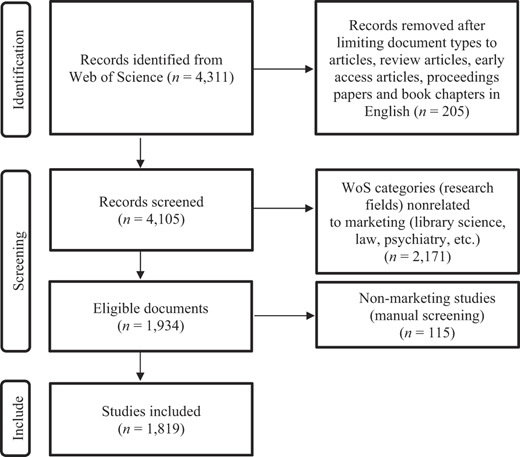
Following the PRISMA (2020) framework, the retrieved records were filtered and screened. As shown in Figure 1, automatic filters using database functions were applied to limit document types and research fields, followed by a manual screening to exclude documents outside the study’s scope. The process provided a final sample of 1,819 documents.
2.3 Data analysis
SciMAT and VOSviewer were used to conduct the performance analysis and science mapping. WoS data were imported to SciMAT (Cobo et al., 2012) to conduct the performance and co-word analysis, and to answer RQs 1–3. SciMAT offers extensive pre-processing capabilities to refine bibliometric records (Paule-Vianez et al., 2020) and is particularly suitable for longitudinal analysis.
The pre-processing stage involved identifying records with missing keywords, inserting appropriate keywords and data normalisation. Singular and plural forms were merged. In addition, abbreviations and their full forms (e.g. e-WOM vs electronic word-of-mouth), and alternative spellings (e.g. social networks, social network sites, social networking sites, SNS), were manually unified to ensure consistency.
The period 2007–2025 was divided into decades, a common practice in bibliometric studies (e.g. Rojas-Lamorena et al., 2022):
an emerging period 2007–2015 (254 publications); and
a growth period 2016–2025 (1,565 publications).
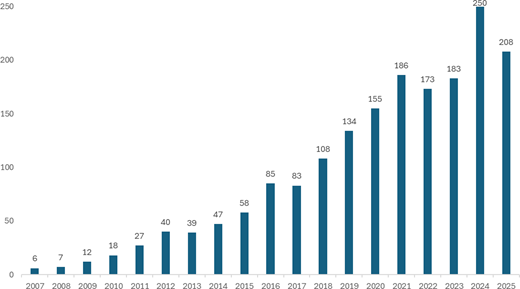
As in most bibliometric studies, more documents were published in the later period. This decade-based division aligns with the publication trend in the data set, as 2016 marked a substantial increase in research output − specifically, a 46.6% rise over 2015. Co-word analysis results for both periods are depicted in strategic diagrams.
Bibliographic coupling was conducted using VOSviewer to address RQ4, as this technique is particularly suited to identifying recent developments in a research field (Donthu et al., 2021). Accordingly, only documents published between 2023 and 2025 were analysed, yielding 641 records, in line with prior studies (e.g. Rojas-Lamorena et al., 2022).
3. Results
3.1 Scientific performance
Regarding the evolution of the publications (RQ1), Figure 2 shows an important increase, particularly from 2016. Publications appearing 2016–2025 account for 86% of 2007–2025 production. The documents attracted 98,292 citations, an average of 54 citations per document.
Table 1 lists the ten most impactful studies in the field (RQ2). The article “Users of the world, unite! The challenges and opportunities of social media” (Kaplan and Haenlein, 2010) had the highest impact. This work offered a conceptual definition of social media, distinguishing it from adjacent constructs such as Web 2.0 and, especially, UGC − emphasising that UGC is the foundational element through which users create, share and exchange information online. It also categorised social media platforms and provided guidance for firms seeking to leverage UGC-driven environments strategically.
3.2 Scientific mapping
The main themes in each period were assessed using SciMAT (RQ3). To identify current research trends and avenues for future inquiry (RQ4), bibliographic coupling was applied to publications over the most recent period (2023–2025), using VOSviewer.
3.3 Strategic diagrams
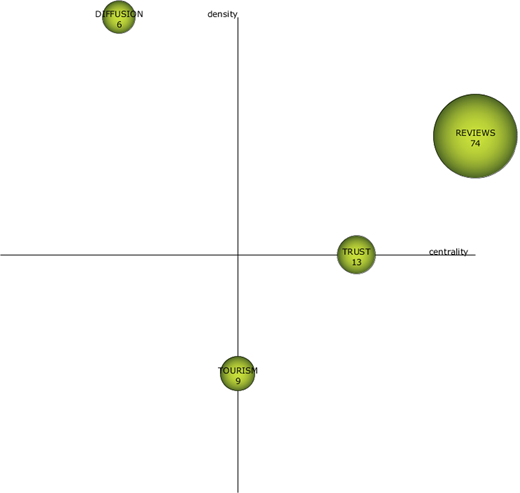
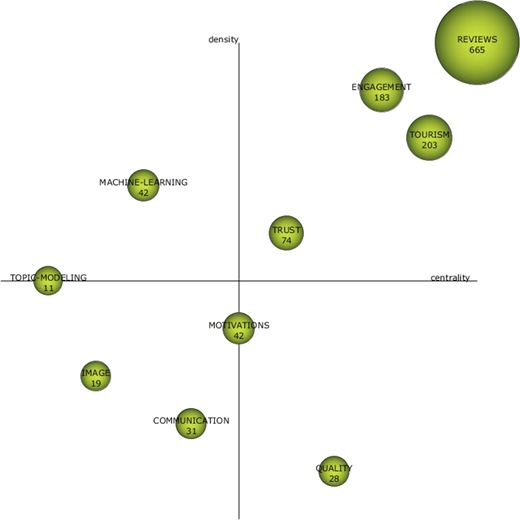
Strategic diagrams (Figures 3 and 4) depict the main themes in the field based on centrality and density. Centrality reflects the importance of a theme in the overall development of a research field, and density its level of internal development (Cobo et al., 2012). Combining these dimensions allows themes to be classified into four quadrants. Themes with high centrality and density appear in the upper-right quadrant (Q1) of diagrams and represent well-developed “motor themes”, mainstream topics very important in the research field. “Peripheral themes” appear in the upper-left quadrant (Q2, low centrality, high density), indicating specialised but relatively isolated topics. “Marginal themes” appear in the lower-left quadrant (Q3, low density, low centrality) and represent emerging topics. Finally, “basic themes” appear in the lower-right quadrant (Q4, strong centrality, low density); while underdeveloped, they are important in the field. It is important to note that the sizes of the spheres representing the themes reflects the number of articles published on each theme.
3.4 Emerging period (2007–2015)
Addressing RQ3, early research on UGC in marketing focused on four themes, reviews clearly dominating.
Reviews, the most developed theme, accounts for the most publications and citations. Related research established online reviews as market signals influencing consumer behaviours and company performance. Early work showed that reviewer cues changed how readers processed the information in the reviews and influenced their purchase decisions; this research highlighted the role of heuristic cues in consumers’ information-processing (Forman et al., 2008). This stream built on the seminal findings of Chevalier and Mayzlin (2006) and the broader eWOM literature, which established the link between online reviews and sales, demonstrating that negative reviews impact more on consumer behaviours than do positive reviews. At the content level, review informational quality and ratings were shown to explain review helpfulness (i.e. diagnosticity) and information adoption, thereby integrating dual-process theory and consumer behaviours into UGC effects research (Filieri, 2015).
In services, reviews were shown to directly influence bookings and company performance, while managerial responses to reviews created measurable business value (e.g. Xie et al., 2014); this body of work links services marketing with online reputation management.
Trust emerged as the second most important theme in this first period. Research in this cluster conceptualised how users assess credibility and trust in UGC platforms, and how these beliefs translated into information adoption, attitudes and behavioural intentions. Source credibility theory (Hovland et al., 1953) predominates in this cluster.
Studies examined the antecedents of the trust consumers develop towards UGC platforms, such as information quality, website quality and prior experience, demonstrating that greater trust enhances information. Channel comparison studies consistently revealed that UGC is trusted more by consumers than are marketer-controlled channels, particularly for experience goods (e.g. Dickinger, 2011). In e-commerce, UGC ratings were found to mitigate perceived transaction risk, and enhanced perceptions of product quality and purchase intentions (Flanagin et al., 2014). Taken together, these studies positioned trust as a mechanism through which UGC becomes persuasive and central to consumers’ decision-making.
Diffusion. Studies in this cluster explained how UGC spreads through platform architectures and social connections, linking diffusion dynamics, social contagion theory (Christakis and Fowler, 2013) and network analysis to marketing communications, media planning and brand management.
Studies conducted into video-sharing platforms emphasised how the size, structure and network position of creators and viewers determined both the reach and impact of UGC, challenging traditional peer-effects literature and earlier diffusion models (e.g. Bass model) which failed to distinguish among different types of social processes (Susarla et al., 2012; Yoganarasimhan, 2012). Cross-platform analyses showed that brand-related UGC adopts different communicative functions on YouTube, Facebook and X, offering actionable insights for content strategy management (Smith et al., 2012).
Finally, the theme tourism positioned UGC as both a behavioural influence on travellers and a valuable data source for destination and hospitality intelligence. Early studies recognised blogs and Web 2.0 platforms as tools for market intelligence and relationship building by destination management organisations (DMOs). Subsequent research used hotel reviews to benchmark customer satisfaction (Zhou et al., 2014) and to analyse brand equity dimensions in hospitality settings (Callarisa et al., 2012). These studies evidenced the importance of UGC for companies’ quality control and positioning.
Experimental evidence from consumer behaviour research demonstrated that, during trip planning, friends’ social media comments influenced travellers’ perceptions of website quality, and hotel booking intentions, through trust and attitudes (Ladhari and Michaud, 2015). Complementarily, mixed-methods findings indicated that the influence of UGC on travellers’ behaviours depends on perceived content value, its credibility and creator-audience similarity (Herrero et al., 2015).
3.5 Growth period (2016–2025)
The research covered ten themes (Figure 4), reviews, tourism, engagement and trust emerging as the most important, impactful and well-developed.
Reviews. Research published on reviews in the growth period evolved from establishing review effects to systematising analytical pipelines encompassing prediction and managerial action, while identifying boundary conditions, such as device type and response strategies. This cluster integrated computational text analysis with managerial outcomes, positioning reviews as operational inputs for companies’ decision-making in areas such as pricing and service improvement (e.g. Guo et al., 2017; Li et al., 2023).
In the service sector, large-scale text analytics (e.g. latent Dirichlet analysis − LDA) were used to extract satisfaction drivers and differences across consumer segments, transforming unstructured data into diagnostic quality indicators (e.g. Guo et al., 2017). Consumer review-based studies also quantified companies’ performance elasticities and managerial levers, with evidence showing that review valence is more impactful than is volume on hotel performance (Yang et al., 2018), and that reviews predict company survival (Li et al., 2023).
Engagement. Research examined how UGC activates engagement, and how engagement translates into persuasion and purchasing behaviours. Reviews conceptualised engagement as a multidimensional construct, and proposed integrative frameworks linking its antecedents and consequences (e.g. Babić Rosario et al., 2020; Saikia and Bhattacharjee, 2024) to dominant theories, such as uses and gratification theory (Blumler and Katz, 1974) and social identity theory (Tajfel and Turner, 2004).
Empirical findings indicated that engagement patterns depend on UGC valence and type, and on personality traits. For instance, negative posts predominate on Facebook business pages, and behavioural engagement varies according to post characteristics (Yang et al., 2019). Similarly, studies showed that UGC creators are more likely to engage in positive brand advocacy than in negative posting, confirming the asymmetry of engagement behaviours (Bilro et al., 2019). Complementary evidence showed that UGC capable of eliciting engagement increases purchasing behaviours, positioning engagement as a measurable driver of marketing performance (e.g. Malthouse et al., 2016). Overall, this cluster reflects a shift from regarding engagement as the user’s online reaction, to conceptualising it as a central mechanism linking exposure to UGC to persuasion and marketplace outcomes.
Tourism. Research into tourism instrumentalised UGC as a decision-support system for destinations and hospitality firms. At the destination level, UGC has become a tool for strategic intelligence and image auditing, enabling comparisons to be made between supply-side projected images and demand-side perceived images (e.g. Lee and Park, 2023; Marine-Roig and Ferrer-Rosell, 2018). This stream also advanced place branding research through visual and semantic analyses of place attributes, practices and personality (Taecharungroj and Mathayomchan, 2019).
Methodologically, there was a focus on enhancing measurement validity in text mining and sentiment analysis. Kirilenko et al. (2018) compared four automated sentiment analysis methods applied to travel-related UGC and found that support vector machines achieved the highest accuracy and most closely approximated human ratings, while SentiStrength performed best on short social-media content.
Trust. Research in this cluster integrated algorithmic diagnostics (e.g. machine learning, neural networks) with classic persuasion frameworks, such as the elaboration likelihood model (ELM), to explain when and why UGC is perceived as credible, trustworthy and persuasive (e.g. Cheng et al., 2019; Moradi and Zihagh, 2022; Srivastava and Kalro, 2019).
In sharing-economy contexts, Cheng et al. (2019) modelled trust formation, revealing aesthetic appeal, host reputation, service location, repurchase intentions, overall evaluations and service descriptions as key antecedents of guests’ perceived trust. Complementary research, using cognitive heuristic approaches, showed that reviewer expertise and review features (i.e. message content and style, rating consistency, review extremity, valence and length) explain perceived review credibility and helpfulness (Filieri, 2016; Lo and Yao, 2019).
Beyond explicit cues, latent semantic features also improved predictions of review helpfulness, suggesting that trust is also influenced by deeper linguistic and argument-quality signals (Srivastava and Kalro, 2019), thereby underscoring the importance of ELM-based persuasion factors. Indeed, a meta-analysis by Moradi and Zihagh (2022) confirmed the importance of ELM mechanisms in explaining how consumers process and adopt UGC, highlighting perceived usefulness and credibility as key drivers of behavioural outcomes.
Machine learning is a highly specialised, yet relatively isolated, topic that extends beyond methodological benchmarking to improve how marketing scholars infer consumer evaluations from large-scale UGC. While studies did compare alternative approaches for automated sentiment classification and highlighted performance–validity trade-offs in model selection (e.g. Alantari et al., 2022; Hartmann et al., 2023), their broader contribution lies in showing that machine learning can identify latent evaluative patterns embedded in consumer expressions. Research captured not only sentiment polarity but also theoretically important marketing outcomes. For example, multimodal applications were used to predict engagement and purchasing outcomes (Hartmann et al., 2021), while hybrid models combining genetic algorithms and artificial neural networks were applied to brand-related images to predict brand love, loyalty and WOM endorsement (Kaiser et al., 2020). More recent research using generative artificial intelligence (AI) and transfer learning suggests that machine learning identifies functional, emotional and social dimensions of customer experience in naturally occurring UGC that influence customer satisfaction (Dahish et al., 2025).
The theme motivations investigated why consumers engage in UGC, distinguishing between intrinsic and extrinsic incentives, while showing that platform design moderates both. In luxury settings, it was shown that UGC was driven by entertainment, brand love, perceived brand equity, self-enhancement and aesthetic appeal, alongside informational needs such as content relevance (Bazi et al., 2020). In online communities, it was seen that personality traits and community dynamics influenced UGC creation (Soylemez, 2021).
In knowledge-sharing and review platforms, studies revealed that incentive hierarchies and reputation systems (e.g. status badges) increased contribution effort and probability, although these effects attenuated over time, leading to a decrease in contribution quality (e.g. Goes et al., 2016). Monetary rewards, in turn, proved ambivalent, highlighting the need for careful incentive design (e.g. He et al., 2023).
Overall, findings in this cluster align with the seminal works of Hennig-Thurau et al. (2004) and Muntinga et al. (2011), but extend them by showing that UGC creation is motive-driven and shaped by the socio-technical environments in which participation is rewarded, recognised and sustained.
Communication. In this cluster, brand-related UGC is conceptualised as a strategic marketing communication system, a heterogenous set of persuasive message forms whose effectiveness depends on message design, source effects, contextual cues and platform-mediated exposure conditions. Kim and Song (2018) demonstrated that sponsorship interacts with content type to influence consumer responses: experience-centric UGC elicits more favourable reactions in unpaid settings, whereas promotional content performs better under sponsored conditions.
At the message level, studies into creative message strategies showed that emotional appeals in Instagram-based UGC elicited more digital engagement than did informative appeals (Rietveld et al., 2020). Farace et al. (2017) showed that selfies are more likely to elicit comments, thereby identifying micro-mechanisms of participatory communication. Recent research further suggests that the impact of UGC is also conditioned by algorithmic curation, as recommendation systems shape exposure patterns, redirect attention and increase the visibility of socially central users and selected content (Liu and Cong, 2023).
Image. This emerging theme conceptualises UGC as a lens through which brand and destination images are perceived, constructed and audited, thereby positioning it as a strategic data source for marketing intelligence.
Strategically, UGC has been shown to co-create and reshape destination and event brand images through sentiment shifts and framing effects. For instance, during crises, negative sentiment was found to attach more strongly to host destinations than to events (Morgan et al., 2021), while coupled framing and online brand advocacy helped protect and restore destination image (Wilk et al., 2024). These findings underscore the need for real-time, adaptive image management in UGC settings.
Platform architectures play a decisive role in shaping brand image co-creation: UGC on TripAdvisor projected sincere brand personality, whereas Booking.com emphasised excitement-oriented traits (Borges-Tiago et al., 2021). Again, platform-specific monitoring and interpretation of UGC was shown to be important.
Recent studies have raised ethical concerns, particularly regarding indigenous locations and taking selfies in dark heritage sites, highlighting the need for responsible destination image governance on social media (e.g. Piscarac and Yoo, 2025).
Topic modelling, particularly through LDA-based approaches, was consolidated as a framework for identifying the latent thematic structure of UGC and translating unstructured consumer discourse into marketing insights. Consistent with Bendle and Wang (2016) call to “uncover the message” in big-data contexts, Guo et al. (2017) extracted dimensions of hotel service satisfaction from UGC and identified differences across demographic segments, showing that UGC can inform theory-building about how consumers structure service evaluations. Related studies combined topic modelling with sentiment analysis to identify tourists’ perceptions of the strengths and weaknesses of destinations (e.g. Ali et al., 2022), while others linked topic structures to behavioural and market outcomes, such as competitive spill-overs in service demand (e.g. Cho et al., 2024).
Quality. This basic theme conceptualised UGC as a signal and a source for inferring and shaping perceived service quality. Research leveraged UGC to extract quality dimensions and connect them to consumer outcomes.
In hospitality, studies mined textual and rating data to identify the most predictive attributes of guest satisfaction (e.g. Lee et al., 2020). They showed that UGC is a traceable proxy for quality evaluation and service improvement. At content level, emotional and rational cues in reviews were shown to enhance consumer perceived value, which in turn drives impulse buying and purchase intentions (Cheung et al., 2022). From the company angle, recent SERVQUAL-related research demonstrated that, beyond traditional quality dimensions, price-place configurations and experiential factors are critical for achieving high service ratings (Rassal et al., 2024). Taken together, this cluster positions UGC as an ongoing external audit of service performance, through which firms can monitor, interpret and respond to consumer-defined quality criteria.
3.6 Research trends and proposed agenda
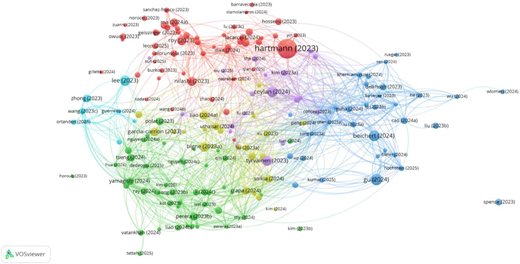
This section identifies current research trends in UGC in marketing and avenues for future inquiry (RQ4). The results of the bibliographic coupling are depicted in a networked map (Figure 5), with each node representing a scientific article, and the links between the articles representing bibliographic couplings. Node size reflects relative importance, while distance indicates thematic proximity. The articles are coloured based on their cluster/stream of research. Articles belonging to one cluster (e.g. purple) may appear close, in the map, to articles from other clusters (e.g. yellow). This indicates thematic overlap or an intermediate position between adjacent research areas.
Six clusters were identified, corresponding to research trends in the field of UGC in marketing:
artificial intelligence;
UGC effects;
platform mechanisms;
UGC vs FGC;
multimodality; and
destination image.
Based on these trends, Table 2 proposes a future research agenda.
Cluster 1 (red) is the “artificial intelligence” theme. Articles examined how AI techniques transform UGC into indicators of service experience and connect the indicators to evaluative outcomes, such as satisfaction and trust. It also highlights the growing role of AI in generating synthetic reviews and other forms of seemingly organic content.
In tourism services, AI-driven sentiment analysis was used to align narrative tone with star ratings, identifying discrepancies between textual valence and numeric scores in reviews of destinations (Bigne et al., 2023). Advanced AI techniques identified the service attributes most important to satisfaction and trust in hospitality services (e.g. Shahhosseini and Khalili Nasr, 2024). Beyond tourism, integrated aspect-based sentiment analysis (ABSA), using pre-trained transformer models, supported recommender and decision-support systems by transforming aspect-level sentiments from reviews into ranked personalised recommendations (e.g. Ray and Singh, 2025).
This trend should not be understood only in analytical terms. Generative AI is also transforming the very nature of UGC, as it can help produce synthetic reviews and other forms of seemingly organic content, which may undermine perceived trust and authenticity (Pocchiari et al., 2025). Future research in this stream should enhance and diversify AI and deep learning models for UGC analysis, expand data sources and application contexts to strengthen the generalisability and depth of insights derived from UGC (Hartmann et al., 2023) and examine the consequences of AI-manipulated UGC.
Cluster 2 (green) covers “UGC effects”.UGC is examined as a form of market communication that drives consumer trust, brand-related activities and behavioural intentions.
In tourism branding, destination-related UGC posted in Instagram was shown to stimulate consumption, sharing and content creation behaviours, identifying which content configurations most effectively activate brand-related engagement (Grosso et al., 2024). In social commerce, UGC was associated with brand trust and engagement mechanisms in platform-mediated environments (George et al., 2023). Research on Gen Z travellers further revealed that UGC and interactive social atmospheres enhanced trust in UGC-based travel applications (Tseng et al., 2024).
Overall, this cluster consolidates UGC as an influential form of market communication whose effectiveness depends on content characteristics and situational conditions. Future research should explore new variables, compare UGC produced by different sources and endorsers and refine methodological approaches (Grosso et al., 2024; Hariningsih et al., 2025; Nguyen et al., 2023; Wei et al., 2023).
Cluster 3 (blue) covers “platform mechanisms”. Studies examined the platform-level mechanisms through which UGC influences consumer behaviours and company performance.
Evidence from Amazon Answer indicated that Q&A systems affect sales outcomes (Khern-am-nuai et al., 2024). Platform endorsement mechanisms, such as votes and badges, were found to stimulate users’ contribution activity (Zhou et al., 2023). Extending this perspective, Hochstein et al. (2025) conducted a meta-analysis that demonstrated that digital trust features moderate the UGC−performance relationship.
Overall, this cluster highlights how platform architecture and trust-enabling mechanisms mediate the economic and behavioural impact of UGC on consumers. Future research should examine how platform features, governance, moderation and curation practices shape consumers’ evaluations of, and digital trust in, UGC, and how specific UGC formats influence their decision-making processes (Hochstein et al., 2025; Khern-am-nuai et al., 2024).
Cluster 4 research (yellow) addressed “UGC vs FGC”. Studies compared the influence of UGC and FGC on consumer engagement, satisfaction and decision-making.
At the message level, Barquero Cabrero et al. (2023) demonstrated that FGC achieves similar levels of likes as UGC, but significantly fewer comments. Textual analyses revealed that UGC and FGC contribute differently to satisfaction formation, UGC exerting a stronger effect. However, managerial responses to negative comments significantly improved satisfaction, underscoring the value of content-mix optimisation (Li et al., 2024).
Studies in restaurant and tourism contexts showed that consumers integrate UGC and FGC during pre-choice information search, relying on both sources (Liu and Chong, 2023; Uthaisar et al., 2024). Overall, this cluster challenges the simplistic assumption that UGC always dominates FGC, suggesting instead that both forms operate through distinct but complementary persuasive functions. Future research should examine company intervention in consumer-led spaces (Pocchiari et al., 2025), new platforms and under-researched contexts, with greater emphasis on interaction between UGC and FGC (e.g. Crapa et al., 2024; Li et al., 2024).
Cluster 5 (purple) encompasses the theme “multimodality”. Studies explored how UGC combining text, images and videos, enhanced consumer understanding, engagement and persuasion. Multi-method studies demonstrated that incorporating photos into reviews increased their perceived helpfulness, with semantic congruence between image and text facilitating cognitive processing (e.g. Ceylan et al., 2024). Similarly, studies revealed that images enhance review helpfulness for hedonic or experience-based products, particularly when they depict product use and are accompanied by short text (Kübler et al., 2024). Furthermore, recent social commerce studies suggest the joint effects of text, images and videos must be examined, this integration being a key research gap (Singh and Pandey, 2024).
Overall, this cluster reflects a multimodal turn in UGC research, whereby consumer-generated meaning emerges from the interaction of verbal and visual cues rather than from text alone. Future research should examine novel multimedia combinations, assess content misalignment between textual and visual cues and improve emotion detection using emerging technologies (Bigne et al., 2024; Ceylan et al., 2024; Jia et al., 2023; Kübler et al., 2024).
Cluster 6 (cyan) covers the theme “destination image”. This research conceptualised destination image as co-constructed through UGC, with travellers’ narratives and visual content collectively shaping place perception.
Mixed-methods approaches identified the cognitive and affective dimensions of destination image, while revealing cross-cultural differences in tourists’ evaluations (Lee and Park, 2023). In this line, content and social network analyses identified destination image attributes in UGC (Guerreiro et al., 2024), and analysed interrelations across these attributes, leading to a classification of destinations into urban, scenic and lifestyle categories (Zhong et al., 2023). In nature-based tourism contexts, Araujo-Batlle et al. (2023) found that users iconised destinations through selfie posting; however, this practice conflicts with conservation objectives, as increased visitor numbers challenge sustainability.
Overall, this cluster advocates that destination image is a dynamic and collectively negotiated outcome of user practices and cultural interpretation. Future research should examine how destination images projected by DMOs and generated by users relate to tourists’ visual perceptions (Torres-Pruñonosa et al., 2024), and examine the predominance of aesthetics-driven processing of idealised UGC (Ortanderl and Bausch, 2023) and the moderating role of cultural and psychographic factors in destination image formation (Lee and Park, 2023).
4. Discussion and implications
The usefulness of UGC for marketing has been widely acknowledged. Since 2007, academics have contributed both conceptually and empirically to advancing knowledge on UGC within marketing. Although previous bibliometric studies have synthesised literature focused on specific contexts and methodological dimensions, no field-wide, longitudinal systematisation of the intellectual structure of UGC in marketing has been offered. Addressing this gap, this study not only catalogues prior work, it reorganises a body of knowledge into a comprehensive framework and structured research agenda for UGC scholarship.
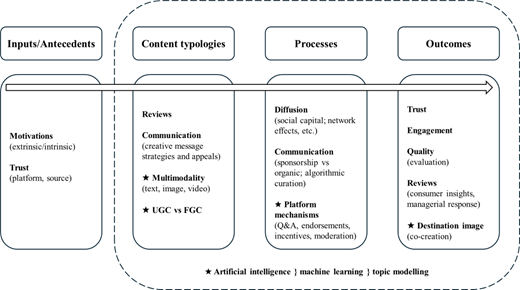
Our findings reveal that UGC research in marketing can be synthesised in an inputs–typologies–processes–outcomes framework that captures, organises and theoretically interprets the field’s intellectual structure. As Figure 6 illustrates, themes identified across the periods, and corresponding research trends, can be positioned in one or more stages of the model. Across the framework, AI, particularly machine learning and topic modelling, emerged as a transversal stream. Tourism also is a cross-cutting domain, evidencing its enduring importance in comparison to other sectors.
4.1 Inputs/antecedents
The mapping of inputs and antecedents advances UGC research by showing that engaging in UGC cannot be reduced to a purely expressive or spontaneous act. Earlier works largely framed engagement in UGC as the outcome of individual-level drivers (e.g. self-expression, utility seeking, social approval) (Hennig-Thurau et al., 2004; Muntinga et al., 2011). The present study confirms these motives but also that users must trust UGC and the platforms that feature it before they will place reliance on them (Dickinger, 2011). Thus, the first stage of the framework captures the motivational and trust-related conditions underlying the generation of UGC and its persuasive power.
From a theoretical perspective, this first stage positions UGC research beyond a voluntaristic view of participation. UGC appears when users are willing to generate, attend to and rely on content within digitally mediated environments. From a managerial perspective, firms should appeal to the motivations that drive UGC creation among their target audiences while fostering baseline trust in the relevant environments.
4.2 Content typologies
The second stage of the model reveals a theoretical evolution in how UGC is conceptualised at message level. Reviews are no longer treated as a single format, but as structured persuasive artefacts whose content properties (text, ratings, justifications) determine credibility and diagnosticity. Consequently, firms/platforms should prioritise reviews containing concrete experiential justifications rather than relying solely on star ratings, as richer content is perceived as more helpful (Filieri, 2016; Lo and Yao, 2019). In this regard, the growing role of AI introduces a trust paradox: while AI enhances firms’ capacity to analyse UGC, it may also weaken the authenticity and trustworthiness users traditionally attribute to it if they see it as AI-generated, or when it is manipulated through AI (Pocchiari et al., 2025).
In parallel, research into communications demonstrated that UGC frequently deploys emotional, experiential, identity-based and authenticity-driven appeals, extending beyond functional information (e.g. Dahish et al., 2025). Managerially, this suggests that brands should encourage consumer narratives conveying personal experience, authenticity and aesthetic self-expression to foster engagement in popular platforms such as Instagram (Rietveld et al., 2020).
Two research trends emerged in this stage. Firstly, multimodality: UGC is no longer predominantly text-based; images, short-form videos, livestreams and other visual formats have been theorised as being extensions of consumer expression. This “multimodal turn” reconceptualises UGC as experiential evidence − showing rather than merely telling − and calls for an integrated analysis of textual and visual signals to understand how meaning is constructed (e.g. Singh and Pandey, 2024; Kübler et al., 2024). Secondly, UGC–FGC comparisons challenge the assumption that peers are always more credible than brands; effective strategies complement brand statements with credible UGC.
4.3 Processes
The processes stage explains how UGC circulates and acquires influence through diffusion dynamics, communicative framing and platform mechanisms. The treatment of diffusion as a networked and orchestrated process marked an evolution beyond early WOM perspectives that assumed it spreads organically. Evidence showed that users’ social capital and network position condition reach and impact (e.g. Susarla et al., 2012; Yoganarasimhan, 2012), making UGC visibility a function of who speaks and where they are positioned in the interaction network, not merely what is said. Research in the communication cluster also showed that consumer responses to UGC varied based on whether it was sponsored or unpaid, as its circulation is no longer understood as purely organic (Kim and Song, 2018). Recent research expanded this logic by showing that moderation systems, incentive architectures, Q&A features and platform curation also shape contribution activity and exposure patterns, as algorithms redirect attention and reorganise content visibility and user interest (e.g. Khern-am-nuai et al., 2024; Liu and Cong, 2023; Zhou et al., 2023).
Taken together, these findings suggest that UGC exposure and persuasive power are not based solely on content, but produced also through the interplay of social diffusion, communicative framing and technical structuring. Companies should treat initiator selection, sponsorship, amplification and visibility management as interdependent decisions, while recognising the credibility trade-offs that may emerge when intervention is misaligned with audience expectations.
4.4 Outcomes
The outcomes stage identifies how UGC creates value when it circulates in the marketplace: Firstly, treating trust as an outcome refines how credibility is understood: it is both a precondition for engaging in UGC and an outcome of UGC. This extends persuasion models showing that trust arises from how UGC is framed and articulated, not merely based on who produces it (Moradi and Zihagh, 2022).
Secondly, evidence showed that engagement operates as a proximal mechanism linking UGC to marketing results (e.g. Malthouse et al., 2016). Moreover, engagement is not uniform, as different formats, and valence, elicit distinct participation patterns (e.g. Yang et al., 2019). This advances the literature by treating engagement as a behavioural state.
Thirdly, quality-related research positions UGC as an external audit of service quality. Collective narratives identify attributes, failures and satisfaction drivers aligned with recognised dimensions (e.g. SERVQUAL), supporting continuous improvement rather than post hoc evaluation (Rassal et al., 2024). Systematic UGC monitoring should therefore function as an ongoing quality-assurance mechanism, with spikes in negative narratives and abrupt rating shifts treated as early warning signals.
Similarly, research into reviews frames them as information infrastructure. Text analytics extract expectations, pain points and consumer needs, formalising reviews as a primary source of market intelligence. Review mining is a core input to product refinement, service-recovery design and communication strategies (e.g. Guo et al., 2017; Li et al., 2023).
Finally, destination image emerges as a key outcome and research trend. In tourism, UGC co-creates and shapes how destinations are perceived and enables image to be observed, tracked and interpreted through narratives and visuals, positioning it as a collectively produced construct (e.g. Araujo-Batlle et al., 2023; Guerreiro et al., 2024). DMOs should integrate UGC monitoring into brand governance and sustainability frameworks to proactively address reputational risks.
4.5 Limitations
A limitation of this research is that it draws on only one database. Although WoS is the most prestigious academic database, and it features the most impactful research, future studies might draw on other reputable databases, such as Scopus.
Secondly, the study used co-word analyses and bibliographic coupling to conduct the science mapping. Although these techniques are suitable, given the RQs posed, other bibliometric techniques (e.g. co-citation and co-authorship analysis) might enrich the analyses, the interpretation of the results and the knowledge obtained (Donthu et al., 2021).
Thirdly, the contextual concentration of UGC research in tourism and hospitality, particularly in some clusters, limits the generalisability of the study’s findings to less represented contexts such as B2B and non-service industries.