


Prior research has investigated the motivations behind posting fake reviews however, a ranking mechanism is required to determine the prominence of these motives. This paper aims to address this gap by identifying and ranking key motives, offering new insights and recommendations.
Grounded in self-determination theory, this study combined qualitative thematic analysis with quantitative ranking of motives. Data were collected from eight Facebook review groups, each exceeding 1,000 members, targeting Indian respondents who admitted to posting fake reviews. A semi-structured questionnaire gathered responses from 44 participants. NVivo was used for thematic analysis, followed by quantitative ranking of identified motives.
The analysis identified three prominent motives namely “Prosocial,” “Product as a Reward” and “Monetary Reward” from a total of 12 motives explored through thematic analysis. In addition, the study introduces two previously unexplored motives “Fear” and “Ranting” enhancing the understanding of fake review behavior. The findings reveal how different motivations influence fake review engagement, offering insights for consumer research and helping policymakers and platforms ensure review authenticity.
By prioritizing the most prominent motives, this research enables businesses and policymakers to develop targeted strategies for detecting and mitigating fake reviews. Understanding these motives allows for more effective resource allocation in combating deceptive online practices.
This study advances the existing literature by not only identifying new motives but also ranking them based on their prominence, moving beyond traditional discussions centered on financial incentives or promotional benefits.
1. Introduction
In the continuously growing world of online businesses, customers have new incentives to publish fake reviews. With the increasing reliance on digital platforms for purchasing decisions, 97% of consumers now see reviews as powerful tools to shape their perceptions and influence their buying behavior (Ganguly et al., 2024). Therefore, there is a surge in posting intentionally manipulated reviews or “fake” reviews to deliberately influence online customers (Wu et al., 2020). Fake reviews are artificial marketing outputs as they are not the genuine opinions of one’s own experience related to products and services posted by customers (Salminen et al., 2022). The valence of fake reviews can be positive, negative or neutral (Liang et al., 2025). In 2022, Trip Advisor identified 1.3 million fake reviews, comprising 4.37% of all submissions. Nearly half of the fake reviews identified on TripAdvisor originated from six countries: India, Russia, the USA, Turkey, Italy and Vietnam. India emerged as the leading contributor of paid reviews on the platform. (TripAdvisor, 2023). It is an indication that there is a large group of Web users who are engaged in writing reviews that are inconsistent with the genuine experiences of products and services. In addition to traditional incentives like monetary rewards, individuals are driven by a desire for social validation, seeking to enhance their standing within online communities through the dissemination of fake reviews.
This necessitates the urgency of studying the motives of customers to post fake reviews on different online platforms. However, to date, many studies empirically explored the motives of customers to post fake reviews (Zaman et al., 2023; Moon et al., 2021), these efforts have largely been confined to identifying and categorizing the motives qualitatively. However, a significant research gap remains: Which motives are the most prominent and influential in driving customers to post fake reviews, and how can they be quantified and ranked? To our knowledge, no study has attempted to address this question, leaving a critical gap in understanding the relative impact of these motives on consumer behavior.
This research aims to bridge this gap and rank the motives based on their prominence that exert the greatest influence on customers’ engagement in posting fake reviews through quantitative analysis after exploring motives through qualitative analysis. By identifying key motives, this study provides actionable insights for platforms and marketers to develop targeted strategies against fake reviews. Understanding these drivers enables more effective detection, consumer education and resource allocation, ultimately strengthening trust and preserving platform integrity.
To address this gap, the paper poses the following research questions:
What are the motives (intrinsic and extrinsic) of customers to post fake reviews on different online platforms?
How to rank motives based on their prominence from the motives explored in RQ1 for posting fake reviews?
In this research online platforms are defined as search engines, social networks and e-commerce platforms (Graef, 2015). The remaining paper is structured as follows. Section 2 presents the theoretical background. Based on the theoretical background hypothesis were framed. Section 3 presents the methodology and the details of data collection and analysis. Section 4 presents the findings, followed by the discussion in Section 5. In Section 6, contributions and implications are discussed, whereas Section 7 addresses the limitations and directions for future research followed by a conclusion in Section 8.
2. Theoretical background and hypothesis development
2.1 Self-determination theory
Self-determination theory posits two types of motivations, namely, intrinsic motivation (IM) and extrinsic motivation (EM) (Deci and Ryan, 1985). It explains human behavior through six mini-theories which are Cognitive Evaluation, Organismic Integration, Causality Orientations, Basic Psychological Needs, Goal Content and Relationships Motivation (Gilal et al., 2019). SDT is about basic psychological needs which are important for optimal functioning and personal well-being. Those needs can be identified as autonomy, competence and relatedness. Cognitive Evaluation Theory highlights that IM thrives in autonomously supportive conditions. It suggests that IM arises when people engage in activities, they find enjoyable or interesting (Deci et al., 1991). This enhances performance, well-being, engagement and joy, unlike EM, which is undermined by external pressure. EM and IM differ in terms of their degree of self-determination. Individuals’ internal motivations are compromised when they experience external controls like pressure, rewards or punishment (Deci et al., 1991). EM is therefore either desirable or necessary for specific activities, making IM less useful or even irrelevant. Organismic Integration Theory (OIT) addresses EM and the perceived locus of causality (Gilal et al., 2019). Besides, IM, the most self-determined of these is “integrated” motivation, followed by “identified”, “introjected” and “external” given by OIT. By integrated motivation we mean hierarchical synthesis of goals, identified motivation means conscious valuing of activity, introjected motivation means approval from self or others and external motivation means reward or punishment. OIT is the only theory in which people’s EM becomes self-determined (Gilal et al., 2019). Past research shows that SDT helps in gaining insights from marketing perspectives like understanding consumer behavior in terms of brand preference, word-of-mouth, customer experience, purchase intention, behavior change, customer satisfaction and basic need for satisfaction (Zaman et al., 2023; Gilal et al., 2019). Based on the SDT framework, the frequency of posting fake reviews increases when grounded by IM and EM (Zaman et al., 2023). Therefore, this research uses SDT to examine the motivations behind customers’ posting fake reviews on different online platforms.
2.2 Intrinsic motivation and extrinsic motivation behind posting fake reviews
IM and EM have unique impacts on individuals’ behavior, and each can be analyzed to understand why individuals might post fake reviews (Pocchiari et al., 2024). Research links fake reviews to IM, as customers with a strong brand preference may fabricate reviews (Thakur et al., 2018). According to Wu et al. (2020), customers intentionally write fake negative reviews to companies to further their own interests. For instance, the actions of self-appointed brand managers are linked to the actions of review spammers. They often passionately submit feedback on products they have not bought, to help improve the brand products, acting independently and without any financial motive. Prosocial customers are less likely to create fake negative reviews and more likely to post fake positive reviews, according to research (Moon et al., 2021). However, a recent study by Zaman et al. (2023) revealed that customers might post fictitious, unfavorable reviews to express support for their family and friends. Moreover, the primary IM driving reviewers to post fake reviews was the sense of enjoyment they experienced (Wu, 2019). According to research, upset customers and the urge to “get even” or “return harm for harm” by leaving negative fake reviews about a company’s goods, is one potential motive for revenge (Anderson and Simester, 2014). In some cases, people even leave extremely unfavorable reviews for goods they have never used. Negative reciprocity on the part of a client might result from either hatred for the firm/brand or a bad experience with it (Thakur et al., 2018). There are several inherent motivations for creating fake negative reviews, including brand hatred, brand ambassador hatred, environmental carelessness and unoriginal publicity (Zaman et al., 2024). Based on this reasoning and previous findings, we offer the following hypothesis (H1):
There are significant intrinsic motivations of customers to post positive, negative or neutral fake reviews on different online platforms.
Fake reviews are also linked to external motivational factors. Research showed that to entice customers to write positive fake reviews businesses can offer financial incentives such as discount coupons, cash backs, extended warranties and free delivery (Aljadani et al., 2024). In addition, businesses can employ noncash rewards also like exclusive badges, first access to products and social media mentions. In addition to rewards, a business can use targeted nudges to encourage customers to leave reviews. Hotels, for instance, can ask guests to provide evaluations before they check out (Verma et al., 2023). Some producers and retailers offer free samples of their goods in exchange for positive reviews from customers (Wu, 2019). A study by Y. Wu et al. (2020), publishing fake negative reviews is mostly motivated by the desire for social prestige. The distinction between fake and genuine reviews is often blurred, as some reviewers receive financial incentives through gamification (Zaman et al., 2024). For the sake of enhancing their self-esteem, people with narcissistic personalities are more inclined to exaggerate good reviews of products or services they’ve used (Kapoor et al., 2021). A recent study by Moon et al. (2021) found that consumers are more likely to publish fake reviews to feel a sense of mastery and express their power of opinion. According to Wu (2019), individuals may post fake reviews to earn a reputation badge, driven by a desire for recognition and attention. Recent studies show that if reviewers are financially paid, especially those who have had unpleasant or dissatisfactory experiences with a company, they are more likely to give it a good rating or turn their negative remarks neutral ones (Ai et al., 2022). Thus, based on previous research, we anticipate that customers are primarily driven by EM to post fake reviews. Therefore, we propose the following hypothesis (H2):
There are significant extrinsic motivations of customers to post positive, negative or neutral fake reviews on different online platforms.
3. Methodology
A comprehensive methodology for identifying motives and ranking prominent motives behind fake reviews is presented, as depicted in Figure 1.
 The flowchart outlines the research methodologies and processes for two research questions, labelled R Q 1 and R Q 2. For R Q 1, it begins with the type of study being qualitative based on Self-Determination Theory. Data collection follows a selection of respondents from Facebook review groups, detailing initial contact with participants, followed by categorising interested and not interested respondents. The interested group enters a phase for scheduling interviews, where fifteen percent participated, leading to transcription of telephonic interviews. The next steps include cleaning the data, coding themes, and ensuring reliability and validity of the findings. R Q 2 shifts to a quantitative study utilising mathematical and computational methods, resulting from data collected in R Q 1. It continues with assigning weights to motives based on reviews and ranks these motives, concluding with findings and discussions aligning them with existing literature.
Comprehensive methodology for the proposed research
The flowchart outlines the research methodologies and processes for two research questions, labelled R Q 1 and R Q 2. For R Q 1, it begins with the type of study being qualitative based on Self-Determination Theory. Data collection follows a selection of respondents from Facebook review groups, detailing initial contact with participants, followed by categorising interested and not interested respondents. The interested group enters a phase for scheduling interviews, where fifteen percent participated, leading to transcription of telephonic interviews. The next steps include cleaning the data, coding themes, and ensuring reliability and validity of the findings. R Q 2 shifts to a quantitative study utilising mathematical and computational methods, resulting from data collected in R Q 1. It continues with assigning weights to motives based on reviews and ranks these motives, concluding with findings and discussions aligning them with existing literature.Comprehensive methodology for the proposed research
3.1 RQ1. What are the motives (intrinsic and extrinsic) of customers to post fake reviews on different online platforms?
3.1.1 RQ1: Research design.
To answer the RQ1, we followed a qualitative research approach. Qualitative research will give us a deep insight into the motives of customers through the interpretation of human behavior (Vo-Thanh et al., 2021).
3.1.2 RQ1: Data collection.
The data was collected telephonically through semi-structured interviews with customers in India. We recruited only those customers who had posted fake reviews, using purposive sampling to ensure accurate insights into their motivations. Purposive sampling is widely “used to select respondents that are most likely to yield appropriate and useful information” and is a way of identifying and selecting cases that will use limited research resources effectively (Campbell et al., 2020). Eight review groups on Facebook were identified with at least 1,000 members each. Respondents from India were identified and approached from these groups who had posted fake reviews. Data was collected from 44 respondents, over three months, from March 2024 to May 2024. Out of 44, 18 were females and 26 were male respondents. Semi-structured interviews were conducted until theoretical saturation was reached. According to Malterud et al. (2016) in a qualitative study, the typical data saturation happens at 30. Each interview lasted 40–55 min. The multilingual researchers performed the interviews in both Hindi and English (masters both Hindi and English perfectly). The researchers agreed on the research procedure to ensure consistency before conducting the interviews. The sample questions were designed based on the theoretical framework and literature review. These questions included: How frequently did you post the fake reviews? Since when you are posting fake reviews? What are the various platforms on which you have posted the fake reviews? What were the motives for posting fake reviews? What was the valence of fake reviews posted?
The profile of customers and valence of reviews posted by respondents are presented in Table 1 below.
Profile of customers and valence of reviews (n = 44)
| Variable | Cases (%) |
|---|---|
| Gender | |
| Male | 26 (59.09) |
| Female | 18 (40.91) |
| Age group | |
| Less than 21 | 21 (47.72) |
| 21–30 | 18 (40.90) |
| 31–40 | 5 (11.38) |
| Education level | |
| Undergraduate | 20 (45.45) |
| Graduate | 19 (43.17) |
| Postgraduate | 5 (11.38) |
| Valence of fake reviews | |
| Positive | 36 (81.81) |
| Negative | 9 (20.45) |
| Neutral | 4 (9.09) |
| Frequency of fake reviews posted | |
| 1–10 | 33 (75) |
| 11–20 | 8 (18.18) |
| Above 20 | 3 (6.82) |
| Duration of fake review (months) | |
| 1–12 | 24 (54.54) |
| 13–24 | 11 (25) |
| 25–36 | 6 (13.63) |
| More than 36 | 3 (6.83) |
3.1.3 RQ1: Data analysis.
The “Bottom-up” approach of the grounded theory is being used to classify the motives into sub-sub themes, sub-themes and the main themes as suggested by (Glaser and Strauss, 1967). Grounded theory is recommended as one of the most cited methods for the analysis of qualitative data (O’Reilly et al., 2012). First, the interviews were coded into text and converted into the transcript by compiling the responses into a single response sheet for every research question separately. In the next step, data cleaning was done to eliminate special characters and spaces from the transcript. Finally, these transcripts were imported into NVivo for analysis. Researchers used line-by-line open coding to analyze the data by giving descriptive codes to specific sections of the interview transcripts. The in-vivo coding method was applied whenever possible by using the interviewee’s own words as codes (Wu, 2019). The researchers analyzed the interviews individually to ensure inter-coder reliability, and differences were settled through discussion. An expert in the field who was familiar with the subject matter being investigated evaluated the research procedure and the transcript data to validate the themes identified by the researchers and come to a consensus with them. The exploration of these subthemes (motives) and main themes (motives) gives us the base for the second research question RQ2, i.e. to predict and rank the prominent motives among the motives explored in RQ1 for posting fake reviews. Hence, to answer the second research question, the methodology followed is given below.
3.2 RQ2. How to rank motives based on their prominence from the motives explored in RQ1 for posting fake reviews?
3.2.1 RQ2: Research design.
As illustrated in Figure 1, a quantitative methodology was employed to address RQ2, using mathematical and computational techniques for data analysis. Unconventional methods offer fresh perspectives on traditional topics and pave the way for new avenues of inquiry. The boundary between conventional and unconventional methodologies is often indistinct, as methods can deviate from norms in various dimensions (Buchanan and Bryman, 2018). The study involves the numerical representation of data to assess the prominence of motives. The study aims to establish weights and ranking based on objective, measurable data rather than subjective interpretation. For this the data is collected from respondents’ interviews transcripts, and the frequency and weights of motives are quantified to derive insights. The study constructs set (respondents and motives) and uses mathematical equations to compute frequency and cumulative weights of each motive. Then ranking of motives was done in descending order based on their cumulative scores. It is important to note that the motives explored in RQ1, exhibit varying degrees of significance and importance, necessitating a nuanced understanding of their weightage respectively, in shaping deceptive customer behavior. Therefore, our second objective is to rank the motives based on their prominence from the motives explored in RQ1. The derivation of the formulae used in RQ2 is given in Section 3.2.1.
3.2.2 RQ2: Quantitative data analysis.
Step 1. Identification of prominent motives
It involves the following steps
a) Different sets used in the study
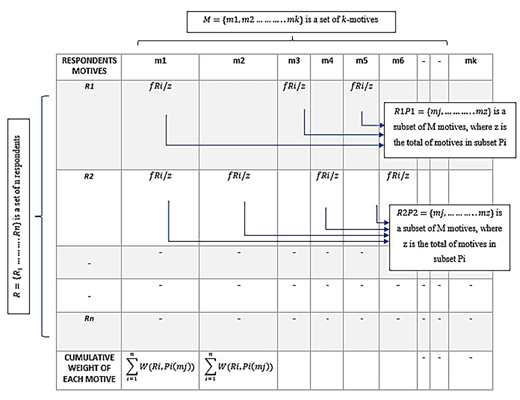
Researchers assume a set of respondents denoted as , and their corresponding motives to post online reviews on the products, denoted as for identifying the prominent motives among the customers on online shopping platforms. Thus,
is a set of n respondents, and is a set of -motives, in a given data set.
b) Frequency of posting fake reviews
Next, researchers identify the frequency of posting fake reviews per month for each reviewer (the term respondents and reviewer are used interchangeably henceforth) considering a given set of motives (such that⊆ ) for anth reviewer. Here, researchers aim to discern a reviewer () and their corresponding motives () that prominently emerge from the larger group of respondents and motives. This implies that has motives for posting the reviews under the study.
Let the frequency, be the number of reviews posted by the th reviewer in a month.
c) Calculating the weight of a respondent’s motives
To measure the significance of each motive within for each corresponding reviewer , researchers considered all motives equally significant for a reviewer. Let’s say, is a motive in with the total number of motives in as . Since ⊆ , and ϵ , it implies ϵ and |S| , where |S| denotes “size of.” Considering all motives equally significant of a particular reviewer, the weight of the respondents is calculated as follows:
d) Cumulative weight for a specific motive of M
As a result, using equation (1), the cumulative weight of a specific motive, W(Ri, Pi (mj)) across all respondents is defined as:
By summing up these weights for all respondents, researchers derive the cumulative weight associated with the particular motive across the entire group.
Step 2. Ranking the motives in a given data set
Finally, researchers rank the motives in descending order based on their scores, as shown in Step 1, thereby creating a comprehensive documentation of the prominent motives. By following these steps, one can effectively identify and evaluate the prominent motives among the respondents, aiding in a better comprehension of their underlying motivations and behaviors. This is illustrated in the Figure 2.
4. Findings
4.1 RQ1
The thematic analysis results for RQ1 supported H1, confirming the presence of significant IMs for posting fake reviews across various online platforms. Similarly, the results supported H2, demonstrating the existence of significant EMs for the same behavior. The analysis identified two main themes, Emotional and Reciprocity, encompassing 12 subthemes and 41 sub-sub-themes. Under the Emotional theme, both IM and EM were observed, including m1 – Altruism (IM), m2 – Revenge (IM), m3 – Joy and Pleasure (IM), m4 – Loyalty (IM), m5 – Ranting (IM), m6 – Fear (EM), m7 – Self-Recognition (EM) and m8 – Prosocial (IM). The Reciprocity theme consisted solely of EM, including m9 – Gamification (EM), m10 – Product as a Reward (EM), m11 – Monetary Reward (EM) and m12 – Obligation (EM). The two main themes are explained below:
4.1.1 Emotional theme.
The emotional theme broadly illustrates the crucial role played by emotions (positive and negative) in an individual:
Intrinsic motives of respondents for writing fake reviews under emotional theme.
Ranting is discovered as a new IM to manipulate reviews negatively. Engaging in ranting offers individuals a momentary sense of calm and relief by expressing their negative sentiments through reviews. Nonetheless, it is important to recognize that this method of emotional release is deemed unhealthy:
R43. I usually rant after fighting with my friends as this is a nice way to release my pent-up emotions and frustrations. I have written negative fake reviews many times randomly against games like Ludo King and various products on playstore.
Our findings reveal that strong attachment to a game drives individuals to post negative fake reviews against competitors, aiming to boost their preferred game’s visibility and loyalty:
R34. I love playing PUBG game and I am a great fan of it. Free Fire and COD is a competitor of PUBG and since I am a great lover of PUBG so I wrote negative fake reviews against free fire and COD many times on Play Store. It will help in attracting more people towards PUBG and to demote its competitor followers. I hope this way I will be able to promote PUBG.
This is consistent with research by Zaman et al. (2023) that highlights customers’ motive brand love for writing a review to promote the brand that they love.
To support the businesses of their relatives and friends, the majority of customers left favorable fake reviews:
R8. My brother, who works as a manager for a digital marketing firm, requested me to post positive fake reviews for a hotel on Google, so I posted it. I just wanted to help him out else I won’t be doing it because he is my brother.
Prosocial incentives have been identified as an underlying driver of positive review manipulation. However, customers create fake positive reviews as well as negative ones to aid their friends and relatives. This solidarity has been explained by Zaman et al. (2023) in their research:
R9. One of my friends told me to post a fake order on Amazon as a customer so that he gets a positive fake review. So, I posted a fake order for him on Amazon, made the payment, and in return, I got an empty box just to show that the order was fulfilled. Then I posted a positive fake review and after that, I got my full refund of the amount in my Paytm account.
This shows that customers can also post fake orders and fake reviews online if the seller and customer are known to each other which can aggravate the problem of fake reviews.
Some respondents posted fake reviews and ratings for delivery boys by giving them fake five-star ratings on apps on humanity basis:
R4. I have given fake 5-star ratings on a humanity basis for delivery boys who came from Zomato, Swiggy, and Blinkit to deliver the food or groceries to me. Even though if they come late then also, I give them full rating as just a five-star rating can make their day in terms of money and happiness as well.
Some of the respondents posted negative fake reviews because of revenge:
R28. The reason I created a fake negative review was out of retaliation since I ordered a product from Meesho but it was delayed and I had to give it to someone in my office.
This has been stated in Wu et al. (2020) that customers who have had unfavorable experiences with their purchases are more prone to create misleading reviews to take revenge from the company.
Some respondents also posted fake reviews out of joy and pleasure.
R11. I created a fake negative review on Zomato just for fun and to see if my food would be changed or not. Even though the food was not bad but I wanted to see whether I would get food in return or the cashback.
Salehi-Esfahani and Ozturk (2018) assert that adopting monetary service recovery could assist businesses in handling or removing unfavorable complaints but also promote people’s opportunistic behavior to provide negative spam reviews:
Extrinsic motives of respondents for writing fake reviews under Emotional theme
Fear is discovered as a new EM to manipulate reviews in either a positive or negative way. Such revelations have the potential to worsen the already complex web of fraudulent activities on the internet, resulting in more disinformation and manipulation in the digital marketplace. The valence can be positive or negative depending upon the situation the reviewer is in:
R12. I posted a fake review for a gym online. The machines were properly working but I posted a negative fake review regarding the machines of the gym so that in the evening time when I visit the gym, so will not face much rush and I won’t have to wait for long to work out on the machines. So, out of fear, I did that.
R2: I was given a task to post positive fake reviews regarding the company itself in which I was an intern to get the LOR and the certificate for my internship. So, I did that as I was afraid that if I didn’t post the fake reviews then I would not get the certificate of internship.
In addition, one of the respondents explained that writing positive fake reviews is due to showing a sense of mastery or to get self-recognition:
R18. I posted positive fake reviews to gain recognition as a verified reviewer and to take advantage of the offer I would receive as the top reviewer. Also, I feel happy and confident when others think of me as an expert and find my review helpful.
This is consistent with research by Wu et al. (2020) that highlights customers’ motivation for writing a review to get recognition.
4.1.2 Reciprocity theme.
Reciprocity is a sense of mutual indebtedness and obligation in the act of favor giving and receiving. The reciprocity theme broadly represents the “give and take” relationship:
Extrinsic motives of respondents for writing fake reviews under the reciprocity theme
The majority of respondents claim that they posted fake reviews to receive free goods or financial benefits like cashback, free coins, etc. We identified that many respondents posted fake reviews for free products as they got a chance to try new products for free:
R22. There was an agreement that if I purchase a product and post a positive review about the same, they will pay back me the full money of the product and I will get the product free of cost. Money directly gets credited to my bank account or at times credit goes to my Paytm account also. I will keep on posting the reviews in the future too as this is a good way to try new products for free.
This is also explained in past research that some producers and retailers offer free samples of their goods in exchange for positive reviews from customers to entice them to post fake reviews (Wu, 2019):
R26. I posted the fake reviews as I want to make easy money. I was getting money on per review basis. I was getting Rs.100/- to Rs.150/- for writing per review.
It was explained by Thakur et al. (2018) in research that monetary incentives influence customers’ willingness to participate in the cyber shilling.
Some respondents also posted fake reviews out of obligation:
R18. I posted a positive fake review because I was obliged as I got a discount from the seller for my purchase and he requested me to write a review for him.
We also find that one of the respondents stated that online contest encourages him to post fake reviews and ratings:
R13. I took part in various contests where I earned free coins which I was able to use for my next purchase and get discounts just by posting some fake reviews and giving some ratings. The more you engage yourself in these contests the higher are the chances of yours to earn more and to get more deals like this.
This finding is consistent with the study Zaman et al. (2023), which discovered gamification as an extrinsic motive for posting fake reviews.
4.2 RQ2
Using the data from Table 1 and applying equation (1) and (2) outlined in Steps 1(c) and 1(d) of Section 3.2.1, researchers identified three key motives associated with posting fake reviews. These prominent motives are denoted as m8, m10 and m11, namely, Prosocial, Product as a Reward and Monetary Reward as given in Table 2. Although there are other motivations also but they are much less significant than these three. The analysis through NVivo software also supports these findings. The hierarchy chart by the number of coding references in Figure 3 depicts that “prosocial” is the most frequent motive used in the responses followed by product as a reward, monetary reward and others.
Table showing ranking of motives
| Motives | m1 | m2 | m3 | m4 | m5 | m6 | m7 | m8 | m9 | m10 | m11 | m12 |
|---|---|---|---|---|---|---|---|---|---|---|---|---|
| Cumulative weight (W(Ri, mj)) | 3.88 | 0.45 | 0.24 | 1.25 | 2.42 | 3.17 | 0.02 | 14.67 | 0.05 | 10.20 | 7.43 | 0.44 |
| Ranks | 4 | 8 | 10 | 7 | 6 | 5 | 12 | 1 | 11 | 2 | 3 | 9 |
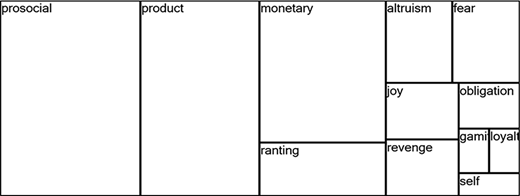
Interestingly, all three of these motives together contribute to more than 50% of the total weight in the posting of all the identified fake reviews. It can be concluded that by focussing on these three motives only marketers can combat the issue of fake reviews up to 50%. The calculated weight and ranks of motives from the data set collected in RQ1 is given below.
5. Discussion
The findings of this study provide significant insights into the motivations driving individuals to post fake reviews across various online platforms in India. The thematic analysis addressing RQ1 identified six (IM) namely altruism, revenge, joy and pleasure, loyalty, ranting and prosocial and six (EM), namely, fear, self-recognition, gamification, monetary reward, obligation and product as a reward supporting H1 and H2. The diversity and complexity of the motives suggest that a wide range of psychological and situational factors influence the act of posting fake reviews. The quantitative analysis highlights prosocial motivation (m8) as a key driver, reflecting individuals’ intent to benefit their family and friends by endorsing products, consistent with prior research (Zaman et al., 2023). Moreover, customers who had bad experiences with a brand are often upset or feel betrayed, seeks to retaliate against the brand by posting negative fake reviews. This is in line with the study by Wu et al. (2020). Our study also reveals that a sense of loyalty to certain brands drives individuals to fabricate positive reviews, consistent with the findings of (Vo-Thanh et al., 2021). Our study identifies ranting as a novel IM for posting negative fake reviews, serving as an emotional outlet for frustration. This aligns with Marr et al. (2022), who describes venting as akin to rumination, and (Bushman, 2002), who links it to cognitive and behavioral challenges. While ranting offers temporary relief, it may reinforce distress and hinder constructive problem-solving, underscoring its psychological impact on online engagement. Customers also posted positive fake reviews driven by kindness, a desire to bring happiness to others or simply for their enjoyment. This finding is in line with Wu (2019).
EM, characterized by external rewards or pressures, were also found to play a pivotal role. Among the explored EM “product as a reward” (m10) and “monetary reward” (m11) stood out prominently in the quantitative analysis, aligning with the growing trend of incentivized online behaviors consistent with prior research (Thakur et al., 2018). Customers post fake reviews due to incentive-driven obligations, as brands offer discounts or rewards in exchange. This practice can pressure customers into posting biased reviews, supporting research on financial rewards, encouraging opportunistic online behavior (Wu, 2019). Individuals post fake reviews to enhance their profile levels, earn badges and attain expert status, reinforcing research by Huotari and Hamari (2017) on gamification driving user engagement. Our results support findings by Moon et al. (2021), confirming that self-esteem, opinion leadership and mastery drive positive review manipulation. Fear has emerged as a novel extrinsic motivator for fake reviews, shaping individuals’ fraudulent behavior through psychological and situational influences. Unlike traditional EM such as monetary incentives or free products, fear arises from perceived external threats or pressures, compelling individuals to act in ways that may not align with their genuine experiences or opinions. The valence of fear-based reviews depends heavily on the reviewer’s specific context. Reviewers may post positive fake reviews to protect incentives, relationships or opportunities, whereas negative reviews can result from coercion or fear of reputational loss. This aligns with research by Chanel et al. (2009), suggesting emotional and cognitive biases shaping individuals’ decisions. This dual nature makes fear a particularly complex and impactful motivator in the domain of fake reviews. Customers also post positive fake reviews as a means to receive free products, often incentivized by brands. This behavior aligns with findings from studies like the one conducted by Wu (2019), which highlights how brands leverage the promise of free goods to encourage customers to write favorable reviews.
The quantitative analysis addressing RQ2 provided a more focused view by identifying three dominant motives: prosocial (m8), product as a reward (m10) and monetary reward (m11). Together, these three motives accounted for over 50% of the total weight in the data set of fake reviews, highlighting their critical role. The prominence of prosocial motives suggests that individuals often rationalize their actions as beneficial, even if ethically questionable. Interestingly, the NVivo-generated hierarchy chart reinforced these findings, with “prosocial” emerging as the most frequently mentioned motive, followed closely by “product as a reward” and “monetary reward.” This consistency across qualitative and quantitative analyses strengthens the reliability of the results. In particular, the study broadens the comprehension of fake reviews by exploring two new motivations, i.e. fear and ranting, surpassing traditional understandings such as financial gain or promotional activities.
6. Contribution and implications
The present study offers significant contributions with implications for both research and practice.
6.1 Theoretical contribution
First, this study highlights the relevance of SDT in understanding IM and EM as demonstrated by (Zaman et al., 2023). It contributes to the body of literature because it is one of the earliest attempts to conduct a thematic analysis and provides two key themes in which all the motives for posting fake reviews may be grouped, and it adds to the existing literature on the motives of customers to post fake reviews.
Second, fear is identified as a new EM for manipulating reviews. Fear is a negative emotion that is stimulated when a person’s self-determination is undermined. To our knowledge, no study has identified fear as an external motivation for posting fake reviews, either in a good or bad sense.
Third, ranting is identified as a new IM behind the act of posting negative fake reviews. Discovering that posting fake negative reviews is motivated by ranting highlights the need for more constructive online platforms for expressing dissatisfaction instead of perpetuating negative feedback. Thus, theoretically, we add to the existing literature on fake reviews by putting out a fresh classification of motives behind posting fake reviews online.
6.2 Managerial implications
From a managerial perspective, this research provides actionable insights for brands and platforms to better strategize the problem of fake reviews.
First, this research proposes an empirical framework to identify prominent motives behind fake reviews, offering brands actionable insights for targeted intervention. Prioritizing prominent motivations enables platforms to allocate resources efficiently, enhance detection methods and implement effective countermeasures.
Second, customers should be educated about the consequences of fake reviews and techniques to identify them. They should be empowered to report fake reviews on the respective platform’s website or app. By actively involving customers in the review process, there is a greater potential to mitigate the impact of fake reviews and uphold the integrity of online platforms (Salminen et al., 2022).
Third, review platforms can boost credibility by publishing transparency reports and using AI and manual verification to detect fake reviews. Techniques like pattern recognition, behavioral analysis and fraud detection help identify suspicious activity and enhance consumers’ trust (Wu et al., 2020).
Fourth, retaliation through fake reviews by customers can be mitigated by developing relationships with them through personalized interactions and dedicated customer care.
Fifth, to reduce incentives for fake reviews, platforms should strengthen policies by clearly outlining consequences such as account suspension, penalties or legal action for those involved in creating or incentivizing fake content. Moreover, platforms must actively monitor and penalize vendors who offer monetary or other benefits to reviewers, effectively discouraging external influence and promoting ethical practices.
Finally, brands should enforce strict penalties on fake review brokers, aligning with global efforts to combat the issue. For example, TripAdvisor penalized 33,194 property owners (TripAdvisor, 2023), and Amazon delisted 50,000 Chinese seller accounts for soliciting fake reviews (Bloomberg, 2021). Table 3 summarizes the findings and implications.
Conclusions and theoretical and managerial implications
| Conclusions | Theoretical and managerial implications |
|---|---|
| Customers post fake reviews due to IM and EM, categorized under emotional and reciprocity themes. Fear is identified as a new EM, while ranting is a new IM | Managers can curb fake reviews by leveraging SDT insights to understand consumer motivations, including fear and ranting. Platforms should enhance consumer engagement to prevent negative emotional outbursts |
| Prosocial, product as a reward and monetary reward are the most prominent motives for posting fake reviews | Using ranking mechanisms to identify prominent motivations behind fake reviews, managers can focus on primary motivations to implement targeted strategies and efficient countermeasures |
| Enhancing AI-driven detection, educating consumers and strengthening seller accountability can reduce fake reviews, protecting consumer trust | Brands can curb fake reviews by educating consumers, enhancing transparency, using AI-driven detection, strengthening customer relationships and enforcing stricter policies with penalties to deter fake reviews and promote ethical practices |
7. Limitation and future research
Regardless of its potential benefits, this study has some limitations. We restricted our attention to the IM and EM of customers only. Future research should take the viewpoint of merchants or managers to better understand the phenomena of fake reviews. Second, respondents were selected from Facebook only. Future research can consider other online platforms also like Instagram, websites and others. Finally, this study focuses on respondents from India, limiting the broader generalizability of the findings and needs statistical inference. Future research could enhance this by incorporating larger and more diverse data sets that allow for the application of statistical techniques. In addition, future research may focus on cross-national comparisons to explore whether motivations for creating fake reviews vary across different countries.
8. Conclusion
This research explores the key motivations driving customers to post fake reviews, providing a quantitative framework for ranking the motives that are explored qualitatively based on their prominence. Prosocial behavior, product as a reward and monetary reward emerged as the most significant drivers. In addition, the study introduces two new motivations: fear (extrinsic) and ranting (intrinsic), further categorizing motivations into two global themes emotional and reciprocity. The findings are crucial for businesses, regulators and consumers. Companies can use these insights to combat fake reviews, protect their brand and build customer trust, whereas regulatory bodies can develop more effective policies to ensure transparency in online reviews. This research underscores the importance of consumer trust in e-commerce, emphasizing the need for continuous adaptation to maintain a fair and reliable online marketplace.

