Organizations seek leaders capable of providing competitive advantages in complex markets; however, recruiting leaders can be quite challenging, given that it is unclear which psychosocial characteristics are considered relevant. This study identifies the psychosocial skills and characteristics considered important in the recruitment and selection of persons for leadership positions in any given organizational context.
The protocol has been registered in the Open Science Framework (OSF) database and has followed the PRISMA model. The analysis included seven databases. The JBI Critical Appraisal Checklist was used to analyze the methodological quality of the included studies.
The systematic review results identified four articles that met the inclusion criteria, revealing nine relevant psychosocial skills and characteristics in the leaders’ recruitment process.
Future research should continue to develop knowledge on this domain because the actual amount of studies are quite insufficient to provide clear guidelines about how leaders are recruited and selected for distinct organizations and contexts.
This is one of first systematic review analyzing psychosocial characteristics considered important in the recruitment and selection of persons for leadership positions.
Organizations operate in an era of globalization that demands constant evolution to survive in increasingly competitive markets. Qualified human resources are necessary for success and good performance (Karim & Latif, 2021). Thus, recruitment and selection become crucial to organizations, enabling them to identify individuals who are qualified for specific tasks and responsibilities. Recruiting and selecting leaders involves finding qualified candidates to fill a particular job vacancy, with the main aim of identifying “the right man for the right job” (Anwar & Abdullah, 2021; Anwar & Shukur, 2015). Human resources management departments typically undertake this process, and they bear a responsibility that can directly impact the productivity and performance of the organization, which in turn affects its competitive advantage in the market (Anwar & Abdullah, 2021).
The failure to recruit the right person for the job can result in financial losses, decreased productivity, and reduced organizational performance. This issue becomes even more evident in the recruitment for a leadership position, given that such a role implies extra responsibility and, therefore, more serious concerns. Leaders’ behaviors significantly impact both the work environment and the conduct of subordinates, influencing their attitudes and involvement, which can lead to negative consequences for the organization (Gilley, McMillan, & Gilley, 2009). For this reason, leadership has been extensively studied over the years and remains an important topic of debate due to its complexity and relevance to corporations (Benmira & Agboola, 2021). In this way, several approaches help to understand how leadership develops and impacts the functioning of others, such as personality trait studies (McCall & Lombardo, 1983; Simic, Ristic, Milosevic, & Ristic, 2022), behavioral studies (Yukl, Gordon, & Taber, 2002), the quality of leader–subordinate relationship dynamics (Andersen, Buch, & Kuvaas, 2020; Scandura & Meuser, 2022), transactional–transformational leadership (Bass, 1985; Olley, 2021; Young, Glerum, Joseph, & McCord, 2021), and “new” forms of leadership related to shared leadership (Chen & Zhang, 2023; Gichuhi, 2021), distributed leadership (Barry, 1991; Harris, Jones, & Ismail, 2022), authentic leadership (Muguna, 2022), and ethical leadership (Kamilah, Mamduh, Damayanti, & Anshori, 2023; Keith, 2008). Although leadership and selection are extensively studied, it is interesting to note that there is still a limited knowledge of which psychosocial skills and characteristics are actually operationalized in recruitment and selection for leadership positions and how theory explains this process. As reported by Jakobsen, Ann-Kristina, & Florian (2023), there is still a tendency to build research on the recruitment and selection processes based on existing empirical research and only briefly refer to how theory can inform this complex process. Nevertheless, some theoretical proposals can, indeed, be useful to understand the recruiting and selecting processes, as is the case of “interactionist processing” theories (Keppeler & Papenfuß, 2022) that examines the interaction and resulting fit between individuals and a particular environment (see fit theories; Kristof-Brown, Zimmerman, & Johnson, 2005); equally, the Attraction-Selection-Attrition (ASA) framework can be also useful when it proposes that organizations are functions of the kinds of people they contain (Schneider, 1987).
All in all, the extensive knowledge generated by the various leadership approaches provides a deeper understanding of how leaders (particularly the most successful) behave and act. However, it is unclear how this knowledge is transferred and applied in the recruitment and selection of individuals for leadership positions. Although there is some literature on recruitment processes and their development (Jakobsen et al., 2023; Lee & Mao, 2020), the results indicate that few studies consider the psychosocial aspects valued when recruiting and selecting people for leadership positions. This is relevant because it can inform organizations and professionals involved in selecting potential leaders about the elements that can better guarantee that the right person is chosen for a specific position. This contrast justifies the need for the present review. In this way, this systematic review aims to summarize the literature on the most relevant psychosocial skills and characteristics for recruiting individuals for leadership positions in organizational contexts, and highlight possible research gaps related to the limited evidence. In fact, we aimed to address a relevant and underexplored topic within organizational psychology and human resource management: the psychosocial skills and characteristics considered during the recruitment and selection process for leadership positions. While extensive literature exists on leadership development, effectiveness, and traits (e.g., Bass, 1985; Judge, Bono, Ilies, & Gerhardt, 2002), considerably less attention has been paid to the factors prioritized during leader selection processes. By focusing specifically on recruitment and selection decisions, rather than postappointment leadership performance, our study makes a timely contribution to the field through transparent, reproducible methods that characterize systematic reviews. To the best of our knowledge, this is the first paper to systematically summarize current knowledge on the psychosocial skills and characteristics to consider when recruiting and selecting persons for leadership positions.
Method
Protocol and registration
The conceptualization and methods used in this review were based on the Preferred Reporting Items for Systematic Reviews and Meta-Analysis (PRISMA) updated guidelines (Page et al., 2021) to reinforce the appropriateness of the employed methodology, and the protocol was registered in the Open Science Framework (OSF) database (Fangueiro, Gonzalez, Gomes, & Seixas, 2024). This approach was chosen to allow a transparent, reproducible search and selection process; to systematically identify all empirical studies addressing our research question; and to map not only existing evidence but also the gaps in how psychosocial skills and characteristics are operationalized in leadership selection.
Research question
This study aimed to answer the following question:
What skills and characteristics are considered when individuals are recruited and selected for leadership positions?
Specifically, we aimed to identify the psychosocial skills and characteristics of leaders considered in the recruitment and selection process for leadership positions. The PICO strategy was used to determine the components of the research question, with the participants (P) being leaders or aspiring leaders; the intervention/exposure (I) strategy being the recruitment and selection process; and the outcome (O) strategy being the skills or characteristics identified for leadership positions.
Inclusion and exclusion criteria
The inclusion criteria consisted of (a) observational studies that analyzed the psychosocial skills and characteristics considered in the recruitment and selection process for leadership positions in any organizational context, and (b) qualitative studies that identified those same psychosocial skills and characteristics. The exclusion criteria were (a) articles that did not fit the scope of the review, (b) articles that were not published in languages familiar to the researchers (other than Portuguese, English, Spanish, and French), and (c) articles that did not meet the expected methodological design (review articles, conference abstracts, book chapters, etc.).
Search strategy
The databases were selected according to their relevance and were accessed by three independent researchers on March 19, 2024. General reference databases (Web of Science, MEDLINE, Academic Search Complete, and Scopus), as well as specific reference databases (PsycINFO and Business Source Complete), were utilized, enabling an in-depth analysis of the published literature. Additionally, the reference lists of relevant publications were screened to identify other potential studies to include.
The search string was defined by including terms selected from previously published systematic reviews that targeted our population and context and was based on the authors’ consensus of this study. The search key used has the following search strings: (“leaders*” or “manage*”) and (“recruitment and selection” or “headhunting”).
Study selection and data extraction
The Rayyan platform was used to store, evaluate, and organize all the publications found in the databases. Two reviewers independently extracted data using a standardized data extraction form, gathering information on the general study description, study design, psychosocial skills and characteristics, assessment methods, characteristics of the recruitment and selection process (context, organizational sector, and skills identification process), and study results. Once all the documents had been exported, two researchers selected duplicate records to eliminate them. These same researchers independently examined the titles and abstracts of the articles according to the inclusion criteria and analyzed the full texts of the articles identified as meeting the previously defined search criteria. A third reviewer solved any disagreements between the data extractors.
The articles that met the inclusion criteria were finally analyzed in terms of description, including author and year of publication, type of methodology used, and conclusions regarding the psychosocial skills and characteristics considered when recruiting and selecting leaders for organizational contexts. The final decision on which articles to include was made with the consensus of the three researchers.
Methodological quality
JBI Critical Appraisal Checklists (Link to jbiLink to the cited article) were used to analyze the methodological quality of the included studies. The JBI Checklist for Prevalence Studies (Munn et al., 2020) was used to analyze the methodological quality of the observational studies. To assess the methodological quality of the qualitative studies, the JBI Checklist for Qualitative Research was used (Lockwood, Munn, & Porritt, 2015). The quality of the studies was analyzed by selecting one of the following options: “Yes,” “No,” “Unclear,” or “Not Applicable.”
Evidence synthesis
Although it can be said that he field of work and organizational psychology started with the study of recruitment and selection (Ployhart, Schmitt, & Tippins, 2017), it is also evident that there is still a need for more sophisticated theory-driven selection and recruitment research (Potočnik, Anderson, Born, Kleinmann, & Nikolaou, 2021). In this way, it is not a simple task to integrate the findings of recruitment and selection studies into a substantive and robust theoretical framework. Nevertheless, there are indications that same factors, may indeed, play a critical role in the recruitment and selection processes, as is the case of personal abilities of the candidates for a job, including their cognitive skills (Campion, Pursell, & Brown, 1988) and motivation (Ulrich & Trumbo, 1965), the social and communication skills of the candidates (Arvey & Campion, 1982), and the person-organization fit (Kristof-Brown et al., 2005). Specifically, and taking as example the case of interviews in the recruitment and selection processes, Huffcutt, Conway, Roth, & Stone (2001) proposed seven factors to consider in the employment interview:
mental capabilities, referring to the overall ability of the candidate to learn and process information, as is the case of “general intelligence,” also called “general mental ability” or “general cognitive ability”;
knowledge and skills stored in long-term memory, referring to both declarative (i.e., terms, values, names, and dates) and procedural (i.e., actions, skills, and operations) components;
basic personality tendencies related to personal “traits” reflecting the persons’ long-term predispositions to act in a certain way, illustrated, for example, by the well-known “Big Five” personality dimensions (i.e., extroversion, conscientiousness, agreeableness, openness to experience, and emotional stability);
applied social skills related to basic personality tendencies, referring to the persons’ ability to adapt effectively in social situations, being related to concepts of “social intelligence,” “personal intelligence,” or “social competence”;
interests and preferences, referring to the persons’ inclination toward certain domains or activities, as is the case of the will to assume a particular role, task or professional activity, as well as hobbies and interests in specific topics or subjects;
organizational fit referring to correspondence between the personal and organizational values, goals, norms, and attitudes; and
physical attributes that may be important for some professional activities (e.g., attractiveness, stamina, agility).
Results
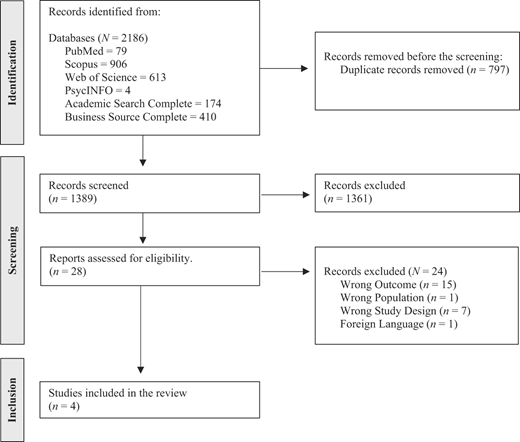
A total of 2186 articles were identified and preliminarily considered for inclusion in this systematic review. Initially, 797 articles were eliminated because they were duplicates. After the titles and abstracts were read, 1361 articles were excluded for several reasons, as explained in Figure 1. The following figure summarizes the selection process followed in this study. The eligibility step included 28 articles for reading the full text, 24 of which were excluded for various reasons, the most frequent of which was an incorrect outcome (see Figure 1). The final inclusion step included four articles that met all the inclusion criteria considered for this systematic review.
Methodological quality and risk of bias
Although the results of the evaluation of the methodology of the included studies are not part of the exclusion criteria defined for this review, this process is important for identifying which studies may be more relevant and the degree of confidence in the results they present. Considering the inherent methodological differences, the methodological quality of the studies was assessed separately for the observational studies (Table 1) and the qualitative studies (Table 2).
Table 1 includes the conclusions drawn from the response to the JBI Critical Appraisal Checklist for Studies Reporting Prevalence Data, referring to the two articles with methodological characteristics of this nature. In general, both studies met the criteria for several items of the methodological assessment tool. Study 1 has an adequate sample, uses a sustained data analysis, and applies valid methods to support the results; however, some concerns remain regarding the response rate and the strategies used to manage this problem. Study 2 has an adequate sample, describes the study subjects correctly, uses valid methods for data analysis, and has an acceptable response rate; however, the data analysis processes are not presented in detail. Neither study provides information on the sampling procedures used to select the participants.
Table 2 includes the conclusions drawn from the response to the JBI Critical Appraisal Checklist for Qualitative Research, referring to the two articles with a qualitative methodology. Study 3 presents congruence between the research methodology and the methods for collecting and interpreting data, the participants and their voices are represented, and the conclusions are in accordance with the data presented and their interpretations; however, no information is presented to clarify the researchers’ cultural and theoretical orientation or their relationship with the participants involved in the study. Study 4 raises some concerns regarding the chosen methodology since the information needed to assess the quality of the methodology is not described in detail, the researchers’ statements about cultural orientations or the relationship with the participants are not disclosed, and no evidence of ethical approval is presented. In contrast, the participants and their voices are adequately represented in the paper, and the conclusions align with the data interpretation. Therefore, despite some methodological inconsistencies in Study 4, it was included in this review, and its conclusions were analyzed.
Analysis of included studies
Study 1 refers to the article “Are we looking through the same lens? Principal recruitment and selection.” The main objective of this study was to identify the factors considered most relevant by recruiters and candidates when making principals’ selection decisions. This article included different types of respondents, namely, aspiring principals (n = 164), newly appointed principals with less than two years of experience (n = 39), school supervisors (n = 93), and principals who were involved in the selection of other principals (n = 71). The participants responded to a questionnaire specifically developed for this study that included 25 items evaluating aspects related to the candidate’s experience, skills or characteristics, and religious affiliation. The items were answered on a 6-point Likert scale to evaluate the importance of each statement. In addition to the questionnaires, interviews were conducted to assess communication skills, timetable management, and interpersonal skills. The results indicated that generic managerial skills were considered the most relevant factor, followed by presentation skills, experience and confidence, religious affiliation, and external connection. Importantly, the generic managerial skills included competencies associated with interpersonal skills, the ability to lead change, decision-making skills, and emotional stability. Presentation skills were associated with the communication skills demonstrated throughout the interviews. Experience was associated with technical school management skills, and religious affiliation and the external connection group are associated with the participants’ connection with religion and contact with the school sponsoring body or Education Bureau officials (Kwan & Walker, 2009).
Study 2 refers to the article “Profiles of successful restaurant managers for recruitment and selection in the US.” The focus of this study was on understanding which characteristics are the most relevant when recruiting leaders for restaurants. To evaluate the perceptions of recruiters, a questionnaire was developed to measure three dimensions:
functional job skills or competencies;
character or personality traits; and
educational and experiential background and achievements.
These three dimensions contained 17, 34, and 21 attributes and traits, respectively. The questionnaires were sent to the people responsible for recruiting restaurants, with 39 people representing quick service restaurants, 23 representing midscale restaurants, and 31 representing upscale restaurants, for a total of 93 participants. Recruiters were asked to indicate the degree of importance of each of the 72 attributes assessed via a Likert scale ranging from 1 (Great Importance) to 5 (No Importance). The results indicated that management, marketing, organizational skills, and attitudes were the most valued characteristics. The least valued characteristics were psychomotor skills and educational and legal background. Additionally, the results for each type of restaurant indicated that upscale restaurants valued attitude, leadership ability, personality and interpersonal skills; midscale restaurants valued attitude as the most important component while also valuing functional job skills; and, finally, quick service restaurants valued functional job skills more than character traits or education (Emenheiser, Clay, & Palakurthi, 1998).
Study 3 refers to the article “Selection criteria, skill sets and competencies: What is their role in the appointment of vice‐chancellors in Australian universities?” The main goal of this study was to identify and analyze the recruitment and selection strategies of the vice-chancellors at Australian universities. A questionnaire was developed and completed by 15 vice-chancellors, 15 former vice-chancellors, 13 chancellors, 7 former chancellors, and 7 selection panel members. Thirty-six interviews were conducted with members of these participant groups. In addition to the information collected through questionnaires and interviews, 20 universities were contacted and provided materials related to the selection process used to select vice-chancellors. The results revealed five common criteria that were considered most important for the selection of a vice-chancellor in the following order of descending importance: the ability to set the strategic direction, knowledge of strategic management, personal motivation, commitment, and communication skills. Furthermore, some of the selection criteria used by the universities that provided the corresponding materials did not coincide with the main characteristics presented previously. These criteria referred to the following: knowledge of Australian higher education, academic reputation, general experience, personality, compatibility with senior staff, academic field, service on government advisory bodies, networking ability and contacts, and political adeptness (O’Meara & Petzall, 2009).
Finally, Study 4 refers to the article “Towards a Gendered Skills Analysis of Senior Management Positions in UK and Australian Universities.” The main aim of this study was to produce a benchmark of competencies needed for leadership positions to overcome current gender biases. This article assumes a qualitative methodology and includes the outcome of interviews carried out with 26 participants, namely, vice-chancellors, recently retired vice-chancellors, senior managers, and companies responsible for recruiting senior managers. The interviews were developed to openly explore the skills or competencies necessary for good management in universities, referring to topics concerning delegation skills, teamwork, consultancy, and personal skills. The results indicated that some skills, including valuing and rewarding staff and sharing information, integrity, emotional intelligence, trust, resilience, and delegation, proved to be important for leadership positions in universities in the United Kingdom and Australia. Another conclusion of this study was that women are still distant from the management of universities in the United Kingdom and Australia and that the participants’ perceptions of management styles vary according to the gender of the person in the leadership position (Bagilhole & White, 2008).
Integrative results
Taking as background the Huffcutt et al. (2001) framework, our data seems to be organized into three main domains:
psychological stable factors, referring to habitual patterns of human functioning in general life (e.g., personality, resilience, emotional stability, etc.), including the mental capabilities, the basic personality tendencies, and the interests and preferences proposed by Huffcutt and colleagues;
psychological dynamic factors, referring to knowledge, skills, abilities and other factors (KSAOs) that are relevant to the job (e.g., dealing with change, decision-making, adaptation to organizational demands, etc.), including the knowledge and skills and the organizational fit proposed by Huffcutt and colleagues; and
social dynamic factors, referring to the persons’ ability to adapt effectively in social work situations (e.g., communication skills, interpersonal skills, etc.), including the applied social skills proposed by Huffcutt and colleagues.
Our data do not indicated the relevance of physical attributes proposed by Huffcutt and colleagues.
Taking this categorization as background, the main goal of our systematic review was to identify the set of psychosocial skills and characteristics considered in the recruitment and selection process for leadership positions in organizational contexts. After analyzing the included studies and considering their methodological quality, the results suggest that psychosocial skills play a significant role in leadership recruitment processes. Table 3 includes a synthesis of the major psychosocial characteristics identified in the four studies included in this systematic review. This analysis suggests that interpersonal skills were considered one of the most relevant characteristics when recruiting leaders in at least three of the four studies. This characteristic is described in Study 1, which highlights the importance of establishing positive human relations, and in Study 4, which highlights the importance of sharing information between staff. Study 2 also mentioned this characteristic as one of the most important. Three studies also mentioned the ability to mentor and lead others, with Study 2 highlighting “the ability to exude competence, confidence and to mentor and lead others successfully” (p. 59). Study 4 also introduced the importance of delegation.
Decision-making skills were considered by Studies 1 and 3 to be among the most important characteristics, indicating, respectively, that they value a leader with the ability to make decisions in adverse environments while maintaining stability and leaders who are capable of defining strategic direction appropriately. Communication skills were also mentioned in two studies, with Study 1 stressing that leaders must have the “skills and abilities to convince and impress their audience” (p. 58). Emotional stability was mentioned in both Studies 1 and 4, as control and emotional intelligence skills are important characteristics to consider when recruiting leaders. In particular, Study 1 states that leaders should not “wear their emotions on their sleeves and avoid confrontation” (p. 58). The characteristics of motivation and resilience and commitment and integrity were also observed in two of the included studies, wherein resilience and commitment were described as the need for leaders to present a “thick skin” in Study 4 (p. 6). Finally, the ability to lead change and personality were only considered in one of the included studies as the most relevant characteristics when recruiting and selecting leaders in different contexts.
Discussion
The main objective of this systematic review was to identify the psychosocial skills and characteristics considered in the recruitment and selection for leadership positions in organizational contexts. Based on the results of the studies included, nine psychological characteristics were identified and considered relevant in our study: interpersonal skills, the ability to mentor and lead others, decision-making skills, emotional stability, communication skills, motivation and resilience, commitment and integrity, the ability to lead change, and personality. These characteristics were subsequently categorized into psychological stable factors (e.g., personality, motivation and resilience, commitment and integrity, and emotional stability), psychological dynamic factors (e.g., ability to lead change and decision-making skills), and social dynamic factors (e.g., communication skills, interpersonal skills, and the ability to mentor and lead others), following indications of literature (Huffcutt et al. (2001).
Our data (Study 2) suggest that aspects related to personality, which represent a key factor in the leadership literature and is included in candidates’ selection for a particular vacancy (Cook, Vance, & Spector, 2000), may be important to consider. As such, the use of personality tests in recruitment and selection has become recurrent (Rothstein & Goffin, 2006). This finding aligns with the literature, as there is a relationship between personality traits and the emergence and effectiveness of leadership. According to the Big Five personality model, extroversion, conscientiousness, and openness to experience are correlated with leadership (Judge et al., 2002). In terms of recruitment and selection processes, Bouland-van Dam, Oostrom, De Kock, Schlechter, & Jansen (2021) analyzed 35 years of leadership potential research and concluded that intelligence, personality traits, and learning agility represented key predictors of leadership potential. It is also interesting to note recent findings suggesting that contextualized measures of conscientiousness (i.e. “industriousness” and “orderliness”) and emotional stability (i.e. “social-interactive” and “continuous”), had an incremental validity of four over and above the comparable traits measured by NEO-PI and cognitive ability in predicting vocational and occupational success (Moldzio, Peiffer, Wedemeyer, & Gentil, 2021).
Motivation and resilience were also identified in this systematic review as important psychologically stable factors related to future leaders (see Studies 3 and 4). This aligns with the idea that leaders should be highly motivated (Hendricks & Payne, 2007; Lee & Mao, 2020), as they are expected to invest considerable time and energy in addressing the demands of leadership positions (Badura, Grijalva, Galvin, Owens, & Joseph, 2020). Aligned with this idea, Lee & Mao (2020) in a systematic review of recruitment and selection of principals concluded that intrinsic motivation (i.e. desire to make a difference in education) was assumed by educators who applied for principal vacancies, with this aspect referred in 10 of 13 studies that explored the role of intrinsic motivation. Resilience is also important for leadership positions because leaders may have to adjust to adverse events, demonstrating adaptive behavior (Newman, 2005). Resilience is associated with motivation, specifically the motivation to succeed or recover and overcome adverse situations, and is a valuable asset for individuals in leadership positions (Sanders, Lim, & Sohn, 2008).
Commitment and integrity emerge as relevant characteristics in this systematic review for recruiting and selecting leaders (Studies 3 and 4). Integrity is often related to leadership, which refers to the personal quality of someone who makes decisions without external influence (Murtomo & Riyanto, 2021; Nawaz, Gilal, Channa, & Gilal, 2022). The relevance of integrity to leadership can be found in its connection to moral standards about what is right and what leads a company to achieve its goals correctly and ethically (Bagilhole & White, 2008). Also important, there is evidence that including measures of integrity during the pre-employment hiring process can, in the future, reduce several costs for organizations (e.g., diminish the number of counter-productive behaviors, prevent the use of illegal drugs, lower the violence over a five-year period, and increase savings in shrinkage losses) (Brown, Jones, Terris, & Steffy, 1987). Thus, a leader with high levels of integrity tends to have high levels of trust and commitment to the organization (McCann & Holt, 2009).
Emotional stability is also a crucial psychological factor related to future leaders (Studies 1 and 4) and is associated with personality traits of the Big Five model, suggesting that low neuroticism is expressed through high levels of emotional stability (Van der Zee, Thijs, & Schakel, 2002a). Furthermore, individuals with higher emotional intelligence tend to have greater self-confidence, motivation, and a more effective orientation toward achieving long-term results, as they manage emotions more effectively (Van der Zee, Thijs, & Schakel, 2002b). With respect to leadership positions, leaders with greater emotional intelligence promote effective collaboration within their teams, recognize and encourage higher levels of motivation, and exhibit greater creative capacity for problem-solving. In this sense, emotionally stable leaders have better personal performance and promote better team performance (Kannaiah & Shanthi, 2015).
Regarding dynamic psychological factors, our data highlight the importance of leading change (Study 1) and decision-making skills (Studies 1 and 3) as key factors for leadership positions. The ability of leaders to have a positive vision of the future is one of the characteristics that recurrently appears in descriptions of leadership roles (Day & Antonakis, 2017). The business and organizational world is increasingly complex and competitive, requiring companies to remain receptive to change to maintain their competitive edge. Leaders play a significant role in this process, implying the need to stay updated and revitalized to promote the survival of their organizations (Landrum, Howell, & Paris, 2000). Decision-making skills are equally important in leadership positions and are closely tied to the use of critical thinking to optimize decision-making (Obioma Ejimabo, 2015). Thus, the ability to involve subordinates in decision-making is considered an important leadership skill (Gomes, 2020); when misused, it may lead to less engagement from subordinates and lower organizational performance (Barrett, Balloun, & Weinstein, 2005). It is interesting to note that these competences are considered important to be evaluated in the recruitment and selection processes, being analyzed the effective ability of candidates for a job position in terms of the ability to evaluate information and to make decisions from that information (Pulakos & Schmitt, 1995) as well as the ability to solve problems (Huffcutt et al., 2001).
With respect to social dynamic factors, our data suggests three main skills related to communication skills (Studies 1 and 3), interpersonal skills (Studies 1, 2, and 4), and the ability to mentor and lead others (Studies 1, 2, and 4). These skills align with the literature, specifically the study by Den Hartog, Caley, & Dewe (2007), which analyzed more than 4200 vacancy advertisements for leadership positions and concluded that the terms “communication,” “influencing,” and “interpersonal skills” are among the most frequently used. Importantly, when used positively, effective communication skills are fundamental for individuals in leadership positions, as they significantly impact their performance (Yang, Wu, Wang, & Chin, 2012). The ability to use communication and words appropriately is fundamental to effective leadership, as effective communication can result in increased satisfaction and performance among peers. For this reason, it represents a necessary interpersonal competence for leadership positions (Clifton, 2006). Additionally, effective leadership goes beyond authority and should be based on personal interaction behaviors and positive relationships (Judge & Piccolo, 2004). Additionally, it can be noted that social dynamic factors are valued during the recruitment and selection processes, existing evidence that oral communication, interpersonal skills, persuasiveness, and leadership are dimensions evaluated in candidates for a job position (Huffcutt et al., 2001). According to these last authors, social skills and personality are the two main areas of evaluation in employment interviews.
Some implications should be highlighted from our study. Theoretically, it seems that integrative perspectives of leadership may better capture the complex task of recruit and select for leadership positions because it seems important to consider psychological stable factors and also social dynamic factors. In practical terms, it seems that the selection process for leadership positions may benefit from analyze more stable personal characteristics of candidates to leadership positions (by evaluating aspects related to personality, motivation and resilience, commitment and integrity, and emotional stability). Our data also suggests that social dynamic factors (e.g., communication skills, interpersonal skills, and the ability to mentor and lead others) are important, which may be more prone to posterior training given to selected leaders after they start their leadership careers.
In terms of limitations of this study, it should be acknowledge the limited number of included studies and their concentration in specific sectors and occidental contexts limits generalizations to all regional and organizational contexts. In fact, the selected studies for our literature review focus on educational contexts (Studies 1, 2, and 3), and in managers of food services (Study 2), meaning that many other leadership contexts were excluded. This is important because the psychological skills and characteristics required in the contexts of our study may not be the same as those required for other activities, such as business contexts, health services, and military forces, among others. In this way, it is paramount that future research continues to develop knowledge on this domain because the actual number of studies is quite insufficient to provide clear guidelines about how leaders are recruited and selected for distinct organizations and contexts. This review focused specifically on psychosocial skills and characteristics of leader selection practices, meaning that more studies are needed to comprehend how these characteristics spreads according distinct contexts and levels of leadership activity; also important, future studies can also analyze the demographic, educational, and professional background of candidates for leadership positions, and eventually more decisive, which characteristics of candidates better predict adaption and success as future leaders. Our literature review demonstrates that there is still a considerable distance to cover in understanding how leaders are recruited and selected for leadership positions. Despite these limitations, our study adds to current knowledge two main aspects: it synthesizes the psychosocial skills and characteristics that are currently documented in empirical studies of leader selection, and, equally important, it demonstrates the paucity and sectoral concentration of such evidence, thereby delineating a clear research gap. This gap should be addressed not only by collecting new data on the skills required for leadership positions but also by integrating this data into general theories of employment recruitment, as there is still a lack of knowledge about how recruitment variables interact with job applicant attributes and organizational attributes (Breaugh, 2013).
Conclusion
The main conclusion of our study is that existing data on the psychosocial skills and characteristics of leaders are more prevalent in studies of individuals who already hold leadership positions than in studies on recruitment and selection for leadership positions. Only four studies on the complex phenomena of recruitment and selection for leadership positions were selected, and concerns were raised about the methodological quality of some of the studies. However, our data also suggests a significant and useful set of psychosocial skills and characteristics considered in selecting individuals for leadership positions, all of which are of the utmost importance in studying individuals in leadership positions.
Informed consent statement
This a systematic review paper. Thus, informed consent from participants was not collected for this work.