Book recommended for 7th grade–8th grade.
Lesson recommended for middle level readers and may be adapted for 9th–10th grades.
Book summary
The Red Bandanna recounts and celebrates the life of Welles Remy Crowther. Crowther worked on the 104th floor of the South Tower of the World Trade Center as a financial analyst. He saved many lives wearing his red bandanna on the day that the Twin Towers were attacked, called September 11, 2001 (9/11). Crowther's father gifted him a red bandanna when he was a young child and from that moment on Crowther carried his red bandanna everywhere. Tom Rinaldi, author of The Red Bandanna, describes the dangerous circumstances at the Twin Towers the day of the September 11th attack. Rinaldi (2017) provides biographical information about Crowther’s lived experiences by his family, friends and 9/11 survivors. The book accounts the dangerous circumstances at the Twin Towers and Crowther’s actions to save others during the 9/11 attacks. The Red Bandanna offers readers the opportunity to learn about 9/11 history and engage with their own feelings (i.e. bravery, civic responsibility, decision-making to help others for the common good and empathy).
NCSS themes
(3) People, Places and Environments.
(4) Individual Development and Identity.
(10) Civic Ideals and Practices.
C3 framework standards
D1.5.6–8. Determine the kinds of sources that will be helpful in answering compelling and supporting questions, taking into consideration multiple points of views represented in the sources.
D2.Civ.10.6–8. Explain the relevance of personal interests and perspectives, civic virtues, and democratic principles when people address issues and problems in government and civil society.
D2.His.12.6–8. Use questions generated about multiple historical sources to identify further areas of inquiry and additional sources.
D4.3.6–8. Present adaptations of arguments and explanations on topics of interest to others to reach audiences and venues outside the classroom using print and oral technologies (e.g. posters, essays, letters, debates, speeches, reports and maps) and digital technologies (e.g. Internet, social media and digital documentary).
Materials
The Red Bandanna (Young Readers Adaptation) by Tom Rinaldi (2017).
Preview Learning Survey – have students complete the preview learning survey/diagnostic pre-assessment prior to the first day of teaching and reading the book (see Appendix 1).
Content Brief – This document offers the teacher an overview of September 11, 2001 history and may also be used with students (see Appendix 2).
Photographs of the World Trade Center’s Twin Towers, and Lower Manhattan New York, New York prior to September 11, 2001 (links provided in web-based references).
Photographs of the One World Trade Center, which was initial called the Freedom Tower in the aftermath of 9/11, and the Twin Towers memorial fountains located at the 9/11 Memorial Plaza (links provided in web-based references).
The Man in the Red Bandanna by SC: Featured on ESPN (n.d.). Retrieved from https://youtu.be/S77KYbkmjwc?si=n2aa_MsPqvUre2xl.
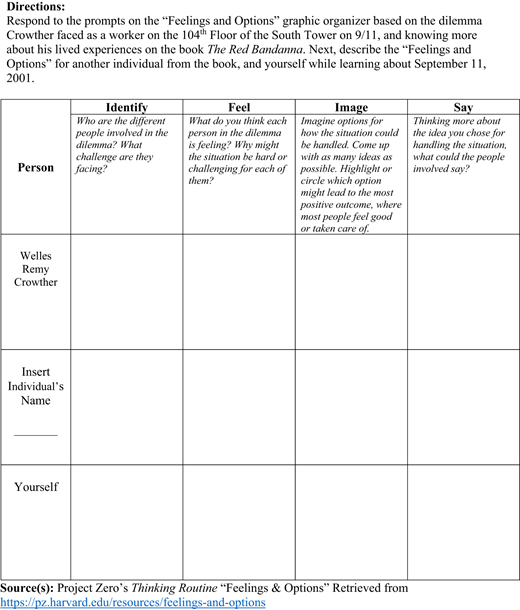
Graphic organizers include “Photograph Analysis” adapted from Visual Thinking Strategies, and “Unveiling Stories,” and “Feelings and Options” adapted from Project Zero’s Thinking Routine Toolbox (see appendixes 3-5).
Notes to the teacher before beginning the lesson
Teachers are encouraged to become more informed about the history of the World Trade Center and September 11, 2001. A content brief is provided in Appendix 2 which offers historical details about the World Trade Center and the September 11th attack. Both topics may be instructed upon concurrently through direct instruction and/or student exploration using primary and secondary sources per teacher discretion regarding their students’ learning needs. Additional content information may be found in the references and web-based references cited in this article, in addition, supplemental instructional materials are noted throughout the lesson plan too.
To prepare students for reading The Red Bandanna by Tom Rinaldi (2017), like other sensitive topics in literature and history, step one is to establish an open and inclusive classroom environment. Second, provide students space to express their feelings and reassure their feelings of safety. Some examples include pausing moments, journaling and talking about their feelings. Teacher discretion and instructional decisions are encouraged throughout this lesson plan. Be mindful of students cultural backgrounds (i.e. religion, national origins and etc.) and their social-emotional learning, if and when, using graphic images (e.g. newspapers, photographs and websites) and digital broadcasts (e.g. movies, recorded newscasts and videos) of 9/11.
Crowther’s actions demonstrated his bravery and integrity. He is one role model, like many other people whose self-sacrifice on 9/11 and the days after, who made a difference saving other people’s lives. Like Crowther, first responders and other rescuers teach heroism and can inspire all individuals to be upstanders to positively impact their community and the world.
Big ideas
Civic responsibility by individuals comes in many forms, such as making decisions to help others. Crowther’s bravery to save others made a difference for Twin Tower survivors on September 11, 2001.
Learning about the World Trade Center and 9/11 history.
Essential question
How do individual actions on 9/11 teach us about making a difference in our community?
Objectives
Exploration/preview: Students will observe and analyze primary and secondary sources about the World Trade Center.
Exploration/introduction: Students will write an explanatory statement using primary and secondary sources about the history of 9/11.
Development/ESPN video clip: Students will give verbal and written responses to the unveiling story of Crowther and the 9/11 event after viewing the YouTube video titled The Man in the Red Bandanna by SC: Featured on ESPN.
Expansion/reading the book: Students will explain the main narrative of Crowther’s lived experiences and analyze his civic responsibility attributes based on stories (i.e. family, friends, 9/11 survivors) from the book The Red Bandanna by Tom Rinaldi.
Expansion/mini-research: Students will use evidence from sources, including the book The Red Bandanna, to generate questions and inquire on additional sources needed to respond to their individual/class inquiry question(s).
Diagnostic assessment: Preview Learning Survey (see Appendix 1) or have a discussion about students’ knowledge about September 11, 2001.
Estimated time to complete: 10–20 min (varies based on student responses and class discussion)
Learning intention: Explain to students they are going to read a book about a person who helped others the day of the September 11, 2001 attack. Crowther made a difference rescuing co-workers yet did not survive the south tower collapse of the World Trade Center. The learning intention seeks for students to understand that civic responsibility comes in many forms, such as making decisions to help others.
Procedure:
Prior to learning about 9/11 or reading the book, have students complete a diagnostic pre-assessment (Preview Learning Survey – see Appendix 1). This pre-assessment helps students to preview the 9/11 topic and their background knowledge. Secondly, the survey results or class discussion informs the teacher of their students’ prior knowledge, and any special considerations that may be needed for students with experiences and/or connections to 9/11 or post-9/11. Again, the pre-assessment survey could also be achieved through a class discussion.
Exploration/preview – World Trade Center
Estimated time to complete: 1–2 days.
Objective: Students will observe and analyze primary and secondary sources about the World Trade Center.
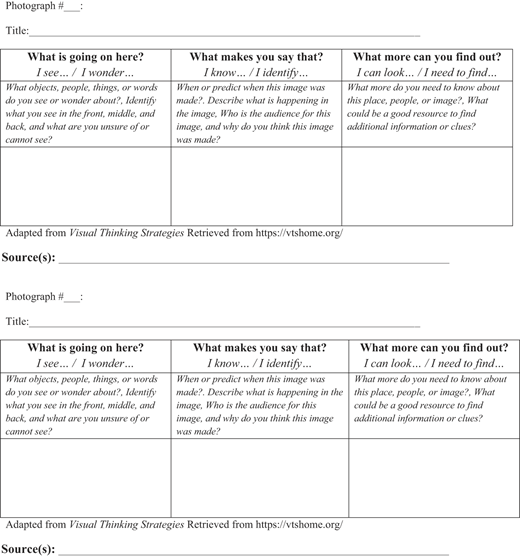
Assessment method: Class discussion or have students write responses on the “Photograph Analysis” graphic organizer (see Appendix 3).
Resources:
Highsmith, C. M., photographer. World Trade Center, New York, New York. United States, New York, New York State, None [Between 1980 and 2001] [Photograph] retrieved from the Library of Congress, https://www.loc.gov/item/2011630654/.
Highsmith, C. M., photographer (2001) Lower Manhattan skyline, including the World Trade Center, New York, New York. United States, New York, New York State, 2001. [Photograph] retrieved from the Library of Congress, https://www.loc.gov/item/2011633437/.
World Trade Center–Home Page: https://www.wtc.com
https://www.wtc.com/memorial – Scroll down for an interactive map
Supplemental Instructional Material from the 9/11 Memorial and Museum:
Procedure:
Display the World Trade Center images (Highsmith, 1980–2001, 2001). It is useful to view the photographs on the Library of Congress’s website as the teacher can zoom in and zoom out of the image to give students a better perspective of NYC’s skyline and geographic location. Pose observation and wonder questions, adapted from the Visual Thinking Strategy (see Appendix 3 – “Photograph Analysis” graphic organizer):
What is going on here?
What makes you say that?
What more can you find out?
Explain to students the history of the World Trade Center. The name “One World Trade Center” is also known as One WTC and Freedom Tower, which is the main building of the rebuilt World Trade Center complex in Lower Manhattan, New York City.
The teacher may state: The Twin Towers were constructed in 1973, and were once the tallest buildings in the world. In addition, the World Trade Center is an international financial hub with many businesses, shops and eateries, plus tourist attractions.
Next, show a map – see https://www.wtc.com/memorial (scroll down for interactive map) and visit the World Trade Center’s website.
Display the images of the Freedom Tower and Twin Towers Memorial Fountain (see https://www.wtc.com/memorial). Have students observe and analyze these images using the “Photograph Analysis” graphic organizer. Continue the class discussion.
The teacher may state: Remembrance and renewal in the aftermath of September 11, 2001, is reflected in the 9/11 Memorial Park. This place gives tribute to the people who perished, and two footprint waterfalls represent each Twin Tower imprinted at their former location at the World Trade Center.
Assessment: Collect the “Photograph Analysis” graphic organizer.
Extension activity: Enhance geographic knowledge of Lower Manhattan, New York, by using Google Maps.
Exploration/introduction – 9/11 history
Estimated time to complete: 1–2 days.
Objective: Students will write an explanatory statement using primary and secondary sources about the history of 9/11.
Assessment method: Using primary and secondary sources, students will write an explanatory statement that describes the history of 9/11.
Procedure:
Explain to students the learning intention for this lesson plan and reading the book The Red Bandanna by Tom Rinaldi.
Ask students if they have ever heard of the “man in the red bandanna”?
Next, show a picture of Crowther so students may make a personal connection with someone whose actions made a difference on 9/11.
Give pause when informing students of Crowther’s heroic actions which resulted in the loss of his life. See the book for pictures or see link retrieved from the 9/11 Memorial and Museum website: https://www.911memorial.org/connect/blog/nyack-lacrosse-team-visits-911-museum-honor-welles-crowther.
Explain to students the history of the September 11, 2001 attack. The teacher may read the content brief aloud to students as students read along (see “Content Brief” Appendix 2).
Provide additional context about the attack on September 11, 2001. Based on teacher discretion, consider using primary and secondary sources to further introduce 9/11 history. See references and web-based references.
Assessment: Using primary and secondary sources, students will write an explanatory statement that describes the history of 9/11. Students may include details about the World Trade Center and express their notices, feelings and wonders.
Development ESPN video clip – the Man in the Red Bandanna
Estimated time to complete: 1 day.
Objective: Students will give verbal and written responses to the unveiling story of.
Crowther and the 9/11 event, after viewing the YouTube video titled The Man in the Red Bandanna by SC: Featured on ESPN.
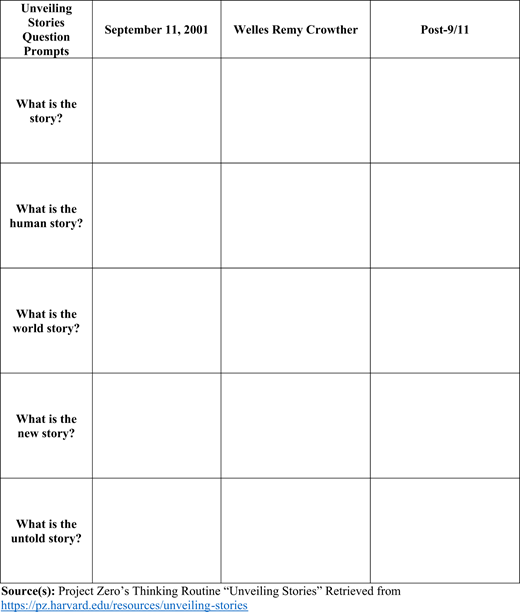
Assessment method: Student responses to the “Unveiling Stories” protocol (see Appendix 4).
Procedure:
Introduce the graphic organizer “Unveiling Stories” for students to write their responses about the ESPN YouTube video (Note: Students may periodically re-visit this note-catcher while reading the book or use the graphic organizer as a formative assessment.)
Prepare students for the ESPN video posted on YouTube, which is narrated by the book’s author Tom.
IMPORTANT NOTE: There is footage of the Twin Towers smoking and burning after the highjacked planes hit them. Second, the teacher should be sensitive to students’ social-emotional learning about loss, grief and human tragedy.
Play the YouTube video clip: The Man in the Red Bandanna by SC: Featured on ESPN, retrieved from https://youtu.be/S77KYbkmjwc?si=n2aa_MsPqvUre2xl.
Using the prompts from the graphic organizer, the teacher may lead a class discussion or have students work in small groups reviewing their responses. Some example discussion questions include:
“According to the Sports Center story by ESPN and narrated by Tom Rinaldi, the story of Crowther; September 11th, and insert topic/person … is …”
“I feel that …” or “I wonder how … would feel about …”
“One of the strengths of this video clip/story is …” or “One of the weaknesses of this video clip/story is …” and/or “The overall message of the story is …”
Conclude this learning session with a class debrief by checking in on students’ social-emotional learning. Next, as a class list Crowther’s civic responsibility attributes and any other notices or wonders students may be having based on the video clip.
Assessment: Collect the graphic organizer and review student work prior to the next day of learning. Continue to have students apply the “Unveiling Stories” questions as they read the book (e.g. What is the story? What is the human story? What is the untold story?).
Expansion/reading the book – the Red Bandanna by Tom Rinaldi
Estimated time to complete: 1–2 weeks reading the book.
Objective: Students will explain the main narrative of Crowther’s lived experiences and analyze his civic responsibility attributes based on stories (i.e. family, friends, 9/11 survivors) from the book The Red Bandanna by Tom Rinaldi.
Assessment method: Reading guide/discussion questions in the back of book and/or the “Feelings and Options” graphic organizer (see Appendix 5).
Educator note: When teaching sensitive history, like the September 11th attack, addressing students’ social-emotional learning is important. While reading the book (before, during and after) the “Feelings and Options” protocol (see Appendix 5) may be useful for students to record their own feelings, express their thoughts about Crowther and the people he saved, and to consider the feelings and options of others who experienced September 11th in NYC, the US, and/or internationally. For additional details about this protocol, see the educator guide titled “Feelings and Options: Educator Guide” by Project Zero and Common Sense Education (Retrieved from https://pz.harvard.edu/sites/default/files/Feelings%20%26%20Options%20-%20Educator%20Guide.pdf).
Procedure:
Restate the essential question: How do individual actions on 9/11 teach us about making a difference in our community and have students list examples/review brainstorm list from the prior learning session (ESPN video clip).
Next, have students reflect about their own civic actions during the school day and/or their lived experiences, such as upstanders or bystanders. The teacher may have students write a reflection or facilitate a class discussion.
Introduce the “Feelings and Options” graphic organizer (see Appendix 5) to students.
Inform students that they are seeking to learn more about Crowther’s narrative and his civic responsibility attributes. Next, while reading the book, students should also seek out other individuals stories/feelings/options depicted in the book (e.g. Crowther’s mom, dad, sibling, friend, and/or people he rescued, and etc.). Last, students may also reflect and consider their own understanding/feelings about 9/11.
Based on the reading schedule, per the teacher’s discretion, students will periodically revisit the attributes brainstormed as a class and/or explicitly stated by the teacher as well as the “Feelings and Options” graphic organizer.
Assessment: Periodically check students book discussion questions and/or the graphic organizer, “Feelings and Options.” Have students account Crowther’s lived experience, and other people’s heroic actions on 9/11, and the days that followed that made a difference or the brave decisions to take civic responsibility.
Expansion/mini-research
Estimated time to complete: 2–3 days.
Objective: Students will use evidence from sources, including the book The Red Bandanna, to generate questions and inquire on additional sources needed to respond to their individual/class inquiry question(s).
Assessment method: Following an inquiry/research process per the teacher discretion, students will produce either print formats (e.g. posters, letters, artwork and etc.) and/or digital formats (infographic, social media, digital documentary and etc.) of their findings to demonstrate their response to their individual/class inquiry question(s).
Educator note: Teacher discretion on how the process of inquiry and research is addressed and assessed. The teacher may select student resources or provide students the opportunity to research on their own. One recommendation is to coordinate with the school/public librarian. A second recommendation is to review resources identified in references and web-based references, including:
“Free Online Resources About 9/11” Smithsonian Magazine compiled by Nora McGreevy (19 September 2021) retrieved from https://www.smithsonianmag.com/smart-news/learn-more-about-september-11-attacks-through-these-free-online-resources-180978601/.
“The September 11 Digital Archive: Saving the histories of September 11, 2011” retrieved from https://911digitalarchive.org/faqs
“9/11” New York State Museum retrieved from https://nysm.nysed.gov/research-collections/history/political-history/collections-0
Assessment method: Students will create and produce printed displays/digital displays of their research in response to their individual or class inquiry question(s).
Procedure:
Based on students’ interest and following an inquiry-research process, students will use evidence from vetted sources about 9/11, including the book The Red Bandanna (Rinaldi, 2017) to express their understanding to their individual or class inquiry question(s) in either a print or digital formatted product.
Teacher discretion for the inquiry/research process.
Summative assessment
Option 1: Students express their understanding to the essential question, “How do individual actions on 9/11 teach us about making a difference in our community?” The aim is for students to demonstrate the relevance of personal interests and perspectives, civic virtues, and democratic principles when people address issues and problems in government and civil society.
Option 2: Students will create arguments and explanations to their inquiry question(s). The aim is for students to present their findings, and the products may be either print formats and/or digital formats.
Suggested extension activities
For either the teacher and/or students, read a second NCSS notable trade book about September 11, 2011 titled Understanding September 11th – Answering Questions about the Attacks on America (Frank, 2002). Mitch Frank details 9/11 and post-9/11 history through a question–answer format. The book provides information about the event, maps and pictures. Frank (2002) also addresses Middle Eastern history and culture, the faith of Islam and Islamophobia, and US involvement in Afghanistan.
Based on inquiry questions, encourage students to take informed action to demonstrate their understanding of the phrase “We Will Never Forget 9/11.”
Have students conduct a school outreach project to address loss and persistence when dealing with challenging times in their own community (i.e. grief from losing a family/friend, hurricane disaster and etc.).
References
Web-based references (in order of appearance)
Highsmith, C. M., photographer. World Trade Center, New York. United States, New York, New York State, None. [Between 1980 and 2001] [Photograph] retrieved from the Library of Congress, https://www.loc.gov/item/2011630654/.
Highsmith, C. M., photographer (2001) Lower Manhattan skyline, including the World Trade Center, New York, New York. United States, New York, New York State, 2001. [Photograph] retrieved from the Library of Congress, https://www.loc.gov/item/2011633437/.
World Trade Center–Home Page: https://www.wtc.com
9/11 Memorial and Museum: https://www.911memorial.org/learn
The Man in the Red Bandanna by SC: Featured on ESPN (n.d.) retrieved from https://youtu.be/S77KYbkmjwc?si=n2aa_MsPqvUre2xl.
“Free Online Resources About 9/11” Smithsonian Magazine compiled by Nora McGreevy (19 September 2021), retrieved from https://www.smithsonianmag.com/smart-news/learn-more-about-september-11-attacks-through-these-free-online-resources-180978601/.
“The September 11 Digital Archive: Saving the histories of September 11, 2011,” retrieved from https://911digitalarchive.org/faqs
“9/11” New York State Museum, retrieved from https://nysm.nysed.gov/research-collections/history/political-history/collections-0
Appendix 1 Preview learning survey
Educator note: Prior to learning about 9/11 or reading the book, have students complete a diagnostic pre-assessment survey. This pre-assessment helps students to preview the topic, and informs the teacher of students’ prior knowledge, and any special considerations that may be needed for students with experiences and/or connections to 9/11 or post-9/11.
Directions: Have students complete this diagnostic survey prior to teaching the history of September 11th and reading the book, consider a digital format to collect student responses (e.g. Google Form, Answer Garden, and etc.). Note: These are suggested diagnostic learning questions to pose to students.
Have you visited New York City in New York? What sights or places did you visit? If so, what do you recall?
Have you visited the World Trade Center and do you know about its history?
Have you heard the phrase “We Will Never Forget 9/11”? Have you learned about September 11, 2011, at school and/or talked about it at home with family and friends?
Do you or your family have personal connections with the experience of the September 11, 2001 attack and/or post-9/11?
Appendix 2 Content brief
September 11, 2001, stands out as a tragic day in global and United States history, and commonly referred as “9/11.” This date marks a devastating event when nineteen men hijacked (took unauthorized control of) four airplanes, and carried out coordinated attacks resulting in three airplanes crashing into important buildings, and a fourth plane crashing into an empty field. The hijackers were members of a terrorist group called Al Qaeda. The hijackers’ intention was to hurt the airplane crew, passengers and people. The 9/11 locations included:
the Twin Towers of the World Trade Center in New York City,
the Pentagon in Washington, D.C., and
a field in Shanksville, Pennsylvania.
The first location to succumb to the targeted attacks was the World Trade Center, specifically the Twin Towers, located in the southernmost part of Manhattan Island in New York City, New York. The Twin Towers were constructed in 1973, and were once the tallest buildings in the world. In addition, the World Trade Center is an international financial hub with many businesses, shops and eateries, plus tourist attractions.
On the morning of 9/11 over 17,000 people were working, shopping and/or visiting the World Trade Center when two planes were flown into the Twin Towers. Many people hurried out of the Twin Towers and many first responders, such as firefighters, police officers and emergency workers rushed to help thousands of individuals in the burning towers. After the two airplanes crashed, one in the North tower and one in the South tower, the severely damaged Twin Towers collapsed due to the plane’s impact and intense heat. The loss of the Twin Towers significantly changed the landscape of lower Manhattan and New York City’s skyline.
Sadly, on September 11th, many people lost their lives which included 3,000 people killed escaping the Twin Towers, 441 first responders at the World Trade Center site, and the perishing of airplane pilots, crew members and all the passengers on the four airplanes. Many people from across the world helped to rescue and restore order to the World Trade Center site. More than twenty years later, the World Trade Center complex was rebuilt which includes a 9/11 memorial and museum, and two fountains to memorialize the Twin Towers.
References
Appendix 3 Photograph analysis
Appendix 4 Unveiling stories protocol
Appendix 5 Feelings and options protocol