

Major Taylor: World Cycling Champion tells the story of Marshall “Major” Taylor, a Black professional cyclist at the turn of the 20th century and the world's first international sports superstar. The book recounts Major's career while interweaving the story of his first professional race in Madison Square Garden in 1896. In this lesson, students learn about an underknown person from the Black community, generate questions about Major Taylor, research his life through various types of primary and secondary sources and build an argument using evidence to make a claim about the past. The activities and sources in the lesson help build the students' historical thinking and interpretation skills and consider how individuals are shaped by institutions and culture. Students engage in large and small group collaborative-inquiry activities that utilize and build their content knowledge and historical thinking skills. As students learn with one another in the body of the lesson, they will develop their own conclusions using evidence provided in the lesson. Students can take action with their new knowledge by investigating their local communities for underknown people and bringing them to light for the community.
Book summary
Marshall “Major” Taylor was a Black professional cyclist at the turn of the 20th century. He is arguably the first international sports superstar [1]. The book recounts Major's career while interweaving the story of his first professional race in Madison Square Garden in 1896. A grueling 6 day race, it was described as one of the premier sporting events in the USA (McArthur, 1895). Though he did not win, he placed 8th out of 28, Major would soon become a cycling sensation. He became a world champion in 1901. The story follows his life from his teens through his professional career. Due to racism, he had to move from his home in Indianapolis, Indiana to Massachusetts and eventually spent significant time outside the USA racing. The reader learns about the life of one of the greatest bicyclists of all time while also seeing how racism at the turn of the 20th century, even in the northern United States of America, greatly shaped his life and deprived many in the USA from seeing the greatest racer of his generation.
Context for Lesson
This lesson puts students at the center of learning and gives them an opportunity to flex their historical thinking muscles. Historical thinking skills are skills that students need to understand history and the world around us. These skills can include corroboration, empathy, perspective taking, contextualization, sourcing and others (Digital Inquiry Group, n.d.; Seixas, 2017). They are important for students to develop because it promotes problem-solving, building inferences and understanding the world in which we live (Wineburg, 2001). Utilizing historical thinking skills within historical inquiry gives students opportunities to ask questions, examine evidence and draw evidence-based conclusions (Foster and Padgett, 1999). Students are required to engage with primary and secondary sources in a variety of modalities (e.g., visual, written and material culture/realia). In the context of elementary social studies’ marginalization in the classroom (Heafner, 2018), this lesson offers an inquiry-based blueprint for teaching social studies and integrating literacy, writing and research skills while emphasizing the impact of racism on the first international sports’ superstar’s career. The lesson seeks to give students an opportunity to engage a counter curriculum that explores a major, yet little known person, in Black history. The lesson is grounded in King's (2023) Elementary Black Historical Consciousness framework that emphasizes “Black Joy and Emotionality” and “Community, Local & Social Histories.” It might also promote Black Futurism by helping students reimagine possibilities for the future. Being grounded in this framework also contributes one piece of a solution to the issue of the “decontextualized narratives, stereotypical constructs and unfulfilling images of Black heroes and heroines” (King and Brown, 2014, p. 24) often presented during Black History Month. Additionally, the lesson is grounded in Ladson-Billings (1995) and Gay's (2018) ideas about culturally relevant pedagogies and teaching and Paris’ (2012) culturally sustaining pedagogies because it offers elementary students a concrete example of historical racism and resilience. The lesson gives students’ access to primary and secondary sources that help them see a Black American in a positive light in history and embodies the National Council for the Social Studies’ (NCSS) (n.d.) commitment to include “underrepresented voices to promote a holistic understanding of humanity, cultures and the world around us” (para. 1). It is expected this lesson would be taught within a unit that could be focused on historical athletes, sports in the United States, racism, segregation, overcoming challenges/obstacles, breaking barriers or the late 19th or early 20th centuries. This would allow Taylor’s life to be analyzed, evaluated or juxtaposed to another person’s life or world event during the time period.
NCSS standards
II – Time, Continuity and Change
IV – Individual Development and Identity
V – Individuals, Groups and Institutions
C3 framework
D2.His.3.3–5. Generate questions about individuals and groups who have shaped significant historical changes and continuities.
D2.His.4.3–5. Explain why individuals and groups during the same historical period differed in their perspectives.
D2.His.16.3–5. Use evidence to develop a claim about the past.
Materials
Major Taylor by Tonya Lippert;
Internet to review resources;
Print outs of primary sources and
Material culture/realia: Bring in a bicycle.
Objectives
Students will be able to learn about one of the world's greatest cyclists, evaluate the impact of racism on his life and be able to place his story in the larger context of the early 20th century;
Students will be able to generate questions about Major Taylor;
Students will be able to practice historical thinking skills to analyze sources and
Students will be able to use evidence to make a claim about the impact of racism on Major Taylor's life.
Essential question
How did racism impact Major Taylor's life?
Procedures
Exploration/Introduction
Before reading.
Whole class discussion: Bring in a bicycle (best if it is a road bicycle because a road bike most resembles the bike Major Taylor would have used. It has similar tires (thin) and bike frame) and have students examine it. Use the object as a starting point to discuss bike riding. Ask them to describe their bikes or bikes they have ridden. Ask them to share what is the furthest they have ridden. Ask them if they think a bike could make them famous.
* For the Teacher's Eyes Only: This is an activity to help connect the students' possible life experiences to the person they are studying. If you do not have a road bike, feel free to bring in another type of bike. If you cannot bring in a bike, show a picture of a road bike. For example, search “Cannondale Road Bikes” on Google and many pictures will populate.
Procedures
Development
Before reading.
Pass out the pictures of Major Taylor
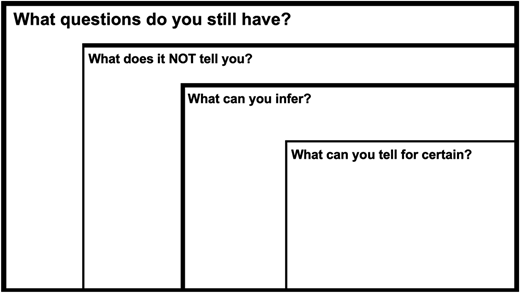
Put students in groups of 3–4. Ask students to analyze the sources. Print out a copy for groups of students and have them analyze the one of the five sources. Ask them to circle anything that they notice on the source and to label it like this photograph on slide 14 from Bober (2020). Tell them they are only making observations. Give students a graphic organizer (see Appendix 1). Have students describe or list the observations they labeled on the source in the bottom right-hand box of the graphic organizer.
- −
- −
Earliest picture of Major Taylor (Wikipedia Commons Version). Indianapolis News, p. 9 (Original) (1895)
- −
- −
In Buffalo Velodrome, Paris, France (Agence photographique, 1909)
- −
World Champion (Beau (1901), Use one of the pictures with Major Taylor on a bike.
*For the Teacher's Eyes Only: If students are struggling to make observations in the sources, teachers can give them guided questions such as:
What do you notice about the person or persons in the photos?
What objects are at the center of the photos?
*For the Teacher's Eyes Only: Some students are going to notice objects and people in the background. Though it may seem as if they are not relevant, background observations will help students complete the rest of the graphic organizer. For example, if they observe there are a lot of people with hats in the background that is going to be useful for them to make an inference after the whole class discussion that those people might be fans attending a bicycling race. Students might miss some observations and that is ok. The teacher can support students' learning by putting each source up on the screen when they move to the whole class discussion.
Whole class discussion: After students have completed the bottom right-hand box of the graphic organizer, have groups share out some of their observations. Then ask them to return to their groups and make inferences, completing the next bigger square about who they think the people were and what they were doing? Where were they? Why were they there?
- −
For the Teacher's Eyes Only: This task promotes the specific historical thinking skills of sourcing (Objective 3) because students are using their observations of the source to figure out when and why it might have been created.
- −
For the Teacher's Eyes Only: This task promotes the specific historical thinking skills of contextualization (Objective 3) because students are situating the events in the sources to a specific historical period.
- −
After giving them a few minutes to discuss and write down their inferences, ask students to discuss with their groups what they still do not know and if they have any questions. Have them complete the next two boxes on their graphic organizer. The teacher could also write their responses up on the board.
- −
For the Teacher's Eyes Only: This task gives them an opportunity to generate questions about the person(s) in their photographs (Objective 2) that might be answered by the book. These questions can then be used as follow-up questions after reading the book or engaging with the other primary sources.
- −
- (2)
Discuss the following vocabulary, ideas and/or places as needed:
Racism;
Madison Square Garden and
Length of a mile.
During reading
Bring the class together as a group and read them the book. During the reading, ask students questions every other page about the characters, plot and settings of the book. This will help the students stay engaged with the reading. If teachers have enough books, allow students to read on their own or in groups. If they read on their own, teachers will need to print these questions out. Questions that you might ask are.
How old do you think Major Taylor is? His competitors?
How do you think Major felt?
How would you feel if you were racing against adults?
Why did Major have to leave Indianapolis?
Where is Indianapolis? Where is Worcester, Massachusetts?
How did other racers react to Major's presence? The crowd? Why?
How would you have felt if you had to race for 6 days in a row?
Who supported Major's racing?
Where did Major have to go race?
* For the Teacher's Eyes Only: This task gives students an opportunity to learn specific details about the life and career of Major Taylor and the context in which he lived (Objective 1).
After reading.
After reading the story, the teacher will lead a whole class discussion about how Major's life was impacted by racism. Split students into three groups. Give each group one packet of sources.
Pack 1 – The fuller life-story and timeline of Major's life from the back of Major Taylor: World Cycling Champion.
Pack 2 – Freeman's (1898) adapted article and drawing and transcription (see Appendix 2) and Archibold's obituary (2019).
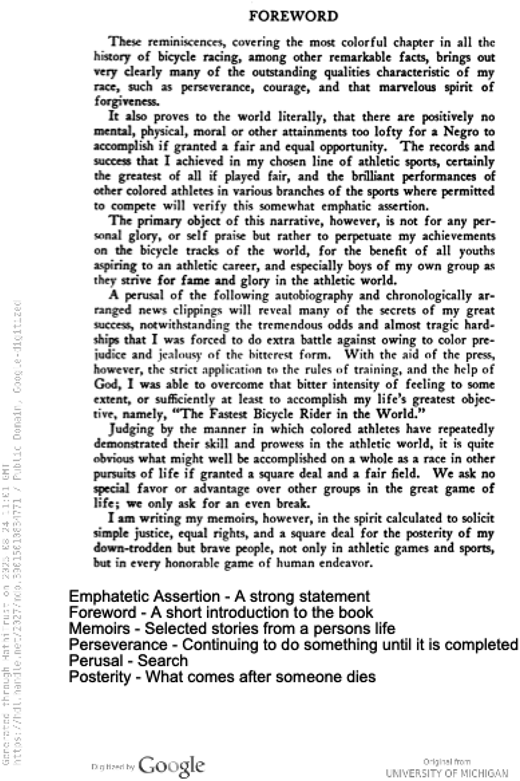
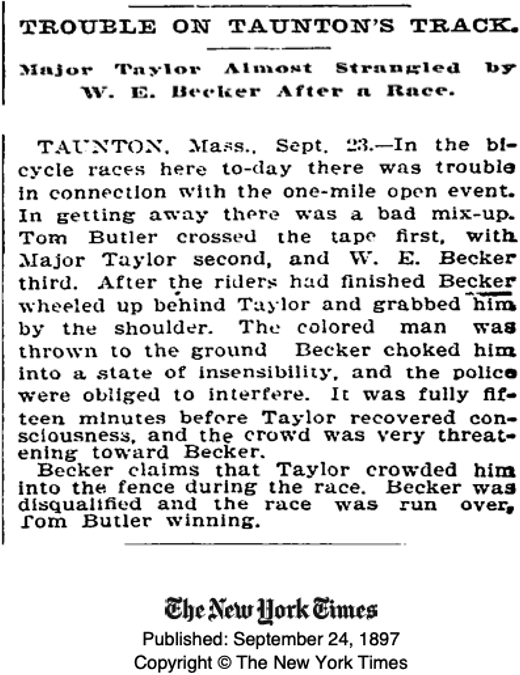
Pack 3 – The Foreword from Major Taylor's (1928) autobiography and the New York Time's (1897) Trouble on Taunton's Track) (see Appendix 3), which is an account of Major Taylor being choked at the end of the race.
* For the Teacher's Eyes Only: For students that are struggling accessing the adapted transcribed texts, the teacher can further focus (meaning take out additional aspects of the text they feel are unnecessary. Adaptations of sources are unique to each classroom's learners. Wineburg and Martin's (2009) article about adapting primary sources for struggling readers highlights several techniques, like focusing, that a teacher can use to support all learners. If the teacher still feels like too many students are struggling with these sources, I suggest reading and analyzing each source as a whole class.
Have students annotate the sources and discuss within their groups what they learned about Major Taylor and how he was impacted by racism.
Bring the groups back together and share out what they learned about how Major Taylor was impacted by racism. Have students write down facts and the sources they think will help them answer the assessment questions.
* For the Teacher's Eyes Only: This activity broadens students' knowledge of Major Taylor's life. Students will be able to place his story in the larger context of the racism many Black Americans experienced in the late 19th and early 20th century (Objectives 1 and 3). If students are struggling to see how Major Taylor was mistreated by other racers, ask them to consider how the sources explain Major Taylor's treatment by other racers. For example, in Freeman's (1898) adapted article, drawing and transcription (see Appendix 2) ask them to look at the last paragraph to find evidence for why the other racers are working hard to not have Major Taylor win the championship. In this paragraph, they will see that Major's competitors work harder to stop Major Taylor because of the color of his skin. This will help the corroborate the evidence across sources to determine how racism impacted Major Taylor.
Before moving on to the Expansion's summative assessment, review the questions students asked from the graphic organizer given about the sources during the Before Reading portion of this section of the lesson. See if they can answer any questions.
Expansion
Have students pull out a sheet of paper answer the following question.
How did racism impact Major Taylor's life?
Students will write at least one paragraph (more for 4th or 5th grade) response using three pieces of evidence from the book and sources provided to answer the question. Have students also explain who Major Taylor was and how they think we should honor him and his accomplishments in their paragraph. Then, using the paragraph they have written, have students work in pairs to build a slide show representing their responses. Encourage these pairs to make one slide for each piece of evidence they used to support their response to the question. Since students might have different conclusions or pieces of evidence, they will have to discuss their differences and come to consensus on how to best answer the question and which sources are most effective in supporting their conclusion (this type of discussion gives students an opportunity to practice hearing other perspectives and incorporating these perspectives into their claim). Have the pairs include one visual image of a source on each slide as well. For example, they could use a picture from the lesson plan or from their own research on the Internet. Have these students present their slideshow to another group or the whole class when completed. If computers are not accessible, the teacher could have students build posters as the medium of representation for their argument. Posters would also give students opportunities to draw their argument rather than put writing on slides combined with visual sources. Both of these ideas allow students an opportunity to creatively represent their argument.
Older or more advanced students can do additional research on their own with some of the sources provided in additional resources.
*Differentiation
Upper grades or more advanced students could look through other juvenile literature to find examples of people that represent their (the student's) identity who shared Major Taylor's experience with discrimination. These students could then be asked to go find primary sources that could be paired with the book and build a similar lesson to what they experienced about Major Taylor. This would give them an opportunity to see themselves in the lesson and be creative in demonstrating their learning about how people have been impacted by discrimination. Below are examples of a small sample of children's books. I suggest reviewing Social Justice Books' Booklists for more identities.
Asian Americans – Barbed Wire Baseball: How One Man Brought Hope to the Japanese Internment Camps of Second World War (Moss, 2016)
Indigenous Americans – Classified: The Secret Career of Mary Golda Ross, Cherokee Aerospace Engineer (Sorrell, 2021)
Women – Dorothea Lange: The Photographer Who Found the Faces of the Depression (Weatherford, 2021)
People with Disabilities – Fighting for Yes! The Story of Disability Rights Activist Judith Heumann (Cocca-Leffler, 2022)
Islam – Lion on the Inside: How One Girl Changed Basketball (Abdul-Qaadir and Henderson, 2023)
Upper grades or more advanced students can complete the Extension activity. This activity asks them to think about contemporary ways of honoring people or events from the past.
If students need support in starting their writing, give them sentence stems like the ones below.
Major Taylor was […] He experienced racism when […] (cite a source). This caused him to […] (cite a source). He responded by […] (cite a source). Unfortunately, he was not able to overcome racism in the USA and had to […] We should honor his life and accomplishments by […] I think this because […]
Rubric (see Appendix 4)
* For the Teacher's Eyes Only: This task gives students an opportunity to build an argument in response to the guiding question of the lesson: “How did racism impact Major Taylor's life?” (Objective 4).
Closure
The teacher will ask students to share their writing with one another. After they have shared, the whole class will discuss what lessons they have learned from Major Taylor's life.
Assessment
Exploration
The discussion about bikes is intended to serve as an informal assessment of their prior knowledge of bikes, bicycling as a sport and pique their interest in the topic.
Development
Before the reading, the teacher informally assesses students' historical thinking skills through the activity with the pictures of Major Taylor;
During the reading, the teacher informally assesses student learning about Major Taylor by asking comprehension questions and
After the reading, the teacher informally assesses students' learning about Major Taylor and the evidence they are gathering to answer the question through small and large group discussions.
Expansion
The teacher formally assesses the paragraphs written by students;
Evaluation of students' paragraphs serves as an assessment of students' ability to make a claim and support it using evidence and
The teacher will assess the students' paragraphs using the rubric ( Appendix 4).
Suggested extension activities
Have students brainstorm how people who have experienced racism or other forms of discrimination should be honored or remembered. This is not suggesting racism is a thing of the past but is asking students to focus on considering how and what we remember as communities and individuals. Have students read an article written by Annis (2021) about Major Taylor being honored in his home town, and then decide how they might remedy the situation of someone in their community like Major Taylor. Is a mural enough? Why or why not? What would you do? Why?
Teachers can also include contemporary people or events. For example, students could analyze how Bad Bunny's performance at Super Bowl LX (60) was a form of remembrance and even protest of the experiences of certain people groups in the USA and for events in Puerto Rico (e.g. sugarcane and plantations, power outages and colonial imperialism) (Morris, 2026). There was a lot of conversation before and after Bad Bunny's performance about him singing predominantly in Spanish and the imagery he evoked through the concert's sets and participants. This would be a contemporary connection to something many students might know about or have watched. Students could then compare Bad Bunny's act of remembrance and/or honoring with how Major Taylor is honored in Indianapolis and then make an argument for which form would they use to highlight ways people have experienced discrimination. This comparison and argument could be done by writing another paragraph explaining their thoughts, adding to their presentation, or having a whole class conversation.
Additional references and web links
Extension books
Primary Sources (These sources would need to be adapted for early-stage readers)
Article about the Major Taylor’s victory (2nd column halfway down) (Randolph, 1909)
Other resources
Library of Congress Blog about Major Taylor
For teachers
I would like to thank Chris Orozco, my graduate assistant, for his assistance in the formatting, language editing and proofreading of this lesson plan to ensure its quality and clarity. I would also like to thank the elementary students that gave feedback on the adapted texts.
Appendix 1 Inference square graphic organizer
Appendix 2 Transcribed version on the next page. Adapted Article from Freeman (1898)
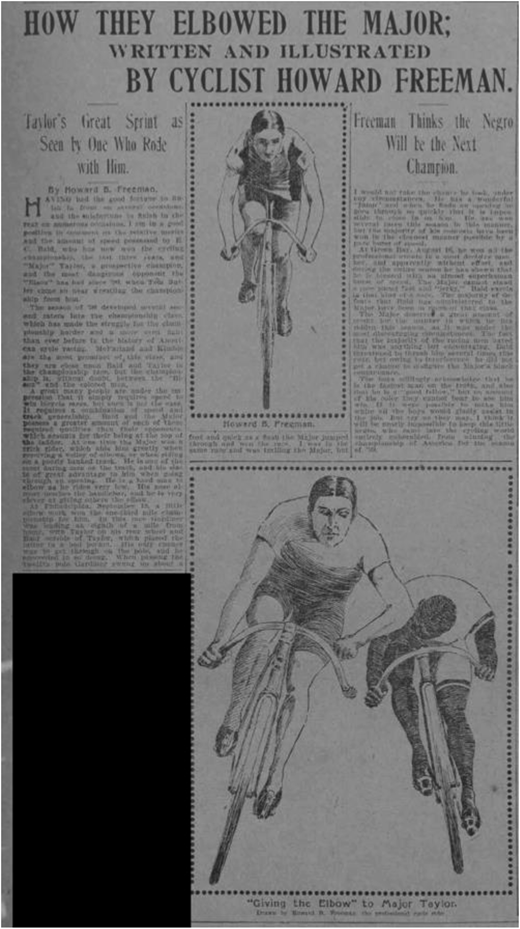
How they elbowed the major written by cyclist Howard Freeman
*For the Teacher's Eyes Only: This is an adapted version that may need further adaptation based on your classroom's reading levels. One of the first things I would do is increase the font size to make it easier to read and add some more space between the lines so students have space to annotate the source.
Having had the good fortune to finish in front on several occasions, and the misfortune to finish in the rear on numerous occasions. I am in a good position to comment on the relative merits and the amount of speed possessed by E. C. Bald, who has now won the cycling championship, the last three years, and “Major” Taylor, a prospective champion, and the most dangerous opponent the “Bison” has had since 1896, when Tom Butler came so near wrestling the championship from him.
The season of 1898 developed several second raters into the championship class, which has made the struggle for the championship harder and a more even fight than ever before in the history of American cycle racing. McFarland and Kimble are the most prominent of this class, and they are close upon Bald and Taylor in the championship race, but the championship is, without doubt, between the “Bison” and the colored man.
A great many people are under the impression that it simply requires speed to win bicycle races, but such is not the case. It requires a combination of speed and track generalship. Bald and the Major possess a greater amount of each of these required qualities than their opponents, which accounts for their being at the top of the ladder. At one time the Major was a trick rider, which aids him greatly when receiving a volley of elbows, or when riding on a poorly banked track. He is one of the most daring men on the track, and his size is of great advantage to him when going through an opening. He is a hard man to elbow as he rides very low. His nose almost touches the handlebar, and he is very clever at giving others the elbow.
At Philadelphia, September I8, a little elbow work won the one-third mile championship for him. In this race Garliner was leading an eighth of a mile from home, with Taylor on his rear wheel and Bald outside of Taylor, which placed the latter in a bad pocket. His only chance was to get through on the pole, and he succeeded in so doing. When passing the twelfth pole Gardiner swung up about a foot and quick as a flash the Major jumped through and won the race. I was in the same race and was trailing the Major, but I would not take the chance he took, under any circumstances. He has a wonderful “jump” and when he finds an opening goes through so quickly that it is impossible to close in on him. He has won several races this season in this manner, but the majority of his contests have been won in the cleanest manner possible hy a pure burst of speed.
At Green Bay, August 16, he won all the professional events in a most decisive manner, and apparently without effort, and during the entire season he has shown that, he is blessed with an almost superhuman burst of speed. The Major cannot stand a race paced fast and “jerky.” Bald excels in that kind of a race. The majority of defeats that Bald has administered to the Major have been in races of that class.
The Major deserves a great amount of credit for the manner in which he has ridden this season, as it was under the most discouraging circumstances. The fact that the majority of the racing men hated him was anything hut encouraging. Bald threatened to thrash him several times this year, but owing to interference he did not get a chance to disfigure the Major's black face.
The boys willingly acknowledge that he is the fastest man on the track, and also that he is a good fellow, but on account of his color they cannot bear to see him win. If it were possible to make him white all the boys would gladly assist in the job. But try as they may, I think it will be nearly impossible to keep this little negro, who came into the cycling world entirely unheralded from winning the championship of America for the season of 1899.
Appendix 3 Adapted foreword from Taylor (1928)
Article adapted by the New York Times (accessed 2025) from the New York Times (1897)
Appendix 4
Rubric for expansion assessment
| 1 | 2 | 3 | 4 | |
|---|---|---|---|---|
| Topic sentence/Claim | No evidence of a claim in response to the question | Claim about the impact of racism on Major Taylor is not clear | Claim to the question is clearly stated | Makes a clear claim about how Major Taylor was impacted or not impacted by racism |
| Supporting sentences | 1 supporting sentence | 2 supporting sentences | 3 supporting sentences | 4–5 clear sentences |
| Use of sources | 0 sources used to support claim | 1 source used to support claim | 2 sources used to support claim | 3 or more sources used to support claim |
| Argumentation | Paragraph lacks a clear organization of an argument to support claim | Paragraph has limited details. Shows effort to create order using sources, but the use of sources does not align with the claim | Paragraph's claim and sources are cohesive, but the argument is not clear | The paragraph's claim and sources are cohesive and communicate a clear argument |
Note
Bill Richmond might be able to claim this title as well, but he was primarily famous in England.

