Research–practice partnerships (RPPs) are widely promoted as a means of bridging the gap between educational practice and research, making research more relevant and actionable for schools. However, to bridge this gap in practice, participants face numerous challenges stemming from sociocultural differences, also called boundaries. Drawing on the conceptualization of RPPs as joint work at the boundaries, this study examines how educators make sense of collaboration in an RPP in Switzerland, how differences become constructed as boundaries and how educators engage with these boundaries in joint work.
Using reflexive thematic analysis (Braun & Clarke, 2022), the study analyses qualitative interview data from teachers and principals (N = 12) involved in an RPP focused on students' participation and school–university collaboration.
Educators' experiences are reflected in three main perspectives: (1) school–university collaboration as correcting, supporting or complementing the schools' own development goals, with research mobilized instrumentally; (2) engaging with differences as productive sites of mutual learning or knowledge hierarchies and (3) navigating between the systems, with boundary crossing enabled by school teams and school leadership.
The findings highlight the importance of making visible how research initiatives connect to schools' local development efforts, while also pointing to the value of structurally supporting educator-enacted boundary-spanning roles as a central actor navigating sustained collaboration across boundaries.
By foregrounding educators' perspectives, this study contributes to research on RPPs as a nascent approach to school–university collaboration and shows how RPPs as joint work at the boundaries is experienced and enacted in practice.
Introduction
Educational research is expected to inform practice, and practice is expected to use research for educational improvement. Yet, despite substantial efforts to bridge the research–practice gap, doing so remains a complex endeavor (Farley-Ripple et al., 2018). Research–practice partnerships (RPPs) form part of these efforts and are considered a promising approach to narrowing this gap by emphasizing a mutual approach to research and practice collaboration (Coburn et al., 2013). Broadly defined as long-term collaborations between representatives of school practice and educational research, RPPs aim to address school-related challenges and to co-construct research processes by intentionally involving both educators and researchers in these processes (Coburn & Penuel, 2016). Striving to engage in more equitable partnerships that move away from “translation” approaches, understood as one-directional transfer from research to practice, RPPs have gained increasing attention and funding (Arce-Trigatti et al., 2018; Penuel et al., 2015).
Despite the benefits associated with RPPs, it is precisely their emphasis on mutuality and sustained collaboration that gives rise to challenges that participants encounter in developing and maintaining the partnership (Farrell et al., 2018). For example, differences in organizational priorities can lead to tensions, as educators experience limited time for partnership work (Klein, 2023). Turnover and staff instability can further complicate partnership maintenance (Farrell et al., 2018), while differing expectations regarding norms, roles and responsibilities can lead to confusion, uncertainty and even conflict (Coburn et al., 2008). These challenges stem from cultural differences and historically unbalanced power relations between researchers and practicioners and are central to how partnerships unfold (Denner et al., 2019; Phelps, 2019). Such differences can be conceptualized as boundaries, a concept that highlights not only challenges emerging from sociocultural differences but also the learning potential inherent in their encounter (Akkerman & Bakker, 2011). From this perspective, boundaries in RPPs can either stall the partnership's work or serve as a resource for mutual learning, depending on how they are navigated (Farrell et al., 2022).
To understand how such challenges can be navigated constructively, scholars have proposed conceptualizing RPPs as “joint work at boundaries” (Penuel et al., 2015). This approach emphasizes mutual engagement across boundaries rather than one-directional transfer from research to practice. RPP actors are understood as “boundary crossers” who navigate cultural and professional differences between organizations, reciprocally shaping practices in the process. Joint work at the boundaries is therefore assumed to challenge hierarchical distinctions and reconfigure how organizations interact and collaborate.
Research on boundaries in RPPs has contributed important knowledge that helps to better understand the learning mechanisms of boundaries (Akkerman & Bakker, 2011) as well as how organizational learning is navigated by people, objects and practices operating at these boundaries (Farrell et al., 2022; Hartmann & Decristan, 2018; Wegemer & Renick, 2021). At the same time, critical perspectives emphasize that boundaries do not generate learning in a linear way. Rather, it depends on how differences are experienced and made sense of, particularly considering existing power imbalances within RPPs (Gamez-Djokic, 2024).
In sum, although boundary crossing has frequently been discussed in terms of its attributed learning potential, empirical insights into how boundaries emerge from educators' perspectives remain limited. This raises questions about how educators make sense of collaboration in RPPs as joint work at boundaries, and how differences come to be constructed as boundaries in the first place. Drawing on reflexive thematic analysis (Braun & Clarke, 2022), this study investigates how educators make sense of collaboration within RPPs, whether and how they experience boundaries in joint work and how they engage with these boundaries in practice. In doing so, the study highlights that boundaries are not simply inherent features of RPP collaboration but are constructed in educators' experiences of joint work.
Background
Research–practice partnerships
RPPs are described as initiatives that “exist to address an historical and persistent imbalance of power” (Farrell et al., 2021, p. 10) between research and practice. They have become a popular strategy for driving educational improvement through a mutual approach to school–university collaboration (Coburn et al., 2013). Defined as “long-term collaborations aimed at educational improvement or equitable transformation through engagement with research” they are “intentionally organized to connect diverse forms of expertise and shift power relations in the research endeavor” (Farrell et al., 2021, p. 4). In contrast to other forms of partnership collaboration where educators have limited access to shape research agendas and contribute to knowledge production, RPPs seek to (1) develop evidence-based solutions, (2) align research with real-world practice challenges, (3) promote co-design, (4) incorporate diverse perspectives and (5) foster shared responsibility between educators and researchers (Farrell et al., 2021).
Accordingly, RPPs are argued to offer benefits for both educators and researchers. They are seen as holding considerable potential to develop useful interventions for improving student learning and to support practitioners' engagement with research (Coburn & Penuel, 2016). Reported benefits include, for example, educators' access to research expertise and data analysis tools, as well as opportunities to strengthen research skills for educational decision-making, while researchers outline benefits such as access to research sites, deeper insight into current school issues and the development of relationships with school practitioners (Brown, 2021). Therefore, RPPs are frequently described as a promising approach to narrowing the research–practice gap by fostering closer alignment between research and educational practice. As such, they have garnered considerable traction as an approach seeking to move beyond one-directional “translation” approaches and toward more equitable forms of research–practice collaboration (Penuel et al., 2015).
Despite their benefits, RPPs also face challenges arising from differing logics and incentive structures that can complicate their establishment and sustainability. Overall, the challenges can be related to three main areas: (1) turnover of people involved in RPPs; (2) differences in timelines or pace of work and (3) getting the right people – with decisional capacity and authority – “at the table” (Farrell et al., 2018, p. 5). For example, differences in (and performance expectations associated with) professional duties shape how partnership work is prioritized, as researchers often face pressure to publish journal articles, whereas school practitioners experience limited time given the urgency of competing everyday demands (Klein, 2023). Further challenges concern unclear roles, responsibilities and resulting tensions within the collaboration, as differing expectations and professional norms may lead to ambiguity and hinder the development of shared understanding (Farrell et al., 2019). These challenges are rooted in cultural differences and underlying power dynamics and must be explicitly addressed if RPPs are to realize their aspirations for equitable partnerships (Denner et al., 2019; Phelps, 2019).
While RPPs have become an established concept of school–university collaboration in the US and other countries (e.g. Sjölund et al., 2022), their implementation in Switzerland remains emergent, with few studies examining this approach (Datnow et al., 2025; El-Hamamsy et al., 2023; Müller-Kuhn et al., 2024; Zala-Mezö et al., 2025; Zala-Mezö & Datnow, 2024). Existing research shows that power relations in RPPs are shaped by participants' institutional roles and by control over meeting discourse, often reproducing existing hierarchies (Datnow et al., 2025), emphasizing that RPPs are characterized by ongoing negotiations of roles, power and professional differences between researchers and practitioners (Zala-Mezö et al., 2025). In addition, patterns of generative discourse have been found to differ between Swiss and US RPPs, largely due to differences in partnership goals, organizational structures and participant roles, suggesting that ongoing debates about research use in the teaching profession may also influence how research evidence appears in RPP discourse (Zala-Mezö & Datnow, 2024). Further insights concern curriculum design, where more direct researcher involvement and an equal, active teacher voice are considered important for aligning reforms with classroom realities (El-Hamamsy et al., 2023). Finally, research on teacher–researcher collaboration highlights evolving roles and modes of engagement across project phases, pointing to hybrid forms of researcher–practitioner collaboration (Müller-Kuhn et al., 2024).
Research–practice partnerships as joint work at the boundaries
Different from, but complementary to, this previous research, we focus on educational professionals' narratives to better understand how professional and cultural differences in RPPs are experienced and potentially leveraged through the lens of joint work at the boundaries (Farrell et al., 2022; Penuel et al., 2015). Within this approach, participants act as boundary crossers, engaging in “transitions and interactions across different sites of practice” (Penuel et al., 2015, p. 188), thus moving across cultural, professional and organizational boundaries between research and practice. In doing so, participants enter each other's territories where they may find themselves confronted with unfamiliar norms and practices; for example, researchers may participate in district meetings, while district leaders may attend research conferences, with both potentially feeling unqualified to operate outside their usual professional domains (Penuel et al., 2015, p. 188).
In their review of research on boundaries, Akkerman and Bakker (2011) identify four mechanisms through which boundaries carry learning potential: (1) identification, referring to becoming aware of the different practices at play within cross-organizational collaboration; (2) coordination, referring to the organization of exchanges between partners; (3) reflection, involving the expansion of perspectives and (4) transformation, referring to the development of new collaborative practices. Drawing on this conceptualization of boundary crossing, Penuel et al. (2015) emphasize that boundaries are understood not only as sociocultural differences, “leading to discontinuity in action or interaction”, but also as continuity, as despite cultural, professional and organizational differences, two or more sites remain mutually relevant (Akkerman & Bakker, 2011, p. 133). Importantly, the emphasis is on “overcoming discontinuities in actions or interactions that can emerge from sociocultural difference rather than overcoming or avoiding the difference itself.” (Allerman & Bakker, p. 136). In other words, encounters with sociocultural differences that give shape to boundaries do not themselves lead to learning; it is the (re)establishment of continuity despite the differences that renders boundaries as productive for learning.
While research on boundary crossing in RPPs has generated growing insights that help to understand how RPP actors can leverage professional and cultural differences across organizational boundaries (Penuel et al., 2015; Wegemer & Renick, 2021), comparatively less attention has been paid to how boundaries themselves are constituted in interaction (Sjölund & Lindvall, 2023) and to how and when perceived differences become experienced as boundaries by RPP participants (Gamez-Djokic, 2024). Following these strands of research, the present study examines whether and how educators articulate experiences of boundaries, and how such boundaries are made meaningful in their narratives. It builds on the assumption that sociocultural differences between researchers and educators are an inherent part of RPP work and may give rise to discontinuities in action and interaction. Drawing on Akkerman and Bakker's (2011) boundary-crossing approach, the study argues that such discontinuities are not only understood as obstacles to collaboration but can be productively mobilized in practice.
Using this approach as a theoretical lens, the study draws on twelve interview narratives to thematically analyze the following research questions:
How do educators experience collaboration within an RPP?
How, if at all, do educators experience and engage with sociocultural differences as boundaries over the course of the RPP?
Context of the study
This study examines the collaboration within a three-year partnership project between a university of teacher education and four secondary schools in Switzerland. The project can be characterized as an RPP, as its design and organizational structure align with core RPP principles outlined above (Farrell et al., 2021). The partnership was designed as a long-term collaboration spanning three years, thus reflecting characteristics of a more “mature” partnership (Penuel et al., 2025). During this period, researchers and educators (teachers and school principals) collaborated toward two overarching goals: (1) strengthening students' participation as part of a participatory school improvement process and (2) developing new forms of school–university collaboration. In this sense, the project aimed at educational improvement within existing school-based structures on students' participation, while simultaneously seeking transformation toward sustained collaboration. To pursue these goals, the partnership was designed to bring together diverse expertise through participatory formats that integrated the perspectives of educators, students and researchers, as well as through regular exchange meetings. The project began with a participatory priority-setting phase in which students, educators and (in some cases) parent representatives worked with researchers to identify school-specific priorities related to student participation. For instance, one school decided to further develop its instructional concept toward individualized learning with students, while another school focused on revising its timetable to allow for a later school start. Building on these jointly defined priorities, educators and researchers met biweekly to discuss their joint approach and plan the implementation of school-specific priorities, with insights from research activities (e.g. group discussions) informing reflection and subsequent planning. As part of the project's structural arrangement, each school appointed one or two educators [1] who were primarily responsible for coordinating the project in collaboration with the researchers. For this, they received a small part-time appointment (10%) at the university. This design arrangement was intended to institutionalize school perspectives within the partnership and provide resources that acknowledged the workload associated with the project. On the university side, two or three researchers were assigned to accompany each partner school throughout the project. Together with the appointed project-leading educators, they planned and implemented school-specific tools, activities and events tailored to each school's needs and priorities.
In line with the boundary-crossing literature, these recurring meetings and formally appointed project-leading educators can be understood as elements of boundary infrastructure, that is, as the networks of people, practice and objects navigating cultural, professional or organizational differences (Farrell et al., 2022). Within this infrastructure, regular meetings can be understood as boundary practices: organized activities through which joint work across institutional practices is enacted, and where perspectives from research and school practice are brought into dialogue. The project-leading educators, in turn, can be understood as boundary spanners: individuals who move across boundaries to co-plan activities and coordinate project work.
Methods
Data collection
This study draws on qualitative data collected through semi-structured interviews with three educators from each of the four partner schools (N = 12; see Table 1). Participants were selected through purposive volunteer sampling (Creswell, 2009; Gill, 2020) based on their relevance to the phenomenon of interest: their experience in the partnership project, ensuring a range of perspectives across different roles and forms of engagement. Interviews were conducted in person at the participating schools between March and November 2024, during the project's concluding phase. At the time of the interviews, schools differed in their stage of involvement: some were still actively engaged in the RPP (School 2), while others were no longer directly involved (School 3). In addition, some educators were undergoing professional transitions, including Petra, and Estelle, who were leaving their positions. Data collection was guided by an interview protocol consisting of open-ended questions, ensuring that the data reflected participants' subjective viewpoints rather than imposing predefined analytical categories (Bohnsack, 2021). The questions were structured consistently across all participants, while allowing for inductive adaptation during the interviews to follow individual accounts, enabling a listener-oriented, narrative-generating interview style (Helfferich, 2011). Educators were asked about their experiences of collaboration within the project and their perceptions of participatory and collaborative formats during the partnership.
Data analysis
Reflexive thematic analysis (Braun & Clarke, 2022) was conducted to seek patterns of shared meaning (themes) on educators' experiences, understandings and perceptions of joint work. Thematic analysis can be understood as an epistemologically flexible and interpretative method. It can be used as an essentialist or realist method, which seeks to represent participants' experiences and meanings as realities; as a constructionist method, following the approach that experiences, meanings and realities are socially produced and reproduced; or, as a contextualist method, positioned between these poles (Braun & Clarke, 2006). In this study, a constructionist perspective was adopted, following the idea that individuals' experiences are socially co-constructed, and thus “effects of a range of discourses operating within society” (Braun & Clarke, 2006, p. 81).
Analysis followed the six phases of reflexive thematic analysis (Braun & Clarke, 2022): (1) data familiarization; (2) systematic data coding; (3) generating initial themes from coded and collated data; (4) developing and reviewing themes; (5) refining, defining and naming themes and (6) writing the report. The process was inherently recursive, involving constant back and forth movement between the data set, coded data extracts and the developing analysis, with writing as an integral part throughout the analysis (Braun & Clarke, 2006). Interviews were audio-recorded and transcribed verbatim by the author using transcription software f4 and MAXQDA, supporting close engagement with the material during familiarization. Transcripts were systematically coded in MAXQDA following a data-driven approach (Braun & Clarke, 2006), moving from semantic to more latent, interpretative codes. Codes were clustered into candidate themes using visual mapping tools, with thematic maps developed for each school to account for contextual variation. Themes were subsequently refined through cross-case comparison to identify patterns of shared meaning.
Throughout the analysis, reflexivity was supported through memo writing, a reflexive journal and regular discussions with colleagues and a peer analysis group, strengthening the interpretative quality of the analysis (Braun & Clarke, 2022). The final themes are presented in the Results section, combining illustrative quotations with analytical commentary that explicates the underlying conceptual interpretations (Braun & Clarke, 2013). Quotations were selected to reflect perspectives across the four schools.
Reflecting on positionality, the author conducted all interviews but was not directly involved in the project. This external position may have supported openness and analytical distance (Dwyer & Buckle, 2009), while limiting first-hand contextual insight (Braun & Clarke, 2022). The researcher's background as a former Swiss teacher likely facilitated shared professional understanding with participants (Asselin, 2003).
Results
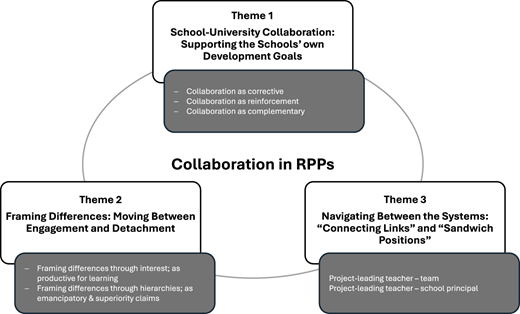
This study's findings fall into three broad themes: (1) School–University Collaboration: Supporting the Schools' Own Development Goals; (2) Framing Differences: Moving Between Engagement and Detachment and (3) Navigating Between Systems: “Connecting Links and Sandwich Positions”. Figure 1 provides a visual overview of the final themes and their associated dimensions. The themes are presented through an analytic narrative that combines illustrative quotes and interpretative commentary to highlight analytic facets and tell an overall story about the data in relation to the research questions (Braun & Clarke, 2022).
Theme 1: School–university collaboration: supporting the schools' own development goals
The first central theme captures how participants framed their experiences of project collaboration through accounts of motivation and reasons for participating in the RPP project; a framing that became particularly evident in educators' responses to the opening interview question. These accounts foregrounded a perceived fit between the project's focus on students' participation and the schools' priorities, through which project participation was rendered meaningful. In line with the schools' organizational structures, principals were initially approached by the researchers and thus occupied a central gatekeeping role. While all principals considered the project relevant, each consulted their team before making a final decision. The theme is structured around three facets that illustrate different ways in which a perceived fit between the project and school priorities was constructed as a rationale for engaging in collaboration. Bianca, for instance, viewed the project collaboration as an opportunity for teachers' professional development, given that not all teachers were implementing student participation in their teaching practice and articulated this rationale as follows:
When I heard about it, I thought it was really cool. The idea of giving participation – especially regarding teaching and instructional development – more space seemed a very interesting idea to me. And I knew that at our school, participation is sometimes strongly embraced by some teachers, while others are a bit more hesitant, partly because they fear that others might interfere too much in their work.
The argumentation in approaching collaboration drew on differentiated attributes of teachers' competences, positioning some teachers as requiring further skills or experience. At the same time, the account foregrounds a hierarchical understanding of leadership, positioning herself as knowledgeable about the needs of “our” school and its teachers, drawing on a particular school-based understanding of how student participation should be enacted in practice. In this sense, collaboration was framed as corrective practice, instrumentalized as a means of adjusting aspects of teachers' professional practice. A corrective approach to project collaboration was also reflected in Manuela's perception of alignment, as collaboration was experienced as an opportunity to engage in a “more progressive” form of school improvement, enabled by stable school conditions that made it possible to extend the mandatory school improvement work in which schools are already required to engage. Manuela noted:
From the perspective of a school principal – working in a school where one can dare to be a bit more progressive. At Randau, we are an extremely stable school. We have… it's good here; we have a neighborhood that is in no way problematic. I think it is almost the best place you could have a school. It is very privileged in terms of access to education, somewhat alternative and the parents are very open and positive toward the school. There is enough funding, overall, it's simply an ideal place for a school. And because of that, I think we could afford to try something different, to do some school improvement that goes a bit beyond what always must be done. And that's why I thought: yes, we'll join this project; we'll do it.
The perceived stability and supportive school context are constructed as providing the organizational conditions necessary to pursue different forms of school improvement work beyond established practices. In this sense, collaboration was seen as a means of extending existing school improvement practices. While participation in the project was also framed as an instrumental benefit by Petra, the collaboration was primarily approached from a different perspective, namely, to address a generally low level of student engagement:
Participation was really important to us, because we realized that students didn't identify much with the school, and there was often this sort of “students against teachers” – that was the overall climate, and we felt, we needed to involve them more. And when we saw the call, we thought, wow, this is really great – then we don't have to do it on our own but can work on it with accompanying support from research. And above all, it helps us to stay engaged with this topic over a period of three years.
In this account, student participation is constructed as a collective target for school improvement rather than something lacking in individual teachers' practices. Through the recurring use of “we,” this process is framed as a collective endeavor that can be supported through collaboration. The instrumental use of the project is thus constructed as a resource that provides (free) support and sustains attention to the school's own improvement process. In this regard, the project's long-term nature was experienced as supportive, as it enabled sustained engagement in school improvement efforts accompanied by research, thereby framing collaboration as reinforcement of their own aims. However, this reinforcement was not experienced as rendering the university indispensable for school improvement efforts. Rather, educators emphasized their own capacity to pursue improvement on their own, while describing joint work with university partners as shaping these efforts in a different way. For Corina, this difference became particularly clear, as she noted:
I think that, as a whole school, we simply moved forward. And I think we would have progressed without the support as well, but in a completely different way. This way, everything was really put on track. We were supported, accompanied, and there was always something coming in. Otherwise, I find it difficult because things tend to fizzle out.
In this sense, collaboration is not framed as necessary for school improvement processes, but rather as a structuring force that shapes and stabilizes ongoing efforts.
Another approach to collaboration centered on the perceived fit between the project topic and the school's existing conceptions of student participation, already being addressed through ongoing improvement work. This is reflected in Marisa's account, as she experienced the researchers' call as aligning with improvement efforts the school had already initiated:
At the beginning, we were already in the process of developing our new school model, with Altair. We called it Altair, and then it [the project call] actually came up in between, when Isabel [the lead researcher] approached me and asked, ‘Hey, would you like to take part? This could be something’. And I thought, ah, this would probably fit well with the concept. Because we were also transitioning towards individualized learning, trust-based levels, the restructuring was already underway, and so on. I said, well, this probably fits.
Marisa emphasized that involving students themselves altered the meaning of this work, noting that “it gains a different significance when they are involved in thinking and working along, and when their suggestions are genuinely heard. And that's what we then did.” The rationale for the perceived fit is thus constructed in a way that frames collaboration as complementary to existing school improvement work, particularly through the systematic involvement of students, which strengthens the school's existing efforts toward student participation.
In all, this theme captures how a perceived fit for collaboration is constructed and justified. Fit is articulated in three distinct ways: collaboration as correction, where project participation is taken up to redirect perceived areas of action; collaboration as reinforcement, where perceived areas of improvement can be addressed through supportive accompaniment; and collaboration as complementarity, where ongoing school improvement efforts are enriched through project work. Across these facets, schools do not view research as something to be used for its own sake; rather, research collaboration is welcomed insofar as it functions as a resource to support school aims: correcting or recalibrating, strengthening or complementing existing school improvement processes.
Theme 2: Framing differences: moving between engagement and detachment
The second recurring theme among participants addressed how differences emerging in the joint work within the RPP were constructed and engaged with. Educators perceived differences in organizational practices and norms, which became apparent in encounters between differing perspectives – particularly in relation to student participation – as well as in divergent organizational logics across school and university contexts. Engagement with these differences is reflected in two distinct facets.
Educators constructed differences as productive, experiencing the external perspectives introduced by researchers as “interesting,” “valuable” or “beneficial,” and as opportunities to draw on additional knowledge. Petra described her experience as “very enriching”, noting that they “were able to benefit greatly from the knowledge of the people involved,” thereby underscoring a sense of compatibility despite perceived differences. In contrast to other accompanying school improvement projects, Petra experienced this collaboration as a “hybrid form,” in which researchers were perceived not only as external facilitators but also as participants within the school:
At the beginning, I wasn’t quite sure how this interplay between research and school was supposed to work. What exactly is different compared to a – what I would call – regular, accompanying school improvement project and this project? Over time, I realized that it is a kind of hybrid form, also in terms of the research setting, in which the researchers are both participants and also steering actors.
Although differences were recognized through joint work and explicitly highlighted as such – for example, in accounts such as “it was clear that they were not from practice” – they were not experienced as hindering the process of joint work. Rather, differences were engaged with productively, framed as useful for one's own learning. For Elina, this was reflected in her experiences of crossing institutional and professional boundaries, particularly in gaining insight into organizational practices and professional perspectives beyond her teaching practice. She noted:
Very valuable. I learned a great deal, also in terms of organization. Gaining insight from my everyday work as a teacher into another professional field was very interesting for me, especially seeing how you work and the kinds of ideas you bring in.
Additionally, knowledge differences were constructed not only as useful learning opportunities for educators but also as enabling learning for researchers, who gained insight into school practice. Educators described how researchers adjusted their professional practices over the course of the collaboration, especially in relation to their communication with students. This became evident in Petra's account, as she noted:
I also had the sense that the university – the researchers gained new knowledge about how things work in schools and what needs to be taken into account. I think there was some adjustment over time, so that students, for example, could better understand what the researchers, who usually work mainly with adults, were actually trying to communicate. This kind of translation.
At the same time, educators' engagement with constructed knowledge differences brought perceived hierarchies between research and practice-based knowledge to the fore. For Sandy, this was reflected in a perceived shift in her position in this hierarchy, as she moved from initial uncertainty about her own knowledge contribution toward the recognition of her professional expertise. She noted:
For me personally, at the beginning, it was quite interesting. I was extremely nervous because it was something new. I have been a teacher – and a class teacher – for an extremely long time, and working together with the university was new for me. At the beginning, I was always nervous in the meetings and thought, “Oh no, they know so much and I know nothing.” I first had to find my way into it and realize that, yes, they know a great deal – but about different things. When it comes to practical aspects, I know more. That was interesting.
Over the course of the collaboration, she engaged with these perceived knowledge hierarchies by repositioning her own expertise as distinct from, yet not subordinate to, research-based knowledge. In Sandy’s account, engaging with these differences thus reflected a process of professional emancipation grounded in a growing recognition of her own expertise.
The recognition of the value of educators' own expertise through experienced knowledge differences was also constructed through the devaluation of research-based knowledge. In relation to the project's focus on student participation, educators described researchers' perspectives on students' needs and interests as differing from their own conceptions. These differences became particularly evident in the planning and implementation of joint activities involving students, where competing claims were articulated regarding “who is actually closer to it and who has the right perspective.” In this context, educators described students as, for example “not interested in theoretical background,” stating that “it simply does not interest them” (as articulated by Manuela). Such accounts positioned practice-based knowledge in contrast to researchers' expertise, which Valentina experienced as grounded in “idealized ideas”. This devaluation was further extended by questioning not only research-based knowledge, but also the researchers' competencies regarding communication. In these accounts, the issue was no longer limited to differing forms of knowledge, but concerned the researchers themselves, particularly their ability to appropriately engage with students. This became especially evident in Valentina's account, criticizing how researchers communicated with students, implicitly positioning researchers as insufficiently attuned to students' needs and interests:
I sometimes felt that they often – or at least at times – didn’t really know how to handle the students. Even when they were working directly with the students, I sometimes had the impression that they didn’t really know how to deal with this group. They simply didn’t have the skills to work with this particular target group. I felt that they didn’t really connect well with the students. At times, I even found their approach towards the students almost a bit ingratiating, and also somewhat insecure. And students sense that immediately. I think they just don’t know this context. And how could they? I don’t want to blame them.
Differences were thus framed as reinforcing differentiation between school practice and research, rather than being viewed productively. Moments of differentiation were also experienced through unclear expectations regarding the project collaboration, as it was experienced as vaguely defined demands that came on top of established school routines. For Loris, this was articulated through feelings of uncertainty:
Most of the time, you’re really tired and exhausted…the Q-days [school improvement days], and then something like this comes on top – something a bit vague – where you think, ‘does this really have to be now?’ Or, what… ‘what does this university want, what does this university actually want?’
Some educators experienced differences as tensions inherent in joint work, highlighting a deficit-oriented approach to difference. In this sense, researchers were positioned as entering practice without sufficient understanding of what educators consider central to their everyday work, while educators experienced their professional knowledge as being questioned, as Valentina described:
From the university side, I had the feeling that there was a lot of fundamental criticism of our work. That was something I constantly sensed. It felt like they thought they had to step in and make sure we somehow got things under control, otherwise the students would “go to the dogs”. At the same time, there was a similar perspective among the teachers: “They have no idea – why are they interfering in our professional everyday work?” They are so far away from our daily practice and from our students; they have no understanding of what concerns us, or of the issues we are dealing with. They have their idealized ideas, but these never really align with practice.
As research-based knowledge was perceived as incompatible with school practice, engagement with these differences was organized through a division of tasks between research and practice. Manuela described her experiences as: “by the end, we really found a way of figuring out who says what and when.” Additionally, an act of translation was perceived as necessary, as she experienced differences in work pace and language use between research and school practice. In response, she (together with Valentina) assumed the speaking role in presentations to the team, drawing on their familiarity as school practitioners within the school context and its established practices:
Valentina and I then did more of the presenting, because we simply know better how the team works – when we need to move quickly and when there is space for discussion.
In sum, this theme highlights two distinct facets of how educators engaged with differences in project collaboration. First, differences were approached with interest and framed as productive experiences that enabled learning for both educators and researchers. Second, differences became salient through hierarchical relations of knowledge. These hierarchies were framed either as emancipatory – by recognizing the value of educators' practice-based knowledge – or as a devaluation of research-based knowledge vis-à-vis practice-based knowledge. Under the latter framing, differences were engaged with in ways that prompted a division of labor, with each party maintaining their distinct professional roles.
Theme 3: Navigating between the systems: “Connecting Link” to “Sandwich Position”
The third and final theme captures how the project-leading educators experienced their role within the collaboration, highlighting how navigating between the systems is shaped by two relational facets: first, to the school principal; and second, to the school team.
The introduction of a project-leading teacher as part of the structural arrangement of the RPP became central for how educators experienced and enacted collaboration. This became particularly salient in relation to organizational and coordination tasks through which boundaries were navigated and crossed. Regarding the workload associated with school leadership, the structural arrangement of assigning a project-leading teacher to these tasks was experienced as relieving. For Marisa, this relief provided by the project-leading role was experienced as a central element – probably a condition to participate – of not enhancing her workload. The enactment of the project-leading teacher role thus contributed to the collaboration being perceived as sound:
I really appreciated that we were able to appoint a teacher as a kind of connecting link. At the beginning, I also had concerns about workload – that’s always the case in school leadership. We’re full, we’re overloaded, and I didn’t want to end up having to coordinate everything again with the team. So, I thought involving a teacher as a connecting link was a great idea. It provided a great deal of relief for me. And the university then largely worked in the background, involving me when needed or when a decision was required, and then things could move on […] Also, Elina [the project-leading teacher], she does this wonderfully. She always clarifies things, brings the team on board, organizes the students, and so on. With this person in place, things actually ran smoothly. For me, that was a central point where I felt the collaboration worked very well. I simply wouldn’t have had the time to manage the whole project together with the university if this teacher hadn’t acted as a link between us.
Appointing a teacher as project lead placed the responsibility for project management in the lead teacher, a role that was acknowledged and valued by the school principal. Marisa's role was therefore limited to selective, needs-based involvement, giving her the feeling of being informed and involved whenever decisions were required. Further, Petra described this arrangement as “beneficial […] because she [the project-leading teacher] comes from the same system, and this made it very participatory,” underscoring the importance of incorporating the school's perspective through the integration of school actors in joint work. It also shows the trust placed in the project-leading teacher to keep an eye on the school's interests.
While enactment of a project-leading role was experienced as demanding, particularly in terms of the tasks associated with it, it was the perceived appreciation and support that shaped how educators made sense of the role. This was reflected both in experienced trust and recognition from the school principal and from the school team. For Elina, appreciation from her colleagues was reflected in how the project was discussed within school, namely in a “positive and appreciative, rather than devaluing, manner.” She further described that she enjoyed enacting the role, despite the organizational effort associated with it:
It requires a great deal of organizational capacity – really on both sides. Keeping both sides up to date. I experienced a lot of appreciation here, also from my colleagues. They were always interested, many of them were strongly involved. And the people from the university – Lara and Tanja, who were responsible for the school this year – also had a good insight into how things work at our school. I found the collaboration very valuable. And I also liked my role as a kind of link between the school and the university.
Thus, perceived school-based support, reflected in appreciative communication among teachers, influenced how the project-leading teacher role was enacted, especially in managing communication and information flow between school and university, thereby constituting a boundary-spanning role through enactment of boundary practices.
The role was perceived as supportive in some cases, but as less supportive in others. For Estelle, a project-leading teacher, internal support for the project was experienced as twofold: while she felt the school principal was supportive and stood behind the project, she found teachers to be less supportive:
There were two different kinds of collaboration. The school principal was always very open and positively inclined toward any requests, questions, or uncertainties, and usually responded very quickly and provided solutions. You could clearly tell that she stood behind the project. And among the teachers, it was different.
Thus, the role was described as particularly demanding in situations where educators experienced perceived low levels of support from teachers. Estelle particularly felt these demands when standing in front of “certain dominant” teachers as a young teacher, noting that “at times, you were also criticized” by colleagues.
In this context, the enactment of the project-leading role by a single person was perceived as deficient, in the sense that the project was not experienced as collectively carried by the school team. For Bianca, the enactment of the project-leading role by a single project-leading teacher (Estelle) was perceived as hindering broader teacher involvement and collective ownership at the school level, as she felt that teachers did not experience a sense of responsibility for the project. She noted:
I think it had something to do with the way the collaboration was set up, with how the university structured this collaboration. I think it would have been better if not just Estelle had been the only person representing the teachers, but perhaps three people, one from each grade level. These could have been instructed by the university, or could have jointly developed how to proceed, with the university taking much more of a background role. Then these three – rather than just one person from the school being at the forefront – would have been better embedded in the team from the very beginning. The project would have been more broadly supported, there would have been more points of contact, whereas in practice it was simply the university and Estelle.
Bianca's account points to perceived constraints in Estelle's project-leading role, especially regarding expectations around engaging the entire school team in the project work. Putting three teachers in the project-lead was thought as advantageous structural arrangement, particularly in situations where project work involved increased coordination demands.
This was almost the case in the school with Manuela and Valentina, who both took on the project-leading role. However, at this school, educators perceived low acceptance for project collaboration from teacher colleagues, as reflected in Valentina's account, in which she described some teachers as not being “on board” and as having not “caught fire” themselves. Thus, the project-leading role was experienced as a challenging in-between position, articulated by Valentina, as being “between chair and bench,” leaving the project-leading educators caught between the demands of teachers and researchers. Manuela further described this as follows:
I was a bit in a sandwich position. On one side were the school and the teachers, who said they would not do that survey because there are other issues more important than that. And I had to say: sorry, no, these twenty minutes, you just have to do it. And that is how it was, standing in between, I found this to be rather exhausting.
The attribution of multiple tasks associated with the role of the project lead was therefore experienced as challenging, particularly when this involved encouraging teachers to engage in project-related activities when they were not perceived as motivated to do so. Manuela described the situation: “Valentina and I were basically always there together as [project name], the two of us, and that really helps.” In addition, here power dynamics are addressed, suggesting that more people are needed to support each other in navigating these dynamics.
This theme captures how the role of the project-leading teacher is constructed in relation to the school principal and the teacher team. While the enactment of the role was perceived as demanding by all educators, not all project leaders felt alone or constrained in their agency. It shows that it is not the situation on its own but its relational aspects – namely the perceived appreciation and trust by the school teams and principals – that shaped how the role was perceived and enacted.
Discussion
The purpose of this study was to gain a deeper understanding of educators' experiences in collaborating within a three-year RPP aimed at enhancing student participation and developing new forms of school–research collaboration. Through the lens of RPPs as joint work at the boundaries (Penuel et al., 2015), we argue that sociocultural differences between researchers and educators may give rise to discontinuities in action and interaction. Drawing on Akkerman and Bakker (2011), we further contend that these discontinuities can be mobilized productively when continuity is re-established across differences. The findings are discussed in relation to the research questions and the central concepts developed across the three themes.
As RPPs are still emerging in Switzerland, and do not yet constitute an established approach, the first research question addressed how educators experienced collaboration within the RPP. From educators' perspectives, collaboration with the university was not framed as an end in itself, but in terms of its contribution to situated school-based improvement goals. Thus, research was seen as an instrumental means of addressing these goals (Theme 1). Engagement in the RPP was contingent upon its perceived alignment with the school-based priorities, serving to correct, strengthen or complement existing efforts. What proved decisive was not the project's intrinsic value but its perceived alignment with the school's improvement agenda, through which collaboration was constructed as fitting.
These experiences align with research showing that RPP collaboration becomes meaningful when linked to existing institutional goals and responsibilities (e.g. Korhonen et al., 2024) and driven by “problems of practice” that are central to educators and their organizations rather than by stand-alone research agendas (Denner et al., 2019). Accordingly, educators did not view research as inherently necessary for improvement; instead, its relevance depended on its alignment with local improvement efforts. This underscores the importance of researchers being familiar with the issues and priorities that matter to educators when initiating an RPP (Coburn et al., 2021).
The second research question examined whether and how educators articulated experiences of sociocultural differences throughout the collaboration, and how they engaged with these differences. This was particularly evident in the accounts reflected through Theme 2. Interpreted through the lens of boundary crossing (Akkerman & Bakker, 2011), perceived discontinuities in some cases raised doubts about the collaboration's meaningfulness; however, they did not lead to its interruption or termination over the three years. Instead, perceived discontinuities were constructed in different ways, thereby enabling continuity of action.
Educators framed sociocultural differences in two ways: as interested encounters with otherness perceived as productive for learning, and as knowledge hierarchies between research and practice. On the one hand, these hierarchies were engaged with as opportunities for professional emancipation through the recognition of practice-based knowledge in relation to research-based knowledge. On the other hand, they also highlighted distinctions between school practice and research by elevating practice-based knowledge, thereby contributing to a division of tasks and responsibilities between educators and researchers.
These findings can be related to the mechanisms identified by Akkerman and Bakker (2011) as constituting the learning potential of boundary crossing. Across the educators' narratives, encounters with sociocultural differences in joint work with university researchers can be interpreted as a process of identification, in which otherness of school and research practices was recognized, emphasized and at the same time accepted throughout the collaboration. However, the enactment of these perceived differences varied among schools. In one school, educators experienced this identification process as a form of professional emancipation, articulated through positioning practice-based knowledge in relation to research-based knowledge. In contrast, in another school, this process was shaped by the evaluation of practice-based knowledge and expertise in relation to the researchers' perceived competencies in school practice. In this school, these dynamics resulted in a division of tasks in which researchers' and educators' roles remained distinct, while educators assumed a mediating and translational role for the school team due to their practice-based expertise. Educators' efforts of task division and translation when dealing with differences can be understood as part of a coordination process across boundaries, where dialogue between partners was established only to the extent necessary to maintain workflow. Furthermore, educators' experiences of crossing professional boundaries, as project leads, gave rise to reflective processes wherein researchers' practices were viewed as enriching and supportive of their own practices. While one school positioned researchers as having limited competence in communicating with students, another observed transformative shifts in researchers' communicative practices, culminating in a shared understanding between students and researchers as a new emergent practice, indicative of a hybridization process.
These observations highlight two contrasting tendencies in schools' engagements with sociocultural differences in joint work. On the one hand, differences do not always lead to processes of transformation or hybridization. This occurred when researchers were largely kept at a distance, and learning happened by maintaining established divisions of labor. Here, continuity of joint work was engaged by reaffirming existing roles and responsibilities rather than allowing practices to change. Conversely, closer engagement across professional boundaries sometimes emerged. This openness enabled researchers to learn from school practice, with learning becoming visible through changes in their communication with students. Through this process, a shared understanding of communication practices emerged, indicating a transformation of practice and a process of hybridization.
In navigating differences, the role of the project-leading teacher stood out, functioning as an intermediary between the university and the school team (Theme 3). Educators who engaged in boundary-crossing practices that facilitated partnership work, such as communicating project planning ideas to teaching staff during school meetings, can be interpreted as boundary spanners (Farrell et al., 2022).
The enactment of these roles was situated in relation to the recognition and support from the school team and school principal, subsequently shaping how project-leading teachers perceived their roles in practice. This aligns with existing studies on boundary-spanning roles, emphasizing that the enactment of such roles is highly context-dependent, shaped by formal organizational rules, cultural norms, relationships and prior group history (Wegemer & Renick, 2021).
In sum, the results highlight the meaning of boundaries in joint work within RPPs, as well as the learning mechanisms that unfold through them (Farrell et al., 2022; Wegemer & Renick, 2021). They further illustrate how sociocultural differences are differentially constructed and engaged. At the same time, shared patterns of meaning within schools suggest that schools constitute distinct cases through which, and within which, sociocultural differences are constructed and dealt with.
Conclusion
Drawing on Akkerman and Bakker's (2011) concept of boundary-crossing, this study demonstrates that approaching RPPs as constructing and navigating boundaries in joint work provides a useful theoretical lens for understanding educators' experiences in RPP collaboration. It reveals how educators construct sociocultural differences and engage with them in ways that enable continuity of joint work, reflected in three overarching patterns of meaning. Ultimately, this study provides insight into how educators experience collaboration within RPPs (RQ1) and how sociocultural differences are constructed and engaged with as boundaries through the partnership (RQ2). In doing so, this study argues that learning, often associated with boundary-crossing processes, should not be assumed. Rather, learning experiences are contingent on the specific contexts in which boundaries are constructed and enacted, and are not merely a direct outcome of encountering sociocultural differences (see also Gamez-Djokic, 2024).
Several limitations must be considered when interpreting the results. The study involves a small sample of educators, and interviews were conducted at different stages of project involvement: while some participants were still in the final phase of the project, others had completed their involvement or were no longer involved. Moreover, though students were actively involved in project activities, their perspectives were not included. Additionally, since RPPs are still emerging in Switzerland, the findings should be interpreted with caution when considering contexts in which such collaborative partnerships are more established.
Building on the finding that collaboration was taken up when perceived to support schools' own improvement agendas, further research could examine RPPs as arrangements through which schools navigate local improvement demands (Coburn et al., 2021). In the Swiss context, this aligns with educational governance structures, where schools operate under a formal mandate for continuous quality development and improvement management (Bildungsdirektion Kanton Zürich, 2011). Future research could examine how RPPs function as potential steering arrangements for schools operating under formal improvement mandates and how they support schools in meeting these top-down requirements.
Ultimately, we propose that collaboration becomes most meaningful for educators when research aligns with locally situated improvement priorities. For practice, this implies that research initiatives should be tailored to the concerns, priorities and goals shaping schools' everyday work and local improvement efforts. This requires explicitly connecting the project's aims to schools' concerns, development goals and teachers' practices. Researchers should articulate this connection not only at the project's initiation but also as the collaboration evolves. At the same time, differences between research and practice do not necessarily need to be resolved; instead, they can create productive friction that supports role clarification and coordination, thereby contributing to the sustainability of the partnership. Finally, assigning and supporting boundary-spanning roles enacted by educators, such as the project-leading teachers discussed in this study, can facilitate the adoption of RPPs in schools and sustain continuity of action across boundaries. However, these roles need support from school principals and the wider school team. Therefore, beyond addressing shared topics, successful collaboration requires continuous work on the collaboration itself, including addressing difficulties and negotiating differences among actors.
Note
The role was assumed by a teacher in three schools and shared by a teacher and a school principal in one school. Thus, project-leading teacher or project-leading educator refers to both arrangements throughout the article. All names and identifying information were anonymized.