This article illustrates how participants' continuous productive learning interactions within a multi-school–university partnership strengthened the organizations' enabling conditions, thereby sustaining the work amid threats to partnership funding. The partnership was designed to support school leaders in implementing evidence-based practices in reading. By combining elements from several established research-practice partnership (RPP) frameworks, we examine the interactions among the RPP's structural components, affording us a more nuanced understanding of factors that contribute to learning among partners and to the partnership's long-term outcomes and sustainability.
This study draws on data from a larger instrumental case study (Merriam, 1998; Stake, 1995; Yin, 2018). Researchers collected data from 2023 to 2025 across multiple sources, including interviews, meeting observations and documents. The participants included members of the RPP leadership team from the participating university and school district, as well as participating principals and instructional leaders at 15 elementary schools.
This study provides insights into how organizational enabling conditions, despite threats to funding, were central to long-term sustainability through interactions among partnership participants as they navigated boundaries around the timing of implementation, instructional coaches' capacity and the strength of communication pathways.
RPP leaders across contexts and countries who are navigating their commitments to student outcomes amid universal challenges can use the guidance in this article to fortify where productive learning is occurring, extending and sustaining partnership work.
Research–practice partnerships (RPPs) represent a collaborative approach to advancing equitable educational improvement, reform and transformation (Farrell et al., 2022; Vetter et al., 2022). RPPs offer practitioners and researchers an approach aimed at improving student outcomes, transforming structures and systems, and sharing knowledge beyond the partnership. RPPs have gained significant traction over the past two decades, and research on RPPs has demonstrated that they can be meaningful when enacted with focused goal setting and a clear sense of vision and direction for transformation, defined as a “profound change in practice” (Akkerman & Bakker, 2011, p. 146; Farrell et al., 2022; Arce-Trigatti et al., 2018; Sjölund et al., 2022; Vetter et al., 2022). The sustainability of RPPs depends on partners' ability to navigate challenges such as precarious funding structures, shifting political contexts and priorities, and changes in staff and leadership, while maintaining the enabling conditions and infrastructure for partnering.
This article describes an empirical study situated in an ongoing RPP between a four-year private university, Mid-Atlantic University (MAU) (pseudonym) and the Mid-Atlantic City Public Schools (MACPS) district (pseudonym). The aim of the partnership was to support school leaders in implementing Evidence-Based Practices (EBPs) in reading. This study is part of a larger case study that investigated how RPP participants learned together to support the implementation of EBPs in reading instruction (Sodani, 2025). Learning together is defined “as developing new ways of doing or new ways of making sense of doing, as triggered by collaboration with or participation across multiple practices” (Akkerman & Bruining, 2016, p. 247). This study explores the conditions for learning and sustainability, including funding, within this RPP, how those conditions changed over time and how the partnership members navigated those changes, including adjusting the direction of professional development (PD) to sustain the partnership.
We focus on the interaction between two key components of RPPs, namely, absorptive capacity and boundary spanning, and their continuing influence on one another and sustainability (Farrell et al., 2022; Yamashiro et al., 2023). Farrell et al. (2022) and Yamashiro et al. (2023) contend that the possibility of organizations learning together is influenced by each organization's internal readiness to engage within a partnership context. This readiness is their absorptive capacity. We use Farrell et al. (2022)'s description of absorptive capacity for RPPs as “an organization's ability to learn productively from its interactions with external partner(s)” (p. 200). Each partner organization's absorptive capacity supports the RPP's boundary-spanning infrastructure, which includes boundary spanners who engage in learning together, as well as the practices and objects that facilitate the learning needed to achieve the RPP's short- and long-term goals. Boundaries are “sociocultural differences leading to discontinuities in action and interaction” (Akkerman & Bakker, 2011, p. 152). Boundary spanners are unique in that they connect partners' work by establishing links across concepts and practices. Boundary spanners can expand their ability to learn together and to partner, leading to the overall RPP developing its own absorptive capacity as a new organization, contributing to the partnership's sustainability (Gamoran, 2023; Yamashiro et al., 2023).
We examined the RPP's enabling conditions, in particular, how absorptive capacity was strengthened by boundary spanners' continuous productive learning interactions and how these conditions sustained the partnership through multiple threats. This study contributes to the special issue by illustrating how sustainability is built at the boundaries where the enabling conditions for partnering are strengthened. RPP leaders across contexts and countries who are navigating their commitments to student outcomes amid universal challenges can use the guidance in this article to fortify where productive learning is occurring, thereby extending and sustaining partnership work.
This U.S-based multi-school–university partnership was designed using an RPP approach – a long-term collaboration between practitioners and researchers aimed at equitable educational transformation through engagement with research where “all partners have a say in the joint work” (Farrell et al., 2021, p. iv). The research team is housed in an institute within a school of education, and both lead faculty members teach in the special education program. The focal schools in this study include 15 elementary schools, 8 of which have dual-language programs. University leaders worked directly with a team of district leaders supporting all 15 schools, including an instructional supervisor and three district-level managers supporting English Language Arts (ELA) and Spanish Language Arts (SLA) instruction. School teams, including principals, assistant principals and instructional coaches, participated in monthly PD. In addition, four university coaches supported instructional coaches and teachers in four of the dual-language schools. This study describes the interaction of absorptive capacity and boundary spanning, key components of RPPs (e.g. Farrell et al., 2022; Welsh & James McGraw, 2025; Yamashiro et al., 2023), and how changes in each organization's ability to partner and learn together contributed to ongoing renegotiations of their interactions, sustaining the partnership year after year.
Relevant literature
RPPs provide both an organizational structure and a methodological framework. RPPs enable researchers and practitioners to learn together, use research to inform the improvement or transformation of district, school and classroom-level systems, and implement EBPs, thereby increasing positive outcomes for students (Tanksley & Estrada, 2022; Farrell et al., 2022). RPP researchers and practitioners, often including families or community members, work together to understand the needs of the district and school communities and apply and adapt scientifically based research and evidence-based policies and practices to improve the educational experiences of the students and their families (Farrell et al., 2021, 2022; Vetter et al., 2022; Wentworth et al., 2017). RPP leaders commit to collaborative, iterative and evolving activities, including conducting and using scholarly research, distinguishing them from other contractual partnerships (Henrick et al., 2023; Yamashiro et al., 2023). RPP researchers and practitioners build relationships grounded in trust and an agreement to break down the research-practice binary, honoring one another as experts and learning from one another within the educational context (Ghiso et al., 2019; Vakil et al., 2016). Sustainability is integral to RPP's long-term operations and outcomes. Understanding the factors of successful sustainability (Welsh, 2021) and failed sustainability (Zumpe et al., 2025), and how RPPs mitigate threats to sustainability, as this study will attempt to do, is critical for educational leaders who are maintaining and initiating RPPs.
The promise of sustained research–practice partnerships
Current RPP frameworks include long-term outcomes that require practice organization transformation (Farrell et al., 2022), recurring through continual cycles of “learning and reflection through research, improving practice, and transforming systems” (Yamashiro et al., 2023, p. 36). Successful RPPs demonstrate a commitment to co-designing research agendas that center students' and the school community's needs (Connolly et al., 2012; University of Chicago Consortium on School Research, 2026). They emphasize trust-based collaborations that provide school districts with greater capacity to use research to guide planning, improve intervention implementation and evaluate intervention effectiveness for overall school improvement (Arce-Trigatti et al., 2018; Penuel et al., 2015). Successful RPPs have deep commitments to educational research that adds to the knowledge base on equitable school improvement and student learning and provides opportunities for faculty and graduate students to gain experiences in school systems (Desimone et al., 2016; Ghiso et al., 2019; Penuel et al., 2020). They also have diversified funding portfolios comprising federal, state and local governments, private foundations and organizations, and major individual donors. A diverse portfolio ensures that an RPP can expand and contract in response to changes in funding access while maintaining its core principles (Connolly et al., 2012). The National Network of Education Research-Practice Partnerships website links to its 83 current members, providing examples of ongoing RPPs.
Barriers to long-term sustainability in RPPs
There are many challenges to building a successful, impactful RPP. Limited funding and resources for partnership work remain a significant challenge, particularly given the reduction in federal education funding, which has made all funding opportunities much more competitive (Kim et al., 2023; Rivera & Chun, 2023; Welsh, 2021). Successful RPPs depend on continuous monetary and human resources, which privilege larger institutions with greater fundraising and administrative capacity (Welsh, 2021). Small school districts and institutions of higher education with limited resources may be enticed by the promise of RPPs and therefore leverage shorter-term grants or contracts to initiate an RPP, with varying long-term success (Sodani, 2025; Zumpe et al., 2025). Zumpe et al. (2025) describe an RPP whose initial year was funded with a short-term contract and “assumed that group development could evolve into joint work involving collaborative research, regardless of the starting point,” yet the partnership ended after a year (p. 15). Zumpe et al. (2025) suggest interorganizational conditions play a significant role in the evolution of joint work and partnership sustainability.
Researchers have documented additional common threats to RPP sustainability, including the political and cultural complexities of partner interactions, difficulties in building trust, leadership turnover and partner reorganization at the school, district or research entity that might shift the RPP's initial priorities and slow down or derail a partnership (Bohannon & Coburn, 2023; Coburn & Penuel, 2016; Cunningham et al., 2023; Farrell & Coburn, 2017; Tanksley & Estrada, 2022).
Organizationally, barriers to partnership sustainability can stem from the enabling conditions for learning together, namely absorptive capacity, defined as an organization's members' ability to acquire and apply new knowledge to transform each member's current systems (Cohen & Levinthal, 1990; Farrell & Coburn, 2017; Farrell et al., 2018; Yamashiro et al., 2023). Through a comparison of two Swedish municipalities participating in the same RPP, Jarl et al. (2025) found that, despite similar socioeconomic contexts, the municipality with limited investment in teachers with postgraduate education failed to develop an effective infrastructure for collective learning and to facilitate meaningful teacher engagement with research, illustrating the importance of a partner organization's capacity (Jarl et al., 2025). Kim et al. (2023) argued that researchers require enabling conditions to conduct collaborative research with practitioner partners, and practitioner organizations require enabling conditions “to improve systems, structures, and practices to improve student learning and outcomes” (p. 3).
Members of RPPs should look to research to guide efforts to mitigate barriers to sustainability. Current scholarship lacks nuance about the nature of fluctuating absorptive capacity and its interactions with the partnership's boundary infrastructure; instead, scholars have investigated absorptive capacity in relation to organizations' readiness to learn or the differences in initial absorptive capacity across units within the same school system (Farrell et al., 2022; Green & Denner, 2021; Jarl et al., 2025). Less is understood about the moves RPPs make when partners' absorptive capacity changes and, consequently, either threatens or alters the partnership's overall direction (Farrell & Coburn, 2017; Lenart-Gansiniec et al., 2022). As more education RPPs emerge, continued understanding of the ongoing and dynamic conditions required for partners to absorb new knowledge, use research and build capacity for partnership work will support RPP longevity and effectiveness.
Conceptual framework
RPP scholars are positioned to promote a collaborative approach to educational improvement, reform and transformation by engaging in empirical research to further understand the strength of current RPP conceptualizations (Farrell et al., 2022; Sjölund et al., 2022; Yamashiro et al., 2023; Vetter et al., 2022). In this study, we combined elements of several established frameworks to examine the interactions among the RPP's structural components, affording us a nuanced understanding of factors that contribute to learning among partners and to the sustainability of the partnership work (Kivunja, 2018; Miles et al., 2020). The elements that guided our investigation of the research questions presented below included absorptive capacity, boundary infrastructure (e.g. boundary crossing, objects and process), and commitments to process and outcome equity (Farrell et al., 2022; Vetter et al., 2022; Yamashiro et al., 2023).
Absorptive capacity
RPP partners are positioned to interact and learn from one another productively when each organization has the conditions for effective partnering (Farrell & Coburn, 2017; Farrell et al., 2022; Yamashiro et al., 2023). This state of readiness, known as absorptive capacity, means organizations “possess relevant prior knowledge, communicate internally, engage in strategic knowledge leadership practice, and mobilize resources” (Farrell et al., 2022, p. 200). Organizations enter RPPs when they have sufficient relevant prior knowledge of the partnership's aims and content to know that collaboration would be beneficial (Farrell & Coburn, 2017). Resources, including budget, time, human resources and materials, are crucial for productive interaction across organizations. Partners value collaboration when they perceive the other organization's knowledge as necessary for their success. Strong internal communication within an organization facilitates the partnership's work and, in turn, the flow of information, ensuring that people with the appropriate expertise are included and that others' perspectives are represented. Finally, strategic knowledge leadership practices are vital to productive interaction (Farrell et al., 2022). RPP leaders using strategic knowledge leadership practices make decisions for the partnership to safeguard its success, including identifying opportunities for collaboration, supporting the design of boundary practices or new routines, making experts available to the RPP team and supporting intermediate and long-term outcomes, which are transformative and co-created within the RPP (Farrell et al., 2022). As RPPs continue, these absorptive capacity features are also evident within the RPP's organizational structure (Cohen & Levinthal, 1990; Farrell et al., 2022; Kim et al., 2023; Yamashiro et al., 2023).
Organizations can have varying initial levels of absorptive capacity (Farrell et al., 2018; Jarl et al., 2025; Kim et al., 2023; Yamashiro et al., 2023). Absorptive capacity can also increase over time. For example, district partners can connect research partners to varying district offices, creating new communication pathways aligned with partnership goals (Farrell & Coburn, 2017). New funding sources may also become available if the partnership yields positive outcomes for teachers or students (Farrell & Coburn, 2017; Rivera & Chun, 2023). In this study, we examine how each organization's absorptive capacity can fluctuate over the course of the partnership, simultaneously threatening and strengthening its future (Farrell & Coburn, 2017; Farrell et al., 2018).
Boundary infrastructure
As organizations with absorptive capacity begin working together, they learn within a boundary infrastructure that includes boundary spanning and the use of boundary practices and learning objects (Akkerman & Bakker, 2011; Farrell et al., 2022; Yamashiro et al., 2023). Within RPPs, researchers and practitioners collectively learn when they encounter differences and unfamiliar practices, develop new understandings of each other, including navigating boundaries of “cultural, professional, and organizational differences” (Akkerman & Bakker, 2011; Penuel et al., 2015, p. 188). Members of organizations who engage in “joint work at the boundaries” are known as boundary spanners (Penuel et al., 2015, p. 184). Boundary spanners are accountable for advancing the partnership's overall goals and, often, act as colleagues and thought partners, negotiating boundaries through their actions and interactions (Akkerman & Bakker, 2011). Boundary practices are newly established routines that unite partners, often facilitated by boundary-spanners (Farrell et al., 2022; Sjölund et al., 2022). Boundary objects are material tools that facilitate collaboration among partners. RPP leaders address equity in their own processes and in the outcomes and impact of their work, which is also situated in the boundary infrastructure (Yamashiro et al., 2023). Within boundary infrastructure, boundary spanners learn collaboratively through research use or implementation science, create communication pathways, reframe ideas, build social networks and mend relationships as needed, expanding the partnership's capacity to learn together (Farrell et al., 2022; Sodani, 2025; Wegemer & Renick, 2021; Yamashiro et al., 2023).
As key components of RPP conceptualizations, this study investigates the interaction between absorptive capacity and boundary infrastructure to sustain partnerships by asking the following research questions:
How do changes in resource allocation affect partnership sustainability?
How does each partner organization's absorptive capacity and the boundary infrastructure of the RPP influence the RPP's sustainability and support the implementation of evidence-based practices in reading?
Methods
This qualitative study draws on data from a larger instrumental case study (Merriam, 1998; Stake, 1995; Yin, 2018) of this RPP, focused on understanding how RPP leaders learned together to use research to inform systems to implement EBPs to increase positive outcomes for students (Sodani, 2025). This RPP is ongoing, and this study includes data collected during the 2023–2025 school years.
Study context
This study is set within an RPP, operating from 2020 to the present, between a research institute at MAU and MACPS, a mid-sized public school district located in the same urban setting. RPP leaders from the university and the district co-created an ongoing PD and coaching structure to support district leaders, principals and instructional leaders as they planned to implement EBPs for reading with teachers in 27 elementary schools. The focal participants are from 15 elementary schools, 8 of which have dual-language programs in English and Spanish.
In 2024–2025, 26% of the students identified as Black, 34% as Hispanic/Latino, 30% as white, 4% as Asian, 5% as mixed race, 27% as multilingual learners, 29% as experiencing economic disadvantage and 14% as students with disabilities. Disparities among students representing these demographic groups include findings from 2024 indicating that only 25% of students experiencing economic disadvantage met or exceeded expectations on the summative annual ELA assessment compared to 51% of all students in these 15 schools. These disparities underscore the crucial importance of implementing EBPs effectively to support all learners, particularly in dual-language contexts.
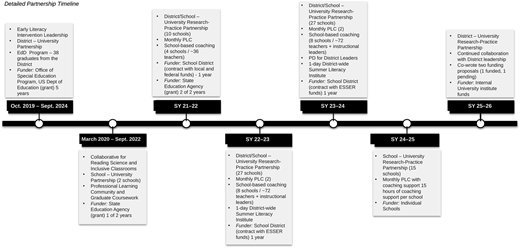
In 2022–23, the RPP leadership team focused monthly PD on implementing small-group reading practices to promote growth in students' word recognition skills. In 2023–24, the monthly PD focused on supporting the implementation of EBPs for reading comprehension. The instructional coaches introduced the EBPs shared in PD sessions to teachers and supported teachers' work with students. MAU coaches were assigned to four schools with dual-language programs and provided instructional leadership teams and teachers with targeted support based on each school's needs. A noteworthy feature of this study's RPP is its focus on implementing EBPs, which hold promise for school districts seeking to increase teachers' use of approaches to improve student outcomes for all students (Terry & Bingham, 2023; Sodani, 2025). Figure 1 provides a detailed timeline for the partnership's six years.
Participants
The primary participants are the RPP leadership team, comprising four district leaders and four researchers, who met weekly in 2023–2024 and twice a month in 2024–2025 to co-create monthly PD sessions for school leaders across the group of 15 elementary schools. The MAU leadership team met regularly without the MACPS team to plan the monthly PD. Please see Table 3 for the complete RPP meeting schedule. Secondary participants included school leaders from two dual-language schools who received coaching support from MAU. As issues of absorptive capacity are usually at the organizational level, district-level leaders and researchers with administrative responsibilities were the focal participants of this study. Table 1 provides details about the study's participants.
Positionality
As equity-driven researchers and as monolingual, economically advantaged, white women, the MAU team members engage in continuous reflection on how our identities, biases, epistemological assumptions, social locations and institutional positions affect this study's design, implementation and analysis (Ravitch & Riggan, 2012). Each author is a member of the RPP researchers' leadership team, which positions us as people in power and privilege, as well as insiders within the partnership (Ghiso et al., 2019). Other aspects of our identities positioned us as insiders and outsiders in relation to our partners. For example, the lead author has never been a K-12 teacher, and thus did not deliver any PD, yet used her over 20 years of experience working in RPPs to build trust with the MACPS participants. The second and third authors led the PD sessions and are formerly K-12 teachers with over 40 years combined experience as higher education faculty and researchers, which increased confidence among the RPP leadership and school-level participants.
Data collection
Three types of qualitative data were collected between August 2023 and May 2025.
Meeting observations: Weekly planning with the RPP leadership team (20), monthly PD sessions (14) and school-based coaching sessions (2) were recorded and transcribed.
Interviews: Semi-structured interviews with nine district and school leaders and three MAU leaders. Interviews were recorded and transcribed.
Document analysis: Meeting agendas, planning documents, district guidance documents, exit tickets from PD sessions and emails (and texts) provided contextual information.
Data analysis
As the lead author identified when determining the instrumental nature of the original case study, this partnership demonstrated elevated absorptive capacity as evidenced by the district's initial strategic decisions to bring in external partners to support its revised guidance on reading instruction and accountability structures, ensuring that every student received high-quality, evidence-based early literacy instruction. MACPS invested its Elementary and Secondary School Emergency Relief (ESSER) funds into these literacy partnerships, including an annual expansion of MAU's partnership from 2021 to 2023. Leadership turnover was limited and did not disrupt partnership activities. Formal and informal communication pathways grew in part because of the MAU doctoral program in educational leadership, which recruited local literacy leaders. These enabling conditions became salient when the district's ability to mobilize resources shifted, as discussed in our findings.
We conducted multiple phases of analysis to understand the interactions between absorptive capacity and boundary-crossing. Initially, we employed a deductive coding process to analyze absorptive capacity in the RPP Leadership meeting transcripts, participant interviews and field notes. Coding was completed using DeDoose, “a cloud-based application used to analyze and visualize qualitative and mixed methods data” (DeDoose, 2026). Saldaña (2021) recommends using deductive coding “when your conceptual framework, research questions, and other matters of research design suggest that certain codes, categories, themes, or concepts are most likely to appear in the data you collect” (p. 39). We used the four elements of absorptive capacity as our codes: resource mobilization, prior knowledge, strategic knowledge leadership and communication pathways (see Table 2). Solo coding was completed by the lead author, the team's most expert qualitative researcher, as part of a larger case study (Saldaña, 2021), and authors two and three, as MAU leadership team participant-researchers, reviewed and confirmed the authenticity of the article's final results (Merriam, 1998). The weekly RPP leadership team meetings, attended by the MAU and MACPS participants, provided not only planning time for the next professional learning activities in the partnership but also time for the MAU team to discuss preliminary findings with the district leaders. In these discussions, the MAU team solicited alternative interpretations of the findings or confirmation of the interpretations. The first author conducted interviews with MAU and MACPS leadership team members as well as school leaders, which enabled additional data collection and provided an opportunity to share preliminary findings and discuss alternative interpretations. The full leadership team developed a level of trust that enabled frank and critical conversations about the partnership and our findings during these member-checking opportunities. These critical conversations also helped mitigate the leadership team's potential bias toward assuming positive partnership outcomes, as they all had a stake in the partnership's success and contributing to future research. Additionally, Mr. Evans, a member of the MACPS leadership team, joined the research team to co-present the case study findings at two practitioner conferences, providing his interpretation of the findings.
The next phase of analysis involved characterizing the types of boundaries negotiated by the participants. Characterizing the unique boundaries of an RPP guides understanding of where boundary spanners encounter discontinuities in practice and engage in learning (Akkerman & Bruining, 2016; Sjölund & Lindvall, 2023). Within the context of this RPP, the goal was to support school leaders in planning for the implementation of EBPs in reading. In implementation science research, researchers identify barriers to the delivery of EBPs and develop solutions to overcome them (Olswang & Prelock, 2015). Implementation barriers include teachers' availability to learn an EBP (Olswang & Prelock, 2015), a school's capacity for systems change (Komesidou & Hogan, 2023) and access to materials and resources (Powell et al., 2015). RPP participants could engage in boundary crossing when developing a strategy to overcome an implementation barrier. We inductively coded the RPP leadership meeting transcripts, interview transcripts and monthly PD field notes for barriers to implementation (Saldaña, 2021). Then we consolidated the barrier codes into three themes representing the main boundaries within the RPP (Miles et al., 2020; Saldaña, 2021). The three boundaries included:
School Capacity for Implementation: RPP participants learning together to mitigate the obstacles school leaders and instructional coaches face when planning EBP implementation.
Timing of Implementation: RPP participants learning together to manage the differing expectations for the time between PD delivery and the implementation of EBPs among researchers, district leaders, principals and school-based coaches.
Use of Curriculum: RPP participants learning together to integrate EBPs into the ELA and SLA blocks and align these practices to the different curricula at each school.
Through boundary characterization and the identification of absorptive capacity elements, we examined boundary spanners' reactions when the enabling conditions for learning were disrupted. We reviewed data excerpts related to absorptive capacity and situated them within the identified boundaries. We then examined how boundary spanners' capacity to learn was influenced by the boundaries they navigated and whether collaborative learning at the boundary contributed to the partnership's sustainability.
We attended to the validity and reliability of our findings through triangulating multiple data sources, memoing about boundary spanners' interactions throughout the data collection and analysis process, debating alternative explanations during weekly planning meetings and corroborating the details of the meetings through interviews with district and school leaders, field notes and relevant documents (Bohannon & Coburn, 2023; Yin, 2018).
Findings
We present how the RPP leadership negotiated the threatened funding stream for the 2024–2025 school year. Then we present the results of our analysis of the boundary spanners' interactions to sustain the partnership. After discussing this disruption in resource mobilization, we present our results on the additional three elements of absorptive capacity – strategic knowledge leaders, prior knowledge and communication pathways – and the most salient corresponding boundary, illustrating how boundary spanners operated at these boundaries to sustain the partnership.
Resource mobilization
A state education agency grant initially funded the partnership in 2020. As explained, a combination of MACPS and ESSER monies funded the contracts in 2021, 2022 and 2023. Federal ESSER funds were distributed during the COVID-19 pandemic and were set to expire September 30, 2024. In February 2024, the RPP leadership team officially learned that MACPS had no internal or external funds for the RPP for the 2024–2025 academic year. Simultaneously, MACPS released the 2024–2025 school budgets, which were severely cut, as ESSER funds also supported additional personnel in schools, including ELA and SLA coaches. Principals and district leaders were under stress because both school-based and district-level budgets required cuts.
Two key district leaders, Dr Sutherland and Dr Kincaid, from different MACPS offices, were instrumental in creating the original multi-year partnership structure of support for literary instruction across elementary schools. When it became clear that neither district nor ESSER funds would be available to continue the partnerships, they collaborated to develop a proposal for the instructional supervisors and principals outlining how individual schools or a consortium of schools could contract directly with any external partner. Additionally, Dr Kincaid and Dr Sutherland, both alumni of the MAU doctoral program in education leadership, with a concentration in early literacy intervention, shared a common understanding of the importance of systems for effective early literacy learning and intervention.
Over several months (February–May 2024), instructional supervisor Mr. Evans worked strategically with the 15 principals to consolidate funds from each school budget to sustain the partnership. He explained his process for reaching out to the principals to the RPP team at a weekly RPP leadership planning meeting.
Mr. Evans [Instructional Supervisor]: I convened principals…to gauge interest in continuing the partnership into the next school year and ask what kind of money they think they had. And I followed up with an interest survey, and the overwhelming majority of folks want to continue the partnership. In terms of money, I think we will be able to pull the money together…(RPP leadership meeting, 03/25/2024)
Mr. Evans planned multiple ways to gauge the principals' interest in continuing the partnership. This process involved multiple group and individual meetings with principals, who had to decide whether to invest their school budget funds into the partnership. Mr. Evans also made the case to the principals at the final May monthly PD session.
Mr. Evans: For the past several years...the impact of the work of foundational literacy has been...showing up in kids. More kids are cracking the code….and that’s the result of the work you are doing here. And then in grades 3–5 with [Formative Assessment] data, where we're making some incremental, small growth year over year, but as we think more about language comprehension, reading comprehension, engaging in complex text…we still have more continued work to do (Monthly PD observation, 05/09/2024).
Mr. Evans believed it would be essential to harness the momentum from learning about reading comprehension and to continue supporting the school-based instructional leaders, knowing that some schools were implementing word recognition strategies introduced the previous year and were only now planning to implement the reading comprehension approaches.
At the end of May, Mr. Evans announced to the MAU team that the principals had pooled enough funds to continue the monthly PD for school leaders in the next academic year.
Mr. Evans: The good news is that everybody has found tremendous community in the partnership over the past two years. And has gotten a lot of learning and really appreciates the space and [the schools] are able to contribute…enough to really cover the costs. (RPP weekly leadership meeting, 5/20/2024)
Approximately half the school principals agreed to pool funding from their school-level budgets to continue monthly PD sessions for school leaders across all 15 schools in the 2024–2025 school year. The funds did not cover the cost of continued university coaching in the four dual-language schools. This resource reallocation demonstrated the perceived value of the partnership and of the learning community to the 15 school principals.
Strategic knowledge leadership and timing of implementation
Mr. Evans demonstrated a strategic knowledge leadership practice by making the case to the principals to use their school funds to continue the partnership. The principals also had to see value in continuing the partnership for another year if they were going to invest school-level funds. In his argument to the principals, Mr. Evans pointed out that ongoing work remained in reading and language comprehension, noting the lag between monthly PD sessions and school-based coaches' planning for EBP implementation in teachers' classrooms, which illustrates a recurring negotiation around the timing of EBP implementation. Interview data revealed the tensions principals felt at this boundary.
Assistant Principal (AP) Sanchez from Cardona Elementary School shared her team’s perspective on the monthly PD sessions and the timing of subsequent EBP implementation.
AP Sanchez: Last year, MAU had an intentional focus on small reading groups, and that has been one of the school’s biggest focuses this year. So while it [reading comprehension] isn't necessarily a PD of this year, that is being implemented at the school-level, it has been saved and stored and we've had conversations with teachers and with coaches around what is it that we want to pull from the [PD] next year (School Leader Interview, 06/11/2024).
Principal Keller described a similar implementation timeline:
And then the second year, when the learning trajectory with MAU was the [language comprehension], my team was implementing [word recognition] really intentionally all year…there were some pieces that were immediately applicable this year, but at the same time, a lot of this year's learning is setting us up for next year (06/20/2024).
In an interview with the biliteracy coach at Cardona Elementary School, Ms. Jobert affirmed the role of coaches in deciding how to roll out new practices to teachers.
[Reading comprehension] is on the back burner because we can only put so much in front of our teachers at a time … Part of my job is creating a scope and sequence for teacher professional learning… but we're asked to do that at the beginning of the year. For example, I'm thinking about it now for next year….I know this is super important, but I can't roll it out right now (School Leaders Interview, 06/11/2024).
The school-based leaders shared that the professional learning delivered in the 2022–2023 school year was being implemented in the 2023–2024 school year. These data illustrate an important boundary for the RPP regarding the timing of implementation. The MAU RPP leaders, MACPS RPP leaders and school-level instructional leaders had to negotiate their expectations for EBP implementation following PD, which influenced RPP sustainability. Both schools, according to Principal Keller and AP Sanchez, were focused on implementing small reading groups, which MAU presented in 2022–2023 at the district's request. School leaders integrated these instructional practices into their comprehensive school plans at the end of that academic year in which the PD was delivered. A survey conducted by Isabel, the MACPS ELA Manager, at the end of the 2023–2024 school year also confirmed that a reported trend across the 15 schools was “increased implementation of small reading groups” (District slides of Coaches Feedback, 06/07/2024). Therefore, if the partnership ended in 2023–2024, the school leaders would not have MAU's continued support to implement the reading comprehension content delivered that year. The school leaders had to make strategic decisions about when to share the content introduced through the monthly PD sessions with the teachers. They knew their teachers needed more prior knowledge to be ready to absorb and implement evidence-based instructional strategies for reading comprehension. With this understanding of PD cycles, the principals knew that another year of the partnership would give their coaches time to implement the content from the 2023–2024 school year.
Prior knowledge and school capacity for implementation
Evidence of prior knowledge supporting sustainability was identified at two time periods: in the 2023–2024 school year, before it was confirmed the partnership would continue and in the summer of 2024, when the RPP team was planning for the school year. In November 2024, the RPP leadership team learned that because ESSER funding was ending, the partnership might also end. The MAU team discussed this possibility at a weekly coaching meeting.
Athena [Research Director]: And I think [school-based goals document] provides a good direction going forward. You know, as Michelle mentioned, I love that we're thinking about long-term in November because, as I said in the chat, [district leader] can't say “fiscal cliff” to me enough.
Selena [University Coach]: Wait, can you tell us what that is? Does that mean this [RPP] is over soon?
Athena: They [school districts] got...COVID recovery money, and they have to spend it this year…they funded this work...from COVID recovery money. So, we're meeting with [district leadership] and trying to figure out creative ways to partner and to get outside grants.
Selena: That's even more of a reason why there needs to be some strategic work on pushing the school leaders to reflect on how the partnership changed to develop the schools and how they're going to continue that work. That would be a successful partnership, right? That has some legacy, too? (Coaches Meeting, 11/06/2024)
In this meeting with the MAU research team and university coaches, Selena realized her work building the capacity of the school-based instructional leadership teams for implementation would be even more critical if the partnership did not continue after this AY. Wanting to “push” the school leaders, Selena expressed the urgency of ensuring that school-based instructional leaders strategically plan to integrate learning from the partnership into their routines and systems.
As the school year continued and the future of the partnership remained uncertain, members of the RPP leadership team felt an urgency to ensure the uptake of EBPs. In an interview, the instructional supervisor, Mr. Evans, explained:
And I'll be honest with you. I also have this fear that this might be our last several months [as a partnership] because of how concerning our district budget is. And I just have no idea what that's actually going to mean for our work. (RPP MACPS leader interview, 02/15/2024)
This uncertainty influenced discussions in the RPP leadership meetings. Knowing that the partnership could end, Mr. Evans reconsidered the topics for the final four PD sessions. Mr. Evans explained:
Our teachers, our classrooms struggle to provide instruction…that support kids in making meaning…of complex texts and demonstrating their understanding of texts through, right now, discourse and, later on, writing. I would want to say, look, we’re going on a four-session journey into complex texts and discourse for our own learning and knowledge…this [PD] is…pre-learning, and next year [coaches] can do this with teachers, and every classroom has meaningful student discourse around comprehension... How do we make this practical?…How do we set ourselves up for something next year in case you all are gone? (RPP MACPS leader interview, 02/15/24)
Instead of moving forward with the original topics for the next four sessions, Mr. Evans wanted the school-based instructional leaders to streamline the topics and delve deeply into complex texts and discourse, rather than the original set of more disparate topics. At Mr. Evan's request for a deeper focus on using complex texts, the MAU lead faculty member, Kara, presented a whole-group classroom reading instruction structure she designed in multiple monthly sessions (session slides for 2/29, 4/4 and 5/9/2024). This whole-group classroom reading structure was a key boundary object, a critical tool in the RPP that facilitates joint activity for the school-based leadership teams. While also working to sustain the partnership for another year, Mr. Evans and the MAU team negotiated an important boundary by adapting the PD schedule to build the school-based leadership teams' capacity and provide them with the knowledge and materials they would need to implement the instructional strategies next year without the MAU partners.
Communication pathways and use of curriculum
The ongoing partnership established several communication channels that enabled knowledge sharing about EBPs in reading. The main communication pathways that facilitated the partnership work were the weekly RPP leadership meetings, monthly PD sessions and weekly in-school coaching sessions. Each team also held regular meetings without its partner members present. Less frequent, but important, pathways included high-level district partner check-ins and an annual literacy institute for elementary school leaders across the district. Table 3 outlines the formal and informal pathways used between the partnership members and those internal to each organization. The change in the regularity of communication pathways is also indicated in Table 3. Per the RPP design, boundary spanning and learning at the boundaries occurred across many of these formal pathways among the district, school leaders and university partners (Sodani, 2025).
Mr. Evans created an important communication pathway for this group of 15 schools and the RPP by inviting the ELA and SLA coaches to the monthly PD sessions in 2022–2023. In previous years, only the principals and, sometimes, the assistant principals attended the monthly sessions. Natalia, the dual language manager, describes the importance of this change:
I think as evidence of how valued this partnership is, is the number of people that principals are bringing…in previous years, our meetings would be the assistant principals, that's it. Now the principals want to bring their APs, they want to bring their instructional leaders…because they recognize that this was an opportunity to really develop expertise (RPP Leader Interview, 04/09/2024).
Natalia linked the quality of the MAU content presented at monthly PD sessions to this change in attendance. In the 2024–25 school year, full instructional leadership teams continued attending the monthly PD sessions and learning together. Although Mr. Evans made this change unilaterally at the beginning of the partnership, the quality of collaboration and interaction among researchers and practitioners sustained the attendance of APs and instructional coaches from each school.
In 2024–2025, funding could only sustain monthly PD and not the school-based coaching for the four schools or the quarterly district-level PLC. The RPP leaders had to switch to meetings twice a month instead of weekly. Principals expressed a desire for more actionable, practical guidance that connected the practices to the in-school professional learning structure and the curricula in their schools (District slides of Coaches' Feedback, 06/07/2024). Natalia summed up this sentiment at the final RPP leadership team meeting of 2023–2024 by explaining, “Next year, we have to make whatever we do as applicable as possible” (RPP Leadership Team Meeting, 5/20/2024). The RPP leaders weighed this feedback against the known implementation lag time and the limited scope of the partnership for the upcoming year, and, during the summer 2024 planning meetings, changed the partnership's structure for the next year.
The university team provided a detailed syllabus at the beginning of the year, reviewed topics from the previous year in two sessions, and designed a presentation structure, as suggested by Selena, a university coach, to address the need for actionable, practical guidance. Within this new structure, coaches at each school implemented a new practice with teachers and then presented at the monthly PD on the implementation process, including both successes and challenges. Selena would support a school for the month leading up to their presentation. In this structure, each school had access to a university coach and could receive guidance on EBP implementation, albeit for only one month. In this new PD structure, the school-level instructional leaders continued to attend monthly PD meetings and received direct support from a university coach, although for only one month.
Discussion
Our findings reinforce prior literature indicating that RPP enabling conditions, including relevant prior knowledge, productive communication pathways, engagement in strategic knowledge leadership practices and the capacity to mobilize resources, were central to long-term sustainability because of the interaction with boundary infrastructure that better prepares partners “to engage in and learn from their encounters at boundaries” (Farrell et al., 2022, p. 200). When district-level partnership funding ended, district and school leaders determined that the joint learning via the partnership was worth continuing with an investment of their own school-level budgets. Similar to Zumpe et al. (2025), this partnership relied on district contracts for funding. Yet its boundary infrastructure and ongoing absorptive capacity fortified it to continue for a fifth year. Our findings indicate that the threat to funding sparked a series of interactions and strategic decisions among RPP and school leaders, illustrating the interplay between partners' capacity for collaborative learning and the RPP's infrastructure for collaborative learning.
An important boundary that RPP leaders navigated, which influenced the RPP's sustainability, was the timing of implementation. A determining factor for principals of whether to fund the next year of the partnership stemmed from their strategic decisions of when to implement the PD content. Most instructional leaders planned to implement the PD content in the next year, giving them enough time to adapt school routines and avoid overburdening teachers. Recognizing their instructional leaders' capacity, the principals valued continued support for EBP implementation. Previous research on PD supports the need for coherence among PD and the current curriculum, assessments and other core educational activities (Desimone & Pak, 2017). Although district leaders encouraged school leaders to quickly implement content from the monthly PD sessions, instructional leaders factored in their teachers' capacity to absorb new knowledge when deciding on EBP implementation. Notably, this implementation lag, an unintended feature of the boundary infrastructure, ultimately supported the RPP's sustainability for another year because the principals strategically determined that continued support would help ensure implementation of the 2023–2024 content.
Our findings attend to the decisions partners make when faced with the end of funding. RPPs are intended to have long-term design and funding plans, which shield them from short-term projects that are less responsive to the needs of practitioner partners or the broader field. Although the district contract for this partnership was renegotiated each year, the partners enjoyed four years of stable funding, beginning with a state-level grant and moving to district contracts. The loss of ESSER funding led to a redesign of the monthly PD topics in 2023–2024 to address another important boundary that RPP leaders were navigating: the capacity of school-level coaches to implement EBPs. After the redesign, MAU leaders focused the PD sessions on what became a key boundary object: the independent reading classroom structure and routines. This classroom structure became a tangible way for school-level coaches to introduce reading comprehension practices to teachers in the last months of 2023–2024 and into 2024–2025.
Our findings highlight the importance of a key feature of absorptive capacity, communication pathways and how they facilitate boundary crossing through “knowledge sharing and joint problem solving” (Farrell & Coburn, 2017, p. 142). The RPP included multiple communication pathways, each of which was a boundary-crossing opportunity for members of MAU and MACPS, facilitating collective sensemaking of new information (Kim et al., 2023). Unsurprisingly, these pathways changed when funding decreased in 2024–2025. RPP leaders met twice a month instead of once a week, and only one coach was assigned to support schools. A notable finding is the additional effort RPP leaders made to be accountable to the principals and instructional leaders who were now funding the partnerships, focusing PD meetings on implementing EBPs in the classroom to sustain the partnership's work. Because each school manages multiple curricula, the adaptation and implementation work is arduous for instructional coaches and may have limited sustainability without continued support.
Limitations
The findings described above are limited in terms of generalizability given the insider status of the researchers. While we attempted to remain unbiased in our analysis of the data and selection of examples to illustrate our findings, our roles as members of the RPP influenced what we considered important to the partnership and to our partners. It may be that researchers who did not know the leaders or educators in the study might have noticed different influences or examples of how the RPP operated and our findings. Further, our findings are limited given the small number of interviews we were able to conduct, the fact that only one member of the research team conducted the coding, and the lack of greater integration of a practitioner team member into the analysis.
Implications
Sustainability is built at the boundaries
This study illustrates that the enabling conditions, including ongoing funding, for learning supported the RPP leaders' ability to sustain the partnership. The RPP's salient boundaries were the places where RPP leaders and participants negotiated the practices that would productively advance partnership goals. When the future of the partnership was threatened by a reduction in resources, the RPP leaders and school principals invested in learning within these boundaries by focusing on a set of PD topics to ensure instructional coaches had the knowledge they needed to implement practices with teachers. Through strategic leadership decisions and the use of established communication pathways, the partners continued for another year, helping to solidify the instructional coaches' learning and ability to apply and adapt the reading practices.
Be ready to pivot
The sustainability of this RPP depended on the team's ability to pivot given funding and structural changes. As RPPs are developed, RPP leaders need to take time to understand where the salient boundaries are, where RPP participants are grappling with and negotiating practices, and where the communication pathways are being built. With this understanding, RPP leaders can make decisions on investing in the joint work at the boundaries that will lead to profound changes in practice. The leaders in this RPP were grappling with how to build instructional coaches' capacity, understand the timing of implementation and integrate new practices into the current curriculum. The funding changes forced RPP leaders to make structural changes that aimed at addressing these issues.
RPP leaders should develop contingency plans for funding disruptions. In the United States, not only did ESSER funding end in 2024, but many federal grants supporting educational partnership work were also recently terminated, including the Teacher Quality Partnership grants and the Supporting Effective Educator Development grants. No one wants to operate under the assumption that distributed funding can be terminated, but this reality offers us new foresight. RPP leaders can discuss annual contingency plans that outline future activities, depending on whether funding continues or ends. RPP leaders can discuss at the beginning of a partnership each participant's expectations for an implementation timeline. For example, if school leaders create goals for comprehensive school plans between February and July of the previous school year, but the partnership begins on October 1, which is a typical start date for U.S. federal education grants, the partnership leaders should have tempered expectations about what school leaders will be able to implement in that academic year. Partnership teams can design PD so that adaptation and application of practices are considered alongside the delivery of new content and sensemaking activities. Having time to grapple with new evidence-based practices is an important step for educators, especially if they are required to abandon previous practices. Yet, seeing early success with a new practice is also very important for its adoption by educators (Nolin, 2023). Therefore, designing professional learning programs with early opportunities for practice and ongoing supports for sensemaking about the EBP could increase implementation success. Researchers can include an ongoing boundary characterization process in the RPP research design (e.g. Sjölund & Lindvall, 2023) to share these boundaries with RPP leaders, who can use them to inform decisions about the trajectory of RPP activities.
Invested RPP participants
Partnership work is about people learning together. Although organizational theory helps us understand the conditions necessary for organizational readiness for partnership, key individuals are needed to advance the partnership work (Denner et al., 2019; Farrell et al., 2018; Sjölund et al., 2022). Mr. Evans and the principals played key roles in sustaining this partnership by understanding its value and investing school-level funds for another year. Yet, an integral change in practice in 2024–2025 was envisioned by an MAU coach following feedback from the district managers and school-level instructional coaches. They demanded that the monthly PD focus more explicitly on school-based adaptation and implementation of EBPs. The boundary-crossing work during the first two years of the partnership gave instructional coaches sufficient prior knowledge to realize they needed more support with classroom implementation. Participants' commitment at all levels of the partnership sustained the RPP for another year. As we continue the partnership into the 2026–2027 academic year with a new group of schools, a priority is to ensure that MAU coaches serve as a line of communication between the school teams and the district leaders and researchers. This structure is intended to systematize the partnership's approach to valuing school-level learning, which might influence district and researchers' initial goals and outcomes. Future research might investigate how and when RPP participants' commitments influence partnership sustainability, providing RPP leaders with insights into which activities and practices are making the greatest impact and warrant continued investment.
Ethical statement
This study was conducted in accordance with the ethical standards of American University and was approved by the Office of Research Integrity (Approval Protocol #: IRB-2020–298, Date of Approval: 03/25/2020).