Digital transformation intensifies pressures for experimentation and iterative innovation in public organizations. Yet many public-sector innovation processes remain structured around industrial governance models emphasizing problem-first entry, linear progression and deliverable-based evaluation. This study aims to examine how innovation governance shapes exploratory digital innovation trajectories, conceptualizing innovation entry as a governance filter.
This study adopts an interpretive case study of innovation practices in a large Swedish regional healthcare organization. Drawing on interviews with innovation intermediaries and formal governance documents, it traces how digitally oriented initiatives move through a stage-gated innovation process.
The findings show that innovation governance operates as a path-creating mechanism. Innovation entry requirements, stage-gated progression, evaluation criteria and legitimacy pressures cumulatively function as governance filters that privilege industrial logics. Problem-first entry conditions stabilize exploratory initiatives and create path dependencies that narrow experimentation. Rather than rejecting digital innovation, governance structures reshape exploratory trajectories to align with institutional expectations of predictability, deliverability and organizational fit.
This study contributes by conceptualizing innovation entry as a governance filter and demonstrating how governance mechanisms structure innovation trajectories from their point of origin. Integrating exploration–exploitation theory and innovation governance research, it advances a mechanism-based explanation of how digital transformation unfolds within institutionalized public-sector systems. The findings offer guidance for designing innovation processes that better accommodate experimentation while maintaining public accountability.
1. Introduction
Digital innovation is widely promoted as a key driver of societal transformation and public value creation (Guenduez et al., 2025; Kindermann et al., 2022; Nylén and Holmström, 2019). In the public sector, digitalization has been described as “the greatest power multiplier of the public interest” (Vigoda-Gadot and Mizrahi, 2024, p. 2), reflecting expectations that digital technologies can improve service quality, efficiency and responsiveness. Over several decades, information systems research has documented how digital technologies reshape organizations and institutional arrangements (Nambisan et al., 2017).
Despite this extensive research, public organizations continue to struggle with realizing the transformative potential of digital innovation. One reason is that digital innovation is often treated as a continuation of earlier forms of IT-enabled change rather than as a distinct innovation regime with different assumptions about how innovation begins, unfolds and creates value (Lyytinen, 2022; Nambisan et al., 2017; Kallinikos et al., 2013). Digital innovation is characterized by generativity, malleability and recombination of digital artifacts, enabling outcomes to evolve through ongoing interaction between technologies, users and organizational contexts. These characteristics intensify exploratory dynamics, where problems and solutions emerge iteratively (von Hippel and von Krogh, 2016). In such contexts, viable innovations often arise from aligning emerging technological possibilities with evolving needs rather than from clearly specified problem statements, contrasting with industrial innovation logic built around linear processes, predefined problems and bounded solutions (Lyytinen, 2022).
A central but underexamined implication concerns how innovation is allowed to begin. Industrial innovation logic presumes that innovation starts from a clearly articulated problem translated into a stable solution through sequential phases. In contrast, exploratory innovation dynamics – frequently intensified in digitally oriented initiatives – may begin with emerging technological possibilities, partial ideas, or provisional solutions that only later become associated with specific needs. In such cases, problems and solutions co-evolve through experimentation, a dynamic described as need–solution (von Hippel and von Krogh, 2016; Nambisan et al., 2017; Lindquist et al., 2023). While well documented, this dynamic remains weakly institutionalized in public-sector innovation governance.
These dynamics are consequential in public organizations, which are deeply embedded in governance logics emphasizing accountability, standardization, transparency and risk minimization (Bertot et al., 2016; Luna-Reyes et al., 2020). Such arrangements have historically supported legitimacy, coordination and large-scale IT initiatives (Coulte and Patmore, 2013), while also privileging problem-first formulations, predictability and early commitment – assumptions that sit uneasily with exploratory innovation dynamics. As digital technologies increasingly permeate the public sector, exploratory initiatives are often required to align with governance frameworks originally designed around industrial models of innovation.
Existing research has acknowledged conceptual differences between industrial and digitally intensive forms of innovation (Lyytinen, 2022) and documented the challenges associated with digital transformation in public-sector contexts (Bertot et al., 2016; Guenduez et al., 2025; Hong et al., 2022). However, there is limited empirical insight into how public-sector innovation governance structures shape innovation trajectories in practice, at the point where initiatives enter formal processes. Much of the literature has focused on adoption, technological outcomes or digital maturity, while paying limited attention to the micro-level enactment of innovation processes and the early-stage decisions that define what counts as legitimate innovation work.
This gap is theoretically and practically significant. As digital transformation intensifies pressures for experimentation, iteration and problem–solution co-evolution, public organizations often continue to rely on governance arrangements rooted in industrial models of predictability, linear progression and predefined deliverables. When exploratory initiatives must conform to problem-first entry requirements and stage-gated evaluation structures, their trajectories may be stabilized early. Understanding how governance mechanisms influence innovation trajectories from their entry point is critical for advancing digital government research and informing public-sector innovation design.
Addressing this gap, this study asks:
How do public-sector innovation governance structures shape exploratory digital innovation trajectories?
To answer this question, the study draws on an interpretive case study of innovation work at a large Swedish regional healthcare organization. By tracing how digitally oriented initiatives move through a formal stage-gated process, the study examines how governance mechanisms structure exploratory dynamics and create path dependencies over time.
This study contributes to digital government research by conceptualizing innovation governance as a path-creating mechanism. Specifically, it introduces the notion of innovation entry as a governance filter, demonstrating how early-stage requirements and stage-gated processes shape exploratory innovation trajectories over time. First, it advances a governance-centered perspective on digital transformation by showing how innovation processes actively structure, rather than merely evaluate, innovation trajectories. Second, it foregrounds need–solution pairing as a critical mechanism through which exploratory dynamics are stabilized or redirected at the point of entry. Third, it shows how inherited governance arrangements generate path dependencies that privilege industrial assumptions of predictability and convergence.
The remainder of the paper is structured as follows. Section 2 reviews relevant literature and develops the theoretical framing and analytical framework. Section 3 describes the research design and methods. Section 4 presents the results. Section 5 discusses the findings. Section 6 presents theoretical, practical and policy implications, limitations and directions for future research.
2. Previous research and theoretical framing
2.1 Exploratory innovation and nonlinear dynamics in digital transformation
Public organizations face sustained pressure to respond to growing societal demands, demographic change and resource constraints while maintaining legitimacy, accountability and equity. Digital transformation has emerged as a central policy response to these pressures, promising improved service quality, efficiency and public value creation (Bertot et al., 2016; Guenduez et al., 2025). At the same time, research on the diffusion of innovation in health service organizations highlights how institutional complexity, professional norms and organizational structures shape how innovations emerge and spread (Greenhalgh et al., 2004). However, digital innovation does not merely introduce new technologies. It intensifies demands for experimentation, iteration and recombination within established organizational structures.
Innovation research has long distinguished between exploratory and exploitative dynamics. March’s (1991) exploration–exploitation framework highlights the tension between experimentation, search and variation on the one hand, and refinement, efficiency and implementation on the other. Exploratory innovation is characterized by uncertainty, iterative learning and the co-evolution of problem and solution spaces. Rather than beginning with clearly specified problems, exploratory initiatives frequently evolve through feedback, reinterpretation and adaptation.
Non-linear models of innovation further challenge linear, stage-based assumptions. Kline and Rosenberg’s (1986) chain-linked model emphasizes feedback loops and recursive movement between problem formulation, design, testing and use. Similarly, research on need–solution pairing demonstrates that viable innovations often emerge not from predefined problems but from the dynamic alignment of emerging technological possibilities and evolving user needs (von Hippel and von Krogh, 2016; Nambisan et al., 2017). These dynamics are visible in digitally intensive contexts, where malleable technologies enable rapid recombination and ongoing reconfiguration (Yoo et al., 2010; Kallinikos et al., 2013).
Digital transformation thus amplifies exploratory innovation pressures within public organizations. However, whether such dynamics can unfold depends not only on technological characteristics but on how innovation processes are governed.
2.2 Industrial innovation governance and stage-gated control
In contrast to exploratory dynamics, industrial innovation governance evolved around assumptions of linear progression, problem-first framing and convergence toward stable deliverables. Stage-gated models institutionalize this logic by structuring innovation into sequential phases separated by decision points, where predefined criteria shape progression (Cooper, 1990). Such models prioritize predictability, resource control and risk reduction.
Industrial governance logic presumes that innovation begins with clearly articulated problems and proceeds through structured refinement toward implementable solutions. Each stage narrows uncertainty and reduces variation, aligning projects with organizational objectives and feasibility constraints. This logic has proven effective in contexts characterized by tangible products, bounded deliverables and stable market conditions.
However, when applied to exploratory innovation dynamics, stage-gated governance may privilege convergence over iteration and deliverables over learning. Rather than accommodating recursive problem–solution co-evolution, linear structures implicitly signal forward progression and closure. While such mechanisms enhance accountability and coordination, they may also shape which forms of innovation are considered legitimate.
2.3 Public-sector governance and legitimacy constraints
The governance of innovation in public organizations is further shaped by institutional environments characterized by legal mandates, professional norms and legitimacy pressures. Public-sector organizations must demonstrate transparency, fairness, responsible resource use and compliance with regulatory frameworks (Bertot et al., 2016; Hinings et al., 2018). These conditions reinforce governance models oriented toward predictability and risk minimization.
As a result, innovation in the public sector often unfolds within highly institutionalized structures designed to ensure stability rather than experimentation. While digital transformation initiatives are encouraged, they must coexist with accountability mechanisms that privilege clarity of objectives, defined ownership and sustainable implementation. Exploratory initiatives that challenge existing infrastructures or blur organizational boundaries may encounter structural constraints, not because they lack potential, but because they disrupt established legitimacy frameworks.
Rather than conceptualizing tensions as failures of digital capability or resistance to change, this perspective suggests that governance structures themselves shape innovation trajectories. The issue is not whether digital innovation is introduced, but how institutionalized governance arrangements influence the forms it can take.
2.4 Innovation entry as governance filtering mechanism
While prior research has examined tensions between exploratory and industrial logics, less attention has been paid to how governance mechanisms shape innovation trajectories from their point of entry. Entry requirements – such as problem-first formulations, predefined objectives and early feasibility assessments – are not neutral procedural steps. Rather, they function as filtering devices that privilege certain innovation logics over others.
Research on organizational ambidexterity has explored how firms balance exploration and exploitation through structural and contextual mechanisms (March, 1991; Raisch and Birkinshaw, 2008; Turner et al., 2012). However, this literature has largely focused on organizational design solutions and managerial balancing strategies, paying limited attention to how innovation governance processes themselves structure exploratory trajectories – particularly in highly institutionalized public-sector contexts undergoing digital transformation.
When exploratory digital initiatives must conform to problem-first entry criteria, their trajectories are stabilized at the outset. Subsequent stage-gated decision points, evaluation templates and legitimacy expectations build upon this initial framing, creating path dependencies that progressively narrow innovation possibilities. Governance mechanisms do not merely evaluate innovation; they actively structure its development over time.
To analyze these dynamics, this study conceptualizes innovation governance through a set of core dimensions contrasting industrial governance logic and exploratory digital innovation logic (see Table 1). Rather than framing digital innovation as inherently incompatible with public-sector institutions, this perspective foregrounds how institutionalized governance mechanisms shape which innovation trajectories become viable.
3. Method
3.1 Research design and setting
This study adopts a qualitative, interpretive case study design to examine how digital innovation is shaped within a public-sector organization. An interpretive approach is appropriate because digital innovation in public organizations is shaped by complex institutional arrangements, overlapping governance structures and situated practices that are difficult to capture through predefined variables or quantitative measures (Walsham, 1995). The aim is to develop a processual understanding of how governance logics are enacted in practice. The study follows established principles for interpretive case research, emphasizing contextual depth, theoretical abstraction and analytically generalizable insights rather than statistical generalization (Walsham, 1995).
The empirical setting is Västra Götalandsregionen (VGR), one of Sweden’s 21 self-governing regions, responsible for public healthcare and transportation. VGR is one of the largest public organizations in Sweden, employing approximately 57,000 people. Its mandate to deliver equitable and high-quality healthcare places it within a highly institutionalized environment characterized by strong regulation, professional dominance and legitimacy demands. This makes it a suitable case for examining how innovation governance operates under strong institutional constraints.
To strengthen its innovation capacity, VGR established a dedicated unit, the Innovation Platform (IP), in 2017. IP functions as an advisory and support unit for innovation initiatives originating across the organization, including digital projects. Rather than owning innovation outcomes, IP supports problem owners in VGR’s operational units by providing coaching, project management, legal guidance and coordination support. IP shapes how innovation ideas are formulated, evaluated and progressed, making it a critical site for studying how innovation logics are enacted in practice.
Two operational roles are central within IP. Innovation coaches support idea owners in articulating needs, applying for funding and navigating regulatory and organizational constraints. Innovation project managers organize and execute approved projects, including budget oversight. These roles are fluid and often combined, reflecting the adaptive nature of innovation work. Decisions regarding implementation and long-term maintenance remain with the originating business units, reinforcing IP’s role as a mediator rather than a decision-making authority.
IP’s work is guided by a document titled Innovation Process as a Guide, which outlines a standardized five-phase innovation process used across VGR. While this document does not have formal regulatory status, it functions as the primary reference for structuring innovation work and aligning practices across projects. It represents a key institutional artifact through which innovation governance is enacted. In parallel, the VGR Innovation Fund (IF) provides financial support through biannual calls for projects. Although organizationally separate from IP, the two units are closely intertwined. Ideas are often pre-coached by IP staff before submission, and approved projects are typically assigned IP personnel. Both operate according to a bottom-up logic, supporting internally generated ideas rather than centrally defined strategies.
3.2 Data collection
The primary data source consists of semi-structured interviews with staff directly involved in operational innovation work at the IP, a dedicated unit within VGR responsible for supporting and governing innovation initiatives across the region. Semi-structured interviews are well suited for accessing participants’ interpretations, experiences and sensemaking related to innovation processes and governance arrangements (Walsham, 1995; Myers and Newman, 2007). The semi-structured format ensured consistency across interviews while enabling participants to elaborate on emergent themes and reflect critically on their experiences. An interview guide was developed based on relevant literature on digital innovation, institutional logics and public-sector governance.
The study focuses on members of the IP, who function as intermediaries within VGR’s innovation system. It does not include interviews with healthcare professionals submitting ideas, senior decision-makers at formal stage-gates or members of the IF committee. The findings reflect how governance structures are experienced and enacted by innovation intermediaries.
The study adopts a purposeful sampling strategy (Patton, 2015) focused on information-rich informants centrally involved in the phenomenon under study. Rather than sampling across the wider organization, the study includes the entire population of the focal unit. During the data collection period, IP comprised two unit managers, one section leader, one strategist and eight project managers, all of whom worked full-time with innovation-related activities. This complete-unit sampling approach captures variation across roles involved in governing and supporting innovation initiatives while maintaining analytical coherence within a single governance setting, thereby strengthening internal validity. It also aligns with established practices in interpretive case study research (Eisenhardt, 1989; Gioia et al., 2013).
Access to the field was facilitated through author’s employment within VGR in a unit separate from IP. In September 2023, the author attended an IP staff meeting where the study and its objectives were presented, and participation was invited. All IP employees engaged in operational innovation work agreed to participate. Twelve interviews were conducted between October and December 2023, resulting in full participation from the invited group. Of the interviewees, nine had been employed in the unit since its establishment, while three joined later. Several long-tenured employees have experienced changes in their operational responsibilities; for example, one unit manager previously served as a project manager and team leader.
Interviews were conducted via Microsoft Teams, recorded with participants’ informed consent, and automatically transcribed. Interview durations ranged from approximately 27–51 min. All interviews were conducted in Swedish. Table 2 provides an overview of respondents, their roles, operational tasks and interview date and lengths. While VGR’s internal systems provide limited role differentiation, the interviews enabled clarification of participants’ actual responsibilities, decision-making roles and everyday innovation practices.
In addition to interviews, the study draws on documentary data, most notably Innovation Process as a Guide, which serves as the formal governance framework structuring innovation initiatives and decision-making within VGR. The use of both interview and documentary data enabled triangulation between reported practices and formal governance structures. This internal document was repeatedly referenced by respondents as central to their work and was analyzed as an institutional artifact shaping innovation practices.
3.3 Data analysis
Data analysis followed an iterative interpretive process. Prior to analysis, transcripts were cleaned to remove system-generated elements, anonymize personal information and improve readability. All transcripts were then imported into Atlas.ti for coding.
The analysis proceeded in two main rounds. In the first round, transcripts were read and coded using a combination of sensitizing concepts derived from the literature and inductively generated codes. First-order coding focused on identifying how innovation work was described in practice, including references to problem formulation, iteration, evaluation and legitimacy. This phase enabled the identification of patterns related to how the formal innovation process was interpreted and enacted, as well as how industrial governance assumptions interacted with exploratory digital innovation dynamics.
In the second round, codes were refined, merged and grouped into higher-order themes through constant comparison. These themes were iteratively compared and abstracted into the governance dimensions presented in Table 1 through ongoing engagement with the theoretical framework. Rather than imposing predefined categories, the dimensions emerged through alignment between theoretical concepts and recurring empirical patterns. This process allowed the analysis to remain grounded in empirical material while developing theoretically informed categories.
The analytical strategy traced interactions between formal governance arrangements, prescribed processes and everyday practices. By examining how actors navigated, adapted and occasionally challenged formal structures, the analysis provides a processual account of how governance mechanisms shape exploratory digital innovation trajectories in practice. This approach supports analytical generalization by linking empirically grounded insights to broader theoretical constructs.
3.4 Researcher positionality and reflexivity
Given the author’s employment within VGR, it is important to reflect on positionality and interpretive bias. The author is employed in a unit separate from the IP and does not hold managerial authority over respondents. While this proximity facilitated access and contextual understanding, it also raises the possibility of familiarity bias, taken-for-granted assumptions or reluctance among participants to express critical views.
Several measures were taken to mitigate these risks. First, interviews were conducted with all operational members of IP, reducing selective sampling bias and ensuring internal perspective diversity. Second, interviews were semi-structured and encouraged critical reflection on the innovation process, including challenges, tensions and shortcomings. Respondents openly discussed limitations of the formal process, suggesting that social desirability bias was limited.
Third, the analysis involved iterative coding and revisiting transcripts to identify both confirmatory patterns and disconfirming instances. Particular attention was paid to cases where the formal innovation process facilitated clarity, discipline or resource prioritization, rather than only constraining exploratory initiatives. This helped avoid an overly deterministic interpretation of governance mechanisms.
Finally, interpretations were grounded in verbatim quotations and explicitly linked to empirical material to maintain analytical transparency. While insider status may have influenced sensitivity to certain dynamics, reflexive awareness and systematic coding procedures were used to strengthen interpretive rigor. Together, these measures align with established practices for ensuring credibility and trustworthiness in interpretive research.
4. Results
4.1 The formal innovation process as governance structure
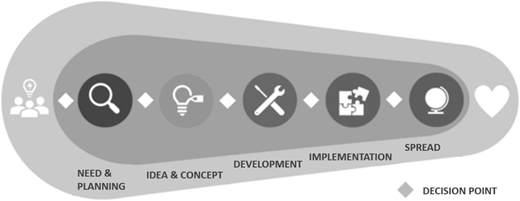
Innovation work at VGR is coordinated through a document titled “Innovation Process as a Guide” (see Figure 1). Although not formally binding, it functions as the primary governance framework structuring innovation initiatives across the organization. As one unit manager explained:
It is a guide to be used, and it is used by everyone who works with us to take the innovation projects further and provide support along the entire process. (Respondent 12)
The guide defines innovation as a process that “starts with a problem and ends with an innovation that creates value” and prescribes five sequential phases:
needs and planning;
idea and concept;
development;
implementation; and
spread.
Each phase is separated by a formal decision point determining whether the initiative may proceed.
A defining feature of the process is its linear and stage-gated structure. Progression depends on meeting predefined criteria at each stage, reinforcing assumptions of forward movement, convergence and increasing stability. Innovation must begin with a clearly articulated problem, and early emphasis is placed on demonstrable user benefit and scalability beyond local needs.
This governance structure applies uniformly across innovation initiatives, regardless of their exploratory or digitally intensive characteristics. As such, the process institutionalizes industrial governance assumptions – problem-first framing, sequential refinement and deliverable-based progression – within the organization’s innovation system.
4.2 Innovation entry as governance filter
The most decisive governance mechanism shaping digital innovation trajectories appears at the point of entry into the formal innovation process. While the Innovation Process as a Guide presents problem formulation as a neutral starting point, empirical accounts reveal that the requirement to begin with a clearly articulated problem functions as a filtering device privileging industrial governance assumptions.
Industrial governance logic presumes that innovation begins with a stable, clearly defined problem that can be translated into objectives and evaluated against predefined criteria. In contrast, exploratory digital innovation often emerges through partial ideas, technological possibilities or evolving interpretations of needs, where problems and solutions co-evolve over time. At VGR, initiatives must be reformulated to align with problem-first expectations before they can progress.
Respondents repeatedly described how healthcare professionals frequently approach the IP with solution-oriented ideas rather than formally articulated problems. Innovation coaches invest significant effort in translating these ideas into acceptable problem descriptions. This translation is not merely semantic; it anchors the initiative to predefined needs and expected user groups.
As one respondent explained:
[…] many people come in with a solution, and they think they have the best solution in the world, an innovation that will solve the needs of the whole world. I have to work with them, to back them up, because I don’t see that they have started from more than their own needs. (Respondent 4)
Several respondents emphasized that the formal process provided structure and legitimacy to initiatives that might otherwise have lacked organizational support. In some cases, problem clarification requirements helped refine overly broad ideas and align them with concrete user needs. These instances suggest that governance mechanisms do not uniformly suppress exploration but may simultaneously enable coordination and resource allocation.
The governance requirement to demonstrate broad applicability and predefined user benefit further reinforces this filtering effect. Initiatives closely tied to local experimentation or uncertain problem definitions are less easily legitimized. While some respondents questioned whether early goal specification is appropriate in exploratory projects, formal entry criteria nonetheless prioritize predictability and clarity over experimentation. This early governance decision has path-dependent consequences, narrowing exploratory dynamics at the outset.
4.3 Linear stage-gating and the suppression of iteration
Beyond the point of entry, exploratory digital innovation trajectories are further shaped by the linear structure of the formal innovation process. Innovation Process as a Guide prescribes sequential progression through five phases, each separated by formal decision points. Advancement depends on demonstrating completion of predefined criteria before moving forward. While such stage-gated models are designed to ensure accountability and resource control, they embed industrial governance assumptions of predictability and convergence.
Industrial governance logic treats innovation as a process of refinement toward a defined solution. Each stage narrows uncertainty and reduces variation, culminating in an implementable outcome. In contrast, exploratory digital innovation unfolds through iteration, experimentation and feedback loops in which problem understandings and solution possibilities evolve together. Rather than converging linearly, exploratory initiatives often revisit earlier assumptions, redefine objectives and adapt direction based on learning.
Empirical accounts from the IP illustrate this tension. In the formal model, the “Idea and concept” phase is expected to culminate in the selection of a concept guiding subsequent development. In practice, respondents described this phase as dominated by exploration and learning rather than convergence:
We are not particularly results-driven in that way. Or it depends on what you count as a result. But […] there is a great learning purpose. (Respondent 10)
Learning, reframing and partial insights were often treated by innovation professionals as valuable outcomes. However, these forms of progress do not easily align with stage-gated expectations of concept selection and forward commitment. As a result, innovation professionals frequently engage in pragmatic adaptation, presenting exploratory insights in ways that satisfy formal decision criteria while preserving space for continued iteration.
The linear structure also reinforces a forward-only logic. Decision points implicitly signal that returning to earlier stages represents failure or inefficiency rather than an inherent feature of exploratory innovation. Although respondents acknowledged that innovation often involves “target searching” and evolving goals, the formal structure provides limited recognition of such dynamics. Iteration is enacted in practice but remains weakly institutionalized in governance.
This misalignment produces a suppression of exploratory dynamics. Rather than accommodating iteration, the governance model encourages convergence, compressing experimentation into early phases.
Respondents did not portray the stage-gated structure as wholly negative. Several noted that decision points can introduce discipline and clarity, particularly in preventing unfocused projects from consuming resources indefinitely. However, this clarifying function simultaneously narrows exploratory scope. The governance mechanism does not eliminate experimentation outright; rather, it channels it into a linear progression model that privileges closure over continuous reconfiguration.
Stage-gated governance operates as a second filtering mechanism. Following the initial stabilization of problem definitions at entry, linear progression expectations further align innovation trajectories with industrial logics. Iteration persists in practice but remains subordinated to formal requirements of convergence and forward movement.
4.4 Evaluation criteria and the marginalization of learning
If innovation entry requirements stabilize problem definitions and stage-gated structures reinforce linear progression, evaluation criteria further shape which forms of progress are recognized as legitimate within the public-sector innovation system. At VGR, movement across decision points depends not only on completing activities but on demonstrating results that align with expectations of clarity, feasibility and organizational relevance. These criteria reflect industrial governance assumptions that innovation should produce tangible deliverables and predictable outcomes.
Under industrial logic, success is measured through the development of defined solutions, validated concepts and readiness for implementation. Progress is demonstrated through concrete outputs that reduce uncertainty and signal increasing stability. In contrast, exploratory digital innovation frequently generates learning, reframing and provisional artifacts as primary outcomes. Iteration produces knowledge about what does not work, shifts problem understandings and surfaces new possibilities. From an exploratory perspective, such learning constitutes substantive progress.
Respondents at the IP consistently described learning-oriented outcomes as central to their work. During early and middle stages, projects often resulted in enhanced understanding, clarified assumptions or revised ambitions rather than finalized concepts. However, these outcomes did not always align neatly with formal evaluation templates. One respondent noted:
We are not particularly results-driven in that way. Or it depends on what you count as a result. But […] there is a great learning purpose. (Respondent 10)
While innovation professionals internally valued learning, the governance system remained oriented toward demonstrable advancement toward implementation. This created an implicit hierarchy in which learning had to be translated into deliverable-oriented language to be legitimized. Insights were reframed as intermediate milestones, and exploratory activities were presented as preparatory steps toward eventual stability.
The tension became particularly visible in projects that culminated in proofs of concept or prototypes rather than finished solutions. Several respondents emphasized that VGR rarely develops full-scale products internally. Instead, outcomes frequently consist of tests, pilots or process adjustments. Yet the formal process retains an underlying expectation of implementable solutions with identifiable ownership and long-term sustainability. When projects did not culminate in such outcomes, their status as “successful innovations” became ambiguous.
This dynamic reveals how evaluation criteria shape trajectories over time. Projects that could not convincingly demonstrate movement toward stable deliverables faced greater difficulty in progressing or securing continued support. Conversely, initiatives that could be framed as converging toward implementation were more easily sustained.
Respondents did not depict evaluation structures as arbitrary or ill-intentioned. In a large public organization responsible for accountable use of resources, the demand for tangible outcomes serves legitimate governance purposes. However, when learning-oriented and exploratory progress lacks formal recognition, digital innovation dynamics characterized by iteration and adaptation risk being marginalized. Evaluation criteria operate as a third governance mechanism aligning exploratory trajectories with industrial expectations.
Together with entry requirements and stage-gating, these evaluation structures contribute to a cumulative narrowing of innovation possibilities. Early stabilization of problems, sequential convergence pressures and deliverable-oriented assessments progressively reshape exploratory initiatives into forms compatible with industrial governance logic.
4.5 Outcome expectations: stable solutions vs provisional artifacts
Beyond evaluation criteria, underlying assumptions about what constitutes a legitimate innovation outcome further shape digital innovation trajectories. The formal innovation process at VGR implicitly reflects an industrial ontology of innovation in which projects culminate in stable, implementable solutions. Even when not explicitly framed as product development, the process assumes that innovation should result in bounded outputs that can be owned, scaled and maintained within existing structures.
Industrial governance logic historically evolved around tangible products and well-defined deliverables. Innovation culminates in an artifact that can be transferred into operations, diffused across user groups and evaluated in terms of performance and impact. This orientation presumes clarity of ownership, technical stability and organizational embedding. In contrast, exploratory digital innovation often produces provisional artifacts – prototypes, pilots, process redesigns or reconfigurable solutions – that remain open to adaptation and ongoing modification.
Empirical accounts from the IP reveal a persistent mismatch between these ontological assumptions and the realities of innovation work. Several respondents emphasized that VGR does not typically develop finished products internally, particularly in digitally intensive domains. Regulatory constraints, procurement rules and medical device requirements limit in-house production. As one respondent explained:
There are very few products. There were more products in the beginning […] A lot of that has disappeared, and that’s because VGR isn’t actually going to manufacture its own products. (Respondent 9)
Instead, innovation initiatives frequently culminate in proofs of concept, prototypes, tests or adjustments to workflows and service processes. Another respondent stated:
No, we don’t work with product innovation; we only do proof of concept, prototypes, and tests. (Respondent 4)
These outcomes align closely with exploratory innovation dynamics intensified by digital transformation, where artifacts remain malleable and subject to continuous refinement. However, they sit uneasily within a governance framework that implicitly anticipates stable deliverables and clear implementation endpoints. When innovation produces provisional artifacts rather than finalized solutions, ambiguity arises regarding what constitutes completion or success.
This ambiguity often results in adaptive compromises. Innovation initiatives are reframed to emphasize aspects that align with stability expectations, such as incremental process improvements or clearly bounded pilot implementations. More transformative or open-ended ambitions are adjusted to fit within organizational constraints and existing system architectures. As one respondent noted:
Even if you have cool ideas for a solution […] you still have to adapt to the systems that VGR has here. (Respondent 5)
Outcome expectations reinforce alignment with existing structures. Entry requirements stabilize problem definitions, stage-gating pressures convergence, evaluation criteria privilege deliverables and outcome expectations favor stable artifacts.
4.6 Legitimacy and organizational fit as constraining forces
While entry requirements, stage-gating, evaluation criteria and outcome expectations shape innovation trajectories internally, broader legitimacy pressures further influence how exploratory digital initiatives evolve. As a large public healthcare organization, VGR operates within institutional environments characterized by accountability demands, regulatory oversight, professional norms and risk sensitivity. Within this context, innovation must not only demonstrate technical feasibility but also organizational compatibility and long-term sustainability.
Respondents consistently emphasized the importance of “anchoring” innovation initiatives across multiple managerial and operational levels. Although formally positioned as a later phase, implementation considerations were described as beginning from the outset. Securing managerial support, clarifying ownership and ensuring compatibility with existing systems were treated as essential preconditions for survival:
The anchoring parts are extremely important, and they are perhaps the clearest success factor for keeping a project alive. (Respondent 11)
This emphasis reflects a legitimacy-oriented governance logic. Innovation initiatives must align with established organizational structures, budgeting processes, professional practices and IT infrastructures to proceed. Projects that cannot demonstrate such alignment risk stagnation or termination, regardless of their exploratory promise.
Several respondents described how innovation trajectories are adjusted over time to secure this fit. Ambitious or visionary solutions are scaled down, reconfigured or redirected to comply with infrastructural constraints and existing system architectures. As one respondent observed:
Those who run various projects often experience that they come up with a great solution, but it doesn’t fit anywhere. (Respondent 3)
Another added:
Even if you have cool ideas for a solution […] you still have to adapt to the systems that VGR has here. (Respondent 5)
These accounts illustrate how exploratory digital innovation is not suppressed through explicit rejection but reshaped through accommodation. Legitimacy-seeking behavior – aimed at ensuring compliance, stability and responsible use of public resources – privileges incremental adaptation over transformative change. Innovation initiatives that challenge existing infrastructures or governance arrangements face greater difficulty in securing long-term adoption.
The “spread” phase further highlights the cumulative effect of these legitimacy pressures. Respondents noted that relatively few projects reach broad dissemination across the organization. Earlier decisions regarding feasibility, alignment and resource commitments constrain scalability. Innovation outcomes that survive are typically those that have been sufficiently stabilized and aligned with existing structures, limiting their generative potential:
Somewhere between phases 2 and 3, decisions need to be made that I may not be able to have this visionary solution in place. (Respondent 10)
Legitimacy orientation operates as a final governance mechanism reinforcing the narrowing of exploratory innovation trajectories. While accountability and risk management serve indispensable public-sector purposes, they also privilege solutions that fit within existing institutional arrangements. Exploratory initiatives that rely on ongoing experimentation, infrastructural reconfiguration or boundary-spanning collaboration face structural barriers.
Altogether, legitimacy and organizational fit pressures consolidate earlier filtering effects, stabilizing exploratory innovation through alignment with institutional expectations.
4.7 Cumulative filtering and path dependency
Taken together, the analysis shows that exploratory digital innovation trajectories are shaped through governance mechanisms that cumulatively privilege industrial logics. Innovation entry requirements stabilize problem definitions, stage-gated structures reinforce linear convergence, evaluation criteria prioritize deliverables over learning, outcome expectations favor stable artifacts over provisional experimentation, and legitimacy pressures demand organizational fit and infrastructural compatibility.
Each mechanism alone may appear reasonable within a large public-sector organization. However, their combined effect produces a structural filtering process. Early governance decisions create framing conditions that shape subsequent possibilities, establishing path dependencies that become difficult to reverse. Once exploratory initiatives are reformulated into predefined problems, aligned with linear progression models, evaluated through deliverable-based criteria and adapted to fit existing systems, the scope for transformative reconfiguration narrows.
This cumulative filtering does not eliminate digital innovation. Instead, it reshapes it. Innovation initiatives survive by aligning with industrial governance expectations, resulting in incremental adaptations, localized improvements and stabilized pilots rather than open-ended experimentation or infrastructural transformation. The clash between exploratory digital dynamics and industrial governance logic unfolds not as confrontation but as gradual alignment.
This cumulative process reveals how public-sector innovation governance structures actively shape innovation trajectories from their point of origin. The trajectory of a project is not shaped solely by technological characteristics or actor intentions, but by the institutionalized mechanisms that define what counts as legitimate innovation at each stage. Innovation governance operates as a path-creating force, structuring both the possibilities and limits of digital transformation within public organizations.
5. Discussion
This study examined how public-sector innovation governance structures shape exploratory digital innovation trajectories. Rather than locating tensions in technological characteristics or actor resistance, the findings show that governance mechanisms function as cumulative filters privileging industrial logics. Digital innovation is not rejected outright; instead, exploratory dynamics are stabilized and aligned with institutional expectations through entry requirements, stage-gated progression, evaluation criteria and legitimacy pressures.
5.1 Innovation entry as a structuring mechanism
The most consequential governance mechanism operates at the point of entry. By requiring initiatives to begin with clearly articulated problems and predefined objectives, public-sector innovation processes privilege industrial assumptions of predictability and linearity. Exploratory dynamics are not excluded but must be translated into problem-first formulations to gain legitimacy.
This finding extends research on exploration and exploitation (March, 1991) by showing how governance structures – not only managerial choices – shape the balance. While ambidexterity research has examined structural and contextual mechanisms for balancing these modes (Raisch and Birkinshaw, 2008; Turner et al., 2012), less attention has been paid to entry requirements as path-creating governance devices. The balance between exploration and exploitation may be tilted at the moment innovation begins.
5.2 Stage-gated governance and convergence pressures
The analysis shows how stage-gated structures reinforce convergence over iteration. Designed to ensure accountability and resource control, industrial governance models embed assumptions of forward progression and deliverable-based advancement. Although exploratory learning persists, it remains weakly institutionalized within formal decision structures.
This contributes to innovation management research by illustrating how stage-gate mechanisms operate in highly institutionalized public-sector contexts. Rather than facilitating disciplined exploration, stage-gating channels experimentation into linear trajectories privileging closure over recursive reconfiguration. Digital transformation intensifies exploratory pressures, but governance structures moderate them through convergence.
5.3 Evaluation, outcome ontology and legitimacy
Beyond process structure, evaluation criteria and outcome expectations further shape innovation trajectories. Deliverable-oriented assessments privilege stable solutions, while learning-oriented outcomes struggle to achieve recognition. Provisional artifacts are often reframed to fit expectations of stability and ownership.
These dynamics are amplified by public-sector legitimacy constraints, as innovation initiatives align with expectations of organizational fit and sustainability.
5.4 Cumulative filtering and path dependency in digital government
Entry requirements stabilize problem definitions; stage-gating reinforces convergence; evaluation criteria privilege deliverables; and legitimacy pressures demand alignment with existing systems.
For digital government scholarship, this shifts attention from technological capabilities and adoption outcomes to the design of innovation governance. Digital transformation unfolds within inherited innovation models that define what counts as legitimate innovation. The key question becomes how governance arrangements configure possible innovation trajectories.
Several respondents described instances in which problem clarification, structured decision points, and anchoring requirements enhanced focus, legitimacy and resource prioritization. These dynamics suggest that industrial governance logics can enable coordination while also constraining exploratory scope.
By conceptualizing innovation entry as a governance filter, this study advances a mechanism-based explanation of how governance structures shape exploratory digital innovation in public-sector systems. The contribution lies not in portraying governance as inherently restrictive, but in showing how its cumulative effects mediate innovation trajectories over time.
At a broader societal level, these findings suggest that innovation governance design influences the public sector’s capacity to respond to uncertain societal needs. If exploratory innovation is narrowed through governance filtering, public organizations risk prioritizing incremental improvements over transformative responses. This affects how effectively digital transformation addresses complex challenges, particularly in healthcare where needs evolve rapidly.
6. Conclusion, implications, limitations and future research
6.1 Conclusion
Drawing on an interpretive case study of innovation practices in a large regional healthcare organization, this study shows that public-sector digital innovation is not constrained primarily through explicit resistance to transformation. Instead, innovation governance operates as a path-creating mechanism that progressively shapes exploratory trajectories over time.
By conceptualizing innovation entry, stage-gated progression, evaluation criteria and legitimacy expectations as cumulative governance filters, the study demonstrates how early-stage requirements structure innovation from its point of origin. Problem-first entry conditions stabilize exploratory initiatives and generate path dependencies that narrow subsequent possibilities.
The central contribution lies in shifting analytical attention from digital innovation outcomes to innovation governance design. Digital innovation is not rejected, but reshaped through cumulative filtering processes that privilege predictability, stability and organizational fit.
6.2 Theoretical implications
The study contributes to digital government research in three ways.
First, it advances a governance-centered perspective on digital transformation. While prior research has emphasized technological affordances, ecosystems and dynamic capabilities, this study demonstrates how innovation governance structures act as path-creating forces. Digital transformation unfolds within institutionalized decision frameworks that shape which forms of innovation are viable.
Second, the study extends research on exploration and exploitation (March, 1991) and organizational ambidexterity by identifying innovation entry requirements as underexamined structural mechanisms. Whereas ambidexterity has focused on organizational design and managerial balancing strategies (Raisch and Birkinshaw, 2008; Turner et al., 2012), this study shows how governance processes tilt the balance between exploratory and industrial logics before projects develop.
Third, the findings contribute to scholarship by reinterpreting stage-gated models in highly institutionalized public-sector contexts. Rather than functioning solely as tools for disciplined innovation management, stage-gated processes can operate as convergence-enforcing mechanisms that reshape exploratory trajectories over time.
Together, these contributions offer a mechanism-based explanation of how exploratory digital innovation becomes aligned with industrial governance expectations within public-sector systems.
6.3 Practical and policy implications
For policymakers and public managers, the findings suggest that improving digital transformation outcomes requires reconsidering how innovation processes are structured and evaluated.
These findings resonate with existing public-sector innovation instruments (e.g. innovation labs, regulatory sandboxes, and pre-commercial procurement) that create protected spaces for experimentation. However, the analysis suggests that such instruments may be insufficient if they are embedded within governance processes that continue to enforce problem-first entry, linear progression and deliverable-based evaluation. Their effectiveness depends on how they are integrated into broader governance structures.
Dual-track governance models – where exploratory and implementation-oriented processes are partially separated – offer a more structural response. For example, exploratory tracks could allow initiatives to enter with provisional ideas or emerging technological possibilities, with early evaluation focused on learning and problem–solution exploration rather than predefined deliverables.
6.3.1 Introduce differentiated entry pathways.
Public IPs may benefit from distinguishing between problem-driven and exploratory entry tracks. Allowing initiatives to enter without fully predefined problem statements can create protected spaces for problem–solution co-evolution while maintaining accountability. For example, an exploratory entry track could allow initiatives to enter with provisional ideas or emerging technological opportunities rather than fully specified problems. Early stages could focus on problem–solution exploration, with evaluation based on learning milestones rather than predefined deliverables, before transitioning into more structured implementation pathways. In practice, this could involve separate application templates, evaluation criteria and funding conditions for exploratory versus problem-driven initiatives within existing innovation funding structures.
6.3.2 Recognize learning as a legitimate outcome.
Evaluation criteria could be expanded to formally recognize learning, reframing and experimentation as valid intermediate results. Explicitly institutionalizing learning milestones may reduce the pressure to prematurely converge on stable solutions.
6.3.3 Recalibrate stage-gated decision points.
Rather than treating progression as strictly linear, governance frameworks could incorporate structured iteration loops, allowing projects to revisit earlier assumptions without signaling failure.
6.3.4 Align legitimacy with experimentation.
Public-sector accountability mechanisms need not be abandoned, but they can be recalibrated to tolerate bounded experimentation. Designing governance models that combine transparency with iterative flexibility may reduce the structural narrowing of innovation trajectories.
These implications do not advocate abandoning industrial governance logic, but complementing it with arrangements that accommodate uncertainty, iteration and emerging problem–solution dynamics. At a societal level, governance filtering may privilege incremental improvements over more transformative responses, affecting long-term service adaptability and public value creation.
6.4 Limitations and future research
This study is based on a single case within a Swedish regional healthcare organization, which limits generalizability. Although the case provides in-depth insight into innovation governance processes, further research is needed to examine whether similar filtering mechanisms operate across different national contexts, administrative traditions and policy domains.
Second, the empirical material reflects primarily the perspective of innovation intermediaries within the IP. The study does not include interviews with healthcare professionals submitting ideas, senior decision-makers at formal stage-gates or members of the IF committee. As a result, the analysis captures how governance filtering is experienced and enacted by intermediaries, rather than how it is perceived across all organizational roles. Future research incorporating multiple stakeholder perspectives could provide a more comprehensive account of how innovation governance dynamics are negotiated across levels of the organization.
Third, while this study conceptualizes innovation entry as a governance filtering mechanism, further research could examine how alternative governance designs – such as dual-track processes, sandbox arrangements or adaptive funding models – reshape exploratory trajectories.
Finally, comparative research across public and private-sector organizations could clarify how institutional environments mediate the relationship between exploratory innovation and stage-gated governance structures. Such work would further illuminate how digital transformation pressures interact with inherited governance models across sectors.