

This paper aims to explain the impacts of the ongoing digitization reform in Benin. It demonstrates that a well-conducted reform can reduce corruption, improve performance and bring citizens closer to the administration. It also highlights the elements needed to ensure the success of such a reform.
The impacts of the digitization of services and processes on both administrative structures and accountability mechanisms are described and discussed through the analysis of interviews conducted with government officials and key external stakeholders.
Findings indicate that the implementation of new technologies has created difficulties for public servants and that reaching out to the entire population is still proving challenging. However, the reform has helped prevent abuses and corruption in management, and it has raised hopes of improving the state–citizen relationship in the long run.
This paper adds to the research on digitization, accountability and state–citizen relationships in developing countries. It fills a gap in the literature by directly analyzing the relationship between digitization and public accountability in Benin.
Introduction
The spread of information and communication technologies (ICTs) in recent years has raised new questions about how to better organize government and engage more deeply with citizens. ICTs offer new opportunities to strengthen transparency by facilitating sharing and access to information (Bertot et al., 2010). Many governments around the world therefore regard digitization processes as a priority. Unfortunately, public authorities in most developing countries are often hampered by limited resources that restrict their capacity to conduct successful digitization projects (Amagoh, 2015).
Recent discussions on government efficacy and public service delivery acknowledge the advantages of using ICTs in public entities (Kayisire and Wei, 2016). Moreover, Gigler et al. (2014) have observed that ICT tools have been used to shift the ways in which accountability and transparency are incorporated into public service delivery. It is widely believed that access to and appropriate usage of ICTs can transform the lives of people and communities. However, Unwin and Unwin (2009) have commented that those implementing technical solutions need to ensure that they are context-specific and adapted to the needs expressed by local communities.
Digitizing public services goes beyond technology development and has potential effects on the transparency, accountability, and efficiency of public sector organizations. In this regard, the case of Benin is compelling, as the country has recently undergone extensive digitization of its government organizations. Consequently, this article aims at exploring the impacts of ICTs on accountability within the public sector in Benin.
While certain significant contributions have been published recently, the scarceness of ICT research in Africa, particularly around the impacts of digitization on accountability, has been underlined by Gillwald (2010). The Beninese case is especially under-researched, with very few publications on ICT diffusion and effects. Based on these premises, we address the following research questions:
In Benin, what are the main outcomes of the digitization of government bodies observed so far?
What are the main effects on internal and external accountability?
This contribution is aimed at all researchers, practitioners and government officials interested in ICT initiatives and accountability in developing countries.
The first section of the article is dedicated to the theoretical foundations of the study. The second section presents the Beninese context. The third section details the method, and the fourth section sets out the findings. The fifth section discusses the results, suggests paths for future research and acknowledges limitations.
Theoretical considerations
Information and communication technologies in the public sector: e-government and digitization in Africa
The implementation and transformational power of new technologies in government have raised considerable attention. Meijer (2006) defines digitization processes in the public sector as the use of ICTs by government organizations to execute their business and management processes. These processes are typically considered as a facilitator or a driver of transformation (Dobrolyubova et al., 2019). Endeavors to digitize public services affect multiple stakeholders, often within different parts of government and society. In general, African countries lag behind Western countries regarding digitization. Imported ICT systems cannot be used as intended due to persistent illiteracy among indigenous populations, limited access to ICT devices and services, high usage costs and weak ICT infrastructure (Tchamyou et al., 2019).
Nevertheless, African countries have built resilience, and they are catching up in the global effort to introduce new technologies in the public sector. Promising results have been found in various areas related to the use of ICTs, and this calls for a wider, more systematic investigation of the situation on the continent (Olatokun, 2008). In this regard, ICTs can positively and significantly improve public sector management practices, as underlined by Evans (2018).
Digitization of government: the accountability promise
In Africa, digitization of government is often regarded as a concrete and efficient way to achieve better governance. Many governments envision the use of ICTs to streamline internal processes (Lindgren et al., 2019), enhance transparency (Bertot et al., 2010) or shift the ways in which transparency and accountability are incorporated into the delivery of public services (Kuriyan et al., 2011).
Accountability allows the public to screen and discipline their officials (Bovens, 2007). Although accountability is classified into several types (Lindberg, 2013), it can be divided into two broad categories: internal and external (Slaughter, 2001). Internal accountability involves public officials reporting to those who supervise their work at all organizational levels. This means hierarchical accountability, based on the presumption that governmental organizations are arranged hierarchically and that they are politically responsible (Deleon, 1998). In contrast, external accountability involves public servants and organizations being answerable to the relevant authorities outside their organizations (Siddiquee, 2005). In this case, accountability for the officials and/or organizations’ actions and level of performance is often diagonal, as indicated by Lührmann et al. (2020). It involves pressure on governments by civil society and media actors, especially via the provision of information or through concrete demands for accountability (Goetz and Jenkins, 2001).
Regarding accountability, ICT systems can be used to monitor work processes and to expose corrupt behaviors, because workflow can be tracked (Shim and Eom, 2008). This explains why technological development and implementation in the public sector are strongly promoted by international organizations on the grounds of government efficiency and openness. A first assumption would be that ICTs will enhance hierarchical accountability within the state apparatus, as thought by Plesner et al. (2018). A second assumption would be that the impact of digitization on state–citizen relations would result in increased diagonal accountability (Agostino et al., 2021). In this study, both assumptions are investigated through a qualitative approach in a developing country, a significant addition to the existing research often conducted in developed states.
Context
Following economic and social troubles in the late 1980s, the “Conférence des forces vives de la Nation” led to significant political and administrative reforms, and Benin is today recognized as a strong democratic republic in West Africa. Following a first phase of changes in the late 2000s, in which the country had started to implement information systems, Benin recently reaffirmed its willingness to push this development forward by launching new reforms like those observed in neighboring countries. These reforms, organized in three programs included in the cross-sectoral programs of the National Information Systems Masterplan, are mainly steered by the Agency for Information Services and Systems (ASSI), the Ministry of Digital Economy and Communication and the Agency for the Development of Digitization (ADN), as described in Figure 1. More generally, the fact that an increasing part of the population now has access to the internet (from 1.79% in 2007 to 20% in 2017; World Bank, 2019), among other factors, has sparked interest for the general development of e-government in the country.
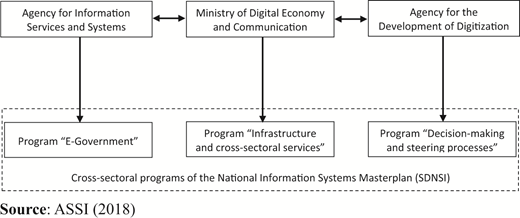
Modernization of the public administration remains at the top of the political agenda: current challenges include lengthy procedures, the difficulty of access to information (Mabillard et al., 2020), inefficient service delivery to citizens and administrative practices not suited to a changing environment characterized by the growing influence of ICTs. In its desire to resolve such matters, the Beninese government has clearly stated that efficiency, cost-saving and greater quality in services are the core objectives of this digitization development. The reform is expected to improve the accountability of public agents regarding their decisions, reduce corruption and increase leverage from actors outside of government. The details of online services by platforms created or to be created by the current reform are presented in Table 1.
Details of the online services by platform
| Platforms (Starting date) | Online services developed in the reform | Main purpose of the service | Intended users | Public bodies in charge of implementation |
|---|---|---|---|---|
| #ASKGouv Bénin (04/11/2018) | Thematic discussion between the population and officials | Explain the recent reform to all interested actors | All Beninese residents and the citizens in the diaspora | Ministry of Digital Economy and ASSI |
| APIEx Bénin (18/02/2020) | Enterprise creation and investment guidance | Set up a business from a mobile phone | All Beninese citizens likely to create businesses | ASSI with the technical support of the United Nations Conference on Trade and Development |
| DEI Bénin (29/06/2020) | Delivery of passports, ID cards and resident cards | Online booking appointments | All Beninese citizens | ASSI, ADN with all ministries affected by the reform |
| DGPR (31/01/2018) | Online platform to signal incivilities | Fight against acts of incivility, police harassment | All Beninese residents and visitors to Benin | Ministry of Digital Economy, ASSI, ADN with the Ministry of Security |
| e-Visa (23/04/2018) | Delivery of visa | Promote hassle-free consular service for visitors | All visitors who need a visa to enter the country | ASSI with the Ministry of Foreign Affairs and the Ministry of Security |
| Portail national des Services publics (26/03/2020) | Delivery of judicial and criminal records, extract from the commercial register and certificate of nonbankruptcy Public procurement | Maintenance of the criminal record (most used service with more than 100,000 requests per year) | All Beninese residents | Ministry of Digital Economy, ASSI and ADN |
| RAVIP Bénin (26/05/2021) | Delivery of citizenship certificate | Provide individuals with a reliable civil status | All Beninese citizens born in the country | ASSI and ADN |
| SGG Bénin (Launched in 2022) | Library of all judicial documents (laws, decrees, etc.) | Promote access to information | All individuals interested in government decisions | ASSI and ADN, with the central Government of Benin |
Method
A qualitative approach was chosen as it would allow the best grasp of the complexity of the context in which the reform is being implemented (Davison and Martinsons, 2016). Such an approach “involves the extraction of meaning, perspective, and experiences viewed from the lens of those affected or involved” (Plume et al., 2020, p. 141). Here, it was well suited to describing the institutional and innovation systems recently mobilized in the reform, and to identifying ways in which the process could favor the development of social accountability practices, depending on the main actors influenced by the reform.
Data collection
Qualitative data were collected through semi-structured interviews, consisting of a series of open-ended questions based on the study’s main subjects of interest. A grid had previously been developed to organize the interviews, including categories identified in the literature and presented above. This approach led to the collection of data based on these categories, which were then enriched by new information obtained through organized and interactive discussion with the interviewees (Ahlin, 2019). As a result, almost all the interviews provided opportunities for various themes or subtopics to develop (Harvey-Jordan and Long, 2001), which were then organized through the coding process. This method allowed us to answer our research questions with the rigor and reliability aimed for in qualitative studies (Klein and Myers, 1999).
Selection of experts
Experts were selected based on two criteria (Meuser and Nagel, 2009): responsibility for development, implementation or control of the digitization reform; and access to information about individuals or decision processes regarding the reform. Additional experts were also added to the list while conducting the first interviews. Indeed, both the interviewees and the researcher were able to identify such experts and interview them while collecting data in the field. In selecting the next interviewee, special attention was paid to balancing the various types of profiles (experts within and outside government) and representing the diverging opinions on the reform.
Interviews with a population of experts (N = 14) were conducted in March and April 2020 (Table 2). Anonymity was guaranteed when we contacted the experts. Three different interview grids were developed based on the interviewees’ profiles. Each version addressed the conditions of ICT adoption, the effects of the digitization reform, an evaluation of the current situation and expectations related to the reform in general. Each interview was recorded and transcribed verbatim using a standard transcription protocol. The transcripts were reviewed by the interviewer for accuracy. Interviews were conducted in French; quotes used below have been translated into English by the authors.
Profile of the interviewees
| Actor type | ID of the interviewees | Relation to digitization | Organization | N |
|---|---|---|---|---|
| Internal experts | 1 | Implementation/monitoring | Directorate of the ADN | 7 |
| Directorate of the Information Systems for the Presidency | ||||
| 2 | ||||
| 4 | Directorate of dematerialization projects | |||
| Directorate of the ANSSI | ||||
| 10 | ||||
| 3 | Internal users/beneficiaries | Directorate of IT systems and pre-archives, Ministry of Interior and Public Security | ||
| Directorate of IT systems and pre-archives, Ministry of Economy and Finance | ||||
| 8 | ||||
| 11 | ||||
| Directorate of IT systems and pre-archives, Ministry of Civil Service | ||||
| External experts | 5 | External users/beneficiaries | Directorate of the House of the Civil Society | 7 |
| 6 | Secretariat of Social Watch Benin | |||
| OPEN SI (company active in information systems, digital innovation) | ||||
| 7 | ||||
| 9 | Freelance community manager | |||
| 12 | Digital journalist and independent marketer | |||
| 13 | RAB-TECH start-up (software development) | |||
| 14 | Consultant in digitization |
Notes:
N = 14. Shortest interview: 21 min, longest interview: 80 min
Data analysis
Analysis of interview data started immediately after each interview. This allowed for the separation of conventional themes and the identification of innovative concepts that were not mentioned in previous interviews. Interviews were coded using content analysis software (NVivo). The data-driven coding process involved the creation of an evolving node structure initially based on early concept identification (initial coding). NVivo was used for the querying of the data and the visualization of the content. Data-driven codes were created inductively from the data collected. They were based entirely on aspects that captured the essence of what we were seeking to understand (Ruona, 2009, p. 243).
Interviews were conducted until sufficient information had been collected for the purpose of this study. This situation was determined based on code saturation (Hennink et al., 2017), whereby the full range of thematic issues was identified. In this case, it was reached after fourteen interviews, as new themes did not emerge. Indeed, similar aspects were addressed and raised by all the experts, and no further interview would have added original content to enrich our study.
Findings
Based on the data collected, we will first detail the reform’s main outcomes, which will help us respond to RQ1, focusing mainly on the effects of the reform on internal workings of public organizations at the national level in Benin. Themes emerging from our qualitative approach will then guide us through the relationships between the ongoing digitization reform and accountability, thereby providing answers to RQ2.
Increased performance through a new paradigm
One of the main objectives of this reform was to increase work efficiency and productivity among public servants through a new work approach. By digitizing most processes performed by employees, this reform has reduced the overall workload of public servants. From the beginning, the reform was aimed at reducing paperwork, and providing citizens with better access to services, which usually required much time to obtain. In this regard, Interviewee 4 argued that “[concerning] users, in the future, we feel that we have made enough (online) platforms, enough services available to them so that they no longer have to come to us.”
As all interviewees confirmed, these objectives have been fulfilled with varying success. The simplification of public procedures has globally been achieved, and many procedures that were cost intensive and lengthy can now be performed online from home. It has opened up several services to new users and has reduced human resources costs: “The digitization of certain processes led to a complete reorganization of services and departments, because the way operations were done was no longer relevant” (Interviewee 3). Using online portals to deliver public services allows requests to be processed in chronological order, avoiding any form of corruption and speeding up processes. Public managers can also track requests and obtain statistics in real time to better anticipate demand and manage their services. This will enable them to learn from these enhanced exchanges with citizens and to identify room for improvement in the future.
These new ways of operating have completely transformed the government agencies involved in the reform, thereby contributing to the creation of a new performance paradigm. Experts highlighted the fact that this new paradigm is not always best suited to the public servants in place: these new practices, largely based on digital skills, require competencies that many public servants do not possess. By radically transforming processes that had been conducted in a well-defined way for decades, the government is putting pressure on some of its workforce, increasing stress and raising fears of losing their jobs. Leadership is sometimes lacking, a phenomenon that may put the digital transformation at risk in some departments. Moreover, the technological foundations needed to conduct the reform are sometimes missing. Although the government is constantly pressuring agencies or departments to go further, they often suffer from an inadequate or under-equipped infrastructure.
As a result, our answer to RQ1 points to a shift in internal workings, driven by the search for efficacy in the public sector, an outcome highlighted by most interviewees. The change revolves around three key themes: a new paradigm for performance, the reduction of corruption and a new way of working for public servants. These three aspects result mainly from the creation of new measurement and accounting platforms and tools, automated systems and increased traceability.
New forms of control and accountability
In addition to this efficacy-related outcome of the reform, digitization has considerably changed the way accountability and control are envisioned by stakeholders inside and outside government. New accountability processes have flourished through the digitization process: operations have become increasingly transparent, and information has been made available to wider segments of the population. In this sense, digitization has improved service delivery to users, who previously struggled to obtain information or a service. By encouraging the use of online portals as intermediary platforms between public authorities and the population, the government has generated new mechanisms of accountability. These platforms create a potential for enhanced traceability of information exchange and payments. This traceability has proved useful as a new form of administrative accountability or control and, externally toward the population, as a form of social accountability.
To create these online portals, the Beninese government has involved various stakeholders such as nongovernmental organizations (NGOs) and external consultants. Their external scrutiny has considerably lowered tolerance of abuses. The population, through community representatives in NGOs or simply through social media, is now mindful of the government’s operations. During the interviews, experts underlined how accountability and trust were strongly intertwined. Nevertheless, creating a trusting relationship between the government, its agencies or departments and the public remains a long-term project, an issue that ICTs alone cannot solve entirely. As Interviewee 8 stated, “We should not expect digitization to raise the level of trust between the citizens and the administration. Rather, it is quite the opposite: we need to create trust for people to consume digital services remotely.”
In addition to this effect of the reform on the relationship between state and nonstate actors, defined here as external accountability, digitization processes have also produced changes within public organizations. The effects on internal accountability mechanisms revolve around the increased possibilities for detecting fraud and sanctioning, which constitute important steps toward the establishment of an accountable and better-functioning government. For instance, audits of public sector employees can improve the allocation of resources and prevent fraud/corruption within the administration. Moreover, better monitoring of personnel recruitment and management of departments, through digitized administrative processes, is a concrete step to counter fictitious employment or over-staffed departments. This was noted by Interviewee 9: “Many cases of fictitious civil servants have been identified. It seems this has led to a lot of savings for the government.”
Therefore, our answer to RQ2 relates to the opportunities brought by the reform to increase levels of both internal and external accountability. As mentioned just above, the improvement in hierarchical accountability and the resulting potential change of conduct have materialized as concrete actions. Effects on external accountability also materialized in the early stages of the reform, through the involvement of nonstate actors. Moreover, public authorities want to increase service accessibility through digital platforms and to “give more satisfaction to users and bring the administration and citizens closer together” (Interviewee 4).
Discussion
Our findings show that concrete actions to increase efficacy and accountability in the Beninese administration have been taken through the digitization reform. One direct outcome is the performance-oriented paradigm envisaged by public authorities; however, as emphasized by most interviewees, the reform is ongoing, and the effects observed are only the first steps toward a more global transformation of the administration. In this regard, most experts expressed reservations about the realization of this outcome, arguing that it is too early to claim that performance has increased significantly. They also affirmed that the reform would not be successful without investment in training or retraining of employees who are now facing new challenges in their daily operations.
The digitization reform has improved internal accountability in three ways. First, most experts agreed that ICTs can increase productivity by identifying over-staffed departments and better monitoring the allocation of human resources across the country. This echoes the findings observed by Kayisire and Wei (2016) in 40 African states. Second, the traceability of all operations helps deter corruption in a more systematic way. The shift from ordinary face-to-face meetings to accessing services online may reduce the temptation to bribe public agents, as already highlighted by Elbahnasawy (2018). And third, hiring staff and allocating human and material resources to specific programs will be closely monitored through online records, thereby raising levels of accountability.
The reform has also created opportunities for increased external accountability through the involvement of stakeholders and better access to services. However, while accessibility is an essential concern of the reform, all interviewees explain that most citizens lack the necessary infrastructure and skills to get access to online public services. Often, they are simply unaware that new ICTs have been developed, or the technology’s potential is not sufficiently well explained by the administration, leading to underuse of new technologies. All these challenges, together with the results identified in our article, are summarized below (Table 3).
Table of results and challenges
| Research questions | RQ1: What are the main outcomes of the reform? | RQ2: What are the main effects on accountability? |
| Main effects on: | Internal workings | Relationships (within the state: hierarchical accountability; with nonstate actors: diagonal accountability) |
| Key concepts | Transparency; performance; control | Transparency; accountability; trust |
| Findings | > Increased traceability of information and payments | > Reduction of corruption through dematerialization process |
| > Reduction of individual workload and paperwork | > Decreasing tolerance regarding fraud in the public sector | |
| > Enhanced access to information and services internally | > Enhanced access to public services and information for users | |
| > Reorganization of certain public departments and agencies | > Increased interactions between public organizations and citizens | |
| > Development of new skills among public servants | > Increasing levels of citizen trust in public sector organizations | |
| > Increased implication of stakeholders, both within and outside the state | ||
| Main findings as expressed in the article’s titles | → A new performance paradigm | → Emerging forms of accountability |
| Challenges | > New ways of working and lacking digital skills | > Creation of trust for a more extensive use of digital platforms |
| > Insufficient existing infrastructure (investment needed) | > Most of the general public lack digital skills and access to Internet | |
| > Leadership in implementing digitization of the public sector | > Education and information are needed to involve citizens | |
Conclusion, future research and limitations
Benin is currently undergoing a digitization reform that aims at following the trend initiated in developed countries, and at establishing a “digitization” hub in West Africa. The reform has already recorded early successes on which the government can capitalize, and Benin continues to invest massively in digitization and has mobilized platforms to connect with its citizens, especially during the COVID-19 pandemic. This article indicates that such a reform has led to increased levels of hierarchical accountability. Nevertheless, further development of reliable performance indicators is needed for hierarchical superiors to evaluate their employees more accurately.
While raising accountability levels within the state will require long-term efforts, increasing external accountability is an even more daunting challenge in the Beninese case. Improved social accountability is a clear objective of the government, but more accessible platforms and an efficient promotion of the reform will be required if the whole population is to benefit (Wakabi and Grönlund, 2015). Citizen empowerment may be one of the most ambitious aspects of the reform, as empowerment depends on numerous complex elements (Kahn et al., 2018). In this sense, our contribution is an invitation to rethink the way digitization impacts accountability in the public sector. If the political objective is to improve state–citizen relationships through diagonal accountability, certain challenges, such as digital illiteracy, lack of infrastructure and low internet access, should be addressed as a priority.
In this regard, the data we collected have shown that constraints specific to developing countries should be allowed for: simply importing models from developed states will not guarantee successful implementation of the reform. These observations have concrete implications when setting priorities and when designing and implementing the reform. For academics, this is an invitation to further investigate the effects of digitization reforms on accountability, especially in developing countries. As one of the current leaders in the West African subregion, Benin is a compelling case for an in-depth analysis. Unfortunately, there is a lack of reference points for comparing the Beninese situation with neighboring states. This represents an interesting path for future research.
The analysis conducted in this contribution could therefore be applied to other countries and may lead to comparative studies. Such an approach would help uncover:
whether some influence is being exerted by international players and/or by Benin in other African states;
whether there is a global trend and/or cross-border influences in implementing ICTs in the public sector in Africa; and
whether clusters of countries leading digitization will emerge in the next few years.
In any case, it would certainly be interesting to see whether the development of technological tools and platforms will contribute to reinforce accountability mechanisms in diverse settings.
We acknowledge that our research meets with certain limitations. While it contributes to a better understanding of the undercommented case of Benin, the qualitative approach relies mostly on experts’ knowledge and perceptions. The absence of hard data makes it difficult to assess the effects of the digitization reform quantitatively. Future research will benefit from the development of performance indicators, provided that data is disclosed by public administrations in a reusable format. Another limitation lies in the exclusion of citizens from the interviews. It would have been desirable to address the consequences of the digitization reform for the citizen–state relationships from the general public’s perspective. However, feasibility constraints make such an approach extremely difficult to adopt.

