Skip to article sections
Purpose

Small and medium-sized enterprises (SMEs) represent a very important part of a country’s economy and depend largely on the development of their innovation capabilities to compete in the market. This study aims to research on innovation in SMEs by classifying the external factors that influence innovation capabilities and proposing a framework to support organizational learning and innovation.

Design/methodology/approach

A systematic literature review was carried out, identifying external factors that, with empirical evidence, have a positive influence on innovation capabilities of SMEs. A keyword co-occurrence analysis was also conducted to facilitate the analysis of the review.

Findings

Thirty-two articles studying external factors according to the established criteria have been identified. The identified factors were grouped into six categories, reflecting different dimensions of the external environment’s relationship with innovation capability. A framework comprising 18 mechanisms for managing knowledge flows with external sources is also proposed.

Research limitations/implications

This article contributes to understanding the influence of the external environment and the organizational learning process on the development of innovation capabilities of SMEs. As a limitation, the classification and framework are conditioned by study methodology and search criteria established.

Practical implications

SME managers can use the proposed framework as a diagnostic and decision-making tool to identify the external knowledge flow mechanisms that, according to the relevant studies, have been linked to positive outcomes in the development of innovation capabilities. This is not a rigid framework. Flexible framework adaptation can be made to their specific context, resources and institutional environment.

Originality/value

This study contributes to the literature on the innovation capability of SMEs by focusing specifically on the external factors that are empirically linked to that capability. By combining a systematic literature review with a keyword co-occurrence analysis, the study provides a classification of external factors to support organizational learning in SMEs. A framework of knowledge flow mechanisms is also proposed to assist SMEs in developing their innovation capability.

Innovation has long been viewed as a driver of economic development and entrepreneurial activity and remains central to firm performance and competitiveness (Saunila, 2020; Schumpeter, 1942, 1989). Small and medium-sized enterprises (SMEs) play a crucial role in economic growth and national competitiveness (Fu et al., 2021; Kamalrulzaman, Ahmad, Ariff, & Muda, 2021). For them, innovation is not only a source of differentiation, but also a condition for survival and sustainable growth (Jalil, Ali, & Kamarulzaman, 2022; Mendoza-Silva, 2020). SMEs face additional challenges compared to large companies, such as having fewer resources or relying more on other stakeholders to find solutions that meet customer needs in a constantly changing market (Singh, Del Giudice, Nicotra, & Fiano, 2022).

Innovation is closely linked to innovation capability (IC), understood as the potential to develop new products or services. For SMEs, IC helps overcome resource constraints and improve competitiveness and performance by enabling adaptation to changing market needs (Maldonado-Guzmán, Garza-Reyes, Pinzón-Castro, & Kumar, 2019). As IC is shaped by both internal and external determinants, identifying these factors is essential for understanding how SMEs can strengthen their innovation processes (Mendoza-Silva, 2020; Saunila, 2020). Despite their relevance, research on the determinants of IC in SMEs remains limited and fragmented, with limited consensus on the factors involved (Fu et al., 2021; Hermawati & Gunawan, 2021; Saunila, 2020; Tsakalerou, Abil, Ribiere, Lukhmanov, & Tynybayeva, 2025).

Previous studies have contributed to a better understanding of IC from various perspectives. Saunila (2020) provides a systematic review of IC in SMEs, identifying its main determinants, outcomes and research gaps, while Mendoza-Silva (2020) examines its nature and determinants at the firm level. Moreira, Navaia and Ribau (2024) focus on the dimensions of innovation capabilities, contributing to a more structured understanding of this multidimensional construct. More recently, Tsakalerou et al. (2025) review the overall determinants of SMEs’ IC. However, less attention has been paid to external factors and the mechanisms that promote knowledge exchange for the development of IC.

External factors are particularly important in the context of SMEs, as interaction with external stakeholders allows them to acquire knowledge and identify opportunities for innovation despite their limited internal resources (Adam & Alofaysan, 2023; Alhassan, Bell, Andrews, Salifu, & Majeed, 2025). In dynamic environments, organizational learning, absorptive capacity and dynamic capabilities become fundamental elements for maintaining competitive advantage and performance (Pan, Essuman, Fumey, Karikari, & Boateng, 2025). It is also essential to advance research on the mechanisms that facilitate external knowledge flows in SMEs (Brunswicker & Vanhaverbeke, 2015). These flows help SMEs acquire knowledge from different sources, overcome resource constraints and promote organizational learning to develop IC (Adam & Alofaysan, 2023; Alhassan et al., 2025).

However, how SMEs access, exchange and integrate external knowledge remains insufficiently understood (Imanto & Kusumastuti, 2019; Ryu, Baek, & Yoon, 2021). Further research is needed on external knowledge flows, the strategies SMEs should adopt to manage them and the frameworks that explain their interrelationships with internal knowledge (Adam & Alofaysan, 2023; Battistella, Ferraro, & Pessot, 2023; Brunswicker & Vanhaverbeke, 2015).

Based on these gaps, the study has two objectives. The first is to identify the external factors that influence the IC of SMEs. The second is to understand the mechanisms through which SMEs exchange knowledge with external sources, promoting the acquisition of knowledge and organizational learning. The research questions (RQs) are therefore as follows:

RQ1.

What external factors determine the innovation capability of SMEs?

RQ2.

What mechanisms facilitate knowledge flows with external sources to support the development of SMEs’ IC?

This article contributes to the literature by offering a focused analysis of how the external environment is associated with the IC of SMEs. Specifically, it identifies and classifies external factors empirically associated with IC through a systematic literature review (SLR) complemented by keyword co-occurrence analysis. It also proposes a framework of mechanisms through which SMEs can acquire external knowledge, promote organizational learning and support the development of IC.

The article is organized as follows. The next section presents the theoretical background, followed by the methodology. The results section reports the categories of external factors and the mechanisms facilitating external knowledge flows. The article concludes with the discussion, conclusions and limitations.

Innovation has been defined as a new or improved product or process that differs significantly from the unit’s previous products or processes and has been made available to users or has been used by the unit (OECD/Eurostat, 2018). In the literature, IC is also referred to as innovation capacity, innovative capability or innovation-based capability (Saunila, 2020). IC can be considered as the potential of the company to generate innovation outputs (Neely, Filippini, Vinelli, & Hii, 2001; Saunila, 2016) and its ability to continuously transform resources and ideas into innovations, including products, processes, organizational changes or marketing (Mendoza-Silva, 2020; Zheng, Liu, & George, 2010).

IC should not be understood as an isolated process or activity, but as a set of capabilities sustained over time that enables companies to generate innovation outputs (Mendoza-Silva, 2020). Empirical studies on IC have typically focused on its determinants and outcomes, including competitiveness and performance (Saunila, 2020). These determinants or factors that condition the IC are both internal and external (Neely et al., 2001). Internal factors refer to firm-level aspects such as organizational culture, structure, processes, staff competence, R&D investment and resources (Albis Salas, Mora Holguin, Lucio-Arias, Sánchez, & Villarreal, 2023; Saunila, 2020). External factors refer to actors in the firm’s environment, including customers, suppliers, competitors and other organizations through which SMEs can access knowledge and develop IC (Saunila, 2020).

External factors are particularly important for SMEs, as the external environment provides them with opportunities to access knowledge, identify opportunities for innovation and compensate for internal resource constraints (Albis Salas et al., 2023). In dynamic environments, firms are also more likely to innovate, as competition and market changes push them to adapt and develop new solutions (Arshad et al., 2023; Leonidou, Christodoulides, Kyrgidou, & Palihawadana, 2017).

This perspective is closely related to open innovation, which emphasizes purposively managed knowledge flows across organizational boundaries, through pecuniary and non-pecuniary mechanisms in line with the organization’s business model (Chesbrough & Bogers, 2013). The concept of open innovation is also linked to the need for entrepreneurship in companies and their consequent relationship with the external environment to promote innovation (Chesbrough & Bogers, 2013; Schumpeter, 1989). Open innovation and access to external sources of knowledge for SMEs are particularly important, as they provide complementary capabilities and facilitate faster adaptation to market demands, especially in times of crisis and uncertainty (Vasi, Sansone, & English, 2024).

IC is closely linked to organizational learning and knowledge acquisition, since firms need to use available knowledge and resources to develop new products and processes and improve its organizational or marketing methods (Hogan, Soutar, McColl-Kennedy, & Sweeney, 2011). External knowledge flow, understood as knowledge exchange with external sources, contributes to organizational learning and is therefore central to the development of IC (Adam & Alofaysan, 2023; Brunswicker & Vanhaverbeke, 2015; Delmas, 2002). This flow is even more important in the context of SMEs, as it provides an alternative way to access knowledge, reduce uncertainty and compensate for limitations such as lower R&D investment and fewer resources (Albis Salas et al., 2023; Battistella et al., 2023).

In addition to promoting knowledge exchange with external sources, SMEs must be able to transform that knowledge into organizational learning and thus develop innovation capabilities. This brings us to the concept of absorptive capacities, which enable organizations to learn from others and transform knowledge into new ideas, products or services through the development of their innovation capabilities (Singh et al., 2022). Absorptive capacity enables organizations to identify, assimilate and apply external knowledge, while knowledge creation processes transform that knowledge into valuable organizational outcomes (Ajmal, Islam, & Islam, 2025). In this regard, the development of IC relies on a balance between exploration and exploitation in organizational learning (Brix, 2019). External knowledge sources can therefore act as catalysts that accelerate and enrich organizational learning (Zhang & Merchant, 2020). In SMEs, this learning also occurs through external networks involving customers, suppliers and other stakeholders (Vos, Petter-Mikx, & Collou, 2025). This study contributes to this body of knowledge by categorizing factors that influence IC and proposing a framework of mechanisms that facilitate external knowledge flow.

The methodology consists of an SLR, which allows previous research, gaps and opportunities in the field to be identified (Bakker, 2010; Khosravi, Newton, & Rezvani, 2019). Following Tranfield, Denyer and Smart (2003), the review was conducted in three phases: planning, execution and reporting.

For the search, several criteria for the selection and analysis of documents were considered. Given that this study aims to identify the external factors that influence SMEs’ IC, the following criteria were applied. The review was designed to identify studies analyzing external factors that influence IC of SMEs. Following established selection criteria for literature reviews (Bakker, 2010), articles were included when they met three conditions: they analyzed one or more external factors affecting IC of SMEs; the relationship between the external factors analyzed and IC was empirically supported through surveys, questionnaires, quantitative analyses or case studies. Studies with negative, non-significant or purely theoretical relationships were excluded, and the study focused specifically on SMEs, given their distinctive characteristics compared with larger firms (Hermawati & Gunawan, 2021).

The search was conducted in Scopus and Web of Science (WOS), as we expect these databases to identify the most relevant articles on the subject under study. No restrictions were placed on the period selected, to ensure that all relevant articles have been considered. The review focused on studies reporting positive associations between external factors and IC. Therefore, factors showing negative or non-significant relationships were outside the scope of the analysis.

The search in both databases was carried out separately and the results were cross-checked to eliminate duplicate papers. Each of the searches is described below:

  • Description of Scopus search

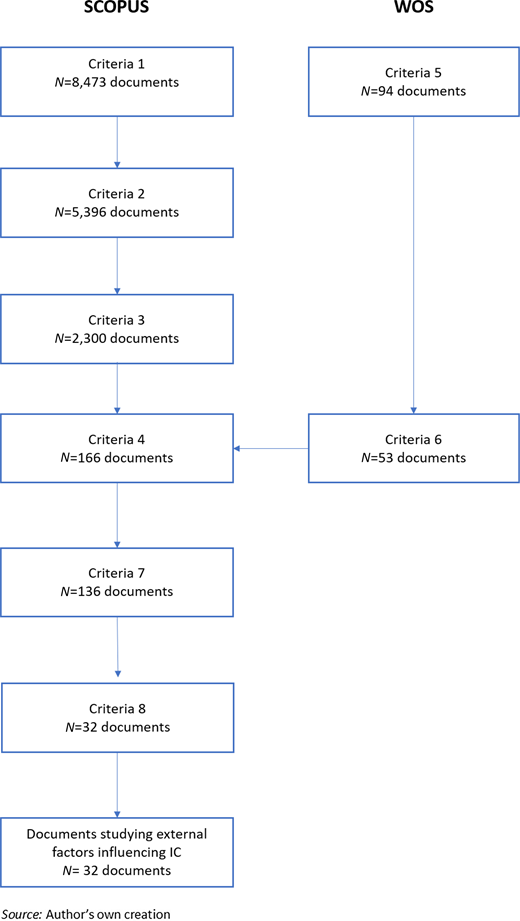
The first filter was used to search for all articles referring to the “innovation capability” on title, abstract and keywords. For this purpose, a first search was performed by including all articles that considered the keywords: “innovation capability,” “innovation capacity,” “capacity of innovation” and “innovation capabilities.” A total of 8,473 documents were obtained with these search criteria (Criteria 1).

To limit the number of documents, the search was restricted to “articles” and those written in English. In total 5,396 articles were recovered using these new criteria (criterion 2). On the other hand, as the capacity to innovate was analyzed from a management point of view, the search was restricted to the areas of “Business, Management, and Accounting,” thus obtaining 2,300 articles (Criteria 3).

The search was then restricted to articles referring to SMEs, for which the following keywords were considered: SME, SMEs, Small and Medium Enterprise, Small and Medium-sized Enterprise. With these new limitations, 166 articles were obtained (Criteria 4):

  • Search in WOS

The search was next conducted in WOS Core collection. The search was carried out considering the following keywords in “All Fields”: (“INNOVATION CAPABILITY” OR “INNOVATION CAPABILITIES” OR “INNOVATION CAPACITY” OR “CAPACITY OF INNOVATION”) AND (“SMALL AND MEDIUM-SIZE* ENTERPRISE*”) AND (“FACTORS” OR “DETERMINANTS” OR “ASPECTS”). With these keywords, 94 documents were obtained (Criteria 5).

Subsequently, only as “Document Types,” articles or reviews were considered. Furthermore, business or management or industrial engineering were also considered as “Web of Science Categories.” With these new criteria, 53 documents were obtained (Criteria 6). These articles were compared with those obtained through Scopus to eliminate duplicates.

Next, the resulting articles were reviewed to identify and discard any that did not correspond to the scope of our research. Indeed, despite the application of the criteria, it is possible that not all articles correspond to studies related to IC in SMEs. To this end, we reviewed the abstracts of the papers, finally selecting 136 papers that carry out studies related to IC in SMEs. We have considered the application of this criterion as Criterion 7.

The final step consisted of reviewing the 136 documents obtained, to identify those that analyze one or more factors influencing the IC of this type of company. To this end, the considerations mentioned above were considered, namely, that the documents examine one or more external factors that influence IC; that this relationship has been empirically demonstrated; and that the study focuses on SMEs. This refers to these considerations as Criterion 8. As a result of this criterion, 32 articles were identified that analyze external factors that influence the IC of SMEs.

The strategy followed for the search is shown in Figure 1.

The literature review was supplemented with an analysis of keyword co-occurrence to support the classification of the identified external factors. Keyword co-occurrence analysis is a bibliometric technique that helps identify the most frequently recurring terms, their relationships and thematic clusters within a selected set of publications (Bakker, 2010; Bouyssou & Marchant, 2011). As part of bibliometric network analysis, it helps reveal patterns, trends and gaps in a research field and supports evidence-based interpretation of the literature (Carley, 1997; Perianes-Rodriguez, Waltman, & van Eck, 2016; Rejeb, Rejeb, Appolloni, & Seuring, 2024).

This bibliometric approach made it possible to summarize the main themes of the selected articles and group related terms into thematic clusters, providing a structured basis for analyzing and classifying the factors identified in the review (Albort-Morant, Henseler, Leal-Millán, & Cepeda-Carrión, 2017; Alsadi, Antony, Mezher, Jayaraman, & Maalouf, 2023; Krndzija & Pilav-Velic, 2022; Nedjwa, Bertrand, & Sassi Boudemagh, 2022; Ye & Ge, 2019).

The analysis was conducted using VOSviewer, a tool that allows users to create and visualize bibliometric networks (van Eck & Waltman, 2010b). The resulting co-occurrence map was used to identify recurring terms, their relationships and the clusters that support the classification of external factors (Albort-Morant et al., 2017; Rejeb et al., 2024).

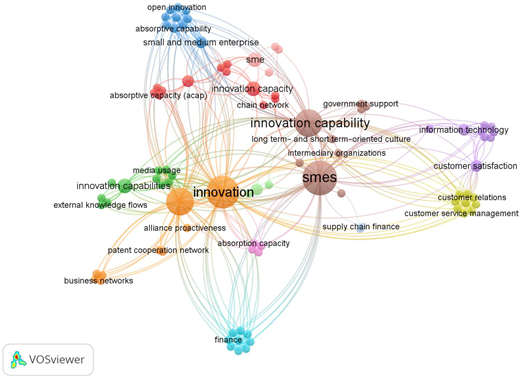
Co-occurrence analysis was applied to the 32 articles selected after applying the search criteria. A minimum co-occurrence threshold of one was established to avoid excluding relevant terms. This resulted in 91 co-occurring terms, grouped into 12 clusters, as shown in the map in Figure 2. On the map, the size of the nodes reflects the frequency of the terms, the colors indicate the groups and the thickness of the links represents the strength of the relationships between the terms.

Details of the different clusters with their associated terms are shown in Table A1 in the  Appendix. For each term (indicated as a label in the Table A1), its position on the map is shown, together with different indices related to the weight of the occurrence of each term. Table A1 also reports cluster overlaps, term citations and the proposed keyword-based category.

The map analysis shows that Clusters 1, 3 and 7 are associated with collaboration-related terms, including relationships, networks, alliances, intermediate organizations and open innovation. Clusters 2 and 5 are associated with technology adoption, including social media, digitization, information and communication technologies (ICTs) and enterprise resource planning.

Clusters 4 and 12 relate to collaboration with customers and suppliers, including customer relationship, customer relationship management (CRM), supplier integration and supply chain. Cluster 6 is associated with innovation funding and subsidies, while Cluster 8 relates to public support for innovation. Clusters 9 and 11 correspond to collaboration with universities and technology centers, respectively, whereas Cluster 10 refers to innovation management.

This analysis provides the basis for the categorization of external factors presented below.

The SLR identified 32 articles that met the established criteria and examined external factors influencing IC of SMEs. These articles were compiled in Table 1, which summarizes the factor categories derived from the review and the keyword co-occurrence analysis. Table 1 reports the authors, publication year, country, sector and external factor categories analyzed in each article. The categories were defined based on the keyword co-occurrence analysis.

The results show that categories related to collaboration are the most frequently studied. Collaboration with customers and suppliers, collaboration with other organizations and collaboration with universities and R&D centers appear in 13, 12 and 9 articles, respectively. Together, they account for 34 of the 47 references to factors (72%), confirming that collaboration is the main theme. By contrast, funding and public support are less well represented, with two and three articles, respectively, while technology adoption appears in eight articles, published mainly in recent years.

Regarding the sample profile, multisectoral studies predominate, followed by those related to the manufacturing sector, suggesting a cross-sectional approach, albeit with a bias toward industrial settings. Most of the studies were published between 2020 and 2023, accounting for 19 of the 32 articles (59%), and indicating a growing interest in external factors, particularly collaboration and technology adoption. Geographically, the articles are mainly concentrated in Asia and Europe, with 17 and 12 studies, respectively.

The results also show limited integration among the different types of collaboration. Only three articles address both business and academic or research collaborations, while business collaborations predominate, with 19 articles, compared to six academic or research studies.

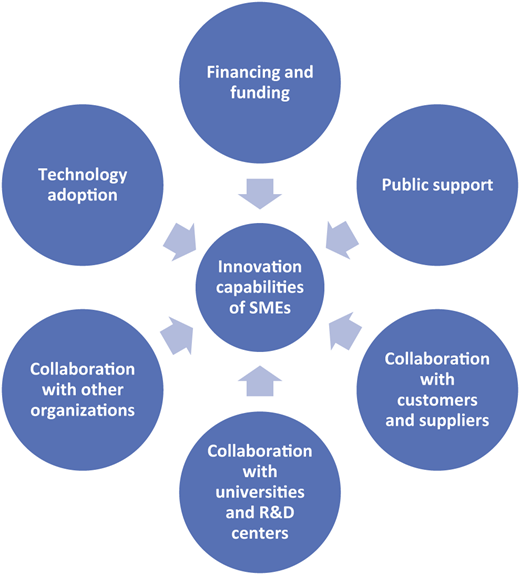
Figure 3 summarizes the resulting categorization of external factors influencing IC of SMEs.

Based on the classification shown in Figure 3, Table 2 briefly describes each category of external factors, summarizes how each contributes to the development of SMEs’ IC and identifies the main sources of support.

Overall, these categories highlight that the innovation capacity of SMEs depends not only on access to external resources and institutional support but also on their ability to interact with various external stakeholders. Specifically, the adoption of technology and collaboration help SMEs translate external knowledge into enhanced innovation capabilities.

External sources of knowledge are diverse and include not only customers and suppliers (vertical relationships) but also competitors, universities, R&D centers and other stakeholders (Albis Salas et al., 2023). The exchange of experiences, values and information with these actors creates external knowledge flows that, when continuous and transformed into useful knowledge, can support the development of SMEs’ IC (Adam & Alofaysan, 2023). Identifying the mechanisms that facilitate these flows is therefore essential to understanding how SMEs acquire external knowledge and support its transformation it into organizational learning. Table 3 summarizes these mechanisms according to the type of external actor involved.

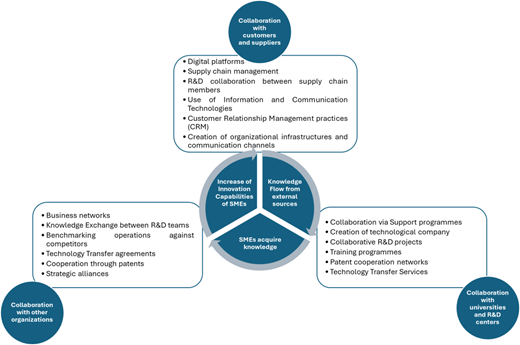
In total, 18 mechanisms have been identified that enable SMEs to acquire information, expertise and external resources through various forms of collaboration. In general, these mechanisms act as channels through which external knowledge flows can be assimilated and transformed into useful knowledge, thereby contributing to the development of SMEs’ IC. Figure 4 summarizes these mechanisms according to the type of collaboration involved.

The 18 mechanisms can also be classified according to two complementary criteria. Table 4 groups them by nature, distinguishing between operational and organizational practices, technological tools and relational forms. Table 5 classifies them according to their function in the organizational learning process, including the generation and acquisition of knowledge, the transfer and application of knowledge, the protection and exploitation of innovation and the creation of networks and the expansion of knowledge.

Although some mechanisms may fit into more than one category, both classifications help clarify how external knowledge flows support organizational learning and the development of IC.

The study addresses the limited understanding of external factors influencing SMEs’ IC and the insufficient analysis of the mechanisms through which SMEs acquire and use external knowledge. In response to RQ1, the SLR and keyword co-occurrence analysis enabled the classification of external factors into several categories. Unlike previous studies that tend to examine external factors in isolation, this classification offers an integrated view of how the external environment supports SMEs’ IC.

The results show significant synergies between the category of technology adoption and the three types of collaboration categories. Specifically, factor analysis reveals that the creation of digital platforms, ICT and the use of social media greatly facilitate collaboration with the external environment, making these collaborations more effective.

Public support also creates synergies with other categories. It is closely linked to financing and funding through grants and other financial instruments. It also fosters innovation through technology transfer, consulting and links with research centers and universities. In this way, public support helps reduce the costs and uncertainty associated with innovation in SMEs (Albis Salas et al., 2023). This classification also opens avenues for comparative research on how the relevance of external factors varies across sectors, regions and institutional contexts.

In response to RQ2, the study proposes a framework of mechanisms that facilitate external knowledge flows. This framework contributes to innovation management and offers practical guidance for SMEs. Classifying mechanisms according to their nature (operational or organizational, technological tools and relational forms) allows managers to select the most appropriate actions for developing innovation capabilities based on their resources and context at any given time.

Likewise, classifying mechanisms according to their purpose in the organizational learning process helps to understand how each mechanism contributes, from different perspectives, to strengthening organizational learning. In this way, SME managers can better adapt their strategies to develop innovation capabilities.

Among the different mechanisms identified, the use of ICT is particularly relevant because it can enhance other knowledge-flow mechanisms. It strengthens mechanisms related to collaboration with customers and suppliers, such as supply chain management, CRM and communication channels. Similarly, digital tools can enhance knowledge-flow mechanisms with universities, R&D centers and other organizations, including collaborative projects, strategic alliances and business networks. Social media also strengthens interaction with customers, suppliers and other stakeholders, supporting joint innovation activities (Fang, Qalati, Ostic, Shah, & Mirani, 2022).

The proposed framework can also be interpreted from the perspective of collective learning within the organization. Recent conceptual studies suggest that absorptive capacity can emerge at the team level as collective intelligence, supported by relational and technological dimensions (Narazaki, Popadiuk, & Rodrigues, 2025). This reinforces the idea that mechanisms such as digital platforms, collaborative projects and business networks not only transfer knowledge but also shape collective capabilities for innovation.

The predominance of collaboration-related studies confirms the importance of interorganizational collaboration in sustaining knowledge flows and supporting SMEs’ IC (Muskat, Hörtnagl, Peters, & Zehrer, 2021). This interest has increased significantly in recent years, confirming the growing importance of SMEs’ collaboration strategies with external sources for innovation, a need that has possibly been accentuated after the pandemic and is also likely associated with the increase in technology and digitalization.

Conversely, public funding and public support are the most under-researched categories. This highlights the need for research studies focusing on both categories, given their importance, particularly the public sector, in developing the innovation capabilities of SMEs (Battistella et al., 2023).

The results also show a decoupling between academic/research and business collaborations, as very few studies – only 9% integrate both approaches. This may lead to fragmented analyses of how knowledge is transferred and exploited, since both types of collaboration often coexist in innovation processes (Rossoni, de Vasconcellos, & de Castilho Rossoni, 2024). It may also limit the design of innovation policies and programs that require an integrated view of university–business and interorganizational collaboration (Ates, Paton, Bititci, & Kemal Konyalıoğlu, 2025). The integrated study from both perspectives provide a better understanding of how both systems interact, identify synergies between them and accelerate the generation of applicable knowledge and the cycle time required for innovation. Future research should therefore adopt integrated approaches to analyze the mechanisms of collaboration between universities and businesses, as well as interorganizational collaboration within SMEs.

Additionally, the concentration of multisectoral studies (18 articles) and manufacturing sector (six articles) suggest that research focused mainly on contexts where innovation and collaboration processes are more visible. By contrast, sectors such as agriculture, tourism and service companies remain underexplored, opening opportunities for future research on how external factors influence SMEs’ IC across different sectoral contexts.

Finally, the mechanisms identified also open avenues for future research into how these mechanisms interact with internal capabilities, such as the internal learning culture or teams’ absorptive capacity. Recent studies on the learning culture of SMEs, collective intelligence and ambidextrous innovation suggest that the effectiveness of external knowledge acquisition may depend on internal factors such as learning routines, team-level absorptive capacity and organizational culture (AlSaied & Alkhoraif, 2024; Narazaki et al., 2025; Vos et al., 2025).

Several limitations should be acknowledged. One limitation relates to the applicability of the model to companies in different sectors. In this regard, the impact according to sector type has not been analyzed, as it may vary depending on the sector to which the company belongs. However, given that most of the studies analyzed consider companies from different sectors, the impact of this aspect is limited.

Another limitation concerns the search terms used in the systematic review. Although the selected terms are commonly used in the IC literature, terminology in this field is not fully standardized. Related expressions such as “innovative capacity,” “innovation potential” or similar concepts could have helped identify additional studies using different terminology to analyze similar phenomena. This limitation may have influenced the resulting sample of articles and, consequently, the external factors identified and the proposed framework. Future reviews could expand the search strategy to include these adjacent constructs and examine whether additional factors, mechanisms or alternative classifications emerge.

On the other hand, this review focused on studies describing positive empirical relationships between external factors and IC, excluding negative or empirically unproven relationships; this implies that the proposed framework does not capture all possible factors, enabling conditions or potential adverse effects in external knowledge relationships.

Finally, regarding the proposed category classification and the resulting framework, although they are based on the soundness of the bibliometric analysis, this does not preclude the possibility of proposing other classifications and frameworks using a different approach.

This study explores the influence of the external environment on the IC of SMEs. Based on the research’s objectives and the SLR, 32 articles were identified that met the established criteria. In addition, keyword co-occurrence analysis enabled these factors to be classified into six categories: financing and funding; public support; technology adoption; collaboration with customers and suppliers; collaboration with universities and R&D centers; and collaboration with other organizations. This classification contributes to understanding how the external environment influences IC of SMEs and how different external factors interact. The results highlight the amplifying effect of technology adoption and the importance of public support in reducing the risks and costs associated with SME innovation. This contributes to the literature by classifying and analyzing external factors by category rather than in isolation, supported by keyword co-occurrence analysis.

The study also highlights the need for future research adopting an integrated view of collaboration in SMEs. This may improve understanding of the factors involved in SME innovation processes and the conditions under which external collaboration supports IC. In addition, the analysis of the three collaboration categories identified 18 mechanisms that facilitate knowledge flows with external sources.

These mechanisms are presented in a framework and have been classified according to several criteria. The proposed framework and classification of mechanisms contribute to understanding organizational learning processes and provide SME managers with guidance for managing innovation within their companies.

The proposed framework may also help SMEs structure knowledge exchange with external sources and strengthen organizational learning processes, thereby supporting their innovation efforts. Furthermore, since these mechanisms are based on previous studies showing positive empirical associations with innovation capabilities, they offer managers a set of options to guide their innovation efforts, although their effectiveness depends on sectoral, organizational and institutional conditions. In this sense, the framework should not be interpreted as a prescriptive model that guarantees innovation outcomes but rather as a synthesis of the mechanisms that previous studies have linked to positive effects in the field of innovation.
Adam
,
N. A.
, &
Alofaysan
,
H.
(
2023
).
External knowledge flows and small and Medium-Sized enterprises’ innovation capabilities enhancement: An empirical investigation
.
Sustainability (Switzerland)
,
15
(
5
), .
Ajmal
,
M.
,
Islam
,
Z.
, &
Islam
,
A.
(
2025
).
Enhancing organizational performance in higher education through knowledge-centered culture and absorptive capacity: The mediating role of the knowledge creation process
.
The Learning Organization
,
32
(
5
),
733
756
, .
Alam
,
S. S.
(
2011
).
Entrepreneur’s traits and firm innovation capability: An empirical study in Malaysia
.
Asian Journal of Technology Innovation
,
19
(
1
),
53
66
, .
Albis Salas
,
N.
,
Mora Holguin
,
H.
,
Lucio-Arias
,
D.
,
Sánchez
,
E. C.
, &
Villarreal
,
N.
(
2023
).
Innovation and productivity in small and medium-sized enterprises: Evidence from the Colombian manufacturing sector
.
Journal of Small Business and Enterprise Development
,
30
(
5
),
1011
1034
, .
Albort-Morant
,
G.
,
Henseler
,
J.
,
Leal-Millán
,
A.
, &
Cepeda-Carrión
,
G.
(
2017
).
Mapping the field: A bibliometric analysis of green innovation
.
Sustainability (Switzerland)
,
9
(
6
), .
Alhassan
,
N.
,
Bell
,
R.
,
Andrews
,
S.
,
Salifu
,
I.
, &
Majeed
,
M.
(
2025
).
Learning of innovation opportunities: Sources and processes of open innovation for sustaining SME hotels
.
The Learning Organization
,
32
(
5
),
775
792
, .
Alsadi
,
J.
,
Antony
,
J.
,
Mezher
,
T.
,
Jayaraman
,
R.
, &
Maalouf
,
M.
(
2023
).
Lean and industry 4.0: A bibliometric analysis, opportunities for future research directions
.
Quality Management Journal
,
30
(
1
),
41
63
, .
AlSaied
,
M. K.
, &
Alkhoraif
,
A. A.
(
2024
).
The role of organizational learning and innovative organizational culture for ambidextrous innovation
.
The Learning Organization
,
31
(
2
),
205
226
, .
Apa
,
R.
,
De Marchi
,
V.
,
Grandinetti
,
R.
, &
Sedita
,
S. R.
(
2021
).
University-SME collaboration and innovation performance: the role of informal relationships and absorptive capacity
.
Journal of Technology Transfer
,
46
(
4
),
961
988
, .
Arshad
,
M. Z.
,
Arshad
,
D.
,
Lamsali
,
H.
,
Ibrahim Alshuaibi
,
A. S.
,
Ibrahim Alshuaibi
,
M. S.
,
Albashar
,
G.
,
Chuah
,
L. F.
(
2023
).
Strategic resources alignment for sustainability: The impact of innovation capability and intellectual capital on SME’s performance
.
Moderating Role of External Environment. Journal of Cleaner Production
,
417
, .
Ates
,
A.
,
Paton
,
S.
,
Bititci
,
U.
, &
Kemal Konyalıoğlu
,
A.
(
2025
).
From transfer to co-creation: Action research perspectives in knowledge transfer partnership (KTP) projects
.
Production Planning & Control
,
36
(
2
),
236
249
, .
Bakker
,
R. M.
(
2010
).
Taking stock of temporary organizational forms: A systematic review and research agenda
.
International Journal of Management Reviews
,
12
(
4
),
466
486
, .
Battistella
,
C.
,
Ferraro
,
G.
, &
Pessot
,
E.
(
2023
).
Technology transfer services impacts on open innovation capabilities of SMEs
.
Technological Forecasting and Social Change
,
196
. .
Borah
,
P. S.
,
Iqbal
,
S.
, &
Akhtar
,
S.
(
2022
).
Linking social media usage and SME’s sustainable performance: The role of digital leadership and innovation capabilities
.
Technology in Society
,
68
. .
Bouyssou
,
D.
, &
Marchant
,
T.
(
2011
).
Ranking scientists and departments in a consistent manner
.
Journal of the American Society for Information Science and Technology
,
62
(
9
),
1761
1769
, .
Brix
,
J.
(
2019
).
Innovation capacity building: An approach to maintaining balance between exploration and exploitation in organizational learning
.
The Learning Organization
,
26
(
1
),
12
26
, .
Brunswicker
,
S.
, &
Vanhaverbeke
,
W.
(
2015
).
Open innovation in small and Medium-Sized enterprises (SMEs): External knowledge sourcing strategies and internal organizational facilitators
.
Journal of Small Business Management
,
53
(
4
),
1241
1263
, .
Calabrese
,
G.
(
2002
).
Small-medium car suppliers and behavioural models in innovation
.
Technology Analysis & Strategic Management
,
14
(
2
),
217
225
, .
Carley
,
K. M.
(
1997
).
Extracting team mental models through textual analysis
.
Journal of Organizational Behavior
,
18
(
S1
),
533
558
. Retrieved from Link to Extracting team mental models through textual analysisLink to the cited article.
Chesbrough
,
H.
, &
Bogers
,
M.
(
2013
).
Explicating open innovation: Clarifying an emerging paradigm for understanding innovation
. Retrieved from Link to Explicating open innovation: Clarifying an emerging paradigm for understanding innovationLink to the cited article.
Delmas
,
M. A.
(
2002
).
Innovating against European rigidities institutional environment and dynamic capabilities
.
The Journal of High Technology Management Research
,
13
(
1
),
19
43
.
Edeh
,
J. N.
, &
Acedo
,
F. J.
(
2021
).
External supports, innovation efforts and productivity: Estimation of a CDM model for small firms in developing countries
.
Technological Forecasting and Social Change
,
173
, .
Egbetokun
,
A. A.
,
Adeniyi
,
A. A.
, &
Siyanbola
,
W. O.
(
2012
).
On the capability of SMEs to innovate: The cable and wire manufacturing subsector in Nigeria
.
International Journal of Learning and Intellectual Capital
,
9
(
1–2
),
64
, .
Fang
,
G. G.
,
Qalati
,
S. A.
,
Ostic
,
D.
,
Shah
,
S. M. M.
, &
Mirani
,
M. A.
(
2022
).
Effects of entrepreneurial orientation, social media, and innovation capabilities on SME performance in emerging countries: A mediated–moderated model
.
Technology Analysis & Strategic Management
,
34
(
11
),
1326
1338
, .
Fang
,
J.
,
Huang
,
G. Q.
, &
Li
,
Z.
(
2013
).
Event-driven multi-agent ubiquitous manufacturing execution platform for shop floor work-in-progress management
.
International Journal of Production Research
,
51
(
4
),
1168
1185
, .
Forsman
,
H.
, &
Temel
,
S.
(
2016
).
From a Non-Innovator to a High-Innovation performer: Networking as a driver
.
Regional Studies
,
50
(
7
),
1140
1153
, .
Fu
,
Q.
,
Sial
,
M. S.
,
Arshad
,
M. Z.
,
Comite
,
U.
,
Thu
,
P. A.
, &
Popp
,
J.
(
2021
).
The inter-relationship between innovation capability and SME performance: The moderating role of the external environment
.
Sustainability (Switzerland)
,
13
(
16
), .
Gellynck
,
X.
,
Kühne
,
B.
, &
Weaver
,
R. D.
(
2011
).
Relationship quality and innovation capacity of chains: The case of the traditional food sector in the EU
.
International Journal on Food System Dynamics
,
2
(
1
),
1
22
, .
He
,
Z.
, &
Sun
,
X.
(
2023
).
How does data empower SMEs to achieve continuous innovation? Implications from China
.
Group & Organization Management
,
50
(
3
), .
Hermawati
,
A.
, &
Gunawan
,
E.
(
2021
).
The implementation of dynamic capabilities for small and medium-sized enterprises in creating innovation
.
VINE Journal of Information and Knowledge Management Systems
,
51
(
1
),
92
108
, .
Hogan
,
S. J.
,
Soutar
,
G. N.
,
McColl-Kennedy
,
J. R.
, &
Sweeney
,
J. C.
(
2011
).
Reconceptualizing professional service firm innovation capability: Scale development
.
Industrial Marketing Management
,
40
(
8
),
1264
1273
, .
Hwang
,
W. S.
, &
Oh
,
S.
(
2023
).
The effectiveness of public R&D subsidy on SMEs’ innovation capability and catch-up in the Korean manufacturing industry
.
Technology Analysis & Strategic Management
,
35
(
10
),
1369
1384
, .
Imanto
,
Y.
, &
Kusumastuti
,
R.
(
2019
).
Terms and conditions privacy policy innovation ecosystem for SMEs in the creative industry
.
International Journal of Business
,
24
(
4
)
Izushi
,
H.
(
2005
).
Creation of relational assets through the “library of equipment” model: An industrial modernization approach of Japan’s local technology centres
.
Entrepreneurship & Regional Development
,
17
(
3
),
183
204
, .
Jalil
,
M. F.
,
Ali
,
A.
, &
Kamarulzaman
,
R.
(
2022
).
Does innovation capability improve SME performance in Malaysia? The mediating effect of technology adoption
.
The International Journal of Entrepreneurship and Innovation
,
23
(
4
),
253
267
, .
Kamalrulzaman
,
N. I.
,
Ahmad
,
A.
,
Ariff
,
A. M.
, &
Muda
,
M. S.
(
2021
).
Innovation capabilities and performance of Malaysian agricultural SMEs: The moderating role of strategic alliance
.
International Journal of Business and Society
,
22
(
2
),
675
695
, .
Khosravi
,
P.
,
Newton
,
C.
, &
Rezvani
,
A.
(
2019
).
Management innovation: A systematic review and meta-analysis of past decades of research
.
European Management Journal
,
37
(
6
),
694
707
, .
Kim
,
M. K.
,
Park
,
J. H.
, &
Paik
,
J. H.
(
2018
).
Factors influencing innovation capability of small and medium-sized enterprises in Korean manufacturing sector: Facilitators, barriers and moderators
,
International Journal of Technology Management
,
76
(
3–4
),
214
235
, .
Kittilaksanawong
,
W.
, &
Ren
,
Z.
(
2013
).
Innovation capability building through intermediary organizations: Cases of manufacturing small- and medium-sized enterprises from China’s Zhejiang province
.
Asian Journal of Technology Innovation
,
21
(
sup2
),
62
79
, .
Krndzija
,
L.
, &
Pilav-Velic
,
A.
(
2022
).
Innovative behavior of small and medium enterprises: A comprehensive bibliometric analysis
.
International Journal of Industrial Engineering and Management
,
13
(
3
),
158
171
, .
Kühne
,
B.
, &
Gellynck
,
X.
(
2010
).
Chain networks as a leverage for innovation capacity: The case of food SMEs
.
International Journal on Food System Dynamics
,
1
(
4
),
279
294
, .
Kurdve
,
M.
,
Bird
,
A.
, &
Laage-Hellman
,
J.
(
2020
).
Establishing SME–university collaboration through innovation support programmes
.
Journal of Manufacturing Technology Management
,
31
(
8
),
1583
1604
, .
Leonidou
,
L. C.
,
Christodoulides
,
P.
,
Kyrgidou
,
L. P.
, &
Palihawadana
,
D.
(
2017
).
Internal drivers and performance consequences of small firm green business strategy: The moderating role of external forces
.
Journal of Business Ethics
,
140
(
3
),
585
606
, .
Lin
,
R. J.
,
Chen
,
R. H.
, &
Chiu
,
K. K. S.
(
2010
).
Customer relationship management and innovation capability: An empirical study
.
Industrial Management & Data Systems
,
110
(
1
),
111
133
, .
Macpherson
,
A.
,
Jones
,
O.
, &
Zhang
,
M.
(
2005
).
Virtual reality and innovation networks: Opportunity exploitation in dynamic SMEs
.
International Journal of Technology Management
,
30
(
1–2
),
49
66
, .
Maldonado-Guzmán
,
G.
,
Garza-Reyes
,
J. A.
,
Pinzón-Castro
,
S. Y.
, &
Kumar
,
V.
(
2019
).
Innovation capabilities and performance: Are they truly linked in SMEs?
International Journal of Innovation Science
,
11
(
1
),
48
62
, .
Mazzucchelli
,
A.
,
Chierici
,
R.
,
Tortora
,
D.
, &
Fontana
,
S.
(
2021
).
Innovation capability in geographically dispersed R&D teams: The role of social capital and IT support
.
Journal of Business Research
,
128
,
742
751
, .
Mendoza-Silva
,
A.
(
2020
).
Innovation capability: A systematic literature review. In.
European Journal of Innovation Management
,
24
(
3
),
707
734
, .
Moreira
,
A.
,
Navaia
,
E.
, &
Ribau
,
C.
(
2024
).
Innovation capabilities and their dimensions: A systematic literature review. In.
International Journal of Innovation Studies
,
8
(
3
),
313
333
, .
Muskat
,
B.
,
Hörtnagl
,
T.
,
Peters
,
M.
, &
Zehrer
,
A.
(
2021
).
Innovation capability and culture: How time-orientation shapes owner-managers’ perceptions
.
Journal of Hospitality and Tourism Management
,
47
,
217
227
, .
Narazaki
,
R. Y.
,
Popadiuk
,
S.
, &
Rodrigues
,
R. G.
(
2025
).
Collective intelligence as an outcome of team absorptive capacity
.
The Learning Organization
,
33
(
1
),
1
20
, .
Ndubisi
,
N. O.
,
Dayan
,
M.
,
Yeniaras
,
V.
, &
Al-Hawari
,
M.
(
2020
).
The effects of complementarity of knowledge and capabilities on joint innovation capabilities and service innovation: The role of competitive intensity and demand uncertainty
.
Industrial Marketing Management
,
89
,
196
208
, .
Nedjwa
,
E.
,
Bertrand
,
R.
, &
Sassi Boudemagh
,
S.
(
2022
).
Impacts of industry 4.0 technologies on lean management tools: A bibliometric analysis
.
International Journal on Interactive Design and Manufacturing (IJIDeM)
,
16
(
1
), .
Neely
,
A.
,
Filippini
,
R.
,
Vinelli
,
A.
, &
Hii
,
J.
(
2001
).
A framework for analysing business performance, firm innovation and related contextual factors: Perceptions of managers and policy makers in two European regions
.
Integrated Manufacturing Systems
,
12
(
2
),
114
124
.
OECD/Eurostat
. (
2018
).
Oslo manual 2018. Guidelines for collecting, reporting and using data on innovation. The measurement of scientific, technological and innovation activities, OECD
, (4th ed.) ,
Paris/Eurostat, Luxemburg
:
OECD Publishing
,
Pan
,
H.
,
Essuman
,
A. N.
,
Fumey
,
M. P.
,
Karikari
,
F. A.
, &
Boateng
,
S. A.
(
2025
).
Dynamics of organizational capabilities and firm performance in an emerging business landscape. The moderating role of environmental dynamism
.
The Learning Organization
,
33
(
2
),
1
24
, .
Perianes-Rodriguez
,
A.
,
Waltman
,
L.
, &
van Eck
,
N. J.
(
2016
).
Constructing bibliometric networks: A comparison between full and fractional counting
.
Journal of Informetrics
,
10
(
4
),
1178
1195
, .
Rejeb
,
A.
,
Rejeb
,
K.
,
Appolloni
,
A.
, &
Seuring
,
S.
(
2024
).
Public procurement research: A bibliometric analysis
.
In International Journal of Public Sector Management
,
37
(
2
),
183
214
, .
Rossoni
,
A. L.
,
de Vasconcellos
,
E. P. G.
, &
de Castilho Rossoni
,
R. L.
(
2024
).
Barriers and facilitators of university-industry collaboration for research, development and innovation: A systematic review
.
Management Review Quarterly
,
74
(
3
),
1841
1877
, .
Ryu
,
D.
,
Baek
,
K. H.
, &
Yoon
,
J.
(
2021
).
Open innovation with relational capital, technological innovation capital, and international performance in SMEs
.
Sustainability (Switzerland)
,
13
(
6
), .
Saunila
,
M.
(
2016
).
Performance measurement approach for innovation capability in SMEs
.
International Journal of Productivity and Performance Management
,
65
(
2
),
162
176
, .
Saunila
,
M.
(
2020
).
Innovation capability in SMEs: A systematic review of the literature
.
Journal of Innovation & Knowledge
,
5
(
4
),
260
265
, .
Saunila
,
M.
, &
Ukko
,
J.
(
2013
).
Facilitating innovation capability through performance measurement: A study of Finnish SMEs
.
Management Research Review
,
36
(
10
),
991
1010
, .
Schumpeter
,
J. A.
(
1942
).
Capitalism, socialism and democracy
,
Routledge
.
Schumpeter
,
J. A.
(
1989
).
Essays on Entrepreneurs, Innovations, Business Cycles and the Evolution of Capitalism
, .
Singh
,
S. K.
,
Del Giudice
,
M.
,
Nicotra
,
M.
, &
Fiano
,
F.
(
2022
).
How firm performs under stakeholder pressure: Unpacking the role of absorptive capacity and innovation capability
.
IEEE Transactions on Engineering Management
,
69
(
6
),
3802
3813
, .
Song
,
Y.
(
2023
).
How do Chinese SMEs enhance technological innovation capability? From the perspective of innovation ecosystem
.
European Journal of Innovation Management
,
26
(
5
),
1235
1254
, .
Tranfield
,
D.
,
Denyer
,
D.
, &
Smart
,
P.
(
2003
).
Towards a methodology for developing evidence-informed management knowledge by means of systematic review. In.
British Journal of Management
,
14
(
3
),
207
222
, .
Tsakalerou
,
M.
,
Abil
,
A.
,
Ribiere
,
V.
,
Lukhmanov
,
Y.
, &
Tynybayeva
,
N.
(
2025
).
The innovation capability equation: A systematic review of global determinants of SME’s success
.
Journal of Innovation & Knowledge
,
10
(
4
), .
van Eck
,
N. J.
, &
Waltman
,
L.
(
2010
).
Software survey: VOSviewer, a computer program for bibliometric mapping
.
Scientometrics
,
84
(
2
),
523
538
, .
Vasi
,
M.
,
Sansone
,
G.
, &
English
,
V.
(
2024
).
Exogenous crises and SMEs resilience: The dynamic open innovation funnel
.
Technovation
,
129
, .
Vos
,
M.
,
Petter-Mikx
,
E.
, &
Collou
,
L.
(
2025
).
Development and validation of the learning culture scale for small- and medium-sized enterprises
.
The Learning Organization
,
32
(
7
),
74
93
, .
Vu
,
T. L.
,
Nguyen
,
D. N.
,
Luong
,
T. A.
,
Nguyen
,
T. T. X.
,
Nguyen
,
T. T. T.
, &
Doan
,
T. D. U.
(
2022
).
The impact of supply chain financing on SMEs performance in global supply chain
.
Uncertain Supply Chain Management
,
10
(
1
),
255
270
, .
Wang
,
L.
,
Wang
,
Y.
,
Lou
,
Y.
, &
Jin
,
J.
(
2020
).
Impact of different patent cooperation network models on innovation performance of technology-based SMEs
.
Technology Analysis & Strategic Management
,
32
(
6
),
724
738
, .
Ye
,
Y.
, &
Ge
,
Y.
(
2019
).
A bibliometric analysis of inventory management research based on knowledge mapping
.
The Electronic Library
,
37
(
1
),
127
154
, .
Zardini
,
A.
,
Ceesay
,
L. B.
,
Rossignoli
,
C.
, &
Mahto
,
R.
(
2023
).
Entrepreneurial business network and dynamic relational capabilities: A case study approach
.
International Journal of Entrepreneurial Behavior & Research
,
29
(
2
),
328
353
, .
Zhang
,
M.
, &
Merchant
,
H.
(
2020
).
A causal analysis of the role of institutions and organizational proficiencies on the innovation capability of Chinese SMEs
.
International Business Review
,
29
(
2
), .
Zheng
,
Y.
,
Liu
,
J.
, &
George
,
G.
(
2010
).
The dynamic impact of innovative capability and inter-firm network on firm valuation: A longitudinal study of biotechnology start-ups
.
Journal of Business Venturing
,
25
(
6
),
593
609
, .
Published by Emerald Publishing Limited. This article is published under the Creative Commons Attribution (CC BY 4.0) licence. Anyone may reproduce, distribute, translate and create derivative works of this article (for both commercial and non-commercial purposes), subject to full attribution to the original publication and authors. The full terms of this licence may be seen at Link to the terms of the CC BY 4.0 licenceLink to the terms of the CC BY 4.0 license.

Data & Figures

Figure 1.
A flowchart shows document screening from Scopus and WOS, reducing 8,567 records through eight criteria to 32 studies on external factors influencing IC.The Scopus pathway starts with Criteria 1, containing 8,473 documents. Criteria 2 reduces this to 5,396 documents. Criteria 3 reduces the total to 2,300 documents. Criteria 4 reduces it to 166 documents. The W O S pathway starts with Criteria 5, containing 94 documents. Criteria 6 reduces this to 53 documents. These 53 documents merge into the Scopus pathway at Criteria 4. Criteria 7 then reduces the combined set to 136 documents. Criteria 8 reduces it to 32 documents. The final box contains documents studying external factors influencing I C, with 32 documents.

Flow diagram followed for the literature review

Figure 1.
A flowchart shows document screening from Scopus and WOS, reducing 8,567 records through eight criteria to 32 studies on external factors influencing IC.The Scopus pathway starts with Criteria 1, containing 8,473 documents. Criteria 2 reduces this to 5,396 documents. Criteria 3 reduces the total to 2,300 documents. Criteria 4 reduces it to 166 documents. The W O S pathway starts with Criteria 5, containing 94 documents. Criteria 6 reduces this to 53 documents. These 53 documents merge into the Scopus pathway at Criteria 4. Criteria 7 then reduces the combined set to 136 documents. Criteria 8 reduces it to 32 documents. The final box contains documents studying external factors influencing I C, with 32 documents.

Flow diagram followed for the literature review

Close Figure 1.
Figure 2.
A network map of research terms has S M Es as the largest central node, linked with innovation capability, innovation, finance, and customer-related terms.The largest central node is S M Es. It is closely linked with innovation capability, innovation, intermediary organisations, supply chain finance, and customer-related terms. Innovation capability appears above S M Es and connects with government support, innovation capacity, chain network, and long-term and short-term-oriented culture. Innovation appears to the left of S M Es and connects with alliance proactiveness, absorptive capacity, media usage, innovation capabilities, and external knowledge flows. Small and medium enterprise, absorptive capability, and open innovation appear in the upper-left area. S M E and absorptive capacity also appear near this group. Business networks and patent cooperation network are positioned in the lower-left area. Finance appears below the central region and connects to several surrounding terms. Information technology appears in the upper-right area. Customer satisfaction, customer relations, and customer service management are grouped on the right. Numerous curved links connect the labelled nodes across the network.

Co-occurrence map of the 32 final documents

Figure 2.
A network map of research terms has S M Es as the largest central node, linked with innovation capability, innovation, finance, and customer-related terms.The largest central node is S M Es. It is closely linked with innovation capability, innovation, intermediary organisations, supply chain finance, and customer-related terms. Innovation capability appears above S M Es and connects with government support, innovation capacity, chain network, and long-term and short-term-oriented culture. Innovation appears to the left of S M Es and connects with alliance proactiveness, absorptive capacity, media usage, innovation capabilities, and external knowledge flows. Small and medium enterprise, absorptive capability, and open innovation appear in the upper-left area. S M E and absorptive capacity also appear near this group. Business networks and patent cooperation network are positioned in the lower-left area. Finance appears below the central region and connects to several surrounding terms. Information technology appears in the upper-right area. Customer satisfaction, customer relations, and customer service management are grouped on the right. Numerous curved links connect the labelled nodes across the network.

Co-occurrence map of the 32 final documents

Close Figure 2.
Figure 3.
A diagram links six external factors to the innovation capabilities of S M E s through inward-pointing arrows.The diagram places Innovation capabilities of S M E s at the centre. Six surrounding factors point inward towards the centre. Financing and funding appears above. Public support appears at the upper right. Collaboration with customers and suppliers appears at the lower right. Collaboration with universities and R and D centers appears below. Collaboration with other organisations appears at the lower left. Technology adoption appears at the upper left.

External factor categories determining innovation capabilities of SMEs

Source: Author’s own elaboration

Figure 3.
A diagram links six external factors to the innovation capabilities of S M E s through inward-pointing arrows.The diagram places Innovation capabilities of S M E s at the centre. Six surrounding factors point inward towards the centre. Financing and funding appears above. Public support appears at the upper right. Collaboration with customers and suppliers appears at the lower right. Collaboration with universities and R and D centers appears below. Collaboration with other organisations appears at the lower left. Technology adoption appears at the upper left.

External factor categories determining innovation capabilities of SMEs

Source: Author’s own elaboration

Close Figure 3.
Figure 4.
A collaboration framework shows how small and medium-sized enterprises acquire knowledge through customers, suppliers, organisations, universities, and research centres.The framework centres on how small and medium-sized enterprises acquire knowledge from external collaboration and use it to increase innovation capabilities. Three collaboration routes surround this process. Collaboration with customers and suppliers supports knowledge acquisition through digital platforms, supply chain management, research and development collaboration between supply chain members, use of information and communication technologies, customer relationship management practices, and creation of organisational infrastructures and communication channels. Collaboration with other organisations supports knowledge exchange through business networks, knowledge exchange between research and development teams, benchmarking operations against competitors, technology transfer agreements, cooperation through patents, and strategic alliances. Collaboration with universities and research and development centres supports knowledge acquisition through support programmes, creation of a technological company, collaborative research and development projects, training programmes, patent cooperation networks, and technology transfer services. These routes enable knowledge flow from external sources, which aids small and medium-sized enterprises in acquiring knowledge and increasing their innovation capabilities.

How SMEs can acquire knowledge and support the development of innovation capability

Source: Author’s own elaboration

Figure 4.
A collaboration framework shows how small and medium-sized enterprises acquire knowledge through customers, suppliers, organisations, universities, and research centres.The framework centres on how small and medium-sized enterprises acquire knowledge from external collaboration and use it to increase innovation capabilities. Three collaboration routes surround this process. Collaboration with customers and suppliers supports knowledge acquisition through digital platforms, supply chain management, research and development collaboration between supply chain members, use of information and communication technologies, customer relationship management practices, and creation of organisational infrastructures and communication channels. Collaboration with other organisations supports knowledge exchange through business networks, knowledge exchange between research and development teams, benchmarking operations against competitors, technology transfer agreements, cooperation through patents, and strategic alliances. Collaboration with universities and research and development centres supports knowledge acquisition through support programmes, creation of a technological company, collaborative research and development projects, training programmes, patent cooperation networks, and technology transfer services. These routes enable knowledge flow from external sources, which aids small and medium-sized enterprises in acquiring knowledge and increasing their innovation capabilities.

How SMEs can acquire knowledge and support the development of innovation capability

Source: Author’s own elaboration

Close Figure 4.
Table 1.

Categories of external factors influencing innovation capabilities of SMEs

AuthorsYearCountryMultisectoralFinancing and fundingPublic support to innovationCollaboration with customers and suppliersCollaboration with universities and R&D centersCollaboration with other organizationsTechnology adoption
Albis Salas et al., 2023 2023ColombiaManufacturing******
He & Sun, 2023 2023ChinaMultisectoral***
Vu et al., 2022 2022VietnamMultisectoral*
Edeh & Acedo, 2021 2021NigeriaMultisectoral**
Apa et al., 2021 2021ItalyMultisectoral*
Wang, Wang, Lou and Jin, 2020 2020ChinaICT***
Zhang & Merchant, 2020 2020ChinaMultisectoral*
Imanto & Kusumastuti, 2019 2019IndonesiaCreative industry*
Kim et al., 2018 2018KoreaManufacturing*
Egbetokun, Adeniyi & Siyanbola, 2012 2013NigeriaManufacturing*
Kühne & Gellynck, 2010 2010EuropeFood sector*
Gellynck et al., 2011 2011EuropeFood sector*
Calabrese, 2002 2002ItalyAutomotive sector*
Song, 2023 2022ChinaMultisectoral*
Battistella et al., 2023 2023ItalyMultisectoral*
Kurdve, Bird & Laage-Hellman, 2020 2020SwedenMultisectoral*
Kittilaksanawong & Ren, 2013 2013ChinaMultisectoral*
Izushi, 2005 2005JapanMultisectoral*
Macpherson, Jones & Zhang, 2005 2005EnglandMultisectoral**
Singh et al., 2022 2022United Arab EmiratesManufacturing*
Lin, Chen & Chiu, 2010 2010TaiwanManufacturing*
Borah, Iqbal & Akhtar, 2022 2022ChinaMultisectoral*
Adam & Alofaysan, 2023 2023Saudi ArabiaMultisectoral*
Saunila & Ukko, 2013 2013FinlandMultisectoral*
Zardini, Ceesay, Rossignoli & Mahto, 2023 2023ItalyFood sector*
Mazzucchelli, Chierici, Tortora & Fontana, 2021 2021ItalyManufacturing**
Forsman & Temel, 2016 2016FinlandMultisectoral**
Muskat et al., 2021 2021EuropeTourism**
Kamalrulzaman et al., 2021 2021MalaysiaAgriculture*
Brunswicker & Vanhaverbeke, 2015 2015EuropeMultisectoral**
Ryu et al., 2021 2021KoreaMultisectoral*
Ndubisi, Dayan, Yeniaras & Al-Hawari, 2020 2020United Arab EmiratesMultisectoral*
Source(s): Author’s own elaboration
Table 2.

Categories of external factors influencing SMEs’ innovation capability

CategoryDescriptionContribution to SME innovation capabilityKey references
Financing and fundingAccess to external financial resources, such as loans, venture capital, credit lines, grants and subsidies, to support innovation activitiesExternal financing helps SMEs overcome internal resource constraints and allocate resources to R&D and innovation projects. This is particularly relevant for SMEs in the manufacturing sector, where technological innovation often requires higher levels of investmentAlbis Salas et al., 2023; Edeh and Acedo, 2021 
Public supportPublic policies, programs and institutional services that support SME innovation, including subsidies, innovation grants, technology transfer services and intermediary supportPublic support reduces the costs, risks and uncertainty associated with innovation. Beyond financial support, public institutions can also facilitate access to technology, expertise and research organizations through technology transfer and advisory servicesAlbis Salas et al., 2023; Battistella et al., 2023; Hwang and Oh, 2023; Muskat et al., 2021 
Technology adoptionAcquisition and use of technologies that support communication, information exchange and value creation, including ICT, digital platforms, social media, big data, artificial intelligence, mobile technologies and the internet of thingsThe adoption of technology facilitates knowledge sharing with external stakeholders and enhances the agility and effectiveness of collaboration. Furthermore, it helps SMEs identify customer needs, improve communication, and transform business models, contributing to the development of ICAlam, 2011; Borah et al., 2022; Fang, Huang, and Li, 2013; Macpherson et al., 2005; Ryu et al., 2021 
Collaboration with customers and suppliersVertical collaboration with customers and suppliers through feedback, joint initiatives, information sharing, supply chain integration and customer relationship management practicesCollaboration with customers and suppliers enables SMEs to better understand market needs, gain access to operational and market insights and increase the likelihood that their innovations will be accepted by the market. Supply chain integration also encourages joint participation in innovation-related activitiesAlbis Salas et al., 2023; Egbetokun et al., 2012; Izushi, 2005; Kühne and Gellynck, 2010; Song, 2023; Vu et al., 2022 
Collaboration with universities and R&D centersCooperation with universities, research centers and technology institutions through research projects, training programs, technology transfer, collaboration on patents and technical supportThis type of collaboration enables SMEs to access specialized knowledge, technological expertise and research capabilities that they often lack internally. It also fosters organizational learning and accelerates the development of innovation capabilities at a lower cost than fully in-house R&DAlbis Salas et al., 2023; Kittilaksanawong and Ren, 2013; Kurdve et al., 2020; Song, 2023 
Collaboration with other organizationsRelationships with external stakeholders other than customers, suppliers, universities and R&D centers, including other companies, competitors, consultants, intermediaries, business networks and strategic alliancesCollaboration with other organizations enables SMEs to expand their knowledge and encourage joint initiatives that strengthen their capacity for innovation. It also helps reduce uncertainty and risk in innovation projectsBattistella et al., 2023; Forsman and Temel, 2016; Kamalrulzaman et al., 2021; Mazzucchelli et al., 2021; Saunila and Ukko, 2013; Wang et al., 2020 
Table 3.

Mechanisms facilitating external knowledge flows in SMEs

External sourceKnowledge-flow mechanismsRole in external knowledge flowKey references
Customers and suppliersDigital platforms; supply chain management; R&D collaboration between supply-chain members; organizational infrastructures and communication channels; CRM practices; use of ICTThese mechanisms create stable channels for exchanging market, operational and technical information with customers and suppliers, while helping to reduce organizational barriers to disruptive innovation. They enable SMEs to identify customer needs, leverage supplier expertise and access supply chain information. They also help transform this information into useful insights for improving products and processesAdam and Alofaysan, 2023; Calabrese, 2002; He and Sun, 2023; Lin et al., 2010; Macpherson et al., 2005; Ndubisi et al., 2020; Vu et al., 2022 
Universities and R&D centersCollaboration via support programs; creation of a technology company; collaborative R&D projects; patent cooperation networks; training programs; technology transfer services.Through project collaboration, training, technology transfer, and cooperation on patents, SMEs can gain access to specialized knowledge and external technological resources that are difficult to develop in-house. In this way, these mechanisms help SMEs assimilate scientific and technological knowledge through organizational learning and apply it to innovation activitiesAlbis Salas et al., 2023; Battistella et al., 2023; Izushi, 2005; Kittilaksanawong and Ren, 2013; Kurdve et al., 2020; Rossoni et al., 2024 
Other organizationsBusiness networks; knowledge exchange with R&D teams; benchmarking operations against competitors; technology transfer agreements; cooperation through patents; strategic alliancesThese mechanisms expand SMEs’ access to external knowledge beyond vertical and academic relationships. Business networks, strategic alliances, benchmarking and R&D team exchanges help SMEs share resources, compare practices and reduce the risks of innovation, while technology transfer agreements and patent cooperation promote the application and protection of external knowledgeBattistella et al., 2023; Forsman and Temel, 2016; Kamalrulzaman et al., 2021; Mazzucchelli et al., 2021; Saunila and Ukko, 2013; Wang et al., 2020; Zardini et al., 2023 
Table 4.

Mechanisms for organizational learning according to their nature

TypeMechanism
Operational and organizational practicesBenchmarking operations against competitors, training programs, supply chain, R&D collaboration between supply chain members, creation of technological company, knowledge exchange between R&D teams, creation of organizational infrastructures and communication channels
Technological toolsDigital platforms, use of ICT technologies, CRM practices
Relational forms (formal and informal relationships)Strategic alliances, business networks, support programs collaboration, patent cooperation networks (universities and R&D centers), technology transfer agreements with other organizations, collaborative R&D projects, technology transfer services, cooperation through patents (other organizations)
Table 5.

Mechanisms for organizational learning according to their purpose in the organizational learning process

TypeMechanism
Knowledge generation and acquisitionTraining programs, knowledge exchange between R&D teams, benchmarking operations against competitors, collaborative R&D projects, R&D collaboration between supply chain members
Knowledge transfer and applicationDigital platforms, use of ICT technologies, CRM practices, technology transfer services, technology transfer agreements, creation of technological company, creation of organizational infrastructures and communication channels
Innovation protection and exploitationPatent cooperation networks (universities and R&D centers), cooperation through patents (other organizations)
Networks creation and knowledge expansionBusiness networks, strategic alliances, supply chain, collaboration via support programs
Table A1.

Cluster classification and categories (1)

NLabelxyClusterCategoryweight<Links>Weight<total link strength>weight<Occurrences>Score<avg. citations>Score<avg. norm. citations>
38Innovation capacity−0.0790.40261Collaboration with organizations111232810,227
3Absorptive capacity−0.420.444611212249.51,289
4Absorptive capacity (acap)−0.57220.37261551350.5676
8Chain network−0.02750.3184122170.0576
9Chain relationship quality0.03490.37191331131
16Different chain relationship directions0.03480.3521331131
24Formal and informal collaboration−0.22220.495717716420,105
26government−0.59810.38681551350.5676
29Industry collaboration−0.25120.516817716420,105
68Small- and medium-sized enterprise stakeholder pressure−0.55860.39781551350.5676
70Small- and medium-sized enterprises (SMEs) stakeholder pressure−0.58420.41211551350.5676
91University–industry collaboration−0.21820.53617716420,105
36Innovation capabilities−0.7522−0.10442Technology adoption141634,63,3330.8408
17Digital leadership−0.5859−0.063421010113321,568
19External knowledge flows−0.8746−0.2011255120.24
47Knowledge−0.8743−0.1681255120.24
54Media usage−0.5774−0.022221010113321,568
69Small- and medium-sized enterprises (SMEs)−0.8454−0.1884255120.24
75Social media−0.5357−0.01721010113321,568
76Social media usage−0.5619−0.098121010113321,568
77Social medium usage−0.5046−0.045821010113321,568
78Social networking (online)−0.522−0.083721010113321,568
79Strategic alliance−0.8185−0.0866211140.1257
62Small and medium enterprise−0.35040.64753Collaboration with organizations1819241.521,452
2Absorptive capability−0.49210.7211312121192.28
43Intermediary organizations−0.48290.7771312121192.28
44Intermediary organization−0.42430.7721312121192.28
56Open innovation−0.47310.8307312121192.28
57Open innovation capabilities−0.51560.8183312121192.28
58Open innovation capability−0.53980.7815312121192.28
71Small-and-medium enterprise−0.4510.7369312121192.28
87Technology transfer service−0.53150.7391312121192.28
88Technology transfer services−0.43280.8145312121192.28
12Customer relations1,071−0.16234Collaboration with customers and suppliers1111123619,424
13Customer relationship management10,279−0.193241111123619,424
15Customer service management10,207−0.244641111123619,424
33Information sharing0.986−0.223641111123619,424
41Innovation programs10,821−0.200741111123619,424
52Long-term partnerships10,348−0.143641111123619,424
53Managers0.9948−0.149741111123619,424
80Supplier integration0.9749−0.184841111123619,424
81Supplier management1.06−0.234641111123619,424
14Customer satisfaction1,088−0.00015Technology adoption19192128.514,485
34Information technology10,2310.18895101123010,898
18Enterprise resource planning11,2570.15265881210.9545
31Information and communication technologies (ICTs)11,7730.17775881210.9545
40Innovation networks11,5960.14955881210.9545
48Knowledge sharing0.84160.197653313912,251
65Small and medium-sized enterprise (SME)11,6170.2075881210.9545
84Supply chains11,2840.21355881210.9545
89Telecommunication networks11,1370.18345881210.9545
Table A2.

Cluster classification and categories (2)

NLabelxyClusterCategoryweight<Links>Weight<total link strength>weight<Occurrences>Score<avg. citations>Score<avg. norm. citations>
20Finance−0.2099−0.90616Financial and funding public support11111300.9424
21Financial constraints−0.1605−0.964611111300.9424
22Financial support−0.1205−0.9534611111300.9424
23Financial system−0.0987−0.9184611111300.9424
25Governance approach−0.1884−0.871611111300.9424
60Public support−0.1109−0.8791611111300.9424
61Public supports−0.1976−0.9454611111300.9424
72Smaller firms−0.1546−0.9122611111300.9424
85Supports−0.148−0.8607611111300.9424
35Innovation−0.2399−0.13617Collaboration with organizations63841546.811,689
64Small and medium-sized enterprise−0.4641−0.186275062113,01,81810,251
5Alliance proactiveness−0.4266−0.323572213510,995
6Business networks−0.8772−0.5992755141
7Business service−0.8702−0.5699755141
10Collaboration−0.8997−0.5616755141
32Information and communication technology−0.5535−0.44737331180.4472
59Patent cooperation network−0.5733−0.44037331180.4472
67Small firms−0.9066−0.5907755141
74SMEs0.2643−0.06078Government support476217310.9179
37Innovation capability0.20620.226784457115,80,9091,313
27Government support0.48380.326784415012,422
28Industry associations0.16110.01778331111
42Institutions0.48370.298584415012,422
45Intermediary organizations0.36550.06968221100.3226
46Joint innovation capabilities0.3775−0.140481117318,137
49Learning capability0.50770.312384415012,422
51Long-term- and short-term-oriented culture0.32980.14328221190.5969
1Absorption capacity−0.075−0.4049Collaboration with universities661200.4969
11Collaborative innovation−0.0407−0.41599661200.4969
30Industry–university collaboration−0.0538−0.44899661200.4969
90University collaborations−0.0879−0.43699661200.4969
73SME−0.0710.555510Innovation management (internal factor)111334115,626
39Innovation management0.0020.4911103315216,774
50Learning orientation0.03540.62361033171
55Networking capability0.05070.61021033171
66Small and medium-sized enterprises−0.0612−0.123611Collaboration with technology centers6624310,227
63Small and medium-sized enterprise0.0027−0.097111441631
86Technology centers−0.1054−0.1426112212310,455
82Supply chain finance0.484−0.314112Supply chain (customers and suppliers)221170.2757
83Supply chain management0.477−0.326112221170.2757
Note(s):

Although financing/funding and public support are closely related in the co-occurrence analysis, they were treated as separate analytical categories because public support also includes non-financial mechanisms, such as technology transfer or advisory services

Supplements

References

Adam
,
N. A.
, &
Alofaysan
,
H.
(
2023
).
External knowledge flows and small and Medium-Sized enterprises’ innovation capabilities enhancement: An empirical investigation
.
Sustainability (Switzerland)
,
15
(
5
), .
Ajmal
,
M.
,
Islam
,
Z.
, &
Islam
,
A.
(
2025
).
Enhancing organizational performance in higher education through knowledge-centered culture and absorptive capacity: The mediating role of the knowledge creation process
.
The Learning Organization
,
32
(
5
),
733
756
, .
Alam
,
S. S.
(
2011
).
Entrepreneur’s traits and firm innovation capability: An empirical study in Malaysia
.
Asian Journal of Technology Innovation
,
19
(
1
),
53
66
, .
Albis Salas
,
N.
,
Mora Holguin
,
H.
,
Lucio-Arias
,
D.
,
Sánchez
,
E. C.
, &
Villarreal
,
N.
(
2023
).
Innovation and productivity in small and medium-sized enterprises: Evidence from the Colombian manufacturing sector
.
Journal of Small Business and Enterprise Development
,
30
(
5
),
1011
1034
, .
Albort-Morant
,
G.
,
Henseler
,
J.
,
Leal-Millán
,
A.
, &
Cepeda-Carrión
,
G.
(
2017
).
Mapping the field: A bibliometric analysis of green innovation
.
Sustainability (Switzerland)
,
9
(
6
), .
Alhassan
,
N.
,
Bell
,
R.
,
Andrews
,
S.
,
Salifu
,
I.
, &
Majeed
,
M.
(
2025
).
Learning of innovation opportunities: Sources and processes of open innovation for sustaining SME hotels
.
The Learning Organization
,
32
(
5
),
775
792
, .
Alsadi
,
J.
,
Antony
,
J.
,
Mezher
,
T.
,
Jayaraman
,
R.
, &
Maalouf
,
M.
(
2023
).
Lean and industry 4.0: A bibliometric analysis, opportunities for future research directions
.
Quality Management Journal
,
30
(
1
),
41
63
, .
AlSaied
,
M. K.
, &
Alkhoraif
,
A. A.
(
2024
).
The role of organizational learning and innovative organizational culture for ambidextrous innovation
.
The Learning Organization
,
31
(
2
),
205
226
, .
Apa
,
R.
,
De Marchi
,
V.
,
Grandinetti
,
R.
, &
Sedita
,
S. R.
(
2021
).
University-SME collaboration and innovation performance: the role of informal relationships and absorptive capacity
.
Journal of Technology Transfer
,
46
(
4
),
961
988
, .
Arshad
,
M. Z.
,
Arshad
,
D.
,
Lamsali
,
H.
,
Ibrahim Alshuaibi
,
A. S.
,
Ibrahim Alshuaibi
,
M. S.
,
Albashar
,
G.
,
Chuah
,
L. F.
(
2023
).
Strategic resources alignment for sustainability: The impact of innovation capability and intellectual capital on SME’s performance
.
Moderating Role of External Environment. Journal of Cleaner Production
,
417
, .
Ates
,
A.
,
Paton
,
S.
,
Bititci
,
U.
, &
Kemal Konyalıoğlu
,
A.
(
2025
).
From transfer to co-creation: Action research perspectives in knowledge transfer partnership (KTP) projects
.
Production Planning & Control
,
36
(
2
),
236
249
, .
Bakker
,
R. M.
(
2010
).
Taking stock of temporary organizational forms: A systematic review and research agenda
.
International Journal of Management Reviews
,
12
(
4
),
466
486
, .
Battistella
,
C.
,
Ferraro
,
G.
, &
Pessot
,
E.
(
2023
).
Technology transfer services impacts on open innovation capabilities of SMEs
.
Technological Forecasting and Social Change
,
196
. .
Borah
,
P. S.
,
Iqbal
,
S.
, &
Akhtar
,
S.
(
2022
).
Linking social media usage and SME’s sustainable performance: The role of digital leadership and innovation capabilities
.
Technology in Society
,
68
. .
Bouyssou
,
D.
, &
Marchant
,
T.
(
2011
).
Ranking scientists and departments in a consistent manner
.
Journal of the American Society for Information Science and Technology
,
62
(
9
),
1761
1769
, .
Brix
,
J.
(
2019
).
Innovation capacity building: An approach to maintaining balance between exploration and exploitation in organizational learning
.
The Learning Organization
,
26
(
1
),
12
26
, .
Brunswicker
,
S.
, &
Vanhaverbeke
,
W.
(
2015
).
Open innovation in small and Medium-Sized enterprises (SMEs): External knowledge sourcing strategies and internal organizational facilitators
.
Journal of Small Business Management
,
53
(
4
),
1241
1263
, .
Calabrese
,
G.
(
2002
).
Small-medium car suppliers and behavioural models in innovation
.
Technology Analysis & Strategic Management
,
14
(
2
),
217
225
, .
Carley
,
K. M.
(
1997
).
Extracting team mental models through textual analysis
.
Journal of Organizational Behavior
,
18
(
S1
),
533
558
. Retrieved from Link to Extracting team mental models through textual analysisLink to the cited article.
Chesbrough
,
H.
, &
Bogers
,
M.
(
2013
).
Explicating open innovation: Clarifying an emerging paradigm for understanding innovation
. Retrieved from Link to Explicating open innovation: Clarifying an emerging paradigm for understanding innovationLink to the cited article.
Delmas
,
M. A.
(
2002
).
Innovating against European rigidities institutional environment and dynamic capabilities
.
The Journal of High Technology Management Research
,
13
(
1
),
19
43
.
Edeh
,
J. N.
, &
Acedo
,
F. J.
(
2021
).
External supports, innovation efforts and productivity: Estimation of a CDM model for small firms in developing countries
.
Technological Forecasting and Social Change
,
173
, .
Egbetokun
,
A. A.
,
Adeniyi
,
A. A.
, &
Siyanbola
,
W. O.
(
2012
).
On the capability of SMEs to innovate: The cable and wire manufacturing subsector in Nigeria
.
International Journal of Learning and Intellectual Capital
,
9
(
1–2
),
64
, .
Fang
,
G. G.
,
Qalati
,
S. A.
,
Ostic
,
D.
,
Shah
,
S. M. M.
, &
Mirani
,
M. A.
(
2022
).
Effects of entrepreneurial orientation, social media, and innovation capabilities on SME performance in emerging countries: A mediated–moderated model
.
Technology Analysis & Strategic Management
,
34
(
11
),
1326
1338
, .
Fang
,
J.
,
Huang
,
G. Q.
, &
Li
,
Z.
(
2013
).
Event-driven multi-agent ubiquitous manufacturing execution platform for shop floor work-in-progress management
.
International Journal of Production Research
,
51
(
4
),
1168
1185
, .
Forsman
,
H.
, &
Temel
,
S.
(
2016
).
From a Non-Innovator to a High-Innovation performer: Networking as a driver
.
Regional Studies
,
50
(
7
),
1140
1153
, .
Fu
,
Q.
,
Sial
,
M. S.
,
Arshad
,
M. Z.
,
Comite
,
U.
,
Thu
,
P. A.
, &
Popp
,
J.
(
2021
).
The inter-relationship between innovation capability and SME performance: The moderating role of the external environment
.
Sustainability (Switzerland)
,
13
(
16
), .
Gellynck
,
X.
,
Kühne
,
B.
, &
Weaver
,
R. D.
(
2011
).
Relationship quality and innovation capacity of chains: The case of the traditional food sector in the EU
.
International Journal on Food System Dynamics
,
2
(
1
),
1
22
, .
He
,
Z.
, &
Sun
,
X.
(
2023
).
How does data empower SMEs to achieve continuous innovation? Implications from China
.
Group & Organization Management
,
50
(
3
), .
Hermawati
,
A.
, &
Gunawan
,
E.
(
2021
).
The implementation of dynamic capabilities for small and medium-sized enterprises in creating innovation
.
VINE Journal of Information and Knowledge Management Systems
,
51
(
1
),
92
108
, .
Hogan
,
S. J.
,
Soutar
,
G. N.
,
McColl-Kennedy
,
J. R.
, &
Sweeney
,
J. C.
(
2011
).
Reconceptualizing professional service firm innovation capability: Scale development
.
Industrial Marketing Management
,
40
(
8
),
1264
1273
, .
Hwang
,
W. S.
, &
Oh
,
S.
(
2023
).
The effectiveness of public R&D subsidy on SMEs’ innovation capability and catch-up in the Korean manufacturing industry
.
Technology Analysis & Strategic Management
,
35
(
10
),
1369
1384
, .
Imanto
,
Y.
, &
Kusumastuti
,
R.
(
2019
).
Terms and conditions privacy policy innovation ecosystem for SMEs in the creative industry
.
International Journal of Business
,
24
(
4
)
Izushi
,
H.
(
2005
).
Creation of relational assets through the “library of equipment” model: An industrial modernization approach of Japan’s local technology centres
.
Entrepreneurship & Regional Development
,
17
(
3
),
183
204
, .
Jalil
,
M. F.
,
Ali
,
A.
, &
Kamarulzaman
,
R.
(
2022
).
Does innovation capability improve SME performance in Malaysia? The mediating effect of technology adoption
.
The International Journal of Entrepreneurship and Innovation
,
23
(
4
),
253
267
, .
Kamalrulzaman
,
N. I.
,
Ahmad
,
A.
,
Ariff
,
A. M.
, &
Muda
,
M. S.
(
2021
).
Innovation capabilities and performance of Malaysian agricultural SMEs: The moderating role of strategic alliance
.
International Journal of Business and Society
,
22
(
2
),
675
695
, .
Khosravi
,
P.
,
Newton
,
C.
, &
Rezvani
,
A.
(
2019
).
Management innovation: A systematic review and meta-analysis of past decades of research
.
European Management Journal
,
37
(
6
),
694
707
, .
Kim
,
M. K.
,
Park
,
J. H.
, &
Paik
,
J. H.
(
2018
).
Factors influencing innovation capability of small and medium-sized enterprises in Korean manufacturing sector: Facilitators, barriers and moderators
,
International Journal of Technology Management
,
76
(
3–4
),
214
235
, .
Kittilaksanawong
,
W.
, &
Ren
,
Z.
(
2013
).
Innovation capability building through intermediary organizations: Cases of manufacturing small- and medium-sized enterprises from China’s Zhejiang province
.
Asian Journal of Technology Innovation
,
21
(
sup2
),
62
79
, .
Krndzija
,
L.
, &
Pilav-Velic
,
A.
(
2022
).
Innovative behavior of small and medium enterprises: A comprehensive bibliometric analysis
.
International Journal of Industrial Engineering and Management
,
13
(
3
),
158
171
, .
Kühne
,
B.
, &
Gellynck
,
X.
(
2010
).
Chain networks as a leverage for innovation capacity: The case of food SMEs
.
International Journal on Food System Dynamics
,
1
(
4
),
279
294
, .
Kurdve
,
M.
,
Bird
,
A.
, &
Laage-Hellman
,
J.
(
2020
).
Establishing SME–university collaboration through innovation support programmes
.
Journal of Manufacturing Technology Management
,
31
(
8
),
1583
1604
, .
Leonidou
,
L. C.
,
Christodoulides
,
P.
,
Kyrgidou
,
L. P.
, &
Palihawadana
,
D.
(
2017
).
Internal drivers and performance consequences of small firm green business strategy: The moderating role of external forces
.
Journal of Business Ethics
,
140
(
3
),
585
606
, .
Lin
,
R. J.
,
Chen
,
R. H.
, &
Chiu
,
K. K. S.
(
2010
).
Customer relationship management and innovation capability: An empirical study
.
Industrial Management & Data Systems
,
110
(
1
),
111
133
, .
Macpherson
,
A.
,
Jones
,
O.
, &
Zhang
,
M.
(
2005
).
Virtual reality and innovation networks: Opportunity exploitation in dynamic SMEs
.
International Journal of Technology Management
,
30
(
1–2
),
49
66
, .
Maldonado-Guzmán
,
G.
,
Garza-Reyes
,
J. A.
,
Pinzón-Castro
,
S. Y.
, &
Kumar
,
V.
(
2019
).
Innovation capabilities and performance: Are they truly linked in SMEs?
International Journal of Innovation Science
,
11
(
1
),
48
62
, .
Mazzucchelli
,
A.
,
Chierici
,
R.
,
Tortora
,
D.
, &
Fontana
,
S.
(
2021
).
Innovation capability in geographically dispersed R&D teams: The role of social capital and IT support
.
Journal of Business Research
,
128
,
742
751
, .
Mendoza-Silva
,
A.
(
2020
).
Innovation capability: A systematic literature review. In.
European Journal of Innovation Management
,
24
(
3
),
707
734
, .
Moreira
,
A.
,
Navaia
,
E.
, &
Ribau
,
C.
(
2024
).
Innovation capabilities and their dimensions: A systematic literature review. In.
International Journal of Innovation Studies
,
8
(
3
),
313
333
, .
Muskat
,
B.
,
Hörtnagl
,
T.
,
Peters
,
M.
, &
Zehrer
,
A.
(
2021
).
Innovation capability and culture: How time-orientation shapes owner-managers’ perceptions
.
Journal of Hospitality and Tourism Management
,
47
,
217
227
, .
Narazaki
,
R. Y.
,
Popadiuk
,
S.
, &
Rodrigues
,
R. G.
(
2025
).
Collective intelligence as an outcome of team absorptive capacity
.
The Learning Organization
,
33
(
1
),
1
20
, .
Ndubisi
,
N. O.
,
Dayan
,
M.
,
Yeniaras
,
V.
, &
Al-Hawari
,
M.
(
2020
).
The effects of complementarity of knowledge and capabilities on joint innovation capabilities and service innovation: The role of competitive intensity and demand uncertainty
.
Industrial Marketing Management
,
89
,
196
208
, .
Nedjwa
,
E.
,
Bertrand
,
R.
, &
Sassi Boudemagh
,
S.
(
2022
).
Impacts of industry 4.0 technologies on lean management tools: A bibliometric analysis
.
International Journal on Interactive Design and Manufacturing (IJIDeM)
,
16
(
1
), .
Neely
,
A.
,
Filippini
,
R.
,
Vinelli
,
A.
, &
Hii
,
J.
(
2001
).
A framework for analysing business performance, firm innovation and related contextual factors: Perceptions of managers and policy makers in two European regions
.
Integrated Manufacturing Systems
,
12
(
2
),
114
124
.
OECD/Eurostat
. (
2018
).
Oslo manual 2018. Guidelines for collecting, reporting and using data on innovation. The measurement of scientific, technological and innovation activities, OECD
, (4th ed.) ,
Paris/Eurostat, Luxemburg
:
OECD Publishing
,
Pan
,
H.
,
Essuman
,
A. N.
,
Fumey
,
M. P.
,
Karikari
,
F. A.
, &
Boateng
,
S. A.
(
2025
).
Dynamics of organizational capabilities and firm performance in an emerging business landscape. The moderating role of environmental dynamism
.
The Learning Organization
,
33
(
2
),
1
24
, .
Perianes-Rodriguez
,
A.
,
Waltman
,
L.
, &
van Eck
,
N. J.
(
2016
).
Constructing bibliometric networks: A comparison between full and fractional counting
.
Journal of Informetrics
,
10
(
4
),
1178
1195
, .
Rejeb
,
A.
,
Rejeb
,
K.
,
Appolloni
,
A.
, &
Seuring
,
S.
(
2024
).
Public procurement research: A bibliometric analysis
.
In International Journal of Public Sector Management
,
37
(
2
),
183
214
, .
Rossoni
,
A. L.
,
de Vasconcellos
,
E. P. G.
, &
de Castilho Rossoni
,
R. L.
(
2024
).
Barriers and facilitators of university-industry collaboration for research, development and innovation: A systematic review
.
Management Review Quarterly
,
74
(
3
),
1841
1877
, .
Ryu
,
D.
,
Baek
,
K. H.
, &
Yoon
,
J.
(
2021
).
Open innovation with relational capital, technological innovation capital, and international performance in SMEs
.
Sustainability (Switzerland)
,
13
(
6
), .
Saunila
,
M.
(
2016
).
Performance measurement approach for innovation capability in SMEs
.
International Journal of Productivity and Performance Management
,
65
(
2
),
162
176
, .
Saunila
,
M.
(
2020
).
Innovation capability in SMEs: A systematic review of the literature
.
Journal of Innovation & Knowledge
,
5
(
4
),
260
265
, .
Saunila
,
M.
, &
Ukko
,
J.
(
2013
).
Facilitating innovation capability through performance measurement: A study of Finnish SMEs
.
Management Research Review
,
36
(
10
),
991
1010
, .
Schumpeter
,
J. A.
(
1942
).
Capitalism, socialism and democracy
,
Routledge
.
Schumpeter
,
J. A.
(
1989
).
Essays on Entrepreneurs, Innovations, Business Cycles and the Evolution of Capitalism
, .
Singh
,
S. K.
,
Del Giudice
,
M.
,
Nicotra
,
M.
, &
Fiano
,
F.
(
2022
).
How firm performs under stakeholder pressure: Unpacking the role of absorptive capacity and innovation capability
.
IEEE Transactions on Engineering Management
,
69
(
6
),
3802
3813
, .
Song
,
Y.
(
2023
).
How do Chinese SMEs enhance technological innovation capability? From the perspective of innovation ecosystem
.
European Journal of Innovation Management
,
26
(
5
),
1235
1254
, .
Tranfield
,
D.
,
Denyer
,
D.
, &
Smart
,
P.
(
2003
).
Towards a methodology for developing evidence-informed management knowledge by means of systematic review. In.
British Journal of Management
,
14
(
3
),
207
222
, .
Tsakalerou
,
M.
,
Abil
,
A.
,
Ribiere
,
V.
,
Lukhmanov
,
Y.
, &
Tynybayeva
,
N.
(
2025
).
The innovation capability equation: A systematic review of global determinants of SME’s success
.
Journal of Innovation & Knowledge
,
10
(
4
), .
van Eck
,
N. J.
, &
Waltman
,
L.
(
2010
).
Software survey: VOSviewer, a computer program for bibliometric mapping
.
Scientometrics
,
84
(
2
),
523
538
, .
Vasi
,
M.
,
Sansone
,
G.
, &
English
,
V.
(
2024
).
Exogenous crises and SMEs resilience: The dynamic open innovation funnel
.
Technovation
,
129
, .
Vos
,
M.
,
Petter-Mikx
,
E.
, &
Collou
,
L.
(
2025
).
Development and validation of the learning culture scale for small- and medium-sized enterprises
.
The Learning Organization
,
32
(
7
),
74
93
, .
Vu
,
T. L.
,
Nguyen
,
D. N.
,
Luong
,
T. A.
,
Nguyen
,
T. T. X.
,
Nguyen
,
T. T. T.
, &
Doan
,
T. D. U.
(
2022
).
The impact of supply chain financing on SMEs performance in global supply chain
.
Uncertain Supply Chain Management
,
10
(
1
),
255
270
, .
Wang
,
L.
,
Wang
,
Y.
,
Lou
,
Y.
, &
Jin
,
J.
(
2020
).
Impact of different patent cooperation network models on innovation performance of technology-based SMEs
.
Technology Analysis & Strategic Management
,
32
(
6
),
724
738
, .
Ye
,
Y.
, &
Ge
,
Y.
(
2019
).
A bibliometric analysis of inventory management research based on knowledge mapping
.
The Electronic Library
,
37
(
1
),
127
154
, .
Zardini
,
A.
,
Ceesay
,
L. B.
,
Rossignoli
,
C.
, &
Mahto
,
R.
(
2023
).
Entrepreneurial business network and dynamic relational capabilities: A case study approach
.
International Journal of Entrepreneurial Behavior & Research
,
29
(
2
),
328
353
, .
Zhang
,
M.
, &
Merchant
,
H.
(
2020
).
A causal analysis of the role of institutions and organizational proficiencies on the innovation capability of Chinese SMEs
.
International Business Review
,
29
(
2
), .
Zheng
,
Y.
,
Liu
,
J.
, &
George
,
G.
(
2010
).
The dynamic impact of innovative capability and inter-firm network on firm valuation: A longitudinal study of biotechnology start-ups
.
Journal of Business Venturing
,
25
(
6
),
593
609
, .

Languages

or Create an Account

Close subscription notice
Close access options