Consumer minimalism has emerged as a promising pathway towards sustainable consumption, yet little is known about how minimalist orientations can be actively fostered among adolescents, a developmental stage during which consumption values and identities are formed. This study aims to examine the effectiveness of educational, peer-led and video-based interventions in promoting consumer minimalism among adolescents.
A randomised controlled trial was conducted with 629 adolescents from 12 Croatian cities. Participants were assigned to three intervention groups or a control group. Interventions targeted cognitive, social and emotional pathways. Minimalism was measured pre- and one-month post-intervention across limited possessions, sparse aesthetics and mindful consumption. Moderation by financial constraints and gender was examined.
Educational interventions showed the strongest effects, particularly in reducing possessions and promoting reflection. Peer-led interventions were weak, while video-based interventions produced modest effects. Outcomes varied across minimalism dimensions. Stronger effects emerged among financially constrained adolescents and among girls. Results indicate that structured, cognitively engaging interventions outperform passive or purely normative approaches.
Short-term design and self-reports limit conclusions on sustained change. Future research should examine long-term effects, hybrid interventions and identity-based mechanisms.
This study provides rare experimental evidence on adolescent minimalism, showing that intervention effects are pathway-specific and dimension-dependent. This study offers a developmentally grounded account of how sustainable consumption behaviours can be shaped during youth.
1. Introduction
Modern consumers increasingly engage in sustainable initiatives to counter irresponsible behaviours such as overconsumption (Lee and Ahn, 2016). Once seen primarily as concerns for adults, these issues are now increasingly recognised among younger populations, with adolescents representing a particularly important group because values, identities and behavioural patterns formed during this developmental stage often persist into adulthood (Piscitelli and D’Uggento, 2022).
Within the broader domain of sustainable consumption, consumer minimalism has emerged as a particularly relevant orientation. Aligned with the principles of sustainable development (Bruntland, 1987), consumer minimalism promotes well-being, happiness and intergenerational responsibility (Meissner, 2019; Sethi, 2019). Minimalism is generally understood as a voluntary lifestyle choice (Mathras and Hayes, 2019) that does not necessarily arise from financial necessity (Fagan, 2017; Rodriguez, 2018) or resource scarcity (Wilson and Bellezza, 2022). By reducing unnecessary consumption, limiting excessive acquisition and encouraging mindful allocation of resources, minimalist lifestyles may simultaneously contribute to ecological sustainability and financial well-being.
Despite growing academic interest in consumer minimalism, relatively little is known about how minimalist orientations can be fostered among adolescents. Existing behavioural research involving young people has focused primarily on health behaviours (McHale et al., 2022; Pirzadeh et al., 2020) and risk prevention (MacArthur et al., 2016; Rømer Thomsen et al., 2023), while sustainable consumption remains comparatively underexplored. Although consumer minimalism has attracted increasing scholarly attention in recent years, existing research has primarily focused on conceptualising the construct, identifying its antecedents and examining its associations with well-being, sustainability and alternative consumption lifestyles (Kang et al., 2021; Wilson and Bellezza, 2022; Devenin and Bianchi, 2023; Lučić, 2026). Comparatively little attention has been devoted to understanding whether minimalist orientations can be actively developed through behavioural interventions. This limitation is particularly evident in adolescent populations. Existing studies on young consumers have predominantly examined sustainability attitudes, environmental concern and anti-consumption tendencies (Piscitelli and D’Uggento, 2022; Ziesemer et al., 2021), while experimental evidence on interventions designed to foster consumer minimalism remains scarce. Consequently, important questions remain regarding the effectiveness of different intervention approaches and the conditions under which minimalist consumption orientations can be strengthened during adolescence.
Although consumer minimalism has been increasingly examined among adults, considerably less is known about how minimalist consumption orientations emerge and develop during adolescence. Adolescence represents a particularly important developmental period for studying consumer behaviour. During this stage, individuals acquire greater marketplace autonomy, develop consumption-related identities and become increasingly influenced by peers and broader social environments (John, 1999; Forbes and Dahl, 2010). Consumer socialisation research suggests that consumption patterns established during adolescence frequently persist into adulthood, making this period especially relevant for interventions aimed at promoting sustainable consumption practices (Flurry and Swimberghe, 2016). At the same time, adolescents face increasing exposure to materialistic values, social comparison and consumption pressures, creating a context in which minimalist consumption may serve as an important counterbalance to overconsumption tendencies (Pangarkar et al., 2021; Ziesemer et al., 2021).
Theory suggests that structured behavioural interventions, grounded in principles of behavioural science and learning processes directed towards specific behaviours (Barlow and Durand, 1999), can shape consumption-related attitudes and behaviours through cognitive, social and emotional pathways (Deci and Ryan, 2000; White et al., 2019). Building on these mechanisms, educational interventions may encourage reflection and value internalisation (Ziesemer et al., 2019); peer-led interventions may influence behaviour through social norms and belonging (Flurry and Swimberghe, 2016), while video-based interventions may activate emotional engagement and increase the salience of sustainable consumption choices (Kim et al., 2021). However, these pathways have rarely been examined in the context of adolescent minimalism or systematically compared within a single experimental framework. Consequently, little is known about the relative effectiveness of cognitive, social and emotional pathways for fostering minimalist consumption among young consumers.
Accordingly, this study asks:
To what extent do educational, peer-led and video-based interventions foster consumer minimalism among adolescents?
Do intervention effects vary according to adolescents’ financial constraints and gender?
Do intervention effects differ across the dimensions of consumer minimalism, namely, limited possessions, sparse aesthetics and mindfully curated consumption?
This study contributes to the literature in three ways. First, it extends emerging research on consumer minimalism by shifting attention from antecedents and correlates towards behavioural interventions designed to actively foster minimalist consumption. Second, it responds to calls for greater attention to adolescent sustainable consumption by examining a developmental stage during which consumption values and identities are formed. Third, by directly comparing educational, peer-led and video-based interventions within a randomised controlled trial, this study provides rare experimental evidence regarding the relative effectiveness of cognitive, social and emotional pathways for promoting consumer minimalism among young consumers.
2. Conceptual framework
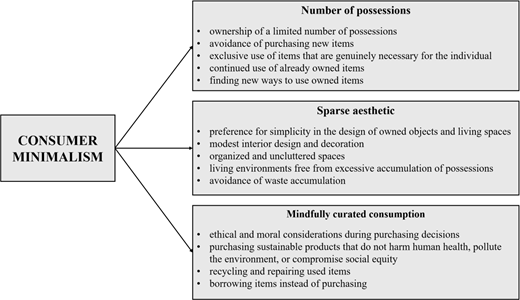
The present study adopts the consumer minimalism framework proposed by Wilson and Bellezza (2022), which conceptualises consumer minimalism as a multidimensional consumption orientation comprising three interrelated dimensions: limited possessions, sparse aesthetics and mindfully curated consumption. Rather than representing a simple reduction in consumption, consumer minimalism reflects a broader orientation towards intentional ownership, thoughtful acquisition and the alignment of consumption choices with personal values and long-term goals. As such, consumer minimalism has increasingly been positioned as a sustainable consumption orientation capable of addressing both environmental and individual well-being concerns.
Consumer minimalism has attracted growing scholarly attention as a response to overconsumption and materialistic lifestyles (Kang et al., 2021; Wilson and Bellezza, 2022; Ježovit and Lučić, 2025; Lučić, 2026). Research has linked minimalist lifestyles to enhanced well-being, psychological growth and life satisfaction (Devenin and Bianchi, 2023; Duong et al., 2023), while also highlighting their potential contribution to environmental sustainability through reduced resource consumption and lower carbon emissions (Blackburn et al., 2024). Furthermore, consumer minimalism has been associated with alternative forms of consumption, including anti-consumption movements and sharing-economy practices (Rasheed and Balakrishnan, 2023; Roster and Ferrari, 2023).
According to Wilson and Bellezza (2022), consumer minimalism consists of three dimensions. Limited possessions refer to a preference for owning fewer but more meaningful possessions and avoiding unnecessary accumulation. Sparse aesthetics reflect a preference for simplicity, uncluttered environments and visual restraint. Mindfully curated consumption captures the deliberate and thoughtful selection of possessions that align with personal values, needs and sustainability considerations. Together, these dimensions illustrate that consumer minimalism is not merely a behavioural outcome but also a broader consumption orientation shaped through cognitive, social and emotional processes (Figure 1).
Given that consumer minimalism encompasses both behavioural and value-based components, interventions targeting cognitive reflection, social influence and emotional engagement may represent effective pathways for fostering minimalist consumption orientations among adolescents. The following sections review the theoretical rationale for educational, peer-led and video-based interventions.
2.1 Adolescent consumer behaviour and consumer minimalism
Adolescence is a distinctive stage of consumer development characterised by increasing marketplace autonomy, identity formation and heightened susceptibility to social influence (John, 1999; Forbes and Dahl, 2010). Consumption during this period serves not only functional purposes but also important symbolic functions related to self-expression, social belonging and status signalling (Flurry and Swimberghe, 2016; Wilska et al., 2023). Consequently, adolescents are particularly responsive to peer norms, social comparison processes and consumption-related influences originating from both offline and digital environments (Mishra et al., 2021).
At the same time, attitudes, values and consumption habits remain relatively malleable during adolescence (Steinberg, 2015). Consumer socialisation research suggests that consumption patterns established during this period often persist into adulthood, making adolescence a particularly important target for interventions promoting sustainable consumption (Flurry and Swimberghe, 2016). These characteristics create both challenges and opportunities for consumer minimalism. While minimalist consumption may conflict with adolescents’ heightened sensitivity to peer influence, status signalling and identity construction, the ongoing development of consumer identities also makes this life stage particularly receptive to interventions encouraging more deliberate and reflective consumption choices.
Despite the rapid growth of consumer minimalism research in recent years, empirical evidence remains overwhelmingly concentrated on adult populations (Kang et al., 2021; Wilson and Bellezza, 2022; Devenin and Bianchi, 2023). Research specifically examining consumer minimalism among adolescents is extremely limited, with existing studies focusing primarily on related constructs such as sustainable consumption, environmental concern, anti-consumption or materialism rather than consumer minimalism itself (Piscitelli and D’Uggento, 2022; Ziesemer et al., 2021). Consequently, little is known about how minimalist consumption orientations emerge during adolescence or whether they can be intentionally fostered through behavioural interventions. Addressing this gap is important because adolescence represents a formative developmental period during which enduring consumption values, identities and behavioural habits are established.
2.2 Educational intervention
Educational interventions are structured activities designed to increase knowledge, stimulate reflection and facilitate behaviour change (Michie et al., 2011). Within the context of consumer minimalism, educational interventions aim to help adolescents critically evaluate consumption habits, understand the consequences of overconsumption and internalise values associated with sustainable consumption.
Education is considered an important driver of consumer minimalism (Ziesemer et al., 2019). By increasing awareness and promoting critical reflection, educational approaches facilitate value internalisation, whereby externally promoted norms become integrated into personal guiding principles and everyday behaviours (Deci and Ryan, 2000). Traditional educational interventions have addressed diverse domains, including financial behaviour (Jin and Chen, 2020), sexual education (Doubova et al., 2017) and environmental protection (Van de Wetering et al., 2022). However, many educational programmes fail to account for the developmental complexities associated with adolescence (Steinberg, 2015).
Behavioural education combines knowledge acquisition with preparation for action (Newsome et al., 2021; UNESCO, 2015). Through tools such as experiential learning, games, practical demonstrations and interactive activities, behavioural education encourages adolescents to translate knowledge into behaviour. Such approaches have demonstrated effectiveness in promoting healthy behaviours (Chu et al., 2015; Viggiano et al., 2015). Their effectiveness appears particularly strong when adolescents recognise a connection between present actions and future consequences (Yeager et al., 2018). Collectively, these arguments suggest that educational interventions may foster consumer minimalism among adolescents by helping them connect their consumption choices with future consequences for society and the environment.
2.3 Peer-led interventions
Peer-led interventions are behaviour-change strategies in which selected members of a social group promote desired attitudes and behaviours among their peers through modelling, communication and social influence (Valente and Pumpuang, 2007). Such interventions are particularly relevant during adolescence because peer relationships become increasingly influential in shaping attitudes, identities and behaviours. The effectiveness of peer-led interventions depends largely on the selection of peer leaders, as socially influential individuals are more likely to shape group norms and behaviours. Consequently, peer intervention research recommends identifying individuals who are recognised and respected within their social networks rather than selecting participants randomly (Valente and Pumpuang, 2007).
Social Learning Theory suggests that behaviour is shaped through not only direct experience but also observation, modelling and social reinforcement (Bandura and Walters, 1977). During adolescence, peers become key social reference points as parental influence gradually declines and normative pressures within peer groups intensify (Flurry and Swimberghe, 2016; Kapur, 2015; Milburn, 1995). Through these processes, peers may influence consumption preferences, lifestyle choices and perceptions regarding socially desirable behaviours.
Peer influence may be especially relevant for consumer minimalism because consumption choices often serve social and identity-related functions. Product ownership, brand preferences and consumption practices are frequently linked to status signalling and social belonging (Pangarkar et al., 2021). Given the importance of peer influence during adolescence (Dewi et al., 2015; Lee, 2010; Lučić et al., 2020), peer-led interventions may provide an effective mechanism for promoting minimalist consumption when influential peer leaders successfully model and legitimise alternative consumption norms. Previous studies have demonstrated the effectiveness of peer-led interventions in school health promotion (Frantz, 2015), smoking and alcohol prevention (Campbell et al., 2008; MacArthur et al., 2016) and healthy lifestyle promotion (McHale et al., 2022). Accordingly, peer-led interventions may contribute to the development of consumer minimalism by shaping consumption norms and socially desirable behaviours among adolescents.
2.4 Video-based narrative interventions
Video-based narrative interventions are behaviour-change approaches that use visual storytelling to communicate information, evoke emotional responses and influence attitudes and behaviours (Kim et al., 2021). Such interventions have been widely applied in health, educational and sustainability contexts because they provide vivid, emotionally engaging representations of behavioural consequences.
Emotions play a central role in sustainable consumption decisions (Antonetti and Maklan, 2014; Harth et al., 2013). Feelings such as pride, guilt and moral responsibility have been shown to influence environmentally responsible behaviour (Wang and Wu, 2016). By highlighting the personal, social and environmental consequences of overconsumption, video narratives may encourage adolescents to reflect on their consumption patterns and adopt more mindful consumption practices (Michie et al., 2014).
Prior studies demonstrate that narrative-based videos can successfully influence behaviours across a range of contexts, including obesity prevention (Frenn et al., 2005), cyberbullying prevention (Doane et al., 2016), alcohol-use reduction (Norman et al., 2019) and remote learning (Insorio and Macandog, 2022). These findings suggest that emotionally engaging video narratives may activate psychological processes that support the development of sustainable and minimalist consumption habits (Anderson and Krettenauer, 2021; De Leeuw et al., 2015). Furthermore, they support the use of video-based narrative interventions, as they may encourage minimalist consumption orientations by fostering emotional engagement and increased awareness of the consequences of overconsumption.
2.5 Hypotheses development
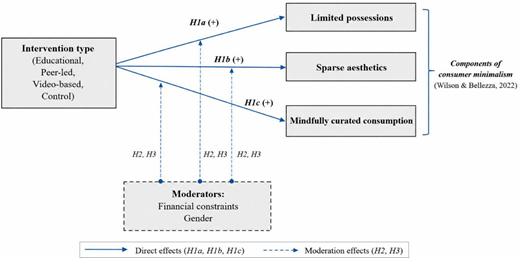
Drawing on the reviewed literature and the formulated research questions, the following hypotheses are proposed. Although educational, peer-led and video-based interventions operate through distinct psychological mechanisms, all three approaches are designed to influence attitudes, values and behavioural intentions associated with consumer minimalism. Educational interventions primarily activate cognitive reflection and value internalisation, peer-led interventions operate through social influence and normative processes, while video-based interventions engage emotional responses and narrative processing. Collectively, these pathways may facilitate the adoption of more deliberate and restrained consumption orientations among adolescents.
Adolescence represents a critical developmental period during which enduring consumption values, identities and behavioural patterns are formed (Forbes and Dahl, 2010). Consumer socialisation research suggests that interventions introduced during this stage may exert lasting effects on consumption-related attitudes and behaviours. Educational programmes have been shown to encourage reflective consumption and value-based decision-making (White et al., 2019), while behavioural interventions have successfully promoted environmentally responsible practices such as waste reduction (Allison et al., 2022) and energy conservation (Wemyss et al., 2018). Moreover, framing consumption choices as socially responsible and personally meaningful facilitates value internalisation and behavioural adoption (Sussman et al., 2020). Accordingly, behavioural interventions are expected to strengthen consumer minimalism among adolescents:
Educational, peer-led and video-based interventions positively influence consumer minimalism among adolescents.
Although consumer minimalism is typically conceptualised as a voluntary lifestyle orientation rather than a response to economic necessity (Fagan, 2017; Rodriguez, 2018; Wilson and Bellezza, 2022), responsiveness to minimalist messages may depend on contextual circumstances. Scarcity theory suggests that financial constraints increase attention to resource management and future consequences, making individuals more receptive to behaviours that reduce unnecessary consumption (Mullainathan and Shafir, 2013). Furthermore, financial considerations are frequently identified as a practical motivation for minimalist lifestyles (Ziesemer et al., 2021). Consequently, adolescents experiencing greater financial constraints may perceive stronger personal relevance in minimalist consumption messages and, therefore, respond more positively to behavioural interventions:
The effect of behavioural interventions on consumer minimalism will be stronger among adolescents with self-reported financial constraints.
Gender socialisation theory suggests that girls and boys are encouraged to develop different value orientations and behavioural priorities (Eagly, 1987). Females are generally socialised towards caring, relational and prosocial roles, whereas males are more frequently encouraged to emphasise autonomy and achievement (Eagly and Crowley, 1986). Consistent with these patterns, sustainability-related behaviours are often perceived as more congruent with feminine social roles (Swim et al., 2020). Empirical evidence further indicates that adolescent girls report higher levels of sustainability consciousness, environmental concern and engagement with environmental education than boys (Goldman et al., 2017; Olsson et al., 2019). Because mindful consumption and aesthetic restraint require greater reflection on consumption consequences and values, girls are expected to exhibit stronger intervention-induced increases in these dimensions of consumer minimalism:
Girls will show greater increases in consumer minimalism than boys, particularly in mindful and aesthetic dimensions.
Intervention effects will differ across the three dimensions of consumer minimalism.
Consumer minimalism encompasses three conceptually distinct dimensions: limited possessions, sparse aesthetics and mindfully curated consumption (Wilson and Bellezza, 2022). Because educational, peer-led and video-based interventions activate different cognitive, social and emotional pathways, they are unlikely to influence all dimensions equally. Educational interventions encourage reflection, value internalisation and deliberate decision-making (Deci and Ryan, 2000), suggesting stronger effects on mindfully curated consumption. Video-based interventions rely on emotional engagement and narrative processing (Kim et al., 2021; Michie et al., 2014), potentially influencing both mindful consumption and aesthetic preferences by increasing awareness of the consequences of overconsumption. In contrast, peer-led interventions operate through social influence and normative processes (Valente and Pumpuang, 2007), making them particularly relevant for possession-related behaviours and the social acceptability of minimalist lifestyles. Accordingly, intervention effects are expected to vary across the three dimensions of consumer minimalism:
The proposed conceptual framework, summarising the hypothesised relationships among the study variables, is presented in Figure 2.
3. Methodology
3.1 Research design
The empirical research was conducted in person using an experimental design from September 2023 to October 2024 in high school classrooms across Croatia, with a random sample of 629 adolescents. The target population comprised adolescents attending secondary schools in Croatia. At the beginning of the 2022/2023 school year, 147,126 students were enrolled in secondary schools nationwide (Croatian Bureau of Statistics, 2023). The research used an experimental research design, specifically a field experiment. The aim of the experiment was to establish a causal relationship between the independent and dependent variables, namely, behavioural interventions and consumer minimalism, while controlling for all influences on the dependent variable except for the effect of the independent variable.
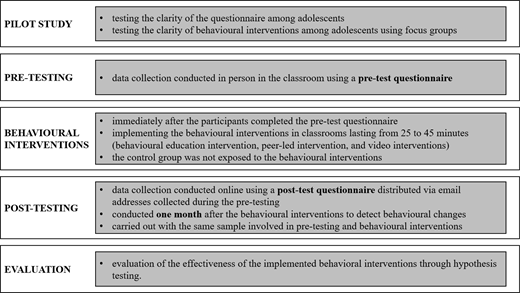
The experiment was conducted using three behavioural interventions (behavioural education intervention, peer-led intervention and video interventions) along with a control group. Behavioural interventions were conducted immediately after the pre-testing, lasting around one hour, in accordance with the optimal duration for interventions targeting adolescents (Saporito et al., 2011). On the other hand, post-testing was conducted one month after the behavioural interventions. Considering one month is the optimal period for post-testing within behaviour change research (Campbell and Stanley, 1963). Before the main data collection, both the questionnaire and the behavioural interventions were pilot-tested to evaluate their clarity, comprehensibility and contextual suitability for Croatian adolescents. Based on the pilot results, minor wording revisions were implemented. The five phases of the empirical research are presented in Figure 3.
3.2 Design and implementation of behavioural interventions
The intervention procedures were not selected arbitrarily but were grounded in established behaviour change theories and evidence on adolescent learning and development. Rather than relying solely on information provision, each intervention was intentionally designed to activate a distinct psychological mechanism expected to promote consumer minimalism. The educational intervention incorporated reflection exercises, interactive learning and group discussion because these techniques encourage cognitive elaboration, value internalisation and more deliberate consumption decisions (Deci and Ryan, 2000; Michie et al., 2011; White et al., 2019). The peer-led intervention was informed by Social Learning Theory (Bandura and Walters, 1977) and research on peer influence during adolescence (Valente and Pumpuang, 2007), which suggests that young people are more likely to adopt behaviours that are modelled and socially endorsed by influential peers. Finally, the video-based intervention drew on principles of narrative persuasion, whereby emotionally engaging stories enhance attention, emotional engagement and message retention, thereby facilitating behavioural reflection and increasing the likelihood of behaviour change (Kim et al., 2021; Michie et al., 2014). Consequently, the three interventions were designed not merely as alternative modes of delivering the same content, but as theoretically distinct behavioural pathways targeting cognitive, social and emotional processes. Three behavioural interventions were developed to target different psychological mechanisms associated with consumer minimalism. The behavioural education intervention focused on cognitive reflection and value internalisation, the peer-led intervention targeted social influence and normative processes, while the video-based intervention sought to activate emotional engagement through narrative communication. Table 1 presents a comprehensive overview of the behavioural interventions and their key features.
3.2.1 Behavioural education.
The authors delivered a session comprising a 25-min interactive lecture, 20-min interactive game and 10-min discussion. The lecture introduced minimalism’s dimensions, practical skills and evidence-based benefits for well-being, financial stability and sustainability. Participants engaged in a categorisation activity mapping behaviours onto minimalist domains, followed by a brief reflective discussion.
3.2.2 Peer-led interventions.
Peer leaders were identified by classroom teachers based on their perceived social influence, leadership characteristics and ability to engage classmates. These peer leaders facilitated classroom sessions intended to encourage minimalist behaviours through social belonging. This approach is consistent with peer-led intervention research, which emphasises the importance of selecting socially influential individuals capable of shaping group norms and behaviours (Valente and Pumpuang, 2007). After a 45-min researcher-led training on minimalism and intervention materials, peer leaders delivered 20-min sessions over three weeks using PowerPoint and curated video content, equivalent to the education intervention but adapted for peer delivery. Videos illustrated practical strategies for daily minimalist practices.
3.2.3 Video-based interventions.
Video sessions aimed to engage motivation and emotion by contrasting minimalism’s benefits with the risks of overconsumption. Participants were introduced to the intervention goals before viewing The Story of Stuff, a 21-min documentary on ecological, social and personal consequences of overproduction and consumption. To reinforce learning, the researcher distributed handouts summarising key messages.
3.3 Data collection and randomisation procedure
To evaluate the effectiveness of the implemented behavioural interventions, the research implemented a randomised controlled trial, comprising three intervention groups (behavioural education, peer-led intervention and video-based intervention) and one control group. Randomised controlled trial is recommended for assessing behavioural interventions in the context of sustainable behaviour (Frederiks et al., 2016; Vine et al., 2014). Random assignment was used to allocate participants to one of three intervention conditions or the control condition (Kendall, 2003). Therefore, the three groups served as the experimental groups, which were exposed to the interventions, while the control group was not exposed to the interventions. The randomised controlled trial represents the most reliable method for establishing a causal relationship between interventions and outcomes (Sibbald and Roland, 1998).
The randomisation criteria included age, specifically high school grade (from 1st to 4th grade), and city. To ensure equal numbers of participants in each group, blocked randomisation was used, a technique that assigns participants to predetermined-size groups (Kendall, 2003). The research used a random stratified sample based on age and the 12 largest Croatian cities. In terms of age, participants were stratified according to predefined age clusters, including middle adolescence (14–16 years) and late adolescence (17–18 years). To gather the sample, a list of all high schools from the 12 largest Croatian cities was compiled. Based on the list, high schools were randomly selected to participate in the research. Within the randomly selected high schools, classes were randomly chosen from the class lists to conduct the questionnaire and behavioural interventions. Randomisation was performed using a MS Office Excel, using the random number function (fx = RAND). The distribution of participants across intervention groups and grade levels is presented in Table 2.
3.4 Questionnaire and measures
Data were collected using pre- and post-test questionnaires. The pre-test questionnaire consisted of two sections. Section 1 measured consumer minimalism using the 12-item scale developed by Wilson and Bellezza (2022), comprising four items for each of the three dimensions of consumer minimalism: limited possessions, sparse aesthetics and mindfully curated consumption. Responses were recorded on a seven-point Likert scale ranging from 1 (strongly disagree) to 7 (strongly agree). Section 2 contained socio-demographic questions, including age, gender, household characteristics, parental education and perceived financial constraints regarding the amount of money they had left at the end of the month. If they had money left, then they were coded as 1; if not, then as 0. The post-test questionnaire contained the same measures as the pre-test questionnaire but excluded socio-demographic items, which had already been collected at baseline. Table 3 presents the items used to measure the three dimensions of consumer minimalism.
3.5 Ethical considerations
Given that the sample includes minors, approval to conduct the research was obtained from the Faculty Ethics Committee, the Ministry of Science and Education and the Agency for Science and Education. The study and the researcher’s conduct adhered to the Faculty’s Code of Ethics as well as the Ethical Guidelines for Research Involving Children. Participation certificates and informed consent for the processing of students’ personal data were secured on the first page of the questionnaire. To ensure compliance with ethical requirements for research involving minors, participants and their legal guardians for those under 18 years of age, provided written informed consent before enrolment in this study.
4. Results
4.1 Sample characteristics
The sample size was calculated using G*Power analysis for sample size determination in experimental research (Faul et al., 2007), resulting in 408 adolescents for a single measurement (Cohen’s f = 0.25, α = 0.05; power = 0.95). However, to account for potential participant dropout at the initial measurement, we oversampled by recruiting 50% more participants. Previous studies have used similar methods when researching adolescent behaviour in the context of healthy lifestyles (Schofield et al., 2005) and internet use (Kalmus et al., 2015).
From the overall sample of 629 respondents, 68.68% were female, and 31.32% were male. The sample showed equal representation of respondents by age or grade level (from 14 to 18 years or from 1st to 4th grade), which is in accordance with the implemented randomisation. At the time of the interview, 96.82% of the respondents declared living in family households. Most of their fathers (50.24%) and mothers (47.85%) completed high school education. Most respondents resided in households comprising four to five members (48.81%). Finally, more than half of the respondents (59.46%) reported a monthly personal income or allowance of 75 EUR or less. The overall sample structure is presented in Table 4.
4.2 Analytical strategy and hypothesis testing
To test the proposed hypotheses, a series of ordinary least squares regression models were estimated. For each intervention type, post-intervention consumer minimalism was regressed on intervention exposure while controlling for baseline levels of consumer minimalism. Separate models were estimated for overall consumer minimalism and its three dimensions: limited possessions, sparse aesthetics and mindfully curated consumption.
H1 was assessed by examining whether educational, peer-led and video-based interventions significantly increased consumer minimalism relative to the control group. H2 was evaluated through subgroup analyses based on financial constraints. H3 was examined using gender-stratified analyses, while H4 was assessed by comparing intervention effects across the three dimensions of consumer minimalism.
Testing H1: Effects of behavioural interventions
Tables 5–7 present the effects of the three intervention types on overall consumer minimalism and its dimensions. Among the three interventions, the educational intervention produced the strongest effects, while peer-led interventions showed no meaningful impact and video-based interventions produced positive but statistically non-significant effects.
The strongest overall effect on consumer minimalism was observed for educational interventions. Participants in the educational group showed a coefficient of B = 2.19 (p = 0.058) in post-intervention minimalism (Minif2), indicating a meaningful increase relative to the control group.
Conversely, the peer intervention had a negligible and negative effect (B = −0.34 and p = 0.776), suggesting limited influence on minimalist behaviour.
The video intervention also demonstrated a positive association (B = 1.60 and p = 0.181), though not statistically significant.
Overall, the findings provide partial support for H1. Educational interventions increased overall consumer minimalism and significantly improved the limited possessions dimension, whereas peer-led and video-based interventions did not produce statistically significant effects.
Testing H2: Financial constraints
H2 proposed that intervention effects would be stronger among adolescents experiencing financial constraints. To examine this possibility, separate regression models were estimated for financially constrained and unconstrained participants.
In subgroup analyses, the intervention effects were larger among financially constrained adolescents (Table 8). Within this subgroup, the intervention effect was B = 3.76 (p = 0.056), suggesting higher receptivity among participants for whom minimalist choices may align with economic necessity. Within specific domains of minimalist consumption, intervention proved to be marginally significant in the domain of sparse aesthetics, increasing the score in this domain by B = 1.32 (p = 0.08) points. Intervention yielded no significant results for participants experiencing no financial constraints.
Overall, the findings provide partial support for H2. Intervention effects were substantially larger among financially constrained adolescents than among their unconstrained counterparts. Although the overall effect was only marginally significant, the pattern suggests that minimalist consumption messages may be particularly relevant for adolescents facing financial limitations, consistent with arguments derived from scarcity theory and resource-management perspectives.
Testing H3: Gender differences
H3 proposed that girls would respond more strongly to the interventions than boys, particularly in the mindful and aesthetic dimensions of consumer minimalism. To examine this possibility, gender-stratified regression models were estimated.
Gender-stratified analyses suggested that girls were generally more responsive to the interventions than boys (Table 9). Intervention coefficients were consistently larger among girls across most outcomes, although these differences did not consistently reach statistical significance. The largest differences emerged for dimensions associated with reflection and value-oriented consumption.
The findings provide limited support for H3. Although intervention effects were generally larger among girls than boys, the observed differences were modest and did not consistently reach statistical significance. Nevertheless, the pattern of results suggests that girls may be somewhat more receptive to intervention messages promoting consumer minimalism, particularly in dimensions associated with reflection and value-oriented consumption.
Testing H4: Dimension-specific effects
As expected, the effects of interventions varied across both the dimensions of consumer minimalism and the type of intervention applied. The peer-led intervention consistently produced the weakest and least consistent outcomes across all three dimensions (e.g. Mindful Consumption, B = −0.31 and p = 0.558), suggesting that normative influence alone may be insufficient to encourage minimalist behaviours in the absence of structured reflection. In contrast, the educational intervention yielded the strongest effects, particularly on the reduction of possessions (Ind1: B = 1.08 and p = 0.048), while also demonstrating a positive – though only marginally significant – trend in mindful consumption (Ind3: B = 0.91 and p = 0.090). The video-based intervention generated more balanced effects across the three dimensions (e.g. Aesthetic Minimalism; Ind2: B = 0.56 and p = 0.266), though none reached statistical significance. Nevertheless, the pattern suggests that visual storytelling may hold potential for influencing aesthetic preferences and reflective awareness. The summary of intervention effects is presented in Table 10.
The estimates suggest variation across intervention formats and minimalism dimensions. The educational intervention showed a statistically significant effect on limited possessions, whereas the remaining dimension-specific effects did not reach the 5% significance threshold. Because differences between coefficients were not formally tested, the findings should be interpreted as descriptive evidence relevant to H4.
Overall, the results indicate that educational interventions were the most effective approach for fostering consumer minimalism among adolescents, particularly in the domain of limited possessions. Intervention effects were stronger among financially constrained adolescents and somewhat more pronounced among girls, although gender differences were generally modest. The findings further suggest that different intervention formats influence different dimensions of consumer minimalism, highlighting the importance of aligning intervention design with the specific behavioural outcomes being targeted.
5. Discussion
This study examined whether educational, peer-led and video-based interventions can foster consumer minimalism among adolescents. By addressing a relatively underexplored area of youth behaviour change, the findings extend previous intervention research that has predominantly focused on health promotion and risk prevention (MacArthur et al., 2016; McHale et al., 2022). Overall, the results indicate that intervention effectiveness depends on both the intervention format and the specific dimension of consumer minimalism being targeted.
The findings provide only partial support for H1. Among the three intervention formats, educational interventions emerged as the only approach that produced meaningful improvements in consumer minimalism, particularly in the domain of limited possessions. In contrast, peer-led and video-based interventions did not generate statistically significant effects. These findings support theoretical arguments suggesting that behavioural change is more likely when interventions actively engage participants in cognitive reflection, knowledge acquisition and value internalisation (Deci and Ryan, 2000; White et al., 2019). The superior performance of the educational intervention may reflect its interactive nature, which encouraged adolescents to critically evaluate their consumption habits and connect them with broader personal, social and environmental consequences. Conversely, peer-led interventions relied primarily on normative influence and social modelling (Bandura and Walters, 1977; Valente and Pumpuang, 2007), while video-based interventions depended largely on emotional engagement and narrative persuasion (Antonetti and Maklan, 2014; Kim et al., 2021). The lack of significant effects for peer-led interventions should be interpreted cautiously. Rather than suggesting that normative influence is ineffective, the findings may indicate that the specific peer-led format implemented in the present study was insufficient to generate measurable short-term changes in consumer minimalism. Peer influence naturally develops through complex and evolving social networks, and such processes may be difficult to fully capture within a structured experimental intervention.
The findings further support H4 by demonstrating that intervention effects differed across the dimensions of consumer minimalism. Educational interventions primarily influenced limited possessions, while effects on sparse aesthetics and mindfully curated consumption were weaker and less consistent. Moreover, video-based interventions produced relatively balanced effects across dimensions despite failing to reach statistical significance, whereas peer-led interventions generated little change across any dimension. These findings suggest that consumer minimalism should not be viewed as a uniform behavioural outcome. Instead, different dimensions appear to respond differently to intervention efforts, depending on the psychological mechanisms being activated. Limited possessions may be more responsive because reducing unnecessary acquisition represents a relatively concrete behavioural adjustment, whereas sparse aesthetics and mindful curation may reflect broader identity-related preferences and lifestyle orientations that require longer periods of reinforcement and reflection to change. The findings, therefore, reinforce the multidimensional conceptualisation of consumer minimalism proposed by Wilson and Bellezza (2022).
The weak performance of the video-based intervention deserves particular attention. Although video interventions are often considered effective because of their emotional appeal and narrative richness (Kim et al., 2021), the present findings suggest that emotional engagement alone may not be sufficient to foster consumer minimalism among adolescents. Dual-process theories propose that emotional arousal does not necessarily translate into lasting value internalisation without deeper cognitive processing (Petty and Cacioppo, 1986; Deci and Ryan, 2000). Furthermore, adolescents are more likely to respond positively to interventions that align with their identities, lived experiences and perceived behavioural opportunities (Yeager et al., 2018). If minimalist lifestyles are presented as desirable ideals without demonstrating achievable behavioural practices, then adolescents may perceive them as attractive but difficult to implement. This interpretation is consistent with previous studies suggesting that video-based interventions are most effective when combined with interactive learning opportunities or peer-supported engagement (Doane et al., 2016; Frenn et al., 2005).
The findings provide partial support for H2. Adolescents experiencing financial constraints were generally more responsive to intervention messages than their unconstrained counterparts. Although some effects reached only marginal levels of significance, the observed pattern suggests that minimalist consumption may be particularly relevant for adolescents facing resource limitations. This finding aligns with the capability approach, which emphasises that behavioural adoption depends on not only preferences but also available opportunities and material circumstances (Lusardi, 2015; Sherraden, 2013). Similarly, scarcity theory suggests that financial constraints increase attention to resource management and future consequences (Mullainathan and Shafir, 2013). Consequently, messages promoting reduced consumption and more deliberate resource use may possess greater personal relevance among adolescents who experience financial limitations in their daily lives.
H3 received only limited support. Although intervention coefficients were generally larger among girls than boys, these differences were modest and did not consistently reach statistical significance. Nevertheless, the observed pattern broadly corresponds with Social Role Theory, which suggests that women are socialised towards caring, prosocial and relationship-oriented values (Eagly, 1987; Eagly and Crowley, 1986). Previous research has similarly shown that sustainability-related behaviours are often perceived as more congruent with feminine social roles and identities (Swim et al., 2020). Furthermore, adolescent girls tend to report higher levels of sustainability consciousness and environmental concern than boys (Goldman et al., 2017; Olsson et al., 2019). Given the relatively weak effects observed in the present study, these findings should be interpreted cautiously. However, they nevertheless suggest that gender may represent an important contextual factor influencing receptiveness to sustainable consumption interventions.
Beyond the individual hypotheses, this study contributes to the emerging literature on consumer minimalism in several important ways. These findings extend recent evidence showing that adolescent consumer minimalism is shaped by distinct psychological antecedents (Ježovit and Lučić, 2025; Lučić, 2026) by demonstrating that minimalist orientations can also be actively fostered through behavioural interventions. First, it provides rare experimental evidence that consumer minimalism can be actively shaped through behavioural interventions rather than being viewed solely as a stable lifestyle orientation. Second, the findings demonstrate that intervention effects differ across the dimensions of consumer minimalism, highlighting the importance of treating limited possessions, sparse aesthetics and mindfully curated consumption as distinct outcomes. Third, by comparing educational, peer-led and video-based interventions within a single randomised controlled trial, the study offers new insight into the relative effectiveness of cognitive, social and emotional pathways for promoting sustainable consumption among adolescents. In doing so, it extends previous research that has largely focused on the antecedents and correlates of consumer minimalism (Kang et al., 2021; Wilson and Bellezza, 2022; Ziesemer et al., 2021) by demonstrating how minimalist orientations may be actively fostered during a critical stage of consumer socialisation.
The findings also carry important educational and policy implications. Adolescence represents a particularly important developmental period because consumption values, identities and behavioural patterns remain relatively malleable (Forbes and Dahl, 2010; Kapur, 2015). Educational institutions may, therefore, represent an effective setting for promoting more mindful and restrained consumption habits. The superior performance of the educational intervention suggests that programmes encouraging active reflection and critical evaluation of consumption behaviours may be particularly effective. At the same time, the weaker effects observed for peer-led and video-based interventions indicate that social and emotional approaches may be more successful when integrated with structured educational content. Such multi-modal strategies may provide a more comprehensive approach to fostering sustainable consumption among young consumers.
6. Conclusion
This study provides preliminary evidence that behavioural interventions may foster certain dimensions of consumer minimalism among adolescents, with educational interventions showing the most consistent effects. By situating behavioural intervention research within adolescent consumption, this study extends the field of experimental sustainable consumption behaviour and highlights the potential of minimalism to strengthen both ecological and financial sustainability (Bruntland, 1987; Ziesemer et al., 2019). The findings suggest that intervention format matters, with educational interventions showing the most consistent effects, while the effectiveness of peer-led and video-based approaches appears to depend on intervention design and implementation. Together, these mechanisms point to the value of multi-modal approaches that align content with adolescents’ developmental needs, social identities and lived contexts.
Beyond theoretical contributions, this study offers actionable implications for policymakers and educators. Embedding consumer minimalism into school curricula and sustainability policies can leverage adolescence as a critical window for shaping long-term orientations (UNESCO, 2015). In this way, behaviour-change initiatives can be positioned as not only ecological imperatives but also tools for financial resilience and social well-being, empowering young consumers to resist the pressures of overconsumption (Sussman et al., 2020).
Limitations must also be acknowledged. The relatively short intervention duration may not fully capture identity-level changes, while reliance on self-report measures raises concerns about social desirability bias (Steinberg, 2015). Moreover, subgroup analyses – particularly across financial and gender strata – were underpowered, calling for replication with larger and more diverse samples.
An additional limitation concerns the modelling of peer socialisation within an experimental setting. Although peer-led interventions are commonly used in adolescent behaviour-change research, peer influence typically develops through ongoing social interactions, evolving friendship networks and informal normative processes. In contrast, the present study relied on teacher-selected peer leaders delivering structured intervention content over a limited period. Consequently, the intervention may not have fully captured the complexity and dynamic nature of naturally occurring peer influence. The relatively weak effects observed for the peer-led intervention should, therefore, be interpreted cautiously, as they may reflect characteristics of the intervention design rather than the limited importance of peer influence for consumer minimalism. Future research could use social network analysis to identify influential actors and examine how naturally emerging peer dynamics shape minimalist consumption orientations among adolescents.
The findings should also be interpreted within the Croatian cultural and educational context. Replication across different countries and institutional settings would help establish the generalisability of the results. Furthermore, this study measured self-reported minimalist orientations rather than objectively observed consumption behaviours, creating opportunities for future studies to incorporate behavioural indicators alongside survey measures.
Future research should adopt longitudinal designs to assess whether minimalist behaviours endure over time, explore hybrid interventions that integrate educational structure with peer and video dynamics (Audrey et al., 2006; Frenn et al., 2005) and investigate identity-based personalisation to align content with adolescents’ self-concepts (Yeager et al., 2018). Such extensions will help move the field from short-term nudges towards lasting transformations in youth consumption (Mullainathan and Shafir, 2013).
In sum, this study provides early but promising evidence that youth-targeted interventions can shape minimalist orientations when they are developmentally sensitive, identity-relevant and delivered through engaging formats. Greater investment in such evidence-based strategies is needed to translate awareness into genuine behavioural transformation, contributing to more sustainable and financially resilient futures.
Andrea Lučić is based at the Department of Marketing, Faculty of Economics and Business, University of Zagreb, Zagreb, Croatia.
Marija Ježovit is based at the Department for Innovation, Business Economics and Business Sectors, The Institute of Economics, Zagreb, Croatia.
Piotr Bialowolski is based at the Department of Economics, Kozminski University, Warsaw, Poland, and Human Flourishing Program, Harvard University, Cambridge, Massachusetts, USA.
Data availability
The data associated with this study have not been deposited into a publicly available repository. The data presented in this study are available on request from the corresponding author.