
Skip to article sections
Purpose

The primary objective of this article is to empirically examine the impact of bank-specific and macroeconomic factors, particularly environmental, social, governance (ESG) and financial technolgy (fintech) factors, on the financial sustainability of Islamic banks (IBs) and conventional banks (CBs).

Design/methodology/approach

Panel data are used on QISMUT plus three countries: Qatar, Indonesia, Saudi Arabia, Malaysia, United Arab Emirates, Turkey, Bahrain, Kuwait and Pakistan for the period from 2005 to 2022. A two-step system using the generalized method of moments (GMM) and panel-corrected standard error (PCSE) methods was employed.

Findings

The findings reveal that CBs exhibit greater financial sustainability persistence, while IBs demonstrate superior management efficiency, liquidity and stability. This distinction is attributed to IB’s Shariah-compliant structures, which foster stability through profit-loss sharing accounts and equity-based risk-sharing mechanisms. The study also finds that IBs achieve financial resilience more rapidly as they grow, supported by higher capital adequacy and liquidity coefficients. Furthermore, ESG adherence plays a more significant role in IBs, reflecting their alignment with socially responsible initiatives.

Practical implications

These findings have substantial implications for practitioners, policymakers, managers and academics, where they can capitalize on IB dominance by promoting and developing innovative Shariah-compliant financial products for both IBs and CBs. CBs should compete by providing Shariah-compliant financial products and opening Islamic Window-Financing. IBs’ risk management efficiency can help conventional bank managers incorporate equity financing and profit-loss sharing into their strategy.

Originality/value

We believe this is the first empirical study of Islamic and conventional banks on the financial self-sufficiency (FSS) indicator proxied as financial sustainability.

In today’s fast-paced world, banking is vital to economic success. As financial middlemen, banks help savers and investors transfer funds efficiently. This process boosts investments across industries, making banks vital to market expansion, economic development, job creation, business creation and support. For long-term economic growth, the economy needs a financially sound and sustainable banking sector (Chowdhury et al., 2017). The banking industry has evolved tremendously from paper-based work to financial technology-based, where they have gained competitive advantage in terms of efficiency and profitability. Banks are financially sustainable when they make enough money to cover their costs continuously and manage different types of risks without harming the society and the environment (Doğan, 2013). Financial sustainability in all industries refers to the ability to maintain the financial health and prosperity of firms over the long term while adhering to economic, social and environmental obligations set by the government – environmental, social, governance (ESG) regulations. Numerous scholars, practitioners and policymakers have studied financial sustainability techniques to identify the characteristics, especially ESG factors in other industries rather than banking. Many researchers have investigated financial self-sufficiency (FSS) and capital structure determinants as a proxy for financial sustainability in other industries (Yitayaw, 2021; Ahmeti et al., 2023; Al-Hunnayan, 2020; Boateng et al., 2022). There are many comparative studies conducted on the nexus between financial performance and ESG factors of both Islamic banks (IBs) and CBs for different countries. To the best of our knowledge, there is no study that investigated the financial sustainability determinants of IBs and CBs in Islamic finance-oriented countries – QISMUT+3.

In recent years, IBs in QISMUT+3 countries have received special attention (Faizulayev et al., 2020). In addition, the QISMUT+3 countries consist of 9 core countries, which collectively hold 93% of the world’s Islamic banking assets. The rise of IBs can be attributed to their inherent financial stability and resilience, particularly evident during the global financial crisis of 2007–2009. IBs have shown significant resilience and their proximity to reaching financial sustainability. The behaviors exhibited by IBs during their operations are solely attributable to their adherence to regulatory requirements by Shariah laws (Lui et al., 2020). The operations of IBs are strictly governed by Shariah standards, which forbid any involvement in activities that include interest rates, gambling and uncertainty. As per their regulatory framework, they are prohibited from engaging in any business or investing activities that have a detrimental impact on society and the environment. These regulatory frameworks closely resemble the form of ESG policy rules, which can facilitate the attainment of financial sustainability in a faster and more efficient manner.

This study empirically analyzed the financial sustainability determinants of IBs and CBs in QISMUT+3 nations. This analysis examines macroeconomic and bank-specific factors. The majority of our research examined how ESG factors affect both types of banks’ financial sustainability. How will financial technology (fintech) affect Islamic and traditional banks’ financial sustainability? Do IBs’ financial sustainability practices differ statistically from their counterparts? We also tested the quadruple bottom line (QBL) and triple bottom line (TBL) theories in light of our research findings to provide practitioners, policymakers and academics with specific policy recommendations.

This research paper seeks to contribute to the existing literature by empirically evaluating financial sustainability practices for IBs and CBs that operate in QISMUT+3 countries. The contribution of this study is threefold, providing novel insights into the determinants of financial sustainability in QISMUT+3 countries. First, to the best of our knowledge, this is the first empirical investigation of financial sustainability in both Islamic and conventional banks in these countries, employing FSS and capital structure as proxies within the dual banking industry. Second, the research uniquely applies the QBL paradigm for IBs and the TBL theory for conventional banks, offering a multi-theoretical framework that enables a comprehensive analysis of factors influencing financial sustainability in Islamic finance-oriented economies. Third, this is the first study to examine over 600 banks in these regions from 2005 to 2022, including a focus on the COVID-19 lockdown period, using advanced methodologies in line with Roodman’s (2009) recommendations, particularly addressing the overidentification issue often overlooked in previous analyses. This study reveals significant findings, such as the positive role of diversified bad loans, ESG compliance, tax policies and fintech in enhancing financial sustainability, while highlighting the greater stability, efficiency and growth potential of IBs due to their unique capital structures and adherence to Shariah principles. By emphasizing the distinct regional dynamics and introducing new evidence on the interplay of ESG policies, regulatory frameworks and external shocks, this research advances the discourse on financial sustainability, providing fresh insights into the comparative strengths of Islamic and conventional banks in Islamic finance-oriented economies.

The findings reveal that CBs exhibit greater financial sustainability persistence, while IBs demonstrate superior management efficiency, liquidity and stability. This distinction is attributed to IB’s Shariah-compliant structures, which foster stability through profit-loss sharing accounts and equity-based risk-sharing mechanisms. The study also finds that IBs achieve financial resilience more rapidly as they grow, supported by higher capital adequacy and liquidity coefficients. Furthermore, ESG adherence plays a more significant role in IBs, reflecting their alignment with socially responsible initiatives.

The study introduces region-specific evidence on tax policy and fintech innovations, diverging from Albertazzi and Gambacorta (2010) and Aizada et al. (2023), showing how these factors uniquely enhance financial sustainability in QISMUT+3 economies. It also quantifies the adverse pandemic impacts, contributing timely insights on external shocks, as highlighted by Labadze and Sraieb (2023). These contributions, particularly the region-specific dynamics and the comparative perspective on IBs vs. CBs, distinguish this research from prior studies in MENA and OECD contexts, emphasizing its novel theoretical and empirical contributions to the banking literature.

Nowadays, banking industries incorporate ESG practices into their operations to achieve financial sustainability in the long run (Serkbayeva et al., 2024). The sustainability of both Islamic and conventional banks has garnered increasing academic and policy attention, particularly during the global financial crisis, regulatory changes and the emergence of ESG considerations (Elkington and Rowlands, 1999). Therefore, financial sustainability practices are crucial for both Islamic and conventional banks, where they try to sustain profitability, resilience and financial inclusion. IBs are designed to operate without interest, adhering to the principles of profit and loss sharing (PLS) as per Islamic law. However, in practice, the operations of IBs often resemble those of conventional banks, with many financial instruments being debt-like rather than strictly PLS-based (Toumi, 2020). COVID-19 and other global financial crises have shown that both types of banks need to be financially sustainable to withstand different types of unexpected shocks (Gutiérrez-López and Abad-González, 2020). While conventional banks have been widely studied, comparative research between Islamic and conventional banks remains limited, especially in the context of Islamic finance-oriented economies. Understanding how these banks differ in terms of risk management, capital structure, governance and ESG integration can provide insights for better financial sustainability practices. Hence, understanding the drivers of the financial sustainability in banks needs a comprehensive theoretical approach that incorporates not only financial traditional factors but also broader sustainability issues.

The selection of financial sustainability indicators and their determinants is very important for understanding the long-term viability of firms, especially in the banking industry, where banking stability directly affects economic resilience (Faizulayev et al., 2020). Financial sustainability is often evaluated using FSS and capital structure (Leverage), as these proxies provide insight into a firm’s ability to generate enough income to sustain operations while maintaining an optimal mix of debt and equity financing (Yitayaw, 2021; Ayayi and Sene, 2010; Parvin et al., 2020). Previous research emphasized that financial difficulties and liquidity issues stem from inadequate coordination in funding decisions, rendering capital structure an essential element for ensuring financial sustainability (Foo et al., 2015). The inclusion of firm-specific variables such as management efficiency (CI), liquidity (LIQ), size (LTA), asset quality (ASQL), tax policies and dividend payment policies enables a more thorough empirical evaluation. Previous research has shown that these characteristics have an important role in determining a firm’s ability to minimize financial risk and optimize financial decision-making (Boateng et al., 2022; Kanapiyanova et al., 2023; Eldomiaty and Azim, 2008). Finally, macroeconomic factors, including GDP growth, ESG-related measures and time dummies for economic shocks, provide external contextual influences that shape financial sustainability and leverage (Ghani et al., 2023; Baigutanova et al., 2023). Given the banking sector’s susceptibility to regulatory and market changes, leveraging these variables ensures a robust empirical evaluation of the determinants influencing financial sustainability, contributing to a nuanced understanding of the dynamics affecting banking institutions worldwide.

The main objective of this research is to empirically evaluate financial sustainability determinants of both Islamic and Conventional banks in QISMUT+3 countries. This study draws upon multi-theoretical approaches: TBL (Elkington and Rowlands, 1999), QBL (Hamidi and Worthington (2023), stakeholder theory (Freeman, 1984) and resource-based theory (Barney, 1986). Therefore, employing these theories will enable both types of banks to provide complementary perspectives to explain how banks navigate financial sustainability in Islamic finance-oriented countries. The integration of these theories allows for comprehensive empirical evaluations of how firm specific and macroeconomic variables, especially including the ESG practices, influence the financial sustainability of Islamic and conventional banks.

TBL theory and QBL theory: The concept of TBL comprises the utilization of three key components (prosperity, planet and people) to attain economic sustainability across many sectors. The idea of the TBL was formulated by Elkington and Rowlands (1999), who made significant contributions to the strategies employed by enterprises, charitable organizations and government entities for assessing sustainability. The TBL theory posits that enterprises, irrespective of their industry, should take into account three primary variables during their business operations: environmental, social and governance considerations. To summarize, the TBL framework indicates that corporate success entails more than only the economic component of providing goods and services efficiently in order to earn profits (also known as “prosperity”). A corporation’s social component refers to its impact on the well-being of its employees and the communities in which it operates. Furthermore, the environmental aspect, dubbed “Planet,” refers to the strategic use of a company’s resources, such as energy, land and water, as well as proper waste management to limit negative environmental impacts (Hubbard, 2009). While focusing solely on the prosperity dimension may allow a corporation to achieve short-term sustainability, it is critical that the organization simultaneously addresses all three dimensions (prosperity, people and planet – 3Ps) for long-term sustainability (Dyllick and Hockerts, 2002; Hamidi and Worthington, 2023).

However, in the case of Islamic financial institutions, it has been recommended by Hamidi and Worthington (2023) to expand the TBL theory by adding reflection of faith (din), one of the five pillars of Maqasid al-sharya [1]. So, Hamidi and Worthington (2023) added Prophet in the existing TBL theory (4Ps – Prosperity, People, Planet and Prophet – QBL), as a proxy for reflection of faith, in which they believed that religiosity plays a significant role in boosting performance both financially and ethically. Specifically, for IBs, our study employs the QBL theory, encompassing 3Ps as dimensions. This approach enables a comprehensive examination of how Islamic principles impact economic prosperity, social well-being, environmental sustainability and adherence to religious teachings, thereby shaping the financial sustainability of IBs (Hamidi and Worthington, 2023).

These theories provide the foundation for assessing whether financial sustainability in banking is driven solely by economic performance or also influenced by ESG and governance factors. By integrating TBL, QBL and faith-based finance principles, this study examines how financial sustainability in banking is shaped not just by economic factors but also by ethical, religious and governance considerations.

Stakeholder theory: The theory states that all companies, regardless of their business type, should consider interests of all stakeholders in order to achieve long-term sustainability. This theory was developed by Freeman (1984). In addition, one of the outstanding studies explores the influence of ESG practices on the financial performance of Indonesian banks between 2010 and 2020. The key findings reveal that environmental and governance factors significantly enhance financial performance metrics such as return on assets (ROA), return on equity (ROE) and Tobin’s Q, while social factors have a mixed impact. The authors employed stakeholder theory to explain how aligning sustainability practices with stakeholders’ interests can lead to improved financial outcomes (Gutiérrez-Ponce and Wibowo, 2023). Conventional banks usually focus on shareholder wealth maximization, while IBs emphasize a wider stakeholder approach, considering social impact, ethics and financial justice. In addition, IBs, guided by Sharia principles, focus on a wider stakeholder approach, integrating CSR into their operations, which positively impacts their financial performance (Aracil, 2019). This contrasts with conventional banks, which prioritize shareholder wealth and use CSR to fill institutional gaps. ESG factors are closely linked to stakeholder satisfaction and reinforcing the need for sustainable finance (Buallay, 2019). Integrating this theory will enable us to investigate how both IBs and CBs balance the economic and social objectives to achieve long-term financial sustainability.

Resource-based theory: This theory, developed by Jay Barney in the 1990s, posits that a firm’s sustainable competitive advantage arises from its unique internal resources and capabilities. In banking, these resources are management efficiency, fintech adoption and asset quality. The study is grounded in resource-based theory, emphasizing that firms leveraging sustainable practices gain competitive advantages and superior financial results (Gleißner et al., 2022). This study employs this theory to empirically evaluate whether financial sustainability is driven by efficient resource allocation and technology adoption. Abdul-Majid et al. (2017) conducted an empirical comparison research of IBs and conventional banks (CBs) in Malaysia, revealing that conventional banks exhibit more cost efficiency than IBs, maybe attributable to the adoption of fintech. Furthermore, it was observed that while a limited number of IBs employ technology that aligns closely with industry standards.

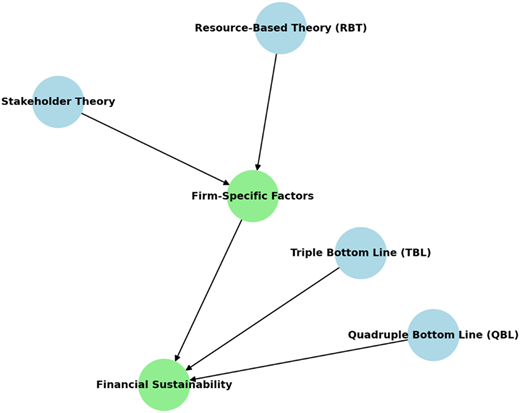
By addressing these gaps, this study contributes to the evolving discourse on sustainable banking practices, offering insights for regulators, financial institutions and policymakers on how Islamic and conventional banks can achieve long-term financial sustainability while maintaining ethical and governance standards. For better understanding please follow conceptual Figure 1 illustrating the theoretical framework for financial sustainability in Islamic and conventional banks:

The main aim of this study is to conduct an empirical analysis on the factors that influence the financial sustainability of IBs and CBs in countries that have a strong focus on Islamic finance. Specifically, the study will focus on QISMUT, along with three additional nations: Qatar, Indonesia, Saudi Arabia, Malaysia, United Arab Emirates, Turkey, Bahrain, Kuwait and Pakistan. The dataset has been systematically gathered from the Banking Orbis database and official web sites of banks, encompassing the timeframe spanning from 2005 to 2022. The dataset used in this study includes a total of 1,138 financial institutions, which consist of both IBs and CBs. There were three main groups used to organize the panel data study at first: all banks, IBs and CBs. We’ve made a total of 5 different models for each group. Two of the models look at how ESG policy rules affect two measures of financial sustainability, while two other models do not include ESG factors. The main goal of the last model is to figure out how financial technology affects the variable for financial survival.

During the first stages, various tests are performed to assess the presence of stationarity, autocorrelation, heteroscedasticity, multicollinearity and endogeneity (Parmankulova et al., 2022). The assessment of multicollinearity is conducted by utilizing the variance inflation factor (VIF), whereas the examination of autocorrelation is performed through the application of the Wooldridge test (Wooldridge, 2003). The Durbin-Wu-Hausman test is utilized in order to assess the presence of endogeneity. Heteroscedasticity can be identified by using the likelihood ratio (LR) chi-square test. Furthermore, to provide robustness and handle potential issues of endogeneity and second-order autocorrelation, a two-step system generalized method of moments (GMM) is employed (Arellano and Bover, 1995; Blundell and Bond, 1998). The Sargan and Hansen tests are commonly employed to address the issue of endogeneity by assessing the overidentification of instrumental factors. The PCSE approach was utilized to carry out robustness tests on each of the three groups.

An econometric model is developed to assess the financial sustainability of Islamic and conventional banks in the specified nations. The model is divided into three primary groups: all banks, IBs and CBs. This methodology aims to evaluate the financial sustainability determinants in both Islamic and conventional banking systems.

(1)

where ALLbct is a proxy for IBs and CBs’ financial performance and vulnerability risk, Xbctj represents bank-specific factors, Ybctl represents market structure variables, Zbctm represents macroeconomic variables, and βj shows the coefficients of variables with certain sign and α is a constant. The error term _bct, where v_t is the unobserved individual specific effect and u_t is the disturbance component, represented by the Greek letter mu. This leads to a regression form with a single error term where v_tIIN(0,_v2) and u_tIIN(0,_u2).

Bank profitability is persistent over time (Athanasoglou et al., 2008), indicating serially associated market competition disorders, informational opacity and sensitivity to macroeconomic shocks. The following formula will make use of dynamic panel data methods to address the issue of endogeneity:

(2)

where δ measures the speed of adjustment towards equilibrium and Πbc,t−1 is the one-period lagged of dependent variable. Table 1 shows the definition and expected sign of variables.

To ensure a robust theoretical foundation for the empirical analysis, this study draws on the TBL, QBL, Stakeholder and Resource-based theories to guide the selection of variables and interpretation of results. The TBL framework underpins the inclusion of ESG adherence as a key variable, reflecting the financial, social and environmental dimensions of sustainability. The QBL framework, with its focus on ethical governance and Shariah-compliant principles, informs the choice of variables such as capital adequacy, liquidity and management efficiency, which are particularly relevant for IBs. These theories are especially applicable to the QISMUT+3 regions, where the dual banking system enables a comparative analysis of Islamic and conventional banks. By aligning the theoretical constructs with measurable proxies, the study ensures a coherent connection between the theoretical framework and the empirical regression analysis, enabling a deeper understanding of the drivers of financial sustainability in these regions.

This section will provide an overview of several studies that have examined the determinants of financial sustainability in different industries. The studies to be reviewed include those conducted by Bisogno et al. (2017), Ebenezer et al. (2020), Henning and Jordaan (2016), Navarro-Galera et al. (2021), Orazalin and Mahmood (2018), and others. There are a few studies that have examined financial sustainability through FSS and capital structure indicators in other industries, but there is no study conducted in the banking industry. It is very crucial to study the capital structure of the firms because the achievement of financial sustainability for firms may prove to be a formidable task in the absence of logical coordination in funding decisions. Such a lack of coordination has the potential to result in financial distress and ultimately lead to bankruptcy (Foo et al., 2015). Given this consideration, we were motivated to conduct an empirical evaluation of the factors that determine capital structure, which might also serve as a proxy for financial sustainability (Ahmeti et al. (2023), Al-Hunnayan (2020), Boateng et al. (2022), Bukair (2019), and Hoque and Liu (2022). For definition and details please follow Table 1.

In this section, we present empirical results on financial sustainability determinants on all three groups: all banks, IBs and CBs in QISMUT+3. Overall, the empirical findings demonstrate how specific variables, particularly ESG and Fintech characteristics, significantly affect the financial sustainability of both the Islamic and conventional banking industries. These findings offer valuable contributions to practitioners, policymakers, academic scholars and other stakeholders. Additionally, the variance inflationary factor analysis confirms that all models have been validated, and there is no multicollinearity issue. Results are presented in Tables: 2, 3, and 4.

Now turning to the analysis of the primary empirical findings, Table 2 demonstrates that in every bank category, all five models exhibit statistical significance of lagged values of financial sustainability indicators, indicating a persistent trend in the financial sustainability of all banks. The highest persistence is observed in Model 5, representing FSS, with a value of 1.10, while the lowest persistence is in Model 1, with a value of 0.72. On the other hand, the lagged value of leverage is most evident in Model 4, showing a value of 0.43. Banks demonstrate constant adherence to the ESG principles that eventually contributes to the long-term sustainability. These findings align with the research conducted by Chowdhury et al. (2017) and Aizada et al. (2023). Furthermore, the quality of assets has a favorable and statistically significant impact on the FSS in model 1, where the coefficient is 0.15 significant at 5%. While bad loans typically have a negative connotation, in our specific situation, they have a favorable consequence. One possible explanation for the significant impact could be the inclusion of these nonperforming loans in a diverse portfolio. In this case, the overall good portions of the portfolio may counterbalance the losses incurred from the bad loans, resulting in a positive net effect, which goes in line with Parmankulova et al. (2022), but opposite to Kjosevski et al. (2019) and Laryea et al. (2016). The relationship between capital structure and capital adequacy can be complex, but our findings indicate that capital adequacy has a positive and statistically significant effect on leverage, with coefficients of 2.229 in Model 2 and 2.065 in Model 4, respectively. These findings suggest that banks in these locations are prioritizing regulatory compliance, particularly with Basel III, in order to strengthen their capital base. This regulation ultimately enhances their trustworthiness and may enable them to secure further loans. Furthermore, banks that are well capitalized will enhance their financial sustainability. These findings are consistent with prior research conducted by Aiyar et al. (2016) and Huang and Song (2006). It is noteworthy that management efficiency has a positive influence on financial sustainability, although the level of significance is low (0.0091) in model 1, which is opposite to Kanapiyanova et al. (2023) and Eldomiaty and Azim (2008). Furthermore, when considering models 2 and 4, it is evident that liquidity has a positive influence on the leverage of banks, and it is significant, with moderate coefficients 0.46 in model 2 and 0.42 in model 4. This positive correlation demonstrates that a higher level of liquid assets held by a bank enhances its strength in terms of creditworthiness and capitalization. Consequently, potential creditors are more likely to extend further credit to finance specific projects. Continuing our empirical examination, model 1 demonstrates that size has a positive and statistically significant impact on financial sustainability with ESG regulations, with a coefficient of 0.566. This will allow banks to grow in size and strengthen their financial sustainability in the aforementioned countries. In other words, these banks are extremely efficient in their resource utilization, which significantly enhances their financial performance and, ultimately, leads to financial sustainability. The results show that total assets have a favorable and considerable impact on financial sustainability, and this finding is supported by previously found effect of capital adequacy on FSS too. These findings align with the resource-based view (RBV) paradigm, as defined by Sanchez (2004), which characterizes assets as resources that can be owned and contain certain capabilities. This capability refers to a company’s ability to utilize its tangible and intangible assets in order to successfully complete specific tasks or activities that enhance financial performance, and it is in line with findings of Clulow et al. (2003) and Liu et al. (2021). Surprisingly, models 1 and 3 demonstrate that tax policy enhances bank financial sustainability, and the results are highly significant (with low coefficients 0.029 and 0.007), contradicting the conclusions of Aizada et al. (2023). These findings are consistent with those of Albertazzi and Gambacorta (2010), and Bashir (2003). One of the primary reasons for the positive significant correlation is that when tax policy is well structured and organized, it eventually contributes to the development and improvement of infrastructure, public services, and some social benefits provided by local government, as a result, all these positive changes will lead to the banks’ financial sustainability. ESG factors negatively affect the FSS in model 1, and they are statistically significant, with negative moderate coefficients −0.26 and −0.72. Overall, ESG factors play significant role in driving the financial sustainability of banks in QISMUT+3 countries, it shows that banks are doing well with compliance of ESG policy requirements, and these findings supported by TBL theory, and they align with empirical results of Parmankulova et al. (2022). For example (Chen and Lee, 2018), empirically investigated Chinese firms, and they found that energy intensity positively affects profitability of firms. Another research paper supports our findings, where (Choi et al., n.d.) found that improvement in energy efficiency affect the performance of the firms positively. In addition, these findings go in line with Gutiérrez-Ponce and Wibowo (2023), whose results validated Stakeholder Theory by demonstrating that aligning sustainability practices with stakeholder interests enhances financial outcomes. Furthermore, both economic growth and improvements in financial technologies positively affect the financial sustainability (with strong coefficients of 0.096 and 0.013 in model 5), that eventually leads to the financial sustainability of banks in the Islamic finance-oriented regions. These findings receive support from Liu et al. (2021), where they empirically researched the financial performance drivers of conventional banks and found that financial technology improves the efficiency of conventional banks through reduction of operational cost, ultimately increasing profitability. Also, our findings are consistent with Wang et al. (2021). Similarly, the analysis of the dummy variable indicates a considerable disparity in the factors determining financial sustainability between IBs and CBs, with a statistically significant outcome (coefficient is 0.4). It can be inferred that IBs exhibit superior financial sustainability compared to conventional banks in nations that prioritize Islamic finance. Extensive research indicates that IBs exhibit greater resilience to unforeseen shocks and possess financial stability characteristics mostly derived from risk-sharing activities, asset-backed lending and a stronger focus on ESG factors (Faizulayev et al., 2021; Nosheen and Rashid, 2019; Wijana and Widnyana, 2022). IBs engage in risk sharing operations to distribute their risks among their partners, but traditional banks face financial difficulties mostly because of their engagement in debt, which ultimately leads to vulnerability. Finally, the pandemic period had a statistically significant adverse impact on the financial sustainability of banks, with strong negative coefficient of −0.44. Due to the epidemic, governments worldwide implemented widespread lockdown measures, which resulted in individuals being confined to their homes. Consequently, this led to a significant increase in job layoffs across several industries, ultimately causing a slowdown in the overall economy (Dahal and Budhathoki, 2022; Labadze and Sraieb, 2023; Wijana and Widnyana, 2022).

The model has a high degree of conformity with the panel data, as evidenced by the relatively consistent coefficients. In the system GMM estimate, the Hansen J-statistic, as proposed by Hansen (1982), is employed to test for over-identification restrictions. The results indicate no evidence of over-identifying restrictions, thereby confirming the statistical validity of all models. All instruments employed to address endogeneity issues in all three models (including all banks, IBs and CBs) have been statistically verified. While certain models may exhibit first-order autocorrelation, it is important to note that this does not automatically imply that our estimation is inconsistent and biased. If the second-order autocorrelation (AR) is present, there would be inconsistent and biased estimation (Arellano and Bond, 1991).

As we proceed further to an empirical comparative analysis of IBs and CBs, Tables 3 and 4 show the empirical outcomes of IBs and CBs in QISMUT+3 countries for the period of 2005–2022. It is worth noting that CBs outplay the IBs in terms of financial sustainability persistency (lag coefficients for IBs are 0.51 and 0.73 in models 1 and 3, respectively; lag coefficients for CBs are 0.91 and 0.94 in models 1 and 3, respectively). In light of this higher persistency of CBs in financial sustainability, we can conclude that CBs are more competitive in contrast to the IBs. This findings go in line with findings of Chowdhury et al. (2017) and Goddard et al. (2011). Furthermore, asset quality exerts negative impact on financial sustainability of both banks (coefficients are −0.054 for CBs and −0.07 for IBs). However, the coefficients of the results show that the effect from IBs are less than from CBs, and these findings go in line with Nosheen and Rashid (2019). Shifting focus to the statistical differences between IBs and CBs, we can observe that IBs outperform the CBs in terms of management efficiency, where cost to income ratio of IBs has got more substantial impact on financial sustainability (coefficients are −0.04 for IBs and −0.01 for CBs), it is consistent with findings of Bitar et al. (2017), and it is statistically significant at 5%. Furthermore, it is worth noting that in these regions, IBs demonstrate greater stability, liquidity and possess a better growth potential. This is evident from the results of models 2 and 4, which indicate that the liquidity and capital adequacy of IBs have a significantly stronger positive impact (coefficients of IBs are 0.0617 and 0.894) on their capital structure compared with conventional banks. In contrast to conventional banks (CBs), IBs have a distinct capital structure that includes profit-loss share accounts (PLSAs) and other deposit accounts that comply with Shariah principles. Both PLSA and Equity holders are co-owners of the fund and share equal investment risks. PLSA holders have the freedom to select from a range of investment options, taking into consideration the potential return and associated risk (Al-Hunnayan, 2020). Well-capitalized IBs enhance the stability and reputation of IBs by attracting new investors and depositors, hence increasing confidence and stability. Sufficient capital in IBs will create additional prospects for nurturing and enlarging their commercial operations, ultimately it will lead to financial sustainability. It is important to mention that IBs are required to adhere to regulatory compliance regarding capital requirements too, just as conventional banks do in accordance with Basel III. Based on our empirical analysis, model 3 shows that the size of IBs has a more positive and statistically significant effect on its financial sustainability, unlike their counterparts (coefficients are 0.34 for IBs and 0.10 for CBs). Therefore, if IBs and conventional banks increase in size, they will enhance their financial resilience in the countries stated above, but IBs will be faster and stronger due to the results of higher coefficients. Both banks demonstrate exceptional efficiency in utilizing their resources, resulting in a notable improvement in their financial performance and, ultimately, ensuring their financial sustainability. Consequently, the overall value of assets has a positive and significant influence on financial sustainability. This conclusion is reinforced by prior research that also revealed a relationship between capital adequacy and financial sustainability. These findings are consistent with the RBV paradigm, as described by Sanchez (2004), which defines assets as resources that can be owned and possess specific capabilities. These capabilities pertain to a company’s capacity to effectively utilize its tangible or intangible assets to accomplish specified tasks or activities that improve financial performance. This aligns with the research findings of Clulow et al. (2003) and Liu et al. (2021). Turning our attention to tax policy of the government, we can see from the model 1 that effective tax rate policy in both banking affects financial sustainability positively, with higher coefficients of 0.175 in IBs and lower of 0.01 in CBs. The results align with the research conducted by Albertazzi and Gambacorta (2010), and Bashir (2003). A key factor behind the strong positive correlation is the effective and well-organized tax policy, which ultimately fosters the growth and enhancement of infrastructure, public services and various social benefits offered by local authorities. Consequently, these favorable developments contribute to the long-term financial stability of banks. ESG policy laws contribute to the financial sustainability of banks in both IBs and CBs (commercial banks) operating in these regions. IBs excel above CBs in implementing ESG compliance due to their inherent authorization to engage in socially and morally responsible initiatives (Lui et al., 2020). This is evident from the outcomes of ESG factors, which demonstrate greater coefficients for IBs compared to CBs, and they are both significant at 1% and 5% (coefficients of ESG for CBs are −0.082, −0.03 and −0.32, respectively; coefficients of ESG for IBs are −0.87, −1.59 and −0.44, respectively). ESG elements have a major impact on the financial sustainability of banks in QISMUT+3 nations. The study indicates that banks are effectively meeting the requirements of ESG policies. These results align with the principles of the QBL and TBL theories, as well as the Stakeholder theory, which are applicable to IBs and conventional banks, respectively.

Focusing on the rigorous examination that utilized the PCSE approach to perform robust checks comparative empirical analysis across all three categories (Tables 2–4). The results exhibit similar patterns and coefficient scales, akin to the primary empirical study conducted using the Two-Step System GMM technique.

The primary aim of this research was to conduct an empirical analysis on the factors that contribute to the financial sustainability of IBs and conventional banks operating in QISMUT+3 nations, including both bank-specific and macroeconomic drivers.

The findings of PCSE demonstrate equivalent patterns and magnitudes of coefficients, resembling those of the original empirical investigation done using the two-step system GMM approach. The dominance of IBs in countries with a focus on Islamic finance is apparent due to various crucial factors: strict compliance with Shariah law, increasing demand for Islamic financial products, efficient risk management strategies, a supportive regulatory framework, and a favorable economic and social environment. IBs primarily abstain from participating in any investment activity that violates Sharia norms. Hence, IBs rigorously evaluate the feasibility of a project, guaranteeing that it satisfies both financial viability and complies with social and ethical obligations. Furthermore, it is imperative that the project does not produce any adverse consequences on society or the environment. Moreover, IBs operate in a conducive environment, marked by a high demand for Islamic financial products relative to other nations and a regulatory framework that adheres to Sharia norms. IBs have exhibited enhanced efficacy in risk management, potentially due to their distinctive structure that incorporates equity financing and profit-loss sharing, thus facilitating the distribution of risk. In the QISMUT+3 regions, both types of banks will achieve long-term financial sustainability by strictly following ESG policy standards. The empirical analysis clearly shows that IBs have a greater presence in the overall banking model compared to conventional banks. This can be ascribed to the existence of places that exhibit a greater inclination towards Islamic funding. The results also suggest that financial technology has a positive effect on improving financial sustainability, specifically in Islamic institutions. The results indicate that the inclusion of the time dummy variable in model 1 of Table 4 positively influenced financial sustainability. The COVID pandemic prompted individuals to work remotely from their homes, leading to a substantial increase in Internet usage, especially for mobile banking transactions. Our research emphasizes established theories and confirms the validity of both the QBL theory, applicable to IBs and the TBL theory, associated with conventional banks.

In light of these compelling empirical findings, it is crucial to consider the practical implications for practitioners, policymakers, managers and academics. The empirical analysis sheds light on the key factors that played a significant role in determining the financial sustainability of both types of banks in QISMUT+3 countries. With this in mind, for practitioners, policymakers, managers and academic scholars, these findings underline some important implications. To put it differently, for example, there is a clear opportunity for practitioners to use the dominance of IBs by promoting and developing innovative Shariah-compliant financial products for both IBs and conventional banks, and of course focusing on risk management efficiency that is used by IBs. CBs, conventional banks, should be competitive by developing innovative Shariah-compliant financial products and, ultimately, they should open Islamic Window-Financing. Policymakers should put as a priority first in line supportive regulatory frameworks that comply with ESG regulation policy and Shariah Laws for both IBs and CBs that will eventually support the financial sustainability. Managers of both IBs and CBs can draw valuable benefits from the effective risk management and efficiency practices of IBs by integrating equity financing and profit-loss sharing principles into their own strategies. For example, IBs could leverage their dominance by not only promoting Shariah-compliant financial products but also enhancing their technological capabilities to meet the growing demand for fintech solutions. Conventional banks could strategically open Islamic windows and integrate profit-loss sharing mechanisms to attract ethically conscious customers. Additionally, ESG policies could be strengthened by incentivizing banks to align more closely with sustainability goals through tax benefits, subsidies for green financing initiatives and mandatory ESG reporting standards. These steps would support both Islamic and conventional banks in achieving long-term financial sustainability. Finally, to increase efficiency that will lead to the financial sustainability, both types of banks should improve the quality and quantity of their fintech products, given the rapidly growing demand for these types of financial products.

The present investigation had several limitations. One significant constraint is the lack of extensive data encompassing all banks and years. The second constraint concerns the fact that the number of IBs that are part of the sample is small. In the upcoming research, we will expand the presence of IBs by incorporating additional nations that have a strong focus on Islamic finance.

This paper forms part of a special section “Sustainability: A Journey for Better Future in Developing Countries”, guest edited by Prof Louis T.W. Cheng.

1.

5 Pillars of Maqasid al-sharya: protection of life, protection of property, protection of health, protection of religion and protection of dignity.
Abdul-Majid
,
M.
,
Falahaty
,
M.
and
Jusoh
,
M.
(
2017
), “
Performance of Islamic and conventional banks: a meta-frontier approach
”,
Research in International Business and Finance
, Vol. 
42
, pp. 
1327
-
1335
, doi: .
Ahmeti
,
Y.
,
Kalimashi
,
A.
,
Ahmeti
,
A.
and
Ahmeti
,
S.
(
2023
), “
The capital structure determinants of banking sector of Western Balkan countries
”,
Ekonomika
, Vol. 
102
No. 
1
, pp. 
102
-
121
, doi: .
Aiyar
,
S.
,
Calomiris
,
C.W.
and
Wieladek
,
T.
(
2016
), “
How does credit supply respond to monetary policy and bank minimum capital requirements?
”,
European Economic Review
, Vol. 
82
, pp.
142
-
165
.
Aizada
,
Z.
,
Arystanbayeva
,
S.
,
Issakhova
,
P.
,
Shakbutova
,
A.
and
Faizulayev
,
A.
(
2023
), “
Fueling financial sustainability in emerging markets: an investigation of ESG public policy and other determinants in the oil and gas industry through effective financial planning
”,
International Journal of Energy Economics and Policy
, Vol. 
13
No. 
4
, pp.
365
-
374
, doi: .
Albertazzi
,
U.
and
Gambacorta
,
L.
(
2010
), “
Bank profitability and taxation
”,
Journal of Banking and Finance
, Vol. 
34
No. 
11
, pp.
2801
-
2810
.
Al-Hunnayan
,
S.H.
(
2020
), “
The capital structure decisions of Islamic banks in the GCC
”,
Journal of Islamic Accounting and Business Research
, Vol. 
11
No. 
3
, pp. 
745
-
764
, doi: .
Aracil
,
E.
(
2019
), “
Corporate social responsibility of Islamic and conventional banks
”,
International Journal of Emerging Markets
, Vol. 
14
No. 
4
, pp. 
582
-
600
, doi: .
Arellano
,
M.
and
Bond
,
S.
(
1991
), “
Some tests of specification for panel data: Monte Carlo evidence and an application to employment equations
”,
The Review of Economic Studies
, Vol. 
58
No. 
2
, p. 
277
, doi: .
Arellano
,
M.
and
Bover
,
O.
(
1995
), “
Another look at the instrumental variable estimation of error-components models
”,
Journal of Econometrics
, Vol. 
68
No. 
1
, pp.
29
-
51
, doi: .
Athanasoglou
,
P.P.
,
Brissimis
,
S.N.
and
Delis
,
M.D.
(
2008
), “
Bank-specific, industry-specific and macroeconomic determinants of bank profitability
”,
Journal of International Financial Markets, Institutions and Money
, Vol. 
18
No. 
2
, pp.
121
-
136
, doi: .
Ayayi
,
A.G.
and
Sene
,
M.
(
2010
), “
What drives microfinance institution’s financial sustainability
”,
The Journal of Developing Areas
, Vol. 
44
No. 
1
, pp.
303
-
324
.
Baigutanova
,
A.
,
Faizulayev
,
A.
,
Jakupova
,
B.
(
2023
), “Does the IFRS16 matter in determining the profitability of airline industries?”, in
Özataç
,
N.
,
Gökmenoğlu
,
K.K.
,
Balsalobre Lorente
,
D.
,
Taşpınar
,
N.
and
Rustamov
,
B.
(Eds),
Global Economic Challenges, Springer Proceedings in Business and Economics
,
Springer
,
Cham
, doi: .
Barney
,
J.B.
(
1986
), “
Strategic factor markets: Expectations, luck, and business strategy
”,
Management Science
, Vol. 
32
No. 
10
, pp.
1231
-
1241
, doi: .
Bashir
,
A.-H.M.
(
2003
), “
Determinants of profitability in Islamic banks: some evidence from the Middle East
”,
Islamic Economic Studies
, Vol. 
11
No. 
1
,
available at:
 https://ssrn.com/abstract=3164222
Bisogno
,
M.
,
Cuadrado-Ballesteros
,
B.
and
García-Sánchez
,
I.M.
(
2017
), “Financial sustainability in local governments: definition, measurement and determinants”, in
Financial Sustainability in Public Administration: Exploring the Concept of Financial Health
,
Springer International Publishing
, pp. 
57
-
83
, doi: .
Bitar
,
M.
,
Hassan
,
M.K.
and
Walker
,
T.
(
2017
), “
Political systems and the financial soundness of Islamic banks
”,
Journal of Financial Stability
, Vol. 
31
, pp. 
18
-
44
, doi: .
Blundell
,
R.
and
Bond
,
S.
(
1998
), “
Initial conditions and moment restrictions in dynamic panel data models
”,
Journal of Econometrics
, Vol. 
87
No. 
1
, pp.
115
-
143
, doi: .
Boateng
,
P.Y.
,
Ahamed
,
B.I.
,
Soku
,
M.G.
,
Addo
,
S.O.
and
Tetteh
,
L.A.
(
2022
), “
Influencing factors that determine capital structure decisions: a review from the past to present
”,
Cogent Business and Management
, Vol. 
9
No. 
1
, doi: .
Buallay
,
A.
(
2019
), “
Is sustainability reporting (ESG) associated with performance? Evidence from the European banking sector
”,
Management of Environmental Quality: An International Journal
, Vol. 
30
No. 
1
, pp. 
98
-
115
, doi: .
Bukair
,
A.A.A.
(
2019
), “
Factors influencing Islamic banks’ capital structure in developing economies
”,
Journal of Islamic Accounting and Business Research
, Vol. 
10
No. 
1
, pp. 
2
-
20
, doi: .
Chen
,
B.
and
Lee
,
K.-S.
(
2018
), “
Cash flow, R&D investment and profitability: evidence from Chinese high-tech and other industrial firms
”,
Korea International Trade Research Institute
, Vol. 
14
No. 
2
, pp. 
51
-
65
, doi: .
Choi
,
B.
,
Park
,
W.
and
Yu
,
B.-K.
(
n.d.
), “
Energy efficiency and firm growth
”,
available at:
 https://ssrn.com/abstract=2691852https://ssrn.com/abstract=2691852Electroniccopyavailableat:https://ssrn.com/abstract=2691852
Chowdhury
,
M.A.F.
,
Haque
,
Md. M.
and
Masih
,
M.
(
2017
), “
Re-examining the determinants of Islamic bank performance: new evidence from dynamic GMM, quantile regression, and wavelet coherence approaches
”,
Emerging Markets Finance and Trade
, Vol. 
53
No. 
7
, pp. 
1519
-
1534
, doi: .
Clulow
,
V.
,
Gerstman
,
J.
and
Barry
,
C.
(
2003
), “
The resource‐based view and sustainable competitive advantage: the case of a financial services firm
”,
Journal of European Industrial Training
, Vol. 
27
No. 
5
, pp.
220
-
232
.
Dahal
,
A.K.
and
Budhathoki
,
P.B.
(
2022
), “
Impact of Covid-19 pandemic on the net profit and its principal determinants of Nepalese commercial banks
”,
Journal of Management
, Vol. 
5
No. 
1
, pp. 
39
-
57
, doi: .
Damira
,
A.
,
Narimanovna
,
J.G.
,
Lyazzat
,
Y.
,
Rustamov
,
B.
,
Faizulayev
,
A.
and
Bekun
,
F.V.
(
2022
), “
Competition determinants of eurasian economic union oil and gas companies
”,
International Journal of Energy Economics and Policy
, Vol. 
12
No. 
2
, pp.
336
-
341
.
Doğan
,
M.
(
2013
), “
Measuring bank performance with gray relational analysis: the case of Turkey
”,
Ege Akademik Bakis (Ege Academic Review)
, Vol. 
13
No. 
2
, p.
215
, doi: .
Dyllick
,
T.
and
Hockerts
,
K.
(
2002
), “
Beyond the business case for corporate sustainability
”,
Business Strategy and the Environment
, Vol. 
11
No. 
2
, pp. 
130
-
141
, doi: .
Ebenezer
,
A.A.
,
Musah
,
A.
and
Ahmed
,
I.A.
(
2020
), “
Determinants of financial sustainability of non-governmental organizations (NGOs) in Ghana
”.
Eldomiaty
,
T.I.
and
Azim
,
M.H.
(
2008
), “
The dynamics of capital structure and heterogeneous systematic risk classes in Egypt
”,
International Journal of Emerging Markets
, Vol. 
3
No. 
1
, pp.
7
-
37
, doi: .
Elkington
,
J.
and
Rowlands
,
I.H.
(
1999
), “
Cannibals with forks: the triple bottom line of 21st century business
”,
Alternatives Journal
, Vol. 
25
No. 
4
, p.
42
.
Faizulayev
,
A.
,
Bektas
,
E.
and
Ismail
,
A.G.
(
2020
), “
Profitability and persistency in the service industry: the case of QISMUT+3
”,
Service Industries Journal
, Vol. 
40
Nos
3-4
, pp. 
290
-
314
, doi: .
Faizulayev
,
A.
,
Wada
,
I.
,
Kyzdarbekova
,
A.S.
and
Parmankulova
,
I.
(
2021
), “
What drives the banking competition in Islamic finance-oriented countries? Islamic vs conventional banks
”,
Journal of Islamic Accounting and Business Research
, Vol. 
12
No. 
4
, pp. 
457
-
472
, doi: .
Foo
,
V.
,
Jamal
,
A.A.A.
,
Karim
,
M.R.A.
and
Ulum
,
Z.K.A.B.
(
2015
), “
Capital structure and corporate performance: panel evidence from oil and gas companies in Malaysia
”,
International Journal of Business Management and Economic Research
, Vol. 
6
No. 
6
, pp.
371
-
379
.
Freeman
,
R.E.
(
1984
),
Strategic management: A stakeholder approach
,
Pitman
,
Boston, MA
.
Ghani
,
E.K.
,
Hye
,
Q.M.A.
,
Rehan
,
R.
and
Salahuddin
,
S.
(
2023
), “
Examining capital structure determinants for ASEAN energy firms
”,
International Journal of Energy Economics and Policy
, Vol. 
13
No. 
3
, pp.
129
-
140
.
Gleißner
,
W.
,
Günther
,
T.
and
Walkshäusl
,
C.
(
2022
), “
Financial sustainability: measurement and empirical evidence
”,
Journal of Business Economics
, Vol. 
92
No. 
3
, pp. 
467
-
516
, doi: .
Goddard
,
J.
,
Liu
,
H.
,
Molyneux
,
P.
and
Wilson
,
J.O.S.
(
2011
), “
The persistence of bank profit
”,
Journal of Banking and Finance
, Vol. 
35
No. 
11
, pp. 
2881
-
2890
, doi: .
Gutiérrez-López
,
C.
and
Abad-González
,
J.
(
2020
), “
Sustainability in the banking sector: a predictive model for the European banking union in the aftermath of the financial crisis
”,
Sustainability
, Vol. 
12
No. 
6
, p.
2566
, doi: .
Gutiérrez-Ponce
,
H.
and
Wibowo
,
S.A.
(
2023
), “
Do sustainability activities affect the financial performance of banks? The case of Indonesian banks
”,
Sustainability
, Vol. 
15
No. 
8
, p.
6892
, doi: .
Hamidi
,
M.L.
and
Worthington
,
A.C.
(
2023
), “
Beyond the triple bottom line: prosperity, people, planet, and Prophet in Islamic banking
”,
Journal of Islamic Marketing
, Vol. 
14
No. 
2
, pp. 
394
-
409
, doi: .
Hansen
,
L.P.
(
1982
), “
Large sample properties of generalized method of moments estimators
”,
Journal of Econometric Society
, Vol. 
50
No. 
4
, p.
1029
, doi: .
Henning
,
J.I.F.
and
Jordaan
,
H.
(
2016
), “
Determinants of financial sustainability for farm credit applications: a Delphi Study
”,
Sustainability
, Vol. 
8
No. 
1
, p.
77
, doi: .
Hoque
,
H.
and
Liu
,
H.
(
2022
), “
Capital structure of Islamic banks: how different are they from conventional banks?
”,
Global Finance Journal
, Vol. 
54
, 100634, doi: .
Huang
,
Y.
and
Song
,
F.M.
(
2006
), “
The determinants of capital structure: evidence from China
”,
China Economic Review
, Vol. 
17
No. 
1
, pp.
14
-
36
, doi: .
Hubbard
,
G.
(
2009
), “
Measuring organizational performance: beyond the triple bottom line
”,
Business Strategy and the Environment
, Vol. 
18
No. 
3
, pp. 
177
-
191
, doi: .
Kanapiyanova
,
K.
,
Faizulayev
,
A.
,
Ruzanov
,
R.
,
Ejdys
,
J.
,
Kulumbetova
,
D.
and
Elbadri
,
M.
(
2023
), “
Does social and governmental responsibility matter for financial stability and bank profitability? Evidence from commercial and Islamic banks
”,
Journal of Islamic Accounting and Business Research
, Vol. 
14
No. 
3
, pp.
451
-
472
, doi: .
Khan
,
N.U.
,
Jehan
,
Q.U.A.S.
and
Shah
,
A.
(
2017
), “
Impact of taxation on dividend policy: evidence from Pakistan
”,
Research in International Business and Finance
, Vol. 
42
, pp.
365
-
375
.
Kjosevski
,
J.
,
Petkovski
,
M.
and
Naumovska
,
E.
(
2019
), “
Bank-specific and macroeconomic determinants of non-performing loans in the Republic of Macedonia: comparative analysis of enterprise and household NPLs
”,
Economic Research-Ekonomska Istrazivanja
, Vol. 
32
No. 
1
, pp. 
1185
-
1203
, doi: .
Labadze
,
L.
and
Sraieb
,
M.M.
(
2023
), “
Impact of anti-pandemic policy stringency on firms’ profitability during COVID-19
”,
Sustainability
, Vol. 
15
No. 
3
, p.
1940
, doi: .
Laryea
,
E.
,
Ntow-Gyamfi
,
M.
and
Alu
,
A.A.
(
2016
), “
Nonperforming loans and bank profitability: evidence from an emerging market
”,
African Journal of Economic and Management Studies
, Vol. 
7
No. 
4
, pp. 
462
-
481
, doi: .
Liu
,
Y.
,
Saleem
,
S.
,
Shabbir
,
R.
,
Shabbir
,
M.S.
,
Irshad
,
A.
and
Khan
,
S.
(
2021
), “
The relationship between corporate social responsibility and financial performance: a moderate role of fintech technology
”,
Environmental Science and Pollution Research
, Vol. 
28
No. 
16
, pp. 
20174
-
20187
, doi: .
Lui
,
T.K.
,
Zainuldin
,
M.H.
,
Wahidudin
,
A.N.
and
Foo
,
C.C.
(
2020
), “
Corporate social responsibility disclosures (CSRDs) in the banking industry: a study of conventional banks and Islamic banks in Malaysia
”,
International Journal of Bank Marketing
, Vol. 
39
No. 
4
, pp. 
541
-
570
, doi: .
Navarro-Galera
,
A.
,
Alcaide-Muñoz
,
L.
,
López-Subires
,
M.D.
and
Rodríguez-Bolívar
,
M.P.
(
2021
), “
Identifying risk determinants of the financial sustainability of regional governments
”,
Public Money and Management
, Vol. 
41
No. 
3
, pp. 
255
-
263
, doi: .
Nosheen
and
Rashid
,
A.
(
2019
), “
Business orientation, efficiency, and credit quality across business cycle: Islamic versus conventional banking. Are there any lessons for Europe and Baltic States?
”,
Baltic Journal of Economics
, Vol. 
19
No. 
1
, pp. 
105
-
135
, doi: .
Orazalin
,
N.
and
Mahmood
,
M.
(
2018
), “
Economic, environmental, and social performance indicators of sustainability reporting: evidence from the Russian oil and gas industry
”,
Energy Policy
, Vol. 
121
, pp. 
70
-
79
, doi: .
Parmankulova
,
I.
,
Issakhova
,
P.
,
Zhanabayeva
,
Z.
,
Faizulayev
,
A.
and
Orazymbetova
,
K.
(
2022
), “
The drivers of financial vulnerability and profitability: evidence from conventional and Islamic banks in Islamic finance-oriented countries
”,
Journal of Islamic Accounting and Business Research
, Vol. 
13
No. 
6
, pp. 
902
-
919
, doi: .
Parvin
,
S.S.
,
Hossain
,
B.
,
Mohiuddin
,
M.
and
Cao
,
Q.
(
2020
), “
Capital structure, financial performance, and sustainability of micro-finance institutions (MFIs) in Bangladesh
”,
Sustainability
, Vol. 
12
No. 
15
, p.
6222
, doi: .
Roodman
,
D.
(
2009
), “
How to do xtabond2: an introduction to difference and system GMM in Stata
”,
The Stata Journal
, Vol. 
9
No. 
1
, pp.
86
-
136
, doi: .
Sanchez
,
R.
(
2004
), “
Understanding competence-based management: identifying and managing five modes of competence
”,
Journal of Business Research
, Vol. 
57
No. 
5
, pp.
518
-
532
, doi: .
Serkbayeva
,
Z.
,
Zhumabayeva
,
M.
,
Kassenova
,
G.
,
Karimbayeva
,
G.
,
Faizulayev
,
A.
and
Kulumbetova
,
D.
(
2024
), “
Examining the impact of fintech and other factors on banking practices: QISMUT + 3 countries
”,
Cogent Business and Management
, Vol. 
11
No. 
1
, doi: .
Tleugaliyev
,
A.
,
Faizulayev
,
A.
and
Arslan
,
M.
(
2025
), “
Oil price and profitability: evidence from Southeast Asian countries
”,
International Journal of Electronic Finance
, Vol. 
14
No. 
1
, pp.
67
-
82
.
Toumi
,
K.
(
2020
), “
Islamic ethics, capital structure and profitability of banks; what makes Islamic banks different?
”,
International Journal of Islamic and Middle Eastern Finance and Management
, Vol. 
13
No. 
1
, pp. 
116
-
134
, doi: .
Wang
,
Y.
,
Xiuping
,
S.
and
Zhang
,
Q.
(
2021
), “
Can fintech improve the efficiency of commercial banks? —an analysis based on big data
”,
Research in International Business and Finance
, Vol. 
55
, 101338, doi: .
Wijana
,
I.M.D.
and
Widnyana
,
I.W.
(
2022
), “
Is Islamic banking stronger than conventional banking during the Covid-19 pandemic? Evidence from Indonesia
”,
Jurnal Ekonomi and Keuangan Islam
, pp. 
125
-
136
, doi: .
Wooldridge
,
J.M.
(
2003
),
Introductory econometrics: A modern approach
, (2nd ed.) ,
South-Western College Publishing
.
Yitayaw
,
M.K.
(
2021
), “
Determinants of profitability and financial sustainability of saving and credit cooperatives in Eastern Ethiopia
”,
International Journal of Rural Management
, Vol. 
17
No. 
2
, pp. 
239
-
261
, doi: .
Ahmed
,
I.E.
and
Sabah
,
A.
(
2021
), “
The determinants of capital structure of the GCC oil and gas companies
”,
International Journal of Energy Economics and Policy
, Vol. 
11
No. 
2
, pp. 
30
-
39
, doi: .
Rahman
,
M.A.
and
Mazlan
,
A.R.
(
2014
), “
Determinants of financial sustainability of microfinance institutions in Bangladesh
”,
International Journal of Economics and Finance
, Vol. 
6
No. 
9
, doi: .
Ramadhan
,
M.S.
and
Lestari
,
M.
(
2023
), “
Size firm and capital structure against earnings management of Islamic banks listed on the Indonesia stock exchange
”,
Journal of Islamic Economics and Business Studies
, Vol. 
1
No. 
1
,
available at:
 https://businessandfinanceanalyst.com
Ramli
,
N.A.
,
Latan
,
H.
and
Solovida
,
G.T.
(
2019
), “
Determinants of capital structure and firm financial performance—a PLS-SEM approach: evidence from Malaysia and Indonesia
”,
Quarterly Review of Economics and Finance
, Vol. 
71
, pp. 
148
-
160
, doi: .
Saif-Alyousfi
,
A.Y.H.
,
Md-Rus
,
R.
,
Taufil-Mohd
,
K.N.
,
Mohd Taib
,
H.
and
Shahar
,
H.K.
(
2020
), “
Determinants of capital structure: evidence from Malaysian firms
”,
Asia-Pacific Journal of Business Administration
, Vol. 
12
Nos
3/4
, pp. 
283
-
326
, doi: .
Santis
,
S.
(
2020
), “
The demographic and economic determinants of financial sustainability: an analysis of Italian local governments
”,
Sustainability
, Vol. 
12
No. 
18
, p.
7599
, doi: .
Talberg
,
M.
,
Winge
,
C.
,
Frydenberg
,
S.
and
Westgaard
,
S.
(
2008
), “
Capital structure across industries
”,
International Journal of the Economics of Business
, Vol. 
15
No. 
2
, pp. 
181
-
200
, doi: .
Tehulu
,
T.A.
(
2013
), “
Determinants of financial sustainability of microfinance institutions in East Africa
”,
European Journal of Business and Management
, Vol. 
5
No. 
17
, pp. 
152
-
158
.
Zhao
,
L.
,
Liu
,
Z.
,
Vuong
,
T.H.G.
,
Nguyen
,
H.M.
,
Radu
,
F.
,
Tăbîrcă
,
A.I.
and
Wu
,
Y.C.
(
2022
), “
Determinants of financial sustainability in Chinese firms: a quantile regression approach
”,
Sustainability
, Vol. 
14
No. 
3
, p.
1555
, doi: .
Published in Asian Journal of Accounting Research. Published by Emerald Publishing Limited. This article is published under the Creative Commons Attribution (CC BY 4.0) licence. Anyone may reproduce, distribute, translate and create derivative works of this article (for both commercial and non-commercial purposes), subject to full attribution to the original publication and authors. The full terms of this licence may be seen at http://creativecommons.org/licences/by/4.0/legalcode

Data & Figures

Figure 1
A figure illustrating theoretical influences converging on financial sustainability.The figure shows 6 circular nodes connected by directional arrows. On the top left, a circle labeled “Stakeholder Theory” is positioned, with a downward arrow extending toward the center and pointing to a circle labeled “Firm-Specific Factors”. At the top center, another circle labeled “Resource-Based Theory (R B T)” is shown, with a downward arrow pointing toward “Firm-Specific Factors” from the former. From “Firm-Specific Factors”, a downward arrow extends to another circle located on the lower left, labeled “Financial Sustainability”. A circle labeled “Triple Bottom Line (T B L)” is positioned below and slightly to the right of “Firm-Specific Factors”. An arrow points downward from the former toward “Financial Sustainability”. A circle labeled “Quadruple Bottom Line (Q B L)” is present below and slightly to the right of “Triple Bottom Line (T B L)”. An arrow also points from the former toward “Financial Sustainability”.

Theoretical framework for financial sustainability in Islamic and conventional banks. Source: Author’s own work

Figure 1
A figure illustrating theoretical influences converging on financial sustainability.The figure shows 6 circular nodes connected by directional arrows. On the top left, a circle labeled “Stakeholder Theory” is positioned, with a downward arrow extending toward the center and pointing to a circle labeled “Firm-Specific Factors”. At the top center, another circle labeled “Resource-Based Theory (R B T)” is shown, with a downward arrow pointing toward “Firm-Specific Factors” from the former. From “Firm-Specific Factors”, a downward arrow extends to another circle located on the lower left, labeled “Financial Sustainability”. A circle labeled “Triple Bottom Line (T B L)” is positioned below and slightly to the right of “Firm-Specific Factors”. An arrow points downward from the former toward “Financial Sustainability”. A circle labeled “Quadruple Bottom Line (Q B L)” is present below and slightly to the right of “Triple Bottom Line (T B L)”. An arrow also points from the former toward “Financial Sustainability”.

Theoretical framework for financial sustainability in Islamic and conventional banks. Source: Author’s own work

Close modal
Table 1

Variables definition and measurement

Variable nameAbbreviationDefinition/MeasurementExpected relationship
Dependent variables
Financial sustainabilityFSSTotal financial income divided by the sum of financial and operating expenses Yitayaw (2021)  
LeverageLEVRatio of total debt to total equity 
Independent firm-specific variables
PersistencyL.FSS, L.LEVLagged values of dependent variables+
Management efficiencyCIRatio of operational expenditures to operational income (Chowdhury et al., 2017)− (FSS), + (LEV)
LiquidityLIQRatio of liquid assets to short-term deposits (Boateng et al., 2022; Faizulayev et al., 2020)+ (FSS), − (LEV)
Firm sizeLTANatural logarithm of total assets (Boateng et al., 2022; Tleugaliyev et al., 2025)+ (FSS), − (LEV)
Asset qualityASQLNPLNon-performing loans ratio (Laryea et al., 2016)− (FSS, LEV)
Effective tax rateTaxNatural logarithm of tax payments (Doğan, 2013)− (FSS)/mixed (LEV)
Dividend payout policyDIVDividend payments as a proportion of net income (Khan et al., 2017)− (FSS, LEV)
Independent macroeconomic variables
Gross domestic product growthGDPGrowthAnnual percentage growth in GDP (Damira et al., 2022)− (FSS, LEV)
Time dummiesTime 2020Dummy variable for COVID-19 period (1 for 2020–2021, 0 otherwise)− (FSS, LEV)
UnemploymentUnemplNational unemployment rate (Serkbayeva et al., 2024)− (FSS, LEV)
Energy intensityEnergyintensityProxy for environmental concerns (energy consumption per unit of GDP)− (FSS, LEV)
Government effectivenessGovEffGovernance effectiveness index+ (FSS, LEV)
FinTech measureFintechNumber of Internet users to population of a country as a percentage+ (FSS, LEV)

Source(s): Author’s own work

Table 2

Two-step system GMM and PCSE estimation methodologies for all banks dependent variables for the 2005–2022 period: FSS and leverage determinants

Two step system GMMRobust check: PCSE method
Model 1Model 2Model 3Model 4Model 5Model 6Model 7Model 8Model 9Model 10
FSS(Coef.)Leverage(Coef.)FSS(Coef.)Leverage(Coef.)FSS(Coef.)FSS(Coef.)Leverage(Coef.)FSS(Coef.)Leverage(Coef.)FSS(Coef.)
Past realization effect
L.FSS***0.7291434 ***1.013356 ***1.103322***0.2647664***0.0355721*0.3074508***0.0358648***0.6140131
L.LEVERAGE *0.3897596 **0.4372512      
Bank-specific variables
ASQLNPL**0.15146031.16042***−0.17180420.6470378−0.02210.16598410.61202350.1452629**0.8315162**0.0301727
CAPADEQ*0.0459596**2.2936590.0088**2.0654790.0358***0.0510414***4.836399***.0599931***4.824814***0.0805832
COSTINCOME*0.00911630.0308987−0.02600.03618020.0317**−0.00967970.139481−0.00539650.09650.0012543
LIQUID−0.0010***0.4668316*−0.0135643**0.4279082**−0.0282391−0.0029272***0.4229041−0.0069756***0.4027856−0.0061779
LTA***0.56659382.28363−0.5999*3.471045***−0.7454907−0.12089470.5015868*−0.40298610.8044−0.0988265
TAX**0.02908860.1771005**0.0076753*0.16258870.02410.00009610.0195668−0.00105950.02170.0042723
DIV−0.0001−0.0063881***0.0005288−0.00181190.00000.0001921−0.00178840.0000166−0.00040.0000918
Macroeconomic variables
(E)Energyintensity*−0.26433911.363968   ***−0.1700222−0.4740052   
(S)Unempl0.08600.8048165   −0.04749071.112005   
(G)GovEff*−0.7273886*8.816819   ***−0.6659091−3.226025   
Fintech    **0.0131401    −0.1043047
GDPGrowth    ***0.0963068    **−0.0096104
Dummy variables
IBD*0.40737048.097619**−1.8595258.319232 ***−1.006266***11.72856***−1.576841***14.53404 
Time 2020**−0.4415634−5.0721170.0496*−2.185364*0.6404526**−0.3339384−1.086802−0.0397825−0.87310.0004651
Intercept***−12.01538−95.39425*12.55854*−97.65838*9.9821683.74202**−82.01628**8.43116**−82.216352.587844
Instrumental variables14146156     
Likelihood ratio P-chi20.00000.00000.00000.00000.00000.00000.00000.00000.00000.0000
Mean variance inflationary factor1.82001.28001.17001.82001.17001.82001.28001.17001.82001.1700
AR(1)0.05900.3280.05400.3220.003     
AR(2)0.20200.9220.13700.4060.3080     
Hansen test0.27200.190.18200.2280.3000     
Wald p-value χ2/F-statistics0.00000.00000.00000.00000.00000.00000.00000.00000.00000.0000

Note(s): Please refer to Table 1 for details of the variables

Source(s): Author’s own work

Table 3

Two-step system GMM and PCSE estimation methodologies for IBs dependent variables for the 2005–2022 period: FSS and leverage determinants

Two step system GMMRobust check: PCSE method
Model 1Model 2Model 3Model 4Model 5Model 6Model 7Model 8Model 9Model 10
FSS(Coef.)Leverage(Coef.)FSS(Coef.)Leverage(Coef.)FSS(Coef.)FSS(Coef.)Leverage(Coef.)FSS(Coef.)Leverage(Coef.)FSS(Coef.)
Past realization effect
L.FSS***0.51989 ***0.7342101 ***1.075278***0.2225597 ***0.2339916 ***0.2376993
L.LEVERAGE 0.0672 −0.0191  −0.081274 0.0262456 
Bank-specific variables
ASQLNPL0.099041.39860.0854−1.6302*−0.0738799*0.3153902−0.0870806*0.3349298−0.0356372*0.3527166
CAPADEQ0.07635***3.5427880.0344***4.625325−0.00610.0268847***4.9495230.0456607***4.827978*0.0791779
COSTINCOME**−0.0403−0.23110.02070.29540.0076***−0.0344856−0.1279511***−0.0311182−0.1403333***−0.0308381
LIQUID−0.00887*0.61711470.0054***0.8943060.0095−0.0023475***0.5296695−0.0039589***0.5160706−0.0036628
LTA−0.9259−4.3004*0.34757545.85250.2501**−0.4608617−4.797317−0.4605096−4.864571−0.3002959
TAX**0.17550.73710.01100.00310.00350.00011920.0003569−0.0013159−0.0120241−0.0007752
DIV−0.000110−0.00980.0000−0.02250.0000*0.00027970.00046330.0000138−0.00029280.0000199
Macroeconomic variables
(E)Energyintensity**−0.8790734.5224   −0.2077107−1.842394   
(S)Unempl**−1.59073**11.02624   0.27908133.001745   
(G)GovEff−0.44498910.5672   ***−1.179977**−9.55362   
Fintech    0.5186    −0.0553715
GDPGrowth    *0.0219126    −0.008327
Dummy variables
Time 2020**3.207134−4.79970.0263**−14.010790.0834−0.05316362.5751270.26176972.626636*−0.0559058
Intercept**10.84359−55.1738*−7.352827−163.3265−6.8462*7.8911523.82261*9.0630334.75694*7.015316
Instrumental Variables10.00008.000010.000010.00008.0000     
Likelihood ratio P-chi20.00000.00000.00000.00000.00000.00000.00000.00000.00000.0000
Mean variance inflationary factor2.12002.02001.44001.78001.66002.12002.02001.44001.78001.6600
AR(1)0.4050.80300.17600.57000.1360     
AR(2)0.2500.36700.23300.53100.4070     
Hansen test0.7120.28200.27800.12600.1650     
Wald p-value χ2/F-statistics0.00000.00000.00000.00000.00000.00000.00000.00000.00000.0000

Note(s): Please refer to Table 1 for details of the variables

Source(s): Author’s own work

Table 4

Two-step system GMM and PCSE estimation methodologies for conventional banks dependent variables for the 2005–2022 period: FSS and leverage determinants

Two-step system GMMRobust check: PCSE method
Model 1Model 2Model 3Model 4Model 5Model 6Model 7Model 8Model 9Model 10
FSS(Coef.)Leverage(Coef.)FSS(Coef.)Leverage(Coef.)FSS(Coef.)FSS(Coef.)Leverage(Coef.)FSS(Coef.)Leverage(Coef.)FSS(Coef.)
Past realization effect
L.FSS***0.915046 ***0.9424311 ***0.8761498***0.4754339 ***0.6405408 ***0.5981621
L.LEVERAGE *0.3141438 ***0.3680938  ***0.0441469 ***0.0438479 
Bank-specific variables
ASQLNPL**−0.05430.3872531*0.0038955−0.229766−0.03118***0.05817030.0364385***0.05641170.0541562**0.0293916
CAPADEQ−0.003395***1.4433150.01005***1.110742**0.0314962**0.0344742***1.577213**0.0678635***1.718515**0.0930905
COSTINCOME**−0.0171−0.1008008−0.005080.00906280.0078359***−0.0153322**0.0269367−0.00084170.01985520.0019474
LIQUID0.00098950.0578146**0.0063486**0.0605264*0.007332***−0.00419070.0214975*−0.0058884**0.034109−0.0064516
LTA−0.115672−0.6793743*0.10342060.43824**0.2363698**0.10565310.0834534−0.15320940.1442413−0.0920213
TAX*0.011020.14119830.002480.04326580.0023306***0.00938880.00859680.009617*0.02081940.0022062
DIV0.0020−0.0308772−0.00323*−0.0187168**−0.0049218−0.000145−0.0008661−0.0003398−0.0016980.0002089
Macroeconomic variables
(E)Energyintensity**−0.0824−0.0590214   ***−0.0848092*−0.12201   
(S)Unempl−0.03284*−1.507489   ***−0.1320148***−0.2186528   
(G)GovEff***−0.3268373**4.232675   ***−0.4671792***0.4853093   
Fintech    0.1200034    *−0.1497917
GDPGrowth    −0.0042962    **−0.0118465
Dummy variables
Time 20200.1790−0.1455962*−0.12844070.2968135**0.0348227***−0.31593230.6832752*−0.16361740.423501−0.0030766
Intercept1.479210.7902−1.68753*−12.44244−4.2574670.5714831**−6.4663732.861596***−10.745572.591893
Instrumental Variables9.00008.00009.000010.000012.0000     
Likelihood ratio P-chi20.00000.00000.00000.00000.00000.00000.00000.00000.00000.0000
Mean variance inflationary factor1.47001.60001.23001.33001.66001.47001.60001.23001.33001.6600
AR(1)0.02000.32100.00500.20100.0060     
AR(2)0.23700.22300.31900.86500.1150     
Hansen test0.11500.14700.10100.11200.2410     
Wald p-value χ2/F-statistics0.00000.00000.00000.00000.00000.00000.00000.00000.00000.0000

Note(s): Please refer to Table 1 for details of the variables

Source(s): Author’s own work

Supplements

References

Abdul-Majid
,
M.
,
Falahaty
,
M.
and
Jusoh
,
M.
(
2017
), “
Performance of Islamic and conventional banks: a meta-frontier approach
”,
Research in International Business and Finance
, Vol. 
42
, pp. 
1327
-
1335
, doi: .
Ahmeti
,
Y.
,
Kalimashi
,
A.
,
Ahmeti
,
A.
and
Ahmeti
,
S.
(
2023
), “
The capital structure determinants of banking sector of Western Balkan countries
”,
Ekonomika
, Vol. 
102
No. 
1
, pp. 
102
-
121
, doi: .
Aiyar
,
S.
,
Calomiris
,
C.W.
and
Wieladek
,
T.
(
2016
), “
How does credit supply respond to monetary policy and bank minimum capital requirements?
”,
European Economic Review
, Vol. 
82
, pp.
142
-
165
.
Aizada
,
Z.
,
Arystanbayeva
,
S.
,
Issakhova
,
P.
,
Shakbutova
,
A.
and
Faizulayev
,
A.
(
2023
), “
Fueling financial sustainability in emerging markets: an investigation of ESG public policy and other determinants in the oil and gas industry through effective financial planning
”,
International Journal of Energy Economics and Policy
, Vol. 
13
No. 
4
, pp.
365
-
374
, doi: .
Albertazzi
,
U.
and
Gambacorta
,
L.
(
2010
), “
Bank profitability and taxation
”,
Journal of Banking and Finance
, Vol. 
34
No. 
11
, pp.
2801
-
2810
.
Al-Hunnayan
,
S.H.
(
2020
), “
The capital structure decisions of Islamic banks in the GCC
”,
Journal of Islamic Accounting and Business Research
, Vol. 
11
No. 
3
, pp. 
745
-
764
, doi: .
Aracil
,
E.
(
2019
), “
Corporate social responsibility of Islamic and conventional banks
”,
International Journal of Emerging Markets
, Vol. 
14
No. 
4
, pp. 
582
-
600
, doi: .
Arellano
,
M.
and
Bond
,
S.
(
1991
), “
Some tests of specification for panel data: Monte Carlo evidence and an application to employment equations
”,
The Review of Economic Studies
, Vol. 
58
No. 
2
, p. 
277
, doi: .
Arellano
,
M.
and
Bover
,
O.
(
1995
), “
Another look at the instrumental variable estimation of error-components models
”,
Journal of Econometrics
, Vol. 
68
No. 
1
, pp.
29
-
51
, doi: .
Athanasoglou
,
P.P.
,
Brissimis
,
S.N.
and
Delis
,
M.D.
(
2008
), “
Bank-specific, industry-specific and macroeconomic determinants of bank profitability
”,
Journal of International Financial Markets, Institutions and Money
, Vol. 
18
No. 
2
, pp.
121
-
136
, doi: .
Ayayi
,
A.G.
and
Sene
,
M.
(
2010
), “
What drives microfinance institution’s financial sustainability
”,
The Journal of Developing Areas
, Vol. 
44
No. 
1
, pp.
303
-
324
.
Baigutanova
,
A.
,
Faizulayev
,
A.
,
Jakupova
,
B.
(
2023
), “Does the IFRS16 matter in determining the profitability of airline industries?”, in
Özataç
,
N.
,
Gökmenoğlu
,
K.K.
,
Balsalobre Lorente
,
D.
,
Taşpınar
,
N.
and
Rustamov
,
B.
(Eds),
Global Economic Challenges, Springer Proceedings in Business and Economics
,
Springer
,
Cham
, doi: .
Barney
,
J.B.
(
1986
), “
Strategic factor markets: Expectations, luck, and business strategy
”,
Management Science
, Vol. 
32
No. 
10
, pp.
1231
-
1241
, doi: .
Bashir
,
A.-H.M.
(
2003
), “
Determinants of profitability in Islamic banks: some evidence from the Middle East
”,
Islamic Economic Studies
, Vol. 
11
No. 
1
,
available at:
 https://ssrn.com/abstract=3164222
Bisogno
,
M.
,
Cuadrado-Ballesteros
,
B.
and
García-Sánchez
,
I.M.
(
2017
), “Financial sustainability in local governments: definition, measurement and determinants”, in
Financial Sustainability in Public Administration: Exploring the Concept of Financial Health
,
Springer International Publishing
, pp. 
57
-
83
, doi: .
Bitar
,
M.
,
Hassan
,
M.K.
and
Walker
,
T.
(
2017
), “
Political systems and the financial soundness of Islamic banks
”,
Journal of Financial Stability
, Vol. 
31
, pp. 
18
-
44
, doi: .
Blundell
,
R.
and
Bond
,
S.
(
1998
), “
Initial conditions and moment restrictions in dynamic panel data models
”,
Journal of Econometrics
, Vol. 
87
No. 
1
, pp.
115
-
143
, doi: .
Boateng
,
P.Y.
,
Ahamed
,
B.I.
,
Soku
,
M.G.
,
Addo
,
S.O.
and
Tetteh
,
L.A.
(
2022
), “
Influencing factors that determine capital structure decisions: a review from the past to present
”,
Cogent Business and Management
, Vol. 
9
No. 
1
, doi: .
Buallay
,
A.
(
2019
), “
Is sustainability reporting (ESG) associated with performance? Evidence from the European banking sector
”,
Management of Environmental Quality: An International Journal
, Vol. 
30
No. 
1
, pp. 
98
-
115
, doi: .
Bukair
,
A.A.A.
(
2019
), “
Factors influencing Islamic banks’ capital structure in developing economies
”,
Journal of Islamic Accounting and Business Research
, Vol. 
10
No. 
1
, pp. 
2
-
20
, doi: .
Chen
,
B.
and
Lee
,
K.-S.
(
2018
), “
Cash flow, R&D investment and profitability: evidence from Chinese high-tech and other industrial firms
”,
Korea International Trade Research Institute
, Vol. 
14
No. 
2
, pp. 
51
-
65
, doi: .
Choi
,
B.
,
Park
,
W.
and
Yu
,
B.-K.
(
n.d.
), “
Energy efficiency and firm growth
”,
available at:
 https://ssrn.com/abstract=2691852https://ssrn.com/abstract=2691852Electroniccopyavailableat:https://ssrn.com/abstract=2691852
Chowdhury
,
M.A.F.
,
Haque
,
Md. M.
and
Masih
,
M.
(
2017
), “
Re-examining the determinants of Islamic bank performance: new evidence from dynamic GMM, quantile regression, and wavelet coherence approaches
”,
Emerging Markets Finance and Trade
, Vol. 
53
No. 
7
, pp. 
1519
-
1534
, doi: .
Clulow
,
V.
,
Gerstman
,
J.
and
Barry
,
C.
(
2003
), “
The resource‐based view and sustainable competitive advantage: the case of a financial services firm
”,
Journal of European Industrial Training
, Vol. 
27
No. 
5
, pp.
220
-
232
.
Dahal
,
A.K.
and
Budhathoki
,
P.B.
(
2022
), “
Impact of Covid-19 pandemic on the net profit and its principal determinants of Nepalese commercial banks
”,
Journal of Management
, Vol. 
5
No. 
1
, pp. 
39
-
57
, doi: .
Damira
,
A.
,
Narimanovna
,
J.G.
,
Lyazzat
,
Y.
,
Rustamov
,
B.
,
Faizulayev
,
A.
and
Bekun
,
F.V.
(
2022
), “
Competition determinants of eurasian economic union oil and gas companies
”,
International Journal of Energy Economics and Policy
, Vol. 
12
No. 
2
, pp.
336
-
341
.
Doğan
,
M.
(
2013
), “
Measuring bank performance with gray relational analysis: the case of Turkey
”,
Ege Akademik Bakis (Ege Academic Review)
, Vol. 
13
No. 
2
, p.
215
, doi: .
Dyllick
,
T.
and
Hockerts
,
K.
(
2002
), “
Beyond the business case for corporate sustainability
”,
Business Strategy and the Environment
, Vol. 
11
No. 
2
, pp. 
130
-
141
, doi: .
Ebenezer
,
A.A.
,
Musah
,
A.
and
Ahmed
,
I.A.
(
2020
), “
Determinants of financial sustainability of non-governmental organizations (NGOs) in Ghana
”.
Eldomiaty
,
T.I.
and
Azim
,
M.H.
(
2008
), “
The dynamics of capital structure and heterogeneous systematic risk classes in Egypt
”,
International Journal of Emerging Markets
, Vol. 
3
No. 
1
, pp.
7
-
37
, doi: .
Elkington
,
J.
and
Rowlands
,
I.H.
(
1999
), “
Cannibals with forks: the triple bottom line of 21st century business
”,
Alternatives Journal
, Vol. 
25
No. 
4
, p.
42
.
Faizulayev
,
A.
,
Bektas
,
E.
and
Ismail
,
A.G.
(
2020
), “
Profitability and persistency in the service industry: the case of QISMUT+3
”,
Service Industries Journal
, Vol. 
40
Nos
3-4
, pp. 
290
-
314
, doi: .
Faizulayev
,
A.
,
Wada
,
I.
,
Kyzdarbekova
,
A.S.
and
Parmankulova
,
I.
(
2021
), “
What drives the banking competition in Islamic finance-oriented countries? Islamic vs conventional banks
”,
Journal of Islamic Accounting and Business Research
, Vol. 
12
No. 
4
, pp. 
457
-
472
, doi: .
Foo
,
V.
,
Jamal
,
A.A.A.
,
Karim
,
M.R.A.
and
Ulum
,
Z.K.A.B.
(
2015
), “
Capital structure and corporate performance: panel evidence from oil and gas companies in Malaysia
”,
International Journal of Business Management and Economic Research
, Vol. 
6
No. 
6
, pp.
371
-
379
.
Freeman
,
R.E.
(
1984
),
Strategic management: A stakeholder approach
,
Pitman
,
Boston, MA
.
Ghani
,
E.K.
,
Hye
,
Q.M.A.
,
Rehan
,
R.
and
Salahuddin
,
S.
(
2023
), “
Examining capital structure determinants for ASEAN energy firms
”,
International Journal of Energy Economics and Policy
, Vol. 
13
No. 
3
, pp.
129
-
140
.
Gleißner
,
W.
,
Günther
,
T.
and
Walkshäusl
,
C.
(
2022
), “
Financial sustainability: measurement and empirical evidence
”,
Journal of Business Economics
, Vol. 
92
No. 
3
, pp. 
467
-
516
, doi: .
Goddard
,
J.
,
Liu
,
H.
,
Molyneux
,
P.
and
Wilson
,
J.O.S.
(
2011
), “
The persistence of bank profit
”,
Journal of Banking and Finance
, Vol. 
35
No. 
11
, pp. 
2881
-
2890
, doi: .
Gutiérrez-López
,
C.
and
Abad-González
,
J.
(
2020
), “
Sustainability in the banking sector: a predictive model for the European banking union in the aftermath of the financial crisis
”,
Sustainability
, Vol. 
12
No. 
6
, p.
2566
, doi: .
Gutiérrez-Ponce
,
H.
and
Wibowo
,
S.A.
(
2023
), “
Do sustainability activities affect the financial performance of banks? The case of Indonesian banks
”,
Sustainability
, Vol. 
15
No. 
8
, p.
6892
, doi: .
Hamidi
,
M.L.
and
Worthington
,
A.C.
(
2023
), “
Beyond the triple bottom line: prosperity, people, planet, and Prophet in Islamic banking
”,
Journal of Islamic Marketing
, Vol. 
14
No. 
2
, pp. 
394
-
409
, doi: .
Hansen
,
L.P.
(
1982
), “
Large sample properties of generalized method of moments estimators
”,
Journal of Econometric Society
, Vol. 
50
No. 
4
, p.
1029
, doi: .
Henning
,
J.I.F.
and
Jordaan
,
H.
(
2016
), “
Determinants of financial sustainability for farm credit applications: a Delphi Study
”,
Sustainability
, Vol. 
8
No. 
1
, p.
77
, doi: .
Hoque
,
H.
and
Liu
,
H.
(
2022
), “
Capital structure of Islamic banks: how different are they from conventional banks?
”,
Global Finance Journal
, Vol. 
54
, 100634, doi: .
Huang
,
Y.
and
Song
,
F.M.
(
2006
), “
The determinants of capital structure: evidence from China
”,
China Economic Review
, Vol. 
17
No. 
1
, pp.
14
-
36
, doi: .
Hubbard
,
G.
(
2009
), “
Measuring organizational performance: beyond the triple bottom line
”,
Business Strategy and the Environment
, Vol. 
18
No. 
3
, pp. 
177
-
191
, doi: .
Kanapiyanova
,
K.
,
Faizulayev
,
A.
,
Ruzanov
,
R.
,
Ejdys
,
J.
,
Kulumbetova
,
D.
and
Elbadri
,
M.
(
2023
), “
Does social and governmental responsibility matter for financial stability and bank profitability? Evidence from commercial and Islamic banks
”,
Journal of Islamic Accounting and Business Research
, Vol. 
14
No. 
3
, pp.
451
-
472
, doi: .
Khan
,
N.U.
,
Jehan
,
Q.U.A.S.
and
Shah
,
A.
(
2017
), “
Impact of taxation on dividend policy: evidence from Pakistan
”,
Research in International Business and Finance
, Vol. 
42
, pp.
365
-
375
.
Kjosevski
,
J.
,
Petkovski
,
M.
and
Naumovska
,
E.
(
2019
), “
Bank-specific and macroeconomic determinants of non-performing loans in the Republic of Macedonia: comparative analysis of enterprise and household NPLs
”,
Economic Research-Ekonomska Istrazivanja
, Vol. 
32
No. 
1
, pp. 
1185
-
1203
, doi: .
Labadze
,
L.
and
Sraieb
,
M.M.
(
2023
), “
Impact of anti-pandemic policy stringency on firms’ profitability during COVID-19
”,
Sustainability
, Vol. 
15
No. 
3
, p.
1940
, doi: .
Laryea
,
E.
,
Ntow-Gyamfi
,
M.
and
Alu
,
A.A.
(
2016
), “
Nonperforming loans and bank profitability: evidence from an emerging market
”,
African Journal of Economic and Management Studies
, Vol. 
7
No. 
4
, pp. 
462
-
481
, doi: .
Liu
,
Y.
,
Saleem
,
S.
,
Shabbir
,
R.
,
Shabbir
,
M.S.
,
Irshad
,
A.
and
Khan
,
S.
(
2021
), “
The relationship between corporate social responsibility and financial performance: a moderate role of fintech technology
”,
Environmental Science and Pollution Research
, Vol. 
28
No. 
16
, pp. 
20174
-
20187
, doi: .
Lui
,
T.K.
,
Zainuldin
,
M.H.
,
Wahidudin
,
A.N.
and
Foo
,
C.C.
(
2020
), “
Corporate social responsibility disclosures (CSRDs) in the banking industry: a study of conventional banks and Islamic banks in Malaysia
”,
International Journal of Bank Marketing
, Vol. 
39
No. 
4
, pp. 
541
-
570
, doi: .
Navarro-Galera
,
A.
,
Alcaide-Muñoz
,
L.
,
López-Subires
,
M.D.
and
Rodríguez-Bolívar
,
M.P.
(
2021
), “
Identifying risk determinants of the financial sustainability of regional governments
”,
Public Money and Management
, Vol. 
41
No. 
3
, pp. 
255
-
263
, doi: .
Nosheen
and
Rashid
,
A.
(
2019
), “
Business orientation, efficiency, and credit quality across business cycle: Islamic versus conventional banking. Are there any lessons for Europe and Baltic States?
”,
Baltic Journal of Economics
, Vol. 
19
No. 
1
, pp. 
105
-
135
, doi: .
Orazalin
,
N.
and
Mahmood
,
M.
(
2018
), “
Economic, environmental, and social performance indicators of sustainability reporting: evidence from the Russian oil and gas industry
”,
Energy Policy
, Vol. 
121
, pp. 
70
-
79
, doi: .
Parmankulova
,
I.
,
Issakhova
,
P.
,
Zhanabayeva
,
Z.
,
Faizulayev
,
A.
and
Orazymbetova
,
K.
(
2022
), “
The drivers of financial vulnerability and profitability: evidence from conventional and Islamic banks in Islamic finance-oriented countries
”,
Journal of Islamic Accounting and Business Research
, Vol. 
13
No. 
6
, pp. 
902
-
919
, doi: .
Parvin
,
S.S.
,
Hossain
,
B.
,
Mohiuddin
,
M.
and
Cao
,
Q.
(
2020
), “
Capital structure, financial performance, and sustainability of micro-finance institutions (MFIs) in Bangladesh
”,
Sustainability
, Vol. 
12
No. 
15
, p.
6222
, doi: .
Roodman
,
D.
(
2009
), “
How to do xtabond2: an introduction to difference and system GMM in Stata
”,
The Stata Journal
, Vol. 
9
No. 
1
, pp.
86
-
136
, doi: .
Sanchez
,
R.
(
2004
), “
Understanding competence-based management: identifying and managing five modes of competence
”,
Journal of Business Research
, Vol. 
57
No. 
5
, pp.
518
-
532
, doi: .
Serkbayeva
,
Z.
,
Zhumabayeva
,
M.
,
Kassenova
,
G.
,
Karimbayeva
,
G.
,
Faizulayev
,
A.
and
Kulumbetova
,
D.
(
2024
), “
Examining the impact of fintech and other factors on banking practices: QISMUT + 3 countries
”,
Cogent Business and Management
, Vol. 
11
No. 
1
, doi: .
Tleugaliyev
,
A.
,
Faizulayev
,
A.
and
Arslan
,
M.
(
2025
), “
Oil price and profitability: evidence from Southeast Asian countries
”,
International Journal of Electronic Finance
, Vol. 
14
No. 
1
, pp.
67
-
82
.
Toumi
,
K.
(
2020
), “
Islamic ethics, capital structure and profitability of banks; what makes Islamic banks different?
”,
International Journal of Islamic and Middle Eastern Finance and Management
, Vol. 
13
No. 
1
, pp. 
116
-
134
, doi: .
Wang
,
Y.
,
Xiuping
,
S.
and
Zhang
,
Q.
(
2021
), “
Can fintech improve the efficiency of commercial banks? —an analysis based on big data
”,
Research in International Business and Finance
, Vol. 
55
, 101338, doi: .
Wijana
,
I.M.D.
and
Widnyana
,
I.W.
(
2022
), “
Is Islamic banking stronger than conventional banking during the Covid-19 pandemic? Evidence from Indonesia
”,
Jurnal Ekonomi and Keuangan Islam
, pp. 
125
-
136
, doi: .
Wooldridge
,
J.M.
(
2003
),
Introductory econometrics: A modern approach
, (2nd ed.) ,
South-Western College Publishing
.
Yitayaw
,
M.K.
(
2021
), “
Determinants of profitability and financial sustainability of saving and credit cooperatives in Eastern Ethiopia
”,
International Journal of Rural Management
, Vol. 
17
No. 
2
, pp. 
239
-
261
, doi: .
Ahmed
,
I.E.
and
Sabah
,
A.
(
2021
), “
The determinants of capital structure of the GCC oil and gas companies
”,
International Journal of Energy Economics and Policy
, Vol. 
11
No. 
2
, pp. 
30
-
39
, doi: .
Rahman
,
M.A.
and
Mazlan
,
A.R.
(
2014
), “
Determinants of financial sustainability of microfinance institutions in Bangladesh
”,
International Journal of Economics and Finance
, Vol. 
6
No. 
9
, doi: .
Ramadhan
,
M.S.
and
Lestari
,
M.
(
2023
), “
Size firm and capital structure against earnings management of Islamic banks listed on the Indonesia stock exchange
”,
Journal of Islamic Economics and Business Studies
, Vol. 
1
No. 
1
,
available at:
 https://businessandfinanceanalyst.com
Ramli
,
N.A.
,
Latan
,
H.
and
Solovida
,
G.T.
(
2019
), “
Determinants of capital structure and firm financial performance—a PLS-SEM approach: evidence from Malaysia and Indonesia
”,
Quarterly Review of Economics and Finance
, Vol. 
71
, pp. 
148
-
160
, doi: .
Saif-Alyousfi
,
A.Y.H.
,
Md-Rus
,
R.
,
Taufil-Mohd
,
K.N.
,
Mohd Taib
,
H.
and
Shahar
,
H.K.
(
2020
), “
Determinants of capital structure: evidence from Malaysian firms
”,
Asia-Pacific Journal of Business Administration
, Vol. 
12
Nos
3/4
, pp. 
283
-
326
, doi: .
Santis
,
S.
(
2020
), “
The demographic and economic determinants of financial sustainability: an analysis of Italian local governments
”,
Sustainability
, Vol. 
12
No. 
18
, p.
7599
, doi: .
Talberg
,
M.
,
Winge
,
C.
,
Frydenberg
,
S.
and
Westgaard
,
S.
(
2008
), “
Capital structure across industries
”,
International Journal of the Economics of Business
, Vol. 
15
No. 
2
, pp. 
181
-
200
, doi: .
Tehulu
,
T.A.
(
2013
), “
Determinants of financial sustainability of microfinance institutions in East Africa
”,
European Journal of Business and Management
, Vol. 
5
No. 
17
, pp. 
152
-
158
.
Zhao
,
L.
,
Liu
,
Z.
,
Vuong
,
T.H.G.
,
Nguyen
,
H.M.
,
Radu
,
F.
,
Tăbîrcă
,
A.I.
and
Wu
,
Y.C.
(
2022
), “
Determinants of financial sustainability in Chinese firms: a quantile regression approach
”,
Sustainability
, Vol. 
14
No. 
3
, p.
1555
, doi: .

Languages

or Create an Account

Close Modal
Close Modal
