


The COVID-19 pandemic has harmed the socioeconomic well-being of millions of low-income people across the globe. The study is to examine the financial strategies adopted by Char dwellers in Bangladesh to deal with the global pandemic’s shock.
A quantitative survey was conducted for data collection, and respondents were chosen through a multistage sampling technique. Binary logistic model, probit model and multinomial logit models and Bayesian multinomial logistic models have been conducted to achieve the objectives. The objective of incorporating Bayesian models is to evaluate the probabilistic certainty and robustness of estimates in the presence of uncertainty and sparse data.
Findings from the binary logit model, probit model, Bayesian logit model and Bayesian probit model show that income, income instability, number of dependents in a family, shrinking work opportunities, financial contributions to family, savings and a comparison of household expenses to pre-pandemic expenses influence the households’ daily financial management strategies. The multinomial logit model and Bayesian multinomial logit model results, on the other hand, show that education, savings, employment status and major sources of expenditure influenced the choice of financial strategies mostly.
This research offers policy recommendations that might alleviate the financial challenges of extremely poor people posed by global crises such as the COVID-19 pandemic. Policymakers can use the results of this study to improve social safety nets, diversify livelihoods and provide char dwellers with banking services. Community leaders and organizations can learn from char dwellers’ coping strategies to improve financial hardship. By sharing lessons learned and best practices during the COVID-19 epidemic, stakeholders may better help vulnerable communities like char dwellers.
To the best of the authors’ knowledge, this is the first study, in Bangladesh to investigate how financially disadvantaged people living in the char region have dealt with the COVID-19 pandemic and thus this paper presents new background information on strategies adopted by poor to cope up with COVID-19 pandemic using both frequentist and Bayesian modeling approaches. A methodological breakthrough, the incorporation of Bayesian analysis strengthens and probabilistically illuminates studies of socio-economic crises. This research clarified about vulnerable groups’ crisis response, financial situations and adaptive behaviors.
1. Introduction
Globally, contagious diseases kill humans and lead the world to the major reason for death with incessant economic misery. Due to the contagious feature, the COVID-19 outbreak spread quickly, infecting a record number of people all over the world. In addition, different countries experience the COVID-19 pandemic in different ways, and it is now evident that the poor suffer greatly (Adesina-Uthman and Obaka, 2020; Buheji et al., 2020; Gupta et al., 2021; Mahdzan et al., 2023; Giovanis and Ozdamar, 2024). The rural underprivileged are one of the groups most affected by COVID-19 around the world. Many of these people lost their job opportunities, leading to a major reduction in purchasing power, which was exacerbated by price increases on some daily commodities, culminating in social unrest and financial insecurity (Chakravorty et al., 2023). In emerging economies like Bangladesh, the occurrence of financial issues during the pandemic has prompted individuals to adopt various financial coping mechanisms.
Bangladesh is a country with a high population density, with over 160 million people and deplorable standards of living. The importance of comprehending the dynamics of the COVID-19 pandemic in Bangladesh is underscored by the country’s high population. The virus spreading quickly in areas with lots of people creates special problems. As a result, Bangladesh ranks second in terms of the greatest number of cases reported in the South Asian region [4]. Consequently, the pandemic has had disproportionate effects on rural and urban regions, with the latter being particularly severely struck by the influenza-induced shock. After noticing the first case in Bangladesh on March 8, 2020 (IEDCR, 2023), COVID-19 spread later on massively, which required the government to take initiatives such as isolation, lockdown, hazard control in the workforce, travel restrictions, the paddock at the border and screening airports, which hampered people’s ways of living, reserves and flows of production. These initiatives create high economic risk for low-wage workers and self-employed people, particularly in char areas where people live hand-to-mouth and gravely threaten earnings and food security, which induces them to adopt different financial strategies in managing their daily lives.
Char dwellers [1], who live near the riverbank, are the poorest and most vulnerable segments of the country (Sarker et al., 2019). In order to survive, char people mainly depend on their daily earnings. Moreover, their work opportunities are very limited due to a lack of geographical, social, political and economic insecurity. Although some individuals cannot plan for long-term savings, they do not spend their entire income immediately and attempt to store some money in different ways to prevent risks and losses. In the event of a financial shortfall, individuals have the option to procure funds from Mahajan’s [2], community level, Dadan [3] on chars, credit groups and homes (Lahiri-Dutt andSamanta, 2013).
In a crisis such as COVID-19, it is plausible that certain vulnerable parts of the population may encounter limited alternatives to effectively manage and respond to the crisis. As such, what policy measures can be implemented to safeguard these groups from increased vulnerabilities? Kesar et al. (2021) searched for subsistence consumers’ well-being and coping strategies by qualitative approach; Simanjuntak et al. (2024) explored families coping mechanisms and their impact on subjective well-being; Umer and Khan (2024) analyzed intra-household financial coping strategies; and Joy et al. (2024) demonstrated posttraumatic growth. As far as we are aware, there is a lack of empirical research on the adaptation of financial strategies of destitute people in char terrestrial to cope with the impact of the COVID-19 pandemic. Therefore, the main objective of the research is to study financial strategies adopted by char people during the COVID-19 pandemic, along with examining factors that induce people to take such financial strategies. Moreover, the objective of this study is to analyze the socio-economic consequences of the COVID-19 epidemic on the char dwellers in Bangladesh.
This study makes several important contributions. First, this study significantly adds to the body of literature review surrounding vulnerability, adaptability and responding to crises. Second, to better understand how disadvantaged populations deal with economic difficulties during times of crisis, this research offers empirical evidence on the financial coping strategies adopted by char people during the COVID-19 pandemic. Third, through an analysis of the factors that led char people to choose particular financial strategies during the COVID-19 pandemic, the paper enhances comprehension of the socio-economic factors that impact financial decision-making in char communities. Fourth, based on the results, the study offers recommendations for policies to enhance the capacity of char people to handle financial uncertainties and risks in the face of future emergencies. Furthermore, this study makes a distinctive contribution to the current body of literature by utilizing Bayesian regression techniques to estimate coping behavior in the presence of uncertainty. This methodological advancement facilitates the refinement of the estimation of coping strategies and the development of more robust policy implications that are based on probabilistic reasoning. Finally, policy actions proposed in this study will be adopted by the government, development partners and international bodies to alleviate COVID-19’s effects on susceptible communities.
This paper is structured into the following sections: Section 2 presents the theoretical background and a review of previous studies. This is followed by Section 3, which outlines the methodology and data collection process. Section 4 lays out a discussion of the empirical results, while Section 5 states the significance, limitations, future research and conclusion of the study.
2. Literature review
The global pandemic has changed human psychology and household financial behaviors throughout the world. Individuals adapted various financial strategies to manage their livelihood. Financial strategies have no specific and precise definition. However, financial strategies deal with the availability of sources, proper utilization and efficient management of funds. The theoretical aspects are described in the following sections:
2.1 Institutional saving theory
Michael Sherraden developed the institutional savings theory, which proposes that individuals are more inclined to save when they have access to a savings option provided by an institution rather than solely relying on their self-discipline and determination to save (Beverly and Sherraden, 1999). According to the theory, institutional factors have a significant impact on people’s capacity for saving. Clarifying the function of formal institutions in assisting low-income households’ savings behavior and asset building would be an enormously positive step. According to Sherraden and McBride (2010), when low-income families have the opportunity to utilize formal financial institutions and services such as credit unions and banks, they are more inclined to save money. By regularly depositing small amounts of money into a savings account, individuals could improve their financial stability. In addition, smoothing consumption over the course of one’s life can be facilitated through saving, which helps households endure challenging economic circumstances. The institutional savings theory provides a useful framework for understanding how financial policies and institutions can assist individuals with lower incomes in dealing with the financial difficulties caused by the COVID-19 pandemic.
2.2 Financial capability theory
Financial capability, as defined by Johnson and Sherraden (2007), refers to individuals’ ability to improve their economic situation through both their personal skills and the opportunities available to them. This includes internal factors like attitude, skills and knowledge, as well as external factors such as access to financial institutions and beneficial financial products and services. When individuals possess strong internal aptitudes alongside supportive external conditions, they are better equipped to make informed financial decisions and adopt behaviors that enhance their overall financial well-being (Sherraden, 2013). The theory recognizes that people have varying levels of financial capacity and achieving widespread economic stability requires considering both individual capacities and environmental factors. Atkinson et al. (2007) emphasized the importance of individuals effectively managing their finances, distinct from their income or material wealth. However, during the COVID-19 pandemic, the financial capability theory may pose challenges for low-income individuals. They may face difficulties in accessing financial resources or making wise financial management decisions to meet their basic needs.
2.3 Previous studies
Besides the impact on public health, COVID-19 has predominantly affected social and economic sectors and brought greater economic depression across the globe. Yue et al. (2020) argued that the ongoing pandemic situation has a spillover impact on domestic business activity, tourism, supply-side disruption, production and trade throughout the world. By surveying 100 salaried workers in Kerala, India, during COVID-19, Kumar and Bhagavathi (2023) discovered that, when financial plans are taken into account, people in the lower income group experience greater stress and have fewer emergency savings. According to the study’s findings, the majority of them stored food for COVID-19, while those who did not opted for grocery store home delivery. According to Palma and Araos (2021), two-generation households were less likely to adopt coping mechanisms and were less likely to be economically impacted by the COVID-19 crisis in Chilean economies. This is because their primary source of income was pensions. Islam et al. (2022) confirmed that households’ coping strategies such as taking on a lower-status job, carrying out outside activities to raise income, taking waged employment, going out to work, increasing work hours, taking formal and informal loans, renting out or selling personal assets, withdrawing savings or investment, stopping paying the mortgage and cutting down their daily meals. Schröder et al. (2020) highlighted two categories of coping mechanisms that people can use to deal with financial stress and hardship, such as cutting spending on items other than necessities and increasing the family’s financial resources by a variety of means, such as taking on more debt, seeking extra employment, selling assets and other methods.
The global economy is turning into a slowdown due to lockdown situations, leading to significant numbers of employment losses (Kugler et al., 2023). The risk of shrinking the income of labor is also affected by social distancing policies (Botha et al., 2021). Low-income households from developing economies are unable to adapt to the “stay home policy” due to the problems they face managing food for their families and themselves. Thus, social distancing is unattainable without economic support, most of which targets poor communities (Wasdani and Prasad, 2020). Buheji et al. (2020) assessed the consequences of the global pandemic situation on poor people and found that around 49 million people are going to reach extreme poverty levels. In addition, authors found that rural households are mostly affected more than urban households, although both lost their jobs. Most rural people rely on agriculture and agriculture-based activities for income. Because of social distancing and stay-at-home policies, landless households, poor peasants and female workers are acutely suffering.
Adesina-Uthman and Obaka (2020) observed that Nigerian households’ financial resources were affected by the pandemic lockdown. This study found that 62% of the people surveyed said they received no help from the government, employers or MPs. One-quarter got supplies from family members, while another 13% got them from neighbors. In addition, 11% of respondents expected to borrow money from family and friends to ease the financial burden, while 71% of those polled said they had no emergency funds in place.
Using data from the ERF COVID-19 MENA Monitor Surveys in Egypt, Jordan, Morocco and Tunisia, Giovanis and Ozdamar (2024) investigated coping strategies used by those enduring wage losses in order to examine the subjective well-being of those navigating economic downturns. Authors found that methods used to lessen earning losses have a major impact on well-being and frequently result in considerable expenses. Notably, authors found that taking out loans from financial institutions and selling assets were the coping mechanisms that came with the most consequences to one’s well-being. Mahdzan et al. (2023) investigated how different coping mechanisms affected the connection between financial stress and financial well-being, acting as moderators. Authors observed that financial stress can be lessened by self-coping strategies and borrowing, but the negative impacts of income loss and legal action stressors are lessened when people depend on government assistance. Agbor et al. (2023) examined the economic setbacks encountered by household heads within Nigeria’s working class within the COVID-19 pandemic, as well as the strategies employed to effectively manage these difficulties. Authors’ findings emphasized that the coping techniques that were put into practice not only strengthened the financial situation of households but also reduced the impact of the epidemic.
Borowski and Jaworski (2023) discovered that the presence of savings cultures and personality qualities that promote adherence to pandemic-related limitations and improve resilience in the face of pandemic difficulties had a beneficial effect on compulsory savings. Yuda and Munir (2023) found that one of the techniques is to categorize the urgency of buying consumer goods according to financial capability rather than necessity. Another strategy is to take advantage of digital financial possibilities as additional sources of income. Additionally, exploiting broader informal networks and resorting to borrowing money are also effective strategies. Another intriguing discovery indicates that the pandemic has, to a certain degree, alleviated social insecurity for impoverished families.
By collecting survey data from 1,125 Indonesian households, Simanjuntak et al. (2024) observed how families coped financially and their subjective well-being during the COVID-19 pandemic. Authors found that dropped in income, which induced households to find creative ways to deal with financial hardships. Authors also found that modifications to income, level of education, poverty, access to savings, liquidation of assets, requests for assistance and borrowing money all had a substantial impact on financial well-being.
Using data from 6,000 homes in a nation-wide large dataset, Umer and Khan (2024) examined seven significant financial coping mechanisms of Pakistani households. Authors used binary logit regressions to demonstrate that households that experienced a severe negative COVID-19 shock were more likely than those that did not to use their savings or investments, take out loans, discontinue their children’s education, cease to pay their utilities and sell their income-generating assets.
During the second wave of COVID-19, Joy et al. (2024) conducted an online survey of 427 COVID-19 survivors in India, assessing post-traumatic growth, family support, social support, coping mechanisms, financial security and demographic factors. Authors discovered that proactive problem-solving and constructive emotional reappraisal facilitated survivors in deriving meaning from the crisis, that financial security was negatively connected with posttraumatic growth and survivors were better able to appreciate the benefits of hardship when they received assistance from friends than from family.
Although a large amount of research has been done on coping strategies used by people in a variety of contexts, such as the financial, mental and physical domains, there is still a substantial knowledge vacuum regarding coping strategies used in the Northern region of Bangladesh, specifically among char dwellers. Consequently, there is a shortage of empirical evidence on the particular financial coping strategies utilized by this susceptible demographic. Closing this gap is crucial to creating focused interventions and policies that help char dwellers become more resilient in the face of hardship and less vulnerable to the effects of economic shocks like the COVID-19 pandemic.
3. Methodology
3.1 Survey area description
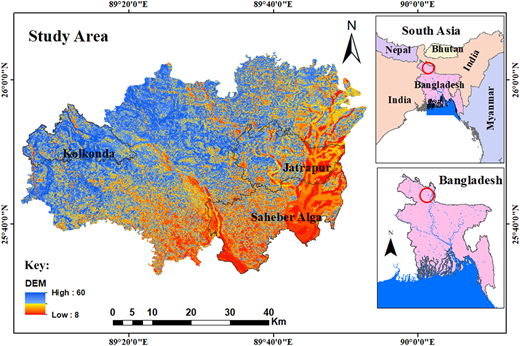
Bangladesh is surrounded by overflow plains from three major rivers (Padma, Meghna and Brahmaputra-Jamuna), making it the world’s largest delta. The Padma, Brahmaputra-Jamuna and Meghna rivers encircle the majority of the country, which has a total land area of 8,450 km2 (6% of the total) and a population of 12 million. The Char people, who live on the sand and silt on the banks of rivers in the northern part of Bangladesh, are the most vulnerable and poorest. They always face natural disasters. The selected regions for this study are the Rangpur and Kurigram districts of the country (see Figure 1). The selected char areas are closely situated beside the riverbanks of the Brahmaputra and the Tista and as shown in Table 1, the similar climatic conditions and population density are notable in that both of those districts have little health concern, work as day labor and mainly depend on agriculture for survival. Therefore, we focus on chars from four administrative units, such as Gujimary Babur char at Saheber Alga union, Ulipur, Kurigram; char Jatrapur at Jatrapur union, KurigramSadar, Kurigram; and Binbinar char and char Mukutpur at Kolkonda union, Gangachara, Rangpur in districts in the northern part of Bangladesh (as shown in Figure 1), as they are typical of people living near Bangladesh’s main rivers. Moreover, we emphasize these places since they represent real-world traits, are vulnerable to COVID-19 threats and were placed under government lockdown during the pandemic period.
Details on survey areas
| Char Upazila | Location | Area Km2 | Population | Density Km2 | Source of income (%) | River | Literacy (%) | Landless (%) |
|---|---|---|---|---|---|---|---|---|
| Ulipur | 25,033’N 89,029’E | 504.19 km2 | 359,626 | 713 | Agriculture- 69.42, non-agriculture- 3.10, Commerce- 10.61, Transport- 1.2, Service- 5.61, Construction- 1.1 and Others- 6.55 | Brahmaputra, Tista, Dharla | 34.91 | 45.3 |
| Kurigram Sadar | 25,045’N 89,034’E | 276.45 km2 | 259,157 | 937 | Agriculture- 53.32, non-agriculture-10.12, Commerce- 13.01 Transport- 3.15, Service- 8.97 and Others- 10 | Brahmaputra, Dharla | 38.38 | 52.03 |
| Gangachara | 25°57'N 89°21'E | 272.28 km2 | 259,856 | 954 | Agriculture- 76.04, non-agriculture- l4.78, industry- 0.28%, Commerce- 9.36, Transport- 2.17, Service- 3.43, Construction- 0.36 and Others- 3.29 | Tista and Ghaghat; Bara Beel, Bullai Beel, Mohsonkura Beel and Dondara Beel | 32.95 | 41.56 |
Source(s): Authors’ own work based on information from Banglapedia. Source of information: https://en.banglapedia.org/index.php/Kurigram_Sadar_Upazila
3.2 Sampling technique
A multi-stage sampling was used in this study that relied on sampling lists to choose households. Multi-stage sampling is a sampling technique that involves progressing from a larger, more inclusive sample to a smaller, more specific sample using a systematic and sequential approach (Ackoff, 1953). Multi-stage sampling can be conceptualized as a systematic approach employed to strategically pick a sample from a given population. Hence, this study endeavors to find a method to acquire a manageable approximation of the design effect for a total, which allows this study to effectively assess the sample variance section on the survey properties of alternative designs.
Prior to conducting the survey, a pilot test is implemented to ascertain the questionnaire’s quality. This study has a pre-test phase, during which the researcher conducts a pilot test to obtain feedback and make any required revisions before conducting the full-scale survey. The information is gathered from a small group of participants and then looked over to see if there are any problems, restrictions, unexpected mistakes or misunderstandings in the questionnaires. In this preliminary investigation, a total of 50 sets of questions were delivered to a sample of 50 participants as a precursor to the subsequent comprehensive survey. Nevertheless, the pilot test may not provide a comprehensive representation of the ultimate findings obtained from the final survey.
As the multi-stage sampling technique has several benefits, this study considered this approach to collect primary data from a large population. Initially, this study purposely selected two districts, followed by randomly selecting villages and then choosing households at the village level. The selected households were invited to participate in both a household survey and an interview, and the participants were mainly either the household head or their spouse, as they were the ones who typically make risky decisions and significant economic choices. In terms of choosing participants, this study took into account whether they were self-employed or wage-employed, both prior to and following the onset of the pandemic. The researchers conducted interviews during daylight hours in order to effectively reach the targeted audience and ensure that all respondents completed the questionnaire without interruption or distraction during the interview process.
3.3 Data collection and variable description
A preliminary survey was carried out in order to understand the background knowledge of the subject regions and to create the research design. After obtaining primary feedback, Gujimary and Babur char at Saheber Alga union, Ulipur, Kurigram; char Jatrapur at Jatrapur union, Kurigram Sadar, Kurigram; and Binbinar char and char Mukutpur at Kolkonda union, Gangachara, Rangpur district, were selected for study. The sample size is determined by the targeted groups using Population Proportionate to Size. The sample is then rearranged to guarantee that every group in both districts (Kurigram and Rangpur) has a minimum sample size. Probability sampling methods were used to identify N = 434 participants from the four poorest communities. Participants were selected using random sampling techniques. Each respondent had a separate respondent identification number, such as ID-1 to ID-434. This research’s survey by means of a structured questionnaire, provided in Appendix 1, was conducted in May and August 2022.
COVID-19 has significant influences on both emerging and fragile economies, with the most substantial adverse effects on the financial strategies of the underprivileged groups. This study attempted to investigate the coping financial strategies of the char terrestrials, who are the most vulnerable populations in Bangladesh throughout the pandemic period, particularly in terms of financial security. Table 2 exhibits the applied variables and descriptive statistics. In this study, 434 respondents (82% male respondents, with the rest being female) participated and were examined in light of the data collection. The majority of those who took part in this survey were in the middle age groups (ages 26–35, 36–45 and 46–60), accounting for 26.60%, 26.40% and 24.80%, respectively, followed by those aged under 18 years (1.90%), 18–25 years (10.70%) and over 61 years (9.60%). Large portions (47.20%) of the Char people have no institutional education. However, only 39.50% of people have a primary-level education. In the case of the employment status of char people, farmers 57.20%, day labor 14.30% and the rest of them are earned their livelihood as self-employed, businessmen, governmental and non-governmental employees, while most of their income per month range exists below [5]Taka1000 (28%), Taka 1000–4999 (35.50%) and Taka 5000–9999 (28.50%), respectively. During the pandemic, people were exposed that their income (95.10%) and work opportunities (90.20%) were decreased. 65.90% of people said that the number of dependents in their family exists between 3 and 5 and 23.40% of families contain 6 or more dependents. Half of the respondents (49.30%) said that other members of their family contributed financially. Most people (81.30%) did not save for their future. In comparison to household expenses to pre-pandemic expenses, people had mixed experiences. For instance, 42.10% of people thought their expenses were higher, 48.40% of people thought their expenses were lower and only 9.60% commented that their household expenses had not much changed. Moreover, the major sources of expenditures of char terrestrials were buying food (76.90%), medical treatment (6.30%), children’s education expenses (15.20%) and other expenses (1.60%).
Variables’ description
| Variable | Variable type | Dummy | Measurement | N | MNL value |
|---|---|---|---|---|---|
| Age | Independent | 1 | Below 18 years | 8 | 1.90% |
| 2 | 18–25 years | 46 | 10.70% | ||
| 3 | 26–35 years | 114 | 26.60% | ||
| 4 | 36–45 years | 113 | 26.40% | ||
| 5 | 46–60 years | 106 | 24.80% | ||
| 6 | 61 years or above | 41 | 9.60% | ||
| Gender | Independent | 1 | Male | 350 | 81.80% |
| 2 | Female | 78 | 18.20% | ||
| Level of education | Independent | 1 | Primary | 169 | 39.50% |
| 2 | SSC or equivalent | 45 | 10.50% | ||
| 3 | HSC or equivalent | 7 | 1.60% | ||
| 4 | Graduate or equivalent | 2 | 0.50% | ||
| 5 | Post-graduate | 3 | 0.70% | ||
| 6 | No institutional education | 202 | 47.20% | ||
| Employment status | Independent | 1 | Self-employed | 30 | 7.00% |
| 2 | Businessman | 24 | 5.60% | ||
| 3 | Government employee | 3 | 0.70% | ||
| 4 | Non-government employee | 10 | 2.30% | ||
| 5 | Farmer | 245 | 57.20% | ||
| 6 | Day laborer | 61 | 14.30% | ||
| 7 | Housewife | 55 | 12.90% | ||
| Income per month | Independent | 1 | Below 1000 Taka | 120 | 28.00% |
| 2 | 1000–4999 Taka | 152 | 35.50% | ||
| 3 | 5000–9999 Taka | 122 | 28.50% | ||
| 4 | 10000–14999 Taka | 22 | 5.10% | ||
| 5 | 15000–19999 Taka | 9 | 2.10% | ||
| 6 | 20000 Taka or above | 3 | 0.70% | ||
| Income instability | Independent | 1 | Increased | 3 | 0.70% |
| 2 | Decreased | 407 | 95.10% | ||
| 3 | Not changed | 18 | 4.20% | ||
| Shrinking work opportunity | Independent | 0 | No | 42 | 9.80% |
| 1 | Yes | 386 | 90.20% | ||
| Number of dependents in family | Independent | 1 | 0–2 | 46 | 10.70% |
| 2 | 3–5 | 282 | 65.90% | ||
| 3 | 6 or above | 100 | 23.40% | ||
| Other’s financial contribution in family | Independent | 0 | No | 217 | 50.70% |
| 1 | Yes | 211 | 49.30% | ||
| Savings | Independent | 0 | No | 348 | 81.30% |
| 1 | Yes | 80 | 18.70% | ||
| Comparison of household expense to pre-pandemic expense | Independent | 1 | Higher now | 180 | 42.10% |
| 2 | Lower now | 207 | 48.40% | ||
| 3 | Not much change | 41 | 9.60% | ||
| Major sources of expenditure | Independent | 1 | Buying food | 329 | 76.90% |
| 2 | Treatment | 27 | 6.30% | ||
| 3 | Education | 65 | 15.20% | ||
| 1 | Other | 7 | 1.60% | ||
| Perception of COVID-19 | Dependent (BNL) | 0 | No | ||
| 1 | Yes | ||||
| Adaptive strategies | Dependent (MNL) | 1 | No adaptive strategy | 59 | 13.80% |
| 2 | Sell personal property + Take loan from for formal source + Take loan from for informal source | 17 | 4.00% | ||
| 3 | Change consumption habit + Sell personal property + Change earning method | 71 | 16.60% | ||
| 4 | Change consumption habit + Sell personal property + Take loan from for informal source | 26 | 6.10% | ||
| 5 | Change consumption habit + Take loan from for formal source + Take loan from for informal source | 25 | 5.80% | ||
| 6 | Change consumption habit + Sell personal property + Get relief | 33 | 7.70% | ||
| 7 | Change consumption habit + Financial support from government + Get relief | 23 | 5.40% | ||
| 8 | Spend savings + Take loan from for formal source + Take loan from for informal source | 20 | 4.70% | ||
| 9 | Change consumption habit + Sell personal property + Take loan from for formal source + Take loan from for informal source | 35 | 8.20% | ||
| 10 | Change consumption habit + Change earning method + Take loan from for informal source + Take advance money on crops | 11 | 2.60% | ||
| 11 | Change consumption habit + Sell personal property + Mortgage property + Change earning method | 23 | 5.40% | ||
| 12 | Change consumption habit + Sell personal property + Financial support from government + Mortgage property | 4 | 0.90% | ||
| 13 | Others (different single or double strategies) | 81 | 18.90% |
Source(s): Authors’ own work
In the context of financial instability and shrinking job opportunities, a substantial percentage of Char residents have implemented a variety of coping strategies, either to minimize household expenditures or to enhance current income. The most common financial coping strategies, according to Palma and Araos (2021), Schröder et al. (2020) and Bartfeld and Collins (2017), are: changing consumption habits; selling personal properties such as ornaments, arable land and cattle; taking loans from informal sources such as friends and relatives, mahajans (money lenders), rich farmers, credit groups; taking loans from formal sources such as banks; changing earning methods; receiving relief from charity or the government; and mortgage personal property. As a percentage of all families, Figure 2 shows the strategies that households have used. However, according to the survey report, it is observed that each individual has taken into consideration more than two or three financial coping mechanisms to address financial challenges throughout the pandemic. Therefore, we combined coping strategies based on the participants’ responses. Moreover, In Table 2, these strategies are dispensed by 2–13, where we consider strategy no. 1 as a “no adaptive strategy.” We have considered combining strategies (2–13), where each respondent takes at least three (2–8) or up to three (9–12) strategies at a time. In addition, we consider other strategies (13) that took single or double strategies during the pandemic to cope with their financial needs.
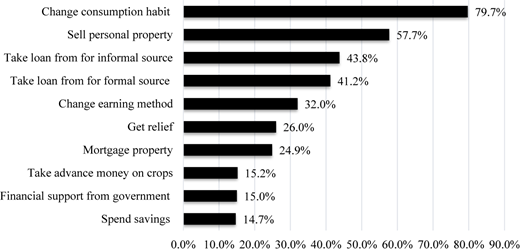
Percentage of households adopting various strategies. Source (s): Figure by authors
Percentage of households adopting various strategies. Source (s): Figure by authors
According to survey findings, 59 (13.80%) of the 434 respondents did not adopt any financial strategies during the pandemic period. The majority of char people take other strategies (18.90%), whereas we consider single or double strategies. In the case of taking combined strategies, Strategy 3 (e.g. change consumption habits + sell personal property + change earning method) is taken by the highest number of people (71 respondents, or 16.60%). Strategy 9 (change consumption habit + sell personal property + take a loan from a formal source + take a loan from an informal source) and Strategy 6 (change consumption habit + sell personal property + get relief) are quite popular and are taken by second and third maximum people, e.g. 35 and 33, respectively. In place of the fourth and fifth maximum numbers, participants adopted Strategies 4 (26 respondents) and 5 (25 respondents), respectively. Remarkably, Strategies 7 and 11 selected a similar number of people (23 respondents, or 5.40%). Consequently, Strategies 8 and 2 are taken to consider the number of people, i.e. 20 and 17 respondents, while Strategies 10 and 12 are considered for a small number of people. As a result, the most common adaptive strategies in the research region are Strategies 3, 4, 6 and 9. As a reference category, the elements influencing the char people’s receptivity to adopt Strategies 2, 7 and 8 are investigated in this study.
3.4 Quantitative analysis
The multinomial logit model is employed to expose the most efficient adaptation methods taken into account by households in the research area. These models, Probit, BNL and MNL, are employed in this investigation to determine what elements would influence people to make an adaptive decision regarding their personal daily financial management in the times of the global pandemic. Application of probit and binary logistic regression models is turned into widely employed techniques that explore the linkage among shocks and coping activities (Palma and Araos, 2021). These three models have been used in this study in an effort to better understand how COVID-19 affects people’s daily lives. Therefore, results from all three of the models employed in this study are more precise and appetizing. Taking these models is further justified by the fact that no previous studies in Bangladesh have made use of them.
3.4.1 Probit model
The following equation defines the probit model:
The latent variable y* is modeled as a function of the explanatory variables X, which denotes the parameters to be estimated and signifies the stochastic error term. Direct interpretation is not provided by the parameters ; therefore, the marginal effect needs to be estimated from the mean of every variable. The following equation gives the marginal effect of the jth continuous variable:
Here, denotes the function of cumulative normal distribution.
3.4.2 Binary logit model
The parameters of the logistic regression model are estimated using the maximum likelihood estimation method. The likelihood of an approach being adopted can be represented as follows:
In equation (4), with the natural logarithm represented by and a vector of explanatory variables marked by Xi, indicates the likelihood that the strategy will be implemented.
In equation (5), and are probability ratio, its log indicates the likelihood of an approach being adopted, where the constant of equation is , i denotes ith household (1 … 434), signifies the probability of financial management strategies adopted by household, whereas non-adoption probability is , is intercept, each explanatory variable has a coefficient of the likelihood of household adopting the technique in its estimation form of logistic transformation.
3.4.3 Multinominal logit model
One of the most widely used regression models for nominal outcomes is the multinomial logit model (MNL). It is employed when the regression is not in any particular order. The random decision variables are signified by with values {1, 2, … J} for a positive integer of J and denote the set of explanatory variables to define the multinomial logit model. stands for alternate adaption techniques in this study. The traits of the person or household making the decision, as well as a number of institutional elements, make up the collection of explanatory variables. Multinomial logit model is used to examine how the variables affect response probabilities . Furthermore, the likelihood that an individual i will select an adaptation option j from the set of adaptation alternatives might be expressed as:
In equation (6), individual perceived utility of adaptation alternatives j and k are and , respectively, with the explanatory variables’ vector is . Thus, the probability model is as follows:
While the parameter estimates of the multinomial logit (MNL) model reveal the direction in which independent variables sway the dependent variable, they fall short of capturing the true size of the effect or the precise probability of an outcome. Therefore, marginal effects capture the expected change in the likelihood of a particular option being selected as an independent variable deviating from its mean value. One way to figure out the marginal effect is as follows:
In equation (7), the probabilities related to the strategies’ adoption are and ; and are estimates of the parameters, j and k are the options of strategies.
3.4.4 Bayesian probit model
The probit model estimates the likelihood of a binary response using the standard normal distribution’s cumulative distribution function. Here is a model explanation:
The equation involves a p × 1 vector of unknown parameters is defined as , xi represents a vector of known variables, and the standard Gaussian cumulative distribution function is denoted by Φ. The latent variable is used to represent the Probit model, as shown in Equation (1). Where is a standard probability distribution. Here is the joint probability distribution of y:
In the Bayesian framework, prior distributions are specified for the model perimeter . Normal prior is as follows . A priori information is used to evaluate the probability of the parameter, denoted as P(δ). The normalization constant is . For simplicity, the proportional representation of the Bayes rule is as follows:
The weighted average of the knowledge of the a priori parameters for the data observation and the parameters in the observed data are described by the posterior distribution, according to equation (10).
3.4.5 Bayesian Logistic Regression
Bayesian Logistic Regression is a statistical technique that enhances traditional logistic regression by integrating previous knowledge about the parameters into the model. Equation (3) represents a binary logistic regression model. A prior distribution P(δ), which is presumed to be Gaussian with full covariance structure, represents the variance in parameter values δ. Therefore, the predictive distribution is:
where a set of explanatory variables is denoted by x = {x1, …, xn}, and y is the binary response variables. Gaussian prior distribution for the perimeter is as follows , and are mean and covariance of priority distribution, respectively. Equation (9) presents the probability distribution of y, where the vector representing the observed binary result is denoted by y = (y1, …,yn). Equation (10) expresses the Bayes rule’s posterior distribution computation.
4. Results and discussions
4.1 Financial management adaptation strategies adopted by households
Two popular methods of regression analysis, binary logistic and probit models, are used in this study to predict the financial strategies of the char people of the northern part of Bangladesh. Table 3 shows the predicted results for results of the binary logit and probit models. Maximum likelihood methods have been employed in these models. Standard errors and computed coefficients illustrate which elements affect participants’ financial strategies. For instance, income per month, income instability, shrinking work opportunities and the number of dependents in the family are positively induced, while other’s financial contributions to the family, savings and comparison of household expenses to pre-pandemic expenses are negatively correlated with adaptive financial strategies. In contrast, the rest of the factors, such as age, level of education, employment status and major sources of expenditure, statistically have no correlation with adaptive financial strategies because there was no particular group exempt from COVID-19 impact. According to Borooah (2002), a statistically significant coefficient suggests that the reaction of the explained variable will influence the likelihood of financial strategies. Results of the likelihood ratio test statistic show that seven variables’ significant probability levels are at 10%, 5% and 1%, separately. Cox and Snell R Square (0.126) and Nagelkerke R Square (0.501) for binary logit and McFadden’s R2 (0.470) for probit model were calculated and attained values designate that both models’ independent variables describe a considerable percentage of the variance in char people’s financial coping strategies. The variables used in the model show that there is a high probability of adopting financial strategies of char terrestrials. The model’s fit was validated using the Chi-square test. The probit model has a 96.5% correct prediction rate. The probit model successfully predicted 96.5% of the cases.
Results of binary logit and probit models
| Factors | Binary logit model | Probit model | ||||
|---|---|---|---|---|---|---|
| B | S.E. | Sig | B | S.E. | Sig | |
| Age | −0.386 | 0.316 | 0.222 | −0.176 | 0.155 | 0.255 |
| Gender | 1.530 | 1.314 | 0.245 | 0.748 | 0.649 | 0.249 |
| Level of education | 0.147 | 0.159 | 0.355 | 0.069 | 0.080 | 0.389 |
| Employment status | −0.940 | 0.586 | 0.109 | −0.447 | 0.276 | 0.104 |
| Income per month | 1.228* | 0.637 | 0.054 | 0.646** | 0.329 | 0.049 |
| Income instability | 4.660** | 1.839 | 0.011 | 2.407** | 0.976 | 0.014 |
| Shrinking work opportunity | 2.992*** | 0.857 | 0.000 | 1.511** | 0.439 | 0.000 |
| Number of dependents in family | 1.699** | 0.741 | 0.022 | 0.766** | 0.373 | 0.039 |
| Other’s financial contribution in family | −1.782** | 0.862 | 0.039 | −0.835** | 0.421 | 0.048 |
| savings | −1.818** | 0.843 | 0.031 | −0.920** | 0.421 | 0.029 |
| Comparison of household expense to pre-pandemic expense | −1.680*** | 0.574 | 0.003 | −0.876** | 0.296 | 0.003 |
| major sources of expenditure | 1.359 | 0.840 | 0.106 | 0.656 | 0.439 | 0.135 |
| Constant | −6.220 | 5.049 | 0.218 | −3.160 | 2.622 | 0.228 |
Note(s): *, ** and *** denote degree of significance at 10%, 5% and 1% level, respectively. Number of observations = 434. For binary model: Hosmer and Lemeshow Test: Chi-square = 1.003**; −2 Log likelihood = 65.946; Cox and Snell R Square = 0.126; Nagelkerke R Square = 0.501 and for probit model: McFadden R-square = 0.470; Log likelihood = −32.637; Restr. log-likelihood = −61.616; overall accuracy (correctly predicted) = 96.5%
Source(s): Authors’ own work
Our findings from the binary logit and probit models indicate that seven out of eleven factors forced char people to take various financial strategies to meet their financial needs during the pandemic period. According to the findings, we found that the level of age has an insignificantly negative association with the Char dwellers financial coping strategies during the COVID-19 pandemic. Age can deter people from using financial coping mechanisms during a recession for a number of reasons, including lack of expertise, stability or worry about losing money or independence. Elderly char communities frequently encounter more significant constraints in expanding their sources of income or participating in physically strenuous occupations due to health issues associated with ageing. However, younger individuals are more susceptible to financial hardships and depend on their families or communities to help them manage the financial repercussions of the pandemic (Eberhardt et al., 2019). During the COVID-19 pandemic crisis, gender has an impact on coping mechanisms, but it is essential to keep in mind that people come from distinct socioeconomic backgrounds. For the purpose of managing their finances through trying times, people of both genders should seek out financial counseling and support. Therefore, we scrutinized an insignificant positive relation between gender and the financial coping strategies adopted by char dwellers during the COVID-19 pandemic period. The finding indicates that gender does not pose a hindrance to the implementation of efficient financial coping strategies among those residing in poverty. Instead, it highlights the ability of individuals, irrespective of their gender, to persist and adjust in the midst of challenging circumstances. We found the degree of education has an insignificant positive impact on char dwellers financial coping strategies. More educated people comprehend financial concepts and tactics better, which makes it easier for them to manage their money during difficult times. Those with lower levels of education have a harder time managing their money during the COVID-19 pandemic, especially if they do not have the fundamentals of financial literacy (Lusardi and Messy, 2023). Households with knowledge of money management demonstrate a proclivity toward engaging in saving, investing, borrowing and upholding creditworthiness (Fan and Chatterjee, 2017). Similarly, how people handle financial hardship during the COVID-19 pandemic is significantly influenced by their employment position. In order to manage their finances and deal with the difficulties of their work status during difficult times, people seek out financial assistance and support Palma and Araos (2021). However, this study observed a negative but insignificant effect of employment status on the adoption of financial coping strategies. This observation indicates that variables other than employment, such as the type of job, income level and availability of social support systems, have a greater impact on determining financial resilience in times of crisis.
Income per month positively influenced people to adapt their financial strategies, and this finding is significant at the 10% level in the binary logit model and at the 5% level in the probit model. This study observes that char dwellers with higher monthly incomes are more likely to utilize a variety of coping strategies in order to minimize the negative effects of the pandemic on their financial situation. Miles (1997) emphasizes that the assessment of permanent income and the level of uncertainty around wages have substantial ramifications for expenditure patterns and the financial decision-making processes of households. Having an income during a recession gives people a sense of security and stability, which might enable them to make wiser financial decisions. Individuals with a stable income are more inclined to engage in prudent financial behaviors such as saving money, establishing emergency funds and curtailing excessive expenditures amidst the COVID-19 epidemic. These actions enable them to effectively adapt their financial plans to the prevailing circumstances. Similar to the findings of PPRC-BIGD (2021), the lower range of income groups has a tendency to meet their financial needs by using different strategies, such as selling personal assets, using savings, mortgaging their property and borrowing money from friends and neighbors. Similar to the findings of Adesina-Uthman and Obaka (2020), we also found that income instability positively impacts people’s ability to adapt their financial strategies. When individuals experience a reduction in their sources of income, they actively seek alternate ways to fulfill their monetary needs. During periods of economic crisis, families with low socioeconomic status had a consistent rise in income instability during the previous three decades. This may be attributed to the widening disparities in income inequality and the increasing variability between households with low and high incomes (Ha et al., 2020). As a result of the economic volatility seen during the global pandemic, households adopted a strategic approach to their expenditure allocation, placing emphasis on basic needs such as rent, mortgage payments, utilities and food, while curtailing non-essential discretionary spending. This finding suggests that Char terrestrials meet their financial needs by taking an advance on their crops, known as Dadan, going back to the workplace and borrowing from family and friends. Next, we observed that “shrinking work opportunity” has a significant positive influence, both in binary logit and probit models, on adapting different financial strategies. Amidst the decline in job prospects caused by lockdowns, limitations and economic downturns, residents of char have exhibited exceptional flexibility in formulating inventive approaches to overcome these difficulties. In response to shrinking work opportunities, numerous residents of char have expanded their income streams by pursuing other means of living, including engaging in small-scale agriculture and finding alternative work opportunities. Global labor markets experienced an unprecedented and substantial shock as a result of the COVID-19 pandemic (Kugler et al., 2023), which has had a disproportionately detrimental effect on marginalized workers. This study found that due to the reduction of people’s work opportunities during the pandemic, they changed their professions and looked for government and non-government relief as alternative financial strategies (Bui et al., 2022). Subsequently, during the COVID-19 crisis, “number of dependents in the family” has an impact on financial coping strategies, especially when it comes to budgeting, long-term planning, employment opportunities and financial help. While creating a financial plan amid hard times, it is crucial to consider these elements. Consistent with the research conducted by Araos and Siles (2021), the present study has identified that the presence of dependents within a family exerts a positive effect on the adoption of financial strategies. This indicates that a family with a larger number of dependents needs a larger amount of financing to maintain their household expenses. Families of greater size allocate a higher proportion of their income toward essential expenditures while allocating a lower proportion toward discretionary expenditures. Due to the COVID-19 pandemic, larger families have become unable to meet their daily financial needs. They must rely on assistance, government and non-government help and official and informal loans. They also need to depend on relief, governmental and non-governmental aid and loans from formal or informal sources. It is difficult for people to adopt financial strategies on their own if other family members are providing financial help since it may foster a sense of dependence. Similar to the findings of Palma and Araos (2021), we observe that other financial contributors in the family adversely impact adapting the financial strategies during the pandemic. This finding shows that families with a greater number of financial contributors are more likely to be reluctant or discouraged from adopting coping strategies during the pandemic because they have enough money in their families to meet their financial needs.
In times of economic distress, saving money can be a deterrent to adopting financial strategies. The accumulation of significant financial resources might engender a sense of contentment and hinder individuals’ motivation to undertake progressive financial strategies aimed at enhancing their economic well-being. Households that possess sufficient savings experience a heightened feeling of financial independence, reduced stress levels and are able to avoid incurring loans (Fuchs-Schündeln et al., 2020). Thus, financial strategies adopted by the Char people are negatively influenced by saving. This suggests that those who have adequate savings are more likely to experience a satisfactory quality of life and do not need to employ financial coping mechanisms. According to Adesina-Uthman and Obaka (2020), people use their savings as a financial strategy during the pandemic period. Moreover, we examine that the comparison of household expenses to pre-pandemic expenses adversely impacts people’s financial strategies. The occurrence of extensive and abrupt reductions in income resulting from job displacement or decreased work hours has engendered a decrease in expenditures for several discretionary items. Consequently, numerous households have been compelled to forego fundamental necessities such as sustenance or housing payments (Roll et al., 2022). When individuals see a decrease in their household expenditures as a result of a global pandemic, they tend to refrain from implementing any financial strategy. Comparing their pre-pandemic home spending to their current expenses can be demoralizing and discourage them from pursuing financial plans. Comparing expenses might also result in a lack of knowledge about the various financial planning options. Finally, we found an insignificant positive impact of major sources of expenditure on char dwellers financial strategies during the COVID-19 pandemic. Spending sources can be quite important in assisting people in developing financial solutions during a recession. It is noteworthy that char dwellers exhibit a notable capacity for adaptation in effectively controlling their expenditures, strategically reallocating resources to prioritize basic needs and mitigating the adverse effects of economic upheavals. This finding is consistent with Latham and Braun (2010) who that consumer behaviors undergo modifications in response to economic recessions. However, the specific changes in consumer behaviors exhibit variations based on regional and demographic factors, product categories and the characteristics of the crisis itself (Engle et al., 2023). Individuals can identify opportunities for cost reduction and budget enhancement by gaining a comprehensive awareness of their expenditure patterns.
4.1.1 Robustness check
To determine the reliability of the outcomes derived from the binary logistic and probit model, we applied the Bayesian logistic and probit models. Similar to (Briggs, 2023; Kalia, 2024), this study incorporates Bayesian methods, which are founded upon Bayes’ theorem of probability (Bayes, 1763) as an adjunct to conventional frequentist approaches. A statistical method, called Bayesian analysis, utilizes probability assertations to answer research inquiries regarding unknown parameters of statistical models. Bayesian approaches employ the Bayes rule, a fundamental principle of probability, to determine how the model parameters are distributed posteriorly. The utilization of the posterior distribution in Bayesian analysis is employed to generate diverse summaries for the parameters of the model, including point estimates and interval estimates (Phadkantha et al., 2019). Therefore, The Bayesian approach offers more advantages compared to conventional frequentist statistics.
The acceptance rates for the Bayesian probit and logistic models were 0.246 and 0.286, respectively. This indicates that about 24.6% and 28.6% of the proposed parameter values were accepted throughout the MCMC sampling procedure, according to Bayesian’s model. Bayesian regression provides a Bayesian confidence interval, specifically an equal-tailed 95% credible interval. This interval represents a range of values for a parameter, with a 95% likelihood that the true parameter value falls inside this range. The Bayesian approach is implemented using the Metropolis–Hastings (MH) algorithm to simulate the regression model 10,000 times. Each simulation yields a regression coefficient, and the resulting regression results table displays the mean (Mean) of these coefficients. In addition, Bayes also estimates the standard error for the regression coefficient, as well as the Monte-Carlo standard error (MCSE). The MCSE is a calculation that provides an estimation of the standard error for the Monte Carlo approximation, which is a method used to estimate the posterior distribution. Assessing the precision of the parameter estimates is crucial. According to Flegal et al. (2008) and Thach et al. (2022a), a smaller value of the MCSE indicates a more robust MCMC series. An acceptable MCSE value is defined as one that is less than 6.5% of the standard deviation, whereas a value below 5% is considered optimal. The findings presented in Table 3 indicate that the majority of the MCSE values for the remaining regression coefficients meet the optimal threshold. Moreover, results obtained through Bayesian analysis offer a credible interval that can be used to designate an impact that encompasses the parameter with a specific probability (Thach et al., 2022b); an extreme effect is defined as a parameter with a likelihood of 90% or more of having either a positive or negative influence.
The findings of the Bayesian probit and logistic models in this study delineate that certain factors, such as gender, level of education, monthly income, income instability, shrinking work opportunities, dependents in the family and major sources of expenditure, have a positive impact on adaptive financial strategies with a probability of approximately 95%. Wagner and Walstad (2023) argued that gender exerts a substantial influence on financial behaviors, the ability to take risks, investing strategies and overall financial planning within households during times of financial difficulty. Moreover, higher-educated people are more inclined to have stronger knowledge and awareness of financial issues, as well as access to a broader range of resources that allow for more effective financial planning during financial predicaments. Thereby, financial constraints – income variability and attenuation of work opportunities – induce households to adopt financial strategies while facing credit quandaries. These findings are compatible with the outcome of the binary logistic and probit models – gender, education and variables associated with income are positively correlated to the adoption of financial coping strategies. Furthermore, the presence of dependents often serves as a strong incentive for individuals to implement proactive financial strategies in order to ensure their families’ financial stability and welfare. Substantive spending requires meticulous financial preparation, resulting in the implementation of versatile financial approaches. On the contrary, there is an adverse correlation between age, employment status, other’s financial contribution to the family, and savings with adaptive financial methods, with a 95% probability. The presence of a stable employment situation reduces the perceived need for adaptive measures, as a regular salary instills a sense of economic security. Moreover, households experience a reduced inducement to employ adaptive strategies when others make financial contributions to the household, instead opting to place greater reliance on shared financial responsibilities. Then, individuals who possess savings may not be immediately obligated to modify their financial strategies due to the safeguarding effect that savings provide against abrupt financial oscillations.
The results from the Bayesian probit and logistic models, presented in Table 4, are consistent with those obtained from the traditional binary logistic and probit models. The constancy of the results further strengthens their robustness. Both Bayesian and frequentist models concur on the direction and relevance of the relationships between the factors and adaptive financial strategies.
Results of Bayesian logistic and probit models
| Bayesian logit model | Bayesian probit model | |||||||
|---|---|---|---|---|---|---|---|---|
| Odds ratio | Std. dev | MCSE | Median | Mean | Std. dev | MCSE | Median | |
| Age | −0.497 | 0.402 | 0.068 | −0.498 | −0.226 | 0.160 | 0.023 | −0.215 |
| Gender | 3.514 | 1.613 | 0.368 | 3.437 | 0.701 | 0.442 | 0.076 | 0.695 |
| Level of education | 0.095 | 0.19 | 0.026 | 0.1 | 0.064 | 0.078 | 0.006 | 0.066 |
| Employment status | −1.795 | 0.561 | 0.09 | −1.775 | −0.472 | 0.178 | 0.031 | −0.460 |
| Income per month | 2.028 | 0.691 | 0.125 | 2.055 | 0.702 | 0.265 | 0.018 | 0.688 |
| Income instability | 5.326 | 1.801 | 0.288 | 5.336 | 2.593 | 0.486 | 0.041 | 2.580 |
| Shrinking work opportunity | 3.514 | 0.895 | 0.097 | 3.494 | 1.561 | 0.323 | 0.032 | 1.563 |
| Number of dependents in family | 2.49 | 0.801 | 0.129 | 2.502 | 0.742 | 0.302 | 0.062 | 0.751 |
| Other’s financial contribution in family | −2.608 | 1.134 | 0.228 | −2.597 | −0.905 | 0.370 | 0.037 | −0.902 |
| savings | −2.855 | 0.895 | 0.127 | −2.858 | −0.923 | 0.364 | 0.046 | −0.914 |
| Comparison of household expense to pre-pandemic expense | −2.381 | 0.758 | 0.142 | −2.354 | −0.928 | 0.254 | 0.026 | −0.918 |
| major sources of expenditure | 1.512 | 0.69 | 0.149 | 1.495 | 0.788 | 0.323 | 0.050 | 0.787 |
| Constant | −4.875 | 2.434 | 0.612 | −5.416 | −3.061 | 0.411 | 0.069 | −3.087 |
| Acceptance rate | 0.286 | 0.246 | ||||||
Source(s): Authors’ own work
4.2 Factors that influence choice of household’s financial management adaptation strategies
The key financial management adaption strategies that usually adopted by households in this study area are Strategy 3, Strategy 4, Strategy 6 and Strategy 9. The specific factors that influence the choice among Strategy 3, Strategy 4, Strategy 6 and Strategy 9 by the majority of households in the study area are shown in Tables 5 and 6.
Factors that influence the choice of household’s financial management adaptation Strategies 3, 4, 6 and 9 using multinominal logit model
| Strategies | Strategy-3 | Strategy-4 | Strategy-6 | Strategy-9 | |||||||||
|---|---|---|---|---|---|---|---|---|---|---|---|---|---|
| Factors in details | Dummy | B | Std. error | Sig. | B | Std. error | Sig. | B | Std. error | Sig. | B | Std. error | Sig. |
| Age | 1 | 2.75 | 3.82 | 0.47 | 5.22 | 4.05 | 0.20 | −1.72 | 8.76 | 0.84 | −0.70 | 7.04 | 0.92 |
| 2 | −2.13** | 0.94 | 0.02 | 0.33 | 1.35 | 0.81 | −0.26 | 0.95 | 0.78 | −0.64 | 1.19 | 0.60 | |
| 3 | −0.49 | 0.64 | 0.44 | 0.29 | 1.20 | 0.81 | −0.71 | 0.83 | 0.39 | 0.12 | 1.00 | 0.91 | |
| 4 | 0.07 | 0.61 | 0.91 | 0.90 | 1.19 | 0.45 | −0.06 | 0.79 | 0.94 | −0.24 | 1.02 | 0.82 | |
| 5 | 0.31 | 0.60 | 0.60 | 0.87 | 1.21 | 0.47 | 0.03 | 0.78 | 0.97 | 0.86 | 0.98 | 0.38 | |
| 6 | 0.00 | 0.00 | 0.00 | 0.00 | |||||||||
| Gender | 1 | 0.49 | 0.71 | 0.49 | 1.38 | 1.13 | 0.22 | 0.07 | 0.86 | 0.93 | 0.26 | 1.02 | 0.80 |
| 2 | 0.00 | 0.00 | 0.00 | 0.00 | |||||||||
| Level of education | 1 | 0.44 | 0.41 | 0.28 | 1.36** | 0.60 | 0.02 | −0.17 | 0.54 | 0.75 | 1.41** | 0.58 | 0.02 |
| 2 | 2.27** | 0.81 | 0.01 | 2.84** | 1.07 | 0.01 | 1.62 | 1.06 | 0.13 | 3.37*** | 1.05 | 0.00 | |
| 3 | −4.52 | 8.03 | 0.57 | 1.90 | 1.61 | 0.24 | 0.25 | 1.52 | 0.87 | −3.92 | 11.52 | 0.73 | |
| 4 | 8.14 | 14.75 | 0.58 | 7.96 | 30.67 | 0.80 | 3.74 | 18.11 | 0.84 | 5.57 | 27.32 | 0.84 | |
| 5 | 11.75 | 104.06 | 0.91 | 2.02 | 181.84 | 0.99 | −3.11 | 133.44 | 0.98 | −0.51 | 206.05 | 1.00 | |
| 6 | 0.00 | 0.00 | 0.00 | 0.00 | |||||||||
| Employment status | 1 | −1.85* | 1.06 | 0.08 | −5.35* | 3.01 | 0.08 | −1.63 | 1.26 | 0.20 | −2.28 | 1.38 | 0.10 |
| 2 | −2.18 | 1.19 | 0.07 | −1.12 | 1.62 | 0.49 | −0.56 | 1.58 | 0.72 | −1.06 | 1.41 | 0.45 | |
| 3 | −11.59 | 104.43 | 0.91 | −5.78 | 182.38 | 0.98 | 6.13 | 132.93 | 0.96 | 1.87 | 205.81 | 0.99 | |
| 4 | −1.14 | 1.72 | 0.51 | −1.03 | 2.21 | 0.64 | 0.11 | 2.35 | 0.96 | −1.87 | 2.14 | 0.38 | |
| 5 | −1.42* | 0.78 | 0.07 | −1.29 | 1.23 | 0.29 | −1.02 | 1.01 | 0.31 | −1.53 | 1.07 | 0.15 | |
| 6 | −1.17 | 0.81 | 0.15 | −0.72 | 1.29 | 0.58 | 0.11 | 1.03 | 0.92 | −4.08** | 1.93 | 0.04 | |
| 7 | 0.00 | 0.00 | 0.00 | 0.00 | |||||||||
| Income per month | 1 | −35.10 | 2315.13 | 0.99 | −6.54 | 2347.30 | 1.00 | −4.08 | 2322.21 | 1.00 | −6.83 | 2331.57 | 1.00 |
| 2 | −34.68 | 2315.13 | 0.99 | −5.31 | 2347.30 | 1.00 | −2.46 | 2322.21 | 1.00 | −4.59 | 2331.57 | 1.00 | |
| 3 | −34.58 | 2315.13 | 0.99 | −6.19 | 2347.30 | 1.00 | −3.23 | 2322.21 | 1.00 | −5.32 | 2331.57 | 1.00 | |
| 4 | −34.85 | 2315.13 | 0.99 | −10.54 | 2347.30 | 1.00 | −5.11 | 2322.21 | 1.00 | −6.15 | 2331.57 | 1.00 | |
| 5 | −34.55 | 2315.13 | 0.99 | −5.53 | 2347.30 | 1.00 | −6.42 | 2322.21 | 1.00 | −5.07 | 2331.57 | 1.00 | |
| 6 | 0.00 | 0.00 | 0.00 | 0.00 | |||||||||
| Income instability | 1 | 9.33 | 47.29 | 0.84 | 3.61 | 71.39 | 0.96 | 2.85 | 90.21 | 0.98 | 1.95 | 71.01 | 0.98 |
| 2 | 0.62 | 1.25 | 0.62 | 2.98 | 3.79 | 0.43 | 2.19 | 3.86 | 0.57 | −0.66 | 1.25 | 0.60 | |
| 3 | 0.00 | 0.00 | 0.00 | 0.00 | |||||||||
| Shrinking work opportunity | 0 | 0.78 | 0.75 | 0.30 | 1.40 | 0.93 | 0.13 | 0.25 | 1.27 | 0.84 | 1.46 | 0.94 | 0.12 |
| 1 | 0.00 | 0.00 | 0.00 | 0.00 | |||||||||
| Number of dependents in family | 1 | −0.89 | 0.69 | 0.20 | −1.37 | 1.25 | 0.28 | −1.00 | 1.04 | 0.33 | 0.11 | 0.90 | 0.90 |
| 2 | −0.01 | 0.43 | 0.98 | 0.12 | 0.61 | 0.85 | 0.59 | 0.59 | 0.32 | 0.22 | 0.60 | 0.71 | |
| 3 | 0.00 | 0.00 | 0.00 | 0.00 | |||||||||
| Other’s financial contribution in family | 0 | 0.24 | 0.38 | 0.53 | −0.04 | 0.52 | 0.94 | −0.29 | 0.48 | 0.54 | 0.32 | 0.51 | 0.53 |
| 1 | 0.00 | 0.00 | 0.00 | 0.00 | |||||||||
| Savings | 0 | 1.48*** | 0.46 | 0.00 | 1.89** | 0.76 | 0.01 | −0.09 | 0.52 | 0.86 | 3.80*** | 1.15 | 0.00 |
| 1 | 0.00 | 0.00 | 0.00 | 0.00 | |||||||||
| Comparison of household expense to pre-pandemic expense | 1 | 0.06 | 0.74 | 0.94 | 0.03 | 0.99 | 0.98 | 1.56 | 1.56 | 0.32 | 0.11 | 0.98 | 0.91 |
| 2 | −0.25 | 0.73 | 0.74 | −0.53 | 0.99 | 0.59 | 1.98 | 1.55 | 0.20 | −0.75 | 1.00 | 0.45 | |
| 3 | 0.00 | 0.00 | 0.00 | 0.00 | |||||||||
| Major sources of expenditure | 1 | 19.49*** | 0.52 | 0.00 | 3.08 | 3.23 | 0.34 | 6.11 | 12.25 | 0.62 | 10.89 | 117.40 | 0.93 |
| 2 | 19.65*** | 0.79 | 0.00 | 3.06 | 3.32 | 0.36 | 1.94 | 12.71 | 0.88 | 9.08 | 117.41 | 0.94 | |
| 3 | 19.35 | 0.00 | 3.13 | 3.24 | 0.34 | 5.84 | 12.26 | 0.63 | 10.95 | 117.40 | 0.93 | ||
| 4 | 0.00 | 0.00 | 0.00 | 0.00 | |||||||||
Note(s): *, ** and *** denote degree of significance at 10%, 5% and 1%
Source(s): Authors’ own work
Factors that influence choice of household’s financial management adaptation Strategies 3, 4, 6 and 9 using Bayesian multinomial logit model
| Strategy-3 | Strategy-4 | Strategy-6 | Strategy-9 | |
|---|---|---|---|---|
| Age | 0.111 | 0.028 | −0.061 | −0.110 |
| Gender | −0.407* | −0.566 | −0.582 | 0.573* |
| Level of education | 0.063* | −0.081 | 0.165* | 0.122* |
| Employment status | 0.070* | 0.046 | 0.058 | −0.172* |
| Income per month | −0.027 | 0.204 | 0.060 | −0.066 |
| Income instability | 0.895* | −0.162 | 0.540 | 1.043 |
| Shrinking work opportunity | 1.623 | 0.160 | 0.503 | 0.064 |
| Number of dependents in family | −0.248 | −0.002 | 0.417* | −0.033 |
| Other’s financial contribution in family | −0.117 | −0.242 | 0.074 | −0.088 |
| Savings | −0.076 | 0.890* | 0.269 | 0.338 |
| Comparison of household expense to pre-pandemic expense | 0.047* | −0.295 | −0.156 | 0.378* |
| Major sources of expenditure | −0.143* | −0.152 | 0.123 | 0.124 |
| _cons | −4.088* | 0.415 | −4.120* | −2.615* |
| Log marginal-likelihood | −342.451 | −359.457 | −286.692 | −367.708 |
| Acceptance rate | 0.201 | 0.285 | 0.216 | 0.253 |
Note(s): * denote degree of significance at 10% level
Source(s): Authors’ own work
Strategy 3: Strategy 3 (change consumption habit + sell personal property + change earning method) is widely accepted by households in the Rangpur and Kurigram regions. Strategy 13 – others (different single or double strategies) – has been considered for adoption in this study as a reference category in the multinomial logit model. As shown in Table 5, findings reveal that more common factors, including age, level of education, household employment, savings status and major sources of expenditure, have a significant contribution to adopting Strategy 3. SSC or equivalent level of education, no savings and more expense on buying and treatment for diseases have positive influence to adopt Strategy 3, while young household heads of age range 18–25 years and employment status such as self-employed and businessman have negative influence to taking this strategy. Furthermore, Silinskas et al. (2021) found that individuals between the ages of 18 and 25 years have the lowest incidence of engaging in borrowing and gambling activities, while demonstrating the largest propensity for augmenting their income. Furthermore, it is noteworthy that the educational attainment of the spouse might exert a substantial influence on the financial decision-making within the household. It is explored whether educated households, households with no savings and households with higher expenses on purchasing food changed their daily consumption habits during the COVID-19 pandemic. Moreover, low-income households sold their personal property like ornaments, land and cattle to meet their financial needs and to adjust to unexpected socio-economic phenomenon (Hossain et al., 2022). During the COVID-19 pandemic lockdown, households in study areas changed their ways of earning and managing family expenses. Moreover, as shown in Table 6, findings reveal that more common factors, including gender, level of education, household’s employment, income variability, expenditure comparison and major sources of expenditure, have a significant contribution to adopting Strategy 3.
Strategy 4: Strategy 4 (change consumption habits + sell personal property + borrow from informal sources) is a strategy that households in this study area are likely to choose. Other (single or double strategy) was used as a reference category in the multinomial logit model in this study. In Table 5, the outcomes of the multinomial logit model reveal that education and savings positively contribute to taking Strategy 4. Formal education equips people with the knowledge and skills they need to understand financial concepts and terminology. People who are more financially literate and educated are more prone to applying sophisticated money management strategies (Xue et al., 2021). On the contrary, employment status has a negative impact on the decision to implement this strategy. Johnston et al. (2016) found the decisions made about household finances are strongly correlated with employment status and salaries. Chronologically, People who have primary and secondary levels of education and no saving changed their food consumption habits (Lamy et al., 2022) and sold their property during the lockdown to meet their basic needs (Janssens et al., 2021). In addition, education level and savings also influenced people to take informal loans such as friends and relatives, mahajans (money lenders), rich farmers and credit groups. Informal lending sources have more flexible payback periods than conventional financial institutions, making them appealing to individuals who do not have a consistent income, face unexpected needs or have no savings. The remaining factors did not have any effect on adopting strategy 4. In contrast, in Table 6, the findings reveal that only savings influence to adopt financial Strategy 4.
Strategy 6: A number of households have adopted Strategy 6 (change consumption habits + sell personal property + get relief). Although a great deal of households from Rangpur and Kurigram region have adopted Strategy 6 during the lockdown for the COVID-19 pandemic. However, there are no specific factors that influence households in study areas to adopt Strategy 6. However, the outcome from the Bayesian multinomial logit model exhibits that employment status and dependence on family contribute to take Strategy 6.
Strategy 9: Strategy 9 (change consumption habit + sell personal property + take loan from for formal source + take loan from for informal source) has been adopted by the household in this study area. Strategy 13, single or double strategies, has been taken into account for this study and chosen as a reference category in the multinomial logit model. Findings show that education level, employment status and savings contribute to selecting Strategy 9. Level of education and savings have significant impacts on taking Strategy 9, while employment status has a negative impact on choice. It is explored that people with no savings and who have primary and secondary level education are considered to take formal loans—such as from banks and NGOs—and informal loans, as well as to change their food consumption habits and to sell personal property. However, one who works for daily wages is adversely affected by taking loans, changing consumption habits and selling property. Baser et al. (2022) found that the residents of Char territories commonly relied on conventional means of sustenance such as fishing, providing transportation services through boats, seeking financial assistance from wealthier relatives, obtaining food loans and engaging in animal sales. Individuals employed in daily wage jobs are significantly impacted by economic downturns. However, they tend to refrain from adopting certain strategies, such as acquiring loans, altering their spending patterns and liquidating assets. However, several factors such as gender, education level, employment and expenditure comparison significantly affect considering financial Strategy 9, as of the findings of Table 6.
5. Conclusion
The concern expressed in this study is particularly crucial in terms of coping with the financial strategies during the COVID-19 pandemic in Bangladesh. As such, we conducted a survey and collected information from 434 respondents in four of the poorest communities in the northern part of Bangladesh. We applied binary logistic and probit models to study what factors affect adaptive financial strategies. Findings delineate that there are some factors that positively influence people’s adoption of such coping strategies, such as monthly income, income instability, shrinking work opportunities and the number of dependents in a family, as well as other family members' financial contributions, savings and comparisons of household expenses to pre-pandemic expenses, that negatively influence people’s adoption of such coping strategies. In addition, Bayesian logistic and probit models are applied in order to check the robustness of the outcomes of binary logistic and probit models. The findings of Bayesian analysis strongly bolster the binary outcome. Multinomial logit model was also employed to delve into the factors that influence the choice of a household’s financial management adaptation strategies. Findings demonstrate that when dealing with the epidemic, people from all professions suffered greatly. We found that char people adopted some financial strategies to address their financial requirements during the pandemic. The Char people mostly used four combined strategies, such as Strategy 3 (e.g. change consumption habits + sell personal property + change earning method), Strategy 9 (change consumption habit + sell personal property + take a loan from a formal source + take a loan from an informal source), Strategy 6 (change consumption habit + sell personal property + get relief) and Strategy 4 (change consumption habit + sell personal property + take loans from formal sources + take loans from informal sources), respectively. To support the people’s adopted strategies, we recommend the COVID-19 knowledge with coping strategies. The scope of NGOs (non-government organizations) and GOs (government organizations), such as skill development and credit facilities, should be expanded so that char people increase the capacity for their livelihood. Government financial assistance along with proper supervision and monitoring is required to make up for char people’s loss of income.
5.1 Significance of the study
The study has several contributions. With the use of these results, policymakers may create and carry out focused interventions such as bettering social safety nets, encouraging livelihood diversification and facilitating access to financial services that cater to the particular needs of indigent people. In order to build resilience, community leaders and organizations can learn from the coping strategies used by penurious communities. Community-based organizations can facilitate workshops to develop skills, promote groups that save and lend money together and construct systems to warn about future disasters. These programs have the potential to enhance the resilience of those living in char, enabling them to better cope with unexpected events and adjust to evolving situations. Furthermore, the government, international agencies and development partners can then take into account the policy suggestions from this research to lessen the effect of COVID-19 on underprivileged populations, considering the multiple difficulties faced by low-income populations, particularly in developing countries, and the potential for heightened vulnerabilities in the aftermath of the pandemic. These adopted financial mechanisms could be exhorted to the strategists from developing nations suffering from COVID-19 to embrace these findings for their impecunious communities in order to preclude financial predicaments from future cataclysmic repercussions. Furthermore, the utilization of the Bayesian technique provides a strong inferential framework for addressing uncertainty in socio-economic data and enhances comprehension of the financial decision-making processes of vulnerable groups during crises. This establishes the work as one of the initial studies to empirically validate the reliability and practical applicability of Bayesian regression in the investigation of crisis-coping behaviors inside developing countries. Finally, this research contributes to the understanding of vulnerability, resilience and crisis management by providing valuable insights into the financial coping strategies used by underprivileged groups during the COVID-19 epidemic.
5.2 Limitations and future research of the study
We recognize that there are certain drawbacks to this study. We consider only limited areas in the northern part of Bangladesh instead of the entire country. Furthermore, because of the pandemic-imposed restrictions on staying at home and social isolation, the population that participated in this research was lower. Further research will cover this stuff. Future research on such an issue will allow determining whether the implementation of income-generating and expenditure-cutting strategies will be able to mitigate the impact of the crisis on char households’ economic well-being in the long run, as well as for which types of households these strategies will be most effective. Exploring such issues in greater detail in the future will shed more light on whether adopting an income increase and expenditure reduction approach can lessen the negative impact of recession in lower char households’ living standards over a significant period of time and also, which household types these approaches will work best for.
The authors express their gratitude to the Editor-in-Chief and anonymous reviewers for their invaluable feedback, which has greatly enhanced the quality of the manuscript.
Notes
Char dwellers are considered to be people who live on islands, which are formed from river sediment and erosion.
Mahajan’ is the informal larger lending groups that lend money to people with high interest rates.
Dadan refers to advance money on crops taken from mahajans by the farmers.
Taka is the Bangladeshi currency name.
References
The supplementary material for this article can be found online.

