
Skip to article sections
Purpose

The primary purpose of this study is to examine the interaction between brand awareness (BA), brand image (BI), perceived quality (PQ) and brand-relationship elements, namely, brand satisfaction (BS) and brand love (BLOV), among Generation Y (Gen Y) smartphone users.

Design/methodology/approach

This quantitative study was cross-sectional, and a sample of 651 Gen Y Samsung smartphone users from two South African universities completed a questionnaire with structured questions. Structural equation modelling (SEM), Analysis of Moment Structures (AMOS) and the bootstrapping method were used to analyse data.

Findings

The study found that BA, BI and PQ among Samsung smartphone users have direct and indirect effects on their BS, and ultimately, their emotional attachment to the BLOV.

Research limitations/implications

The sample was confined to the Gen Y cohort of 18–25 years in South Africa. This suggests that the results of this study cannot be generalised beyond the country and as being representative of the views of other generational cohorts. The study focused on the telecommunications industry and therefore, results are relevant to this specific industry. The model presented in this research can be replicated in other industries. The study employed the quantitative approach and future studies could adopt a mixed-methods approach to generate more insightful findings. Lastly, the study is cross-sectional and future research could adopt a longitudinal approach.

Practical implications

In terms of practical/managerial implications, the Samsung marketing teams should integrate the BA, BI, PQ, BS and BLOV elements in their brand strategies to continue growing the brand and outmanoeuvre competitors. Direct and indirect results have proven that the BS element is the cornerstone underpinning consumers’ emotional attachment to the Samsung smartphone. This implies that companies such as Samsung should invest financial resources toward satisfying their consumers. The insights of this study can further assist marketers of competing products, such as Apple, to develop strategies to capture the lucrative Gen Y market and ultimately increase market share.

Originality/value

This study integrates Esch et al.’s (2006) brand-relationship model with Aaker’s (1996) seminal brand equity framework to propose and test a conceptual model to explore the interaction between the traditional dimensions of brand equity and the additional brand-relationship elements. Furthermore, the S-O-R theory, pioneered by Mehrabian and Russell (1974), underpins the theoretical foundation of this study.

The recent Euromonitor International Report (2024) depicts that in the smartphone industry, Samsung currently has the highest retail volume market share of 39% followed by Huawei, iPhone, Hisense and ZTE with 14%, 12%, 8% and 6%, respectively. However, these market share figures demonstrate that competition in the industry is intense as a result of market infiltration by other competitors. Murtiasih et al. (2021) recommend that to win the competition battle, marketing and brand managers of smartphone brands should invest in devising effective marketing strategies aimed at enhancing the brand equity of the product. Brand equity, which entails dimensions such as brand awareness (BA), brand image (BI), perceived quality (PQ) and brand loyalty (BL), is instrumental in entrenching the product’s market share, competitive edge and brand value (Saleem and Afridi, 2025).

BA is essential in determining the brand’s existence in the consumer’s mind, and this forms part of the purchasing decision process (Khrisnanda and Dirgantara, 2021). BA is regarded to have occurred if a consumer is exposed to the brand and can identify and remember it under different circumstances (Hameed et al., 2023). Mulyono and Pasaribu (2021, p. 3) define BI as a “consumer’s perception of the brand’s attributes, product features and benefits”. According to Dash et al. (2021), an organisation with a favourable BI can benefit by executing product promotions seamlessly in the market, thus having an opportunity to increase brand loyalty. Consumers who associate a product with a positive image tend to be emotionally attached to it and are likely to pay a premium price for such a brand (Khrisnanda and Dirgantara, 2021). Shanahan et al. (2019, p. 58) define PQ as the “consumer’s perception of the product’s reliability and dependability”. Al-Zyoud (2020) indicates that PQ, which focuses on individual consumers’ subjective emotional evaluation of the brand, plays an important role in persuading consumers to buy the product. This aspect of brand equity encourages consumers to choose and purchase the brand over competitors’ products (Masrun et al., 2023).

A study conducted by Feyisa and Beyene (2021) in Ethiopia investigated the direct relationship between brand equity, that is, BA, BI, PQ and brand loyalty on the purchase decision of mobile phones. In this study, it was discovered that BA and BI are contributing factors affecting the decision of consumers to buy a smartphone. Ono et al. (2021) postulated that a relationship between brand equity and the purchase intention of university students exists. The findings of this study revealed that the three elements of brand equity had a positive effect on the university students’ purchase intention of a smartphone product. In another study conducted in Vietnam, it was found that brand equity has a positive impact on BS (Tran and Nguyen, 2022). The aforementioned authors recommended that further research be executed to extend the scope and investigate not only the direct experiences of consumers but also indirect experiences. Shava (2021) asserts that in the South African smartphone industry, research on customer satisfaction is trailing behind despite its importance for brand growth and consumer loyalty.

Benaiah and Chandrasekaran (2022) assert that one of the challenges encountered by companies operating in the smartphone industry is that consumers’ satisfaction is relatively low. This declaration is further expressed by Wahyuningsih et al. (2023), who state that a decision to switch brands can be attributed to dissatisfaction with a particular product. Cho and Hwang (2020) express that BLOV is one of the important outcomes of a consumer who is satisfied with a product. BLOV is realised when consumers display signs of emotional attachment towards a particular brand (Nawaz et al., 2020). This study targeted consumers classified as the Gen Y market segment. The Gen Y cohort, also known as millennials, is represented by individuals born between 1980 and 2000 (Yudistira and Putra, 2022). According to Chong et al. (2021), Gen Y consumers who reside in various emerging countries have more smartphone devices than other generations such as their parents. The Gen Y market segment is renowned for its spending power, which enables this consumer cohort to purchase products such as smartphones (Arora, 2023). Gen Y consumers constitute 34% of the South African population and are regarded as a substantial market segment (Fritz et al., 2024).

This section starts by presenting a case for focusing on South Africa. Thereafter, a discussion on the theoretical framework and foundation is presented. Subsequently, the basis for proposing hypotheses is delineated.

In South Africa, there is approximately over 90% smartphone usage, which translates to an estimated 20–22 million users of this device (Axcell and Ellis, 2023). In the African context, an estimated 1.13 billion people, or 67% of the population, are smartphone owners and users (Mkansi and Nsakanda, 2025). These figures imply that a brand like Samsung has the potential to grow its market share in South Africa and the African continent at large. According to Redda and Shezi (2021), the most prevalent smartphone product in South Africa is Samsung. South Africa is regarded as an important market for international brands like Samsung due to a myriad of reasons, such as the emergence of the middle class and increased buying power (Lee and Robb, 2022). Furthermore, South Africa is regarded as the main gateway to access the African continent, and its gross domestic product (GDP) accounts for 20% of sub-Saharan Africa (Boddewyn and Peng, 2021).

Aaker (1996) brand equity and Esch et al.’s (2006) brand-relationship models

The study’s conceptual model is underpinned by two frameworks, namely Aaker's (1996) brand equity and Esch et al.’s (2006) brand-relationship models. The Aaker (1996) brand equity model has been adopted as a theoretical framework in various studies measuring brand equity worldwide (Ekinci et al., 2023; Prachaseree et al., 2022). Aaker (1996) purports that brand equity consists of four components: BA, PQ, BL, and BI. The BA, PQ and BI constructs are defined and delineated in the preceding section. The Esch et al. (2006) brand-relationship model proclaims that BA and BI, which are two of the four dimensions of brand equity, are determinants of whether a consumer will be satisfied with the brand (BS), will trust the brand, and will eventually be emotionally attached to the product (BLOV). Iqbal et al. (2023) describe BLOV as the fondness and connection consumers display towards a certain product or brand.

Mehrabian and Russell’s (1974) Stimuli-organism-response (S-O-R) theory

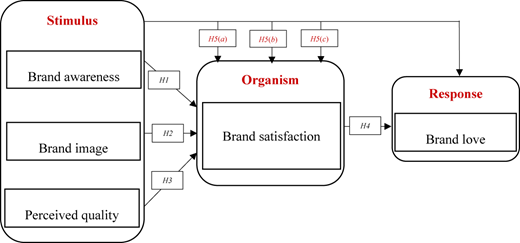
The study’s theoretical grounding and foundation is based on the stimulus–organism–response (S-O-R) theory pioneered by Mehrabian and Russell (1974) to illustrate the interaction between constructs in the proposed conceptual model in Figure 1. The S-O-R model posits that the influence of marketing and social environments stimulate consumers to make a certain decision. These environments stimulate the consumer to process information and may or may not activate the consumer’s reaction (Makhitha and Duffett, 2024; Hochreiter et al., 2023). The S-O-R model has been adopted to explain the behaviour of consumers and outcomes such as user experience, purchase decisions and consumer loyalty (Mkpojiogu et al., 2024; Widarmanti et al., 2024). In the context of this study, stimulus elements include BA, BI, and PQ. The organism and mediator element is related to the BS construct, and the response factor is BLOV. The rationale for the adoption of this theory is that a brand with equity among consumers (stimulus) will lead to their satisfaction with it (organism) and subsequently be emotionally attached to it (response).

In the next section, the inter-relationships between the constructs and their ensuing hypotheses are presented.

The inter-relationship between brand awareness, brand image, perceived quality and brand satisfaction

A brand recognised and familiar with consumers provides a sense of satisfaction (Ilyas et al., 2020). It has been argued that brand awareness erects barriers to competitors, makes customers less price sensitive and enhances trust, satisfaction, commitment and loyalty (Kuada, 2016). BI is deemed to have a substantial relationship with consumer satisfaction and their brand choice over competing alternatives (Zukhrufani and Ratnasari, 2022). This view is supported by Ilyas et al. (2020), who state that a recognisable and familiar brand contributes to the consumers’ satisfaction with the product. Dos et al. (2021) postulate that a brand perceived to have a favourable image provides the consumer with an opportunity to purchase products that are likely to satisfy their needs. A study conducted by Tunahan and Kutlu (2023) found that consumers’ satisfaction with mobile phone and computer brands was positively influenced by the quality of the products. The results of another study conducted by Samudro et al. (2020) revealed that consumers’ PQ of an industrial product influences their satisfaction with the product’s performance. A study by Abrokwah-Larbi (2024) found that customer-focused derivatives such as effective processes, customer information quality and customer service quality positively influence customer satisfaction.

Based on the preceding assertions, this study proposes the following hypotheses:

H1.

The BA of the smartphone brand by Gen Y consumers has a positive impact on BS

H2.

The BI that Gen Y consumers have about the smartphone brand has a positive impact on BS.

H3.

The PQ Gen Y consumers believe about the smartphone brand has a positive impact on BS.

The inter-relationship between brand satisfaction and brand love

Aro et al. (2018) espouse that BLOV, which is classified as a deep and passionate emotional attachment of consumers to products, is a strategic tactic used by marketers to manage the value of a brand. This emotional attachment is important to brands because, unlike a fad or fling, it signifies the most intensive relationship between the consumer and the brand (Rahman et al., 2021). Moreover, consumers who are emotionally in love with the brand improve the economic value of organisations due to the consumer-brand relationship (Rahman et al., 2021). Prior studies have shown that consumers who are satisfied with the brand forge a relationship with it and ultimately love it (Ledikwe et al., 2019). This sentiment is shared by Ghorbanzadeh and Rahehagh (2020, 2021), who assert that BLOV is reinforced by consumers’ satisfaction with the brand; hence, companies should not only pay attention to satisfying consumers but must endeavour to ensure that the end-user of the brand develops an emotional attachment to the brand, that is BLOV). Based on the discussion presented above, the study hypothesises the following relationship:

H4.

The BS Gen Y consumers have for the smartphone brand has a positive impact on their love for the brand (BLOV).

The mediation relationship between brand equity, brand satisfaction and brand love

In the seminal article by Esch et al. (2006), it was argued that irrespective of the awareness and image consumers possess about the brand, their satisfaction level is the precursor to falling in love with the brand. This argument was corroborated by the findings of their study, wherein it was discovered that BA and BI did not have a direct effect on purchase decisions (current and future). Instead, brand equity represented by BA and BI had an indirect effect on purchase decisions through BLOV and brand trust. According to Raut et al. (2019), the majority of previous studies have deserted investigating the mediating effects of brand trust and BS on the relationship between brand equity precursors (in this instance, BA, BI and PQ) and brand equity outcomes such as BLOV, purchase decisions, brand loyalty, to mention a few. In their study, Aro et al. (2018) found that consumer satisfaction mediates the relationship between BA, BI and BLOV. Therefore, in an attempt to address the aforementioned knowledge gap, the present study empirically analysed the mediating role of BS on brand equity independent variables and the dependent variable (i.e. BLOV). Based on the discussion presented above, the study hypothesises the following relationship:

H5(a).

BS mediates the relationship effect of BA on BLOV.

H5(b).

BS mediates the relationship effect of BI on BLOV.

H5(c).

BS mediates the relationship effect of PQ on BLOV.

It is on the basis of the above discussion that the study’s proposed conceptual model, depicted in Figure 1, was conceived.

The cross-sectional study was executed under Protocol Number H16/07/05 granted by the Ethics Review Board of a particular university in South Africa. The questionnaire consisted of five constructs in the form of BA, BI, BS, PQ and BLOV, and these were measured using a 5-point Likert scale. The 27 original items to measure the constructs were adapted from previously validated measurement scales (Severi and Ling, 2013; Shen et al., 2014; Severi and Ling, 2013; Shen et al., 2014; Baalbaki and Guzman, 2016; Chinomona, 2013; Hameed, 2013; Lee et al., 2015; Wallace et al., 2014). The questionnaire was distributed to 844 Gen Y Samsung smartphone users from two South African universities usin the purposive sampling technique. The use of students as a sample is acceptable and desirable when they are the majority consumers or users of the product under investigation (Sardar et al., 2021). Cross-sectional studies are prone to encountering the issue of common method bias. To alleviate this issue, the study employed the procedural remedies recommended by various authors (Podsakoff et al., 2024; Koob et al., 2021). The measuring instrument was divided into three sections with different instructions for respondents to cautiously read and execute. The questionnaire was pilot-tested to identify and eliminate ambiguous questions. In addition, the measurement scales to evaluate the constructs were derived from nine accredited journal articles. Data was collected from multiple independent respondents from two universities using paper-based and online versions of the questionnaire. Out of the 844 questionnaires disseminated, 651 respondents completed them, resulting in a response rate of 77%. The Statistical Package for Social Sciences (SPSS) and AMOS were used to analyse the data. The reliability of the measurement scales adopted in the questionnaire was established using the Cronbach’s alpha coefficient. The data set was deemed to be reliable and acceptable since the Cronbach’s alpha coefficients indicated in Table 1 exceeded the threshold of 0.6–0.8 (Raharjanti et al., 2022).

The constructs’ validity was determined by convergent and discriminant validity methods. Convergent validity was established using factor loadings from the confirmatory factor analysis (CFA) and average variance extracted (AVE). A factor loading of 0.5 or more indicates that the measurement item is compatible with the respective construct (Okello et al., 2021). In this study, factor loadings of the measurement items were between 0.52 and 0.88. The exception in this instance is that item BA3, which belongs to the BA construct, had a factor loading of 0.45. However, if the sample of a study has over 500 respondents, it is permissible to include an item with a factor loading below 0.5 (Schreiber, 2021). Therefore, considering that this study had a sample of 651 respondents, the decision to retain this item is justified. Regarding assessing convergent validity, Chaveesuk et al. (2022) assert that the AVE threshold should be equal to or greater than 0.5. In Table 1, it is evident that the AVE figures for PQ, BS and BLOV meet the threshold of 0.5. Although the BA and BI constructs attained AVE values of 0.43, which is below the recommended threshold, Hair et al. (2017) state that an AVE value of less than 0.5 but equal to 0.4 is acceptable on condition that the concerned construct has a composite reliability coefficient of more than 0.6. The composite reliability coefficients for BA and BI are 0.679 and 0.818, respectively (see Table 1). Therefore, the inclusion of these constructs in the final model is justifiable. Discriminant validity was assessed using a correlation matrix. Ordóñez de Pablos (2017) states that to confirm discriminant validity, the correlation coefficients of the paired constructs must be below 0.85. The correlation matrix results reflected in Table 2 confirm the attainment of discriminant validity.

The main techniques used to conduct the model fit assessment and their thresholds (in brackets) are Normed-chi-square χ2/df (<3), Goodness-of-fit = GFI (>0.90), Tucker-Lewis index = TLI (>0.95), Comparative fit index = CFI (>0.95) and Root mean square error of approximation = RMSEA (<0.06) (Domenech-Abella et al., 2021). The results derived from the CFA after removing six items (five from BA and one from BI) due to low factor loadings (see Table 1), the fit indices values for χ2/df, GFI, TLI, CFI, and RMSEA were 1.418, 0.916, 0.978, 0.982, and 0.025, respectively (see Table 3), indication a goodness of fit.

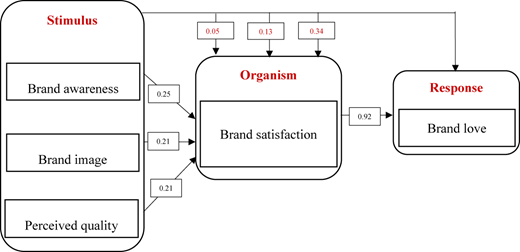
This section presents the results of the standardised relationships in the conceptual model depicted in Figure 1. Table 4 depicts the hypotheses relationship outcomes, and Figure 2 illustrates the structural model and its standardised regression weights. H1 stated that BA has a positive and significant influence on BS. The results demonstrate a beta coefficient (β) of 0.25 at p < 0.001, and this implies that H1 is supported and accepted. H2 stated that BI has a positive and significant influence on BS. The results show a β value of 0.21 at p < 0.001, thus, H2 is supported and accepted. H3 hypothesised that PQ has a positive and significant influence on BS. The results show a β value of 0.20 at p < 0.001 and subsequently, H3 is supported and accepted. H4 proposed that BS has a positive and significant influence on BLOV. The results indicate a β value of 0.92 at p < 0.001, hence, H4 is supported and accepted. Table 4 portrays that the outcomes of all four hypotheses are significant and supported at 0.01 significance level.

In this study, it was hypothesised that the relationship between brand equity and BLOV is mediated by BS. To examine this relationship, the bootstrapping method was utilised. According to Abu-Bader and Jones (2021), this method is recommended because it overcomes the challenge of normality, allows for the resampling of a small sample to a higher number and reduces the risk of type 1 errors. The results in Table 5 depict that all three predictors (i.e. BA, BI and PQ) have significant indirect effects on BLOV through BS. Specifically, PQ showed the strongest indirect effect (β = 0.343, with a 95% confidence interval (CI) ranging between 0.256 and 0.426), followed by BI (β = 0.134, with a 95% CI [0.111, 0.239]) and BA (β = 0.053, 95% CI [0.033, 0.126]), thus, the H5(a-c) is accepted.

The results of this study are presented in two parts. The first part deals with direct relationship results, and the second part focuses on indirect relationship or mediation results. The direct relationships were examined by investigating the influence of BA, BI and PQ on Gen Y’s BS and BLOV with a specific focus on the Samsung smartphone brand. The first hypothesis postulated a positive relationship between BA and BS, and a beta coefficient (β) of 0.25 at p < 0.001 indicates that H1 is supported and accepted. This hypothesis was confirmed and further supported by the results of previous studies (Zukhrufani and Ratnasari, 2022; Tannady and Purnamaningsih, 2023). These studies found that BS is positively influenced by BA. The second claim hypothesised that there is a positive relationship between BI and BS. This study’s results validated this assertion as the results populated a β value of 0.21 at p < 0.001, thus, H2 is supported and accepted. This finding was corroborated by other studies (Dayanti et al., 2019; Neupane, 2015), where it was found that the BI of the product is a determining factor in whether a consumer is satisfied with the product or not. However, in a study conducted in Indonesia about the perceptions of a specific city, the results showed that BI did not have a significant impact on consumer satisfaction (Panjaitan et al., 2024).

The third hypothesis proposed that there is a positive influence between PQ and BS. As reflected in this study’s results, a β value of 0.20 at p < 0.001 indicates a significant relationship; hence, H3 is supported and accepted. The results of this study established that the perceptions of a product’s PQ contribute to the BS of consumers towards the product, a consistent finding with other previous studies (Mulyono and Pasaribu, 2021; Puriwat and Tripopsakul, 2017). Finally, the assumption that there is a positive relationship between BI and BLOV was supported by the results of this study, which revealed a β value of 0.92 at p < 0.001. This finding is coherent with the results of studies conducted by Song and Kim (2022) and Drennan et al. (2015), who concluded that consumers who are satisfied with a product/brand become emotionally attached to it. In contrast, a study conducted by Safitri (2024) discovered that the image of the Samsung smartphone alone does not necessarily translate to consumers’ love towards it (brand).

The second aspect of this study analysed the indirect relationship between brand equity and BLOV as mediated by BS. To examine this relationship, the bootstrapping method was utilised. According to Abu-Bader and Jones (2021), this method is recommended because it overcomes the challenge of normality, allows for the resampling of a small sample to a higher number and reduces the risk of type 1 errors. The results in Table 5 depict that all three predictors (BA, BI and PQ) have significant indirect effects on BLOV through BS. Specifically, PQ showed the strongest indirect effect (β = 0.343, with a 95% confidence interval (CI) ranging between 0.256 and 0.426), followed by BI (β = 0.134, with a 95% CI [0.111, 0.239]) and BA (β = 0.053, 95% CI [0.033, 0.126]), thus H5(a-c) is accepted. These results emphasise the importance of BS as a mediating factor between brand equity and BLOV.

There are practical/managerial and theoretical contributions emanating from the findings of this study.

In terms of practical/managerial implications, the Samsung marketing teams should integrate the BA, BI, PQ, BS and BLOV elements in their brand strategies to continue growing the brand and outmanoeuvre competitors. Direct and indirect results have proven that the BS element is the cornerstone underpinning consumers’ emotional attachment to the Samsung smartphone. This implies that companies such as Samsung should invest financial resources towards satisfying their consumers. The insights of this study can further assist marketers of competing products, such as Apple, to develop strategies to capture the lucrative Gen Y market and ultimately increase market share.

With regard to the theoretical contribution, a conceptual model integrating three frameworks was proposed and tested. This adds to the body of knowledge in the brand management discipline by adding new dimensions (i.e. BS and BLOV) to the traditional brand equity dimensions. Future studies seeking to measure the brand equity of a particular brand should consider including these important elements revealed by the findings of this study.

This study is not without limitations. The sample was confined to the Gen Y cohort of 18–25 years in South Africa. This suggests that the results of this study cannot be generalised beyond the country and as being representative of the views of other generational cohorts. The study focused on the telecommunications industry and therefore, results are relevant to this specific industry and the Samsung smartphone product/brand. The model presented in this research can be replicated in other industries. The study employed the quantitative approach and future studies could adopt a mixed-methods approach to generate more insightful findings using the qualitative technique. Lastly, the study is cross-sectional and future research could adopt a longitudinal approach and observe the Samsung smartphone brand over a prolonged period.
Aaker
,
D.A.
(
1996
),
Building Strong Brands
,
The Free Press
,
New York, NY
.
Abrokwah-Larbi
,
K.
(
2024
), “
The impact of customer-focus on the performance of business organizations: evidence from SMEs in an emerging West African economy
”,
African Journal of Economic and Management Studies
, Vol. 
15
No. 
1
, pp. 
31
-
59
, doi: .
Abu-Bader
,
S.
and
Jones
,
T.V.
(
2021
), “
Statistical mediation analysis using the Sobel test and Hayes SPSS process macro
”,
International Journal of Quantitative and Qualitative Research Methods
, Vol. 
9
No. 
1
, pp. 
42
-
61
.
Al-Zyoud
,
M.F.
(
2020
), “
The role of firms's mobile applications in developing brand's equity
”,
Entrepreneurship and Sustainability Issues
, Vol. 
8
No. 
2
, pp. 
324
-
340
, doi: .
Aro
,
K.
,
Suomi
,
K.
and
Saraniemi
,
S.
(
2018
), “
Antecedents and consequences of destination brand love—A case study from Finnish Lapland
”,
Tourism Management
, Vol. 
67
, pp. 
71
-
81
, doi: .
Arora
,
N.
(
2023
), “
Shifting consumers' mindset towards the growth of sustainable fashion practices in India
”,
International Journal of Sustainable Fashion and Textiles
, Vol. 
2
No. 
1
, pp. 
9
-
27
, doi: .
Axcell
,
S.
and
Ellis
,
D.
(
2023
), “
Exploring the attitudes and behaviour of Gen Z students towards branded mobile apps in an emerging market: UTAUT2 model extension
”,
Young Consumers
, Vol. 
24
No. 
2
, pp. 
184
-
202
, doi: .
Baalbaki
,
S.
and
Guzman
,
F.
(
2016
), “
A consumer-perceived consumer-based brand equity scale
”,
Journal of Brand Management
, Vol. 
23
No. 
3
, pp. 
229
-
251
, doi: .
Benaiah
,
S.J.
and
Chandrasekaran
,
M.
(
2022
), “
User satisfaction towards smartphone: a study
”,
International Journal of Early Childhood Special Education
, Vol. 
14
No. 
5
, pp. 
7362
-
7364
.
Boddewyn
,
J.J.
and
Peng
,
M.W.
(
2021
), “
Reciprocity and informal institutions in international market entry
”,
Journal of World Business
, Vol. 
56
No. 
1
, pp. 
1
-
11
, doi: .
Chaveesuk
,
S.
,
Khalid
,
B.
and
Chaiyasoonthorn
,
W.
(
2022
), “
Continuance intention to use digital payments in mitigating the spread of Covid-19 virus
”,
International Journal of Data and Network Science
, Vol. 
6
No. 
2
, pp. 
527
-
536
, doi: .
Chinomona
,
R.
(
2013
), “
The influence of brand experience on brand satisfaction, trust and attachment in South Africa
”,
The International Business and Economics Research Journal
, Vol. 
12
No. 
10
, pp. 
1303
-
1316
, doi: .
Cho
,
E.
and
Hwang
,
J.
(
2020
), “
Drivers of consumer-based brand equity: a two-country analysis of perceived brand origin and identity expressiveness
”,
International Marketing Review
, Vol. 
37
No. 
2
, pp. 
241
-
259
, doi: .
Chong
,
L.L.
,
Ong
,
H.B.
and
Tan
,
S.H.
(
2021
), “
Acceptability of mobile stock trading application: a study of young investors in Malaysia
”,
Technology in Society
, Vol. 
64
, pp. 
1
-
8
, doi: .
Dash
,
G.
,
Kiefer
,
K.
and
Paul
,
J.
(
2021
), “
Marketing-to-Millennials: marketing 4.0, customer satisfaction and purchase intention
”,
Journal of Business Research
, Vol. 
122
, pp. 
608
-
620
, doi: .
Dayanti
,
A.D.
,
Sudapet
,
I.N.
and
Subagyo
,
H.D.
(
2019
), “
The effect of brand image and brand trust on customer satisfaction and customer loyalty of Ara Shop Sidoarjo
”,
Journal of World Conference
, Vol. 
1
No. 
2
, pp. 
257
-
262
, doi: .
Domenech‐Abella
,
J.
,
Mundo
,
J.
,
Switsers
,
L.
,
Van Tilburg
,
T.
,
Fernandez
,
D.
and
Aznar‐Lou
,
I.
(
2021
), “
Social network size, loneliness, physical functioning and depressive symptoms among older adults: examining reciprocal associations in four waves of the longitudinal Aging Study Amsterdam (LASA)
”,
International Journal of Geriatric Psychiatry
, Vol. 
36
No. 
10
, pp. 
1541
-
1549
, doi: .
Dos
,
L.V.J.M.S.
,
Sawitri
,
D.
and
Rosidi
,
R.
(
2021
), “
Brand awareness and brand image on customer satisfaction and loyalty in Lifebuoy soap products in Dili city
”,
Journal of Innovative Studies on Character and Education
, Vol. 
5
No. 
2
, pp. 
251
-
266
.
Drennan
,
J.
,
Bianchi
,
C.
,
Cacho-Elizondo
,
S.
,
Louriero
,
S.
,
Guibert
,
N.
and
Proud
,
W.
(
2015
), “
Examining the role of wine brand love on brand loyalty: a multi-country comparison
”,
International Journal of Hospitality Management
, Vol. 
49
, pp. 
47
-
55
, doi: .
Ekinci
,
Y.
,
Japutra
,
A.
,
Molinillo
,
S.
and
Uysal
,
M.
(
2023
), “
Extension and validation of a novel destination brand equity model
”,
Journal of Travel Research
, Vol. 
62
No. 
6
, pp. 
1257
-
1276
, doi: .
Esch
,
F.R.
,
Langner
,
T.
,
Schmitt
,
B.H.
and
Geus
,
P.
(
2006
), “
Are brands forever? How brand knowledge and relationships affect current and future purchases
”,
Journal of Product and Brand Management
, Vol. 
15
No. 
2
, pp. 
98
-
105
, doi: .
Euromonitor International
(
2024
), “
Mobile phones in South Africa
”,
available at:
 https://www.portal.euromonitor.com/analysis/related (
accessed
 1 February 2025).
Feyisa
,
B.M.
and
Beyene
,
D.B.
(
2021
), “
The effect of brand equity on consumer purchase decision: the case of cell phone in Ethiopia
”,
Journal of Marketing and Consumer Research
, Vol. 
78
, pp. 
1
-
10
.
Fritz
,
C.
,
Lues
,
H.
,
van Deventer
,
M.
and
Klonaridis
,
R.
(
2024
), “
Factors influencing generation Y consumers' intention to purchase sneakers
”,
International Journal of Research in Business and Social Science
, Vol. 
13
No. 
3
, pp. 
26
-
35
, doi: .
Ghorbanzadeh
,
D.
and
Rahehagh
,
A.
(
2020
), “
The role of emotional structures in the relationship between satisfaction and brand loyalty
”,
Cogent Psychology
, Vol. 
7
No. 
1
, pp. 
1
-
19
, doi: .
Ghorbanzadeh
,
D.
and
Rahehagh
,
A.
(
2021
), “
Emotional brand attachment and brand love: the emotional bridges in the process of transition from satisfaction to loyalty
”,
Rajagiri Management Journal
, Vol. 
15
No. 
1
, pp.
16
-
38
, doi: .
Hair
,
J.F.
,
Hult
,
G.T.M.
,
Ringle
,
C.M.
and
Sarstedt
,
M.
(
2017
),
A Primer on Partial Least Squares Structural Equation Modeling (PLS-SEM)
,
SAGE Publications
.
Hameed
,
F.
(
2013
), “
The effect of advertising spending on brand loyalty mediated by store image, perceived quality and customer satisfaction: a case of hypermarkets
”,
Asian Journal of Business Management
, Vol. 
5
No. 
1
, pp. 
181
-
192
, doi: .
Hameed
,
F.
,
Malik
,
I.A.
,
Hadi
,
N.U.
and
Raza
,
M.A.
(
2023
), “
Brand awareness and purchase intention in the age of digital communication: a moderated mediation model of celebrity endorsement and consumer attitude
”,
Online Journal of Communication and Media Technologies
, Vol. 
13
No. 
2
, pp. 
1
-
14
, doi: .
Hochreiter
,
V.
,
Benedetto
,
C.
and
Loesch
,
M.
(
2023
), “
The Stimulus-Organism-Response (S-O-R) paradigm as a guiding principle in environmental psychology: comparison of its usage in consumer behavior and organizational culture and leadership theory
”,
Journal of Entrepreneurship and Business Development
, Vol. 
3
No. 
1
, pp. 
7
-
16
, doi: .
Ilyas
,
G.B.
,
Rahmi
,
S.
,
Tamsah
,
H.
,
Munir
,
A.R.
and
Putra
,
A.H.P.K.
(
2020
), “
Reflective model of brand awareness on repurchase intention and customer satisfaction
”,
Journal of Asian Finance, Economics and Business
, Vol. 
7
No. 
9
, pp. 
427
-
438
, doi: .
Iqbal
,
A.
,
Ghazanfar
,
S.
,
Sarki
,
I.H.
,
Yaseen
,
M.N.
,
Haque
,
R.
and
Ahmad
,
S.
(
2023
), “
Have brand love will travel: IT's role between brand equity and attitude toward online review
”,
Journal of Policy Research
, Vol. 
9
No. 
1
, pp. 
371
-
379
.
Khrisnanda
,
H.R.R.
and
Dirgantara
,
I.M.B.
(
2021
), “
The effect of brand awareness, brand image, and brand credibility on Oppo mobile phone brand product purchase intention
”,
Diponegoro Journal of Management
, Vol. 
10
No. 
2
, pp. 
1
-
10
.
Koob
,
C.
,
Schröpfer
,
K.
,
Coenen
,
M.
,
Kus
,
S.
and
Schmidt
,
N.
(
2021
), “
Factors influencing study engagement during the COVID-19 pandemic: a cross-sectional study among health and social professions students
”,
PLoS One
, Vol. 
16
No. 
7
, pp. 
1
-
19
, doi: .
Kuada
,
J.
(
2016
), “
Marketing, economic growth, and competitive strategies of firms in Africa
”,
African Journal of Economic and Management Studies
, Vol. 
7
No. 
1
, pp. 
2
-
8
, doi: .
Ledikwe
,
A.
,
Roberts-Lombard
,
M.
and
Klopper
,
H.B.
(
2019
), “
The perceived influence of relationship quality on brand loyalty: an emerging market perspective
”,
African Journal of Economic and Management Studies
, Vol. 
10
No. 
1
, pp. 
85
-
101
, doi: .
Lee
,
Y.K.
and
Robb
,
C.A.
(
2022
), “
Relationship amongst cultural openness, world-mindedness, product-country image and purchase intention of Korean and Chinese smartphone products: a case study of the South African consumers
”,
South African Journal of Business Management
, Vol. 
53
No. 
1
, pp. 
1
-
12
, doi: .
Lee
,
D.
,
Moon
,
J.
,
Kim
,
Y.J.
and
Yi
,
M.Y.
(
2015
), “
Antecedents and consequences of mobile phone usability: linking simplicity and interactivity to satisfaction, trust, and brand loyalty
”,
Information and Management
, Vol. 
52
No. 
3
, pp. 
295
-
304
, doi: .
Makhitha
,
K.M.
and
Duffett
,
R.G.
(
2024
), “
Perceived risk mediation of website quality in online clothing shopping in a South African township
”,
The African Journal of Information Systems
, Vol. 
16
No. 
4
, pp. 
251
-
284
.
Masrun
,
S.
,
Gisip
,
I.A.
and
Sumin
,
V.
(
2023
), “
Effects of perceived quality and brand loyalty on perceived brand equity of Sabah SMEs' food brands: the moderating role of brand credibility
”,
Res Militaris
, Vol. 
13
No. 
1
, pp. 
3769
-
3777
.
Mehrabian
,
A.
and
Russell
,
J.A.
(
1974
),
An Approach to Environmental Psychology
,
The MIT Press
,
Cambridge
.
Mkansi
,
M.
and
Nsakanda
,
A.L.
(
2025
), “
Mobile application e-grocery retail adoption challenges and coping strategies: a South African small and medium enterprises' perspective
”,
Electronic Commerce Research
, Vol. 
25
No. 
1
, pp. 
419
-
464
, doi: .
Mkpojiogu
,
E.O.
,
Okeke-Uzodike
,
O.E.
and
Abdullahi
,
M.J.
(
2024
), “
Explaining the applicability of the stimuli-organism-response (SOR) framework in UX processes for static and dynamic contexts
”,
2024 IEEE International Conference on Interdisciplinary Approaches in Technology and Management for Social Innovation (IATMSI)
, Vol. 
2
, pp. 
1
-
6
, doi: .
Mulyono
,
R.A.
and
Pasaribu
,
L.H.
(
2021
), “
The impact of mobile service quality and brand image on customer loyalty
”,
Enrichment: a Journal for Pentecostal Ministry: Journal of Management
, Vol. 
12
No. 
1
, pp. 
1
-
7
.
Murtiasih
,
S.
,
Hermana
,
B.
and
Febriani
,
W.
(
2021
), “
The effect of marketing communication on brand equity with brand image, brand trust, and brand loyalty as the intervening variables
”,
Marketing
, Vol. 
7
No. 
1
, pp. 
7
-
16
, doi: .
Nawaz
,
S.
,
Jiang
,
Y.
,
Alam
,
F.
and
Nawaz
,
M.Z.
(
2020
), “
Role of brand love and consumers' demographics in building consumer–brand relationship
”,
Sage Open
, Vol. 
10
No. 
4
, pp. 
1
-
19
, doi: .
Neupane
,
R.
(
2015
), “
The effects of brand image on customer satisfaction and loyalty intention in retail super market chain UK
”,
International Journal of Social Sciences and Management
, Vol. 
2
No. 
1
, pp. 
9
-
26
, doi: .
Okello
,
A.O.
,
Nzuma
,
J.M.
,
Otieno
,
D.J.
,
Kidoido
,
M.
and
Tanga
,
C.M.
(
2021
), “
Farmers' perceptions of commercial insect-based feed for sustainable livestock production in Kenya
”,
Sustainability
, Vol. 
13
No. 
10
, pp. 
1
-
13
, doi: .
Ono
,
E.
,
Ahungwa
,
A.
and
Michael
,
O.
(
2021
), “
Effect of brand equity on consumer behaviour among students of Veritas University, Nigeria: a study of Apple smartphones
”,
Marketing and Branding Research
, Vol. 
8
, pp. 
48
-
64
.
Ordóñez de Pablos
,
P.
(
2017
),
Managerial Strategies and Solutions for Business Success in Asia
,
IGI Global
.
Panjaitan
,
H.P.
,
Vinson
,
V.
,
Yani
,
F.
,
Sitompul
,
S.S.
,
Sari
,
O.
and
Lubis
,
W.M.C.
(
2024
), “
Influence of product quality, price, brand image and promotion on customer satisfaction on Lazada (case study in Pekanbaru city communities)
”,
International Conference on Business Management and Accounting
, Vol. 
2
No. 
2
, pp. 
373
-
390
.
Podsakoff
,
P.M.
,
Podsakoff
,
N.P.
,
Williams
,
L.J.
,
Huang
,
C.
and
Yang
,
J.
(
2024
), “
Common method bias: it's bad, it's complex, it's widespread, and it's not easy to fix
”,
Annual Review of Organizational Psychology and Organizational Behavior
, Vol. 
11
No. 
1
, pp. 
17
-
61
, doi: .
Prachaseree
,
K.
,
Ahmad
,
N.
and
Isa
,
N.M.
(
2022
), “
Reviews of brand equity for online retailers
”,
ABAC Journal
, Vol. 
42
No. 
1
, pp. 
52
-
72
.
Puriwat
,
W.
and
Tripopsakul
,
S.
(
2017
), “
The impact of e-service quality on customer satisfaction and loyalty in mobile banking usage: case study of Thailand
”,
Polish Journal of Management Studies
, Vol. 
15
No. 
2
, pp. 
183
-
193
, doi: .
Raharjanti
,
N.W.
,
Wiguna
,
T.
,
Purwadianto
,
A.
,
Soemantri
,
D.
,
Indriatmi
,
W.
,
Poerwandari
,
E.K.
,
Levania
,
M.K.
,
Nugrahadi
,
N.R.
,
Roekman
,
A.E.
,
Saroso
,
O.J.D.A.
and
Ramadianto
,
A.S.
(
2022
), “
Translation, validity and reliability of decision style scale in forensic psychiatric setting in Indonesia
”,
Heliyon
, Vol. 
8
No. 
7
, pp. 
1
-
5
, doi: .
Rahman
,
R.
,
Langner
,
T.
and
Temme
,
D.
(
2021
), “
Brand love: conceptual and empirical investigation of a holistic causal model
”,
Journal of Brand Management
, Vol. 
28
No. 
6
, pp. 
609
-
642
, doi: .
Raut
,
U.R.
,
Pawar
,
P.A.
,
Brito
,
P.Q.
and
Sisodia
,
G.S.
(
2019
), “
Mediating model of brand equity and its application
”,
Spanish Journal of Marketing-ESIC
, Vol. 
23
No. 
2
, pp. 
295
-
318
, doi: .
Redda
,
E.H.
and
Shezi
,
N.E.
(
2021
), “
Modelling the antecedents that explain generation Y students' attitudes toward smartphone brands
”,
International Journal of eBusiness and eGovernment Studies
, Vol. 
13
No. 
2
, pp. 
242
-
259
.
Safitri
,
E.A.
and
Albari
(
2024
), “
The influence of brand awareness, brand image recognition on brand loyalty with the intervening mediation of brand trust and brand love on Samsung smartphone products in Indonesia
”,
Indonesian Journal of Economics, Business, Accounting, and Management (IJEBAM)
, Vol. 
2
No. 
4
, pp. 
11
-
30
, doi: .
Saleem
,
D.
and
Afridi
,
F.K.
(
2025
), “
The impact of green marketing on brand equity
”,
Journal of Business Management and Research
, Vol. 
4
No. 
1
, pp. 
44
-
57
.
Samudro
,
A.
,
Sumarwan
,
U.
,
Simanjuntak
,
M.
and
Yusuf
,
E.
(
2020
), “
Assessing the effects of perceived quality and perceived value on customer satisfaction
”,
Management Science Letters
, Vol. 
10
No. 
5
, pp. 
1077
-
1084
, doi: .
Sardar
,
A.
,
Manzoor
,
A.
,
Shaikh
,
K.A.
and
Ali
,
L.
(
2021
), “
An empirical examination of the impact of eWom information on young consumers' online purchase intention: mediating role of eWom information adoption
”,
Sage Open
, Vol. 
11
No. 
4
, pp. 
1
-
12
, doi: .
Schreiber
,
J.B.
(
2021
), “
Issues and recommendations for exploratory factor analysis and principal component analysis
”,
Research in Social and Administrative Pharmacy
, Vol. 
17
No. 
5
, pp. 
1004
-
1011
, doi: .
Severi
,
E.
and
Ling
,
K.C.
(
2013
), “
The mediating effects of brand association, brand loyalty, brand image and perceived quality on brand equity
”,
Asian Social Science
, Vol. 
9
No. 
3
, pp. 
125
-
137
, doi: .
Shanahan
,
T.
,
Tran
,
T.P.
and
Taylor
,
E.C.
(
2019
), “
Getting to know you: social media personalization as a means of enhancing brand loyalty and perceived quality
”,
Journal of Retailing and Consumer Services
, Vol. 
47
, pp. 
57
-
65
, doi: .
Shava
,
H.
(
2021
), “
The relationship between service quality and customer satisfaction in the South African mobile network telecommunications industry
”,
Journal of International Studies
, Vol. 
14
No. 
2
, pp. 
70
-
83
, doi: .
Shen
,
H.
,
Yuan
,
Y.
,
Zhang
,
Q.
and
Zhao
,
J.
(
2014
), “
An empirical study of customer-based brand equity model for China economy hotels
”,
Journal of China Tourism Research
, Vol. 
10
No. 
1
, pp. 
21
-
34
, doi: .
Song
,
S.
and
Kim
,
H.Y.
(
2022
), “
Is social media marketing worth it for luxury brands? The dual impact of brand page satisfaction and brand love on word-of-mouth and attitudinal loyalty intentions
”,
Journal of Product and Brand Management
, Vol. 
31
No. 
7
, pp. 
1033
-
1046
, doi: .
Tannady
,
H.
and
Purnamaningsih
,
P.
(
2023
), “
Determinant factors of customer satisfaction and its implication on customer loyalty: from the perspective of customers of Vespa
”,
International Journal of Science, Technology and Management
, Vol. 
4
No. 
2
, pp. 
434
-
438
, doi: .
Tran
,
V.D.
and
Nguyen
,
N.T.T.
(
2022
), “
Investigating the relationship between brand experience, brand authenticity, brand equity, and customer satisfaction: evidence from Vietnam
”,
Cogent Business and Management
, Vol. 
9
No. 
1
, pp. 
1
-
20
, doi: .
Tunahan
,
C.
and
Kutlu
,
M.B.
(
2023
), “
Experienced product quality and brand loyalty: mediating role of customer satisfaction
”,
Ege Academic Review
, Vol. 
23
No. 
2
, pp. 
185
-
202
.
Wahyuningsih
,
B.A.
,
Dewi
,
R.S.
and
Farida
,
N.
(
2023
), “
The effect of product attributes and price on brand switching with consumer dissatisfaction as an intervening variable
”,
International Journal of Multidisciplinary Research and Publications
, Vol. 
5
No. 
10
, pp. 
159
-
163
.
Wallace
,
E.
,
Buil
,
I.
,
de Chernatony
,
L.
and
Hogan
,
M.
(
2014
), “
Who “likes” you … and why? A typology of Facebook fans
”,
Journal of Advertising Research
, Vol. 
54
No. 
1
, pp. 
92
-
109
, doi: .
Widarmanti
,
T.
,
Ramantoko
,
G.
,
Pillai
,
S.
and
Rachmawati
,
I.
(
2024
), “
Towards a unified model of planned obsolescence and innovation adoption in consumer behavior: a literature review and conceptual proposition using the stimulus-organism-response framework
”,
Management and Production Engineering Review
, Vol. 
15
No. 
2
, pp. 
25
-
41
.
Yudistira
,
G.P.
and
Putra
,
A.
(
2022
), “
Generation Y behavior change in Bandung city in receiving news Covid-19
”,
Jurnal Mantik
, Vol. 
6
No. 
2
, pp. 
1938
-
1945
.
Zukhrufani
,
A.
and
Ratnasari
,
R.T.
(
2022
), “
The influence of brand personality, brand awareness, fashion consciousness, and satisfaction as intervening variables on Muslim fashion product loyalty in Indonesia
”,
Jurnal Ekonomi Bisnis dan Kewirausahaan
, Vol. 
11
No. 
1
, pp. 
1
-
14
.
Published by Emerald Publishing Limited. This article is published under the Creative Commons Attribution (CC BY 4.0) licence. Anyone may reproduce, distribute, translate and create derivative works of this article (for both commercial and non-commercial purposes), subject to full attribution to the original publication and authors. The full terms of this licence may be seen at Link to the terms of the CC BY 4.0 licence.

Data & Figures

Figure 1
A flowchart with “Brand awareness,” “brand image,” and “perceived quality” influences “brand satisfaction” and “brand love”.The flowchart starts with a first rectangle on the left labeled “Stimulus” that consists of three text boxes arranged vertically and labeled from top to bottom as follows: “Brand awareness,” “Brand image,” and “Perceived quality.” Rightward arrows labeled “H 1,” “H 2,” and “H 3” from these text boxes lead to a second rectangle in the middle labeled “Organism” that consists of a fourth text box labeled “Brand satisfaction.” A rightward arrow labeled “H 4” from “Organism” leads to a third rectangle labeled “Response” that consists of a fifth text box labeled “Brand love.” Rightward arrows labeled “H 5 a,” “H 5 b,” and “H 5 c” from “Stimulus” lead to “Organism.” A rightward arrow from “Stimulus” leads to “Organism.”

Proposed conceptual model. Source: Author’s own creation

Figure 1
A flowchart with “Brand awareness,” “brand image,” and “perceived quality” influences “brand satisfaction” and “brand love”.The flowchart starts with a first rectangle on the left labeled “Stimulus” that consists of three text boxes arranged vertically and labeled from top to bottom as follows: “Brand awareness,” “Brand image,” and “Perceived quality.” Rightward arrows labeled “H 1,” “H 2,” and “H 3” from these text boxes lead to a second rectangle in the middle labeled “Organism” that consists of a fourth text box labeled “Brand satisfaction.” A rightward arrow labeled “H 4” from “Organism” leads to a third rectangle labeled “Response” that consists of a fifth text box labeled “Brand love.” Rightward arrows labeled “H 5 a,” “H 5 b,” and “H 5 c” from “Stimulus” lead to “Organism.” A rightward arrow from “Stimulus” leads to “Organism.”

Proposed conceptual model. Source: Author’s own creation

Close modal
Figure 2
A flowchart shows relationships between stimulus, organism, and response with path coefficients.The flowchart starts with a first rectangle on the left labeled “Stimulus” that consists of three text boxes arranged vertically and labeled from top to bottom as follows: “Brand awareness,” “Brand image,” and “Perceived quality.” Rightward arrows labeled “0.25,” “0.21,” and “0.21” from these text boxes lead to a second rectangle in the middle labeled “Organism” that consists of a fourth text box labeled “Brand satisfaction.” A rightward arrow labeled “0.92” from “Organism” leads to a third rectangle labeled “Response” that consists of a fifth text box labeled “Brand love.” Rightward arrows labeled “0.05,” “0.13,” and “0.34” from “Stimulus” lead to “Organism.” A rightward arrow from “Stimulus” leads to “Organism.”

Structural model with standardised regression weights. Source: Author’s own creation

Figure 2
A flowchart shows relationships between stimulus, organism, and response with path coefficients.The flowchart starts with a first rectangle on the left labeled “Stimulus” that consists of three text boxes arranged vertically and labeled from top to bottom as follows: “Brand awareness,” “Brand image,” and “Perceived quality.” Rightward arrows labeled “0.25,” “0.21,” and “0.21” from these text boxes lead to a second rectangle in the middle labeled “Organism” that consists of a fourth text box labeled “Brand satisfaction.” A rightward arrow labeled “0.92” from “Organism” leads to a third rectangle labeled “Response” that consists of a fifth text box labeled “Brand love.” Rightward arrows labeled “0.05,” “0.13,” and “0.34” from “Stimulus” lead to “Organism.” A rightward arrow from “Stimulus” leads to “Organism.”

Structural model with standardised regression weights. Source: Author’s own creation

Close modal
Table 1

Assessment of reliability and validity of the constructs in the model

ConstructsItemCronbach’s alphaComposite reliabilityAverage variance extractedFactor loadings
Brand awareness 0.6280.6790.43 
BA3Features of the Samsung mobile phone quickly come up in my mind   0.45
BA5I think of the Samsung mobile phone first among many mobile phones   0.80
BA7I think the Samsung mobile phone is a leader in the mobile phone industry   0.80
Brand image 0.7920.8180.43 
BI1Using the Samsung mobile phone makes me feel superior   0.63
BI2The Samsung mobile phone represents efficiency   0.71
BI3Compared with other mobile phones, the brand image of Samsung mobile phone is unique   0.52
BI4I have a good impression of the overall image of the Samsung mobile phone   0.68
BI6I trust the Samsung mobile phone   0.72
Perceived quality 0.8910.8900.54 
PQ1The quality of the Samsung mobile phone is extremely high   0.79
PQ2The Samsung mobile phone has consistent quality   0.74
PQ3The Samsung mobile phone has an acceptable standard of quality   0.66
PQ4The performance of Samsung mobile phone is high   0.74
PQ5The Samsung mobile phone consistently performs well   0.77
PQ6The reliability of Samsung mobile phone is high   0.77
PQ7The quality of Samsung mobile phone is higher in comparison to other phones   0.66
Brand satisfaction 0.9390.9350.71 
BS1I am very satisfied with the performance of the Samsung mobile phone   0.82
BS2I am very happy with the Samsung mobile phone   0.88
BS3The Samsung mobile phone does a good job in satisfying my needs   0.78
BS4I believe that buying the Samsung mobile phone was the right decision   0.86
BS5I am satisfied with my decision to purchase the Samsung mobile phone   0.86
BS6Overall, I am satisfied with the Samsung mobile phone   0.84
Brand love 0.9280.9260.68 
BLOV1The Samsung mobile phone makes me feel good   0.84
BLOV2I love the Samsung mobile phone brand   0.84
BLOV3The Samsung mobile phone is awesome   0.88
BLOV4I am passionate about the Samsung mobile phone   0.86
BLOV5I am attached to the Samsung mobile phone   0.79
BLOV6I love the features of the Samsung mobile phone   0.74
Source(s): Author’s own creation
Table 2

Correlation matrix between construct pairs

ConstructsBABIPQBSBLOV
BA1    
BI0.583**1   
PQ0.533**0.677**1  
BS0.549**0.675**0.741**1 
BLOV0.571**0.706**0.676**0.797**1

Note(s): BA denotes brand awareness; BI = brand image; PQ = perceived quality; BS = brand satisfaction; BLOV = brand love

Source(s): Author’s own creation
Table 3

Model fit indices of the study’s CFA measurement model

Fit indicesAbbreviationInitial modelRe-specified model
Normed-chi-squareχ2/df3.0581.418
Goodness-of-fitGFI0.7700.916
Tucker-Lewis indexTLI0.8710.978
Comparative fit indexCFI0.8780.982
Root mean square error of approximationRMSEA0.0560.025
Source(s): Author’s own creation
Table 4

Hypothesised direct relationships results

Relationships between constructsRegression weightsS.E.C.R.pLabelOutcome
BSBA0.2510.0514,935***par_42Accepted
BSBI0.2110.0297,347***par_43Accepted
BSPQ0.1950.0267,415***par_44Accepted
BLOVBS0.9160.05616,236***par_55Accepted

Note(s): *** = Significant level 0.01

Source(s): Author’s own creation
Table 5

Hypothesised mediation relationships results

PathIndirect effect (β)95% CI for indirect effectMediation typeOutcome
BA → BLOV (via BS)0.053[0.033, 0.126]Weak partialAccepted
BI → BLOV (via BS)0.134[0.111, 0.239]PartialAccepted
PQ → BLOV (via BS)0.343[0.256, 0.426]Strong partialAccepted

Note(s): Bootstrap resamples = 5,000. BS = brand satisfaction, BA = brand awareness, BLOV = brand love. All indirect effects are significant at p < 0.05 as the 95% confidence intervals do not include zero

Source(s): Author’s own creation

Supplements

References

Aaker
,
D.A.
(
1996
),
Building Strong Brands
,
The Free Press
,
New York, NY
.
Abrokwah-Larbi
,
K.
(
2024
), “
The impact of customer-focus on the performance of business organizations: evidence from SMEs in an emerging West African economy
”,
African Journal of Economic and Management Studies
, Vol. 
15
No. 
1
, pp. 
31
-
59
, doi: .
Abu-Bader
,
S.
and
Jones
,
T.V.
(
2021
), “
Statistical mediation analysis using the Sobel test and Hayes SPSS process macro
”,
International Journal of Quantitative and Qualitative Research Methods
, Vol. 
9
No. 
1
, pp. 
42
-
61
.
Al-Zyoud
,
M.F.
(
2020
), “
The role of firms's mobile applications in developing brand's equity
”,
Entrepreneurship and Sustainability Issues
, Vol. 
8
No. 
2
, pp. 
324
-
340
, doi: .
Aro
,
K.
,
Suomi
,
K.
and
Saraniemi
,
S.
(
2018
), “
Antecedents and consequences of destination brand love—A case study from Finnish Lapland
”,
Tourism Management
, Vol. 
67
, pp. 
71
-
81
, doi: .
Arora
,
N.
(
2023
), “
Shifting consumers' mindset towards the growth of sustainable fashion practices in India
”,
International Journal of Sustainable Fashion and Textiles
, Vol. 
2
No. 
1
, pp. 
9
-
27
, doi: .
Axcell
,
S.
and
Ellis
,
D.
(
2023
), “
Exploring the attitudes and behaviour of Gen Z students towards branded mobile apps in an emerging market: UTAUT2 model extension
”,
Young Consumers
, Vol. 
24
No. 
2
, pp. 
184
-
202
, doi: .
Baalbaki
,
S.
and
Guzman
,
F.
(
2016
), “
A consumer-perceived consumer-based brand equity scale
”,
Journal of Brand Management
, Vol. 
23
No. 
3
, pp. 
229
-
251
, doi: .
Benaiah
,
S.J.
and
Chandrasekaran
,
M.
(
2022
), “
User satisfaction towards smartphone: a study
”,
International Journal of Early Childhood Special Education
, Vol. 
14
No. 
5
, pp. 
7362
-
7364
.
Boddewyn
,
J.J.
and
Peng
,
M.W.
(
2021
), “
Reciprocity and informal institutions in international market entry
”,
Journal of World Business
, Vol. 
56
No. 
1
, pp. 
1
-
11
, doi: .
Chaveesuk
,
S.
,
Khalid
,
B.
and
Chaiyasoonthorn
,
W.
(
2022
), “
Continuance intention to use digital payments in mitigating the spread of Covid-19 virus
”,
International Journal of Data and Network Science
, Vol. 
6
No. 
2
, pp. 
527
-
536
, doi: .
Chinomona
,
R.
(
2013
), “
The influence of brand experience on brand satisfaction, trust and attachment in South Africa
”,
The International Business and Economics Research Journal
, Vol. 
12
No. 
10
, pp. 
1303
-
1316
, doi: .
Cho
,
E.
and
Hwang
,
J.
(
2020
), “
Drivers of consumer-based brand equity: a two-country analysis of perceived brand origin and identity expressiveness
”,
International Marketing Review
, Vol. 
37
No. 
2
, pp. 
241
-
259
, doi: .
Chong
,
L.L.
,
Ong
,
H.B.
and
Tan
,
S.H.
(
2021
), “
Acceptability of mobile stock trading application: a study of young investors in Malaysia
”,
Technology in Society
, Vol. 
64
, pp. 
1
-
8
, doi: .
Dash
,
G.
,
Kiefer
,
K.
and
Paul
,
J.
(
2021
), “
Marketing-to-Millennials: marketing 4.0, customer satisfaction and purchase intention
”,
Journal of Business Research
, Vol. 
122
, pp. 
608
-
620
, doi: .
Dayanti
,
A.D.
,
Sudapet
,
I.N.
and
Subagyo
,
H.D.
(
2019
), “
The effect of brand image and brand trust on customer satisfaction and customer loyalty of Ara Shop Sidoarjo
”,
Journal of World Conference
, Vol. 
1
No. 
2
, pp. 
257
-
262
, doi: .
Domenech‐Abella
,
J.
,
Mundo
,
J.
,
Switsers
,
L.
,
Van Tilburg
,
T.
,
Fernandez
,
D.
and
Aznar‐Lou
,
I.
(
2021
), “
Social network size, loneliness, physical functioning and depressive symptoms among older adults: examining reciprocal associations in four waves of the longitudinal Aging Study Amsterdam (LASA)
”,
International Journal of Geriatric Psychiatry
, Vol. 
36
No. 
10
, pp. 
1541
-
1549
, doi: .
Dos
,
L.V.J.M.S.
,
Sawitri
,
D.
and
Rosidi
,
R.
(
2021
), “
Brand awareness and brand image on customer satisfaction and loyalty in Lifebuoy soap products in Dili city
”,
Journal of Innovative Studies on Character and Education
, Vol. 
5
No. 
2
, pp. 
251
-
266
.
Drennan
,
J.
,
Bianchi
,
C.
,
Cacho-Elizondo
,
S.
,
Louriero
,
S.
,
Guibert
,
N.
and
Proud
,
W.
(
2015
), “
Examining the role of wine brand love on brand loyalty: a multi-country comparison
”,
International Journal of Hospitality Management
, Vol. 
49
, pp. 
47
-
55
, doi: .
Ekinci
,
Y.
,
Japutra
,
A.
,
Molinillo
,
S.
and
Uysal
,
M.
(
2023
), “
Extension and validation of a novel destination brand equity model
”,
Journal of Travel Research
, Vol. 
62
No. 
6
, pp. 
1257
-
1276
, doi: .
Esch
,
F.R.
,
Langner
,
T.
,
Schmitt
,
B.H.
and
Geus
,
P.
(
2006
), “
Are brands forever? How brand knowledge and relationships affect current and future purchases
”,
Journal of Product and Brand Management
, Vol. 
15
No. 
2
, pp. 
98
-
105
, doi: .
Euromonitor International
(
2024
), “
Mobile phones in South Africa
”,
available at:
 https://www.portal.euromonitor.com/analysis/related (
accessed
 1 February 2025).
Feyisa
,
B.M.
and
Beyene
,
D.B.
(
2021
), “
The effect of brand equity on consumer purchase decision: the case of cell phone in Ethiopia
”,
Journal of Marketing and Consumer Research
, Vol. 
78
, pp. 
1
-
10
.
Fritz
,
C.
,
Lues
,
H.
,
van Deventer
,
M.
and
Klonaridis
,
R.
(
2024
), “
Factors influencing generation Y consumers' intention to purchase sneakers
”,
International Journal of Research in Business and Social Science
, Vol. 
13
No. 
3
, pp. 
26
-
35
, doi: .
Ghorbanzadeh
,
D.
and
Rahehagh
,
A.
(
2020
), “
The role of emotional structures in the relationship between satisfaction and brand loyalty
”,
Cogent Psychology
, Vol. 
7
No. 
1
, pp. 
1
-
19
, doi: .
Ghorbanzadeh
,
D.
and
Rahehagh
,
A.
(
2021
), “
Emotional brand attachment and brand love: the emotional bridges in the process of transition from satisfaction to loyalty
”,
Rajagiri Management Journal
, Vol. 
15
No. 
1
, pp.
16
-
38
, doi: .
Hair
,
J.F.
,
Hult
,
G.T.M.
,
Ringle
,
C.M.
and
Sarstedt
,
M.
(
2017
),
A Primer on Partial Least Squares Structural Equation Modeling (PLS-SEM)
,
SAGE Publications
.
Hameed
,
F.
(
2013
), “
The effect of advertising spending on brand loyalty mediated by store image, perceived quality and customer satisfaction: a case of hypermarkets
”,
Asian Journal of Business Management
, Vol. 
5
No. 
1
, pp. 
181
-
192
, doi: .
Hameed
,
F.
,
Malik
,
I.A.
,
Hadi
,
N.U.
and
Raza
,
M.A.
(
2023
), “
Brand awareness and purchase intention in the age of digital communication: a moderated mediation model of celebrity endorsement and consumer attitude
”,
Online Journal of Communication and Media Technologies
, Vol. 
13
No. 
2
, pp. 
1
-
14
, doi: .
Hochreiter
,
V.
,
Benedetto
,
C.
and
Loesch
,
M.
(
2023
), “
The Stimulus-Organism-Response (S-O-R) paradigm as a guiding principle in environmental psychology: comparison of its usage in consumer behavior and organizational culture and leadership theory
”,
Journal of Entrepreneurship and Business Development
, Vol. 
3
No. 
1
, pp. 
7
-
16
, doi: .
Ilyas
,
G.B.
,
Rahmi
,
S.
,
Tamsah
,
H.
,
Munir
,
A.R.
and
Putra
,
A.H.P.K.
(
2020
), “
Reflective model of brand awareness on repurchase intention and customer satisfaction
”,
Journal of Asian Finance, Economics and Business
, Vol. 
7
No. 
9
, pp. 
427
-
438
, doi: .
Iqbal
,
A.
,
Ghazanfar
,
S.
,
Sarki
,
I.H.
,
Yaseen
,
M.N.
,
Haque
,
R.
and
Ahmad
,
S.
(
2023
), “
Have brand love will travel: IT's role between brand equity and attitude toward online review
”,
Journal of Policy Research
, Vol. 
9
No. 
1
, pp. 
371
-
379
.
Khrisnanda
,
H.R.R.
and
Dirgantara
,
I.M.B.
(
2021
), “
The effect of brand awareness, brand image, and brand credibility on Oppo mobile phone brand product purchase intention
”,
Diponegoro Journal of Management
, Vol. 
10
No. 
2
, pp. 
1
-
10
.
Koob
,
C.
,
Schröpfer
,
K.
,
Coenen
,
M.
,
Kus
,
S.
and
Schmidt
,
N.
(
2021
), “
Factors influencing study engagement during the COVID-19 pandemic: a cross-sectional study among health and social professions students
”,
PLoS One
, Vol. 
16
No. 
7
, pp. 
1
-
19
, doi: .
Kuada
,
J.
(
2016
), “
Marketing, economic growth, and competitive strategies of firms in Africa
”,
African Journal of Economic and Management Studies
, Vol. 
7
No. 
1
, pp. 
2
-
8
, doi: .
Ledikwe
,
A.
,
Roberts-Lombard
,
M.
and
Klopper
,
H.B.
(
2019
), “
The perceived influence of relationship quality on brand loyalty: an emerging market perspective
”,
African Journal of Economic and Management Studies
, Vol. 
10
No. 
1
, pp. 
85
-
101
, doi: .
Lee
,
Y.K.
and
Robb
,
C.A.
(
2022
), “
Relationship amongst cultural openness, world-mindedness, product-country image and purchase intention of Korean and Chinese smartphone products: a case study of the South African consumers
”,
South African Journal of Business Management
, Vol. 
53
No. 
1
, pp. 
1
-
12
, doi: .
Lee
,
D.
,
Moon
,
J.
,
Kim
,
Y.J.
and
Yi
,
M.Y.
(
2015
), “
Antecedents and consequences of mobile phone usability: linking simplicity and interactivity to satisfaction, trust, and brand loyalty
”,
Information and Management
, Vol. 
52
No. 
3
, pp. 
295
-
304
, doi: .
Makhitha
,
K.M.
and
Duffett
,
R.G.
(
2024
), “
Perceived risk mediation of website quality in online clothing shopping in a South African township
”,
The African Journal of Information Systems
, Vol. 
16
No. 
4
, pp. 
251
-
284
.
Masrun
,
S.
,
Gisip
,
I.A.
and
Sumin
,
V.
(
2023
), “
Effects of perceived quality and brand loyalty on perceived brand equity of Sabah SMEs' food brands: the moderating role of brand credibility
”,
Res Militaris
, Vol. 
13
No. 
1
, pp. 
3769
-
3777
.
Mehrabian
,
A.
and
Russell
,
J.A.
(
1974
),
An Approach to Environmental Psychology
,
The MIT Press
,
Cambridge
.
Mkansi
,
M.
and
Nsakanda
,
A.L.
(
2025
), “
Mobile application e-grocery retail adoption challenges and coping strategies: a South African small and medium enterprises' perspective
”,
Electronic Commerce Research
, Vol. 
25
No. 
1
, pp. 
419
-
464
, doi: .
Mkpojiogu
,
E.O.
,
Okeke-Uzodike
,
O.E.
and
Abdullahi
,
M.J.
(
2024
), “
Explaining the applicability of the stimuli-organism-response (SOR) framework in UX processes for static and dynamic contexts
”,
2024 IEEE International Conference on Interdisciplinary Approaches in Technology and Management for Social Innovation (IATMSI)
, Vol. 
2
, pp. 
1
-
6
, doi: .
Mulyono
,
R.A.
and
Pasaribu
,
L.H.
(
2021
), “
The impact of mobile service quality and brand image on customer loyalty
”,
Enrichment: a Journal for Pentecostal Ministry: Journal of Management
, Vol. 
12
No. 
1
, pp. 
1
-
7
.
Murtiasih
,
S.
,
Hermana
,
B.
and
Febriani
,
W.
(
2021
), “
The effect of marketing communication on brand equity with brand image, brand trust, and brand loyalty as the intervening variables
”,
Marketing
, Vol. 
7
No. 
1
, pp. 
7
-
16
, doi: .
Nawaz
,
S.
,
Jiang
,
Y.
,
Alam
,
F.
and
Nawaz
,
M.Z.
(
2020
), “
Role of brand love and consumers' demographics in building consumer–brand relationship
”,
Sage Open
, Vol. 
10
No. 
4
, pp. 
1
-
19
, doi: .
Neupane
,
R.
(
2015
), “
The effects of brand image on customer satisfaction and loyalty intention in retail super market chain UK
”,
International Journal of Social Sciences and Management
, Vol. 
2
No. 
1
, pp. 
9
-
26
, doi: .
Okello
,
A.O.
,
Nzuma
,
J.M.
,
Otieno
,
D.J.
,
Kidoido
,
M.
and
Tanga
,
C.M.
(
2021
), “
Farmers' perceptions of commercial insect-based feed for sustainable livestock production in Kenya
”,
Sustainability
, Vol. 
13
No. 
10
, pp. 
1
-
13
, doi: .
Ono
,
E.
,
Ahungwa
,
A.
and
Michael
,
O.
(
2021
), “
Effect of brand equity on consumer behaviour among students of Veritas University, Nigeria: a study of Apple smartphones
”,
Marketing and Branding Research
, Vol. 
8
, pp. 
48
-
64
.
Ordóñez de Pablos
,
P.
(
2017
),
Managerial Strategies and Solutions for Business Success in Asia
,
IGI Global
.
Panjaitan
,
H.P.
,
Vinson
,
V.
,
Yani
,
F.
,
Sitompul
,
S.S.
,
Sari
,
O.
and
Lubis
,
W.M.C.
(
2024
), “
Influence of product quality, price, brand image and promotion on customer satisfaction on Lazada (case study in Pekanbaru city communities)
”,
International Conference on Business Management and Accounting
, Vol. 
2
No. 
2
, pp. 
373
-
390
.
Podsakoff
,
P.M.
,
Podsakoff
,
N.P.
,
Williams
,
L.J.
,
Huang
,
C.
and
Yang
,
J.
(
2024
), “
Common method bias: it's bad, it's complex, it's widespread, and it's not easy to fix
”,
Annual Review of Organizational Psychology and Organizational Behavior
, Vol. 
11
No. 
1
, pp. 
17
-
61
, doi: .
Prachaseree
,
K.
,
Ahmad
,
N.
and
Isa
,
N.M.
(
2022
), “
Reviews of brand equity for online retailers
”,
ABAC Journal
, Vol. 
42
No. 
1
, pp. 
52
-
72
.
Puriwat
,
W.
and
Tripopsakul
,
S.
(
2017
), “
The impact of e-service quality on customer satisfaction and loyalty in mobile banking usage: case study of Thailand
”,
Polish Journal of Management Studies
, Vol. 
15
No. 
2
, pp. 
183
-
193
, doi: .
Raharjanti
,
N.W.
,
Wiguna
,
T.
,
Purwadianto
,
A.
,
Soemantri
,
D.
,
Indriatmi
,
W.
,
Poerwandari
,
E.K.
,
Levania
,
M.K.
,
Nugrahadi
,
N.R.
,
Roekman
,
A.E.
,
Saroso
,
O.J.D.A.
and
Ramadianto
,
A.S.
(
2022
), “
Translation, validity and reliability of decision style scale in forensic psychiatric setting in Indonesia
”,
Heliyon
, Vol. 
8
No. 
7
, pp. 
1
-
5
, doi: .
Rahman
,
R.
,
Langner
,
T.
and
Temme
,
D.
(
2021
), “
Brand love: conceptual and empirical investigation of a holistic causal model
”,
Journal of Brand Management
, Vol. 
28
No. 
6
, pp. 
609
-
642
, doi: .
Raut
,
U.R.
,
Pawar
,
P.A.
,
Brito
,
P.Q.
and
Sisodia
,
G.S.
(
2019
), “
Mediating model of brand equity and its application
”,
Spanish Journal of Marketing-ESIC
, Vol. 
23
No. 
2
, pp. 
295
-
318
, doi: .
Redda
,
E.H.
and
Shezi
,
N.E.
(
2021
), “
Modelling the antecedents that explain generation Y students' attitudes toward smartphone brands
”,
International Journal of eBusiness and eGovernment Studies
, Vol. 
13
No. 
2
, pp. 
242
-
259
.
Safitri
,
E.A.
and
Albari
(
2024
), “
The influence of brand awareness, brand image recognition on brand loyalty with the intervening mediation of brand trust and brand love on Samsung smartphone products in Indonesia
”,
Indonesian Journal of Economics, Business, Accounting, and Management (IJEBAM)
, Vol. 
2
No. 
4
, pp. 
11
-
30
, doi: .
Saleem
,
D.
and
Afridi
,
F.K.
(
2025
), “
The impact of green marketing on brand equity
”,
Journal of Business Management and Research
, Vol. 
4
No. 
1
, pp. 
44
-
57
.
Samudro
,
A.
,
Sumarwan
,
U.
,
Simanjuntak
,
M.
and
Yusuf
,
E.
(
2020
), “
Assessing the effects of perceived quality and perceived value on customer satisfaction
”,
Management Science Letters
, Vol. 
10
No. 
5
, pp. 
1077
-
1084
, doi: .
Sardar
,
A.
,
Manzoor
,
A.
,
Shaikh
,
K.A.
and
Ali
,
L.
(
2021
), “
An empirical examination of the impact of eWom information on young consumers' online purchase intention: mediating role of eWom information adoption
”,
Sage Open
, Vol. 
11
No. 
4
, pp. 
1
-
12
, doi: .
Schreiber
,
J.B.
(
2021
), “
Issues and recommendations for exploratory factor analysis and principal component analysis
”,
Research in Social and Administrative Pharmacy
, Vol. 
17
No. 
5
, pp. 
1004
-
1011
, doi: .
Severi
,
E.
and
Ling
,
K.C.
(
2013
), “
The mediating effects of brand association, brand loyalty, brand image and perceived quality on brand equity
”,
Asian Social Science
, Vol. 
9
No. 
3
, pp. 
125
-
137
, doi: .
Shanahan
,
T.
,
Tran
,
T.P.
and
Taylor
,
E.C.
(
2019
), “
Getting to know you: social media personalization as a means of enhancing brand loyalty and perceived quality
”,
Journal of Retailing and Consumer Services
, Vol. 
47
, pp. 
57
-
65
, doi: .
Shava
,
H.
(
2021
), “
The relationship between service quality and customer satisfaction in the South African mobile network telecommunications industry
”,
Journal of International Studies
, Vol. 
14
No. 
2
, pp. 
70
-
83
, doi: .
Shen
,
H.
,
Yuan
,
Y.
,
Zhang
,
Q.
and
Zhao
,
J.
(
2014
), “
An empirical study of customer-based brand equity model for China economy hotels
”,
Journal of China Tourism Research
, Vol. 
10
No. 
1
, pp. 
21
-
34
, doi: .
Song
,
S.
and
Kim
,
H.Y.
(
2022
), “
Is social media marketing worth it for luxury brands? The dual impact of brand page satisfaction and brand love on word-of-mouth and attitudinal loyalty intentions
”,
Journal of Product and Brand Management
, Vol. 
31
No. 
7
, pp. 
1033
-
1046
, doi: .
Tannady
,
H.
and
Purnamaningsih
,
P.
(
2023
), “
Determinant factors of customer satisfaction and its implication on customer loyalty: from the perspective of customers of Vespa
”,
International Journal of Science, Technology and Management
, Vol. 
4
No. 
2
, pp. 
434
-
438
, doi: .
Tran
,
V.D.
and
Nguyen
,
N.T.T.
(
2022
), “
Investigating the relationship between brand experience, brand authenticity, brand equity, and customer satisfaction: evidence from Vietnam
”,
Cogent Business and Management
, Vol. 
9
No. 
1
, pp. 
1
-
20
, doi: .
Tunahan
,
C.
and
Kutlu
,
M.B.
(
2023
), “
Experienced product quality and brand loyalty: mediating role of customer satisfaction
”,
Ege Academic Review
, Vol. 
23
No. 
2
, pp. 
185
-
202
.
Wahyuningsih
,
B.A.
,
Dewi
,
R.S.
and
Farida
,
N.
(
2023
), “
The effect of product attributes and price on brand switching with consumer dissatisfaction as an intervening variable
”,
International Journal of Multidisciplinary Research and Publications
, Vol. 
5
No. 
10
, pp. 
159
-
163
.
Wallace
,
E.
,
Buil
,
I.
,
de Chernatony
,
L.
and
Hogan
,
M.
(
2014
), “
Who “likes” you … and why? A typology of Facebook fans
”,
Journal of Advertising Research
, Vol. 
54
No. 
1
, pp. 
92
-
109
, doi: .
Widarmanti
,
T.
,
Ramantoko
,
G.
,
Pillai
,
S.
and
Rachmawati
,
I.
(
2024
), “
Towards a unified model of planned obsolescence and innovation adoption in consumer behavior: a literature review and conceptual proposition using the stimulus-organism-response framework
”,
Management and Production Engineering Review
, Vol. 
15
No. 
2
, pp. 
25
-
41
.
Yudistira
,
G.P.
and
Putra
,
A.
(
2022
), “
Generation Y behavior change in Bandung city in receiving news Covid-19
”,
Jurnal Mantik
, Vol. 
6
No. 
2
, pp. 
1938
-
1945
.
Zukhrufani
,
A.
and
Ratnasari
,
R.T.
(
2022
), “
The influence of brand personality, brand awareness, fashion consciousness, and satisfaction as intervening variables on Muslim fashion product loyalty in Indonesia
”,
Jurnal Ekonomi Bisnis dan Kewirausahaan
, Vol. 
11
No. 
1
, pp. 
1
-
14
.

Languages

or Create an Account

Close Modal
Close Modal
