


Supply chain collaboration is increasingly important in today’s competitive business environment. While prior research has acknowledged the role of relationships in facilitating collaboration, few studies have considered inter-personal and inter-organisational attributes simultaneously. This study addresses this gap by investigating these two levels of the manufacturer-supplier relationship in Vietnam’s fishery industry and their impacts on supply chain collaboration.
The study employed a quantitative approach. A questionnaire was distributed to 635 fishery manufacturers in Vietnam by the drop-and-collect method. EFA and CFA were used to assess the reliability and validity of the measurement model, while CB-SEM was employed for structural model assessment and hypothesis testing.
Supply chain collaboration encompasses incentive alignment, collaborative communication, decision synchronisation, and information sharing. All antecedents, including commitment, inter-organisational trust, reciprocity, and inter-personal trust, positively affect collaboration. Inter-personal trust positively influences the other antecedents, and inter-organisational trust enhances commitment. Furthermore, there are partial mediating effects among these relationship attributes. However, no significant moderating effect regarding firm size is observed.
The study extends the social exchange theory to encompass both inter-personal and inter-organisational relationship attributes. Additionally, it pioneers in investigating the interrelatedness of these antecedents. By addressing the research gap in the Vietnamese fishery supply chain, it offers valuable insights for both academics and practitioners, contributing to theoretical understanding and practical implications in supply chain collaboration.
1. Introduction
Collaboration is pivotal in today’s globalised, competitive business environment, extending beyond individual firms to entire supply chains (Wu et al., 2014; Christopher, 2023). Shaped by concepts of sharing and mutuality, supply chain collaboration is defined as a willingness among participants to share information and resources toward common goals (Simatupang and Sridharan, 2008). Research has identified two main antecedents of collaboration, with technological factors as facilitators and relationships as initial drivers of collaborative efforts (Sanders, 2007; Salam, 2017). Although relationships could be formed on both organisational and personal levels, Wang et al. (2018) pointed out that most Western-based studies have focused on the former while overlooked the latter. Neglecting inter-personal attributes and their interplay with inter-organisational ones could lead to misrepresentation or underestimation of the impact of relationships on supply chain collaboration, especially in Asian contexts where personal connections hold great values in business settings.
This research aims to address this gap by empirically investigating relationship implications on supply chain collaboration. Specifically, the study extends social exchange theory to incorporate inter-personal elements to investigate (1) what impacts inter-personal and inter-organisational relationship attributes have on manufacturer-supplier collaboration, (2) how these antecedents affect one another, and (3) whether firm size moderates these linkages. By doing so, the paper could reveal different direct and indirect mechanisms to leverage supply chain collaboration to enhance mutually beneficial partnerships and sector performance.
The study is set in the Vietnamese fishery supply chain context due to its practical and academic importance. Practically, it is a major industry with an urgent need to improve supply chain collaboration. Despite being the third-largest exporter of aquatic products globally (FAO, 2022) and projected to be the biggest alongside China and Norway in the next decade (FAO, 2018), the Vietnamese fishery industry faces uneven performances among its participants due to insufficient collaboration (Nair, 2015; Thu Giang, 2015). Past research attributes discrepancies among participants to relationship factors: strong connections between export producers and primary suppliers enable adaptation to demanding circumstances, while inadequate communication and trust hinder progress, rendering the sector vulnerable and unresponsive to downstream changes (van Duijn et al., 2012; Thu Giang, 2015; Nguyen et al., 2023). Arguably, relationships are pivotal to cooperation in this sector, which makes it a potential context to examine relationship implications on supply chain collaboration.
The academic importance is highlighted as the industry is under both Western and Eastern influences, simultaneously providing insights into affective-based Eastern factors and cognitive-based Western ones. Vietnam is considered a cultural admixture synthesizing Confucian humanism and Enlightenment rationality (Ferraro et al., 2015; Nguyen et al., 2022a, b). Specifically, the fishery industry involves traditional cultures and conventional practices (Nguyen and Jolly, 2020; Xuan et al., 2021) as well as adopted international processes and standards to facilitate exports to Western markets (Hasan and Shipton, 2021; Khuu et al., 2021). The unique combination of cultural values allows studying inter-personal and inter-organisational relationship attributes in more details.
Despite its practical and academic importance, the Vietnamese fishery supply chain has been under-examined regarding antecedents of collaboration, with past studies fragmented and small in scope (e.g., Anrooy, 2003; Huu et al., 2020; Nguyen et al., 2023). Thus, choosing this sector as the research context, the authors hope to offer practical insights for practitioners in the Vietnamese fishery industry and the broader Asian manufacturing sector, as well as academic contribution to the literature on supply chain collaboration.
2. Literature review
2.1 Concepts and definitions
2.1.1 Supply chain collaboration
In literature, collaboration is defined as “a process of joint decision making among key stakeholders of a problem domain about the future of that domain” (Boon-itt and Chee Yew, 2011). Supply chain collaboration refers to at least two autonomous firms with shared resources, mutual planning, and joint execution to meet customer demand (Simatupang and Sridharan, 2008; Cao and Zhang, 2011; Moshtari, 2016), leading to exclusive mutual benefits (Huang et al., 2020).
Supply chain collaboration could be classified as internal or external based on organisational boundaries (i.e., within a firm or across firms), or vertical or horizontal based on the involved partners (Barratt, 2004). Vertical collaboration exists between an organisation and its suppliers and customers, while horizontal collaboration involves competitors and non-competing businesses sharing common resources (Simatupang and Sridharan, 2002; Barratt, 2004; Huang et al., 2020).
This research focuses on the external and vertical manufacturer-supplier relationship within the Vietnamese fishery industry. “Manufacturers” are fishery-product manufacturers, while “suppliers” are primary producers or middlemen supplying to these manufacturers. The generic fishery supply chain in Vietnam is illustrated in Figure 1.
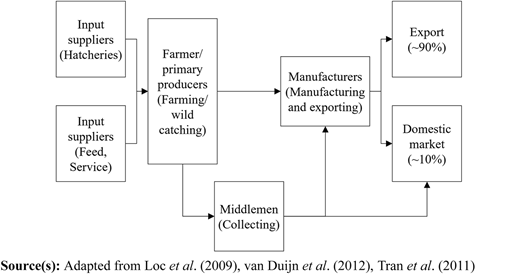
Several studies have attempted to conceptualise collaborative efforts in supply chains. Employing a comprehensive view, this study adopts the measurement of collaboration across four dimensions: information sharing, decision synchronisation, incentive alignment, and collaborative communication (Table 1).
Components of collaboration
| Factor | Definition | Source |
|---|---|---|
| Information sharing | The exchange of confidential information among supply chain partners which focus on the accuracy, relevance, and completion of information in a timely manner | Cao and Zhang (2011), Simatupang and Sridharan (2002) |
| Decision synchronisation | The joint decision-making process in supply chain planning and operations for the expansion and optimisation of supply chain benefits | Cao and Zhang (2011), Harland et al. (2004) |
| Incentive alignment | The sharing process among collaborative firms in terms of costs, risks, and benefits | Cao and Zhang (2011) |
| Collaborative communication | The frequency, direction, mode, and influence strategy of contacting and message transmission between collaborative partners | Cao and Zhang (2011) |
Source(s): Created by authors
2.1.2 Antecedents of supply chain collaboration
Antecedents of collaborative efforts are categorised into technological and relationship factors. As technological advancements serve as tools to enhance human interactions (Sanders, 2007; Salam, 2017), this research prioritises examining relationship elements. Previous studies have identified four key factors: inter-personal trust, inter-organisational trust, commitment, and reciprocity (Table 2).
Antecedents of collaboration
| Factor | Definition | Source |
|---|---|---|
| Inter-personal trust | The extent of trust of an individual in a focal firm in their counterpart in the supply chain partner | Lobo et al. (2013), Zaheer and Trkman (2017) |
| Inter-organisational trust | The extent of trust placed by a focal firm in the supply chain partner | Cai et al. (2010), Chen et al. (2014), Lee et al. (2010), Wu et al. (2014) |
| Commitment | The belief that an ongoing relationship between partners is important and efforts to maintain it indefinitely | Lee et al. (2010), Morgan and Hunt (1994), Wu et al. (2014) |
| Reciprocity | The perception of common goals and mutual benefits which leads to fair mutual exchanges between partners | Wu et al. (2014), Saglam et al. (2022) |
Source(s): Created by authors
2.2 Underpinning theory: social exchange theory
The social exchange theory (SET) postulates that interactions among organisations or individuals could be explained based on expected gains from the relationships (Emerson, 1976). Past research used it to analyse relationships on both inter-organisational (Wu et al., 2014) and inter-personal levels (Barnes et al., 2015). Moreover, SET has been utilised to investigate various supply chain relationships (Chao et al., 2013), making it a suitable underpinning theory for this study.
Trust, commitment, and reciprocity emerge as key SET issues in fostering collaboration (Wu et al., 2014). Building on past literature and adapting to the Asian context, this study reclassifies these variables. Trust is categorised into inter-personal and inter-organisational trust, with the former serving as the foundation for the latter. This aligns with research in Asian countries, such as Fu et al.’s (2017) on dyadic communication in China and Barnes et al.’s (2015) on inter-personal connections in Asian businesses, both rooted in SET. Consequently, this paper explores four primary SET factors as antecedents of supply chain collaboration: inter-personal trust, inter-organisational trust, commitment, and reciprocity.
2.3 Hypotheses development
Figure 2 presents the proposed conceptual model and hypotheses in this study.
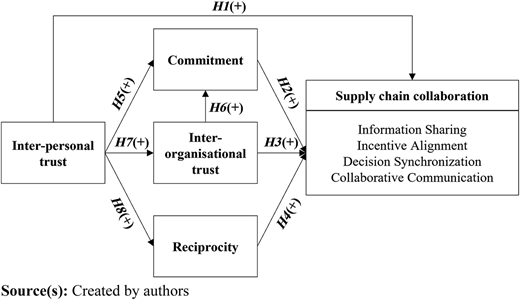
Several studies highlight the positive influence of inter-personal trust on supply chain collaboration. Wang et al. (2018) emphasize the impact of personal credibility, affection, and communication on supply chain integration. Similarly, Lee and Ha (2024) find a significant influence of trust on relationship satisfaction among partners in agri-food supply chains. Hence, it is expected that:
Inter-personal trust positively impacts supply chain collaboration.
Commitment is a facilitator of several supply chain management activities, including information sharing and collaboration (Lee et al., 2010; Wu et al., 2014). It also fosters cooperative efforts (Apostolopoulos et al., 2023). Hence, the second hypothesis is:
Commitment positively impacts supply chain collaboration.
Inter-organisational trust is another potential antecedent. Chen et al. (2014) argue that it forms the basis for partners to fulfil their obligations, while Rungsithong and Meyer (2024) demonstrate its impact on relationship performance. In the Vietnamese context, Nguyen et al. (2023) find partner trust to enhance international supply chain collaboration. Thus, the third hypothesis is derived:
Inter-organisational trust positively impacts supply chain collaboration.
Reciprocity, from a social exchange theory perspective, motivates members to establish and maintain relationships (Narasimhan et al., 2009). Saglam et al. (2022) define reciprocity as fair mutual exchanges among partners, where behaviour encourages reciprocal efforts whenever there is added value. Hence, the fourth hypothesis anticipates:
Reciprocity positively impacts supply chain collaboration.
The commitment-trust theory suggests that firms aim for long-term relationships with trustworthy partners for sustainable mutual benefits (Morgan and Hunt, 1994). Trust, on both inter-personal and inter-organisational levels, could positively impact commitment between business partners (Morgan and Hunt, 1994; Tsanos et al., 2014). Hence, the relationship between trust and commitment could be hypothesised as follows:
Inter-personal trust positively impacts commitment between supply chain partners.
Inter-organisational trust positively impacts commitment between supply chain partners.
Past studies in Asian contexts show a positive impact of inter-personal trust on inter-organisational trust (Rungsithong and Meyer, 2024; Shaalan et al., 2013). Wang et al. (2018)’s case studies further investigate and show that the specific impacts depend on firm size and organisational positions. From this comes the next hypothesis:
Inter-personal trust positively impacts inter-organisational trust.
Inter-personal trust also facilitates reciprocity. Wang et al. (2008) note a positive connection between inter-personal trust (xinyoung) and reciprocity (renqing) in their research on buyer – seller relationships in Hong Kong and Chinese businesses. Vanneste’s (2016) simulation also demonstrates that inter-personal trust leads to indirect reciprocity. Hence, the final hypothesis is:
Inter-personal trust positively impacts reciprocity.
3. Research methodology
3.1 Research design
This study adopts a positivist research paradigm, employing a quantitative approach with a questionnaire-based survey to gather empirical data and test hypotheses. This method was chosen due to its common usage in similar studies (Hudnurkar et al., 2014), its ability to mitigate interviewer bias, and its feasibility for conducting a large-scale survey within time and cost constraints. Collaboration with government bodies and the Vietnam Association of Seafood Exporters and Producers (VASEP) facilitated access to manufacturing firms in the Vietnamese fishery industry.
3.2 Research instrument design and development
The questionnaire contained three sections: (1) demographics information, (2) relationship attributes, and (3) manufacturer-supplier collaboration. Demographic questions were adapted from Wu et al.'s (2014) and Chen et al.’s (2014), tailored to the Vietnamese fishery industry context. The measurement items were evaluated on a 5-point Likert scale. The initial questionnaire was refined with feedback from six postgraduates and professionals in a pre-test and input from seven academic and professional experts for contextualisation. A pilot study with 29 randomly selected fishery manufacturers led to the removal of two variables to enhance internal consistency. The final instrument comprised 40 questions, including six demographic items and 34 measurement items.
3.3 Data sampling, collection, and analysis
The target population in this study is Vietnamese fishery-product manufacturers, particularly those adhering to the standards of the National Agro-Forestry-Fisheries Quality Assurance Department Home (NAFIQAD) as they represent a significant portion of the sector’s production volume and value. The unit of analysis is at the organisational level, with each organisation represented by a single respondent holding a managerial and supply chain-related position. These respondents are knowledgeable about their companies’ operations and procurement, helping validate the applicability of the conceptual model. The questionnaire was distributed to all 635 fishery producers listed by NAFIQAD (2016) using the drop-and-collect method. Brown (1993) considered this method a hybrid technique combining the strengths of interviews (higher response rate) and post mails (more economical).
Covariance-based structural equation modelling (CB-SEM) was employed to examine the proposed associations between constructs, as it is well-suited for evaluating construct validity and associations between variables. SPSS was utilized for data examination and cleaning, while exploratory factor analysis (EFA) and confirmatory factor analysis (CFA) were conducted to test the validity and reliability of the measurement instrument. Analysis of moment structures (AMOS) was employed to evaluate the measurement and structural models.
4. Research findings
4.1 Data examination and cleaning
The survey received 365 responses, amounting to a 57.5% response rate. During the data examination and cleaning process, ten cases were dropped due to missing values (more than 10%) and nine others were omitted as multivariate outliers using D2 values. Consequently, 346 valid responses remained for further analysis.
Multivariate non-normality was not detected as all skewness and kurtosis values lay within the range of −1 to +1. Normal P-P plots of demonstrated linear relationships among constructs, which were also confirmed by ANOVA tests. No correlation coefficient between any pair of items exceeded 0.9, indicating no multicollinearity issues.
To mitigate common method bias, the authors employed several procedural remedies during instrument development, such as reverse coding, reducing evaluation apprehension, and ensuring respondents' ability and motivation (Tehseen et al., 2017; Podsakoff et al., 2024). Regarding statistical procedures, the Harman’s single-factor test showed no issue. In general, as researchers recommend procedural remedies over post-hoc statistical techniques (Conway and Lance, 2010; Tehseen et al., 2017; Podsakoff et al., 2024), CMB was not deemed an issue.
4.2 Participant demographics and organisational profiles
Table 3 summarises respondent demographics, including their positions and working years at the respective companies.
Respondent demographics
| Demographics | Number | % |
|---|---|---|
| Position | 346 | 100 |
| Top manager | 54 | 15.6 |
| Middle manager | 156 | 45.1 |
| Line manager | 136 | 39.3 |
| Working years | 346 | 100 |
| 5 years or less | 141 | 40.8 |
| 6–10 years | 148 | 42.8 |
| 11–15 years | 43 | 12.4 |
| 15 years or more | 14 | 4.0 |
Source(s): Created by authors
The participating organisations were categorised according to the number of employees, average annual sales, supply source, business type, and socio-economic region (Table 4). Overall, the collected data was comprehensive and representative of the sample frame, especially regarding business types and socio-economic regions of the participating organisations.
Organisational profiles
| Classification | Number | % |
|---|---|---|
| Number of employees | 346 | 100 |
| 1–50 | 47 | 13.6 |
| 51–100 | 62 | 17.9 |
| 101–200 | 107 | 30.9 |
| 201–500 | 76 | 22.0 |
| 501–1,000 | 31 | 9.0 |
| Over 1,000 | 23 | 6.6 |
| Sales (billion VND) | 346 | 100 |
| 50 or less | 66 | 19.1 |
| More than 50 to 200 | 63 | 18.2 |
| More than 200 to 500 | 64 | 18.5 |
| More than 500 to 1,000 | 76 | 22.0 |
| More than 1,000 to 2,000 | 45 | 13.0 |
| More than 2,000 | 32 | 9.2 |
| Supply source | 346 | 100 |
| Only primary producers | 43 | 12.4 |
| Primary producers (major) + middlemen (minor) | 180 | 52.0 |
| Primary producers (minor) + middlemen (major) | 110 | 31.8 |
| Only middlemen | 13 | 3.8 |
| Business type | 346 | 100 |
| State-owned | 8 | 2.3 |
| Private | 16 | 4.6 |
| Joint-stock | 199 | 57.5 |
| Limited liability | 118 | 34.1 |
| Wholly foreign-owned | 5 | 1.5 |
| Socio-economic region | 346 | 100 |
| Northern midland and mountainous region | 19 | 5.5 |
| Red River Delta | 23 | 6.6 |
| North central coast and central coast | 38 | 11.0 |
| Central Highlands | 122 | 35.3 |
| Southeastern region | 43 | 12.4 |
| Mekong Delta | 101 | 29.2 |
Source(s): Created by authors
4.3 Measurement model evaluation
The content validity of the research instrument was assured by the pre-test, contextualisation, and pilot study. Internal consistency was tested with Cronbach’s alpha and item-to-total correlation, with all constructs passing; hence no items dropped.
Construct validity was examined through factor analysis. The authors used PCA with varimax rotation to test discriminant validity. This step yielded four antecedents (inter-personal trust - PT, inter-organisational trust - OT, commitment - Co, and reciprocity - Re) and four constituents of supply chain collaboration (information sharing - IS, incentive alignment - IA, decision synchronisation - DS and collaborative communication - CC), all with significant factor loadings (>0.60), exceeding Hair et al.’s (2010) threshold of 0.35 for sample sizes larger than 250. Although six items had cross-loadings, the differences were at least 0.330, larger than the 0.20 threshold suggested by Hair et al. (2010). Therefore, no items were discarded.
The validity of the measurement model was further tested with CFA. With necessary modification indices, the final congeneric measurement models of all constructs had acceptable goodness-of-fit (GOF) indices according to Byrne (2010) and Kline (2010) (Table 5).
GOF indices for the measurement models (after MIs) and the full CFA model
| Measure | Threshold | OT | PT | Co and Re | SCCol | Full model |
|---|---|---|---|---|---|---|
| CMIN/DF | <5 | 1.383 | 1.865 | 0.867 | 2.735 | 1.614 |
| CFI | >0.90 | 0.999 | 0.999 | 1.000 | 0.074 | 0.955 |
| SRMR | <0.08 | 0.014 | 0.010 | 0.028 | 0.0412 | 0.040 |
| RMSEA | <0.08 | 0.035 | 0.052 | 0.000 | 0.934 | 0.044 |
| TLI | >0.90 | 0.996 | 0.992 | 1.002 | 0.934 | 0.951 |
| IFI | >0.90 | 0.999 | 0.999 | 1.001 | 0.923 | 0.955 |
Source(s): Created by authors
The second-order construct of supply chain collaboration (SCCol) was evaluated in terms of discriminant validity among its components and the target coefficient. Supply chain collaboration effectively embodied its components, as the squared correlation for each pair of components was less than the AVE for each constituent (Table 6). Furthermore, the target coefficient was 0.9994, within the range of 0.80–1.00 suggested by Handley and Benton (2009) (Table 7).
Discriminant validity of supply chain collaboration components
| Sub-construct | CR | AVE | DS | IA | CC | IS |
|---|---|---|---|---|---|---|
| DS | 0.863 | 0.558 | 0.747 | |||
| IA | 0.876 | 0.587 | 0.647 | 0.766 | ||
| CC | 0.887 | 0.611 | 0.606 | 0.700 | 0.792 | |
| IS | 0.921 | 0.746 | 0.570 | 0.684 | 0.643 | 0.839 |
Note(s): CR: Composite Reliability; AVE: Average Variance Extracted
Italic value: square root of AVE, non-italic value: correlation
Source(s): Created by authors
Fit indices for first- and second-order constructs of supply chain collaboration
| Construct | Model | χ2 (df) | Normed χ2 | CFI | NNFI | RMSEA | T-coefficient |
|---|---|---|---|---|---|---|---|
| Supply chain collaboration | First order | 404.518 (146) | 2.771 | 0.933 | 0.958 | 0.075 | 99.94% |
| Second order | 404.740 (148) | 2.735 | 0.934 | 0.959 | 0.074 |
Source(s): Created by authors
The full CFA measurement model also had acceptable GOF statistics (Table 5) and adequate discriminant validity, which requires the AVE value to be consistently greater than the squared inter-construct correlations estimate (Straub et al., 2004; Hair et al., 2010) (Table 8).
Discriminant validity of the full CFA measurement model
| Construct | CR | AVE | SCCol | PT | OT | Co | Re |
|---|---|---|---|---|---|---|---|
| SCCol | 0.876 | 0.640 | 0.800 | ||||
| PT | 0.872 | 0.632 | 0.684 | 0.795 | |||
| OT | 0.870 | 0.627 | 0.704 | 0.635 | 0.792 | ||
| Co | 0.915 | 0.782 | 0.697 | 0.498 | 0.594 | 0.884 | |
| Re | 0.834 | 0.560 | 0.661 | 0.695 | 0.559 | 0.427 | 0.748 |
Note(s): CR: Composite Reliability; AVE: Average Variance Extracted
Italic value: square root of AVE, non-italic value: correlation
Source(s): Created by authors
4.4 Structural model evaluation
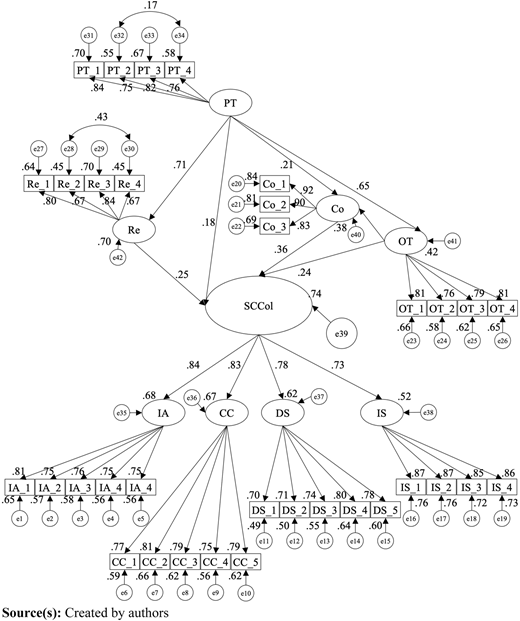
The structural model (Figure 3) had adequate explanatory power, representing by the squared multiple correlations (SMCs) of the six dependent constructs (Table 9).
All theorised structured paths were supported, with six at the 0.001 significant level and the other two at the 0.01 significant level (Figure 4). Table 10 summarises hypothesis testing results.
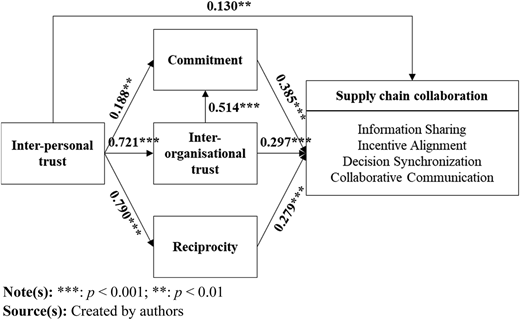
Results of hypothesis testing
| Hypothesis | Std estimate | Decision |
|---|---|---|
| H1. Inter-personal trust increases supply chain collaboration | 0.130** | Accepted |
| H2. Commitment increases supply chain collaboration | 0.385*** | Accepted |
| H3. Inter-organisational trust increases supply chain collaboration | 0.297*** | Accepted |
| H4. Reciprocity increases supply chain collaboration | 0.279*** | Accepted |
| H5. Inter-personal trust increases commitment | 0.188** | Accepted |
| H6. Inter-organisational trust increases commitment | 0.514*** | Accepted |
| H7. Inter-personal trust increases inter-organisational trust | 0.721*** | Accepted |
| H8. Inter-organisational trust increases reciprocity | 0.790*** | Accepted |
Note(s): ***: p < 0.001; **: p < 0.01
Source(s): Created by authors
4.5 Mediation analysis
The study explored mediating effects alongside direct impacts. Findings showed that the relationship between inter-personal trust and collaboration was partially mediated by commitment and reciprocity. Commitment also partially mediated the relationship between inter-organisational and collaboration. Additionally, inter-personal trust indirectly influenced commitment and collaboration through inter-organisational trust. Table 11 summarises these mediating effects.
Results of mediating effects
| Path (A → B → C) | Direct effect (A → C) | Indirect effect | Result |
|---|---|---|---|
| PT → Co → SCCol | 0.130** | 0.072** | Partial Mediation |
| PT → OT → Co | 0.188** | 0.371*** | Partial Mediation |
| OT → Co → SCCol | 0.297*** | 0.198*** | Partial Mediation |
| PT → OT → SCCol | 0.130** | 0.214*** | Partial Mediation |
| PT → Re → SCCol | 0.130** | 0.221*** | Partial Mediation |
Note(s): ***: p < 0.001; **: p < 0.01
Source(s): Created by authors
All total effects of relationship attributes on supply chain collaboration and one another were significant at the 0.001 level, highlighted the indispensable role of relationship attributes, especially inter-personal trust, in facilitating manufacturer-supplier collaboration (Table 12).
Results of total effects
| Path | Direct effect | Total indirect effect | Total effect |
|---|---|---|---|
| PT → SCCol | 0.130** | 0.650*** | 0.780*** |
| OT → SCCol | 0.297*** | 0.198*** | 0.495*** |
| Co → SCCol | 0.385*** | – | 0.385*** |
| Re → SCCol | 0.279*** | – | 0.279*** |
| PT → Co | 0.188** | 0.371*** | 0.558*** |
| OT → Co | 0.514*** | – | 0.514*** |
| PT → OT | 0.721*** | – | 0.721*** |
| PT → Re | 0.790*** | – | 0.790*** |
Note(s): ***: p < 0.001
Source(s): Created by authors
4.6 Moderation analysis
The authors performed multiple group analysis to compare small- and medium-sized enterprises (SMEs) and large enterprises. Pursuant to the 2017 Law on Provision of Assistance for SMEs (National Assembly, 2017), firms with fewer than 200 employees were categorised as SMEs. Although firm size was considered a potential moderator as it affects collaborative advantage (Cao and Zhang, 2011), chi-square difference tests found no moderation effect at the model or path level. While SMEs and large enterprises varied slightly in their perceptions of relationship attribute roles, overall differences were insignificant (Table 13).
Results of hypotheses testing among SMEs and large enterprises
| Hypothesis | Path | SMEs | Large enterprises | Overall |
|---|---|---|---|---|
| H1 | PT → SCCol | 0.154** | 0.096 | 0.130** |
| H2 | Co → SCCol | 0.332** | 0.472*** | 0.385*** |
| H3 | OT → SCCol | 0.326*** | 0.267*** | 0.297*** |
| H5 | Re → SCCol | 0.254*** | 0.320*** | 0.279*** |
| H6 | PT → Co | 0.195* | 0.147 | 0.188** |
| H7 | OT → Co | 0.569*** | 0.404*** | 0.514*** |
| H8 | PT → OT | 0.754*** | 0.630*** | 0.721*** |
| H9 | PT → Re | 0.818*** | 0.711*** | 0.790*** |
Note(s): ***: p < 0.001; **: p < 0.01; *: p < 0.05
Source(s): Created by authors
Notably, in SMEs, inter-personal trust exerted both direct and indirect impacts on collaboration, whereas in large companies, its effect was solely indirect, fully mediated by inter-organisational trust and reciprocity. Additionally, inter-personal trust and inter-organisational trust had larger total effects on commitment in SMEs (β = 0.624 and β = 0.569) than in large enterprises (β = 0.401 and β = 0.404). Conversely, large enterprises witnessed a higher direct effect of commitment on supply chain collaboration (β = 0.472 versus β = 0.332).
5. Discussions
5.1 Components of supply chain collaboration
5.1.1 Incentive alignment
Incentive alignment is the biggest constituent of supply chain collaboration (path loading = 0.843). Past literature has also emphasized its significance in multiple industries, such as manufacturing (Cao and Zhang, 2011; Pradabwong et al., 2017) and financial services (Ma et al., 2020. Since this component encompasses mutuality and fairness, it drives them towards joint efforts and mutual benefits regardless of context or industry.
Incentive alignment comprises five factors, with cost-sharing exhibiting the highest factor loading (0.807). This aligns with the prevalent cost-related challenges faced by Vietnamese firms, such as joint investments in advanced production technologies to meet quality standards for export. The other four factors reflect the diverse nature of the Vietnamese fishery industry: a blend of Western performance-based culture (evaluation systems and fairness) and Confucian values (benefit- and risk-sharing). This combination of cultural values is expected as the sector is in a Confucian-influenced society and export-oriented towards Western markets.
5.1.2 Collaborative communication
Collaborative communication is the second-largest component of collaboration (path loading = 0.831). In Vietnam, strong business relationships are forged through intensive bilateral communication, vital for navigating uncertainties in the fishery industry (Nguyen and Rose, 2009; Cadilhon and Fearne, 2005; Nguyen et al., 2022a, b). This fosters flexibility and responsiveness, prompting manufacturers and suppliers to engage in collaboration.
The indicators have relatively similar factor loadings (0.748–0.814). With two-way communication scoring the highest (0.814). To promote bilateral communication, firms should adopt a problem-solving orientation and display cooperative attitudes in specific actions, such as timely responses to their partners’ requests. Two more factors to note are discussion-based decision-making (0.787) and informal communication (0.786). Collaborative communication is more effective when executed on multiple formal and informal channels and oriented towards mutual decision-making. Other indicators include contact frequency and informal communication.
5.1.3 Decision synchronisation
Decision synchronisation is another component (path loading = 0.779). Its importance is highlighted in the Indian textile industry (Ramanathan and Gunasekaran, 2014) and the German automotive industry (Wiengarten et al., 2013). In the Vietnamese fishery industry, manufacturers assume the dual role of focal firms in the domestic chain and sellers in international transactions. Thus, there are more partners involved in the decision-making process, requiring more collaborative efforts.
Joint product assortment planning has the highest factor loading (0.799), vital for aligning with partners to meet diverse export market demands. Joint problem-solving (0.776) addresses challenges from foreign natural and market conditions, while joint inventory management (0.738) ensures material and product perishability requirements are met. Additional focus lies on promotion planning and demand forecasts.
5.1.4 Information sharing
Effective information sharing, with a path loading of 0.734, is crucial for supply chain collaboration. It fosters transparency and reduces uncertainties, enhancing participant performance (Wiengarten et al., 2013; Wu et al., 2014; Nguyen et al., 2022a, b). A smooth information flow helps match supply to demand and deal with export-related issues, such as international transportation, international sales, and food safety standards.
In this study, information sharing is measured based on relevance, timeliness, accuracy, and complete sharing of information, with factor loadings ranging from 0.852 to 0.871. This indicates that all indicators equally reflect information sharing. To effectively compete with manufacturers from other countries like Thailand and Indonesia), partners in the Vietnamese fishery supply chain must exchange relevant, timely, accurate, and comprehensive information.
5.2 Antecedents of supply chain collaboration
5.2.1 Commitment
Commitment is an indispensable prerequisite for collaboration (β = 0.385, CR = 12.740, p < 0.001), similar to the findings of Wu et al. (2014) and Tsanos and Zografos (2016). Committed firms invest resources and effort to maintain relationships, facilitating cooperative actions.
Commitment is measured based on the desire for relationship continuation (factor loading = 0.916), relationship expansion (0.901), and time investment (0.832), reflecting a dedication to durable relationships and mutual effort. As the Eastern business culture is relationship-oriented, Vietnamese firms are more likely to develop new projects with their current partners, which, in turn, tightens cooperation. Therefore, supply chain partners should align business directions to facilitate joint projects, commitment, and collaboration.
5.2.2 Inter-organisational trust
Inter-organisational trust has a significant influence on collaboration (β = 0.297, CR = 8.222, p < 0.001), aligning with past studies (e.g., Wu et al., 2014; Nguyen et al., 2023; Lee and Ha, 2024). Trust forms the foundation for risk-taking in partnerships, allowing them to take timely and decisive actions. This is crucial in the dynamic export-oriented Vietnamese fishery industry.
Key components of trust include mutual welfare consideration and problem-solving support, with the highest loadings at 0.809. Firms gain credibility by prioritizing collective interests and providing assistance, reinforcing trust. Sharing resources, particularly during crises, further builds trust. For instance, manufacturers could offer technological support to help primary producers meet international food safety standards. Additionally, given the interconnected nature of participants in the Vietnamese fishery supply chain, collaborative efforts are essential to mitigate the domino effect of adverse events. Fulfilling promises (0.788) and avoiding opportunistic behaviours (0.761) are crucial for maintaining credibility and reputation, which are paramount in Vietnamese business relationships (Cadilhon and Fearne, 2005; Cadilhon et al., 2005).
5.2.3 Reciprocity
Aligning with Wu et al.’s (2014) and Zaheer and Trkman’s (2017) studies, reciprocity is another antecedent of supply chain collaboration (β = 0.279, CR = 7.567, p < 0.001). Firms motivated by mutual favours are inclined to sustain collaboration to avoid the risk of losing a reputation for failing to reciprocate in contexts like Vietnam (Nguyen and Rose, 2009). This underscores the importance of bidirectional efforts and rewards in Asian business dynamics.
Reciprocity, in this study, encompasses fair policies for suppliers, equitable treatment of suppliers, positive supplier contributions, and fair treatment from suppliers. Notably, positive contributions and fair policies exhibit the highest loadings (0.839 and 0.798), indicating an expectation of reciprocal efforts in response to sensible policies. However, equitable treatment from both sides holds relatively lower weight, deviating from Western-centric perspectives where reciprocity is often linked with justice and fairness (Tan and Chee, 2005). In Confucian-influenced Eastern contexts, reciprocation involves enhancing the value of favours received, rather than aiming for a simple tit-for-tat exchange, which may be perceived as overly calculated or ungrateful (Yeung and Tung, 1996).
5.2.4 Inter-personal trust
Inter-personal trust, a unique driver in the Asian business culture, also facilitates collaboration (β = 0.130, CR = 2.955, p < 0.01), consistent with prior research. Employees who trust their counterparts tend to initiate more frequent communication, fostering inter-firm collaboration. In Vietnam, establishing personal trust is essential before formal business transactions (Cadilhon and Fearne, 2005; Nguyen and Rose, 2009), emphasizing the significance of personal connections alongside formal partnerships.
Openness in business objectives and honesty have the highest loadings (0.838 and 0.821, respectively), followed by mutual respect and mutual understanding (0.762 and 0.745, respectively). This underscores the importance of transparency and sincerity in partnerships, aligning with Vietnam’s Confucian-influenced and market economy characteristics, where honesty is fundamental (Zhang and Zhu, 2012). Mutual respect and understanding emphasize the need for deeper insights into partners' roles and performance, necessitating frequent communication and knowledge exchange.
5.3 Inter-relationships among relationship attributes
Inter-personal relationship positively impacts reciprocity (β = 0.790, CR = 22.876, p < 0.001), inter-organisational trust (β = 0.721, CR = 18.456, p < 0.001), and commitment (β = 0.188, CR = 3.089, p < 0.01), aligning with extant literature. Personal interactions foster mutual respect and understanding, motivating reciprocal engagement and building trust between organizations. In Vietnam’s business landscape, trust, crucial for economic relations, often stems from personal connections due to evolving market institutions (Nguyen and Rose, 2009). However, the impact of inter-personal trust on commitment is slightly less noticeable, as commitment in the globalized Vietnamese fishery industry necessitates formal, legally binding contracts (Leung et al., 2005) rather than trust. Overall, through its impacts on these other three antecedents, inter-personal relationship indirectly influences supply chain collaboration (β = 0.650), surpassing its direct effect (β = 0.130). This suggests the intervention of business Western practices in Confucian-influenced Vietnamese society.
Inter-organisational trust significantly impacts commitment (β = 0.514, CR = 8.458, p < 0.001), as firms with high trust are more inclined to commit to each other, ensuring mutual benefits and relationship durability (Tsanos and Zografos, 2016). Through commitment, inter-organisational trust could indirectly facilitate collaborative efforts (β = 0.198).
Furthermore, inter-organisational trust partially mediates the relationship between inter-personal trust and commitment. This underscores the foundational role of personal relationships in building trust between firms, which then leads to commitment. Although trust on both personal and organisational levels is an attitudinal construct in Confucianism, commitment must be legally binding due to Western influences. This mediating effect has not been intensively investigated in past studies, thus contributing to the originality of this research.
5.4 Moderating effects of firm size
While no significant difference between SMEs and large enterprises was detected, notable distinctions emerged. SMEs place greater value on inter-personal trust, which impact on supply chain collaborationhu only partially mediated by other factors compared to large enterprises, where it is fully mediated. Trust enhances commitment more in SMEs, whereas commitment holds a greater influence on collaboration in larger firms.
These differences can be attributed to several factors. Firstly, SMEs, due to their smaller size and scope, rely more heavily on trust, particularly personal connections, whereas larger enterprises can afford structured systems, lessening their reliance on informal ties. Secondly, large enterprises, engaged in international transactions, adopt more Western practices, emphasizing legally binding commitments like contracts to foster collaboration. Consequently, although trust forms the basis of relationships in the Vietnamese fishery sector, inter-personal trust has limited influence on collaboration willingness in larger businesses.
6. Conclusion
In the modern business environment, fierce competition is no longer among companies but among entire supply chains. Supply chain collaboration, facilitated by relationship attributes, is crucial for gaining a competitive edge. This study, set in the Vietnamese fishery industry and employing social exchange theory (SET), demonstrates the positive impacts of inter-personal trust, inter-organisational trust, commitment, and reciprocity on collaboration and each other. Specifically, the importance of inter-personal trust was highlighted, especially for SMEs.
Academically, this study expands the application of SET in supply chain contexts to cover both organisational- and personal-level relationship attributes, reflecting the blended characteristics of Confucian-influenced economies exporting towards Western markets like Vietnam. The results suggest the importance of all antecedents, reinforcing past findings. Moreover, the study addresses the previously overlooked interrelatedness of the antecedents and reveals different direct and indirect collaboration facilitating mechanisms. Additionally, the study contributes to the limited literature on the fishery industry, which is pivotal for Vietnam’s national development as a leading export-oriented sector.
Practically, the study offers recommendations to build inter-firm collaborative relationships. At the organisational level, firms can develop strategies based on the identified SET issues. For instance, appointing inter-firm teams to cultivate partnerships can enhance inter-personal relationships, inter-organisational trust, commitment, and reciprocity. Particularly, SMEs could leverage personal networks to overcome limited resources and gain competitive advantages. At the governmental level, policymakers and industry associations like VASEP can facilitate mutual interactions through local entrepreneur groups and nationwide meetings, acting as mediators and supporting market and research development through academic and professional programs and conferences.
However, there are limitations. This is a snapshot study limited to the Vietnamese fishery industry. Thus, future research should consider cross-sectional and longitudinal data, as well as apply the model in diverse regional and international contexts for better generalization. Furthermore, as the analysis method is CB-SEM, the results only demonstrate the extent of influences among factors without explaining how and why. To gain more insights, other methods such as in-depth interviews or experiments are necessary. Another potential direction is gathering inputs from suppliers for a comprehensive understanding of this dyadic relationship.
This paper is a product of the Research Project at Ministry-level “The role of social capital in the development of household economy in some pilot areas of constructing model new rural”, Code: B2022-NTH-02.

