


Nowadays, more and more brands are developing their own virtual ambassadors for interactive communication and marketing with consumers. Exploring the interactive effectiveness of virtual brand ambassadors on consumer behavior is crucial to understanding the interactions between brands, virtual ambassadors and consumers as well as further increasing consumer engagement in AI-mediated interactive marketing.
This study investigated different interactive effects of virtual ambassadors on consumer behavior in terms of virtual ambassadors’ anthropomorphism, virtual experience and consumer behavior through a mixed method of questionnaires and semi-structured interviews.
The results indicate that consumers’ sharing, reviewing and purchasing behavior is significantly and positively influenced by virtual ambassadors’ anthropomorphism and virtual experience. In addition, specific anthropomorphic features and virtual experiences were discussed in detail.
This study helps brands develop and manage their virtual ambassadors and consumers in AI-mediated interactive marketing and communication.
Introduction
Interactive marketing is one of the fastest-growing academic fields in contemporary marketing communications, focusing on consumer brand relationships, especially consumer interactivity and engagement (Wang, 2024). Over the past 15 years, social media influencers have become an integral part of most brands’ interactive marketing strategies (Audrezet and Koles, 2023). With the advancement of technology, virtual influencers have emerged as a new trend in interactive marketing strategies for brands in addition to human influencers. According to the AI Marketing Benchmark Report 2023, 71.2% of respondents believe that virtual influencers can outperform human influencers in their work, and 61.4% of marketers are using virtual influencers in their marketing campaigns (Influencer Marketing Hub, 2024). Furthermore, more and more brands are developing their own virtual ambassadors. For example, Lu of Magalu comes to life on behalf of Magazine Luiza, one of Brazil’s largest retail companies; and KFC has virtualized Colonel Sanders as a younger, fitter human named the Colonel. The rise of developing virtual brand ambassadors suggests a new research direction for interactive consumer brand communication in marketing (Volles et al., 2024; Song et al., 2024).
The pertinent research concentrates on exploring how consumers respond to virtual influencers through comparisons with human influencers (Byun and Ahn, 2023; Zhou et al., 2024). One of the main criticisms is virtual influencer anthropomorphism, which can lead to negative consumer reactions to brands (Mirowska and Arsenyan, 2023; Stein et al., 2024). That is, consumer perceive brands endorsed by virtual influencers to be less authentic than brands endorsed by humans because they perceive virtual endorsers as less authentic (Song et al., 2024). However, other scholars have argued that virtual influencer applications are highly appealing to consumers (Lou et al., 2023; Akhtar et al., 2024). These previous studies have agreed that virtual influencers can affect consumers, but the inconsistency of the findings suggests that the effect of virtual influencer anthropomorphism on consumers still deserves to be understudied. In particular, previous studies have mainly explained these effects in terms of virtual-human differences (de Cicco et al., 2024; Kholkina et al., 2024) or consumer psychology (e.g. uncanny valley effect and parasocial interactions) (Lou et al., 2023; Stein et al., 2024). More recently, it has been pointed out that the existing literature neglects to explore the factors by which virtual influencers affect consumer behavior from the perspective of consumer brand engagement (Wang et al., 2023; Shen, 2024), suggesting that there is a significant knowledge gap in this area.
Accordingly, this study extends the existing literature by investigating the interactive effectiveness of virtual brand ambassadors on consumer behavior in terms of virtual ambassadors’ anthropomorphism, virtual experience, and consumer behavior. Unlike previous studies on the comparison of virtual and human influencers and consumer psychology, this study explains the different effects of self-created virtual brand ambassadors on consumer behavior based on the factor analysis of consumer brand engagement. Existing literature highlights the uniqueness and importance of virtual influencers’ interactions with consumers (Byun and Ahn, 2023; Volles et al., 2024), so it is crucial to further examine more factors affected virtual brand ambassadors’ engagement with consumer behavior. This study further discusses different interactive effects of specific anthropomorphic features and virtual experiences on consumer behavior through a mixed method of questionnaires and semi-structured interviews. Theoretically, this study extends the current understanding of virtual influencer interactions to self-created virtual brand ambassadors from the perspective of consumer brand engagement, helping to further clarify inconsistent findings. In practice, this study provides managerial insights for those interested in developing their own virtual ambassadors to further help brands increase consumer brand engagement during virtual experiences.
Literature review and research hypotheses
Virtual interaction and its impact on consumers
Enhancing consumer brand engagement is of increasing theoretical and practical significance in the marketing literature. Extant literature emphasizes the importance of consumer brand engagement in marketing because of its predictive role in consumer behavior and brand performance (Akhtar et al., 2024). Recent research has shown the value of understanding how consumers interact with new technologies such as artificial intelligence and virtual reality, as they have dramatically changed consumer brand communication and interaction (Wang, 2024). The most discussed in related research are virtual influencers. They are digital characters created through computer graphics software, which are then given personalities based on their first-person worldviews and published on media platforms to create an impact (Audrezet and Koles, 2023). Existing literature finds that virtual influencers can provide distinctive consumer engagement compared to humans (Volles et al., 2024). This is because they can interact with consumers on multiple social media accounts at the same time and generate a large amount of consistent content, which is difficult for humans to achieve (Stein et al., 2024).
However, current research discusses the impact of virtual influencers on consumers primarily by comparing virtual influencers to human influencers, with inconsistent findings (Mrad et al., 2022; Lou et al., 2023; Kholkina et al., 2024). On the one hand, it is noted that human-like appearance and life of virtual influencers make it possible for consumers to perceive them as real influencers, which in turn increases consumer awareness of the brand (Mrad et al., 2022). On the other hand, it is also argued that virtual influencers lack persuasiveness in motivating consumers’ purchase intentions due to their lack of authenticity and credibility (Lou et al., 2023). Scholars have tried to explain these inconsistent findings from different perspectives. One frequent explanation comes from consumer psychology based on the Uncanny Valley Theory (UVT). For example, Zhang et al. (2022) agree that UVT can help us understand consumers’ low responses, as many other studies have proven that the precise similarity of virtual influencers to humans negatively affects consumers. In contrast, Shen (2024) reveals that differences in consumer brand engagement are not affected by the authenticity and humanization of virtual influencers. The results support previous findings that not all types of human-like virtual influencers lead to the uncanny effect.
Another frequent explanation is from the perspective of human-computer interaction in AI marketing. For instance, De Cicco et al. (2024) state that disclosure of the synthetic nature of fully anthropomorphized virtual characters does not affect consumer perceptions of virtual influencers and brand outcomes, consistent with the computers-are-social-actors (CASA) paradigm’s establishment of individuals applying human social rules when interacting with computers. Additionally, Kim and Baek (2023) argue that there is a significant relationship between virtual influencer attributes and consumers’ perceived authenticity, emotional attachment, and word-of-mouth intentions in virtual influencer marketing. More recently, many scholars have explained such inconsistent findings based on parasocial interaction (PSI) in AI marketing (Lim and Lee, 2023; Melnychuk et al., 2024; Stein et al., 2024). It refers to a psychological relationship experienced by consumers in their mediated encounters with brands in mass media (especially online platforms) (Melnychuk et al., 2024). Previous research has shown that PSI mediates the effects of origin disclosure and emotional content on the credibility of virtual influencers (Lim and Lee, 2023). Some scholars argue that the stronger PSI between virtual influencers and consumers compared to human influencers, which in turn has significant implications for virtual engagement (Akhtar et al., 2024; Melnychuk et al., 2024). However, two opposing effects have also been found—while significant direct effects suggest stronger PSI for virtual influencers, consumers also perceive the role as less psychologically similar to human and themselves—ultimately inhibiting the observed advantage (Mirowska and Arsenyan, 2023; Stein et al., 2024).
By reviewing recent studies mentioned above, we can find that existing literature mainly investigates the effects of virtual influencers’ human-likeness, authenticity, and credibility on consumer psychology and behavior through comparing human and virtual influencers. Recent research is still in its infancy on how to explain these inconsistent findings, especially on consumer brand engagement. Because of the broad societal implications of AI, scholars believe that computer-human interaction is the ultimate solution, and explanations are merely a starting point (Raees et al., 2024). Extant literature calls for further analysis and research on factors controlling consumer brand engagement such as characteristics, personalities, and behavior of virtual influencers (Lou et al., 2023; Shen, 2024). Furthermore, while several studies discuss avatars, they are mostly virtual influencers belonging to external business partnerships (Akhtar et al., 2024), and none of them formally address virtual brand ambassadors. Unlike these AI marketing tools, virtual brand ambassadors are self-created by brands to represent the brand and help promote the brand’s image and products (Liu et al., 2024). Recent research suggests that self-created virtual influencers offer unique advantages in ensuring alignment with the brand’s image, and significantly enhance informational social influence (Jiang et al., 2024). While avatars are becoming increasingly common for brands, their impact on consumers remains underexplored (Elsharnouby et al., 2023). Therefore, this study responds to the current call for the following research questions: (1) How does the anthropomorphism of virtual brand ambassadors affect consumer brand engagement? (2) Which virtual experiences can affect consumer brand engagement? (3) Which consumer behavior can be affected by virtual brand ambassadors?
Anthropomorphism
Anthropomorphism has been defined as “the tendency to imbue the real or imagined behavior of non-human agents with human-like characteristics, motivations, intentions, or emotions” (Epley et al., 2007, p. 864). For virtual influencers, a growing body of research has explored how to assign human-like characteristics to virtual influencers (Block and Lovegrove, 2021; Shen, 2024). These studies have identified various key elements of virtual influencers such as anthropomorphism, attractiveness, and storytelling. Among them, anthropomorphism is ranked as the primary factor in characterizing virtual influencers (Da Silva Oliveira and Chimenti, 2021). Regarding the effect of anthropomorphism on consumers, as mentioned above, the results of existing studies tend to be inconsistent, with both positive and negative effects. This may be due to the fact that anthropomorphism is a complex factor. Some studies discuss anthropomorphism as a holistic factor (Ahn et al., 2022; Da Silva Oliveira and Chimenti, 2021), while others analyze anthropomorphism from a single perspective such as appearance (Arsenyan and Mirowska, 2021; Shen, 2024). Thus, a lack of knowledge about the details of anthropomorphic elements may lead to differences in research results. As shown in previous studies (Miao et al., 2022; Ju et al., 2024), anthropomorphism can include appearance, character, and behavior of virtual influencers and these factors may play a key role in consumer behavior.
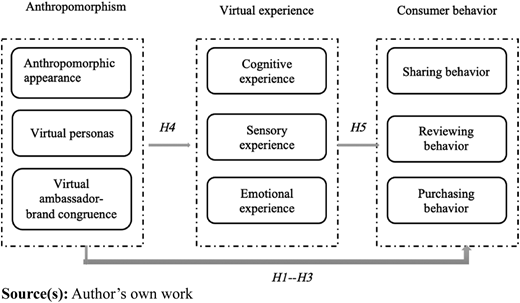
Moreover, related research suggests that consumer expectations and responses to anthropomorphism may not be consistent across contexts. For instance, consumers expect chatbots to have strong conversational skills (Lee et al., 2020), whereas artificial intelligence associated with self-driving cars has strong logical reasoning skills (Wu et al., 2023). For this reason, this study explores multiple anthropomorphic elements related to consumer brand engagement, namely anthropomorphic appearance, virtual personas, and virtual ambassador-brand congruence, in order to understand their effects and identify key factors. In addition to the importance of anthropomorphic appearance and virtual personas as emphasized in the existing literature, previous studies have shown that influencer-brand congruence can affect consumers’ brand attitudes (Wei et al., 2022; Dhun and Dangi, 2023). As such, there is a need to investigate whether virtual ambassador-brand congruence may also have a similar effect on consumers. Hence, the following hypotheses were formulated in this study:
The anthropomorphic appearance of virtual ambassadors has a positive effect on consumers’ sharing, reviewing, and purchasing behavior;
The virtual personas of virtual ambassadors have a positive effect on consumers’ sharing, reviewing, and purchasing behavior;
The virtual ambassador-brand congruence has a positive effect on consumers’ sharing, reviewing, and purchasing behavior.
Virtual experiences
A virtual experience is a state of immersion for consumers where they interact through the use of a computer-based presentation format (Trabelsi-Zoghlami and Touzani, 2019). Existing literature suggests that virtual experiences play an important role in consumer acceptance of artificial intelligence technologies (Fernandes and Oliveira, 2021). This is because consumers can interact with fictional characters or immerse themselves in different situations. This virtual experience allows consumers to experience situations they would not be able to experience in real life and extend themselves in virtual experiences (Trabelsi-Zoghlami and Touzani, 2019). In the extant marketing literature, previous studies on virtual experiences have concentrated on different virtual experiences and their components, which help gain insights and manage consumer engagement at different stages (Rusthollkarhu et al., 2022). Consumer engagement is recognized as a link between brands and consumers, and a prerequisite for other beneficial marketing outcomes such as brand loyalty (McLean et al., 2021). Recent research on virtual experiences further suggests that different virtual experiences have different engagement effects on consumer experience (Roggeveen et al., 2020). For instance, Chen et al. (2021) examined how different levels of consumer experience affect consumer engagement with artificial intelligence technologies, and found that higher levels of interactive experience lead to higher levels of consumer engagement. Moreover, Hoyer et al. (2020) argue that understanding the cognitive, sensory, and emotional dimensions, as well as the social values, that consumer experience at different stages would help marketers improve consumer engagement. In a word, enhancing virtual experience is a key marketing objective and there is a need to investigate how AI marketing can be used in consumer experience (Patti et al., 2020). Therefore, this study proposes the following hypotheses and the research model is shown in Figure 1:
The cognitive, sensory, and emotional dimensions of virtual experiences are positively affected by virtual ambassadors’ anthropomorphism (appearance, personas, and influencer-brand congruence);
The cognitive, sensory, and emotional dimensions of virtual experiences positively affect consumers’ sharing, reviewing, and purchasing behavior.
Methodology
In order to test the research hypotheses, this study followed the design of previous studies on the effectiveness of virtual influencers in marketing (Creswell and Creswell, 2017; Wang et al., 2023), using a mixed method of questionnaires and semi-structured interviews. Prior to the start of the study, all participants provided an Informed Consent Statement. After consent, participants completed the questionnaires from April to May 2023. Questionnaires allow for quick and efficient data collection and quantification of findings. Therefore, questionnaires were used in this study to test the above hypotheses. Subsequently, interviews were conducted with a representative sample of participants between October and December 2023 to gain further detail on virtual ambassador anthropomorphism, virtual experiences, and consumer behavior. Finally, based on the data collected from the questionnaires and interviews, the following statistical analysis methods were conducted using SPSS: reliability and validity analysis, descriptive statistical analysis, correlation analysis, and regression analysis, as a way to test the research hypotheses and answer the research questions.
Questionnaires
Referring to the existing scales of related variables and combining the research hypotheses, this study designed a questionnaire with a total of 21 questions, including five dimensions of anthropomorphic appearance, virtual personas, virtual ambassador-brand congruence, virtual experience, and consumer behavior (see Table 1). The study used Cronbach’s Alpha coefficient to analyze the reliability and validity of each scale. In terms of anthropomorphic appearance, according to the literature (Sokolova and Kefi, 2020; Ahn et al., 2022), anthropomorphic appearance was adapted from the Physical Attractiveness Scale, and contained four measurement items to examine virtual ambassadors’ facial, overall, and stylistic attractiveness, with Cronbach’s α = 0.76–0.82. Virtual personas were measured by scales of post characteristics and information quality based on Miao et al. (2022) and Ju et al. (2024), consisting of four measurement items with Cronbach’s α = 0.72–0.75. There were also four measurement items of virtual ambassador-brand congruence, which were built on Dhun and Dangi (2023) and Wei et al. (2022) with Cronbach’s α = 0.87–0.91. According to Trabelsi-Zoghlami and Touzani (2019) and Hoyer et al. (2020), virtual experiences consist of six measurement items, namely cognitive, sensory, and emotional experience, with Cronbach’s α = 0.84–0.87. Finally, consumer behavior was measured through three measurement items: sharing, reviewing, and purchasing on the grounds of Lou et al. (2023) and Shen (2024), with Cronbach’s α = 0.75–0.76. As mentioned above, the Cronbach’s Alpha for each measurement item was above 0.70, indicating reliability and validity.
Questionnaire design
| Dimension | No. | Measurement items | Source |
|---|---|---|---|
| Anthropomorphic appearance | AA1 | I think the virtual ambassador has an attractive face | Ahn et al. (2022), Sokolova and Kefi (2020) |
| AA2 | I think the virtual ambassador attractive physically | ||
| AA3 | The virtual ambassador is good looking and has a fashion/technology sense | ||
| AA4 | The virtual ambassador makes me pleasant | ||
| Virtual personas | VP1 | I think the virtual persona is very interesting and unique | Miao et al. (2022), Ju et al. (2024) |
| VP2 | I would like the virtual ambassador to have more independent and richer personas and backstories | ||
| VP3 | I am willing to learn more about the virtual ambassador’s stories | ||
| VP4 | I am not averse to interacting with the virtual ambassador, e.g. reviewing and chatting | ||
| Virtual ambassador-brand congruence | VC1 | It is appropriate for the virtual ambassador to endorse the brand | Dhun and Dangi (2023), Wei et al. (2022) |
| VC2 | The virtual ambassador fits the brand’s image | ||
| VC3 | The virtual ambassador’s persona fits the brand’s image | ||
| VC4 | There is a high correlation between the virtual ambassador and the brand | ||
| Virtual experiences | VE1 | The ads make a strong visual and other sensory impression on me | Trabelsi-Zoghlami and Touzani (2019), Hoyer et al. (2020) |
| VE2 | The ads give me an immersive experience | ||
| VE3 | The ads trigger a certain emotion in me, e.g. pleasant/unpleasant | ||
| VE4 | Purchasing and using the brand’s products endorsed by the virtual ambassador makes me pleasant | ||
| VE5 | Purchasing the brands’ products makes me fufilled/superior | ||
| VE6 | I think purchasing the brand’s products endorsed by the virtual ambassador helps improve my perception in the minds of others | ||
| Consumer behaivor | CB1 | If I want to buy a product, I will prefer a brand endorsed by virtual ambassadors | Lou et al. (2023), Shen (2024) |
| CB2 | I am willing to post my virtual experience on social media platforms if it was good | ||
| CB3 | I would recommend a brand endorsed by virtual ambassadors to others |
Source(s): Author’s own work
Regarding variable measurement, this study mainly used a five-level Likert scale (1 = “strongly disagree” to 5 = “strongly agree”) to assign and measure the variables. The questionnaires were distributed and collected through Wenjuanxing, which is the largest online survey platform in China, equivalent to SurveyMonkey and Qualtrics in providing online questionnaire functions. Consequently, a total of 527 questionnaires were collected for this study. Due to inconsistencies in the pre and post results of the questionnaires, 9 participants were deleted, leaving 518 participants with a sample size of 98.29%, which was sufficient for the study analysis. In terms of descriptive statistics, there were 218 male participants and 300 female participants (See Table 2). The ratio of male to female participants was 1:1.38, a relatively even distribution, with the age group mainly concentrated in the 18–25 age group.
Descriptive statistics of the questionnaire
| Variable | Sub-variable | No. | Percentage (%) |
|---|---|---|---|
| Sex | Male | 218 | 42.08 |
| Female | 300 | 57.92 | |
| Age | Below 18 | 2 | 0.39 |
| 18–25 | 476 | 91.89 | |
| 26–35 | 22 | 4.25 | |
| 36 or above | 18 | 3.48 | |
| Location | South | 275 | 53.09 |
| Central | 80 | 15.44 | |
| North | 159 | 30.69 | |
| Others (HK etc.) | 4 | 0.78 | |
| Education | High School or below | 9 | 1.74 |
| Bachelor | 444 | 85.71 | |
| Master or above | 65 | 12.55 |
Source(s): Author’s own work
Semi-structured interviews
Accordingly, two batches of semi-structured interviews were conducted from October to December 2023 to gain more details. Based on previous studies of virtual influencers (Yoo et al., 2024; Kholkina et al., 2024), participants were selected using a convenience sampling method. But at the same time their heterogeneity (ie. sex and location), in addition to their willingness to participate, was taken into account during the selection process to avoid bias. In line with extant literature (Bryman, 2012), “fewer than 60 interviews cannot support convincing conclusions and more than 150 produce too much material to analyze effectively and expeditiously” (p. 223). As a result, a total of 134 representative respondents [Male = 56, Female = 78, aged 18–25] participated in the interviews. To make the interview data more structured and systematic, the interview questions (19 questions in total) were designed in three dimensions: anthropomorphism (6 questions), virtual experience (7 questions), and consumer behavior (6 questions). See Table 3 for details. After the interviews, the textual content was extracted and categorized according to the three dimensions, and frequency analysis was analyzed in SPSS to further explain research hypotheses and answer research questions.
Interview design
| Dimension | Interview questions |
|---|---|
| Anthropomorphism |
|
| |
| |
| |
| |
| |
| Virtual experiences |
|
| |
| |
| |
| |
| |
| |
| Consumer behavior |
|
| |
| |
| |
| |
|
Source(s): Author’s own work
Results and discussion
Hypothesis testing
Correlation analysis
Pearson correlation analysis was conducted in the correlation analysis of the study. The results of the correlation analysis between the variables all show significance (p < 0.01) and are positive (see Table 4), indicating that there is a positive correlation between the variables and the next step of regression analysis could be carried out.
Pearson correlation results for variables
| Variables | 1 | 2 | 3 | 4 | 5 | 6 | 7 | 8 | 9 |
|---|---|---|---|---|---|---|---|---|---|
| 1. Anthropomorphic appearance | 1 | 0.624** | 0.399** | 0.378** | 0.476** | 0.581** | 0.364** | 0.323** | 0.467** |
| 2. Virtual personas | 0.624** | 1 | 0.485** | 0.471** | 0.525** | 0.579** | 0.451** | 0.434** | 0.492** |
| 3. Virtual ambassador-brand congruence | 0.399** | 0.485** | 1 | 0.347** | 0.546** | 0.533** | 0.438** | 0.386** | 0.375** |
| 4. Cognitive experience | 0.378** | 0.471** | 0.347** | 1 | 0.564** | 0.601** | 0.556** | 0.428** | 0.534** |
| 5. Sensory experience | 0.476** | 0.525** | 0.546** | 0.564** | 1 | 0.703** | 0.510** | 0.427** | 0.489** |
| 6. Emotional experience | 0.581** | 0.579** | 0.533** | 0.601** | 0.703** | 1 | 0.535** | 0.435** | 0.594** |
| 7. Sharing behavior | 0.364** | 0.451** | 0.438** | 0.556** | 0.510** | 0.535** | 1 | 0.606** | 0.609** |
| 8. Reviewing behavior | 0.323** | 0.434** | 0.386** | 0.428** | 0.435** | 0.435** | 0.606** | 1 | 0.417** |
| 9. Purchasing behavior | 0.467** | 0.492** | 0.375** | 0.534** | 0.594** | 0.594** | 0.609** | 0.417** | 1 |
Note(s): **Correlation is significant at the 0.01 level (2-tailed)
Source(s): Author’s own work
Regression analysis
The results of regression analysis all show significant and positive (p < 0.01), indicating that all hypotheses are supported (see Table 5). Specifically, the paths from anthropomorphic appearance to consumer behaivor are all positive and significant (B = 0.401–0.621, p = 0.000 < 0.01), supporting H1. Similarly, the paths from virtual personas (B = 0.558–0.677, p = 0.000 < 0.01) and virtual ambassador-brand congruence (B = 0.504–0.592, p = 0.000 < 0.01) to consumer behavior are also positive and significant, supporting H2 and H3. Therefore, virtual ambassadors’ anthropomorphic appearance, virtual personas, and virtual ambassador-brand congruence have significantly positive effects on consumers’ sharing, reviewing, and purchasing behavior. Moreover, the regression coefficients from anthropomorphism to virtual experience range from 0.461 to 0.636 with a significance of 0.000. Thus, H4 is supported, indicating virtual experiences are positively affected by virtual ambassadors’ anthropomorphism. Finally, the regression coefficients from virtual experience to consumer behavior range from 0.406–0.742 with a significance of 0.000, indicating that virtual experience has a significantly positive effect on consumer behavior (H5).
Results of regression analysis
| Hypothesis | Path | Non-standardized coefficients | Standardization factor | R2 | F | 95%CI | p | Result | |
|---|---|---|---|---|---|---|---|---|---|
| B | Standard error | Beta | |||||||
| H1 | Anthropomorphic appearance → Sharing behavior | 0.468 | 0.053 | 0.364 | 0.132 | 78.714 | 0.364–0.571 | 0.000** | Supported |
| Anthropomorphic appearance → Reviewing behavior | 0.401 | 0.052 | 0.323 | 0.104 | 60.036 | 0.300–0.503 | 0.000** | ||
| Anthropomorphic appearance → Purchasing behavior | 0.621 | 0.052 | 0.467 | 0.218 | 143.963 | 0.519–0.722 | 0.000** | ||
| H2 | Virtual personas → Sharing behavior | 0.599 | 0.052 | 0.451 | 0.203 | 131.530 | 0.497–0.702 | 0.000** | Supported |
| Virtual personas → Reviewing behavior | 0.558 | 0.051 | 0.434 | 0.188 | 119.604 | 0.458–0.658 | 0.000** | ||
| Virtual personas → Purchasing behavior | 0.677 | 0.053 | 0.492 | 0.242 | 165.073 | 0.574–0.780 | 0.000** | ||
| H3 | Virtual ambassador-brand congruence → Sharing behavior | 0.592 | 0.053 | 0.438 | 0.192 | 122.657 | 0.487–0.697 | 0.000** | Supported |
| Virtual ambassador-brand congruence → Reviewing behavior | 0.504 | 0.053 | 0.386 | 0.149 | 90.343 | 0.400–0.608 | 0.000** | ||
| Virtual ambassador-brand congruence → Purchasing behavior | 0.523 | 0.057 | 0.375 | 0.141 | 84.387 | 0.412–0.635 | 0.000** | ||
| H4 | Anthropomorphic appearance → Cognitive experience | 0.495 | 0.053 | 0.378 | 0.143 | 86.145 | 0.390–0.600 | 0.000** | Supported |
| Virtual personas → Cognitive experience | 0.638 | 0.053 | 0.471 | 0.222 | 147.044 | 0.534–0.741 | 0.000** | ||
| Virtual ambassador-brand congruence → Cognitive experience | 0.477 | 0.057 | 0.347 | 0.121 | 70.726 | 0.366–0.588 | 0.000** | ||
| Anthropomorphic appearance → Sensory experience | 0.461 | 0.038 | 0.476 | 0.227 | 151.233 | 0.388–0.535 | 0.000** | ||
| Virtual personas → Sensory experience | 0.527 | 0.038 | 0.525 | 0.276 | 196.737 | 0.453–0.600 | 0.000** | ||
| Virtual ambassador-brand congruence → Sensory experience | 0.556 | 0.038 | 0.546 | 0.298 | 219.432 | 0.482–0.629 | 0.000** | ||
| Anthropomorphic appearance → Emotional experience | 0.617 | 0.038 | 0.581 | 0.337 | 262.500 | 0.542–0.692 | 0.000** | ||
| Virtual personas → Emotional experience | 0.636 | 0.039 | 0.579 | 0.335 | 260.286 | 0.559–0.714 | 0.000** | ||
| Virtual ambassador-brand congruence → Emotional experience | 0.594 | 0.042 | 0.533 | 0.284 | 204.290 | 0.513–0.676 | 0.000** | ||
| H5 | Cognitive experience → Sharing behavior | 0.546 | 0.036 | 0.556 | 0.309 | 230.327 | 0.475–0.616 | 0.000** | Supported |
| Cognitive experience → Reviewing behavior | 0.406 | 0.038 | 0.428 | 0.183 | 115.417 | 0.332–0.480 | 0.000** | ||
| Cognitive experience → Purchasing behavior | 0.542 | 0.038 | 0.534 | 0.285 | 205.450 | 0.468–0.616 | 0.000** | ||
| Sensory experience → Sharing behavior | 0.676 | 0.050 | 0.510 | 0.260 | 181.014 | 0.578–0.775 | 0.000** | ||
| Sensory experience → Reviewing behavior | 0.549 | 0.051 | 0.427 | 0.183 | 115.344 | 0.449–0.649 | 0.000** | ||
| Sensory experience → Purchasing behavior | 0.671 | 0.053 | 0.489 | 0.239 | 162.442 | 0.568–0.775 | 0.000** | ||
| Emotional experience → Sharing behavior | 0.648 | 0.045 | 0.535 | 0.287 | 207.338 | 0.560–0.736 | 0.000** | ||
| Emotional experience → Reviewing behavior | 0.510 | 0.046 | 0.435 | 0.190 | 120.660 | 0.419–0.600 | 0.000** | ||
| Emotional experience → Purchasing behavior | 0.742 | 0.044 | 0.594 | 0.352 | 280.689 | 0.656–0.829 | 0.000** | ||
Note(s): *p < 0.05; **p < 0.01
Source(s): Author’s own work
Responses to interview and research questions
Virtual brand ambassadors: young and cultural-rooted 3D comic personas
Regarding Q1, the anthropomorphism of virtual brand ambassadors turn out to be young and cultural-rooted 3D comic personas, resulting in positive consumer brand engagement. 43.28% of respondents agree that they do not currently have a favorite virtual ambassador, which ranked first among the answers to the interview question. But for anthropomorphic appearance, respondents prefer them to be “21–30 years old” (79.85%) and “10–20 years old” (48.68%), with favorite ambassadors resembling “Hatsune Miku” (41.38%), “Megurine Luka” (31.58%), “Luo Tianyi” (25%), and “Kaito” (24.14%). As shown in previous studies (Yu et al., 2023; Fan et al., 2024), the younger generation, especially Millennials and Gen Z, is the core fan base of virtual idols (e.g. Hatsune Miku and Luo Tianyi). Since the preferred age group of virtual brand ambassadors is roughly similar to the age of respondents (18–25 years old), this suggests that consumers prefer virtual brand ambassadors to be of similar age or younger.
Moreover, the respondents’ favorite ambassadors tend to be all 3D comic appearance, as evidenced by the responses to other interview questions. For instance, most respondents prefer “oval faces” (78.47%), “long straight hair” (52.14%), and “long curly hair” (46.22%). These features coincide with the Chinese culture of “good-looking” (Wang, 2023). Specifically, 60.89% of respondents chose “Chinese style” as their favorite virtual ambassadors. Findings support that anthropomorphic appearance has a significant impact on consumers in AI marketing (Arsenyan and Mirowska, 2021; Mrad et al., 2022), and further specify that consumers prefer the 3D comic appearance of virtual brand ambassadors. Combining hypotheses and interviews, the results also reveal that the anthropomorphism of virtual brand ambassadors should be considered not only in terms of consistency with the brand (Wei et al., 2022; Dhun and Dangi, 2023), but also with the corresponding consumer culture.
Finally, for virtual personas, this study finds that respondents have different expectations for male and female virtual brand ambassadors. Namely, males like to be “humorous” (72.85%), “sunny and lively” (63.43%), and “intelligent and confident” (58.20%); while females like to be “lively and lovely” (71.73%), “generous and friendly” (67.91%), and “intelligent and elegant” (64.18%). Since the majority of respondents do not mind the sex of virtual ambassadors, the results indicate that lively and intelligent are two shared traits that consumers expect from virtual ambassadors. The findings complement previous research on consumers’ expectations of AI in terms of strong conversational and logical reasoning abilities (Lee et al., 2020; Wu et al., 2023). Accordingly, consumers’ preferred virtual ambassadors can be anthropomorphized into young, lively and intelligent 3D comic personas that fit the brand and consumer culture.
Virtual experience: innovative but lack of emotional and personalized experiences
Regarding Q2, virtual experience and consumer brand engagement, the results highlight the importance of virtual experiences for consumers (Fernandes and Oliveira, 2021; Rusthollkarhu et al., 2022), and find its positive effect on consumer behavior. Specifically, most of the respondents agree that “intelligent interactions” (79.13%) and “the on-call availability of virtual ambassadors” (65.66%) left them with good virtual experiences. However, when it comes to unsatisfactory virtual experiences, 58.96% of respondents complained that virtual ambassadors’ functions are more or less the same and unattractive; 66.42% complained that “virtual ambassadors are unable to correctly recognize their meanings”; and 63.43% complained that “virtual ambassadors are unable to continuously interact and communicate with them”. This result is in line with the above-mentioned consumer expectations about the intelligent traits of virtual ambassadors.
In response to previous calls (Hoyer et al., 2020; Chen et al., 2021), this study examined different virtual experiences. On the cognitive dimension, respondents see the “collaboration between brands and virtual ambassadors as innovative” (60.45%), and believe that “it can deepen the impression of the brand and related products” (46.27%). Additionally, 67.91% of respondents “expect virtual ambassadors to present in showrooms”, and 48.51% “expect them to market products”. Different from previous findings (Mirowska and Arsenyan, 2023; Stein et al., 2024), this study indicates that consumers hold a positive attitude towards virtual brand ambassadors.
Regarding the sensory dimension, most respondents attributed the negative experience to the virtual ambassadors’ “lack of prominent personality” (60.45%), “the virtual ambassadors’ stories not being rich enough to resonate with them” (55.97%), and “the virtual ambassadors’ facial expressions and movements not being realistic and techy enough” (64.18%). The results agree that in AI marketing, consumers’ attention is attracted by virtual ambassadors’ stories rather than brand itself, but disagree that technical issues may weaken the effectiveness of AI marketing campaigns (Yu et al., 2023). The findings are consistent with the results of the questionnaire and previous research on virtual influencers (Ahn et al., 2022) that virtual ambassadors’ anthropomorphic characteristics significantly affect consumers’ virtual experience, and ultimately significantly affect their behavior.
Finally, for the emotional dimension, respondents believe that it is necessary to strengthen “the emotional perception of virtual ambassadors” (70.15%), and “the consumers’ personalized experience” (66.42%). The results support that emotional experience affect overall consumer satisfaction with brand outcomes (Lim and Lee, 2023; Kim and Baek, 2023), and further identify the need to enhance personalized experience in the emotional dimension. Namely, in terms of emotional and personalized experience, the primary answer is that respondents “would like to try lifestyle services (e.g. news, film, and music) provided by virtual brand ambassadors”. Additionally, the second primary answer is that they “would like virtual brand ambassadors to be able to interact with them emotionally (e.g. chatting) and to remember their preferences so that they can recommend and comment on their outfits”. Therefore, brands are advised to enhance virtual brand ambassadors’ lifestyle services, interact emotionally with consumers, and make appropriate brand and product suggestions based on their personal preferences.
Consumer behavior: affordable but seeking uncertain stimuli
For Q3, the results show that virtual brand ambassadors can positively affect consumers’ sharing, reviewing, and purchasing behavior. The results are inconsistent with previous findings that virtual brand ambassadors lack the persuasive power to inspire purchase intentions and have a weak parasocial relationship with consumers (Lou et al., 2023; Shen, 2024). To explain this, this study finds that most respondents (58.96%) “do not tend to interact with virtual brand ambassadors on a long-term basis”, indicating that they only interact with them on a time-sensitive basis during brand campaigns. Furthermore, they (67.16%) “would like virtual brand ambassadors to choose appropriate interactive ways depending on consumers’ moods (e.g. different outfits, tone of voice, and chat topics) ”. The results indicate that consumers focus on emotional and changeable engagement with virtual brand ambassadors, which is consistent with the aforementioned consumer demand for virtual brand ambassadors to be intelligent, emotional and personalized.
In terms of purchasing behavior, the top three factors that respondents tend to refer to when purchasing brand products endorsed by virtual ambassadors are “memorable significance” (especially emotional ties, 73.13%), “practicality” (56.72%), and “relevance to brand image” (46.27%). Also, respondents further imply that “brand products endorsed by virtual ambassadors that are memorable but related to anniversaries or festivals are not as important as brand products that are memorable with an emotional bond”. Regarding price, respondents would like to “pay less than ¥20” (equivalent to $3), and “the higher the price, the less they are willing to pay”. The findings indicate consumers are also practical and concerned about price in their virtual interactions with virtual brand ambassadors. This result differs from previous findings on virtual idols in that consumers would spend more than ¥200 per month on virtual idols and spend more on them compared to human idols (Yu et al., 2023). However, this could also be a result of the younger age and limited income of the respondents.
Finally, about the purchasing form of virtual ambassadors’ brand products, the primary answer is “in the form of a blind box”. Blind box purchase refers to consumers’ uncertainty about what they purchase because different styles of brand products are packaged in small, closed and opaque boxes with the same exterior packaging. Existing literature indicates that blind box purchase is popular among the younger generation who seek novelty and excitement, and that the uncertainty of blind box purchase affects consumers’ purchase intention mainly by influencing their emotional value (Zhang and Zhang, 2022). Hence, consumer behavior in virtual brand marketing and communication can be summarized as affordable but seeking uncertain stimuli.
Conclusions
To summarize, this study examined the interactive effectiveness of virtual brand ambassadors on consumer behavior in terms of anthropomorphism, virtual experience, and consumer behavior through a mixed method of questionnaires and interviews. All the hypotheses are supported, indicating that consumer behavior in virtual brand-consumer communication is positively affected by anthropomorphism and virtual experience. Also, the results indicate that virtual experience is also positively affected by anthropomorphism.
Theoretical implications
Theoretically, this study extends related research by exploring the factors that virtual brand ambassadors affect consumer behavior from the perspective of consumer brand engagement. As mentioned earlier, current research mainly explains these effects through the comparison of virtual and human influencers and consumer psychology (de Cicco et al., 2024; Kholkina et al., 2024; Stein et al., 2024), and calls for further research on factors controlling consumer brand engagement (Wang et al., 2023; Shen, 2024). Thus, this study responds to previous calls, and further examined anthropomorphic factors (anthropomorphic appearance, virtual personas, and virtual ambassador-brand congruence), virtual experience (cognitive, sensory, and emotional), and consumer behavior (sharing, reviewing, and purchasing). As positive effects of these factors are identified in the study, they can help brands increase consumer engagement in AI-mediated interactive marketing and communication.
Moreover, the results also help clarify current inconsistent findings on virtual influencer-consumer effects in UVT, PSI, and human-computer interactions (Kim and Baek, 2023; Melnychuk et al., 2024). Specifically, this study supports that anthropomorphism has a positive effect on consumers’ virtual experience and behavior (Ahn et al., 2022; Lou et al., 2023). By further investigating virtual personas and virtual ambassador-brand congruence in anthropomorphism, this study finds that consumers value virtual personas and virtual ambassador-brand congruence more than anthropomorphic appearance. Also, respondents highlight the importance of emotional and personalized experiences in virtual experiences. This may explain the current inconsistency in consumer behavioral results. Therefore, this study contributes to fully understanding of the inconsistent interactions between brands, virtual ambassadors, and consumers in terms of consumer brand engagement.
Practical implications
In practice, this study help create and develop virtual brand ambassadors. This study suggests that consumers’ preferred virtual ambassadors can be anthropomorphized as young, lively and intelligent 3D comic personas that fit the brand and consumer culture. Accordingly, different virtual brand ambassadors can be designed according to the age group and culture of the target consumers. Moreover, this study shows that consumers expect their virtual experience to be more emotional and personalized. As such, brands are advised to pay attention to customizing the uniqueness of their virtual brand ambassadors’ personas or selecting virtual brand ambassadors that are consistent and distinctive from brand images. This helps brands stand out from different virtual brand ambassadors. Namely, brands need to focus on using virtual brand ambassadors to provide emotional and personalized experiences to target consumers by offering lifestyle services, interacting with consumers emotionally, and making appropriate brand and product suggestions based on consumers’ personal preferences. In addition, since consumers in virtual brand consumer engagement are price-sensitive and stimuli-seeking, brands can market brand products endorsed by virtual brand ambassadors or design brand products associated with virtual brand ambassadors in the form of affordable blind boxes. As a result, this study provides managerial insights for those who are interested in developing their own virtual ambassadors or selecting the appropriate virtual influencers to work with.
Societal implications
This study also has societal implications. The results suggest that young consumers are not yet fully aware of the potential risks associated with their privacy and data use when interacting with virtual brand ambassadors. Respondents in the study complained that virtual ambassadors were unable to provide them with intelligent and personalized interactions. However, they failed to note that to improve the situation, consumers need to provide detailed information about their personal preferences. When they engage with virtual ambassadors, this behavioral and interactive data is collected for intelligent and personalized experiences, which can also lead to privacy breaches and data misuse (Dwivedi et al., 2023). Namely, consumers lack a realistic understanding of the severity of unauthorized access to data and continue to share data with virtual ambassadors in the belief that brand companies can protect privacy (Nunan, 2021). Indeed, brand companies’ disregard for self-regulatory privacy protections contributes to data breaches, so consumers’ personal data is vulnerable to misuse and manipulate through unauthorized access (Campbell et al., 2022). Therefore, this study calls for the further development of public policies regarding the interaction of virtual ambassadors with consumers. Also, cultural differences need to be taken into account during implementation. Data regulation depends on the nature and characteristics of political system, including consideration of how to weigh the private rights of domestic consumers and brands against social rights, and how to deal with such trade-offs in a globally competitive environment, as other countries may choose to make different trade-offs (Martens and Zhao, 2021). Brands should design their virtual ambassadors with this in mind, allowing consumers to authorize what and how to access, share, and use their data during the engagement process. Consumers, especially Millennials and Generation Z, should be made more aware of the potential risks to privacy and data use in the virtual ambassadors’ interactions with consumers. Finally, a specialized public third-party agency should be established to provide relevant training to consumers and monitor virtual brand ambassadors to avoid the power imbalance between consumers and brand companies in the privacy paradox (Liyanaarachchi et al., 2024).
Limitations for future research
This study has several limitations for future research. For one thing, this study explains the interactive effectiveness of virtual brand ambassadors on consumer behavior in the light of ambassadors, consumers, and their engagement experience. Existing literature provides an overview of AI in interactive marketing, and suggests that other factors could be considered such as psychological, social, industry, and environmental factors. Therefore, future studies could extend our research model to include one of these aspects in the moderation of the virtual brand-consumer relationship. For another, this study used a mixed method of questionnaires and interviews, which are common methods for sample collection and analysis in the current literature on interactive marketing with virtual influencers, and the findings can be replicated in further studies. As the results show that consumers’ preferences for virtual brand ambassadors are culturally related, future research could consider testing the hypotheses by comparing consumers in different countries.
Funding: This work was supported by the Zhejiang Provincial Philosophy and Social Sciences Planning Project [grant number 23NDJC151YB]; Soft Science Research Program of Zhejiang Province [grant number 2025C35053]; Teaching Reform Project for Graduate Education of Zhejiang Sci-Tech University [grant number YJG-M202314]; and the Science Foundation of Zhejiang Sci-Tech University [grant number 22252284-Y].

