This study aims to develop a practical method for evaluating how Performance-Based Contracting (PBC) features are embedded in the design of Public-Private Partnership (PPP) road contracts in China. It addresses a gap in understanding how performance expectations are structured, specified, and enforced during contract formulation.
A qualitative document analysis was conducted using all 26 road PPP projects recorded in China's National PPP Project Information System. A unified three-tier Key Performance Indicator (KPI) framework was developed through iterative coding and consolidation of contract content. A structured scoring method was then created to evaluate contracts across three dimensions: breadth (coverage of performance domains), depth (granularity of indicators), and clarity and enforceability (precision and legal operability). The approach was applied to a representative case to demonstrate its practical utility.
The study presents two core outputs: a benchmark KPI framework and a conceptual scoring method aligned with PBC features. These tools enable systematic and transparent evaluation of how well PPP contracts articulate and support performance expectations. The case application illustrates how contractual provisions can be assessed for structural coverage, operational detail, and enforceability.
This paper contributes a replicable framework for diagnosing performance system design in infrastructure contracts. It advances the literature by translating PBC features into measurable contract features and provides practical tools for cross-project comparison, contract template improvement, and policy alignment. The approach supports more consistent integration of performance logic into PPP governance.
1. Introduction
Public-Private Partnerships (PPPs) in China refer to long-term contractual collaborations between the government and private capital for developing infrastructure and delivering public services (Ke et al., 2024). The evolution of China's PPPs has spanned through four distinct stages (Cheng et al., 2020, 2024a). From 1984 to 2002, the central government prioritised attracting foreign investment, primarily through Build-Operate-Transfer (BOT) model. Between 2003 and 2013, local governments and state-owned enterprises became the dominant players in implementation. A period of rapid expansion followed between 2014 and 2023, often described as the “PPP fever.” However, the pace and scale of growth raised concerns over project quality and financial discipline, leading to a formal pause in new project approvals. In November 2023, a new PPP mechanism was launched, introducing stricter entry criteria and greater emphasis on performance-based delivery. This renewed policy emphasis on service outcomes and long-term value, which places stricter demands on PPP contract design and highlights the need for systematic, performance-oriented evaluation tools.
Although policy has clearly shifted toward performance-based approaches, significant challenges remain in translating this principle into executable contracts. Performance-Based Contracting (PBC) provides a key theoretical framework for this transformation. PBC emphasizes linking payments to measurable outcomes rather than prescribed inputs or processes, featuring core design elements such as clear outcome specifications, robust performance measurement, and performance-linked payments (Selviaridis and Wynstra, 2015). This approach aligns closely with the underlying logic of recent PPP policy in China.
While performance specification, monitoring, and the link between payments and service delivery are widely recognised as central to PPPs (Cao et al., 2024; Ke et al., 2024; Su et al., 2023), research on performance management often remains disconnected from contract design practice. Although existing studies have examined output specifications (Lam and Javed, 2015), objectives and indicators (Yuan et al., 2009), and measurement systems (Liu et al., 2018; Wang et al., 2023), there has been limited progress in understanding how performance systems are structured and embedded in PPP contracts (Ma et al., 2023). As a result, it remains unclear whether these contracts reflect key features such as outcome orientation, measurability, enforceability, and incentive alignment. The absence of a structured assessment tool makes it difficult to verify whether contemporary contract practices have genuinely transitioned from “process compliance” to “output orientation,” and limits evidence-based improvements to contract templates and policy evaluation. This exposes a key methodological gap between China's performance-oriented PPP policy and the actual design of PPP contracts: how can a PPP contract be objectively and systematically evaluated as a “well-designed” performance-based agreement? To address this gap, this study formulates the following core research question: How can a systematic diagnostic tool be developed and applied to assess the degree to which the textual design of road PPP contracts in China embodies the core features of PBC?”
To fill this gap, this study develops a reusable framework and scoring method to translate the abstract principles of PBC into quantifiable diagnostics for road PPP contracts. It addresses a critical gap by enabling policymakers, agencies, and investors to assess whether contract design effectively embeds performance expectations, thereby improving contract quality, value for money, and risk-informed decision-making. The study's innovation lies in creating the first systematic, document-based tool that operationalizes PBC features into measurable dimensions, constructs a full-sample benchmark KPI framework from 26 Chinese road PPP contracts, and links macro-level policy intent with micro-level contract evaluation, offering a transparent and scalable approach for research, practice, and policy assessment.
The paper is structured as follows. Section 2 reviews the conceptual foundations of PBC features, their application in infrastructure sectors, and how performance management has been addressed in PPP research. Section 3 outlines the research methodology. Section 4 presents the KPI framework and scoring method developed from the sample. Section 5 applies these tools to a representative case. Section 6 discusses the findings, draws implications, and concludes with suggestions for future research.
2. Literature review
A systematic search using terms such as “Performance-Based Contracting”, “outcome-based contracts”, “pay-for-performance”, “infrastructure PPPs” and “performance measurement systems” was conducted. Included studies focused on the design of contract performance provisions, including outcomes, KPIs, service standards, and performance-linked incentives, within infrastructure projects, particularly road PPPs. Studies addressing only contract execution, behavioural dynamics, or post-contract performance were excluded. This strategy ensured a focused literature base and highlighted gaps in methods for systematically evaluating how PBC principles are embedded in contract design.
2.1 Performance-based contracting (PBC)
PBC is a procurement approach that links payment to the achievement of measurable outcomes rather than compliance with prescribed inputs or processes (Selviaridis and Wynstra, 2015). Although terminology varies across sectors, related concepts such as “outcome-based contracts” (Ng et al., 2009), “pay for performance” (Tzani et al., 2022), and “performance-based logistics” (Aytekin and Korucuk, 2024) share a common principle: supplier compensation is tied to the delivery of verified results. Despite contextual differences, these approaches reflect a shift from activity-based service delivery to performance-focused accountability. Rather than a fixed model, PBC is better understood as a design philosophy that emphasises aligning objectives, transferring performance risk, and incentivising innovation without prescribing how services must be delivered (Glas and Kleemann, 2017). As such, PBC provides a conceptual lens for examining whether contracts are designed in a way that enables accountability, encourages results, and balances control and autonomy. In this study, PBC is not treated as a predefined standard but as a set of core features that can be used to evaluate the structure and intent of performance provisions in contracts.
The literature identifies a broad range of features that collectively define the institutional logic of PBC, encompassing outcome specification, performance measurement, payment conditionality, risk allocation, supplier autonomy, transparency, and relational governance. Together, these features articulate a shift in contract philosophy from prescriptive input control to results-oriented accountability. Yet, from the perspective of contract theory, these features operate at different stages of the contractual relationship. Elements such as risk allocation, supplier discretion, and relational mechanisms primarily influence the behavioural and managerial dimensions of contract execution, reflecting the governance capacity of PBC in practice. By contrast, a subset of PBC features directly shapes how the performance logic is codified at the contract formation stage. Three design-oriented dimensions are particularly central. Outcome specification defines the intended service results rather than prescribed inputs, providing the normative anchor for accountability and value creation (Selviaridis and Wynstra, 2015; Hypko et al., 2010). . Performance measurement systems operationalize these expectations through structured, verifiable indicators that ensure traceability between objectives and observed outcomes (Glas and Kleemann, 2017; Glas et al., 2018). Payment conditionality links performance to financial consequences, creating incentive alignment and reinforcing compliance through measurable contingencies (Ng et al., 2009).
Collectively, these three features, i.e. outcome specification, performance measurement, and payment conditionality, constitute the design-oriented core of PBC. They represent the contractual mechanisms through which abstract performance principles are institutionalized in enforceable provisions. Accordingly, this study focuses on these features to examine how performance expectations are encoded within the textual structure of PPP contracts.
PBC has been widely adopted across a range of public and private service sectors, including health and social services (Petersen et al., 2006), defense and aerospace (Ng et al., 2009), and education and workforce development (Lu, 2016). These diverse applications demonstrate the adaptability of the PBC approach, which allows contracts to be tailored around sector-specific goals and operational conditions. Although PBC is well established in these domains, its application in infrastructure delivery, particularly through PPPs, presents additional challenges and design considerations. The next section explores how PBC thinking has been interpreted and implemented in infrastructure projects, with a focus on the road sector.
2.2 PBC in infrastructure projects
The application of PBC in infrastructure has been discussed in a limited but growing body of literature, particularly in the context of road and bridge maintenance. These studies explicitly adopt terms such as PBC, performance-based maintenance contracting (PBMC), or output-based contracts, and focus primarily on asset preservation and service quality assurance in long-term maintenance arrangements (Sultana et al., 2013; Wirahadikusumah et al., 2015; Tseng and Yang, 2024). Much of this work centres on roads, where standardised service outcomes, such as pavement condition, ride quality, or lane availability, are relatively well suited to performance-based models. Studies from Indonesia, Australia, and China, e.g. Wirahadikusumah et al. (2015), Wu et al. (2025), highlight the value of aligning payment with verifiable service outcomes but caution that successful implementation depends on clear metrics, institutional capacity, and adaptive contract design.
Beyond these explicitly PBC-labelled studies, a much larger body of literature addresses performance requirements in infrastructure projects without using PBC terminology. For instance, Flyvbjerg et al. (2003) and Odeck (2004) document widespread cost overruns in road infrastructure and attribute them partly to weak performance forecasting and lack of accountability mechanisms. Chan et al. (2004) and Zhao et al. (2010) explore success factors in construction and energy projects, emphasising the role of well-defined quality standards and measurable outputs. Others propose tools such as fuzzy logic systems (Poveda and Fayek, 2009) or stakeholder-aligned metrics (Doloi, 2013) to support continuous performance monitoring and adaptive decision-making. Although these studies do not refer to PBC, their focus on performance outcomes and measurement systems is consistent with performance-based logic.
A comparison of the two strands of literature reveals important complementarities and gaps. The first group provides direct conceptual and implementation models of PBC in infrastructure, but is largely confined to maintenance-focused projects with limited empirical scope. The second group shows that performance management is a widespread concern in infrastructure delivery, yet it rarely addresses how performance expectations are embedded at the contract level. Together, the two bodies of work suggest that while performance-based thinking is relevant and increasingly applied, there is no established method for systematically evaluating how it is operationalised through infrastructure contract design. This gap reinforces the value of applying a structured PBC lens to the analysis of contractual performance systems.
The next section builds on this foundation by reviewing how performance management has been studied specifically in the context of PPPs, where contracts are central to long-term service delivery.
2.3 Structuring performance in PPP contracts
In PPPs, contract design plays a central role in defining, monitoring, and enforcing long-term performance obligations. Recent studies have converged on three interrelated instruments used to structure these obligations: output specifications, KPIs, and service standards (Javed et al., 2013). Output specifications describe the desired outcomes of service delivery, such as availability, safety, or user satisfaction, rather than prescribing how services should be delivered (Lam and Javed, 2015). KPIs translate these outputs into quantifiable measures that can be tracked throughout the contract period (Yuan et al., 2009). Service standards define the acceptable levels or thresholds for each KPI, distinguishing compliance from underperformance (Robinson and Scott, 2009). Together, these three instruments form a layered performance system: output specifications guide the strategic intent, KPIs provide measurable metrics, and service standards establish enforceable benchmarks. While this study focuses specifically on the design and benchmarking of KPI systems, these are understood as the operational core of a broader performance framework structured through all three instruments.
The enforceability of performance expectations depends on how well contractual provisions define consequences for underperformance. Several studies describe how contracts operationalise enforcement through financial and procedural mechanisms. These include penalty deductions, performance-linked payments (Robinson and Scott, 2009), step-in rights, and in some cases, termination clauses (Opawole, 2018; Song et al., 2018). However, enforceability is not always straightforward. Germani and Zeller (2021) point out that ambiguous drafting and uneven monitoring capacity often limit the effectiveness of formal penalties. Furthermore, practical enforcement may be constrained by political considerations, especially when the private operator is delivering essential public services (Galilea and Medda, 2010). The literature suggests that enforceability is strongest when response mechanisms are clearly defined, proportionate, and supported by objective performance data (Liu et al., 2018).
Designing performance expectations into contracts is only the first step. Effective implementation also depends on how performance is measured, reported, and managed throughout the project lifecycle (Liu et al., 2018). Several studies emphasise that performance monitoring acts as the bridge between contractual expectations and enforcement (Wang et al., 2023). Despite Robinson and Scott (2009) describe a reporting system and Liu et al. (2018) develop a process management life cycle performance measurement system, the literature reports persistent challenges such as disputes over data accuracy, limited oversight capacity, and vague enforcement triggers (Liu et al., 2014, 2015). As noted by Koppenjan et al. (2022), the practical effectiveness of performance systems depends not only on their design but also on how clearly roles, responsibilities, and response procedures are defined in the contract.
2.4 Gap in knowledge
Despite increasing policy emphasis on performance-based delivery, a persistent gap remains in the literature: there is no established method to evaluate whether PPP contracts are designed to reflect the core features of PBC. Existing research provides limited insight into how outcome expectations, performance indicators, and enforcement mechanisms are jointly structured within contractual performance systems, leaving unclear how performance logic is embedded in long-term service delivery. This gap is especially salient in China, where recent reforms have clarified policy-level performance expectations, yet contractual provisions still vary widely in structure and clarity. Addressing this gap, this study distinguishes itself by examining the contract design phase of PBC rather than focusing solely on implementation or outcomes. It introduces a systematic, document-based framework that operationalizes core PBC principles—outcome orientation, measurable performance, and incentive alignment—allowing objective evaluation of how performance expectations are embedded in contracts. By bridging explicit PBC literature with broader performance management research, it extends the theoretical lens to a wider set of infrastructure contracts. This approach addresses a key methodological gap, challenges assumptions that contract effectiveness can be inferred without design analysis, and enables large-scale, comparable assessments.
3. Methodology
3.1 Research philosophy and design
This study adopts a pragmatist research philosophy, reflecting its aim to develop a practical method for evaluating how PBC features are embedded in PPP contract design. Pragmatism is suited to problem-driven research that priorities useful outcomes over strict adherence to a single epistemological tradition (Saunders et al., 2019). Given that the data source of this study consists of complex, unstructured legal contract texts, and the objective is to uncover their underlying performance logic and structural patterns, qualitative content analysis was identified as the most appropriate research method.
A qualitative document analysis is employed to examine how performance expectations are structured within contractually defined indicator systems. PPP contracts are treated as formal artefacts that encode outcome objectives, measurement arrangements, and enforcement conditions. Document analysis is particularly appropriate for interpreting meaning, structure, and intent embedded in written materials (Bowen, 2009). The research is based on a complete sample of 26 PPP road projects currently recorded in the National PPP Project Information System, established in 2024. This ensures comprehensive coverage of current PPP practice in the road sector.
The unit of analysis is the performance indicator system within each contract. The study follows an inductive–deductive process: a three-level KPI framework is developed inductively from the observed contract content, followed by the conceptual development of a scoring method to assess the presence of key PBC features.
To establish a robust foundation, a systematic literature review was conducted before analyzing PPP contracts, focusing on scholarship at the intersection of PBC theory, infrastructure project performance, and PPP contract design. The search was performed in Web of Science and Scopus, supplemented by the China National Knowledge Infrastructure (CNKI) database to include relevant Chinese-language studies. The following search string was used for English databases (2000–early 2025):
(“performance-based contracting” OR “outcome-based contract” OR “pay for performance” OR “performance-based logistics”) AND (“public-private partnership” OR PPP OR “infrastructure project” OR “road project”) AND (“performance indicator” OR KPI OR “key performance indicator” OR “contract design” OR “performance measurement” OR “service standard”)
A corresponding Chinese search string was applied in CNKI. Titles and abstracts were screened to include studies on the design of performance provisions in infrastructure or PPP contracts, while excluding those focused solely on post-contract execution, behavioural dynamics, or pure project finance. Snowballing from reference lists further identified relevant literature. This systematic process ensured a comprehensive conceptual basis for developing the study's analytical framework.
3.2 Data collection
Data for this study were obtained from the National PPP Project Information System, an official database established by the National Development and Reform Commission in 2024. The dataset includes all 26 PPP road projects recorded as of March 2025 and verified in June 2025 (see Appendix Table A1). All projects are toll roads under the BOT model, including two Rehabilitate-Operate-Transfer (ROT) projects consistent with the BOT framework. The contracts and performance annexes are publicly available, ensuring comprehensive and unbiased coverage of current PPP practices in China's road transport sector..
For each project, the contract document and annexes were reviewed to identify performance-related provisions. Contract content was extracted, cleaned, and segmented into structured records for analysis. Common formatting issues and variations in terminology were resolved through manual review to ensure consistency. This prepared dateset formed the basis for the development of the KPI framework and the subsequent scoring method, as detailed in the next two sections.
3.3 Development process of the KPI framework
The KPI framework was developed through a two-step process that combined inductive content analysis with deductive validation. Drawing on all 26 national PPP road contracts, original performance indicators were systematically coded to reflect real-world industry practice. Structural validity was ensured through iterative coding following the mutually exclusive and collectively exhaustive (MECE) principle, producing a logically distinct and comprehensive framework. The empirically derived structure was then refined using policy guidelines (Caijin [2020] No. 13) and PBC literature, ensuring alignment with policy intent and theoretical foundations.
Step 1: Extraction and Normalisation.
All available KPIs were extracted from each contract document, including annexes or attachments where indicator tables were presented. Some projects employed a multi-level indicator structure, typically including primary categories, subcategories, and specific indicators. These three levels were disaggregated and standardised to enable cross-project comparison. Where necessary, variations in terminology were harmonised to reflect consistent meaning. This step also involved identifying equivalent indicators presented under different names and normalising their structure and function.
Step 2: Categorisation and Framework Construction.
Following extraction, indicators were grouped into a hierarchical framework based on shared functional meaning. The top-level categories were aligned with China's official PPP performance guidance (Caijin [2020] No. 13), which requires evaluation across three dimensions: output, outcome, and management. A fourth dimension, i.e. incentive-based indicators, was added to reflect features specific to PBC, such as granted autonomy and outcome-driven innovation. Within each top-level category, subcategories and third-level indicators were developed to capture specific operational, technical, and public value domains observed in the contracts.
The outcome of this process is a benchmark KPI framework that consolidates indicator systems from all reviewed contracts into a unified three-level architecture. It does not assign weights or interpret performance quality but provides a neutral basis for evaluating how contractually defined indicators are organised and represented. Importantly, the framework is intended to remain adaptive and will be refined as more PPP road projects are added to the national database. This framework forms the foundation for the scoring method developed in the next section.
3.4 Development process of the scoring method
To evaluate the extent to which contractually defined performance systems embody key features of PBC, a scoring method was developed based on the benchmark KPI framework. The method enables structured and comparative assessment across projects, focusing on how performance expectations are defined, organised, and operationalised within each contract. Its development combined theoretical deduction with empirical calibration using real contract data. The core framework, comprising breadth, depth, clarity, and enforceability, was derived from the fundamental principles of PBC theory on sound contract design. Building on this conceptual foundation, specific scoring rules were iteratively tested and inductively refined through analysis of actual contract texts, ensuring that the theoretical dimensions were translated into objective, transparent, and consistently applicable measurement criteria.
Step 1: Definition of Scoring Dimensions
The first step involved identifying relevant aspects of contract design that reflect PBC features. Drawing on the architecture of the KPI framework and literature on PBC, three scoring dimensions were defined: breadth of KPI coverage, depth of indicator detail, and clarity and enforceability of performance definitions. Each dimension was selected to capture a specific attribute of how performance is structured within the contract. Breadth reflects the scope of performance areas addressed. Depth captures the granularity and detail of performance expectations. Clarity and enforceability relate to the definitional strength and operational utility of individual indicators.
Step 2: Development of Measurement Rules
Each dimension was then translated into a measurable rule to ensure consistency across projects. Breadth was measured as the proportion of sub-categories (Level 2 indicators) from the benchmark framework that appear in each contract. Depth was assessed as the proportion of third-level indicators (Level 3) used under each included category. Clarity and enforceability were operationalised through a four-level classification of each indicator: vague or incomplete, defined, measurable, and enforceable. These categories were designed to reflect increasing degrees of contractual specificity and alignment with PBC features.
Step 3: Design of the Scoring Format
Finally, a percentage-based scoring format was developed to enable comparability across projects of different size and complexity. Each contract receives an independent score between 0 and 100% for each of the three dimensions. In addition to these individual scores, an overall PBC alignment score is calculated as the average of the three dimensions. The scoring method is diagnostic in nature and intended to support consistent assessment across a diverse set of PPP projects.
The scoring method is conceptual in nature but designed to be transparent, repeatable, and adaptable. It serves as a tool for assessing contract design quality from a performance-based perspective and is applied in Section 5 to a representative case.
4. Results: KPI framework and scoring method
4.1 Benchmark KPI framework
Based on a complete sample of 26 Chinese road PPP contracts, this study develops a three-level KPI framework to represent current practice in structuring contractual performance obligations. The framework adopts a hierarchical architecture comprising four top-level categories (Level 1), 13 subcategories (Level 2), and 42 specific indicators (Level 3), as shown in Table 1. The framework focuses on the operational phase of PPP delivery, where lifecycle costs are most concentrated and performance expectations are most fully articulated in contract documents. In road PPPs, this phase is critical because it governs long-term service delivery and forms the basis for linking payments to outcomes (Cherkos and Jha, 2021).
The four Level-1 categories reflect both national policy guidance and the conceptual foundations of PBC. The first three categories, i.e. output, outcome, and management, are directly drawn from the official PPP performance evaluation guidelines (Caijin [2020] No. 13). The output category includes indicators that capture operational deliverables directly under the private partner's control, such as service quality, maintenance execution, and safety management. These indicators reflect routine service delivery responsibilities and are essential for ensuring baseline performance. The outcome category encompasses broader public value dimensions, including social and environmental impacts, financial resilience, and satisfaction of government and end users. These indicators move beyond basic service provision to assess the long-term value and externalities generated by the project. The management category covers institutional and procedural aspects such as organizational structure, financial discipline, information disclosure, and record-keeping. It reflects the importance of transparency and internal control in maintaining contract compliance and enabling effective oversight.
The fourth category, incentive, captures contract features that extend beyond government-mandated requirements, reflecting the advanced logic of PBC (Abu Samra et al., 2017). Unlike the first three dimensions, output, outcome, and management that set baseline compliance thresholds, the incentive dimension highlights mechanisms that actively encourage private partners to exceed expectations, fostering flexibility, innovation, and value creation. By rewarding enhanced performance and adaptive service delivery, it aligns with the PBC principle of shifting from input control to outcome-based incentives (Sumo et al., 2016), embodying a forward-looking, value-generating approach to PPP contract design.
This benchmark framework is not intended as a static model but as a structured representation of current practice. As the National PPP Project Information System continues to expand and more contracts are made available, the framework can evolve to incorporate emerging indicator types, refined definitions, and additional performance dimensions. Its hierarchical framework allows for modular updates without compromising consistency, supporting both longitudinal analysis and adaptation to shifting policy or sectoral priorities. In this way, the framework offers a foundation for ongoing refinement and broader application in future contract evaluations.
4.2 Scoring method
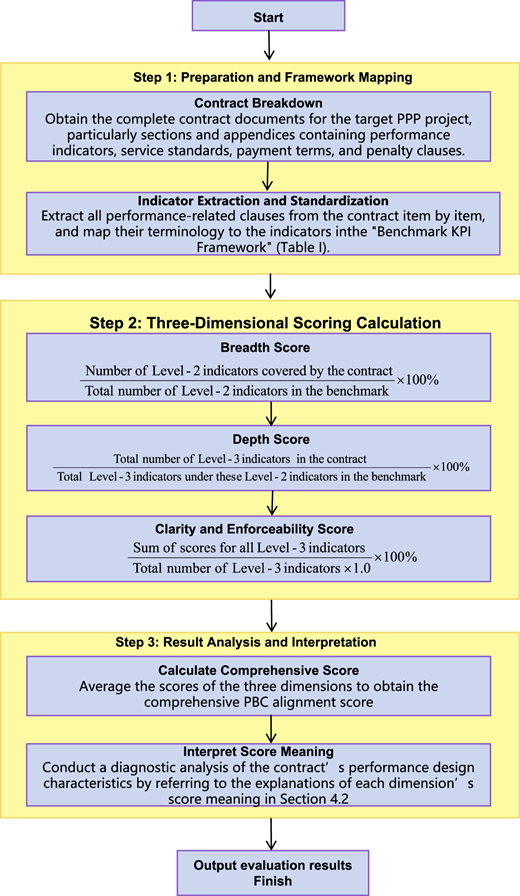
The unified KPI framework introduced in Section 4.1 provides the analytical basis for evaluating the extent to which individual PPP contracts reflect core features of PBC. The scoring method focuses not on actual project outcomes, but on how performance expectations are defined and operationalized within each contract. Each contract is assessed across three dimensions: breadth, depth, and clarity and enforceability.
Breadth refers to the extent to which a contract addresses the range of performance domains outlined in the benchmark framework. It is measured by calculating the proportion of Level-2 subcategories covered in each contract. A higher score indicates broader coverage of key functional areas. For this dimension, a higher score is clearly preferable, as it reflects a more comprehensive performance system that attends to a wider set of operational, outcome-based, and management-related responsibilities. This breadth ensures that performance monitoring extends across all critical aspects of service delivery, rather than concentrating on a narrow subset of priorities, thereby supporting balanced contract execution and more holistic oversight.
Depth captures the granularity of indicator systems, as measured by the proportion of Level-3 indicators present under the performance domains that a contract includes. This dimension reflects how fully each addressed performance area is articulated through specific, actionable indicators. A higher score often signals greater operational clarity, but it does not necessarily imply better contract design. Excessive detail concentrated in a few subcategories may suggest over-engineering, while moderate but evenly distributed depth, particularly when combined with broad coverage, may indicate a more coherent and balanced structure. To avoid penalising contracts for domains they do not cover, the depth score is calculated only across Level-2 subcategories actually present in the contract. This approach ensures that the depth dimension remains focused on indicator refinement, independent of breadth. Moreover, as the benchmark framework evolves with additional project inputs, the reference framework itself may shift. This implies that there may be an optimal range for depth scores, and values significantly above this range could signal unnecessary complexity rather than improved performance definition. Therefore, depth should be interpreted in relation to both coverage balance and benchmark evolution.
Clarity and enforceability refer to how precisely each performance indicator is defined and the extent to which it is supported by measurable targets and enforceable mechanisms. This dimension captures the operational utility of Level-3 indicators, i.e. whether they are vague or actionable, and whether they provide a credible basis for monitoring and enforcement. Each present indicator is assessed using a four-tier classification (see Table 2): (1) vague or incomplete (0.0), (2) defined only (0.5), (3) defined and measurable (0.75), and (4) defined, measurable, and enforceable (1.0). For each contract, the clarity score is calculated as the total points assigned to all present Level-3 indicators divided by the maximum possible points (i.e. the number of such indicators multiplied by 1.0), then converted to a percentage. This approach ensures that the score reflects the quality of definition among indicators that are actually used in the contract, rather than penalising for absence.
Together, the three scores provide a multidimensional perspective on how performance-based China's PPP road projects are. Although the three scores serve primarily diagnostic purposes, an overall PBC alignment score calculated as the average can support simplified benchmarking across projects. This aggregate score may be helpful for policy analysis, cross-project comparison, and identifying contracts where alignment with PBC features is limited or uneven. Practitioners can refer to the algorithm flowchart in Figure 1 to conduct the aforementioned analysis.
5. Case study: application of the scoring method
To demonstrate the practical application of the KPI framework and scoring methodology developed in Section 4, the G208 project is presented as an illustrative case following the process outlined in Figure 1. The example illustrates how a real PPP contract can be systematically transformed into structured, quantifiable evaluation results, validating the method's feasibility and providing a clear practical reference for readers.
5.1 Case overview
The G208 Reconstruction Project in Mengjin District, Luoyang City, is a toll road PPP implemented under a BOT model. The concession period is 34 years, comprising a 4-year preparatory and construction phase followed by a 30-year operational phase.
The concession agreement, included in the project's bidding documents, consists of 15 chapters and 90 thematic clauses. Chapter 7, titled “Operations and Services,” sets out 12 clauses addressing general requirements for operations, maintenance, and service provision. Chapter 9, “Specific Regulatory Matters and Measures,” specifies that an operational performance evaluation must be conducted annually on a rolling 12-month basis.
The operational performance indicators that underpin this evaluation are detailed in Appendix Table A1 of the concession agreement. For the purposes of this study, these indicators have been extracted and reorganised as Table 3, which serves as the basis for applying the scoring method presented in Section 4.2.
5.2 Contract assessment results
Table 4 presents the mapping between the performance indicators specified in the G208 project and the corresponding benchmark indicators in Table 1. Each matched benchmark indicator is identified using its hierarchical code. While the wording of indicators in the case differs from the terminology used in the benchmark, interpretive alignment was achieved using the “Evaluation Criteria” and “Scoring Methodology” outlined in Table 3. These two columns guided the mapping of case indicators by assessing their intent, structure, and level of specificity, ensuring consistent correspondence with the benchmark.
The breadth analysis identifies 9 out of 13 Level-2 subcategories from the benchmark framework as being represented in the G208 project, resulting in a breadth coverage score of 69%. While some correspondences, such as those related to financial management, do not fully align with the benchmark's depth or specificity, they reflect the presence of relevant domains and are therefore counted in the breadth dimension. According to the benchmark in Table 1, the G208 project lacks indicators in four subcategories: sustainability, organisational management, institutional management, and incentive mechanisms. However, relevant clauses within the concession agreement address these domains implicitly. For instance, Article 42 (“Quality and Service Standards”) and Article 50 (“Party B's Innovation and Proactive Efficiency Enhancement”) stipulate requirements related to institutional systems and innovation practices. These provisions underscore the importance of broader performance domains, even when they are not explicitly itemised within the formal evaluation criteria.
The G208 project covers 20 Level-3 indicators across the 37 indicators located within the nine Level-2 subcategories it addresses, resulting in a depth score of 54%. This score reflects the extent to which performance expectations are specified through detailed and actionable indicators in the domains actually covered by the contract. Several indicators are directly defined, including those related to toll services (1.1.3), maintenance quality (1.2.6–1.2.9), and emergency management (1.3.2). Notably, in sub-category 1.1 (Project Operation), only 3 out of 11 benchmark indicators are present, indicating a shortcoming in how operational performance is detailed. While the formal indicator system appears limited, additional contract clauses implicitly align with benchmark indicators. For instance, Articles 19, 42, 44, 45, and 47 correspond to indicators such as insurance coverage (1.1.11), asset disposal (1.1.8), and maintenance quality standards (1.2.10). These provisions suggest a deeper performance logic embedded within the contract text, even when not presented as standalone indicators.
The G208 project demonstrates a high level of clarity and enforceability across its performance indicators. All 20 Level-3 indicators identified are clearly defined, with explicit assessment objectives, measurable thresholds, and associated penalty rules, as outlined in Table 3. For instance, full marks are granted for PQI, SCI, BCI, and TCI scores of 80 or above, while scores below this threshold receive no credit. In addition, Article 56 specifies evaluation methods such as document review, on-site inspection, and stakeholder feedback, and links overall assessment results to financial penalties ranging from 500,000 to 2 million yuan per point below defined thresholds. Contracts falling below a score of 60 for two consecutive years may be terminated. Based on these provisions, the clarity and enforceability score is calculated as: (20 × 1)/20 × 100 = 100%. This result indicates that all performance indicators are unambiguous, measurable, and backed by enforceable mechanisms, reflecting strong alignment with PBC features and a proactive approach to performance-based management.
5.3 Interpretation and reflections
Taken together, the G208 project's breadth score (69%), depth score (54%), and clarity and enforceability score (100%) yield an overall PBC Alignment Score of 74%. This reflects a reasonably strong alignment with PBC features. The project demonstrates wide coverage of performance domains and a high degree of indicator clarity and enforceability. However, the moderate depth score points to opportunities for enhancing the detail and granularity of performance expectations across all subcategories. Notably, many performance indicators are not explicitly listed within the contract's formal KPI framework but are embedded across various clauses. While these dispersed references support a more comprehensive performance logic, integrating such indicators directly into the KPI system would improve transparency, facilitate systematic monitoring, and strengthen contractual accountability.
The assessment of the G208 project highlights several important opportunities to strengthen the design of its performance evaluation system. While the contract demonstrates clear alignment with PBC features in terms of indicator clarity and enforceability, other areas merit targeted improvement. For instance, the operational subcategory (1.1) includes only 3 of 11 benchmark indicators, suggesting an under-specified performance framework in one of the most critical domains. More generally, the moderate depth score (54%) reflects limited granularity across several subcategories, which may constrain the precision of performance monitoring and weaken the guidance provided for service delivery.
A further limitation lies in the disconnection between formal KPI listings and performance-related clauses embedded elsewhere in the contract. The analysis revealed that many requirements aligned with benchmark indicators were present in the text but not explicitly included in the KPI framework. Had these qualitative clauses been quantified and incorporated into the formal indicator system, the breadth score would have risen from 69% to 85%, and the depth score to 78%. This finding reinforces a practical recommendation: integrating such clauses directly into the KPI framework would improve transparency, enhance systematic monitoring, and strengthen contractual accountability.
6. Conclusion
This study developed two key tools to evaluate how PBC features are embedded within road PPP contracts: a benchmark KPI framework and a structured scoring method. The framework offers a standardised, three-tiered architecture for organising performance expectations across four functional categories, while the scoring method provides a replicable approach to assessing the breadth, depth, and enforceability of performance provisions. Together, these outputs enable systematic analysis of contract design alignment with PBC features. The application of the method to the G208 project illustrated its practical utility, demonstrating how the framework and scoring criteria can be used to diagnose strengths and identify design gaps in real contracts.
This study contributes to the body of knowledge by creating the first systematic, document-based, and quantitative tool to diagnose how PBC features are embedded in Chinese PPP road contracts, bridging a gap between abstract policy principles and contract-level evaluation. The resulting KPI framework provides a practical diagnostic tool for key stakeholders involved in PPP road projects. For practitioners and contract drafters, it serves as a benchmark checklist for evaluating and comparing contracts, identifying gaps (e.g. missing sustainability metrics) and enabling structured self-assessment through scoring. For instance, a low breadth score indicates incomplete coverage, while high clarity with low depth suggests well-defined but operationally simplistic indicators. Benchmarking across contracts helps identify industry-wide weaknesses and supports establishing minimum design standards. For researchers, the framework provides a consistent coding scheme for large-scale comparative studies of PPP contracts across sectors or time, with the scoring method supplying replicable variables for empirical analysis.
This study also recognises its limitations. The benchmark KPI framework is based on a specific dataset of 26 PPP road projects and reflects the current stage of contract evolution in China. As additional projects enter the national database, the reference framework will need to be revised to capture emerging practices and new performance areas. Similarly, the scoring method focuses on design provisions rather than actual implementation or outcomes. Moreover, future research should implement the proposed evaluation method across all the projects in the project database to examine the status of PBC in PPP roads and inform the refinement of PPP contract performance design in China.