The Netherlands is one of the frontrunners in green concrete with innovative pilot projects and institutional settings (e.g. concrete agreement). However, mainstreaming green concrete needs to further overcome economic, institutional, technical and social barriers. Especially, demand-side organizations can play a critical role by setting environmental standards and project prioritization. In this regard, this study aims to understand how demand-side organizations can stimulate green concrete adoption in the construction sector by using the multi-level perspective (MLP) framework.
The MLP framework was chosen to understand the dynamics between socio-technical elements that shape the transition. This research uses a qualitative research approach by interviewing 12 key experts in the Dutch concrete industry based on their expertise and experience. Interviewees were identified based on the snowballing technique. Subsequent thematic analysis reveals strategies for accelerating green concrete adoption.
Key findings emphasize the need to promote diverse cement types tailored to specific applications, accelerate the development of alternative supplementary cementitious materials (SCM), create aggregate demand for near-mature innovations and provide large-scale testing for radical innovations.
This research provides construction stakeholders with a framework for identifying leverage points where policy alignment and market demand can jointly drive innovation diffusion.
This study highlights the necessity of integrating incremental and radical innovations to meet greenhouse gas reduction targets.
This study contributes to the construction management field by translating transition theory into operational insights for project-based organizations and demand-side actors.
1. Introduction
Concrete is extensively used in built environments, producing up to 8% of global CO2 emissions (Benhelal et al., 2013). Moreover, climate change, energy transition and material shortage call for innovation in construction materials (Bal and Rani, 2025). Green concrete is concrete that reduces environmental impact by partially or fully replacing Portland cement (PC) and natural aggregates with materials such as supplementary cementitious materials (SCM), alkali-activated binders, recycled aggregates and geopolymers while maintaining required performance (Suhendro, 2014; Al-Mansour et al., 2019; Sivakrishna et al., 2020; Asadollahfardi et al., 2021). Despite these innovations, their implementation remains limited due to their technical performance, political and market demand, and risk-averse behaviour from purchasers (Wesseling and Van der Vooren, 2017; Türkeli et al., 2022).
The existing literature on green concrete transition has largely focused on supply-side dynamics, including technological development, material innovation and producer-side barriers (e.g. Al-Otaibi, 2024; Danish and Mosaberpanah, 2022; Nodehi and Taghvaee, 2022). Demand-side perspectives have received comparatively limited attention, with only a small number of studies addressing how buyers and infrastructure owners shape market conditions for sustainable construction materials (e.g. Kadefors et al., 2021; Ruparathna and Hewage, 2015). The demand side organizations, including infrastructure owners and construction companies, can accelerate the transition by creating significant demand for green concrete through project prioritization and setting environmental standards that can influence the supply side (Edquist and Zabala-Iturriagagoitia, 2012). However, demand-side organizations are dispersed across various institutions, making it difficult to develop collaborative actions towards green concrete transition (Schiele, 2010). While green concrete technologies are well developed, there is insufficient understanding of how dispersed demand-side organizations can coordinate and mobilize collective demand to enable large-scale adoption of green concrete (Al-Otaibi, 2024).
To address this research gap, this study aims to investigate “How can demand-side organizations accelerate green concrete transitions leveraging different socio-technical elements of transition?” The objectives of the study are (1) to identify socio-technical elements in landscape, regime and niche levels of green concrete transition and (2) to identify barriers and potential transition pathways for demand-side organizations. The multi-level perspective (MLP) framework is useful to understand the interaction among multi-dimensional factors and actors that shape radical changes in socio-technical systems (Elzen et al., 2004; Wu et al., 2021). While MLP has been widely used to explain systemic transitions in energy and transportation sectors, its application to construction materials remains scarce. This study, therefore, contributes to the construction management field by translating transition theory into operational insights for project-based organizations and demand-side actors.
The Netherlands has been implementing various measures to reduce CO2 emissions in the construction industry, including the concrete agreement (Betonakkoord, 2018), the Circular Building Initiative (BouwCirculair, Link to the website) and the Concrete Innovation Desk (Beton Innovatie Loket, Link to the website), an independent verifier of concrete innovation. The active public procurement instruments, such as MKI (Milieukostenindicator; Environmental Cost Indicator), create a fertile context for examining regime–niche interactions. Moreover, there have been various pilot projects to test innovative green concrete applications (e.g. Afsluitdijk and URBCON-project). The Netherlands case can provide insight into the transition at different levels.
The study is structured as follows. The literature review section first introduces green concrete and its application limitations as well as the MLP framework. The next section outlines the methodology, including the context of the Netherlands. The analysis section details socio-technical elements in landscape, regime and niche levels of the Dutch concrete sector. The discussion section illustrates possible transition pathways, a typology of potential solutions and a reflection on using the MLP framework. Finally, the conclusion section highlights the significance, limitations and future research directions.
2. Multi-level perspective framework for green concrete transition
2.1 Green concrete transition as a socio-technical problem
Green concrete is defined as an environment-friendly building material that has less environmental impact compared to concrete made with traditional cement, PC (Suhendro, 2014). Green concrete essentially uses industrial waste or recycled materials to replace traditional PC or aggregates, providing benefits like lower costs, less landfill waste, new markets for waste and improved sustainability (Al-Otaibi, 2024). Despite technical innovations, the implementation of green concrete is yet limited due to economic, institutional, social and technical barriers, as summarized in Table 1.
Economic barriers mainly stem from the construction industry's focus on the iron triangle (scope, cost, time) of project management (Pollack et al., 2018). High initial costs and market uncertainties discourage the use of green concrete. Institutional barriers include a lack of policy, guidelines and regulation regarding green concrete practices, a lack of commitment and knowledge, as well as complex decision-making processes (Orozco et al., 2023). Social barriers are a lack of awareness of the benefits of green concrete, a negative perspective of waste material and a preference to maintain the status quo, making the transition difficult (Altarrazi et al., 2022). Finally, technical barriers include inflexible codes and standards, a lack of adequate data for green concrete and variations in the quality of green concrete (Darko and Chan, 2017).
Although these studies identified barriers of full green concrete implementations in domains, how technological, institutional and market dynamics interact across the socio-institutional dimensions have been underexplored (Al-Otaibi, 2024). There is a lack of understanding of the full complexity in economic and market dynamics that influence the adoption of green concrete, such as policy incentives, procurement practices and industry norms. To address this research gap, this study adopts the MLP framework.
2.2 Multi-level perspective framework
The MLP framework aids to analyse transitions in various sectors and cases (Wu et al., 2021; Wang et al., 2022). It is a heuristic, process-oriented framework to interpret long-term socio-technical transitions. Although MLP lacks empirical validation in terms of hypothesis-testing, it contributes to historically grounded empirical analysis based on qualitative data such as interviews, policy documents and industry reports. MLP has extensive empirical application, especially in energy and sustainability transitions (e.g. Kern, 2012; Lauttamaki and Hyysalo, 2019; Lode et al., 2022).
MLP categorizes the transition process into three different levels: landscape, regimes and niche (Geels, 2002; Geels and Schot, 2007). The landscape, the highest level, is characterized by its hardness and material context, such as the physical and spatial configurations of cities, industries and infrastructures. The change occurs at the slowest pace, influenced by cultural shifts, demographic movements and political transformations. The socio-technical regime represents the meso-level, stable state of existing technological developments. Technological developments are already well-integrated with other dimensions of the social framework, including policy, market dynamics, user preferences, industry, science and culture (Ninan et al., 2025). Finally, niche represents a protected space that allows for the experimentation and development of radical innovations that deviate from the dominant regime (Schot, 1998).
Transition starts with radical innovation at the niche level, driven by pressures from regime and landscape changes that create a “window of opportunity” (Köhler et al., 2019). When learning converges on a dominant design, network strengthens and performance improves, niche technologies can evolve into regime-level dominance (Geels and Schot, 2007). Effective transition management requires phasing out of old technologies while scaling up and supporting niche innovations through financial, regulatory and programmatic initiatives (Köhler et al., 2019).
More recent studies utilize MLP in sustainability transition, identifying potential drivers of transition (Cândido et al., 2023) and linking to macro project studies (e.g. Daniel, 2022; Geels and Locatelli, 2024), broadening its practical applicability and relevance. By using MLP as a diagnostic framework, this study identifies how emerging green concrete technologies (niches) can disrupt established practices (regimes) influenced by broader societal trends (landscapes). This holistic view aids in developing targeted strategies for accelerating the transition process. Furthermore, expanding the range of solutions beyond supply-side technology and economic considerations is critical to engaging more actors in the transition process (Geels et al., 2016).
3. Methodology
Under pragmatism, which focuses on investigating practical challenges and solutions (Creswell and Poth, 2016) by a reflective and iterative research process (Morgan, 2014), this study adopts qualitative research methods to understand the green concrete. A qualitative interview-based strategy is appropriate to capture experts' perspectives, experiences and interpretations rather than to test predefined hypotheses. Semi-structured interviews were conducted for the data collection, as they allow extracting comprehensive information from structured and non-structured open-ended questions (Adams, 2015). The selection criteria for interviewees are (1) experience with green concrete initiatives (e.g. involvement in national concrete agreement), (2) sectoral representation to ensure a mix of perspectives and (3) decision-making influence in determining concrete specifications. Snowballing was used to identify the interviewees since the experts with tactic knowledge on green concrete are difficult to identify through public datasets. Initial key informants were asked to recommend other relevant interviewees, allowing access to otherwise hard-to-reach expertise.
In total, twelve semi-structured interviews were conducted as thematic saturation was reached, with no new themes emerging in later interviews (Boddy, 2016). This follows the recommendation of 6–12 in-depth interviews for theoretical saturation in single-case qualitative research by Guest et al. (2006). The interviewees include policymakers, suppliers, clients and research institutes, as shown in Table 2. They are affiliated with the concrete agreement, which is a 2018 pact where the concrete industry, government and research bodies committed to making the sector sustainable by 2030. The roles of the respondents varied from managerial to technical experts.
The predetermined interview questions are aligned with key components of the MLP framework, for example, “What external pressures are influencing the green concrete transition in the Netherlands?” The interviews were conducted in English as the researchers are non-Dutch speakers. However, this did not affect the quality of the data as all respondents were comfortable with English. The interview transcripts were edited for grammar and clarity and analysed through ATLAS.ti. software.
The analysis followed a hybrid approach, beginning with deductive coding based on the MLP framework. As the analysis progressed, new codes and themes emerged inductively (see Appendix Table A1). Analysis focused on the positional logic of the actor (e.g. policy, client, supplier) and the nature of the interaction (technological, institutional, cultural). Coding was performed by a single researcher. Validity was ensured through triangulation across multiple data sources, including interviews, policy documents and industry reports, which allowed for cross-checking of emerging codes and themes.
4. Findings
The findings are organized according to the three analytical levels of MLP but interpreted through the lens of construction management dynamics, emphasizing the interdependencies between regulatory frameworks, procurement mechanisms and material innovation pathways.
4.1 Landscape level
At the landscape level, the interviewees recognized that the industry is stable with an internationally organized market that has relied on the same materials and practices for over a century. However, several drivers of green concrete transition are identified, including political transformation, economic trends, cross-sectoral interaction and technical characteristics.
At the European level, political transformation, such as the European Union's Emission Trading System (EU ETS), is perceived as the primary driver of the green concrete transition. Cement factories must acquire allowances for each tonne of CO2 they emit, incentivizing them to reduce emissions to avoid the costs of additional allowances. During interviews, cement manufacturers and associations noted that the EU ETS equalizes the playing field for all European cement producers and has effectively prompted the industry to reduce its emissions, as EXP 7 noted: “The ETS system creates an incentive for the industry to move away from CO2 emission and to go to lower CO2 emissions and to carbon capture in the end.” EU ETS is further supported by the Carbon Border Adjustment Mechanism (CBAM), which imposes carbon taxation on cement imported from outside Europe (European Commission, n.d.).
However, due to the EU ETS, interviewees highlighted the concerns on significant rise in carbon prices over the past years. For instance, the carbon price in April 2020 was around 18 euros per tonne, which increased to 73 euros per tonne by May 2024 (Trading Economics, 2024). This creates a strong economic incentive for cement producers to reduce CO2 emissions during the production process to avoid purchasing additional allowances. This situation not only motivates the cement industry to adopt incremental innovations such as low-carbon clinker or alternative SCMs but also encourages investment in efficient logistics, electrification of grinding and handling processes, and the adaptation of relevant standards and specifications.
Cross-sectoral changes pressure the cement industry. Currently, most cement factories in European countries use slag, which is a by-product of traditional iron-making processes, as EXP 6 mentioned, “there is no alternative material that comes close to the properties of slag.” However, steel producers are increasingly shifting to direct reduced iron (DRI) routes, which do not generate blast furnace slag (e.g. Tata Steel Nederland's planned transition to DRI around 2030). This shift is likely to reduce the availability of blast furnace slag, potentially constraining supply of a critical low-cost, low-carbon SCM used in blast furnace cement (CEM III) and composite cement (e.g. CEM V and CEM VI), thereby affecting both the feasibility and economics of low-carbon cement production pathways.
Finally, the technical characteristics of the cement industry influence transition. Annually, the global output of cement is around four billion tonnes according to the Global Cement and Concrete Association. Interviewees highlighted a critical issue: the success of sustainable innovations in the cement industry heavily depends on the availability and scalability of alternative raw materials. Any further innovations must consider the bulk nature of cement if they are to become mainstream in this sector. EXP 6 said: “The nature of our [cement] industry is […] a bulk industry. […] We need a substantial volume of raw materials.” This characteristic creates challenges for innovation, such as high energy consumption and extensive supply chain infrastructure.
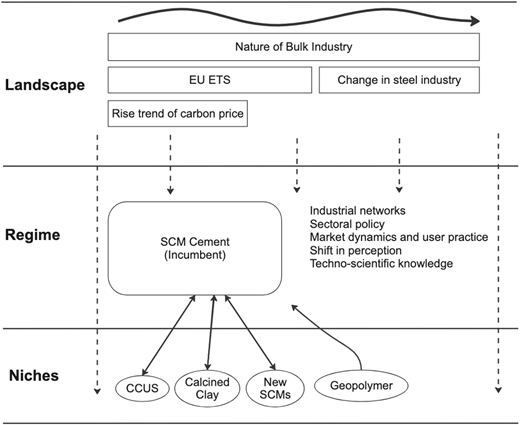
These findings demonstrate that the landscape level is not a passive backdrop but an active force in the transition process. Regulatory instruments such as EU ETS and CBAM, combined with cross-sectoral material disruptions and bulk industry constraints, are generating landscape pressures that destabilize the existing sociotechnical regime and create openings for niche-level green concrete innovations to emerge (Geels, 2002; Geels and Schot, 2007).
4.2 Regime level of green concrete transition in the Netherlands
The regime level represents the incumbent and institutionalized practice. In the Netherlands, SCM cement is mainstream in the concrete sector in regulations and standards, and culture. The main cement producers in the Netherlands offer different types of cement based on the composition of the clinker, including SCM CEM I (95–100% clinker composition), CEM II (65–94% clinker composition) and CEM III (5–64% clinker composition) products. According to EXP6, About 20% of the market still uses CEM I, which has the highest clinker content. Currently, there is a significant effort within the industry to shift from CEM I to CEM II to further reduce emissions.
Despite its dominance, the SCM cement producers face significant pressures from the landscape level, including EU-ETS and DRI, as illustrated in Figure 1. At the regime level, several drivers challenge incumbent SCM cement towards green concrete, including industrial networks, sectoral policy, market dynamics and user practices, shifts in perception and techno-scientific knowledge.
Industrial networks
The industrial networks among stakeholders in the Netherlands are structurally interconnected through various organizational levels and agreements. Nationally, since 2018, the connection between stakeholders has been formalized by the concrete agreement. This agreement facilitates collaboration between clients, concrete producers, cement manufacturers, cement associations, contractors and engineering consulting firms.
Bouwcirculair links local and regional stakeholders through nodes or concrete chains (e.g. Betonketen Amsterdam or Betonketen Zuid-Holland) that connect partners within a specific radius to leverage locational advantages for promoting sustainability. Moreover, the Dutch concrete industry supports the Beton Innovatie Loket, an independent entity tasked with verifying new innovations in concrete or cement. In addition, a coalition of concrete buyers from municipalities and provinces, known as Pianoobeton (PIANOo), facilitates the sharing of knowledge regarding the purchasing processes for specific thematic areas related to concrete.
Despite these initiatives, some experts believe the movement towards sustainable concrete requires compulsion, as EXP 8 noted, “As long as there is now no penalty […] in the agreement, it doesn't make much difference.” Interviewees estimated that only about 15% of the market is actively working towards sustainable concrete practices. Currently, barriers to innovation are becoming more pronounced due to organizational and commercial constraints.
Sectoral policy
In general, many interviewees believe that policy harmonization between higher and lower levels is quite collaborative. At the European level, the EU ETS system incentivizes suppliers to minimize their emissions, while at the project level, particularly within public client organizations, the MKI, the environmental cost indicator, provides an advantage to bid proposals that support CO2 reduction. The MKI translates lifecycle environmental impacts into a monetary score that can be used as a weighted criterion within BPQR (Best Price Quality Ratio) awards to prioritize lower environmental impact bids (PIANOo, 2024). Recent Rijkswaterstaat protocols further embed MKI requirements into contract calculations and monitoring to ensure that the offered MKI performance is realized in delivery (RWS, 2024). Although the MKI does not directly push contractors to use green concrete, it does assign significant weight to carbon reduction during tendering, potentially encouraging the use of low-carbon concrete in projects.
Interviewees recommend the development of standardization measures similar to MilieuPrestatie Gebouwen (MPG), the building performance indicator, which displays CO2 emissions per square metre of building. While building standards have a maximum acceptable CO2 emission level, similar standards for other types of infrastructure, such as bridges or roads, are not yet established. Moreover, building codes and standards are perceived as prescriptive, discouraging contractors from using sustainable concrete due to the additional testing required to achieve equivalency with traditional materials. Additionally, innovators in SCM highlight the lack of legislation concerning cementitious materials. They face lengthy processes of compiling reports and conducting testing to prove the performance of cementitious concrete. Furthermore, interviewees advise that the Dutch concrete sector should prepare for future legislation that might restrict concrete infrastructure development due to limited carbon emission quotas.
Market dynamics and user practices
There are diverse perspectives from public clients toward green concrete. On one hand, many parties prefer to adopt new solutions only once they have reached a high level of maturity due to a risk-averse attitude. EXP 6 mentioned: “You see some resistance in the market, and they want to remain with what they know now instead of switching to.” On the other hand, some market segments are keen to engage in experimental programmes, such as those led by Rijkswaterstaat, ProRail and some municipalities and provinces. These groups tend to apply sustainable concrete in low-risk situations, such as in non-load-bearing or removable parts.
The interviewees also highlighted that the level of expertise among in-house engineers significantly influences how organizations respond to green concrete options. Conversely, current cement producers and concrete associations note a lack of structured purchasing in the market, which does not sufficiently motivate cement manufacturers towards specific innovation directions. Furthermore, another cement producer pointed out the absence of standardized demands across organizations, with each requesting different solutions, complicating the ability to meet a minimum business case. Concrete buyer groups have suggested forming a coalition of small- and medium-sized purchasing organizations to consolidate demand for specific green concrete solutions, particularly those nearing maturity. Technical methodologies are suggested to catalyse broader adoption among organizations, such as over 300 municipalities in the Netherlands, which could create higher aggregate demand than Rijkswaterstaat or ProRail. One suggestion is to establish a standardized labelling system for concrete products, such as grades B, A and A+, that denotes durability performance, maximum carbon emissions, environmental class and circularity level, aiding client organizations in making informed purchases.
Addressing user practices, interviewees emphasize the future scarcity of slag, a key cementitious material in CEM III and recommend preparing the market for a new paradigm in cement usage. Historically, the market has been accustomed to a “one cement fits all” approach. This needs to shift towards a “cement with purpose” strategy, where different types of cement (e.g. CEM II/C-M and CEM VI (EN 197 5 (2021)) are developed for specific applications, each with varying strengths, curing times and durability profiles. This shift is essential for saving the emissions quota and addressing the challenges of replacing slag.
Shift in perception
Many interviewees noted that there is no other structural material comparable to concrete in terms of longevity and durability, capable of lasting decades or centuries. This resilience is often celebrated, and many stakeholders are keen on preserving this legacy, as EXP7 said: “Concrete is a very durable material. So, it has a lifespan of possibly, depending on the situation, 50 years to infinite. […] so that's very valuable to keep it that way.”
Introducing green concrete has challenged these perceptions, particularly regarding the material's inherent strength. Such changes are viewed symbolically among stakeholders, where the strength of concrete represents more than just a physical property and embodies reliability and security. The symbolic value was evident when one Dutch cement supplier attempted to transition from CEM I to CEM II, which led to a perceived reduction in strength and, subsequently, customer resistance.
Additionally, the solid knowledge and stability of the concrete industry have relied on traditional materials for over 80 years. The current focus on carbon emission reduction presents good momentum for the industry to explore alternative materials beyond traditional cement. This period of transition is not just about technological innovation but also cultural adaptation, as EXP2 said: “It's now time to learn to accept new materials because, for the last 150 years, we have only used cement-based concrete and steel reinforcements.” Moreover, societal attitudes towards risk tolerance have shifted. Historically, there was greater acceptance of potential failures; today, there is less tolerance for risk, which poses a significant cultural barrier.
Techno-scientific knowledge
Current technology and scientific knowledge highlight the superior qualities of slag as an SCM predominantly used in cement. They noted slag’s unique characteristics, which are currently irreplaceable by any single material, such as calcined clays, volcanic ashes and bottom ashes. To achieve performance comparable to that of current slag-based products, a combination of several alternative materials will be necessary. Therefore, researchers anticipate that future SCM cement formulations will involve more complex chemical interactions, as EXP9 said: “There will be more chemistry in the concrete than before to optimise the properties.”
Additionally, the precast industry in the Netherlands faces a significant technical challenge. This sector requires concrete with a rapid strength development time to maintain daily production cycles that optimize space and materials, such as moulds and formwork. Low-carbon cements like CEM III, which contain less clinker, typically require longer times to reach full strength, posing challenges for industries needing quick turnaround times.
While landscape-level pressures such as EU ETS and DRI transitions are beginning to destabilize incumbent practices, the regime's institutional structures, cultural resistance and technical dependencies continue to constrain the pace and direction of green concrete transition. This tension between external pressure and internal inertia is a defining characteristic of regime-level dynamics in sociotechnical transitions (Geels, 2002; Geels and Schot, 2007).
4.3 Niche level of green concrete transition in the Netherlands
Generally, interviewees believe that the Netherlands offers a conducive environment for developing niche innovations. Many radical innovations are sponsored by public client organizations. For example, geopolymer concrete is frequently supported for its potential to completely replace traditional cement (Singh et al., 2015). There are technological developments that can break through to the regime level, including new SCM, carbon capture utilization and storage (CCUS) and geopolymer concrete.
New SCM
Although slag-based SCM currently predominates in the market, extensive research focuses on alternative green concrete solutions in the Netherlands. In the near term, the primary focus of both incumbent cement manufacturers and new entrants is to search for suitable SCM alternatives to replace slag. Interviewees highlight calcined clays and volcanic ashes due to their scalability and technical feasibility. Calcined clay aims to replace traditional limestone in kilns with clays that emit less carbon (Scrivener et al., 2018), while volcanic ashes are recognized for their similar properties to natural cement but with fewer environmental impacts (Játiva et al., 2021). These ashes, which can be sourced from places like Germany and the Mediterranean, could also be supplemented using bottom ashes from the 10–12 incinerators operating in the Netherlands.
Other potential SCM alternatives include natural pozzolan and finely recycled materials. Most interviewees are optimistic that all these alternatives will dominate the market within the next 10–15 years in the Netherlands, as EXP 7 asserts, “I think in 10 years, we need to be able to have 2 million tons of other SCM, and that will mostly be calcined clay and volcanic ash.” They perceive no significant technical barriers to development, though extensive testing, such as for carbonation, is required and can be time-consuming. The relatively low cost of slag, at around 130 euros per tonne, poses a challenge to the economic feasibility of developing these alternative SCM. However, experts anticipate that rising demand for SCM from neighbouring countries like Germany and France will drive up slag prices. Should slag prices surpass those of PC, which is currently around 200 euros per tonne, the development of alternative SCM would become markedly more appealing.
Carbon capture utilization and storage
In the long-term strategic transition, cement manufacturers are increasingly focused on developing CCUS. This technology is favoured by most producers as it can integrate with existing infrastructure. EXP 6 said, “The carbon capture […] is very expensive, but in the long run, it's cheaper […] than to emit and to pay for the emission rights.” Despite extensive efforts to reduce emissions from the clinker process, a residual amount of carbon remains, making this technology crucial for achieving the zero-emission target by 2050. However, the Dutch clinker producing plant (ENCI Maastricht) ceased to operate in 2019, making the applicability of CCUS technology in the Netherlands low (West and Uslu, 2023). Yet, the Netherlands continues to invest in CCUS research, infrastructure and pilots, recognizing carbon capture will likely be required at some point to achieve deep emissions cuts in cement (West and Uslu, 2023). Interviewees also recommend maintaining openness to the potential of CCUS, emphasizing that any initiative aimed at preventing carbon release into the atmosphere is beneficial.
Geopolymer concrete
Cement producers currently view geopolymers as not yet sufficiently developed for mainstream use, particularly at the regime level. Interviews revealed that geopolymers are not a priority in cement producer agendas, as EXP 7 noted, “It [Geopolymer concrete]'s a young child. […] But there's still a lot to learn before it gets adult.” This is partly because this alternative binder heavily relies on slag, a material already utilized in SCM. In addition, existing design codes may not account for the material behaviour of geopolymer concrete, which can lead to inadequate performance in structural applications. Despite promising developments in geopolymer concrete, the use of non-slag materials remains challenging.
Many interviewees predict that geopolymers will eventually find certain parts in the Dutch market, especially those that do not require high load-bearing capacity or pose significant risks, as EXP 9 noted, “It [geopolymer] will take part, and many other technologies will also take part.”
While none of these innovations has yet achieved sufficient maturity or scale to challenge the incumbent regime, the conducive environment in the Netherlands – supported by public clients and research investments – suggests that protected niche spaces are actively being cultivated. The transition potential of these innovations will ultimately depend on the alignment between niche developments, regime-level openings and continued landscape-level pressures (Geels, 2002; Geels and Schot, 2007).
5. Discussion
This study contributes to understanding how niche-level innovations in green concrete interact with existing construction regimes, influenced by landscape pressure. The findings are in line with existing literature that, despite growing technological readiness at the niche level, economic, social and institutional barriers constrain wider diffusion at regime and landscape levels (Löfgren and Rootzen, 2021; Al-Otaibi, 2024). The Dutch market shows a preference for mature technologies due to risk-averse behaviour under market uncertainties (Altarazzi et al., 2022). Also, the interviewees agreed that the absence of standardized demands across organizations hinders meeting a minimum business case for green concrete, which was also highlighted in the findings of Busch et al. (2022). Consolidating demand through coalitions of small- and medium-sized purchasing organizations could create higher aggregate demand for near-mature innovations. This is also highlighted in Barbhuiya et al. (2024) that collective behavioural change and policies are crucial for sustainable transition in the cement industry.
In terms of social barriers, a strong cultural attachment to traditional concrete's durability and safety, which is recognized both in the Netherlands and worldwide, strengthens the dominance of energy-intensive cement (Wilde and Hermans, 2024). Shifting perceptions towards accepting new materials and promoting the “cement with purpose” concept, which suggests that one or two types of cement will no longer be suitable for all concrete applications, is essential for broader adoption and a shift in perception. To do so, addressing industry and end-users’ concerns about the health, performance and economic impacts of using green concrete is required (Love et al., 2025).
The findings showed how policy and regulatory frameworks at the landscape level can accelerate green concrete transition. The broader initiatives at the European level, such as the EU ETS and CBAM, incentivize emission reductions in the cement industry. At the national level, the concrete agreement and the MPG (Environmental Performance of Buildings) provide benefits for the cement industry. However, the Dutch case also illustrates new institutional barriers, such as the lack of standardized regulations for infrastructure projects and the prescriptive nature of building codes. This supports the need for harmonized policies to facilitate sustainable practices in the construction industry (Busch et al., 2022). Moreover, external factors such as change in the steel industry and rising carbon price pressure the price of traditional cement production, which can in turn increase demand for alternative cements. Therefore, it is important to consider multi-dimensional policy impact, which may have an unexpected impact (Bernsteiner and Ninan, 2024).
Based on these findings, several potential transition pathways are identified (see Table 3). Achieving carbon reduction targets will require a combination of all possible green concrete alternatives, as no single solution is sufficient. The pathways include various transition processes, from bottom up (breakout, substitution and reconfiguration) to top down (transformation). This does not mean there exists only one “right” pathway; rather, it shows a possibility of various combinations and possibilities. It is important to remain open to potential innovations, even those that may seem far-fetched today.
6. Conclusions
This study applied the MLP framework to investigate the transition process towards green concrete in the Netherlands. The qualitative analysis was underpinned by semi-structured interviews with key stakeholders in the Dutch concrete industry. At the niche level, the study identified a fertile environment for radical innovations such as geopolymer concrete and alternative SCMs like volcanic ashes, calcined clays and CCUS. These innovations are often shielded from standard market pressures. At the regime level, the dominance of SCM-based cement like CEM III, supported by the high-quality slag from the steel industry, underscores the Dutch market's leadership in green concrete. Nonetheless, the industry faces pressures from the landscape level: EU carbon regulations and shifts in the steel industry, necessitating both incremental innovations and radical transformations.
The findings demonstrate that, along with technological feasibility, the alignment (or misalignment) between demand-side coordination, institutional arrangements and material innovation pathways across multiple socio-technical levels also constrains the green concrete transition. We argue that transitions in construction materials are fundamentally governance- and demand-driven processes, rather than linear technology diffusion processes.
The MLP framework suggests that integrating incremental and radical innovations is necessary for successful transitions. The demand-side organizations can accelerate the green concrete transition in the construction sector by first promoting the “cement with purpose” concept. This concept advocates for the use of specific cement types for different applications based on their environmental impact, offering a practical decision-making heuristic for clients and contractors to balance performance requirements with carbon reduction objectives under increasing regulatory pressure. Second, the invention of new materials beyond slag and fly ash, supported by pilot projects, is crucial for enhancing emission reduction. Third, demand-side organizations can create aggregate demand for near-mature innovations and provide a large-scale testing field for radical innovations. Finally, strategies at the regional level, such as promoting slag in Germany and France, may also incentivize the feasibility of new SCMs. For industry and practitioners, the findings provide actionable guidance on how demand-side organizations can move beyond pilot projects by aggregating demand, standardizing procurement criteria and strategically supporting near-mature innovations. Conceptually, this study contributes to sustainability transition theory by positioning demand aggregation and procurement practices as mediating mechanisms between regime stability and niche experimentation. It demonstrates that the MLP framework can be adapted to capture micro-level decision-making processes in construction organizations, thus extending its relevance beyond conventional transition domains such as energy and mobility. This cross-disciplinary perspective provides a foundation for future comparative studies on low-carbon construction transitions across different national contexts.
This research has several limitations. First, the single case study focussing on the Netherlands may have limited insight into other countries where the policies and governance structure are widely different. However, many construction markets worldwide face similar challenges, including fragmented demand and increasing carbon regulation. The demand-side mechanisms identified in this study are transferable to other national contexts seeking to decarbonize construction materials. Second, this research only investigated demand-side organizations, especially municipal and provincial-level organizations. National public clients or private sector organizations were not included. Future research can focus on the broader boundary to analyse transitions such as the EU or Benelux level and understand how national-level policies and mandates influence other countries. Future research can broaden the actors to suppliers and investigate how a sustainable supply chain can be created for the green concrete transition.
Human participants
This research followed all necessary ethics approval, mainly by the Human Research Ethics Committee (HREC) from the TU Delft including the Data Management Plan. The Ethics coordinator for this matter is Thijs Slot. The HREC application was approved on 1 May 2024.
Declaration of generative AI and AI-assisted technologies in the writing process
During the preparation of this work, the author(s) used ChatGPT in order to improve grammar and readability. After using this tool/service, the author(s) reviewed and edited the content as needed and take(s) full responsibility for the content of the publication.
This study was part of the research done to achieve a master's degree at the University Technology of Delft.