School-provided lunch programs have widespread benefits, but there is no universal school-provided lunch program in Australia. This study analysed teacher perceptions about current school food provision practices and the transition to a school-provided lunch program, and associations with school characteristics.
A cross-sectional online survey collected data about teacher perceptions regarding (1) current school food practices and children’s food behaviours; and (2) a proposed school-provided lunch program. Statistical analyses were conducted using STATA, including descriptive statistics and simple and multiple regression models to determine associations with school type, rurality, socioeconomic position (SEP) and size.
Participants were 337 Australian primary school teachers. Teachers in low-SEP areas were more likely to report students coming to school without lunch (p < 0.0005) and less likely to report students having a healthy lunchbox (p < 0.0005). Teachers were either uncertain (n = 141, 42.0%) or they agreed (n = 99, 29.4%) that schools should implement a school-provided lunch program. They identified benefits, barriers and enablers relevant to school-provided lunch programs.
This is the first study to explore perceptions of Australian primary school teachers about a school-provided lunch program. With growing demand and increasing political traction for school-based food provision, findings from this study can be used by governments, public health advocates, school leadership and other stakeholders to develop a feasible, economically viable and sustainable approach to a universal school-provided lunch program for Australian schools.
Background
Healthy dietary habits during childhood are essential for health and development (World Health Organization, 2016). The primary school years (ages 5–12 years) are critical for establishing dietary habits that may track into later life, influencing short- and long-term health (Movassagh et al., 2017). Nearly all Australian children attend school, for an average of seven hours on weekdays (Victorian Department of Education, 2023), where they consume over a third of their daily energy (Manson et al., 2021). Schools are uniquely positioned to promote healthy eating for children, and systematic reviews suggest interventions that support a healthy school food environment can improve children’s eating behaviours (Chatterjee and Nirgude, 2024, O'Brien et al., 2021).
The school lunch meal can promote healthy eating at school. Internationally, school lunch models vary, but typically comprise a packed lunchbox from home; food purchased from school canteens or external outlets; or school-provided lunch programs. Up to 90% of Australian children bring a packed lunchbox from home (Sanigorski et al., 2005), though up to 40% of energy from lunchbox foods comes from unhealthy choices (Sutherland et al., 2020). While some schools offer canteen or lunch order purchasing, menu compliance with government canteen policies is low (Woods et al., 2014; de Silva-Sanigorski et al., 2011). This indicates children’s dietary intake at school may be suboptimal.
Universal school-provided lunch programs, where schools supply cooked meals, may address this issue. Systematic reviews suggest school-provided lunches can improve children’s diet quality and food security (Cohen et al., 2021), wellbeing (Wall et al., 2022) and school attendance and academic achievement (Raveenthiranathan et al., 2024). While such programs exist in the US (U.S.D.A, 2024), Japan (Tanaka and Miyoshi, 2012) and several European nations (Bruckmayer et al., 2021), Australia remains one of few Organization for Economic Cooperation and Development (OECD) countries without a universal school-provided lunch program. However, the transition to such a model is gaining consumer and political momentum (ACT Government, 2024), spearheaded by the pilot Tasmanian School Lunch Project (SLP) which is the only implemented and evaluated school-provided lunch program in Australia to date (Jose et al., 2024). Evaluation of 12 participating schools identified benefits including increased student access to healthy food, enhanced social connection and positive behavioural changes. Short-term commitment and inadequate strategic direction regarding project delivery were barriers to the initiative.
Growing support for transitioning to a school-provided lunch program in Australia, and sparsity of research in this space, indicates evidence to guide strategic delivery of such a program is pertinent. This includes understanding key stakeholder perspectives, particularly teachers, who can influence students’ dietary habits through mealtime supervision, role modelling and linking school meals to curricula (Rossiter et al., 2007; Manson et al., 2022). Whilst previous studies have investigated Australian parents’ (Aydin et al., 2023; Nanayakkara et al., 2024a) and children’s (Coulls et al., 2023) perceptions regarding school-provided meals, little is known about the perspectives of Australian primary school teachers. Whilst the SLP evaluation considered teacher perceptions, this was limited to teachers from only seven primary schools within one Australian state, focusing on one individual program (Jose et al., 2024).
To our knowledge, no published studies have explored broader teacher perspectives about transitioning from a lunchbox model to a school-provided lunch program in Australia. Moreover, the degree to which school-specific characteristics, for example, school type, rurality, socioeconomic position (SEP) or school size may influence these perceptions is unknown.
Given these research gaps, this exploratory study analysed teacher perspectives about food provision in Australian primary schools, focusing on school lunch. We aimed to address the research questions (1) How do teachers perceive current practices in school-based food provision and children’s food behaviours; (2) What are teachers’ perceptions about transitioning to a school-provided lunch program; and (3) Are teacher perceptions associated with school-level characteristics (school type, rurality, SEP and school size).
Methods
Study design and participants
A cross-sectional online survey was conducted in July 2022. Eligible participants were teachers of primary school aged students in Foundation (Prep) – Grade Six in a registered school in Victoria, Australia. Participants were excluded if they were not a primary school teacher (for example, administrative staff) or if they did not work at a registered Victorian school (for example, interstate).
Participants were recruited via convenience sampling using a social media advertisement promoted on Facebook. Teachers who clicked on the embedded link were directed to a voluntary, self-administered survey with a Plain Language Statement and consent question. Respondents who consented to participate and responded “yes” to the screening question “Are you a classroom teacher at a Victorian primary school?” could complete the survey.
Survey instrument
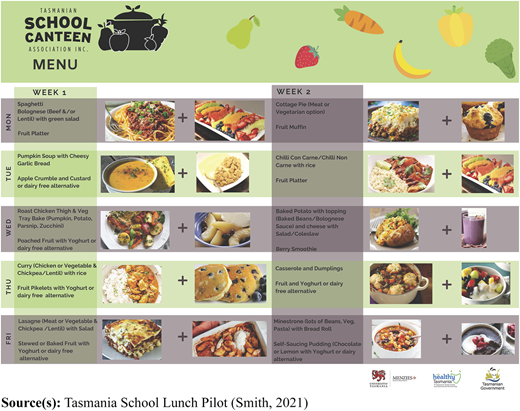
Due to the novelty of this study, a survey instrument was purpose-built by the research team, based on previous analyses of parent opinions of school-provided lunch programs (Aydin et al., 2023; Nanayakkara et al., 2024a). The survey included questions about teachers’ perspectives regarding: (1) current school food practices and children’s food behaviours (n = 20); (2) a proposed school-provided lunch program (n = 14); and (3) teacher (n = 5) and school (n = 3) demographics (questions are summarised in Table 1; see Supplementary file 1 for full survey). Where relevant, prompts (for example, “please specify … ”) were used to glean specific information. One open-ended question captured teacher-generated ideas about their role in a school-provided lunch program. An image of a sample school-provided lunch menu was included to support participant responses (Figure 1; Smith, 2021). The survey was checked for clarity by three experienced school food education researchers and one primary school teacher. Minor adaptations were made for clarity. The survey was built into Qualtrics XM (Qualtrics, 2020) and was designed to be completed within 10 min.
Data analysis
Statistical analysis
Statistical analyses were conducted using STATA v17 (StataCorp, 2021). Ordinal variables with 4–5 response options (for example, proportion of children not bringing lunch to school) were grouped into three categories (for example, all/many, some and few/none). Responses to matrix questions (5-point Likert scale) about teacher perceptions of current lunchtime practices were grouped into three categories (strongly agree/somewhat agree, neither agree nor disagree, somewhat disagree/strongly disagree).
School type was dichotomised as government and non-government (independent, Catholic, other schools). Area-level SEP was determined using the Australian Bureau of Statistics Index of Relative Socioeconomic Advantage and Disadvantage (IRSAD). Decile IRSAD scores were matched via postcode (1 = greatest disadvantage; 10 = greatest advantage) and categorised into tertiles (low-SEP = deciles 1–4, medium SEP = deciles 5–7, high-SEP = deciles 8–10). School rurality was determined by postcode matching to the Australian Statistical Geography Standard (Australian Bureau of Statistics, 2021). Schools were classified as “Major city”, “Inner regional city” or “Outer regional city” based on postcode and dichotomised to “Major city” or “Regional city”. School size was reported as “Small” (≥15 to ≤200 students), “Medium”(>200 to <300 students) or “Large” (≥300 students) as classified in the Australian Education Act (Australian Government, 2013).
Frequency data were reported for the complete cohort of teachers. Descriptive statistics were also reported across categories of school characteristics, including frequencies and proportions for categorical variables and means with standard deviations for continuous variables. Subgroups analysis was used to explore associations between survey outcomes and school characteristics including school type, rurality, and SEP (categorical variables) as well as school size (analysed as a continuous variable).
Simple regression models were fitted to analyse associations between survey outcomes and each school characteristic. Additionally, multiple independent variable regression models were fitted to analyse associations between outcomes and school characteristics independent of each other. There was no evidence of multicollinearity between school characteristics. As analyses were exploratory, no explicit adjustment was made for multiple testing, however a conservative p-value of <0.01 was used for statistical significance.
Content analysis
Conceptual content analysis, which quantifies the frequency of words or phrases within text (Baumeister and Vohs, 2007), was conducted using NVivo 14 (Lumivero, 2023). Responses to prompt questions (for example, “please specify”) and the one open-ended question about teachers’ role in a school-provided lunch program were uploaded to NVivo. Text was reviewed to identify presence and frequency of words and concepts, which were then grouped into categories based on similarity.
Results
Respondents
Of 450 participants who consented to participate in the survey, 53 were excluded because they were not located in Victoria (n = 24) or were not current classroom teachers (n = 29). Sixty survey records did not include at least one school demographic variable used in statistical analyses (school type, postcode or size) and were considered incomplete. In total, 337 responses were included in the analysis. Respondents were mostly female (n = 310, 92.0%) and teaching in government schools (n = 276, 81.9%). Schools had an average IRSAD of 5.4 (SD ± 2.8) and an average 499.1 (SD ± 410.0) enrolments. School and teacher characteristics are outlined in Table 2.
Teacher perceptions of current school-based food provision practices and children’s food behaviours
Teacher perceptions of current school-based food provision practices and children’s food behaviours are reported in Table 3 and explained below, focusing on lunchtime, breakfast and school food policies. Associations with school characteristics are reported (see Supplementary file 2, Tables S1 and S2 for regression analyses).
Lunchtime
Students without lunch
Most teachers (n = 260, 77.2%) reported few/no students come to school without lunch on one or more days in a typical week. Teachers from low-SEP areas were more likely to report some students coming to school without lunch than teachers from high-SEP area schools, independent of other school characteristics (27.3% vs 3.5%; p < 0.0005). No further associations with school characteristics were observed. Most teachers stated if a child comes to school without lunch, food is provided to them (n = 304, 90.2%), for example, a sandwich from staffroom supplies. In an adjusted model, this was not associated with school characteristics.
Healthy lunchbox
Over half of teachers agreed most students have a healthy lunchbox (n = 183, 54.3%) (Table 3). In an adjusted regression model, teachers were less likely to agree their students had a healthy lunchbox when they taught in a government vs non-government school (50.2% vs 70.5%; p = 0.003) and in a low-SEP vs high-SEP area (40.5% vs 70.6%; p < 0.001). These results were not associated with school rurality or size.
Lunch purchasing
Less than half of teachers reported their school had a canteen (n = 161, 47.8%) or off-site lunch order service (n = 102, 30.3%). Some specified that this was only available a few times a week or a few times a term. Few teachers reported their students could access an onsite café (n = 12, 3.6%) or delivery service such as Uber Eats (n = 5, 1.5%).
Time available for eating lunch
The mean time available for students to each lunch was 13.8 min (SD ± 9.0), however 55.8% of teachers (n = 188) reported their students had ≤10 min available to eat. Whilst approximately half of teachers agreed enough time is provided for students to eat lunch (n = 188, 56.0%) and that most finish their lunch in the allocated time (n = 188, 56.0%), 61.3% (n = 206) reported most students rush to finish their lunch at school (Table 3). These results were not associated with school characteristics.
Lunch environment
Nearly all teachers agreed the social environment during school lunchtime is important (n = 313, 92.9%) (Table 3). A third agreed teachers should eat their lunch with students (n = 120, 35.7%) and that lunchtime should be used as an opportunity to teach students about food and nutrition (n = 119, 35.3%) (Table 3). These results were not associated with school characteristics. Most teachers reported students eat lunch in the classroom (n = 283, 84.0%), rather than a dedicated outside eating area (n = 101, 30.0%) or the school yard (n = 53, 15.7%).
Breakfast
Half of teachers reported their school had a breakfast program (n = 169, 50.2%), for example, Foodbank (n = 122) or Outside School Hours Care (n = 62). Fewer teachers specified breakfast programs were run by the school itself (n = 21). Teachers reports of school breakfast programs were more likely in government vs non-government schools (58.2% vs 13.1%), in regional vs major cities (65.3% vs 42.7%) and in low- vs high-SEP areas (63.6% vs 25.9%) (all p < 0.0005). When adjusted for covariates, this relationship was retained for school type and SEP only. Presence of breakfast programs was not associated with school size.
Policies
Less than a quarter of teachers reported their school had policies about food and nutrition (n = 81, 24.0%) and this was not associated with school characteristics. When prompted to describe policies in place, teachers discussed general healthy eating (n = 28), nude food and food packaging (n = 22), allergies (n = 17), fruit and vegetables (n = 14) and canteen food provision (n = 9).
Teacher perceptions of a school-provided lunch program
Teachers’ perceptions of a proposed school-provided lunch program are reported in Table 4 and explained below, focusing on benefits, barriers and enablers, funding, dietary requirements, parent preferences and teacher roles. Associations with school characteristics are reported (see Supplementary file 2, Table S3 for regression analyses).
Benefits, barriers and enablers
When asked whether all primary schools should have a school-provided lunch program, 71.2% (n = 240) of teachers responded “yes” (n = 99) or “maybe” (n = 141), and this was not associated with school characteristics. These teachers (n = 240) reported a variety of benefits of a school-provided lunch program (Table 4), including the opportunity for students to eat healthy food (n = 212, 88.0%) and a hot cooked meal (n = 161, 67.4%), convenience for parents (n = 170, 70.5%) and positive peer influence to encourage trying new foods (n = 151, 62.9%). Less than a quarter of teachers reported primary schools should not have a school-provided lunch program (n = 83, 24.6%).
Teachers reported a variety of barriers to implementing a school-provided lunch program (Table 4) including cost to parents (n = 265, 78.6%), teachers not wanting to serve food (n = 244, 72.4%), time to serve students (n = 233, 69.1%), food waste (n = 208, 61.7%), fussiness (n = 183, 53.3%) and inadequate space (n = 177, 52.5%). After adjusting for covariates, teachers from schools in major cities (vs regional cities) were more likely to report allergies as a barrier to a school-provided lunch program (42.2% vs 23.5%; p = 0.009). There were no further associations between perceived barriers and school characteristics.
Funding (n = 281, 83.4%), resources (n = 262, 77.7%) and improved facilities (n = 258, 76.6%) were reported enablers for successful implementation of a school-provided lunch program. Teachers from schools in low-SEP areas were more likely to report funding as an enabler, independent of other school characteristics (91.7% vs 77.7%; p = 0.009). There were no other associations between perceived enablers and school characteristics. When prompted, 34 teachers (10.1%) described additional personnel (for example, to cook, serve and clean) as important.
Funding
Of 240 teachers who reported all primary schools should/maybe should have a school-provided lunch program, 49.2% (n = 118) reported this should be fully government funded as opposed to co-funded by government and families (n = 111, 46.3%) or fully funded by families (n = 5, 2.1%). These results were not associated with school characteristics. Of 116 teachers who reported parents should be involved in funding (solely or together with government), 48.3% (n = 56) thought parents would be prepared to pay $3–4 AUD per meal whilst 25.9% (n = 30) thought they would pay $1–2 AUD per meal. Half (n = 61, 52.6%) stated parents would need to see what is offered before deciding what to pay.
Dietary requirements
Of 240 teachers who reported schools should/maybe should have a school-provided lunch program, most agreed providing nut-free (n = 226, 94.6%), vegetarian (n = 219, 91.6%), dairy-free (n = 217, 90.4%), egg-free (n = 210, 88.2%), gluten-free (n = 207, 86.3%) and vegan (n = 175, 73.2%) options was important. Of 45 teachers who reported other important dietary considerations, 66.7% (n = 30) described cultural and religious needs (for example, Halal meals).
Parent preferences
When asked whether they thought parents would prefer a school-provided lunch program, 58.3% of teachers reported “maybe” (n = 166) or “unsure” (n = 30). Almost a third agreed parents would prefer a school-provided lunch program (n = 100, 29.8%), whilst 11.9% (n = 40) responded “no” to this question. These results were not associated with school characteristics.
Teacher role
Three hundred and thirteen teachers (92.9%) provided qualitative responses about the role of teachers in a school-provided lunch program. The most common response was supervising students (n = 162, 51.8%). Seventy-one teachers (22.7%) reported teachers should have no/little role in a school-provided lunch program. They discussed workload, this not being their job and needing to source other staff as important considerations.
Discussion
This exploratory study analysed teacher perspectives about primary school food provision, children’s food behaviours and the transition to a school-provided lunch program and associations with school characteristics in Victoria, Australia. Whilst no associations with school size and rurality were identified, school type, and SEP were associated with various teacher perspectives.
More than three-quarters of teachers reported few students come to school without lunch, though over a quarter of teachers from low-SEP area schools reported students attending without lunch at least once a week. This indicates children from low-SEP areas may experience higher levels of food insecurity, consistent with published evidence (Bowden, 2020). Previous Australian data has reported 15% of children from food insecure households come to school without lunch each week (Foodbank, 2018). Results from our study suggest this proportion may be higher, indicating a pressing need to address this issue. Whilst half the teachers in our study agreed students have a healthy lunchbox, this was less likely for teachers in low-SEP areas. Notably, teacher perceptions of what constitutes a healthy lunchbox is unknown, likely to vary and difficult to quantify. However, Australian studies indicate 90% of primary school children’s lunchboxes include unhealthy snacks (Sanigorski et al., 2005), and that almost 40% of energy in children’s lunchboxes is from discretionary foods (Sutherland et al., 2020). Collectively this suggests a concerning number of Australian primary school children come to school without a healthy lunch, or without lunch at all, and that this is exacerbated for students from low-SEP areas where food insecurity is more common.
Providing healthy food at school, for example, through breakfast and lunch programs, can address these issues (O'Brien et al., 2021). In our study, half of teachers reported their school had a breakfast program, and this was more likely in government and low-SEP area schools. Although comprehensive data on the presence of breakfast programs in Australian schools is lacking, Foodbank’s School Breakfast Clubs Program reaches 30% of public school students in Victoria (MacDonald, 2019). The government has committed $21.1 million in 2024–2025 to support all public schools opting in to this initiative (State Government of Victoria, 2024). Similar funding increases and growing demand for transitioning to school-based lunch programs have been observed across Australia. For example, the Tasmanian SLP is set to extended from 15 pilot schools in 2022 to 45 schools in 2025 (School Food Matters, 2023), whilst the 2024–2025 Australian Capital Territory budget included a pilot lunch program for five public schools (ACT Government, 2024). Moreover, the not-for-profit organisation Eat Up has increased its reach from providing free lunches to 20 Victorian schools in 2014, to over 890 schools nationwide (Eat Up, 2023). This increase in scope and funding underscores clear demand and uptake of school-based food provision programs within the Australian school sector.
In our study, nearly a third of teachers reported schools should transition to a school-provided lunch program, with 58% indicating parents would support this. Teachers recognised the benefits of this initiative, primarily the opportunity for students to eat healthy food. This is crucial for Australian children where there are significant discrepancies between contemporary dietary patterns and national dietary guidelines (Hill et al., 2023). Systematic reviews demonstrate that in the presence of strong nutrition standards, school-provided lunch programs can improve diet quality (Cohen et al., 2021; Micha et al., 2018). Such programs can increase children’s intake of fruit, vegetables, dairy and calcium (Cohen et al., 2014; Au et al., 2016) and reduce intake of refined grains, added sugars, fat and energy (Au et al., 2016; Micha et al., 2018). Children who consume school-provided lunches may also have higher diet quality scores than children who eat packed lunches from home (Gearan et al., 2020), and may consume lower levels of ultra-processed foods (Parnham et al., 2022). At school, positive peer-modelling can increase children’s liking of a school meal program (Andersen et al., 2016), which was a potential benefit noted by teachers in our study. Healthy school-provided lunches have also been associated with reduced intake of less healthy options outside of school, indicating benefits beyond the school environment (Cohen et al., 2018).
School-provided lunch programs can further enhance diet quality by reducing food insecurity, through direct food provision to children and by alleviating costs for families, thereby increasing purchasing power for other food (Cohen et al., 2021). In Australia, families spend around AUD$25 per child per week on packed lunches (Manson et al., 2024), whilst a main meal, snack and drink from a school canteen costs approximately AUD$7.50 (Hill et al., 2023). Although establishing a school-provided lunch program would incur substantial start-up costs for systems and infrastructure, it will likely yield long-term savings for families. For example, the Tasmanian SLP Evaluation demonstrated a cost-per-meal reduction from AUD$11.55 during the 2022 pilot to AUD$9.98 the following year indicating increased cost-efficiency (Jose et al., 2024). Globally, a cost-benefit analysis of school feeding programs found a return of USD$3–10 on every dollar invested, with a major benefit of additional income to households through reduced food and healthcare costs (World Food Programme, 2016). Further evidence from the US suggests universal school-provided lunch programs have positive financial outcomes for schools in lower-income districts due to government meal reimbursements (Cohen et al., 2021).
Teachers in our study reported convenience for parents as a benefit of transitioning towards school-provided lunch. In Australia, caregivers are primarily responsible for packing school lunch, and face challenges including limited time for eating at school, children’s food preferences, inconvenience and unaffordability of healthy options, peer- and staff-shaming and food spoilage concerns (O'Rourke et al., 2020; Lindquist et al., 2023; Nanayakkara et al., 2024b). Transitioning to school-provided meals can alleviate these challenges (Manson et al., 2022). In systematic reviews, school-provided lunch programs have also been associated with improved school enrolment and attendance and lower dropout rates (Raveenthiranathan et al., 2024). This may have wider societal benefits on caregiver productivity by decreasing school absenteeism and reducing time away from work to care for children not attending school (Manson et al., 2022).
More than three-quarters of teachers reported cost to families as a barrier to school-provided lunch. Despite potential long-term return on investment, offsetting immediate cost to families is crucial and can be achieved via various funding models. For instance, in Finland and Sweden government-funded free lunches are provided to all students (Persson Osowski and Fjellström, 2019). Conversely, France employs a co-funded model where lunch is provided to all students and family contribution is assessed via household income. In England, free school meals are provided to children in Year 2 and below, and for eligible families based on financial circumstance. In our study, almost all teachers reported a school-provided lunch program should be at least partially government funded. Teachers indicated families may be willing to pay up to AUD$4 per meal as part of a co-funding arrangement, similar to previous reports (Nanayakkara et al., 2024a). Given the potential for school-provided lunches to save money for Australian families, determining an economically viable funding model, including potential co-funding arrangements, is an important direction for future research.
Implications for teachers pose further considerations for transitioning to school-provided lunch program. Beyond supervision, teachers expressed limited willingness to participate in such a program due to workload and school meal responsibilities being beyond their professional scope. This aligns with previous Australian research which found primary school teachers view food education as peripheral to their role, and that being overworked is a barrier to conducting food-related activities at school (Kempler et al., 2024). Adequately resourcing a school-provided lunch program is crucial to prevent additional teacher burden. Various models have been previously suggested, including reorienting canteen staff, establishing centralised kitchens to serve multiple schools or involving students in food preparation, serving and cleaning (Johnson et al., 2020).
Despite their hesitance to participate in a school-provided lunch program, one-third of teachers agreed teachers should eat with their class and use lunchtime to teach about food and nutrition. A school-provided lunch program could foster a shift towards using school meals as an educational opportunity, similar to Sweden and Japan where lunch is integrated into the education system. In Sweden, the pedagogical lunch involves teachers eating with children whilst discussing concepts including food and health (Persson Osowski et al., 2013). Similarly, the Japanese School Lunch Act positions school meals as a time for teaching about food which extends to the classroom. This approach, known as shokuiku, can provide up to 190 opportunities for hands-on learning about food throughout the school year (Hosoyamada and Miyahara, 2018). This is a stark difference to Australia where students are taught about food and nutrition as infrequently as 1–2 times per year (Kempler et al., 2024).
A school-provided lunch program, and particularly one that integrates pedagogy, would require time within an already overcrowded school timetable. Most teachers in our study reported less than 10 min is available for students to eat lunch, consistent with previous research (Burton et al., 2022). Teachers reported students rushing to finish lunch and identified time to serve students and impacts on teaching time as barriers to a school-provided lunch program. Shifting to such a program would require careful consideration of timetabling within the school day, including adequate time for serving and eating, and particularly if lunchtime were to be leveraged for teaching. These are important areas for future investigation.
Strengths and limitations
To our knowledge this is the first study to investigate Australian teachers’ perspectives about transitioning to a school-provided lunch program. Whilst the survey used was based on previous analyses of parent opinions of school-provided lunch programs (Aydin et al., 2023; Nanayakkara et al., 2024a) and tested for clarity, it was not tested for validity or reliability. Using the responses options “all”, “many”, “some”, “few”, “none” to identify the proportion of children not bringing lunch to school is imprecise, particularly the distinction between “some” and “few”. However, asking teachers to report precise proportions would be difficult and we used this terminology to prioritise ease of accessing information over precision. Similarly, we asked teachers whether students have a healthy lunchbox without defining the term “healthy”, which may have introduced bias. Given the study was cross-sectional, we were unable to make any inferences about causation with respect to survey outcomes and school characteristics.
Our participants were mostly female and from government schools, reflecting Australia’s primary school sector where 82% of teachers are female (ACARA, 2023b) and 70% of schools are government schools (ACARA, 2023a). Our sample was limited to Victorian teachers which may impact generalisability of results to other Australian states. Using convenience sampling and the voluntary nature of the study could result in self-selection bias. However, our study had a large sample size including participants with varying levels of experience who taught across all school year levels, and there was wide variety in school size and SEP, indicating our findings are likely to reflect broader perspectives of Australian primary school teachers.
Conclusion
Teachers in our study described a variety of perspectives regarding food provision in Australian primary schools and the potential transition to a school-provided lunch program. We found that, overall, teachers were either uncertain about or supportive of this transition. Whilst research in this space is in its infancy, these findings contribute to a developing body of evidence that stakeholder support for school-provided lunch programs in Australian schools is increasing. This indicates a growth in societal readiness for transitioning from the traditional lunchbox model towards a national school-provided lunch program.
Several implications for society, practice and research warrant consideration. For example, providing students with a healthy lunch at school will likely have important implications for children’s health and food security. This is especially important for children living in lower-SEP areas, where coming to school without lunch is seemingly more common. However, to ensure health benefits are achieved it is critical that any school-provided lunch program in Australia is underscored by strong nutrition policy with implementation, monitoring and accountability processes in place.
Further societal implications include benefits for families, such as alleviating challenges around packing a daily lunchbox. As school-provided lunch may improve school attendance, there are likely further implications for improved caregiver productivity due to reduced student absenteeism. Despite substantial start-up costs, school-provided lunch programs are likely to yield long-term savings for families through reduced spending on food. Further economic benefits may be observed, for example, reduced healthcare costs at the population level due to improved nutritional health in the community.
Our findings indicate there is a need to ensure that any school-provided lunch program does not add to teacher workload. However, such an initiative could also foster a shift towards using the school meal as a pedagogical opportunity. Future research and program planning may therefore consider strategies to integrate school meals with the curriculum and student learning outcomes.
As consumer demand and political commitment for school-based food provision increases, collaboration is needed between governments, public health advocates, school stakeholders and researchers to develop a viable and sustainable model for a universal school-provided lunch program for Australian schools.
This study received ethics approval from the Deakin University Human Ethics Advisory Group (HEAG-H_85_2022).
The research received no external funding.
Authors have no competing interests to declare.
Alison O. Booth, Claire Margerison, Janandani Nanayakkara, Gillian Cameron contributed to the study design and data acquisition. Jessica Vivienne Kempler led data analysis and interpretation and drafted the manuscript. All authors revised the manuscript and approved this version for publication.
References
The supplementary material for this article can be found online.