This paper presents a comprehensive overview of existing academic research on the application of Generative AI (Gen-AI) and ChatGPT within agricultural supply chains, highlighting current trends, leading publishers, thematic areas and proposing a future research agenda.
A bibliometric analysis was conducted using VOSviewer software on a sample of 79 articles retrieved from the Web of Science (WoS) and Scopus databases to identify emerging research topics.
The number of publications in this area has increased, and since 2023, academic interest in the application of Gen-AI and ChatGPT to agricultural supply chains has shown a consistent upward trend. Key areas of focus include enhancing prediction accuracy, coordination, automation, employee performance, optimizing supply chain management and improving overall business outcomes. However, concerns also exist, like hallucination, data privacy, security risks, lack of accuracy, copyright issues and ethical implications. Consequently, the risk of ungoverned Gen-AI outputs without human oversight potentially disrupting operations underscores the need for robust governance frameworks to ensure its reliable integration in agricultural contexts.
Gen-AI and ChatGPT provide several advantages for agricultural supply chains. They enhance forecasting capabilities and coordination among partners, automate stakeholder interactions to increase efficiency, reduce manual tasks to improve employee performance and support data-driven decision-making through advanced analytics, ultimately strengthening supply chain management.
This study offers a structured and in-depth examination of the Gen-AI and ChatGPT phenomenon in agricultural supply chains. Moreover, it contributes to the literature by identifying existing research gaps and suggesting potential directions for future investigation.
1. Introduction
The rise of ChatGPT has brought generative artificial intelligence (Gen-AI) into focus, a subset of machine learning that generates new content, like text, images, music, or video, by identifying patterns in current data (Erik et al., 2023). The significant advances in Gen-AI stem from four key factors: enhanced data processing capacity, innovative model frameworks, the capacity for preliminary training using massive amounts of unannotated data and improvements in learning methodologies (Erik et al., 2023). The effectiveness of a model largely depends on its magnitude, which is affected by the volume of computational capacity employed during training, the count of model parameters and the size of the dataset (Kaplan et al., 2020). Pre-training large language models demands considerable resources, requiring thousands of GPUs operating continuously for several weeks or even months. For example, a single training session for a GPT-3 model, encompassing 175 billion parameters and trained on 300 billion tokens, is projected to incur a computing cost of approximately $5 million (Kaplan et al., 2020). Currently, Gen-AI is forecasted to contribute several trillion dollars in economic worth each year to the worldwide economy (Chui et al., 2023), and the global market valuation for Gen-AI and services is expected to attain $126.5 billion by the year 2031 (Research, 2023).
The media has been amazed by its ability to imitate and exceed human intellect. Noy and Zhang (2023) demonstrated that ChatGPT significantly enhances employee efficiency in intermediate professional writing assignments. Moreover, Erik et al. (2023) revealed a 14% increase in efficiency for customer service agents employing Gen-AI, with novice employees experiencing improvements exceeding 30%. Notably, client satisfaction increased during engagements with representatives supported by Gen-AI, which may have played a role in lowering staff turnover. The rise of “conversational” Gen-AI like ChatGPT enables more natural and sophisticated communications with employers and promises quicker and broader adoption compared to conventional, rule-based programming methods (Rožanec et al., 2023). AI and Gen-AI are expected to drive a significant increase in efficiency and transform supply chain management (Sheffi, 2023), pushing its boundaries and permanently reshaping the employment environment.
Agriculture supply chain management (ASCM) is a critical component of global food security, economic stability and sustainability. However, traditional ASCM systems face challenges such as demand-supply mismatches, resource inefficiency, climate change impacts and fragmented stakeholder coordination (Zhang et al., 2022). The integration of advanced technologies like Gen-AI and ChatGPT offers transformative potential to address these challenges by enabling predictive analytics, real-time decision-making and automated workflows in the supply chain (Jackson et al., 2024). Furthermore, Shahriar et al. (2025) emphasized that advanced generative technologies, including ChatGPT, have the potential to produce artificial datasets and linguistically generated content that facilitate and improve strategic planning. For example, such generative approaches play a pivotal role in revolutionizing farming and food sector operations by increasing efficiency, encouraging eco-friendly practices and bolstering adaptive capacity. Despite this, the adoption and theoretical understanding of Gen-AI and ChatGPT in ASCM remain underexplored, creating a significant research gap (Suprobo et al., 2025).
Nevertheless, regardless of all these advantages, Gen-AI and large language models (LLM) have several significant limitations and challenges that should be identified. They are biases encoded in training data, which result in unfair outputs, security risks, copyright, the lack of transparency and explainability in decision-making processes, high energy consumption when training a model and deploying it, and privacy concerns (Barreto et al., 2023; Boone et al., 2025). Furthermore, Gen-AI sometimes produces realistic but deceptive data (hallucinations), which is problematic in supply chain decision-making situations that require a high level of accuracy (Boone et al., 2025). These problems underscore the relevance of critical analysis and careful implementation of Gen-AI within the ASCM.
Although extensive literature has explored the potential of Gen-AI and its capacity to emulate human decision-making, the objectives, barriers and challenges associated with its implementation and utilization within the agricultural supply chain have received limited academic attention (Jackson et al., 2024; Chen et al., 2020; Peres et al., 2023b). Nonetheless, practitioner-oriented publications have consistently emphasized the transformative promise of Gen-AI (Jackson et al., 2024), identifying supply chain management as a particularly promising domain for its application (Deighton, 2023). Moreover, González-Mendes et al. (2024) have called for further research into how ChatGPT can be leveraged to explore potential benefits within agricultural supply chain management.
Therefore, based on the above gap, we solve the below questions:
Q1: What is the academic interest of the literature on Gen-AI and ChatGPT in ASCM?
Q2: Which academic journals have most contributed to this body of literature?
Q3: What thematic areas and conceptual clusters have emerged from existing academic studies on Gen-AI, ChatGPT and agricultural supply chains?
Q4: What research gaps and future directions exist in the current academic literature?
Thus, the present study aims to provide the below contributions to the current body of knowledge:
This research undertook an extensive systematic review of the literature employing VOS viewer software. An evaluative analysis was carried out to identify the leading thematic domains, quantify the number of academic journals, assess country-wise contributions, examine annual publication trends and delineate the principal fields of investigation.
The present study developed a conceptual framework following computer-assisted thematic analysis to classify existing studies, thereby facilitating the identification of primary research themes.
The study additionally classified the existing body of work according to the employed research methods. The findings offer valuable understanding of the applied investigative techniques as well as the underexplored approaches that have received limited consideration.
Moreover, we additionally suggested research directions for forthcoming investigations grounded in the obtained findings.
2. Literature review and theoretical background
Gen-AI technologies produce innovative artifacts, including images, videos, documents and sounds, by utilizing patterns extracted from their training inputs (Peres et al., 2023a). Unlike traditional AI, Gen-AI can produce new and unique outputs instead of just analyzing and operating on existing information (Jackson et al., 2024). Conventional AI depends on explicit coding to perform specific functions, while Gen-AI can produce content through interactive human-machine dialogues. However, Gen-AI is fundamentally grounded in core AI methodologies, including neural networks and deep learning techniques. Gen-AI-powered supply chains have the potential to bring about a fundamental transformation in the field (Fosso Wamba et al., 2024), offering numerous distinct benefits such as enhanced supplier evaluation, improved risk management across the supply chain, greater accuracy in procurement and inventory control, better coordination of logistics, strengthened customer relationship management, and the promotion of more sustainable and ethically responsible supply chain practices (Jackson et al., 2024). Such technologies can improve decision-making capabilities, accelerate real-time handling of customer questions and refine the forecasting of customer actions (Shekhar et al., 2023).
This study is anchored in the resource-based view (RBV) theory, which emphasizes that firms achieve competitive advantage by acquiring and deploying valuable, rare, inimitable and non-substitutable resources. These resources may be tangible (e.g. land, machinery) or intangible (e.g. knowledge, organizational routines). In RBV terms, Gen-AI can be a tangible manifestation of competitive capability: it embodies technical know-how and data that competitors may find hard to replicate. For example, a farm cooperative that builds a custom ChatGPT-based advisory system for crop management could gain a productivity edge. Thus, the integration of Gen-AI into the agriculture supply chain aligns with RBV thinking: it represents the use of advanced internal capabilities (data and AI models) to enhance firm performance. For instance, Chen et al. (2022) describe AI capability as “an ensemble of implicit resources” encompassing algorithms, skilled personnel, data assets and organizational. When a firm effectively masters these AI resources, it can enhance decision-making, productivity and innovation. In addition, building upon the RBV, Jackson et al. (2024) highlight that Gen-AI and ChatGPT enhance organizational competitiveness by improving strategic choices, streamlining operations, informing investment allocation and fostering talent development.
3. Methods
This study primarily concentrates on a systematic examination of Gen-AI and ChatGPT applications within the agriculture supply chain domain. The research employs VOS viewer software to conduct bibliometric analysis, extracting quantitative insights from visual data representations. Initially, relevant literature was gathered through multiple academic search engines, followed by an evaluation of publication trends over time and identification of key research areas. Consequently, this systematic review encompasses scholarly works focused on the integration of Gen-AI and ChatGPT in agricultural supply chain management.
3.1 Data collection
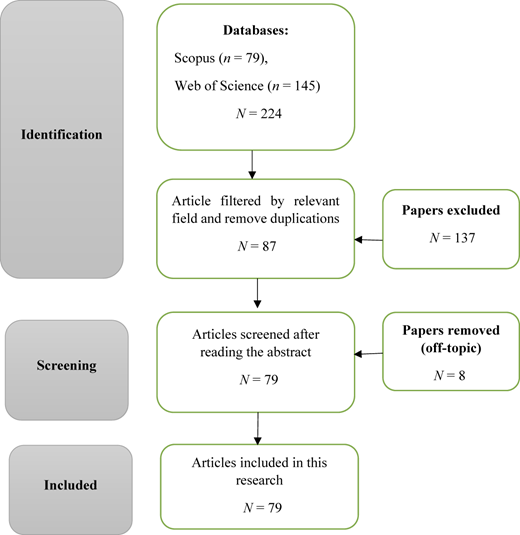
A comprehensive literature review was conducted using a structured protocol. Following the PRISMA framework, we systematically searched major academic databases, specifically Scopus and Web of Science (WoS), for relevant articles published between 2023 and 2025. This time frame was selected to capture the most recent studies following the public release of ChatGPT on November 30, 2022. The search strategy involved the use of carefully constructed keyword combinations, integrating concepts related to Gen-AI with terms relevant to agriculture and supply chains. Specifically, in the WoS, the search string used was Topic Search (TS) = (“chatgpt” OR “LLM” OR “large language model” OR “generative AI” OR “generative artificial intelligence”) AND TS = (“agriculture” OR “supply chain” OR “value chain” OR “logistics” OR “supply network”), which yielded 145 articles. In Scopus, the search was conducted in the title, abstract and keywords using a similar string: (“chatgpt” OR “LLM” OR “large language model” OR “generative AI” OR “generative artificial intelligence”) AND (“agriculture” OR “supply chain” OR “value chain” OR “logistics” OR “supply network”), resulting in 79 articles. In total, 224 articles were identified across both databases for further screening and analysis.
In the second stage, we refined our search by limiting the subject areas to operations research, management science, agriculture (multidisciplinary), business, transportation, finance and economics. Only peer-reviewed journal and review articles published in English were considered. Scopus also provided the functionality to filter by relevant journals, which was utilized to further narrow the scope. The third step involved a detailed screening of the selected articles based on their titles, abstracts and the presence of critical keywords. Following this screening, 26 articles were extracted from Scopus and 53 from WoS. All selected articles were exported in Excel format for further analysis. In the final step, duplicates were identified and removed from the combined dataset. After duplication, a total of 79 unique articles were retained for bibliometric analysis. The overall selection process is illustrated in Figure 1.
3.2 Bibliometric analysis method
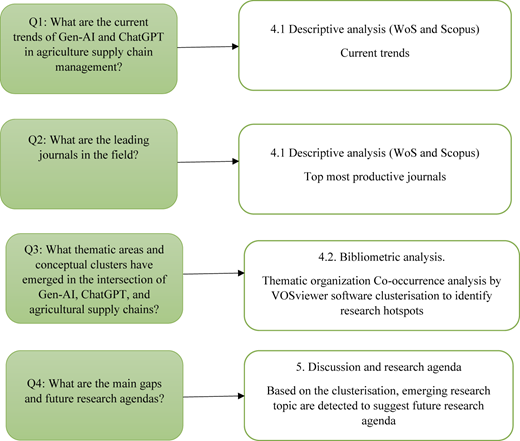
This study adopts a bibliometric approach, utilizing co-occurrence analysis to identify and explore key themes within the scientific literature of this domain. The review focuses on publications featuring the most frequently recurring keywords, allowing for a comprehensive thematic mapping of the research landscape. Co-occurrence analysis relies on the relationships and frequency of keywords to pinpoint research themes and reveal the underlying conceptual framework of the field being examined (Zheng et al., 2023; Zhang et al., 2016). Bibliometric analysis, as a quantitative method, facilitates the graphical representation of connections among concepts (Khan et al., 2023; Sun et al., 2024). Co-occurrence analysis investigates the connections between keywords to trace the development and progression of a specific research area. This approach is extensively applied in fields such as management, entrepreneurship and innovation (Khan et al., 2022; Darko et al., 2016). It enables researchers to uncover and analyze the interrelationships among various articles or studies within a discipline by examining shared citations and references (Oladejo et al., 2018; Mahmood et al., 2018). Figure 2 illustrates the bibliometric analysis conducted in this study to address the research questions.
4. Results
4.1 Descriptive analysis
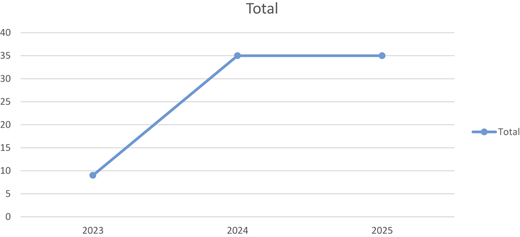
The pandemic highlighted weaknesses within the international food supply system. As a result of the pandemic, numerous food sector enterprises have been driven to reassess their approaches for the years ahead (Basit et al., 2023; Li et al., 2021; Javed et al., 2024). Therefore, our paper review uncovered a rapidly growing interest in Gen-AI and ChatGPT in supply chains in recent years. Even general AI–SCM reviews note an “abrupt rise in the number of documents” after 2020. Consistent with this, we find that publications on Gen-AI in supply chain have surged post-2022, coinciding with the release of ChatGPT (Teixeira et al., 2025). Figure 3 presents the distribution of studies by year of publication. The years 2024 and 2025 stand out with the highest number of studies, recording 35 publications each, followed by 2023 with 9 studies. This analysis reveals a growing trend in scientific production in recent years, particularly in 2024 and 2025.
Table 1 presents the journals with the highest publication output based on the number of documents published and their quality rankings obtained from the Scimago database. Transportation Research Part E: Logistics and Transportation Review leads with six published articles, followed by the International Journal of Production Research and IEEE transactions on intelligent vehicles, each contributing five publications. Additionally, technology in society and Transportation Research Part E: Logistics and Transportation Review each account for four publications, among others. Moreover, Table 1 reveals that the reviewed studies consist of 47 empirical, 21 conceptual and 11 mixed-method research papers.
Table 1 presents the distribution of publications across the most prominent research areas. The highest number of publications (23) was in business and economics, followed by engineering and operations research and management science (15). A further 13 publications spanned the fields of business and economics; engineering; operations research and management science and transportation.
4.2 Bibliometric analysis
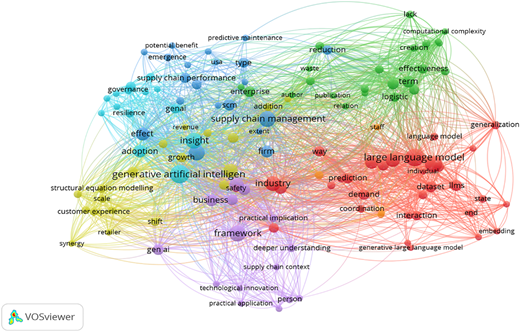
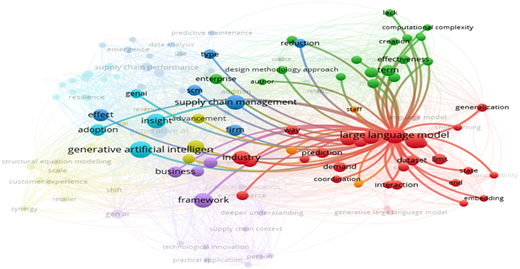
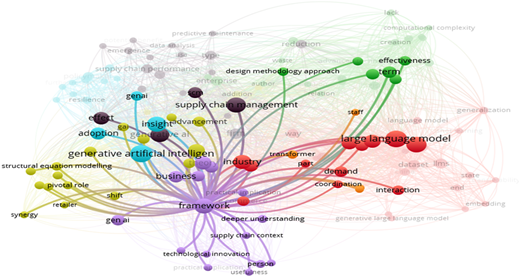
The thematic exploration is derived from the outcomes of a bibliometric assessment utilizing the co-occurrence method through VOSviewer software. To address issues related to keyword redundancy and inconsistency, the researchers developed a customized thesaurus. A co-word analysis was conducted to uncover key research themes within the domain of Gen-AI and ChatGPT, particularly regarding their application in the agricultural supply chain. The clustering of keywords was based on the intensity of their interrelationships, as determined by the VOSviewer tool. This analysis produced six distinct keyword clusters, each visually represented by a different color (see Figure 4).
4.2.1 Cluster 1 (red): large language model for prediction and coordination
This cluster focuses on the technical and operational aspects of large language model (LLM) like ChatGPT in the context of supply chain prediction, demand forecasting and interaction (Figure 5). It includes research on model architectures, dataset requirements and the generalizability of AI-driven predictions. Similarly, Shaikh et al. (2024) and Krupitzer (2024) mention that LLM automate communication between farmers, distributors and retailers by interpreting natural language queries and providing real-time updates on inventory levels, delivery timelines and logistics bottlenecks. For instance, they streamline cold-chain management by integrating IoT sensor data with weather forecasts to recommend optimal transportation routes and storage conditions (Banerjee et al., 2024; Feng et al., 2024). However, obstacles arise in the integration of varied datasets and gaining stakeholder trust (Krupitzer, 2024; Banerjee et al., 2024). LLMs leverage vast datasets to forecast crop yields, predict demand, optimize supply chain logistics and facilitate real-time decision-making by analyzing weather patterns, market trends and historical production data, thereby reducing uncertainties and enhancing efficiency in agricultural systems.
One of the key advantages of LLMs in this domain is their ability to support natural language interaction, which enables farmers, suppliers, and policymakers to access and interpret predictive analytics without extensive technical training (Tzachor et al., 2023). Moreover, Gezdur and Bhattacharjya (2025) demonstrated that integrating an LLM into supply chain operations significantly enhanced training efficiency by reducing employee training costs by 25%, enabling new hires to quickly access relevant supply chain information, thereby shortening training time and improving overall training quality. Furthermore, LLMs contribute to improved supply chain coordination by automating communication across different tiers, identifying disruptions early and suggesting adaptive strategies for logistics (Kmiecik, 2025). This coordination is particularly vital in developing countries, where agriculture is often vulnerable to volatility in climate and market conditions.
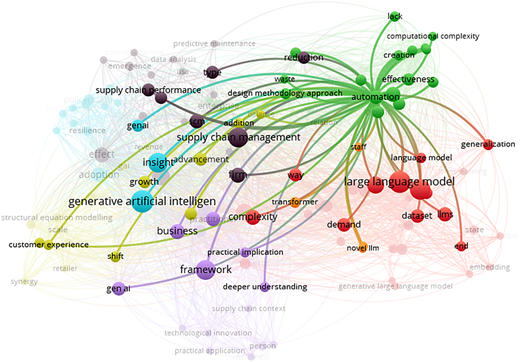
4.2.2 Cluster 2 (green): Gen-AI for automation and effectiveness
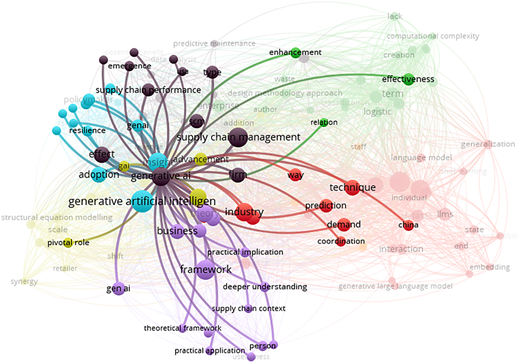
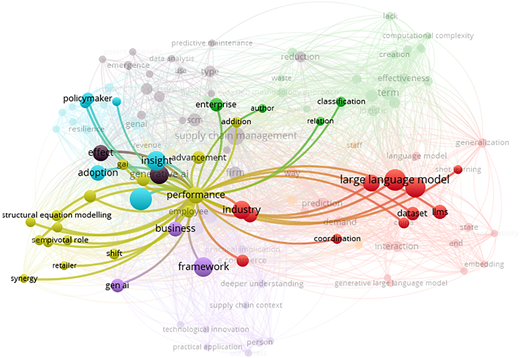
The growing complexity of agriculture supply chains, marked by fragmented processes, fluctuating demands and uncertain external conditions, has driven the need for intelligent automation tools. Gen-AI, with its capacity to learn from large-scale, multimodal data and generate content, solutions and simulations, has emerged as a powerful enabler of automation and operational effectiveness in ASCM (Figure 6). Likewise, Boone et al. (2025) highlights that Gen-AI is rapidly becoming a key driver of supply chain resilience by enabling enhanced decision-making, process automation and real-time simulation of innovative solutions and alternative scenarios to improve adaptability to disruptions. Nevertheless, the deployment of Gen-AI also raises significant concerns, including hallucinations, data privacy and ethical implications for agricultural stakeholders. Therefore, without human oversight, Gen-AI may generate misleading outputs that disrupt operations and undermine organizational reliability. Gen-AI is particularly relevant in optimizing repetitive tasks and streamlining decision-making processes across production, procurement, transportation, warehousing and retail stages (Mohamed, 2023). Its applications include automated report generation, inventory management, demand forecasting and dynamic pricing based on real-time inputs. By leveraging deep learning techniques and reinforcement learning architectures, Gen-AI systems can autonomously adapt to changes in supply and demand, identify inefficiencies and recommend corrective actions (Khlie et al., 2024) (see Figures 7–9).
By integrating Gen-AI with IoT devices and connectivity solutions, agricultural supply chains benefit from enhanced coordination and resource allocation. For example, smart farming solutions use Gen-AI to optimize logistics, monitor product quality and automate ordering processes based on real-time demand, thereby reducing spoilage and improving market responsiveness (Sai et al., 2025). Gen-AI contributes to sustainable agriculture by enabling precision farming techniques that minimize the use of water, fertilizers and pesticides. This targeted approach reduces environmental footprints while maintaining or increasing yields, supporting green supply chain objectives (Shahriar et al., 2025).
4.2.3 Cluster 3 (eggplant): Gen-AI and supply chain management performance
Gen-AI is increasingly recognized as a transformative enabler of performance optimization in supply chain management, especially within the agricultural context. The third thematic cluster, centered on “Gen-AI and Supply Chain Management Performance”, captures a growing body of literature that investigates how Gen-AI tools and techniques contribute to the enhancement of key performance indicators such as effectiveness, responsiveness, supply chain risk and resilience. Similarly, Haddud (2024) highlights that ChatGPT in supply chain systems delivers multi-dimensional performance benefits, primarily by enhancing operational efficiency through automated planning and execution processes that reduce lead times, labor costs, and errors in order fulfillment. Nevertheless, ChatGPT cannot override human expertise; it is not currently a decisive innovation, its uses are not always accurate, and it will take time before it becomes fully robust. The integration of Gen-AI, such as ChatGPT, can streamline operations by enhancing demand forecasting, inventory optimization and logistics management, thereby minimizing costs, improving process efficiencies and ultimately boosting supply chain performance and customer satisfaction (Wamba et al., 2023; Fan et al., 2025). They mentioned that Gen-AI enables supply chains to rapidly adapt to uncertainties such as demand fluctuations, weather events, and market shocks by generating real-time forecasts and scenario analyses that support proactive decision-making, reduce stockouts, overstocking and spoilage, and enhance the ability to assess supply chain risk. Furthermore, Maghroor et al. (2024) analyzes how Gen-AI transforms supply chain operations by enabling predictive maintenance, optimizing procurement and refining logistics, all contributing to improved supply chain resilience.
4.2.4 Cluster 4 (yellow): Gen-AI and employee performance
Cluster 4 focuses on the relationship between Gen-AI and employee performance, particularly within the context of ASCM. This research theme has gained traction as Gen-AI tools, such as ChatGPT are being integrated into supply chain workflows, influencing the roles, skills, efficiency and satisfaction of employees. One of the most notable impacts of Gen-AI on employees is improved task efficiency and decision support. Gen-AI systems can automate routine activities such as data entry, document generation, customer communication and performance analysis, allowing employees to focus on higher-value tasks (Gezdur and Bhattacharjya, 2025). For instance, ChatGPT can be used by procurement officers or logistics coordinators to summarize reports, generate procurement memos, or provide instant answers to regulatory queries. These capabilities enhance operational agility and reduce cognitive load, especially in fast-paced agricultural logistics environments. Prasad and De (2024) highlighted that the use of Gen-AI tools improves employee vigor, dedication and trust, crucial factors for sustained engagement and productivity, by automating repetitive tasks and providing timely, relevant insights, which in turn enhance job satisfaction and reduce cognitive load. The integration of Gen-AI into workplace processes also supports knowledge sharing and organizational agility, vital for adapting to rapidly changing environments (Nguyen et al., 2025).
4.2.5 Cluster 5 (purple): Gen-AI and business performance
Gen-AI is revolutionizing business performance within supply chain ecosystems by enhancing operational agility, reducing costs and enabling scalable solutions. Gen-AI optimizes supply chain operations by automating complex processes, minimizing bottlenecks and improving productivity. For instance, Gen-AI tools enable real-time monitoring and predictive analytics, ensuring smoother workflows and faster decision-making (Khlie et al., 2024). The adoption of Gen-AI in supply chain management provides an effective framework for performance evaluation, informed decision-making and workflow enhancement by utilizing its forecasting, responsive and interactive features to improve operational efficiency (Dubey et al., 2024). Combining genetic algorithms with LLM provides an innovative and effective method for streamlining warehouse delivery planning in third-party logistics, efficiently managing complex, large-scale tasks such as scheduling, cost control and vehicle allocation where conventional approaches may struggle (Kmiecik, 2025).
5. Discussion and research agenda
Based on the clusterisation results, it is evident that additional research and investigation into the use of Gen-AI and ChatGPT within the agricultural supply chain is necessary. Furthermore, increased focus should be directed toward understanding how ChatGPT influences various aspects of agricultural supply chain operations (González-Mendes et al., 2024). The co-occurrence investigation reveals that terms like “Generative Artificial Intelligence” and “Large Language Model,” while relevant to the core obstacles and challenges, are notably absent among the identified keywords in this analysis. This pattern is also observed in earlier co-occurrence analyses (Fosso Wamba et al., 2024). Moreover, there is limited understanding and insufficient awareness concerning user acceptance and educational aspects. These elements are considered key obstacles to the successful implementation of Gen-AI and ChatGPT in the agricultural supply chain.
Consequently, drawing on the assessment of thematic structure, emerging research trends and gaps revealed through the bibliometric analysis, this section outlines the proposed research agenda.
The first proposal, aligned with the red cluster, focuses on using large language models for prediction and coordination to improve transparency in the agricultural supply chain. LLMs are used to extract geospatial knowledge from unstructured locational data and integrate it into demand prediction models for e-commerce, enabling the use of extensive textual data to enhance predictive accuracy by incorporating contextual information often missed by traditional data sources (Nie et al., 2025). Gen-AI facilitates improved coordination among suppliers, manufacturers and distributors by providing accurate demand forecasts and optimizing inventory levels, thus reducing the bullwhip effect and associated inefficiencies (Li et al., 2024a). While studies like (Li et al., 2024b) have explored Gen-AI in sustainable supply chain performance for manufacturing firms, research on their application in the agricultural supply chain remains limited. Regarding the green cluster, Gen-AI can enhance automation and effectiveness in the agricultural supply chain. Robotics and automated control mechanisms can be utilized to facilitate data extraction and minimize labor demands in the agriculture sector. Furthermore, the adoption of AI and blockchain-driven solutions may enhance resource effectiveness and yield prediction (De Baerdemaeker et al., 2023). The eggplant clusters elucidate the Gen-AI in the agriculture supply chain performance. Gen-AI optimizes supply chains through demand forecasting, risk mitigation and resource sharing among stakeholders (Mohamed, 2023). However, cross-border supply chains face cultural and regulatory barriers to adoption, underscoring the need for policies that address regional disparities (Fosso Wamba et al., 2024). Regarding the yellow cluster, Gen-AI can improve the employee performance in the agriculture supply chain. LLM can simulate disruption scenarios by analyzing historical data and external factors, enabling employees to forecast potential disturbances and refine risk management strategies, thereby strengthening emergency preparedness (Gezdur and Bhattacharjya, 2025; Asif et al., 2023) suggest that employee adaptation to AI tools depends on training frameworks that align with evolving task hierarchies. The purple cluster discusses about Gen-AI and business performance. Gen-AI technologies provide transformative advantages for operational efficiency, reduce costs and support innovation through intelligent automation and data-driven decision-making (Sedkaoui and Benaichouba, 2024). Table 2 summarizes future research opportunities in this discipline.
5.1 Theoretical implications
From a theoretical standpoint, this study offers significant contributions to understanding the role of Gen-AI and ChatGPT within the agricultural supply chain. Unlike earlier analyses, this bibliometric review adopts a more comprehensive approach by incorporating broader Gen-AI-related concepts, including ChatGPT and LLM. The growing application of Gen-AI and ChatGPT, particularly in enhancing supply chain prediction and coordination (red cluster) (Jackson et al., 2024), as well as automation and operational effectiveness (green cluster), has emerged as a key driver in advancing supply chain management and business performance, as reflected in the eggplant and purple clusters. The visual mapping generated using VOSviewer offers a comprehensive overview of both inter- and intra-cluster research trends, thereby enhancing the understanding of literature related to the agricultural supply chain, Gen-AI and ChatGPT, while also tracing its development over time. Furthermore, by highlighting the most prolific journals and the influential areas of research, this analysis provides valuable guidance for scholars seeking suitable publication outlets and identifies key areas for future research in this field. The findings could be helpful for scholars in the further development of research on Gen-AI and ChatGPT-based technologies. It is highlighted that the results of Cluster (Red) centers on the use of LLM for prediction and coordination, highlighting the growing interest in leveraging LLM to improve forecasting accuracy and streamline coordination across supply chain processes. Cluster (Green) focuses on Gen-AI for automation and effectiveness, demonstrating how Gen-AI technologies are being employed to enhance operational efficiency and automate agricultural tasks. Cluster (Eggplant) represents studies related to Gen-AI and supply chain management performance, indicating an emerging body of work examining how Gen-AI contributes to improving various dimensions of supply chain effectiveness, such as responsiveness and flexibility. Cluster (Purple) addresses the link between Gen-AI and business performance, suggesting a strong interest in the strategic outcomes of AI adoption, particularly in terms of profitability, competitiveness and innovation. The analysis reveals several areas needing further exploration regarding Gen-AI and ChatGPT in the agricultural supply chain. Greater emphasis is required on their role in enhancing automation, coordination and disruption management. Although some studies mention Gen-AI and blockchain integration, their combined application for automation and resilience remains underexplored. Research is also limited on how cultural and regulatory differences affect Gen-AI adoption in cross-border agricultural supply chains. Moreover, the long-term effects on workforce reskilling and the lack of data-driven insights into the financial returns of Gen-AI implementation present additional gaps. Addressing these issues is essential for realizing Gen-AI full potential in agriculture.
5.2 Practical implications
The outcomes of this study provide various practical insights for both practitioners and society. From a practical perspective, organizations within the agriculture supply chain can deploy LLM-powered platforms to synthesize unstructured data (e.g. weather reports, market news, sensor feeds) into actionable forecasts. Procurement and logistics teams should integrate these platforms into their planning cycles to improve demand visibility, reduce inventory and optimize routing. Moreover, by embedding Gen-AI into routine workflows, such as order processing, quality inspection and invoice reconciliation, firms can reduce manual errors and free employees for higher-value tasks. Supply chain managers should conduct pilot projects in high-volume process areas, measure time savings and error rates, and then scale successful automations across the network. To ensure that translate AI investments into measurable performance gains, companies should establish clear KPIs (e.g. lead-time reduction, fill-rate improvement, resilience score) and employ Gen-AI to model “what-if” scenarios under varying demand and disruption conditions. Additionally, executives should align Gen-AI initiatives with strategic objectives, such as cost leadership, differentiation, or market expansion, and conduct ROI analyses that capture both quantitative benefits (e.g. cost savings, revenue uplift) and qualitative gains (e.g. customer satisfaction, innovation speed).
From a societal standpoint, Gen-AI enhances agricultural business performance by improving market responsiveness, pricing strategies and compliance with sustainability standards (e.g. Environmental, Social, and Governance reporting). This can contribute to greater food security and more sustainable resource management. However, the adoption of these technologies also raises important societal and ethical concerns. The overreliance on Gen-AI insights without adequate human oversight may lead to biased decisions, data privacy breaches and misinformation in critical supply decisions. Additionally, automation-driven efficiency gains could disrupt rural employment patterns and deepen digital inequalities among smallholder farmers and less technologically advanced regions.
6. Conclusion and limitations
This study offers valuable perspectives on the application of Gen-AI and ChatGPT within agricultural supply chain management. The volume of scholarly work addressing the integration of Gen-AI and ChatGPT in this domain has shown notable growth between 2024 and 2025. The emergence of Gen-AI and ChatGPT has redefined the strategic landscape of agricultural supply chain management, encouraging firms to reconfigure their decision-making processes toward automation, coordination, prediction and resilience (Q1). The outcomes specify that journals in transportation research part e: logistics and transportation review, IEEE transactions on intelligent vehicles, International Journal of Production Research and Transportation Research Part E-logistics and Transportation Review are the most prevalent (Q2). Research trends are currently focused on prediction and coordination, Gen-AI for automation and effectiveness, Gen-AI and supply chain management performance, Gen-AI and business performance and Gen-AI adoption towards insight. However, despite growing enthusiasm, there are also concerns that exist, like hallucination, data privacy, security risks, lack of accuracy, copyright issues and ethical implications (Q3). The analysis highlights key research gaps in applying Gen-AI and ChatGPT to the agricultural supply chain, particularly in automation, coordination and disruption management. Limited studies address their integration for resilience, the impact of cultural and regulatory barriers in cross-border adoption, workforce reskilling and financial outcomes. These areas require further investigation to fully harness Gen-AI potential in agriculture (Q4).
First, this study is limited to articles indexed in the WoS and Scopus, which may exclude valuable contributions from other academic databases. Second, only English-language publications were included, potentially overlooking relevant research published in other languages. Third, while the software used for mapping and visualizing scientific trends was effective, alternative tools such as R could also enhance the analysis. Furthermore, additional methods like bibliographic coupling and co-citation analysis may offer deeper insights into the intellectual foundation of Gen-AI and ChatGPT within the agricultural supply chain domain.