This study investigates the determinants of job satisfaction and turnover intention among hospitality employees in a small-island food tourism destination, with particular emphasis on work-related issues, workplace quality, compensation, and supervisory/managerial support, as well as the mediating effects of job insecurity and work-induced stress.
Adopting a quantitative research design, data were collected from 270 employees working in four- and five-star hotels in Cyprus. Structural equation modelling (SEM) was employed to test the hypothesized relationships among eight latent constructs, and bootstrapping procedures were used to examine the mediating roles of job insecurity and work-induced stress in the relationship between job satisfaction and turnover intention.
Results indicate that workplace quality and supervisory/managerial support are strongly associated with job satisfaction, whereas work-related issues and compensation practices are not. Job satisfaction is negatively associated with job insecurity, work-induced stress, and turnover intention; however, mediation analysis reveals that job insecurity partially mediates the relationship between job satisfaction and turnover intention, whereas work-induced stress does not. These findings suggest that relational and environmental aspects of HRM are particularly critical for sustaining workforce stability within food tourism-oriented hospitality environments.
The findings underscore the critical importance of fostering supportive leadership and a psychologically positive work environment in small island food tourism destinations. Industry stakeholders should prioritize employment stability and relational HR practices over purely transactional rewards to enhance employee satisfaction and reduce turnover. Moreover, for destinations like Cyprus, which depend on food tourism as a strategic branding tool, optimal HRM practices are vital to ensuring culinary sustainability and preserving cultural authenticity.
By contextualizing HRM practices within the unique socio-economic and operational conditions of a small-island food tourism destination, this study challenges dominant assumptions in hospitality HRM and highlights job insecurity – rather than work stress, which seems to be normalized – as the key psychological mechanism linking job satisfaction to turnover intention.
Introduction
Diachronically, operational imperatives have often superseded the more “theoretical” elements of human resource management (HRM) in small-island tourism destinations. Despite global advancements, especially in employee development, talent management, and retention, in small-island destinations, these practices are often relegated to basic personnel administration, reflecting more traditional HR approaches. The renowned contextual challenges of operating in such environments, noted in existing literature (Baum, 2012; Glaveli et al., 2019; Shakeela et al., 2011; Zopiatis et al., 2025), include, amongst others, high turnover, labor shortages, overdependence on peripheral part-time and/or seasonal employees, average intrinsic benefits, recruitment and retention challenges, poor or nonexistent career structures, unsocial work hours and family unfriendly shifts, and inadequate training. These contextual challenges, fueled by seasonality, overtourism, and quality fluctuations, perpetuate a problematic situation in which the universal benefits of contemporary HRM practices, both strategic and operational, are severely compromised. Moreover, such conditions may challenge prevailing assumptions in hospitality HRM, as supported by a substantial body of relevant research that emphasizes, among other factors, compensation and formal HR systems as primary determinants of employee satisfaction and retention.
Cyprus, the study's setting, is not immune to such challenges, since the industry's operational norms, influenced by seasonality, portray a short-termism turnover culture characterized by split shifts, especially in entry-level food and beverage (F&B) positions, an over-reliance on peripheral labor, nepotism, and minimal investment in employee development and retention. F&B operations, the cornerstone of the country's efforts to project itself as a food-tourism (gastronomic) destination, are heavily affected by such externalities. Henderson (2009) suggests that for small island destinations, food tourism may enhance branding and competitiveness, while gastronomic culture and regional culinary traditions constitute a significant pull factor motivating individuals to visit a particular destination (Ellis et al., 2018). In addition, scholars (see Björk and Kauppinen-Räisänen, 2016) highlight the experiential power of food in influencing tourists' expectations and shaping positive perceptions. Undoubtedly, food tourism sustainability, reflecting unique operational characteristics, depends heavily on optimal HRM practices, a topic that is understudied in international literature.
Local industry stakeholders highlight the absence of a strategic HRM vision, warning of the externalities associated with prolonged labor shortages, leadership deficits, and dangerous fluctuations in service quality. Furthermore, alarming evidence that the local population is shifting away from relevant careers, especially those related to F&B, which, for some, is crucial to maintaining the authenticity of the Cyprus tourism experience, along with reports of HR malpractice, further worsens the situation. Complementing this toxic mix is the country's vulnerability to exogenous factors and its geostrategic location near volatile hotspots, all of which present atypical challenges to the development of its tourism industry.
To address these issues within the specific context of a small-island destination, this study examines the key factors influencing employees' job satisfaction and their subsequent association with turnover intention. Reflecting on the existing literature and related theories, the perceived satisfaction of employees regarding work-related issues, workplace quality, compensation practices, and supervisory/managerial support was explored and associated with their stated level of job satisfaction. Moreover, work-induced stress and job insecurity were incorporated as mediators to examine their confounding effects on the association between job satisfaction and turnover intention. Findings broaden collective knowledge of the specificities of HRM practices in small-island food tourism destinations by highlighting the optimal conditions that enhance job satisfaction and mitigate the negative externalities of turnover. The provided implications and suggestions aim to enhance sustainable HR practices and address the industry's diachronic labor-related challenges at both the operational and strategic levels.
Literature review
Contemporary HR practices and concepts are grounded in a well-established theoretical foundation comprising multiple interrelated and complementary theories. According to Swanson (2022), the foundation of HR can be traced to psychology, economics, and systems/organizational theories. Psychological theories, most notably social exchange theory (Meira and Hancer, 2021), emphasize the reciprocal exchanges between employees and organizations that shape formal HR procedures and influence inter-work relationships, levels of engagement, and motivation practices. Economic theories, such as the human capital theory, which has both micro- and macroeconomic implications, inform many of the industry's HR practices, particularly in training and development, performance management, and compensation management (Carlbäck et al., 2024). Finally, within the broad conceptual landscape of organizational theories, systems theory—the foundation of high-performance work systems—emphasizes the importance of acknowledging the complexity of hospitality organizations and the need for a holistic approach to managing people. This approach has a significant impact on organizational performance, technology integration, and relevant employee outcomes (Kloutsiniotis and Mihail, 2020). Collectively, these perspectives suggest that hospitality employee outcomes emerge from the interaction among transactional, relational, and contextual workplace conditions rather than from isolated HR practices alone.
Although the study focuses on the hospitality industry workforce in a small-island food-tourism destination, it is important to note that a substantial proportion of F&B employees were included in the investigation. The experiential nature of gastronomy, in both its tangible and intangible elements, depends on human interaction and emotional engagement. F&B employees are entrusted with multifaceted roles, including cultural ambassadors, culinary experts, experience providers, relationship builders, and salespeople, thereby constituting a critical yet understudied element of the service delivery process (Björk and Kauppinen-Räisänen, 2016; Ellis et al., 2018). Complementing the above, the country's strategic tourism plan identifies gastronomic and wine tourism as essential for sustainable development, diversification, and reducing seasonality (Cyprus Deputy Ministry of Tourism, 2017).
While the benefits of food tourism are well-documented in the international literature, so are the associated operational challenges, especially in HRM. Numerous studies (Henderson, 2009; Zopiatis and Orphanides, 2009) highlight issues that can disrupt hospitality F&B operations, especially in small-island food tourism destinations. It is therefore prudent to investigate such HR issues in the context of a small-island food tourism destination, such as Cyprus, thereby providing important insights that enhance the competitiveness and sustainability of these operations.
Literature review and hypotheses development
Work-related issues and job satisfaction
The journey of employees within an organization, loosely referred to as the HR or employee life cycle, is a conceptual framework that portrays the continuous interconnected stages from initial recruitment to eventual separation or retirement (Gladka et al., 2022). Theoretically, work-related issues and relevant stages are influenced by a variety of theoretical frameworks, including human capital theory, person–organization fit theory, adult learning theory, and experiential learning. Each stage encompasses specific work-related processes and activities that, according to the literature, affect the quality of employees' experience, particularly their perceived job satisfaction. For this study, and in light of the existing literature (see Baum, 2015), work-related issues encompass interlinked variables related to recruitment and selection, induction, training and development, retention practices, and formal performance appraisals.
The hospitality industry, known for its dynamic and customer-centric nature, relies heavily on HR to deliver exceptional service and achieve its operational and strategic goals. As expected, a plethora of studies have investigated related issues from various perspectives, with job satisfaction being at the forefront (Pelit and Katircioglu, 2022). The association between recruitment/selection activities, an integral part of strategic HR planning, and job satisfaction has received limited scholarly attention, with only a handful of relevant investigations. More specifically, studies investigating the impact of recruitment and selection procedures, some of which fall under the generic conceptual umbrella of HR activities, revealed significant positive associations with job satisfaction (Elrehail et al., 2020). Similar attention was given to the industry's induction activities, also known as the familiarization process, with Hussien et al. (2022) highlighting positive effects on employees' sense of belongingness, job satisfaction, and productivity. Finally, in contrast to the previous work-related issues, employees' training and development activities have received extensive scholarly attention, with a plethora of studies confirming a significant association with job satisfaction (Costen and Salazar, 2011).
Formal performance appraisals, a vital tool for employees' development, have been found in numerous studies to be closely associated with job satisfaction (Kampkötter, 2016). In the hospitality industry, despite the well-known challenges, such as performance pressure (Song and Mistry, 2022), scholars have noted a positive association between structured evaluations and job satisfaction (Hayes and Ninemeier, 2009). Moreover, the specificities of the actual job, a term derived from the theoretical framework of job analysis that is closely related to the job-person fit theories, have been found to have a positive impact on job satisfaction (Kim et al., 2005), whereas, in similar terms, so do the characteristics of the employees' schedule and workload (Heimerl et al., 2020). Finally, the industry's retention strategies, namely career advancement, internal promotions, and recognition programs, have been examined from various operational and strategic perspectives with findings indicating a positive association with job satisfaction and a negative association with turnover dynamics (Ashton, 2018).
It is essential to note that very few studies have investigated the association between the aforementioned work-related issues and job satisfaction on an individual, one-on-one basis. Most studies (see Ashton, 2018), using inferential statistics, reduced the dimensionality of the data by grouping relevant variables into a generic, unobserved construct, such as HR activities. By espousing a similar reasoning and reflecting on the existing conceptual landscape, the following hypothesis is developed.
Work-related issues (WRI) have a positive and significant association with job satisfaction (JSat).
Quality of the workplace and job satisfaction
Drawing on the theoretical underpinnings of person–environment fit theory, social exchange theory, and self-determination theory, workplace quality is a hybrid socio-organizational construct encompassing physical/environmental, psychological/relational, and organizational aspects that significantly influence hospitality employees (Heimerl et al., 2020). Generally, workplace environment quality involves physical elements related to safety and environmental conditions that directly affect employees' perceptions of job satisfaction and their intentions to leave (Lee et al., 2015). Additionally, intangible elements such as ethics, fairness and equality, role clarity, inclusive work culture, autonomous decision-making, and communication (upward and downward) influence the workplace environment and affect employees' performance, behavioral, and attitudinal outcomes, including job satisfaction (Kim et al., 2024; Papageorgiou et al., 2024; Vassou et al., 2025). Finally, the specifics of co-workers’ relationships emerged as a key element of a positive hospitality environment, with scholars supporting outcomes such as increased productivity, organizational commitment, citizenship behavior, development, and job satisfaction (Chi and Gursoy, 2009). The literature also indicates that such positive relationships can mitigate adverse employee outcomes, including stress, burnout, absenteeism, and turnover (Bufquin et al., 2017; Kang and Jang, 2022). Reflecting on the above, the following hypothesis is proposed:
The quality of the workplace (QoW) atmosphere is positively and significantly associated with job satisfaction (JSat).
Compensation practices and job satisfaction
Historically, compensation management practices (such as salaries and wages, incentives and bonuses, etc.), grounded in human capital and equity theories, are among the most challenging tasks in hospitality HR because they form a fundamental yet influential psychological contract between the organization and its employees (Wu et al., 2021). Stereotypically, the industry is seen as offering below-average remuneration packages, which, according to Michael and Fotiadis (2022), contribute to employees' dissatisfaction and turnover. The association between monetary rewards and fringe benefits with employee behavior (e.g. perceived recognition, organizational support, and loyalty) and performance is well documented in the hospitality literature, with studies primarily supporting positive associations. In particular, a plethora of studies (Ashton, 2018; Jolly et al., 2021; Heimerl et al., 2020) have highlighted the relationship between fair compensation practices and job satisfaction. However, it is important to recognize that the unique characteristics of small-island destinations, such as seasonality, reliance on peripheral labor, and the presence of part-time workers, may affect this relationship. Indicatively, Herzberg et al. (1959) two-factor theory suggests that compensation practices in seasonal and/or volatile environments may act as a ‘hygiene factor’ preventing dissatisfaction rather than actively enhancing job satisfaction. Reflecting on the above, the following hypothesis is postulated:
Compensation practices (CP) have a positive and significant association with job satisfaction (JSat).
Supervisory/managerial support and job satisfaction
Drawing on a strong theoretical foundation (e.g. social exchange theory, motivational theories, and perceived organizational support theory), supervisory/managerial support is vital in the hospitality industry (Chen and Li, 2025). Responsible for creating an anthropocentric work environment, managerial employees are granted authority and assigned responsibilities, including guiding and motivating employees, as well as recognizing and valuing their contributions to achieving organizational goals. Hospitality literature highlights the vital role of managerial employees, whose Knowledge, Skills, and Abilities (KSAs) can significantly impact their subordinates' perceived job satisfaction and turnover intentions (Gordon et al., 2019; Kong et al., 2018). In conceptually analyzing these relationships, scholars (Gordon et al., 2019; Giousmpasoglou et al., 2021) stressed the importance of genuine care and emotional support, while Durão et al. (2024) focus on managerial employees' human qualities, suggesting that those who perceive their supervisors as approachable, understanding, and helpful report higher job satisfaction and lower turnover intentions. Moreover, recognition and appreciation by management, both forms of validation of an employee's organizational contributions, also influence job outcomes (Karatepe and Kilic, 2007), while multiple studies highlight the positive effects of managerial motivational practices, especially those of an intrinsic nature (Norbu and Wetprasit, 2021; Zhang et al., 2023). Reflecting on the above literature, the following hypothesis is suggested.
Supervisory/ managerial support (SMS) has a significant and positive association with job satisfaction (JSat).
Job satisfaction, job insecurity, work-induced stress, and turnover intention
Contemporary hospitality research has thoroughly examined the complex relationships among perceived job satisfaction, job insecurity, work-related stress, and, ultimately, turnover. Studies have consistently shown, despite some exceptions, a negative association between job insecurity—caused by various personal, organizational, and socioeconomic factors—and job satisfaction (Jung et al., 2021; Zopiatis et al., 2014). It is important to note that job insecurity regained scholarly attention during the recent pandemic, as the industry's inherent volatility—exacerbated by external shocks—disrupts employees' psychological “comfort zone” and diminishes their perceived job satisfaction (Ghaderi et al., 2023; Vo-Thanh et al., 2021). Reflecting on the above, the following hypothesis is proposed:
Job satisfaction (JSat) has a significant and negative association with job insecurity (JIns).
Similarly, work-induced stress emerged as a detrimental factor undermining employee well-being and satisfaction. Numerous studies (Vong and Tang, 2017; Zopiatis et al., 2025) support this negative relationship, highlighting other associated externalities, including decreased productivity and increased absenteeism. From a different perspective, Islam and Alam (2024) report that workplace fun and engagement, vital elements of a positive organizational environment, reduce work-related stress, while Jung and Yoon (2016) report that employees' cognitive-appraisal stress-coping styles and mechanisms have a significant positive effect on their job satisfaction. Based on these theoretical elements, the following hypothesis is proposed:
Job satisfaction (JSat) has a significant and negative association with work-induced stress (WIS).
Finally, the association between job satisfaction and turnover intentions is arguably the most well-documented relationship in hospitality research, with consistent findings indicating a negative association between the two (Kim et al., 2016; Kong et al., 2018; Zopiatis et al., 2014). It is noted that job satisfaction is a complex concept that includes both intrinsic and extrinsic factors, while various personal and environmental elements, acting as mediators, may influence its relationship with turnover. Echoing the above, the following hypothesis is proposed:
Job satisfaction (JSat) has a significant and negative association with turnover intention (TurnI).
Mediating role of work-induced stress (WIS) and job insecurity (JIns)
Literature highlights the critical mediating role of work-induced stress in the relationship between job satisfaction and turnover intentions. While job satisfaction reduces employees' desire to leave, elevated work-induced stress may undermine this effect, leading to higher turnover even among the most satisfied employees. Numerous scholars support this argument (Huang et al., 2018; Vong and Tang, 2017; Zopiatis et al., 2025) by highlighting the negative externalities of work-induced stress, often in relation to other psychological stressors (e.g. work-family conflict, excessive workloads, etc.) and calling for the immediate attention of industry stakeholders to mitigate adverse effects. Reflecting the above, the following hypothesis is proposed:
Work-induced stress (WIS) mediates the negative relationship between job satisfaction (JSat) and turnover intentions (TurnI)
The complex role of job insecurity as a mediator in the relationship between job satisfaction and turnover intentions in the hotel industry has received extensive coverage (Etehadi and Karatepe, 2019; Jung et al., 2021). Studies indicate that while job satisfaction traditionally serves as a buffer, reducing employees' desire to leave, job insecurity significantly weakens this protective effect, ultimately increasing uncertainty and turnover intentions. Along the same lines, Etehadi and Karatepe (2019) argue that increasing job satisfaction alone may not be enough to reduce turnover unless job insecurity is also tackled. In light of the above, the following hypothesis has been proposed:
Job insecurity (JIns) mediates the negative relationship between job satisfaction (JSat) and turnover intentions (TurnI)
Methodology
Adopting a quantitative methodology, the study aims to revisit the impact of HRM practices on job satisfaction and subsequent turnover intentions among hospitality employees in the context of a small-island food tourism destination, namely Cyprus. Reflecting the study's purpose and grounded in existing literature, nine hypotheses were developed for testing using a survey instrument. A four-section, bilingual (Greek–English) survey was developed using a back-translation technique and designed to ensure content validity with assistance from a linguistics expert and a panel of three experts, while reliability was assessed using the test-retest method. The survey measured eight distinct constructs using a five-point Likert scale, namely work-related issues, workplace quality, supervisory/managerial support, monetary rewards, job satisfaction, turnover intention, job insecurity, and work-induced stress.
The survey's first section included four constructs representing primary HRM functions, namely, work-related issues, workplace quality, supervisory/managerial support, and compensation practices. Partially adopted from other studies (Costen and Salazar, 2011; Yang, 2008), respondents were asked to express their level of satisfaction with various work-related operational issues, including training and development, hiring standards and procedures, induction/assimilation practices, retention policies, and actual job duties. Workplace quality, inspired by numerous studies (see Ciarlante et al., 2024; Yeung, 2004) covers elements such as role clarity, quality of communication, work culture, ethics, fairness, equality, and workplace safety, whereas supervisory and managerial support depicts elements such as appreciation from management, motivational practices, and caring (see Ann and Blum, 2020; Kang et al., 2014). Finally, compensation practices encompass salaries and wages, as well as other fringe benefits.
The respondents' perceived level of job satisfaction, the survey's second section, was measured with five variables, adopted from relevant literature (see Chi and Gursoy, 2009; Tsaur and Yen, 2018), namely “Overall, I am satisfied with my job at this hotel”, “In general, I like working here”, “I get feelings of accomplishment at my job”, “I have no hesitation in recommending my current employer to a friend/relative”, and “I look forward to coming to work.” Subsequently, section three measured turnover intention, job insecurity, and work-induced stress. Indicative variables measuring turnover intention (see Wong et al., 2021; Zopiatis et al., 2014) include “It is likely that I will actively look for a new job next year,” and “I often think about quitting this job,” whereas job insecurity (see Jung et al., 2021; Vo-Thanh et al., 2021) with statements such as “I am afraid that I might lose my job,” and “I am afraid that the organization will not need me in the near future.” The third factor of this section, work-induced stress, was measured with variables (see Lee and Ok, 2012; Zopiatis et al., 2025) such as “I feel that I am working under quite a lot of stress,” “Work frustration causes me to have sleeping problems”, and “I worry that this job is hardening me emotionally.” Finally, the survey's last section gathered demographic and other related information to enable a more comprehensive analysis of the data.
The study's population included individuals working in 4- and 5-star hotels in Cyprus. Based on industry figures, fewer than 8,000 individuals met our participation criteria from a total of 13,000 directly working in the hospitality industry; therefore, a representative sample of 500 (Confidence level 95%; Margin of Error 4.2%) was pursued. Following an initial communication, 25 hotels agreed to grant us access to their premises to administer surveys. Face-to-face random administration of surveys was conducted in designated hotel cafeterias during employee breaks by two experienced researchers over a two-month period. In accordance with institutional protocols, the researchers took specific steps to ensure compliance with all ethical guidelines and regulations for studies involving human subjects. In particular, all participants were informed of the study's purpose and objectives, the voluntary nature of their participation, the anonymity and confidentiality of their data, and their right to withdraw at any time. Informed consent was obtained before survey administration, and researchers provided additional information on data storage and academic use, noting that there were no foreseeable risks associated with their participation. Finally, descriptive and inferential statistics, specifically factor analysis and multivariate structural equation modeling, were employed to verify the factorial validity of the study's latent constructs, assess the model's fit, and ultimately test the hypothesized model by either accepting or rejecting the postulated hypotheses. Moreover, mediation analysis using bootstrapping (see Rasoolimanesh et al., 2021) was utilized to examine the effects of job insecurity and work-induced stress on employees' turnover intention.
Findings
Profile of the respondents
A total of 270 (n = 270) valid surveys were completed, yielding a response rate of 54%. Table 1 displays the demographic profile of respondents by gender, age, nationality, education, current employer, department or division of employment, and employment level and status. Notably, a substantial proportion of respondents (38.1%) were employed in F&B, thus, findings indirectly reflect the idiosyncrasies of such operations.
Measurement model evaluation
Absolute, incremental, and parsimonious goodness-of-fit measures were used to assess the model's fit. It is essential to note that, before this evaluation, a preliminary step was taken to verify the distinct dimensionality of the study's latent constructs through factor analysis (PCA with Promax rotation and Kaiser normalization). Goodness-of-fit measures confirm a satisfactory fit between the study's theoretical model and the sample data (df = 723, χ2 = 1454.049, χ2/df = 2.011 (p < 0.001), CFI = 0.906, IFI = 0.907, RMSEA = 0.060).
Additional measures have been employed to assess the validity and reliability of the proposed model and investigate the relationships between latent variables and their indicators (observed measured variables). As exhibited in Table 2, all standardized factor loadings exceeded the recommended threshold of 0.50, with the exception of turnover intention (TurnI1 = 0.487), which was retained due to its theoretical relevance and borderline loading. Furthermore, the model's average variance extracted (AVE) of 59.41% is acceptable (see Bagozzi and Yi, 1988), whereas construct reliabilities range from 74.29% to 92.69% and exceed the suggested 70%. Finally, discriminant validity was assessed using the Heterotrait–Monotrait Ratio (HTMT), with all values below the recommended 0.90 threshold, confirming adequate distinctiveness among the constructs (Henseler et al., 2015).
Structural model and hypothesis testing
After validating the measurement model, the structural model was used to assess the study's hypothesized relationships (see Table 3). In particular, and per existing literature (see Hair et al., 2010), a CMIN/DF value of 1.916 (df = 720, χ2 = 1379.269; CMIN<3), a Root Mean Square Error of Approximation (RMSEA) of 0.058 (<0.07), a PRATIO of 0.923, and the incremental fit measures of CFI (0.916) and IFI (0.916) suggest an acceptable fit. As noted by Hair et al. (2010), models with more than 250 observations and 30 observed variables, CFI above 0.900, and RMSEA below 0.070 indicate an acceptable fit. Moreover, R2 statistics (square multiple correlation) for the dependent (endogenous) variables indicated that the model has a 72% explanatory power for job satisfaction (JSat), 39% for work-induced stress (WIS), 28% for job insecurity (JIns), and 73% for turnover intentions (TurnI).
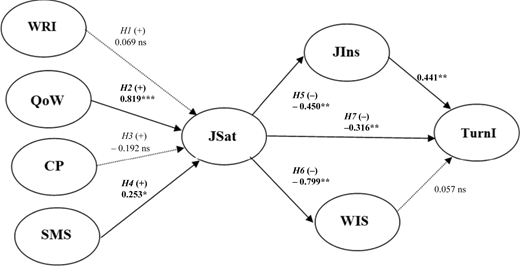
The hypothesized model, comprising nine proposed hypotheses, was tested after the measurement model was evaluated. Figure 1 displays the standardized path coefficients and the significance of the hypothesized relationships in diagrammatic form, whereas Table 4 summarizes the results of the hypotheses. Hypothesis 1, which proposed a positive association between work-related issues (WRI) and job satisfaction (JSat), cannot be supported (β = 0.069; n.s.), despite the literature suggesting a positive relationship. In contrast, the second hypothesis, which posits a positive association between workplace quality and job satisfaction, is supported (β = 0.819; p < 0.01). The third hypothesis, which assumes a positive association between compensation practices (CP) and job satisfaction (JSat), cannot be supported, as the findings reveal a nonsignificant standardized path coefficient, β = −0.192. Finally, hypothesis four is supported, as a significant positive association (β = 0.253; p < 0.05) was found between supervisory and managerial support (SMS) and job satisfaction (JSat). Overall, the quality of the workplace, which primarily encompasses intangible elements such as the quality of communication, ethics, work culture, relationships with coworkers, and fairness and equality, is the strongest predictor of job satisfaction, whereas, in contrast to popular belief, salaries and wages are not.
The study's fifth hypothesis, aligned with existing literature, was supported, as a significant negative association between job satisfaction (JSat) and job insecurity (JIns) was revealed (β = −0.450; p < 0.01). Likewise, hypothesis six is also supported, with a significant negative association (β = −0.799; p < 0.01) found between job satisfaction (JSat) and work-induced stress (WIS). The strength of this negative relationship is noteworthy, indicating that job satisfaction is negatively associated with work-induced stress. Similarly, hypothesis seven is supported since a significant negative association (β = −0.316; p < 0.01) was found between job satisfaction (JSat) and turnover intention (TurnI).
Mediation analysis
To further dissect the dynamic relationship between job satisfaction and turnover intention, mediation analysis was conducted to examine the confounding effects of work-induced stress and job insecurity (Hypotheses 8 and 9). As suggested by Rasoolimanesh et al. (2021), mediation analysis using bootstrapping is the most robust and widely employed method in hospitality literature. It aims to assess whether the effect of an independent variable (X = Job satisfaction) on a dependent variable (Y = Turnover intention) is mediated by variables (M = Job insecurity; Work-induced stress). As exhibited in Table 5, mediation analysis, with a number of bootstrap samples of 2,000 at a bias-corrected confidence interval of 90%, revealed a partial mediation between JSat → JIns → TurnI relation and no mediation for the JSat → WIS → TurnI. Findings suggest that job insecurity is the only factor that mediates the relationship between job satisfaction and turnover intention, while work-induced stress has no mediating effect, despite its significant negative association with the independent variable. This might suggest a process of stress normalization in seasonal island destinations, in which high pressure and demanding conditions are expected and institutionalized, and therefore no longer function as a signal for withdrawal, while future-oriented job insecurity remains the primary psychological trigger of turnover intentions.
Discussion and implications
The findings of this study provide insights into HRM practices in small-island destinations, aligning with and, in some cases, challenging existing research. Consistent with the literature (Gordon et al., 2019; Heimerl et al., 2020; Kong et al., 2018), this study (re)confirms the significant positive effects of workplace quality and supervisory/managerial support on job satisfaction. Regarding workplace environment quality, the most significant factor, the findings reinforce the idea that safety, communication, coworker relationships, and ethical culture are vital drivers of satisfaction in the hospitality industry. Similarly, supervisory/managerial support, characterized by genuine care, appreciation, recognition, and praise, emerged as a key predictor of job satisfaction and appears to serve as an emotional and relational stabilizer for employees.
In contrast to existing literature (see Ashton, 2018; Jolly et al., 2021), the findings revealed a non-significant relationship between the industry's compensation strategies and job satisfaction. Theoretically, this finding may be partially explained by Herzberg et al.'s (1959) two-factor theory, which classifies compensation practices as hygiene factors rather than intrinsic motivators. From this perspective, compensation may prevent dissatisfaction, but it may not be sufficient to enhance job satisfaction. This discrepancy may reflect the contextual idiosyncrasies and economic dynamics of the Cypriot labor market, where non-monetary factors, such as workplace quality and managerial/supervisory support, outweigh financial considerations in driving employee satisfaction. Conceptually, this may suggest that, in transactional, precarious employment environments with lax HR practices, employees tend to prioritize job security over monetary gains. From a F&B operational perspective, this implies that relational and environmental stability, rather than financial incentives, may define the sustained delivery of culinary experiences in such environments.
Challenging existing conceptual paradigms and relevant literature (see Costen and Salazar, 2011; Elrehail et al., 2020), findings revealed that employees' perceived satisfaction with compensation practices and work-related HR processes was not significantly associated with their overall job satisfaction. This may suggest that in such destinations, employees prioritize immediate workplace conditions and relational support systems over long-term developmental strategies and extrinsic incentives; a notion that may be consistent with a security-oriented rather than growth-oriented psychological contract (see Rousseau, 1995). Plausibly, the nature and urgency of day-to-day hospitality operations in such environments may present a different set of challenges that often supersede the more ‘theoretical’ HR frameworks relevant to retention and development. In such environments, employees tend to adapt to seasonal fluctuations, with their expectations regarding career progression, development, and training kept to a minimum. However, from another perspective, especially for food tourism operations that depend heavily on tacit culinary knowledge, resilience, and continuity, such an adaptation might have negative externalities on long-term sustainability.
Consistent with existing literature (see Jung et al., 2021; Kim et al., 2016; Zopiatis et al., 2014), findings revealed negative associations between job satisfaction with job insecurity, turnover intentions, and work-related stress, with the latter exerting the most significant influence. Interestingly, job insecurity emerged as a significant partial mediator between job satisfaction and turnover intention, whereas work-induced stress, despite its considerable direct relationship with job satisfaction, does not mediate this relationship; a finding that contradicts the stress-mediated models proposed by Huang et al. (2018) and Vong and Tang (2017). This calls for further investigation into contextual resilience factors, as the findings may reflect a process of institutionalized stress normalization in high-turnover small-island food tourism destinations, where demanding workloads, emotional exhaustion, and operational volatility gradually become the norm in everyday organizational culture. In such environments, employees may adapt to chronic stress conditions as part of the expected realities of hospitality employment, particularly within F&B operations characterized by intense customer interaction and emotional labor. Conceptually, this may align with broader discussions of resilience and adaptation, as well as with the normalization of precarious labor conditions in hospitality settings (see Baquero et al., 2025; Wong et al., 2025). In these settings, employees develop coping mechanisms that reduce the direct influence of stress on turnover intentions, despite its negative effects on their well-being and job satisfaction.
Theoretical implications
Reflecting on the operational and strategic characteristics of a small-island food tourism destination, this study enhances the existing body of knowledge on hospitality HR practices by either confirming or challenging widely held assumptions about the antecedents of job satisfaction. More precisely, findings revealed that work-related issues, which are often seen as pivotal to the industry's contemporary HR practices, and monetary rewards have no impact on employees' perceived level of job satisfaction; an emotional state influenced by the quality of the workplace and the adequacy of supervisory/managerial support. In conceptual terms, the findings challenge traditional HRM motivation theories by highlighting the need for more context-specific models that account for destination-specific factors such as seasonality, vulnerability to exogenous factors, job (in)security, limited career progression paths, and labor-market volatility. Such conditions seem to challenge traditional HRM practices, which are partially replaced by the relational elements of the workplace environment.
While the importance of workplace quality and supervisory support may reflect broader dynamics across seasonal hospitality environments internationally, the heightened role of employment stability, the reduced influence of compensation practices, and the apparent normalization of work-related stress may be more closely associated with small-island food tourism destinations characterized by labor-market constraints, seasonality, and (over)dependence on peripheral employment. This distinction is particularly important given the scarcity of relevant research in either seasonal or small-island destination contexts. Notably, much of the existing hospitality HRM literature, especially the seminal work of the 1990s, was developed in Western-centric contexts that portray relatively stable, large-scale economies with well-established labor structures (Winter, 2009), all of which are atypical of seasonal or small-island tourism destinations. Echoing this, in his lucid critique, Baum (2015) cautions against the uncritical application of Westernized HRM frameworks in global destinations, as they often overlook essential cultural, contextual, economic, institutional, and legal parameters.
In response to this necessity, a more context-specific (re)theorization of HRM practices could benefit industry stakeholders. By challenging the one-size-fits-all approach that dominates mainstream hospitality HRM literature, scholars should critically examine such practices in peripheral, seasonal, small-island, and resource-constrained economies, thereby contributing to refining the current conceptual framework. Notably, in this study, workplace quality and supervisory/managerial support emerged as the strongest determinants of job satisfaction, whereas compensation practices and formal work-related HR processes were not found to exert significant effects. This suggests that employees operating in such environments may prioritize psychological stability, fairness, communication quality, trust-based workplace relationships, and supportive organizational cultures over traditional monetary or long-term developmental incentives. It is therefore prudent to suggest that a context-sensitive HRM framework for small-island food tourism destinations should move beyond purely transactional and performance-oriented assumptions by prioritizing employment stability, workplace quality, supportive leadership, relational management, emotional sustainability, and employee well-being.
Beyond the macro-level perspective, such an approach must also consider the unique operational characteristics of hospitality subsectors, particularly F&B operations, where emotional labor, customer interaction, cultural representation, and service continuity are central to the tourism experience. Future research could therefore investigate the complex relationship between job insecurity and employment stability in environments characterized by socio-economic and political volatility, as well as the emerging normalization of work-related stress among hospitality employees in seasonal destinations, where unpredictable workloads and emotional demands are gradually embedded in everyday organizational culture. Furthermore, studies could explore how contextual adaptation and emotional resilience influence the stress–satisfaction–turnover relationship in such business environments, alongside the relative importance of intangible workplace factors (e.g. inclusion, psychological safety, fairness, and ethics) compared with more transactional or fixed benefits.
Practical implications
Challenging long-standing theoretical paradigms that have informed industry practices, the study's findings have significant operational and strategic implications for stakeholders. At the operational level, the study emphasizes the vital importance of workplace quality in enhancing employees' job satisfaction and mitigating turnover intentions. Derived recommendations include implementing workplace safety protocols, promoting transparent communication, fostering an ethical and inclusive workplace free from favoritism, discrimination, and harmful behaviors, enhancing employees' autonomy and role clarity, and investing in innovative work-life balance initiatives, family-friendly policies, and cultural assimilation programs that aim to mitigate the notorious anti-social externalities of the industry. Furthermore, conflict-resolution and mediation mechanisms should be implemented to reinforce fairness, trust, and workplace stability across hierarchical levels. In F&B operations, these practices are particularly critical for frontline employees who co-create gastronomic experiences and serve as cultural interpreters of local cuisine.
The study's results emphasize the critical role of supervisory/managerial support in enhancing employees' job satisfaction and mitigating turnover intentions. Combining transformational leadership with relational management will strengthen the connection between managers and employees, improve their daily work experience, and help achieve organizational goals. Managerial employees should therefore adopt leadership styles that emphasize emotional intelligence, communication, empathy, and team cohesion, moving beyond traditional task supervision. By sponsoring leadership development programs for those who display transactional or autocratic traits and by incorporating specific servant-leadership qualities, the industry will help prepare the next generation of entry-level supervisors to foster a positive organizational environment.
Industry stakeholders need to reevaluate HR practices in small-island food tourism destinations, especially those related to the employee lifecycle, by identifying gaps between theory and practice. The observed non-significant association between vital HR practices (e.g. training and development, performance evaluations, retention) and job satisfaction raises questions regarding their credibility, implementation, effectiveness, and the organization's overall commitment and strategic vision. Reflecting on the specificities of such destinations, greater emphasis should be placed on practices that enhance employees' psychological contracts, such as timely contract renewals, flexible scheduling, uniform regulations, and transparent rewards. Such improved HR practices are especially important for F&B employees who aim to maintain culinary authenticity and service consistency, elements that directly shape guests' experiences.
From a strategic perspective and based on study findings, industry stakeholders may address specific issues to facilitate a more employee-centric environment. Statewide policies that institutionalize job security measures for all employees, regardless of employment status, must be enacted, while context-sensitive HRM frameworks that consider factors such as labor geographic mobility, seasonality, socio-economic, and cultural norms and constraints should be developed and implemented. It is important to note that such frameworks must also consider the equilibrium between labor demand and supply, the potential uses and impacts of technology (e.g. Artificial Intelligence), migration policies, and incentives to attract non-traditional workers.
Conclusion and limitations
The study highlights the determinants of job satisfaction and subsequent turnover intentions within the unique socio-economic and geographic setting of Cyprus, a small-island food tourism destination in the eastern Mediterranean. Ultimately, the findings suggest that sustainable hospitality employment in small-island food tourism destinations depends less on transactional HR mechanisms and more on relational, context-sensitive HRM practices that foster psychological stability, workplace trust, and supportive organizational environments. In particular, findings revealed the importance of workplace quality and supervisory/managerial support, whereas job insecurity mediates the relationship between job satisfaction and turnover. Challenging existing theories, monetary rewards, and HR practices were revealed as insignificant predictors; an insight that might suggest a paradigm shift from solely transactional incentives and long-term theoretical initiatives to relational, inclusive, and supportive efforts that foster a positive organizational environment.
Despite the study's contributions, it would be an oversight not to acknowledge its limitations. Firstly, including only 4- and 5-star hotel employees in our sample limits generalizability, whereas the cross-sectional design does not capture the dynamic changes that drive the cause-and-effect relationships being studied. It is recommended that future studies extend to independent and family-run establishments to capture broader dimensions of culinary authenticity and informal employment relations, using either longitudinal designs to observe how HR-related factors change over time in these settings or mixed methods to thoroughly explore the context and meaning of employees' subjective workplace experiences. Future research could investigate both the effects of seasonality on employees' chronic job insecurity, which has been identified as a vital antecedent of turnover, and the (pre)conditions of occupational stress normalization in such environments. Finally, concerned scholars should expand the limited hospitality HRM literature on small island destinations, especially in the F&B, by proposing a context-specific framework to enhance employee retention strategies.
Disclaimer
AI tools were used for copy-editing (correcting, editing, formatting, modifying, or refining) the authors' own original existing work with the aim of improving its structure, readability, and clarity.