This study examines the use of artificial intelligence (AI) in consumer-facing food systems to support sustainable consumption. It aims to synthesize empirical insights, identify dominant types of AI interventions and propose a process-based theoretical model that captures how AI solutions facilitate sustainable consumer behavior.
A systematic literature review was conducted in accordance with the SPAR-4-SLR protocol. 66 peer-reviewed articles published between 2010 and 2025 were included. Results were thematically organized using Transformative Consumer Research (TCR) and Technology Affordances to explore how AI-enabled solutions facilitate value creation and foster behavior change in sustainable food consumption contexts.
Five key AI domains were identified: product discovery, sustainability signaling, dietary guidance, household food management and social engagement. While personalization and health nudging dominate current applications, the potential of AI to drive long-term sustainable behavior remains underexploited. Existing research is fragmented and often lacks an integrative theoretical foundation.
This paper introduces the AI-Enabled Behavioral Activation Model for Sustainable Consumption, a novel theoretical framework grounded in transformative consumer research (TCR), transformative value theory (TVT), technology affordances and the COM-B model of behavior change. The model conceptualizes how AI solutions catalyze sustainable behavior by enabling consumer capabilities, shaping motivational processes, and expanding action opportunities, all while generating experiential and ethical forms of value. This integrative, process-based approach advances theoretical understanding of AI’s transformative potential in food-related consumer behavior.
1. Introduction
Artificial intelligence is experiencing a boom in every aspect of marketing functions (Kumar et al., 2024). AI’s modern abilities surpass purely logical models, exhibiting efficient adaptive learning, emotional interferences, and creative content production, such as painting (Zhang et al., 2024). Such capabilities enable AI-integrated solutions to interact with humans in ways that are socially intelligent, perceptually rich, and behaviorally impactful (Mariani et al., 2022).
In the food sector, AI implementation has been particularly focused on optimizing the supply side of operations, including agricultural production (Feng et al., 2024; Frau and Keszey, 2024; Ryan et al., 2023), processing (Agrawal and Kumar, 2025), quality control, and logistics (Dora et al., 2022; Manning et al., 2022; Vilas-Boas et al., 2023; Wang et al., 2024; Zhao et al., 2025). These solutions are primarily developed and implemented to benefit companies, improving operational efficiency (e.g. through process automation), reducing costs, or enhancing quality control. However, such a focus overlooks the opportunity to drive significant transformation shifts by targeting consumers and their food choices. Consumers cumulatively shape the environmental and social impact of the food system. Thus, consumer agency must be prioritized, and bottom-up change systematically cultivated. Given the emerging and rapidly evolving nature of artificial intelligence solutions for creating genuine consumer value and, in turn, fostering the development of sustainable food markets, the importance of this issue remains underexplored in scholarly discourse. The limited scholarly attention to this topic can be attributed to several factors. First, the implementation of artificial intelligence solutions aimed at sustainability is still in its early stages, with research largely focusing on supply-side efficiencies and business process optimization rather than consumer-facing interventions. Second, ethical concerns surrounding AI-driven nudges and decision-making triggers have created hesitation and critical debate in the literature (Ganapini and Panai, 2025; Hermann, 2023a, b), further slowing empirical work. Together, these factors help explain why the intersection of consumer agency, AI adoption, and sustainable food markets remains underexplored.
This study aims to systematically review the scientific literature on the application of artificial intelligence (AI) in food marketing to promote sustainable consumption, with a specific focus on consumer-oriented innovations. Moreover, the overarching aim of this paper is to develop a novel, process-based conceptual framework grounded in the transformative value creation perspective, which explains how artificial intelligence (AI) applications in food marketing generate multifaceted value that supports more sustainable consumption behavior.
Importantly, this review is situated in a broader societal context where digital innovation must increasingly serve dual goals: to create value for consumers – through more informed choices, personalized support, and improved well-being – and to generate collective value for the planet, through reduced food waste, healthier dietary patterns, and lower environmental footprints. In this regard, AI holds enormous promise: it can provide real-time nudges, feedback loops, and behavioral insights that help consumers act in alignment with both their personal values and global sustainability goals (Leroy et al., 2022; Starke et al., 2025).
Building upon principles of Transformative Consumer Research (TCR) (Mick, 2006; Ozanne et al., 2024), the Technology affordances (Faraj and Azad, 2012; Park, 2024), and the transformative value theory (Anderson et al., 2013; Blocker and Barrios, 2015) this study interprets sustainable consumption not only as a reduction in environmental impact but also as an opportunity to promote consumer well-being, empowerment, and ethical decision-making through AI-enabled marketing strategies and tools.
To anchor the analysis in behavioral terms, the review applies the COM-B model (Michie et al., 2011), which identifies capability, opportunity, and motivation as core determinants of behavior change. In the context of sustainable food consumption, the COM-B framework highlights that, while personal motivation to act sustainably can be a key driver of behavioral change, it is rarely sufficient. To adopt sustainable consumption patterns, consumers must also possess (or develop) the necessary capabilities, such as breaking existing habits, and have enough opportunities and convenient access to sustainable food options (Schulze et al., 2024). In this paper, the capability, opportunity, and motivation are linked directly to the types of consumer value created by AI systems. By integrating these perspectives, the review provides the first structured synthesis of scientific knowledge on consumer-facing AI in food marketing.
It is worth noting that behavior change is a process involving various stages, and that many obstacles, impediments, and inconveniences may be encountered along the way. Progressing through these stages brings individuals closer to making or sustaining a change in their food consumption (Reuzé et al., 2023). Artificial intelligence (AI)-based solutions can act as triggers, amplifiers, and support along this path of change (Van Baal et al., 2024), delivering specific value to consumers.
Accordingly, this review is structured around the following key research questions:
How is artificial intelligence used in the food sector to support sustainable consumption?
In what ways does AI-enabled innovation create value for consumers in the context of sustainable food consumption?
How can patterns of AI-driven consumer value creation be synthesized into a conceptual framework for promoting sustainable food consumption?
Currently, there is no available synthesis that explicitly focuses on the application of AI in the food sector, particularly in customer-oriented solutions that contribute to sustainable consumption behaviors. There are studies in the field that are primarily fragmented across disciplines (e.g. marketing, nutrition, and IT) but have not been holistically assessed (Mariani et al., 2022; Miyazawa et al., 2022). Without a substantial, structured analysis, there is a potential for underestimating the potential of AI tools and their transformative power. It is valuable to understand not only what AI tools do but also how they contribute to value creation and how they foster sustainability-related value. By mapping existing interventions, dominant efforts, and outcomes, this review provides evidence-based recommendations for future research and innovation in the food sector.
2. Methodology
This research literature review is a systematic process aimed at identifying, evaluating, and synthesizing the current state of knowledge and research (Fink, 2020) in the field of AI application in food marketing to enhance sustainable consumption. The proposed approach has been previously used in the analysis of existing research on: green marketing strategies for sustainable food system transformation (House et al., 2024), sustainable food and consumer behavior (Irfan and Bryła, 2025), artificial intelligence impact on sustainability (Kar et al., 2022), applications of AI in nutrition (Theodore Armand et al., 2024), artificial intelligence in marketing and consumer research (Chintalapati and Pandey, 2022; Mariani et al., 2022).
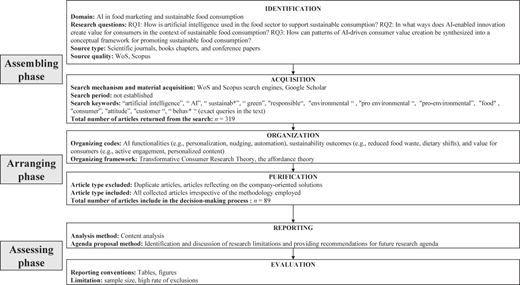
To ensure structured and transparent reporting, the Scientific Procedures and Rationales for Systematic Literature Reviews (SPAR-4-SLR) protocol developed by Paul et al. (2021) was adopted (see Figure 1).
The subject scope of the literature review encompassed AI in food marketing, with a focus on sustainable consumption and consumer-oriented innovation. The research was limited to the papers, book chapters, and conference papers retrieved from the recognized databases. Authors did not restrict the search to journal papers because of the topic’s novelty, expecting better outcomes with a broader search scope. For the same reasons, the thematic scope of the sources was also not limited.
The first step of the SPAR protocol is assembling, which includes identifying and acquiring data. To ensure the reliability and credibility of this review study, Scopus and Web of Science databases were used. Only items indexed in these two databases were included. The database searches began with the identification of words and phrases to be queried. The authors tried various combinations relating to the consumption sphere (e.g. “consumer”, “consumption”, “behavior”, “purchasing”, “shopping”), food (e.g. “food”, “diet”, “meal”, “meat”), artificial intelligence (e.g. “artificial intelligence”, “AI”, “machine learning”, “chatbot”) and sustainability (e.g. “sustainable”, “sustainability”, “responsible”, “environmental”, “proenvironmental”) were used at this stage. As part of this phase, four databases containing between 167 and nearly 500 items were downloaded for initial evaluation, and 50 records were randomly selected for review. Both authors verified each record and assessed the fit between the content of the abstract and the research questions posed. Due to the unsatisfactory results, and considering it essential to include all main domains and relevant keywords in the query, it was formulated broadly to encompass as many matching records as possible. The concept was to merge the focus on sustainability, the food market, and consumer orientation with AI implementation in the marketing field. Synonyms for each domain were included to minimize the risk of missing relevant studies. Moreover, due to the focus on consumer-oriented solutions, we excluded from the query records referring to farming, food production, and its optimization, processing, manufacturing, as well as documents related to food quality, food safety, or the chemical composition of food.
The following queries were entered into the search engines of Scopus and Web of Science in mid-August 2025:
in Scopus: (TITLE-ABS-KEY (“sustainab*” OR “green” OR “responsible” OR “environmental” OR “proenvironmental” OR “pro-environmental”) AND TITLE-ABS-KEY (“food”) AND TITLE-ABS-KEY (“Artificial intelligence” OR “AI”) AND TITLE-ABS-KEY (“consumer” OR “attitude” OR “customer” OR “behav*”) AND NOT TITLE-ABS-KEY (“optimization” OR “manufacturing” OR “production” OR “farming” OR “processing” OR “agriculture” OR “crop” OR “food quality” OR “food safety” OR “chemi*”)) AND (LIMIT-TO (DOCTYPE, “ar”) OR LIMIT-TO (DOCTYPE, “cp”) OR LIMIT-TO (DOCTYPE, “ch”) OR LIMIT-TO (DOCTYPE, “cr”) OR LIMIT-TO (DOCTYPE, “re”)) – with 190 results,
in WoS: “sustainab*” OR “green” OR “responsible” OR “environmental” OR “proenvironmental” OR “pro-environmental” (Topic) and “food” (Topic) and “Artificial intelligence” OR “AI” (Topic) and “consumer” OR “attitude” OR “customer” OR “behav*” (Topic) not “optimization” OR “manufacturing” OR “production” OR “farming” OR “processing” OR “agriculture” OR “crop” OR “food quality” OR “food safety” OR “chemi*” (Topic) and Article or Review Article or Proceeding Paper or Early Access (Document Types) – with 93 results.
Due to the rapid pace of changes in the studied phenomenon, it was decided to conduct an additional supplementary manual search in Google Scholar, as well as to leverage the proposals of expert researchers in the field of food marketing. In this way, 36 records were added to the database. Interestingly, all were indexed in databases selected by the authors but not retrieved within the queries. This initial search identified 319 records.
The Transformative Consumer Research Theory, in the context of sustainable consumption, and the AI affordance framework were employed to organize the review findings within a structured and meaningful framework in the arranging phase. For the data purification, the following inclusive and exclusive criteria were developed:
Inclusive criteria: articles published in peer-reviewed journals, books, or conference proceedings, articles focused on the usage of AI in terms of sustainable consumption pattern enhancement from the perspective of an individual consumer, and articles published in English.
Exclusive criteria – duplicates, papers out of scope (no AI, no food or no sustainability in the record), papers not focused on consumer-oriented solutions, papers focused on medicine and health issues with minor reference to the food market or behaviors, conference proceedings compilations, papers impossible to retrieve.
It is worth noting that the authors attempted to narrow down the results by introducing subject-area filters for the publication sources. However, this significantly reduced the number of records returned, often yielding between 10 and 20 search results. Therefore, the use of filters was abandoned to make the searches as broad as possible.
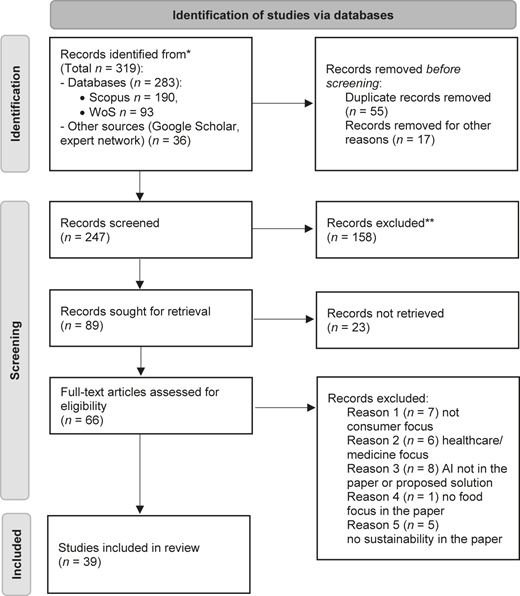
Among the search results obtained (see Figure 2), 55 duplicates were removed. 17 records that were compilations of conference materials were also excluded. Then, the screening of titles and abstracts was started. It turned out that many results, despite the introduction of appropriate restrictions in the query, may not relate to the examined issues or address them only to a limited extent. Therefore, their contribution to the conducted analyses is either negligible or debatable. The screening of titles and abstracts was performed independently by two researchers specializing in marketing on the food market and consumer behavior. Each expert evaluated the records according to the inclusion and exclusion criteria and recommended whether the text should be retained in the database or excluded. If any inconsistencies were found in the assessment, the experts would jointly evaluate the disputed record and make a final decision on whether to qualify it.
After reviewing the titles and abstracts, the authors decided to reduce the initial set to 89 papers. Unfortunately, it was not possible to retrieve 23 records, which limited the sample to 66 papers. These records formed the basis for the subsequent analyses. The relatively limited number of publications analyzed in this study reflects the emergent nature of the intersection between artificial intelligence (AI) and sustainable food consumption.
In the next stage, all 66 articles were read. Due to a lack of correspondence between the content announced in the abstract and keywords, and the actual content of the text, only 39 papers qualified for the final analysis. The 27 papers were excluded because they focused on healthcare or medicine, lacked a consumer or food focus, did not address sustainability issues, or did not incorporate AI into the proposed solution.
The final stage of the systematic review involves extracting and analyzing key information from the selected publications. This includes conducting descriptive analyses to identify the journal publishing the highest number of articles, the most frequently cited papers, and the average number of citations per year.
2.1 Coding and analysis process
Following the initial selection of studies through database screening and full-text eligibility assessment, we conducted a systematic qualitative content analysis to extract and synthesize data from the final sample. Each study was coded according to predefined and inductively refined categories based on three theoretical and thematic dimensions: Transformative Consumer Research Theory regarding sustainability consumption, and the AI affordance.
The TCR agenda marketing practices enhance individual and collective well-being (Mick, 2006; Davis and Pechmann, 2020). It proposes that AI is not merely a tool for efficiency, but a potential agent of consumption transformation (Leroy et al., 2022). Sustainable consumption can serve as an agent for reducing food waste (Khan and Prasetyo, 2023), adopting plant-based or locally produced food products (Hassoun et al., 2022), or shifting purchasing patterns toward ethically sourced goods.
The Technology Affordance theory (Faraj and Azad, 2012) explores how technological properties enable or constrain action possibilities for users and organizations. In the food marketing domain, AI technologies can afford hyper-personalization (e.g. recommender systems), real-time interaction (e.g. chatbots), or pattern recognition for behavior prediction (e.g. machine learning algorithms) (Pantano, 2020; Shankar et al., 2021). Understanding the type and role of AI mechanisms is crucial for evaluating their transformative capacity.
Coding categories included AI functionalities (e.g. personalization, nudging, automation), sustainability outcomes (e.g. reduced food waste, dietary shifts), and value for consumers (e.g. active engagement, personalized content).
The coding was conducted manually in an Excel-based matrix and iteratively refined through comparative cross-checking. The inter-coder reliability of the data was evaluated on a subset of the data, with two coders reaching an agreement rate of 90%. Any differences in opinion were addressed through consensus discussions, with the objective of ensuring consistency across the full dataset. Although percent agreement does not adjust for chance agreement, it provides a reasonable indication of coding reliability in this context. Since we have established that there isn’t a significant number of papers, the process allowed for both deductive coding (guided by established frameworks) and inductive insights (emerging patterns across studies), which informed the development of the thematic synthesis and supported the construction of an integrative conceptual framework.
2.2 Descriptive results
The assessment phase involved conducting and documenting a comprehensive literature review. Given the novelty of the research problem and the limited number of existing publications, along with the specific focus of the article, the descriptive analysis was narrowed to the following key aspects: types of publications, trends in publication volume over time, distribution of sources by JCR quartiles, most frequently cited articles, and the most commonly used keywords.
The papers analyzed included both journal articles (including early access papers), conference papers, reviews, book chapters, and proceedings papers. The distribution of individual sources, as shown in Table 1, indicates the dominance of articles published in journals within the sample.
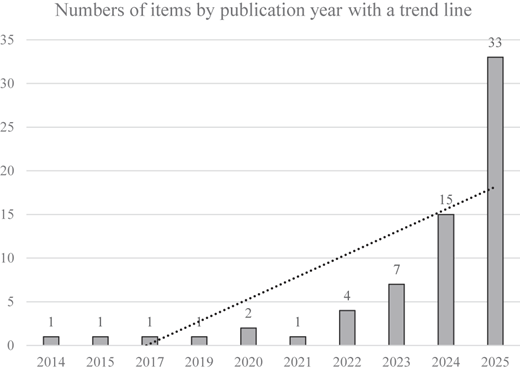
It was also agreed upon to examine the dynamics of change in the number of publications about the phenomenon under study. As demonstrated in Figure 3, there has been a substantial increase in publications over the past three years. For the year 2025, the number of publications in the area under analysis has already doubled the number of publications in 2024, and the database for analysis was downloaded in mid-August 2025. In light of the advancements in artificial intelligence and its applications in the domain of consumption, a further increase in the number of publications can be anticipated, exhibiting a heightened dynamism.
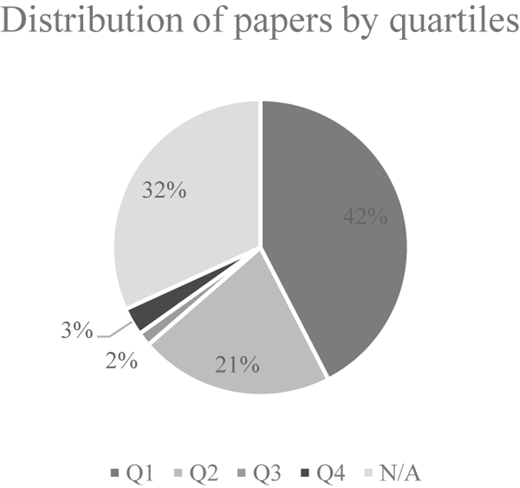
In the next step, it was decided to verify the structure of the analyzed sample in terms of the Journal Citation Report ranking system. The system displays the highest-ranked (Q1) and lowest-ranked (Q4) journals in a given category. As Figure 4 shows, 42% of the papers were published in Q1 journals, 21% in Q2, and 2% in Q3. Only 3% of analyzed documents were published in the lowest-ranked journals. A significant percentage of publications had no assigned rank. This is primarily a consequence of the sample structure, which also included book chapters and conference and proceeding papers (which are much less frequently indexed in databases).
As far as citations are concerned, the most cited papers were:
Zhang, J., Oh, Y.J., Lange, P., Yu, Z., Fukuoka, Y., “Artificial Intelligence Chatbot Behavior Change Model for Designing Artificial Intelligence Chatbots to Promote Physical Activity and a Healthy Diet: Viewpoint” published in Journal of Medical Internet Research – 402 citations,
Fadhil, A. and Gabrielli, S. (2017), “Addressing challenges in promoting healthy lifestyles: The Ai-Chatbot approach”, published in ACM International Conference Proceeding Series – 195 citations,
Egolf, A., Hartmann, C. and Siegrist, M. (2019), “When evolution works against the future: Disgust’s contributions to the acceptance of new food technologies”, published in Risk Analysis – 89 citations,
Daradkeh, F.M., Hassan, T.H., Palei, T., Helal, M.Y., Mabrouk, S., Saleh, M.I., Salem, A.E. et al. (2023), “Enhancing Digital Presence for Maximizing Customer Value in Fast-Food Restaurants” published in Sustainability (Switzerland) – 59 citations.
The following 15 papers in the ranking had between 10 and 30 citations. The remaining articles were cited fewer than 10 times. The limited number of citations observed in the 71% of the reviewed papers can be attributed to the nascent state of the research area. It remains at a relatively early stage of scientific exploration, with recent contributions that have not yet accumulated a sufficient level of inclusion in the reference lists of other papers.
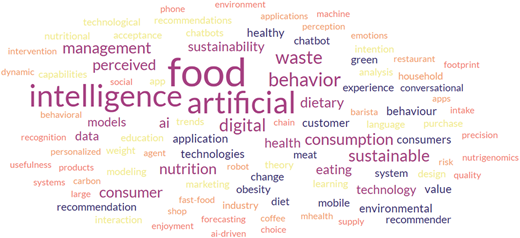
The final element analyzed was the keywords that appeared in the article descriptions. Given the considerable existing research fragmentation and the interdisciplinary nature of the subject matter, a wide variety of keywords appeared in the texts analyzed. Rather than presenting the keywords in statistical terms, it was decided to illustrate them in the form of a word cloud (Figure 5). This visualization tool presents the most frequently recurring words in larger and more prominent letters. The frequency with which a word occurs in a given text is indicative of its size in the resulting word cloud.
The keyword landscape is centered on consumer-facing, micro-level AI (chatbots, mHealth, self-monitoring, recommenders) with a secondary stream in service automation, while the uses of supply chains in this field remain comparatively underexamined from a consumer-impact perspective. The focus of sustainability initiatives is twofold, with work streams centering on the mitigation of food waste and the implementation of initiatives aimed at reducing meat consumption. The subjects of precision/biomedical nutrition (wearables, biomarkers, nutrigenomics) and governance (privacy, explainability, transparency) are emerging, but are currently fragmented. Persistent gaps concern policy and environmental levers, equity and access, and the durability of behavior change. Moreover, the integration of health–environment co-benefits and consideration of AI’s own footprint remain uncommon, underscoring the need for preregistered, longitudinal, and comparative study designs.
After conducting an in-depth content analysis, we identified six categories of AI-driven interventions related to sustainable food consumption.
AI for Product Discovery and Choice Navigation includes/, smart filters, and recipe engines that simplify sustainable choices by aligning suggestions with user values, reducing cognitive effort, and supporting habit formation (Kamran et al., 2021; Starke et al., 2025). Studies show that these tools integrate sustainability filters (Casado-Mansilla et al., 2024), provide emotionally intelligent nudges (Aman et al., 2025), and enable low-effort food swaps (Tanwar et al., 2024), thereby fostering plant-based consumption and promoting waste reduction.
AI for Food Label Interpretation and Sustainability Signaling utilizes XAI, carbon footprint visuals, and eco-feedback to make environmental data accessible at the point of decision (Chiu et al., 2022; Linseisen et al., 2025). Tools such as real-time dashboards (Braga et al., 2024; Tanwar et al., 2024) and barcode apps (Zumthurm et al., 2025) enhance transparency, foster trust, and facilitate low-impact purchasing.
AI for Health Nudging and Dietary Guidance features chatbots, meal planners, and feedback dashboards that tailor nutrition advice and motivate healthy, sustainable eating (Fadhil and Gabrielli, 2017; Linseisen et al., 2025). Applications offer plant-based meal prompts (Chiu et al., 2022; Braga et al., 2024), reminders (Kamran et al., 2021), and automated planning to reduce waste (Starke et al., 2025), leading to improved health and environmental outcomes.
AI for Smart Household Food Management applies smart bins, monitors, and alerts to manage storage, prevent spoilage, and reduce waste (Kamran et al., 2021; Starke et al., 2025). Systems automate expiry tracking and optimize usage (Tanwar et al., 2024; Linseisen et al., 2025), enhancing consumer capabilities and minimizing over-purchasing.
AI for Social Engagement and Value Co-Creation utilizes gamified challenges, peer comparison, and citizen science to promote collective behavioral change (Aman et al., 2025; Wandhekar et al., 2024). Leaderboards and participatory platforms foster motivation, reinforce social norms, and embed sustainability into community interaction.
3. Theoretical framework
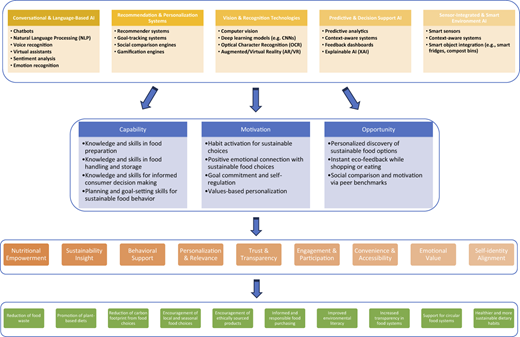
As AI becomes increasingly embedded in customer-oriented solutions, it is crucial to understand how it influences behaviors and fosters long-term environmental and social value. Thus, we are proposing an ethically grounded and impact-oriented theoretical model for the food sector. The model resides within multiple conceptual lenses: Transformative Consumer Research (TCR), Transformative Value Theory (TVT), the affordance theory of technology, and the COM-B Model of behavior change. This process-based model (available in Figure 6) captures how AI solutions and behavioral mechanisms catalyze specific actions, enable capabilities, motivate, and ultimately generate diverse forms of customer value that encourage sustainable consumer behavior in the food domain. However, the change will occur if the solution bears vivid and legitimate value for consumers (Fang et al., 2023; Hollebeek et al., 2024). To clarify how these mechanisms unfold, it is useful to distinguish between short-term activation effects (e.g. instant nudges, reminders, or eco-feedback) and long-term mechanisms (e.g. habit formation, food literacy, or identity alignment) that sustain enduring change.
To unpack the model systematically, we draw on the COM-B framework, which conceptualizes behavior as a function of three interdependent elements: capability, motivation, and opportunity. The following sections trace each element in turn, illustrating how AI affordances activate consumer skills, reinforce motivation, and restructure opportunities for sustainable food choices.
Table 2 reveals that by creating the right AI’s behavioral enablers of consumer capabilities, it extends well beyond simple information delivery.
Consumer capability can be strengthened through tools that deliver nutritional education, automate food analysis, and track behavioral patterns. Systems like smart compost bins (Beery et al., 2024b), receipt-based food assistants (Nguyen et al., 2025), and dietary assessment apps (Braga et al., 2024) provide real-time insights that simplify decision-making. These AI applications empower users to understand the health and environmental implications of their behavior without requiring manual input, thereby enhancing critical food literacy. Other systems – AI-powered cooking assistants and meal-planning apps (Starke et al., 2025; Tanwar et al., 2024) and interactive shopping/chatbot interfaces (Aman et al., 2025) – combine personalization, monitoring, feedback, and explainability to facilitate habit formation and long-term goal setting. In addition, smart kitchen systems (Kamran et al., 2021) extend support into storage and handling by providing context-aware prompts and feedback that help prevent avoidable waste. From a sustainability perspective, the outcomes associated with each capability element are tightly aligned with global food system challenges, including household food waste, consumption of plant-based foods, and overall recycling rates. Notably, the final two capability elements – decision-making and goal-setting – demonstrate the most significant potential for habit formation and long-term impact, as they address intentionality and self-regulation. In the short term, capability-oriented tools provide education, just-in-time feedback, and decision aids, whereas their long-term contribution lies in strengthening food literacy and embedding sustainable planning and handling skills into everyday practice.
While capability establishes the foundation of what consumers can do, motivation determines why they act. Within the COM-B sequence, capability shifts open the door to new routines, but it is motivational drivers that sustain them. AI affordances therefore move from building competence toward reinforcing commitment, emotion, and value alignment.
Motivation presents a key psychological skill that facilitates consumer behavior toward more sustainable food choices (Campbell-Arvai et al., 2014). Within the COM-B framework, motivation refers to both rational and irrational, automatic, emotional, and identity-related drivers (Keyworth et al., 2020). Due to its capabilities of personalization, prediction, and adaptation, AI presents a powerful tool for augmenting all facets of motivation for sustainable food consumption (see Table 3).
AI tools actively support motivational mechanisms, especially consequence awareness and self-regulation. Feedback-based systems, such as compost tracking (Beery et al., 2024b) and carbon footprint analysis (Nguyen et al., 2025), increase user reflection by visualizing the sustainability outcomes of food choices. Many applications deliver personalized, emotionally sensitive nudges (Aman et al., 2025; Beery et al., 2024a), fostering both autonomous motivation and value alignment. Goal-setting is reinforced through iterative suggestions (Starke et al., 2025), while chatbot systems and behavior change platforms (Aman et al., 2025; Tanwar et al., 2024; Chatterjee et al., 2025) combine intention detection, gamification, and emotional analysis to personalize motivational strategies.
Contribution to creating habits and automated behavior in food-related routines presents one of the most prominent venues. Creative solutions that target the establishment of automated sustainable habits are based on simplifying everyday decisions (Kamran et al., 2021; Clark et al., 2025). This is especially important in the context of nutrition, where the number of choices is high and engagement is often low. Motivation for sustainability-oriented behavior is further enhanced if linked to emotionally pleasant experiences, such as praise, symbolic rewards, or badges (Fadhil and Gabrielli, 2017; Braga et al., 2024). AI communication systems that utilize affirmative messages, visual incentives, and gamified elements can enhance feelings of pride, satisfaction, and belonging.
Furthermore, many food decisions are driven not only by information but also by value alignment. By visualizing the consequences of food decisions – for example, CO2 emissions, water consumption, or waste generation – AI enables individuals to connect their everyday behavior to global sustainability issues (Nunkoo et al., 2024; Dash et al., 2024). Such insights encourage reflective motivation and long-term change, especially when AI offers alternative scenarios that make sustainable choices more salient and personally meaningful. Motivational mechanisms often yield immediate effects through gamified rewards, affirming messages, and emotional prompts, yet their lasting impact depends on reinforcing identity alignment and reflective awareness that anchor sustainable choices as part of one’s self-concept.
Motivation alone, however, is insufficient if consumers lack supportive conditions. The final component of COM-B – opportunity – clarifies how external enablers shape the ease and likelihood of sustainable food choices. At this stage, technology affordances extend beyond the individual to reconfigure the broader consumption environment.
Opportunity in the COM-B model includes all external conditions that enable or reinforce sustainable food consumption behavior (Keyworth et al., 2020). The role of AI is to reconfigure and extend these conditions – physical (availability, information, time) and social (norms, belonging, comparisons) – to facilitate and encourage consumers to act towards sustainable goals (see Table 4). For example, an app extension provides personalized sustainability advice at the point of purchase, answers user questions, and offers tailored recommendations based on individual habits and preferences (Aman et al., 2025; Chatterjee et al., 2025).
AI solutions reshape the food environment by embedding low-friction opportunities for sustainable behavior. From smart retail simulations (Huang et al., 2025) to drone delivery models (Nunkoo et al., 2024), these interventions reduce logistical and cognitive barriers to sustainable consumption. Image recognition systems (Dash et al., 2024) and OCR-powered apps (Nguyen et al., 2025) provide real-time, tailored recommendations that require minimal user effort, improving accessibility and supporting micro-level decision shifts with scalable potential (Kamran et al., 2021).
Transparency and eco-feedback tools (Linseisen et al., 2025; Capecchi et al., 2025) empower users to make choices that align with their ethical, health, or environmental values. Socially driven applications such as community dashboards, gamified leaderboards, and peer benchmarks (Aman et al., 2025; Beery et al., 2024a) encourage participation and belonging, thereby reinforcing sustainable consumption as a social norm.
Moreover, consumers increasingly want to understand the environmental impact of their choices, yet often lack access to relevant information at the time of decision-making. AI serves as a bridge, translating complex data into actionable, understandable signals – for instance, through carbon footprint visualizations or packaging impact scores. By doing so, AI enhances not only the sense of control and convenience but also strengthens moral responsibility and alignment with collective sustainability goals. Opportunity-focused interventions trigger short-term shifts by lowering friction at the point of choice (e.g. swap prompts, real-time labels), while their long-term effectiveness stems from reshaping social norms and embedding sustainable options as the default within consumption environments.
Taken together, the capability, motivation, and opportunity mechanisms show how AI affordances intervene across multiple behavioral levers. When mapped to Transformative Consumer Research and Transformative Value Theory, these mechanisms highlight not only immediate consumption shifts but also broader contributions to consumer well-being and societal sustainability outcomes.
4. Future research recommendations
As demonstrated throughout the paper, AI is being increasingly embedded in consumer-oriented solutions. To address this development, it is crucial to scientifically investigate and understand both the societal and individual impacts of such solutions. While existing studies demonstrate extensive potential to personalize favorable food choices, reduce waste, and foster sustainable consumption, most investigative endeavors remain fragmented, pilot-based, or narrowly focused on short-term implications.
Therefore, we offer future research recommendations to advance both theory and practice in key AI domains related to sustainable food consumption, encompassing product navigation and social co-creation. The overview is given in Table 5.
In the field of product discovery and choice navigation, the dominant focus is on enhancing convenience and relevance in product selection (Kamran et al., 2021; Tanwar et al., 2024; Chatterjee et al., 2025), often prioritizing user satisfaction and commercial goals over long-term behavior change and sustainable outcomes. Future research should compare ethically guided versus commercially driven recommendation systems, and examine how recommendation diversity influences habit formation, disruption, and exploration of sustainable options. Work should also consider how adaptive systems (Clark et al., 2025) balance personalization with consumer autonomy.
For AI in food label interpretation and sustainability signaling, most solutions aim to make invisible environmental data visible at the point of decision (Dash et al., 2024; Linseisen et al., 2025; Capecchi et al., 2025), but lack attention to consumers’ deep comprehension and long-term use. Future studies should assess cognitive load, trust, and learning effects of repeated exposure, using longitudinal and real-world monitoring designs. Integration of multimodal systems, such as image recognition (Nguyen et al., 2025) and augmented reality (Huang et al., 2025), deserves further evaluation for accessibility and impact.
In AI-driven health nudging and dietary guidance, existing work shows efficacy in personalized tracking and promoting sustainable choices (Aman et al., 2025; Fadhil and Gabrielli, 2017; Linseisen et al., 2025), but lacks insight into identity formation and value integration. Further research should investigate how personal identity and perceived AI authority influence trust and behavioral alignment (Beery et al., 2024a).
AI for household food management primarily focuses on waste reduction through monitoring and smart inventory management (Kamran et al., 2021; Zumthurm et al., 2025). However, adoption rates, user fatigue, and performance in real-world contexts remain underexplored. Research should investigate adoption barriers across diverse households and user responses to automated alerts, while also considering innovative contexts such as drone-enabled logistics (Nunkoo et al., 2024).
Recent studies further highlight the role of AI-enabled smart bins and composting systems in supporting waste sorting and responsible disposal (Beery et al., 2024a; Clark et al., 2025; Garg and Arora, 2025). Future research should therefore integrate these household-level innovations into broader discussions of sustainable consumption to capture their combined impact on food waste reduction and consumer behavior.
Finally, AI for social engagement and value co-creation is emerging as a promising area fostering sustainable identities through social norms (Nunkoo et al., 2024; Starke et al., 2025; Elayat and Elalfy, 2025). Yet, research on behavioral impact, emotional engagement, and platform ethics is sparse. Future studies should examine whether such platforms promote lasting, sustainable habits or only short-term engagement, and assess the role of gamified AI features, peer benchmarking, and social comparison in encouraging pro-environmental behavior. Comparative work on cultural differences and equity of access (Casado-Mansilla et al., 2024) would also enrich this research stream.
5. Conclusion and limitations
This study presents a comprehensive synthesis of the application of AI in the food sector, particularly in customer-oriented solutions that contribute to sustainable consumption behaviors. The study incorporates an analysis of 66 publications based on the SPAR-4-SLR protocol. The study investigated how artificial intelligence is used in the food sector to support sustainable consumption and confirms that prior research has focused largely on optimizing supply-side operations, including agricultural production, processing, quality control, and logistics. By contrast, this review makes a theoretical contribution by providing one of the first systematic examinations of customer-facing AI applications and demonstrating their capacity to actively promote sustainable consumption behaviors, thus broadening the conceptual understanding of AI’s role beyond operational efficiency. In examining how AI-enabled innovation creates value for consumers, the analysis offers an empirically grounded synthesis of five interrelated domains – product discovery, sustainability signaling, dietary guidance, household food management, and social engagement – thereby advancing the literature on consumer-oriented digital innovation for sustainability. Furthermore, by exploring how patterns of AI-driven consumer value creation can be synthesized into a conceptual framework, this study delivers a process-based, impact-oriented model that explicates how AI activates consumer capabilities, motivations, and behaviors, aligning technological interventions with contextual realities. In sum, these findings make a practical contribution by providing actionable insights for industry stakeholders seeking to design AI solutions that foster sustainable consumption, and a theoretical contribution by positioning AI as a transformative mechanism for generating consumer value and catalyzing long-term behavioral change, ultimately advancing the transition toward more sustainable food systems.
Several implications emerge for stakeholders seeking to leverage AI for sustainable food systems. Practitioners should design solutions that go beyond efficiency to enhance consumer capabilities by designing solutions that not only improve efficiency but also facilitate product discovery, provide transparent sustainability information, and support household food management with minimal cognitive burden. Regulatory bodies can enhance trust by mandating algorithmic transparency, ensuring equitable access to sustainability data, and incentivizing solutions that create experiential and ethical value. At the design level, AI systems should incorporate affordances that foster motivation and expand opportunities, using personalization, nudging, and social engagement to encourage durable pro-sustainability habits. Together, these actions operationalize the AI-Enabled Behavioral Activation Model, translating its theoretical insights into practical interventions that activate capabilities, motivate change, and create enabling contexts for sustainable consumption.
Despite its contributions, this study has certain limitations. Primarily, it draws exclusively from the Scopus and Web of Science databases to identify relevant English-language articles on AI-based solutions in the field of food consumption, thereby excluding publications from other sources. Future research could address this by incorporating additional databases, such as Wiley Online Library, ScienceDirect, EBSCO, or Google Scholar, and including non-English literature to provide a more comprehensive review. Although we used a wide range of keywords in our search, the rapid innovation and evolution of AI may have led to the emergence of new terminology that was not captured in our analysis. Thus, future research could incorporate additional terms, such as “consumer awareness” and “consumer consciousness”, alongside related concepts, thereby broadening the sample size.
It is crucial to acknowledge that while the present study explored the potential of AI from the perspective of consumer value and its role in influencing sustainability-related food behavior within the COM-B model framework, this approach captures only part of a much broader landscape. The main obstacle to the large-scale implementation of AI-based solutions may be the technical literacy required to benefit from them, or the low level of acceptance of technological innovation within the field, which is mainly associated with human-to-human interactions, such as food consumption.