In this study, the authors explore how sensing and seizing of market opportunities, asset reconfiguration and top management team (TMT) consensus on these elements jointly relate to a firm's international expansion. By doing this, the authors contribute to the existing literature by addressing dynamic managerial capabilities at the TMT level instead of considering them as individual executives' traits. The authors use the qualitative comparative analysis (QCA) method to analyze our data from 261 TMT executives in 63 firms. The findings indicate that sensing, seizing and reconfiguration capabilities are highly relevant for internationalization but in different configurations for specific stages and elements of international business. Presence of sensing as a part of configurations is observable, especially in connection to a firm having foreign customers and explicit internationalization strategies, while configurations where seizing and reconfiguration emerge are connected to firms showing continuity in the international markets. The authors’ results also indicate that a lack of TMT consensus in connection to dynamic managerial capabilities is a driving force that allows the firm not to stagnate with regards to internationalization. Yet, lack of TMT consensus combined with low reconfiguration capabilities seems to generate negative results, which suggests that different views are not helpful if the firm is incapable of changing its approaches.
This study uses data gathered with a questionnaire where the executives select either “yes” or “no” in response to statements describing the firm situation with regard different managerial aspects and progress of international growth. The authors analyze these data from 261 TMT executives from 63 firms using the QCA method.
The findings indicate that sensing, seizing and reconfiguration capabilities are highly relevant for internationalization but to different extents for specific elements of international business; generally, while sensing is needed, in particular, for having foreign customers and internationalization strategies in the first place, seizing and reconfiguration became relevant for continuity in the international markets. Consensus or rather lack of it on these elements also plays a role. It seems that some disagreement is a driving force that allows the firm not to stagnate with regards to internationalization. However, TMT disagreement combined with low reconfiguration capabilities seems to generate negative results, which suggests that different views are not helpful if the firm is incapable of changing its approaches.
The findings contribute to existing knowledge by exploring how managerial capabilities influence firm-level dynamic capabilities from the point of view of the TMT. The authors also add to existing research that has often focused on the relationships between TMT executives' demographic traits and TMT consensus and, further, the (subsequent) firm performance by looking at different configuration rather than linear linkages. Together, these notions further mean that the authors change the point of view on diversity. The authors consider the consensus on existing managerial dynamic capabilities rather than evaluate the functional diversity or the TMT executives' agreement on strategic moves.
All capabilities are important. TMT does not need to agree on everything, as long as they acknowledge where their problem areas are, and they can capture at least some of the relevant trends and opportunities. In fact, having some lack of consensus seems to be a driving force that allows capabilities to be questioned and potentially keeps (false) under-appreciation of existing capabilities from becoming a barrier to international expansion.
Unlike previous studies that have focused on the relationship between the TMT executives' demographic characteristics and firm performance or the relationship of the demographics and TMT strategic consensus at a general level – or studies that have explained international performance with TMT consensus (or with dynamic managerial capabilities), this study brings forth how the dynamic managerial capabilities and the TMT executives' strategic consensus with regard to these capabilities influence the firm's international expansion. Here, the authors consider internationalization widely, looking at whether the firm has foreign customers or international expansion strategy in place, and whether there this activity is sustained and continuous (with repeated trading and long-term international contracts, in particular). To our knowledge, there is no research on TMT strategic consensus that explains how the unanimity among executives on dynamic managerial capabilities connects to the firm's international expansion.
Introduction
Earlier theorization suggests that expansion into foreign markets requires specific resources (Zachary et al., 2015) and calls for managerial capabilities of sensing opportunities and threats, seizing recognized opportunities and reconfiguration of resources and capabilities (Augier and Teece, 2009; Prange and Verdier, 2011; Teece, 2007; Weerawardena et al., 2007). To succeed in foreign markets, firms need to make prudent decisions on allocating suitable resources and capabilities to capitalize on emerging opportunities (Aharoni et al., 2011; Woldesenbet et al., 2012). Such resource orchestration is a manifestation of the dynamic managerial capabilities that reside in the top management team (TMT) (Adner and Helfat, 2003; Sirmon and Hitt, 2009; Helfat and Martin, 2014).
However, possession of the required capabilities does not necessarily determine the firm performance. Understanding whether a firm has the relevant resources and capabilities, or if it needs to acquire or develop them, is also relevant. How a TMT makes decisions and allocates firm resources so that they are used optimally is a fundamental issue (Ferguson et al., 2016; Teece, 2014). In this regard, Martin (2011) has suggested that dynamic managerial capabilities should not be studied at the individual level only, but research should be targeted at observing the interactions between these capabilities at the TMT level. Trying to tap into these issues, previous studies have explored the links between TMT, managerial capabilities and firm performance (Adner and Helfat, 2003; Helfat and Martin, 2014).
Many TMT researchers connect organizational outcomes with executives' differing demographic backgrounds in their studies (Francioni et al., 2015; Hambrick and Mason, 1984; Knight et al., 1999; Mousa et al., 2016). Many of these studies also generally consider that, despite variation in the backgrounds, executives of a TMT (should) share premises, beliefs, and assumptions in steering the firm (Lampel and Shamsie, 2000; Teece, 2007). In fact, there are quite a few studies on TMT strategic consensus – on how the individual TMT executives see the characteristics of their organization, its environment (Iaquinto and Fredrickson, 1997) and strategic goals (Bourgeois III, 1980; Bragaw and Misangyi, 2016) in unison. These studies suggest that common understanding generally has a positive impact on firm performance (Kor and Mesko, 2013; Lampel and Shamsie, 2000; Prahalad and Bettis, 1986), including international performance (Teece, 2007; Boxer et al., 2013).
However, deviating findings have also been made: Certo et al. (2006) and Ramos-Garza (2009) focus on the relationship between the TMT strategic consensus and firm performance and find that this relationship is hardly straightforward. In line with this, scholars are asking for more studies on TMT dynamics (Neill and Dulewicz, 2010; Pye and Pettigrew, 2005). Executives' (dis)similar awareness and perceptions may either erode or enhance the exploitation of firm capabilities, and consequently, such (dis)agreement may either complicate or facilitate firm activities (Elron, 1997; Francioni et al., 2015).
Furthermore, there is also a reason to believe that the role of dynamic managerial capabilities and the strategic consensus within TMT may change as a firm's international presence grows. Barkema and Shvyrkov (2007) suggest that young firms tend to build trust and search for consensus, which enhances the international commitments, whereas in more established firms the cognitive diversity increases together with the expanding international presence. This ambiguity invites research on the underlying dynamics and turns attention to the possibility that instead of individual factors as such, varying configurations of them might be relevant for firm performance (Greckhamer et al., 2018).
In this study, we focus on these problematics as we ask how the dynamic managerial capabilities and the TMT executives' strategic consensus with regard to these capabilities jointly influence the firm's international expansion. We consider internationalization widely, looking at whether firms have initiated their international sales, if firms have international expansion strategies, and whether firms have been able to sustain their growth in foreign markets. In our study, we follow Augier and Teece (2009) and disaggregate dynamic managerial capabilities at the TMT level into sensing, seizing and reconfiguration capabilities. We assume that these capabilities together with the TMT strategic consensus on them have a significant impact on a firm's international entry and expansion, even if it less clear based on existing theory, how exactly the different configurations of these constructs relate to the internationalization outcomes. In order to provide empirical evidence on this, we use binary data that we collected from 261 respondents in 63 firms. We adopted the qualitative comparative analysis (QCA) method to focus on relationships between the three types of managerial capabilities, TMT strategic consensus and different elements of international entry and expansion.
Theoretical background
Top management teams and diversity
Teams, in general, share common goals within boundaries set by an organization and interact socially in order to perform organizationally relevant tasks independently (Kozslowski and Bell, 2013). Firm executives in a TMT are responsible for executing firm strategies, and they have an important role of allocating scarce resources, especially when making foreign market expansion decisions (Hutzschenreuter and Horstkotte, 2013). Whereas firm boards often include outsiders who are not hands-on in operative businesses (Rivas, 2012) but rather monitor and guide the firm (Fama and Jensen, 1983; Forbes and Milliken, 1999). A TMT continuously makes strategic decisions that demand good insight into customers, markets, technologies and the competitive environment (Barrick et al., 2007; Boxer et al., 2013). Therefore a TMT needs a thorough understanding of available firm resources and capabilities (Ferguson et al., 2016).
TMTs are collective bodies of individual executives with different backgrounds. Extensive body of research examined how differences among individual executives' observable demographic characteristics, such as age, gender, tenure, education and functional experience influence firm performance (Acar, 2016; Francioni et al., 2015; Hambrick and Mason, 1984; Mathieu et al., 2008; Mousa et al., 2016; Tihanyi et al., 2000; Tsui and O'reilly, 1989; Yang and Wang, 2014). This upper echelon perspective (Hambrick and Mason, 1984) suggests that differences between demographic characteristics imply greater knowledge and cognitive resource bases and wider information processing skills (Hambrick et al., 1996; Parola et al., 2015). Therefore, the differences are initially expected to promote innovativeness and increase decision quality (Hambrick and Mason, 1984) and have the potential to generate varying capabilities. However, differences in demographic characteristics may also hamper communication, development of strategic consensus and decision-making, thereby hindering the implementation of strategies and leading to negative outcomes (Hambrick and Mason, 1984; Knight et al., 1999; Parola et al., 2015). Likewise, the cognitive managerial capabilities may lead to executives paying attention to different issues, which may at least partly lead to different – even conflicting – perceptions on strategies and operative moves (Melone, 1994). Subsequently, the TMTs may be notably different with regard to the accumulation of dynamic capabilities, TMT consensus and combinations of these, which, in turn, may be relevant sources of firm heterogeneity (Adner and Helfat, 2003; Barney, 1991; Helfat and Martin, 2014; Wernerfelt, 1984).
Dynamic managerial capabilities
Dynamic capabilities refer to managerial abilities to modify and reconfigure firm routines, processes, functional competencies, resources and capabilities in order to maintain competitiveness (Teece et al., 1997; Winter, 2003; Sapienza et al., 2006; Teece, 2007). Prior research suggests that dynamic managerial capabilities build on individual TMT executives' managerial human capital (learned skills), managerial social capital (resulting from relationships) and managerial cognition (assumptions and beliefs) (Adner and Helfat, 2003; Helfat and Martin, 2014). Dynamic managerial capabilities refer to the individual executives' capabilities to manipulate firm resource and competence bases in order to sustain competitiveness as the business environment changes (Adner and Helfat, 2003; Helfat and Martin, 2014). Individual TMT executives interpret the prevailing market situation by filtering the available data through their values and cognitive bases (Hambrick and Mason, 1984; Mousa et al., 2016), which means that they pay attention to different things and make different decisions. Firm characteristics may also play a role in this. Especially small and medium sized firms (SMEs) often face challenges in terms of their resource-capability endowment and market knowledge (Hewerdine et al., 2014), while multinational enterprises (MNEs), with their resource and capability bases, tend to become richer (Teece et al., 1997).
Recent management literature disaggregates dynamic capabilities, for analytical purposes, into managerial abilities to sense opportunities and threats, to seize opportunities and to reconfigure firm assets (Teece, 2007; Helfat and Martin, 2014). This allows researchers to decompose, analyze and explain the fundamental structures, that is, the microfoundations, beneath the dynamic managerial capabilities (Foss, 2011; Felin et al., 2015). Scholars suggest that the microfoundations of dynamic capabilities emerge in underlying firm processes, systems, decision rules and structures (Teece, 2007; Felin et al., 2012), particularly within firm key functions (Swoboda and Olejnik, 2016; Ray et al., 2004). Accordingly, it can be expected that dynamic managerial capabilities, in fact, come together and are both produced and used in the TMT. How fluent this process is depends on the nature of the TMT.
TMT strategic consensus
In the strategic management literature, strategic consensus is defined as “the shared understanding of strategic priorities among managers” (Kellermanns et al., 2005, p. 721). In line with Bragaw and Misangyi (2016), we limit the scope of strategic consensus to the TMT executives, and we posit that TMT strategic consensus occurs when executives share their perception of the firm's current competitive standing and, based on this common understanding, are capable of making strategic decisions. Looking at the internal management team decision-making processes (Bourgeois III and Eisenhardt, 1988; Eisenhardt, 1989; Eisenhardt et al., 1997; Eisenhardt, 2013; Friedman et al., 2016; Li et al., 2016), it seems that diversity in the TMT executives' demographic variables, in general, has a negative effect on the TMT strategic consensus (Elron, 1997; Knight et al., 1999). Generally, those firms in which TMT executives share the view of where a firm stands in its business environment, and consequently, what a firm should do next (Hurmelinna-Laukkanen and Heiman, 2012; Lampel and Shamsie, 2000; Prahalad and Bettis, 1986), perform better than their counterparts with the executives having diverse strategic perceptions of the strategic choices.
However, the logic is not straightforward or complete. Studies that address the levels of (dis)agreement within TMTs, and more specifically that consider how the strategic consensus (or lack thereof) impacts firm performance, come with conflicting results (González-Benito et al., 2012; Kellermanns et al., 2011). In this, an issue to consider is that existing research seems to focus on executives' diverging perceptions on the strategic moves (explaining them with diverging managerial capabilities and considering them as the antecedent for firm performance) rather than on the possibility that diverging perceptions of the capabilities could actually give a start to performance effects. In fact, as management researchers rarely have an opportunity to observe how TMTs make decisions and how they come to strategic consensus, the dynamics of this connection call for further research, especially considering international expansion.
Configurations of capabilities and consensus as premises of international expansion
In international business literature, and especially in relation to foreign market entries, managerial decision-making has been addressed from the point of view of bounded rationality, human cognitive process and behavioral perspective (Aharoni et al., 2011). Many studies stress managerial knowledge, skills and motivation as key resources facilitating international business (Dimitratos et al., 2011; Hitt et al., 2006). Generally, TMTs that have more executives with international experience are often better prepared to work in foreign cultures (Hutzschenreuter and Horstkotte, 2013) and are therefore able to trigger more rapid international expansion compared to firms with executives having less such experience (Reuber and Fischer, 1997). In this, any international experience helps. It does not seem to be decisive if the experience comes from the same industries (Bjørnåli and Aspelund, 2012). The functional diversity among TMT executives seems to have a positive relationship with internationalization (Rivas, 2012), suggesting that dynamic managerial capabilities are, in fact, relevant.
At the same time, existing literature also suggests that international expansion and related allocation of scarce resources presume at least some level of managerial consensus (Teece, 2007; Boxer et al., 2013). In particular, asset orchestration and reconfigurations of structural rigidities related to international expansion require careful consideration by the TMT (Teece, 2007). TMT executives' awareness and perceptions of the capabilities may vary, however, and it is possible that they either erode or enhance utilization of the capabilities to facilitate different international activities (see Elron, 1997; Francioni et al., 2015). It can be argued that variation in the knowledge that the executives hold brings benefits only if it is understood correctly and put to appropriate use. Different things are needed at varying stages of internationalization (Barkema and Shvyrkov, 2007). For example, in young internationalizing firms, TMT strategic consensus and the related decision-making process seems to be quite crucial (Dimitratos et al., 2011; Francioni et al., 2015).
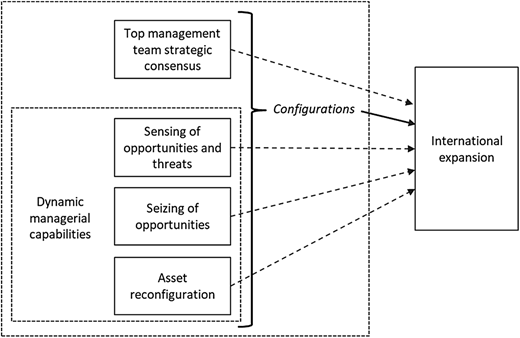
We follow the logic in earlier literature that dynamic managerial capabilities have a significant impact on a firm's international expansion, and we combine it with Barkema and Shvyrkov's (2007) findings indicating that the dynamics within a TMT's decision-making vary as firms progress. However, we also acknowledge that apart from the notions that dynamic managerial capabilities generally promote international expansion and that TMT consensus does the same (see the dashed black arrows in Figure 1), the current literature is scant with regard to how the strategic consensus over the dynamic managerial cognitive capabilities to sense opportunities and threats, to seize opportunities and to reconfigure firm assets, which impacts internationalization. That is, it is not clear if configurations of these elements promote or limit international expansion, or if there are such combinations that are quite irrelevant.
Some expectations can be built based on existing literature. In the international business context, sensing involves monitoring and identifying expressed or latent needs of foreign customers, supplier and competitor information and scanning for collaborators, scientific and technological opportunities (Teece, 2007; Felin and Powell, 2016). The sensing of local market opportunities allows an internationalizing firm to select and transform the most promising opportunities into commercially viable products and services (Eriksson et al., 2014; Felício et al., 2016). Swoboda and Olejnik (2016) show that the more efficient the firm's scanning of international market information is, the better the international performance is. Liability of foreignness, combined with liability of newness in young firms or SMEs, may make sensing more challenging (Markman and Waldron, 2014). Sensing depends on individuals and their cognitive skills, and for this reason, firms need to employ suitable processes to manage information (Teece, 2007; Thornhill and Amit, 2003). A TMT's ability to access, interpret and filter the available foreign market information has been found to be important for international expansion (Julien and Ramangalahy, 2003; Yeoh, 2000), but it is not as clear about what it means in terms of whether the whole TMT sees sensing capabilities in this regard in a similar fashion.
On the other hand, it is quite established that based on identified foreign opportunities, TMTs need to make product-related decisions and to adjust business models and firm boundaries accordingly (Teece, 2007). Such seizing of opportunities comes down to the firm's available resources and capabilities (Cavusgil, 1984; Welch and Luostarinen, 1988; Katsikeas et al., 2000; Hewerdine et al., 2014). Prior studies suggest that domestic resources and capabilities often do not fit foreign operations directly (Bauer and Matzler, 2014; Kim and Finkelstein, 2009; Kumar, 2009), which generally means that different capabilities need to be employed. Then a question is whether they do exist – and how the TMT perceives them.
In addition, international expansion decisions are often associated with irreversible resource commitments and related reconfigurations of asset bases and organizational structures (Trahms et al., 2013; Teece, 2007). Again, it could be assumed that whether these capabilities exist, and if they are interpreted consistently in the TMT, play a role in terms of the internationalization outcomes. The related dynamics, however, may not be straightforward.
Generally, the sensing and seizing of foreign opportunities and the consequent asset orchestration decisions have been considered to call for strong dynamic managerial capabilities and outstanding collective organizational problem-solving skills (Augier and Teece, 2009; Ellonen et al., 2009; Fain and Wagner, 2014; Hughes et al., 2010). We expect that configurations of varying dimensions of dynamic managerial capabilities (sensing, seizing and reconfiguration) and TMT strategic consensus jointly impact a firm's international expansion (see the solid black lines in Figure 1). Based on earlier theorizing and empirical evidence, it can be proposed that a firm's international expansion will be highest among firms with high levels of dynamic managerial capabilities (sensing, seizing and reconfiguration) and TMT strategic consensus on these capabilities. However, since internationalization covers different dimensions and stages, and as there is limited evidence on what kind of combinations of capabilities and consensus might be needed for these, we proceed with empirical, explorative and examination.
Methodology
Research design and data
We collected our data between 2013 and 2016 from several consultancy projects. These projects aimed at assisting the participating firms in their international expansion. To gain a solid insight into a firm's current position, in each participating firm, all TMT executives individually answered a questionnaire that covered both the firms' resource and capability endowments and indicators on international expansion. While a firm is our unit of analysis, multiple individual answers from each firm enhanced the reliability of measuring the firm-level dynamic capabilities and enabled us to reveal how unanimous firms' TMT members were in their views. In this regard, the resulting data allow us to reveal how a firm capabilities and TMT consensus on these elements relate to a firm's international expansion.
The questionnaire used in data collection had some quite unique features. TMT executives judged a large set of simple, unequivocal claims (i.e. questions or statements presented) with either a “yes” or “no” answer. These binary yes/no statements, such as “The company has a budget for international sales and marketing” pushes the individual executive to express his/her understanding of the firm's current practices. This approach was used to remove any ambivalence that may result from middle scores in conventional Likert scales. The use of binary questions is also a response to Woodside's (2013) call to consider data collection methods other than traditional Likert-based point scales. Moreover, the statements in the questionnaire cover such operational topics that any TMT member should be familiar with. The questionnaire was initially developed for consultancy purposes, which ensured managerial relevance, but it was also tightly grounded on existing theorizing, utilizing the expertise of management scholars and practitioners.
The framework behind the questionnaire assumes that expansion in the international markets requires impartial investments in all firm functions and pays specific attention to underlying, function-specific processes, routines and skills. In this regard, the framework reflects dynamic capabilities perspective (Teece, 2007) and includes contemporary discussions on dynamic capabilities' microfoundations (Felin et al., 2012, 2015; Felin and Powell, 2016). Consistent with the microfoundations approach, the framework emphasizes managerial cognition (Maitland and Sammartino, 2015) and expands the way in which Knight et al. (1999) approach the TMT strategic consensus. Furthermore, the framework accepts that previous investment decisions in resources and capabilities influence the available growth paths in the future (Teece et al., 1997) and hence, earlier decisions and available resources resonate with firms' internationalization processes. In this sense, the framework has similarities with the internationalization stage models (cf. Bilkey and Tesar, 1977) and the Uppsala internationalization process model (Johanson and Vahlne, 1977). However, the framework acknowledges that some firms may be international from their establishment or may internationalize very fast, as suggested by the international entrepreneurship literature (c.f. Madsen and Servais, 1997; Oviatt and McDougall, 1994). Over the years, and rather surprisingly, the results from using the framework have shown that TMT executives come with quite diverse views. These findings led us to ask whether such distinctions hinder or promote firms' international expansion.
Information gained from the questionnaire on the firm situation with regard to existing resources and capabilities as seen by each TMT member, and as an aggregation of those views, shows both the firm's preparedness for (further) international growth and the level of TMT consensus. Following the theoretical considerations, members of a well-functioning TMT should end up with very similar answers while also showing adequate levels of experience and functional variety. It could also be assumed that these aspects relate to the types of international activities and the phase of the internationalization process of the firms.
To analyze our data, we adopted the QCA method (QCA, Ragin, 1987, 2000; Longest and Vaisey, 2008). Longest and Vaisey (2008, p. 79) note that instead of estimating the net effects of single variables, “QCA employs Boolean logic to examine the relationship between an outcome and all binary combinations of multiple predictors.” They further suggest that this approach is appropriate for testing “social and behavioral theories that posit combinations of variables working in highly contingent ways.” Unlike traditional explanatory models, QCA supports the issue of equifinality (Munoz and Cohen, 2017), i.e. the fact that a similar internationalization status can be achieved through several different configurations of capabilities. QCA can also capture causal asymmetries (Fiss, 2011), i.e. release the (often hidden) assumption that the causal conditions leading to internationalization are the opposite of those leading to staying in the domestic markets. QCA can also be utilized when the sample size is small or moderate (with the latter applying to our case), as long as overfitting can be avoided by careful selection of a limited number of causal conditions. Traditional multivariate analysis methods usually require five to ten times, as many cases as there are variables in the model, and with the main and interaction effects of several independent constructs each measured by multi-item scales, the required sample size would usually exceed 200 cases. Furthermore, sample representativeness is not as critical as in traditional linear models because QCA does not rely on assumptions of normal distributions. In our analysis, we employ crisp set qualitative comparative analysis (csQCA) with the software called “fs/QCA v.3.0 for Windows” (Ragin and Davey, 2016), and as a robustness check, we also conduct fuzzy set QCA with “Stata SE 16” software. The choice between crisp and fuzzy sets is surprisingly little as discussed in the QCA literature, and researchers often routinely apply fuzzy sets when the underlying variables are measured on a continuous scale, especially with large samples (Rohlfing, 2020). On the other hand, crisp sets are the only alternative when the underlying variables are dichotomous. In our case, the outcome variables are dichotomous but the causal conditions continuous, so both calibration methods could be used. According to Rohlfing (2020), fuzzy calibration is often justified by the idea that it retains more information and leads to more conservative estimates of consistency. However, as this is not necessarily the case, use of both is recommended for situations where the chosen method does not yield any consistent solution. We are following this advice and uses primarily crisp sets but also include fuzzy sets as a secondary, robustness checking method. We report the results for the robustness check in an easily comparable format in Appendix 4.
Our data cover all consultancy projects between 2013 and 2016 in which the participating firm had a goal to expand their businesses in foreign markets. The data consist of 261 respondents' answers to the questionnaire from 63 firms from various industries. Before filling in the questionnaire, the respondents were informed that the resulting data would be used for research purposes. The firms in our data come from different industries. On average, the age of the firms is 13.2 years, they employ 31.2 people, their turnover is EUR 11.6m and their sizes vary from start-ups to firms with 96 employees. The respondents are solely TMT members. All data were gathered using the same questionnaire and collected in a single database. We used 185 individual statements from the questionnaire (see Table 1 below for examples) to explore the TMT strategic consensus and to examine how this consensus (or lack of it) relates to firms' international expansion [1]. The number of members in each TMT varies between 2 and 12, with the average being 4.1 members.
Measures
Following Teece (2007), we disaggregated dynamic managerial capabilities into sensing, seizing and reconfiguration capabilities. In addition, similarly to Teece (2007), we further divided, based on theoretical foundations, each type of capabilities into four classes, each class reflecting the respective capability's underlying microfoundations (processes, systems, decision rules and structures). We used these three categories of capabilities and combined them with TMT consensus as causal conditions in QCA to explain how different configurations emerge in a firm's international expansion (outcomes in QCA).
Outcomes
In our study, we used four internationalization outcomes to capture different elements and stages of internationalization: (1) whether the firm has foreign customers (ForCust), (2) whether the firm is able to repeat its sales to its existing foreign customers (RepSales), (3) whether the firm has several long-term international customer agreements (LongTerm) and (4) whether the firm has an internationalization strategy that sets clear priorities to expand to new target countries (ExpStr). All outcome variables are single items, which the TMT executives responded to with either with “yes” or “no.” The firm-level score was set to “yes” if the majority of its TMT members gave an affirmative answer.
Causal conditions
We calculated each firm's sensing-related abilities (S) as an average of its TMT members' responses to 69 items. Sensing consists of varying elements (in line with the discussion on microfoundations as described in Teece, 2007), covering a firm's various processes and practices for identifying and managing internal R&D and related technologies, information on supplier/complementor innovation and distributors, developments in exogenous science and technology and target market segments and customer needs. Members of the TMT individually judged 69 items reflecting sensing capabilities as either “yes” or “no”. The sensing score was calculated as an average over all respondents in the company and all 69 items in the scale, resulting in a continuous score in the range of 0–1, with a Cronbach alpha value of 0.95. We list examples of these statements in Table 1 below.
Seizing (Z) is a measure that reflects a firm's seizing-related abilities, constructed similarly to sensing; it is the average of 70 items (alpha = 0.94). In line with Teece (2007), sensing covered elements of a firm's processes and practices for aligning the customer solution and the business model, for managing decision-making protocols as well as enterprise boundaries, controlling bottleneck assets, assessing appropriability and for building loyalty and commitment (see Table 1 for examples).
Reconfiguration (R) measures a firm's reconfiguration abilities: it is the average of 46 binary items assessed by the firm TMT members (alpha = 0.92). Reconfiguration addresses, as proposed by Teece (2007), are the following: A firm's processes and practices for managing decentralization and firm structures; incentive alignment and minimizing agency issues; strategic fit so that asset combinations are value-enhancing and for managing learning, knowledge transfer and intellectual property protection (see Table 1 for examples).
Consensus (C) is a measure that captures TMT consensus. We computed it as the within-company coefficient of variation in the scores for sensing, seizing and reconfiguring.
Contextual conditions. We applied two contextual conditions in our analyses: Firm age was included as less mature firms are less likely to have internationalized, and as younger firms may also have different dynamic capabilities and tendencies to reach consensus compared to more mature firms (Barkema and Shvyrkov, 2007; Teece et al., 1997). The size of the management team was included since very small teams are more likely to have, and require, consensus in making decisions about internationalization (Simsek et al., 2005). Larger management teams could also imply higher levels of dynamic capabilities (Teece et al., 1997).
Calibration. For the purposes of the crisp set QCA, we calibrated into 0/1 dichotomies (see Russo and Confente, 2019). As for the outcomes, we applied a conceptual rule by setting the outcome (indicator of internationalization) to 1 if the majority of the firm's TMT members had answered “yes”. For the causal conditions, there was no meaningful conceptual threshold available, so we resorted to an empirical threshold (i.e. using a median split). For example, if a firm's average score (calculated over all respondents in the company and all items on the scale) for sensing capability was higher than the median sensing capability score of all companies, a value of 1 indicating high sensing capability was assigned. Consensus was coded as 1 if the firm's coefficient of variation was smaller than the median value in the sample. Firm age was calibrated as young if the firm was less than ten years old (following the notions by Coad et al., 2016) and TMT size as small if it had only two or three members.
Results
QCA is a set-theoretic method capable of indicating underlying cross-case patterns, even in small data samples (Ragin, 1987, 1997, 2000; Greckhamer et al., 2018), and in our case, groups firms based on the configurations of sensing, seizing, reconfiguration and consensus measures. Our unit of analysis is a firm and especially the TMT of a firm. QCA focuses on relations, not correlations, and it provides an assessment of different combinations of causal conditions (Ragin, 1997).
Data description and analysis of necessity
The descriptive information of all measures applied in the analyses is shown in Table 2. Of the 63 firms altogether, 62% are less than ten years old and 52% have an executive team consisting of only two or three people. In terms of the internationalization outcomes, 75% have foreign customers, 44% have repeated sales to foreign customers, 35% have long-term contracts and 38% have an international expansion strategy. In line with recommendations by Greckhamer et al. (2018), we analyze the configurations for the presence and the absence of each outcome separately.
Following the suggestion of Schneider and Wagemann (2010), we begin with the analysis of necessity, applying the threshold of 0.90 for consistency as suggested in Greckhamer et al. (2018). This means that a causal condition can only be interpreted as a necessary condition if more than 90% of the cases exhibiting the condition are also exhibiting the outcome. Overall, the consistencies are rather low in Table 2, and none of our causal conditions by themselves are necessary for any of the outcomes. The lower part of Table 2 shows coverages, i.e. how many percent of cases with the outcome have the causal condition.
Analysis of sufficiency: truth tables
Following the example of Cannaerts et al. (2020), we report truth tables as a first step of the analysis of sufficiency. As we employ four causal conditions (sensing, seizing, reconfiguration and consensus), the number of potential configurations is 24 = 16. Table 3 is a truth table, showing the frequencies of occurrence for each of these 16 configurations in our data set of 63 firms. The most common configuration is the one where the firm has low sensing, seizing and reconfiguring capabilities with a low consensus among the TMT members. This configuration (#1) covers 16 firms, which represents 25% of all firms in the sample. Two potential configurations (#15–16) of the causal conditions were not observed at all in the data: A closer look at these counterfactuals (also known as logical remainders) reveals that #16 would represent a firm with high reconfiguring capabilities, while sensing and seizing capabilities would be low. This is not in line with theory of dynamic capabilities, and we excluded this configuration from further analyses. The other logical remainder, configuration #15 is theoretically plausible but not covered by our sample. However, it is interesting to note that the similar capability configuration combined with low consensus among team members (#5) is exhibited by four cases. Configuration #14 is theoretically implausible for the same reasons as #16 and was thus removed. As for the other low-frequency configurations, we decided to apply a frequency threshold of three for inclusion in the analyses. When the total number of cases in a QCA analysis is relatively small, the frequency cutoff is usually one or two, but with large samples a larger threshold should be used (Ragin, 2017, pp. 39–40). Our sample size (N = 63) is above 50 and can thus be considered rather large than small in the QCA context (Greckhamer et al., 2013). Furthermore, as the data do not have in-depth information on every individual case, a threshold above one or two can be justified. Applying the threshold of three cases retains 54 (or 86%) out of the original 63 cases, which meets the recommended 80% retention guideline (Greckhamer et al., 2013, p. 66). Thus, configurations #9 to #13 are excluded from further analyses. Numbers 9, 10 and 11 are also theoretically questionable, as they indicate high seizing and/or reconfiguring capabilities despite low sensing capability. However, this combination could also be possible in some specific situations: Accurate reconfiguration as a response to seizing a random opportunity could turn out to be beneficial (Dalli, 1994).
Table 3 also shows the consistencies for each of our four internationalization outcomes. Consistency refers to the percentage of firms in the configuration that have the outcome “yes.” For example, out of the 15 firms unanimously agreeing to having high sensing, seizing and reconfiguring capabilities in configuration #2, 87% (i.e. 13 firms) have foreign customers, while 73% (i.e. 11 firms) have a foreign expansion strategy. The consistencies for the negated outcomes are not shown, as they equal 1 – the shown consistency. For example, in configuration #2, 13% (i.e. 1–0.87) have no foreign customers.
The truth tables with contextual conditions included are presented in Appendixes 1 and 2. The tables are arranged so that it is easy to compare the configurations that share all other characteristics except for the contextual condition. In most cases, the consistencies are quite similar regardless of whether the contextual condition is present or absent. The few exceptions are italic in the appendices and discussed below.
Table A1 shows the results for the TMT size. The frequencies in the configurations reveal an interesting pattern: The configuration where all dynamic capabilities are high is present in a total of 19 cases, out of which only seven (37%) are firms with small TMTs. Meanwhile, in the total sample, there are 33 out of 63 (52%) firms with small teams. The under-representation of small teams in this configuration supports the idea that larger TMTs, in general, enable firms to build stronger dynamic capabilities. The reverse proportionality is observed in the configuration where there is high consensus that all dynamic capabilities are low. The six cases in this configuration are all firms with small teams.
The truth table also supports the idea present in existing studies that it may be easier to reach consensus in smaller teams: 19 (63%) of the 30 cases in the high consensus set are firms with small teams. Whether or not this consensus is a good thing is another issue, however.
On the other hand, firm age is not as decisive according to our findings (which deviates to some extent from the findings of Barkema and Shvyrkov, 2007, for example). Table A2 shows the truth table with firm age added as a contextual condition, and the frequencies of the configurations do not seem to be overly affected by firm age.
Analysis of sufficiency: Boolean minimization
The analysis of sufficiency aims to identify the configurations that are sufficient for the outcome, i.e. are consistent subsets of the outcome set (Greckhamer et al., 2018). In other words, when a particular configuration is sufficient, all cases within it exhibit the outcome. In the analysis of sufficiency, it is critical that the consistency is high enough, and the usual recommended threshold is 0.80 (Ragin, 2008). In large samples it is common to observe contradictory configurations (that is, it can be observed that cases within a single configuration exhibit a different outcome), which by definition lowers the consistencies (Greckhamer et al., 2013). We applied a less stringent threshold of 0.73 in order to include in the Boolean minimization process those configurations (#2, 3 and 5 in Table 3) that made sense theoretically and had a consistency of just below 0.80. The Boolean minimization was conducted by using the Quine-McCluskey algorithm (Ragin, 2017, p. 37). Table 4 shows the results from the analysis of sufficiency.
For the outcome of foreign customers, configurations #2, 4, 5 and 8 from Table 3 meet the thresholds of frequency and consistency, thus qualifying for the Boolean minimization. The total number of cases is 26, and the intermediate solution covers just above 50% of all firms with foreign customers. However, the consistency of the solution is good at the level of 0.92. The Boolean minimization results in three prime implicants. The one with highest coverage (0.36) has high levels of all three dynamic capabilities, and the other two implicants are also high in seizing with either sensing or reconfiguring. Interestingly, when seizing is combined with only sensing or reconfiguring (but not both), the firm must also have a low level of consensus in order to have foreign customers. There were only 16 firms with no foreign customers, and our analysis revealed no consistent solution for this outcome. The inclusion of the contextual conditions would not have altered the solution, as the consistencies for small and large teams in Table A1 and young and mature firms in Table A2 are on the same side of the threshold in all cases but one. The configuration where all capabilities are low and consensus high would result in foreign customers within the group of mature firms (possibly indicating that mature firms may end up having foreign customers at some point in their life, even if they do not have the capabilities to create a more sustainable approach and even if they did not pursue internationalization actively), but even there the consistency (0.75) does not meet the conventional threshold of 0.80.
Our analysis results in only one configuration (#8 in Table 3) with three firms that have consistently succeeded in repeating sales to their existing foreign customers. The configuration combines low sensing capabilities and low consensus with high levels of seizing and reconfiguring, but the coverage of this solution is only 0.11. On the other hand, the solution for the absence of repeated foreign sales covers 46% of the cases with that outcome with a consistency of 0.80. In this solution, either all the causal conditions have low values (coverage 0.37) or low reconfiguring and consensus are combined with high sensing and seizing capabilities (coverage 0.09). These results would not be altered by the inclusion of the context variables (see Appendixes 1 and 2).
The outcome of long-term international customer agreements has rather similar results to repeated sales. The Boolean minimization results in the same formula for the outcome, and the coverages and consistencies are very close to those found for repeat sales.
Finally, our data reveal 26 firms in four configurations (#2, 4, 5, and 7 in Table 3) where they consistently have an international Expansion strategy setting clear priorities for expanding to new target countries. The Boolean minimization (see Table 4) gives a complex solution with a consistency of 0.77 and a parsimonious solution with 0.74 consistency, respectively. The coverage is quite good at 0.83. The combination of high sensing and seizing capabilities alone can cover 46% of the firms with an international expansion strategy. The other implicant combines high sensing with low consensus, but it also has a lower unique coverage (0.13). Out of a total of 39 firms with no expansion strategy, 22 qualified for the Boolean minimization. Configuration #1 exhibits low dynamic capabilities with low consensus and 16 firms occupied this set. Six firms had low capabilities combined with high consensus in configuration #3 (Table 3). The solution path thus implies no expansion strategy when all dynamic capabilities are low. This solution is fully consistent with a coverage of 0.56. The inclusion of the contextual conditions would change some of the results regarding this outcome, as can be seen in Table A3. The impact of TMT size on expansion strategy is such that the need for high sensing and seizing capabilities is especially valid in the context of large teams. The same is true in the context of young firms. As for the absence of an expansion strategy, low levels of all capabilities are still valid, but lack of consensus is not required in small teams. In young firms, all capabilities must be low without consensus, and in mature firms there must be consensus about the low capabilities for a firm not to have an international expansion strategy.
Robustness checks
Robustness checks were run (1) by varying the frequency threshold, which was dropped to 2, (2) by changing the consistency threshold, which was raised to 0.80 and (3) by using the fuzzy sets instead of crisp sets. As the results implied that the contextual conditions had only minor impact on the outcomes, we did not include the firm age or TMT size in the robustness checks. In the first robustness check, lowering the frequency cutoff to 2 obviously slightly improved the coverage of the solutions, but at the same time consistencies decreased to some extent. In the second robustness check, applying a consistency threshold of 0.80 reduced the coverage of the solution for expansion strategy quite dramatically, from 0.83 to 0.13, retaining only the path where high sensing capability is combined with a low value of other causal conditions. The other outcomes were not impacted by the altered consistency threshold.
The third robustness analysis with fuzzy sets was run using the fuzzy command in STATA (Longest and Vaisey, 2008), and the key results are shown in Appendix 4. All variables were first calibrated into sets ranging from 0 to 1 using the standardized ranking procedure (Longest and Vaisey, 2008, p. 89). Table A4.1 indicates that the distribution of firms into the configurations is rather similar to the respective crisp set-based distribution. The fuzzy set method loses four observations because one of the calibrated variables receives the value of exactly 0.5, which is the cross-over point. A chi-square test supports the similarity of the distributions, as the test statistic equals to 6.68 with a p-value of 0.92. Table A4.2 compares the y-consistencies. In general, the consistencies are in line with those from csQCA: for the most populated configurations fuzzy consistencies tend to be slightly higher, whereas they are less extreme than crisp consistencies in the configurations with a small number of firms. The logical reduction applied the Quine-McCluskey algorithm, and it was required that all configurations entering the solution should fulfill two conditions: (1) y-consistency should be larger than n-consistency and (2) y-consistency should be larger than 0.73. The results are shown in Table A4.3.
Overall, the comparison of our robustness check using fuzzy sets with the original crisp sets indicates that the fuzzy coverages are substantially larger than the crisp ones, but this is at the cost of reduced consistency. The sets in the fuzzy solutions are also somewhat simpler than the respective crisp solutions. For example, in terms of foreign sales, the fuzzy solution suggests that it is sufficient to have a high value in any one of the four conditions, while the crisp solution required at least two high-level capabilities. Furthermore, the fuzzy solution reveals that 54% of firms with repeated sales record high levels on all three capabilities, but this solution has poor consistency. For long-term contracts, neither method yielded a plausible solution, but the lack of contracts can be consistently explained by the presence of a low value in any of the primary conditions. Expansion strategy seems to require high sensing and seizing capabilities in both methods, but the robustness check reveals an interesting difference for the lack of such a strategy: the crisp analysis indicated that no firm with a low value in all capabilities had an expansion strategy, but these represented only 56% of firms that lacked the strategy. The fuzzy solution came up with a coverage of 83% (yet the consistency was still above 80%) with a solution where any one of the three capabilities is low.
Summary
To sum up the results, we take into account the solutions from the main (crisp) analysis and the robustness checks (fuzzy sets). The solutions need to cover at least 25% of the outcome (Munoz and Dimov, 2015) and have a consistency above 0.73. In the outcomes where both crisp and fuzzy solutions satisfy these criteria, we select the one with higher values. In cases where the complex, intermediate and parsimonious solutions were different from each other, we preferred the most parsimonious one as long as it met the abovementioned coverage and consistency criteria. As we show in Table 5, the Boolean formulas of the final solutions can be expressed as follows:
As an overview of the formulas, it can be concluded that internationalization outcomes related to having foreign customers and an internationalizing strategy (that is, the basic elements to access international markets) seem to require a high level on at least two out of the three dynamic capabilities (with seizing present in all of these). The existence of an internationalization strategy can potentially build on the combination of sensing and low TMT consensus. Low rather than high consensus within the TMT seems to connect to high values of dynamic managerial capabilities in explaining these types of internationalization outcomes. On the other hand, continuity in the international markets seems to be much more difficult to explain.
The negated outcomes are dominated by configurations with low values in the combination of individual capabilities. High strategic consensus does not emerge in the configurations explaining a lack of international activity, whereas a low level of agreement within the TMT can contribute negative outcomes, especially in terms of continuity (that is, repeated international sales and international long-term contracts). We will discuss our findings further below.
Discussion
In this study, we explored how sensing and seizing market opportunities, asset reconfiguration and TMT consensus on these elements relate to a firm's international expansion both in terms of basic elements (i.e. having an internationalization strategy and having foreign customers) and continuity (repeated sales and long-term contracts). Our empirical examination brings forth many intriguing aspects regarding these interconnections.
Our findings indicate that having high levels of dynamic managerial capabilities is generally connected to having the basic elements to access international markets in place, and that, on the other hand, low levels (of any of them) are present in firms that have not been able to establish a specific internationalization strategy or to secure long-term contracts and repeated sales. These findings are in line with those of Woldesenbet et al. (2012), suggesting that dynamic managerial capabilities are, in general, important for internationalizing firms.
However, our study also provides nuanced empirical evidence on the role of dynamic managerial capabilities. First, they seem to gain importance in relevant configurations. Except for having an international strategy in place (where sensing comes together with low TMT consensus rather than other dynamic capabilities), in all plausible configurations explaining internationalization, at least two types were combined. Considering the favorable combinations, high sensing and seizing capabilities often emerge in configurations that relate to a firm having an expansion strategy and foreign customers. This leads us to conclude that being able to find relevant opportunities is, generally, a threshold condition for engaging in internationalization. In order to make investment decisions – like investment in internationalization, a firm's resource and capability endowments have to support these decisions (Nummela et al., 2004; Kahiya and Dean, 2016). Surely it is possible that an opportunity comes along without actively looking for it (we also observe one configuration where foreign customers are gained even without sensing being present), but then, seizing and reconfiguring capabilities may become important.
Our empirical study also points to another interesting observation with regard to dynamic capabilities. While sensing and seizing seem to facilitate the strategic approach and initial entry when combined with other capabilities (see Eriksson et al., 2014; Felício et al., 2016), they seem to play a more intricate role in connection with more sustained international activity (cf. Bauer and Matzler, 2014; Teece, 2007): Low values of these higher order dynamic capabilities seem to connect to the lack of international strategy, repeated sales and long-term contracts (suggesting that they are in fact needed), but at the same time, high values of sensing and seizing together with low reconfiguring capabilities and low TMT consensus contribute to not having repeated sales. Whereas high sensing and seizing and low consensus, or high sensing and seizing and reconfiguration capabilities, support having foreign customers; the balance seems to shift very easily when continuity is considered. It seems that narrowing of and acting on the available opportunities is needed, at least to some extent, to be able to focus on those international activities that are viable in the long run.
Regarding the role of TMT strategic consensus, a lack thereof seems to be of importance rather than reaching agreement. This finding both matches and contradicts earlier studies. First, a lack of TMT consensus combined with dynamic capabilities – and even on its own – seems to connect to not reaching continuity in international activities. This resonates with studies suggesting that divergence may cause challenges for firms (see Hambrick and Mason, 1984; Knight et al., 1999; Parola et al., 2015).
On the other hand, not finding evidence on TMT consensus promoting internationalization contradicts many earlier studies that expect TMT consensus to support firm performance (e.g. Boxer et al., 2013; Kor and Mesko, 2013; Lampel and Shamsie, 2000; Prahalad and Bettis, 1986; Teece, 2007). This warrants closer examination – similarly to the finding that a lack of consensus, in fact, may contribute to having foreign customers and an internationalization strategy in interaction with specific dynamic capabilities. We interpret these results to suggest that low consensus can be a driving force that gives the company the initial push to move forward. For example, earlier internationalization literature indicates that individual circumstances can at some point trigger random patterns of expansion where determinism is relatively low and decision-making falls into the hands of specific managers (Dalli, 1994). Both Eisenhardt (1989) and Hutchinson et al. (2006) indicate that effective TMTs strive for consensus, but also can make the choice if no consensus emerges. Combined with a couple of types of strong capabilities, a lack of consensus on the remaining capabilities may allow the TMT to discard potentially missing capabilities and take the initial risk. Internationalization easily becomes more random (not strategy based), if consensus – and capabilities – are missing. For continuity, a lack of consensus may not be useful, especially if there are, de facto, no capabilities to act on the opportunities.
The reasons why low consensus is differently present in “go/no-go decisions” with regard to having international activities in the first place and making them more sustained could also be explained by contextual factors, at least to some extent. First, while we found that firm age as a contextual factor is not very decisive for capabilities or consensus in general (it may be that the experience of TMT executives counteracts young firm age) (Hutzschenreuter and Horstkotte, 2013), firm age becomes an issue to be reckoned with as part of the configuration when the expansion strategy is considered. It seems that in young firms, expansion strategy may emerge as a result of some risk-taking during the “honeymoon period” (Covin and Wales, 2019; Fichman and Levinthal, 1991) and that the early phases of international expansion demand sales and marketing resources (Yeoh, 2000; Swoboda and Olejnik, 2016). Second, TMT size may be of importance. Generally, our findings suggest that firms with small TMTs may have challenges in developing good coverage of sensing, seizing and reconfiguring capabilities, while these all emerge more easily in firms where TMTs are larger. This is in line with the existing literature suggesting that adequate (functional) diversity generated by variation in the TMT executives' backgrounds can be beneficial (Rivas, 2012).
Conclusions
Theoretical contributions and managerial implications
In our study, we aimed to find out how the dynamic managerial capabilities and the TMT executives' strategic consensus with regard to these capabilities jointly influence a firm's international expansion. In doing this, we examined the configurations of sensing, seizing and reconfiguration, and the top management team's strategic consensus with respect to different dimensions of international expansion. Earlier research has suggested that sensing, seizing and reconfiguring capabilities are inherently needed in such endeavors, and that TMT strategic consensus is generally useful for gaining better performance outcomes (Barkema and Shvyrkov, 2007; Boxer et al., 2013; Ferguson et al., 2016; Helfat and Martin, 2014; Knight et al., 1999). At the same time, it has been indicated that these connections are not definite, as diversity in the TMT, which ensures a sufficiently broad resource and capability base needed for internationalization (Hambrick et al., 1996), is also a source of potential lack of consensus (Hambrick and Mason, 1984; Knight et al., 1999; Parola et al., 2015). We believe that it is far from irrelevant in which elements diversity resides, or what kind of dynamics are at play in top management teams.
Our findings contribute to existing theory by exploring how managerial capabilities influence firm-level dynamic capabilities from the point of view of the TMT, rather than looking at individual managers (cf. Melone, 1994; Acar, 2016). We also add to existing research that has often focused on the relationships between TMT executives' demographic traits and TMT consensus and, further, the (subsequent) firm performance by looking at configurations of relevant factors rather than linear linkages. Together, these notions further mean that we pay attention to a different source of diversity compared to earlier studies. We consider the varying or unified perceptions of existing managerial dynamic capabilities, rather than evaluate the functional diversity (connected to the demographic characteristics of executives) or the TMT executives' agreement on strategic moves. This allows us to gain different insights into the dynamics of TMT decision-making.
Providing some explanation to the indecisive results in earlier studies with regard to the relationships between dynamic managerial capabilities, TMT strategic consensus and firm performance – international expansion in our case (cf. Certo et al., 2006; Ramos-Garza, 2009), we find that different configurations are relevant to varying extents when specific dimensions of internationalization are taken under scrutiny. It can be argued that neither TMT strategic consensus nor diversity in the executives' backgrounds or managerial dynamic capabilities alone explain the firm's internationalization and performance (cf. Barkema and Shvyrkov, 2007; Boxer et al., 2013; Certo et al., 2006; Fernandez-Ortiz and Lombardo, 2009; Helfat and Peteraf, 2015; Ramos-Garza, 2009).
Besides contributing to the academic discussion on TMT consensus, dynamic capabilities and internationalization, we also contribute to existing research as we use somewhat unconventional means of data collection and analysis. For empirical evidence, we used data gathered with a questionnaire where executives select either “yes” or “no” in response to a number of statements describing the firm's situation. While this approach may have its limitations (see below), it also provides a chance to objectively observe consensus among the respondents in one organization, and it avoids some of the vagueness associated with collecting data with Likert-scale questions, for example. That is, subjective perceptions of managers on capabilities or (dis)agreement within the TMT are replaced with a more neutral evaluation of these elements. Coverage and variation come from the number of evaluated issues rather than from degrees regarding few factors. We also analyzed our data using the QCA method, which is, while relatively established in many fields, still in limited use in studying international business-related phenomena.
Our findings also contribute to practice. The managerial implications of our study indicate that all capabilities are important, even if in different configurations, which means that nurturing them benefits successful internationalization. TMT size seems to be a contributing factor, meaning that any firm where the TMT executives lack prior international experience in particular could benefit from inviting more members onto the team. It seems that the managers need not worry about disagreement increasing as a result of increasing TMT size since having consensus, as such, does not come across as a decisive issue with regard to internationalization. Even if lack of consensus may limit international expansion, this end-result may be quite appropriate if the necessary capabilities are missing. In fact, consensus can be a double-edged sword. Having some lack of consensus seems to be a driving force that allows capabilities to be questioned and potentially keeps (false) under-appreciation of existing capabilities from becoming a barrier to international expansion.
Limitations and future research
We acknowledge that, like any research, ours has limitations. These can be used as points of departure for future research. First, the data are collected in a new way, using a questionnaire with vast amounts of binary statements. While the instrument is a result of practical expertise and is in line with theoretical considerations, validation of this kind of approach is welcomed. Relatedly, we collected our data in a small, open economy with specific features. Results might be different if the data were collected in other countries. Another point regarding our data is that we do not make a distinction between de novo entrants and other firms. Such delimitation could be a valid one to make in future studies. While firm age is considered, companies that are international from their initiation may be different from those internationalizing slowly and reactively, and the role of the TMT may look different.
Regarding analysis of the data, our data and research design are in many respects at the borderline between the typical csQCA and fsQCA applications outlined in the literature. Our sample size is 63, which is larger than most csQCA applications, but also quite small compared to many fsQCA applications (Greckhamer et al., 2013). Furthermore, our outcomes are clearly binary and best treated as crisp, but our conditions could also have been treated as fuzzy. Our research design is based on four different internationalization-related outcomes and taken that their negations must also be analyzed, we considered that the presentation of all analyses and results from the crisp version is clearer and more concise. Future studies can, however, perhaps take a different approach and reveal information from other points of view. Finally, we have not been able to provide detailed casewise information. This was simply not feasible due to the large numbers of cases and outcomes to be analyzed. Future studies could consider multi-method settings where QCA is combined with casewise process tracing in order to get an in-depth understanding of the causal dynamics (Schneider and Rohlfing, 2013).
Beyond these issues related to data collection and analysis and the identified need to study speed of internationalization as a relevant factor, we believe that our study invites closer examination of aspects such as the role of cultural diversity. As Elron (1997) points out, teams with larger cultural heterogeneity often come with larger degree of lack of consensus, and it would be interesting to see whether this also applies to consensus on managerial capabilities and the related effects of internationalization. Likewise, the actual means of decision-making (and not just the underlying elements behind dynamism related to it) could be connected to consensus on capabilities. Finally, we also acknowledge that TMTs may focus on those aspects of an unpredictable future that they can control (Sarasvathy, 2001) and, hence, considerations of effectuation would bring additional value to future studies. We hope that our findings can provide a starting point for such further studies.
Note
The framework consists of 480 statements in total. In this study, we selected 185 statements that represent issues related to international expansion and cover versatile aspects of dynamic managerial capabilities, especially sensing, seizing, and reconfiguration capabilities.
References
APPENDICES
Appendix 1
Appendix 2