
Skip to article sections
Purpose

This paper aims to review how digital disruption is conceptualised across organisations, markets and society and interpret its implications through managerial and sustainability-oriented perspectives. It conceptualises disruption not as a technology itself, but as a process mediated by the reconfiguration of core managerial functions and examines how that process affects transparency, accountability and the credibility of sustainability-oriented market practices.

Design/methodology/approach

This study draws on a qualitative systematic literature review of 81 peer-reviewed articles published between 2000 and 2025 and retrieved from Scopus. An integrative interpretive framework is developed by analysing disruption through the lens of classical managerial functions (i.e. planning, organising, staffing, leading and controlling) and interpreting them from an internal and external marketing management perspective.

Findings

Digital disruption reconfigures managerial functions by making planning more anticipatory, organising more platform-mediated, staffing more hybrid, leadership more interpretive and ethically demanding and control more “datafied” and continuous. These interconnected changes offer opportunities for greater transparency, traceability, and responsiveness, while also creating risks of opacity, platform dependence, metric fixation, and accountability gaps. Sustainable marketing outcomes therefore depend on how organisations govern digitally enabled managerial reconfiguration rather than on technology adoption alone.

Originality/value

This paper distinguishes digital technologies from the disruptive organisational consequences that may follow their adoption and explains disruption as a managerially mediated process. It extends disruption research through an integrated managerial functions framework and clarifies how this process conditions credible sustainable marketing. Practically, the framework helps managers assess whether digital initiatives support transparent sustainability claims, accountable decision-making and stakeholder trust.

The concept of disruption has become crucial in management and marketing studies. Yet, its pervasive use has progressively diluted its analytical precision, obscuring the theoretical boundaries that once granted it explanatory strength. Far from being a simple synonym for technological acceleration, disruption entails a fundamental reconfiguration of how knowledge is organised, interpreted and mobilised within firms, markets and consumption systems (Cozzolino et al., 2018; Godart and Pistilli, 2024). Rather than operating solely as a driver of innovation or competitive repositioning, disruption increasingly reshapes the managerial foundations through which organisations design offerings, coordinate value creation and interact with consumers and stakeholders. From a marketing perspective, these shifts change the way value is created and captured, moving marketing beyond a communicative or promotional function towards a market-facing expression of deeper organisational and governance choices. They also make it necessary to rethink how sustainability is presented, not just as a list of claims, but as a series of real responsibilities and difficult trade-offs that a brand has to justify to its customers (Gleim et al., 2023). Disruption therefore signals a rupture with established assumptions and cognitive frames, prompting new ways of acting, reasoning and making sense of environments increasingly shaped by digital technologies (Duggan, 2019).

Although initially associated with technological discontinuities and the reconfiguration of competitive positions, disruption now captures a broader and more complex set of transformations extending beyond market dynamics. It denotes a multi-layered phenomenon involving profound changes in how firms create value; how consumers interpret, evaluate and engage with digital and sustainable environments; and how institutions respond to shifts in socio-technical systems (Christensen et al., 2018; Godart and Pistilli, 2024). Importantly, digital technologies should not be equated with digital disruption itself. Technologies such as artificial intelligence, interconnected platforms, algorithmic decision-making systems and immersive interfaces act as potential enablers of disruption; digital disruption occurs when their adoption destabilises established organisational arrangements, managerial practices, market relationships or institutional expectations (Cozzolino et al., 2018; Godart and Pistilli, 2024).

A comprehensive view therefore positions digital disruption as a cumulative process through which digital technologies contribute to changes in the cognitive, operational and institutional architectures underpinning economic and social action (Godart and Pistilli, 2024; Morel et al., 2020). Rather than generating isolated episodes of change, disruption unfolds through intertwined mechanisms that reshape how organisations structure their capabilities, how markets coordinate exchanges and how individuals interpret information, evaluate alternatives and form preferences. In this sense, digital disruption is not reducible to technological novelty but reflects deeper transformations in the logics governing interaction, coordination and sense-making (Soeffner, 2025).

These transformations are particularly consequential for sustainable marketing management, which refers to the planning, implementation, coordination and governance of market-facing activities that seek to create value for customers and other stakeholders while accounting for environmental integrity, social well-being and long-term economic viability (Kemper and Ballantine, 2019; Purani et al., 2014). It therefore extends beyond the communication of environmental or social claims to encompass the organisational processes through which such claims are developed, substantiated, monitored and made accountable. Under conditions of digital disruption, sustainability must consequently be understood not simply as a collection of market claims, but as a set of responsibilities and trade-offs that organisations must justify to consumers and other stakeholders (Gleim et al., 2023).

Based on such preliminary insights, the contemporary relevance of digital disruption may substantially strengthen these processes. On one side, digital technologies create opportunities for scalability, real-time responsiveness, the personalisation of sustainable offerings and the development of circular business models supported by predictive, automated and distributed intelligence (Lacy et al., 2020; George et al., 2024; Sestino et al., 2025a). They can also improve how firms monitor, measure and report their environmental and social impacts and how consumers access and evaluate sustainability information (Kemper and Ballantine, 2019; Purani et al., 2014). However, the same technologies introduce tensions associated with the concentration of power, the opacity of algorithmic processes, digitally amplified greenwashing, platform dependency and new forms of consumer vulnerability (Gleim et al., 2023; Papadopoulou et al., 2021; Papasolomou et al., 2022). They also raise broader questions concerning privacy, autonomy, equity, labour transformation and accountability (Al-Emran and Griffy-Brown, 2023; Wunderlich et al., 2019). Digital disruption is therefore inherently ambivalent: its implications for sustainable marketing depend not only on what technologies enable but also on how organisations manage and govern their adoption.

Despite extensive research across these thematic areas, the academic discourse remains fragmented. Existing studies tend to focus on specific facets, such as organisational transformation (e.g. Hopp et al., 2018; Godart and Pistilli, 2024), consumer behavioural shifts (e.g. Behl et al., 2024; Giza and Wilk, 2021) or institutional adaptation (e.g. Christensen et al., 2018; Cozzolino et al., 2018), without offering an integrated view capable of connecting micro- (i.e. cognition and behaviour changes), meso- (i.e. organisational and market reconfiguration) and macro-level (i.e. institutional consequences) dynamics. In particular, limited attention has been devoted to the managerial mechanisms through which digital technologies produce disruptive consequences across organisations and markets and, subsequently, shape the transparency, accountability and credibility of sustainability-oriented market practices.

Based on the above, this study aims to review the literature on digital disruption and interprets its implications through a managerial and sustainability-oriented marketing perspective, shedding light on how digitally enabled disruption reconfigures core managerial functions and how these reconfigurations influence sustainable marketing management.

Accordingly, this study would like to address the following research questions:

RQ1.

How does current academic research conceptualise the role of digital technologies in shaping digital disruption across organisations, markets and society?

RQ2.

What opportunities, risks and tensions emerge from these transformations, and what are their implications for sustainable marketing management?

To address these questions, the study adopts a qualitative approach based on a systematic literature review. Through a thematic synthesis aimed at identifying cross-cutting theoretical configurations, the literature was first classified according to the managerial functions framework (i.e. planning, organising, staffing, leading and controlling; Weihrich and Koontz, 2005) and subsequently interpreted through an internal vs external marketing management lens of digital transformation (Sestino et al., 2025b). This sequential structure allows for analysing how digital disruption is conceptualised in various research areas and how its managerial consequences extend to market-facing sustainability practices.

Findings of our analysis suggest that digital disruption reshapes the very conditions under which sustainability marketing can operate as a credible market practice. Firstly, rather than representing a merely technological shift, digital disruption emerges as a managerial process that reconfigures planning, organising, staffing, leading and controlling, thereby influencing how sustainability promises are designed, communicated and evaluated by consumers. Moreover, digital infrastructures expand opportunities for transparency, traceability and personalised engagement, while simultaneously generating new risks of opacity, metric fixation and platform dependency that may weaken perceptions of authenticity.

From a theoretical perspective, this study reframes digital disruption as a socio-technical process emerging through the reconfiguration of managerial functions rather than as an automatic consequence of technological adoption, explaining why similar technologies may generate different organisational and market consequences depending on how they are integrated into planning, organising, staffing, leading and controlling. It reconnects disruption research with core theories of management and organisation and extends it to sustainable marketing research by positioning marketing as the market-facing expression of managerial and governance choices and sustainability as an emergent governance outcome. From a practical perspective, the proposed framework helps managers evaluate how digitally enabled changes in planning, organising, staffing, leading and controlling affect the credibility of sustainability practices. It highlights the need to balance efficiency, personalisation and traceability with transparency, accountability, consumer autonomy and long-term value creation.

The notion of disruption has progressively evolved into a foundational lens for interpreting how contemporary socio-technical systems transform, adapt and sometimes fracture under the influence of emerging technologies (Christensen, 1997; Christensen and Raynor, 2003). Although the term originally framed the competitive consequences of technological discontinuities, its current meaning extends far beyond market entry dynamics or firm-level competitive responses (e.g. as in Schmidt and Druehl, 2008). Disruption has become an analytical construct that captures radical reconfigurations in the underlying structures of production, exchange and consumption. This expanded interpretation reflects a shift from understanding disruption as a discrete event toward conceiving it as an ongoing systemic process shaped by technological trajectories, institutional pressures and behavioural adaptations.

At its core, disruption concerns the “destabilisation of established assumptions” that guide economic and organisational action. It manifests when new technologies challenge dominant cognitive frames, resource configurations and coordination forms. A technology may be considered disruptive not merely because it introduces novel functionalities, but because it alters how actors perceive value, organise work, make decisions and construct meaning in their interactions. This perspective positions disruption within a broader theoretical space that includes organisational learning, institutional change, behavioural adaptation and capability reconfiguration, emerging on the basis of several perspectives and definitions suggested by extant literature (see Table 1 below).

A comprehensive definition of disruption, based on extant literature (see Table 1), needs to integrate at least three dimensions:

  1. technological;

  2. organisational; and

  3. societal.

The first is technological, referring to the introduction of artefacts or systems that significantly expand or modify the informational, computational or relational possibilities available to actors. The second is organisational, reflecting the extent to which such technologies reshape routines, coordination mechanisms, decision architectures and the distribution of knowledge and power within firms. The third is societal, encompassing shifts in norms, expectations, consumption patterns and collective identities triggered by new forms of digital mediation. These dimensions operate simultaneously and recursively, generating feedback loops that extend the impact of disruption beyond individual firms or industries.

A distinctive trait of disruption in the contemporary context is its accumulative nature. Unlike earlier waves of technological change, current transformations occur within densely interconnected infrastructures in which innovations build upon each other, accelerating diffusion and amplifying spillover effects. Digital platforms, algorithmic systems and distributed data environments continuously generate new forms of interdependence that magnify the reach and pace of disruptive phenomena (Nambisan et al., 2017; Skog et al., 2018). As a result, disruption does not unfold as an abrupt replacement of old technologies but as a gradual displacement of established practices through cycles of experimentation, scaling and institutionalisation.

Moreover, from a behavioural viewpoint, disruption redefines how individuals access information, form preferences and interact with organisations (Behl et al., 2024): The integration of predictive and personalised interfaces alters the cognitive processes underlying search, evaluation and choice, shifting agency from human deliberation to algorithmic mediation. In parallel, the expansion of immersive, automated and data-intensive environments transforms consumers’ identities and expectations, raising questions about autonomy, competence and fairness (Holloway, 2024; Pellegrino, 2024).

At the institutional level, disruption challenges the regulatory, ethical and governance frameworks that underpin market functioning. The emergence of opaque algorithmic systems, the concentration of digital power and the expansion of data-driven business models raise concerns about accountability, transparency and inclusion (e.g. as in Hopster and Maas, 2024). This creates a need to “merge” innovation-driven value creation and the need to preserve the integrity of democratic, social and economic institutions (Sestino and Nasta, 2024), and the imperative of understanding this tension conceptualising disruption not as an inevitable outcome of technological progress, but as a process shaped by societal choices and institutional responses, aimed to better societies as well.

The current wave of digital disruption is inseparable from the rise of a data-intensive socio-technical environment that redefines how information is produced, processed and leveraged across organisational and societal contexts. At the core of this transformation lies the emergence of a data economy, in which the generation, circulation and appropriation of data constitute the primary drivers of value creation (Kumar, 2023; Sestino et al., 2025a). Rather than functioning as a mere input for analytical systems, data become an infrastructural resource that reorganises economic relationships, shifts power structures and shapes the logics of coordination across markets (Xu et al., 2024).

The expansion of datafication processes, intended as the systematic translation of behaviours, interactions and material states into machine-readable formats (Flensburg and Lomborg, 2023), creates the informational substrate upon which disruptive technologies operate (Houenou, 2024). Through pervasive sensing, platform-mediated interactions and algorithmic surveillance, datafication extends visibility into domains previously resistant to measurement. This new informational granularity not only enhances predictive and optimisation capabilities but also reshapes organisational routines, consumers’ expectations and institutional norms (Sestino et al., 2025b). In this sense, the data economy functions as both a technological infrastructure and a governance regime that reconfigures how actors understand and act upon their environments.

Within this setting, artificial intelligence (AI) and machine learning (ML) serve as computational engines that transform data into actionable insights. Their disruptive power derives not only from their capacity to recognise patterns or automate decisions but from the way they redistribute cognitive responsibilities between humans and machines, opening unforeseen applications (Kietzmann and Pitt, 2020; Volkmar et al., 2022). Indeed, as algorithms increasingly mediate strategic, operational and consumer-facing activities, organisations shift from experience-based reasoning toward probabilistic and model-driven logics (Lee et al., 2019), by changing managerial cognition, strategy formation processes and influencing how consumers perceive relevance, risk and value (Kietzmann and Pitt, 2020).

Complementing these developments, the Internet of Things (IoT) and ubiquitous sensing infrastructures expand the scope of data generation by embedding computational capabilities in physical environments (Kraus et al., 2021). IoT systems create dynamic feedback loops in which real-time data flows continuously reshape operational and organisational configurations (Sestino et al., 2025a). When integrated into supply chains (Ben-Daya et al., 2019), production systems (Soori et al., 2023), urban environments (Houssein et al., 2024) and so on, these technologies enable new forms of optimisation, anticipation and coordination. Their disruptive potential lies in their ability to dissolve traditional boundaries between digital and material processes, enabling firms to operate through interconnected and self-adjusting systems (Sestino et al., 2025a). Moreover, the rise of platform architectures further amplifies disruptive dynamics by positioning platforms as central intermediaries in the data economy (Xue et al., 2020): Such platforms orchestrate multi-sided interactions, accumulate vast reservoirs of behavioural data and establish standards that regulate access, visibility and value creation. Their capability to set the terms of participation, shape market boundaries and control the distribution of data-driven advantages makes them not only technological infrastructures but institutional actors that influence competitive and societal dynamics (Nuccio and Guerzoni, 2019).

In parallel, blockchain and distributed ledger technologies introduce alternative modes of coordination that challenge established assumptions about verification, trust and authority (Tapscott and Tapscott, 2017): Indeed, from a managerial perspective, by enabling decentralised consensus and immutable record-keeping, these technologies open pathways for reconfiguring value chains, reducing reliance on intermediaries and transforming institutional arrangements (Nofer et al., 2017). Blockchain disruptive implications extend to identity management, supply chain transparency and financial services, where they offer new governance structures that contrast with the concentrated power of platform ecosystems (Weking et al., 2020).

Another critical domain involves immersive and extended reality technologies, which are reconfiguring how individuals experience information and interact with digital environments: Based on its typicalities, by blending physical and virtual worlds, these technologies generate new forms of perception, presence and experiences (Mahrous and ElSabry, 2025; Vasarainen et al., 2021). Indeed, their ability to shape attention, influence emotion and mediate experiential value positions them as key enablers of disruptive change in retail, education, health services and cultural industries (Kao et al., 2020).

Underlying all these domains are data infrastructures, in terms of cloud architectures and edge computing ecosystems, which provide the computational capacity required for scaling intelligent applications as recognised by Laxminarayana Korada and Somepalli (2022). It is on the basis of these infrastructures that firms can iterate rapidly, reconfigure processes and deploy distributed capabilities with minimal friction, accelerating experimentation and amplifying disruptive effects across industries.

Based on the above, a synoptical table summarising these technologies and their contribution to the “disruption era” is proposed below (Table 2).

When considering the disruption, it clearly emerges how the interplay among these technologies is producing a cumulative and reinforcing dynamic. AI becomes more powerful when fuelled by data-rich environments; IoT infrastructures intensify datafication; platforms centralise data flows and govern access; distributed ledgers introduce new trust architectures; immersive technologies generate new modes of consumer interaction; and cloud infrastructures enable the rapid scaling of all these systems. Digital disruption emerges from this interdependence: A complex, mutually amplifying ecosystem in which technologies, data and organisational practices continuously reshape one another.

In this perspective, digital disruption is not driven by any single technology but by the “convergence” of digital infrastructures, data-driven logics and computational intelligence. This convergence alters the structure of competition, transforms organisational capabilities, redefines consumer behaviours and reshapes institutional landscapes.

This review adopts a qualitative orientation aimed at examining how the current conceptualisation of the role of digital technologies is influencing (both positively or negatively) digital disruption across organisations, markets and society, together with associated opportunities, risks and tensions emerging from these transformations.

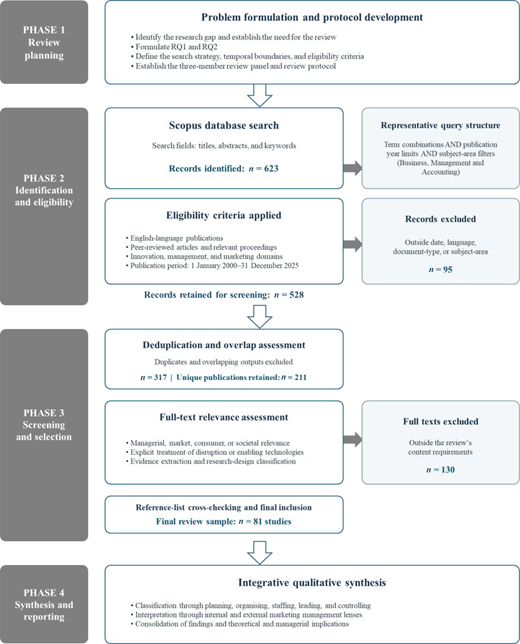
The process began with the constitution of a review panel composed of three specialists (two researchers and a professional) with consolidated expertise in methodological design and theoretical framing. Consistently with the structured procedure delineated by Tranfield et al. (2003), the work progressed through four principal phases. In Phase 1, we focused on identifying research gaps and formulating a precise research problem, which required assessing the need for a review (coherently with the research questions provided above), drafting its preliminary proposal and outlining a formal protocol. Phase 2 consisted of a qualitative examination of the existing body of knowledge on disruption, associated technologies for managerial applications and its implications. Phase 3 entailed the extraction and synthesis of evidence from selected studies, whereas Phase 4 concentrated on consolidating the review outcomes and presenting them in an integrated and interpretative narrative. Figure 1 summarises the selection process.

Within this framework, the problem definition and the operational strategy were articulated by gathering information on the core research questions addressed in the literature and the emerging research trajectories deserving further inquiry. Moreover, in line with established guidance on systematic reviews, the search strategy and the inclusion and exclusion criteria were precisely specified. A set of four keywords referring to the managerial use of disruption technologies has been defined. Leading journals in economics and management commonly adopt terms such as “disruption”, “disruptive technologies”, “disruption innovation”, “disruption management”, “innovation” and related combinations, which guided the construction of the search strings.

Searches were executed using Scopus, overseen by Elsevier and recognised for its extensive indexing capabilities and refined filtering options, which make it preferable to broader aggregators. To conduct a rigorous assessment of scholarly contributions, by including conceptual, empirical and review papers, the analysis considered only academic articles in the innovation, management and marketing domains published in international peer-reviewed outlets between 1 January 2000 and 31 December 2025, as well as articles considered “accepted” before 2026. The start date captures the early phase of studies where the disruption concept converged with research on innovation and the emerging development of internet-based technologies (Barnett and Freeman, 2001; Christensen and Raynor, 2003; Harvard Business Review, 2000). The end date provides a complete 25-year analytical window, capturing the progressive expansion of disruption research beyond its original focus on competitive displacement towards broader processes of technological, managerial and market transformation, and incorporating recent developments concerning platforms, AI, datafication and algorithmic management. A representative structure of the query used was as follows: “Term_1” AND “Term_2” AND “Term_3” AND “Term_4” AND “Term_5” AND “Pubyear > year_min” AND “Pubyear < year_max” AND “Subject Area = SA1”. Applied to this study, such a query generated results such as “Internet” AND “of” AND “things” AND “business” AND “management” AND “Pubyear > 2000” AND “Pubyear < 2026” AND “Subject Area = Business, Management and Accounting”.

The second phase involved selecting journal articles or conference proceedings that could support the development of a coherent conceptual framework for articulating our propositions. Only works that explicitly address the effects of disruption and its associated enabling technologies, with a strong orientation toward business consumers, and that consider societal implications were examined. In the third phase, data were analysed through a systematic extrapolation procedure following a meticulous reading of the selected studies. The analytical framework is centred on key dimensions such as the study’s thematic focus (comparable to a research question), methodological choices in data collection and analysis and classification by type of research (qualitative, quantitative or review).

The initial screening (intended as a massive download, retrieved a total amount of 623 results) retrieved 528 documents published between 2008 and 2025 based on the various keyword combinations. The volume of publications exhibited steady growth from 2008, with a sharp increase from 2015 onwards. After removing duplicates and overlapping outputs, the data set was reduced to 211 unique publications. A further in-depth assessment of relevance, reinforced by a manual review of the references in each article, led to the exclusion of 130 additional contributions that did not align with the content requirements. The remaining 81 studies were then synthesised using a coherent and integrative approach to develop the Findings section, thereby allowing us to map how business digitalisation influences core managerial functions. To organise and interpret the findings, the analysis adopts the managerial functions framework proposed by Weihrich and Koontz (2005), namely, planning, organising, staffing, leading and controlling as a core analytical category.

These functions are used as analytical categories to synthesise heterogeneous contributions and to examine how digital disruption reconfigures foundational logics of managerial strategies: More importantly, results have been then interpreted and refined through a conceptual lens that frames digital transformation according to its internal vs external marketing management implications, distinguishing organisational dynamics from market-facing outcomes (Sestino et al., 2025b), to better capture main implications of each managerial function on marketing strategies. Such a perspective allows the analysis to connect managerial reconfiguration with changes in consumer relationships, competitive behaviour and sustainability-oriented value propositions.

This section presents the results of the literature review by organising the analysed contributions through the lens of classical managerial functions (Weihrich and Koontz, 2005) and interpreting them from the perspectives of internal and external marketing management in the context of digital transformation (Sestino et al., 2025a; Sestino et al., 2025b).

Importantly, rather than adopting these functions as prescriptive categories, they are used here as “analytical coordination logics” that allow observation of how digital disruption reshapes managerial action across organisational, market and societal levels. As regards the marketing lens, it is conceptualised as a managerially mediated domain through which digitally enabled organisational choices are translated into market governance, consumer relationships and sustainability-oriented value propositions. In this regard, sustainability does not appear as a separate strategic objective, but as an emergent property of how managerial functions are reconfigured under digital conditions, influencing transparency, accountability, trust and legitimacy in markets (Lloveras and Quinn, 2016). Importantly, digital disruption is shown to involve non-technical dimensions (e.g. behaviours, practices and cultural models) alongside changes in markets, regulations and actor networks, highlighting that technology adoption and sustainability outcomes co-evolve through organisational mediation and governance arrangements rather than deterministic technological trajectories. Complementarily, work on technology adoption for sustainable development stresses that digital innovations can generate both positive and negative sustainability impacts, calling for closer attention to adoption conditions, governance and unintended consequences (Al-Emran and Griffy-Brown, 2023).

Interpreting managerial reconfiguration through an internal-external marketing lens allows the analysis to connect organisational dynamics with changes in consumer engagement, competitive behaviour and sustainability-oriented market strategies. The subsections that follow illustrate how each managerial function is reconfigured under digital disruption and how these transformations generate distinct, yet interrelated, internal and external marketing management implications.

The literature consistently indicates that digital disruption profoundly alters the nature of managerial planning (Pankewitz, 2016; Thakur et al., 2023), shifting it from a predominantly intentional, forward-looking activity towards a process increasingly shaped by algorithmic anticipation and data-driven foresight (Daniel and Pettit, 2021). Predictive analytics, machine learning models and scenario simulations enable organisations to process large volumes of real-time data, identifying patterns and weak signals that would remain invisible to human judgement alone (Browning et al., 2023; Ngai and Wu, 2022; Ramya et al., 2024; Sestino and De Mauro, 2022). These technologies also allow managers to explore multiple contingent futures simultaneously, shifting planning from single-path projections to probabilistic and adaptive reasoning (Boppiniti, 2019; Nwoke, 2025). Planning cycles consequently become shorter and more iterative, with strategic orientations continuously updated rather than fixed ex ante. This evolution reduces reliance on retrospective experience while increasing dependence on algorithmic models as cognitive supports for anticipating environmental change (Lu and Yin, 2021; Snyder et al., 2025). As a result, planning becomes less about ex ante defining long-term strategic objectives and more about dynamically adjusting strategic orientations in response to probabilistic signals and emergent patterns.

From an internal marketing management perspective, this transformation reflects a deeper change in managerial cognition (Hopp et al., 2018; Vecchiato, 2017), that reconfigures how organisations develop and govern market strategies. Disruptive technologies may reduce reliance on experiential reasoning and past-based extrapolation, encouraging managers to engage with future-oriented insights generated through computational models (Lacy et al., 2020; George et al., 2024). Planning thus evolves into an iterative process of sense-making under uncertainty, where strategic decisions are informed by continuously updated predictions rather than fixed plans (Garrelfs et al., 2023; Marshall, 2018). Fresh literature on this domain suggests that this shift does not simply enhance planning accuracy, but redefines the temporal logic of decision-making, compressing planning cycles and blurring the distinction between strategy formulation and execution (Kringelum et al., 2025; Kohtamäki et al., 2025). Particularly, some studies emphasise that technology adoption in planning emerges as a double-edged dynamic (Kivimaa et al., 2021; Wang and Bai, 2023): it enhances the capacity to anticipate environmental and societal pressures, while also redistributing strategic authority towards non-transparent computational systems. Managers act less as sole architects of strategy and more as interpreters of probabilistic signals, with important implications for accountability and responsible decision-making, particularly when sustainability commitments are involved (Neves et al., 2022; Trisiana, 2024).

From an external marketing management perspective, algorithmic anticipation helps firms align sustainability-oriented value propositions with changing consumer expectations and regulatory scrutiny. Predictive systems can identify emerging demand for environmentally responsible offerings and reduce exposure to reputational risk (Gleim et al., 2023). They also enable faster responses to environmental volatility, market fluctuations and changes in consumer behaviour (Palmerino et al., 2019; Biethahn and Nissen, 2012; Rahmani et al., 2023; Giza and Wilk, 2021; Pandey and Jain, 2025). However, such responsiveness depends on data quality, model assumptions and technological infrastructures (Lustig et al., 2016). The partial redistribution of planning authority from managers to technological artefacts therefore raises concerns about transparency, interpretability and responsibility for strategic choices (Leavitt et al., 2025). These tensions become particularly salient when firms use predictive insights to formulate ethical commitments or sustainability claims (Purani et al., 2014).

Planning under digital disruption also extends beyond firm boundaries (Wallin et al., 2022). Platform ecosystems and interconnected value networks require planning processes that incorporate external actors, shared data environments and co-evolving strategies (Kapoor et al., 2021). Planning thus becomes relational and distributed, reinforcing the idea that sustainability-oriented competitiveness depends on coordinated action across organisational and institutional systems rather than on isolated firm-level initiatives.

The review highlights that digital disruption fundamentally reshapes organising as a managerial function by challenging traditional assumptions about hierarchy, boundaries and coordination mechanisms. Classical organisational forms, characterised by relatively stable structures, clearly defined roles and internalised coordination, are progressively replaced or complemented by fluid, modular and networked arrangements that extend across markets and value chains (Day, 2019). Digital platforms, ecosystems and data-driven interfaces facilitate coordination via technological infrastructure instead of formal authority, thereby changing how firms organise marketing activities, stakeholder relationships and sustainability programs (Donald, 2019).

From an internal marketing management perspective, organising is described as a shift from internally focused structuring towards orchestration of interdependencies among multiple actors, including partners, developers, users and institutional stakeholders (Tudoran and Tudoran, 2024). Platforms, in particular, emerge as organising devices that define participation rules, govern access to resources and shape value creation logics, effectively embedding organisational principles within technical architectures (Berman et al., 2018). Empirical studies on sustainability-oriented supply chains illustrate how technology adoption becomes intertwined with ecosystem-level organising and policy instruments. For example, Wang and Bai (2023) showed that blockchain adoption combined with government subsidies can support sustainability goals (e.g. recycling and remanufacturing logics) while also functioning as partial protections against supply chain disruption, highlighting that organisational resilience and sustainability are achieved through coordinated configurations of technologies, incentives and inter-firm roles rather than technology alone.

From an external marketing management perspective, platform-mediated organising reshapes how standards, certifications and sustainability narratives circulate within markets. Because sustainability commitments are increasingly produced across multi-actor ecosystems, organisational responsibility becomes distributed across firms, platforms and value-chain partners. Although these configurations enhance flexibility and scalability, they also create dependencies, power asymmetries and lock-in effects (Rahman and Ramos, 2010; Zobel and Hagedoorn, 2020). Such tensions not only complicate operations but also radically reshape the way responsibilities and accountability are assigned, especially when traditional value distribution lines are redrawn.

At a deeper level, decision rights, routines and coordination mechanisms are increasingly encoded in algorithms, interfaces and standards (Day, 2019; Donald, 2019). Consequently, the application and monitoring of sustainability criteria depend on the organising principles embedded within digital infrastructures. As a result, organising under digital disruption emerges as a hybrid process in which human actors and technological infrastructures jointly coordinate market activity. Marketing, in turn, operates not only as a communicative function but also as a form of market governance that shapes participation in value creation, the enforcement of sustainability standards and the distribution of accountability. Organising thus connects the internal coherence of sustainability strategies with their external legitimacy.

Digital disruption transforms required skill sets as well as the meaning of work, expertise and professional identity (Kim et al., 2022; Priyashantha et al., 2024). Traditional staffing practices, focused on role specialisation and functional competencies, are increasingly challenged by the diffusion of digital technologies that automate, augment, or “hybridise” human tasks (Stanley and Aggarwal, 2019). As a consequence, staffing becomes a dynamic process of capability reconfiguration rather than a static matching of individuals to pre-defined positions (Setiawan et al., 2025; Stanley and Aggarwal, 2025). From a sustainability perspective, this requires employees to combine digital competence with ethical reasoning, stakeholder engagement and environmental awareness.

From an internal marketing management perspective, staffing reshapes how organisations build, govern and sustain the capabilities that underpin market strategies. A recurrent theme in the literature concerns the emergence of “hybrid human-technology” roles, in which decision-making, analysis and execution are distributed between humans and intelligent systems (Abbas et al., 2023; Petani and Mengis, 2023). Employees must therefore develop digital literacy, interpret algorithmic outputs, collaborate with automated agents and exercise judgement under partial automation and uncertainty (Cetindamar Kozanoglu and Abedin, 2021; Sousa and Rocha, 2019; Guercini, 2023; Weritz, 2022). This reconfiguration generates tensions concerning reskilling, displacement and inequality (George et al., 2025; Shimray and Subaveerapandiyan, 2025). Digital technologies increase demand for analytical and interpretive skills while reducing the relevance of routine tasks (Acemoglu and Restrepo, 2019; Almeida et al., 2017; Parker and Grote, 2022). Access to training and learning opportunities consequently becomes a major determinant of inclusion and employability (Agarwal et al., 2022; Kim et al., 2022). The social sustainability of staffing therefore depends on whether organisations embed continuous learning and responsible technology use within their core operations (Vrontis et al., 2022).

From an external marketing management perspective, staffing affects how sustainability strategies are enacted, communicated and trusted. Consumer adoption of sustainability-related technologies depends on attitudes, perceived benefits, personal norms, incentives and behavioural control (Neves et al., 2022; Fu et al., 2018). Other contributions emphasise the importance of trust, privacy concerns and perceived fairness in shaping consumer acceptance of digitally mediated sustainability solutions (Al-Emran and Griffy-Brown, 2023; Wunderlich et al., 2019). These insights highlight that technology-driven sustainability strategies rely heavily on human engagement and interpretive work rather than on technical implementation alone. Employees increasingly act as boundary spanners who translate data-driven insights into meaningful interactions, address consumer concerns and sustain the credibility of sustainability claims.

Beyond firms, staffing under digital disruption has broader societal implications (Bondarouk and Brewster, 2016; Keegan and Francis, 2008). Algorithmic management systems influence recruitment, performance evaluation and career progression (Cheng and Hackett, 2021; Meijerink and Bondarouk, 2023), but often embedding opaque criteria and reinforcing existing biases. As a result, staffing is no longer solely a managerial concern but intersects with ethical, regulatory and institutional debates about fairness, accountability and the social consequences of technological mediation in work environments even including potential discrimination (Grewal et al., 2025; Köchling and Wehner, 2020). If left unchecked, such consequences can creep into the hiring process, creating a stark contradiction for any company engaged in ethical or sustainable market practices. Thus, it remains to be seen how a market offering can be sustainable if the labour practices that support it are governed by an altered or even irresponsible code. Staffing under digital disruption thus emerges as a critical site where technology adoption intersects with equity, resilience and the social legitimacy of digitally mediated business models.

Digital and technological disruption significantly alters leadership by redistributing authority and transforming how influence, direction and meaning are constructed within organisations (Abadia, 2022; Matarazzo and Pearlstein, 2016). Traditional leadership models, centred on individual authority and hierarchical command, are increasingly challenged by environments in which decisions are shaped by algorithmic recommendations, data-driven insights and automated processes (Lakshmikanth et al., 2024; Mudunuri et al., 2025). Therefore, leadership under digital disruption becomes less about direct control and more about facilitating sense-making in complex socio-technical contexts. These processes are especially relevant when organisations must reconcile digital innovation with sustainability commitments and stakeholder expectations.

From an internal marketing management perspective, leadership is increasingly concerned with mediating between technological outputs and organisational values. Several studies highlight that algorithmic systems often operate as black boxes, limiting leaders’ ability to fully explain or justify decisions derived from automated analyses. Consequently, leadership involves mediating between technological outputs and human values, translating data-driven insights into narratives that can be understood, accepted and acted upon by organisational members. Thus, this mediation increases the importance of communication and how companies disseminate their messages to consumers; it becomes central to maintaining internal alignment, especially when digital transformation intersects with sustainability commitments and ethical responsibilities. Leaders are required to navigate competing demands for innovation, efficiency and accountability, ensuring that algorithmic decision-making does not undermine organisational trust, employee autonomy or shared values (Herbst, 2021; Liveris, 2023).

From an external marketing management perspective, leadership plays a critical role in shaping how organisations are perceived and evaluated in markets. As sustainability claims and digital strategies are increasingly scrutinised by consumers, regulators and civil society, leaders function as key interpreters who connect internal practices with external expectations. The ability to articulate coherent and credible narratives around sustainability, technology use and organisational purpose becomes essential for sustaining legitimacy and consumer trust. In this regard, leadership under digital disruption extends beyond internal coordination to include responsibility for guiding how digital innovation is framed and justified in public discourse (Gustafsson et al., 2021; Ravn et al., 2022).

Digital disruption also reshapes the distribution of leadership across organisations (Herbst, 2021; Matarazzo and Pearlstein, 2016; Petrova, 2024). Authority is increasingly decentralised, embedded in technological artefacts and dispersed across networks of actors. Informal leadership roles emerge among those who possess critical digital expertise or control access to key data resources (Chartier-Rueg and Zweifel, 2017; O’Reilly et al., 2015): This challenge establishes hierarchies and requires leaders to manage power dynamics that are less visible but highly consequential, particularly when (long-term) sustainability priorities are in contrast with (short-term) commercial objectives.

At a normative level, the literature emphasises that leading under digital disruption entails heightened ethical responsibility (Herbst, 2021; Liveris, 2023). Leaders must address concerns related to transparency, autonomy and trust, particularly when decisions affect consumers, employees and broader societal groups (Gustafsson et al., 2021; Ravn et al., 2022). Leadership thus evolves into a relational and ethical practice, focused on guiding organisations through technological change while maintaining legitimacy and social acceptance. In this sense, leadership under digital disruption functions as a critical bridge between internal organisational governance and external market-facing legitimacy, shaping how sustainability-oriented strategies are enacted, communicated and evaluated.

As for the controlling activities, the analysis shows that digital disruption radically transforms controlling by embedding monitoring and evaluation processes within data-intensive technological infrastructures (Hellman and Liu, 2013). Traditional control mechanisms, historically centred on periodic reporting, standardised performance indicators and hierarchical managerial oversight, are progressively reconfigured by the diffusion of real-time data infrastructures and automated monitoring systems (Choi et al., 2022; Souza et al., 2022). With ongoing data collection, algorithmic dashboards and automated feedback systems, control is embedded in daily organisational routines rather than being a separate, episodic evaluation (Bhimani and Willcocks, 2014).

From an internal marketing management perspective, datafied control systems reshape the governance of performance, accountability and sustainability priorities. Sensors, platforms and advanced analytics generate fine-grained data that make outcomes, processes and deviations visible in real time (Sestino et al., 2025a). While this enhanced visibility supports efficiency, coordination and rapid corrective action, the literature emphasises that it also intensifies surveillance and constrains discretionary spaces, potentially undermining informal coordination, professional autonomy and situated judgement (Shafiq et al., 2023). As control becomes embedded in technological infrastructures, managerial discretion is partly displaced by algorithmic logics, raising questions about how sustainability priorities are interpreted, weighted and enforced.

A central tension identified in the review concerns the temporal reorientation of control from retrospective assessment to anticipatory governance. Predictive analytics and algorithmic risk assessment systems enable organisations to forecast deviations and intervene before performance failures materialise, effectively collapsing the distinction between evaluation and intervention (Alaimo and Kallinikos, 2021; Duijn and Sloot, 2015). This development blurs the boundary between controlling and planning, demonstrating the interdependence of managerial functions under digital disruption (Faraj et al., 2018).

From an internal marketing management perspective, control may strengthen alignment between strategic objectives and operational execution, but it may also encourage metric fixation and short-termism when complex sustainability performance is reduced to quantifiable indicators (Lu and Yin, 2021).

From an external marketing management perspective, digitally enabled control systems shape how organisations communicate, justify and legitimate their sustainability performance in markets. Real-time metrics and automated reporting influence how performance, compliance and risk exposure are presented to consumers and stakeholders (Lu and Yin, 2021; Stanley and Aggarwal, 2019). Although these systems can improve transparency and responsiveness, they may marginalise qualitative, indirect or long-term effects that are difficult to quantify (López-Mielgo et al., 2009). Controlling systems therefore function simultaneously as internal governance mechanisms and market-facing devices shaping credibility, accountability and trust.

At the institutional level, controlling under digital disruption poses challenges regarding data ownership, responsibility and regulatory oversight, as monitoring systems extend beyond organisational boundaries (Hellman and Liu, 2013). Control consequently becomes not only a managerial activity but also a socio-political process requiring alignment among technological capabilities, organisational values and institutional safeguards (Prasad and Tata, 2003; López-Mielgo et al., 2009). As such, controlling emerges as a key mechanism through which technology adoption influences the sustainability and resilience of market arrangements, mediating between internal performance governance and external market legitimacy.

Overall, the review above shows that digital disruption reshapes marketing-relevant outcomes not through isolated technological effects, but through the reconfiguration of managerial functions and their internal and external marketing management implications. Sustainable market-driven strategies therefore emerge from how organisations plan, organise, staff, lead and control under digital conditions, rather than from communication practices or technology adoption alone. To synthesise these findings, Table 3 summarises how each managerial function translates into internal and external marketing management implications relevant to sustainable market-driven strategies.

The findings of this review allow for a more critical and integrative interpretation of how digital disruption is currently conceptualised within management, marketing and sustainability research. In addressing RQ1, the analysis challenges a substantial stream of literature that treat digital disruption primarily as technologically driven change or an outcome of competitive dynamics (Weeks, 2015; Christensen, 2006). Digital disruption is more accurately understood as a cumulative reconfiguration of managerial logics, affecting the foundational functions through which organisations anticipate, coordinate, mobilise and govern economic and social action. Its consequences therefore extend beyond internal efficiency and innovation to value propositions, maintain legitimacy and respond to rising expectations for environmental and social responsibility.

This perspective also challenges technologically deterministic interpretations of digital disruption (Ruan et al., 2021). The review shows that digital technologies do not autonomously produce disruption; rather, their disruptive potential materialises through their integration into planning, organising, staffing, leading and controlling practices, which mediate how technologies are interpreted, enacted and legitimised. Digital disruption emerges as a socio-technical and managerially mediated process shaped by organisational choices, institutional arrangements and governance mechanisms, rather than as an exogenous force imposed on firms and markets.

Whether digital disruption contributes to more sustainable market arrangements depends on how managerial functions incorporate resource constraints, stakeholder accountability and societal trust. Sustainability is not an external objective imposed on organisations, but an outcome that emerges (or fails to emerge) from the logics through which digital disruption is enacted.

With respect to RQ2, the findings reveal that opportunities and risks co-evolve as outcomes of the same disruptive dynamics. While the literature often emphasises efficiency gains, agility and scalability (López-Mielgo et al., 2009; Souza et al., 2022), the results highlight parallel tensions related to the redistribution of agency, the opacity of algorithmic decision-making and the concentration of control within digital infrastructures. These tensions challenge assumptions that technological advancement automatically produces societal progress.

Furthermore, when decision-making is mediated through unclear systems and responsibility is distributed across platform ecosystems, it becomes harder to substantiate environmental and social claims and to attribute accountability for unintended consequences (Kivimaa et al., 2021; Wang and Bai, 2023). This weakens sustainability strategies, whose legitimacy depends on transparency and credibility as much as on innovation and increases reputational risks (Papadopoulou et al., 2021; Papasolomou et al., 2022). The findings thus reinforce a central implication: digital disruption intensifies the governance demands placed on organisations by sustainability expectations, rather than simplifying them.

By adopting managerial functions as an analytical lens (Weihrich and Koontz, 2005; Sestino et al., 2025a), this study contributes to the literature by reconnecting digital disruption research with core theories of management and organisation, while extending it into the domain of sustainable marketing and offering a structured yet flexible framework capable of integrating micro-, meso- and macro-level transformations. Rather than treating marketing as a downstream communicative activity, the findings position it as a market-facing expression of deeper managerial and governance choices. Building on this integrative interpretation, the following sections further develop the theoretical implications of reframing digital disruption as a process of managerial mediation and examine how this perspective advances ongoing debates in sustainable marketing by clarifying the governance conditions under which digital transformation supports credible and accountable market practices.

A central insight emerging from this study concerns the need to reconsider prevailing assumptions that implicitly equate digital disruption with technological novelty or acceleration. Much of the extant literature, particularly in early and mainstream disruption research, tends to attribute transformative outcomes primarily to the intrinsic properties of digital technologies. The findings of this review suggest a different interpretation: digital disruption does not stem from technology per se, but from the ways in which technologies are incorporated into and reconfigure managerial functions that structure organisational and societal action. Specifically, the findings highlight that: planning becomes anticipatory and data-driven; organising shifts towards platform-mediated coordination; staffing evolves through hybrid human-technology roles; leadership is redefined by sense-making and ethical mediation; and controlling intensifies through datafication and anticipatory governance.

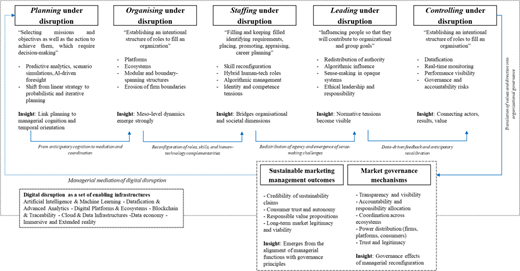
While Table 3 clarifies function-specific implications, Figure 2 integrates these dynamics into an integrative framework showing how managerial mediation links digital disruption to sustainable marketing management outcomes through market governance. Importantly, these functions evolve interdependently through mechanisms that redistribute cognition, agency and coordination across socio-technical systems.

Anticipatory and data-driven planning changes how future risks and opportunities, including environmental and social ones, are evaluated. It also enables new organisational architectures based on platforms and ecosystems, which in turn require the reconfiguration of roles, skills and human–technology complementarities. These staffing changes raise questions concerning inclusion, employability and the social sustainability of work

These changes intensify leadership challenges related to legitimacy, trust and ethical responsibility in increasingly opaque and algorithmically mediated environments. At the same time, datafied and anticipatory forms of control generate continuous feedback that recalibrates strategic orientations and managerial decisions. In this perspective, digital disruption emerges as a dynamic process in which managerial functions mutually shape and reinforce one another, with digital technologies acting as enabling infrastructures rather than deterministic forces. Sustainable market outcomes depend on aligning managerial functions with transparency, accountability, inclusion and long-term value creation. Sustainability in digital economies cannot therefore be understood by examining consumer preferences, corporate actions or regulations in isolation. Instead, attention must be directed towards the managerial structures through which digital technologies affect coordination, responsibility and legitimacy within market systems.

The reframing developed in this study carries important theoretical implications for marketing research concerned with sustainability and digital transformation. Firstly, this study repositions marketing as the market-facing domain in which the effects of managerial reconfiguration under digital disruption become observable and consequential. Consistent with the internal vs external marketing management lens (Sestino et al., 2025b) adopted in this study, marketing is not examined as an individual or separate functional activity, but as the organisational and market-facing domain most directly affected by the reconfiguration of managerial functions under digital disruption. Marketing outcomes such as trust, credibility and consumer engagement depend on governance mechanisms embedded within managerial infrastructures rather than on persuasive communication or ethical intent alone. Technology adoption in marketing is therefore inseparable from transparency, consumer autonomy and the allocation of responsibility and power. From this perspective, technology adoption in marketing is inseparable from broader questions of governance, transparency and consumer autonomy, shifting the focus from whether digital tools are used to how they restructure market interactions, responsibility allocation and power relations.

Secondly, the study contributes to sustainable marketing research (Gleim et al., 2023; Kemper and Ballantine, 2019; Purani et al., 2014) by redirecting focus from viewing sustainability as a collection of messages, attributes or isolated initiatives, towards understanding it as an emergent outcome of how market-facing activities are governed through managerial infrastructures under digital conditions. The findings indicate that sustainability does not arise simply from adopting digital technologies or from aligning marketing communications with ethical values; instead, it emerges from how organisations integrate technologies into anticipatory planning, platform- and ecosystem-based organising, capability development, leadership sense-making and datafied control systems. These managerial configurations determine how sustainability promises are formulated, substantiated, monitored and rendered credible to consumers and other stakeholders. Sustainability is therefore neither exclusively consumer-driven nor solely a firm-level strategic choice. It is a systemic property of how digitally mediated markets are coordinated, evaluated and legitimised over time (Peattie and Belz, 2010).

Thirdly, the study provides a theoretical explanation for the persistent contradictions between economic growth and sustainability highlighted in prior research (Lloveras and Quinn, 2016). The findings demonstrate that digital technologies simultaneously enable and destabilise sustainability-oriented marketing strategies. On the one hand, predictive analytics, platforms and data-intensive control systems enhance firms’ ability to anticipate consumer demand, personalise sustainable offerings, improve traceability across value chains and monitor sustainability performance in real time. On the other hand, these same technologies redistribute agency towards opaque infrastructures, concentrate power within platforms and intensify risks of greenwashing, consumer vulnerability and accountability gaps. Grounding these tensions in managerial reconfiguration explains why digitally enabled sustainability initiatives often produce ambivalent rather than uniformly positive outcomes.

Finally, the managerial-functions lens provides a framework that reconnects levels of analysis that are often treated separately in sustainability and management research (George et al., 2021; Trisiana, 2024; Wang and Bai, 2023. Consumer-related dynamics such as trust, perceived credibility and the adoption of sustainability-relevant innovations are linked to organisational capabilities such as data analytics, behavioural insight and ethical judgement, which, in turn, are shaped by broader institutional arrangements, including platforms, standards and regulatory expectations. This integration responds to calls for more coherent multi-level theorisation capable of bridging micro-level behaviour, meso-level organisational practices and macro-level sustainability agendas. It also provides a foundation for future research examining how changes in managerial functions influence market governance and sustainability outcomes across industries, technologies and institutional contexts.

This study set out from the observation that, despite its pervasive use in managerial and academic discourse, the concept of digital disruption has progressively lost analytical precision, often being treated as a synonym for technological acceleration or innovation intensity, because disruption results as “disruptive” by nature in its terms as well (Christensen, 2006). By revisiting disruption through an extensive and systematic analysis of the literature, jointly technologies and its enabler characteristics to reconfigure managerial functions, allowing the analysis to capture disruption as a systemic and cross-cutting process rather than a technology-specific phenomenon, the paper sought to add knowledge and reposition digital disruption as a systemic and cumulative process that transcends firm-level competitive dynamics. In doing so, the study addressed two central research questions concerning how digital technologies are conceptualised as drivers of digital disruption and how the resulting transformations generate opportunities, risks and tensions across organisations, markets and society.

The review demonstrates that digital disruption is best understood not as a technologically determined outcome, but as a process mediated by the reconfiguration of core managerial functions. The findings show that digital technologies reshape planning, organising, staffing, leading and controlling in interconnected ways, altering managerial cognition, redistributing agency between humans and technological artefacts and redefining coordination and governance mechanisms. Rather than eliminating foundational managerial logics, digital disruption transforms how they operate within data-intensive and platform-based socio-technical systems. This perspective enables an integrated understanding of digital disruption that connects micro-level changes in decision-making, meso-level transformations in organisational and ecosystem structures and macro-level implications for institutional arrangements and societal norms.

At the same time, the study highlights the inherently ambivalent nature of disruption. While the literature emphasises enhanced anticipation, scalability and responsiveness, the analysis reveals parallel dynamics related to opacity, concentration of control, algorithmic dependence and emerging forms of consumer and worker vulnerability. These tensions suggest that digital disruption should not be interpreted as an unequivocally progressive force, but as a phenomenon whose outcomes depend on how managerial practices, organisational choices and institutional safeguards evolve in response to digital infrastructures. From this perspective, the sustainability and legitimacy of digitally mediated markets hinge less on technology adoption per se than on the capacity of managerial functions to govern transparency, accountability and long-term value creation.

Despite these contributions, some limitations need to be acknowledged. Firstly, the qualitative and interpretative nature of the review, while appropriate for theory integration, could not allow empirical testing or causal validation of the identified configurations. In addition, the analysis is based exclusively on peer-reviewed articles published in English, which may have led to the exclusion of relevant insights developed in other languages or scholarly traditions. Finally, despite a potential point of strength, the review deliberately focused on contributions explicitly addressing the interplay between digital technologies, managerial functions and their role in shaping disruption, potentially overlooking studies that examine these elements in isolation. Future research could address these limitations through longitudinal and multi-method approaches, as well as through comparative analyses across institutional contexts, to further assess how the reconfiguration of managerial functions influences organisational and societal outcomes over time.

The authors acknowledge the use of AI-assisted tools and the tool “Open Grammarly” exclusively for grammar and language refinement. The intellectual content of the manuscript is entirely the responsibility of the authors.
Abadia
,
A.
(
2022
), “
Leadership styles during disruption: a multi-case study
”.
Abbas
,
S.M.
,
Liu
,
Z.
and
Khushnood
,
M.
(
2023
), “
When human meets technology: unlocking hybrid intelligence role in breakthrough innovation engagement via self-extension and social intelligence
”,
Journal of Computer Information Systems
, Vol.
63
No.
5
, pp.
1183
-
1200
.
Acemoglu
,
D.
and
Restrepo
,
P.
(
2019
), “
Automation and new tasks: how technology displaces and reinstates labor
”,
Journal of Economic Perspectives
, Vol.
33
No.
2
, pp.
3
-
30
.
Agarwal
,
V.
,
Mathiyazhagan
,
K.
,
Malhotra
,
S.
and
Saikouk
,
T.
(
2022
), “
Analysis of challenges in sustainable human resource management due to disruptions by Industry 4.0: an emerging economy perspective
”,
International Journal of Manpower
, Vol.
43
No.
2
, pp.
513
-
541
.
Alaimo
,
C.
and
Kallinikos
,
J.
(
2021
), “
Managing by data: algorithmic categories and organizing
”,
Organization Studies
, Vol.
42
No.
9
, pp.
1385
-
1407
.
Al-Emran
,
M.
and
Griffy-Brown
,
C.
(
2023
), “
The role of technology adoption in sustainable development: overview, opportunities, challenges, and future research agendas
”,
Technology in Society
, Vol.
73
, p.
102240
.
Almeida
,
R.
,
Leite Corseuil
,
C.H.
and
Poole
,
J.
(
2017
), “
The impact of digital technologies on routine tasks: do labor policies matter?
”,
World Bank Policy Research Working Paper
, Vol.
8187
.
Ansari
,
S.
,
Garud
,
R.
and
Kumaraswamy
,
A.
(
2016
), “
The disruptor’s dilemma: TiVo and the US television ecosystem
”,
Strategic Management Journal
, Vol.
37
No.
9
, pp.
1829
-
1853
.
Barnett
,
W.P.
and
Freeman
,
J.
(
2001
), “
Too much of a good thing? Product proliferation and organizational failure
”,
Organization Science
, Vol.
12
No.
5
, pp.
539
-
558
, doi: .
Behl
,
A.
,
Nigam
,
A.
and
Vrontis
,
D.
(
2024
), “
Guest editorial overview: ‘mapping the future of consumer behaviour using disruptive technologies
”,
Journal of Consumer Behaviour
, Vol.
23
No.
4
, pp.
1854
-
1858
.
Ben-Daya
,
M.
,
Hassini
,
E.
and
Bahroun
,
Z.
(
2019
), “
Internet of things and supply chain management: a literature review
”,
International Journal of Production Research
, Vol.
57
Nos
15-16
, pp.
4719
-
4742
.
Berman
,
S.
,
Davidson
,
S.
,
Ikeda
,
K.
and
Marshall
,
A.
(
2018
), “
Navigating disruption with ecosystems, partners and platforms
”,
Strategy and Leadership
, Vol.
46
No.
5
, pp.
26
-
35
.
Bhimani
,
A.
and
Willcocks
,
L.
(
2014
), “
Digitisation,‘Big Data’ and the transformation of accounting information
”,
Accounting and Business Research
, Vol.
44
No.
4
, pp.
469
-
490
.
Biethahn
,
J.
and
Nissen
,
V.
(
2012
),
Evolutionary Algorithms in Management Applications
,
Springer Science and Business Media
.
Bondarouk
,
T.
and
Brewster
,
C.
(
2016
), “
Conceptualising the future of HRM and technology research
”,
The International Journal of Human Resource Management
, Vol.
27
No.
21
, pp.
2652
-
2671
.
Boppiniti
,
S.T.
(
2019
), “
Machine learning for predictive analytics: enhancing data-driven decision-making across industries
”,
International Journal of Sustainable Development in Computing Science
, Vol.
1
.
Browning
,
T.
,
Kumar
,
M.
,
Sanders
,
N.
,
Sodhi
,
M.S.
,
Thürer
,
M.
and
Tortorella
,
G.L.
(
2023
), “
From supply chain risk to system-wide disruptions: research opportunities in forecasting, risk management and product design
”,
International Journal of Operations and Production Management
, Vol.
43
No.
12
, pp.
1841
-
1858
.
Cetindamar Kozanoglu
,
D.
and
Abedin
,
B.
(
2021
), “
Understanding the role of employees in digital transformation: conceptualization of digital literacy of employees as a multi-dimensional organizational affordance
”,
Journal of Enterprise Information Management
, Vol.
34
No.
6
, pp.
1649
-
1672
.
Chartier-Rueg
,
T.C.
and
Zweifel
,
T.D.
(
2017
), “
Blockchain, leadership and management: business as usual or radical disruption?
”,
EUREKA: Social and Humanities
, Vol.
4
, pp.
76
-
110
.
Cheng
,
M.M.
and
Hackett
,
R.D.
(
2021
), “
A critical review of algorithms in HRM: definition, theory, and practice
”,
Human Resource Management Review
, Vol.
31
No.
1
, p.
100698
.
Choi
,
T.M.
,
Kumar
,
S.
,
Yue
,
X.
and
Chan
,
H.L.
(
2022
), “
Disruptive technologies and operations management in the Industry 4.0 era and beyond
”,
Production and Operations Management
, Vol.
31
No.
1
, pp.
9
-
31
.
Christensen
,
C.M.
(
1997
), “
The innovator’s
”,
Dilemma: When New Technologies Cause Great Firms to Fail
, pp.
168
-
169
.
Christensen
,
C.M.
(
2006
), “
The ongoing process of building a theory of disruption
”,
Journal of Product Innovation Management
, Vol.
23
No.
1
.
Christensen
,
C.M.
,
Baumann
,
H.
,
Ruggles
,
R.
and
Sadtler
,
T.M.
(
2006
), “
Disruptive innovation for social change
”,
Harvard Business Review
, Vol.
84
No.
12
, pp.
94
-
101
.
Christensen
,
C.M.
,
McDonald
,
R.
,
Altman
,
E.J.
and
Palmer
,
J.E.
(
2018
), “
Disruptive innovation: an intellectual history and directions for future research
”,
Journal of Management Studies
, Vol.
55
No.
7
, pp.
1043
-
1078
.
Christensen
,
C.
and
Raynor
,
M.E.
(
2003
),
The Innovator’s Solution: Creating and Sustaining Successful Growth
,
Harvard Business Review Press
.
Cozzolino
,
A.
,
Verona
,
G.
and
Rothaermel
,
F.T.
(
2018
), “
Unpacking the disruption process: new technology, business models, and incumbent adaptation
”,
Journal of Management Studies
, Vol.
55
No.
7
, pp.
1166
-
1202
.
Daniel
,
C.
and
Pettit
,
C.
(
2021
), “
Digital disruption and planning–use of data and digital technology by professional planners, and perceptions of change to planning work
”,
Australian Planner
, Vol.
57
No.
1
, pp.
50
-
64
.
Day
,
A.
(
2019
),
Disruption, Change and Transformation in Organisations: A Human Relations Perspective
,
Routledge
.
Donald
,
M.
(
2019
), “Organisational impacts from disruption”, In
Leading and Managing Change in the Age of Disruption and Artificial Intelligence
,
Emerald Publishing Limited
, pp.
21
-
56
.
Duggan
,
S.B.
(
2019
), “
Digital disruption, education policy, and the future of work: shift
”.
Duijn
,
P.A.
and
Sloot
,
P.M.
(
2015
), “
From data to disruption
”,
Digital Investigation
, Vol.
15
, pp.
39
-
45
.
Faraj
,
S.
,
Pachidi
,
S.
and
Sayegh
,
K.
(
2018
), “
Working and organizing in the age of the learning algorithm
”,
Information and Organization
, Vol.
28
No.
1
, pp.
62
-
70
.
Flensburg
,
S.
and
Lomborg
,
S.
(
2023
), “
Datafication research: mapping the field for a future agenda
”,
New Media and Society
, Vol.
25
No.
6
, pp.
1451
-
1469
.
Fu
,
Y.
,
Kok
,
R.A.W.
,
Dankbaar
,
B.
,
Ligthart
,
P.E.M.
and
Van Riel
,
A.C.R.
(
2018
), “
Factors affecting sustainable process technology adoption: a systematic literature review
”,
Journal of Cleaner Production
, Vol.
205
, pp.
226
-
251
.
Garrelfs
,
C.
,
Schultz
,
C.
and
Luengen
,
M.
(
2023
), “
Employee acceptance of disruptive service innovations at the frontline: the role of collective sensemaking processes
”,
Creativity and Innovation Management
, Vol.
32
No.
3
, pp.
388
-
406
.
George
,
A.S.
,
Baskar
,
T.
and
Siranchuk
,
N.
(
2025
), “
Navigating the AI disruption: strategic frameworks for workforce transformation and innovation in the age of intelligent automation
”,
Partners Universal International Innovation Journal
, Vol.
3
No.
3
, pp.
83
-
95
.
George
,
A.S.
,
Baskar
,
T.
and
Srikaanth
,
P.B.
(
2024
),
The Erosion of Cognitive Skills in the Technological Age: How Reliance on Technology Impacts Critical Thinking, Problem-Solving, and Creativity
,
Partners Universal Innovative Research Publication
,
2
, pp.
147
-
163
.
George
,
G.
,
Merrill
,
R.K.
and
Schillebeeckx
,
S.J.D.
(
2021
), “
Digital sustainability and entrepreneurship: how digital innovations are helping tackle climate change and sustainable development
”,
Entrepreneurship Theory and Practice
, Vol.
45
No.
5
, pp.
999
-
1027
.
Giza
,
W.
and
Wilk
,
B.
(
2021
), “
Revolution 4.0 and its implications for consumer behaviour
”,
Entrepreneurial Business and Economics Review
, Vol.
9
No.
4
, pp.
195
-
206
.
Gleim
,
M.R.
,
McCullough
,
H.
,
Sreen
,
N.
and
Pant
,
L.G.
(
2023
), “
Is doing right all that matters in sustainability marketing? The role of fit in sustainable marketing strategies
”,
Journal of Retailing and Consumer Services
, Vol.
70
, p.
103124
.
Godart
,
F.
and
Pistilli
,
L.
(
2024
), “
The multifaceted concept of disruption: a typology
”,
Journal of Business Research
, Vol.
170
, p.
114311
.
Govindarajan
,
V.
and
Kopalle
,
P.K.
(
2006
), “
Disruptiveness of innovations: measurement and an assessment of reliability and validity
”,
Strategic Management Journal
, Vol.
27
No.
2
, pp.
189
-
199
.
Grewal
,
H.
,
Vishnoi
,
A.
,
Saxena
,
A.
and
Gupta
,
M.
(
2025
), “
Study of ethical, social and legal implications of emerging technologies in HRM
”,
Digital HR
, pp.
97
-
105
.
Guercini
,
S.
(
2023
), “
Marketing automation and the scope of marketers’ heuristics
”,
Management Decision
, Vol.
61
No.
13
, pp.
295
-
320
.
Gustafsson
,
S.
,
Gillespie
,
N.
,
Searle
,
R.
,
Hope Hailey
,
V.
and
Dietz
,
G.
(
2021
), “
Preserving organizational trust during disruption
”,
Organization Studies
, Vol.
42
No.
9
, pp.
1409
-
1433
.
Harvard Business Review
(
2000
), “
Will disruptive innovations cure health care?
”,
available at:
Link to Will disruptive innovations cure health care?Link to the pdf of the cited article
Hellman
,
P.
and
Liu
,
Y.
(
2013
), “
Development of quality management systems: how have disruptive technological innovations in quality management affected organizations?
”,
Quality Innovation Prosperity
, Vol.
17
No.
1
, pp.
104
-
119
.
Henderson
,
R.M.
and
Clark
,
K.B.
(
1990
), “
Architectural innovation: the reconfiguration of existing product technologies and the failure of established firms
”,
Administrative Science Quarterly
, Vol.
35
No.
1
, pp.
9
-
30
.
Herbst
,
T.H.
(
2021
), “Leading in times of disruption: reimagining leadership and repositioning leaders”, In
Leadership-New Insights
,
IntechOpen
.
Holloway
,
S.
(
2024
), “
How supply chain disruptions affect brand loyalty: a qualitative analysis of consumer experiences during crises
”.
Hopp
,
C.
,
Antons
,
D.
,
Kaminski
,
J.
and
Oliver Salge
,
T.
(
2018
), “
Disruptive innovation: Conceptual foundations, empirical evidence, and research opportunities in the digital age
”,
Journal of Product Innovation Management
, Vol.
35
No.
3
.
Hopster
,
J.K.
and
Maas
,
M.M.
(
2024
), “
The technology triad: disruptive AI, regulatory gaps and value change
”,
AI and Ethics
, Vol.
4
No.
4
, pp.
1051
-
1069
.
Houenou
,
B.
(
2024
), “
Datafication in the age of AI: economic models and policy
”, available at SSRN 5163471.
Houssein
,
E.H.
,
Othman
,
M.A.
,
Mohamed
,
W.M.
and
Younan
,
M.
(
2024
), “
Internet of things in smart cities: comprehensive review, open issues and challenges
”,
IEEE Internet of Things Journal
, Vol.
11
No.
21
.
Kao
,
G.
,
Hong
,
J.
,
Perusse
,
M.
and
Sheng
,
W.
(
2020
), “The rise and fall of virtual reality: what it takes to create technological disruption”, In
Turning Silicon into Gold: The Strategies, Failures, and Evolution of the Tech Industry
,
Apress
,
Berkeley, CA
, pp.
133
-
139
.
Kapoor
,
K.
,
Bigdeli
,
A.Z.
,
Dwivedi
,
Y.K.
,
Schroeder
,
A.
,
Beltagui
,
A.
and
Baines
,
T.
(
2021
), “
A socio-technical view of platform ecosystems: systematic review and research agenda
”,
Journal of Business Research
, Vol.
128
, pp.
94
-
108
.
Keegan
,
A.
and
Francis
,
H.
(
2008
), “HRM, technology and strategic roles: considering the social implications”, In
Technology, Outsourcing and Transforming HR
,
Routledge
, pp.
421
-
447
.
Kemper
,
J.A.
and
Ballantine
,
P.W.
(
2019
), “
What do we mean by sustainability marketing?
”,
Journal of Marketing Management
, Vol.
35
Nos
3-4
, pp.
277
-
309
.
Kietzmann
,
J.
and
Pitt
,
L.F.
(
2020
), “
Artificial intelligence and machine learning: what managers need to know
”,
Business Horizons
, Vol.
63
No.
2
, pp.
131
-
133
.
Kim
,
S.
,
Vaiman
,
V.
and
Sanders
,
K.
(
2022
), “
Strategic human resource management in the era of environmental disruptions
”,
Human Resource Management
, Vol.
61
No.
3
, pp.
283
-
293
.
Kivimaa
,
P.
,
Laakso
,
S.
,
Lonkila
,
A.
and
Kaljonen
,
M.
(
2021
), “
Moving beyond disruptive innovation: a review of disruption in sustainability transitions
”,
Environmental Innovation and Societal Transitions
, Vol.
38
, pp.
110
-
126
.
Köchling
,
A.
and
Wehner
,
M.C.
(
2020
), “
Discriminated by an algorithm: a systematic review of discrimination and fairness by algorithmic decision-making in the context of HR recruitment and HR development
”,
Business Research
, Vol.
13
No.
3
, pp.
795
-
848
.
Kohtamäki
,
M.
,
Rabetino
,
R.
,
Parida
,
V.
and
Ritala
,
P.
(
2025
), “
Strategy in the digitalization era
”,
International Journal of Management Reviews
, Vol.
27
No.
3
, pp.
309
-
323
.
Kraus
,
S.
,
Jones
,
P.
,
Kailer
,
N.
,
Weinmann
,
A.
,
Chaparro-Banegas
,
N.
and
Roig-Tierno
,
N.
(
2021
), “
Digital transformation: an overview of the current state of the art of research
”,
Sage Open
, Vol.
11
No.
3
, p.
21582440211047576
.
Kringelum
,
L.B.
,
Holm
,
C.G.
,
Holmgren
,
J.
,
Friis
,
O.
and
Jensen
,
K.F.
(
2025
), “
Digital transformation: strategy comes first to lay the groundwork
”,
Journal of Business Strategy
, Vol.
46
Nos
1-2
, pp.
3
-
10
.
Kumar
,
V.
(
2023
),
The Economic Value of Digital Disruption. A Holistic Assessment for CXOs
,
Springer book
.
Lacy
,
P.
,
Long
,
J.
and
Spindler
,
W.
(
2020
), “Disruptive technologies”, In
The Circular Economy Handbook: Realizing the Circular Advantage
, pp.
43
-
71
.
Palgrave Macmillan UK
,
London
.
Lakshmikanth
,
R.
,
Vijai
,
C.
,
Krishna
,
S.H.
,
Alla
,
P.C.R.
,
Lourens
,
M.
and
Soni
,
M.
(
2024
), “
Utilizing AI to tailor leadership styles and interventions for optimal employee engagement and performance
”, In
2024 International Conference on Trends in Quantum Computing and Emerging Business Technologies
,
IEEE
, pp.
1
-
7
.
Laxminarayana Korada
,
V.K.S.
and
Somepalli
,
S.
(
2022
), “
Importance of cloud governance framework for robust digital transformation and it management at scale
”,
Journal of Scientific and Engineering Research
, Vol.
9
No.
8
, pp.
151
-
159
.
Leavitt
,
K.
,
Barnes
,
C.M.
and
Shapiro
,
D.L.
(
2025
), “
The role of human managers within algorithmic performance management systems: a process model of employee trust in managers through reflexivity
”,
Academy of Management Review
, Vol.
50
No.
4
, pp.
745
-
767
.
Lee
,
J.
,
Suh
,
T.
,
Roy
,
D.
and
Baucus
,
M.
(
2019
), “
Emerging technology and business model innovation: the case of artificial intelligence
”,
Journal of Open Innovation: Technology, Market, and Complexity
, Vol.
5
No.
3
, p.
44
.
Liveris
,
A.
(
2023
),
Leading through Disruption: A Changemaker’s Guide to Twenty-First Century Leadership
,
HarperCollins Leadership
.
Lloveras
,
J.
and
Quinn
,
L.
(
2016
), “
Growth and its discontents
”,
Journal of Macromarketing
, Vol.
37
No.
2
, pp.
131
-
142
.
López-Mielgo
,
N.
,
Montes-Peón
,
J.M.
and
Vázquez-Ordás
,
C.J.
(
2009
), “
Are quality and innovation management conflicting activities?
”,
Technovation
, Vol.
29
No.
8
, pp.
537
-
545
.
Lu
,
Z.
and
Yin
,
M.
(
2021
), “
Human reliance on machine learning models when performance feedback is limited: heuristics and risks
”, In
Proceedings of the 2021 CHI Conference on Human Factors in Computing Systems
, pp.
1
-
16
Lustig
,
C.
,
Pine
,
K.
,
Nardi
,
B.
,
Irani
,
L.
,
Lee
,
M.K.
,
Nafus
,
D.
and
Sandvig
,
C.
(
2016
), “
Algorithmic authority: the ethics, politics, and economics of algorithms that interpret, decide, and manage
”, In
Proceedings of the 2016 CHI Conference Extended Abstracts on Human Factors in Computing Systems
, pp.
1057
-
1062
.
Mahrous
,
K.
and
ElSabry
,
E.
(
2025
), “
Unveiling extended reality: a systematic review of use cases across industries
”,
Technology Analysis and Strategic Management
, pp.
1
-
17
.
Markides
,
C.
(
2005
), “
Disruptive innovation: in need of better theory*
”,
Journal of Product Innovation Management
, Vol.
23
No.
1
, pp.
19
-
25
.
Marshall
,
S.J.
(
2018
), “Strategic planning as sense-making”, In
Shaping the University of the Future: Using Technology to Catalyse Change in University Learning and Teaching
, pp.
413
-
436
.
Springer Singapore
,
Singapore
.
Matarazzo
,
J.M.
and
Pearlstein
,
T.
(
2016
), “
Leadership in disruptive times
”,
IFLA Journal
, Vol.
42
No.
3
, pp.
162
-
178
.
Meijerink
,
J.
and
Bondarouk
,
T.
(
2023
), “
The duality of algorithmic management: toward a research agenda on HRM algorithms, autonomy and value creation
”,
Human Resource Management Review
, Vol.
33
No.
1
, p.
100876
.
Morel
,
P.
,
Bier,Weking
,
J.
,
Mandalenakis
,
M.
,
Hein
,
A.
,
Hermes
,
S.
,
Böhm
,
M.
and
Krcmar
,
H.
(
2020
), “
The impact of blockchain technology on business models–a taxonomy and archetypal patterns
”,
Electronic Markets
, Vol.
30
No.
2
, pp.
285
-
305
.
Mudunuri
,
L.N.R.
,
Hullurappa
,
M.
,
Vemula
,
V.R.
and
Selvakumar
,
P.
(
2025
), “AI-powered leadership: shaping the future of management”, In
Navigating Organizational Behavior in the Digital Age With AI
, pp.
127
-
152
.
IGI Global Scientific Publishing
.
Nambisan
,
S.
,
Lyytinen
,
K.
,
Majchrzak
,
A.
and
Song
,
M.
(
2017
), “
Digital innovation management: reinventing innovation management research in a digital world
”,
MIS Q Manag Inf Syst
, Vol.
41
No.
1
.
Neves
,
C.
,
Oliveira
,
T.
and
Santini
,
F.
(
2022
), “
Sustainable technologies adoption research: a weight and meta-analysis
”,
Renewable and Sustainable Energy Reviews
, Vol.
165
, p.
112627
.
Ngai
,
E.W.
and
Wu
,
Y.
(
2022
), “
Machine learning in marketing: a literature review, conceptual framework, and research agenda
”,
Journal of Business Research
, Vol.
145
, pp.
35
-
48
.
Nofer
,
M.
,
Gomber
,
P.
,
Hinz
,
O.
and
Schiereck
,
D.
(
2017
), “
Blockchain
”,
Business and Information Systems Engineering
, Vol.
59
No.
3
, pp.
183
-
187
.
Nuccio
,
M.
and
Guerzoni
,
M.
(
2019
), “
Big data: Hell or heaven? Digital platforms and market power in the data-driven economy
”,
Competition and Change
, Vol.
23
No.
3
, pp.
312
-
328
.
Nwoke
,
J.
(
2025
), “
Harnessing predictive analytics, machine learning, and scenario modeling to enhance enterprise-wide strategic decision-making
”,
International Journal of Computer Applications Technology and Research
, Vol.
14
No.
4
, pp.
123
-
136
, doi: .
O’Reilly
,
D.
,
Leitch
,
C.M.
,
Harrison
,
R.T.
and
Lamprou
,
E.
(
2015
), “
Leadership, authority and crisis: reflections and future directions
”,
Leadership
, Vol.
11
No.
4
, pp.
489
-
499
.
Palmerino
,
J.
,
Yu
,
Q.
,
Desell
,
T.
and
Krutz
,
D.
(
2019
),
November
). “
Improving the decision-making process of self-adaptive systems by accounting for tactic volatility
”, In
2019 34th IEEE/ACM International Conference on Automated Software Engineering (ASE)
,
IEEE
, pp.
949
-
961
.
Pandey
,
D.
and
Jain
,
S.
(
2025
), “
Al-Driven consumer behavior and decision making
”,
Adapting Global Communication and Marketing Strategies to Generative AI
, p.
113
.
Pankewitz
,
C.
(
2016
), “Automation, robots, and algorithms will drive the next stage of digital disruption”, In
Phantom Ex Machina: Digital Disruption’s Role in Business Model Transformation
,
Springer International Publishing
,
Cham
, pp.
185
-
196
.
Papadopoulou
,
M.
,
Papasolomou
,
I.
and
Thrassou
,
A.
(
2021
), “
Exploring the level of sustainability awareness among consumers within the fast-fashion clothing industry: a dual business and consumer perspective
”,
Competitiveness Review: An International Business Journal
, Vol.
32
No.
3
, pp.
350
-
375
.
Papasolomou
,
I.
,
Melanthiou
,
Y.
and
Tsamouridis
,
A.
(
2022
), “
The fast fashion vs environment debate: consumers’ level of awareness, feelings, and behaviour towards sustainability within the fast-fashion sector
”,
Journal of Marketing Communications
, Vol.
29
No.
2
, pp.
191
-
209
.
Parker
,
S.K.
and
Grote
,
G.
(
2022
), “
Automation, algorithms, and beyond: why work design matters more than ever in a digital world
”,
Applied Psychology
, Vol.
71
No.
4
, pp.
1171
-
1204
.
Peattie
,
K.
and
Belz
,
F.
(
2010
), “
Sustainability marketing — an innovative conception of marketing
”,
Marketing Review St. Gallen
, Vol.
27
No.
5
, pp.
8
-
15
.
Pellegrino
,
A.
(
2024
), “Consumer expectations in the digital environment”, In
Decoding Digital Consumer Behavior: Bridging Theory and Practice
,
Springer Nature Singapore
,
Singapore
, pp.
61
-
76
.
Petani
,
F.J.
and
Mengis
,
J.
(
2023
), “
Technology and the hybrid workplace: the affective living of IT-enabled space
”,
The International Journal of Human Resource Management
, Vol.
34
No.
8
, pp.
1530
-
1553
.
Petrova
,
E.
(
2024
), “Leadership skills in disruptive and uncertain environments”, In
Business Continuity Management and Resilience: Theories, Models, and Processes
, pp.
61
-
77
.
IGI Global Scientific Publishing
.
Prasad
,
S.
and
Tata
,
J.
(
2003
), “
The role of socio‐cultural, political‐legal, economic, and educational dimensions in quality management
”,
International Journal of Operations and Production Management
, Vol.
23
No.
5
, pp.
487
-
521
.
Priyashantha
,
K.G.
,
De Alwis
,
A.C.
and
Welmilla
,
I.
(
2024
), “
Disruptive human resource management technologies: a systematic literature review
”,
European Journal of Management and Business Economics
, Vol.
33
No.
1
, pp.
116
-
136
.
Purani
,
K.
,
Sahadev
,
S.
and
Kumar
,
D.S.
(
2014
), “
Globalization and academic research: the case of sustainability marketing
”,
IIM Kozhikode Society and Management Review
, Vol.
3
No.
1
, pp.
93
-
99
.
Rahman
,
H.
and
Ramos
,
I.
(
2010
), “
Open innovation in SMEs: from closed boundaries to networked paradigm
”,
Issues in Informing Science and Information Technology
, Vol.
7
No.
4
, pp.
471
-
487
.
Rahmani
,
A.M.
,
Rezazadeh
,
B.
,
Haghparast
,
M.
,
Chang
,
W.C.
and
Ting
,
S.G.
(
2023
), “
Applications of artificial intelligence in the economy, including applications in stock trading, market analysis, and risk management
”,
IEEE Access
, Vol.
11
, pp.
80769
-
80793
.
Ramya
,
J.
,
Yerraguravagari
,
S.S.
,
Gaikwad
,
S.
and
Gupta
,
R.K.
(
2024
),
AI and Machine Learning in Predictive Analytics: Revolutionizing Business Strategies through Big Data Insights
,
Library of Progress-Library Science, Information Technology and Computer
, p.
44
.
Ravn
,
J.E.
,
Moe
,
N.B.
,
Stray
,
V.
and
Seim
,
E.A.
(
2022
), “
Team autonomy and digital transformation: disruptions and adjustments in a well-established organizational principle
”,
AI and Society
, Vol.
37
No.
2
, pp.
701
-
710
.
Ruan
,
X.
,
Lyu
,
D.
,
Gong
,
K.
,
Cheng
,
Y.
and
Li
,
J.
(
2021
), “
Rethinking the disruption index as a measure of scientific and technological advances
”,
Technological Forecasting and Social Change
, Vol.
172
, p.
121071
.
Schmidt
,
G.M.
and
Druehl
,
C.T.
(
2008
), “
When is a disruptive innovation disruptive?
”,
Journal of Product Innovation Management
, Vol.
25
No.
4
, pp.
347
-
369
.
Sestino
,
A.
and
Nasta
,
L.
(
2024
),
The Digital Paradigm Shift for a New Business DNA
, doi: .
Sestino
,
A.
and
De Mauro
,
A.
(
2022
), “
Leveraging artificial intelligence in business: implications, applications and methods
”,
Technology Analysis and Strategic Management
, Vol.
34
No.
1
, pp.
16
-
29
.
Sestino
,
A.
,
Leoni
,
E.
and
Gastaldi
,
L.
(
2025a
), “
Exploring the effects of digital transformation from a dual (internal vs external) marketing management perspective
”,
European Journal of Innovation Management
, Vol.
28
No.
8
, pp.
3619
-
3647
.
Sestino
,
A.
,
Kahlawi
,
A.
and
De Mauro
,
A.
(
2025b
), “
Decoding the data economy: a literature review of its impact on business, society and digital transformation
”,
European Journal of Innovation Management
, Vol.
28
No.
2
, pp.
298
-
323
.
Setiawan
,
S.
,
Rusilowati
,
U.
,
Jaya
,
A.
and
Wang
,
R.
(
2025
), “
Transforming human resource practices in the digital age: a study on workforce resilience and innovation
”,
Journal of Computer Science and Technology Application
, Vol.
2
No.
1
, pp.
84
-
92
.
Shafiq
,
M.
,
Thakre
,
K.
,
Krishna
,
K.R.
,
Robert
,
N.J.
,
Kuruppath
,
A.
and
Kumar
,
D.
(
2023
), “
Continuous quality control evaluation during manufacturing using supervised learning algorithm for Industry 4.0
”,
The International Journal of Advanced Manufacturing Technology
, pp.
1
-
10
.
Shimray
,
S.R.
and
Subaveerapandiyan
,
A.
(
2025
), “
AI and workforce dynamics: a bibliometric analysis of job creation, displacement and reskilling
”,
Global Knowledge, Memory and Communication
.
Skog
,
D.A.
,
Wimelius
,
H.
and
Sandberg
,
J.
(
2018
), “
Digital disruption
”,
Business and Information Systems Engineering
, Vol.
60
No.
5
, pp.
431
-
437
.
Snyder
,
C.
,
Keppler
,
S.
and
Leider
,
S.
(
2025
),
Algorithm Reliance: Fast and Slow
,
Management Science
.
Soeffner
,
J.
(
2025
), “
Age of disruption
”,
AI and Society
, Vol.
40
No.
4
, pp.
1
-
4
.
Soori
,
M.
,
Arezoo
,
B.
and
Dastres
,
R.
(
2023
), “
Internet of things for smart factories in industry 4.0, a review
”,
Internet of Things and Cyber-Physical Systems
, Vol.
3
, pp.
192
-
204
.
Sousa
,
M.J.
and
Rocha
,
Á.
(
2019
), “
Skills for disruptive digital business
”,
Journal of Business Research
, Vol.
94
, pp.
257
-
263
.
Souza
,
F.F.D.
,
Corsi
,
A.
,
Pagani
,
R.N.
,
Balbinotti
,
G.
and
Kovaleski
,
J.L.
(
2022
), “
Total quality management 4.0: adapting quality management to Industry 4.0
”,
The TQM Journal
, Vol.
34
No.
4
, pp.
749
-
769
.
Stanley
,
D.S.
and
Aggarwal
,
V.
(
2019
), “
Impact of disruptive technology on human resource management practices
”,
International Journal of Business Continuity and Risk Management
, Vol.
9
No.
4
, pp.
350
-
361
.
Stanley
,
D.S.
and
Aggarwal
,
V.
(
2025
), “
Digital human resource management: a precursor for workforce agility
”,
International Journal of Business Excellence
, Vol.
35
No.
1
, pp.
114
-
135
.
Tapscott
,
D.
and
Tapscott
,
A.
(
2017
), “
How blockchain will change organizations
”,
MIT Sloan Management Review
, Vol.
58
No.
2
, p.
10
.
Thakur
,
R.
,
AlSaleh
,
D.
and
Hale
,
D.
(
2023
), “
Digital disruption: a managers’ eye view
”,
Journal of Business and Industrial Marketing
, Vol.
38
No.
1
, pp.
53
-
70
.
Tranfield
,
D.
,
Denyer
,
D.
and
Smart
,
P.
(
2003
), “
Towards a methodology for developing evidence-informed management knowledge by means of systematic review
”,
British Journal of Management
, Vol.
14
No.
3
, pp.
207
-
222
, doi: .
Trisiana
,
D.A.
(
2024
), “
A Sustainability-Driven innovation and management policies through technological disruptions: navigating uncertainty in the digital era
”,
Global Perspectives in Management
, Vol.
2
No.
1
.
Tudoran
,
D.
and
Tudoran
,
C.
(
2024
), “Cultural agility in the age of disruption”,
Proceedings of the International Conference on Business Excellence
,
Sciendo
, Vol.
18
, No.
1
, pp.
3049
-
3058
.
Tushman
,
M.L.
and
Anderson
,
P.
(
2018
), “Technological discontinuities and organizational environments”, In
Organizational Innovation
,
Routledge
, pp.
345
-
372
.
Vasarainen
,
M.
,
Paavola
,
S.
and
Vetoshkina
,
L.
(
2021
), “
A systematic literature review on extended reality: virtual, augmented and mixed reality in working life
”,
International Journal of Virtual Reality
, Vol.
21
No.
2
, pp.
1
-
28
.
Vecchiato
,
R.
(
2017
), “
Disruptive innovation, managerial cognition, and technology competition outcomes
”,
Technological Forecasting and Social Change
, Vol.
116
, pp.
116
-
128
.
Volkmar
,
G.
,
Fischer
,
P.M.
and
Reinecke
,
S.
(
2022
), “
Artificial intelligence and machine learning: exploring drivers, barriers, and future developments in marketing management
”,
Journal of Business Research
, Vol.
149
No.
2
, pp.
599
-
614
.
Vrontis
,
D.
,
Chaudhuri
,
R.
and
Chatterjee
,
S.
(
2022
), “
Adoption of digital technologies by SMEs for sustainability and value creation: moderating role of entrepreneurial orientation
”,
Sustainability
, Vol.
14
No.
13
, p.
7949
.
Wallin
,
A.
,
Pihlajamaa
,
M.
and
Malmelin
,
N.
(
2022
), “
How do large corporations manage disruption? The perspective of manufacturing executives in Finland
”,
European Journal of Innovation Management
, Vol.
25
No.
6
, pp.
19
-
43
.
Wang
,
Z.
and
Bai
,
Y.
(
2023
), “
Enhancing supply chain resilience through government subsidies and blockchain adoption: ensuring sustainability and preventing disruptions
”,
Managerial and Decision Economics
, Vol.
44
No.
7
, pp.
3979
-
3996
.
Weeks
,
M.R.
(
2015
), “
Is disruption theory wearing new clothes or just naked? Analyzing recent critiques of disruptive innovation theory
”,
Innovation
, Vol.
17
No.
4
, pp.
417
-
428
.
Weihrich
,
H.
and
Koontz
,
H.
(
2005
), “
Management: a global perspective
”.
Weking
,
J.
,
Mandalenakis
,
M.
,
Hein
,
A.
,
Hermes
,
S.
,
Böhm
,
M.
and
Krcmar
,
H.
(
2020
), “
The impact of blockchain technology on business models–a taxonomy and archetypal patterns
”,
Electronic Markets
, Vol.
30
No.
2
, pp.
285
-
305
.
Weritz
,
P.
(
2022
), “
Hey leaders, it’s time to train the workforce: critical skills in the digital workplace
”,
Administrative Sciences
, Vol.
12
No.
3
, p.
94
.
Wunderlich
,
P.
,
Veit
,
D.J.
and
Sarker
,
S.
(
2019
), “
Adoption of sustainable technologies: a mixed-methods study of German households1
”,
MIS Quarterly
, Vol.
43
No.
2
, pp.
673
-
691
.
Xu
,
T.
,
Shi
,
H.
,
Shi
,
Y.
and
You
,
J.
(
2024
), “
From data to data asset: conceptual evolution and strategic imperatives in the digital economy era
”,
Asia Pacific Journal of Innovation and Entrepreneurship
, Vol.
18
No.
1
, pp.
2
-
20
.
Xue
,
C.
,
Tian
,
W.
and
Zhao
,
X.
(
2020
), “
The literature review of platform economy
”,
Scientific Programming
, Vol.
2020
No.
1
, p.
8877128
.
Zobel
,
A.K.
and
Hagedoorn
,
J.
(
2020
), “
Implications of open innovation for organizational boundaries and the governance of contractual relations
”,
Academy of Management Perspectives
, Vol.
34
No.
3
, pp.
400
-
423
.
Block
,
M.
(
2016
), “
How organisations can master global disruptions: about learning and organisational culture
”,
International Conference on Intellectual Capital and Knowledge Management and Organisational Learning
,
Academic Conferences International
, p.
56
.
Mishra
,
R.
,
Singh
,
R.K.
and
Song
,
M.
(
2025
), “
Managing tensions in resilience development: a paradox theory perspective on the role of digital transformation
”,
Journal of Enterprise Information Management
, Vol.
38
No.
1
, pp.
127
-
151
.
Morel
,
P.
and
Bier
,
H.
(
2023
),
Disruptive Technologies: The Convergence of New Paradigms in Architecture
,
Springer
,
Cham
.
Upadhyay
,
N.
(
2024
), “
Business models for the blockchain: an empirical analysis
”,
Digital Business
, Vol.
4
No.
2
, p.
100082
.
Wright
,
R.
(
2023
), “Disruptive spacemaking and extended reality”, In
A Research Agenda for Digital Geographies
,
Edward Elgar Publishing
, pp.
187
-
197
.
Published by Emerald Publishing Limited. This article is published under the Creative Commons Attribution (CC BY 4.0) licence. Anyone may reproduce, distribute, translate and create derivative works of this article (for both commercial and non-commercial purposes), subject to full attribution to the original publication and authors. The full terms of this licence maybe seen at Link to the terms of the CC BY 4.0 licenceLink to the terms of the CC BY 4.0 licence.

Data & Figures

Figure 1.
A flowchart presents 4 phases from review planning and article identification to screening, synthesis, and reporting.The flowchart progresses through 4 phases. Phase 1 covers review planning through problem formulation and protocol development. It includes identifying the research gap and establishing the need for the review, formulating R Q 1 and R Q 2, defining the search strategy, temporal boundaries, and eligibility criteria, and establishing a 3-member review panel and review protocol. Phase 2 covers identification and eligibility. First, a Scopus database search uses titles, abstracts, and keywords and identifies n 623 records. The representative query structure combines terms with and, publication year limits, and subject-area filters covering Business, Management and Accounting. Next, eligibility criteria include English-language publications, peer-reviewed articles and relevant proceedings, innovation, management, and marketing domains, and a publication period from 1 January 2000 to 31 December 2025. Applying these criteria excludes n 95 records for date, language, document-type, or subject-area reasons and retains n 528 records for screening. Phase 3 covers screening and selection. Deduplication and overlap assessment then excludes n 317 duplicate and overlapping outputs and retains n 211 unique publications. Next, full-text relevance assessment considers managerial, market, consumer, or societal relevance, explicit treatment of disruption or enabling technologies, and evidence extraction and research-design classification. This assessment excludes n 130 full texts that fall outside the review content requirements. Reference-list cross-checking then produces a final review sample of n 81 studies. Phase 4 covers synthesis and reporting. Finally, integrative qualitative synthesis classifies the studies through planning, organising, staffing, leading, and controlling, interprets them through internal and external marketing management lenses, and consolidates findings with theoretical and managerial implications.

Research design

Source: Authors’ elaboration

Figure 1.
A flowchart presents 4 phases from review planning and article identification to screening, synthesis, and reporting.The flowchart progresses through 4 phases. Phase 1 covers review planning through problem formulation and protocol development. It includes identifying the research gap and establishing the need for the review, formulating R Q 1 and R Q 2, defining the search strategy, temporal boundaries, and eligibility criteria, and establishing a 3-member review panel and review protocol. Phase 2 covers identification and eligibility. First, a Scopus database search uses titles, abstracts, and keywords and identifies n 623 records. The representative query structure combines terms with and, publication year limits, and subject-area filters covering Business, Management and Accounting. Next, eligibility criteria include English-language publications, peer-reviewed articles and relevant proceedings, innovation, management, and marketing domains, and a publication period from 1 January 2000 to 31 December 2025. Applying these criteria excludes n 95 records for date, language, document-type, or subject-area reasons and retains n 528 records for screening. Phase 3 covers screening and selection. Deduplication and overlap assessment then excludes n 317 duplicate and overlapping outputs and retains n 211 unique publications. Next, full-text relevance assessment considers managerial, market, consumer, or societal relevance, explicit treatment of disruption or enabling technologies, and evidence extraction and research-design classification. This assessment excludes n 130 full texts that fall outside the review content requirements. Reference-list cross-checking then produces a final review sample of n 81 studies. Phase 4 covers synthesis and reporting. Finally, integrative qualitative synthesis classifies the studies through planning, organising, staffing, leading, and controlling, interprets them through internal and external marketing management lenses, and consolidates findings with theoretical and managerial implications.

Research design

Source: Authors’ elaboration

Close Figure 1.
Figure 2.
A conceptual framework links digital disruption with 5 management functions, sustainable marketing outcomes, and market governance mechanisms.The conceptual framework presents managerial mediation of digital disruption through planning, organising, staffing, leading, and controlling under disruption. Planning under disruption involves selecting missions and objectives and actions to achieve them through decision-making. It includes predictive analytics, scenario simulations, A I driven foresight, and a shift from linear strategy to probabilistic and iterative planning. Its insight links planning to managerial cognition and temporal orientation. The flow from planning to organising progresses from anticipatory cognition to mediation and coordination. Organising under disruption involves establishing an intentional structure of roles to fill an organisation. It includes platforms, ecosystems, modular and boundary-spanning structures, and erosion of firm boundaries. Its insight states that meso-level dynamics emerge strongly. The flow from organising to staffing involves reconfiguration of roles, skills, and human-technological complementarities. Staffing under disruption involves filling and keeping roles filled through identifying requirements, placing, promoting, appraising, and career planning. It includes skill reconfiguration, hybrid human-tech roles, algorithmic management, and identity and competence tensions. Its insight bridges organisational and societal dimensions. The flow from staffing to leading involves redistribution of agency and emergence of sense-making challenges. Leading under disruption involves influencing people so that they contribute to organisational and group goals. It includes redistribution of authority, algorithmic influence, sense-making in opaque systems, and ethical leadership and responsibility. Its insight states that normative tensions become visible. The flow from leading to controlling involves data-driven feedback and anticipatory recalibration. Controlling under disruption involves establishing an intentional structure of roles to fill an organisation. It includes datafication, real-time monitoring, performance visibility, and governance and accountability risks. Its insight connects actors, results, and value. An additional reflexive loop on governance returns from controlling through the framework. Digital disruption as a set of enabling infrastructures includes Artificial Intelligence and Machine Learning, datafication and Advanced Analytics, Digital Platforms and Ecosystems, Blockchain and Traceability, Cloud and Data Infrastructures, Data economy, and Immersive and Extended reality. These infrastructures contribute to managerial mediation of digital disruption. Sustainable marketing management outcomes include credibility of sustainability claims, consumer trust and autonomy, responsible value propositions, and long-term market legitimacy and viability. Its insight states that these outcomes emerge from alignment of managerial functions with governance principles. Market governance mechanisms include transparency and visibility, accountability and responsibility allocation, coordination across ecosystems, power distribution among firms, platforms, and consumers, and trust and legitimacy. Its insight identifies governance effects of managerial reconfiguration.

Integrative framework

Source: Authors’ elaboration

Figure 2.
A conceptual framework links digital disruption with 5 management functions, sustainable marketing outcomes, and market governance mechanisms.The conceptual framework presents managerial mediation of digital disruption through planning, organising, staffing, leading, and controlling under disruption. Planning under disruption involves selecting missions and objectives and actions to achieve them through decision-making. It includes predictive analytics, scenario simulations, A I driven foresight, and a shift from linear strategy to probabilistic and iterative planning. Its insight links planning to managerial cognition and temporal orientation. The flow from planning to organising progresses from anticipatory cognition to mediation and coordination. Organising under disruption involves establishing an intentional structure of roles to fill an organisation. It includes platforms, ecosystems, modular and boundary-spanning structures, and erosion of firm boundaries. Its insight states that meso-level dynamics emerge strongly. The flow from organising to staffing involves reconfiguration of roles, skills, and human-technological complementarities. Staffing under disruption involves filling and keeping roles filled through identifying requirements, placing, promoting, appraising, and career planning. It includes skill reconfiguration, hybrid human-tech roles, algorithmic management, and identity and competence tensions. Its insight bridges organisational and societal dimensions. The flow from staffing to leading involves redistribution of agency and emergence of sense-making challenges. Leading under disruption involves influencing people so that they contribute to organisational and group goals. It includes redistribution of authority, algorithmic influence, sense-making in opaque systems, and ethical leadership and responsibility. Its insight states that normative tensions become visible. The flow from leading to controlling involves data-driven feedback and anticipatory recalibration. Controlling under disruption involves establishing an intentional structure of roles to fill an organisation. It includes datafication, real-time monitoring, performance visibility, and governance and accountability risks. Its insight connects actors, results, and value. An additional reflexive loop on governance returns from controlling through the framework. Digital disruption as a set of enabling infrastructures includes Artificial Intelligence and Machine Learning, datafication and Advanced Analytics, Digital Platforms and Ecosystems, Blockchain and Traceability, Cloud and Data Infrastructures, Data economy, and Immersive and Extended reality. These infrastructures contribute to managerial mediation of digital disruption. Sustainable marketing management outcomes include credibility of sustainability claims, consumer trust and autonomy, responsible value propositions, and long-term market legitimacy and viability. Its insight states that these outcomes emerge from alignment of managerial functions with governance principles. Market governance mechanisms include transparency and visibility, accountability and responsibility allocation, coordination across ecosystems, power distribution among firms, platforms, and consumers, and trust and legitimacy. Its insight identifies governance effects of managerial reconfiguration.

Integrative framework

Source: Authors’ elaboration

Close Figure 2.
Table 1.

Disruption and its meaning. an analysis

Definition of disruption and its implications on marketing managementSupporting literature
Disruption occurs when a new technology or business model initially underperforms on mainstream metrics, appeals to overlooked or low-end segments and gradually improves to displace incumbentsChristensen (1997) 
Disruptive innovation is defined as an innovation that creates new performance trajectories and eventually transforms existing markets by introducing a different value proposition, often simpler, cheaper or more convenient than incumbent offeringsChristensen and Raynor (2003) 
Disruption is not only about technology but also about a business model that makes an innovation unattractive to incumbents. It is a strategic process in which newcomers redefine the basis of competition rather than competing on established dimensionsMarkides (2005) 
A disruptive innovation is one that underperforms on attributes valued by mainstream customers but introduces new attributes valued by a niche segment, enabling entrants to move upmarket and challenge incumbents once performance improvesGovindarajan and Kopalle (2006) 
Disruptive innovation is a process in which low-end or new-market footholds allow entrants to challenge established firms. It is characterised by asymmetric motivations: incumbents overshoot customer needs while entrants target neglected segmentsChristensen et al. (2006) 
Disruption is a market‐creating innovation that transforms existing value networks by introducing new logics of performance, resulting in the reconfiguration of industry structures and strategic positionsSchmidt and Druehl (2008) 
Disruption emerges from architectural innovation that challenges core competencies and embedded knowledge structures, producing organisational inertia and strategic misalignment for incumbentsHenderson and Clark (1990) 
This definition, related to architectural innovation was not “coined” as disruption, but coherent with the modern meaning
Disruption is a consequence of technological discontinuities that make existing competencies obsolete and force firms to develop fundamentally new capabilities to compete in redesigned market landscapesTushman and Anderson (2018) 
Disruption occurs when entrants exploit asymmetries in resource allocation, experimentation and learning processes to scale new technological trajectories that incumbents cannot imitate without undermining their existing business modelsAnsari et al. (2016) 
Disruption refers to innovation outcomes that reshape consumer behaviour and market expectations through new digital affordances, altering the cognitive and behavioural foundations of value creation. Such a concept could be applied and assimilated to disruptionNambisan et al. (2017) 
Digital disruption is a systemic transformation driven by data-centric technologies, algorithmic processes and platform logics that reorganise industry architectures and the nature of consumer–firm interactions. This concept formally introduces, seminarly, the concept of “digital” disruptionSkog et al. (2018) 
Source(s): Authors’ elaboration
Table 2.

Disruption-enabling technologies and their core disruptive mechanisms

Enabling technologyEffects and implications in terms of core disruptive “mechanism” for marketing-management pratices
Data economyTransforms behaviours, interactions and organisational processes into analysable data, enabling predictive, real-time and scalable decision environments
Artificial intelligence and machine learningRedistributes cognitive agency by automating analytical, evaluative and adaptive tasks, altering managerial logics and consumer decision architectures
Internet of ThingsIntegrates physical and digital environments through continuous data flows, enabling real-time coordination and self-adjusting operational systems
Digital platformsRestructure market boundaries and interaction rules through multi-sided coordination, network effects and control over data circulation and standards
BlockchainIntroduce decentralised forms of verification, trust and governance, enabling new organisational arrangements and alternative value configurations
Immersive and extended realityRedefine perception, presence and engagement by blending physical and digital layers, reshaping experiential value and consumer interaction patterns
Cloud and infrastructuresProvide scalable, modular and distributed computational resources that support rapid experimentation, deployment and recombination of digital capabilities
Source(s): Authors’ elaboration
Table 3.

How managerial reconfiguration translates into marketing management implications under digital disruption

Managerial functionCore reconfiguration under digital disruptionInternal marketing management implicationsExternal marketing management implications
PlanningShift from intentional, linear planning to algorithmic anticipation based on predictive analytics and scenario modellingReorientation of strategic cognition toward probabilistic reasoning; redistribution of planning authority to data-driven systems; increased reliance on models for risk and sustainability forecastingAlignment of sustainability value propositions with anticipated consumer expectations and regulatory pressures; increased risk of misalignment when algorithmic assumptions lack transparency
OrganisingTransition from hierarchical structures to platform-mediated, ecosystem-based coordinationReconfiguration of organisational boundaries and coordination mechanisms; embedding of sustainability criteria into digital infrastructures and standardsReshaping of value chains and sustainability narratives through platforms; enhanced traceability alongside accountability dilution across multi-actor ecosystems
StaffingEmergence of hybrid human–technology roles and continuous capability reconfigurationDemand for integrated digital, ethical and behavioural competencies; tensions around reskilling, inclusion and workforce sustainabilityImpact on credibility of sustainability communication through human mediation of data, analytics and consumer trust; influence on adoption of sustainability-relevant innovations
LeadingRedistribution of authority toward socio-technical systems; leadership as sense-making and ethical mediationMediation between algorithmic outputs and organisational values; management of internal trust, legitimacy and responsibility under opaque decision systemsConstruction of credible sustainability narratives; leadership visibility in aligning innovation, accountability and stakeholder expectations
ControllingIntensification of datafied, real-time and anticipatory control systemsContinuous monitoring embedded in everyday operations; risks of metric fixation and reduced discretionary judgementGovernance of sustainability performance visibility; increased scrutiny of claims, heightened risks of greenwashing and trust erosion if metrics substitute substantive impact
Source(s): Authors’ elaboration

Supplements

References

Abadia
,
A.
(
2022
), “
Leadership styles during disruption: a multi-case study
”.
Abbas
,
S.M.
,
Liu
,
Z.
and
Khushnood
,
M.
(
2023
), “
When human meets technology: unlocking hybrid intelligence role in breakthrough innovation engagement via self-extension and social intelligence
”,
Journal of Computer Information Systems
, Vol.
63
No.
5
, pp.
1183
-
1200
.
Acemoglu
,
D.
and
Restrepo
,
P.
(
2019
), “
Automation and new tasks: how technology displaces and reinstates labor
”,
Journal of Economic Perspectives
, Vol.
33
No.
2
, pp.
3
-
30
.
Agarwal
,
V.
,
Mathiyazhagan
,
K.
,
Malhotra
,
S.
and
Saikouk
,
T.
(
2022
), “
Analysis of challenges in sustainable human resource management due to disruptions by Industry 4.0: an emerging economy perspective
”,
International Journal of Manpower
, Vol.
43
No.
2
, pp.
513
-
541
.
Alaimo
,
C.
and
Kallinikos
,
J.
(
2021
), “
Managing by data: algorithmic categories and organizing
”,
Organization Studies
, Vol.
42
No.
9
, pp.
1385
-
1407
.
Al-Emran
,
M.
and
Griffy-Brown
,
C.
(
2023
), “
The role of technology adoption in sustainable development: overview, opportunities, challenges, and future research agendas
”,
Technology in Society
, Vol.
73
, p.
102240
.
Almeida
,
R.
,
Leite Corseuil
,
C.H.
and
Poole
,
J.
(
2017
), “
The impact of digital technologies on routine tasks: do labor policies matter?
”,
World Bank Policy Research Working Paper
, Vol.
8187
.
Ansari
,
S.
,
Garud
,
R.
and
Kumaraswamy
,
A.
(
2016
), “
The disruptor’s dilemma: TiVo and the US television ecosystem
”,
Strategic Management Journal
, Vol.
37
No.
9
, pp.
1829
-
1853
.
Barnett
,
W.P.
and
Freeman
,
J.
(
2001
), “
Too much of a good thing? Product proliferation and organizational failure
”,
Organization Science
, Vol.
12
No.
5
, pp.
539
-
558
, doi: .
Behl
,
A.
,
Nigam
,
A.
and
Vrontis
,
D.
(
2024
), “
Guest editorial overview: ‘mapping the future of consumer behaviour using disruptive technologies
”,
Journal of Consumer Behaviour
, Vol.
23
No.
4
, pp.
1854
-
1858
.
Ben-Daya
,
M.
,
Hassini
,
E.
and
Bahroun
,
Z.
(
2019
), “
Internet of things and supply chain management: a literature review
”,
International Journal of Production Research
, Vol.
57
Nos
15-16
, pp.
4719
-
4742
.
Berman
,
S.
,
Davidson
,
S.
,
Ikeda
,
K.
and
Marshall
,
A.
(
2018
), “
Navigating disruption with ecosystems, partners and platforms
”,
Strategy and Leadership
, Vol.
46
No.
5
, pp.
26
-
35
.
Bhimani
,
A.
and
Willcocks
,
L.
(
2014
), “
Digitisation,‘Big Data’ and the transformation of accounting information
”,
Accounting and Business Research
, Vol.
44
No.
4
, pp.
469
-
490
.
Biethahn
,
J.
and
Nissen
,
V.
(
2012
),
Evolutionary Algorithms in Management Applications
,
Springer Science and Business Media
.
Bondarouk
,
T.
and
Brewster
,
C.
(
2016
), “
Conceptualising the future of HRM and technology research
”,
The International Journal of Human Resource Management
, Vol.
27
No.
21
, pp.
2652
-
2671
.
Boppiniti
,
S.T.
(
2019
), “
Machine learning for predictive analytics: enhancing data-driven decision-making across industries
”,
International Journal of Sustainable Development in Computing Science
, Vol.
1
.
Browning
,
T.
,
Kumar
,
M.
,
Sanders
,
N.
,
Sodhi
,
M.S.
,
Thürer
,
M.
and
Tortorella
,
G.L.
(
2023
), “
From supply chain risk to system-wide disruptions: research opportunities in forecasting, risk management and product design
”,
International Journal of Operations and Production Management
, Vol.
43
No.
12
, pp.
1841
-
1858
.
Cetindamar Kozanoglu
,
D.
and
Abedin
,
B.
(
2021
), “
Understanding the role of employees in digital transformation: conceptualization of digital literacy of employees as a multi-dimensional organizational affordance
”,
Journal of Enterprise Information Management
, Vol.
34
No.
6
, pp.
1649
-
1672
.
Chartier-Rueg
,
T.C.
and
Zweifel
,
T.D.
(
2017
), “
Blockchain, leadership and management: business as usual or radical disruption?
”,
EUREKA: Social and Humanities
, Vol.
4
, pp.
76
-
110
.
Cheng
,
M.M.
and
Hackett
,
R.D.
(
2021
), “
A critical review of algorithms in HRM: definition, theory, and practice
”,
Human Resource Management Review
, Vol.
31
No.
1
, p.
100698
.
Choi
,
T.M.
,
Kumar
,
S.
,
Yue
,
X.
and
Chan
,
H.L.
(
2022
), “
Disruptive technologies and operations management in the Industry 4.0 era and beyond
”,
Production and Operations Management
, Vol.
31
No.
1
, pp.
9
-
31
.
Christensen
,
C.M.
(
1997
), “
The innovator’s
”,
Dilemma: When New Technologies Cause Great Firms to Fail
, pp.
168
-
169
.
Christensen
,
C.M.
(
2006
), “
The ongoing process of building a theory of disruption
”,
Journal of Product Innovation Management
, Vol.
23
No.
1
.
Christensen
,
C.M.
,
Baumann
,
H.
,
Ruggles
,
R.
and
Sadtler
,
T.M.
(
2006
), “
Disruptive innovation for social change
”,
Harvard Business Review
, Vol.
84
No.
12
, pp.
94
-
101
.
Christensen
,
C.M.
,
McDonald
,
R.
,
Altman
,
E.J.
and
Palmer
,
J.E.
(
2018
), “
Disruptive innovation: an intellectual history and directions for future research
”,
Journal of Management Studies
, Vol.
55
No.
7
, pp.
1043
-
1078
.
Christensen
,
C.
and
Raynor
,
M.E.
(
2003
),
The Innovator’s Solution: Creating and Sustaining Successful Growth
,
Harvard Business Review Press
.
Cozzolino
,
A.
,
Verona
,
G.
and
Rothaermel
,
F.T.
(
2018
), “
Unpacking the disruption process: new technology, business models, and incumbent adaptation
”,
Journal of Management Studies
, Vol.
55
No.
7
, pp.
1166
-
1202
.
Daniel
,
C.
and
Pettit
,
C.
(
2021
), “
Digital disruption and planning–use of data and digital technology by professional planners, and perceptions of change to planning work
”,
Australian Planner
, Vol.
57
No.
1
, pp.
50
-
64
.
Day
,
A.
(
2019
),
Disruption, Change and Transformation in Organisations: A Human Relations Perspective
,
Routledge
.
Donald
,
M.
(
2019
), “Organisational impacts from disruption”, In
Leading and Managing Change in the Age of Disruption and Artificial Intelligence
,
Emerald Publishing Limited
, pp.
21
-
56
.
Duggan
,
S.B.
(
2019
), “
Digital disruption, education policy, and the future of work: shift
”.
Duijn
,
P.A.
and
Sloot
,
P.M.
(
2015
), “
From data to disruption
”,
Digital Investigation
, Vol.
15
, pp.
39
-
45
.
Faraj
,
S.
,
Pachidi
,
S.
and
Sayegh
,
K.
(
2018
), “
Working and organizing in the age of the learning algorithm
”,
Information and Organization
, Vol.
28
No.
1
, pp.
62
-
70
.
Flensburg
,
S.
and
Lomborg
,
S.
(
2023
), “
Datafication research: mapping the field for a future agenda
”,
New Media and Society
, Vol.
25
No.
6
, pp.
1451
-
1469
.
Fu
,
Y.
,
Kok
,
R.A.W.
,
Dankbaar
,
B.
,
Ligthart
,
P.E.M.
and
Van Riel
,
A.C.R.
(
2018
), “
Factors affecting sustainable process technology adoption: a systematic literature review
”,
Journal of Cleaner Production
, Vol.
205
, pp.
226
-
251
.
Garrelfs
,
C.
,
Schultz
,
C.
and
Luengen
,
M.
(
2023
), “
Employee acceptance of disruptive service innovations at the frontline: the role of collective sensemaking processes
”,
Creativity and Innovation Management
, Vol.
32
No.
3
, pp.
388
-
406
.
George
,
A.S.
,
Baskar
,
T.
and
Siranchuk
,
N.
(
2025
), “
Navigating the AI disruption: strategic frameworks for workforce transformation and innovation in the age of intelligent automation
”,
Partners Universal International Innovation Journal
, Vol.
3
No.
3
, pp.
83
-
95
.
George
,
A.S.
,
Baskar
,
T.
and
Srikaanth
,
P.B.
(
2024
),
The Erosion of Cognitive Skills in the Technological Age: How Reliance on Technology Impacts Critical Thinking, Problem-Solving, and Creativity
,
Partners Universal Innovative Research Publication
,
2
, pp.
147
-
163
.
George
,
G.
,
Merrill
,
R.K.
and
Schillebeeckx
,
S.J.D.
(
2021
), “
Digital sustainability and entrepreneurship: how digital innovations are helping tackle climate change and sustainable development
”,
Entrepreneurship Theory and Practice
, Vol.
45
No.
5
, pp.
999
-
1027
.
Giza
,
W.
and
Wilk
,
B.
(
2021
), “
Revolution 4.0 and its implications for consumer behaviour
”,
Entrepreneurial Business and Economics Review
, Vol.
9
No.
4
, pp.
195
-
206
.
Gleim
,
M.R.
,
McCullough
,
H.
,
Sreen
,
N.
and
Pant
,
L.G.
(
2023
), “
Is doing right all that matters in sustainability marketing? The role of fit in sustainable marketing strategies
”,
Journal of Retailing and Consumer Services
, Vol.
70
, p.
103124
.
Godart
,
F.
and
Pistilli
,
L.
(
2024
), “
The multifaceted concept of disruption: a typology
”,
Journal of Business Research
, Vol.
170
, p.
114311
.
Govindarajan
,
V.
and
Kopalle
,
P.K.
(
2006
), “
Disruptiveness of innovations: measurement and an assessment of reliability and validity
”,
Strategic Management Journal
, Vol.
27
No.
2
, pp.
189
-
199
.
Grewal
,
H.
,
Vishnoi
,
A.
,
Saxena
,
A.
and
Gupta
,
M.
(
2025
), “
Study of ethical, social and legal implications of emerging technologies in HRM
”,
Digital HR
, pp.
97
-
105
.
Guercini
,
S.
(
2023
), “
Marketing automation and the scope of marketers’ heuristics
”,
Management Decision
, Vol.
61
No.
13
, pp.
295
-
320
.
Gustafsson
,
S.
,
Gillespie
,
N.
,
Searle
,
R.
,
Hope Hailey
,
V.
and
Dietz
,
G.
(
2021
), “
Preserving organizational trust during disruption
”,
Organization Studies
, Vol.
42
No.
9
, pp.
1409
-
1433
.
Harvard Business Review
(
2000
), “
Will disruptive innovations cure health care?
”,
available at:
Link to Will disruptive innovations cure health care?Link to the pdf of the cited article
Hellman
,
P.
and
Liu
,
Y.
(
2013
), “
Development of quality management systems: how have disruptive technological innovations in quality management affected organizations?
”,
Quality Innovation Prosperity
, Vol.
17
No.
1
, pp.
104
-
119
.
Henderson
,
R.M.
and
Clark
,
K.B.
(
1990
), “
Architectural innovation: the reconfiguration of existing product technologies and the failure of established firms
”,
Administrative Science Quarterly
, Vol.
35
No.
1
, pp.
9
-
30
.
Herbst
,
T.H.
(
2021
), “Leading in times of disruption: reimagining leadership and repositioning leaders”, In
Leadership-New Insights
,
IntechOpen
.
Holloway
,
S.
(
2024
), “
How supply chain disruptions affect brand loyalty: a qualitative analysis of consumer experiences during crises
”.
Hopp
,
C.
,
Antons
,
D.
,
Kaminski
,
J.
and
Oliver Salge
,
T.
(
2018
), “
Disruptive innovation: Conceptual foundations, empirical evidence, and research opportunities in the digital age
”,
Journal of Product Innovation Management
, Vol.
35
No.
3
.
Hopster
,
J.K.
and
Maas
,
M.M.
(
2024
), “
The technology triad: disruptive AI, regulatory gaps and value change
”,
AI and Ethics
, Vol.
4
No.
4
, pp.
1051
-
1069
.
Houenou
,
B.
(
2024
), “
Datafication in the age of AI: economic models and policy
”, available at SSRN 5163471.
Houssein
,
E.H.
,
Othman
,
M.A.
,
Mohamed
,
W.M.
and
Younan
,
M.
(
2024
), “
Internet of things in smart cities: comprehensive review, open issues and challenges
”,
IEEE Internet of Things Journal
, Vol.
11
No.
21
.
Kao
,
G.
,
Hong
,
J.
,
Perusse
,
M.
and
Sheng
,
W.
(
2020
), “The rise and fall of virtual reality: what it takes to create technological disruption”, In
Turning Silicon into Gold: The Strategies, Failures, and Evolution of the Tech Industry
,
Apress
,
Berkeley, CA
, pp.
133
-
139
.
Kapoor
,
K.
,
Bigdeli
,
A.Z.
,
Dwivedi
,
Y.K.
,
Schroeder
,
A.
,
Beltagui
,
A.
and
Baines
,
T.
(
2021
), “
A socio-technical view of platform ecosystems: systematic review and research agenda
”,
Journal of Business Research
, Vol.
128
, pp.
94
-
108
.
Keegan
,
A.
and
Francis
,
H.
(
2008
), “HRM, technology and strategic roles: considering the social implications”, In
Technology, Outsourcing and Transforming HR
,
Routledge
, pp.
421
-
447
.
Kemper
,
J.A.
and
Ballantine
,
P.W.
(
2019
), “
What do we mean by sustainability marketing?
”,
Journal of Marketing Management
, Vol.
35
Nos
3-4
, pp.
277
-
309
.
Kietzmann
,
J.
and
Pitt
,
L.F.
(
2020
), “
Artificial intelligence and machine learning: what managers need to know
”,
Business Horizons
, Vol.
63
No.
2
, pp.
131
-
133
.
Kim
,
S.
,
Vaiman
,
V.
and
Sanders
,
K.
(
2022
), “
Strategic human resource management in the era of environmental disruptions
”,
Human Resource Management
, Vol.
61
No.
3
, pp.
283
-
293
.
Kivimaa
,
P.
,
Laakso
,
S.
,
Lonkila
,
A.
and
Kaljonen
,
M.
(
2021
), “
Moving beyond disruptive innovation: a review of disruption in sustainability transitions
”,
Environmental Innovation and Societal Transitions
, Vol.
38
, pp.
110
-
126
.
Köchling
,
A.
and
Wehner
,
M.C.
(
2020
), “
Discriminated by an algorithm: a systematic review of discrimination and fairness by algorithmic decision-making in the context of HR recruitment and HR development
”,
Business Research
, Vol.
13
No.
3
, pp.
795
-
848
.
Kohtamäki
,
M.
,
Rabetino
,
R.
,
Parida
,
V.
and
Ritala
,
P.
(
2025
), “
Strategy in the digitalization era
”,
International Journal of Management Reviews
, Vol.
27
No.
3
, pp.
309
-
323
.
Kraus
,
S.
,
Jones
,
P.
,
Kailer
,
N.
,
Weinmann
,
A.
,
Chaparro-Banegas
,
N.
and
Roig-Tierno
,
N.
(
2021
), “
Digital transformation: an overview of the current state of the art of research
”,
Sage Open
, Vol.
11
No.
3
, p.
21582440211047576
.
Kringelum
,
L.B.
,
Holm
,
C.G.
,
Holmgren
,
J.
,
Friis
,
O.
and
Jensen
,
K.F.
(
2025
), “
Digital transformation: strategy comes first to lay the groundwork
”,
Journal of Business Strategy
, Vol.
46
Nos
1-2
, pp.
3
-
10
.
Kumar
,
V.
(
2023
),
The Economic Value of Digital Disruption. A Holistic Assessment for CXOs
,
Springer book
.
Lacy
,
P.
,
Long
,
J.
and
Spindler
,
W.
(
2020
), “Disruptive technologies”, In
The Circular Economy Handbook: Realizing the Circular Advantage
, pp.
43
-
71
.
Palgrave Macmillan UK
,
London
.
Lakshmikanth
,
R.
,
Vijai
,
C.
,
Krishna
,
S.H.
,
Alla
,
P.C.R.
,
Lourens
,
M.
and
Soni
,
M.
(
2024
), “
Utilizing AI to tailor leadership styles and interventions for optimal employee engagement and performance
”, In
2024 International Conference on Trends in Quantum Computing and Emerging Business Technologies
,
IEEE
, pp.
1
-
7
.
Laxminarayana Korada
,
V.K.S.
and
Somepalli
,
S.
(
2022
), “
Importance of cloud governance framework for robust digital transformation and it management at scale
”,
Journal of Scientific and Engineering Research
, Vol.
9
No.
8
, pp.
151
-
159
.
Leavitt
,
K.
,
Barnes
,
C.M.
and
Shapiro
,
D.L.
(
2025
), “
The role of human managers within algorithmic performance management systems: a process model of employee trust in managers through reflexivity
”,
Academy of Management Review
, Vol.
50
No.
4
, pp.
745
-
767
.
Lee
,
J.
,
Suh
,
T.
,
Roy
,
D.
and
Baucus
,
M.
(
2019
), “
Emerging technology and business model innovation: the case of artificial intelligence
”,
Journal of Open Innovation: Technology, Market, and Complexity
, Vol.
5
No.
3
, p.
44
.
Liveris
,
A.
(
2023
),
Leading through Disruption: A Changemaker’s Guide to Twenty-First Century Leadership
,
HarperCollins Leadership
.
Lloveras
,
J.
and
Quinn
,
L.
(
2016
), “
Growth and its discontents
”,
Journal of Macromarketing
, Vol.
37
No.
2
, pp.
131
-
142
.
López-Mielgo
,
N.
,
Montes-Peón
,
J.M.
and
Vázquez-Ordás
,
C.J.
(
2009
), “
Are quality and innovation management conflicting activities?
”,
Technovation
, Vol.
29
No.
8
, pp.
537
-
545
.
Lu
,
Z.
and
Yin
,
M.
(
2021
), “
Human reliance on machine learning models when performance feedback is limited: heuristics and risks
”, In
Proceedings of the 2021 CHI Conference on Human Factors in Computing Systems
, pp.
1
-
16
Lustig
,
C.
,
Pine
,
K.
,
Nardi
,
B.
,
Irani
,
L.
,
Lee
,
M.K.
,
Nafus
,
D.
and
Sandvig
,
C.
(
2016
), “
Algorithmic authority: the ethics, politics, and economics of algorithms that interpret, decide, and manage
”, In
Proceedings of the 2016 CHI Conference Extended Abstracts on Human Factors in Computing Systems
, pp.
1057
-
1062
.
Mahrous
,
K.
and
ElSabry
,
E.
(
2025
), “
Unveiling extended reality: a systematic review of use cases across industries
”,
Technology Analysis and Strategic Management
, pp.
1
-
17
.
Markides
,
C.
(
2005
), “
Disruptive innovation: in need of better theory*
”,
Journal of Product Innovation Management
, Vol.
23
No.
1
, pp.
19
-
25
.
Marshall
,
S.J.
(
2018
), “Strategic planning as sense-making”, In
Shaping the University of the Future: Using Technology to Catalyse Change in University Learning and Teaching
, pp.
413
-
436
.
Springer Singapore
,
Singapore
.
Matarazzo
,
J.M.
and
Pearlstein
,
T.
(
2016
), “
Leadership in disruptive times
”,
IFLA Journal
, Vol.
42
No.
3
, pp.
162
-
178
.
Meijerink
,
J.
and
Bondarouk
,
T.
(
2023
), “
The duality of algorithmic management: toward a research agenda on HRM algorithms, autonomy and value creation
”,
Human Resource Management Review
, Vol.
33
No.
1
, p.
100876
.
Morel
,
P.
,
Bier,Weking
,
J.
,
Mandalenakis
,
M.
,
Hein
,
A.
,
Hermes
,
S.
,
Böhm
,
M.
and
Krcmar
,
H.
(
2020
), “
The impact of blockchain technology on business models–a taxonomy and archetypal patterns
”,
Electronic Markets
, Vol.
30
No.
2
, pp.
285
-
305
.
Mudunuri
,
L.N.R.
,
Hullurappa
,
M.
,
Vemula
,
V.R.
and
Selvakumar
,
P.
(
2025
), “AI-powered leadership: shaping the future of management”, In
Navigating Organizational Behavior in the Digital Age With AI
, pp.
127
-
152
.
IGI Global Scientific Publishing
.
Nambisan
,
S.
,
Lyytinen
,
K.
,
Majchrzak
,
A.
and
Song
,
M.
(
2017
), “
Digital innovation management: reinventing innovation management research in a digital world
”,
MIS Q Manag Inf Syst
, Vol.
41
No.
1
.
Neves
,
C.
,
Oliveira
,
T.
and
Santini
,
F.
(
2022
), “
Sustainable technologies adoption research: a weight and meta-analysis
”,
Renewable and Sustainable Energy Reviews
, Vol.
165
, p.
112627
.
Ngai
,
E.W.
and
Wu
,
Y.
(
2022
), “
Machine learning in marketing: a literature review, conceptual framework, and research agenda
”,
Journal of Business Research
, Vol.
145
, pp.
35
-
48
.
Nofer
,
M.
,
Gomber
,
P.
,
Hinz
,
O.
and
Schiereck
,
D.
(
2017
), “
Blockchain
”,
Business and Information Systems Engineering
, Vol.
59
No.
3
, pp.
183
-
187
.
Nuccio
,
M.
and
Guerzoni
,
M.
(
2019
), “
Big data: Hell or heaven? Digital platforms and market power in the data-driven economy
”,
Competition and Change
, Vol.
23
No.
3
, pp.
312
-
328
.
Nwoke
,
J.
(
2025
), “
Harnessing predictive analytics, machine learning, and scenario modeling to enhance enterprise-wide strategic decision-making
”,
International Journal of Computer Applications Technology and Research
, Vol.
14
No.
4
, pp.
123
-
136
, doi: .
O’Reilly
,
D.
,
Leitch
,
C.M.
,
Harrison
,
R.T.
and
Lamprou
,
E.
(
2015
), “
Leadership, authority and crisis: reflections and future directions
”,
Leadership
, Vol.
11
No.
4
, pp.
489
-
499
.
Palmerino
,
J.
,
Yu
,
Q.
,
Desell
,
T.
and
Krutz
,
D.
(
2019
),
November
). “
Improving the decision-making process of self-adaptive systems by accounting for tactic volatility
”, In
2019 34th IEEE/ACM International Conference on Automated Software Engineering (ASE)
,
IEEE
, pp.
949
-
961
.
Pandey
,
D.
and
Jain
,
S.
(
2025
), “
Al-Driven consumer behavior and decision making
”,
Adapting Global Communication and Marketing Strategies to Generative AI
, p.
113
.
Pankewitz
,
C.
(
2016
), “Automation, robots, and algorithms will drive the next stage of digital disruption”, In
Phantom Ex Machina: Digital Disruption’s Role in Business Model Transformation
,
Springer International Publishing
,
Cham
, pp.
185
-
196
.
Papadopoulou
,
M.
,
Papasolomou
,
I.
and
Thrassou
,
A.
(
2021
), “
Exploring the level of sustainability awareness among consumers within the fast-fashion clothing industry: a dual business and consumer perspective
”,
Competitiveness Review: An International Business Journal
, Vol.
32
No.
3
, pp.
350
-
375
.
Papasolomou
,
I.
,
Melanthiou
,
Y.
and
Tsamouridis
,
A.
(
2022
), “
The fast fashion vs environment debate: consumers’ level of awareness, feelings, and behaviour towards sustainability within the fast-fashion sector
”,
Journal of Marketing Communications
, Vol.
29
No.
2
, pp.
191
-
209
.
Parker
,
S.K.
and
Grote
,
G.
(
2022
), “
Automation, algorithms, and beyond: why work design matters more than ever in a digital world
”,
Applied Psychology
, Vol.
71
No.
4
, pp.
1171
-
1204
.
Peattie
,
K.
and
Belz
,
F.
(
2010
), “
Sustainability marketing — an innovative conception of marketing
”,
Marketing Review St. Gallen
, Vol.
27
No.
5
, pp.
8
-
15
.
Pellegrino
,
A.
(
2024
), “Consumer expectations in the digital environment”, In
Decoding Digital Consumer Behavior: Bridging Theory and Practice
,
Springer Nature Singapore
,
Singapore
, pp.
61
-
76
.
Petani
,
F.J.
and
Mengis
,
J.
(
2023
), “
Technology and the hybrid workplace: the affective living of IT-enabled space
”,
The International Journal of Human Resource Management
, Vol.
34
No.
8
, pp.
1530
-
1553
.
Petrova
,
E.
(
2024
), “Leadership skills in disruptive and uncertain environments”, In
Business Continuity Management and Resilience: Theories, Models, and Processes
, pp.
61
-
77
.
IGI Global Scientific Publishing
.
Prasad
,
S.
and
Tata
,
J.
(
2003
), “
The role of socio‐cultural, political‐legal, economic, and educational dimensions in quality management
”,
International Journal of Operations and Production Management
, Vol.
23
No.
5
, pp.
487
-
521
.
Priyashantha
,
K.G.
,
De Alwis
,
A.C.
and
Welmilla
,
I.
(
2024
), “
Disruptive human resource management technologies: a systematic literature review
”,
European Journal of Management and Business Economics
, Vol.
33
No.
1
, pp.
116
-
136
.
Purani
,
K.
,
Sahadev
,
S.
and
Kumar
,
D.S.
(
2014
), “
Globalization and academic research: the case of sustainability marketing
”,
IIM Kozhikode Society and Management Review
, Vol.
3
No.
1
, pp.
93
-
99
.
Rahman
,
H.
and
Ramos
,
I.
(
2010
), “
Open innovation in SMEs: from closed boundaries to networked paradigm
”,
Issues in Informing Science and Information Technology
, Vol.
7
No.
4
, pp.
471
-
487
.
Rahmani
,
A.M.
,
Rezazadeh
,
B.
,
Haghparast
,
M.
,
Chang
,
W.C.
and
Ting
,
S.G.
(
2023
), “
Applications of artificial intelligence in the economy, including applications in stock trading, market analysis, and risk management
”,
IEEE Access
, Vol.
11
, pp.
80769
-
80793
.
Ramya
,
J.
,
Yerraguravagari
,
S.S.
,
Gaikwad
,
S.
and
Gupta
,
R.K.
(
2024
),
AI and Machine Learning in Predictive Analytics: Revolutionizing Business Strategies through Big Data Insights
,
Library of Progress-Library Science, Information Technology and Computer
, p.
44
.
Ravn
,
J.E.
,
Moe
,
N.B.
,
Stray
,
V.
and
Seim
,
E.A.
(
2022
), “
Team autonomy and digital transformation: disruptions and adjustments in a well-established organizational principle
”,
AI and Society
, Vol.
37
No.
2
, pp.
701
-
710
.
Ruan
,
X.
,
Lyu
,
D.
,
Gong
,
K.
,
Cheng
,
Y.
and
Li
,
J.
(
2021
), “
Rethinking the disruption index as a measure of scientific and technological advances
”,
Technological Forecasting and Social Change
, Vol.
172
, p.
121071
.
Schmidt
,
G.M.
and
Druehl
,
C.T.
(
2008
), “
When is a disruptive innovation disruptive?
”,
Journal of Product Innovation Management
, Vol.
25
No.
4
, pp.
347
-
369
.
Sestino
,
A.
and
Nasta
,
L.
(
2024
),
The Digital Paradigm Shift for a New Business DNA
, doi: .
Sestino
,
A.
and
De Mauro
,
A.
(
2022
), “
Leveraging artificial intelligence in business: implications, applications and methods
”,
Technology Analysis and Strategic Management
, Vol.
34
No.
1
, pp.
16
-
29
.
Sestino
,
A.
,
Leoni
,
E.
and
Gastaldi
,
L.
(
2025a
), “
Exploring the effects of digital transformation from a dual (internal vs external) marketing management perspective
”,
European Journal of Innovation Management
, Vol.
28
No.
8
, pp.
3619
-
3647
.
Sestino
,
A.
,
Kahlawi
,
A.
and
De Mauro
,
A.
(
2025b
), “
Decoding the data economy: a literature review of its impact on business, society and digital transformation
”,
European Journal of Innovation Management
, Vol.
28
No.
2
, pp.
298
-
323
.
Setiawan
,
S.
,
Rusilowati
,
U.
,
Jaya
,
A.
and
Wang
,
R.
(
2025
), “
Transforming human resource practices in the digital age: a study on workforce resilience and innovation
”,
Journal of Computer Science and Technology Application
, Vol.
2
No.
1
, pp.
84
-
92
.
Shafiq
,
M.
,
Thakre
,
K.
,
Krishna
,
K.R.
,
Robert
,
N.J.
,
Kuruppath
,
A.
and
Kumar
,
D.
(
2023
), “
Continuous quality control evaluation during manufacturing using supervised learning algorithm for Industry 4.0
”,
The International Journal of Advanced Manufacturing Technology
, pp.
1
-
10
.
Shimray
,
S.R.
and
Subaveerapandiyan
,
A.
(
2025
), “
AI and workforce dynamics: a bibliometric analysis of job creation, displacement and reskilling
”,
Global Knowledge, Memory and Communication
.
Skog
,
D.A.
,
Wimelius
,
H.
and
Sandberg
,
J.
(
2018
), “
Digital disruption
”,
Business and Information Systems Engineering
, Vol.
60
No.
5
, pp.
431
-
437
.
Snyder
,
C.
,
Keppler
,
S.
and
Leider
,
S.
(
2025
),
Algorithm Reliance: Fast and Slow
,
Management Science
.
Soeffner
,
J.
(
2025
), “
Age of disruption
”,
AI and Society
, Vol.
40
No.
4
, pp.
1
-
4
.
Soori
,
M.
,
Arezoo
,
B.
and
Dastres
,
R.
(
2023
), “
Internet of things for smart factories in industry 4.0, a review
”,
Internet of Things and Cyber-Physical Systems
, Vol.
3
, pp.
192
-
204
.
Sousa
,
M.J.
and
Rocha
,
Á.
(
2019
), “
Skills for disruptive digital business
”,
Journal of Business Research
, Vol.
94
, pp.
257
-
263
.
Souza
,
F.F.D.
,
Corsi
,
A.
,
Pagani
,
R.N.
,
Balbinotti
,
G.
and
Kovaleski
,
J.L.
(
2022
), “
Total quality management 4.0: adapting quality management to Industry 4.0
”,
The TQM Journal
, Vol.
34
No.
4
, pp.
749
-
769
.
Stanley
,
D.S.
and
Aggarwal
,
V.
(
2019
), “
Impact of disruptive technology on human resource management practices
”,
International Journal of Business Continuity and Risk Management
, Vol.
9
No.
4
, pp.
350
-
361
.
Stanley
,
D.S.
and
Aggarwal
,
V.
(
2025
), “
Digital human resource management: a precursor for workforce agility
”,
International Journal of Business Excellence
, Vol.
35
No.
1
, pp.
114
-
135
.
Tapscott
,
D.
and
Tapscott
,
A.
(
2017
), “
How blockchain will change organizations
”,
MIT Sloan Management Review
, Vol.
58
No.
2
, p.
10
.
Thakur
,
R.
,
AlSaleh
,
D.
and
Hale
,
D.
(
2023
), “
Digital disruption: a managers’ eye view
”,
Journal of Business and Industrial Marketing
, Vol.
38
No.
1
, pp.
53
-
70
.
Tranfield
,
D.
,
Denyer
,
D.
and
Smart
,
P.
(
2003
), “
Towards a methodology for developing evidence-informed management knowledge by means of systematic review
”,
British Journal of Management
, Vol.
14
No.
3
, pp.
207
-
222
, doi: .
Trisiana
,
D.A.
(
2024
), “
A Sustainability-Driven innovation and management policies through technological disruptions: navigating uncertainty in the digital era
”,
Global Perspectives in Management
, Vol.
2
No.
1
.
Tudoran
,
D.
and
Tudoran
,
C.
(
2024
), “Cultural agility in the age of disruption”,
Proceedings of the International Conference on Business Excellence
,
Sciendo
, Vol.
18
, No.
1
, pp.
3049
-
3058
.
Tushman
,
M.L.
and
Anderson
,
P.
(
2018
), “Technological discontinuities and organizational environments”, In
Organizational Innovation
,
Routledge
, pp.
345
-
372
.
Vasarainen
,
M.
,
Paavola
,
S.
and
Vetoshkina
,
L.
(
2021
), “
A systematic literature review on extended reality: virtual, augmented and mixed reality in working life
”,
International Journal of Virtual Reality
, Vol.
21
No.
2
, pp.
1
-
28
.
Vecchiato
,
R.
(
2017
), “
Disruptive innovation, managerial cognition, and technology competition outcomes
”,
Technological Forecasting and Social Change
, Vol.
116
, pp.
116
-
128
.
Volkmar
,
G.
,
Fischer
,
P.M.
and
Reinecke
,
S.
(
2022
), “
Artificial intelligence and machine learning: exploring drivers, barriers, and future developments in marketing management
”,
Journal of Business Research
, Vol.
149
No.
2
, pp.
599
-
614
.
Vrontis
,
D.
,
Chaudhuri
,
R.
and
Chatterjee
,
S.
(
2022
), “
Adoption of digital technologies by SMEs for sustainability and value creation: moderating role of entrepreneurial orientation
”,
Sustainability
, Vol.
14
No.
13
, p.
7949
.
Wallin
,
A.
,
Pihlajamaa
,
M.
and
Malmelin
,
N.
(
2022
), “
How do large corporations manage disruption? The perspective of manufacturing executives in Finland
”,
European Journal of Innovation Management
, Vol.
25
No.
6
, pp.
19
-
43
.
Wang
,
Z.
and
Bai
,
Y.
(
2023
), “
Enhancing supply chain resilience through government subsidies and blockchain adoption: ensuring sustainability and preventing disruptions
”,
Managerial and Decision Economics
, Vol.
44
No.
7
, pp.
3979
-
3996
.
Weeks
,
M.R.
(
2015
), “
Is disruption theory wearing new clothes or just naked? Analyzing recent critiques of disruptive innovation theory
”,
Innovation
, Vol.
17
No.
4
, pp.
417
-
428
.
Weihrich
,
H.
and
Koontz
,
H.
(
2005
), “
Management: a global perspective
”.
Weking
,
J.
,
Mandalenakis
,
M.
,
Hein
,
A.
,
Hermes
,
S.
,
Böhm
,
M.
and
Krcmar
,
H.
(
2020
), “
The impact of blockchain technology on business models–a taxonomy and archetypal patterns
”,
Electronic Markets
, Vol.
30
No.
2
, pp.
285
-
305
.
Weritz
,
P.
(
2022
), “
Hey leaders, it’s time to train the workforce: critical skills in the digital workplace
”,
Administrative Sciences
, Vol.
12
No.
3
, p.
94
.
Wunderlich
,
P.
,
Veit
,
D.J.
and
Sarker
,
S.
(
2019
), “
Adoption of sustainable technologies: a mixed-methods study of German households1
”,
MIS Quarterly
, Vol.
43
No.
2
, pp.
673
-
691
.
Xu
,
T.
,
Shi
,
H.
,
Shi
,
Y.
and
You
,
J.
(
2024
), “
From data to data asset: conceptual evolution and strategic imperatives in the digital economy era
”,
Asia Pacific Journal of Innovation and Entrepreneurship
, Vol.
18
No.
1
, pp.
2
-
20
.
Xue
,
C.
,
Tian
,
W.
and
Zhao
,
X.
(
2020
), “
The literature review of platform economy
”,
Scientific Programming
, Vol.
2020
No.
1
, p.
8877128
.
Zobel
,
A.K.
and
Hagedoorn
,
J.
(
2020
), “
Implications of open innovation for organizational boundaries and the governance of contractual relations
”,
Academy of Management Perspectives
, Vol.
34
No.
3
, pp.
400
-
423
.
Block
,
M.
(
2016
), “
How organisations can master global disruptions: about learning and organisational culture
”,
International Conference on Intellectual Capital and Knowledge Management and Organisational Learning
,
Academic Conferences International
, p.
56
.
Mishra
,
R.
,
Singh
,
R.K.
and
Song
,
M.
(
2025
), “
Managing tensions in resilience development: a paradox theory perspective on the role of digital transformation
”,
Journal of Enterprise Information Management
, Vol.
38
No.
1
, pp.
127
-
151
.
Morel
,
P.
and
Bier
,
H.
(
2023
),
Disruptive Technologies: The Convergence of New Paradigms in Architecture
,
Springer
,
Cham
.
Upadhyay
,
N.
(
2024
), “
Business models for the blockchain: an empirical analysis
”,
Digital Business
, Vol.
4
No.
2
, p.
100082
.
Wright
,
R.
(
2023
), “Disruptive spacemaking and extended reality”, In
A Research Agenda for Digital Geographies
,
Edward Elgar Publishing
, pp.
187
-
197
.

Languages

or Create an Account

Close subscription notice
Close access options
