As higher education institutions begin to reemerge from the global pandemic, they are reimagining how multimodal learning environments (MMLE) can be used to help shape future delivery modes. This article explores definitions for multimodal learning environments in terms of pedagogy, implementation, and management. According to this study, multimodal is defined as a learning environment that utilizes multiple delivery formats (e.g., in-person colocated space, online) in a meaningful way. By exploring multimodal definitions across higher education institutions and the literature, this study found that definitions largely define these environments in terms of pedagogy and delivery modality. Further, various combinations of time (synchronous and asynchronous) and space (in-person, colocated, and online) were identified. By understanding how MMLEs are defined, scholars and practitioners can get a clearer picture of how these environments can be classified, which can help identify best practices for their design and implementation and measures of their effectiveness.
Introduction
Education has always been influenced by other related fields, such as communication, technology, and psychology. As technologies evolve, so do the learning environments that leverage them. From these perpetually changing landscapes emerge new terminologies that describe new paradigms. As a result, misconceptions and disagreements of definitions among researchers can lead to confusion and inconsistencies. For example, the terms blended and hybrid learning. Since the introduction of these learning environments over 30 years ago, definitional disagreement has muddled the distinction between the two terms (Oliver & Trigwell, 2005). This has made collecting empirical data on these environments problematic due to the variations in definitions (Malczyk, 2018).
This study proposes a way to define and categorize learning environments that occur in various combinations across time and place by analyzing how the literature and higher education institutions define and conceptualize these environments in terms of pedagogical, implementation, and management perspectives. The intention is to help create a shared understanding among researchers in educational research and across closely related disciplines including communication, psychology, and technology. This can help to effectively set up and execute research initiatives whose findings can be used to inform the development of effective pedagogical strategies. As such, the term multimodal learning environment (MMLE) is proposed and is further detailed in this study.
Literature Review
In recent years, particularly since the COVID-19 pandemic, higher education institutions have been actively seeking flexible learning environments to help alleviate disruptions to education while providing students with more flexible opportunities (Singh et al., 2021). Flexible learning is not anything new; conversations about flexible learning have been going on since the 1970s. For example, Harrison & Stolurow (1974) discussed the changing needs of college students and their need for flexibility and hoped one day to be able to “blur the boundary between the campus system and the open university type of system” (p. 24). They go on to state that we should be thinking in terms of “promoting learning, rather than providing instruction” (p. 13) by creating formats that provide open access, utilize flexible approaches, and leverage technology (Harrison & Stolurow, 1974). As technology advances, so does the ability to create flexible learning environments. The advent of the internet has proliferated a wide array of communication and information-sharing platforms, thus creating new modes of teaching and learning (Singh et al., 2021).
Three instructional delivery mode formats have been widely used over the past few decades: (1) face to face (F2F), which is also called “traditional” because the instructor and students meet in a shared physical space (2) blended/hybrid environments take place in a combination of F2F and online (Blau & Drennan, 2017), and (3) online learning environments take place remotely. While many researchers, practitioners, and higher education institutions utilize the terms blended and hybrid learning interchangeably (Cavanagh et al., 2016; Kaleta & Garnham, 2002), others try to distinguish between the two. For instance, they may define hybrid as a reduction of in-person classroom time, meaning a class that meets twice a week may have one of those meetings replaced with asynchronous online activities (Linder, 2017). However, others argue that blended learning also reduces seat time (Allen et al., 2007; Dziuban et al., 2004; Lewis & Parsad, 2008). Nevertheless, the interchange of these terms is commonplace across the literature.
To muddy the definitional waters further, universities create their definitions of how they define specific delivery modes. For example, a university may define blended/hybrid learning as a mixing of modes that results in a 50% reduction in physical F2F seat time (Dziuban et al., 2004). Although there are different definitions for blended/hybrid learning, there is a consensus that it involves the mixing of F2F and online modalities.
More recent delivery formats, such as HyFlex and BlendFlex, have emerged due to the growing need to provide students with more flexible learning opportunities (Beatty, 2006). Beatty (2006) calls the HyFlex design a hybrid model, combining online and face-to-face teaching and learning activities, and flexible, providing students the choice to attend face-to-face instruction. According to Bower and colleagues (2015), HyFlex course design combines physical learning spaces with online spaces while infusing face-to-face interactions between the spaces. Another key element of HyFlex is that it gives students choices in terms of when and where they will attend the synchronous portions of the course. They can choose to attend live in person in the shared classroom space or synchronously through the online format. When conceiving the HyFlex model, Beatty (2006) found that the literature often neglected the student in the teaching and learning process. For instance, the literature often does not mention the design of student support in these learning environments. It assumes that instructors know what is best for each student despite the diverse student factors such as schedule and location conflicts (Beatty, 2006).
BlendFlex, on the other hand, was pioneered at Central Georgia Technical but is believed to have been inspired by the University of Central Florida (Lieberman, 2018). There appears to be little to no disagreement in the literature between the terms BlendFlex and HyFlex; instead, the term choice seems to reflect the preference of one of the words, much like what is seen with blended and hybrid. However, the defining marker of both HyFlex and BlendFlex environments is student choice in deciding which mode to participate, giving them maximum opportunities for flexibility.
The pandemic created a situation where instructors had to teach synchronously online, and this created a situation where universities created terms for these different combinations of time and space. For example, California State University created a delivery mode called Chicoflex, like the more commonly known HyFlex/Blend-Flex approaches but offering an option for rotation, meaning students rotate between attending synchronously online and F2F. Another example is that DePaul University uses bimodal. Bimodal is essentially the same as HyFlex/BlendFlex and is just another example of how terms are being created yet essentially mean the same thing as other terms.
Defining Multimodal Learning Environments
The term multimodal has only been mentioned in the literature by a few researchers (Beatty, 2006; Malzyk, 2018). In both instances, the researchers defined MMLEs as comparable to the HyFlex model in terms of several modalities occurring concurrently in the course. For example, an instructor would be in a physical classroom with some students while other students join the session through a web conferencing interface while remote learners watch the recordings later on their own time. This use of the term MM is not widely utilized and could be used to categorize the different combinations of learning environments across time and space. That is why in this study MMLE is defined as an:
umbrella term describing learning environments that take place across a combination of time (synchronous, asynchronous) and space (online, colocated physical) and uses these modes to infuse effective pedagogical strategies and technologies across both modalities…. Simply, an MMLE is any combination of relevant teaching and learning strategies and learning technologies integrated across varying combinations of time and space. (Marton McGowin, 2022, p. 12)
An important thing to note is that multimodal learning environments reflect more than just the aspects of time and space in which teaching and learning occur. Multimodal instruction requires different technologies and pedagogical approaches leveraged by the affordances of the environments.
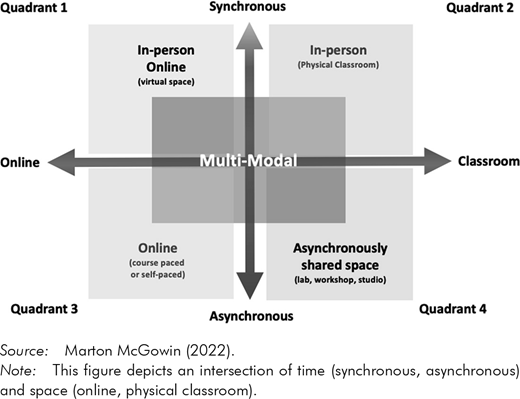
To illustrate MMLEs, Figure 1 illustrates how learning environments fall between time and space across four main quadrants (Marton McGowin, 2022):
Quadrant 1: Synchronous online virtual space;
Quadrant 2: Synchronous F2F in-person classroom space;
Quadrant 3: Asynchronous online space; and
Quadrant 4: Asynchronous shared space (lab, studio, workshop).
Any multimodal type will fit into any two of these quadrants. In other words, each of these quadrants can be combined with each other to create an MMLE. For example, quadrant two (in-person physical classroom space) can be combined with either an online asynchronous (quadrant three) or share an asynchronous physical space such as a lab, workshop, or studio (Quadrant 4) at different times. Quadrant 2 (in-person online space) can be coupled with online asynchronous instruction or share a physical space asynchronously such as a lab, workshop, or studio. These combinations will vary in degree of use. For instance, an online course may have varying degrees of synchronous online time, or an in-person physical classroom space may have reduced time to make room for more asynchronous activities online.
Methods
This study sought to answer one research question, How are multimodal learning environments being defined in higher education ?
Two data sources were used to locate definitions of MMLEs, extant literature, and higher education websites. The investigation conducted a systematic process of locating literature as well as university and college websites and then conducted a qualitative analysis of the definitions in terms of pedagogy, implementation, and management.
First, this study explored the literature on blended/hybrid learning and BlendFlex/ HyFlex, specifically looking at how the terms were defined regarding pedagogy, implementation, and management. Next, public college and university websites were identified and explored to locate definitions of various types of MMLEs. Because there are numerous higher education institutions, this study narrowed the scope of the data collection to public US colleges and universities to see what is trending in the United States in terms of miles. The Carnegie Classification was used to randomly pull four public colleges and universities from each of the main categories: (1) research-focused universities; (2) Master’s colleges and universities; (3) Baccalaureate Colleges; and (4) Associate’s colleges. Keywords such as blended learning, hybrid learning, HyFlex, BlendFlex, higher education, and learning environments were used to locate higher education institution websites that contained respective definitions for blended/hybrid and BlendFlex/HyFlex learning environments. Some universities were excluded when data on definitions of learning formats were not found.
Findings
Findings From the Literature
Blended/Hybrid
Some of the definitions for blended/hybrid encompass at least two of the categories (pedagogy, implementation, and management). Many definitions mention a blending of modalities, and some focus on the pedagogical aspect, meaning that they account for the shift in pedagogical teaching and learning strategies across modalities (Dziuban et al., 2004; Garrison & Kanuka, 2004; Laster et al., 2005). Some definitions indicate that implementation should involve some form of reduction in seat time in order to engage with the asynchronous online component of the course (Allen et al., 2007; Dziuban et al., 2004; Lewis & Parsad, 2008), while other definitions frame implementation as thoughtful consideration of design that incorporates strategies across modalities (Boelens et al., 2015; McGee & Reis, 2012; Osguthorpe et al., 2003; Stein & Graham, 2020). In terms of the management of blended/hybrid learning environments, some of the longer and more descriptive definitions may articulate the importance of being deliberate or intentional across modalities through ongoing activities and strategies that leverage the affordances of each mode (Boelens et al., 2015; Aycock et al., 2002; Laster et al., 2005).
Many definitions for hybrid learning were described as being interchangeable with blended learning. However, it is essential to note that some definitions distinguish between the two by whether or not there is a reduction in seat time.For example, Linder (2017) defines hybrid as a way of
intentionally incorporating technology tools to enhance student learning and respond to a wide range of learning preferences. In hybrid classroom settings, face-to-face activities are often combined with technology-mediated activities so that there is more active learning in the face-to-face setting and more intentional guidance when students are learning outside the classroom. Hybrid courses often result in a decrease in “face time” since inclass activities are replaced by time spent outside a traditional classroom setting. (p. 11)
HyFlex/BlendFlex
It is not surprising that many of the definitions for BlendFlex/ HyFlex resemble blended/hybrid models because it is based on the blended/hybrid format. The single defining difference is the “flex” part of the term, which means that students can choose which mode they will participate while changing mode preference throughout the course. Some universities have adopted the term bimodal to describe this environment (DePaul University, University of Ottawa).
Beatty (2006) defined the HyFlex design as a hybrid model, combining online and face-to-face teaching and learning activities, and flexible, providing students the choice to attend face-to-face instruction. According to Bower et al. (2015), the HyFlex course design combines physical learning and online spaces while infusing face-to-face interactions between the spaces. Another key element of HyFlex is that it gives students a choice in terms of when and where they will attend the synchronous portions of the course. They can choose to attend live in person in the shared classroom space or synchronously through the online format.
Beatty (2006), when conceiving the HyFlex model, found that the literature often neglected the student in the teaching and learning process. Sufficient design guidance is often found. However, these often neglect the design of student support in these learning environments; instead, it assumes instructors know what is best for each student despite the diverse student factors such as schedule and location conflicts (Beatty, 2006).
There appears to be little to no disagreement in the literature between the terms BlendFlex and HyFlex; instead, the term choice seems to reflect preference, much like what is seen with blended and hybrid. For example, the University of Central Florida utilizes the term blended learning and later added BlendFlex into their course delivery choices. That said, BlendFlex and HyFlex are essentially blended and hybrid learning with the flexibility of choosing when and where to participate in the course throughout the semester. Collectively, all these approaches would fall under the MML umbrella.
The BlendFlex format was pioneered at Central Georgia Technical College; however, other universities, such as the University of St. Thomas, use the term HyFlex, an equivalent format to BlendFlex. Essentially, students can choose to attend as many or as few face-to-face sessions as they want and complete the rest of the course online with no penalty. Table 1 highlights some definitions for multimodal environments described in the literature.
Findings From the Universities and Colleges
A university website search yielded definitions for multimodal environments. The universities and colleges were selected at random from the Carnegie Classification list of four main categories: (1) Research 1 and Research 2, (2) master’s, (3) baccalaureate, and (4) associates colleges and universities were created, and summaries are listed in Tables 2–5.
Upon a review of college and university websites, two additional multimodal formats (flexible with rotation and bichronous) were added to the initial blended/ hybrid, HyFlex/BlendFlex multimodal delivery formats. Table 6 lists the revised types of MMLEs found in this study’s investigation and the different combinations of time and space to which the MM type belongs. Notice that some MMLEs allow students to choose when and where they will attend the synchronous portion of the course. For example, HyFlex/Blend-Flex formats allow students to choose if they will attend synchronously in-person or online, while other flexible formats add a rotation element. This means that students rotate physically versus online when they attend the synchronous portion of the course in person. It still gives a level of flexibility to students, but not as much as a HyFlex/BlendFlex format.
Flexible With Rotation
These formats are beginning to emerge across universities and are often called different names depending on the college or university implementing them. These environments are essentially HyFlex or BlendFlex, with the requirement of attending in person in the same physical space. Two forms were identified: “Hybrid with rotation,” defined as “A flexible course where students will rotate on a set schedule between face-to-face and virtual instruction” (University of Iowa, n.d.). The other form, California State calls “Chicoflex rotating,” which they define as a class that “meets at set days/ times with students rotating in person and online attendance” (California State, 2021). However, it is essential to note that California state created the rotation as a response to COVID-19 and the need to maintain social distancing in the classrooms. Whether or not they will continue with this format has yet to be seen.
Bichronus
This delivery format also appears to have resulted from the COVID-19 pandemic to support the continuation of education (Alblooshi, 2021). This format has been defined as a learning environment that combines synchronous and asynchronous online learning. Martin et al. (2020) define bichronous as
The blending of both asynchronous and synchronous online learning, where students can participate in any time, anywhere learning during the asynchronous parts of the course but then participate in real-time activities for the synchronous sessions. The amount of the online learning blend varies by the course and the activities included in the course. (para. 5)
This means that there is no in-person physically colocated interaction; however, the synchronous online time can be used to have discussions and activities as if the instructor and students were in the same physical space (Martin et al., 2020).
Synthesis of Definitions
The definitions from the universities and literature were then analyzed in terms of pedagogical, implementation, and management strategies (Table 7). While the literature definitions vary across pedagogy, implementation, and management, the university definitions focus largely on the implementation in terms of modality. This may be due to the target audience of those websites being students or prospective students and therefore do not go into detail about pedagogy or management.
To illustrate the differences and similarities in MMLEs identified in this study, a modality combination matrix (Table 8) was created. The modality combination matrix shows how each of these MMLEs is related regarding participation requirements across time and space. What is interesting to note here is that blended/ hybrid and flex with rotation all require students to attend in both modes and at both times. However, the differentiating factor is flexibility. Flexible models, such as the ChicoFlex model used at California State, allow for greater flexibility in the how a student will attend compared to blended/hybrid, which the instructor or administration predetermines. BlendFlex/ HyFlex is the most flexible because they give students a choice weekly when and how they will attend. A student can technically do the course entirely asynchronously online, so there is no requirement to attend synchronously, but there is at least an online requirement. The bichronous format takes place completely online, however, there are requirements to attend synchronously and participate in asynchronous activities.
Conclusion
As advances in technology propagate educational innovations, the need will continue to revisit and rethink how teaching and learning paradigms are defined and conceptualized. The recent demand for remote and flexible learning has created a need for researchers to reexamine conceptualizations of instructional delivery methods to understand better the different combinations of these environments and the multifaceted implications of their use.
This study sought to answer the question, how are multimodal learning environments defined in higher education ? To answer this question, the term multimodal learning environments was proposed to serve as an umbrella term for how learning environments that take place across time and space can be grouped. Further, this study sought to identify how learning environments such as blended/hybrid and Blend-Flex/HyFlex are defined and conceptualized across the literature regarding pedagogical, implementation, and management. By doing so, the opportunity to classify learning environments that take place across time and space helped to get a clearer picture of these environments to help improve future research efforts.
Two key findings resulted from this study. First, there are four broad combinations for MMLEs that this study categorized into four main quadrants: (1) Synchronous F2F in-person classroom space; (2) Synchronous online virtual space; (3) Asynchronous online space; and (4) Asynchronous shared space (lab, studio, workshop). Second, in addition to these combinations of space and time, there appears to be an element of flexibility. For instance, the blended/hybrid format can have the option of flex where students can choose when and where to attend each time the class meets. However, some universities have created a flex option with rotation, which means that students rotate between attending synchronously in person and synchronously online. Therefore, it can be said that MMLEs is not only a combination of pace and time but also can allow a level of flexibility in terms of student choice in terms of attending the synchronous portion.
Further exploration is needed into the different combinations of MMLEs, as illustrated in Figure 1. The quadrants could be used as a framework to explore the different combinations. In doing so, strategies could be identified and measured. Specifically, there is little research on combinations that utilize asynchronous shared spaces (e.g., labs and studios). This will help conceptualize and define quadrant four in combination with quadrant one or two. Secondly, further research will need to conduct a deeper dive into university definitions and conceptualizations of MMLEs. Findings from that investigation can be aggregated by looking at patterns and frequencies of term use. By understanding how MMLEs are defined, implemented, and managed in higher education institutions, scholars and practitioners can focus on exploring possibilities and implications afforded by the various combinations of time and space and plan appropriate measures of their effectiveness. Future research could utilize the multimodal combinations matrix developed herein to identify and explore teaching and learning strategies made possible by implementing MMLEs.