

Graduate student candidates enrolled in literacy courses in the college of education at two regional universities spanning urban, suburban, and rural settings are provided with authentic opportunities to apply research-based approaches and modes of developing their students’ literacy and critical thinking skills in fully online programs. This article will explore faculty-to-student and student-to-student interaction—including discussion boards, announcements, email, individual/group work, presentations, and feedback on assignments—to create a framework to facilitate effective online learning experiences.
Online Teaching and Learning Philosophy
According to Albert Einstein, “it is the supreme art of the teacher to awaken joy in creative expression and knowledge.” This quote illustrates our online teaching philosophy as we work to mentor graduate-level candidates, deepening their knowledge of how best to facilitate their students’ abilities to tackle 21st century literacy demands. Through designing and teaching courses for fully online MEd reading specialist and MEd literacy programs, as well as for candidates pursuing a reading specialist endorsement, this article will detail the successful strategies of two online educators committed to inspire graduate student success. It is essential to offer a range of opportunities for learners to discuss, evaluate, and synthesize information and to “think creatively about your content” (Christopher, 2015, p. 168).
This article will explore faculty-to-student and student-to-student interaction in fully online programs—including discussion boards, announcements, email, individual/group work, and feedback on assignments—to create a framework which facilitates effective online learning experiences. An interactive instructional style combined with meaningful assessment practices will allow faculty to better prepare candidates for 21st century demands. For faculty to be effective in supporting educators’ learning, they must ensure that candidates have “knowledge of multiple literacies and the processes and phases of literacy and language development” (Risko & Reid, 2019, p. 424).
Our respective graduate programs provide a comprehensive study of the teaching of reading and writing for P–12 students throughout the grade levels. They are geared to address the Common Core Performance Standards that emphasize literacy skills across content areas. The programs are aligned with state professional standards as well as the International Literacy Association Standards, among other professional organizations. Coursework is designed to develop reading practitioners with a deep understanding of research-based practices for improving literacy skills and serve the literacy skills needs of a broad spectrum of constituencies. Kentner (2015) states that “maybe it’s time we rethink the image of our students reading into something that better fits the world they live in” (p. 640). These tenets guide our work with these educators as we design learning experiences throughout the fully online graduate programs.
A common thread throughout coursework is the ability to impact assessment and instructional practices in the classroom as well as throughout the school. Connecting expanding definitions of literacy in the broad context of students’ lives with literacy instruction in our schools may require that teachers reevaluate and transform their understandings about literacy and their approaches to instruction (Albers et al., 2008; Cowan & Albers, 2006; Spitler, 2009). Therefore, as teacher educators, it also becomes our responsibility to design learning experiences that support this ongoing transformation of teacher literacy identity (Spitler, 2009).
Overview of Strategies for Applying Theory to Practice
We seek to create a welcoming learning environment where candidates are provided with authentic opportunities to practice the application of research-based approaches and modes of developing their P–12 students’ literacy, communication, and critical thinking skills through creative means—through engaging course announcements (including current articles on course content to pique interest and introduce weekly content); discussion board strategies (offering choices of prompts and encouraging active discussion among colleagues); and regular email communications (sending reminders of long-term assignments and encouraging students to break content into manageable components). We enjoy mentoring online students, encouraging them to participate in the university’s student scholar symposium, and to consider future conference presentation or publication opportunities.
We also align practica experiences with several of the courses. In those practica, the candidates prepare and deliver a professional development session for their staff, coach a colleague in an identified area of interest/improvement, create a specific plan for differentiation within the candidate’s classroom, and participate in the assessment-instruction-reflection cycle with a student. Our goal is to create a forum that encourages active reflection and analysis. Baugh (2017) notes that a “comprehensive reading program incorporates effective instruction, multiple resources, and a wide variety of experiences to help each student achieve optimal reading progress every year” (pp. 229– 230).
Discussion boards play an integral role in creating a sense of community in the online classroom. Sense of community is accomplished through the design of creative and thoughtful student self-introductions and meaningful responses to the text and additional research articles/videos/ resources. Our goal is to create a forum that encourages active reflection and analysis. Providing an initial discussion (such as a story from our professional experience that relates to the weekly topic), individualized feedback, and recommendations on additional resources for discussion boards and assignments cultivate an authentic rapport with students. We infuse our professional development experiences from conference panels and workshops throughout our instruction to ensure that our lessons remain topical and multidimensional.
Highlights of Engaging Online Instructional Strategies for Graduate Students From Fully Online Courses
Below we will highlight promising instructional strategies and objectives for 100% fully online courses we have developed and taught.
Online Course Announcements
Course announcements provide a forum to communicate with candidates and pique interest in the upcoming week’s topics of study and assignments. A strategy enlisted is to post a link to the forthcoming module in the course announcements so that candidates can easily access the weekly overview with objectives, instruction, and additional resources. Links to journal articles and videos are provided so that candidates can anticipate discussion board content and curriculum that will be accessed during the forthcoming week. To encourage educators to pace themselves for larger assignments, reminders are posted as well as quick links regarding assignment details, the rubric, sample projects, and relevant library resources in the course announcements.
Course announcements are utilized as a tool to encourage candidates to review response comments/resources from the previous week. A review is facilitated by acknowledging graduate students for their valuable contributions to the previous week’s discussion board while simultaneously inviting them to revisit previous posts to learn from one another and comment when applicable. Acknowledgment creates a purpose for response posts, as candidates realize that their work is valued and that we are learning from one another throughout the online classroom community over the course of the semester. Teachers benefit from “carefully planned and mentored opportunities during preparation for debriefing and reconciling prior beliefs with new knowledge and theories about pedagogy” (Risko & Reid, 2019, p. 425).
Introductory Discussion Boards
An example of a discussion board from a literacy theory course asks candidates to consider the following prompt and resources: “How do you think your reading experience(s) differed from that of the generation of young people you are now teaching? I spotted this interesting article on NPR that might provide you with some additional insights. Please read and include thoughts that the article sparked in your post.” http://www.npr.org/2015/05/28/408787099/the-technology-of-books-has-changed-but-bookstores-are-hanging-in
A sample student response:
After listening to the podcast on NPR, I see that I am not alone when I say, “Reading books from an actual tangible book are becoming more and more obsolete.” The interesting response to the question, “Is a digital book ‘better’ than a printed one?” is what sparked my interest (Weiner, 2015). I think the biggest difference between my experience and that of the students I will be teaching is the use of technology and the instant gratification/multitasking culture it creates, which I think has its positives and negatives. For example, with my Nook, if I do not know a word, I can highlight it, and using WiFi, it will tell me how to pronounce it and the meaning. I can even save passages or quotes I like or want to revisit. But I also believe it doesn’t allow students to analyze or, as the article said, “immerse” themselves in the process of just reading. They don’t like to discuss things as much, they just move through things as quickly as possible.
In a literacy assessment course, the following prompt was posed: Please review a Washington Post article on assessment based upon the National Council of Teachers of English Assessment Project (https://www.washingtonpost.com/news/answersheet/wp/2015/04/23/how-teachers-want-to-evaluate-their-students/) (Fournel, 2015).
Students were asked to reflect upon one of these current articles on literacy assessment and respond to both components of a colleague’s post to generate a sense of community. A sample candidate response was as follows:
I would relate the strongest with the first middle school teacher that reported with The Washington Post. On a daily basis, I use a plethora of both formative and summative assessment yet lack time to use the data objectively. In my personal confession, that is my weak link. I agree with the statement that there are plenty of assessments. It is the direct use of the outcome of assessment to drive instruction that is lacking. It is often difficult to find the time to analyze each student’s results and personalize remediation. However, I know that this individual spectrum is necessary to catch students that may be falling through the gaps. This is one of my goals for taking this course— to become fluent with efficient assessment to target struggling students without being bogged down with unnecessary fluff. I would like to create assessments with purpose and specifically targeted goals.
In a content-area literacy course, candidates watch CBS News video (Hartman, 2013) about a WWII veteran who shows that it is never too late to learn how to read and enjoy the benefits that literacy affords: http://www.cbsnews.com/videos/wwii-veteran-refuses-to-close-the-book-on-his-life/. The focus of their post is on how they think Mr. Bray’s perspectives may change after he reads biographies of historical individuals, such as George Washington. Also, graduate students write about how Mr. Bray’s life has changed as he enjoys other activities that literacy affords him, such as karaoke. A current update on Mr. Bray’s story and details of how students across the country are supporting his hard work is also included (“Support Pours In,” 2013). This introductory post helps cultivate a sense of community among candidates as they discuss this human-interest story with a content-area literacy application.
Close Reading Discussion Boards
Throughout our courses, we share how annotation strategies could be adapted in an online setting, as well as close reading strategies to foster students’ critical reading/ recording skills in an online environment. Close reading was introduced as a lens through which the reader sets a purpose for the literacy task, interprets words and phrases, analyzes the structure (visual and text elements), finds patterns and relationships between details, seeks to understand the author’s reasoning and use of evidence, integrates ideas from the text, and promotes connections (Lehman & Roberts, 2013). A rationale for the importance of close reading strategies was also presented. An example of the close reading prompt for an assignment looks as follows:
First reading: Overview. Figure out what the text says.
Second reading: Figure out how the text works.
Record a text-to-self connection you made with the text with the red highlighter. Annotate connection in margin.
Record a memorable word choice or sentence with the blue highlighter. Annotate your rationale for word choice.
Record the author’s perspective as you read with the green highlighter. Explain why you selected this language as contributing to the author’s point of view.
This led to a discussion of how the process of close reading can help students concentrate on what is being read, encourages sustained effort to understand the text, and develops critical reading and thinking skills. Overall, the value of close reading strategies to facilitate candidates’ ability to become strategic and independent readers was modeled.
This was followed by the “Knew-New-Q” activity (Gambrell, 2014), where candidates practiced annotating the text. If the information in the article was content that they already knew, they placed a “K” in the margin. If the information was new to them, an “N” was placed in the margin. If graduate students had a question regarding a portion of the article, they placed a “Q” in the margin. Afterward, candidates shared their reflections with a colleague and wrote a sentence to solidify their Knew-New-Q insights.
Additional close reading strategies were introduced, which included a “what do you notice?” chart to record ideas, spark discussion, and additional annotation strategies that can be utilized while reading (see Figure 1).
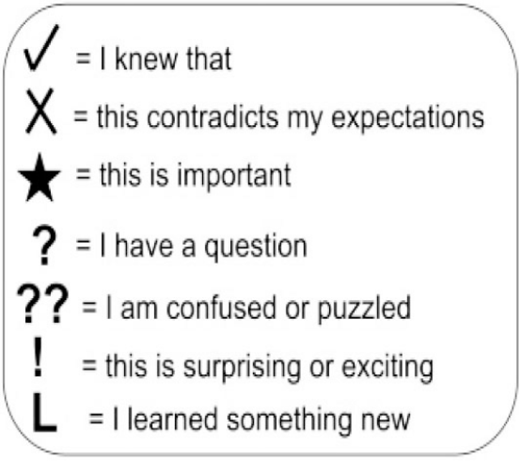
Visual literacy activities with Post-it notes (such as determining important concepts in a reading and noting connections with lines, circles, arrows, and symbols to show the relationship between the ideas) were modeled. Strategies such as rewriting the text as a series of tweets, discussion circle roles, analyzing a text from different viewpoints, and creating student-generated discussion questions to accompany a text were also introduced. Candidates were invited to consider the role that teachers “play in facilitating productive discussions that simultaneously serve students’ learning needs and content acquisition while also developing their literacy knowledge and skill” (Ford-Connors & Robertson, 2017, p. 131).
Semester-Long Literature Response Discussion Board Posts Around a Literacy Case Study
In another course, candidates participate in semester-long literature response discussion board posts around Other People’s Words: The Cycle of Low Literacy (Purcell-Gates, 1995). They develop skills in interpreting and analyzing reading difficulties faced by the urban Appalachian family presented in the book. Graduate students examine the family’s cultural background, difficulties navigating the school’s literacy demands, and document the steps they took to improve their reading and writing skills with the assistance of Dr. Purcell-Gates. Candidates make a selection among the listed prompts each week to provide an element of choice in the discussion board.
A graduate student, who is currently teaching elementary school abroad in a foreign county, noted the following:
How does Jenny travel to select locations in the city where they live? What does this show about Jenny in terms of her resolve and determination?
Jenny and her family will walk short distances from their home and will travel by car to necessary locations in the city also. The text says that she walks nearly 20 minutes to visit her family in a nearby neighborhood and that she will drive using familiar landmarks to go to needed places in the city. These places include the welfare office and grocery shopping. She also made her way to the university. This shows me that Jenny has to be very dedicated to her family and to taking care of what needs to be addressed. She went away from her usual pattern to go find help at the university, which demonstrates how passionate she is about stopping her children from having to live illiterate lives as she and her husband do.
Victoria Purcell-Gates also mentions that the family will travel along interstates and through “backroads” because they are familiar and numbered. I can relate to traveling in this method in a city where I am essentially illiterate. I stick to familiar landmarks and the metro station because these things are recognizable and numbered. I know how to get to work and back to the apartment where I am currently staying. I know these things because they are needed for my survival. I rarely venture past the familiar. When I have, it is only because I have had to (to eat). So, in this way, you can see how Jenny shows a serious commitment to finding a solution because she traveled out of the familiar zone.
At the middle point of the book, another candidate’s post reflected upon the value of the mother, Jenny, writing “her own words for the first time in her life.”
When I think about a young child first discovering their ability to “write,” I envision how proud they are and how they may be the only person who knows what it says, but to them, it is their words—it says exactly what they want it to say. To think that Jenny did not have these experiences as a child is hard to comprehend. For Jenny, this was something that was not within her reach; it seems like it wasn’t even something that she considered. Jenny wanted to learn words, to learn to read. However, it’s like she hadn’t thought about writing being a part of that process, so having this experience where she’s able to communicate in her own written words was something above and beyond anything she had imagined for herself. For Jenny, the value of writing her own words for the first time feels like she has opened a door for herself that she didn’t even know was available to her. Now, the possibilities are possible. I find it so heartwarming to see how Jenny used the journal, revealing such truths about herself. It’s as if she unknowingly discovered a major purpose of writing while at the same time learning how to write.
As the book continued, a candidate reflected as follows:
For me, this book has been one “aha” moment after another. I would consider myself a teacher for all students, understanding that each student comes to school with their own story and set of circumstances—of which they have little to no control over. I am very aware that students’ lives vary in terms of what is available to them at home—but it was Jenny and Donny that really opened my eyes to the bigger picture—the relevance of print in the lives of students. For so many students, print is a foreign language, a foreign way of life. When Victoria said that we would be no less deficient than Jenny and Donny if we were placed in a culture other than our own—I can’t forget sometimes that these students have to be given a reason for their reading and writing; they have to see a purpose for literacy.
Prezi/PowerPoint Presentation
During a content-area literacy course, candidates prepare a content-area reading Prezi. Students select a book (fiction or nonfiction) for use in a content area (math, social studies, science, or literature). This assignment also served as a powerful reminder that read-alouds can be used with students of all ages. Ma’ayan (2010) noted that making room for students’ voices, literacies, and lived experiences is a “first step in … shifting schools to be successful learning spaces for all students” (pp. 653–654).
Candidates were invited to view a professional presentation that describes a Title II Part A Higher Education Improving Teacher Quality State Grant project entitled “WISE Workshop: Writing Intended to Strengthen Educators—A Flipped Classroom Professional Development Initiative Embedding Technology Tools and Authentic Writing Instruction for Primary and Elementary Grade Mathematics Teachers.” This grant project integrates content-area read-alouds with writing instruction posted in the module. This project included a flipped classroom element as well to allow teachers to have more time to apply the content in the classroom. From previous research on best practices in teaching and learning, a learner-centered educator “provides activities in the classroom that are action-based, authentic, connected, and collaborative, innovative, high-level, engaging, experience-based, project-based, inquiry-based, and self-actualizing” (Hamdan et al., 2013a, p. 17). The flipped learning model enables teachers to expand the scope of learner-centered activities by freeing up class time that was spent to deliver the basic concepts. Hamdan et al. (2013b), include peer instruction, active learning, priming, and pre- and postclass modeling as important aspects of flipped learning.
Candidates were provided with a template for their presentation, which included the following elements:
Slide 1: Your name, picture of the front cover of the book, author of the book, link to the text from an online source so your colleagues can refer to it.
Slide 2: Summarize/describe the content of the text in a full paragraph.
Slide 3: Describe how you will specifically utilize the text in your instruction. Will it supplement or replace your textbook instruction? How? Be specific and explain in a full paragraph.
Slides 4 and 5: Think about the following items (refer to the presentation provided by the professor for a sample).
Math, science, social studies content connections.
Vocabulary terms. List at least four content-area vocabulary terms that you will focus on during the read-aloud.
Author’s writing style. List three “noticings” about the author’s writing style that you will discuss with students. Detail your prompting questions to invite conversation and encourage oral language development skills.
Real-life connections. List three real- life connections in complete sentences.
Slide 6: Describe a meaningful contentarea writing application for the read-aloud. Please feel free to utilize one of the writing strategies mentioned in the PowerPoint presentation and/or the journal article (Fisher & Frey, 2013) for inspiration. Include the specific prompt you will utilize and your instructional approach.
Slide 7: Reference page. Cite the fiction or nonfiction content-area text, textbooks mentioned, as well as the Reading Teacher journal articles that you referenced. Please see the links below for helpful hints on APA style.
A sixth-grade English language arts teacher composed a thoughtful presentation around Resistance: Book (Jablonski, 2010). This graphic novel is a three-part book series. The student explains that if teachers should find their students highly captivated by this novel, then they may find the other two extensions of the story beneficial regarding World War II, the Holocaust, and Hitler’s devastation of the European nations. He continues to explain that Resistance is a high-interest story with easy readability. It would make a valuable supplemental text to accompany a standard social studies textbook, providing students with a more personal perspective of the events they are studying in class (Camp, 2000). Colleague responses to the student’s presentation demonstrated its impact:
Wow! This is a great lesson. The summary alone entices me to read the book. I agree with the real-life connections you want to address with your scholars. Discrimination still exists today, and it is important to encourage scholars to be leaders. I also like the power writing technique. It provides a quick insight into their thoughts. As you stated, you can also identify and address any deficits in their writing. The use of a graphic novel is a powerful genre. As you mention, the readability is fairly easy, so even your struggling readers will be able to grasp the idea behind the story. I also think the story itself is great supplemental material to go with the standard facts of the textbook. It gives students someone to relate to as they read the information. It turns numbers and facts into people, which will create a deeper connection for them.
Those enrolled in a learning theories course as part of the foundational knowledge component of their program were also required to create a PowerPoint to summarize the vast content covered in a 6-week session. The directions for the assignment were as follows:
Using your notes taken on graphic organizers, create a PowerPoint presentation that summarizes your understandings of the five major learning theories discussed in this course. When finished, post it in the discussion board, creating a new thread for your PowerPoint. Then, respond to two of the postings made by your peers. Consider asking additional questions, making recommendations, making connections to ideas, offering support. Again, at a minimum, the course texts, articles, or videos must be used as a reference in your discussion board. To improve your chances of a better grade, include references to materials not from this course. These references could include but are not limited to, other texts, articles, videos, or notes from conferences. Refer to the discussion board rubric to guide the construction of your responses to your peers ( Appendix A).
 The asset presents a screenshot of a PowerPoint presentation with the main slide titled Writing Applications. The content includes several writing prompts such as creating a persuasive paragraph about library card access imagining a story if Ron McNair had not received his library card considering how to become a leader comparing rights and responsibilities in civic life exploring why Ron could or could not read books in the library and reflecting on feelings about being treated unfairly. On the left a sidebar shows slide previews while a quote citing Fisher and Frey emphasizes the importance of regular opportunities to engage students in a range of writing tasks. A pencil graphic appears on the slide and various toolbar options are visible above the slide area. The asset presents a PowerPoint slide featuring two main sections. On the left content area connections are listed such as social studies science reading and writing character education scientists space and challenger astronaut travel and career interests with a graphic of paper and pencil above. On the right real life connections are highlighted including African American history civil rights tolerance and acceptance setting goals visiting the public library and making choices with a drawing of children included above. A sidebar of slide thumbnails is visible on the left and additional graphics and labels are present in the slide layout.The asset presents a screenshot of a PowerPoint presentation with the main slide titled Writing Applications. The content includes several writing prompts such as creating a persuasive paragraph about library card access imagining a story if Ron McNair had not received his library card considering how to become a leader comparing rights and responsibilities in civic life exploring why Ron could or could not read books in the library and reflecting on feelings about being treated unfairly. On the left a sidebar shows slide previews while a quote citing Fisher and Frey emphasizes the importance of regular opportunities to engage students in a range of writing tasks. A pencil graphic appears on the slide and various toolbar options are visible above the slide area. The asset presents a PowerPoint slide featuring two main sections. On the left content area connections are listed such as social studies science reading and writing character education scientists space and challenger astronaut travel and career interests with a graphic of paper and pencil above. On the right real life connections are highlighted including African American history civil rights tolerance and acceptance setting goals visiting the public library and making choices with a drawing of children included above. A sidebar of slide thumbnails is visible on the left and additional graphics and labels are present in the slide layout.
Video Self-Reflection
Another critical component of these online graduate programs was the use of video self-reflection. In a course about literacy curriculum design and delivery, the candidates first researched a literacy interest area. Most often, the topics chosen were those grappled with by the candidate or the school in which they taught. Once the topic was chosen, the candidates completed a literature review. Then, using that information, the candidates prepared a professional development session for colleagues at their school. The session was recorded so that the candidate could analyze and reflect upon the design and delivery of their work. Two papers were submitted to complete this assignment. First, the candidate described the delivery of the session. The directions for this portion follow.
Video of PD Session
Part 1
The first paper is a description of the delivery of your PD Session. As you watch the video of yourself presenting, take notes on the Video Observation Sheet. Then use those notes to craft a written description about your delivery of the PD session. This description is written in narrative form. The Video Observation Sheet is NOT submitted with or as the assignment. The measurement for writing such a description is that it should be written with enough detail so that any reader can “see” what happened without actually watching the video. Use the rubric to craft your description.
Part 2
As part of the planning of your PD session, you created an evaluation/feedback form. Use that information to craft a reflection about the session itself. First, write an introduction that provides your reader with a context of your professional development session. Think of the who, what, when, where, why, and how of the session. Pretend that your reader knows absolutely nothing about this session.
Then, consider what you felt went well in the session and why you believe that to be so. Then consider what you thought did not go so well and how you would change it for next time.
Next, consider the feedback you received from your attendees. Use the questions or prompts you stated on your evaluation/feedback form as the frameworks for your paragraphs in this section of the paper.
Finally, sum up your ideas in a conclusion/discussion about the experience. Use the rubric to help craft your ideas ( Appendix B).
Practica Experiences
The International Literacy Association (2017) standards for reading professionals includes an item in which candidates must engage in practical experiences. In an online program, this can be problematic. However, with careful planning and accountability, the requirements can be met and verified. In a three-block course of assessment, instruction, and practicum, the candidates participated in weekly modules that outlined the types of assessments they would use as they worked for 6-weeks, three days a week with one student. Once the initial assessments were completed, the candidates designed instruction for the student based upon the assessments. The candidates submitted weekly lesson plans, weekly reflections of the teaching sessions and weekly progress reports to the parents of the student. As evidence of the content of the plans, lessons, and reports were uploaded to the class grade book as well. The culminating project for this practical experience was the creation of a case study. The case study was submitted to the instructor for evaluation and shared with the guardian of the student tutored during the session. Additionally, the candidates prepared a 4-week plan as a guide for the parent should they wish to continue to work with the student for the rest of the summer. The directions for the case study follow:
As the culminating project for this three-course block, write a case study that details your assessment process and findings, your recommendations for instruction, the instruction you provided for your student, and the weekly communications you had with the parent/guardian about these tutoring sessions. Please use the template loaded in the online classroom on which to write this case study. Because this is a three-course block, the case study will be submitted for evaluation in each course.
Please load your draft into the grade book of the assessment course. I will review it and make suggestions based on what you have written. You will receive full points for this portion of the assignment if the case study is submitted by the due date.
Also, submit a copy of your case study as an attachment in the discussion board. Then, read the case study of your assigned peer. Provide clear comments, ask questions, or offer suggestions to your peer. Feel free to use the rubric for the assignment to guide your comments ( Appendix C).
After you have reviewed your peer’s submission, return it to the discussion board. You will receive full points for this portion of the class if you submit and review within the required time frame.
Reading Specialist Master’s Capstone Project
In the final course for the MEd reading specialist program, a reading specialist master’s capstone project, the candidates complete a peer review feedback chart for action research (see Figure 3). The instructor explains that “full credit will be given for a document that shows evidence of thoughtful consideration and meaningful feedback that can assist your colleague in making their paper the best it can be.”
An additional element of the course is an action research plan professional video update through http://www.screencast-o-matic.com/. Candidates post a transcript of their video as well as a Screencast-o-matic link (their script) for colleagues to follow. Below is the presentation format that is provided to guide the candidates’ presentation. The goal is to provide them with the experience of professionally presenting their work and utilizing academic language while they receive constructive feedback and guidance from the professor and colleagues.
Introduce yourself. Describe your educational background (undergraduate degrees and graduate degree program). Tell the grade/content area(s) and school where you currently teach. Describe something that the audience might find of interest in your background to engage them.
Create a “strong lead” for your action research project. Why did you become interested in the topic? Was there a moment that sparked your curiosity in terms of designing your action research project? Please share.
Tell us about your area-of-focus statement and variables.
State your research questions.
Describe the intervention or innovations you are implementing.
Describe the membership of your action research group.
Update us on your data collection. Include successes/ areas that you are working to refine.
Close with a conclusion that is interesting and engaging to your audience. Describe the next steps/how you might apply what you have learned from conducting this action research project to your own teaching practices.
 The asset presents a table for peer review feedback with item and feedback columns containing four main evaluation areas. Strengths of the paper asks for at least two specific strengths with a requirement for a minimum of two sentences each. Clarity directs the reviewer to identify at least two points for improvement specifying page number and what information could clarify the writing. In organization the chart asks if the paper is well organized whether subheadings could be added and if sections should be rearranged with page reference and reasons if applicable also suggesting track changes in the paper. The mechanics section includes recommendations for spelling grammar capitalization and APA formatting. Guidance notes with bullet points are provided for each section and the chart caption identifies it as figure three peer review feedback chart.
Peer review feedback chart.
The asset presents a table for peer review feedback with item and feedback columns containing four main evaluation areas. Strengths of the paper asks for at least two specific strengths with a requirement for a minimum of two sentences each. Clarity directs the reviewer to identify at least two points for improvement specifying page number and what information could clarify the writing. In organization the chart asks if the paper is well organized whether subheadings could be added and if sections should be rearranged with page reference and reasons if applicable also suggesting track changes in the paper. The mechanics section includes recommendations for spelling grammar capitalization and APA formatting. Guidance notes with bullet points are provided for each section and the chart caption identifies it as figure three peer review feedback chart.Peer review feedback chart.
Finally, this course provided an opportunity to collaborate with the university’s academic librarian. The instructor and librarian jointly developed an online reference guide for the course. This resource enabled students to conduct a focused literature review for their projects. The following journals were easily accessible to students to facilitate their literature review—Reading Teacher, Journal of Adolescent and Adult Literacy, Reading Research Quarterly, Language Arts, and Voices From the Middle.
Conclusion
Course evaluation comments reveal the high degree of faculty-student interaction evident throughout these online courses. “The professor made sure to connect with me one on one even though she had so many other students, and I loved that. She responds to each of our discussions as well as giving us additional resources to help us become better teachers.” Another student noted the value of our online courses in “relating the chapters to real-life teaching experiences. The professor always emailed us with articles related to the topics we have studied and that she felt we could benefit from. This online course offers so many opportunities to learn.” Most significantly, this student noted the following:
Even though we didn’t meet in a traditional classroom setting, I think I have gotten more out of this class than any others in my graduate program. She makes the most of the online experience by providing students with supplemental materials, outside of the textbook, and opportunities to virtually discuss what we have learned.
An MEd reading specialist education candidate presented “Concepts About Print: An Emergent Literacy Case Study” at the university’s student scholar symposium. The student emailed the professor afterward, expressing, “thank you for nominating me to have the chance to share my work!” Another graduate student was the recipient of the universitywide writing competition award (graduate expository category) for an emergent literacy case study completed in the “understanding readers and the reading process” course. She emailed after that, expressing, “Thank you for encouraging me to participate. I am very proud of this accomplishment.”
Outside reviewers also commented about the online environment. A Quality Matters reviewer commented on the capstone course, noting, “This was a well-done course. The course author obviously worked very hard to develop a very good course that ought to provide a great opportunity for these graduate students to shine and to apply all they have learned not only in this course but throughout their graduate program.” Another reviewer wrote, “I found this course easy to navigate, including excellent course content for the learner level, and a variety of learning methods.”
Teachers’ beliefs and identities influence, and are influenced by, all that they do each day. They bring who they are to their teaching, using their personal and professional knowledge to shape and guide their teaching decisions (Uzum, 2012). Spitler (2009) defines teacher literacy identity as “a confident view of self as responsible for and in control of improving the literacy learning of self and competency to enact engagements to guide the literacy learning of students” (pp. 129–130). Through these online programs, our beliefs and identities were evident to these graduate candidates.
About the author's


Acknowledgment
“Compliance with Ethical Standards”: Disclosure of potential conflicts of interest: There are no potential conflicts of interest on the part of either author. Research involving human participants and/or animals were not involved in this article. This is a description of instructional strategies. Informed consent not applicable.
References
Appendix A
Discussion Board Rubric: CWU MEd.-Literacy Online Program
| Criteria | Exemplary 10–8 | Proficient 8–6 | Basic 6–4 | Below Expectations Below 4 |
|---|---|---|---|---|
| Initial posting content 40% |
|
|
|
|
| Responses to peers 40% |
|
|
|
|
| Professionalism 20% |
|
|
|
|
Note: Each week the participant is expected to make an initial post, followed by two responses to peers.
Appendix B
EDLT 592D Videotape Analysis Rubric
| Criteria | Below the Standard 5 Points and Below | Meets the Standard 8–6 Points | Exceeds the Standard 9–10 Points |
|---|---|---|---|
| Introduction |
|
|
|
| Verbal communication skills 10% |
|
|
|
| Nonverbal communication skills 10% |
|
|
|
| Management/organization skills 10% |
|
|
|
| Content 50% |
|
|
|
| Writing: Flow of ideas 5% |
|
|
|
| Writing: Grammar and mechanics 5% |
|
|
|
Appendix C
Case Study Rubric: EDLT 526, 528, 592D
| This rubric will be used for the case study in all three classes listed above. The case study is worth 25% of the grade in EDLT 526 and 528, and 30% of the grade in EDLT 592D. |
| This same rubric will be used for the draft submitted in EDLT 526 which is worth 10% of the grade. This is listed as “case study for peer review” in the EDLT 526 Syllabus. The draft needs to be submitted to SafeAssign in Week 5, as well as to your thread in the DB for Week 5. |
| (4) Completeness ______ |
| All elements of the case study are included. Elements are clearly and concisely described. Parent-friendly language is used. Factual reporting of conditions under which data collected is included. Factual, detailed reporting under which data collected is clearly and concisely conveyed. |
| (4) Understanding _____ |
| Demonstrates a clear understanding of the assessment, teaching, and reporting process. Case study is reported factually that accurately portrays the student’s abilities and targets. Statements are supported with data collected during the experience. Clear statements are written in positive terms. Data points are clearly referenced in the report. |
| (2) Professionalism/Presentation ______ |
| Correct mechanics, spelling and grammar are used. Writing is organized to aid in the reading and locating of information. Sentences are clearly and concise |
