


In response to the increasing implementations of online problem-based learning (PBL), this paper presents a new framework, 4S PBL, with a wide range of strategies and technologies to empower instructors and learners. Based on a critical synthesis of research on and practice of PBL, self-regulated learning (SRL), socially shared regulated learning (SSRL), and related learning technologies, the 4S PBL framework outlines key strategies to address each of the four domains (i.e., motivation, affect, cognition and behaviors) at each PBL stage. A wide range of strategies is recommended with practical examples and research support. In addition, an array of learning technologies is discussed (e.g., asynchronous, synchronous, specialized, and emerging) with an emphasis on their proven or potential benefits in supporting online PBL. From multiple perspectives, the 4S PBL framework provides a solid foundation for educators and instructional design professionals to understand the complex dynamics of online PBL fully and empowers them with a pool of strategies and technologies accordingly. Similarly, online learners could leverage the strategies to develop their SRL and SSRL skills, collaborative learning, creative thinking, critical thinking, and problem-solving skills needed in the 21st century.
Purpose
Problem-based learning (PBL) has been introduced to online environments to promote higher order thinking, support knowledge acquisition, and improve learning outcomes (Delialioğlu, 2012; Hmelo-Silver, 2004; Lajoie et al., 2014; Schmidt et al., 2011). Educators and researchers have created many models and frameworks to help online instructors from different perspectives, such as generational learners (Dede, 2005; Zhang & Bonk, 2010), community building (Swan, 2002), multiple intelligence, and e-learning technologies (Zhang & Aslan, 2020, 2021; Zhang & Bonk, 2009), learner preferences (Bonk & Zhang, 2006, 2008), problem-solving (Bonk & Zhang, 2008), and e-learning stages (Salmon, 2012, 2013). However, little work is available specifically to facilitate online PBL.

Professor, College of Education, Wayne State University. 385 Education, 5424 Gullen Mall, Detroit, MI, 48202.
Professor, College of Education, Wayne State University. 385 Education, 5424 Gullen Mall, Detroit, MI, 48202.

Assistant Professor, College of Education, Wayne State University, 365 Education, 5425 Gullen Mall, Detroit, MI, 48202.
Assistant Professor, College of Education, Wayne State University, 365 Education, 5425 Gullen Mall, Detroit, MI, 48202.
To succeed in online PBL, self-regulated learning (SRL) and socially shared regulations of learning (SSRL) are critical (Bannert et al., 2014; Hadwin et al., 2011; Rogat & Linnenbrink-Garcia, 2011). SRL happens when learners adjust their cognitions, behaviors, motivations, and emotions in the learning process to achieve individual learning goals (Zimmerman, 2000). SSRL emphasizes the social perspectives of SRL, especially the interactions among group members to achieve shared learning goals (Hadwin et al., 2011; Järvelä & Hadwin, 2013; Malmberg et al., 2017; Volet et al., 2009). However, students do not automatically master regulatory skills (Malmberg et al., 2015) because mastering and applying SRL and SSRL are challenging (Järvelä et al., 2010). Thus strategic scaffolding and careful facilitation are necessary.
Instructors’ facilitation efforts are imperative in online PBL (Salmon, 2012, 2013; Savery, 2006; Zhang et al., 2009; Zhang & Ge, 2006; Zhang & Toker, 2011) while transitioning their role from knowledge giver to a facilitator of learning (Ertmer & Simons, 2006; Hmelo-Silver, 2004; Authors, 2006). Thus, in this article, we summarize key research and literature on SRL and SSRL related to online PBL, synthesize a wide range of strategies and technologies, and present a new framework, namely 4S PBL, to guide instructors’ facilitation efforts in online PBL.
Theoretical Foundations
Self-Regulated Learning
SRL occurs when learners actively adjust their cognitions, behaviors, motivations, and emotions to achieve learning goals (Järvelä & Hadwin, 2013; Pintrich, 2000; Zimmerman, 2000). With self-regulation skills, students set meaningful learning goals for themselves, monitor their progress, and remain motivated, and thus are more likely to achieve satisfactory learning outcomes (Järvelä et al., 2016; Lin & Lai, 2013). Researchers conceptualize SRL processes as several cyclical stages (Winne & Hadwin, 1998; Zimmerman, 2000). A widely accepted model identifies the four iterative stages of the SRL process as (1) task understanding, (2) goal setting and planning, (3) strategy enactment, and (4) evaluation (Winne & Hadwin, 1998, 2008). Recently, researchers (Zheng et al., 2019) have also adapted this model to explore the sequential patterns of SRL and SSRL of science technology, engineering, and mathematics learning in collaborative learning.
Socially Shared Regulation of Learning
SSRL occurs when group members work together to negotiate shared perceptions and goals, enact strategies for the task, monitor group progress and performance, and adjust when needed to achieve shared learning goals (Hadwin et al., 2011; Winne & Hadwin, 1998). In SSRL, learners collaboratively regulate their cognition, behaviors, motivations, and emotions through negotiations to achieve shared goals (Hadwin et al., 2018; Järvelä & Hadwin, 2013; Kim & Lim, 2018). Unlike SRL, SSRL emphasizes the process of group interactions and group achievements (Rogat & Linnenbrink-Garcia, 2011). Research shows that SSRL is positively related to participation, learning attitudes (Lin et al., 2020; Tsai et al., 2018), learning outcomes, and performances (De Backer et al., 2020; Volet et al., 2009).
A New Framework: 4S PBL
Facilitate Online PBL: Strategies by Stage
Group PBL involves three primary stages: (1) launching the project, (2) creating solutions, and (3) concluding the project (English & Kitsantas, 2013). SSRL happens when group members collectively regulate their group learning behaviors and processes (Järvelä et al., 2013; Panadero & Järvelä, 2015). In the following, we present a framework with strategies to facilitate online PBL by stage from the SRL and SSRL perspectives (see Figure 1).
 The schematic representation shows a learning process within a large outer circle labeled Domains: Monitoring motivation, affect, cognition, and behavior, and Technologies. Inside the large circle is a flow of three main boxes and two sub-boxes. The top box is labeled Launching phase, with a smaller box above it marked Understanding the task, Setting learning goals, and plans. An arrow points from the Launching phase box to a box labeled Creating solutions. A smaller box below the creating solutions box is labeled Enacting strategies. The Creating solutions box has an arrow pointing to a box labeled Concluding the project. A smaller box below the concluding the project box is labeled Evaluation. Arrows connect all three main boxes in a circular fashion. The main flow of boxes has a label in the center marked P B L, while the circular flow of arrows is labeled S R L and S S R L.
SRL and SSRL strategies to support PBL (4S PBL).
The schematic representation shows a learning process within a large outer circle labeled Domains: Monitoring motivation, affect, cognition, and behavior, and Technologies. Inside the large circle is a flow of three main boxes and two sub-boxes. The top box is labeled Launching phase, with a smaller box above it marked Understanding the task, Setting learning goals, and plans. An arrow points from the Launching phase box to a box labeled Creating solutions. A smaller box below the creating solutions box is labeled Enacting strategies. The Creating solutions box has an arrow pointing to a box labeled Concluding the project. A smaller box below the concluding the project box is labeled Evaluation. Arrows connect all three main boxes in a circular fashion. The main flow of boxes has a label in the center marked P B L, while the circular flow of arrows is labeled S R L and S S R L.SRL and SSRL strategies to support PBL (4S PBL).
As illustrated in Figure 1, the inner circle of the 4S PBL framework is the three stages or stages of the PBL process, which focuses on problem-solving, collaboration, creative thinking, and critical thinking skills. The middle circle represents the corresponding SRL and SSRL stages. The launching stage in PBL corresponds to understanding tasks, setting goals, and planning processes in SRL and SSRL. The creating solutions stage in PBL is related to strategy enactment in SRL and SSRL. The concluding stage is associated with the evaluation stage in SRL and SSRL. The primary stages have a cyclical relationship. Although SRL and SSRL stages are described as cyclical, it is not in any strict order (Greene & Azevedo, 2010).
All these stages, supported by technologies, constantly monitor the four domains: motivation, affect, cognition, and behavior. Motivation is essential in SRL (Corno, 1989); thus, regulation of motivation is critical for successful SRL (Wolters, 1998). Affect refers to feelings that influence cognitions, moods, affect, and well-being. Cognitive regulations include planning, monitoring, and self-evaluation. Generally, positive affect is expected to support cognitive regulations, while negative affect may interfere with cognitive regulations (Rogat & Linnenbrink-Garcia, 2011).
In the planning stage, learners actively set learning goals. Monitoring cognition is when learners appraise their understanding and learning progress. Self-evaluation involves their judgment about their content understanding and task performance. Behavioral regulations may include sustaining on-task behaviors by eliminating distractions and focusing on tasks. The strategies that regulate learners’ motivations and affect cognitions and behaviors may overlap as they are closely related (Wolters, 1998). Based on the 4S PBL framework, an array of strategies is recommended at each stage.
4S PBL: The Launching Stage
Motivation
In the launching stage, it is critical to identify the value of collaboration and learning tasks. Authentic, real-world problems and appropriately challenging tasks (Zhang & Ge, 2006; Zhang et al., 2009) are powerful. Increasing self-efficacy is also imperative (Wolters, 1998, 2003), as it is positively related to SRL skills (Demirören et al., 2016). Modeling (Panadero & Järvelä, 2015) the problemsolving procedure and providing examples are powerful strategies to help develop self-regulation skills.
Leveraging external motivation (Zimmerman & Martinez-Pons, 1990) is also highly effective. Such strategies include recognizing individual contributions in the evaluation of group projects, and gamification of the evaluations (e.g., digital badges, levels, and progress bars), especially with the tech-savvy generational learners (Dede, 2005; Zhang & Bonk, 2009, 2010).
Affect
Affect plays a vital role in group work. positive affect is typically associated with beneficial outcomes in engagement and satisfaction (Rogat & Linnenbrink-Garcia, 2011; Volet et al., 2009), while negative affect is likely to result in withdrawals or lower levels of engagement and satisfaction. Group affect is significant in complex collaborative learning (Bakhtiar et al., 2018). Icebreakers and online community activities are beneficial for building trust, and it is also vital to foster positive interactions and emotions. Instructors can help groups identify necessary roles and strategies or assign roles to individual learners. In addition, a brief training session on how to collaborate effectively in online PBL can also be impactful and effective.
Cognition
Cognitive regulations in the launching stage include key tasks like understanding the group task, setting shared and personal learning goals, increasing group awareness, and making shared and individual plans. Setting learning goals is critical for successful SRL and SSRL (Bakhtiar et al., 2018; Volet & Mansfield, 2006; Zhu, 2021). It is critical to make plans to achieve the learning goals, including task allocations and deadlines (Järvelä et al., 2015; Malmberg et al., 2017; Zhu, 2021). Rogat and Linnenbrink-Garcia (2011) found that high-quality planning can set the initial stage for promoting the monitoring of cognitive processes. Instructors can also scaffold by providing planning tools to create a work schedule and allocate their steps to planners (Järvelä et al., 2015; Malmberg et al., 2017) or to illustrate group members’ strengths and weaknesses to enhance SSRL (Järvelä et al., 2015).
 The table presents three columns labeled S R L and S S R L phases, Domains, and Strategies. The S R L and S S R L phases column has two main sections labeled Understanding the task and Setting learning goals and making plans. The Understanding the task section has one row with two sub-rows. The first sub-row has the Domain marked Motivation and the Strategy is marked Clarifying the learning objectives, Highlighting the importance of the content, and Using authentic problems or tasks. The second sub-row has the Strategy marked Connecting tasks with students professional or personal life. The Setting learning goals and making plans section has two main rows. The first main row has the Domain labeled Motivation, with four sub-rows. The first sub-row has a Goal marked Identifying the value of learning content, and Strategies marked Explaining the complexity of the group task, and Explaining group collaboration needed in real world. The second sub-row has a Goal marked Increasing self efficacy, and Strategies marked Modeling the tasks and Providing examples. The third sub-row has a Goal marked Leveraging external motivation, and a Strategy marked Evaluation criteria. The fourth sub-row has a Strategy marked Gamification for example, Digital badge, levels. The second main row has the Domain labeled Affect. The first sub-row has a Goal labeled Building trust, and Strategies labeled Ice breaker activities, and Creating a learning community through synchronous meetings, discussion forums, social media, and so on. The second sub-row has a Goal labeled Fostering positive interactions, and a Strategy labeled Facilitating group interactions for example, assign group roles. The third sub-row has a Strategy labeled Providing training on group discussion and communication skills. The third main row has the Domain labeled Cognition. The first sub-row has a Goal labeled Understanding the task, and Strategies labeled Reading, activating prior knowledge, and communicating, and Defining the problems. The second sub-row has a Goal labeled Setting shared and personal learning goals, and Strategies labeled Brainstorming learning goals, Negotiating shared learning goals, and Setting personal learning goals. The third sub-row has a Goal labeled Increasing Group awareness, and a Strategy labeled Sharing strengths and weaknesses of group members. The fourth sub-row has a Goal labeled Making shared and personal plans, and Strategies labeled Dividing group tasks into small tasks, Setting deadlines for small group tasks, and Assigning a small task to group members. The fifth sub-row has a Strategy labeled Individuals create personal plans. The fourth main row has the Domain labeled Behavior. It has one row with a Goal labeled Setting collaboration rules and a Strategy labeled Creating Group contract.
4S PBL: The launching stage.
The table presents three columns labeled S R L and S S R L phases, Domains, and Strategies. The S R L and S S R L phases column has two main sections labeled Understanding the task and Setting learning goals and making plans. The Understanding the task section has one row with two sub-rows. The first sub-row has the Domain marked Motivation and the Strategy is marked Clarifying the learning objectives, Highlighting the importance of the content, and Using authentic problems or tasks. The second sub-row has the Strategy marked Connecting tasks with students professional or personal life. The Setting learning goals and making plans section has two main rows. The first main row has the Domain labeled Motivation, with four sub-rows. The first sub-row has a Goal marked Identifying the value of learning content, and Strategies marked Explaining the complexity of the group task, and Explaining group collaboration needed in real world. The second sub-row has a Goal marked Increasing self efficacy, and Strategies marked Modeling the tasks and Providing examples. The third sub-row has a Goal marked Leveraging external motivation, and a Strategy marked Evaluation criteria. The fourth sub-row has a Strategy marked Gamification for example, Digital badge, levels. The second main row has the Domain labeled Affect. The first sub-row has a Goal labeled Building trust, and Strategies labeled Ice breaker activities, and Creating a learning community through synchronous meetings, discussion forums, social media, and so on. The second sub-row has a Goal labeled Fostering positive interactions, and a Strategy labeled Facilitating group interactions for example, assign group roles. The third sub-row has a Strategy labeled Providing training on group discussion and communication skills. The third main row has the Domain labeled Cognition. The first sub-row has a Goal labeled Understanding the task, and Strategies labeled Reading, activating prior knowledge, and communicating, and Defining the problems. The second sub-row has a Goal labeled Setting shared and personal learning goals, and Strategies labeled Brainstorming learning goals, Negotiating shared learning goals, and Setting personal learning goals. The third sub-row has a Goal labeled Increasing Group awareness, and a Strategy labeled Sharing strengths and weaknesses of group members. The fourth sub-row has a Goal labeled Making shared and personal plans, and Strategies labeled Dividing group tasks into small tasks, Setting deadlines for small group tasks, and Assigning a small task to group members. The fifth sub-row has a Strategy labeled Individuals create personal plans. The fourth main row has the Domain labeled Behavior. It has one row with a Goal labeled Setting collaboration rules and a Strategy labeled Creating Group contract.4S PBL: The launching stage.
Behavior
Behavioral regulations aim to keep group members on task and avoid distractions. A group contract and the contracting process are highly recommended (Volet & Mansfield, 2006; Zhang & Ge, 2006). Group contracts empower members to create a shared understanding of the tasks, expected behaviors, and deliverables. A group contract may be a template provided by the instructor or a document entirely created by group members or formulated cooperatively by the instructor and the students (Zhang & Ge, 2006). All group members should sign and date the document to confirm their commitment to the contract.
Motivation
Learners’ motivation influences the quality of collaboration (Volet et al., 2009). Powerful strategies include group contracts (Volet & Mansfield, 2006), peer evaluation (Lin, 2018), celebrating progressive achievements, and acknowledging individual contributions (Zhu & Bonk, 2019). Peer evaluation is a practical approach to motivating students, reducing free-rider issues, and engaging them in collaborative work (Lin, 2018). The instructor can administer anonymous peer evaluations, have the class vote for the best group project, and recognize individual contributions and group performance. These actions can be supported by technologies such as learning progress indicators and group contribution indicators (Zhu & Bonk, 2019).
Affect
Affective regulations keep learners motivated (Wolters, 2003). Positive social or emotional interactions facilitate high-quality SSR, resulting in behavioral engagement and effective feedback communication (Rogat & Linnenbrink-Garcia, 2011; Volet et al., 2009). It is essential to control self-affect. For instance, self-talk or inner speech strategies can control negative affect, while defensive pessimism can control negative emotions and thus improve performance. Likewise, self-affirmation empowers learners to seek positive self-evaluations and avoid negative emotional experiences. Second, fostering positive affective interactions is necessary. Social communications are imperative to create and sustain a positive collaboration climate (Grau & Whitebread, 2012). Therefore, instructors may encourage learners to provide positive comments, praise other group members, acknowledge understanding, joke, and comfort group members (Bakhtiar et al., 2018).
Cognition
Monitoring cognition allows learners to receive feedback and support, which promotes deeper knowledge understanding (Rogat & Linnenbrink-Garcia, 2011). Thus, it positively affects students’ collaborative learning (Molenaar & Chiu, 2014) and may lead to high-quality collaboration (Lee et al., 2015). Keeping project records and meeting minutes can support monitoring and reduce individuals’ or groups’ cognitive load. Roleplay can also enhance learners’ understanding of group tasks (Hadwin & Oshige, 2011) while building reciprocal, interdependent relations through roleplaying (Park & Kim, 2014). Monitoring learners’ progress is also essential (Malmberg et al., 2017). When learners encounter challenges, instructors could provide necessary resources and support. Metacognitive processes are vital at the individual and group social levels (De Backer et al., 2014). Instructors can provide rubrics or guidelines for peer feedback.
Behavior
Behavioral regulations are essential to keep groups on task and to achieve high performance (Rogat & Linnenbrink-Garcia, 2011). At the solution creation stage, instructors can guide learners to create time management plans and mark their weekly and daily calendars (Zhu, 2021; Zhu et al., 2021). In addition, constant evaluations of the group work timeline are necessary (Malmberg et al., 2017).
In online PBL, managing the virtual collaboration space includes decisions on who, when, and how to administer the technologies for file sharing, storage, and coauthoring (e.g., Google Drive, OneDrive, etc.). Instructors may encourage equal power to share such responsibilities among group members (Panadero & Järvelä, 2015). Member’s contribution indicators can help promote group regulations.
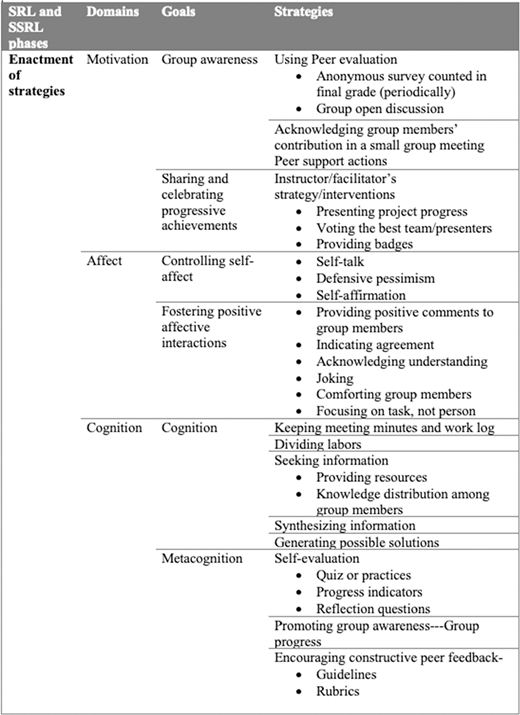
 The table presents four columns labeled S R L and S S R L phases, Domains, Goals, and Strategies. The S R L and S S R L phases column has one main section labeled Enactment of strategies. The first main row has the Domain labeled Motivation. The first sub-row has a Goal labeled Group awareness, and Strategies labeled Using Peer evaluation, Anonymous survey counted in final grade periodically, and Group open discussion. The second sub-row has a Strategy labeled Acknowledging group members' contribution in a small group meeting and Peer support actions. The third sub-row has a Goal labeled Sharing and celebrating progressive achievements, and Strategies labeled Instructor slash facilitator's strategy slash interventions, Presenting project progress, Voting the best team slash presenters, and Providing badges. The second main row has the Domain labeled Affect. The first sub-row has a Goal labeled Controlling self-affect, and Strategies labeled Self-talk, Defensive pessimism, and Self-affirmation. The second sub-row has a Goal labeled Fostering positive affective interactions, and Strategies labeled Providing positive comments to group members, Indicating agreement, Acknowledging understanding, Joking, Comforting group members, and Focusing on task, not person. The third main row has the Domain labeled Cognition. The first sub-row has a Goal labeled Cognition, and Strategies labeled Keeping meeting minutes and work log, and Dividing labors. The second sub-row has a Goal labeled Seeking information, and Strategies labeled Providing resources, and Knowledge distribution among group members. The third sub-row has a Goal labeled Synthesizing information, and a Strategy labeled Generating possible solutions. The fourth sub-row has a Goal labeled Metacognition, and Strategies labeled Self-evaluation, Quiz or practices, Progress indicators, and Reflection questions. The fifth sub-row has a Goal labeled Promoting group awareness, and a Strategy labeled Group progress. The sixth sub-row has a Goal labeled Encouraging constructive peer feedback, and Strategies labeled Guidelines and Rubrics.
4S PBL: The creating solutions stage.
The table presents four columns labeled S R L and S S R L phases, Domains, Goals, and Strategies. The S R L and S S R L phases column has one main section labeled Enactment of strategies. The first main row has the Domain labeled Motivation. The first sub-row has a Goal labeled Group awareness, and Strategies labeled Using Peer evaluation, Anonymous survey counted in final grade periodically, and Group open discussion. The second sub-row has a Strategy labeled Acknowledging group members' contribution in a small group meeting and Peer support actions. The third sub-row has a Goal labeled Sharing and celebrating progressive achievements, and Strategies labeled Instructor slash facilitator's strategy slash interventions, Presenting project progress, Voting the best team slash presenters, and Providing badges. The second main row has the Domain labeled Affect. The first sub-row has a Goal labeled Controlling self-affect, and Strategies labeled Self-talk, Defensive pessimism, and Self-affirmation. The second sub-row has a Goal labeled Fostering positive affective interactions, and Strategies labeled Providing positive comments to group members, Indicating agreement, Acknowledging understanding, Joking, Comforting group members, and Focusing on task, not person. The third main row has the Domain labeled Cognition. The first sub-row has a Goal labeled Cognition, and Strategies labeled Keeping meeting minutes and work log, and Dividing labors. The second sub-row has a Goal labeled Seeking information, and Strategies labeled Providing resources, and Knowledge distribution among group members. The third sub-row has a Goal labeled Synthesizing information, and a Strategy labeled Generating possible solutions. The fourth sub-row has a Goal labeled Metacognition, and Strategies labeled Self-evaluation, Quiz or practices, Progress indicators, and Reflection questions. The fifth sub-row has a Goal labeled Promoting group awareness, and a Strategy labeled Group progress. The sixth sub-row has a Goal labeled Encouraging constructive peer feedback, and Strategies labeled Guidelines and Rubrics.4S PBL: The creating solutions stage.
4S PBL: Concluding the Project
Concluding the project is the last stage of PBL. While many of the previously mentioned strategies also apply here, evaluations are particularly vital at this stage, including those done by learners themselves, their peers, instructors, and outside experts from authentic professional contexts. For self-evaluation, instructors can provide surveys or ask students to write reflection papers on their interactions with peers, cognitive contributions to the group project, and their learning outcomes assessed by appropriate criteria. Rubrics are also highly recommended as a tool to facilitate group regulation and evaluation (Panadero & Järvelä, 2015). In addition, instructors can evaluate group projects and individual learning through students’ presentations, projects, products, or other artifacts and deliverables. Learning analytics are applied to monitor students’ learning progress, identify struggling students, predict learner success, and facilitate adaptive learning (Ryan et al., 2019; Sedrakyan et al., 2020). Specialized technologies are also created to facilitate self- and group evaluation, such as OurEvaluation (Järvelä et al., 2015) to monitor individual and group progress.
Facilitate Online PBL: Technologies
It is impossible to identify all technologies; thus, in this section, we briefly discuss some of the most widely applied types of learning technology, including asynchronous (Chatterjee & Correia, 2020; Elola & Oskoz, 2017; Zhang & Bonk, 2009; Zhang & DeLoose, 2009; Zhang et al., 2009), synchronous (Chatterjee & Correia, 2020; Elola & Oskoz, 2017; Ishtaiwa & Aburezeq, 2015), specialized (Lin et al., 2016; Järvelä et al., 2015) and the emerging ones (Zhang & Aslan, 2020, 2021). Different communication modalities influence learners’ attention and learning performance (Cho, 2018; Frear & Bitchener, 2015). Asynchronous communication tools, such as discussion boards, wikis (Zhang & DeLoose, 2009), blogs, and more, are widely applied (Zhu & Bonk, 2019). Discussion boards, for example, facilitate multiple types of interactions to minimize the transactional distance (Moore, 1993) and may increase learners’ satisfaction (Ku et al., 2013). Slack (https://slack.com) has been increasingly popular for collaborations, with functions like group and individual communication channels, sharing documents, and setting deadlines.
 The table is titled Self Regulated Learning and Social Shared Regulated Learning phases, Domains, Goals, and Strategies, with four columns. The first column is labeled Self Regulated Learning and Social Shared Regulated Learning phases and has one item listed, Evaluation. The second column is Domains and has Motivation, Affect, and Cognition Behavior listed. The third column is Goals and lists Evaluation. The fourth column is Strategies, which has three main sections: Self evaluation, Peer evaluation, and Instructor Teaching Assistant evaluation. Self evaluation includes Communication, Cognitive contribution, Participation, and Learning outcomes labeled with rubrics or quizzes in parentheses. Peer evaluation lists Communication, Cognitive contribution, Participation, and Learning outcomes. Instructor Teaching Assistant evaluation lists Presentation, Group project solutions, Participation, and Learning analytics from the online platform.
4S PBL: The concluding stage.
The table is titled Self Regulated Learning and Social Shared Regulated Learning phases, Domains, Goals, and Strategies, with four columns. The first column is labeled Self Regulated Learning and Social Shared Regulated Learning phases and has one item listed, Evaluation. The second column is Domains and has Motivation, Affect, and Cognition Behavior listed. The third column is Goals and lists Evaluation. The fourth column is Strategies, which has three main sections: Self evaluation, Peer evaluation, and Instructor Teaching Assistant evaluation. Self evaluation includes Communication, Cognitive contribution, Participation, and Learning outcomes labeled with rubrics or quizzes in parentheses. Peer evaluation lists Communication, Cognitive contribution, Participation, and Learning outcomes. Instructor Teaching Assistant evaluation lists Presentation, Group project solutions, Participation, and Learning analytics from the online platform.4S PBL: The concluding stage.
Synchronous technologies empower learners with real-time communications, discussions, and decision-making capacities and increase productivity in collaborative tasks (Huang, 2017). The synchronous editing and chatting tools, for instance, allow users to create, share, revise, and edit documents, make comments, and provide feedback simultaneously or asynchronously and thus facilitating knowledge sharing (Al-Samarraie & Saeed, 2018) in PBL. Google Docs and Google Drive are available for collaborative writing, peer review, progress reports, and resources and drafts sharing (Liu et al., 2014). It supports collaborative problem-solving (Qin et al., 2016). In addition, online conference tools, such as Google Hangout, Zoom, Microsoft Teams, and Skype, provide rich media (Dennis & Kinney, 1998) and allow learners to capture the nuances of gestures and facial expressions; thus, such technologies are also powerful for bounding and trust building in online PBL.
Social media can facilitate teaching, learning, and community building in formal education, MOOCs, and informal and lifelong learning (e.g., Gao et al., 2012; Greenhow & Lewin, 2016; Zhang, 2015; Zhang & Gao, 2014), which further foster SRL (Zhu & Bonk, 2019). It also increases learners’ satisfaction and promotes knowledge sharing and exchange (Al-Rahmi & Othman, 2013). For example, the Facebook chat window can be used for live discussions, social networking, and trust building (Charlton et al., 2009). However, it can be really distracting (Lampe et al., 2011).
Researchers have also developed specialized technology (e.g., Deason & Zhang, 2012) to support SRL or SSRL (Chang et al., 2013; Poitras et al., 2021; Shih et al., 2010). For example, using an SRL training system for students to set personal learning goals and review their learning progress (Shih et al., 2010) or a collaborative mind mapping tool to improve learning and self-efficacy (Zheng et al., 2020). Learning technology researchers (Deason & Zhang, 2012) creates an interactive, culturally sensitive computer-based learning environment, utilizing hip-hop pedagogy to motivate at-risk teenagers and to promote active and effective learning. A research group in Canada (Winne et al., 2006) adopt a collaborative software, gStudy, to scaffold SRL through activities like making notes, creating concept maps, searches, and collaborations. Other research groups implement group awareness tools to promote SRL for collaboration (Lin et al., 2016; Järvelä et al., 2015). With the increasing application of learning management systems (LMS) in online or blended learning, instructors can track students’ online participation and monitor individual and group progress on LMS (Hershey & Wood, 2011). Many LMS now also provide visual analytics by the learner, class, or time frame (i.e., day, week, date, etc.).
With advanced learning analytics (LA), instructors can apply LA-based predictive models to promote student success (Hung & Zhang, 2008, 2012; Sedrakyan et al., 2020; Xing et al., 2015). Through LA-based feedback and other interventions, learners can benefit from adaptive learning experiences (Gaševic et al., 2016; Tlili et al., 2019), customized guidance and recommendations (Dawson et al., 2014; Karaoglan Yilmaz & Yilmaz, 2020; Ustun et al., 2022) and scalable personalized support (Pardo et al., 2019; Ryan et al., 2019; Zhang & Aslan, 2021) in online PBL.
A recent review on AI in education (AIEd) research (Zhang & Aslan, 2021) has identified a range of AIEd technologies and their educational benefits, such as chatbots, expert systems, intelligent tutors or agents, machine learning, personalized learning systems or environments (PLS/E), and visualization. AIEd, as a technology element in 4S PBL, could foster SRL and SSRL in PBL through expert systems, visual feedback, and immersive learning environments (Zhang & Aslan, 2020, 2021). For learners, AIEd could engage learners, facilitate interaction, and provide metacognitive prompts, which play a critical role in supporting SRL and SSRL in online PBL. From educators’ and administrators’ perspectives, the functions enabled by AIEd, such as predictive models, gifted or at-risk students’ identification, learning progress indicators, assessments, and feedback could tremendously help educators to facilitate learners’ SRL and SSRL in online PBL.
Conclusion
During the COVID-19 pandemic, over 200 million students, 12.5% of total students worldwide, were influenced by the shutting down of the university and schools by the end of December 2020 (UNESCO, 2020). As a response to the global crisis, online learning was implemented in educational systems worldwide (Gardner, 2020). This paper presents 4S PBL, a new framework to facilitate online PBL in four domains from SRL and SSRL perspectives throughout the three PBL stages. Aligning the PBL process and SRL/SSRL phases, the 4S PBL framework outlines key strategies to address each of the four domains (i.e., motivation, affect, cognition and behaviors) at each PBL stage. A wide range of strategies is recommended with practical examples and research support. In addition, an array of learning technologies is discussed (e.g., asynchronous, synchronous, specialized, and emerging) with an emphasis on their proven or potential benefits in supporting online PBL.
The 4S PBL framework synthesizes research and practice concerning PBL, SRL, SSRL, and related learning technologies. 4S PBL is a unique framework that leverages SRL, SSRL, and learning technologies to support effective online PBL. From multiple perspectives, the 4S PBL framework provides a solid foundation for educators and instructional design professionals to understand the complex dynamics of online PBL fully and empowers them with a pool of strategies and technologies accordingly. Educators and instructional design professionals could creatively integrate strategies of their choice to facilitate online PBL, SRL, and SSRL. Similarly, online learners could leverage the strategies to develop their SRL and SSRL for collaborative learning, creative thinking, critical thinking, and problem-solving skills needed in the 21st century. Future research may further explore, test, validate or otherwise study any specific strategies or technologies per the 4S PBL framework to support online PBL.
