Drawing on ability-motivation-opportunity (AMO) framework, this study investigates the direct effect of innovation-oriented HRM on SMEs’ innovation performance, both directly and through intrapreneurial behavior. Besides, the study assesses the moderating role of innovation-oriented leadership in the relationship between innovation-oriented HRM and intrapreneurial behavior.
A two-wave dataset collected from 183 SMEs was used to test the proposed hypotheses by partial least squares structural equation modeling (PLS-SEM).
Findings suggest that innovation-oriented HRM positively impacts SMEs’ innovation performance directly and through intrapreneurial behavior. Evidence also confirms that innovation-oriented leadership positively moderates the effect of innovation-oriented HRM on intrapreneurial behavior.
Through the AMO framework, this study advances our understanding of how the interaction between innovation-oriented HRM and leadership fosters intrapreneurial behavior, ultimately contributing to superior innovation performance in SMEs.
The study recommends that SMEs implement innovation-oriented HRM practices to encourage intrapreneurial behavior and achieve superior innovation performance in SMEs.
Limited research has addressed the contributions of innovation-oriented HRM and leadership toward realizing strategic innovation objectives. Our study offers valuable insights into the functions of innovation-oriented HRM and leadership in stimulating intrapreneurial behavior, thereby enhancing the innovation performance of SMEs.
1. Introduction
Small and medium-sized enterprises (SMEs) are vital contributors to economic development (Gherghina et al., 2020). However, in today’s turbulent business landscape, these enterprises often grapple with resource constraints, hindering their competitiveness (Dasanayaka and Sardana, 2017; Franco and Haase, 2010; Haq et al., 2024). To navigate these hurdles, innovation emerges as an essential factor in SMEs success (Amarakoon et al., 2018; Thukral, 2021). Strategic management scholars suggest that human resource management (HRM) practices aligned with strategic objectives (i.e. innovation) may help SMEs in achieving superior innovation (Shahzad et al., 2022). Therefore, research investigating the facilitating role of innovation-oriented HRM practices in innovation performance is warranted (Le and Ha, 2024). Comprehending HRM as a precursor to innovation within SMEs (Alkhalaf and Al-Tabbaa, 2024; Aslam et al., 2023), this article theorizes that innovation-oriented HRM is a collection of practices—innovation-oriented recruitment, rewards, and training and development—that enable SMEs to recruit individuals with innovative abilities, nurture innovative skills, and motivate them to apply them for superior innovation outcomes (Koster and Benda, 2020; Lasisi et al., 2020; Stock et al., 2014). By addressing the call for an investigation into how SMEs can achieve superior innovation performance (Gupta, 2024; Peris-Ortiz et al., 2022), the first objective of this research is to investigate the role of innovation-oriented HRM in promoting innovation within SMEs.
Our research also investigates the underlying process between innovation-oriented HRM practices and innovation performance in SMEs through intrapreneurial behavior. Following the AMO framework’s theoretical reasoning, it proposes that innovation-oriented HRM practices like innovative recruitment and training and development help SMEs recruit and develop human resources with innovative abilities (Stock et al., 2014; Zhou et al., 2023). Innovation-based incentives motivate employees to proactively share innovative ideas for introducing new products and services (Sanders et al., 2018). To harness employees’ innovative potential, SMEs can foster intrapreneurial behavior, which involves employees actively employing innovative skills to take risks by introducing innovative products and services into the marketplace (Badoiu et al., 2020; Dabić et al., 2021; Deprez et al., 2024; Seshadri and Tripathy, 2006). Recent studies underscore the need for future research to explore innovation-oriented HRM (Shahzad et al., 2022; Zhou et al., 2023) as precursors of SME innovation (Pertuz and Pérez, 2021; Ramdani et al., 2022) through the underlying mechanism of individual-level intrapreneurial behavior (Hernández-Perlines et al., 2022). Thus, the second objective of this research is to explore the mechanism between innovation-oriented HRM and SME innovation through intrapreneurial behavior to answer how SMEs may promote intrapreneurial behavior to achieve SME innovation performance.
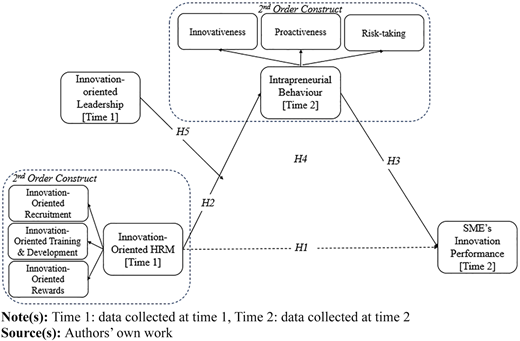
Scholars highlight the combined influence of leadership and HRM as strategic resources (Zhou et al., 2023) on employee behavior (Doğru, 2023; Khan, 2022; Rasheed et al., 2021). Most research has individually studied these variables, overlooking essential implications for their interaction (Zhao et al., 2023). Therefore, innovation-oriented leadership may amplify the impact of innovation-oriented HRM on intrapreneurial behavior, fostering SME innovation (Moschko and Blazevic, 2022). Innovation-oriented leadership offers opportunities for employees to utilize their innovative abilities by proactively pursuing risky initiatives, such as introducing new products and services (Stock et al., 2014). Thus, the third objective is to examine the interactive effect of innovation-oriented leadership and innovation-oriented HRM on fostering intrapreneurial behavior for innovation within SMEs (see Figure 1).
This study elaborates on how strategic HRM—specifically, innovation-oriented HRM practices—foster innovation within SMEs, making a significant contribution to the literature on strategic HRM (Alkhalaf and Al-Tabbaa, 2024; Jackson et al., 2014; McClean and Collins, 2019; Shahzad et al., 2022). Moreover, it contributes to the emerging literature on intrapreneurial behavior (Hernández-Perlines et al., 2022) in the context of innovation-oriented HRM (Aslam et al., 2023; Zhou et al., 2023), by exploring the intermediation of intrapreneurial behavior. This research also adds to the evolving literature concerning leadership within the HRM domain (Zhao et al., 2023) by examining the complementary impact of innovation-oriented leadership on the influence of innovation-oriented HRM practices on SMEs’ innovation (Stock et al., 2014; Zhou et al., 2023).
2. Theory and hypotheses development
The AMO framework has recently become a valuable theoretical perspective for understanding the relationships between HRM and innovation performance (Bos-Nehles et al., 2023; Shahzad et al., 2019). It emphasizes the vital synergy of these elements (ability, motivation, and opportunity) in enhancing individual and organizational performance (Appelbaum et al., 2000). Ability includes technical skills and problem-solving competencies (Haq, 2016). Motivation is the drive to excel, sourced from intrinsic or extrinsic factors (Appelbaum et al., 2000). Opportunity involves external factors such as the work environment, organizational culture, leadership, and available resources that enable employees to effectively utilize their abilities and motivation to achieve organizational goals (Appelbaum et al., 2000).
In light of the AMO framework, Jiang et al. (2012a, b) and Shahzad et al. (2019) explained that ability-enhancing HRM practices, such as recruitment and development programs, motivation-enhancing practices, such as rewards and recognition, and opportunity-enhancing practices, such as work-environment or leadership, contribute to innovation outcome. Scholars using the AMO framework show that HRM systems promote innovative abilities and motivation to achieve innovative performance (Shahzad et al., 2019). Therefore, using the AMO framework, this study proposes that innovation-oriented HRM practices, focused on recruiting and developing talent and providing training in innovation-related areas, directly impact intrapreneurial behavior (Antonioli and Della Torre, 2016; Bauernschuster et al., 2009). HRM practices such as innovation-based performance evaluations and recognition also motivate employees to exhibit intrapreneurial behavior (Sanders et al., 2018; Stock and Zacharias, 2011). When employees know their innovative efforts will be acknowledged and rewarded, they are more likely to contribute to innovation proactively (Jong et al., 2015; Sanders et al., 2018). Innovation performance depends on innovative capabilities, the motivation to pursue innovation, and the readiness to initiate risky initiatives (Chouchane et al., 2021; Farrukh et al., 2021a, b; Fulmer and Ployhart, 2014; Jong et al., 2015). Besides, innovation-oriented leaders provide opportunities by setting a clear vision and providing direction for innovation within SMEs (Stock and Zacharias, 2011). Leaders who actively champion and support innovation projects foster intrapreneurial behavior (Farrukh et al., 2021a, b). Their guidance, support, and open communication influence employees to channel their intrapreneurial behavior toward achieving innovative goals.
2.1 Innovation-oriented HRM and innovation performance
Innovation refers to “the adoption of an idea or behavior, whether a system, policy, program, device, process, product or service, that is new to the adopting organization” (Jiménez-Jiménez and Sanz-Valle, 2008, p. 1209). Thus, innovation performance refers to the number of new products and services introduced into the marketplace (Jiménez-Jiménez and Sanz-Valle, 2008). On the other hand, the combination of innovative recruitment, training and development, and rewards works synergistically to achieve innovation outcomes, which refers to innovation-oriented HRM (Stock et al., 2014).
Applying the AMO framework, this study posits that HRM practices, which emphasize the recruitment and development of talent with innovative capabilities and motivate them to invest in these capabilities, are instrumental in driving innovation within SMEs (Antonioli and Della Torre, 2016; Sanders et al., 2018) in the following ways. First, innovation-oriented recruitment and selection practices, e.g. recruitment of staff members with competencies for the management of innovations, conducting tests of job applications for innovativeness and creativity, and sharing innovativeness expectations with new employees (Lasisi et al., 2020; Stock and Zacharias, 2011) enable organizations to recruit human capital with innovation-oriented knowledge, skills, and abilities (KSAs) (Haq et al., 2021; Ployhart and Moliterno, 2011). Such innovation-oriented human capital substantially impacts SMEs’ innovation performance (McGuirk et al., 2015; Ployhart et al., 2014). McGuirk et al. (2015) suggest that innovative human capital is more important for SMEs gaining innovation. Innovation predominately depends on the organization’s ability to attract human capital through the recruitment process to hire talented and creative employees (Shahzad et al., 2019). A firm’s knowledge stock with innovation capabilities substantially affects innovation performance (Haq and Davies, 2023; Sung and Choi, 2018).
Second, innovation-oriented training and development practices, such as training programs/sessions to develop technical KSAs for innovation, improve the internal knowledge stock of firms (Stock et al., 2014; Sung and Choi, 2018). The training sessions are focused on increasing the strategic importance of innovation orientation, providing a clear message to the employees that the firm expects them to indulge in innovative behaviors (Antonioli and Della Torre, 2016; Bauernschuster et al., 2009). Training sessions are also conducted to train employees to pursue innovation. In response, employees share new ideas and suggestions to improve the current processes and products, resulting in superior innovation performance (Rasheed et al., 2017; Sanz-Valle and Jiménez-Jiménez, 2018). Third, innovation-oriented rewards, like performance evaluation, primarily depend on innovativeness. Employees are rewarded highly based on innovation orientation, motivating employees (Sanders et al., 2018) to pursue innovativeness in performing their tasks. Thus, employee’s motivation to invest in their KSAs results in superior innovation performance in SMEs (Shahzad et al., 2019). In line with the above arguments, this study proposes:
Innovation-oriented HRM has a positive influence on the innovation performance of SMEs.
2.2 Innovation-oriented HRM, intrapreneurial behavior and innovation performance
Intrapreneurial behavior refers to “a process whereby employee(s) recognizes and exploit opportunities by being innovative, proactive and by taking risks, for the organization to create new products, processes and services, initiate self-renewal or venture new businesses to enhance the competitiveness and performance of the organization” (Neessen et al., 2019, p. 551). Though there is a lack of consensus on the definition of intrapreneurial behavior, most of the literature “characterizes individual intrapreneurial behaviors in terms of three widely acknowledged dimensions: innovativeness, risk-taking, and pro-activeness” (Chouchane et al., 2021; Farrukh et al., 2021a, b; Jong et al., 2015). Innovativeness is individual actions to generate, process, and implement new ideas and suggestions to benefit the organization (Kleysen and Street, 2001). Risk-taking refers to pursuing any action without fear of failure (Jong et al., 2015). Pro-activeness is taking actions beyond everyday work routines, focusing on innovations to achieve anticipated potential opportunities and threats (Frese and Gielnik, 2014).
In line with the theoretical assumptions of AMO framework, this paper theorized that innovation-oriented HRM prompts employees’ intrapreneurial behavior in the following way. First, innovative recruitment HR practices enable SMEs to recruit human resources with innovative KSAs (Stock et al., 2014). Similarly, training and development programs focused on developing innovation knowledge and skills of employees also improve their innovation skill set (Sung and Choi, 2018). Considering innovation as a critical indicator of evaluating performance and high rewards for innovation performance motivates employees to invest their energies to pursue innovativeness (Campbell-Allen et al., 2008). Thus, innovation-oriented HRM promotes innovativeness among employees. Employees’ innovativeness in their behavior motivates them to invest in their innovative KSAs, which results in superior innovation performance (Seshadri and Tripathy, 2006).
Second, SMEs recruit employees with innovative KSAs and behavior through innovative recruitment HR practices (Stock et al., 2014). Different training programs further improve these innovative abilities (Antonioli and Della Torre, 2016). Similarly, innovative rewards create a sense of strategic innovation inclination (Campbell-Allen et al., 2008). Thus, innovation-oriented HRM provides clear direction to the employees, letting them know that the organization expects them to pursue innovation proactively. As a result, they proactively share new ideas and suggestions to improve processes, products, and services (Belschak and Hartog, 2010; Haq and Davies, 2023). Because of the pro-activeness in employee behavior, they perceive future business requirements and suggest ways to introduce new products and services into the marketplace compared to competitors (Belschak and Hartog, 2010).
Third, employees indulge in risk-taking behavior when they feel safe. Thus, innovation-oriented HRM through innovative recruitment, training, and development, and innovative rewards provides a clear direction that the organization expects innovative and risk-taking behavior to achieve strategic goals (Aslam et al., 2023; Cabrales et al., 2008). Thus, risk-taking in employee behavior enables them to pursue innovation without fear of the negative consequences of failure (Giaccone and Magnusson, 2022). Risk-taking also is one of the key determinants of innovation. Finally, Seshadri and Tripathy (2006) affirm that intrapreneurship at the individual level shows employees’ inclination to pursue proactiveness, innovativeness, and risk-taking initiatives. As a result, employees’ innovative, proactive, and risk-taking behavior enables SMEs to improve existing products or services and introduce new products and services into the marketplace. Based on the AMO framework, this research proposes that:
Innovation-oriented HRM has a positive influence on intrapreneurial behavior.
Intrapreneurial behavior has a positive influence on the innovation performance of SMEs.
2.3 Mediating role of intrapreneurial behavior
The AMO framework explains that the HRM system is a combination of ability-enhancing, motivation-enhancing, and opportunity-enhancing practices, which improve employees’ abilities and motivate them to apply their abilities to achieve superior performance (Jiang, Wang. Accordingly, we argue that innovation-oriented HRM practices first promote intrapreneurial behavior that, in turn, amplifies innovation performance because of the following reasons. Innovative ability-enhancing practices, such as recruiting and selecting employees with innovation-related knowledge and skills, help SMEs hire innovative employees (Stock et al., 2014). Similarly, training programs, continuous learning opportunities, and skill development initiatives focusing on innovation-related skills enhance employees’ abilities, making them more competent in generating and implementing innovative ideas within SMEs (Aslam et al., 2023; Shahzad et al., 2022). Thus, innovation-related competencies help employees engage in intrapreneurial behavior by proposing new and innovative ideas to improve products and services. This intrapreneurial behavior, in turn, enhances SMEs’ innovation performance. Further, innovation-based incentives, such as performance evaluation, rewards, and recognition of innovative contributions (Sanders et al., 2018), encourage employees to pursue risky and innovative initiatives and contribute to intrapreneurial behavior. In addition, the opportunity-enhancing practices allow employees to engage in intrapreneurial behavior through innovativeness and proactiveness in their ideas and solutions to improve existing products and services. As a result, employees are more likely to take innovative and risky initiatives and implement them proactively to introduce new products and services, leading to superior SME innovation. In addition, empirical research posits that employee behaviors mediate the relationship between HRM practices and innovation performance (Shahzad et al., 2019). Therefore, based on the theoretical argumentation and empirical evidence, we propose that:
Intrapreneurial behavior mediates the relationship between innovation-oriented HRM and SME innovation performance.
2.4 Moderating role of innovation-oriented leadership
Innovation-oriented leadership refers to the extent to “which leaders promote subordinates’ innovation orientation” (Stock and Zacharias, 2011, p. 874). Employing the AMO framework, this study posits that innovation-oriented leadership creates opportunities by providing essential employee support to engage in intrapreneurial activities (Zhou et al., 2023). Innovation-oriented leaders set a clear vision and provide direction for innovation within the organization (Stock et al., 2014; Stock and Zacharias, 2011). Their guidance influences employees to channel their intrapreneurial behavior toward achieving innovative goals (Zhou et al., 2023). Effective leaders facilitate open communication, allowing employees to share ideas and concerns freely (Farrukh et al., 2021a, b; Rasheed et al., 2021). Such communication encourages intrapreneurial behavior, as employees are more willing to contribute innovative insights (Stock et al., 2014). Leaders who empower employees to take ownership of innovation projects foster intrapreneurial behavior (Farrukh et al., 2021a, b). When employees feel they have the autonomy to drive innovation, they are more likely to engage in intrapreneurial activities.
The collaboration of HRM practices and leadership in fostering innovation creates a synergistic effect that spurs intrapreneurial behavior (Farrukh et al., 2021a, b). Employees witnessing a collective dedication to innovation from both HRM and leadership are motivated to engage in intrapreneurial activities actively (Shah, 2020). Innovation-oriented leadership encourages employees to act as intrapreneurs (Farrukh et al., 2021a, b), while HRM practices ensure that employees have the skills and capabilities necessary to succeed in these roles as they encourage employees with innovation skills to engage in intrapreneurial activities (Giaccone and Magnusson, 2022; Stock et al., 2014). It also assured evaluations and recognition through rewards practices as it strongly motivates employees to demonstrate intrapreneurial behavior (Sanders et al., 2018). When employees anticipate acknowledgment and rewards for their innovative contributions, their proactive engagement in innovation is heightened (Sanders et al., 2018). Thus, it is argued that leaders who value innovation are more likely to devote technological, human, and financial resources to HRM practices that stimulate intrapreneurial behavior, potentially leading to increased innovation capabilities (Zhao et al., 2023; Zhou et al., 2023). Innovation-oriented leadership can help mobilize and allocate resources for innovation (Shah, 2020). Therefore, based on the AMO framework, this study hypothesizes that innovative leadership combines innovation-oriented HRM practices prioritizing innovation, which can foster a culture of creativity and continual innovation development. So:
Innovation-oriented leadership positively moderates the impact of innovation-oriented HRM on intrapreneurial behavior.
3. Methods
3.1 Sample and data collection
The proposed hypotheses were tested by collecting data from Pakistani small and medium-sized enterprises (SMEs). Small and Medium Enterprises Development Authority (SMEDA) defined SMEs as “the organizations having a maximum of 250 employees or rupees 400 million annual sales turnover in Pakistan’s currency” (SMEDA, 2007). This study adopted the definition of SMEDA based on the number of employees, i.e. 250. A self-administrated structured questionnaire was shared with randomly selected 600 SMEs listed in SMEDA. We followed prior studies (Rasheed et al., 2017; Shahzad et al., 2022) to select HR managers to respond to the questions about implementing innovation-oriented HRM practices, leadership style, intrapreneurial behavior and innovation performance, as they have the information regarding these variables.
Two separate questionnaires were used to collect two-wave data. In the first stage, the questionnaire comprising independent and moderating variables was shared with the selected SMEs’ HR departments. After two weeks, questionnaires were collected, and reminder calls were made to increase the response rate. In the second stage, the questionnaire comprising mediating and dependent variables was shared with the HR department after a gap of 3 months. We received 201 responses, yielding a response rate of 33.5%, consistent with similar studies conducted in Pakistan (Rasheed et al., 2017; Shahzad et al., 2019). Eighteen (18) questionnaires were dropped because of the incomplete information. Thus, 183 responses were used to test hypotheses. The demographic of the final sample postulated that the majority of SMEs have 200–250 employees (26.5%), followed by 150–200 employees (26.4%), 100–150 employees (19.3%), 50–100 employees (22%) and less than 50 employees (5.8%). Participated SMEs are working over 15 years (48.4%), followed by 9–15 years (21.4%), 6–9 years (10.4%), 3–6 years (11%), and less than 3 years (8.8%). Finally, most respondents over 9 years of experience (32.2%), followed by 6–9 years (14.8%), 3–6 years (20.2), 1–3 years (26.8%) and less than one year (6%).
3.2 Measures
3.2.1 Innovation-oriented HRM
Innovation-oriented HRM was measured using a 9-item scale validated by Stock et al. (2014). The scale comprises 3 dimensions: (1) innovation-oriented recruitment, (2) innovation-oriented training and development, and (3) innovation-oriented rewards. Innovation-oriented recruitment was measured through 3 items. A sample item of innovation-oriented recruitment is “during the recruiting process; we test job applicants for innovativeness and creativity”. Innovation-oriented training and development was captured by using 4-items. A sample item is “training programs to increase personal innovativeness are offered regularly.” Finally, innovation-oriented rewards were captured using 2-items. A sample item is “employees with extraordinary innovation orientation are rewarded highly.” The respondents will be asked to indicate their agreement/disagreement with the statements on a five-point Likert scale where “1 = strongly disagree” and “5 = strongly agree”. The value of composite reliability of innovation-oriented HRM (CR = 0.86) and dimensions (1) innovation-oriented recruitment (CR = 0.73), (2) innovation-oriented training and development (CR = 0.89) and (3) innovation-oriented rewards (CR = 0.86) confirm the reliability of the scale.
3.2.2 Innovation-oriented leadership
Innovation-oriented leadership was measured using a 6-item scale validated by Stock et al. (2014). A sample item is “the leaders in our company encourage activities that foster innovations.” The respondents were asked to indicate their agreement/disagreement with the statements on a five-point Likert scale where “1 = strongly disagree” and “5 = strongly agree”. The value of composite reliability of innovation-oriented leadership (CR = 0.92) confirms the reliability of the scale.
3.2.3 Intrapreneurial behavior
A 13-item scale having three dimensions: (1) risk-taking, (2) innovativeness, and (3) pro-activeness developed by Farrukh et al. (2016), was used to measure intrapreneurial behavior. Five (05) items were used to capture innovativeness. A sample item is “I attempt to convince people to support an innovative idea.” Pro-activeness and risk-taking were captured by using 4-items. A pro-activeness sample item is “usually, I do more than I am asked to do.” A sample item of risk-taking is “I boldly move ahead with a promising new approach when others might be more cautious.” The respondents will be asked to indicate their agreement/disagreement with the statements on a five-point Likert scale where “1 = strongly disagree” and “5 = strongly agree”. The value of composite reliability of innovation-oriented leadership (CR = 0.85) and dimensions (1) innovativeness (CR = 0.86), (2) pro-activeness (CR = 0.73), and (3) risk-taking (CR = 0.85) confirm the reliability of the scale.
3.2.4 Innovation performance
Innovation performance was measured using a 6-item scale from Jiménez-Jiménez and Sanz-Valle (2008). Innovation scale captures innovation to introduce new products and services. Sample items are “number of new products/services introduced during the past three years” and “number of changes in the process introduced during the past three years,” respectively. The respondents were asked to rate on a -point Likert-type scale ranging from “below competitors (1)” to “above competitors (5)”. The value of composite reliability of innovation (CR = 0.94) confirms the reliability of the scale.
3.3 Common method bias
Scholars have emphasized that data collection from a single source or through cross-sectional research may introduce Common Method Bias (CMB) (Podsakoff et al., 2003). Podsakoff et al. (2012) have proposed various strategies for mitigating CMB during the design and data analysis phases, including time-lapse to address this concern. To mitigate the problem of CMB, this study employed a two-wave data collection approach. Specifically, data related to independent and moderating variables was collected at time 1, while data about the mediator and dependent variables was gathered at time 2. The variance inflation factors (VIFs) were also examined to assess CMB and ensure its absence. The VIF values, all below 3.3, confirm the absence of any CMB issue by the recommendations provided by Kock (2015).
3.4 Data analysis and results
PLS (Partial Least Squares), a variance-based approach, has gained widespread adoption in recent years within the fields of human resource management and leadership research (Hair et al., 2022; Legate et al., 2023; Rasheed et al., 2021; Sarstedt et al., 2022). By the recommendations of Legate et al. (2023), this study utilized PLS-SEM through Smart-PLS 4.0.9.5 for several reasons. First, it aligns with the predictive nature of the research, where variables such as innovation-oriented HRM, intrapreneurial behavior, and innovation-oriented leadership were used to predict SEM innovation performance (Legate et al., 2023). Second, given the complexity of the research model, which involves mediation and moderation relationships with multidimensional variables (i.e. first-order and second-order constructs), PLS-SEM is better equipped to handle such intricate models. Third, PLS-SEM provides advanced techniques, including the determination of effect sizes for each predictor in the model, assessment of the model’s predictive power, and the calculation of the Heterotrait-Monotrait (HTMT) ratio to establish discriminant validity (Hair et al., 2019; Henseler et al., 2015). Finally, PLS-SEM assesses complex models comprising direct and indirect paths and conditional moderating effects. Unlike CB-SEM (Covariance-Based Structural Equation Modeling), PLS-SEM does not impose distributional assumptions or sample size restrictions (Hair et al., 2019).
3.4.1 Measurement model
As per the guidelines of Hair et al. (2019), the measurement model was tested using the PLS algorithm (in SmartPLS), which provides different criteria to establish internal consistency, convergent validity, and discriminant validity of the study measures. Factor loadings, composite reliability (CR), and average variance extracted (AVE) criteria are used to establish internal consistency and convergent validity. A two-stage approach was used to test innovation-oriented HRM and intrapreneurial behavior as higher-order constructs (Sarstedt et al., 2019). Factor loadings, CR, and AVE values of all constructs (first-order in Table 1 and second-order in Table 2) are higher than the minimum threshold level, i.e. factor loading >0.50, CR > 0.70 (Nunnally, 1978) and AVE > 0.50 (Fornell and Larcker, 1981), establishing the internal consistency and convergent validity (Hair et al., 2019).
The discriminant validity was evaluated using the Heterotrait-Monotrait (HTMT) Ratio of Correlation test, which provides more consistent results as compared to the Fornell and Larcker (1981) test (Henseler et al., 2015). The HTMT values of first (1st) order and second (2nd) order constructs (Tables 3 and 4) were less than the 0.85 thresholds, confirming discriminant validity (Hair et al., 2019).
3.4.2 Modelling 2nd order constructs
Innovation-oriented HRM and intrapreneurial behavior were modeled as higher-order constructs. Innovation-oriented HRM comprises three dimensions: (1) innovative recruitment and selection, (2) innovative training and development, and (3) rewards. Intrapreneurial behavior comprises three dimensions: (1) proactiveness, (2) innovativeness, (3) and risk-taking. Figure 1 depicts innovation-oriented HRM and intrapreneurial behavior as a higher-order construct, including dimensions. In line with previous research, a two-stage approach was applied to test higher-order constructs (Islami, 2021; Li et al., 2006; Rasheed et al., 2024; Sarstedt et al., 2019). In the first stage, the reflective constructs’ dimensions (1st order) were assessed to obtain the latent variable scores for the 2nd order constructs (Sarstedt et al., 2019). Values of Tables 1–4 confirm that the internal consistency, reliability, convergent, and discriminant validity criteria are met for the 1st order and 2nd order constructs.
3.4.3 Model fit
Henseler et al. (2015) suggested standardized root mean square residual (SRMR) to establish the goodness of fit of the estimated model. The value of SRMR < 0.08 indicates a good model fit (Hair et al., 2019). Results in Table 5 confirm the goodness of fit of the estimated model with the empirical data as the value of SRMR = 0.06 < 0.08.
3.4.4 Structural model
The structural model’s evaluation was conducted using PLS bootstrapping methods to assess its explanatory power, indicated by R2 and its predictive relevance, measured through Q2 (Hair et al., 2019). The values of R2 (Table 5) show that innovation-oriented HRM explains 62 and 40% of the variance for intrapreneurial behavior and innovation performance respectively. The values of f2 show that innovation-oriented HRM (f 2 = 0.30) has a medium effect size in predicting intrapreneurial behavior, which has a small effect size in predicting SME’s innovation performance (f2 = 0.14). Further, the PLS-path model’s predictive accuracy was assessed through the blindfolding procedure (Hair et al., 2019). Values of Q2 (Table 5) show that the PLS-path model has a medium and large predictive relevance for innovation performance (Q2 = 0.60) and intrapreneurial behavior respectively (Q2 = 0.41) (Hair et al., 2019).
3.4.5 Hypotheses testing
According to Hair et al. (2019), the path coefficients in SmartPLS closely resemble the standardized beta coefficients in regression analysis. Following their recommendation, path analysis was conducted using the Bootstrapping method with 10,000 resampling iterations. In this analysis, the p-value and t-value serve as the criteria for establishing a significant relationship, with a significance level of p < 0.05 and t > 1.96 considered significant at a 95% confidence interval, as suggested by Greenland et al. (2016). The results, including all direct, indirect, and total effects, are presented in Table 5.
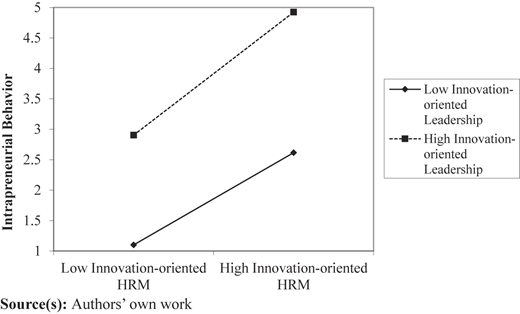
The results indicate that innovation-oriented HRM significantly and positively influences SMEs’ innovation performance (β = 0.32; p < 0.001, t = 3.24), supporting Hypothesis 1. Furthermore, it demonstrates that innovation-oriented HRM has a statistically significant and positive impact on intrapreneurial behavior (β = 0.40; p < 0.001, t = 6.74), confirming Hypothesis 2. The findings affirm that intrapreneurial behavior plays a significant and positive role in enhancing innovation performance (β = 0.38; p < 0.001, t = 4.55), thus supporting Hypothesis 3. Specifically, the analysis of the specific indirect effect reveals that intrapreneurial behavior is a mediating mechanism in transmitting the influence of innovation-oriented HRM on innovation performance (β = 0.15; p < 0.001, t = 4.06), supporting Hypothesis 4. Lastly, the interaction effects (IOHRM*IOL) confirm that innovation-oriented leadership positively and significantly influences the impact of innovation-oriented HRM on intrapreneurial behavior (β = 0.15; p < 0.001, t = 4.51), thereby supporting Hypothesis 5.
4. Discussion
Our study investigated the role of innovation-oriented HRM in promoting intrapreneurial behavior to boost innovation in SMEs using the AMO framework with two-wave data collected from SMEs. Specifically, we examined the underlying role of intrapreneurial behavior in translating innovation-oriented HRM into superior SME innovation performance. Further, innovation-oriented leadership influences the enhancement of innovation-oriented HRM’s effect on intrapreneurial behavior. Overall, the findings are in line with the study’s proposed hypotheses. First, the finding affirms the positive influence of innovation-oriented HRM on the innovation performance of SMEs. This result specifies that strategic HRM principles emphasizing the importance of aligning innovation-oriented HRM practices with an organization’s strategic objectives (Jackson et al., 2014). In the context of SMEs, where resources and capabilities are often limited, the role of innovation-oriented HRM practices in driving innovation becomes even more crucial (Rasheed et al., 2017; Shahzad et al., 2022). By doing so, extend the literature on strategically aligned HRM (i.e. innovation-oriented HRM) for achieving strategic goals (i.e. innovation) in SMEs (Aslam et al., 2023; McClean and Collins, 2019; Shahzad et al., 2022). Second, innovation-oriented HRM boosts intrapreneurial behavior through innovative recruitment, training, development, and rewards (Stock et al., 2014). It empirically establishes that innovation-oriented HRM plays a vital role in shaping intrapreneurial behaviors (Chouchane et al., 2021; Farrukh et al., 2021a, b). Third, findings showed that intrapreneurial behavior amplifies SMEs’ innovation performance, empirically corroborating that intrapreneurial behavior has a substantial role in SMEs’ innovation performance (Seshadri and Tripathy, 2006).
Fourth, the findings complement the AMO framework by empirically validating that innovation-oriented HRM provides clear direction to the employees that the organization expects them to indulge in innovative behaviors (Antonioli and Della Torre, 2016; Campbell-Allen et al., 2008). In response, employees pursue innovative, proactive, and risk-taking behavior to achieve strategic goals, such as introducing new products and services, leading to improved SMEs’ innovation performance. Using the AMO framework, our study unlocks the black box between the innovation-oriented HRM-innovation link (Bos-Nehles et al., 2023; Caputo et al., 2022; Shahzad et al., 2019). Finally, the finding suggests that innovation-oriented leadership amplifies the impact of innovation-oriented HRM on intrapreneurial behavior (see Figure 2). It shows that innovation-oriented leadership fosters open communication to share new ideas and solutions for innovation. As a result, employees share innovative ideas and proactively take risky initiatives for innovation. This fertile ground provided by the leaders for innovation further enhances the effect of innovation-oriented HRM on intrapreneurial behavior.
4.1 Theoretical implications
This paper complements the theoretical reasoning of the AMO framework by revealing that innovation-oriented HRM practices such as recruitment, training, and development are ability-enhancing practices and innovation-based rewards are motivation-enhancing practices in prompting intrapreneurial behavior (Aslam et al., 2023; Stock et al., 2014) for advancing innovation outcomes in SMEs. Additionally, it examines how innovation-oriented leadership enhances opportunities (Moschko and Blazevic, 2022), improving employees’ ability, i.e. intrapreneurial behavior. This research magnifies the importance of innovation-oriented HRM in leveraging innovation performance in SMEs by encouraging innovative capabilities, making a novel contribution to strategic HRM research (Aslam et al., 2023; Gupta, 2024; Zhou et al., 2023).
It is one of the pioneering studies illustrating that innovation-oriented HRM practices create a conducive environment for fostering intrapreneurship by promoting proactivity, encouraging risk-taking, and stimulating innovativeness among employees, which in turn endorse SME innovation performance (Antonioli and Della Torre, 2016; Bauernschuster et al., 2009; Giaccone and Magnusson, 2022; Sung and Choi, 2018). Earlier studies have overlooked the mediational mechanism between innovation-oriented HRM and innovation performance. Therefore, this research fills the gap by exploring intrapreneurial behavior as a mediator (Chouchane et al., 2021; Hernández-Perlines et al., 2022) in the context of innovation-oriented HRM (Aslam et al., 2023; Zhou et al., 2023).
This study adds to the growing body of literature on the role of innovation-oriented leadership in HRM (Zhao et al., 2023; Zhou et al., 2023) by exploring the interaction effect of innovation-oriented HRM and leadership on intrapreneurial behaviors. Recent literature shows a significant interaction between leadership and HRM on employee outcomes (McClean and Collins, 2019; Zhao et al., 2023; Zhou et al., 2023). However, previous studies have overlooked the synergetic effect of innovation-oriented HRM and leadership on intrapreneurship and innovation outcomes. Therefore, this research empirically established that the interactive effect of innovation-oriented leadership and HRM positively influences employee intrapreneurial behavior (McClean and Collins, 2019; Zhao et al., 2023; Zhou et al., 2023), thus complementing the AMO framework and addressing the prevailing gap in the strategic HRM literature.
4.2 Practical implications
This study holds significant implications for SMEs in developing countries. For SME practitioners and leaders, these insights underscore the pivotal role of incorporating innovation-oriented HRM practices into their organizational frameworks. It extends beyond merely acquiring and nurturing talent possessing innovative skills, emphasizing the alignment of HRM strategies with the overarching innovation objectives. Additionally, acknowledging the substantial influence of HRM on innovation performance can serve as a compass for SMEs in making informed decisions regarding resource allocation and strategic choices.
Firstly, to attain heightened innovation and competitiveness within a volatile environment, senior management must champion innovation-oriented leadership, shaping the inclination of SMEs toward innovation pursuit. This leadership approach provides a clear trajectory for managers and employees, signifying the top management’s commitment to innovation. This shared perception fosters superior innovation performance in SMEs. Secondly, the study advocates for SMEs to embrace an HRM system comprising innovative recruitment, training, development, and reward mechanisms. Innovative recruitment practices facilitate the hiring of staff equipped with innovation-centric skills. Progressive training and development initiatives enhance employees’ skills, fostering innovation capability. Likewise, formal appraisal systems that reward innovative behaviors motivate employees to channel their efforts toward innovation. Through the utilization of innovation-oriented HRM, SMEs can attain elevated innovation levels. Lastly, by showcasing the significance of innovation-oriented HRM and leadership in promoting intrapreneurial behavior for superior innovation, this study suggests that SME managers in Pakistan can adopt these practices to thrive in domestic and international markets. The increased survival rate and growth of Pakistani SMEs contribute significantly to employment opportunities, poverty reduction, GDP, and enhanced export performance, culminating in national and regional economic and social development.
4.3 Limitations and future directions
Though this study extends valuable contributions, it contains some limitations. First, though two-wave data were collected in this study, the study’s cross-sectional nature may impose inferential limits. Longitudinal studies, in which HRM and innovation are measured at three points in time, are recommended. Second, it explained the role of two emerging determinants, e.g. innovation-oriented HRM and leadership variables of intrapreneurial behavior and innovation performance. Other relevant variables from the management/entrepreneurship literature, e.g. strategic orientation or entrepreneurial orientation, could also be considered boundary conditions in future studies. Finally, this paper has not explored institutional conditions, such as legal systems and cultural norms that can modify the innovation-orientated HRM-innovation performance link. How these factors and conditions influence the effects of innovation-oriented HRM and leadership on innovation performance and its underlying processes in Asia and the SME sector remains to be studied. A cross-country comparison may help to address this issue.
5. Conclusion
Our study has postulated the vital role of innovation-oriented HRM and leadership in fostering intrapreneurial behavior for amplifying innovation within SMEs. The study findings emphasized the importance of implementing innovative recruitment, training, and rewards to nurture a workforce capable of generating and implementing novel ideas to introduce innovative products and services into the marketplace. Further, the synergy or strategic fit between innovation-oriented HRM and leadership is essential for creating an environment that encourages and supports employees in intrapreneurial behaviors. By explaining the interplay between HRM and leadership, our study suggests that SMEs must invest in employee development programs that magnify innovative thinking and solutions, devise reward systems that recognize and incentivize intrapreneurial behavior, and cultivate a leadership supporting proactively undertaking risky initiatives. By employing these recommendations, SMEs may encourage employees to behave innovatively and proactively to introduce new products and services that help them survive and grow in the competitive environment.