
Skip to article sections
Purpose

The purpose of this study is to investigate the influence of positive leadership (PL), a theory originating from positive psychology, on affective commitment (AC), an important outcome in times of skilled labor shortages. This study also examines psychological need satisfaction (PNS) and well-being as serial mediators between PL and AC.

Design/methodology/approach

A 2-wave-study with 282 employees of a German company in the finance and insurance sector was conducted. The data were analyzed using covariance analytic structural equation modeling with RStudio.

Findings

The results suggest that PL improves AC. Additionally, PNS and well-being mediate this relationship individually and serially.

Originality/value

Our study is one of the few to examine PL as a leadership style in its own right and not a synonym for various leadership styles (e.g. transformational leadership) and one of the first to emphasize its importance for employee retention. Moreover, we make a unique contribution by combining work design theory and self-determination theory to examine the underlying mechanisms of the influence of PL on AC. Therefore, this research is the first to investigate a serial mediation between PL, PNS, well-being and AC.

With the increasing importance of positive psychology, the emerging theory of positive leadership (PL) has received more attention (Schimschal and Lomas, 2019). In previous research literature, PL has often been considered synonymous with more established leadership styles, such as transformational leadership (Schimschal and Lomas, 2019). Currently, there is an ongoing debate about the importance and relevance of examining different and particularly those “positive leadership styles” in future research. Some definitions refer to positive leadership styles as those that enhance different organizational outcomes in a positive way (Decuypere and Schaufeli, 2020). This is part of the criticism of these leadership styles, which states that they represent ideologies that create fantasies of excessive positivity (Alvesson and Einola, 2019). However, at this point, PL has to be differentiated from positive leadership styles, as it is not limited to its potential influence on organizational outcomes and does not only consider positivity in terms of the direction of impact. This has made it particularly important to reduce the mixing of concepts and terms and acknowledge PL as a separate leadership style, especially in the context of positive psychology.

PL describes a leadership behavior through which employees experience positive feelings and emotions (Kelloway et al., 2013). These behaviors include recognizing, thanking, complimenting, praising, and encouraging employees (Caniëls, 2023). PL describes how supervisors can encourage exceptional positive performance, focus on strengths and abilities, and attract the best out of individuals (Cameron, 2012). PL concentrates on employees’ strengths and does not focus on failure (Cameron, 2012). This does not mean that negative perceptions are ignored; instead, they are seen as the potential to recognize the value created by negative aspects, leading to the creation of an inspiring climate (Salmi et al., 2014; Algera and Lips-Wiersma, 2012). Based on PL, a climate that emphasizes employees’ strengths and resources is created (Salmi et al., 2014). PL contains three fundamental components: (1) it focuses on employees’ skills and strengths that support their human potential; (2) by highlighting the results, it enables outstanding organizational and individual performance; and (3) its scope focuses on the elements that can be considered essential human virtues (Blanch et al., 2016). Following a combination of these definitional approaches, we define PL as a leadership behavior that evokes pleasant feelings and emotions in employees, focuses on their strengths and abilities, and thus creates a climate of appreciation.

Although the research literature on the impact of other leadership styles is extensive, research on PL has received little attention to date. Previous limited research on PL has shown that PL increases follower vigor (Caniëls, 2023), organization-based self-esteem and professional respect for a leader (Li, 2024), and workplace trust and flourishing (Ramdas and Patrick, 2019). Furthermore, PL has been found to reduce job insecurity and worries about job insecurity (Heponiemi et al., 2012) and increase job satisfaction, positive affect, and engagement (Yan et al., 2023; Kelloway et al., 2013).

Moreover, there are initial findings that PL increases employees’ well-being (Kelloway et al., 2013; Khanom and Shee, 2024) and affective commitment (AC) (Kelloway et al., 2013). In times of shortages of skilled workers, it is particularly relevant that companies retain their employees, as this avoids dismissals and reduces costs (Chang et al., 2013). While several studies have investigated the relationship between other leadership styles and AC (e.g. Duarte et al., 2021; Gillet and Vandenberghe, 2014), there is a lack of profound research on the relationship between PL and AC, especially in Germany. The threat of shortages of skilled workers, coupled with an aging workforce in the finance and insurance industry in Germany, implies that increasing AC is a key challenge for companies (Versicherungsbote, 2024). PL could be a crucial influencing factor in this respect. Nevertheless, the impact of PL on AC and its mechanisms remains an underexplored topic.

A potential explanation of these mechanisms can be provided by the work design model by Humphrey et al. (2007) in combination with self-determination theory (SDT) by Deci and Ryan (1985) (Gagné et al., 2022). According to the work design model, critical psychological states mediate the relationship between work characteristics and work outcomes (Humphrey et al., 2007). While PL can be seen as a work characteristic, AC is represented as an attitudinal outcome in the work design model (Humphrey et al., 2007). Under the consideration of SDT, psychological need satisfaction (PNS) may represent a critical psychological state. In line with the assumption of the work design model, Deci et al. (2017) argued that PNS mediates the relationship between environmental aspects of the workplace, well-being, and attitudinal work outcomes. Regarding the limited state of research on PL, to the best of our knowledge, no studies have investigated PL in relation to PNS. Although the theoretical perspective provides evidence that PNS is an underlying mechanism between PL and AC, there is a lack of empirical research.

A core assumption of the self-determination mini-theory of basic needs is that PNS is closely linked to well-being (Ryan and Deci, 2002; Vansteenkiste et al., 2020). While there is empirical evidence of the impact of PL on well-being, the SDT perspective indicates that PNS appears to be an underlying mechanism in this relationship. Moreover, while the work design model included well-being as an outcome, Moussa et al. (2017) demanded a modification in the form of expanding mediators with well-being. Given the repeatedly demonstrated effects of well-being on AC (e.g. Ribeiro et al., 2021), we conclude that PNS and well-being as serial mediators may represent crucial underlying mechanisms between PL and AC. At this point, a research gap has been identified, as to the best of our knowledge, no study to date has examined this serial mediation.

The present research makes a unique contribution in three ways. First, it contributes to the understanding of PL by examining it as a specific construct and not a direction of effect or an aggregated term for various leadership styles. Furthermore, we provide a novel contribution to the research field of PL by broadening the research on the influences of PL on well-being and AC, and by adding the relationship between PL and PNS to the field of research. Second, it contributes to the research field of work design theory by integrating the understanding of PL as a social characteristic, explaining the mediating effects of well-being, and thereby extending the work design model with serial mediation. Third, it contributes to the SDT research field by including PNS in work design theory, especially with regard to the link between PNS and well-being.

For the development of the proposed model, the work design model by Humphrey et al. (2007), an extension of the job characteristics model by Hackman and Oldham (1976), is applied in combination with SDT by Deci and Ryan (1985). By examining PL, we want to take a deeper look at PL as a social characteristic and its associated impacts. Humphrey et al. (2007) argued that social characteristics impact a broad set of well-being and attitudinal outcomes that contain AC (Humphrey et al., 2007). In accordance with the original model by Hackman and Oldham (1976), Humphrey et al. (2007) assumed three critical psychological states that mediate the relationship between motivational characteristics and work outcomes. Whether the mediators also impact the relationship between social characteristics and work outcomes, particularly attitudinal outcomes, has not been examined by Humphrey et al. (2007), but various later studies have confirmed this assumption (e.g. Pradhan and Pradhan, 2016). As mentioned by Gagné et al. (2022), SDT is closely linked to work design theory. Therefore, we suggest that this linkage can provide a deeper understanding of the impact of social characteristics on the critical psychological states represented by PNS. According to Ryan and Deci (2002), each individual has three fundamental psychological needs: autonomy, competence, and relatedness. We suggest that the satisfaction of these psychological needs can be widely seen as a critical psychological state due to the same psychological link, which is similar to that of the mediators in the work design model. The critical psychological states, as mentioned in work design theory, refer to the extent to which employees experience that they have personally performed well on tasks that are important to them (Hackman and Oldham, 1976). This can be transferred to PNS, as it represents the extent to which individuals feel effective and responsive (Ryan and Deci, 2017). The assumption of SDT that a supportive leadership style has an impact on employees’ PNS (Ryan and Deci, 2017) can thus be applied to PL and integrated into the work design model. Moreover, SDT suggests that a social context that fosters the fulfillment of psychological needs enhances job attitudes, such as AC (Deci and Ryan, 1985; Gillet et al., 2015).

While well-being has been recognized in the work design model as an outcome, there are empirical indicators that well-being also influences AC and does not necessarily function as a specific outcome. Combined with the role of PNS assumed by SDT in relation to well-being and AC, the inclusion of SDT in the work design model leads us to suggest a more dynamic relationship than originally assumed in the work design model. Accordingly, by integrating SDT, our theoretical model represents a modified application of the work design model that examines the relationship between PL as a social characteristic and AC as an attitudinal outcome, with PNS and well-being as mediators, and extends it through serial mediation.

According to the work design model, social characteristics impact attitudinal outcomes such as AC (Humphrey et al., 2007). AC captures the integral and emotional attachment of an employee to the company, which is reflected in the strength of the employee’s identification with the organization (Porter et al., 1974; Kanning and Hill, 2013). It is represented by three factors: first, a strong belief in and willingness to accept the goals and values of the organization; second, the willingness to make a substantial effort to the organization; and third, the desire to remain a member of the organization (Porter et al., 1974; Mowday et al., 1979).

Employees who witness PL are more open and focused and are likely to invest greater amounts of energy in their work (Diener et al., 2020; Yan et al., 2023). Therefore, we suggest that PL influences AC by fostering a willingness to make a substantial effort. Yan et al. (2023) transferred the assumption of Barsade et al. (2018) to PL, which states that leadership is fundamentally an emotion-driven process in which leaders transfer their emotions to employees and attempt to stimulate their feelings and emotions. These assumptions are in line with emotional contagion theory, which describes a process in which a deliberate or unconscious spontaneous transfer of feelings, emotions, or behaviors from one individual or group affects those of another individual or group (Yan et al., 2023; Schoenewolf, 1990). Stimulating emotions and evoking motivation are essential characteristics of PL (Yan et al., 2023; Malinga et al., 2019). Drawing on emotional contagion theory, we assume that transferring positive emotions and focusing on strengths will increase employees’ identification with their organization and its values and goals. Empirical findings of a significant positive impact of positive emotions on AC underline this assumption (e.g. Ko and Choi, 2020). The experience of positive emotions through PL influences employees’ affective reactions to the environmental processes that generate AC (Cropanzano et al., 1993). Therefore, we hypothesize that:

H1.

PL has a positive influence on AC.

As a social characteristic, PL contributes to the fulfillment of the three fundamental psychological needs for autonomy, competence, and relatedness regarding SDT (Deci et al., 2017). PL helps to positively stimulate employees in their interactions with other employees (Yan et al., 2023), which, in turn, might foster their connections and the urge to feel close to others (Ryan and Deci, 2017). This assumption addresses the need for relatedness, which is characterized by the urge to feel a sense of belonging to people or groups as well as personally meaningful connections with people in the immediate vicinity and broader connections with the general society (Ryan and Deci, 2017; Deci and Ryan, 2000). This involves perceiving others as receptive and sensitive, and being receptive and sensitive toward them (Ryan and Deci, 2017).

Employees who are influenced by PL are more likely to determine new ideas and methods to solve problems so that they can be more energetic and creative (Yan et al., 2023; Diener et al., 2020). Therefore, we assume that PL promotes employees’ sense of self-direction and encourages them to take responsibility for their actions. This refers to the need for autonomy, which is characterized by the urge for one’s own behavior to be in accordance with one’s personal, deeply rooted interests and values.

Deci et al. (2017) argued that a leadership style that generally supports employees could foster PNS. Due to the creation of a climate that focuses on the strengths and resources of employees and ensures that they can be more productive, the need for competence is addressed. The need for competence refers to the desire to be capable of action and the feeling of being effective in the interaction with the social environment (Ryan and Deci, 2017). When individuals are encouraged to develop skills, comprehension, or proficiency, the need for competence can be fulfilled (Ryan and Deci, 2017).

Ryan and Deci (2017) argued that the three psychological needs are equally valuable and interdependent, and that their fulfillment is facilitated by each need. Thus, the satisfaction of needs is usually coherent and balanced (Ryan and Deci, 2017). Overall, we assume that PL leads to greater PNS.

The satisfaction of psychological needs supplies a certain psychological nourishment that supports individuals’ innate growth propensities and, in turn, results in a strengthened state of well-being (Shir et al., 2019). In the literature, well-being refers either to a specific area (e.g. the workplace) or to an emotional state in relation to life in general (Hosie and Sevastos, 2010; Warr, 1990). In this study, well-being is defined as a person’s subjective feelings about the positive or negative consequences resulting from the performance of specific work tasks (Wu et al., 2017; Warr, 1990). Thus, we focus on affective job-related well-being. While positive consequences are expressed as feeling satisfied and glad, negative consequences are associated with pressure and stress (Warr, 1990; Hosie and Sevastos, 2010). Therefore, well-being can be described as the quality of an employee’s experience and functioning at work (Warr, 1987).

When employees fulfill their psychological needs, they shift to an autonomous self-regulation mode that enhances their well-being (Koole et al., 2019). Deci and Ryan (2000) suggested that psychological needs are essential, universal, and inherent to people’s well-being. The understanding of universality suggests that every individual will receive higher well-being through experiences that are need-satisfying (Schüler et al., 2016). Several studies have investigated and proved this assumption (e.g. Tang et al., 2020). Therefore, we assume that PNS leads to greater well-being.

When employees experience high well-being at work and thus feel that the organization takes care of them, they consider the work and the company to be responsible for this and build an emotional attachment to their organization (Ribeiro et al., 2021). Therefore, they want to remain part of the organization, as otherwise there is a risk that their well-being will be negatively impacted. Ribeiro et al. (2021) found that well-being significantly improves AC. Thus, we argue that PL promotes PNS by creating a conducive work climate and enhancing positive emotions in employees, which, in turn, improves their well-being, thus increasing their AC.

Overall, based on the combination of the work design model with SDT, we hypothesized that:

H2.

The relationship between PL and AC is serially mediated by PNS and well-being.

The data were collected through a two-wave study in a large German company in the insurance and financial sector. About 2,500 employees from different back-office departments were invited to participate in the study. Participation was voluntary, and the survey was self-reported. The survey focused on employee-skilled worker retention. The data were collected at two different time points to derive more specific statements on the impact of PL on PNS, well-being, and AC. The first wave was measured in April 2023 (T1), and the second wave was measured in June 2023 (T2), with a period of 19 days for each wave. The employees were invited to take part in the study via a post on the company’s intranet. The post contained a link to participate in the survey. After 7 days, another post was published on the intranet as a reminder of the survey. The participation period was initially set at 14 days. In order to increase the participation rate, Survey 1 was extended by a further 5 days after the planned 14 days, and another reminder was posted. To ensure the same conditions for participation, the procedure was repeated in the second wave.

In T1, 583 employees completed the survey. In T2, 507 employees participated. After removing participants for whom the self-generated codes to match the dates of T1 and T2 were either incorrect or could not be assigned, 303 participants remained (51.97% of the sample from T1). After eliminating those with inconsistencies in response behavior, the final sample contained 282 participants. Of the total, 53.5% of the sample were male, and on average, the participants were between 43 and 52 years old. The participants had an average tenure between 18 and 27 years. Our sample thus mirrors both the average age (44.1 years) and the average gender distribution (52% male) of employees in the German insurance industry (AGV, 2023). Of the respondents, 85.3% had completed at least an apprenticeship or had a higher education qualification. Selective dropout was examined by investigating whether the employees who participated in both waves were different from the employees who only participated in T1. There were no striking differences.

Positive leadership (T1): PL was measured using four items of the scale from Kelloway et al. (2013). The measurement was done using a 5-point Likert scale ranging from never to very often. An example of an item is “How often does your supervisor thank you?” We translated the scale into German using the back-translation method (Brislin, 1970). Cronbach’s alpha was α = 0.90.

Psychological need satisfaction (T2): We measured PNS using the German basic PNS and frustration scale by Heissel et al. (2018), which depends on the original scale by Chen et al. (2015). The participants rated on a 5-point Likert scale ranging from Strongly disagree to Strongly agree to what extent the statement applied to them. We used 12 items for satisfaction and did not include items for frustration. There were four items for each of the needs: autonomy (e.g. “I feel that my decisions reflect what I really want”, α = 0.79), relatedness (e.g. “I feel connected to people who care about me and whom I care about”, α = 0.87), and competence (e.g. “I am convinced that I can do things well”, α = 0.82). Cronbach’s alpha of the second-order construct was α = 0.74.

Well-being (T2): Well-being was measured using six items of the job-related affective well-being scale by Warr (1990). A 5-point Likert scale ranging from never to very often was used. The participants were asked how often they felt a certain way at work when they thought back to the last few weeks (e.g. depressed, or worried). We translated the scale into German using the back-translation method (Brislin, 1970). Cronbach’s alpha was α = 0.87.

Affective commitment (T2): AC was measured by 11 items of the German version of the Organizational Commitment Questionnaire by Kanning and Hill (2013), such as “I talk up this organization to my friends as a great company to work for”. The scale depends on the original Organizational Commitment Questionnaire by Mowday et al. (1979). A 5-point Likert scale ranging from Strongly disagree to Strongly agree was used for each item. Cronbach’s alpha was α = 0.91.

Control variables: We included age, gender, and tenure as control variables due to previous empirical findings and theoretical considerations (e.g. Mathieu and Zajac, 1990; Charles and Piazza, 2009). Older people use emotion regulation strategies to avoid stress and negative experiences (Charles and Piazza, 2009), making them more aware of their psychological needs and how to manage and fulfill them. Employees with high tenure acquire company-specific knowledge that can only be transferred to a limited extent, which increases their sunk cost when they leave the company (Ng and Feldman, 2010; Mathieu and Zajac, 1990). Moreover, women tend to have a greater role conflict between work and leisure than men, which can lead to difficulties in establishing satisfactory relationships with their organizations (Peterson et al., 2019).

As shown in Table 1, all correlations between the variables of our hypothesized model were positively related and significant, except for the control variables.

To analyze the collected data, a two-stage approach was followed, with an evaluation of the measurement models in the first stage and the structural model in the second stage (Anderson and Gerbing, 1988). We used RStudio (R Core Team, 2023) and the lavaan package (Rosseel, 2012) for our analysis. We conducted a confirmatory factor analysis (CFA) to test the reliability and construct validity of the measurement models. Reliability was tested using Cronbach’s Alpha (α) (>0.70), and composite reliability (CR) (≥0.70) (Hair et al., 2019). All tests showed satisfactory reliability (Table 1). To test for convergent validity, we examined the average variance extracted value (AVE) (≥0.50 (Fornell and Larcker, 1981)). For AC, the AVE falls slightly below the threshold, but when combined with a satisfactory CR, convergent validity can still be considered adequate (Fornell and Larcker, 1981). For the other variables, the AVE criterion was fulfilled. For the examination of discriminant validity, the Fornell–Larcker criterion (Fornell and Larcker, 1981) and the heterotrait-monotrait ratio (Hair et al., 2019) were used. Afterward, we tested for nomological validity by estimating the correlations among our variables (Hair et al., 2019), as shown in Table 1. All tests showed satisfactory validity.

We used inferential statistical, descriptive, and incremental fit indices to assess the model fit of the measurement models (Hu and Bentler, 1999; Hair et al., 2019). Due to a slight deviation from the univariate normal distribution, we used the Satorra–Bentler correction (Gana and Broc, 2019). The measurement models of well-being (χ2 = 22.43, d.f. = 9, χ2/d.f. = 2.49, p < 0.01, RMSEA = 0.07, SRMR = 0.04, CFI = 0.98, TLI = 0.96) and AC (χ2 = 119.98, d.f. = 44, χ2/d.f. = 2.73, p < 0.001, RMSEA = 0.08, SRMR = 0.05, CFI = 0.94, TLI = 0.92) provided good model fits. Because of the three-dimensional structure of the high-order construct of PNS, model fit values cannot be given. For PL, the normed χ2 deviates slightly from the threshold value. The RMSEA was also slightly above the threshold, but due to a d.f. of 2, we refrained from interpreting it as an indicator of model fit (MacCallum et al., 1996). Since the other threshold values were fulfilled, an acceptable model fit was concluded for PL (χ2 = 6.31, d.f. = 2, χ2/d.f. = 3.15, p < 0.05, RMSEA = 0.09, SRMR = 0.01, CFI = 0.99, TLI = 0.98).

We compared our hypothesized four-factor model with alternative factor models. As shown in Table 2, the hypothesized model (χ2 = 396.18, d.f. = 246, χ2/d.f. = 1.61, p < 0.001, RMSEA = 0.05, SRMR = 0.05, CFI = 0.94, TLI = 0.94) showed a slightly better fit overall than the alternative models.

In a single-source survey, common method bias is a serious risk (Podsakoff et al., 2012). To reduce this risk, we statistically tested the potential influence of common method variance using two methods. First, applying Harman’s 1-factor test revealed no evidence of a substantial level of common method variance (Table 2). Harman’s 1-factor test is a widely used method to test for common method variance but has some non-negligible weaknesses (Podsakoff et al., 2012). Therefore, we applied a second method, the unmeasured latent method construct technique. Considering the χ2-difference test from Jöreskog (1971), we also found no evidence of a substantial level of common method variance (Δχ2 = 1.62 < 3.81, χ2 = 394.56, d.f. = 245, χ2/d.f. = 1.61, p < 0.001, RMSEA = 0.05, SRMR = 0.05, CFI = 0.94, TLI = 0.94).

Afterward, we added the hypothesized structural paths and control variables to the measurement models and estimated our structural model with covariance analytic structural equation modeling (CB-SEM). The fit indices demonstrated a satisfactory fit of the proposed structural model (χ2 = 581.940, d.f. = 309, χ2/d.f. = 1.88, p < 0.001, RMSEA = 0.06, SRMR = 0.06, CFI = 0.91, TLI = 0.89).

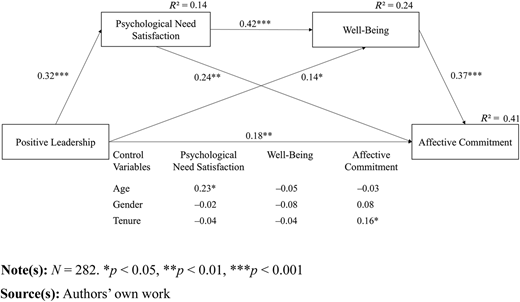
We used CB-SEM to analyze the hypothesized four-factor model and to test our hypotheses. All hypotheses were tested simultaneously using bootstrapping with 5,000 replications (Hayes, 2009). The results of the CB-SEM of the direct effects are presented in Figure 1.

PL was positively and significant related to AC (β = 0.18, p < 0.01), whereby H1 was supported. The indirect effect of PL on AC through PNS was positive and significant on the 95% CI (β = 0.08, 95% CI [0.02, 0.13]). The indirect effect of PL on AC through well-being was also positive and significant on the 90% CI (β = 0.05, 90% CI [0.01, 0.09]). Moreover, when testing the serial mediation between PL and AC through PNS and well-being, we found a positive and significant indirect effect on the 95% CI (β = 0.05, 95% CI [0.02, 0.09]). Therefore, H2 was supported. Partial mediation has been demonstrated due to the significant direct effect of PL on AC. The results of CB-SEM without control variables showed no substantial deviation due to the integration of the control variables (Becker, 2005).

Overall, our analysis provided strong support for our hypothesized model. We highlighted that PL enhances employees’ AC. In addition to direct influence, we found that PNS and well-being act as individual mediators in the relationship between PL and AC. Moreover, our research provides evidence of serial mediation through PNS and well-being.

First, our study extends the research field of PL by demonstrating that PL increases AC. Moreover, we found that PL also influences PNS and well-being. Therefore, our study falls in line with previous research. Initial findings have shown that PL influences AC and well-being (Kelloway et al., 2013). Our study extends this research and thus confirms the theoretical assumption of Lloyd and Atella (2000) and Malinga et al. (2019) that well-being and commitment are relevant outcomes of PL. Taken together, our study makes a novel contribution to the field of PL by demonstrating the influence of PL on AC and well-being in a German sample. And, by being the first study to show that PL increases PNS and to uncover the mechanisms of the influence of PL on AC through PNS and well-being.

Second, by showing that PL impacts AC, we contribute to the work design literature by extending the line of research that has examined and confirmed the influence of leadership styles as social characteristics on attitudinal outcomes (e.g. Gillet and Vandenberghe, 2014). Moreover, we respond to the call to investigate well-being as a mediator in the context of the work design model (Moussa et al., 2017). Our study posits that well-being impacts attitudinal outcomes and must not only be seen as a category of outcome. The extension of the model in the form of serial mediation emphasizes this approach, showing that well-being is not necessarily a substitute for the critical psychological states provided by the work design model but rather that it can precede other outcomes. Therefore, our research offers a novel perspective on the work design model by showing that the relationship between outcomes is more dynamic than the model initially considered. Furthermore, by integrating PNS, we also contributed to further insight into research on work design theory (Gagné et al., 2022). Our results suggest that the satisfaction of psychological needs operates as another critical psychological state that mediates the relationship between social characteristics and attitudinal outcomes. The findings thus enrich our understanding of PL as a leadership behavior that enables employees to fulfill their psychological needs by focusing on their strengths, abilities, and emotions, which helps improve well-being and, in turn, fosters AC.

The integration of PNS also represents the third contribution, as we thus advance the SDT research field. By including PNS as a critical psychological state, PNS appears in a new light. Moreover, while the link between PNS and well-being is well demonstrated in the context of SDT (e.g. Tang et al., 2020), we extend the research on the mechanism through which the fulfillment of psychological needs can be enhanced. Our results are in line with the assumption and research field that leadership styles that generally focus on employees can foster PNS (e.g. Hetland et al., 2011). We concretize this approach by showing that PL, by creating a supportive working climate and focusing on strengths and skills, creates an environment in which the fulfillment of employees’ psychological needs is enhanced.

The combination of work design theory and SDT applied in this study offers a novel view and enriches the body of knowledge with a new and unique perspective for both work design research and positive psychology.

Our research has several practical implications for both employees and organizations. Companies should support and train leaders in practicing PL correctly. In particular, modules should be included in training courses that enable leaders to reflect on their own leadership styles. While leaders are not always conscious of their strengths (Mills et al., 2013), the aim is to raise awareness of the extent to which leaders are already practicing PL and which aspects need to be improved. Therefore, it is advisable to incorporate role plays into training courses. Moreover, by promoting experiential learning, role play aims to make managers demonstrably aware of the positive impacts of PL (Li, 2024; Hoe and Greulich-Smith, 2022). Additionally, managers should be trained to correctly recognize and respond to employees’ emotions, which could be a core element in the correct practice of PL. This could also be implemented through role-playing by training leaders to recognize emotional reactions to PL behaviors, such as complimenting and encouraging employees.

In addition to developing specific training, it is important that organizations create a work environment that facilitates the application of training outcomes (Yan et al., 2023) and allows employees to openly show their emotions to their managers so that they are actually able to evoke genuine positive emotions in their employees.

However, the creation of positive emotions should not only be focused on the short term but also on the long term. In the coming years, many people in the German insurance and financial sector will retire due to the aging population, and as our results show, employees with a higher tenure tend to already have higher level of AC. Therefore, leaders should particularly focus on employees with shorter tenure to increase AC. This does not mean that PL is not relevant for employees with a high tenure. Due to the shortage of qualified skilled workers in the German insurance and financial sector in particular (Versicherungsbote, 2024), it is important for leaders to focus on positive psychology through PL to be able to keep up with other companies when recruiting and retaining specialists. To embed PL in the organizational culture in the long term, PL could either be integrated into existing competency models for leaders, or new competency models could be created in which PL is included. In this way, attention can be paid directly to the practice of PL, both in external recruitment and in internal development.

Furthermore, our results show that the satisfaction of psychological needs plays an important role in the mechanism that determines the impact of PL on AC. Therefore, a work environment should be created in which employees can fulfill their psychological needs. To make this possible, employees should be trained to recognize and assess their psychological needs. By applying PL, the leader is able to support employees in satisfying their basic psychological needs, which in turn fosters their well-being and increases their AC.

This study has some limitations that should be recognized. A first limitation is the self-reported measurement of PL, PNS, well-being, and AC, which can lead to restricted ranges of values, resulting in lower variability, which weakens the estimated correlations between the variables (Chang et al., 2013). However, self-assessments also have their strengths, as PL, PNS, well-being, and AC are based on employees’ individual assessments due to their psychological characteristics and the inner-psychological process that we capture with serial mediation. In addition, our results may be compromised, as we measured PNS, well-being, and AC at the same time. However, as affective reactions are instant subsequent to experiences (Weiss and Cropanzano, 1996), our results still provide valuable perspectives on the underlying mechanisms between PL and AC. Nevertheless, future studies could use data from multiple sources, such as supervisor ratings, or conduct experiments, and extend the survey to four time points of data collection to confirm our findings.

A further limitation is the generalizability of the results. Due to the company’s data protection guidelines, we used categorical variables to measure age and tenure. This could explain the few significant relationships in relation to age and tenure, as the categorization could hide important variances in the influences on the dependent variables (Sturman, 2003). Moreover, as the data were collected from employees of a German company in the insurance and finance industry, the specific characteristics should be taken into account when generalizing the findings. It is unclear to what extent the influence of PL has an impact on sectors where there may be a different emotional environment, such as the healthcare sector. However, we suspect that PL also has a relevant influence on AC here, particularly due to the potential for higher emotional involvement and could therefore become even more important. Future studies could investigate this approach and include different industries in their analyses.

We would like to thank Verena Linnenborn and Lisa Seck for their support in this research. We would also like to express our gratitude to the company that provided us with the opportunity to collect the data for this study.
AGV
(
2023
), “
Branchenzahlen
”,
available at:
 https://www.agv-vers.de/statistiken/branchenzahlen/beschaeftigtenstruktur.html (
accessed
19 February 2025).
Algera
,
P.M.
and
Lips-Wiersma
,
M.
(
2012
), “
Radical Authentic Leadership: Co-creating the conditions under which all members of the organization can be authentic
”,
The Leadership Quarterly
, Vol. 
23
No. 
1
, pp. 
118
-
131
, doi: .
Alvesson
,
M.
and
Einola
,
K.
(
2019
), “
Warning for excessive positivity: authentic leadership and other traps in leadership studies
”,
The Leadership Quarterly
, Vol. 
30
No. 
4
, pp. 
383
-
395
, doi: .
Anderson
,
J.C.
and
Gerbing
,
D.W.
(
1988
), “
Structural equation modeling in practice: a review and recommended two-step approach
”,
Psychological Bulletin
, Vol. 
103
No. 
3
, pp. 
411
-
423
, doi: .
Barsade
,
S.G.
,
Coutifaris
,
C.G.
and
Pillemer
,
J.
(
2018
), “
Emotional contagion in organizational life
”,
Research in Organizational Behavior
, Vol. 
38
, pp. 
137
-
151
, doi: .
Becker
,
T.E.
(
2005
), “
Potential problems in the statistical control of variables in organizational research: a qualitative analysis with recommendations
”,
Organizational Research Methods
, Vol. 
8
No. 
3
, pp. 
274
-
289
, doi: .
Blanch
,
J.
,
Gil
,
F.
,
Antino
,
M.
and
Rodríguez-Muñoz
,
A.
(
2016
), “
Positive leadership models: theoretical framework and research
”,
Psychologist Papers
, Vol. 
37
No. 
3
, pp. 
170
-
176
.
Brislin
,
R.W.
(
1970
), “
Back-translation for cross-cultural research
”,
Journal of Cross-Cultural Psychology
, Vol. 
1
No. 
3
, pp. 
185
-
216
, doi: .
Cameron
,
K.
(
2012
),
Positive Leadership
, (2nd ed.) ,
Berret-Koehler
,
San Francisco
.
Caniëls
,
M.C.J.
(
2023
), “
How remote working increases the importance of positive leadership for employee vigor
”,
Frontiers in Psychology
, Vol. 
14
, pp. 
1
-
10
, doi: .
Chang
,
W.-J.A.
,
Wang
,
Y.-S.
and
Huang
,
T.-C.
(
2013
), “
Work design-related antecedents of turnover intention: a multilevel approach
”,
Human Resource Management
, Vol. 
52
No. 
1
, pp. 
1
-
26
, doi: .
Charles
,
S.T.
and
Piazza
,
J.R.
(
2009
), “
Age differences in affective well‐being: context matters
”,
Social and Personality Psychology Compass
, Vol. 
3
No. 
5
, pp. 
711
-
724
, doi: .
Chen
,
B.
,
Vansteenkiste
,
M.
,
Beyers
,
W.
,
Boone
,
L.
,
Deci
,
E.L.
,
Van der Kaap-Deeder
,
J.
,
Duriez
,
B.
,
Lens
,
W.
,
Matos
,
L.
,
Mouratidis
,
A.
,
Ryan
,
R.M.
,
Sheldon
,
K.M.
,
Soenens
,
B.
,
Van Petegem
,
S.
and
Verstuyf
,
J.
(
2015
), “
Basic psychological need satisfaction, need frustration, and need strength across four cultures
”,
Motivation and Emotion
, Vol. 
39
No. 
2
, pp. 
216
-
236
, doi: .
Cropanzano
,
R.
,
James
,
K.
and
Konovsky
,
M.A.
(
1993
), “
Dispositional affectivity as a predictor of work attitudes and job performance
”,
Journal of Organizational Behavior
, Vol. 
14
No. 
6
, pp. 
595
-
606
, doi: .
Deci
,
E.L.
and
Ryan
,
R.M.
(
1985
),
Intrinsic Motivation and Self-Determination in Human Behavior
,
Plenum Press
,
New York
.
Deci
,
E.L.
and
Ryan
,
R.M.
(
2000
), “
The ‘what’ and ‘why’ of goal pursuits: human needs and the self-determination of behavior
”,
Psychological Inquiry
, Vol. 
11
No. 
4
, pp. 
227
-
268
, doi: .
Deci
,
E.L.
,
Olafsen
,
A.H.
and
Ryan
,
R.M.
(
2017
), “
Self-determination theory in work organizations: the state of a science
”,
Annual Review of Organizational Psychology and Organizational Behavior
, Vol. 
4
No. 
1
, pp. 
19
-
43
, doi: .
Decuypere
,
A.
and
Schaufeli
,
W.
(
2020
), “
Leadership and work engagement: exploring explanatory mechanisms
”,
German Journal of Human Resource Management: Zeitschrift für Personalforschung
, Vol. 
34
No. 
1
, pp. 
69
-
95
, doi: .
Diener
,
E.
,
Thapa
,
S.
and
Tay
,
L.
(
2020
), “
Positive emotions at work
”,
Annual Review of Organizational Psychology and Organizational Behavior
, Vol. 
7
No. 
1
, pp. 
451
-
477
, doi: .
Duarte
,
A.P.
,
Ribeiro
,
N.
,
Semedo
,
A.S.
and
Gomes
,
D.R.
(
2021
), “
Authentic leadership and improved individual performance: affective commitment and individual creativity's sequential mediation
”,
Frontiers in Psychology
, Vol. 
12
, 675749, doi: .
Fornell
,
C.
and
Larcker
,
D.F.
(
1981
), “
Evaluating structural equation models with unobservable variables and measurement error
”,
Journal of Marketing Research
, Vol. 
18
No. 
1
, pp. 
39
-
50
, doi: .
Gagné
,
M.
,
Parker
,
S.K.
,
Griffin
,
M.A.
,
Dunlop
,
P.D.
,
Knight
,
C.
,
Klonek
,
F.E.
and
Parent-Rocheleau
,
X.
(
2022
), “
Understanding and shaping the future of work with self-determination theory
”,
Nature reviews psychology
, Vol. 
1
No. 
7
, pp. 
378
-
392
, doi: .
Gana
,
K.
and
Broc
,
G.
(
2019
),
Structural Equation Modeling with Lavaan
,
Wiley & Sons
,
London, Hoboken
.
Gillet
,
N.
and
Vandenberghe
,
C.
(
2014
), “
Transformational leadership and organizational commitment: the mediating role of job characteristics
”,
Human Resource Development Quarterly
, Vol. 
25
No. 
3
, pp. 
321
-
347
, doi: .
Gillet
,
N.
,
Forest
,
J.
,
Benabou
,
C.
and
Bentein
,
K.
(
2015
), “
The effects of organizational factors, psychological need satisfaction and thwarting, and affective commitment on workers' well-being and turnover intentions
”,
Le Travail Humain
, Vol. 
78
No. 
2
, pp. 
119
-
140
, doi: .
Hackman
,
J.
and
Oldham
,
G.R.
(
1976
), “
Motivation through the design of work: test of a theory
”,
Organizational Behavior and Human Performance
, Vol. 
16
No. 
2
, pp. 
250
-
279
, doi: .
Hair
,
J.F.
,
Black
,
W.C.
,
Babin
,
B.J.
and
Anderson
,
R.E.
(
2019
),
Multivariate Data Analysis
, (8th ed.) ,
Cengage
,
Andover
.
Hayes
,
A.F.
(
2009
), “
Beyond Baron and Kenny: statistical mediation analysis in the New Millennium
”,
Communication Monographs
, Vol. 
76
No. 
4
, pp. 
408
-
420
, doi: .
Heissel
,
A.
,
Pietrek
,
A.
,
Flunger
,
B.
,
Fydrich
,
T.
,
Rapp
,
M.A.
,
Heinzel
,
S.
and
Vansteenkiste
,
M.
(
2018
), “
The validation of the German basic psychological need satisfaction and frustration scale in the context of mental health
”,
European Journal of Health Psychology
, Vol. 
25
No. 
4
, pp. 
119
-
132
, doi: .
Heponiemi
,
T.
,
Elovainio
,
M.
,
Kouvonen
,
A.
,
Noro
,
A.
,
Finne-Soveri
,
H.
and
Sinervo
,
T.
(
2012
), “
The association of ownership type with job insecurity and worry about job stability the moderating effects of fair management, positive leadership, and employment type
”,
Advances in Nursing Science
, Vol. 
35
No. 
1
, pp. 
39
-
50
, doi: .
Hetland
,
H.
,
Hetland
,
J.
,
Schou Andreassen
,
C.
,
Pallesen
,
S.
and
Notelaers
,
G.
(
2011
), “
Leadership and fulfillment of the three basic psychological needs at work
”,
Career Development International
, Vol. 
16
No. 
5
, pp. 
507
-
523
, doi: .
Hoe
,
S.L.
and
Greulich-Smith
,
T.
(
2022
), “
Using role play to develop an empathetic mindset in executive education
”,
Industrial and Commercial Training
, Vol. 
54
No. 
1
, pp. 
145
-
151
, doi: .
Hosie
,
P.J.
and
Sevastos
,
P.P.
(
2010
), “
A framework for conceiving of job-related affective wellbeing
”,
Management Revu
, Vol. 
21
No. 
4
, pp. 
406
-
436
, doi: .
Hu
,
L.
and
Bentler
,
P.M.
(
1999
), “
Cutoff criteria for fit indexes in covariance structure analysis: conventional criteria versus new alternatives
”,
Structural Equation Modeling: A Multidisciplinary Journal
, Vol. 
6
No. 
1
, pp. 
1
-
55
, doi: .
Humphrey
,
S.E.
,
Nahrgang
,
J.D.
and
Morgeson
,
F.P.
(
2007
), “
Integrating motivational, social, and contextual work design features: a meta-analytic summary and theoretical extension of the work design literature
”,
Journal of Applied Psychology
, Vol. 
92
No. 
5
, pp. 
1332
-
1356
, doi: .
Jöreskog
,
K.G.
(
1971
), “
Statistical analysis of sets of congeneric tests
”,
Psychometrika
, Vol. 
36
No. 
2
, pp. 
109
-
133
, doi: .
Kanning
,
U.
and
Hill
,
A.
(
2013
), “
Validation of the organizational commitment Questionnaire (OCQ) in six languages
”,
Journal of Business and Media Psychology
, Vol. 
4
No. 
2
, pp. 
11
-
20
.
Kelloway
,
E.K.
,
Weigand
,
H.
,
McKee
,
M.C.
and
Das
,
H.
(
2013
), “
Positive leadership and employee well-being
”,
Journal of Leadership and Organizational Studies
, Vol. 
20
No. 
1
, pp. 
107
-
117
, doi: .
Khanom
,
N.
and
Shee
,
H.
(
2024
), “
Workplace diversity and positive leadership style: impacts on employee well-being in Australian businesses
”,
Leadership and Organization Development Journal
, Vol. 
45
No. 
8
, pp. 
1504
-
1525
, doi: .
Ko
,
S.-H.
and
Choi
,
Y.
(
2020
), “
The effects of compassion experienced by SME employees on affective commitment: double-mediation of authenticity and positive emotion
”,
Management Science Letters
, Vol. 
10
No. 
6
, pp. 
1351
-
1358
, doi: .
Koole
,
S.L.
,
Schlinkert
,
C.
,
Maldei
,
T.
and
Baumann
,
N.
(
2019
), “
Becoming who you are: an integrative review of self-determination theory and personality systems interactions theory
”,
Journal of Personality
, Vol. 
87
No. 
1
, pp. 
15
-
36
, doi: .
Li
,
H.-T.
(
2024
), “
How positive leadership leads to employees' interpersonal citizenship behavior: a self-consistency perspective
”,
Leadership and Organization Development Journal
, Vol. 
45
No. 
7
, pp. 
1185
-
1204
, doi: .
Lloyd
,
P.J.
and
Atella
,
M.D.
(
2000
), “
Positive leadership that inspires: theoretical and empirical perspectives from positive psychology, existential theory, and hardiness research
”,
The Psychologist-Manager Journal
, Vol. 
4
No. 
2
, pp. 
155
-
165
, doi: .
MacCallum
,
R.C.
,
Browne
,
M.W.
and
Sugawara
,
H.M.
(
1996
), “
Power analysis and determination of sample size for covariance structure modeling
”,
Psychological Methods
, Vol. 
1
No. 
2
, pp. 
130
-
149
, doi: .
Malinga
,
K.S.
,
Stander
,
M.
and
Nell
,
W.
(
2019
), “Positive leadership: moving towards an integrated definition and interventions”, in
Van Zyl
,
L.E.
and
Rothmann
,
S.
(Eds),
Theoretical Approaches to Multi-Cultural Positive Psychological Interventions
,
Springer International Publishing
,
Cham
, pp. 
201
-
228
.
Mathieu
,
J.E.
and
Zajac
,
D.M.
(
1990
), “
A review and meta-analysis of the antecedents, correlates, and consequences of organizational commitment
”,
Psychological Bulletin
, Vol. 
108
No. 
2
, pp. 
171
-
194
, doi: .
Mills
,
M.J.
,
Fleck
,
C.R.
and
Kozikowski
,
A.
(
2013
), “
Positive psychology at work: a conceptual review, state-of-practice assessment, and a look ahead
”,
The Journal of Positive Psychology
, Vol. 
8
No. 
2
, pp. 
153
-
164
, doi: .
Moussa
,
M.
,
Bright
,
M.
and
Varua
,
M.E.
(
2017
), “
Investigating knowledge workers' productivity using work design theory
”,
International Journal of Productivity and Performance Management
, Vol. 
66
No. 
6
, pp. 
822
-
834
, doi: .
Mowday
,
R.T.
,
Steers
,
R.M.
and
Porter
,
L.W.
(
1979
), “
The measurement of organizational commitment
”,
Journal of Vocational Behavior
, Vol. 
14
No. 
2
, pp. 
224
-
247
, doi: .
Ng
,
T.W.H.
and
Feldman
,
D.C.
(
2010
), “
Human capital and objective indicators of career success: the mediating effects of cognitive ability and conscientiousness
”,
Journal of Occupational and Organizational Psychology
, Vol. 
83
No. 
1
, pp. 
207
-
235
, doi: .
Peterson
,
M.F.
,
Kara
,
A.
,
Fanimokun
,
A.
and
Smith
,
P.B.
(
2019
), “
Country culture moderators of the relationship between gender and organizational commitment
”,
Baltic Journal of Management
, Vol. 
14
No. 
3
, pp. 
389
-
410
, doi: .
Podsakoff
,
P.M.
,
MacKenzie
,
S.B.
and
Podsakoff
,
N.P.
(
2012
), “
Sources of method bias in social science research and recommendations on how to control it
”,
Annual Review of Psychology
, Vol. 
63
No. 
1
, pp. 
539
-
569
, doi: .
Porter
,
L.W.
,
Steers
,
R.M.
,
Mowday
,
R.T.
and
Boulian
,
P.V.
(
1974
), “
Organizational commitment, job satisfaction, and turnover among psychiatric technicians
”,
Journal of Applied Psychology
, Vol. 
59
No. 
5
, pp. 
603
-
609
, doi: .
Pradhan
,
S.
and
Pradhan
,
R.K.
(
2016
), “
Transformational leadership and job outcomes: the mediating role of meaningful work
”,
Global Business Review
, Vol. 
17
No. 
3_suppl
, pp. 
173S
-
185S
, doi: .
R Core Team
(
2023
),
R: A Language and Environment for Statistical Computing
,
R Foundation for Statistical Computing
,
Vienna
.
Ramdas
,
S.K.
and
Patrick
,
H.A.
(
2019
), “
Positive leadership behaviour and flourishing: the mediating role of trust in information technology organizations
”,
South Asian Journal of Human Resource Management
, Vol. 
6
No. 
2
, pp. 
258
-
277
, doi: .
Ribeiro
,
N.
,
Gupta
,
M.
,
Gomes
,
D.
and
Alexandre
,
N.
(
2021
), “
Impact of psychological capital (PsyCap) on affective commitment: mediating role of affective well-being
”,
International Journal of Organizational Analysis
, Vol. 
29
No. 
4
, pp. 
1015
-
1029
, doi: .
Rosseel
,
Y.
(
2012
), “
Lavaan: an R package for structural equation modeling
”,
Journal of Statistical Software
, Vol. 
48
No. 
2
, doi: .
Ryan
,
R.M.
and
Deci
,
E.L.
(
2002
), “An overview of self-determination theory”, in
Deci
,
E.L.
and
Ryan
,
R.M.
(Eds),
Handbook of Self-Determination Research
,
University of Rochester Press
,
Rochester, NY
, pp. 
3
-
33
.
Ryan
,
R.M.
and
Deci
,
E.L.
(
2017
),
Self-determination Theory: Basic Psychological Needs in Motivation, Development, and Wellness
,
Guilford Press
,
New York
.
Salmi
,
I.
,
Perttula
,
J.
and
Syväjärvi
,
A.
(
2014
), “
Positive leadership and experiences explaining workers' well-being in knowledge-intensive organisation
”,
The Polar Journal
, Vol. 
4
No. 
1
, pp. 
52
-
68
, doi: .
Schimschal
,
S.E.
and
Lomas
,
T.
(
2019
), “
Gritty leaders: the impact of grit on positive leadership capacity
”,
Psychological Reports
, Vol. 
122
No. 
4
, pp. 
1449
-
1470
, doi: .
Schoenewolf
,
G.
(
1990
), “
Emotional contagion: behavioral induction in individuals and groups
”,
Modern Psychoanalysis
, Vol. 
15
No. 
1
, pp. 
49
-
61
.
Schüler
,
J.
,
Sheldon
,
K.M.
,
Prentice
,
M.
and
Halusic
,
M.
(
2016
), “
Do some people need autonomy more than others? Implicit dispositions toward autonomy moderate the effects of felt autonomy on well-being
”,
Journal of Personality
, Vol. 
84
No. 
1
, pp. 
5
-
20
, doi: .
Shir
,
N.
,
Nikolaev
,
B.N.
and
Wincent
,
J.
(
2019
), “
Entrepreneurship and well-being: the role of psychological autonomy, competence, and relatedness
”,
Journal of Business Venturing
, Vol. 
34
No. 
5
, pp. 
1
-
17
, doi: .
Sturman
,
M.
(
2003
), “
Searching for the inverted U-shaped relationship between time and performance: meta-analyses of the experience/performance, tenure/performance, and age/performance relationships
”,
Journal of Management
, Vol. 
29
No. 
5
, pp. 
609
-
640
, doi: .
Tang
,
M.
,
Wang
,
D.
and
Guerrien
,
A.
(
2020
), “
A systematic review and meta-analysis on basic psychological need satisfaction, motivation, and well-being in later life: contributions of self-determination theory
”,
PsyCh Journal
, Vol. 
9
No. 
1
, pp. 
5
-
33
, doi: .
Vansteenkiste
,
M.
,
Ryan
,
R.M.
and
Soenens
,
B.
(
2020
), “
Basic psychological need theory: advancements, critical themes, and future directions
”,
Motivation and Emotion
, Vol. 
44
No. 
1
, pp. 
1
-
31
, doi: .
Versicherungsbote
(
2024
), “
Kostensenken, Geld einsparen, Modernisieren – die Herkulesaufgabe für die Versicherungsbranche
”,
available at:
 https://www.versicherungsbote.de/id/4930079/Kostensenken-Geld-einsparen-Modernisieren---die-Herkulesaufgabe-fur-die-Versicherungsbranche/ (
accessed
 19 February 2025).
Warr
,
P.
(
1987
),
Work, Unemployment, and Mental Health
,
Clarendon Press
,
Oxford
.
Warr
,
P.
(
1990
), “
The measurement of well-being and other aspects of mental health
”,
Journal of Occupational Psychology
, Vol. 
63
No. 
3
, pp. 
193
-
210
, doi: .
Weiss
,
H.M.
and
Cropanzano
,
R.
(
1996
), “Affective Events Theory: a theoretical discussion of the structure, causes and consequences of affective experiences at work”, in
Staw
,
B.M.
and
Cummings
,
L.L.
(Eds),
Research in Organizational Behavior: An Annual Series of Analytical Essays and Critical Reviews
,
JAI Press
,
Greenwich, CT, London
, Vol. 
18
, pp. 
1
-
74
.
Wu
,
W.
,
Rafiq
,
M.
and
Chin
,
T.
(
2017
), “
Employee well-being and turnover intention
”,
Career Development International
, Vol. 
22
No. 
7
, pp. 
797
-
815
, doi: .
Yan
,
Y.
,
Zhang
,
J.
,
Akhtar
,
M.N.
and
Liang
,
S.
(
2023
), “
Positive leadership and employee engagement: the roles of state positive affect and individualism-collectivism
”,
Current Psychology
, Vol. 
42
No. 
11
, pp. 
9109
-
9118
, doi: .
Published by Emerald Publishing Limited. This article is published under the Creative Commons Attribution (CC BY 4.0) licence. Anyone may reproduce, distribute, translate and create derivative works of this article (for both commercial and non-commercial purposes), subject to full attribution to the original publication and authors. The full terms of this licence may be seen at http://creativecommons.org/licences/by/4.0/legalcode

Data & Figures

Figure 1
A path diagram shows positive leadership influencing need satisfaction, well-being, and commitment.The path diagram shows four rectangular nodes connected by directional arrows with coefficients and R squared values. On the left, a box labeled “Positive Leadership” is positioned. A diagonal upward arrow labeled “0.32 triple asterisk” extends from “Positive Leadership” to a box positioned at the top center labeled “Psychological Need Satisfaction”, which has “R squared equals 0.14” above it. From “Psychological Need Satisfaction”, a horizontal rightward arrow labeled “0.42 triple asterisk” extends to a box positioned at the top right labeled “Well-Being”, with “R squared equals 0.24” above it. From “Well-Being”, a diagonal downward arrow labeled “0.37 triple asterisk” extends to a box positioned at the bottom right labeled “Affective Commitment”, which has “R squared equals 0.41” displayed near it. A horizontal rightward arrow labeled “0.18 double asterisk” extends directly from “Positive Leadership” to “Affective Commitment”. Additional diagonal paths are shown: a diagonal upward arrow labeled “0.14 single asterisk” extends from “Positive Leadership” to “Well-Being”, and a diagonal downward arrow labeled “0.24 double asterisk” extends from “Psychological Need Satisfaction” to “Affective Commitment”. Below the diagram, control variables are listed in a table format with three columns labeled “Psychological Need Satisfaction”, “Well-Being”, and “Affective Commitment”. Rows include “Age” with values “0.23 single asterisk”, “negative 0.05”, and “negative 0.03”; “Gender” with values “negative 0.02”, “negative 0.08”, and “0.08”; and “Tenure” with values “negative 0.04”, “negative 0.04”, and “0.16 single asterisk”.

Results of structural equation modeling (direct effects and standardized coefficients)

Figure 1
A path diagram shows positive leadership influencing need satisfaction, well-being, and commitment.The path diagram shows four rectangular nodes connected by directional arrows with coefficients and R squared values. On the left, a box labeled “Positive Leadership” is positioned. A diagonal upward arrow labeled “0.32 triple asterisk” extends from “Positive Leadership” to a box positioned at the top center labeled “Psychological Need Satisfaction”, which has “R squared equals 0.14” above it. From “Psychological Need Satisfaction”, a horizontal rightward arrow labeled “0.42 triple asterisk” extends to a box positioned at the top right labeled “Well-Being”, with “R squared equals 0.24” above it. From “Well-Being”, a diagonal downward arrow labeled “0.37 triple asterisk” extends to a box positioned at the bottom right labeled “Affective Commitment”, which has “R squared equals 0.41” displayed near it. A horizontal rightward arrow labeled “0.18 double asterisk” extends directly from “Positive Leadership” to “Affective Commitment”. Additional diagonal paths are shown: a diagonal upward arrow labeled “0.14 single asterisk” extends from “Positive Leadership” to “Well-Being”, and a diagonal downward arrow labeled “0.24 double asterisk” extends from “Psychological Need Satisfaction” to “Affective Commitment”. Below the diagram, control variables are listed in a table format with three columns labeled “Psychological Need Satisfaction”, “Well-Being”, and “Affective Commitment”. Rows include “Age” with values “0.23 single asterisk”, “negative 0.05”, and “negative 0.03”; “Gender” with values “negative 0.02”, “negative 0.08”, and “0.08”; and “Tenure” with values “negative 0.04”, “negative 0.04”, and “0.16 single asterisk”.

Results of structural equation modeling (direct effects and standardized coefficients)

Close modal
Table 1

Descriptive statistics

VariableMeanSDαCRAVE123456
1Age6.772.14         
2Gender0.460.50   −0.06     
3Tenure5.402.48   0.72***0.09    
4Positive Leadership2.920.910.900.900.70−0.18**0.03−0.21***   
5Psychological Need Satisfaction3.970.520.740.740.510.10−0.020.030.20***  
6Well-Being3.590.830.870.880.540.01−0.09−0.010.22***0.36*** 
7Affective Commitment3.250.760.910.910.480.110.070.12*0.29***0.37***0.46***

Note(s): N = 282. SD = standard deviation; α = Cronbach’s alpha; CR = composite reliability; AVE = average variance extracted value. To fulfill the privacy policy of the company, we measured age and tenure as category variables. Age contains 10 categories, and tenure has 11, each with a span of five years. Gender was dummy-coded (0 = male and 1 = female). p < 0.10, *p < 0.05, **p < 0.01 and ***p < 0.001

Source(s): Authors’ own work

Table 2

Results of confirmatory factor analysis

Modelχ2 (d.f.)χ2/d.fRMSEASRMRCFITLI
Four-factor model396.18 (246)1.610.050.050.940.94
Six-factor model
Including Autonomy, Relatedness and Competence
736.44 (480)1.530.040.060.930.92
Three-factor model
Psychological need satisfaction and well-being were blended
542.00 (249)2.180.070.070.890.88
One-factor model1521.51 (252)6.040.130.130.520.47

Note(s): N = 282. d.f. = degree of freedom; RMSEA = root mean square error of approximation; SRMR = standardized root mean square residual; CFI = comparative fit index and TLI = Tucker–Lewis index

Source(s): Authors’ own work

Supplements

References

AGV
(
2023
), “
Branchenzahlen
”,
available at:
 https://www.agv-vers.de/statistiken/branchenzahlen/beschaeftigtenstruktur.html (
accessed
19 February 2025).
Algera
,
P.M.
and
Lips-Wiersma
,
M.
(
2012
), “
Radical Authentic Leadership: Co-creating the conditions under which all members of the organization can be authentic
”,
The Leadership Quarterly
, Vol. 
23
No. 
1
, pp. 
118
-
131
, doi: .
Alvesson
,
M.
and
Einola
,
K.
(
2019
), “
Warning for excessive positivity: authentic leadership and other traps in leadership studies
”,
The Leadership Quarterly
, Vol. 
30
No. 
4
, pp. 
383
-
395
, doi: .
Anderson
,
J.C.
and
Gerbing
,
D.W.
(
1988
), “
Structural equation modeling in practice: a review and recommended two-step approach
”,
Psychological Bulletin
, Vol. 
103
No. 
3
, pp. 
411
-
423
, doi: .
Barsade
,
S.G.
,
Coutifaris
,
C.G.
and
Pillemer
,
J.
(
2018
), “
Emotional contagion in organizational life
”,
Research in Organizational Behavior
, Vol. 
38
, pp. 
137
-
151
, doi: .
Becker
,
T.E.
(
2005
), “
Potential problems in the statistical control of variables in organizational research: a qualitative analysis with recommendations
”,
Organizational Research Methods
, Vol. 
8
No. 
3
, pp. 
274
-
289
, doi: .
Blanch
,
J.
,
Gil
,
F.
,
Antino
,
M.
and
Rodríguez-Muñoz
,
A.
(
2016
), “
Positive leadership models: theoretical framework and research
”,
Psychologist Papers
, Vol. 
37
No. 
3
, pp. 
170
-
176
.
Brislin
,
R.W.
(
1970
), “
Back-translation for cross-cultural research
”,
Journal of Cross-Cultural Psychology
, Vol. 
1
No. 
3
, pp. 
185
-
216
, doi: .
Cameron
,
K.
(
2012
),
Positive Leadership
, (2nd ed.) ,
Berret-Koehler
,
San Francisco
.
Caniëls
,
M.C.J.
(
2023
), “
How remote working increases the importance of positive leadership for employee vigor
”,
Frontiers in Psychology
, Vol. 
14
, pp. 
1
-
10
, doi: .
Chang
,
W.-J.A.
,
Wang
,
Y.-S.
and
Huang
,
T.-C.
(
2013
), “
Work design-related antecedents of turnover intention: a multilevel approach
”,
Human Resource Management
, Vol. 
52
No. 
1
, pp. 
1
-
26
, doi: .
Charles
,
S.T.
and
Piazza
,
J.R.
(
2009
), “
Age differences in affective well‐being: context matters
”,
Social and Personality Psychology Compass
, Vol. 
3
No. 
5
, pp. 
711
-
724
, doi: .
Chen
,
B.
,
Vansteenkiste
,
M.
,
Beyers
,
W.
,
Boone
,
L.
,
Deci
,
E.L.
,
Van der Kaap-Deeder
,
J.
,
Duriez
,
B.
,
Lens
,
W.
,
Matos
,
L.
,
Mouratidis
,
A.
,
Ryan
,
R.M.
,
Sheldon
,
K.M.
,
Soenens
,
B.
,
Van Petegem
,
S.
and
Verstuyf
,
J.
(
2015
), “
Basic psychological need satisfaction, need frustration, and need strength across four cultures
”,
Motivation and Emotion
, Vol. 
39
No. 
2
, pp. 
216
-
236
, doi: .
Cropanzano
,
R.
,
James
,
K.
and
Konovsky
,
M.A.
(
1993
), “
Dispositional affectivity as a predictor of work attitudes and job performance
”,
Journal of Organizational Behavior
, Vol. 
14
No. 
6
, pp. 
595
-
606
, doi: .
Deci
,
E.L.
and
Ryan
,
R.M.
(
1985
),
Intrinsic Motivation and Self-Determination in Human Behavior
,
Plenum Press
,
New York
.
Deci
,
E.L.
and
Ryan
,
R.M.
(
2000
), “
The ‘what’ and ‘why’ of goal pursuits: human needs and the self-determination of behavior
”,
Psychological Inquiry
, Vol. 
11
No. 
4
, pp. 
227
-
268
, doi: .
Deci
,
E.L.
,
Olafsen
,
A.H.
and
Ryan
,
R.M.
(
2017
), “
Self-determination theory in work organizations: the state of a science
”,
Annual Review of Organizational Psychology and Organizational Behavior
, Vol. 
4
No. 
1
, pp. 
19
-
43
, doi: .
Decuypere
,
A.
and
Schaufeli
,
W.
(
2020
), “
Leadership and work engagement: exploring explanatory mechanisms
”,
German Journal of Human Resource Management: Zeitschrift für Personalforschung
, Vol. 
34
No. 
1
, pp. 
69
-
95
, doi: .
Diener
,
E.
,
Thapa
,
S.
and
Tay
,
L.
(
2020
), “
Positive emotions at work
”,
Annual Review of Organizational Psychology and Organizational Behavior
, Vol. 
7
No. 
1
, pp. 
451
-
477
, doi: .
Duarte
,
A.P.
,
Ribeiro
,
N.
,
Semedo
,
A.S.
and
Gomes
,
D.R.
(
2021
), “
Authentic leadership and improved individual performance: affective commitment and individual creativity's sequential mediation
”,
Frontiers in Psychology
, Vol. 
12
, 675749, doi: .
Fornell
,
C.
and
Larcker
,
D.F.
(
1981
), “
Evaluating structural equation models with unobservable variables and measurement error
”,
Journal of Marketing Research
, Vol. 
18
No. 
1
, pp. 
39
-
50
, doi: .
Gagné
,
M.
,
Parker
,
S.K.
,
Griffin
,
M.A.
,
Dunlop
,
P.D.
,
Knight
,
C.
,
Klonek
,
F.E.
and
Parent-Rocheleau
,
X.
(
2022
), “
Understanding and shaping the future of work with self-determination theory
”,
Nature reviews psychology
, Vol. 
1
No. 
7
, pp. 
378
-
392
, doi: .
Gana
,
K.
and
Broc
,
G.
(
2019
),
Structural Equation Modeling with Lavaan
,
Wiley & Sons
,
London, Hoboken
.
Gillet
,
N.
and
Vandenberghe
,
C.
(
2014
), “
Transformational leadership and organizational commitment: the mediating role of job characteristics
”,
Human Resource Development Quarterly
, Vol. 
25
No. 
3
, pp. 
321
-
347
, doi: .
Gillet
,
N.
,
Forest
,
J.
,
Benabou
,
C.
and
Bentein
,
K.
(
2015
), “
The effects of organizational factors, psychological need satisfaction and thwarting, and affective commitment on workers' well-being and turnover intentions
”,
Le Travail Humain
, Vol. 
78
No. 
2
, pp. 
119
-
140
, doi: .
Hackman
,
J.
and
Oldham
,
G.R.
(
1976
), “
Motivation through the design of work: test of a theory
”,
Organizational Behavior and Human Performance
, Vol. 
16
No. 
2
, pp. 
250
-
279
, doi: .
Hair
,
J.F.
,
Black
,
W.C.
,
Babin
,
B.J.
and
Anderson
,
R.E.
(
2019
),
Multivariate Data Analysis
, (8th ed.) ,
Cengage
,
Andover
.
Hayes
,
A.F.
(
2009
), “
Beyond Baron and Kenny: statistical mediation analysis in the New Millennium
”,
Communication Monographs
, Vol. 
76
No. 
4
, pp. 
408
-
420
, doi: .
Heissel
,
A.
,
Pietrek
,
A.
,
Flunger
,
B.
,
Fydrich
,
T.
,
Rapp
,
M.A.
,
Heinzel
,
S.
and
Vansteenkiste
,
M.
(
2018
), “
The validation of the German basic psychological need satisfaction and frustration scale in the context of mental health
”,
European Journal of Health Psychology
, Vol. 
25
No. 
4
, pp. 
119
-
132
, doi: .
Heponiemi
,
T.
,
Elovainio
,
M.
,
Kouvonen
,
A.
,
Noro
,
A.
,
Finne-Soveri
,
H.
and
Sinervo
,
T.
(
2012
), “
The association of ownership type with job insecurity and worry about job stability the moderating effects of fair management, positive leadership, and employment type
”,
Advances in Nursing Science
, Vol. 
35
No. 
1
, pp. 
39
-
50
, doi: .
Hetland
,
H.
,
Hetland
,
J.
,
Schou Andreassen
,
C.
,
Pallesen
,
S.
and
Notelaers
,
G.
(
2011
), “
Leadership and fulfillment of the three basic psychological needs at work
”,
Career Development International
, Vol. 
16
No. 
5
, pp. 
507
-
523
, doi: .
Hoe
,
S.L.
and
Greulich-Smith
,
T.
(
2022
), “
Using role play to develop an empathetic mindset in executive education
”,
Industrial and Commercial Training
, Vol. 
54
No. 
1
, pp. 
145
-
151
, doi: .
Hosie
,
P.J.
and
Sevastos
,
P.P.
(
2010
), “
A framework for conceiving of job-related affective wellbeing
”,
Management Revu
, Vol. 
21
No. 
4
, pp. 
406
-
436
, doi: .
Hu
,
L.
and
Bentler
,
P.M.
(
1999
), “
Cutoff criteria for fit indexes in covariance structure analysis: conventional criteria versus new alternatives
”,
Structural Equation Modeling: A Multidisciplinary Journal
, Vol. 
6
No. 
1
, pp. 
1
-
55
, doi: .
Humphrey
,
S.E.
,
Nahrgang
,
J.D.
and
Morgeson
,
F.P.
(
2007
), “
Integrating motivational, social, and contextual work design features: a meta-analytic summary and theoretical extension of the work design literature
”,
Journal of Applied Psychology
, Vol. 
92
No. 
5
, pp. 
1332
-
1356
, doi: .
Jöreskog
,
K.G.
(
1971
), “
Statistical analysis of sets of congeneric tests
”,
Psychometrika
, Vol. 
36
No. 
2
, pp. 
109
-
133
, doi: .
Kanning
,
U.
and
Hill
,
A.
(
2013
), “
Validation of the organizational commitment Questionnaire (OCQ) in six languages
”,
Journal of Business and Media Psychology
, Vol. 
4
No. 
2
, pp. 
11
-
20
.
Kelloway
,
E.K.
,
Weigand
,
H.
,
McKee
,
M.C.
and
Das
,
H.
(
2013
), “
Positive leadership and employee well-being
”,
Journal of Leadership and Organizational Studies
, Vol. 
20
No. 
1
, pp. 
107
-
117
, doi: .
Khanom
,
N.
and
Shee
,
H.
(
2024
), “
Workplace diversity and positive leadership style: impacts on employee well-being in Australian businesses
”,
Leadership and Organization Development Journal
, Vol. 
45
No. 
8
, pp. 
1504
-
1525
, doi: .
Ko
,
S.-H.
and
Choi
,
Y.
(
2020
), “
The effects of compassion experienced by SME employees on affective commitment: double-mediation of authenticity and positive emotion
”,
Management Science Letters
, Vol. 
10
No. 
6
, pp. 
1351
-
1358
, doi: .
Koole
,
S.L.
,
Schlinkert
,
C.
,
Maldei
,
T.
and
Baumann
,
N.
(
2019
), “
Becoming who you are: an integrative review of self-determination theory and personality systems interactions theory
”,
Journal of Personality
, Vol. 
87
No. 
1
, pp. 
15
-
36
, doi: .
Li
,
H.-T.
(
2024
), “
How positive leadership leads to employees' interpersonal citizenship behavior: a self-consistency perspective
”,
Leadership and Organization Development Journal
, Vol. 
45
No. 
7
, pp. 
1185
-
1204
, doi: .
Lloyd
,
P.J.
and
Atella
,
M.D.
(
2000
), “
Positive leadership that inspires: theoretical and empirical perspectives from positive psychology, existential theory, and hardiness research
”,
The Psychologist-Manager Journal
, Vol. 
4
No. 
2
, pp. 
155
-
165
, doi: .
MacCallum
,
R.C.
,
Browne
,
M.W.
and
Sugawara
,
H.M.
(
1996
), “
Power analysis and determination of sample size for covariance structure modeling
”,
Psychological Methods
, Vol. 
1
No. 
2
, pp. 
130
-
149
, doi: .
Malinga
,
K.S.
,
Stander
,
M.
and
Nell
,
W.
(
2019
), “Positive leadership: moving towards an integrated definition and interventions”, in
Van Zyl
,
L.E.
and
Rothmann
,
S.
(Eds),
Theoretical Approaches to Multi-Cultural Positive Psychological Interventions
,
Springer International Publishing
,
Cham
, pp. 
201
-
228
.
Mathieu
,
J.E.
and
Zajac
,
D.M.
(
1990
), “
A review and meta-analysis of the antecedents, correlates, and consequences of organizational commitment
”,
Psychological Bulletin
, Vol. 
108
No. 
2
, pp. 
171
-
194
, doi: .
Mills
,
M.J.
,
Fleck
,
C.R.
and
Kozikowski
,
A.
(
2013
), “
Positive psychology at work: a conceptual review, state-of-practice assessment, and a look ahead
”,
The Journal of Positive Psychology
, Vol. 
8
No. 
2
, pp. 
153
-
164
, doi: .
Moussa
,
M.
,
Bright
,
M.
and
Varua
,
M.E.
(
2017
), “
Investigating knowledge workers' productivity using work design theory
”,
International Journal of Productivity and Performance Management
, Vol. 
66
No. 
6
, pp. 
822
-
834
, doi: .
Mowday
,
R.T.
,
Steers
,
R.M.
and
Porter
,
L.W.
(
1979
), “
The measurement of organizational commitment
”,
Journal of Vocational Behavior
, Vol. 
14
No. 
2
, pp. 
224
-
247
, doi: .
Ng
,
T.W.H.
and
Feldman
,
D.C.
(
2010
), “
Human capital and objective indicators of career success: the mediating effects of cognitive ability and conscientiousness
”,
Journal of Occupational and Organizational Psychology
, Vol. 
83
No. 
1
, pp. 
207
-
235
, doi: .
Peterson
,
M.F.
,
Kara
,
A.
,
Fanimokun
,
A.
and
Smith
,
P.B.
(
2019
), “
Country culture moderators of the relationship between gender and organizational commitment
”,
Baltic Journal of Management
, Vol. 
14
No. 
3
, pp. 
389
-
410
, doi: .
Podsakoff
,
P.M.
,
MacKenzie
,
S.B.
and
Podsakoff
,
N.P.
(
2012
), “
Sources of method bias in social science research and recommendations on how to control it
”,
Annual Review of Psychology
, Vol. 
63
No. 
1
, pp. 
539
-
569
, doi: .
Porter
,
L.W.
,
Steers
,
R.M.
,
Mowday
,
R.T.
and
Boulian
,
P.V.
(
1974
), “
Organizational commitment, job satisfaction, and turnover among psychiatric technicians
”,
Journal of Applied Psychology
, Vol. 
59
No. 
5
, pp. 
603
-
609
, doi: .
Pradhan
,
S.
and
Pradhan
,
R.K.
(
2016
), “
Transformational leadership and job outcomes: the mediating role of meaningful work
”,
Global Business Review
, Vol. 
17
No. 
3_suppl
, pp. 
173S
-
185S
, doi: .
R Core Team
(
2023
),
R: A Language and Environment for Statistical Computing
,
R Foundation for Statistical Computing
,
Vienna
.
Ramdas
,
S.K.
and
Patrick
,
H.A.
(
2019
), “
Positive leadership behaviour and flourishing: the mediating role of trust in information technology organizations
”,
South Asian Journal of Human Resource Management
, Vol. 
6
No. 
2
, pp. 
258
-
277
, doi: .
Ribeiro
,
N.
,
Gupta
,
M.
,
Gomes
,
D.
and
Alexandre
,
N.
(
2021
), “
Impact of psychological capital (PsyCap) on affective commitment: mediating role of affective well-being
”,
International Journal of Organizational Analysis
, Vol. 
29
No. 
4
, pp. 
1015
-
1029
, doi: .
Rosseel
,
Y.
(
2012
), “
Lavaan: an R package for structural equation modeling
”,
Journal of Statistical Software
, Vol. 
48
No. 
2
, doi: .
Ryan
,
R.M.
and
Deci
,
E.L.
(
2002
), “An overview of self-determination theory”, in
Deci
,
E.L.
and
Ryan
,
R.M.
(Eds),
Handbook of Self-Determination Research
,
University of Rochester Press
,
Rochester, NY
, pp. 
3
-
33
.
Ryan
,
R.M.
and
Deci
,
E.L.
(
2017
),
Self-determination Theory: Basic Psychological Needs in Motivation, Development, and Wellness
,
Guilford Press
,
New York
.
Salmi
,
I.
,
Perttula
,
J.
and
Syväjärvi
,
A.
(
2014
), “
Positive leadership and experiences explaining workers' well-being in knowledge-intensive organisation
”,
The Polar Journal
, Vol. 
4
No. 
1
, pp. 
52
-
68
, doi: .
Schimschal
,
S.E.
and
Lomas
,
T.
(
2019
), “
Gritty leaders: the impact of grit on positive leadership capacity
”,
Psychological Reports
, Vol. 
122
No. 
4
, pp. 
1449
-
1470
, doi: .
Schoenewolf
,
G.
(
1990
), “
Emotional contagion: behavioral induction in individuals and groups
”,
Modern Psychoanalysis
, Vol. 
15
No. 
1
, pp. 
49
-
61
.
Schüler
,
J.
,
Sheldon
,
K.M.
,
Prentice
,
M.
and
Halusic
,
M.
(
2016
), “
Do some people need autonomy more than others? Implicit dispositions toward autonomy moderate the effects of felt autonomy on well-being
”,
Journal of Personality
, Vol. 
84
No. 
1
, pp. 
5
-
20
, doi: .
Shir
,
N.
,
Nikolaev
,
B.N.
and
Wincent
,
J.
(
2019
), “
Entrepreneurship and well-being: the role of psychological autonomy, competence, and relatedness
”,
Journal of Business Venturing
, Vol. 
34
No. 
5
, pp. 
1
-
17
, doi: .
Sturman
,
M.
(
2003
), “
Searching for the inverted U-shaped relationship between time and performance: meta-analyses of the experience/performance, tenure/performance, and age/performance relationships
”,
Journal of Management
, Vol. 
29
No. 
5
, pp. 
609
-
640
, doi: .
Tang
,
M.
,
Wang
,
D.
and
Guerrien
,
A.
(
2020
), “
A systematic review and meta-analysis on basic psychological need satisfaction, motivation, and well-being in later life: contributions of self-determination theory
”,
PsyCh Journal
, Vol. 
9
No. 
1
, pp. 
5
-
33
, doi: .
Vansteenkiste
,
M.
,
Ryan
,
R.M.
and
Soenens
,
B.
(
2020
), “
Basic psychological need theory: advancements, critical themes, and future directions
”,
Motivation and Emotion
, Vol. 
44
No. 
1
, pp. 
1
-
31
, doi: .
Versicherungsbote
(
2024
), “
Kostensenken, Geld einsparen, Modernisieren – die Herkulesaufgabe für die Versicherungsbranche
”,
available at:
 https://www.versicherungsbote.de/id/4930079/Kostensenken-Geld-einsparen-Modernisieren---die-Herkulesaufgabe-fur-die-Versicherungsbranche/ (
accessed
 19 February 2025).
Warr
,
P.
(
1987
),
Work, Unemployment, and Mental Health
,
Clarendon Press
,
Oxford
.
Warr
,
P.
(
1990
), “
The measurement of well-being and other aspects of mental health
”,
Journal of Occupational Psychology
, Vol. 
63
No. 
3
, pp. 
193
-
210
, doi: .
Weiss
,
H.M.
and
Cropanzano
,
R.
(
1996
), “Affective Events Theory: a theoretical discussion of the structure, causes and consequences of affective experiences at work”, in
Staw
,
B.M.
and
Cummings
,
L.L.
(Eds),
Research in Organizational Behavior: An Annual Series of Analytical Essays and Critical Reviews
,
JAI Press
,
Greenwich, CT, London
, Vol. 
18
, pp. 
1
-
74
.
Wu
,
W.
,
Rafiq
,
M.
and
Chin
,
T.
(
2017
), “
Employee well-being and turnover intention
”,
Career Development International
, Vol. 
22
No. 
7
, pp. 
797
-
815
, doi: .
Yan
,
Y.
,
Zhang
,
J.
,
Akhtar
,
M.N.
and
Liang
,
S.
(
2023
), “
Positive leadership and employee engagement: the roles of state positive affect and individualism-collectivism
”,
Current Psychology
, Vol. 
42
No. 
11
, pp. 
9109
-
9118
, doi: .

Languages

or Create an Account

Close Modal
Close Modal
