Employee engagement is crucial for organizational success, yet it has become increasingly challenging, particularly post-COVID-19. Research highlights that engaged employees contribute significantly to organizational performance, driving productivity, creativity and commitment. This paper aims to explore the role of emotional climate and responsible leadership in fostering engagement.
Data were collected from 100 employees across various organizations using an online survey. Participants completed questions on demographic, work-related factors and measures of responsible leadership, emotional climate and employees' engagement. Multiple regression analyses tested the relationships between responsible leadership, emotional climate and engagement, while mediation analysis explored the three-way relationship across variables.
This study demonstrates a significant positive relationship between responsible leadership and employees' engagement. Responsible leadership, characterized by ethical behavior, transparency and stakeholder focus, fosters employee engagement. Additionally, the study highlights responsible leadership's role in enhancing organizational emotional climate, with dimensions like moral person and moral manager driving this effect. Such leadership promotes fairness and ethical standards, cultivating a positive climate. The findings show that emotional climate directly impacts engagement, for example, encouraging risk-taking, creativity and deeper involvement. Finally, emotional climate was found to mediate the relationship between responsible leadership and engagement, emphasizing the importance of ethical and socially sustainable practices in modern organizations.
By investigating the dynamic interplay between responsible leadership and emotional climate, this study seeks to advance understanding of how their combined influence shapes employee engagement and organizational performance, thereby addressing a notable gap in the existing literature.
Introduction
In today's rapidly evolving business environment, employee engagement is a critical driver of organizational success. Maintaining engagement has become increasingly difficult, as illustrated by post-COVID-19 trends such as the “Great Resignation” and “Quiet Quitting” (Formica and Sfodera, 2022). Engaged employees demonstrate higher productivity, creativity, and commitment, supporting performance and competitive advantage (Markos and Sridevi, 2010). Engagement extends beyond transactional exchange to include feelings of self-worth, being valued, and opportunities for growth (Robinson et al., 2004). Understanding its drivers is therefore essential.
This exploratory study examines two key organizational factors: emotional climate and responsible leadership. Emotional climate—the shared emotional tone of the workplace—acts as a social glue shaping employees' experiences (Ashkanasy, 2003). Positive climates (e.g. supportive, respectful, psychologically safe) enhance well-being, collaboration, retention, and performance (Cooper et al., 2019), yet affective dimensions of climate remain understudied.
Responsible leadership emphasizes ethics, inclusivity, and stakeholder well-being, positioning leaders as relationship-builders rather than heroic figures (Stone-Johnson, 2014) and fostering cohesion and resilience (Lips-Wiersma et al., 2020). Although responsible leadership and related styles have been examined, their interaction with emotional climate in shaping engagement remains underexplored.
Existing studies tend to examine leadership or climate separately, without testing emotional climate as a mediating mechanism. Yet, emotional climate represents the “felt” size of organizational life that shapes how employees interpret and respond to leadership behaviors. This exploratory study brings these strands together by examining how responsible leadership influences employee engagement through emotional climate, doing so addresses a clear gap in the literature, already identified in prior work (Ashkanasy, 2003; Hassanein et al., 2025; Ozcelik et al., 2008; Pansini et al., 2024; Qasim and Laghari, 2025; Yazıcı et al., 2025) that has rarely considered how ethical, stakeholder-oriented leadership translates into day-to-day emotional experiences. Integrating responsible leadership with emotional climate adds value because it illuminates how and why responsible leaders may foster engagement—not only through ethical intent, but by shaping the emotional tone that supports connection, trust, and motivation. Understanding this three-way relationship is essential for developing leadership strategies that enhance performance, promote employee well-being, and strengthen organizational social sustainability.
Literature review
Responsible leadership
Today's leaders operate in a global, complex, and uncertain environment. As a result, leadership can no longer focus solely on profit. Its purpose now includes building enduring, trustworthy relationships with diverse stakeholders inside and outside the organization and coordinating their efforts toward shared goals that support an ethical business vision (Maak and Pless, 2006). Moreover, the evolving needs of today's workforce and the rising importance of CSR have heightened the demand for responsible and ethical leader behavior. In response, leadership research has increasingly emphasized relational and ethical leadership styles, leading to a proliferation of approaches centered on leaders' relationships and values. Across these leadership styles, responsible leadership is seen as a socio-relational and ethical approach that delves from the context of social interaction processes (Maak and Pless, 2006). Responsible leadership is guided by principles such as respect, care, honesty, accountability, humility, trust, and active citizenship (Maak and Pless, 2006). Recent empirical research further highlights that responsible leaders display competencies in stakeholder-engagement, ethics/values, systems-thinking and innovation (Muff et al., 2021). Agarwal and Bhal (2020) categorize responsible leader behaviors into moral behavior, ethical performance, stakeholder relationships and long-term objectives, like sustainability and social change. Stone-Johnson (2014) uses the metaphor of weaver to underscore the integrative and connective role of responsible leaders, who lead from the center rather than asserting control from the top. Maak and Pless (2006) identify four roles of responsible leaders: architects who foster collaboration; change agents driving sustainable transformation; storytellers who create shared meanings; and coaches who support ethical behaviors and emotional intelligence. Importantly, responsible leadership also influences employee morality: Inam et al. (2021) found it reduces unethical pro-organizational behavior via leader-member exchange, while Akhtar et al. (2020) linked it to increased whistleblowing intentions, as mediated by trust in the leader. More recently, responsible leadership has been shown to influence affective organizational commitment via CSR practices (Piñeros Espinosa, 2022) and followers' low-carbon behavior through dual mediation mechanisms (Zhang et al., 2023).
Responsible Leadership shares numerous traits with other leadership styles, including ethical (Brown et al., 2005), servant (Barbuto and Wheeler, 2006), authentic (Walumbwa et al., 2008), and transformational (Bass, 1985) leadership. These commonalities—such as a focus on values, ethics, and relational processes—have been underscored by meta-analytic studies (Banks et al., 2018; Hoch et al., 2018), which highlight significant conceptual overlap and raise concerns regarding construct redundancy. The extent to which responsible leadership represents a distinct theoretical construct therefore remains debated. de Klerk and Jooste (2023) argue that responsible leadership largely integrates and extends existing leadership theories, whereas Heim et al. (2026) position it as an independent, multi-level construct with unique implications across individual, team, organizational, and societal domains. Earlier reviews further underscore this conceptual ambiguity: Marques et al. (2018) identify fragmentation and a predominance of theoretical and Western-centric contributions, while Foldøy et al. (2021) document an expanding yet heterogeneous field, marked by multiple operationalizations and emerging empirical interest. Despite these inconsistencies, responsible leadership introduces some meaningful differentiators. It adopts a multi-stakeholder orientation and explicitly considers the long-term social and environmental impact of leadership (Maak and Pless, 2006). Instead of centering only on leader–follower dynamics or individual authenticity, it emphasizes balancing diverse stakeholder interests and creating sustainable value beyond the organization. Although empirical evidence remains limited, studies (Dong and Zhong, 2021; Xuecheng et al., 2022) suggest its potential relevance for innovation and sustainability outcomes. Overall, responsible leadership's contribution to leadership theory lies less in conceptual novelty than in its integrative capacity to connect ethical leadership with stakeholder engagement and systemic responsibility.
Regarding leadership and organizational outcomes, prior research has shown a strong link between leadership and employee motivation, satisfaction, and engagement. Leadership is widely recognized as a key driver of engagement (Macey and Schneider, 2008) and is believed to have a “multiplier effect” on engagement through its influence on factors like communication, performance objectives, and innovation (Sanborn and Oehler, 2013). Xu and Thomas (2011) demonstrated that leadership behaviors—both relationship-oriented (e.g. team support) and task-oriented (e.g. effective performance management)—positively impact employee engagement. With respect to responsible leadership, Lin et al. (2020), found that work engagement and helping initiatives mediated the indirect effects of responsible leadership and knowledge sharing on job performance, highlighting the key role of responsible leadership in social exchange. More recently, Li et al. (2022) showed that responsible leadership boosts employee work engagement which leads to career success, and that this effect is stronger among individuals with high self-enhancement motives (Li et al., 2022). The results of a systematic literature review reports that responsible leadership yields several positive outcomes, such as improved financial performance, employee higher job satisfaction and engagement, and enhanced reputations and trust among stakeholders (Greige Frangieh and Khayr Yaacoub, 2017). Along similar lines, Miska and Mendenhall (2018) highlight that it may reduce the occurrence of presenteeism by fostering a supportive work environment; further, it positively affects organizational commitment and can reduce employees' turnover intentions.
Together, these studies indicate that responsible practices are key drivers of employee engagement. Therefore, it is possible to hypothesize:
Responsible leadership has a positive impact on employees' engagement.
Emotional climate
Emotions are an integral part of daily life, shaping responses to events and influencing reactions to situations (Fox and Spector, 2002). Given their centrality and the substantial time employees spend at work, it is inevitable that work and emotion intersect (Elfenbein, 2023). Organizational climate, defined as “a relatively enduring characteristic of an organization which distinguishes it from other organizations,” reflects members' collective perceptions on dimensions such as autonomy, trust, cohesiveness, and fairness (Moran and Volkwein, 1992, p. 20). As such, it links organizational-level phenomena to individual-level experiences, bridging macro-level dynamics and micro-level outcomes (Schneider et al., 2013). A key aspect of organizational climate is its emotional tone, or emotional climate, conceptualized as “the predominant collective emotions generated through the social interaction of a group's members in a particular milieu” (De Rivera and Páez, 2007, p. 235). Emotional climate encompasses not only the prevailing emotions—whether joy, stress, or apathy—but also the extent to which individuals feel comfortable expressing their emotions authentically (Gross, 2014). It arises from the interplay of social norms around emotional expression, the quality of relationships, and the extent to which individuals feel safe and supported in managing their emotions.
Leadership and emotional climate
Previous research underscores the relationship between leadership and emotional climate. Sy et al. (2005) demonstrates that a leader's emotional state can significantly shape group members' emotions, coordination, and performance: groups with leaders in positive moods exhibited more constructive attitudes, better coordination, and effective task strategies, mediated by a positive group emotional tone. This aligns with the phenomenon of emotional contagion, whereby individuals subconsciously mimic the emotions of those around them (Barsade and O'Neil, 2016), suggesting that leaders exert a significant influence on group affect through their visibility and authority. Although Barsade and O'Neil (2016) primarily address emotional culture—the shared norms and values regarding appropriate emotional expression—their work remains critical for understanding emotional climate, as culture provides the normative foundation from which collective emotional experiences emerge. In this sense, the emotional culture established and modeled by leaders becomes manifest in the group's emotional climate, which reflects how members actually feel in their daily interactions (Ashkanasy and Dorris, 2017).
Leadership influence extends beyond emotional display. Maamari and Majdalani (2017) show that leaders' emotional intelligence (EI) shapes leadership style, which in turn affects employees' perceptions of organizational climate. Afrifa Jnr et al. (2024) similarly find that leaders' EI—particularly social awareness and relationship management—directly fosters positive emotional climates (e.g. supportive, respectful and psychologically safe) that enhance outcomes such as citizenship behaviors and commitment. Yet, despite these insights, the role of responsible leadership in shaping organizational climate remains underexplored.
Emerging evidence suggests that responsible leadership—defined by a multi-stakeholder orientation and long-term accountability—also shapes emotional and ethical climates. Koh et al. (2018) show that responsible leaders foster trust and inclusiveness, strengthening relational dynamics, while Taştan et al. (2019) find that socially responsible leadership enhances ethical climate through relational transparency. Yasin (2020) further identifies ethical climate as a mediator between responsible leadership and lower turnover intentions. Although empirical work remains limited and often focused on ethical or sustainability outcomes rather than emotional dynamics, recent findings point to broader climate effects: Zhang et al. (2023) show that responsible leadership promotes a “green work climate,” which mediates pro-environmental behavior. Related leadership models offer comparable evidence: ethical leadership improves emotional, psychological, and ethical climates (Qasim and Laghari, 2025), and inclusive leadership fosters a caring ethical climate that reduces emotional exhaustion (Li and Peng, 2022). Together, these studies suggest that leadership dynamically shapes—and is shaped by—the emotional and relational context of the workplace. Based on this evidence, it is hypothesized:
Responsible leadership has a positive impact on the emotional climate of the organization.
Emotional climate and employees' engagement
Employee engagement reflects employees' physical, cognitive, and emotional connection to their organization, supporting alignment with organizational goals (Rasool et al., 2021). It involves emotional investment, dedication, and satisfaction—a positive affective-motivational state distinct from job resources or outcomes (Parent and Lovelace, 2018). Engaged employees emotionally align with the organization's vision and actively contribute to its objectives (Rasool et al., 2021), highlighting a reciprocal relationship between employees and the organization (Elfenbein, 2023; Robinson et al., 2004). Engagement is strengthened by workplace relationships that create emotional bonds beyond formal structures (Ozcelik et al., 2008). Affective commitment particularly enhances engagement and extra-role behaviors more than other commitment types (Meyer and Allen, 1991). Overall, emotions function as a social glue that fosters cohesion and well-being (Härtel, 2008; Ozcelik et al., 2008).
Positive emotions, such as joy and companionate love, are associated with greater satisfaction, commitment, and accountability, whereas negative emotions like fear and anger can weaken engagement (Härtel, 2008; Ozcelik et al., 2008). These findings highlight the value of a supportive emotional climate, though emotional dynamics remain complex and context dependent. Social Exchange Theory suggests that employees reciprocate perceived emotional support with engagement and loyalty (Cropanzano et al., 2017). Recent studies confirm that positive emotional climates boost motivation, discretionary effort, and pro-social behaviors (Jianchun, 2024; Macey and Schneider, 2008; Nair and Muthuvelayutham, 2024; Tsoni et al., 2025). While individual and contextual factors may moderate these effects, cultivating a supportive emotional climate remains a promising avenue for enhancing engagement. Based on these premises, it is possible to hypothesize:
The emotional climate of the organization has a positive impact on employees' engagement.
Three-way relationship
Although leadership, emotional climate, and employee engagement have been studied individually, the integrated relationship among responsible leadership, emotional climate, and engagement remains poorly understood. Existing research offers partial insights but is still fragmented, leaving the mechanisms through which leadership shapes engagement via emotional climate largely untested.
Ashkanasy (2003) highlights leaders' emotional sensitivity as central to effective leadership, shaping high-quality LMX relationships that support autonomy and development, whereas low-quality exchanges restrict growth (Ashkanasy and Dorris, 2017). Affective Events Theory (Weiss and Cropanzano, 1996) further explains how work events trigger emotional responses that influence attitudes and outcomes.
Empirical evidence shows that leadership can shape emotional climate and downstream effects. Ozcelik et al. (2008) demonstrate that leadership fostering positive emotional climates enhances performance, and recent studies extend this to responsible and ethical leadership: supportive leadership increases engagement via perceived supportive climate (Pansini et al., 2024), responsible leadership shapes pro-organizational attitudes through psychological climate (Yazıcı et al., 2025), and ethical leadership's effects on creativity and engagement depend on ethical climate (Qasim and Laghari, 2025). Leadership combined with organizational climate also predicts employee well-being, closely tied to engagement (Hassanein et al., 2025).
Yet few studies explicitly test emotional climate as the mediating mechanism linking responsible leadership to engagement, leaving a key gap in understanding how leadership influences employees' emotional and motivational processes. Addressing this gap is essential. Therefore, it is possible to hypothesize:
The positive relationship between responsible leadership and employees' engagement is mediated by emotional climate.
Methods
Participants
Participants provided informed consent in accordance with the 1964 Declaration of Helsinki and APA ethical standards and were informed of their right to discontinue at any time. Recruitment occurred through social media and direct or indirect contacts. A total of 163 responses were collected; 63 were excluded—41 due to discontinuation (incomplete responses) and 22 based on screening criteria (see questionnaire section). The final sample consisted of 100 participants (age = 27.12 ± 4.24; F = 59, M = 41).
Most participants held either a master's degree (54%) or a bachelor's degree (46%). The majority (85%) were employed full-time, with 2% part-time and 13% interns. All worked in private organizations in the tertiary sector, across marketing and sales (24%), operations (17%), business analytics (16%), accounting (9%), customer support (9%), IT (7%), supply chain (5%), HR (4%), administration (3%), and logistics (2%). The remaining 4% worked in various other fields. Seniority levels were as follows: 55% employees, 26% junior managers, 13% interns, 4% department heads, and 2% senior managers. Regarding tenure, 85% had been with their company for under five years, 2% for six to ten years, and 13% for eleven to twenty years. Table 1 provides a full overview of the sample.
Survey
The survey, available in Italian and English, was administered online via Qualtrics. After obtaining informed consent, participants completed two screening questions to ensure sample representativeness: employment status and whether they worked under a supervisor/leader. Participants answering “no” to either were thanked and redirected to the survey's end.
Screening was followed by demographic and work-related questions and three sections measuring responsible leadership, emotional climate, and employee engagement. Demographics served as control variables in analyses, accounting for individual and contextual factors that may independently influence engagement. Prior research shows that age, gender, and education affect perceptions of leadership and emotional responses at work (Ng and Feldman, 2010; Wilson, 2017), while marital and employment status relate to psychological availability and affective investment (Kahn, 1990). Tenure is linked to familiarity with organizational climate and internalization of leadership practices (Meyer and Allen, 1991), and language accounts for potential differences in comprehension in multilingual or culturally diverse contexts (Reiche et al., 2018). Controlling for these factors strengthens the validity of the findings by isolating the effects of responsible leadership and emotional climate on engagement.
Responsible leadership was measured using the 21-item scale by (Agarwal and Bhal, 2020; α = 0.992), comprising four subscales: (1) moral person (6 items) – ethical behavior, integrity, and moral decision-making; (2) moral manager (5 items) – ability to communicate clear strategic direction; (3) multi-stakeholder interest (5 items) – effectiveness in engaging employees, customers, suppliers, and the community; (4) sustainability growth (5 items) – commitment to sustainable practices and long-term value creation. Items were rated on a 5-point Likert scale (1 = strongly disagree to 5 = strongly agree).
Emotional climate was assessed using Yurtsever and de Rivera (2010) 28-item scale (α = 0.969), with three factors: (1) trust (12 items) – employees' trust in the organization and management; (2) hope (10 items) – optimism and motivation regarding growth and future success; (3) security (6 items) – perceptions of safety, fairness, and job security. Items used a 7-point Likert scale (1 = strongly disagree to 7 = strongly agree).
Employee engagement was measured with the 17-item Utrecht Work Engagement Scale (UWES; Schaufeli et al., 2006; α = 0.978), with three dimensions: (1) vigor (6 items) – energy, resilience, and persistence at work; (2) dedication (5 items) – significance, enthusiasm, pride, and challenge; (3) absorption (6 items) – concentration and immersion in work. Items were rated on a 7-point Likert scale (0 = never to 6 = always/every day).
Analysis
Questionnaire responses were scored to obtain individual measures of the variables, and scores were z-transformed prior to analysis.
H1: Tested via linear multiple regression with employee engagement as the dependent variable, responsible leadership as the independent variable, and age, gender, education, marital status, employment, tenure, and language as controls. A second regression examined engagement as a function of the four subdimensions of responsible leadership (moral person, moral manager, multi-stakeholder interest, sustainable growth) alongside the controls.
H2: Examined using multiple regression with emotional climate as the dependent variable and responsible leadership as the independent variable, controlling for the same covariates. A second regression tested the effects of the subdimensions of responsible leadership on emotional climate.
H3: Tested via multiple regression with employee engagement as the dependent variable and emotional climate as the independent variable, including control variables.
H4: Tested using a mediation analysis with the PROCESS macro for SPSS (Hayes, 2014), specifying employee engagement as the dependent variable, responsible leadership as the independent variable, emotional climate as mediator, and control variables as covariates.
Results
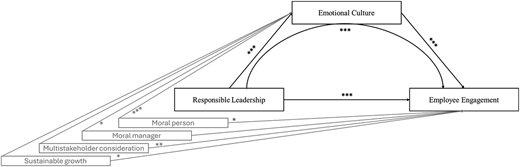
The multiple regression testing H1 showed a significant overall model (F8,99 = 32.69, p < 0.001). Responsible leadership was positively related to employee engagement (β = 0.84, p < 0.001), confirming H1. None of the control variables had a significant effect (Table 2, Figure 1).
The second analysis, examining the subdimensions of responsible leadership on employee engagement, showed a significant overall model (F11,99 = 24.29, p < 0.001). Moral person (β = 0.319, p < 0.05), multi-stakeholder interest (β = 0.380, p < 0.01), and sustainability growth (β = 0.228, p < 0.05) had significant positive effects, while moral manager was not significant (β = −0.04, p = 0.77). None of the control variables were significant (Table 3, Figure 1).
The multiple regression testing H2 was significant (F8,99 = 37.73, p < 0.001). Responsible leadership positively affected emotional climate (β = 0.865, p < 0.001), confirming H2. Among controls, only marital status was negatively associated with emotional climate (β = −0.38, p < 0.05), indicating that married or divorced participants perceived a more negative climate than singles (Table 4, Figure 1).
The second analysis, conducted to further examine the relationship between responsible leadership—along with its four sub-dimensions—and emotional climate, was significant (F11,99 = 29.19, p < 0.001). Among the sub-dimensions, only moral person (β = 0.485, p < 0.001) and moral manager (β = 0.328, p < 0.05) showed a positive and significant association with emotional climate (Table 5, Figure 1).
The regression analysis conducted to test hypothesis H3 was also significant (F8,99 = 30.83, p < 0.001). Emotional climate (β = 0.824, p < 0.001) emerged as a strong positive predictor of employees' engagement, thereby supporting hypothesis H3. In contrast, none of the control variables exhibited a significant effect on employees' engagement (Table 6, Figure 1).
Finally, to test hypothesis H4, a mediation analysis was conducted. The overall model was significant (R = 0.88, R2 = 0.78, F = 35.94, p < 0.001). Consistent with the results obtained for H1, the direct effect of responsible leadership on employees' engagement was significant (β = 0.48, p < 0.001). Likewise, and in line with the regression conducted for H2, emotional climate exerted a positive and significant direct effect on employees' engagement (β = 0.42, p < 0.001). None of the covariates showed significant effects (Table 7, Figure 1). Crucially, the indirect effect of responsible leadership on employees' engagement through emotional climate was significant (β = 0.36, LLCI = 0.16, ULCI = 0.58), thereby supporting hypothesis H4.
Discussion
This study examines the three-way relationship between responsible leadership, emotional climate, and employees' engagement. The findings provide insights that both align with and challenge existing literature.
First, the results confirm a significant positive relationship between responsible leadership and employees' engagement, supporting H1 and echoing prior research (Den Hartog and Belschak, 2012; Xu and Thomas, 2011). Notably, the “moral manager” dimension did not significantly predict engagement, suggesting internal tension within the responsible leadership construct. Whereas “moral person” reflects leaders' intrinsic ethical values, “moral manager” centers on monitoring and enforcement, revealing a potential paradox between care and control. This paradox may be context-dependent: in post-pandemic hybrid work settings, employees may prioritize authenticity, empowerment, and relational support over transactional oversight, indicating that the relevance of specific leadership dimensions varies with organizational conditions.
Second, the positive relationship between responsible leadership and emotional climate supports H2 and aligns with prior work (Maamari and Majdalani, 2017). Only “moral person” and “moral manager” predicted emotional climate, indicating that employees are especially sensitive to leaders' ethical integrity and fair role modeling—consistent with emotional labor research. Leaders who display authenticity, consistency, and fairness help shape a shared positive emotional tone, reflecting the interplay of care and control. This is in line with Ashkanasy's (2003) multi-level theory, which posits that employees derive affective cues from both leaders' values and interpersonal behavior, ultimately reinforcing commitment.
Third, the findings confirm that emotional climate directly enhances employees' engagement, supporting H3 and extending prior research (Elfenbein, 2023; Rasool et al., 2021). Emotional climate acts as a contextual enabler of role connection: in positive climates, employees experience greater alignment, reduced emotional dissonance, and more authentic engagement. This has become especially salient post-COVID-19, as personal and professional emotional regulation increasingly overlap. Thus, emotional climate functions as both a buffer and an amplifier of emotional labor, ultimately shaping engagement.
Finally, the mediation analysis confirmed that emotional climate is a key pathway through which responsible leadership enhances engagement, indicating that emotional climate transmits leadership effects (Ashkanasy and Dorris, 2017). This highlights that leadership influence is not only direct but also contextually mediated, underscoring the need for leaders to actively shape the emotional climate—an aspect whose relevance may vary across organizational contexts and work arrangements. Overall, the study points to the increasing centrality of emotional dynamics in a post-COVID world (Formica and Sfodera, 2022). Socially sustainable leadership depends not only on ethical intent but on the emotional experiences it fosters, revealing how tensions between control and care ultimately shape engagement.
Theoretical and managerial implications
This study offers important theoretical contributions. It clarifies how responsible leadership, emotional climate, and employee engagement are interconnected, showing that leadership effects operate both directly and through affective mechanisms. Extending prior work focused on direct outcomes such as job satisfaction and commitment (Barsade and O'Neill, 2014), the findings underscore emotional climate as a key mediator linking leadership to engagement (Ashkanasy and Dorris, 2017; Barsade and O'Neil, 2016; Elfenbein, 2023). The results further show that responsible leadership shapes both ethical practices and the emotional environment, highlighting the tension between care and control in contemporary workplaces. Finally, the findings raise conceptual questions about whether responsible leadership is a distinct construct or overlaps with ethical, servant, or transformational leadership. As Maak and Pless (2006) note, its integrative ambition enriches but also blurs its conceptual boundaries.
Practically, the findings suggest that HR and leadership interventions should target emotional climate and psychological safety. Leadership development programs could include emotional intelligence training (Goleman, 2020), scenario-based ethical decision-making, and 360-degree assessments emphasizing relational and ethical competencies. In remote and hybrid work, interventions should address emotional fatigue, isolation, and cognitive overload (Dong et al., 2025; Mäkikangas et al., 2022). HR can foster a positive emotional climate by embedding empathy, respect, and fairness into evaluations, rewards, and feedback, while monitoring affective outcomes via pulse surveys or validated instruments (Briner and Barends, 2016). Managers can enhance engagement through structured check-ins, recognition of collaboration, and transparent communication, especially in digitally mediated work. CSR initiatives aligned with organizational values may further strengthen employees' sense of purpose, mitigating emotional fatigue and supporting engagement (Ribeiro et al., 2024).
In sum, responsible leadership is most effective when ethical conduct is paired with attention to emotional dynamics, balancing care and control. Evidence-based, context-sensitive HR practices that address challenges like remote engagement and emotional fatigue help create environments where employees feel valued, supported, and highly engaged.
Limitations and future research
Despite its contributions, this study has limitations. The small, convenience sample limits generalizability, and the cross-sectional design precludes causal inferences. Future research should use larger, stratified samples, longitudinal designs, and multi-source data to reduce bias and enhance validity (Harms and Credé, 2010). The conceptual boundaries of responsible leadership remain unclear, warranting studies on its discriminant validity and comparison with related styles. Other factors—such as organizational structure, job design, team dynamics, and cultural or contextual variations—should also be explored. Qualitative studies could examine leaders' perceptions of ethical and relational leadership and potential conflicts with organizational goals. Addressing these issues will yield a more nuanced understanding of the links between leadership, emotional climate, and engagement.
Thanks to Nana Gogokhia for her help with data collection.