Skip to Main Content
Purpose

Existing research claims that institutional investors view corporate social responsibility (CSR) as an important mechanism in measuring corporate legitimacy. Yet, broader research on how retail investors (RIs) respond to CSR remains scarce. This study aims to investigate the perception of CSR-related investment criteria among RIs and how RIs in different societal contexts prioritize their investment decisions regarding CSR.

Design/methodology/approach

The study examines how RIs from China, Germany, Brazil and the USA (n = 452) prioritize CSR when making investment decisions. CSR is measured through environmental, social and governance (ESG) activities, as defined by Bloomberg’s and Dow Jones’ social behavioral indexes and viewed through the lens of legitimacy theory. The ESG prioritization was conducted using the choice-experiment method, which is suitable for investigative and multi-criteria contexts.

Findings

The findings reveal an inconsistency that challenges academic beliefs regarding CSR, suggesting that what is suitable for firms (e.g. gender diversity on boards and union collaboration) appeals to all investors. Yet, this is refuted among RIs. Widely accepted business practices and ESG activities are not perceived in the same way by RIs.

Practical implications

The significant differences regarding Ris’ ESG preferences between sample groups can be helpful to executives managing investor relations. Firms could adjust their CSR reports to target each investor category, just like market communication is adjusted to appeal to different target groups. Correctly designed, this could increase firms’ legitimacy, investment image, corporate reputation and financial performance.

Originality/value

The research reveals that RIs prioritize ESG activities differently in their decision-making criteria than the mainstream knowledge body. The results show that what is commonly accepted as essential for institutional investors is unimportant to RIs. RIs deprioritize, e.g. gender equity on boards, which, according to the broader literature and contemporary press, is beneficial to organizations. This represents a “dark side” where there is a discrepancy between what firms believe to be important to all investor categories and how CSR programs are designed.

A company’s value proposition can be improved by including a corporate social responsibility (CSR) program. This has been shown to yield positive effects, such as enhanced legitimacy and reputational capital (Brunen and Laubach, 2022; Hafeez et al., 2022). Therefore, stakeholders perceive firms with solid CSR as more trustworthy and as upholding societal norms and expectations (Palazzo and Scherer, 2006). Consequently, executives today face increased pressure from both private (retail) and professional (institutional) investors to report on their CSR activities (Hawn et al., 2018; Hsieh et al., 2020). Retail investors (RIs) are private individuals who invest their own money with varying experience and rationale (Ricci and Sautter, 2021), and institutional investors are licensed professionals (Basile, 2024) who invest their clients’ money (e.g. pension funds) on behalf of their employers (e.g. a bank). Yet most research focuses on CSR as a concept (Tarba et al., 2020; Zhou et al., 2022) and firms’ interactions with institutional investors, leaving RIs largely unexplored (Huang et al., 2024) regarding, for example, the extent to which RIs care about sustainable investments and, if they do, why (Li et al., 2024; Moss et al., 2024). RIs’ preferences have become increasingly important because of the rapid growth of this investor category. In 2012, RIs in the USA held 11% of sustainable assets, compared to 25% in 2020, representing a 227% growth. This makes it essential to understand the drivers and worth systematizing the factors driving RIs’ sentiment regarding ESG interest (Pasquino and Lucarelli, 2024). In their study, Li et al (2024) find that US RIs care about firms’ environmental, social and governance (ESG) activities (primarily for the potential financial improvements of the investment target) yet highlight that existing RIs research is narrow and vague (Li et al., 2024). Hence, showing research highlights institutional investors’ value CSR, but broader research on how RIs perceive CSR remains scarce (Huang et al., 2024; Li et al., 2024; Paisarn et al., 2021; Petelczyc, 2022) and lacks detail regarding how RIs prioritize the investment target’s ESG activities (Benuzzi et al., 2024; Hazelton and Perkiss, 2018; Li et al., 2024; Prasad et al., 2021). A deeper insight into the RIs’ perception of firms’ ESG activities (CSR operationalization) is, therefore, a valid research imperative (Li et al., 2024; Öberseder et al., 2011).

With CSR potentially improving corporate financial performance (CFP), investors actively seek CSR-related investment information (Yu et al., 2018), for example, assessing their investment targets’ CSR on social and ethical behavioral (SEB) indexes. These indices measure (rank) social responsibility in terms of ESG activities (Eccles et al., 2020; Ramchander et al., 2012) to indicate (price) the potential financial benefit (Benlemlih, 2017; Hawn et al., 2018; Kim et al., 2021). Firms awarded a higher indexed position than a lower-ranked firm are more likely to gain improved CFP, making the ESG rank an investment decision criterion over time (Ford et al., 2022; Mervelskemper and Streit, 2017). However, while preponderant research firmly states that institutional investors embrace SEB indexes, there is limited research on whether this is consistent with RIs (Öberseder et al., 2011).

Consequently, this study assesses CSR business activities in terms of ESG, evaluating the similarities and differences regarding RIs’ preferences versus established norms among institutional investors, using the choice experiment (CE) method. Unlike previous research that has investigated one ESG activity, this study examines 22 previously assessed ESG activities important to institutional investors ( Appendix). The study thereby contributes to the repeated call for better contextualized CSR (Eccles et al., 2020; Fatma et al., 2022; Pérez and Rodríguez del Bosque, 2013; Schiessl et al., 2022; Wijesundara et al., 2024) via the lens of legitimacy theory. This theory, whose central assumption states that:

the maintenance of successful organizational operations requires managers to ensure that their organization appears to be operating in conformance with community expectations and therefore is attributed the status of being legitimate (Deegan, 2019, p.2315), is suitable for multiple reasons.

First, according to legitimacy theory:

[…] organizations can only continue to exist if the society in which they are based perceives [them] to be operating to a value system that is commensurate with the society’s value system (Lee and Raschke, 2023, p.2).

Second, as the legitimacy theory suggests that society determines what is perceived as proper behavior, RIs’ behavior could be influenced by a society’s view (Suchman, 1995). Third, corporate decisions affect individuals and society (Tsirtsis et al., 2024), for instance, the selection of “E,” “S,” and “G” activities supportive of, or opposed to, stakeholders’ expectations of “good” corporate behavior (Eccles et al., 2020). Finally, it is a suitable theory, as the study seeks insight into which categories of legitimate actions represent a win-win outcome regarding compliance with societal expectations and improved corporate reputation, both of which represent solid social contract components (Carlsson Hauff and Nilsson, 2023; Hamdoun et al., 2022).

While stakeholder theory is normative in CSR research, we deviate from its inclusion in this study due to its focus on how stakeholders in general perceive a concept (i.e. a stakeholder approach without a specific stakeholder). Furthermore, applying legitimacy theory enables the assessment of how a particular stakeholder category responds to distinct criteria in multiple contexts, particularly when making a dedicated decision that involves multiple variables. The study further assesses RIs from Brazil, China, Germany and the USA (n = 452). This approach directs the study to investigate RIs’ perceptions from a strategic management perspective through four research propositions: that RIs value ESG information when making investment decisions (RQ1); that the “E”, “S” and “G” categories differ in importance to RIs (RQ2); that RIs, in general, prefer different ESG activities than those previously reported to be important to investors (RQ3); and that RIs from different nationalities value different ESG activities (RQ4).

The study contributes to legitimacy theory and our understanding of legitimacy within the context of RIs’ decision-making. That is, by highlighting inconsistencies in RI perceptions versus those of normal business practice related to CSR (a form of building legitimacy), this study shows that RIs may perceive or prioritize different factors of CSR within the investment decision. The results indicate that context, such as country or cultural background, may influence the social norm of the decision-maker and lead to different investment decisions. The study reveals an inconsistency in the evaluation of CSR activity, where what is perceived to be of significant value to institutional investors (e.g. gender diversity) is widely viewed as irrelevant among RIs. This level of detail suggests theoretical and practical implications from the dark insights. Current and widely accepted business practices, such as “one-size-fits-all,” do not align with RIs’ perceptions of expected business ethics and standards, as a contextual bias influences financial investor behavior. One part of the problem is the mismatch where socially responsible investment managers lack a detailed understanding of how individual investors respond to specific ESG activities (Meunier and Ohadi, 2023). In summary, the study empirically concludes that RIs prioritize certain ESG activities collectively (homogeneity), ignore other ESG activities individually (heterogeneity) and, overall, prioritize ESG activities that contradict previous research. This supports Schneider’s (2020) claim that corrective measures are necessary to modify corporate practices and policies, thereby enhancing societal understanding and preparing firms for future business challenges.

To link the theory to the literature review, this section builds on the broader legitimacy descriptions provided in the introduction section by connecting the theory to the research context. From an organizational perspective, legitimacy theory is founded on a social contract between society and the organization (Fernando and Lawrence, 2014; Lee and Raschke, 2023). It is a constructed societal view of proper organizational behavior that can build, repair and maintain trust (legitimacy) in the eyes of that society (Suchman, 1995). There is consequently complexity for organizations that operate across multiple societies, such as international organizations or those with international investments. This can be one reason why some firms provide CSR-ESG disclosure of questionable quality, leading, for instance, to symbolic reporting practices (Del Gesso and Lodhi, 2025). While ESG represents a way to measure how organizations conform to appropriate operational behavior and context, the complexity of organizational conformity might lead to a misalignment with the expectations of society. Furthermore, while exhibiting CSR and ESG behavior may contribute to trust and legitimacy in one society, this may not be the case in another society. If we extend this logic, what might be acceptable behavior that contributes to legitimacy in one group within society might not be considered legitimate by another group (Moll et al., 2006). Therefore, although CSR and or ESG frameworks may be used to help establish an organization’s legitimacy, they may have varying effects within and across societies. Xu and Liu (2023) support this phenomenon, claiming that positive ESG effects are significantly moderated by national culture. However, as suggested, this is not well understood within differing investor and societal groups or cultures. In conclusion, to gain legitimacy as an organization, the principal practice of engaging in CSR is to build reputation and/or legitimacy among stakeholders (Olateju et al., 2022). Investors’ decisions are based in part on the organization and its CSR reporting practice as a form of legitimacy expectations within business practice.

The application of legitimacy theory on ESG as a tool of CSR will be evaluated next.

To acknowledge the widespread acceptance of ESG among institutional investors, the first research question (RQ1) addresses whether RIs perceive ESG information as valuable when making investment decisions. From an academic perspective, the positive relationship between ESG and CFP stems from three meta-analyses. Combining Orlitzky et al.’s (2003), Wang et al.’s (2015) and Friede et al.’s (2015) analysis spanning 158,963 observations in 1,678 uniquely identifiable studies over four decades (1972–2012), a distinct and positive relationship where >90% of the studies report a positive ESG-CFP relationship with increasing effects over time (Brooks and Oikonomou, 2018; Raithel and Schwaiger, 2015).

ESG also provides internal and external intangible competitive advantages (CA). Employees who perceive an employer as socially good and legitimate may, for example, display increased employer loyalty and a sense of organizational belonging (DeTienne et al., 2012), as well as improved organizational commitment and a willingness to provide better customer service (Porter, 2008; Shen and Benson, 2014). With employees being better motivated to perform and contribute to corporate success (Hamdoun et al., 2022; Jarvis et al., 2017), research highlights the creation of external intangible CA. For instance, improved corporate reputation (González-Rodríguez et al., 2015; Haleblian et al., 2017); environmental innovation (Schiessl et al., 2022); lower financial risks (Shakil, 2021); internationalization costs (Berrill et al., 2019); enhanced investor trust (Rezaee and Tuo, 2017); and increased demand for firms’ shares (Chen and Craig, 2023), all of which are important and supportive of corporate growth and future profitability. RIs are therefore likely to be interested in ESG rankings as they signal potential increased future returns (Ford et al., 2022; Hillenbrand and Schmelzer, 2017). As a result, organizations that communicate their CSR strategy increase ESG attention and display legitimacy as their CSR portrays a more genuine and potentially more profitable firm than organizations that do not (Mervelskemper and Streit, 2017; Oyotode-Adebile et al., 2022). We therefore hypothesize (RQ1) that RIs perceive ESG information to be valuable when making investment decisions.

Building on the first research question, the second question (RQ2) is: which of the three categories “E”, and/or/“S” and/or “G” appeals (more or less) to RIs? Do any ESG categories in aggregate point toward any of them being more favorable? As indexes use ESG scores to measure CSR, they assume that corporate actions must be desirable, legitimate, or appropriate within a social context of norms, values and definitions. Hence, legitimacy becomes a mechanism that supports the development and implementation of voluntary pro-environmental, pro-social and/or pro-governance actions to satisfy perceived or undertaken social contracts (Schiopoiu Burlea and Popa, 2013).

To satisfy the demand for ESG information, multiple SEB indexes report firms’ E, S and G performance (Eccles et al., 2020; Isaksson and Woodside, 2016; Ramchander et al., 2012). These are provided by investment services providers and marketed as advisory tools, for example, the Dow Jones Sustainability World Index (Durand et al., 2019); the S&P500 (Tamimi and Sebastianelli, 2017); the EuroStoxx600 index (Stolowy and Paugam, 2018); the KLD index (Eccles et al., 2020; Perrault and Quinn, 2018); and Bloomberg ESG (Tamimi and Sebastianelli, 2017). The ESG scores aggregate multiple sub-category measures to provide an indexed rank, for instance, whether firms engage in “Eco-Friendly Logistics” (E activities), “Promoting Diversity” (S activities) or having “Female Board Members” (G activities). The study applies 22 recognized ESG activities that, in effect, represent operative or management tactics enabling a strategic approach to CSR ( Appendix). Investors then assess the target firm’s ESG and its potential to increase firm-level CFP, aiding their investment decisions. That is, to buy, increase, or decrease shareholdings. As a result, interest arises regarding whether and how RIs believe firm-level CSR to be performance-enhancing (Hawn et al., 2018) and which foundational ESG categories (operative or management tactics) increase investor appeal (Keig et al., 2019).

Research on investor ESG preferences is abundant (Friede et al., 2015; Huang et al., 2024), often concluding that institutional investors are influenced by various ESG activities (Paisarn et al., 2021; Petelczyc, 2022). On the other hand, research into how RIs respond to and prioritize ESG activities remains incomplete (Arvidsson and Dumay, 2022; Huang et al., 2024). We remind the reader that RIs are private individuals who invest their own money with varying experience and rationale (Ricci and Sautter, 2021), and that institutional investors are licensed professionals (Basile, 2024) who invest client funds (e.g. pension funds) on behalf of their employers (e.g. a bank). The third research question (RQ3) consequently assesses whether RIs prefer different ESG activities than those previously reported as essential for academia and institutional investors (Tables 1 and 7).

Several researchers (Durand et al., 2019; Zhou et al., 2022) report “S” activities to be perceived as more important to investors and financial analysts than “E” or “G” given the positive effect on firms’ market-capitalization value (MCAP), and positive correlation to increased shareholdings in a target company (Chen and Craig, 2023; Durand et al., 2019). Yet, “E” and “G” disclosure can also positively increase CFP and be perceived as economic value adds (Schiessl et al., 2022). For example, recycling raw material (E) or having anti-corruption policies (G). It is further reported that institutional investor quality matters as top investment institutions allocate higher proportions to firms with high ESG rankings (Lopez‐de‐Silanes et al., 2024). If ESG is externally visible, it is also more attractive to investors who perceive the firm as having better governance in general, thus being more dependable and operationally robust (Oyotode-Adebile et al., 2022). While investors assess ESG (Durand et al., 2019) when comparing investment alternatives (López-Cabarcos et al., 2019; Raithel and Schwaiger, 2015), it is noteworthy that they might value different “E”, “S” and “G” activities across different markets influenced, e.g. by CSR communication (Hillenbrand and Schmelzer, 2017). Investors in general perceive “E” activities as more appealing due to increasing societal interest in sustainability, for instance, energy and water-saving plans (Benuzzi et al., 2024; Hazelton and Perkiss, 2018), yet RIs with a financial perspective prefer “S” activities (Benuzzi et al., 2024). Non-financial reporting, such as annual CSR reports or Sustainability Reports, is a necessary corporate activity for these reasons (Arvidsson and Dumay, 2022; Rezaee and Tuo, 2017): to accommodate investor needs and to demonstrate corporate legitimacy (Szkudlarek et al., 2020). As maximizing shareholder returns and a firm’s MCAP is often a formal and legislated requirement, non-financial reporting should logically be in the best interest of all investor categories. This supports the strategic rationale for firms to pursue genuine CSR, as organizations with strategically and robustly integrated ESG are perceived more favorably (Amel-Zadeh and Serafeim, 2018) and more legitimately (Du and Vieira, 2012).

In addition, research reports that RIs’ characteristics can affect (screening) their decision-making (Abreu and Mendes, 2020; Hemrajani et al., 2024; Paisarn et al., 2021), such as gender, risk tolerance, the propensity to gamble, along with psychological traits such as anchoring, culture and overconfidence (Jaiyeoba et al., 2020). It is further reported that the external environment, sociodemographic profile, internal dimension of RIs (Pasquino and Lucarelli, 2024), and level of financial literacy can affect RIs’ decision-making (Prasad et al., 2021).

It consequently commands an evaluation and deeper understanding of how RIs respond to and prioritize ESG activities (Arvidsson and Dumay, 2022). Drawing support from Heeb et al. (2023) that RIs’ investment decisions are partially emotional (e.g. feeling positive emotions when choosing sustainable investments), we proxy the existence of personal characteristics by hypothesizing (RQ3) that RIs prefer different ESG activities than those previously reported to be of importance for institutional investors (Table 1).

The effects of national culture on behavior and decision-making represent a growing body of knowledge (Petersen et al., 2015; Sobol et al., 2018; Swoboda and Sinning, 2020). Although a considerable amount of research examines financial decision-making (Doney et al., 1998; Hemrajani et al., 2024; Lee et al., 2019) and proclaims that nationality affects how investors embrace and act upon information (Chang and Lin, 2015; Galariotis and Karagiannis, 2021), to this point, little empirical research exists linking nationality and intangible financial decision-making (Chang and Lin, 2015; Ngcamu et al., 2023; Petersen et al., 2015). One exception is a study by Hsee and Weber (1999), which concludes that systematic cross-national differences in choice-inferred risk preferences exist when comparing USA and Chinese investors (in a dual-comparison), with Chinese risk investors displaying lower risk aversion when making financial decisions. As a result, firms could consider national culture, for instance, when marketing investment opportunities (Aggarwal and Goodell, 2018; House et al., 2002), especially in international stock markets (Chang and Lin, 2015). Yet, most studies assess homogenous contexts (singular nationality), covering, for example, France, Malaysia, Poland, South Korea, Spain, Thailand, or the UK (Assaf et al., 2024; Chen and Schmidt, 2021; Jaiyeoba et al., 2020; Panicker et al., 2019; Petelczyc, 2022). These studies further address culturally based perceptions rather than examining the potential impact of national values. The study, therefore, assesses (RQ4) potential national differences between RIs’ decision-making.

Given that RIs’ decision-making is an under-researched topic (Busch et al., 2016; Hafeez et al., 2022; Huang et al., 2024; Moss et al., 2024), robust contextual insight is required. Insight into whether RIs respond to ESG information, how they respond, and whether RIs respond differently compared to what research suggests is important to institutional investors, would add to the body of ESG knowledge (Li et al., 2024). Yet most research uses conventional empirical models (e.g., regression analysis) despite the risks of shallow contextual insight (Woodside et al., 2020). This research contrasts conventional modeling with a CE. Pasquino and Lucarelli’s (2024) analysis revealed that studies investigating investor preferences often fail to consider the concurring influence of multiple perspectives. They conclude that the literature has not adequately addressed the mediating and moderating effects of the factors determining RIs’ decisions. This lends significant and robust support to the selected CE methodology. That is, it is a complex matter where individual rationale and psychological influences (see “behavioral finance theory”) interact with multiple mediating and moderating variables, such as the external environment and sociodemographic profile (Pasquino and Lucarelli, 2024), lending robust support to deploying CE.

CE further enables more consistent comparisons, delivering more precise and reliable outcomes and minimizes inconsistency and uncertainty in the results while solving complicated multi-criteria decision-making problems (Debnath et al., 2023; Lee et al., 2008; Rezaei, 2015). CE is consequently a suitable method in the multi-criteria context of this study. Not only does the CE method avoid conventional empirical research limitations (e.g. by implying distinct linear relationships or suggesting single outcome directionality), but it is also a more robust and more suitable method for investigative and indicative research, and in multi-criteria contexts, as is the case in this study investigating ESG preferences among RIs (Chang and Lin, 2015; Tsirtsis et al., 2024). The CE method is for these reasons applied across multiple academic disciplines (Adamowicz et al., 1998; Harrison, 2024; Louviere et al., 2015) and published in Q1-A* journals such as the Journal of Management and Strategic Management Journal (Auger et al., 2007; Chua, 2018; Chatterji et al., 2016; Jia et al., 2020; Stefano and Gutierrez, 2019). Examples of research using the CEs method include decision-making behavior (Auger et al., 2007), strategic management (Stefano and Gutierrez, 2019) and strategic ESG and ESG performance (Carlsson Hauff and Nilsson, 2023; Heeb et al., 2023).

In CE, respondents make decisions while exposed to various alternatives or choices, repeatedly selecting what they perceive as the best option versus the worst. We highlight that each decision choice in CE questionnaires is presented equally to the respondent, eliminating any decision bias. It thereby represents absolute respondent and assessment fairness. The inherent fairness in the method also removes any clustering, grouping or patterns of information presented to the respondent that frequently lead to biased responses in traditional (non-experimental) questionnaire-based research (Cohen, 2003; Woodside, 2016).

To maximize randomness and to minimize respondent bias during the experiments, the Sawtooth software (Cohen, 2003; Demirciftci et al., 2023; Orme, 2009; Sawtooth Software, 2019) uses orthogonal questionnaire design, also known as paired comparison design, which balances respondent exposure to the experimental decision simulations (the questions and choices). This means that each respondent is presented with every choice option (i.e. the 22 ESG items in this study) where:

  • each item appears an equal number of times (balanced frequency);

  • each item is shown in the same sets of information with all other items an equal number of times (orthogonality);

  • each item appears an equal number of times in the top, middle and bottom positions in the sets (within-set balanced positions); and

  • items in each version are distributed across the questions to avoid showing the same item in successive (or nearby) sets translating to an effective balanced across-set position (Cohen, 2003; Orme, 2009).

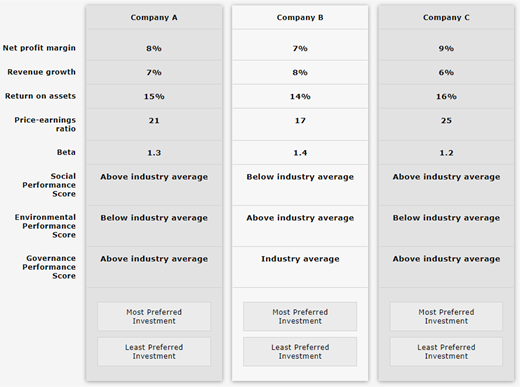
This fairness applies to all ESG choices and financial performance indicators (Net Profit Margin, Revenue Growth, return on assets, profit earnings ratio, Beta), making distinct individual-level analysis appropriate (Orme, 2009), as exemplified in Figure 1.

The study applied 22 previously assessed ESG activities reported to be relevant and valued by institutional investors to investigate the value perception of these activities to RIs (see Tables 1, 7 and  Appendix for criteria descriptions and references). That is, the research design did not pre-screen which activities to exclude but instead allowed for a broader criteria assessment by, in this case, including all empirically assessed activities at the time of data collection. This maximization of choices are methodologically recommended since the chance to extract elusive and unexpected findings increases in general (Carlsson Hauff and Nilsson, 2023; Heeb et al., 2023; Rezaei, 2020), and from interrelationship effects (correlations and interactions) specifically, as findings can be unobservable in studies with narrower criteria inclusion (Debnath et al., 2023). Hence, the authors accepted unbalanced criteria inclusions (more “S” activities than “E” or “G”) in line with Debnath et al. (2023) and Heeb et al. (2023) recommendations and conjecture this criteria palette to better enable in-depth probing into preferential and differing perceptions among RIs (Huang et al., 2024; Li et al., 2024). The ESG activities are also:

  • commonplace in SEB indexes;

  • assessed in previous ESG research; and

  • logically sense-making and easy to understand by individual RIs.

A logit analysis (Table 2) displays the comparative outcome of each heterogeneity activity in the form of rescaled coefficients. When comparing, for example, Chinese RIs and German RIs’ view (preference) on safe working conditions (social: S8; Table 2), we find the coefficients 0.98 for Chinese RIs and 0.41 for German. This means the relative desirability of the “S8” ESG activity is more than two times more important (0.98 / 0.41 = 2.4; or 240%) when comparing these RIs groups.

The next step is to derive the proportional RIs preferences expressed in percentage (%) (Table 3). For instance, to assess which “G” activity US RIs view as most important, they were asked to select which ESG activity was best versus worst and compare the number of times they selected one or the other. To exemplify, they selected G7 (anti-corruption policy) the most times (28% of all choices made by the US RIs). A proportional assessment was then undertaken. The proportions assess the most significant difference between the times an ESG activity was selected as the best choice (i.e. most important) versus the worst choice (i.e. least important). Using this calculation, we find G6 to be more interesting than G7 from a comparative point of view. That is, the G7 difference (28% vs 15%) is 28 / 15 = 1.86, or 186%, compared to the G6 difference (26% vs 10%), which is 26 / 10 = 2.6, or 260%. Hence, in absolute measure, US investors rate G7 as the most critical “'G” activity. Still, given the larger percentage difference (a 260% difference for G6 vs a 186% difference for G7), G6 is the more critical governance activity from a proportional perspective.

The proportional RIs’ preferences are then used to rescale the coefficients into scores, enabling contextual comparison to interpret the RIs’ choices (Table 4) distinctly. The preferential choice comparison is measured by the relative desirability or worth, i.e. how valuable an ESG activity is perceived to be by an RIs respondent, and whether the relative desirability of a particular ESG activity differs between the RIs groups. Findings of high importance to one RIs group and of low significance to another are therefore also assessed. In other words, the following step displays which specific ESG activities were individually ranked as best and worst in total, by gender and separately by each RIs group.

The main challenge to acquiring neutral and/or accurate responses (data) in traditional questionnaire-based research is to avoid respondent bias across groups for a particular instrument. For example, in the form of scalar inequivalence whereby two or more constructs have the same meaning (Cohen, 2003), social desirability bias, or acquiescence bias (yes-saying) (Lee et al., 2008). At its core, it represents the risks that respondents respond in line with expected views according to their group identity, or the tendency to agree with any research statement without it being a true reflection of their actual beliefs. The CE method eliminates these common bias categories, allowing researchers to understand the extent to which people value and prioritize the distinct ESG criteria in their decision-making process, as applied in this study (Tables 1 and 7 and  Appendix). It also assesses whether they view them differently, i.e. whether their responses are heterogeneous (Auger et al., 2007; Stefano and Gutierrez, 2019). CE is therefore a more solid and robust method in this type of research (complex multi-criteria decision-making problems). The study followed Bryman’s (2016) recommendation to maximize research contribution for CE using convenience sampling (normative in business and management research modeling) as the preferred approach over, for example, probability sampling (Bryman, 2016).

Although convenience sampling is potentially non-representative and can challenge research generalizability (Sekaran and Bougie, 2016), the large sample size (n = 452 RIs) and broad representation (four different nations) are considered substantial and therefore represent a robust counterweight to non-generalizability, which, in combination with the applied established national comparative frameworks (the World-Values scales and Hofstede), enables generalizability in this context, as evident by using more than one RIs nationality.

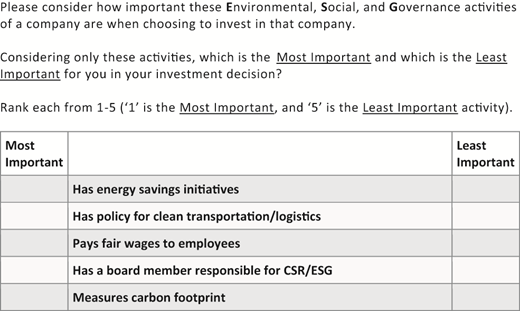
The participants were recruited through the online research panel CINT (CINT, 2022), as recommended by behavioral scientists for research in today’s digital society (Chandler et al., 2019; Litman and Robinson, 2020). The RIs received a nominal remuneration (symbolic $5) to provide demographic data and participate in experiments that exposed respondents to investment alternatives with varying ESG activities. The completion time of each CE (investment simulations) occurred during January and February 2019 and took 15 min. To prevent potential language challenges, the study engaged professional translators who translated the experiment from English to Portuguese, Modern Standard Mandarin and German, respectively, whereafter a second translator was engaged to perform back translations to ensure linguistic accuracy and consistency. Figure 2 exemplifies the randomized structure for which the respondents had to decide which ESG activity was the most (and least) important “E”, “S” and “G” activity when making investment decisions alongside financial performance information.

Despite growing knowledge, research into RI-ESG preference remains scarce (Li et al., 2024) and portrays weak generalizability. In brief, little empirical research exists investigating the potential effects of RIs’ general perception (Huang et al., 2024) or individual effect (Pasquino and Lucarelli, 2024; Prasad et al., 2021) on financial decision-making (Benuzzi et al., 2024; Chang and Lin, 2015; Petersen et al., 2015). Therefore, the sampling choice was to opt for an exploratory study following Bryman’s (2016) recommendations, including using convenience sampling (to extend beyond the single-nation or dual-nation unit of analysis) and to advance research that contributes to theory regarding RIs’ behavior and ESG preferences. Sampling also eliminates potential arbitration issues, as both the sample and the selection criteria are well-defined (Bryman, 2016). The study sought to source RIs from:

  • nations with online international trading experience;

  • developed and emerging economies;

  • from diverse locations; and

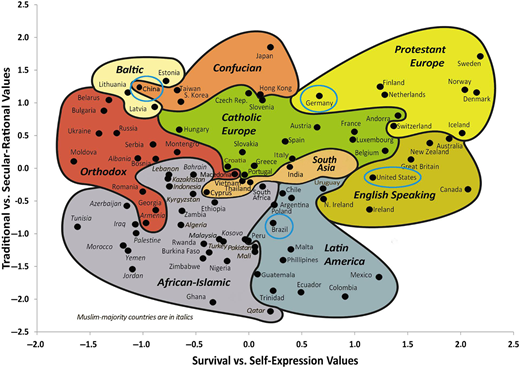
  • from nations as apart as possible from each other according to the World Values Survey (WVS) definition of cultural clusters and its scales “traditional vs secular-rationale values” and the “survival vs self-expression values” (Haerpfer et al., 2022; Figure 3).

After completing the national selection, scores for Hofstede’s cultural dimensions (Table 5) were widely used in psychology, marketing and management research to assist outcome interpretation (Makino and Neupert, 2000; Matharu et al., 2024; Soares et al., 2007; Steenkamp, 2001).

The study therefore selected RIs (Figure 3) from the “English-speaking” cluster (USA), the “Protestant Europe” cluster (Germany) and the “Confucian” cluster (China). While the above rationale would suggest including RIs from nations in the WVS “African-Islamic” cluster (e.g. Morocco), we replaced it with RIs from the WVS “Latin American” cluster (selecting Brazil) because of a lack of participants with online international trading experience and data availability in the former cluster (Haerpfer et al., 2022). We further excluded nations from the “Orthodox”, the “Catholic Europe”, the “Baltics” (being smaller economies) and the “South-Asia” cluster (being culturally too close to Germany and the USA as positioned on the WVS scale: Figure 3), and these clusters lesser experience in online trading. Two thousand invitations were distributed via CINT (CINT, 2022) resulting in 452 (22.6%) complete information sets for RIs from Brazil, China, Germany and the USA (n = 114; n = 113; n = 114; n = 111 respectively) to assess which ESG activities they perceived to be the most (best) or least (worst) important factors alongside financial performance indicators when making investment decisions. The average respondent profile displays a male investor (58% versus 42% women) holding a BSc degree (44%) belongs to the 30–49 age bracket (68%). The RIs displayed homogeneity in their trading profiles, with solid investment experience (33% 1–4 years; 29% 5–9 years; 33% > 10 years) and in regularity (34% 1–9 trades per year; 35% 10–20 trades per year). Consequently, it is conjectured that the RIs are knowledgeable about ESG, as per the study by Li et al. (2024). See Table 6 for details.

The results show both homogenous and heterogenous relations (i.e. significant indifference or difference in relative desirability) regarding how RIs rate the importance of different ESG activities (Table 3), and that only seven of the 22 (32%) previously reported ESG activities important to institutional investors are also crucial to RIs (Table 7).

When assessing which Top3 and Bottom3 ESG activities the sample groups prefer and detest, we find the “S” (social) activities, in line with our expectations, to dominate the Top3 activities. We also find that the in-between Top3 and Bottom3 choices display cultural influences, that the data distribution for the Bottom3 choices is distributed across all ESG categories, and that the least important activities were homogenous and contrary to our expectations and to what is supported to be relevant within the institutional investment literature (Table 8).

4.1.1 Top3 choices.

RIs were most concerned overall with “S” (social) activities, which in aggregate focus on the well-being of the workforce. Paying fair wages (S2), not using child labor (S5) and providing safe working conditions (S8) were selected as the most important (best) activities among all RIs. This echoes the preferences among institutional investors as well, yet institutional research mainly assesses ESG activities in singular national samples (e.g. the USA). Hence, the study indicates that workforce well-being might be of universal interest among RIs (Nair et al., 2024). The exception to the strong “S” preference was Chinese RIs who rated fair wages (S2) as the 5th most important ESG activity (just outside the Top3 focus), child labor (S5) as irrelevant (12th) instead selecting it to be more important that firms have a generic CSR policy (G5). Specifically, “Fair Wages” (S2) was chosen as the best activity 37% of the time, “Not Using Child Labor” (S5) 39% and “Safe Working Conditions” (S8) 35% of the time.

To further exemplify the data distribution, we provide samples of findings where one RI group differs from the other RI groups regarding their Top3 and Bottom3 preferences, elevating discussion opportunities in future research. Regarding the recurring threats of cybersecurity (G6), a topic intuitive to be important to all investors (Lopez‐de‐Silanes et al., 2024), only US RIs consider this governance activity a vital investment criterion, ranking it the 4th most important and on average 317% more important than any other RIs group (Table 3) ranking cyber threats the 13th, 14th and 11th “most” necessary (Table 4). In contrast, Chinese RIs rank the inclusion of a CSR-assigned director of the board (G1) as the 4th most important ESG activity (an outlier) and having an official CSR policy (G5) as the 3rd most important ESG activity. In comparison, all other RIs groups rated these governance activities differently. We find that US RIs rate the G1-G5 combination as the 19th and 16th most important (in effect, non-important), with equivalent results for Brazilian (16th and 14th) and German RIs (18th and 17th). Potentially, this might be an oddity observable only in the Chinese market, where institutional investors require high (all) levels of ESG to be in place to trust ESG information (Zou and Zhong, 2025) and display prominent levels of power distance (Table 5). The opposite relationship between the Chinese and the other RIs prevails regarding their view on corruption, another area of paramount importance to institutional investors. Corruption (G7) is not a significant issue among Chinese RIs (rated 13th or insignificant), but it is among Brazilian, German and US RIs (ranking 4th, 6th and 5th, respectively). Again, Chinese RIs are, in this aspect, an outlier compared to even Chinese institutional investors’ concern for fraudulent corporate behavior (Liu and Sun, 2024).

4.1.2 In-between choices.

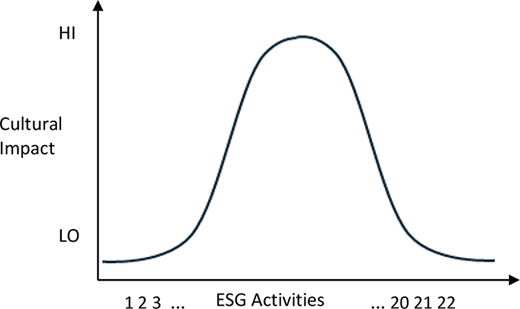
The study finds that nationality matters for ESG activities ranked between the RIs’ Top3 and Bottom3 preferences, indicating a bell curve (Figure 4). The detected preference differences between the respondent groups guide future research on ESG preferences. These are of interest for firms listed in the respective nation, but of lower significance for the research questions. In other words, while nationality effects (culture) were absent and non-observable in the Top3 and Bottom3 choices, there are distinct nationality-related (cultural) preferences regarding the ESG activities between these extremes. This finding aligns with the work of Petersen et al. (2015), Galariotis and Karagiannis (2021) and Chang and Lin (2015), who have also noted that nationality influences RIs’ decision-making.

The four RIs groups displayed heterogeneity in the investment CEs. That is, they did not assign the same level of importance (desirability) to applied ESG activities. To clarify, they viewed and rated the presented ESG choices differently when confronted with financial and corporate behavioral information. To interpret the data, we present selected examples aligned with the nationality scores (Table 5) and a potential explanation.

Brazilian RIs ranked “tending to resource scarcity” (E2) 5th most essential and 340% more important than the Chinese RIs (ranked 17th). The different views align with their expected cultural behavior regarding uncertainty avoidance (UAI), where Brazil displays a higher UAI (76) compared to China (UAI 30). We conjecture this to match China’s authoritarian political environment and that Chinese RIs consequently expect this to prevail (long-term orientation: LTO 87) where guiding “rules” (policy) exists (G5: ranked 3rd), and that an official (executive person) decides (G1: ranked 4th) which activities to engage in (power distance: PDI 80), resource scarcity or other.

In contrast, German RIs do not consider diversity or equality important (S9: ranked 9th), assuming it is inherent in their social fabric. Brazil, on the other hand, perceives equality and diversity in organizations as something that must be collectively enforced (S9: ranked 3rd). This is supported by the indicated cultural expectations (IDV 38) compared to those in Germany (IDV 67). Other examples of nationality-related differences can also be extracted from the data set. US RIs, for instance, perceive workers’ safety in organizations (S8) to be 900% more important than Brazilian RIs (IDV 91 for USA vs 38), and that combating cyber-attacks (G6), uncertainty avoidance and long-term orientation combination, to be almost 400% more important than for Chinese RIs (UAI 46 for USA vs 30 and LTO 26 for USA vs 87).

These findings support the third and fourth research questions (RQ3, RQ4): RIs’ ESG preferences differ from those previously reported to be of importance for institutional investors (Tables 4 and 7), and that nationality affects the RIs’ ESG preferences (RQ4). Additionally, the results reveal interesting patterns related to nationality. Nationality (culture) did not matter regarding which ESG activities the RIs rated the most important (Top3), nor the least important (Bottom3). However, nationality did matter for the ESG activities ranked between their Top3 and Bottom3 preferences, indicating a bell curve regarding the level of conformity versus uniformity (Figure 4).

4.1.3 Bottom3 choices.

The Bottom3 finding starkly contrasts with the body of research, where the least (worst) value-added ESG activities were having a female board member (G4). This activity was perceived as the worst choice by 43% of respondents, followed by collaborating with unions (S6), at 39%, and donating to charities (S4), at 32%. This presents a policy and communication opportunity, as “G” (governance) activities are often portrayed as unattractive to RIs, despite governance being paramount to institutional investors and businesses (Feng et al., 2025; Lopez‐de‐Silanes et al., 2024).

The data also points to significant differences at the micro level between what is essential for RIs and what is important in industry and academia (see Table 3). For example, board diversity in the form of female directors (governance: G4) is a necessary, accepted and often expected ESG activity for institutional investors. It is also mandatory in business curricula and a thoroughly concluded academic concept (Oyotode-Adebile et al., 2022). Yet, having a female director was neither a top-of-mind resource nor a value-adding feature from the RIs’ perspective (43% of all respondents). It was the lowest (worst) ranked ESG activity among male RIs (48%) and the third worst among female RIs (36%). A potential reason for this unexpected finding could be that investors might perceive female executives as more risk-averse (Sah et al., 2022). The “E,” “S,” and “G” categories in the Bottom3 choices are, in summary, evenly distributed (33% each) yet directly opposed to what institutional investors expect from their investment targets. These results are consistent (homogenous) across the RIs groups.

4.1.4 Summary of findings.

In summary, the study statistically validates that RIs prioritize ESG activities differently than institutional investors when making investment decisions. The findings consequently support the four research questions: RIs perceive ESG information as valuable when making investment decisions (RQ1); RIs prefer a distinct ESG category when making investment decisions, as they unanimously prioritize the “S” activities while largely ignoring “E” and “G” activities (RQ2). RIs also display different preferences for ESG activities than those previously reported to be important for investors (RQ3), and that RIs’ nationality affects ESG preferences and decision-making in the intermediate choices (RQ4).

This suggests novel tactical insight highlighting the presence of “dark CSR”. The insight suggests that RIs may overlook the perceived benefits of, for example, female board members and union collaboration. This means that, regardless of the standards set globally, there is a counterintuitive behavior, a “dark CSR”, whereby investors make decisions related to personal finance and local culture (rather than global policy), although academia, theory and widely accepted business practices of CSR approaches currently report the opposite. That is, RIs within differing cultures may behave according to their cultural determinants, as opposed to global standards of CSR, and will inevitably make investment decisions in different ways. At its core, the current widespread, accepted and expected CSR practices pursued by firms to gain investor appreciation mean that investment relations executives have likely overlooked important nuances among their majority investor category – the RIs – that could yield counterproductive outcomes. In essence, adopting widely accepted CSR models and frameworks might not be helpful for firms.

This study makes significant contributions to ESG research by highlighting inconsistencies in the financial investment behavior of RIs, challenging shared beliefs and prejudices reported in studies targeting institutional investors. First, the evident discrepancies between widely accepted business practices and CSR approaches, where firms apply a “one-size-fits-all” approach, do not adhere to RIs’ perceptions of expected business ethics and standards. Firms with a “one-size-fits-all” mindset fail to build solid relationships with key stakeholders and to capture the operative challenges in the changing business landscape. Second, to date, research has investigated ESG activities in isolation or occasionally as summative measures (Wang et al., 2020), reporting investor preference for one ESG category (E) over another (S) activities (Benuzzi et al., 2024) or combinations thereof (Shnayder and Van Rijnsoever, 2018). In contrast, this study assesses a larger collection of ESG items in detail and multiple nations, as opposed to singular national contexts applied in previous research. For example, whether RIs view combating child labor as particularly important, whether they prioritize female board members, union engagement or social donations. The current RIs literature does not highlight such details regarding ESG preferences. Third, we find “E” or “G” activities outside the scope of the “S” categories to be insignificant among the RIs. Furthermore, the combined contributions suggest that RIs seek evidence of workforce well-being. The most important criteria for all sampled RIs, were paying fair wages (social: S2), avoiding child labor (social: S5) and providing safe working conditions (social: S8) being selected as the 1st, 2nd and 3rd most important of all the 22 assessed ESG activities, except for China who rated CSR policy (governance: G5) more critical than combating child labor. In summary, this study reveals that ESG preferences among RIs differ significantly from what earlier research suggested was necessary.

ESG has progressively become part of building legitimacy for socially responsible investing, for example, in managed funds (see Alda, 2021). This study suggests that RIs may be more susceptible to social and cultural norms than corporate norms. That is, how an organization helps maintain standards of behavior may not necessarily align with perceived standards when RIs are involved. Such financial behavior related to social legitimacy may vary accordingly. Considering legitimacy theory implies a social contract between the community and the organization (Fernando and Lawrence, 2014), the retail investor’s social norm within the environment they live in will impact what is considered proper standards.

The results display a positive perception of CSR-related activities and RIs’ investment decisions. First, the results indicate that RIs perceive CSR as necessary; however, China, Brazil, the USA and Germany rated the requirement of having female executives (governance: G4) among the bottom three priorities for both male and female RIs. This result is surprising, considering that, for example, Germany and the USA foster liberal progress and discourse (among media, policymakers, regulators and multi-national corporations), highlighting the value of equity on boards and its beneficial impact on CSR and organizational profitability (Đặng et al., 2020). The results show that while RIs deprioritize female company board members (governance: G4), they view general gender diversity (social: S9) as desirable, yet not at the board level. Notably, even female RIs rated female board members as unimportant, ranking it the 20th worst of ESG activities. Second, the study indicates the presence of a public and private face of investment. That is, there is rhetoric in the public domain related to gender equality that does not match reality when RIs make their financial investment decisions. As Brunet (2022) points out, RIs might claim a willingness to invest in more supposedly socially correct firms but neglect to act on the premises when making their decisions. This contribution to theory resonates with the legitimacy concept, where firms increase their efforts to meet expected operational requirements in line with perceived community expectations, despite potential mismatches, e.g. collaborating with unions and engaging in charitable donations. Third, although these indicators of ESG success are normative industry standards, the study highlights that RIs do not always see value in these ESG activities. This inconsistency in RIs’ behavior indicates a divergence from industry standards and suggests bias due to the context within which the RIs’ decisions are made. Finally, the study further contributes to theory by demonstrating that RIs might not be as supportive of every long-term CSR strategy, risking misalignment between the intent behind ESG programs and desirable long-term reputation effects. Achieving legitimacy at the corporate level, therefore, requires tailoring the approach to appeal to each investor category. What might internally appear as an ESG-driven legitimacy boost may be externally perceived as counterproductive and weak among these stakeholders. These socio-cultural variations across countries reveal a more individualistic perspective on behavioral finance decisions, as RIs may not perceive themselves as accountable to corporate standards of perceived legitimacy.

The study reveals that managers could benefit from addressing the needs of institutional and RIs separately, given their distinctly different decision-making processes and ESG preferences. For instance, designing and providing RIs with appropriate CSR roadmaps and ESG-related information, including both financial and non-financial data, is critical. The information may be perceived as genuine and aligned with corporate objectives, supported by a strong level of buy-in among stakeholders. In contrast, a “tick-the-box” exercise that complies with indexed ESG metrics has failure risks regarding the appeal of RIs and boosting CFP. Second, the selection of ESG activities may require contextual adjustment, as different market dynamics may exist in parallel; hence, executives could audit their corporate proficiency to establish a robust CSR-CFP linkage. Consequently, executives in best-practices firms assess which ESG combinations best fit their strategy to support improved CFP. The findings, therefore, indicate that executives should investigate how their RIs respond (positively, neutral or negatively) to their ESG activities. Finally, different RIs groups might react differently to CSR information in isolation, for instance, in how they accept the content, visualization and language. In other words, firms benefit from tailoring their CSR information to each investor group. While this statement is tautological in the marketing discipline, our findings represent an improvement in CSR-ESG communication and reputation-building. The findings firmly suggest that firms should consider RIs’ perceptions when researching and designing their ESG programs and address their concerns. Ideally, attracting RI’s attention and corporate interest can improve share tradability and potentially its market capitalization value (MCAP).

The main limitation of this study is that it assesses RIs’ ESG perception at face value without pre-testing for existing ESG knowledge. Yet, excluding such a condition was intentional since broader research on how RIs respond to ESG and CSR remains scarce. In contrast, institutional investors possess substantial knowledge of both concepts. Another limitation is therefore that the comparison between institutional and RIs’ ESG perceptions was indicative (as opposed to comprehensive). This was also intentional, given that the study was empirically built upon previous findings and recommendations, i.e. ESG activities empirically tested to be of importance to institutional investors. The more “open and unrestricted” experimental choice design supports the rationale of deliberately accepting these limitations. The alternative, to address the limitations of this investigative study firsthand, would be to rely on commonly assessed and accepted theories, which would instead limit and restrict the creation of new knowledge and insight into RIs’ ESG perception. We do, however, acknowledge that a theoretical width, combined with a pre-assessment of RIs’ existing ESG knowledge, appreciation or sensitivity, could further enhance academic and practitioner understanding of RIs’ behavior.

These limitations, however, may not represent a significant issue, given that the RI category represents the lion’s share (if not an absolute majority) of shareholders worldwide. Understanding their broader preference regarding corporate behavior is simply essential to comprehend. We instead recommend future research to sample RIs from other markets, known for their societal-wide ESG knowledge and the acceptance thereof. Canada and Sweden, for example, represent economies that exhibit deep ESG penetration and a strong understanding of CSR, which also have substantial proportions of RIs actively trading in their markets. Furthermore, we contribute to the debate regarding ESG index robustness by comparing firms’ CSR practices. The criticism is that these indices proxy an aggregated and averaged score of environmental (E), social (S) and governance (G) to reflect firms’ CSR levels. Allocating equal weight to each instrument (E, S and G) ignores important nuances of which ESG activity would be most productive in specific market settings. This research suggests that this is indeed the case. The indexed “E,” “S,” and “G” activities are not equally important to the stakeholders they are intended to appeal to – the investors. Hence, using ESG information in social and ethical indexes (in their current form) to assess firms’ CSR contradicts corporate practice and societal expectations. This calls for more robust CSR measures and redistribution of the ESG weighting. Institutional and RIs alike seek genuine “E” indicators to assess the CSR of their investment targets, given their potential to intangibly improve their CFP – the ultimate reason for investing in the first place. A more robust and valid ESG measure is therefore called for, as it would provide greater predictability of future returns for the firm, potentially leading to better growth and higher share prices and dividends for all investor categories.

Ethical Clearance January 2023: This study involves unidentifiable human respondents voluntarily participating in a choice-based investment decision-making experiment by researchers from Queensland University of Technology and Bond University (both from their respective Faculty of Business).

Title (initial): Environmental, social and governance preferences of retail investors//PROJECT ID 1792//CATEGORY Human Ethics Variation Request//Queensland University of Technology.

The authors would like to provide a special thanks to Emeritus Professor Geoff Soutar for his valuable input regarding the choice modelling in the early stages of this study. They also thank Professor Arch G Woodside for his contribution with the title.
Abreu
,
M.
and
Mendes
,
V.
(
2020
), “
Do individual investors trade differently in different financial markets?
”,
The European Journal of Finance
, Vol.
26
No.
13
, pp.
1253
-
1270
, doi: .
Adamowicz
,
W.
,
Boxall
,
P.
,
Williams
,
M.
and
Louviere
,
J.
(
1998
), “
Stated preference approaches for measuring passive use values: choice experiments and contingent valuation
”,
American Journal of Agricultural Economics
, Vol.
80
No.
1
, pp.
64
-
75
, doi: .
Aggarwal
,
R.
and
Goodell
,
J.W.
(
2018
), “
Sovereign wealth fund governance and national culture
”,
International Business Review
, Vol.
27
No.
1
, pp.
78
-
92
, doi: .
Alda
,
M.
(
2021
), “
The environmental, social, and governance (ESG) dimension of firms in which socially responsible investment (SRI) and conventional pension funds invest: the mainstream SRI and the ESG inclusion
”,
Journal of Cleaner Production
, Vol.
298
, p.
126812
, doi: .
Amel-Zadeh
,
A.
and
Serafeim
,
G.
(
2018
), “
Why and how investors use ESG information: evidence from a global survey
”,
Financial Analysts Journal
, Vol.
74
No.
3
, pp.
87
-
103
, doi: .
Arvidsson
,
S.
and
Dumay
,
J.
(
2022
), “
Corporate ESG reporting quantity, quality, and performance: where to now for environmental policy and practice?
”,
Business Strategy and the Environment
, Vol.
31
No.
3
, pp.
1091
-
1110
, doi: .
Assaf
,
C.
,
Monne
,
J.
,
Harriet
,
L.
and
Meunier
,
L.
(
2024
), “
ESG investing: does one score fit all investors’ preferences?
”,
Journal of Cleaner Production
, Vol.
443
, p.
141094
, doi: .
Auger
,
P.
,
Devinney
,
T.M.
and
Louviere
,
J.J.
(
2007
), “
Using best–worst scaling methodology to investigate consumer ethical beliefs across countries
”,
Journal of Business Ethics
, Vol.
70
No.
3
, pp.
299
-
326
, doi: .
Baudot
,
L.
,
Johnson
,
J.A.
,
Roberts
,
A.
and
Roberts
,
R.W.
(
2020
), “
Is corporate tax aggressiveness a reputation threat? Corporate accountability, corporate social responsibility, and corporate tax behavior
”,
Journal of Business Ethics
, Vol.
163
No.
2
, pp.
197
-
215
, available at: Link to Is corporate tax aggressiveness a reputation threat? Corporate accountability, corporate social responsibility, and corporate tax behaviorLink to the cited article.
Basile
,
I.
(
2024
), “Institutional investors”, in
Basile
,
I.
and
Ferrari
,
P.
(Eds),
Asset Management and Institutional Investors. Contributions to Finance and Accounting
,
Springer
,
Cham
, doi: .
Bear
,
S.
,
Rahman
,
N.
and
Post
,
C.
(
2010
), “
The impact of board diversity and gender composition on corporate social responsibility and firm reputation
”,
Journal of Business Ethics
, Vol.
97
No.
2
, pp.
207
-
221
, doi: .
Benlemlih
,
M.
(
2017
), “
Corporate social responsibility and firm financing decisions: a literature review
”,
Journal of Multinational Financial Management
, Vols
42-43
, pp.
1
-
10
, doi: .
Benuzzi
,
M.
,
Klaser
,
K.
and
Bax
,
K.
(
2024
), “
Which ESG+ F dimension matters most to retail investors? An experimental study on financial decisions and future generations
”,
Journal of Behavioral and Experimental Finance
, Vol.
41
, p.
100882
, doi: .
Berrill
,
J.
,
Kearney
,
C.
and
O’Hagan-Luff
,
M.
(
2019
), “
Measuring the diversification benefits of investing in highly internationalised firms
”,
International Business Review
, Vol.
28
No.
4
, pp.
672
-
684
, doi: .
Bone
,
J.
(
2016
), “
Cognitive risk framework for cybersecurity: bounded rationality
”,
EDPACS
, Vol.
54
No.
5
, pp.
1
-
11
, doi: .
Brooks
,
C.
and
Oikonomou
,
I.
(
2018
), “
The effects of environmental, social and governance disclosures and performance on firm value: a review of the literature in accounting and finance
”,
The British Accounting Review
, Vol.
50
No.
1
, pp.
1
-
15
, doi: .
Brunen
,
A.-C.
and
Laubach
,
O.
(
2022
), “
Do sustainable consumers prefer socially responsible investments? A study among the users of robot advisors
”,
Journal of Banking and Finance
, Vol.
136
, p.
106314
, doi: .
Bryman
,
A.
(
2016
),
Social Research Methods
,
Oxford university press
.
Busch
,
T.
,
Bauer
,
R.
and
Orlitzky
,
M.
(
2016
), “
Sustainable development and financial markets: old paths and new avenues
”,
Business and Society
, Vol.
55
No.
3
, pp.
303
-
329
, doi: .
Carlsson Hauff
,
J.
and
Nilsson
,
J.
(
2023
), “
Is ESG mutual fund quality in the eye of the beholder? An experimental study of investor responses to ESG fund strategies
”,
Business Strategy and the Environment
, Vol.
32
No.
4
, pp.
1189
-
1202
, doi: .
Chandler
,
J.
,
Rosenzweig
,
C.
,
Moss
,
A.J.
,
Robinson
,
J.
and
Litman
,
L.
(
2019
), “
Online panels in social science research: expanding sampling methods beyond mechanical Turk
”,
Behavior Research Methods
, Vol.
51
No.
5
, pp.
2022
-
2038
, doi: .
Chang
,
C.H.
and
Lin
,
S.J.
(
2015
), “
The effects of national culture and behavioral pitfalls on investors’ decision-making: herding behavior in international stock markets
”,
International Review of Economics and Finance
, Vol.
37
, pp.
380
-
392
, doi: .
Chatterji
,
A.K.
,
Findley
,
M.
,
Jensen
,
N.M.
,
Meier
,
S.
and
Nielson
,
D.
(
2016
), “
Field experiments in strategy research
”,
Strategic Management Journal
, Vol.
37
No.
1
, pp.
116
-
132
, doi: .
Cheng
,
B.
,
Ioannou
,
I.
and
Serafeim
,
G.
(
2014
), “
Corporate social responsibility and access to finance
”,
Strategic Management Journal
, Vol.
35
No.
1
, pp.
1
-
23
, doi: .
Chen
,
Z.
and
Craig
,
K.A.
(
2023
), “
Active attention, retail investor base, and stock returns
”,
Journal of Behavioral and Experimental Finance
, Vol.
39
, p.
100820
, doi: .
Chen
,
Z.
and
Schmidt
,
A.
(
2021
), “
Retail investor risk-seeking, attention, and the January effect
”,
Journal of Behavioral and Experimental Finance
, Vol.
30
, p.
100511
, doi: .
Chng
,
D.H.M.
,
Rodgers
,
M.S.
,
Shih
,
E.
and
Song
,
X.-B.
(
2012
), “
When does incentive compensation motivate managerial behaviors? An experimental investigation of the fit between incentive compensation, executive core self-evaluation, and firm performance
”,
Strategic Management Journal
, Vol.
33
No.
12
, pp.
1343
-
1362
, doi: .
Christ
,
K.L.
and
Burritt
,
R.L.
(
2017
), “
Water management accounting: a framework for corporate practice
”,
Journal of Cleaner Production
, Vol.
152
, pp.
379
-
386
, doi: .
Chua
,
R.Y.J.
(
2018
), “
Innovating at cultural crossroads: how multicultural social networks promote idea flow and creativity
”,
Journal of Management
, Vol.
44
No.
3
, pp.
1119
-
1146
, doi: .
CINT
(
2022
),
available at:
Link to CINTLink to the cited article. (
accessed
20 April 2022).
Cohen
,
S.
(
2003
), “
Maximum difference scaling: improved measures of importance and preference for segmentation
”,
Sawtooth Software Conference Proceedings
,
Provo, UT
:
Sawtooth Software, Inc
,
Vol. 530, pp. 61-74, available at:
Link to Maximum difference scaling: improved measures of importance and preference for segmentationLink to the cited article.
Đặng
,
R.
,
Houanti
,
L.H.
,
Reddy
,
K.
and
Simioni
,
M.
(
2020
), “
Does board gender diversity influence firm profitability? A control function approach
”,
Economic Modelling
, Vol.
90
, pp.
168
-
181
, doi: .
Deegan
,
C.M.
(
2019
), “
Legitimacy theory: despite its enduring popularity and contribution, time is right for a necessary makeover
”,
Accounting, Auditing and Accountability Journal
, Vol. ahead-of-print No.
ahead-of-print
, pp.
2307
-
2329
, available at: Link to Legitimacy theory: despite its enduring popularity and contribution, time is right for a necessary makeoverLink to the cited article.
Debnath
,
B.
,
Bari
,
A.M.
,
de Jesus Pacheco
,
D.A.
and
Karmaker
,
C.L.
(
2023
), “
An integrated best–worst method and interpretive structural modeling approach for assessing the barriers to circular economy implementation
”,
Decision Analytics Journal
, Vol.
7
, p.
100250
, doi: .
Del Gesso
,
C
,. and
Lodhi
,
R.N.
(
2025
), “
Theories underlying environmental, social and governance (ESG) disclosure: a systematic review of accounting studies
”,
Journal of Accounting Literature
, Vol.
47
No.
2
, pp.
433
-
461
, doi: .
Demirciftci
,
T.
,
Belarmino
,
A.
and
Raab
,
C.
(
2023
), “
An application of choice-based conjoint analysis to measure willingness to pay for casino buffets
”,
International Hospitality Review
, Vol.
38
No.
2
, pp.
376
-
396
, available at: Link to An application of choice-based conjoint analysis to measure willingness to pay for casino buffetsLink to the cited article.
DeTienne
,
K.
,
Agle
,
B.
,
Phillips
,
J.
and
Ingerson
,
M.-C.
(
2012
), “
The impact of moral stress compared to other stressors on employee fatigue, job satisfaction, and turnover: an empirical investigation
”,
Journal of Business Ethics
, Vol.
110
No.
3
, pp.
377
-
391
, doi: .
Desender
,
K.A.
,
Aguilera
,
R.V.
,
Crespi
,
R.
and
GarcÍa-Cestona
,
M.
(
2013
), “
When does ownership matter? Board characteristics and behavior
”,
Strategic Management Journal
, Vol.
34
No.
7
, pp.
823
-
842
, doi: .
Doney
,
P.M.
,
Cannon
,
J.P.
and
Mullen
,
M.R.
(
1998
), “
Understanding the influence of national culture on the development of trust
”,
The Academy of Management Review
, Vol.
23
No.
3
, pp.
601
-
620
, doi: .
Durand
,
R.
,
Paugam
,
L.
and
Stolowy
,
H.
(
2019
), “
Do investors actually value sustainability indices? Replication, development, and new evidence on CSR visibility
”,
Strategic Management Journal
, Vol.
40
No.
9
, pp.
1471
-
1490
, doi: .
Du
,
S.
and
Vieira
,
E.T.
(
2012
), “
Striving for legitimacy through corporate social responsibility: insights from oil companies
”,
Journal of Business Ethics
, Vol.
110
No.
4
, pp.
413
-
427
, doi: .
Eccles
,
R.G.
,
Lee
,
L.E.
and
Stroehle
,
J.C.
(
2020
), “
The social origins of ESG: an analysis of Innovest and KLD
”,
Organization and Environment
, Vol.
33
No.
4
, pp.
575
-
596
, doi: .
Fatma
,
M.
,
Khan
,
I.
,
Kumar
,
V.
and
Shrivastava
,
A.K.
(
2022
), “
Corporate social responsibility and customer-citizenship behaviors: the role of customer–company identification
”,
European Business Review
, Vol.
34
No.
6
, pp.
858
-
875
, doi: .
Feng
,
C.
,
Cheng
,
X.
,
Luo
,
J.
,
Zheng
,
H.
and
Wang
,
M.
(
2025
), “
Can corporate site visits by institutional investors improve the quality of corporate environmental information disclosure? Evidence from China
”,
International Review of Financial Analysis
, Vol.
102
, p.
104138
.
Fernando
,
S.
and
Lawrence
,
S.
(
2014
), “
A theoretical framework for CSR practices: integrating legitimacy theory, stakeholder theory and institutional theory
”,
Journal of Theoretical Accounting Research
, Vol.
10
No.
1
, pp.
149
-
178
.
Fjeldstad
,
Ø.D.
,
Snow
,
C.C.
,
Miles
,
R.E.
and
Lettl
,
C.
(
2012
), “
The architecture of collaboration
”,
Strategic Management Journal
, Vol.
33
No.
6
, pp.
734
-
750
, doi: .
Ford
,
J.M.
,
Gehricke
,
S.A.
and
Zhang
,
J.E.
(
2022
), “
Option traders are concerned about climate risks: ESG ratings and short-term sentiment
”,
Journal of Behavioral and Experimental Finance
, Vol.
35
, p.
100687
, doi: .
Friede
,
G.
,
Busch
,
T.
and
Bassen
,
A.
(
2015
), “
ESG and financial performance: aggregated evidence from more than 2000 empirical studies
”,
Journal of Sustainable Finance and Investment
, Vol.
5
No.
4
, pp.
210
-
233
, doi: .
Galariotis
,
E.
and
Karagiannis
,
K.
(
2021
), “
Cultural dimensions, economic policy uncertainty, and momentum investing: international evidence
”, “
The European Journal of Finance
, Vol.
27
No.
10
, pp.
976
-
993
, doi: .
Godfrey
,
P.C.
(
2005
), “
The relationship between corporate philanthropy and shareholder wealth: a risk management perspective
”,
Academy of Management Review
, Vol.
30
No.
4
, pp.
777
-
798
, doi: .
González-Rodríguez
,
M.R.
,
Díaz-Fernández
,
M.C.
and
Simonetti
,
B.
(
2015
), “
The social, economic and environmental dimensions of corporate social responsibility: the role played by consumers and potential entrepreneurs
”,
International Business Review
, Vol.
24
0 No.
5
, pp.
836
-
848
, doi: .
Govindan
,
K.
and
Soleimani
,
H.
(
2017
), “
A review of reverse logistics and closed-loop supply chains: a journal of cleaner production focus
”,
Journal of Cleaner Production
, Vol.
142
No.
1
, pp.
371
-
384
, doi: .
Gössling
,
T.
and
Vocht
,
C.
(
2007
), “
Social role conceptions and CSR policy success
”,
Journal of Business Ethics
, Vol.
74
No.
4
, pp.
363
-
372
, doi: .
Hafeez
,
B.
,
Kabir
,
M.H.
and
Wongchoti
,
U.
(
2022
), “
Are retail investors really passive? Shareholder activism in the digital age
”,
Journal of Business Finance and Accounting
, Vol.
49
Nos
3-4
, pp.
423
-
460
, doi: .
Haleblian
,
J.J.
,
Pfarrer
,
M.D.
and
Kiley
,
J.T.
(
2017
), “
High-reputation firms and their differential acquisition behaviors
”,
Strategic Management Journal
, Vol.
38
No.
11
, pp.
2237
-
2254
, doi: .
Hamdoun
,
M.
,
Achabou
,
M.A.
and
Dekhili
,
S.
(
2022
), “
Could CSR improve the financial performance of developing countries’ firms? Analyses of mediating effect of intangible resources
”,
European Business Review
, Vol.
34
No.
1
, pp.
41
-
61
, doi: .
Hawn
,
O.
,
Chatterji
,
A.K.
and
Mitchell
,
W.
(
2018
), “
Do investors actually value sustainability? New evidence from investor reactions to the Dow Jones sustainability index (DJSI)
”,
Strategic Management Journal
, Vol.
39
No.
4
, pp.
949
-
976
, doi: .
Hazelton
,
J.
, and
Perkiss
,
S.
(
2018
), “How useful are CSR reports for investors? The problems of comparing environmental and social disclosures”, in
Boubake
,
S.
,
Cumming
,
D.
and
Nguyen
,
D. K.
(Eds),
Research Handbook of Finance and Sustainability
,
Edward Elgar Publishing
,
Cheltenham
, pp.
93
-
109
, doi: .
Haerpfer
,
C.
,
Inglehart
,
R.
,
Moreno
,
A.
,
Welzel
,
C.
,
Kizilova
,
K.
,
Diez-Medrano
,
J.
,
Lagos
,
M.
,
Norris
,
P.
,
Ponarin
,
E.
and
Puranen
,
B.
(
2022
), “
World values survey wave 7 (2017-2022) cross-national dataset
”,
Version: 4.0.0. World Values Survey Association
, (
accessed
23 March 2024), doi: , available at: Link to World values survey wave 7 (2017-2022) cross-national datasetLink to the cited article.
Harrison
,
G.W.
(
2024
), “Real choices and hypothetical choices”,
Handbook of Choice Modelling
,
Edward Elgar Publishing
, pp.
246
-
275
, doi: .
Heeb
,
F.
,
Kölbel
,
J.F.
,
Paetzold
,
F.
and
Zeisberger
,
S.
(
2023
), “
Do investors care about impact?
”,
The Review of Financial Studies
, Vol.
36
No.
5
, pp.
1737
-
1787
, doi: .
Hemrajani
,
P.
,
Rajni
. and
Dhiman
,
R.
(
2024
), “
Retail investors’ financial risk tolerance and risk-taking behaviour: the role of psychological factors
”,
FIIB Business Review
, Vol.
13
No.
1
, pp.
87
-
105
, doi: .
Hillenbrand
,
A
,. and
Schmelzer
,
A.
(
2017
), “
Beyond information: disclosure, distracted attention, and investor behavior
”,
Journal of Behavioral and Experimental Finance
, Vol.
16
, pp.
14
-
21
, doi: .
House
,
R.J.
,
Hanges
,
P.J.
,
Javidan
,
M.
,
Dorfman
,
P.W.
, and
Gupta
,
V.
(
2002
),
Culture, Leadership and Organizations: The GLOBE Study of 62 Societies
,
SAGE Publications
,
London
.
Hsee
,
C.K.
and
Weber
,
E.U.
(
1999
), “
Cross‐national differences in risk preference and lay predictions
”,
Journal of Behavioral Decision Making
, Vol.
12
No.
2
, pp.
165
-
179
, doi: .
Hsieh
,
S.F.
,
Chan
,
C.Y.
and
Wang
,
M.C.
(
2020
), “
Retail investor attention and herding behavior
”,
Journal of Empirical Finance
, Vol.
59
, pp.
109
-
132
, doi: .
Huang
,
L.
,
Liu
,
J.
,
Shi
,
J.
and
Ying
,
Q.
(
2024
), “
Retail investors matter: the value of corporate interactions
”,
Research in International Business and Finance
, Vol.
69
, p.
102226
, doi: .
Huddart
,
S.
and
Liang
,
P.J.
(
2005
), “
Profit sharing and monitoring in partnerships
”,
Journal of Accounting and Economics
, Vol.
40
Nos
1-3
, pp.
153
-
187
, doi: .
Ioannou
,
I.
and
Serafeim
,
G.
(
2015
), “
The impact of corporate social responsibility on investment recommendations: analysts’ perceptions and shifting institutional logics
”,
Strategic Management Journal
, Vol.
36
No.
7
, pp.
1053
-
1081
, doi: .
Isaksson
,
L.E.
and
Woodside
,
A.
(
2016
), “
Modelling firm heterogeneity in corporate social performance and financial performance
”,
Journal of Business Research
, Vol.
69
No.
9
, pp.
3285
-
3314
, doi: .
Jaiyeoba
,
H.B.
,
Abdullah
,
M.A.
and
Ibrahim
,
K.
(
2020
), “
Institutional investors vs retail investors: are psychological biases equally applicable to investor divides in Malaysia?
”,
International Journal of Bank Marketing
, Vol.
38
No.
3
, pp.
671
-
691
, doi: .
Jarvis
,
W.
,
Ouschan
,
R.
,
Burton
,
H.J.
,
Soutar
,
G.
and
O’Brien
,
I.M.
(
2017
), “
Customer engagement in CSR: a utility theory model with moderating variables
”,
Journal of Service Theory and Practice
, Vol.
27
No.
4
, pp.
833
-
853
, doi: .
Jia
,
Y.
,
Gao
,
X.
and
Julian
,
S.
(
2020
), “
Do firms use corporate social responsibility to insure against stock price risk? Evidence from a natural experiment
”,
Strategic Management Journal
, Vol.
41
No.
2
, pp.
290
-
307
, doi: .
Keig
,
D.L.
,
Brouthers
,
L.E.
and
Marshall
,
V.B.
(
2019
), “
The impact of formal and informal institutional distances on MNE corporate social performance
”,
International Business Review
, Vol.
28
No.
5
, p.
101584
, doi: .
Kim
,
S.
,
Lee
,
G.
and
Kang
,
H.
(
2021
), “
Risk management and corporate social responsibility
”,
Strategic Management Journal
, Vol.
42
No.
1
, pp.
202
-
230
, doi: .
Klaiman
,
K.
,
Ortega
,
D.L.
and
Garnache
,
C.
(
2016
), “
Consumer preferences and demand for packaging material and recyclability
”,
Resources, Conservation and Recycling
, Vol.
115
, pp.
1
-
8
, doi: .
Kolk
,
A.
and
van Tulder
,
R.
(
2002
), “
The effectiveness of self-regulation: corporate codes of conduct and child labour
”,
European Management Journal
, Vol.
20
No.
3
, pp.
260
-
271
, doi: .
Kroll
,
M.
,
Walters
,
B.A.
and
Wright
,
P.
(
2008
), “
Board vigilance, director experience, and corporate outcomes
”,
Strategic Management Journal
, Vol.
29
No.
4
, pp.
363
-
382
, doi: .
Larkin
,
I.
,
Pierce
,
L.
and
Gino
,
F.
(
2012
), “
The psychological costs of pay-for-performance: implications for the strategic compensation of employees
”,
Strategic Management Journal
, Vol.
33
No.
10
, pp.
1194
-
1214
, doi: .
Lawrence
,
E.
and
Turner
,
N.
(
2016
), “
Equal opportunities work
”,
Transforming Politics: Power and Resistance
, Vol.
p. 183
.
Lee
,
J.
,
Soutar
,
G.
and
Louviere
,
J.
(
2008
), “
The Best-Worst scaling approach: an alternative to Schwartz’s values survey
”,
Journal of Personality Assessment
, Vol.
90
No.
4
, pp.
335
-
347
, doi: .
Lee
,
M.T.
and
Raschke
,
R.L.
(
2023
), “
Stakeholder legitimacy in firm greening and financial performance: what about greenwashing temptations?
”,
Journal of Business Research
, Vol.
155
, p.
113393
, doi: .
Lee
,
S.
,
Pantzalis
,
C.
and
Park
,
J.
(
2019
), “
Does local culture trigger speculative investment behavior?
”,
Journal of Business Research
, Vol.
103
, pp.
71
-
88
, doi: .
Leonidou
,
L.C.
,
Christodoulides
,
P.
and
Thwaites
,
D.
(
2016
), “
External determinants and financial outcomes of an eco-friendly orientation in smaller manufacturing firms
”,
Journal of Small Business Management
, Vol.
54
No.
1
, pp.
5
-
25
, doi: .
Li
,
Q.
,
Watts
,
E.M.
and
Zhu
,
C.
(
2024
), “
Retail investors and ESG news
”,
Journal of Accounting and Economics
, Vol.
78
Nos
2-3
, p.
101719
, doi: .
Litman
,
L.
and
Robinson
,
J.
(
2020
), “
Conducting ethical online research: a data-driven approach
”,
Conducting online research on Amazon Mechanical Turk and beyond
, pp.
234
-
263
.
Liu
,
G.
and
Sun
,
J.
(
2024
), “
The impact of institutional environment on auditor reporting: evidence from China’s anti-corruption campaign
”,
Journal of Accounting in Emerging Economies
, Vol.
14
No.
5
, pp.
1156
-
1175
, doi: .
López-Cabarcos
,
Á.M.
,
Pérez-Pico
,
M.A.
and
López-Pérez
,
L.M.
(
2019
), “
Does social network sentiment influence S&P 500 environmental and socially responsible index?
”,
Sustainability
, Vol.
11
No.
2
, p.
320
, doi: .
Lopez‐de‐Silanes
,
F.
,
McCahery
,
J.A.
and
Pudschedl
,
P.C.
(
2024
), “
Institutional investors and ESG preferences
”,
Corporate Governance: An International Review
, Vol.
32
No.
6
, pp.
1060
-
1086
, doi: .
Louviere
,
J.
,
Flynn
,
T.
, and
Marley
,
A.
(
2015
),
Best-Worst Scaling: theory, Methods and Applications
,
Cambridge University Press
, doi: .
Makino
,
S.
and
Neupert
,
K.E.
(
2000
), “
National culture, transaction costs, and the choice between joint venture and wholly owned subsidiary
”,
Journal of International Business Studies
, Vol.
31
No.
4
, pp.
705
-
713
, doi: .
Matharu
,
G.K.
,
von der Heidt
,
T.
,
Sorwar
,
G.
and
Sivapalan
,
A.
(
2024
), “
The moderating role of Hofstede’s cultural dimensions on consumer purchasing of organic food
”,
Journal of International Consumer Marketing
, Vol.
36
No.
1
, pp.
21
-
40
, doi: .
Meiers
,
R.
(
2014
), “
To prevent another rana plaza, build better societies, not just better factories
”,
Harvard Business Review Digital Articles
.
Mervelskemper
,
L.
and
Streit
,
D.
(
2017
), “
Enhancing market valuation of ESG performance: is integrated reporting keeping its promise?
”,
Business Strategy and the Environment
, Vol.
26
No.
4
, pp.
536
-
549
, doi: .
Meunier
,
L.
and
Ohadi
,
S.
(
2023
), “
Exclusion strategy in socially responsible investment: one size does not fit all
”,
Journal of Behavioral and Experimental Finance
, Vol.
39
, p.
100829
, doi: .
Moll
,
J.
,
Burns
,
J.
, and
Major
,
M.
(
2006
),
Institutional Theory, Methodological Issues in Accounting Research: Theories and Methods
,
Spiramus Press Ltd
,
Z. Hoque, London.
Moss
,
A.
,
Naughton
,
J.P.
and
Wang
,
C.
(
2024
), “
The irrelevance of environmental, social, and governance disclosure to retail investors
”,
Management Science
, Vol.
70
No.
4
, pp.
2626
-
2644
, doi: .
Nair
,
S.
,
Hawaldar
,
A.
and
Kumar
,
A.
(
2024
), “
Employee experience, well-being, and turnover intentions in the workplace
”,
International Journal of Organizational Analysis
, doi: .
Ngcamu
,
L.J.
,
Quaye
,
E.S.
,
Horvey
,
S.S.
and
Jaravaza
,
D.C.
(
2023
), “
Personality traits, money attitudes and consumer decision‐making styles as predictors of investment products choice in South Africa
”,
Journal of Consumer Behaviour
, Vol.
22
No.
3
, pp.
618
-
631
, doi: .
Nielsen
,
B.B.
and
Nielsen
,
S.
(
2013
), “
Top management team nationality diversity and firm performance: a multilevel study
”,
Strategic Management Journal
, Vol.
34
No.
3
, pp.
373
-
382
, doi: .
Nordlöf
,
H.
,
Wiitavaara
,
B.
,
Högberg
,
H.
and
Westerling
,
R.
(
2017
), “
A cross-sectional study of factors influencing occupational health and safety management practices in companies
”,
Safety Science
, Vol.
95
, pp.
92
-
103
, doi: .
Olateju
,
D.J.
,
Olateju
,
O.A.
,
Adeoye
,
S.V.
and
Ilyas
,
I.S.
(
2022
), “
A critical review of the application of the legitimacy theory to corporate social responsibility
”,
International Journal of Managerial Studies and Research
, Vol.
9
No.
3
, pp.
1
-
6
, doi: .
Orlitzky
,
M.
,
Schmidt
,
F.L.
and
Rynes
,
S.L.
(
2003
), “
Corporate social and financial performance: a meta-analysis
”,
Organization Studies
, Vol.
24
No.
3
, pp.
403
-
441
, doi: .
Orme
,
B.
(
2009
), “
MaxDiff analysis: simple counting, individual-level logit, and HB, software research paper series
”,
available at:
Link to MaxDiff analysis: simple counting, individual-level logit, and HB, software research paper seriesLink to the cited article. (
accessed
20 September 2023).
Oyotode-Adebile
,
R.
,
Hibbert
,
A.M.
and
Shankar
,
S.
(
2022
), “
The impact of gender-diverse board and institutional investors on accruals management
”,
Journal of Behavioral and Experimental Finance
, Vol.
34
, p.
100621
, doi: .
Paisarn
,
W.
,
Chancharat
,
N.
and
Chancharat
,
S.
(
2021
), “
Factors influencing retail investors’ trading behaviour in the THAI stock market
”,
Australasian Accounting, Business and Finance Journal
, Vol.
15
No.
2
, pp.
26
-
37
, available at: Link to Factors influencing retail investors’ trading behaviour in the THAI stock marketLink to the cited article.
Palazzo
,
G.
and
Scherer
,
A.G.
(
2006
), “
Corporate legitimacy as deliberation: a communicative framework
”,
Journal of Business Ethics
, Vol.
66
No.
1
, pp.
71
-
88
, doi: .
Panicker
,
V.S.
,
Mitra
,
S.U.
and
Rajesh
,
S.
(
2019
), “
Institutional investors and international investments in emerging economy firms: a behavioral risk perspective
”,
Journal of World Business
, Vol.
54
No.
4
, pp.
322
-
334
, doi: .
Pasquino
,
M.
and
Lucarelli
,
C.
(
2024
), “
Socially responsible investments inside out: a new conceptual framework for investigating retail investor preferences
”,
International Journal of Bank Marketing
, Vol.
43
No.
3
, pp.
449
-
475
, doi: .
Pérez
,
A.
and
Rodríguez del Bosque
,
I.
(
2013
), “
Measuring CSR image: three studies to develop and to validate a reliable measurement tool
”,
Journal of Business Ethics
, Vol.
118
No.
2
, pp.
265
-
286
, doi: .
Perrault
,
E.
and
Quinn
,
M.A.
(
2018
), “
What have firms been doing? Exploring what KLD data report about firms’ corporate social performance in the period 2000-2010
”,
Business and Society
, Vol.
57
No.
5
, pp.
890
-
928
, doi: .
Petelczyc
,
J.
(
2022
), “
The readiness for ESG among retail investors in Central and Eastern Europe. The example of Poland
”,
Global Business Review
, Vol.
23
No.
6
, pp.
1299
-
1315
, doi: .
Petersen
,
J.A.
,
Kushwaha
,
T.
and
Kumar
,
V.
(
2015
), “
Marketing communication strategies and consumer financial decision making: the role of national culture
”,
Journal of Marketing
, Vol.
79
No.
1
, pp.
44
-
63
, doi: .
Porter
,
M.
(
2008
), “
Managerial applications of corporate social responsibility and systems thinking for achieving sustainability outcomes
”,
Systems Research and Behavioral Science
, Vol.
25
No.
3
, pp.
397
-
411
, doi: .
Prasad
,
S.
,
Kiran
,
R.
and
Sharma
,
R.K.
(
2021
), “
Influence of financial literacy on retail investors’ decisions in relation to return, risk and market analysis
”,
International Journal of Finance and Economics
, Vol.
26
No.
2
, pp.
2548
-
2559
, doi: .
Raithel
,
S.
and
Schwaiger
,
M.
(
2015
), “
The effects of corporate reputation perceptions of the general public on shareholder value
”,
Strategic Management Journal
, Vol.
36
No.
6
, pp.
945
-
956
, doi: .
Ramchander
,
S.
,
Schwebach
,
R.G.
and
Staking
,
K.I.M.
(
2012
), “
The informational relevance of corporate social responsibility: evidence from DS400 index reconstitutions
”,
Strategic Management Journal
, Vol.
33
No.
3
, pp.
303
-
314
, doi: .
Rezaee
,
Z.
and
Tuo
,
L.
(
2017
), “
Are the quantity and quality of sustainability disclosures associated with the innate and discretionary earnings quality?
”,
Journal of Business Ethics
, Vol.
155
No.
3
, pp.
763
-
786
, doi: .
Rezaei
,
J.
(
2020
), “
A concentration ratio for nonlinear best worst method
”,
International Journal of Information Technology and Decision Making
, Vol.
19
No.
3
, pp.
891
-
907
, doi: .
Rezaei
,
J.
(
2015
), “
Best-worst multi-criteria decision-making method
”,
Omega
, Vol.
53
, pp.
49
-
57
, doi: .
Ricci
,
S.A.
and
Sautter
,
C.M.
(
2021
), “
Corporate governance gaming: the collective power of retail investors
,”
SSRN Electronic Journal
, Vol.
22
, pp.
51
, doi: .
Sah
,
N.B.
,
Adhikari
,
H.P.
,
Krolikowski
,
M.W.
,
Malm
,
J.
and
Nguyen
,
T.T.
(
2022
), “
CEO gender and risk aversion: further evidence using the composition of firm’s cash
”,
Journal of Behavioral and Experimental Finance
, Vol.
33
, p.
100595
, doi: .
Sawtooth Software
(
2019
), “
Getting started: what is CBC analysis?
”,
available at:
Link to Getting started: what is CBC analysis?Link to the cited article. (
accessed
30 April 2022).
Schiessl
,
D.
,
Korelo
,
J.C.
and
Mussi Szabo Cherobim
,
A.P.
(
2022
), “
Corporate social responsibility and the impact on economic value added: the role of environmental innovation
”,
European Business Review
, Vol.
34
No.
3
, pp.
396
-
410
, doi: .
Schiopoiu Burlea
,
A.
, and
Popa
,
I.
(
2013
), “Legitimacy theory”, in
Idowu
,
S. O.
,
Capaldi
,
N.
,
Zu
,
L.
and
das Gupta
,
A.
(Eds),
Encyclopedia of Corporate Social Responsibility
,
Springer Verlag
,
Berlin Heidelberg
, pp.
1579
-
1584
, doi: .
Schneider
,
A.
(
2020
), “
Bound to fail? Exploring the systemic pathologies of CSR and their implications for CSR research
”,
Business and Society
, Vol.
59
No.
7
, pp.
1303
-
1338
, doi: .
Schulze
,
M.
,
Nehler
,
H.
,
Ottosson
,
M.
and
Thollander
,
P.
(
2016
), “
Energy management in industry – a systematic review of previous findings and an integrative conceptual framework
”,
Journal of Cleaner Production
, Vol.
112
No.
5
, pp.
3692
-
3708
, doi: .
Sekaran
,
U.
, and
Bougie
,
R.
(
2016
),
Research Methods for Business: A Skill Building Approach
,
John Wiley, and Sons
, doi: .
Shakil
,
M.
,
H.
, (
2021
), “
Environmental, social and governance performance and financial risk: moderating role of ESG controversies and board gender diversity
”,
Resources Policy
, Vol.
72
, pp.
102144
, doi: .
Shen
,
J.
and
Benson
,
J.
(
2014
), “
When CSR is a social norm: how socially responsible human resource management affects employee work behavior
”,
Journal of Management
, Vol.
42
No.
6
, pp.
1723
-
1746
, doi: .
Shnayder
,
Van Rijnsoever
. (
2018
), “
How expected outcomes, stakeholders, and institutions influence corporate social responsibility at different levels of large basic needs firms
”,
Business Strategy and the Environment
, Vol.
27
No.
8
, pp.
1689
-
1707
, doi: .
Short
,
J.L.
,
Toffel
,
M.W.
and
Hugill
,
A.R.
(
2016
), “
Monitoring global supply chains
”,
Strategic Management Journal
, Vol.
37
No.
9
, pp.
1878
-
1897
, doi: .
Silva
,
A.
,
Rosano
,
M.
,
Stocker
,
L.
and
Gorissen
,
L.
(
2017
), “
From waste to sustainable materials management: three case studies of the transition journey
”,
Waste Management
, Vol.
61
, pp.
547
-
557
, doi: .
Soares
,
A.M.
,
Farhangmehr
,
M.
and
Shoham
,
A.
(
2007
), “
Hofstede’s dimensions of culture in international marketing studies
”,
Journal of Business Research
, Vol.
60
No.
3
, pp.
277
-
284
, doi: .
Sobol
,
K.
,
Cleveland
,
M.
and
Laroche
,
M.
(
2018
), “
Globalization, national identity, biculturalism and consumer behavior: a longitudinal study of Dutch consumers
”,
Journal of Business Research
, Vol.
82
, pp.
340
-
353
, doi: .
Steenkamp
,
J.B.E.
(
2001
), “
The role of national culture in international marketing research
”,
International Marketing Review
, Vol.
18
No.
1
, pp.
30
-
44
, doi: .
Stefano
,
G.
and
Gutierrez
,
C.
(
2019
), “
Under a magnifying glass: on the use of experiments in strategy research
”,
Strategic Organization
, Vol.
17
No.
4
, pp.
497
-
507
, doi: .
Stolowy
,
H.
and
Paugam
,
L.
(
2018
), “
The expansion of non-financial reporting: an exploratory study
”,
Accounting and Business Research
, Vol.
48
No.
5
, pp.
525
-
548
, doi: .
Swoboda
,
B.
and
Sinning
,
C.
(
2020
), “
How country development and national culture affect the paths of perceived brand globalness to consumer behavior across nations
”,
Journal of Business Research
, Vol.
118
, pp.
58
-
73
, doi: .
Suchman
,
M.C.
(
1995
), “
Managing legitimacy: strategic and institutional approaches
,”
The Academy of Management Review
, Vol.
20
No.
3
, pp.
571
-
610
, doi: .
Szkudlarek
,
B.
,
Osland
,
J.S.
,
Nardon
,
L.
and
Zander
,
L.
(
2020
), “
Communication and culture in international business – moving the field forward
”,
Journal of World Business
, Vol.
55
No.
6
, p.
101126
, doi: .
Tamimi
,
N.
and
Sebastianelli
,
R.
(
2017
), “
Transparency among S&P 500 companies: an analysis of ESG disclosure scores
”,
Management Decision
, Vol.
55
No.
8
, pp.
1660
-
1680
, doi: .
Tarba
,
S.Y.
,
Cooke
,
F.L.
,
Weber
,
Y.
,
Ahlstrom
,
D.
,
Cooper
,
S.C.L.
and
Collings
,
D.G.
(
2020
), “
Mergers and acquisitions in the global context: the role of human resource management
”,
Journal of World Business
, Vol.
55
No.
2
, p.
101048
, doi: .
Tisdale
,
S.
,
M.
, (
2015
), “
Cybersecurity: challenges from a systems, complexity, knowledge management and business intelligence perspective
”,
Issues in Information Systems
, Vol.
16
No.
3
, pp.
191
-
198
, doi: .
Toka
,
A.
,
Koh
,
S.C.L.
, and
Shi
,
V.G.
(
2015
), “Carbon footprint management for food supply chains”,
Supply Chain Management for Sustainable Food Networks
,
John Wiley and Sons, Ltd
, pp.
205
-
231
, doi: .
Tsirtsis
,
S.
,
Tabibian
,
B.
,
Khajehnejad
,
M.
,
Singla
,
A.
,
Schölkopf
,
B.
and
Gomez-Rodriguez
,
M.
(
2024
), “
Optimal decision-making under strategic behavior
”,
Management Science
, doi: .
Vaughan-Whitehead
,
D.
(
2010
),
Fair Wages: strengthening Corporate Social Responsibility
,
Edward Elgar
.
Wang
,
Q.
,
Dou
,
J.
and
Jia
,
S.
(
2015
), “
A meta-analytic review of corporate social responsibility and corporate financial performance: the moderating effect of contextual factors
”,
Business and Society
, Vol.
55
No.
8
, pp.
1083
-
1121
, doi: .
Wang
,
T.
and
Bansal
,
P.
(
2012
), “
Social responsibility in new ventures: profiting from a long-term orientation
”,
Strategic Management Journal
, Vol.
33
No.
10
, pp.
1135
-
1153
, doi: .
Wang
,
Y.
,
Xu
,
S.
and
Wang
,
Y.
(
2020
), “
The consequences of employees’ perceived corporate social responsibility: a meta‐analysis
”,
Business Ethics: A European Review
, Vol.
29
No.
3
, pp.
471
-
496
, doi: .
Wei
,
L.-Q.
and
Wu
,
L.
(
2013
), “
What a diverse top management team means: testing an integrated model
”,
Journal of Management Studies
, Vol.
50
No.
3
, pp.
389
-
412
, doi: .
Wijesundara
,
C.N.R.
,
Khatibi
,
A.
,
Azam
,
S.F.
and
Tham
,
J.
(
2024
), “
A critique on theoretical framework for adoption of corporate sustainability practices: integrating institutional motives, stakeholder motives, and managerial motives
”,
International Journal of Professional Business Review
, Vol.
9
No.
1
, pp.
e04202-e04202
, doi: .
Woodside
,
A.G.
(
2016
), “
Diffusion and adoption of good science: overcoming the dominant logic of NHST and the reporting of rubbish
”,
Journal of Business-to-Business Marketing
, Vol.
23
No.
4
, pp.
327
-
333
, doi: .
Woodside
,
A.G.
,
Megehee
,
C.M.
,
Isaksson
,
L.E.
and
Ferguson
,
G.
(
2020
), “
Consequences of national cultures and motivations on entrepreneurship, innovation, ethical behavior, and quality-of-life
”,
Journal of Business and Industrial Marketing
, Vol.
35
No.
1
, pp.
40
-
60
, doi: .
Yang
,
K.
(
2009
), “
Institutional congruence, ideas, and anticorruption policy: the case of China and the United States
”,
Public Administration Review
, Vol.
69
No.
s1
, pp.
142
-
150
, doi: .
Yu
,
E.P.
,
Guo
,
C.Q.
and
Luu
,
B.V.
(
2018
), “
Environmental, social and governance transparency and firm value
”,
Business Strategy and the Environment
, Vol.
27
No.
7
, pp.
987
-
1004
, doi: .
Xu
,
X.
and
Liu
,
Z.
(
2023
), “
ESG, cultural distance and corporate profitability: evidence from Chinese multinationals
”,
Sustainability
, Vol.
15
No.
8
, p.
6771
, doi: .
Zhou
,
G.
,
Liu
,
L.
and
Luo
,
S.
(
2022
), “
Sustainable development, ESG performance and company market value: mediating effect of financial performance
”,
Business Strategy and the Environment
, Vol.
31
No.
7
, pp.
3371
-
3387
, doi: .
Öberseder
,
M.
,
Schlegelmilch
,
B.B.
and
Gruber
,
V.
(
2011
), “
Why don’t consumers care about CSR? A qualitative study exploring the role of CSR in consumption decisions
”,
Journal of Business Ethics
, Vol.
104
No.
4
, pp.
449
-
460
, doi: .
Barr
,
P.S.
and
Glynn
,
M.A.
(
2004
), “
Cultural variations in strategic issue interpretation: relating cultural uncertainty avoidance to controllability in discriminating threat and opportunity
”,
Strategic Management Journal
, Vol.
25
No.
1
, pp.
59
-
67
, doi: .
Carroll
,
A.B.
(
2016
), “
Carroll’s pyramid of CSR: taking another look
”,
International Journal of Corporate Social Responsibility
, Vol.
1
No.
1
, pp.
1
-
8
, available at: Link to Carroll’s pyramid of CSR: taking another lookLink to the cited article.
Hawn
,
O.
and
Ioannou
,
I.
(
2016
), “
Mind the gap: the interplay between external and internal actions in the case of corporate social responsibility
”,
Strategic Management Journal
, Vol.
37
No.
13
, pp.
2569
-
2588
, doi: .
Hoepner
,
A.G.F.
,
Majoch
,
A.A.A.
and
Zhou
,
X.Y.
(
2021
), “
Does an asset owner’s institutional setting influence its decision to sign the principles for responsible investment?
”,
Journal of Business Ethics
, Vol.
168
No.
2
, pp.
389
-
414
, doi: .
Isaksson
,
L.E.
and
Kiessling
,
T.
(
2023
), “
Corporate social responsibility (CSR) and engineering management: performance implications
”,
IEEE Transactions on Engineering Management
, Vol.
70
No.
11
, pp.
4021
-
4031
, doi: .
Kang
,
J.
(
2009
), “
Corporate social responsibility? Not my business anymore: the CEO horizon problem in corporate social performance
”,
Academy of Management Perspectives
, Vol.
2009
, pp.
1
-
6
, doi: . Link to Corporate social responsibility? Not my business anymore: the CEO horizon problem in corporate social performance
Li
,
C.
,
Brodbeck
,
F.C.
,
Shenkar
,
O.
,
Ponzi
,
L.J.
and
Fisch
,
J.H.
(
2017
), “
Embracing the foreign: cultural attractiveness and international strategy
”,
Strategic Management Journal
, Vol.
38
No.
4
, pp.
950
-
971
, doi: .
Mittal
,
S.K.
(
2022
), “
Behavior biases and investment decision: theoretical and research framework
”,
Qualitative Research in Financial Markets
, Vol.
14
No.
2
, pp.
213
-
228
, doi: .
Nair
,
S.
,
Hawaldar
,
A.
and
Kumar
,
A.
(
2024
), “
Employee experience, well-being, and turnover intentions in the workplace
”,
International Journal of Organizational Analysis
, doi: .
Ogden
,
D.T.
,
Ogden
,
J.R.
and
Schau
,
H.J.
(
2004
), “
Exploring the impact of culture and acculturation on consumer purchase decisions: toward a micro cultural perspective
”,
Academy of Marketing Science Review
, Vol.
3
No.
1
, pp.
1
-
22
. Link to Exploring the impact of culture and acculturation on consumer purchase decisions: toward a micro cultural perspectiveLink to the cited article.
Zou
,
J.
,
Zhong
,
X.
,
Gong
,
C.
and
Lu
,
X.
(
2025
), “
Examining institutional investor preferences: the influence of ESG ratings on stock holding in China’s stock market
”,
Research in International Business and Finance
, Vol.
73
, p.
102609
, doi: .
Published by Emerald Publishing Limited. This article is published under the Creative Commons Attribution (CC BY 4.0) licence. Anyone may reproduce, distribute, translate and create derivative works of this article (for both commercial and non-commercial purposes), subject to full attribution to the original publication and authors. The full terms of this licence may be seen at Link to the terms of the CC BY 4.0 licenceLink to the terms of the CC BY 4.0 licence.

Data & Figures

Figure 1.
A comparison table presents financial ratios and performance scores for Company A, Company B, and Company C, including profitability, growth, risk, and sustainability indicators.The table compares Company A, Company B, and Company C across financial and performance metrics. Company A shows a net profit margin of 8 percent, revenue growth of 7 percent, return on assets of 15 percent, a price earnings ratio of 21, and a beta of 1.3. Its social and governance performance scores are above industry average, while its environmental performance score is below industry average. Company B records a net profit margin of 7 percent, revenue growth of 8 percent, return on assets of 14 percent, a price earnings ratio of 17, and a beta of 1.4. It has a below industry average social performance score, above industry average environmental performance score, and governance performance score at industry average. Company C achieves a net profit margin of 9 percent, revenue growth of 6 percent, return on assets of 16 percent, a price earnings ratio of 25, and a beta of 1.2. Its social and governance performance scores are above industry average, while its environmental performance score is below industry average.

ESG description of the best-worst choices, decision-making Part I (sample firm)

Note(s): Each respondent was presented with each choice option where: (i) each item appeared an equal number of times (balanced frequency); (ii) each item was shown in the same sets of information with all other items an equal number of times (orthogonality); (iii) each item appeared an equal number of times in the top, middle and bottom positions in the sets (within-set balanced positions); (iv) items in each version were distributed across the questions to avoid showing the same item in successive (or nearby) sets translating to an effective balanced across-set position (Cohen, 2003; Harrison, 2024; Orme, 2009)

Figure 1.
A comparison table presents financial ratios and performance scores for Company A, Company B, and Company C, including profitability, growth, risk, and sustainability indicators.The table compares Company A, Company B, and Company C across financial and performance metrics. Company A shows a net profit margin of 8 percent, revenue growth of 7 percent, return on assets of 15 percent, a price earnings ratio of 21, and a beta of 1.3. Its social and governance performance scores are above industry average, while its environmental performance score is below industry average. Company B records a net profit margin of 7 percent, revenue growth of 8 percent, return on assets of 14 percent, a price earnings ratio of 17, and a beta of 1.4. It has a below industry average social performance score, above industry average environmental performance score, and governance performance score at industry average. Company C achieves a net profit margin of 9 percent, revenue growth of 6 percent, return on assets of 16 percent, a price earnings ratio of 25, and a beta of 1.2. Its social and governance performance scores are above industry average, while its environmental performance score is below industry average.

ESG description of the best-worst choices, decision-making Part I (sample firm)

Note(s): Each respondent was presented with each choice option where: (i) each item appeared an equal number of times (balanced frequency); (ii) each item was shown in the same sets of information with all other items an equal number of times (orthogonality); (iii) each item appeared an equal number of times in the top, middle and bottom positions in the sets (within-set balanced positions); (iv) items in each version were distributed across the questions to avoid showing the same item in successive (or nearby) sets translating to an effective balanced across-set position (Cohen, 2003; Harrison, 2024; Orme, 2009)

Close modal
Figure 2.
A list with random ESG activities that the RI must rank as 'Most Important' or 'Least Important' when making investment decisions.The chart maps countries according to traditional versus secular-rational values on the vertical axis and survival versus self-expression values on the horizontal axis. Cultural groupings are marked, including Protestant Europe, English speaking, Catholic Europe, Confucian, South Asia, Orthodox, Latin America, African-Islamic, and Baltic. Countries are plotted as points within these cultural zones. Muslim-majority countries are indicated in italics. Protestant Europe countries such as Sweden, Norway, and Denmark score high on secular-rational and self-expression values, while African-Islamic countries like Morocco, Egypt, and Iraq score high on traditional and survival values.

ESG description of the best-worst choices, decision-making Part II (sample firm)

Note(s): Figure 2 exemplifies the randomized structure for which the respondents had to decide which ESG activity among the study’s applied 22 instruments was the most (and least) important “E”, “S” and “G” activity when making investment decisions alongside financial performance information. Each of the 22 instruments was randomized to cover all combinations. The method is robust in investigative and indicative research and for multi-criteria contexts, as is the case in this study (Cohen, 2003; Debnath et al., 2023; Tsirtsis et al., 2024)

Figure 2.
A list with random ESG activities that the RI must rank as 'Most Important' or 'Least Important' when making investment decisions.The chart maps countries according to traditional versus secular-rational values on the vertical axis and survival versus self-expression values on the horizontal axis. Cultural groupings are marked, including Protestant Europe, English speaking, Catholic Europe, Confucian, South Asia, Orthodox, Latin America, African-Islamic, and Baltic. Countries are plotted as points within these cultural zones. Muslim-majority countries are indicated in italics. Protestant Europe countries such as Sweden, Norway, and Denmark score high on secular-rational and self-expression values, while African-Islamic countries like Morocco, Egypt, and Iraq score high on traditional and survival values.

ESG description of the best-worst choices, decision-making Part II (sample firm)

Note(s): Figure 2 exemplifies the randomized structure for which the respondents had to decide which ESG activity among the study’s applied 22 instruments was the most (and least) important “E”, “S” and “G” activity when making investment decisions alongside financial performance information. Each of the 22 instruments was randomized to cover all combinations. The method is robust in investigative and indicative research and for multi-criteria contexts, as is the case in this study (Cohen, 2003; Debnath et al., 2023; Tsirtsis et al., 2024)

Close modal
Figure 3.
A cultural values map positioning countries by traditional versus secular-rational values and survival versus self-expression values.The chart plots cultural impact on the vertical axis, ranging from low to high, against environmental, social, and governance activities on the horizontal axis, numbered from 1 to 22. The curve rises from low cultural impact at the early activities, peaks at the middle range of activities, and declines back to low impact towards the later activities. This indicates maximum cultural impact occurring at moderate levels of environmental, social, and governance activities.

The World Values Survey Map, 7th review (2022)

Note(s): The Inglehart–Welzel World Cultural Map – World Values Survey Wave 7, cross-national dataset, version: 4.0.0. World Values Survey Association (accessed 23 March 2024) from: WVS Database (worldvaluessurvey.org), Haerpfer et al. (2022) 

Figure 3.
A cultural values map positioning countries by traditional versus secular-rational values and survival versus self-expression values.The chart plots cultural impact on the vertical axis, ranging from low to high, against environmental, social, and governance activities on the horizontal axis, numbered from 1 to 22. The curve rises from low cultural impact at the early activities, peaks at the middle range of activities, and declines back to low impact towards the later activities. This indicates maximum cultural impact occurring at moderate levels of environmental, social, and governance activities.

The World Values Survey Map, 7th review (2022)

Note(s): The Inglehart–Welzel World Cultural Map – World Values Survey Wave 7, cross-national dataset, version: 4.0.0. World Values Survey Association (accessed 23 March 2024) from: WVS Database (worldvaluessurvey.org), Haerpfer et al. (2022) 

Close modal
Figure 4.

Indicative relationship between ESG preferences and nationality in the sample

Source: Authors’ conjectured visualization of reported findings, 2024

Figure 4.

Indicative relationship between ESG preferences and nationality in the sample

Source: Authors’ conjectured visualization of reported findings, 2024

Close modal
Table 1.

Summary of previously assessed ESG activities applied in this study

(E) Environmental activitiesSources
(E1) Energy saving InitiativesSchulze et al. (2016) 
(E2) Water saving Initiatives.Christ and Burritt (2017) 
(E3) Measuring carbon footprintToka et al. (2015) 
(E4) Recycling of raw materialsSilva et al. (2017) 
(E5) Recyclable packagingKlaiman et al. (2016) 
(E6) ECO friendly logisticsGovindan and Soleimani (2017); Leonidou et al. (2016) 
(S) Social activities
(S1) Paying taxesBaudet et al. (2020)
(S2) Fair wagesLarkin et al. (2012); Vaughan-Whitehead (2010) 
(S3) Profit-sharingHuddart and Liang (2005) 
(S4) Charitable givingGodfrey (2005) 
(S5) Child laborKolk and van Tulder (2002) 
(S6) Collaboration with UnionsFjeldstad et al., 2012; Meiers (2014) 
(S7) Supplier Codes of ConductShort et al. (2016) 
(S8) Employee Health and Safety PolicyNordlöf et al. (2017) 
(S9) Diversity and equal opportunitiesLawrence and Turner (2016); Nielsen and Nielsen (2013) 
(G) Governance activities
(G1) Board-level CSR/ESG programsIoannou and Serafeim (2015) 
(G2) Executive compensation approved by AGMChng et al. (2012) 
(G3) Independent board membersDesender et al. (2013); Kroll et al. (2008) 
(G4) Female board membersBear et al. (2010) 
(G5) ESG/CSR policyCheng et al. (2014); Wang and Bansal (2012) 
(G6) Cybersecurity managementBone (2016); Tisdale (2015) 
(G7) Anti-corruption policyYang (2009) 
Note(s):

See  Appendix for full description. These activities are empirically confirmed as relevant/important to institutional investors

Source(s): Table by authors
Table 2.

Logit analysis: Model 1–7 (the 7 ESG respondent groups)

ESG activityAllMaleFemaleBrazilChinaGermanyUSA
(E1) Has energy savings initiatives−0.1 (−1.46)0.02 (–0.22)−0.26** (−2.57)−0.45*** (−3.42)0.3** (−2.24)0.03–0.22−0.27** (−1.96)
(E2) Has water savings initiatives−0.46*** (−6.99)−0.44*** (−5.07)−0.5*** (−4.85)−0.25* (−1.87)−0.52*** (−3.86)−0.4*** (−2.96)−0.73*** (−5.47)
(E3) Measure carbon footprint−0.77*** (−11.59)−0.8*** (−9.21)−0.73*** (−7.09)−0.5*** (−3.8)−0.49*** (−3.66)−1.28*** (−9.49)−0.88*** (−6.53)
(E4) Recycles raw material−0.15** (−2.21)−0.12 (−1.36)−0.18* (−1.79)−0.45*** (−3.37)0.28** (−2.08)0.16–1.16−0.59*** (−4.36)
(E5) Uses recyclable packaging−0.39*** (−5.92)−0.35*** (−4.02)−0.45*** (−4.4)−0.58*** (−4.35)0.25* (−1.86)−0.46*** (−3.37)−0.84*** (−6.21)
(E6) Policy for clean transportation/logistics−0.31*** (−4.73)−0.4*** (−4.56)−0.2* (−1.96)−0.43*** (−3.27)0.11–0.8−0.33** (−2.44)−0.64*** (−4.76)
(S1) Does not avoid paying taxes−0.56*** (−8.44)−0.56*** (−6.39)−0.57*** (−5.52)−1.13*** (−8.52)−0.35** (−2.56)−0.47*** (−3.46)−0.34** (−2.49)
(S2) Pays fair wages to employees0.51*** (−7.79)0.52*** −6.020.5*** (−4.91)0.35*** (−2.65)0.42*** (−3.1)0.61*** −4.550.74*** −5.5
(S3) Profit-sharing with employees−0.17** (−2.56)−0.06 (−0.67)−0.33*** (−3.2)−0.52*** (−3.92)0.12–0.86−0.19 (−1.4)−0.09 (−0.69)
(S4) Donates to charities−1.12*** (−16.85)−1.2*** (−13.85)−1*** (−9.7)−0.83*** (−6.3)−0.76*** (−5.64)−1.71*** (−12.64)−1.28*** (−9.52)
(S5) Does not use child labor0.42*** −(6.33)0.52*** (−5.98)0.28*** −2.760.19–1.470.01–0.11*** (−7.48)0.48*** −3.58
(S6) Collaborates with unions−1.4*** (−21.09)−1.31*** (−15.01)−1.54*** (−14.93)−1.96*** (−14.71)−1.3*** (−9.6)−1.2*** (−8.93)−1.27*** (−9.45)
(S7) Has a supplier code of conduct−0.45*** (−6.78)−0.36*** (−4.11)−0.58*** (−5.63)−0.95*** (−7.18)0.25* −1.84−0.56*** (−4.18)−0.56*** (−4.13)
(S8) Provides safe working conditions0.41*** (−6.2)0.43*** −4.960.39*** (−3.78)−0.49*** (−3.72)0.98*** −7.310.41*** −3.10.78*** −5.86
(S9) Promotes diversity and equal opportunity0.13* (−1.93)−0.03 (−0.3)0.34*** (−3.32)0.12–0.910.86*** −6.41−0.36*** (−2.62)−0.12 (−0.87)
(G1) Has a board member responsible for CSR−0.58*** (−8.71)−0.62*** (−7.12)−0.53*** (−5.09)−0.88*** (−6.6)0.44*** −3.28−0.98*** (−7.25)−0.96*** (−7.16)
(G2) Shareholders approve Ex. Compensation−0.85*** (−12.83)−0.59*** (−6.82)−1.22*** (−11.81)−1.52*** (−11.44)−0.97*** (−7.22)−0.51*** (−3.76)−0.46*** (−3.39)
(G3) Requires independent board members−0.88*** (−13.29)−0.66*** (−7.52)−1.2*** (−11.68)−1.7*** (−12.75)−0.78*** (−5.77)−0.57*** (−4.25)−0.54*** (−3.98)
(G4) Requires female board members−1.47*** (−22.18)−1.66*** (−18.99)−1.22*** (−11.87)−1.35*** (−10.17)−1.64*** (−12.03)−1.82*** (−13.47)−1.22*** (−9.08)
(G5) Has a CSR/ESG policy−0.45*** (−6.76)−0.46*** (−5.24)−0.44*** (−4.27)−0.77*** (−5.78)0.56*** −4.2−0.84*** (−6.25)−0.79*** (−5.87)
(G6) Manages cyber security risk−0.31*** (−4.63)−0.17* (−1.91)−0.51*** (−4.95)−0.62*** (−4.67)−0.31** (−2.27)−0.41*** (−3.02)0.08–0.6
(G7) Has an anti-corruption policy
n452264188114113114111
Pseudo R20.070.070.070.080.10.10.08
Log likelihood−19003.64−11050.18−7873.35−4721.71−4578.89−4598.52−4606.36
Null−20369.05−11896.97−8472.08−5137.33−5092.26−5137.33−5002.13
Note(s):

The results from logit models 1–7 analyze the individual preferences of the full sample (“All”), and the subsamples for Male, Female, Brazil, China, Germany and USA. “G7” (“Has an anti-corruption policy”) is the model reference category and thus left blank. Standard errors in parentheses. *** p < 0.01, ** p < 0.05, *p < 0.10

Source(s): Table by authors
Table 3.

Individual preferences and proportions*: comparing the most important vs the least important ESG factor (%)

All %Male %Female %Brazil %China %Germany %USA %
Activity (ESG #; description)BestWorstBestWorstBestWorstBestWorstBestWorstBestWorstBestWorst
(E1) Has energy savings initiatives21112310181219132182491915
(E2) Has water savings initiatives1618151717182411122416141121
(E3) Measure carbon footprint132513271322191415277321126
(E4) Recycles raw material2113211322142215221029111318
(E5) Uses recyclable packaging1817181718182017231217171124
(E6) Policy for clean transportation and logistics1815171721132215211517131319
(S1) Does not avoid paying taxes1621152117201227132118182118
(S2) Pays fair wages to employees3773673883972811396425
(S3) Profit-sharing with employees2315251520172116201423152717
(S4) Donates to charities1032835112914191232443936
(S5) Does not use child labor391341123713371025205384112
(S6) Collaborates with unions83993884274854110331036
(S7) Has a supplier code of conduct1718161617211322241314181519
(S8) Provides safe working conditions3593493592015428336446
(S9) Promotes diversity and equal opportunity301326143712381340921172414
(G1) Has a board member responsible for CSR172216231921162330131228926
(G2) Shareholders approve exec. Compensation15292026103493673423242324
(G3) Requires independent board members1328162493363882817212023
(G4) Requires female board members94374811361234552952934
(G5) Has a CSR/ESG policy171917201717161928811231324
(G6) Manages cyber security risk1815201316181816142016152610
(G7) Has an anti-corruption policy2916281630153313242028152815
Note(s):

*Proportions: to assess e.g. which “G” activity US investors view as most important, we find them to de facto select G7 (anti-corruption policy) the most times (28% times). Yet, proportions assess the largest difference between the number of times a specific ESG activity was selected as the best (most) vs worst (least) important. Using this calculation, we find G6 to be more interesting from a comparative point of view, i.e. the G7 difference (28% vs 15%) is 28 / 15 = 1.86, or 186%, compared to the G6 difference (26% vs 10%), which is 26 / 10 = 2.6, or 260%. Hence, in absolute measure, US investors rate G7 as the most important “G” activity, yet from a proportional perspective, G6 is the most important “G” activity given its larger difference (%)

Source(s): Table by authors
Table 4.

Rescaled coefficients and ranking based on logit analysis (Table 2): Model 1–7

ESG activitiesAllMaleFemaleBrazilChinaGermanyUSA
RescaledRankRescaledRankRescaledRankRescaledRankRescaledRankRescaledRankRescaledRank
(E1) Has energy savings initiatives5.4365.7744.9385.0085.7065.9454.828
(E2) Has water savings initiatives4.09144.04134.11125.8352.96174.30103.2915
(E3) Measure carbon footprint3.17172.99193.39174.82103.03162.03202.9118
(E4) Recycles raw material5.2475.2185.2565.0275.6176.4943.7213
(E5) Uses recyclable packaging4.32114.35104.26114.54125.4984.11123.0217
(E6) Has a policy for clean transportation/logistics4.60104.20125.1875.0764.93114.5583.5614
(S1) Does not avoid paying taxes3.77153.68153.87152.87183.43154.08134.569
(S2) Pays fair wages to employees8.2418.0918.3818.6216.1958.6429.412
(S3) Profit-sharing with employees5.1485.4574.6994.75114.97105.0775.496
(S4) Donates to charities2.34202.10202.69183.69152.40181.37212.0422
(S5) Does not use child labor7.7628.0827.3047.8424.581210.6818.103
(S6) Collaborates with unions1.82211.92211.66221.35221.47212.18192.0721
(S7) Has a supplier code of conduct4.13134.33113.84163.34175.4893.77153.8212
(S8) Provides safe working conditions7.7137.6437.8024.8598.8617.6939.661
(S9) Promotes diversity and equal opportunity6.3945.5867.5737.4938.2724.4595.397
(G1) Board member responsible for CSR/ESG3.72163.50174.02143.56166.2942.66182.7119
(G2) Shareholders approve CxO compensation2.95183.58162.21212.04201.98203.95144.1410
(G3) Requires independent board members2.87193.39182.25191.73212.36193.74163.8911
(G4) Requires female board members1.69221.38222.22202.36191.07221.23222.1620
(G5) Has a CSR/ESG policy4.14124.00144.30103.90146.8432.98173.1416
(G6) Manages cyber security risk4.6395.0394.06134.39133.54144.28116.234
(G7) Has an anti-corruption policy5.8455.6956.0156.9244.54135.8265.875
Source(s): Table by authors
Table 5.

The sample nations’ indicative scores based on Hofstede’s cultural dimensions

CountriesPower distance (PDI)Individualism vs collectivism (IDV)Masculinity vs femininity (MAS)Uncertainty avoidance (UAI)Long- vs short-term orientation (LTO)Indulgence (DUL)
Brazil693849764459
China802066308724
Germany356766658340
USA409162462668
Source(s): Country comparison tool (theculturefactor.com) retrieved September 30, 2024. Table courtesy of the Culture Factor Group, 2024
Table 6.

Respondent profile

Demographicsn%
Country
Brazil11425
China11325
Germany11425
USA11125
Gender
Male26458
Female18842
Age
18–24174
25–3414833
35–4915835
50–647817
>655111
Education
Less than high school72
High school6414
College education6414
Bachelor’s degree20044
Master’s degree or above11726
Investment experience
Less than 1 year245
1–4 years14833
5–9 years13229
10 years or more14833
Investment activity (trades per year)
1–9 trades per year15234
10–19 trades per year15935
20–29 trades per year7817
>30 trades per year6314
Investment perspective
A few days5612
A few months19844
The next year8018
The next few years7617
The next 5–10 years245
Longer than 10 years184
Source(s): Table by authors
Table 7.

Outcome summary of retail vs institutional investors’ ESG preferential differences

(E) Environmental activitiesRetail investor preferencesInstitutional investor preferencesSources
(E1) Energy Saving InitiativesRelevant (6th)RelevantSchulze et al. (2016) 
(E2) Water Saving InitiativesIrrelevantRelevantChrist and Burritt (2017) 
(E3) Measuring carbon footprintIrrelevantRelevantToka et al. (2015) 
(E4) Recycling of raw materialsRelevant (7th)RelevantSilva et al. (2017) 
(E5) Recyclable packagingIrrelevantRelevantKlaiman et al. (2016) 
(E6) Ecofriendly logisticsIrrelevantRelevantGovindan and Soleimani (2017); Leonidou et al. (2016) 
(S) Social activities
(S1) Paying taxesIrrelevantRelevantBaudet et al., 2020
(S2) Fair wagesMost important (1st)RelevantLarkin et al. (2012); Vaughan-Whitehead (2010) 
(S3) Profit-sharingIrrelevantRelevantHuddart and Liang (2005) 
(S4) Charitable givingIrrelevantRelevantGodfrey (2005) 
(S5) Child laborMost important (2nd)RelevantKolk and van Tulder (2002) 
(S6) Collaboration with UnionsIrrelevantRelevantFjeldstad et al. (2012); Meiers, 2014 
(S7) Supplier Codes of ConductIrrelevantRelevantShort et al. (2016) 
(S8) Employee Health and Safety PolicyMost important (3rd)RelevantNordlöf et al. (2017) 
(S9) Diversity and equal opportunitiesRelevant (4th)RelevantLawrence and Turner (2016); Nielsen and Nielsen (2013) 
(G) Governance activities
(G1) Board-level CSR/ESG programsIrrelevantRelevantIoannou and Serafeim (2015) 
(G2) Executive compensation approved by AGMIrrelevantRelevantChng et al. (2012) 
(G3) Independent board membersIrrelevantRelevantDesender et al. (2013); Kroll et al. (2008) 
(G4) Female board membersIrrelevantRelevantBear et al. (2010) 
(G5) ESG/CSR policyIrrelevantRelevantCheng et al. (2014); Wang and Bansal (2012) 
(G6) Cybersecurity managementIrrelevantRelevantBone (2016); Tisdale (2015) 
(G7) Anti-corruption policyRelevant (5th)RelevantYang (2009) 
Note(s):

The “Relevant” label in the “Institutional Investor Preferences” column means that published research has provided evidence that the ESG activities are relevant to these investors

Source(s): Table by authors
Table 8.

Summary of respondent preferences (Table 4) rescaled Top3 and Bottom3 coefficients (preferences)

Top3 Attributes (1st, 2nd and 3rd)Bottom3 Attributes (20th, 21st and 22nd)
Logit model #81114152031012171918
ESG category #S2S5S8S9G5E3S4S6G2G3G4
ESG category DescriptionPays fair wages to employeesDoes not usechild laborProvidessafe working conditionsPromotes diversity and equal opportunityHas a CSR/ESGpolicyMeasurescarbonfootprintDonates to charitiesCollaborateswithunionsShareholdersapproveexecutive compensationRequires independent board membersRequires femaleboard members
All123202122
Male123202122
Female123222120
Brazil123222021
China123212022
Germany213202122
USA231222120
Source(s): Table by authors
Table A1.

Descriptions of assessed ESG activities

(E) Environmental activitiesTacticBrief explanationSources
(E1) Energy Saving InitiativesOperativeThe company assesses its overall energy consumption and profile to reduce costs, to compare efficiency with other energy sources or replace machinery, lighting and office equipment with low-energy-consuming alternatives and/or applies to the ISO50001 standardSchulze et al. (2016) 
(E2) Water Saving InitiativesOperativeThe company deliberately focuses on reducing its water consumption in its production by using in-house water recycling technologies, or by recycling its products at the consumer level to decrease the need for water consumption in the first placeChrist and Burritt (2017) 
(E3) Measuring carbon footprintManagementThe company measures its carbon footprint, buys emission offset credits, or otherwise proactively strives to reduce emissions in the supply chainToka et al. (2015) 
(E4) Recycling of raw materialsManagementThe company recycles raw material directly and/or recycles waste material to reduce costs of production and/or sells the waste material as input into other companies’ productionSilva et al. (2017) 
(E5) Recyclable packagingManagementThe company recycles any material or parts thereof that protect the product from the source of production to the consumer purchasing itKlaiman et al. (2016) 
(E6) Ecofriendly logisticsOperativeThe company deliberately focuses on reducing environmental impact by, e.g. replacing non-renewable energy with renewable, using rail instead of road cargo, or using direct logistics/3PLsGovindan and Soleimani (2017); Leonidou et al. (2016) 
(S) Social activitiesTacticBrief explanationReferences
(S1) Paying taxesOperativeThe company accepts its responsibility to pay its share of local taxes in each of the countries it operates and generates revenuesBaudot et al. (2020) 
(S2) Fair wagesManagementThe company complies with industry standards applicable to legislated minimum wages and does not discriminate against women to have lower wages than men for the same workLarkin et al. (2012); Vaughan-Whitehead (2010) 
(S3) Profit-sharingManagementThe company allocates part of its profits to the workforce at large to retain staff, improve workforce motivation and attract talentHuddart and Liang (2005) 
(S4) Charitable givingOperativeThe company occasionally donates cash or other resources for a specific societal target of improvementGodfrey (2005) 
(S5) Child laborManagementThe company ensures that no worker is under the age of 13 and is engaged in their supply chain in an illegal and unsafe fashionKolk and van Tulder (2002) 
(S6) Collaboration with UnionsOperativeThe company allows individual workers to organize themselves in labor unions and allows unionized labor to operate in their immediate business environment in believing that a stronger white-collar blue-collar interaction benefits the companyFjeldstad et al. (2012); Meiers (2014) 
(S7) Supplier Codes of ConductOperativeThe company has a policy on how its suppliers should or must act. For instance, suppliers’ approach to occupational health and safety issues (OHSE) or, e.g. not employing childrenShort et al. (2016) 
(S8) Employee Health and Safety PolicyManagementThe company complies with local legislation or implements home-nation policies if the local legislation is inferior to their local subsidiariesNordlöf et al. (2017) 
(S9) Diversity and equal opportunitiesManagementThe company employs people from other cultural backgrounds than the home nation; hires people with disabilities; provides workers with the same opportunity to develop skills, performance and to be promoted on equal groundsLawrence and Turner (2016); Wei and Wu (2013) 
(G) Governance activities:TacticBrief explanation:References:
(G1) Board-level CSR/ESG programsManagementThe board of directors has at least one assigned director holding responsibility for the company’s corporate social responsibility activitiesIoannou and Serafeim (2015) 
(G2) Executive compensation approved by AGM.ManagementThe company has a compensation committee that annually prepares a review and remuneration proposal to be voted upon (accepted or rejected) by the shareholders at the annual general meetingChng et al. (2012) 
(G3) Independent board membersOperativeThe board of directors consists of independent board members who are not related to the company’s daily activities or operationsDesender et al. (2013); Kroll et al. (2008) 
(G4) Female board membersOperativeThe company has a policy of deliberately including (voluntarily or by quotation) women as board membersBear et al. (2010) 
(G5) ESG/CSR policyManagementThe company has a policy (or implemented standard) describing their corporate social responsibility and/or position regarding their environmental, social and governance behaviorCheng et al. (2014); Gössling and Vocht (2007) 
(G6) Cybersecurity managementOperativeThe company has a policy (or implemented standard) that specifically protects customer information and corporate information from unauthorized access (hacks)Bone (2016); Tisdale (2015) 
(G7)Anti-corruption policyManagementThe company has a policy (or implemented standard) manifesting a zero-tolerance towards corruption and/or enforces rules that address anti-corruptive behaviorYang (2009) 

Supplements

References

Abreu
,
M.
and
Mendes
,
V.
(
2020
), “
Do individual investors trade differently in different financial markets?
”,
The European Journal of Finance
, Vol.
26
No.
13
, pp.
1253
-
1270
, doi: .
Adamowicz
,
W.
,
Boxall
,
P.
,
Williams
,
M.
and
Louviere
,
J.
(
1998
), “
Stated preference approaches for measuring passive use values: choice experiments and contingent valuation
”,
American Journal of Agricultural Economics
, Vol.
80
No.
1
, pp.
64
-
75
, doi: .
Aggarwal
,
R.
and
Goodell
,
J.W.
(
2018
), “
Sovereign wealth fund governance and national culture
”,
International Business Review
, Vol.
27
No.
1
, pp.
78
-
92
, doi: .
Alda
,
M.
(
2021
), “
The environmental, social, and governance (ESG) dimension of firms in which socially responsible investment (SRI) and conventional pension funds invest: the mainstream SRI and the ESG inclusion
”,
Journal of Cleaner Production
, Vol.
298
, p.
126812
, doi: .
Amel-Zadeh
,
A.
and
Serafeim
,
G.
(
2018
), “
Why and how investors use ESG information: evidence from a global survey
”,
Financial Analysts Journal
, Vol.
74
No.
3
, pp.
87
-
103
, doi: .
Arvidsson
,
S.
and
Dumay
,
J.
(
2022
), “
Corporate ESG reporting quantity, quality, and performance: where to now for environmental policy and practice?
”,
Business Strategy and the Environment
, Vol.
31
No.
3
, pp.
1091
-
1110
, doi: .
Assaf
,
C.
,
Monne
,
J.
,
Harriet
,
L.
and
Meunier
,
L.
(
2024
), “
ESG investing: does one score fit all investors’ preferences?
”,
Journal of Cleaner Production
, Vol.
443
, p.
141094
, doi: .
Auger
,
P.
,
Devinney
,
T.M.
and
Louviere
,
J.J.
(
2007
), “
Using best–worst scaling methodology to investigate consumer ethical beliefs across countries
”,
Journal of Business Ethics
, Vol.
70
No.
3
, pp.
299
-
326
, doi: .
Baudot
,
L.
,
Johnson
,
J.A.
,
Roberts
,
A.
and
Roberts
,
R.W.
(
2020
), “
Is corporate tax aggressiveness a reputation threat? Corporate accountability, corporate social responsibility, and corporate tax behavior
”,
Journal of Business Ethics
, Vol.
163
No.
2
, pp.
197
-
215
, available at: Link to Is corporate tax aggressiveness a reputation threat? Corporate accountability, corporate social responsibility, and corporate tax behaviorLink to the cited article.
Basile
,
I.
(
2024
), “Institutional investors”, in
Basile
,
I.
and
Ferrari
,
P.
(Eds),
Asset Management and Institutional Investors. Contributions to Finance and Accounting
,
Springer
,
Cham
, doi: .
Bear
,
S.
,
Rahman
,
N.
and
Post
,
C.
(
2010
), “
The impact of board diversity and gender composition on corporate social responsibility and firm reputation
”,
Journal of Business Ethics
, Vol.
97
No.
2
, pp.
207
-
221
, doi: .
Benlemlih
,
M.
(
2017
), “
Corporate social responsibility and firm financing decisions: a literature review
”,
Journal of Multinational Financial Management
, Vols
42-43
, pp.
1
-
10
, doi: .
Benuzzi
,
M.
,
Klaser
,
K.
and
Bax
,
K.
(
2024
), “
Which ESG+ F dimension matters most to retail investors? An experimental study on financial decisions and future generations
”,
Journal of Behavioral and Experimental Finance
, Vol.
41
, p.
100882
, doi: .
Berrill
,
J.
,
Kearney
,
C.
and
O’Hagan-Luff
,
M.
(
2019
), “
Measuring the diversification benefits of investing in highly internationalised firms
”,
International Business Review
, Vol.
28
No.
4
, pp.
672
-
684
, doi: .
Bone
,
J.
(
2016
), “
Cognitive risk framework for cybersecurity: bounded rationality
”,
EDPACS
, Vol.
54
No.
5
, pp.
1
-
11
, doi: .
Brooks
,
C.
and
Oikonomou
,
I.
(
2018
), “
The effects of environmental, social and governance disclosures and performance on firm value: a review of the literature in accounting and finance
”,
The British Accounting Review
, Vol.
50
No.
1
, pp.
1
-
15
, doi: .
Brunen
,
A.-C.
and
Laubach
,
O.
(
2022
), “
Do sustainable consumers prefer socially responsible investments? A study among the users of robot advisors
”,
Journal of Banking and Finance
, Vol.
136
, p.
106314
, doi: .
Bryman
,
A.
(
2016
),
Social Research Methods
,
Oxford university press
.
Busch
,
T.
,
Bauer
,
R.
and
Orlitzky
,
M.
(
2016
), “
Sustainable development and financial markets: old paths and new avenues
”,
Business and Society
, Vol.
55
No.
3
, pp.
303
-
329
, doi: .
Carlsson Hauff
,
J.
and
Nilsson
,
J.
(
2023
), “
Is ESG mutual fund quality in the eye of the beholder? An experimental study of investor responses to ESG fund strategies
”,
Business Strategy and the Environment
, Vol.
32
No.
4
, pp.
1189
-
1202
, doi: .
Chandler
,
J.
,
Rosenzweig
,
C.
,
Moss
,
A.J.
,
Robinson
,
J.
and
Litman
,
L.
(
2019
), “
Online panels in social science research: expanding sampling methods beyond mechanical Turk
”,
Behavior Research Methods
, Vol.
51
No.
5
, pp.
2022
-
2038
, doi: .
Chang
,
C.H.
and
Lin
,
S.J.
(
2015
), “
The effects of national culture and behavioral pitfalls on investors’ decision-making: herding behavior in international stock markets
”,
International Review of Economics and Finance
, Vol.
37
, pp.
380
-
392
, doi: .
Chatterji
,
A.K.
,
Findley
,
M.
,
Jensen
,
N.M.
,
Meier
,
S.
and
Nielson
,
D.
(
2016
), “
Field experiments in strategy research
”,
Strategic Management Journal
, Vol.
37
No.
1
, pp.
116
-
132
, doi: .
Cheng
,
B.
,
Ioannou
,
I.
and
Serafeim
,
G.
(
2014
), “
Corporate social responsibility and access to finance
”,
Strategic Management Journal
, Vol.
35
No.
1
, pp.
1
-
23
, doi: .
Chen
,
Z.
and
Craig
,
K.A.
(
2023
), “
Active attention, retail investor base, and stock returns
”,
Journal of Behavioral and Experimental Finance
, Vol.
39
, p.
100820
, doi: .
Chen
,
Z.
and
Schmidt
,
A.
(
2021
), “
Retail investor risk-seeking, attention, and the January effect
”,
Journal of Behavioral and Experimental Finance
, Vol.
30
, p.
100511
, doi: .
Chng
,
D.H.M.
,
Rodgers
,
M.S.
,
Shih
,
E.
and
Song
,
X.-B.
(
2012
), “
When does incentive compensation motivate managerial behaviors? An experimental investigation of the fit between incentive compensation, executive core self-evaluation, and firm performance
”,
Strategic Management Journal
, Vol.
33
No.
12
, pp.
1343
-
1362
, doi: .
Christ
,
K.L.
and
Burritt
,
R.L.
(
2017
), “
Water management accounting: a framework for corporate practice
”,
Journal of Cleaner Production
, Vol.
152
, pp.
379
-
386
, doi: .
Chua
,
R.Y.J.
(
2018
), “
Innovating at cultural crossroads: how multicultural social networks promote idea flow and creativity
”,
Journal of Management
, Vol.
44
No.
3
, pp.
1119
-
1146
, doi: .
CINT
(
2022
),
available at:
Link to CINTLink to the cited article. (
accessed
20 April 2022).
Cohen
,
S.
(
2003
), “
Maximum difference scaling: improved measures of importance and preference for segmentation
”,
Sawtooth Software Conference Proceedings
,
Provo, UT
:
Sawtooth Software, Inc
,
Vol. 530, pp. 61-74, available at:
Link to Maximum difference scaling: improved measures of importance and preference for segmentationLink to the cited article.
Đặng
,
R.
,
Houanti
,
L.H.
,
Reddy
,
K.
and
Simioni
,
M.
(
2020
), “
Does board gender diversity influence firm profitability? A control function approach
”,
Economic Modelling
, Vol.
90
, pp.
168
-
181
, doi: .
Deegan
,
C.M.
(
2019
), “
Legitimacy theory: despite its enduring popularity and contribution, time is right for a necessary makeover
”,
Accounting, Auditing and Accountability Journal
, Vol. ahead-of-print No.
ahead-of-print
, pp.
2307
-
2329
, available at: Link to Legitimacy theory: despite its enduring popularity and contribution, time is right for a necessary makeoverLink to the cited article.
Debnath
,
B.
,
Bari
,
A.M.
,
de Jesus Pacheco
,
D.A.
and
Karmaker
,
C.L.
(
2023
), “
An integrated best–worst method and interpretive structural modeling approach for assessing the barriers to circular economy implementation
”,
Decision Analytics Journal
, Vol.
7
, p.
100250
, doi: .
Del Gesso
,
C
,. and
Lodhi
,
R.N.
(
2025
), “
Theories underlying environmental, social and governance (ESG) disclosure: a systematic review of accounting studies
”,
Journal of Accounting Literature
, Vol.
47
No.
2
, pp.
433
-
461
, doi: .
Demirciftci
,
T.
,
Belarmino
,
A.
and
Raab
,
C.
(
2023
), “
An application of choice-based conjoint analysis to measure willingness to pay for casino buffets
”,
International Hospitality Review
, Vol.
38
No.
2
, pp.
376
-
396
, available at: Link to An application of choice-based conjoint analysis to measure willingness to pay for casino buffetsLink to the cited article.
DeTienne
,
K.
,
Agle
,
B.
,
Phillips
,
J.
and
Ingerson
,
M.-C.
(
2012
), “
The impact of moral stress compared to other stressors on employee fatigue, job satisfaction, and turnover: an empirical investigation
”,
Journal of Business Ethics
, Vol.
110
No.
3
, pp.
377
-
391
, doi: .
Desender
,
K.A.
,
Aguilera
,
R.V.
,
Crespi
,
R.
and
GarcÍa-Cestona
,
M.
(
2013
), “
When does ownership matter? Board characteristics and behavior
”,
Strategic Management Journal
, Vol.
34
No.
7
, pp.
823
-
842
, doi: .
Doney
,
P.M.
,
Cannon
,
J.P.
and
Mullen
,
M.R.
(
1998
), “
Understanding the influence of national culture on the development of trust
”,
The Academy of Management Review
, Vol.
23
No.
3
, pp.
601
-
620
, doi: .
Durand
,
R.
,
Paugam
,
L.
and
Stolowy
,
H.
(
2019
), “
Do investors actually value sustainability indices? Replication, development, and new evidence on CSR visibility
”,
Strategic Management Journal
, Vol.
40
No.
9
, pp.
1471
-
1490
, doi: .
Du
,
S.
and
Vieira
,
E.T.
(
2012
), “
Striving for legitimacy through corporate social responsibility: insights from oil companies
”,
Journal of Business Ethics
, Vol.
110
No.
4
, pp.
413
-
427
, doi: .
Eccles
,
R.G.
,
Lee
,
L.E.
and
Stroehle
,
J.C.
(
2020
), “
The social origins of ESG: an analysis of Innovest and KLD
”,
Organization and Environment
, Vol.
33
No.
4
, pp.
575
-
596
, doi: .
Fatma
,
M.
,
Khan
,
I.
,
Kumar
,
V.
and
Shrivastava
,
A.K.
(
2022
), “
Corporate social responsibility and customer-citizenship behaviors: the role of customer–company identification
”,
European Business Review
, Vol.
34
No.
6
, pp.
858
-
875
, doi: .
Feng
,
C.
,
Cheng
,
X.
,
Luo
,
J.
,
Zheng
,
H.
and
Wang
,
M.
(
2025
), “
Can corporate site visits by institutional investors improve the quality of corporate environmental information disclosure? Evidence from China
”,
International Review of Financial Analysis
, Vol.
102
, p.
104138
.
Fernando
,
S.
and
Lawrence
,
S.
(
2014
), “
A theoretical framework for CSR practices: integrating legitimacy theory, stakeholder theory and institutional theory
”,
Journal of Theoretical Accounting Research
, Vol.
10
No.
1
, pp.
149
-
178
.
Fjeldstad
,
Ø.D.
,
Snow
,
C.C.
,
Miles
,
R.E.
and
Lettl
,
C.
(
2012
), “
The architecture of collaboration
”,
Strategic Management Journal
, Vol.
33
No.
6
, pp.
734
-
750
, doi: .
Ford
,
J.M.
,
Gehricke
,
S.A.
and
Zhang
,
J.E.
(
2022
), “
Option traders are concerned about climate risks: ESG ratings and short-term sentiment
”,
Journal of Behavioral and Experimental Finance
, Vol.
35
, p.
100687
, doi: .
Friede
,
G.
,
Busch
,
T.
and
Bassen
,
A.
(
2015
), “
ESG and financial performance: aggregated evidence from more than 2000 empirical studies
”,
Journal of Sustainable Finance and Investment
, Vol.
5
No.
4
, pp.
210
-
233
, doi: .
Galariotis
,
E.
and
Karagiannis
,
K.
(
2021
), “
Cultural dimensions, economic policy uncertainty, and momentum investing: international evidence
”, “
The European Journal of Finance
, Vol.
27
No.
10
, pp.
976
-
993
, doi: .
Godfrey
,
P.C.
(
2005
), “
The relationship between corporate philanthropy and shareholder wealth: a risk management perspective
”,
Academy of Management Review
, Vol.
30
No.
4
, pp.
777
-
798
, doi: .
González-Rodríguez
,
M.R.
,
Díaz-Fernández
,
M.C.
and
Simonetti
,
B.
(
2015
), “
The social, economic and environmental dimensions of corporate social responsibility: the role played by consumers and potential entrepreneurs
”,
International Business Review
, Vol.
24
0 No.
5
, pp.
836
-
848
, doi: .
Govindan
,
K.
and
Soleimani
,
H.
(
2017
), “
A review of reverse logistics and closed-loop supply chains: a journal of cleaner production focus
”,
Journal of Cleaner Production
, Vol.
142
No.
1
, pp.
371
-
384
, doi: .
Gössling
,
T.
and
Vocht
,
C.
(
2007
), “
Social role conceptions and CSR policy success
”,
Journal of Business Ethics
, Vol.
74
No.
4
, pp.
363
-
372
, doi: .
Hafeez
,
B.
,
Kabir
,
M.H.
and
Wongchoti
,
U.
(
2022
), “
Are retail investors really passive? Shareholder activism in the digital age
”,
Journal of Business Finance and Accounting
, Vol.
49
Nos
3-4
, pp.
423
-
460
, doi: .
Haleblian
,
J.J.
,
Pfarrer
,
M.D.
and
Kiley
,
J.T.
(
2017
), “
High-reputation firms and their differential acquisition behaviors
”,
Strategic Management Journal
, Vol.
38
No.
11
, pp.
2237
-
2254
, doi: .
Hamdoun
,
M.
,
Achabou
,
M.A.
and
Dekhili
,
S.
(
2022
), “
Could CSR improve the financial performance of developing countries’ firms? Analyses of mediating effect of intangible resources
”,
European Business Review
, Vol.
34
No.
1
, pp.
41
-
61
, doi: .
Hawn
,
O.
,
Chatterji
,
A.K.
and
Mitchell
,
W.
(
2018
), “
Do investors actually value sustainability? New evidence from investor reactions to the Dow Jones sustainability index (DJSI)
”,
Strategic Management Journal
, Vol.
39
No.
4
, pp.
949
-
976
, doi: .
Hazelton
,
J.
, and
Perkiss
,
S.
(
2018
), “How useful are CSR reports for investors? The problems of comparing environmental and social disclosures”, in
Boubake
,
S.
,
Cumming
,
D.
and
Nguyen
,
D. K.
(Eds),
Research Handbook of Finance and Sustainability
,
Edward Elgar Publishing
,
Cheltenham
, pp.
93
-
109
, doi: .
Haerpfer
,
C.
,
Inglehart
,
R.
,
Moreno
,
A.
,
Welzel
,
C.
,
Kizilova
,
K.
,
Diez-Medrano
,
J.
,
Lagos
,
M.
,
Norris
,
P.
,
Ponarin
,
E.
and
Puranen
,
B.
(
2022
), “
World values survey wave 7 (2017-2022) cross-national dataset
”,
Version: 4.0.0. World Values Survey Association
, (
accessed
23 March 2024), doi: , available at: Link to World values survey wave 7 (2017-2022) cross-national datasetLink to the cited article.
Harrison
,
G.W.
(
2024
), “Real choices and hypothetical choices”,
Handbook of Choice Modelling
,
Edward Elgar Publishing
, pp.
246
-
275
, doi: .
Heeb
,
F.
,
Kölbel
,
J.F.
,
Paetzold
,
F.
and
Zeisberger
,
S.
(
2023
), “
Do investors care about impact?
”,
The Review of Financial Studies
, Vol.
36
No.
5
, pp.
1737
-
1787
, doi: .
Hemrajani
,
P.
,
Rajni
. and
Dhiman
,
R.
(
2024
), “
Retail investors’ financial risk tolerance and risk-taking behaviour: the role of psychological factors
”,
FIIB Business Review
, Vol.
13
No.
1
, pp.
87
-
105
, doi: .
Hillenbrand
,
A
,. and
Schmelzer
,
A.
(
2017
), “
Beyond information: disclosure, distracted attention, and investor behavior
”,
Journal of Behavioral and Experimental Finance
, Vol.
16
, pp.
14
-
21
, doi: .
House
,
R.J.
,
Hanges
,
P.J.
,
Javidan
,
M.
,
Dorfman
,
P.W.
, and
Gupta
,
V.
(
2002
),
Culture, Leadership and Organizations: The GLOBE Study of 62 Societies
,
SAGE Publications
,
London
.
Hsee
,
C.K.
and
Weber
,
E.U.
(
1999
), “
Cross‐national differences in risk preference and lay predictions
”,
Journal of Behavioral Decision Making
, Vol.
12
No.
2
, pp.
165
-
179
, doi: .
Hsieh
,
S.F.
,
Chan
,
C.Y.
and
Wang
,
M.C.
(
2020
), “
Retail investor attention and herding behavior
”,
Journal of Empirical Finance
, Vol.
59
, pp.
109
-
132
, doi: .
Huang
,
L.
,
Liu
,
J.
,
Shi
,
J.
and
Ying
,
Q.
(
2024
), “
Retail investors matter: the value of corporate interactions
”,
Research in International Business and Finance
, Vol.
69
, p.
102226
, doi: .
Huddart
,
S.
and
Liang
,
P.J.
(
2005
), “
Profit sharing and monitoring in partnerships
”,
Journal of Accounting and Economics
, Vol.
40
Nos
1-3
, pp.
153
-
187
, doi: .
Ioannou
,
I.
and
Serafeim
,
G.
(
2015
), “
The impact of corporate social responsibility on investment recommendations: analysts’ perceptions and shifting institutional logics
”,
Strategic Management Journal
, Vol.
36
No.
7
, pp.
1053
-
1081
, doi: .
Isaksson
,
L.E.
and
Woodside
,
A.
(
2016
), “
Modelling firm heterogeneity in corporate social performance and financial performance
”,
Journal of Business Research
, Vol.
69
No.
9
, pp.
3285
-
3314
, doi: .
Jaiyeoba
,
H.B.
,
Abdullah
,
M.A.
and
Ibrahim
,
K.
(
2020
), “
Institutional investors vs retail investors: are psychological biases equally applicable to investor divides in Malaysia?
”,
International Journal of Bank Marketing
, Vol.
38
No.
3
, pp.
671
-
691
, doi: .
Jarvis
,
W.
,
Ouschan
,
R.
,
Burton
,
H.J.
,
Soutar
,
G.
and
O’Brien
,
I.M.
(
2017
), “
Customer engagement in CSR: a utility theory model with moderating variables
”,
Journal of Service Theory and Practice
, Vol.
27
No.
4
, pp.
833
-
853
, doi: .
Jia
,
Y.
,
Gao
,
X.
and
Julian
,
S.
(
2020
), “
Do firms use corporate social responsibility to insure against stock price risk? Evidence from a natural experiment
”,
Strategic Management Journal
, Vol.
41
No.
2
, pp.
290
-
307
, doi: .
Keig
,
D.L.
,
Brouthers
,
L.E.
and
Marshall
,
V.B.
(
2019
), “
The impact of formal and informal institutional distances on MNE corporate social performance
”,
International Business Review
, Vol.
28
No.
5
, p.
101584
, doi: .
Kim
,
S.
,
Lee
,
G.
and
Kang
,
H.
(
2021
), “
Risk management and corporate social responsibility
”,
Strategic Management Journal
, Vol.
42
No.
1
, pp.
202
-
230
, doi: .
Klaiman
,
K.
,
Ortega
,
D.L.
and
Garnache
,
C.
(
2016
), “
Consumer preferences and demand for packaging material and recyclability
”,
Resources, Conservation and Recycling
, Vol.
115
, pp.
1
-
8
, doi: .
Kolk
,
A.
and
van Tulder
,
R.
(
2002
), “
The effectiveness of self-regulation: corporate codes of conduct and child labour
”,
European Management Journal
, Vol.
20
No.
3
, pp.
260
-
271
, doi: .
Kroll
,
M.
,
Walters
,
B.A.
and
Wright
,
P.
(
2008
), “
Board vigilance, director experience, and corporate outcomes
”,
Strategic Management Journal
, Vol.
29
No.
4
, pp.
363
-
382
, doi: .
Larkin
,
I.
,
Pierce
,
L.
and
Gino
,
F.
(
2012
), “
The psychological costs of pay-for-performance: implications for the strategic compensation of employees
”,
Strategic Management Journal
, Vol.
33
No.
10
, pp.
1194
-
1214
, doi: .
Lawrence
,
E.
and
Turner
,
N.
(
2016
), “
Equal opportunities work
”,
Transforming Politics: Power and Resistance
, Vol.
p. 183
.
Lee
,
J.
,
Soutar
,
G.
and
Louviere
,
J.
(
2008
), “
The Best-Worst scaling approach: an alternative to Schwartz’s values survey
”,
Journal of Personality Assessment
, Vol.
90
No.
4
, pp.
335
-
347
, doi: .
Lee
,
M.T.
and
Raschke
,
R.L.
(
2023
), “
Stakeholder legitimacy in firm greening and financial performance: what about greenwashing temptations?
”,
Journal of Business Research
, Vol.
155
, p.
113393
, doi: .
Lee
,
S.
,
Pantzalis
,
C.
and
Park
,
J.
(
2019
), “
Does local culture trigger speculative investment behavior?
”,
Journal of Business Research
, Vol.
103
, pp.
71
-
88
, doi: .
Leonidou
,
L.C.
,
Christodoulides
,
P.
and
Thwaites
,
D.
(
2016
), “
External determinants and financial outcomes of an eco-friendly orientation in smaller manufacturing firms
”,
Journal of Small Business Management
, Vol.
54
No.
1
, pp.
5
-
25
, doi: .
Li
,
Q.
,
Watts
,
E.M.
and
Zhu
,
C.
(
2024
), “
Retail investors and ESG news
”,
Journal of Accounting and Economics
, Vol.
78
Nos
2-3
, p.
101719
, doi: .
Litman
,
L.
and
Robinson
,
J.
(
2020
), “
Conducting ethical online research: a data-driven approach
”,
Conducting online research on Amazon Mechanical Turk and beyond
, pp.
234
-
263
.
Liu
,
G.
and
Sun
,
J.
(
2024
), “
The impact of institutional environment on auditor reporting: evidence from China’s anti-corruption campaign
”,
Journal of Accounting in Emerging Economies
, Vol.
14
No.
5
, pp.
1156
-
1175
, doi: .
López-Cabarcos
,
Á.M.
,
Pérez-Pico
,
M.A.
and
López-Pérez
,
L.M.
(
2019
), “
Does social network sentiment influence S&P 500 environmental and socially responsible index?
”,
Sustainability
, Vol.
11
No.
2
, p.
320
, doi: .
Lopez‐de‐Silanes
,
F.
,
McCahery
,
J.A.
and
Pudschedl
,
P.C.
(
2024
), “
Institutional investors and ESG preferences
”,
Corporate Governance: An International Review
, Vol.
32
No.
6
, pp.
1060
-
1086
, doi: .
Louviere
,
J.
,
Flynn
,
T.
, and
Marley
,
A.
(
2015
),
Best-Worst Scaling: theory, Methods and Applications
,
Cambridge University Press
, doi: .
Makino
,
S.
and
Neupert
,
K.E.
(
2000
), “
National culture, transaction costs, and the choice between joint venture and wholly owned subsidiary
”,
Journal of International Business Studies
, Vol.
31
No.
4
, pp.
705
-
713
, doi: .
Matharu
,
G.K.
,
von der Heidt
,
T.
,
Sorwar
,
G.
and
Sivapalan
,
A.
(
2024
), “
The moderating role of Hofstede’s cultural dimensions on consumer purchasing of organic food
”,
Journal of International Consumer Marketing
, Vol.
36
No.
1
, pp.
21
-
40
, doi: .
Meiers
,
R.
(
2014
), “
To prevent another rana plaza, build better societies, not just better factories
”,
Harvard Business Review Digital Articles
.
Mervelskemper
,
L.
and
Streit
,
D.
(
2017
), “
Enhancing market valuation of ESG performance: is integrated reporting keeping its promise?
”,
Business Strategy and the Environment
, Vol.
26
No.
4
, pp.
536
-
549
, doi: .
Meunier
,
L.
and
Ohadi
,
S.
(
2023
), “
Exclusion strategy in socially responsible investment: one size does not fit all
”,
Journal of Behavioral and Experimental Finance
, Vol.
39
, p.
100829
, doi: .
Moll
,
J.
,
Burns
,
J.
, and
Major
,
M.
(
2006
),
Institutional Theory, Methodological Issues in Accounting Research: Theories and Methods
,
Spiramus Press Ltd
,
Z. Hoque, London.
Moss
,
A.
,
Naughton
,
J.P.
and
Wang
,
C.
(
2024
), “
The irrelevance of environmental, social, and governance disclosure to retail investors
”,
Management Science
, Vol.
70
No.
4
, pp.
2626
-
2644
, doi: .
Nair
,
S.
,
Hawaldar
,
A.
and
Kumar
,
A.
(
2024
), “
Employee experience, well-being, and turnover intentions in the workplace
”,
International Journal of Organizational Analysis
, doi: .
Ngcamu
,
L.J.
,
Quaye
,
E.S.
,
Horvey
,
S.S.
and
Jaravaza
,
D.C.
(
2023
), “
Personality traits, money attitudes and consumer decision‐making styles as predictors of investment products choice in South Africa
”,
Journal of Consumer Behaviour
, Vol.
22
No.
3
, pp.
618
-
631
, doi: .
Nielsen
,
B.B.
and
Nielsen
,
S.
(
2013
), “
Top management team nationality diversity and firm performance: a multilevel study
”,
Strategic Management Journal
, Vol.
34
No.
3
, pp.
373
-
382
, doi: .
Nordlöf
,
H.
,
Wiitavaara
,
B.
,
Högberg
,
H.
and
Westerling
,
R.
(
2017
), “
A cross-sectional study of factors influencing occupational health and safety management practices in companies
”,
Safety Science
, Vol.
95
, pp.
92
-
103
, doi: .
Olateju
,
D.J.
,
Olateju
,
O.A.
,
Adeoye
,
S.V.
and
Ilyas
,
I.S.
(
2022
), “
A critical review of the application of the legitimacy theory to corporate social responsibility
”,
International Journal of Managerial Studies and Research
, Vol.
9
No.
3
, pp.
1
-
6
, doi: .
Orlitzky
,
M.
,
Schmidt
,
F.L.
and
Rynes
,
S.L.
(
2003
), “
Corporate social and financial performance: a meta-analysis
”,
Organization Studies
, Vol.
24
No.
3
, pp.
403
-
441
, doi: .
Orme
,
B.
(
2009
), “
MaxDiff analysis: simple counting, individual-level logit, and HB, software research paper series
”,
available at:
Link to MaxDiff analysis: simple counting, individual-level logit, and HB, software research paper seriesLink to the cited article. (
accessed
20 September 2023).
Oyotode-Adebile
,
R.
,
Hibbert
,
A.M.
and
Shankar
,
S.
(
2022
), “
The impact of gender-diverse board and institutional investors on accruals management
”,
Journal of Behavioral and Experimental Finance
, Vol.
34
, p.
100621
, doi: .
Paisarn
,
W.
,
Chancharat
,
N.
and
Chancharat
,
S.
(
2021
), “
Factors influencing retail investors’ trading behaviour in the THAI stock market
”,
Australasian Accounting, Business and Finance Journal
, Vol.
15
No.
2
, pp.
26
-
37
, available at: Link to Factors influencing retail investors’ trading behaviour in the THAI stock marketLink to the cited article.
Palazzo
,
G.
and
Scherer
,
A.G.
(
2006
), “
Corporate legitimacy as deliberation: a communicative framework
”,
Journal of Business Ethics
, Vol.
66
No.
1
, pp.
71
-
88
, doi: .
Panicker
,
V.S.
,
Mitra
,
S.U.
and
Rajesh
,
S.
(
2019
), “
Institutional investors and international investments in emerging economy firms: a behavioral risk perspective
”,
Journal of World Business
, Vol.
54
No.
4
, pp.
322
-
334
, doi: .
Pasquino
,
M.
and
Lucarelli
,
C.
(
2024
), “
Socially responsible investments inside out: a new conceptual framework for investigating retail investor preferences
”,
International Journal of Bank Marketing
, Vol.
43
No.
3
, pp.
449
-
475
, doi: .
Pérez
,
A.
and
Rodríguez del Bosque
,
I.
(
2013
), “
Measuring CSR image: three studies to develop and to validate a reliable measurement tool
”,
Journal of Business Ethics
, Vol.
118
No.
2
, pp.
265
-
286
, doi: .
Perrault
,
E.
and
Quinn
,
M.A.
(
2018
), “
What have firms been doing? Exploring what KLD data report about firms’ corporate social performance in the period 2000-2010
”,
Business and Society
, Vol.
57
No.
5
, pp.
890
-
928
, doi: .
Petelczyc
,
J.
(
2022
), “
The readiness for ESG among retail investors in Central and Eastern Europe. The example of Poland
”,
Global Business Review
, Vol.
23
No.
6
, pp.
1299
-
1315
, doi: .
Petersen
,
J.A.
,
Kushwaha
,
T.
and
Kumar
,
V.
(
2015
), “
Marketing communication strategies and consumer financial decision making: the role of national culture
”,
Journal of Marketing
, Vol.
79
No.
1
, pp.
44
-
63
, doi: .
Porter
,
M.
(
2008
), “
Managerial applications of corporate social responsibility and systems thinking for achieving sustainability outcomes
”,
Systems Research and Behavioral Science
, Vol.
25
No.
3
, pp.
397
-
411
, doi: .
Prasad
,
S.
,
Kiran
,
R.
and
Sharma
,
R.K.
(
2021
), “
Influence of financial literacy on retail investors’ decisions in relation to return, risk and market analysis
”,
International Journal of Finance and Economics
, Vol.
26
No.
2
, pp.
2548
-
2559
, doi: .
Raithel
,
S.
and
Schwaiger
,
M.
(
2015
), “
The effects of corporate reputation perceptions of the general public on shareholder value
”,
Strategic Management Journal
, Vol.
36
No.
6
, pp.
945
-
956
, doi: .
Ramchander
,
S.
,
Schwebach
,
R.G.
and
Staking
,
K.I.M.
(
2012
), “
The informational relevance of corporate social responsibility: evidence from DS400 index reconstitutions
”,
Strategic Management Journal
, Vol.
33
No.
3
, pp.
303
-
314
, doi: .
Rezaee
,
Z.
and
Tuo
,
L.
(
2017
), “
Are the quantity and quality of sustainability disclosures associated with the innate and discretionary earnings quality?
”,
Journal of Business Ethics
, Vol.
155
No.
3
, pp.
763
-
786
, doi: .
Rezaei
,
J.
(
2020
), “
A concentration ratio for nonlinear best worst method
”,
International Journal of Information Technology and Decision Making
, Vol.
19
No.
3
, pp.
891
-
907
, doi: .
Rezaei
,
J.
(
2015
), “
Best-worst multi-criteria decision-making method
”,
Omega
, Vol.
53
, pp.
49
-
57
, doi: .
Ricci
,
S.A.
and
Sautter
,
C.M.
(
2021
), “
Corporate governance gaming: the collective power of retail investors
,”
SSRN Electronic Journal
, Vol.
22
, pp.
51
, doi: .
Sah
,
N.B.
,
Adhikari
,
H.P.
,
Krolikowski
,
M.W.
,
Malm
,
J.
and
Nguyen
,
T.T.
(
2022
), “
CEO gender and risk aversion: further evidence using the composition of firm’s cash
”,
Journal of Behavioral and Experimental Finance
, Vol.
33
, p.
100595
, doi: .
Sawtooth Software
(
2019
), “
Getting started: what is CBC analysis?
”,
available at:
Link to Getting started: what is CBC analysis?Link to the cited article. (
accessed
30 April 2022).
Schiessl
,
D.
,
Korelo
,
J.C.
and
Mussi Szabo Cherobim
,
A.P.
(
2022
), “
Corporate social responsibility and the impact on economic value added: the role of environmental innovation
”,
European Business Review
, Vol.
34
No.
3
, pp.
396
-
410
, doi: .
Schiopoiu Burlea
,
A.
, and
Popa
,
I.
(
2013
), “Legitimacy theory”, in
Idowu
,
S. O.
,
Capaldi
,
N.
,
Zu
,
L.
and
das Gupta
,
A.
(Eds),
Encyclopedia of Corporate Social Responsibility
,
Springer Verlag
,
Berlin Heidelberg
, pp.
1579
-
1584
, doi: .
Schneider
,
A.
(
2020
), “
Bound to fail? Exploring the systemic pathologies of CSR and their implications for CSR research
”,
Business and Society
, Vol.
59
No.
7
, pp.
1303
-
1338
, doi: .
Schulze
,
M.
,
Nehler
,
H.
,
Ottosson
,
M.
and
Thollander
,
P.
(
2016
), “
Energy management in industry – a systematic review of previous findings and an integrative conceptual framework
”,
Journal of Cleaner Production
, Vol.
112
No.
5
, pp.
3692
-
3708
, doi: .
Sekaran
,
U.
, and
Bougie
,
R.
(
2016
),
Research Methods for Business: A Skill Building Approach
,
John Wiley, and Sons
, doi: .
Shakil
,
M.
,
H.
, (
2021
), “
Environmental, social and governance performance and financial risk: moderating role of ESG controversies and board gender diversity
”,
Resources Policy
, Vol.
72
, pp.
102144
, doi: .
Shen
,
J.
and
Benson
,
J.
(
2014
), “
When CSR is a social norm: how socially responsible human resource management affects employee work behavior
”,
Journal of Management
, Vol.
42
No.
6
, pp.
1723
-
1746
, doi: .
Shnayder
,
Van Rijnsoever
. (
2018
), “
How expected outcomes, stakeholders, and institutions influence corporate social responsibility at different levels of large basic needs firms
”,
Business Strategy and the Environment
, Vol.
27
No.
8
, pp.
1689
-
1707
, doi: .
Short
,
J.L.
,
Toffel
,
M.W.
and
Hugill
,
A.R.
(
2016
), “
Monitoring global supply chains
”,
Strategic Management Journal
, Vol.
37
No.
9
, pp.
1878
-
1897
, doi: .
Silva
,
A.
,
Rosano
,
M.
,
Stocker
,
L.
and
Gorissen
,
L.
(
2017
), “
From waste to sustainable materials management: three case studies of the transition journey
”,
Waste Management
, Vol.
61
, pp.
547
-
557
, doi: .
Soares
,
A.M.
,
Farhangmehr
,
M.
and
Shoham
,
A.
(
2007
), “
Hofstede’s dimensions of culture in international marketing studies
”,
Journal of Business Research
, Vol.
60
No.
3
, pp.
277
-
284
, doi: .
Sobol
,
K.
,
Cleveland
,
M.
and
Laroche
,
M.
(
2018
), “
Globalization, national identity, biculturalism and consumer behavior: a longitudinal study of Dutch consumers
”,
Journal of Business Research
, Vol.
82
, pp.
340
-
353
, doi: .
Steenkamp
,
J.B.E.
(
2001
), “
The role of national culture in international marketing research
”,
International Marketing Review
, Vol.
18
No.
1
, pp.
30
-
44
, doi: .
Stefano
,
G.
and
Gutierrez
,
C.
(
2019
), “
Under a magnifying glass: on the use of experiments in strategy research
”,
Strategic Organization
, Vol.
17
No.
4
, pp.
497
-
507
, doi: .
Stolowy
,
H.
and
Paugam
,
L.
(
2018
), “
The expansion of non-financial reporting: an exploratory study
”,
Accounting and Business Research
, Vol.
48
No.
5
, pp.
525
-
548
, doi: .
Swoboda
,
B.
and
Sinning
,
C.
(
2020
), “
How country development and national culture affect the paths of perceived brand globalness to consumer behavior across nations
”,
Journal of Business Research
, Vol.
118
, pp.
58
-
73
, doi: .
Suchman
,
M.C.
(
1995
), “
Managing legitimacy: strategic and institutional approaches
,”
The Academy of Management Review
, Vol.
20
No.
3
, pp.
571
-
610
, doi: .
Szkudlarek
,
B.
,
Osland
,
J.S.
,
Nardon
,
L.
and
Zander
,
L.
(
2020
), “
Communication and culture in international business – moving the field forward
”,
Journal of World Business
, Vol.
55
No.
6
, p.
101126
, doi: .
Tamimi
,
N.
and
Sebastianelli
,
R.
(
2017
), “
Transparency among S&P 500 companies: an analysis of ESG disclosure scores
”,
Management Decision
, Vol.
55
No.
8
, pp.
1660
-
1680
, doi: .
Tarba
,
S.Y.
,
Cooke
,
F.L.
,
Weber
,
Y.
,
Ahlstrom
,
D.
,
Cooper
,
S.C.L.
and
Collings
,
D.G.
(
2020
), “
Mergers and acquisitions in the global context: the role of human resource management
”,
Journal of World Business
, Vol.
55
No.
2
, p.
101048
, doi: .
Tisdale
,
S.
,
M.
, (
2015
), “
Cybersecurity: challenges from a systems, complexity, knowledge management and business intelligence perspective
”,
Issues in Information Systems
, Vol.
16
No.
3
, pp.
191
-
198
, doi: .
Toka
,
A.
,
Koh
,
S.C.L.
, and
Shi
,
V.G.
(
2015
), “Carbon footprint management for food supply chains”,
Supply Chain Management for Sustainable Food Networks
,
John Wiley and Sons, Ltd
, pp.
205
-
231
, doi: .
Tsirtsis
,
S.
,
Tabibian
,
B.
,
Khajehnejad
,
M.
,
Singla
,
A.
,
Schölkopf
,
B.
and
Gomez-Rodriguez
,
M.
(
2024
), “
Optimal decision-making under strategic behavior
”,
Management Science
, doi: .
Vaughan-Whitehead
,
D.
(
2010
),
Fair Wages: strengthening Corporate Social Responsibility
,
Edward Elgar
.
Wang
,
Q.
,
Dou
,
J.
and
Jia
,
S.
(
2015
), “
A meta-analytic review of corporate social responsibility and corporate financial performance: the moderating effect of contextual factors
”,
Business and Society
, Vol.
55
No.
8
, pp.
1083
-
1121
, doi: .
Wang
,
T.
and
Bansal
,
P.
(
2012
), “
Social responsibility in new ventures: profiting from a long-term orientation
”,
Strategic Management Journal
, Vol.
33
No.
10
, pp.
1135
-
1153
, doi: .
Wang
,
Y.
,
Xu
,
S.
and
Wang
,
Y.
(
2020
), “
The consequences of employees’ perceived corporate social responsibility: a meta‐analysis
”,
Business Ethics: A European Review
, Vol.
29
No.
3
, pp.
471
-
496
, doi: .
Wei
,
L.-Q.
and
Wu
,
L.
(
2013
), “
What a diverse top management team means: testing an integrated model
”,
Journal of Management Studies
, Vol.
50
No.
3
, pp.
389
-
412
, doi: .
Wijesundara
,
C.N.R.
,
Khatibi
,
A.
,
Azam
,
S.F.
and
Tham
,
J.
(
2024
), “
A critique on theoretical framework for adoption of corporate sustainability practices: integrating institutional motives, stakeholder motives, and managerial motives
”,
International Journal of Professional Business Review
, Vol.
9
No.
1
, pp.
e04202-e04202
, doi: .
Woodside
,
A.G.
(
2016
), “
Diffusion and adoption of good science: overcoming the dominant logic of NHST and the reporting of rubbish
”,
Journal of Business-to-Business Marketing
, Vol.
23
No.
4
, pp.
327
-
333
, doi: .
Woodside
,
A.G.
,
Megehee
,
C.M.
,
Isaksson
,
L.E.
and
Ferguson
,
G.
(
2020
), “
Consequences of national cultures and motivations on entrepreneurship, innovation, ethical behavior, and quality-of-life
”,
Journal of Business and Industrial Marketing
, Vol.
35
No.
1
, pp.
40
-
60
, doi: .
Yang
,
K.
(
2009
), “
Institutional congruence, ideas, and anticorruption policy: the case of China and the United States
”,
Public Administration Review
, Vol.
69
No.
s1
, pp.
142
-
150
, doi: .
Yu
,
E.P.
,
Guo
,
C.Q.
and
Luu
,
B.V.
(
2018
), “
Environmental, social and governance transparency and firm value
”,
Business Strategy and the Environment
, Vol.
27
No.
7
, pp.
987
-
1004
, doi: .
Xu
,
X.
and
Liu
,
Z.
(
2023
), “
ESG, cultural distance and corporate profitability: evidence from Chinese multinationals
”,
Sustainability
, Vol.
15
No.
8
, p.
6771
, doi: .
Zhou
,
G.
,
Liu
,
L.
and
Luo
,
S.
(
2022
), “
Sustainable development, ESG performance and company market value: mediating effect of financial performance
”,
Business Strategy and the Environment
, Vol.
31
No.
7
, pp.
3371
-
3387
, doi: .
Öberseder
,
M.
,
Schlegelmilch
,
B.B.
and
Gruber
,
V.
(
2011
), “
Why don’t consumers care about CSR? A qualitative study exploring the role of CSR in consumption decisions
”,
Journal of Business Ethics
, Vol.
104
No.
4
, pp.
449
-
460
, doi: .
Barr
,
P.S.
and
Glynn
,
M.A.
(
2004
), “
Cultural variations in strategic issue interpretation: relating cultural uncertainty avoidance to controllability in discriminating threat and opportunity
”,
Strategic Management Journal
, Vol.
25
No.
1
, pp.
59
-
67
, doi: .
Carroll
,
A.B.
(
2016
), “
Carroll’s pyramid of CSR: taking another look
”,
International Journal of Corporate Social Responsibility
, Vol.
1
No.
1
, pp.
1
-
8
, available at: Link to Carroll’s pyramid of CSR: taking another lookLink to the cited article.
Hawn
,
O.
and
Ioannou
,
I.
(
2016
), “
Mind the gap: the interplay between external and internal actions in the case of corporate social responsibility
”,
Strategic Management Journal
, Vol.
37
No.
13
, pp.
2569
-
2588
, doi: .
Hoepner
,
A.G.F.
,
Majoch
,
A.A.A.
and
Zhou
,
X.Y.
(
2021
), “
Does an asset owner’s institutional setting influence its decision to sign the principles for responsible investment?
”,
Journal of Business Ethics
, Vol.
168
No.
2
, pp.
389
-
414
, doi: .
Isaksson
,
L.E.
and
Kiessling
,
T.
(
2023
), “
Corporate social responsibility (CSR) and engineering management: performance implications
”,
IEEE Transactions on Engineering Management
, Vol.
70
No.
11
, pp.
4021
-
4031
, doi: .
Kang
,
J.
(
2009
), “
Corporate social responsibility? Not my business anymore: the CEO horizon problem in corporate social performance
”,
Academy of Management Perspectives
, Vol.
2009
, pp.
1
-
6
, doi: . Link to Corporate social responsibility? Not my business anymore: the CEO horizon problem in corporate social performance
Li
,
C.
,
Brodbeck
,
F.C.
,
Shenkar
,
O.
,
Ponzi
,
L.J.
and
Fisch
,
J.H.
(
2017
), “
Embracing the foreign: cultural attractiveness and international strategy
”,
Strategic Management Journal
, Vol.
38
No.
4
, pp.
950
-
971
, doi: .
Mittal
,
S.K.
(
2022
), “
Behavior biases and investment decision: theoretical and research framework
”,
Qualitative Research in Financial Markets
, Vol.
14
No.
2
, pp.
213
-
228
, doi: .
Nair
,
S.
,
Hawaldar
,
A.
and
Kumar
,
A.
(
2024
), “
Employee experience, well-being, and turnover intentions in the workplace
”,
International Journal of Organizational Analysis
, doi: .
Ogden
,
D.T.
,
Ogden
,
J.R.
and
Schau
,
H.J.
(
2004
), “
Exploring the impact of culture and acculturation on consumer purchase decisions: toward a micro cultural perspective
”,
Academy of Marketing Science Review
, Vol.
3
No.
1
, pp.
1
-
22
. Link to Exploring the impact of culture and acculturation on consumer purchase decisions: toward a micro cultural perspectiveLink to the cited article.
Zou
,
J.
,
Zhong
,
X.
,
Gong
,
C.
and
Lu
,
X.
(
2025
), “
Examining institutional investor preferences: the influence of ESG ratings on stock holding in China’s stock market
”,
Research in International Business and Finance
, Vol.
73
, p.
102609
, doi: .

Languages

or Create an Account

Close Modal
Close Modal