This paper aims to explore how and why salespeople enhance or hinder long-term business-to-business (B2B) customer relationships at the interpersonal level by considering self-disclosure and relational cost and reward evaluations.
Data from interviews (N = 47) with B2B sales professionals were analyzed, focusing on the shift of the phases in long-term B2B customer relationships.
Long-term B2B customer relationships evolve at the interpersonal level through a process of continuous relational cost and reward evaluation, self-disclosure and business disclosure in three phases: becoming business partners, collaborative partners and collaborative and personal partners. The reward evaluations progress from being business related to including even more relational benefits. Disclosure progresses through general business disclosure and general self-disclosure; strategic business disclosure and personal life self-disclosure; and synergistic business disclosure and private self-disclosure.
The long-term B2B customer relationships could be studied at the interpersonal level from the customer’s perspective. Self-disclosure could be studied in cross-cultural settings as well as gender differences should be considered in future studies. Business and social penetration theory could be applied to investigate different types of relationships and other professional relationships, such as those between employers and employees. It would be important to test whether the business-related and self-disclosure subtypes apply to the development of other types of professional relationships or whether other disclosure subtypes exist. The authors recommend exploring salespeople’s and customers’ privacy management strategies in multiple communication channels.
Managers may apply the results of this study in their customer relationship management and sales training.
The findings outline a contextual extension of social penetration theory.
Introduction
Building and maintaining long-term, profitable customer relationships is essential for companies’ success. Long-term, mature business-to-business (B2B) relationships have been found to exhibit the highest level of trust and commitment (Zhang et al., 2016). Research has established that strong relational development produces the highest level of profit and good sales growth (Zhang et al., 2016). According to the well-known Pareto rule (Anderson, 2006), 20% of the company’s customers bring the highest profit to the company, and therefore, companies should focus on maintaining these long-term profitable relationships. Developing long-term matured customer relationships is important as later relationship phases exhibit a reduced risk of lower profits (Mullins et al., 2014), and having repeated interactions with customers and meeting their expectations has a stronger impact on customer willingness to pay than meeting the customer during a single interaction (Homburg, Koschate and Hoyer, 2005). In this study, we investigate how salespeople’s self-disclosure and business-related disclosure in combination with relational cost and reward evaluation lead to the development of long-term profitable B2B customer relationships.
In this investigation, relationship selling is defined as a process of concentrating on building, maintaining and securing long-term relationships with profitable customers (Arli et al., 2018; Johnston and Marshall, 2016). Customer relationships are formed and maintained both at the interorganizational and at the interpersonal levels. Still, it is surprising how little we know about long-term customer relationships development at the interpersonal level, and how the interpersonal communication mechanism drives the relationship development toward deeper levels. In this study, we respond to this research gap and provide an interpersonal level exploration of the evolvement of long-term, profitable B2B customer relationships. Our rationale is built on responding to three important research gaps.
First, salespeople are the key actors in those companies that are involved in customer interactions, in creating and maintaining long-term customer relationships (Panagopoulos et al., 2017), in communicating value to customers (Haas et al., 2012) and in collecting customer information (Mullins et al., 2014). Customer information is inevitable to understand the customer’s situation better and to improve the effectiveness of individual and company level decision-making (Mullins et al., 2014). Furthermore, information also related to companies, products and salespeople is also important, and B2B buyers search for information on the internet and use social networks to communicate with other buyers (Salesforce, 2019). Indeed, B2B buyers do not rely so much on salespeople whom they might consider to be biased related to the information they share (Rangajaran et al., 2019). However, the most sensitive information, such as companies’ or customers’ strategic decisions or future plans, is not openly available on the internet. From agency theory (Bosse and Phillips, 2016), we know that information asymmetries are important sources of power. In principal–agent relationships, parties are concerned about their self-interest, which encourages them to be careful in information sharing and to focus on achieving their own goals (Bosse and Phillips, 2016). Consequently, information asymmetry is considered a natural state in customer relationships (Eisenhardt, 1989). Therefore, it is interesting to consider why some salespeople want to disclose sensitive information related to their business – or to themselves as a person – to their business partners and lose the information asymmetry. From previous studies, we know that disclosing personal information is important, as it relates to creating social bonds between sellers and customers (Geiger and Turley, 2005) and having a more personal (Haytko, 2004) or closer (Hung and Lin, 2013) relationship with customers. However, the existing sales and marketing literature has a limited understanding of how and why salespeople decide to reveal business-related and personal information as the B2B customer relationships evolve. We respond to this research gap and investigate what kind of self-disclosure exists in different phases of the long-term, profitable customer relationships and how it changes as the relationship evolves.
Second, the importance of information sharing and interpersonal communication becomes obvious, particularly in B2B selling, because B2B relationships take a long time to develop, involve high switching costs and have a major impact on business outcomes (Zhang et al., 2016). Besides the unexpected COVID-19 crisis, new challenges, such as the rapid development of new technologies and growing expectations from buyers, inhibit opportunities for relationship building (Arli et al., 2018; Dixon et al., 2011; Sleep et al., 2020). A recent survey shows that the majority of B2B decision-makers desire digital self-service or remote human interaction (McKinsey and Company, 2021). Building long-term customer relationships requires time for interaction, which is limited if purchasing is conducted through an online store or by a digital self-service. Traditionally, customer relationships have been built through in-person, face-to-face interaction (Dwyer et al., 1987). Today, B2B sales interactions, information sharing and the customer relationship development process occur increasingly online. For instance, B2B customer relationships may be launched and maintained via social media tools, telephone, text messages, e-mail and online video meetings; and in-person face-to-face interactions occur much later in the sales process if there is even a need for the salesperson and customer to meet in person (Bharadwaj and Shipley, 2020; Rodriguez et al., 2016; Sleep et al., 2020). Therefore, the requirements for customer relationship management have changed, and we need a new understanding of how to guide salespeople in relationship building through interpersonal communication mechanisms when communication occurs via multiple channels. We respond to this research gap and investigate how and why long-term customer relationships evolve when salespeople and customers have multiple communication channels in use during the relationship development process.
Third, according to Moon and Bonney (2007, p. 344), it is important to acknowledge that salespeople and customers establish personal relationships and that these personal relationships have an impact on customers’ decisions on which suppliers to choose, and salespeople’s decisions about which prospective customers to vigorously pursue. Furthermore, social bonds with customers can positively affect the level of communication in the relationship and increase quality, trust and satisfaction within the relationship (Geiger and Turley, 2005). As well as this, developing close interpersonal relationships with customers has been considered beneficial to account managers’ professional and personal lives (Haytko, 2004). From a previous study (Xu et al., 2021) we know that in the prospecting phase, salespeople conduct a benefit–cost analysis, based on their initial judgment of opportunity magnitude, before they decide which sales opportunities to reach for. However, there is a limited understanding of the exact relational rewards that salespeople gain when the customer relationships develop toward deeper levels. To respond to this research gap, we investigate salespeople’s relational reward and cost evaluation in different phases of the customer relationships, which are profitable at the company level. This investigation is important, because it is known that personal relationships usually start to develop if partners find them beneficial at the relational level (Altman and Taylor, 1973). Therefore, we investigate relational reward and cost evaluation in different phases of the long-term customer relationship.
This study uses the central concepts of social penetration theory (SPT) (Altman and Taylor, 1973) involving self-disclosure, relational cost and reward evaluation to understand how and why interpersonal customer – salesperson relationships develop or fail to develop – to enter deeper phases, when sales interaction involves multiple communication channels. Research establishes that SPT explains interpersonal-level relationship development: prospective partners start building an interpersonal relationship if they evaluate having more relational benefits than costs from previous interactions, if the forecast of the future is favorable and if the partners trust each other. Whenever that evaluation on costs and rewards is unfavorable, the theory explains that the development of a relationship slows or stops (Altman and Taylor, 1973). In SPT, self-disclosure is the central mechanism that shifts the relationships. Self-disclosure refers to the process of one person telling another about themselves (Altman and Taylor, 1973; Derlega et al., 1987). Still, few studies have investigated self-disclosure in B2B sales contexts (Bantham et al., 2003; Geiger and Turley, 2005), and to the best of our knowledge, as far as we can discern, none have investigated how salespeople’s self-disclosure and business-related disclosure in combination with relational cost and reward evaluation lead to the development of long-term profitable B2B customer relationships. Moreover, previous studies have not specifically shown the boundary conditions for sharing information that can be highly personal in nature. Therefore, the following research questions guide the scrutiny of customer relationship development in the B2B relationship selling context:
How and why does/does not the salesperson’s evaluation of the relational costs and rewards of a long-term B2B customer relationship shift toward deeper phases?
How and why does/does not the salesperson’s disclosure (self-disclosure and business disclosure) shift the long-term B2B customer relationship toward deeper phases?
We position our study against existing key research focusing on B2B customer relationship development and introducing SPT. First, with our findings, we contribute to the previous marketing and sales literature, which has both conceptually (Dwyer et al., 1987; Wilson, 1995) and empirically investigated B2B customer relationship development (Palmatier et al., 2013; Zhang et al., 2016) mainly focusing on interorganizational exploration, yet not so much on relationships at the interpersonal level. By contrast, our focus is on the interpersonal level and exploring how and why salespeople decide to develop their B2B customer relationships by considering self-disclosure and relational cost/reward evaluation. Second, as a theoretical contribution, we provide original theoretical knowledge on long-term B2B customer relationship development at the interpersonal level in three phases: becoming business partners, collaborative partners and collaborative and personal partners. We are the first to show that B2B customer relationships evolve at the interpersonal level through a process of relational cost and reward evaluation, alongside increased business disclosure and more intimate self-disclosure. Third, we contribute to the existing understanding of information sharing and show how salespeople are willing to reveal the most sensitive information through multichannel communication to the customer, for instance, companies’ strategic decisions, future plans or their private issues, if they evaluate gaining both relational benefits and business benefits. Fourth, our findings contribute to existing studies investigating relational costs and rewards in B2B relationships (Dwyer et al., 1987; Johnson and Selnes, 2004; Rousseau et al., 1998; Wilson, 1995) by showing that relational and business benefits multiply as the B2B customer relationship evolves, and collaboration between partners develops. Fifth, we contribute to those previous studies acknowledging the importance of self-disclosure in B2B sales contexts (Bantham et al., 2003; Geiger and Turley, 2005; Haytko, 2004) by introducing new subtypes of disclosure. Finally, our findings incrementally enhance the marketing and sales literature by outlining a contextual extension of SPT (Altman and Taylor, 1973) – business and social penetration theory (BSPT).
Next, we present our theoretical foundation and position our study in the field of B2B sales and marketing. Then, we explain our method and how the qualitative data collected via interviews (N = 47) with B2B sales professionals were analyzed. Following this analysis, we present our findings. We show how long-term B2B customer relationships evolve at the interpersonal level through a process of continuous relational cost and reward evaluation, self-disclosure and business disclosure in three phases: becoming business partners, collaborative partners and collaborative and personal partners. In the discussion section, we argue how the findings provide a contextual extension of SPT.
Literature review
Overview of social penetration theory
The current research applies the relational cost and reward evaluations and self-disclosure aspects of SPT to explain the interpersonal relationship development process over time in phases (Altman, 1993; Altman and Taylor, 1973; Altman et al., 1981). According to Stafford (2008), SPT theory can be understood as the next step for social exchange theory that has its roots in psychology (Thibaut and Kelley, 1959), sociology (Blau, 1964) and economics (costs and rewards or behaviorist psychology [rewards and punishment]) involving the analogous connection to economic exchange. Stafford (2008, p. 377) states: “just as in a profit-motivated economic exchange, in social exchange, decisions are based on projections of the rewards and costs of a particular course of action.” Social exchange theory assumes that we can predict and explain human behavior through an understanding of the factors that individuals consider when making decisions about their actions (i.e. costs and rewards). The contribution of SPT lies in expanding social exchange theory and adding self-disclosure to its cost and rewards evaluation.
The origins of SPT lie in the communication research field, and Altman and Taylor (1973, p. 10) explain how an “interpersonal exchange gradually progresses over time from superficial, non-intimate areas to more intimate, deeper layers of the selves.” The theory predicts that relationships usually become deeper and more trusting as people reveal personal information to one another (Baack et al., 2000). Relationships, their development and their deterioration have been described as communicative processes in which people construct, reconstruct and deconstruct their relationships via changes in verbal, nonverbal and environmentally oriented behaviors (Mongeau and Miller Henningsen, 2008). SPT explains the development of interpersonal relationships in stages and acknowledges the cyclical and dialectical nature of relationship development (Mongeau and Miller Henningsen, 2008).
Cost and reward evaluation in SPT is closely linked to the customer relationship development process and is analogous to economic exchange: “We engage in behaviours we expect to be rewarding and act in a manner we believe will be profitable” (Stafford, 2008, p. 377). Relational partners not only assess the rewards and costs of the relationship but also use the information to predict future costs and rewards. When we receive rewards from others, we feel a sense of obligation and try to repay what another person has given us (Mongeau and Miller Henningsen, 2008).
Self-disclosure in SPT refers to the process of narrating oneself to another person (Mongeau and Miller Henningsen, 2008). The depth of that self-disclosure refers to how personal the information communicated. The breadth of self-disclosure refers to the number of topics discussed (e.g. work, religion and politics). The development of self-disclosure is described through an onion metaphor suggesting layers of self-disclosure (Altman and Taylor, 1973). As people disclose information about themselves, the layers of the onion peel away, signifying the development of the relationship. The surface level is seen by others and includes only very general information concerning oneself (e.g. height, weight and gender). At the peripheral level, more information is revealed, the information is still fairly general and of the kind a person could reveal in almost any social circumstances (e.g. first name, educational background and occupation). The intermediate level contains information that, while not hidden, is shared with other people only infrequently. The core level contains private information disclosed only with caution, such as feelings, values and inner thoughts (Bylund et al., 2012). If the disclosure and the relationship are rewarding to the partners, it is possible to deepen the relationship. Therefore, Altman and Taylor (1973) present four stages of relationship development, defined by the depth and breadth of self-disclosure and the evaluation of the costs and rewards of the relationship: orientation, exploratory affective exchange, affective exchange and stable exchange.
The work of Altman and Taylor (1973) explains that the norm of reciprocity is crucial when interpersonal relationships develop and that relationships involve more than simply increasing social penetration. The examples given are how relationships may involve reduced intimacy, disengagement and dissolution. As the rewards decline and the costs increase at more intimate levels of communication, the social penetration process reverses and the relationship begins to fragment (Mongeau and Miller Henningsen, 2008).
Academics have deployed SPT to scrutinize close relationships (e.g. friendships and romances; Littlejohn, 1999), relationships in the health-care context (Bylund et al., 2012) and ethical reasoning in the field of business (Baack et al., 2000). However, in the field of sales and marketing, we found only four studies applying or mentioning SPT (see Table 2), but those studies did not explore B2B customer relationship development per se. Moreover, previous sales research has investigated relational costs and rewards (or benefits) (Graça et al., 2016; Moon and Bonney, 2007; Wang et al., 2014) but has not focused on interpersonal-level exploration. Therefore, we conclude that none of the previously mentioned studies used SPT and relational cost and reward evaluation to explain how the B2B customer relationship evolves at the interpersonal level.
To the best of our knowledge, this study is the first to apply SPT to investigate how and why B2B salespeople decide to develop their customer relationships.
Previous research on business-to-business relationship development, social penetration theory, self-disclosure and cost/reward evaluation
Key previous research investigating B2B relationship development in phases or investigating the B2B relationship life cycle has been either conceptual (Dwyer et al., 1987; Wilson, 1995) or empirical with a quantitative approach (Jap and Ganesan, 2000; Zhang et al., 2016). The selection of key conceptual and empirical research on B2B customer relationship development was guided by reviews conducted by Palmatier et al. (2013) and Zhang et al. (2016), as well as by the visualization provided by Han et al. (2017). We have included articles that addressed relationship state conceptualization, explored relationship development and included relational state variables (at least trust and possibly self-disclosure, relational cost and reward evaluation, commitment, communication and social bonds) in B2B business settings. As shown in Table 1, these studies have widely investigated trust, commitment and communication in B2B customer relationships, whereas self-disclosure and social bonding have not been extensively researched. Although previous studies provide conceptualizations of relational stages, most focus on B2B relationship development at the interorganizational level, not at interpersonal level. Communication has been conceptualized as the amount, frequency and quality of information shared between partners (Zhang et al., 2016). However, self-disclosure has not been investigated as a mechanism in parallel with relational cost and reward evaluations. Additionally, the focus has been more on sales work and business tasks than on exploring relationship development at the interpersonal level. Because previous empirical studies have been quantitative, there is a need to explore B2B customer relationship development via a qualitative approach capable of revealing how and why the interpersonal communication mechanism influences the relationship development process at the interpersonal level.
Besides focusing on studies exploring B2B relationship development in phases, we reviewed the previous sales and marketing literature considering SPT (Altman and Taylor, 1973). These studies are summarized in Table 2. First, Hansen and Riggle (2009) used SPT to build a hypothesis related to buyers’ communication. The results showed that the ethical behavior of the salesperson was positively related to trust in the salesperson. Second, Johnston et al. (2012) examined the role of interchannel communications motivating buyers to take joint action in international, cross-border exchange relationships. They adopted ideas from SPT to build a hypothesis related to the seller’s communication frequency and how this is linked to the buyer’s trust in the seller and satisfaction with that seller. In using SPT, the authors proposed a new conceptual basis to help understand how communication builds international exchange relationships. Third, Liu and Gao (2014) used SPT and defined the theory as tied to social exchange embedded in Western cultures. The authors identified two factors that create four types of relational risks concerning guanxi brokering. However, none of these studies applied SPT to explain how interpersonal customer relationships deepen. Fourth, Arli et al. (2018) mentioned SPT in reviewing theories of relationship selling; however, they could not identify any studies using SPT to investigate the B2B customer relationship development process.
Furthermore, we reviewed previous research applying self-disclosure in marketing and sales research (see Table 3). We found five studies that applied the concept of self-disclosure. First, Bantham et al. (2003) presented a study that applied interdependence and dialectical theory to understand interorganizational relationships. Self-disclosure was seen as a communication skill used to convey needs, feelings and specific requests belonging to a larger skill set. Second, Haytko, (2004) investigated advertising agency account managers’ experiences of their firm-to-firm and interpersonal relationships. Interpersonal relationships were characterized as strictly business, business friends or highly personal. Relationships categorized as strictly business featured no self-disclosure, whereas relationships categorized as personal included intimate self-disclosure.
Third, Geiger and Turley (2005) investigated socializing behavior in B2B sales, particularly in the context of socializing with clients outside work. Geiger and Turley recognized self-disclosure as one of four important concepts related to socializing. The findings indicate that client socializing can create social bonds between partners, which can positively affect the level of communication in the relationship and increase its quality and the trust and satisfaction it precipitates. Fourth, Hung and Lin (2013) explored the interplay between effective communication and interpersonal conflict and their influence on satisfaction. Purchasers’ self-disclosure with sellers was measured using four items that reflected the closeness of their interpersonal relationships (Crosby et al., 1990). The results indicated that as the level of effective communication increased, the negative impacts of relationship conflict on customer satisfaction decreased. Finally, Koponen et al. (2019) investigated sales communication competence in international B2B solution selling contexts and found that self-disclosure is an important relational communication skill for salespeople. Therefore, it is important to study how salespeople’s self-disclosure drives the relationship development process. All in all, previous studies on self-disclosure in B2B sales contexts have not investigated the dynamic nature of self-disclosure throughout the customer relationship development process or how salespeople’s self-disclosure advances as the relationship evolves toward more personal levels.
Research methodology
The current study applies a qualitative research approach that uses a rich data set and finds unique insights for understanding a multifaceted phenomenon (Croucher and Cronn-Mills, 2015), such as the development of long-term B2B customer relationships at the interpersonal level over time. The qualitative research approach allowed comparisons between the interpersonal customer relationships, helped us to deliver holistic but still deep research findings (Hartley, 1994) and revealed important theoretical insights. Our ontological assumption is tied to relativism, and we agree that there are multiple realities in which people’s constructions can be understood as more or less sophisticated (Guba and Lincoln, 1994; Eriksson and Kovalainen, 2016). Our epistemological assumptions are tied to subjectivism (Guba and Lincoln, 1994). We explore subjective meanings connected with certain contexts and believe that reality is understood through subjective perceptions and interpretations of reality (Croucher and Cronn-Mills, 2015). As researchers, we accept that our understanding is created jointly in interactions with the researchers and participants of the study (Eriksson and Kovalainen, 2016). With our methodological decisions, we agree with Eury et al. (2018), who underline the importance of analytical processes and appropriate methods when researchers are aiming at the delivery of theoretically meaningful patterns. Next, we explain the data collection and data analysis in the current study.
Data collection
We conducted expert interviews, as recommended by Croucher and Cronn-Mills (2015), with a sample comprising participants with the best possible knowledge of the research topic (Morse et al., 2002). We interviewed B2B salespeople in Scandinavia, including sales managers, salespeople and chief executive officers (CEOs) from companies representing different industries (hereafter, salespeople). All the salespeople interviewed were responsible for the sales functions in their companies. The reliability of the study was strengthened by the longitudinal and detailed data collection conducted over ten years (2007–2018). We established specific criteria for the interviewees: the B2B salespeople had to have over ten years of experience in B2B sales and had to have long-term customer relationships (marked by a duration of over five years). Therefore, we labeled the B2B salespeople as senior salespersons. The salespeople were invited to participate in semi-structured interviews with open-ended questions. We collected new data until we achieved effective saturation of the studied categories (Morse et al., 2002). The interview data were collected in 47 in-depth interviews (each lasting approximately 120 min). The interviewees were assigned pseudonyms and are logged in Table 4.
We conducted semi-structured expert interviews (Croucher and Cronn-Mills, 2015). Prior literature and our research questions served as a starting point to build the interview guide. We focused on long-term B2B customer relationship development with our questions. Furthermore, we focused on the salesperson’s perceptions of relational cost and reward evaluations and on self-disclosure as the relationship matured. We encouraged the interviewees to express their views on customer relationships and asked them to choose two important long-term customer relationships with a high economic outcome in their customer portfolio. The interviewees described that the customer relationships which they considered to be at the deepest level were the most profitable ones in the long run, as the following quotations illustrate:
The depth of customer relationship means specifically that the continuation of the relationship is guaranteed regardless of the price, unlike in a customer relationship that is not so close. (Seller F)
In the deepest customer relationships, the speed of making deals accelerates, negotiation times get shorter, we get straight to the front line as suppliers, we are aware of the customer’s situation, and therefore our competitive status is good. We achieve a good profit in this customer relationship. (Seller E)
The depth of the relationship is represented by listening, questions and respect. Ideas for development and new solutions are born, and we get a perspective and understanding of how to meet as humans. The result of all this is business profit. (Seller H)
Then, we asked the interviewees to consider the development of these relationships from inception up to the point of the interview. The interviewees first answered some background questions about their firms in general, defined the firm’s strategic philosophy and reported their experience in B2B sales. Then, we asked for information following an open-ended chronology on the development of their chosen customer relationships. For example, we asked the following questions to acquire an in-depth and holistic understanding of the phenomenon:
When did you meet the customer for the first time?
How did you communicate with the customer?
What did you tell the customer about your company as the relationship evolved?
Why did you tell the customer such things?
How would you describe the relationship development process?
How was the relationship created, developed and maintained?
How did the relationships deteriorate?
What advantages or disadvantages did you experience as the relationship evolved?
What did you tell the customer about yourself as the relationship evolved?
Why did you tell the customer such things?
The lengthy period for the set of interviews offered an opportunity to incorporate several rounds into our data gathering exercise. First, we interviewed 27 sales professionals; next, 16 sellers were selected for additional interviews, and they were asked to describe their long-term relationships again with a sharper focus on the characteristics of the relationship. Finally, additional interviews were conducted with five salespeople. The purpose of the last interview round was to confirm the understanding built during previous interviews. Between the interview rounds, we analyzed the data and selected questions to be asked in following next round to clarify our findings. The interviews were carefully tape-recorded and transcribed, and we created a database to organize the data, maintain the qualitative study protocol and ensure validity. To acquire a better understanding of the companies’ B2B sales contexts, we familiarized ourselves with secondary data (e.g. the companies’ websites and business publications).
Data analysis
Our analysis and interpretation phases mostly followed the inductive Gioia methodology (Gioia, Corley and Hamilton, 2013), which we applied in a similar manner as described by Geiger (2017). Interviews were first transcribed verbatim, and then, the completed transcripts were used as material for open coding (Corbin and Strauss, 2008). As Geiger (2017) explains, in the open coding phase, the researcher adheres to the interviewees’ own terms to represent insights, thoughts or patterns. Following this, we compared the in-vivo codes to find differences and similarities (Gioia et al., 2013; Geiger, 2017). We then connected similar in-vivo codes and formed first order concepts. Appendices 1, 2 and 3 show exemplary quotations from the verbatim transcription and how they were connected to the first order concepts. We also summarized the original in-vivo codes in brackets after each first-order concept in Appendix 1. After this, we compared the first-order concepts and formed second-order themes, which are largely expressed in the researchers’ terms (see also Geiger, 2017). Our second-order themes included only those first-order concepts that were mentioned by several interviewees (Tuli et al., 2007). Finally, we compressed the second-order themes into large aggregate dimensions that represent the top-level categories in our analysis (Geiger, 2017). In Appendix 1, we show how we analyzed those rewards related to the relationship development and what the link was between the raw data, first-order concepts, second-order themes and aggregate dimensions. In Appendix 2, we show how we analyzed costs related to relationship development and the similar analysis path. In Appendix 3, we provide a table to illustrate how we analyzed disclosure and what the link was between the raw data and the ultimate concepts and dimensions. Finally, we developed Table 5 to undertake a systematic comparison of the relationship phases.
Findings
We investigated the salespersons’ evaluations of the costs and rewards and the self-disclosure that led to long-term B2B customer relationships entering deeper phases. The respondents reported communicating with their customers via several channels during the long-term customer relationship, including e-mail, telephone, face-to-face meetings, video calls and videoconferencing. Based on the differences in cost and reward evaluations in the participants’ self-disclosure, as well as the interviewees’ qualifications for each phase of transition, we labeled the customer relationship phases as becoming business partners, collaborative partners and collaborative and personal partners. Thick descriptions (Eriksson and Kovalainen, 2016) of the long-term B2B customer relationship phases and their transitions are illustrated in Table 5.
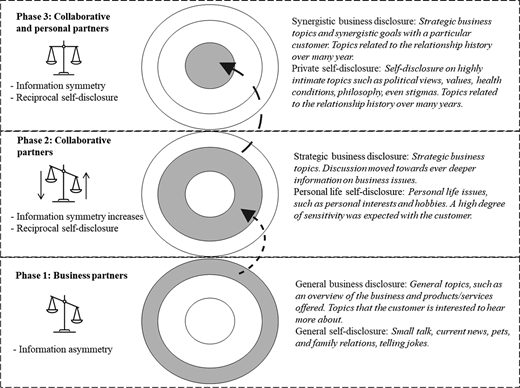
Based on our findings, customer relationships may deteriorate at any time in the development process. The findings revealed that not all customer relationships need to evolve through all phases. The salespeople described profitable relationships with their customers in all phases of their relationships. However, the findings indicate that different phases are characterized by different types of self-disclosure. Furthermore, mutual understanding and reciprocal self-disclosure were needed between partners at the interpersonal level to deepen the interpersonal relationship. The transition in self-disclosure and change in information asymmetry/symmetry are illustrated in Figure 1.
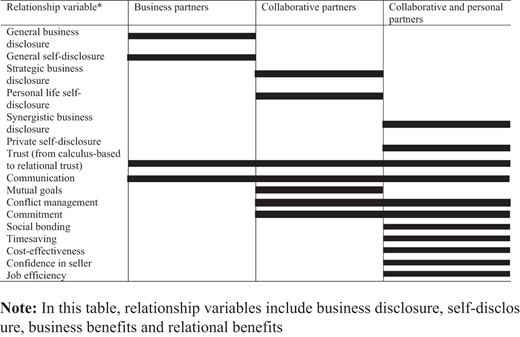
We found that the salespeople evaluated the costs and rewards differently as the relationship matured. Figure 2 summarizes the findings integrating the relationship variables related to self-disclosure and cost and reward evaluation during the relationship development process.
Next, we explain the meanings identified related to the salespeople’s evaluation of costs and rewards at each phase of the long-term B2B customer relationship. Then, we report the meanings identified relating to self-disclosure and business disclosure.
First phase: business partners
Cost and reward evaluation.
Regarding cost and reward evaluation, we found both business and relational benefits. Business benefits were related to calculus-based trust. Rousseau et al. (1998, p. 399) defined calculus-based trust as being, “based on rational choice–characteristic of interactions based upon economic exchange.” Trust emerges when the trustor perceives that the trustee intends to perform an action that is beneficial.” Before a seller invested time in the customer, he/she made sure there were opportunities to make money and create value with that customer. The prospective customer’s firm having a stable cash position was a requirement for starting to build a relationship. Therefore, strong dependency on a customer firm’s financial position was identified and was described as a safeguard for starting a collaboration with the customer. The following quotations illustrate this aspect:
In this way, it will bring our company a profit. (Salesperson Y)
You always have to think about how this could benefit each party. (Salesperson N)
A profitable business is important, at least at the beginning there’s no need to get to know the person. (Salesperson B)
We’ll get credit insurance […] Or it’s some kind of advance payment […] The most important point is that we don’t take a risk. (Salesperson G).
Relational benefits were related to polite and effective communication, as well as relational trust, as salesperson B stated: “It’s for the sake of trust that the sellers try to build continuity, this kind of personal relationship.” When the seller found a customer interesting as a person, he/she was willing to share more personal information.
Relational costs were associated with excessive demands to socialize outside work if the salespeople did not consider the customer interesting on a personal level. Salespeople experienced uncertainty about the relationship if they felt customers were not interesting as a person, if they found no common interests or shared values with the customer and if they did not feel that the relationship could develop to enter a more personal stage. That uncertainty meant the salespeople did not want to move toward sharing anything more personal about themselves. Therefore, socializing and spending time outside work with the customer was considered a cost, as the following quotation illustrates: “It’s just wasting time if it doesn’t help with sales” (Salesperson Z).
Self-disclosure and business disclosure.
During the first phase of the long-term customer relationship, the salespeople reported that both self-disclosure and business-disclosure remained at the general level. General level business disclosure referred to revealing information about the company, its products or services. Essentially, it included talking about general business topics, as the following examples show:
It’s about the skill of listening and content expertise. We give them an overview of our company. (Salesperson K)
If the customer wants me to present the company, I’ll tell them about its structure and history, what we produce and where, why our product is so good […] I talk about how great we are. [I stress] our main selling argument repeatedly. (Salesperson G)
General self-disclosure refers to disclosing information about oneself as a person. It includes small talk on topics such as current affairs, weather, pets and family relations. Salespeople disclose such information to create trust with their customers at the beginning of the relationship. One of the interviewees explained this by saying, “You can always talk about the weather, your family, and pets. They are always good subjects to talk about” (Salesperson N). Moreover, the sellers wanted to broach topics that the customer was interested in, as the following quotation from the data illustrates: “It depends on what the buyer wants to talk about, of course, the seller will talk about the same thing[…] (Salesperson B).
Second phase: collaborative partners
Cost and reward evaluation.
Business benefits are connected to mutual goals and conflict management. The understanding of the customer’s strategy and even finding congruence on a strategic goal shared by the seller’s and customer’s firms were highlighted. Moreover, the benefits included appropriately managing any conflicts over business issues. Sellers aware of the competition a customer faced were considered crucial, as were the high-level professional sales skills of such salespeople:
You must be a person who has the right kind of know-how and expertise. I mean expertise concerning business, technology, the market, the customer. Then you have good vibes. (Salesperson N)
You can even resolve difficult issues by talking them through if the relationship with the customer has lasted for a long time. (Salesperson K)
Relational benefits were connected with mutual relational trust, commitment and social bonding. Rousseau et al. (1998, p. 399) state that “relational trust derives from the repeated interactions over time between trustor and trustee. The information available to the trustor from within the relationship itself forms the basis of relational trust. Reliability and dependability in previous interactions with the trustor give rise to positive expectations about the trustee’s intentions.” The sellers interviewed focused intently on developing mutual relational trust and commitment in the relationship, as the following quotations illustrate:
We have trust on both sides. You support each other enough in all dealings and search for a common goal […] and you’re also able to commit to the customer, and the customer is committed. (Salesperson U)
When salespeople could establish a good rapport in the relationship and had shared interests with the customer, socializing and spending a considerable amount of time outside work with the customer were not considered a burden, but something rewarding. This strengthened social bonds between partners:
You do outdoor activities [with the customer], you ski, or skeet shoot, or drive ATVs. You do more activities together and go to the sauna. (Salesperson D)
We meet with this customer to show we’re interested. We try to keep up personal contact. When I visit [the customer], they don’t want to meet me at the office. We go golfing, and we don’t even talk about business. You’re just present. (Salesperson F)
Relational costs were related to concerns about sharing too much private information. Some salespeople did not want to move toward a deeper collaborative and personal partner phase, as they felt it would cause uncertainty in their customer relationship and they wanted to protect their privacy. A conflict was also identified between a salesperson’s professional role and private role, as the following quotations from the data show:
You have to be able to separate your relationship with the customer and then the actual work you do, so it doesn’t get in the way and lead to unfairness when compared to some other customer. (Salesperson I)
Information sharing just needs to be subtle enough that you’re still professional. They’re not friends. (Salesperson O)
Self-disclosure and business disclosure.
We identified two types of disclosure in this phase of the customer relationship: strategic business disclosure and self-disclosure relating to personal life. Strategic business-related disclosure refers to talking about strategic business topics and thereby moving toward more intimate business topics than were raised during general business-related disclosure in the first phase of the customer relationship. The more advanced stage was explained by salesperson L as follows:
Both parties have high expectations. We try to discuss all kinds of [business] matters, about how we’ll proceed in the future […] we talk very openly, and they are also very outspoken along the way […]. It’s about giving feedback to each other all the time.
Self-disclosure relating to personal life involved sharing social interests and talking about hobbies, as salesperson G explained:
When I meet with [the customer], we almost always start by talking about football. It’s not related to business at all. Golf, for example, you spend four or five hours with the customer, and you don’t talk about business at all.
However, a high degree of sensitivity was expected during this type of interaction with a customer, and the salespeople noted that it was more appropriate that they talk about their personal matters rather than ask about the customer’s. This was explained by salesperson L:
You can’t ask about personal things, but you can give a lot of information about yourself, about where you live and how you commute to work, and all these kinds of things that are related to your personal life anyway.
Third phase: collaborative and personal partners
Cost and reward evaluation.
Business benefits were connected with time savings, cost effectiveness, confidence in seller and job efficiency. Time-savings on business issues and cost-effectiveness of doing business with the customer were crucial. The sellers interviewed underlined that their customers had confidence in salespeople’s ability to build the best offerings and solutions to address their customers’ needs, which enhanced commitment. Moreover, salespeople identified a benefit in the improved efficiency of conducting sales tasks because less time had to be devoted to information searches and ensuring communication fluency. Examples of these benefits are shown below:
As our relationship has become familiar, we avoid all the unnecessary complications. (Salesperson L)
We share things at a slightly deeper level than the blueprint would set out. In this way, we can make progress in [business] matters somewhat sooner. (Salesperson P)
We try to commit the customers to us, [tie them] closer to us by trying to make these solutions for them. It will make it more difficult for them to change supplier. As long as everything works automatically and well with us, why would they want to break it off? (Salesperson G)
Relational benefits were related to relational trust, commitment, conflict management, social bonding and communication. Although these relationships were not described as typical friendships, a private relationship with the customer was identified. For instance, relational trust and commitment and social bonding were highlighted, as follows:
A relationship of trust. Friendship is rarer, perhaps, but there can be friendship, too. I achieve a relationship of trust that comes quite close to how I am with my mates outside work […] Everything is based on trust. (Salesperson P)
In a way, the business and personal relationships intertwine in that sense. Both evolve over time. In a certain sense, you could describe it as a committed companionship […] You talk things through, and through that, it begins to resemble knowing each other so well personally, that maybe you become true friends. (Salesperson O)
This kind of collaborative and personal relationship gave the sellers and customers an opportunity to share their philosophies of life and other private matters. Social bonding occurs through developing feelings of emotional attachment: engaging with each other’s private lives, emotional social support, mutual respect and honesty and a sense of comradery. Relationships entering this advanced level meant salespeople received invitations to weddings; for example, the parties shared and received emotional social support by helping each other, and tensions related to the relationship were easily resolved. In our findings, the parties to the B2B relationships had mutual respect and were honest with each other. Such relationships are marked by an enjoyable and informal atmosphere and comradery. The following examples demonstrate the relational benefits:
If the other person is organizing something […] you can call them and say ‘Hey, I can do that, should I fetch your trailer? Mine’s over there, and can I come and borrow it?’ (Salesperson D)
I started to get invited to their family functions and stuff like that. It also brought a lot of fun to my private life. Everything starts to affect the business side of things indirectly after that. (Salesperson P)
The cost of a collaborative and personal relationship was associated with inequality between so-called average customers and customers who were almost as close as friends.
Self-disclosure and business disclosure.
The phase marked by the parties being collaborative and personal partners was accompanied by synergistic business disclosure and private self-disclosure. Synergistic business disclosure involves discussing strategic business topics and synergistic goals with a particular customer. Furthermore, the topics were related to relationship history over many years, as the following quotations illustrate:
You’ve got to keep the [customer] company’s strategy in mind so that you know inside that you’re doing good things and that you’re really bringing added value to their business. Continuously reminding them what we’re doing and how it will support their strategy. (Salesperson O)
I genuinely want to provide good solutions that serve the customer and their team and their business, and through that, ultimately, their company’s mission statement and sales targets. (Salesperson N).
Having in-person, face-to-face meetings was crucial to offer opportunities for disclosing the most sensitive information. Private self-disclosure included talking about very personal topics, such as values, personal health conditions, philosophies of life and even addressing personal taboos. The level of disclosure was only possible due to trust between partners and a mutual commitment. Furthermore, private self-disclosure was reciprocal; that is, both salespeople and their customers were willing to share private matters. Private self-disclosure took place during informal meetings, e.g. when playing golf or socializing without any formal plans. The following extracts illustrate these areas of discussion:
You talk about things that human beings talk about, about how you’re doing, your workload, and your focus in life. This kind of sharing is reciprocal with the customer. (Salesperson O)
A physical injury or disability of some sort is taboo. It’s only when you really know a person that you can ask them about it, and mention that you’ve noticed it years ago. Not to mention, if it’s something even more visible, a big mole or burn, or you find out that the person is homosexual, or they have a different skin colour, or you show each other pictures of your children, and it turns out that their child is adopted. (Salesperson O)
Private self-disclosure also included topics related to the relationship history over many years, as salesperson V stated:
They [the customer] had heard about my divorce […] they came to visit me and told me that I would get through it […] they had this big-brotherly attitude, and I knew that my situation was not so bad after all.
Relationship deterioration
The salespeople explained that long-term B2B customer relationships do not deteriorate easily; however, they can still deteriorate at any time throughout the relationship development process. For this reason, in our findings, the deterioration is not an additional phase in the relationship development process, which happens only after all three phases have been completed. Instead, our findings indicate that long-term B2B customer relationships deteriorate due to protecting one’s privacy; inappropriate conflict management; and natural separation. Protecting privacy is related to relational costs. Our findings reveal examples of salespeople refusing to disclose personal and/or private information to the customer. Salesperson G described this: “They […] invite me to parties, but I don’t want to go. I don’t want to reveal more about myself, and I don’t want to make friends with customers.” Inappropriate conflict management refers to salespeople’s experiences of not being able to manage relationship conflict appropriately, as described by salesperson O: “If a conflict is not resolved, then it will remain troublesome and detrimental to the customer relationship.” Moreover, the customer relationship may deteriorate due to natural separation if the salesperson or buyer changes the workplace or if the business between the companies ends.
Discussion
We investigated how salespeople’s self-disclosure and business-related disclosure in combination with relational cost and reward evaluation lead to the development of long-term profitable B2B customer relationships. With our findings, we contribute to the previous marketing and sales literature, which has both conceptually (Dwyer et al., 1987; Wilson, 1995) and empirically investigated B2B customer relationship development (Palmatier et al., 2013; Zhang et al., 2016) mainly focusing on interorganizational exploration, yet not so much on relationships at the interpersonal level. Our findings provide original theoretical knowledge on long-term B2B customer relationship development at the interpersonal level in three phases: becoming business partners, collaborative partners and collaborative and personal partners. To the best of the authors’ knowledge, the current study is the first to show that B2B customer relationships evolve at the interpersonal level through a process of relational cost and reward evaluation, alongside increased business disclosure and more intimate self-disclosure.
Based on a previous understanding of customer relationship development and agency theory (Bosse and Phillips, 2016), we know that information asymmetry is considered a natural state in business relationships (Eisenhardt, 1989). Therefore, it is not expected that some salespeople will disclose sensitive information to their business partners. However, today information is more openly available, and customers actively seek information from the internet (Salesforce, 2019), and information search is the starting point for the sales process. Still, the most sensitive information is not openly available. With our findings, we contribute to the existing understanding of information sharing and show how salespeople are willing to reveal the most sensitive information to the customer, for instance, companies’ strategic decisions, future plans or their private issues, if they evaluate gaining both relational benefits and business benefits. As SPT predicts (Baack et al., 2000), in our study, relationships also become deeper and more trusting as people reveal personal information to one another. Our findings indicate that information asymmetry moves toward symmetry as partners disclose information more openly.
Findings of this study indicate that long-term profitable customer relationships evolve toward deeper levels through multichannel communication. In our data, salespeople and customers applied multiple communication channels – including e-mail, telephone, face-to-face meetings, video calls and videoconferencing – while the relationship evolved. Still, our findings showed that having in-person, face-to-face meetings is important to have opportunities for disclosing the most sensitive information. This was related to opportunities to socialize and have outside of work interaction between partners. When having outside of work interactions and meeting physically face-to-face with the customer gave the best opportunity to share private information. These findings indicate that the importance of in-person meetings still exists in B2B relationship selling, even though B2B customer relationships may be launched and maintained via social media tools, telephone, text messages, e-mail and online video meetings (Bharadwaj and Shipley, 2020; Rodriguez et al., 2016; Sleep et al., 2020). Furthermore, when partners meet in-person, the sellers need to be highly competent in interpersonal communication (Koponen et al., 2019) to be able to move through the layers of self-disclosure and business disclosure when appropriate and bring added value to their customers.
In this study, we investigated long-term B2B customer relationships that were evaluated as profitable by the salespeople (see the method section of the paper). Morgan and Hunt (1994) have already theorized that trust and commitment are crucial for successful relationship marketing. Our findings contribute to existing studies investigating relational costs and rewards in B2B relationships (Dwyer et al., 1987; Johnson and Selnes, 2004; Rousseau et al., 1998; Wilson, 1995) by showing that relational and business benefits multiply as the B2B customer relationship evolves, and collaboration between partners develops. Receiving these multiple benefits is the reason salespeople want to move toward deeper levels in their relationship, as SPT predicts (Altman and Taylor, 1973). In the business partner phase, business benefits are connected to opportunities for profitable transactions and the development of calculus-based trust (Rousseau, 1998). Our findings are supported by a recent study by Xu et al. (2021, p. 2) who showed that “based on their initial judgment of opportunity magnitude, salespeople conduct a benefit–cost analysis under resource constraints to decide which opportunity to pursue.” Our findings further indicate, that in the business partner’s phase, salespeople received relational benefits including relational trust (Rousseau, 1998) and having polite and effective communication between partners.
When shifting to the collaborative partner phase, relational rewards include relational trust (Rousseau, 1998), frequent and effective communication and commitment. Business benefits included having mutual goals and easy conflict management. During the collaborative and personal partners phase, relational rewards are connected to relational trust (Rousseau, 1998), good quality communication, appropriately managed conflicts, commitment and social bonding. Business benefits included time savings, cost-effectiveness, confidence in the seller and job efficiency. In each customer relationship phase, both business rewards and relational rewards increase. Therefore, we clearly show that developing customer relationships toward the deepest phase is beneficial both from the business perspective and from the relational perspective.
However, our findings reveal that costs prevent the customer relationship from deepening, which is in line with SPT (Altman and Taylor, 1973; Baack et al., 2000). Not all customer relationships need to evolve toward highly personal phases, because not all customers and salespeople want to reveal private information about themselves. We found that salespeople were not willing to reveal the most sensitive information to the customer if they found it to be a relational cost. The findings designate that if the salespeople did not consider the customer to be an interesting person, they were unlikely to share any personal information, and those we interviewed regarded the time spent with the customer as a cost in such cases. Furthermore, transition from the first relationship phase to the next one was considered possible if the salesperson thought the customer was an interesting person and was willing to get to know that customer better. This evaluation was made quickly after meeting the customer, as the salespeople assessed if the customer fit (or could fit) the model of colleague or friend. Moreover, when considering whether to deepen the relationship even more, the salespeople considered transitioning to the deepest phase to be possible if the evaluation of relational rewards exceeded relational costs and if there was mutual trust between partners. If they did not have a willingness to form stronger social bonds and become closer with the customer at the personal level, the most sensitive information (private self-disclosure, synergistic business disclosure) was not revealed. Revealing or concealing private information refers to privacy management (Petronio, 2002; Petronio and Durham, 2008), which has become an important issue in today’s contemporary communication environments. People maintain and coordinate privacy boundaries, which indicate limits to information they are willing to share with their communication partners, depending on the perceived benefits and costs of disclosing information (Petronio and Durham, 2008). To the best of our knowledge, we are the first to identify these privacy boundaries in the context of B2B relationship selling.
The findings of this study contribute to those from previous studies acknowledging the importance of self-disclosure in B2B sales contexts (Bantham et al., 2003; Geiger and Turley, 2005; Haytko, 2004) by introducing new subtypes of disclosure. We show how both business disclosure and self-disclosure become deeper and more intimate as the customer relationship evolves. We found the following subtypes: general business disclosure, general self-disclosure, strategic business disclosure, personal life self-disclosure, synergistic business disclosure and private self-disclosure. Throughout long-term B2B customer relationships, salespeople should be able to adapt to customers’ disclosures, listen and then discuss the topics that are important to the customer. Moreover, we reveal how salespeople must be prepared to reciprocate disclosures and even to initiate disclosing private information if they want to move beyond merely being a business partner of the customer. Through reciprocal disclosure, it is possible to achieve information symmetry in the relationship.
Our findings incrementally enhance the marketing and sales literature by outlining a contextual extension of SPT (Altman and Taylor, 1973). Given that SPT has previously mainly been used to investigate how close interpersonal relationships evolve (Littlejohn, 1999), we apply the theory by focusing on the movement of long-term B2B customer relationships toward entering deeper phases. Although some studies in the field of sales and marketing have applied or mentioned SPT (Hansen and Riggle, 2009; Johnston et al., 2012), those studies did not explore B2B customer relationship development per se. The current study applied the central concepts of SPT (self-disclosure and relational cost and reward evaluation) in combination with knowledge from the current sales literature to understand how and why interpersonal customer–salesperson relationships develop toward entering deeper phases, or do not. We show that self-disclosure in B2B customer relationships is not only related to the parties themselves, as described in SPT (Altman and Taylor, 1973), but is also significantly business-related in this context. We used the B2B exchange context to show that salespeople evaluate the benefits of self-disclosure before doing so. It is not expected that this type of disclosure (combining business disclosure with self-disclosure) will occur outside the B2B selling context, because, for example, strategic and synergistic business-related information is shared only if there is deep trust and commitment between business partners. It would not be expected that, in other interpersonal relationships, for instance, between friends, people share confidential and sensitive business-related information. However, private self-disclosure is expected to occur in other interpersonal relationships if people trust each other, if they evaluate that rewards of self-disclosure exceed costs and if they are willing to reciprocally share their inner thoughts (Altman and Taylor, 1973).
The findings lead us to propose a contextual extension of SPT –BSPT – which is summarized in Table 6.
We suggest three phases for interpersonal B2B customer relationship development (business partners, collaborative partners and collaborative and personal partners) instead of the original four phases suggested by SPT (Altman and Taylor, 1973). Furthermore, with our findings, we claim that the original types of self-disclosure suggested in SPT are too vague to illustrate self-disclosure in B2B customer relationships. Our findings indicate that besides self-disclosure, business disclosure is inherently tied to the development of B2B customer relationships. Therefore, we suggest that in BSPT, both business disclosure and self-disclosure are central elements (see Table 6). Our model will help managers improve their bottom line performance, as we have found that at the deepest phase, collaborative and personal partners, it was possible to reach most business outcomes and the most relational outcomes (see Figure 2). We show that long-term profitable B2B customer relationships at the deepest level include business benefits (mutual goals, conflict management, timesaving, cost-effectiveness, confidence in seller, job efficiency) and relational benefits (trust, communication, commitment and social bonding). Our findings are also supported by previous studies, as long-term, mature B2B relationships have been found to exhibit the highest level of trust and commitment and research has established that strong relational development produces the highest level of profit and good sales growth (Zhang et al., 2016).
Managerial implications
Based on our findings, it is important for managers to understand how their salespeople evaluate the relational costs and rewards of developing a customer relationship and the extent to which they use self-disclosure, which can enhance or restrict the maintenance and development of long-term B2B customer relationships. Our findings are useful in customer relationship management, as they show the benefit of salespeople enhancing the relational side of the customer relationship. Nevertheless, our results showed that not all salespeople (or their customers) want to reveal highly personal information about themselves and become collaborative and personal partners with customers. Therefore, managers should train their salespeople to recognize the different relational needs of customers and respond to those needs. Moreover, managers should allocate enough resources to salespeople to nurture long-term customer relationships. At the sales team level, managers can share responsibility between team members for nurturing different types of customer relationships based on their salespeople’s interpersonal communication competence (Koponen et al., 2019).
Our findings can be useful in sales training. Salespeople in training might be asked to analyze the types of long-term B2B relationships they would like to have in their customer portfolios and the costs and rewards associated with different types of customer relationships. Salespeople could formulate appropriate relationship-building and maintenance strategies. Furthermore, understanding self-disclosure subtypes is an aspect of sales communication competence (Koponen et al., 2019) and should therefore be underlined when training salespeople. Self-disclosure could be applied as a tool to build and maintain long-term B2B customer relationships. For instance, salespeople should be able to encourage customer’s disclosure, as it is often critical in B2B relationship settings when the salesperson is asked to solve complex problems. If the customer is unwilling to share critical personal or business-related information, this may cause delays in satisfactory problem-solving (see also Crosby et al., 1990). Then again, salespeople should recognize their own self-disclosure behaviors. It is known that reciprocal self-disclosure is influenced by the partners’ positive or negative attributions, the relational goal of the partners (e.g. the type of relationship desired) and the development stage of the relationship (Derlega et al., 1993, p. 35). Among strangers, the desire to reciprocate self-disclosure at a comparable level is strong (Derlega et al., 1993, p. 35); therefore, in the beginning of the customer relationship, it is appropriate and effective to reciprocate self-disclosure. Still, self-disclosure is a curvilinear communication skill (the more is not always better), and salespeople should be sensitive in disclosing the appropriate amount and depth of information about the relationship phase.
Furthermore, with our findings, we claim that focusing purely on self-interest and concealing information prevents collaboration, and instead, focusing on both parties’ interests and reciprocal information sharing enhances collaboration between partners. Salespeople should be aware of these findings and understand that by deepening the customer relationship at the personal level, it is possible to achieve benefits that are otherwise unavailable (such as social bonding, timesaving, cost-effectiveness, confidence in seller and job efficiency).
The findings of this study could also be taken into account by firms developing customer relationship management (CRM) systems. When there is a considerable turnover of salespeople, managers should ensure that salespeople leaving the company do not walk away with valuable interpersonal-level customer knowledge. Instead, they should transfer as much interpersonal information about the customer to their successors as can be disclosed under codes of ethics. To ensure the successful transmission of information, managers could be required to systematically input interpersonal-level information as well as information regarding the customer relationship phase (see also Mullins et al., 2014) into their CRM systems. The disclosure types found in this study could guide the establishment of interpersonal-level information categories. Understanding the customer relationship phase is important for companies, and other researchers have suggested using customer relationship phases as a profitability leverage (Mullins et al., 2014). Mullins et al. (2014, p. 55) have suggested, that as “later relationship phases exhibit a reduced risk of lower profits, managers should give salespeople more freedom to allocate relationship efforts and focus on customers with higher payoffs.” Based on our findings, we support the idea of allocating resources (time, money) to salespeople for relationship efforts, because through repeated interactions (Homburg et al., 2005) and socializing (Geiger and Turley, 2005) with customers, it is possible to build and maintain the most matured customer relationships.
Limitations and future research suggestions
In common with all studies, this investigation has its limitations. Because this study adopts a qualitative approach, it is not possible to achieve generalizability or to aim for performance goals in the findings. The interviewees’ descriptions can never be complete; they rely on the informant’s recall of long-term B2B customer relationships and related relational cost and reward evaluations in addition to their reported levels of self-disclosure. The current study obtains its data from B2B salespeople in Scandinavia. Therefore, our findings may not apply, for example, in Asia, where relationships typically precede transactions (see the concept of guanxi; Liu and Gao, 2014). Because the interviewees come from Scandinavia and involve so-called small and open economies, we suggest that generalizability can be considered in this environment. Small and open economies have several similarities, such as the size of domestic markets, levels of economic development and a high proportion of exports (Gabrielsson et al., 2012), which may homogenize the B2B salespeople’s working environment.
In the future, we recommend that self-disclosure and relational cost and reward evaluations in long-term B2B customer relationships be studied from the customer’s perspective. Furthermore, self-disclosure could be studied in cross-cultural settings because cross-cultural differences in preferences for self-disclosure may exist (Jacobs et al., 2001). Also, gender differences should be considered in future studies, as gender has been found to be a moderating variable in self-disclosure (Derlaga et al., 1993). Moreover, BSPT could be applied by researchers to investigate different types of relationships and other professional relationships, such as those between employers and employees. It would be important to test whether the business-related and self-disclosure subtypes apply to the development of other types of professional relationships or if other disclosure subtypes exist. The current research thereby advances previous research while being of value to those seeking a means to build measures of business-related disclosure and self-disclosure and to be able to generalize from its findings. Furthermore, self-disclosure is important when maintaining customer relationships via online channels (Koponen and Rytsy, 2020). Therefore, it would be interesting to explore salespeople’s and customers’ privacy management strategies (Petronio, 2002) in multiple communication channels, focusing, for example, on social media (LinkedIn profiles and posts) or digital sales interactions (Bharadwaj and Shipley, 2020).

Dr Jonna Pauliina Koponen is Associate Professor of Service Management and Communication at University of Eastern Finland (UEF) Business School in the University of Eastern Finland. Her research focuses on e-leadership, digital communication, interpersonal communication competence, cross-cultural communication, selling and sales management, service management and value creation, and communication education. She has published e.g., in European Journal of Marketing, Industrial Marketing Management, International Marketing Review, Simulation & Gaming, Medical Teacher, Communication Teacher, and Studies in Communication Sciences.
 Saara Maria Julkunen is a Professor of International Sales and the Head of UEF Business School at the University of Eastern Finland. Her research focuses on international sales, sales management, customer–seller relationship development, interorganizational collaboration and entrepreneurship. She has published, e.g. in Industrial Marketing Management, International Marketing Review, International Journal of Export Marketing, Simulation & Gaming and Relationship Marketing. Furthermore, she has co-authored in the Handbook of Research on International Entrepreneurial Strategy.
The work described is part of a research project funded by the Academy of Finland, decision number 342265.