The study aims to combine economic, critical and recreational motives with the intention–behaviour relationship to explore what motivates consumers to buy second-hand gifts. The study further explores how the intention to buy second-hand gifts is realized in actual gift purchases, and how this relationship varies depending on individual’s green consumption values. The study conceptualizes second-hand gift-giving and emphasizes its importance in reducing the environmental burden.
This study collected data in two-phases, before and after Christmas. Study 1 focuses on the motive–intention–behaviour chain in second-hand gift-giving and combines motivating factors with the intention–behaviour relationship. Given the known gap in the intention–behaviour relationship, study 2 tests the robustness of the findings related to the intention–behaviour relationship, moderated by green consumption values.
This study shows that the search for a fair price operates as the strongest predictor of second-hand gift-giving intentions, followed by treasure hunting, ethics and ecology-related factors and the distance from the system. Motivating factors generally impact second-hand gift-giving indirectly through intention and they account for 21.9% of the variance in intention. The results further show that the intention to buy second-hand gifts is a strong predictor of the actual purchase, with intention alone explaining 29.1% and 17.9% of the variance in the purchase behaviour in studies 1 and 2, respectively.
Future research could explore actual purchase behaviour of second-hand gift-giving in the long term, as the present study was unable to account for such an issue. The present study purposefully focused on the purchasing of non-altered second-hand items, which does not cover upcycling, referring to reuse and alteration that results in an increase in value. Overall, limited research exists on the upcycling of products, let alone on the gifting of upcycled items, which would provide a fruitful avenue for future research.
The study sheds light on the purchasing intentions versus behaviour of second-hand gifts; yet not only do consumers need to reconsider their consumption patterns, but similarly retailers are encouraged to rethink their business models to foster second-hand trade and to open avenues for the sale of pre-loved and pre-used second-hand items.
The study conceptualizes second-hand gift-giving and shows how economic, critical and recreational factors drive second-hand gift-giving. This study show that the intention to buy second-hand gifts is a good predictor of actual behaviour and the well-known intention–behaviour gap is not much of an issue in second-hand gift-giving. We conclude that second-hand gift-giving is intentional and not impulsive.
1. Introduction
Popular celebrations such as Christmas, Valentine’s Day, Mother’s Day and Father’s Day are peak gift-giving seasons with a significant environmental impact, as people all over the world spend money and time purchasing, giving and delivering gifts to one another. Every year, consumers in the USA alone spend hundreds of billions of dollars on gifts (Givi et al., 2022) with statistics showing how Christmas retail sales were predicted to set a new high in 2024, with customer spending an average of over $1,000 on Christmas gifts (Statista, 2025). While Christmas gift-giving boosts the economy, it also has a significant negative impact on the environment. Concern for the environment encourages us to re-evaluate our overall consumption habits, and if more people gave recycled and refurbished products as gifts, we could gradually reduce the environmental footprint of our gift-giving actions, as second-hand consumption generally reduces the environmental footprint of consumers’ daily choices. These actions would promote both the United Nations (2025) sustainable development goals and the broader goals to find alternative ways to fulfil consumption needs (Böhm et al., 2022). In raising the question of whether second-hand gift-giving could be an alternative to gifting something new, we focus on the motive–intention–behaviour relationship to explore what motivates consumers to buy second-hand gifts and how the intention to buy second-hand gifts realizes in actual purchases. Given that people vary in their green values, we further test if the magnitude of the intention–behaviour relationship depends on individual’s green consumption values.
In this study, second-hand gift-giving refers to recycled or refurbished products bought second-hand as an alternative to gifting something new. Second-hand gift-giving should be distinguished from regifting, which refers to “the act of taking a gift that has been received and deciding to give it to someone else” (Ertimur et al., 2015, p. 1998). Environmental friendliness drives regifting (Ertimur et al., 2015), however, with the key difference that in regifting, unused items are typically given away to a new recipient, whereas in buying second-hand items as gifts, the items are typically not new and have already been used by somebody else. In addition, the purchase behaviour of second-hand gifts is more deliberate compared to regifting, as the gift-giver follows a similar planning–intention–behaviour chain as when buying a new product as a gift.
Psychological theories generally argue that intention is a direct and the most fundamental predictor of behaviour (Ajzen and Madden, 1986; Davis, Bagozzi and Warshaw, 1989). However, research on green consumption (e.g. Hassan et al., 2016; Park and Lin, 2020) and healthier living (e.g. Adriaanse et al., 2011; Conner and Norman, 2022) argues that intentions seldom actualize in true behaviour when it comes to pro-environmental, healthier or otherwise “better” consumption choices. Johnstone and Tan (2015) studied the gap between consumers’ green rhetoric and purchase behaviour, and they argue that intentions to behave green do not necessarily correlate well with actual behaviour, referring to the so-called green gap (Johnstone and Tan, 2015). This is a major concern in research that relies solely on intentional behaviour, and therefore, we follow a two-phase before vs after study design to better understand the association between consumer intentions before Christmas and the actual behaviour of buying second-hand gifts after Christmas. Given that motives relate to internal factors that arouse, direct and integrate a person’s behaviour, we include motivating factors (Guiot and Roux, 2010) as antecedents to intention–behaviour relationship. In addition, individuals tend to act in ways that enable them to express their values (Bardi and Schwartz, 2003), and we expect that green consumption values (Haws et al., 2014) will narrow the gap between intentions and actual second-hand gift-giving behaviour further.
This study makes five key contributions. First, we contribute to the gift-giving literature (Givi and Galak, 2024; Song et al., 2021; Vanhamme et al., 2021) by conceptualizing second-hand gift-giving. Second, we focus on motivating factors that promote second-hand gift-giving (study 1) and we explore the motive–intention–behaviour chain with economic, critical and recreational motives as antecedents to second-hand gift-giving intention and behaviour. Third, in response to a call to seek alternative ways to address consumers’ consumption needs (Böhm et al., 2022), we extend the intention–behaviour literature to second-hand gift-giving to demonstrate how the intention–behaviour relationship actualizes in purchase situations that are not made for oneself but as a gift to someone else (studies 1 and 2). Our findings suggest that second-hand gift-giving is mainly intentional rather than impulsive apart originality, with the results demonstrating that “real finds” in second-hand shopping can bypass intentions. Fourth, we show that consumers’ green consumption values (Haws et al., 2014) strengthen the relationship between intentions and behaviour (studies 1 and 2). Fifth, while previous research demonstrates mixed results regarding the impact of socio-demographic variables on the intention–behaviour gap, our findings suggest that age, gender or education do not confound the above findings (studies 1 and 2).
2. Literature review and hypotheses
2.1 Second-hand gift-giving
While second-hand shopping refers to “the acquisition of second-hand objects through methods and places of exchange that are generally distinct from those for new products” (Guiot and Roux, 2010, p. 356), we define second-hand gift-giving as the purchase of second-hand products and giving them to others as gifts. As the definition of second-hand shopping implies, the sources and places of second-hand shopping may vary, and consumers can obtain second-hand products as gifts, for instance, from flea markets, swap meets and garage sales (Guiot and Roux, 2010). Consumers increasingly buy second-hand products also over digital channels in online marketplaces at websites and social media (Chang et al., 2020; Padmavathy et al., 2019), not to forget consumer-to-consumer marketplaces (Yoon and Occena, 2015; Abdul-Ghani et al., 2011; Chang et al., 2020).
In a transition towards more environmentally friendly patterns of gift-giving, second-hand gifting could operate as an alternative to other forms of gift-giving, and it may have more functionality than previously thought. For example, Teigen et al. (2005) evince that recipients seem more receptive to receiving used goods as gifts compared to gift-givers. Moreover, gift-givers frequently overestimate the relation between the price of the gift with respect to how much the receiver will value the gift (Flynn and Adams, 2009; Givi and Galak, 2022). In addition, not everyone is overly pleased to receive expensive gifts (Givi et al., 2022), and sometimes gifts that are too pricey can make recipients feel guilty and needy (Ruth et al., 1999). Therefore, by introducing the concept of second-hand gift-giving, we argue that research should devote more emphasis to this form of gift-giving, considering that it could help to lower the environmental footprint of gift-giving actions. While earlier work has generally explored how people buy gifts (e.g. Sherry, 1983), it is important to explore motivating factors specific to second-hand gift-giving.
2.2 Motivating factors
This study builds on the theories in motivation psychology (e.g. Weiner, 2012; Deci and Ryan, 1980) to explore factors that drive consumers’ second-hand gift-giving. Motivation psychology generally seeks to explain the direction, persistence and intensity of goal-directed behaviour (Heckhausen and Heckhausen, 2018). We focus on motivating factors behind consumers’ intentional and behavioural patterns, with motives referring to internal factors that arouse, direct and integrate a person’s behaviour. We conceptualize this research within consumption literature, which targets studying and explaining how consumers decide about their purchases based on environmental values, individual preferences and budget constraints. We narrow the domain of this research to consumption and purchase behaviour that is, first, related to purchasing of second-hand items and, second, to gift-buying, which occurs from a fundamentally different starting point compared to purchases that a person makes for oneself (Boncinelli et al., 2019; Pandya and Venkatesh, 1992). We build on economic, critical and recreational motives (Guiot and Roux, 2010) that operate as internal factors that drive consumers to act in a certain way.
2.2.1 Economic motives.
Economic motives are associated with price-related aspects of purchasing, suggesting common-sense frugality (Fernando et al., 2018) as a reasoned approach to decision-making that relates to purchase behaviour. Economic motives stem from price sensitivity and price consciousness (Ferraro et al., 2016), and they relate to the underlying refusal to pay a premium just because an item is new (Guiot and Roux, 2010). Recent research finds that economic motives are associated e.g. with the resale value of second-hand items, particularly when it comes to luxury products (Turunen and Pöyry, 2019). Fundamentally, purchasing second-hand items can ease a consumer’s pressures of money spending by enabling one to satisfy his/her needs without having to deprive oneself of less essential acquisitions (Ferraro et al., 2016; Guiot and Roux, 2010).
In the domain of second-hand consumption, consistent with Guiot and Roux (2010), economic motives are composed of two interrelated dimensions: (a) search for a fair price; and (b) gratifying role of price. The first of these, search for a fair price, relates to Korgaonkar’s (1984) concept of price orientation, which refers to a consumer’s intention and habit of looking at the price tags to acquire better value for money. The concept is also linked to Zeithaml’s (1988) value-for-money, which captures how a consumer evaluates a product relative to its pricing (Wu et al., 2011), capturing a consumer’s desire not to waste money and to pay a reasonable price for the desired items (Zeithaml, 1988).
The second dimension, the gratifying role of price, relates to bargain hunting and consumers’ hopes of finding products at a cheap price to obtain bargains (Guiot and Roux, 2010). The gratifying role of price relates to personal enjoyment that derives from identifying and taking advantage of purchasing desired products at distinctively attractive prices (Wagner and Rudolph, 2010). The gratifying role of price links to bargain hunting, which, as a concept, refers to the activity of looking for goods that are good value for money, typically because they are being sold at prices lower than usual. Some studies have linked bargain hunting to calculative economic shopping motives, while other researchers suggest that the hunt for a low price is not driven solely by cognitive factors but may also be a source of emotional satisfaction (Cox et al., 2005). Thus, paying a lower price can lead to feelings of pride, excitement and a sense of accomplishment (Mano and Elliott, 1997), while bargain hunting shoppers can also gain pleasure from beating the system (Cox et al., 2005; Kim and Kim, 2008). Based on existing literature, we expect that:
a) Search for a fair price and b) the gratifying role of price as economic motives positively associate with the intention to buy second-hand items as gifts.
2.2.2 Critical motives.
Guiot and Roux (2010) identify a “critical” component in motives that drive consumers towards second-hand consumption. Critical motives, according to Guiot and Roux (2010), are composed of two interrelated dimensions, (a) distance from the system and (b) ethics and ecology, of which the first is grounded in the consumer’s willingness to engage with unconventional shopping channels in an attempt to escape the wider consumption system while the second builds on green and ethical considerations as a motivating factor. Critical motives relate to consumers’ beliefs about the environment (Seo and Kim, 2019) and the extent to which decision-making is driven by ethical and environmental concerns, such as preference for recycled items over brand new ones and fighting to reduce waste through one’s buying choices.
The first dimension of critical motives, distance from the system, relates to idealization of anti-consumption (Iyer and Muncy, 2009; Lee et al., 2009) and to the critical attitudes that consumers manifest as distancing and avoidance of behaviours towards the classic market system (Guiot and Roux, 2010). Distance from the system stems from consumer attitudes, according to which buying and consumption of new goods is perceived as wasting resources, while buying second-hand equates with escaping from a classic consumption system and resisting mass consumption (Ek Styvén and Mariani, 2020).
The second dimension of critical motives, ethics and ecology, builds upon consumers’ willingness to be environmentally and ethically conscious and to promote sustainable practices through one’s shopping behaviours (Jain et al., 2022). Because of environmental motives, some consumers reuse and resell their used products rather than throw them into landfills (Seo and Kim, 2019). This thinking also applies to their shopping behaviours, promoting environmental beliefs as a driver for second-hand purchasing and gifting. According to Pierce and Paulos (2011), critical orientations are the most salient among young people who are typically characterized by strong oppositions to the status quo and who emphasize moral, social and political considerations in their decision-making. We expect that:
a) Distance from system and b) ethics and ecology as critical motives positively associate with the intention to buy second-hand items as gifts.
2.2.3 Recreational motives.
Recreational motives link to browsing second-hand markets as a recreational activity that does not directly link to purchase activities, and which oftentimes takes place without a recognized consumption need (Bloch et al., 1986). Recreational motives link to the hedonic dimension of consumption, which focuses on the emotional aspects of shopping (Hirschman and Holbrook, 1982) and the ways in which consumers seek pleasure and enjoyment through their shopping activities (Alba and Williams, 2013). Consistent with the original definition of hedonic consumption, which relates to multisensory, fantasy and emotive aspects (Hirschman and Holbrook, 1982) of shopping, recreational motives behind second-hand consumption go beyond economic and critical motives, and they focus on the characteristics of second-hand markets to provide various and unpredictable offerings and excitement (Guiot and Roux, 2010; Roux and Guiot, 2008). We focus on two dimensions of recreational motives: (a) treasure hunting and (b) originality.
Treasure hunting means browsing second-hand markets as a recreational activity that can enable a consumer to encounter original objects that cannot be found elsewhere in the market (Machado et al., 2019). In addition, treasure hunting links to consumers’ attempts to find products from the second-hand marketplaces and the related thrill and excitement of finding products that are rare or valuable (Ertz et al., 2017). The key takeaway of treasure hunting lies in the statement that “one person’s trash is another person’s treasure” (Turunen and Leipämaa-Leskinen, 2015). Excitement, thus, which is known to stimulate high levels of pleasure and arousal (Jayawardhena and Wright, 2009; Russell and Pratt, 1980), is a pertinent characteristic of treasure hunting. In second-hand fashion markets, Machado et al. (2019) define treasure hunting as the pursuit of unique products that, when found, arouses consumer pleasure and pride. A similar pleasure likely arises when a person encounters a unique and distinctive second-hand item to be purchased as a gift.
The second dimension, originality, considers second-hand shopping as a way of finding objects that are unique and not available at shops (Roux and Guiot, 2008). As a concept, originality refers to the authenticity and genuineness of items, but in second-hand consumption it also relates to consumers’ attempts to get away from uniformity, and it targets obtaining items that other people do not have or are hard to find (Guiot and Roux, 2010). In addition, originality can relate to the hunt for vintage items (Schibik et al., 2022) that are conceptualized as authentic and rare pieces that represent and are linked to a specific style of couturier or era. Alternatively, originality is also linked to collecting behaviour, that is, possessing items that are regarded as holding a significant intrinsic and psychological value to the collector (Turunen and Leipämaa-Leskinen, 2015). Generally, originality does not only link to finding original products of precious brands but also to subjective assessment of perceived originality. We expect that:
a) Treasure hunting and b) originality as recreational motives positively associate with the intention to buy second-hand items as gifts.
2.3 Intention–behaviour relationship
Psychological theories argue that intention is a direct and the most fundamental predictor of human behaviour (e.g. Ajzen and Madden, 1986; Davis, Bagozzi and Warshaw, 1989). Intentions are described as self-instructions to achieve certain outcomes or perform a behaviour (Webb and Sheeran, 2006; Triandis, 1980). Prior research expects intentions to capture motivational factors that influence behaviour (Webb and Sheeran, 2006), and intentions should typically point in the same direction as the behaviour and strongly correlate with the behaviour (Ajzen and Fishbein, 2005). While multiple studies across disciplines show that intentions reliably associate with behaviour (Webb and Sheeran, 2006), more recent work emphasizes the importance of measuring both the intention and behaviour (Hulland and Houston, 2021), because the predictive accuracy of intentions in predicting behaviour varies considerably between studies. We measure both intention and behaviour, and following psychological theories (Ajzen and Madden, 1986; Davis et al., 1989), assume that intention predicts behaviour. We hypothesize that:
Consumer intention to buy second-hand gifts predicts actual purchase of second-hand gifts.
2.4 Green consumption values
Green consumption values refer to a person’s propensity to convey values of environmental protection through one’s purchases and consumption behaviour (Haws et al., 2014; Gong et al., 2022; Yan et al., 2021; Bailey et al., 2018), whereas individual-level values in general reinforce the intention–behaviour relationship (Li and Cai, 2012). This means that people with strong values are more likely to behave in accordance with their values, while those with significantly weaker values are less likely to do so. Prior research argues that green consumption values relate to economic and conscious use of resources (Haws et al., 2014). Green consumption values, for example, foster planned resale behaviour meaning that consumers think about the resale value of the products they buy and try to keep them in good condition so they can later resell them to other consumers (Tan et al., 2022). Given that recycling and second-hand shopping represent green behaviour for many, we expect green consumption values to strengthen the intention–behaviour relationship. Do Paço et al. (2019) highlight that consumers who emphasize green consumption values tend to be more concerned about making green purchases and saving the environment. Green consumption values, thus, reinforce the intention–behaviour relationship in second-hand gifting because green consumers focus more on utilizing the full potential of goods before disposing of them (Haws et al., 2014). In addition, they are also more inclined to look for multiple uses and creative reuse opportunities for the goods (Do Paço et al., 2019). Consequently, we expect green consumption values to reinforce the relationship between intention and actual purchase behaviour of second-hand gifts:
Green consumption values reinforce the relationship between the intention to buy and the actual purchase of second-hand gifts.
Considering that socio-demographic characteristics influence consumption decisions, following prior research (e.g. Hansen and Thomsen, 2020; Roth et al., 2017), we control the effects of age, gender and education in the research model (Figure 1).
3. Research overview
This research consists of two interrelated studies (Figure 1; Table 1). Study 1 (n = 622) explores the motive–intention–behaviour chain and the motivating factors driving second-hand gift-giving by combining economic, critical and recreational motives with the intention–behaviour relationship. Study 2 (n = 210) demonstrates the robustness of the findings related to the intention–behaviour relationship, moderated by green consumption values.
Both studies followed the same methodology which we set up because recent editorials recommend measuring both intention and behaviour in studies investigating behavioural outcomes (Hulland and Houston, 2021). Consequently, studies 1 and 2 build on a two-phase before vs after study design in which we collect data in two waves, before and after Christmas, so that the intention to buy second-hand Christmas gifts is measured before Christmas while the actual gift-buying behaviour is measured after Christmas. Participants were unaware of the follow-up study after Christmas at the time they responded to the survey before Christmas. They were also unaware that we would pair their responses in the first and the second wave. We performed our data collections purposefully during Christmas season and with a focus on Christmas gift-giving because in countries where Christianity dominates as a religion, Christmas is one of the leading gift-giving seasons. Moreover, Christmas has a clear cut-off point by which consumers have bought and given gifts, in comparison to other gifting situations such as birthdays, making it an attractive period for studying the intention–behaviour gap.
4. Study 1: motivating factors explaining intention and behaviour of buying second-hand gifts
4.1 Method
Study 1 includes 25 theory-driven questions (Table 2) to measure motivating factors (Guiot and Roux, 2010), purchase intention (Hassan et al., 2016), green consumption values (Haws et al., 2014), together with socio-demographic background characteristics, in the first data collection wave before Christmas. We measure motivating factors using a seven-point Likert scale ranging from 1 = totally disagree to 7 = totally agree with the following six dimensions adopted from Guiot and Roux (2010): search for a fair price, gratifying role of price, distance from the system, ethics and ecology, treasure hunting and originality. We measured purchase intention with two items: “How likely are you to purchase second-hand Christmas gifts?” and “How strong is your intention to buy second-hand Christmas gifts?” (Hassan et al., 2016). The measurement scale ranged from 1 to 7, with a greater value indicating a greater second-hand gift-buying intention. In addition, the questionnaire included green consumption values scale from Haws et al. (2014) ranging from 1 = totally disagree to 7 = totally agree. We also asked the respondents to report their age (continuous variable), gender (categorical variable with 1 = female and 2 = male) and education (categorical variable with 5 gradually growing education levels).
We performed the first wave of data collection between 1st and 22nd of December, where the 13,035 invitations resulted in 779 valid responses with a response rate of 6%. Respondents participated in the study voluntarily and they did not receive any direct compensation. However, we motivated the respondents to take part by giving them the opportunity to participate in a raffle of 50 free lunch coupons at a local restaurant. After Christmas, we emailed the participants of the first wave survey and asked them to fill-in a follow-up survey and report the percentage of all Christmas gifts they bought second-hand (Hassan et al., 2016). The second wave of data collection was open between 29 December and 9 January, and we sent respondents a reminder to participate on 5 January. In total, we received 622 responses with an 80% response rate. These 622 responses form the sample for study 1. A confirmatory factor analysis with the latent variables indicates a good fit to the model with χ2(df) = 641.317(224); CFI = 0.966 and RMSEA = 0.049. The factor loadings are all significant and greater than 0.669, and the model does not indicate concerns regarding convergent or discriminant validity (Table 2).
4.2 Results
Of the 622 participants who responded in both data collection waves, 500 (80.4%) were female and 122 (19.6%) were male, with an average age of 27.4 years. Participants were relatively highly educated, with 131 (21.1%) holding an education of up to upper secondary school degree, 327 (52.6%) holding a bachelor’s degree, 162 (26.0%) holding a master’s degree and 2 (0.3%) holding a doctorate (Table 3).
H1 suggests that a) search for a fair price and b) the gratifying role of price as economic motives positively associate with the intention to buy second-hand items as gifts. We find that the search for a fair price (H1a) positively relates to the intention to buy second-hand items as gifts (β = 0.208, p < 0.001); yet the effect of the gratifying role of price (H1b) on purchase intention is not supported (β = −0.075, 0.071). To test H2 suggesting that a) distance from system and b) ethics and ecology as critical motives positively associate with the intention to buy second-hand items as gifts, we find that both critical motives positively relate to intention to buy second-hand items as gifts with β = 0.096 (p = 0.016) and β = 0.163 (p < 0.001), respectively. Regarding H3 suggesting that a) treasure hunting and b) originality as recreational motives positively associate with the intention to buy second-hand items as gifts, we find support for H3a, as treasure hunting positively relates to purchase intention with β = 0.182 (p < 0.001). However, the results do not support H3b (β = 0.029, p = 0.452). Together the motivating factors explain 21.9% of the variance of a consumer’s intention to buy second-hand items as gifts. Regarding H4 stating that a consumer’s intention to buy second-hand gifts before Christmas significantly predicts actual purchase of second-hand Christmas gifts, the intention–behaviour relationship is highly significant with β = 0.557 (p < 0.001). Consequently, the results support H4.
To better understand the motive–intention–behaviour relationship, we performed a post-hoc analysis bootstrapped with 500 iterations, with intention as a mediating variable between motivating factors and actual second-hand gift-giving behaviour. The results show that behavioural intention fully mediates the relationship between motivating factors and behaviour in second-hand gift-giving. Originality is the only exception with a direct-only non-mediation (Zhao et al., 2010).
H5 presumes that green consumption values reinforce the relationship between the intention to buy and the actual purchase of second-hand gifts. In testing this, we add the interaction of green consumption values on the path between purchase intention and actual purchase of second-hand Christmas gifts. We orthogonalized the purchase intention and green consumption value variables involved in the multiplicative interaction (Little et al., 2006). The resulting interaction is statistically significant with β = 0.104 (p = 0.049), supporting H5. The result suggests that green consumption values, indeed, reinforce the relationship between the intention and actual purchase of second-hand Christmas gifts. Finally, we add the control variables (gender, age and education level) in the model, and they all have a statistically non-significant relationship with the purchase behaviour (Table 4).
We pay attention to the interaction of green consumption values in the intention–behaviour relationship as it is close to marginal significance (Table 5). Model 1 includes the main effect only, and this model operates as a baseline for the comparisons that follow. Model 1 shows a highly significant positive relationship between purchase intentions reported before Christmas and actual purchase behaviour after Christmas (β = 0.539, p < 0.001). This provides further support for H4, showing that a consumer’s intention to buy second-hand gifts is positively associated with the corresponding actual behaviour. Purchase intention alone explains 29.1% of the variance of the actual purchase behaviour.
Model 2 adds the control variables, age, gender and education level in the model. These effects are all statistically non-significant. Adding the control variables causes only a minor change in the model’s explanatory power (ΔR2 = 0.001), indicating that control variables play a negligible role in the model. Model 3 adds the moderating variable, green consumption values, in the model. The resulting effect is statistically non-significant and does not cause a change in the R2 estimate. Model 4 adds the interaction of green consumption values on the path between purchase intention and actual behaviour. The resulting interaction is highly significant (β = 0.114, p < 0.001), while the R2 estimate also improved (R2 = 0.306). This further supports H5, stating that green consumption values reinforce the relationship between the intention and actual purchase of second-hand Christmas gifts.
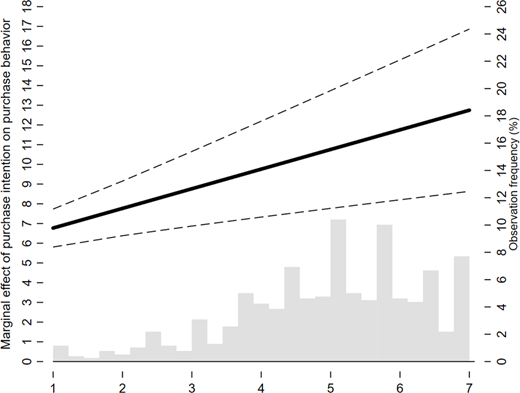
Since recent studies and editorials (Brambor et al., 2006; Meyer et al., 2017) highlight that p-values seldom reflect the full extent of the effect, researchers are advised to report confidence intervals when testing interaction effects. To depict the marginal effect of purchase intention on purchase behaviour and its confidence intervals, we used example scripts provided by Golder (2025), taking into consideration the range of our moderating variable. The two dashed lines in Figure 2 show a confidence interval of 95% for the interaction effect, allowing one to identify the circumstances in which the interaction effect is statistically significant over various values of the moderating variable (x-axis). On the left, the vertical y-axis shows the magnitude of the marginal effect, and the vertical axis on the right depicts a histogram, which reflects the distribution of observations (%) in the sample on the variable shown on the horizontal x-axis. Figure 2 demonstrates that the interaction is positive and statistically significant throughout the range of green consumption values.
Furthermore, given that the type of product may be an important moderator for the intention–behaviour relationship, we test the robustness of the intention–behaviour relationship by distinguishing between low-touch products (e.g. books, electronics) vs high-touch products (e.g. clothing, furniture) (Lederman and Klatzky, 1987; Peck and Childers, 2003). We do so because the evaluation of second-hand items may be substantially different between low-touch vs high-touch products, as they possess salient material properties important for touching (Donato and Raimondo, 2021) to a different extent. For this reason, we approached the participants with a post hoc survey measuring participants’ attitudes towards buying low-touch vs high-touch products as second-hand gifts. Data collection resulted in 119 responses, and using this subset of the data, we find that low-touch products reinforce the intention–behaviour relationship further, as the interaction term [intention x low-touch products] is statistically significant with β = 0.158 (p = 0.038), while the interaction of high-touch products is not supported (β = 0.064; p = 0.394).
4.3 Discussion
Study 1 makes the following contributions to literature. First, a look at the motive–intention–behaviour relationship reveals that motivating factors impact second-hand gift-giving intentions, and they link only indirectly to behaviour. These findings imply that second-hand gift-giving is intentional and not impulsive. Originality, which refers to trying to find items that are unique and hard to find, such as vintage items and collectibles (Roux and Guiot, 2008), makes an exception to this generic pattern and affects directly to behaviour. This may be because second-hand shopping builds on “real finds” that cannot be foreseen.
Second, regarding the motive–intention relationship, searching for a fair price operates as the strongest predictor of second-hand gift-giving intentions, followed by treasure hunting, ethics and ecology-related factors and the distance from the system. Searching for a fair price relates to the concept of price orientation (Korgaonkar, 1984) and to the general habit of paying attention to prices to get better value for money. This finding links to the earlier research on gift-giving, demonstrating that gift-givers generally are ready to pay more for a gift that they believe is valued by the recipient and that gift-givers generally rate gift prices higher compared to gift recipients (Liu et al., 2022).
Both critical motives, distance from the system and ethics and ecology-related factors, impact second-hand gift-giving through behavioural intention. Critical motives relate to consumers’ beliefs about the environment (Seo and Kim, 2019) and the extent to which decision-making is driven by ethical and environmental concerns. Consistent with previous second-hand studies (Gilal et al., 2024), the findings of our research demonstrate that both the ideological idealization of anti-consumption and the willingness to be environmentally conscious in one’s shopping behaviours drive the intention to buy second-hand items as gifts. Recreational factors are also important predictors of second-hand gift-giving, with treasure hunting impacting second-hand gift-giving indirectly via intention.
Third, related to the intention–behaviour relationship, study 1 finds that intention significantly predicts actual purchase of second-hand gifts so that the intention alone explains 29.1% of the variance of the behaviour. Gift-giving typically requires orderliness and pre-planning, and consequently these results are consistent with Carrington et al. (2014), who argue that the green gap varies from one purchasing situation to another so that the gap is at its smallest in pre-planned purchasing situations and increases at the point of purchase.
Fourth, there exists substantial differences in the intention–behaviour relationship between low and high-touch products (Lederman and Klatzky, 1987; Peck and Childers, 2003), which we recommend paying attention to in future studies. Hence, the intention–behaviour relationship becomes stronger for low-touch products, while the same does not hold for high-touch products. This indicates that participants hesitate to buy second-hand high-touch products such as clothing and furniture, whereas low-touch products are considered a preferred choice.
Fifth, we show that consumers’ green consumption values reinforce the effect of intentions on behaviour, that is, green consumption values reduce the intention–behaviour gap further. Although the findings from the present study imply that the green consumption values do not directly explain the purchase behaviour of second-hand Christmas gifts, the consumers guided by green consumption values are more likely to engage in such green behavioural patterns.
5. Study 2: robustness test of intention–behaviour relationship in second-hand gift-giving
Study 2 has two main goals. First, to delve deeper into the relationship between intention and behaviour in second-hand gift-giving, and second, to verify the role of green consumption values in shaping the intention–behaviour relationship. While the results of study 1 confirm H1 in showing that intention to buy second-hand gifts is a strong predictor of corresponding behaviour, the findings of study 1 show that intention alone explains only 29.1% of the variance of buying second-hand gifts. This finding aligns with numerous earlier studies stressing an inconsistency between intended behaviour relative to actual behaviour that follows (Carrington et al., 2014; Crossler et al., 2014; Hassan et al., 2016; White et al., 2012). Literature refers to this as the so-called intention–behaviour gap (Gollwitzer et al., 2009; Nguyen et al., 2019) or green gap specific to green consumption (Johnstone and Tan, 2015). Green gap refers to the discrepancy between a person’s positive attitudes towards green behaviour and actions in comparison to actual behaviour (Johnstone and Tan, 2015). In explaining the green gap, people tend to prioritize what they consider the most important, which is then reflected in consumers’ purchasing and consumption behaviour (Carrington et al., 2014). Therefore, secondary concerns are not always reflected in actual behaviour, as they do not usually lead to the active development of action plans, which is required for habit formation, and this prioritization is one of the causes behind the gap between intentions and behaviour (Carrington et al., 2014). In addition, a lack of commitment and a reluctance to sacrifice convenience can explain the gap between intentions and behaviour in actual customers of a customer-to-customer marketplace.
5.1 Method
Study 2 includes 3 theory-driven constructs to measure green consumption values (Haws et al., 2014), purchase intention (Hassan et al., 2016) and behaviour using scales corresponding to those being used in study 1 (scales are reported in detail in Table 2). The respondents represent customers of Finland’s most popular and the largest consumer-to-consumer (C2C) online marketplace, Tori.fi (Link to the website of tori.). Second-hand trade via C2C platforms represents one of the fastest-growing segments of e-commerce (Fernando et al., 2018), and on the C2C marketplace, consumers can sell and buy products ranging from clothes to furniture and hobby equipment. Consistent with study 1, we collected the data before and after Christmas, using a survey questionnaire administered to the users of the C2C online marketplace. Before Christmas, a link to the survey was visible on the marketplace’s landing page, and visitors to the site could voluntarily participate in the survey with a small incentive of participating in a raffle with the opportunity of winning a €50 gift voucher. After Christmas, we sent an email to the respondents who responded to the first wave of data collection and invited them to participate in the second wave of the study. This procedure resulted in valid responses from 210 customers who participated in both waves of the data collection. Table 2 reports the measurement items used and a confirmatory factor analysis indicates a good fit to the model with χ2(df) = 19.629(9); CFI = 0.984 and RMSEA = 0.068. The factor loadings are all significant and greater than 0.698, and the model does not indicate concerns regarding convergent or discriminant validity.
5.2 Results
The data consists of 31.4% male and 68.6% female respondents, with an average age of 43 years (Table 6). Model 1 includes the main effect only (H4), and it shows a highly significant positive relationship between purchase intention and actual purchase behaviour of second-hand gifts (β = 0.971, p < 0.001), lending further support to H4 (Table 7). The purchase intention alone explains 17.3% of the variance of the actual purchase behaviour (R2 = 0.173).
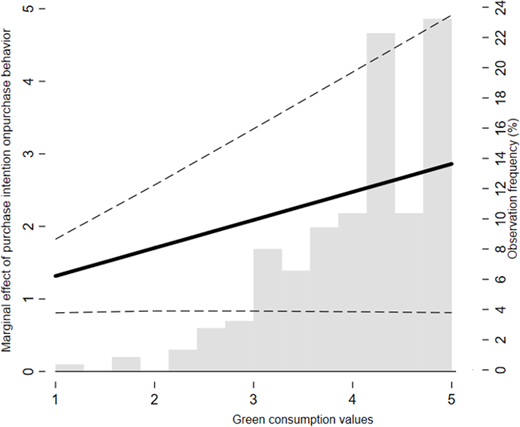
Model 2 adds the control variables, age, gender and education, in the model. The effects of control variables are all statistically non-significant. Adding the control variables improved the model’s explanatory power to R2 = 0.205. Model 3 adds the moderating variable, green consumption values. The effect is statistically non-significant and does not cause a change in the R2 estimate. To test robustness of H5, Model 4 adds the interaction term of green consumption values. This model suggests a significant moderation effect at the 90-percent confidence level (β = 0.386, p = 0.063) and a modestly improved R2 estimate with R2 = 0.219 (Table 7). Figure 3 demonstrates that the intention–behaviour relationship is statistically significant over the entire range of green consumption values.
5.3 Discussion
Findings of study 2 contribute to the literature by validating the intention–behaviour relationship in second-hand gift-giving and by providing robust estimation on how green consumption values narrow the intention–behaviour gap. Findings of studies 1 and 2 are consistent. The marginal deviation in explanatory power likely relates to study 1 representing consumers in general, whereas participants in study 2 represent customers of a C2C marketplace specifically.
6. General discussion
6.1 Theoretical contributions
Our research makes the following theoretical contributions (Table 8) to marketing and consumer behaviour literature. First, we contribute to the gift-giving literature by introducing second-hand gift-giving as a concept. Second-hand gift-giving refers to the purchase of second-hand products and giving them to others as gifts. Gifting second-hand items could help us to become closer to the United Nations (2025) sustainable development goals. In a transition towards ecologically sustainable and socially just marketplace systems, we call for future research to pay further attention to alternative forms of gift-buying and gift-giving, with non-material gifts (Reshadi et al., 2023), and self-produced gifts (Atakan et al., 2014) and second-hand gifts (this study) representing some examples of gifts that will help to reduce the environmental burden.
Second, we explore the motive–intention–behaviour chain with a focus on motivating factors that promote second-hand gift-giving specifically (Study 1). This is important, given that gift-giving research emphasizes that researchers have taken only limited attempts to apply the main consumer behaviour models to gift purchasing and giving, and prior research has devoted even less attention to the empirical verification of the phenomenon (Antón et al., 2014; Davies et al., 2010). In response to our first research question, we find that search for a fair price operates as the strongest predictor of second-hand gift-giving intentions, followed by treasure hunting, ethics and ecology-related factors and the distance from the system, while gratifying role of price does not predict the intention to purchase second-hand gifts. Interestingly, we additionally find that originality directly links to behaviour and not intention, and we estimate this to be because originality in second-hand shopping builds on “real finds” that cannot be predicted not foreseen. This finding links to Husnain et al. (2025), who emphasize that browsing of second-hand marketplaces can at times lead to impulsive purchases, creating a paradox that can at times undermine consumers’ sustainability efforts.
Third, in response to a call to seek alternative ways to address consumers’ consumption needs (Böhm et al., 2022), we extend the intention–behaviour literature (Carrington et al., 2014; Crossler et al., 2014; Hassan et al., 2016) to second-hand gift-giving and demonstrate across two studies how the intention–behaviour relationship actualizes in purchase situations that are not made for oneself but as a gift to someone else. Gifting involves the selection and transfer of something to someone else without expecting direct compensation; however, the gift-giver may expect a return, “be it reciprocity, a change in the relationship with the recipient, or a favour, or another social or psychological benefit” (Davies et al., 2010, p. 414). By its profound nature, the act of gift-giving fundamentally differs from self-purchases, which is why it is important to revisit intended versus actual behaviour in gift-giving. Based on the research that exists, we know that a large gap exists between consumers’ intentions and behaviour (Carrington et al., 2014; Caruana et al., 2016; Crossler et al., 2014; Govind et al., 2019; Hassan et al., 2016). In responding to second research question, compared to previous studies in intention–behaviour relationship, we find that the intention to purchase second-hand gifts significantly predicts the actual buying of second-hand gifts so that the intention alone explains 29.1 and 17.9% of the variance of the behaviour, respectively, in studies 1 and 2. This means that the gap associated with intention and actual behaviour appears not to be as strong when consumers buy second-hand gifts, compared to previous studies on intention–behaviour relationship conducted in other domains. Gift-giving typically requires orderliness and pre-planning, and consequently these results are consistent with Carrington et al. (2014), who argue that the green gap varies from one purchasing situation to another so that the gap is at its smallest in pre-planned purchasing situations and increases at the point of purchase.
Fourth, we demonstrate how consumers’ green consumption values (Haws et al., 2014) strengthen the relationship between intentions and behaviour, indicating that green consumption values operate to reduce the green gap further. Although green consumption values do not directly explain the purchase behaviour of second-hand Christmas gifts, consumers who are guided by green consumption values are more likely to engage in such green behavioural patterns. This finding is theoretically substantial and leads to a question about whether the same would hold with any other strongly held individual-level values, providing a fruitful avenue for future research. Taking economic values as an example:
If a person follows the principles of frugality in life, a follow-up study could address that would frugality similarly shape the intention–behaviour relationship?
Fifth, we demonstrate considerable differences in the intention–behaviour relationship between low-touch and high-touch products (Lederman and Klatzky, 1987; Peck and Childers, 2003) so that the intention–behaviour relationship is stronger for low-touch products (vs high-touch products). This suggests that low-touch products are regarded as a preferred option, and participants are more hesitant to purchase high-touch items like clothing and furniture as second-hand gifts.
Sixth, while previous research has yielded mixed results regarding the impact of socio-demographic variables on the intention–behaviour gap, we demonstrate across two studies that age, gender or education do not confound the above findings. This is surprising given that the existing research commonly reports that young, female and highly educated people tend to be more strongly disposed towards environmental issues and behaviour (Chen et al., 2011; Nguyen et al., 2019) overall. The discrepancy may be explained by the fact that, in contrast to the majority of earlier research, which concentrated solely on intention, we in this study examined actual purchase behaviour. On the other hand, greater green consumption values are known to exist, particularly among older, highly educated and well-earning consumers (Haws et al., 2014). While existing studies report conflicting findings on the impact of socio-demographic characteristics in altering the intention–behaviour relationship, our findings call for future research on how individual-level characteristics associate with actual pro-environmental behaviour.
We purposefully performed our study during the Christmas season and with a focus on Christmas gift-giving, because Christmas is undoubtedly one of the leading gift-giving seasons worldwide. This provides an avenue for future research to replicate the findings in the context of other popular gift-giving seasons, such as Valentine’s Day, Mother’s Day or birthday gift-giving. In addition, a recent bibliometric analysis on gift-giving (Gupta et al., 2023) emphasizes that the existing state of gift-giving research has been strongly focused on the USA, the UK and China, which makes it important to study gift-giving behaviours also in other countries and cultures. Consistent with Hassan et al. (2016), we encourage future studies to build on temporal research designs in exploring the intention–behaviour gap and particularly in drawing more encompassing insights on how intentions are actualized into behaviour in the long term.
6.2 Practical contributions
The present study sheds light on the purchasing intentions versus behaviour of second-hand gifts. Not only do consumers need to reconsider their consumption patterns, but correspondingly practitioners are encouraged to rethink their business models to foster second-hand trade and to open avenues for the sale of pre-loved and pre-used second-hand items particularly at popular gift-giving seasons. Retailers that work to extend the lifecycle of products being sold could promote the sale of second-hand gifts via second-hand gift-giving catalogues with targeted suggestions for different customer segments, correspondingly as they do for their general assortment. Promotion of second-hand gifts can have a remarkable impact in driving green consumption patterns, as such gifts can remarkably extend product lifecycles while also reducing the need to produce new products, saving emissions not only in production but also in transportation For practitioners, the understanding of the controversy between consumer intentions and behaviour is highly relevant, as Carrington et al. (2010) emphasize that product launches based on mere purchase intentions can easily lead to costly failures. Consequently, it is imperative to understand the motive–intention–behaviour chain and we recommend practitioners to reconsider how their business could drive the second-hand trade, to promote consumer attitudes and behaviour towards buying second-hand products more.
6.3 Limitations
Second-hand gift-giving entails an environmentally friendly component that is known to be hindered by socially desirable responding (Govind et al., 2019), referring to such response patterns within the questionnaire that are favourable to the respondent (Steenkamp et al., 2010). In addition, the subjectively reported measurement items may pose a limitation because consumers generally tend to evaluate their attitudes, values and behaviour more positively than they are (Hassan et al., 2016; Casais and Faria, 2022). These are likely to reflect also in the measurement items used in the study as responses e.g. in the green consumption values scale follow an asymmetric distribution, with most respondents reporting relatively high green consumption values.
6.4 Conclusion
Findings of this study suggest consumers reconsider conventional gift-giving patterns and to rethink the cases and situations in which second-hand items could replace the purchasing of new products as gifts. Overall, actions towards such a direction would have an incremental impact at the societal level and at achieving sustainable development goals of the United Nations (2025), as gift-giving is a universal phenomenon. The environmental footprint of new products surpasses the end-of-life waste of the product, taking into consideration the multilateral production chain and different supply chain operators within the production chain.