Knowledge competencies and (R&D) activities are one of the most important sources of innovation and have been widely discussed in the literature. In comparison, the role of the competitive environment for the innovation activities of firms is still open to debate and has not been fully understood yet. Therefore, this paper intends to provide new evidence on the interaction between knowledge competencies and R&D activities of firms on the one side and their competitiveness in the market environment on the other. In particular, the moderating function of market competition is explored. In this respect, the analysis covers the main innovation types as well as both sectors, manufacturing and services.
The empirical analysis is based on a three years panel dataset of German manufacturing and service firms obtained from Mannheim Innovation Panel (MIP) and Community Innovation Surveys (CISs: 2011, 2013 and 2015). For the estimation, a binary instrumental variable treatment model with Heckman selection method is used. Also, it provides a suitable approach to estimating the binary variables in order to cope with endogeneity concerns.
The estimation results show that R&D activities and knowledge competencies are positively related to innovation activities of different types conditioned on firms' specific perception of their competitive environment, in terms of outdated products/services as well as strong competition from abroad. Most importantly, the results from the moderation estimation reveal that there is a significant difference between the manufacturing and service sector. Service firms engage more in internal R&D activities on generating product innovations while the manufacturing firms conduct more external R&D on specific types of innovation. Further, the authors find that strong competition from abroad positively and significantly reinforces the effect of knowledge competencies on innovation activities for more types in services than in manufacturing. In contrast, outdated products and services tend to decline the effect of knowledge competencies for some innovation types in both sectors. The authors also observe a positive and significant reinforcement effect on knowledge competencies. However, it is found more beneficial for service firms since they can employ more innovation strategies.
The focus of the study is mainly on the impact of firms' competitive environment on innovation activities in various types through its interaction with knowledge competencies and R&D activities, across manufacturing and service firms.
1. Introduction
Innovation is known as a key driver for productivity and economic growth and can take various forms including novel products and new material sources, new production methods, opening of new markets as well as creating new industry structures (Schumpeter, 1934). Notwithstanding, what is still left to debate is what factors are in turn impacting the innovation activities of firms. In this study, we put the focus on the role of the competitive environment for the innovation activities of firms in the manufacturing and service sector, in particular through the induced enhancement of knowledge competencies and reasearch and development (R&D) activities. In this view, market competition more or less is working as a kind of moderator.
In the existing literature, knowledge competencies and R&D activities are widely discussed as factors of innovation. According to Teece et al. (1990), knowledge competencies obviously foster the development of new products. For instance, Leonard-Barton (1992) assert that knowledge skills embodied in the people relate to both the application of specific techniques in firms as well as the understanding of scientific knowledge. Linking knowledge competencies to innovation activities, empirical literature suggests that a firm's ability to innovate depends on the educational level of employees (see Gupta and Singhal, 1993; McGuirk et al., 2015; Sun et al., 2020; Wu et al., 2021). Further, it is well acknowledged in the literature that human capital is explained by generic knowledge and skills and is acquired through the level of education and work experience (Blundell et al., 1999b; Harpan and Draghici, 2014; Gregorič and Poulsen, 2020). It supports the competitive advantage of firms in different ways. For instance, it furnishes the firm with skills, willingness to work and expertise to innovate (Hewitt-Dundas, 2006; Protogerou et al., 2017). Haltiwanger et al. (1999) assert that the productivity of firms is positively related to the higher education of employees, i.e. knowledge competencies. Many scholars discussed that highly educated and technically qualified employees are more receptive to innovation and further posit this innovation effect on knowledge competencies and market competitiveness (e.g. Carter and Williams, 1957; Souitaris, 2002). Moreover, De Faria and Mendonça (2011) analyzed the relationship between innovation and firm performance in small and medium companies and found that innovation activities are more important for new and small firms as a source of competitive advantage than for older and larger firms, respectively. Further, their study estimates the effect of the share of employees holding a university degree on firm sales performance and finds a positive effect. However, they did not analyze systematically the graduate employee's effect on innovation activities as influenced by market competitiveness.
A good number of literature suggests that R&D intensity is another important indicator for firms' innovation activities (see Roper and Hewitt-Dundas, 2015; Carvache-Franco et al., 2020; Zhu et al., 2021). Taking this into account, knowledge intensive firms invest a relatively high proportion of revenues into R&D. As a result, firms' knowledge competencies increase in response to such kind of investment. The above-mentioned studies improve our understanding of the effect of R&D activities on innovation and productivity. However, the impact of internal and external R&D activities on marketing and organizational innovation is not fully clarified yet.
In this study, the role of the competitive environment for innovation activities is considered more of a moderator, and competition a main key responsible for technology diffusion in the market. Strong competition can boost the incentive to achieve and increase the technological advantages that in turn lead to the survival of the company in the market (Ahn, 2002). In this regard, some empirical studies pointed out a positive correlation between product market competition and firms growth (e.g. Aghion and Griffith, 2008; Nickell, 1996; Javeed et al., 2020). Levinthal and March (1993) and Lewin et al. (1999) asserted that environmental aspects, especially competitiveness, moderate the relationship between firm performance and explorative innovation [1] as well as exploitative innovation [2].
Numerous studies provide evidence for the external environment's influence on firm innovation (see Malerba, 2002; Tian et al., 2019; Cao and Chen, 2019; Fu et al., 2021). Huang (2011) shows that a competitive environment has no direct impact on the innovation activities of firms, but it well has an indirect one by interacting with in-house R&D (while missing the knowledge competencies dimension). Finally, Auh and Menguc (2005) state that intensive market competition is heavily affecting firm performance via the undertaken actions by competitors.
Despite of the huge literature, there are research issues still left more or less unresolved. Particularly, the previous studies have been limited to analyzing the market competition impact on product or process innovation (see Avenyo et al., 2021; Yang et al., 2021; Moen et al., 2018; Mendi and Costamagna, 2017; Negassi and Hung, 2014; Damanpour, 2010), but ignore its impact on marketing and organizational innovation. Moreover, previous studies consider the competition index in general rather than analyzing the impact of specific types of competition on innovation activities in various areas (see Negassi and Hung, 2014). In contrast, in this study, the managers' perception of their competitive environment is used in considering two types of competition, i.e. outdated products and services due to the entry of competitors as well as strong competition faced from abroad.
Moreover, Avenyo et al. (2021) recommend that future research is needed to analyze the impact of competition on the process, organizational and marketing innovations. Therefore, this paper contributes to the literature by estimating the impact of market competition of different types on the probability of introducing marketing and organizational innovation across the manufacturing and service sector (in accordance with product and process innovation). The objective is to provide a deeper understanding of the strategies which could be taken to bring about successful innovation in the manufacturing and service sector.
Previous research has not paid adequate attention to the competitive environment that shapes the relationship among knowledge competencies, internal and external R&D activities and the innovation activities of firms in terms of product, process, marketing and organizational innovation. According to our knowledge, the influence of the competitive environment on innovation through knowledge competencies and R&D activities across manufacturing and service firms at the firm level has not been studied so far. Hardly any study has tested empirically for manufacturing and service firms how market competitiveness may strengthen or weaken the relationship between knowledge competencies, R&D activities and firms' innovation activities.
In this respect, we would like to propose three main research questions in this study. First, do firms perform better in innovation than other firms when R&D activities and knowledge competencies are higher? Second, how far does market competition impact innovation activities through its influence on knowledge competencies and R&D activities? Third, how far does market competition affect manufacturing and service sectors differently? Providing the answers to these questions might advance the literature on the combination of different market competition and R&D activities in supporting successful innovation across the manufacturing and service sectors. After observing the literature gap, the present study contributes to the existing literature in many aspects. First, this study shed more light on the impact of different market competition on different types of innovation: product, process, marketing and organizational innovation. For instance, Avenyo et al. (2021) recommend that future research is needed to analyze the impact of competition on the process, organizational and marketing innovations. Also, some studies consider the competition index in general rather than analyzing the impact of specific types of competition on innovation activities in various areas (see Negassi and Hung, 2014). Therefore, it is useful to know whether different market competition such as outdated products and services as well as strong competition from abroad impact innovation types differently among the manufacturing and service sectors. Second, this study provides insight into the impact of internal and external R&D activities on marketing and organizational innovation and also examines how market competition moderates both internal and external R&D activities for the introduction of innovation types among sectors. Third, this study advances the literature on the link between knowledge competencies and innovation types and examines how different market competition (such as outdated products and services as well as strong competition from abroad) moderate knowledge competencies impact on innovation activities.
2. Theoretical framework
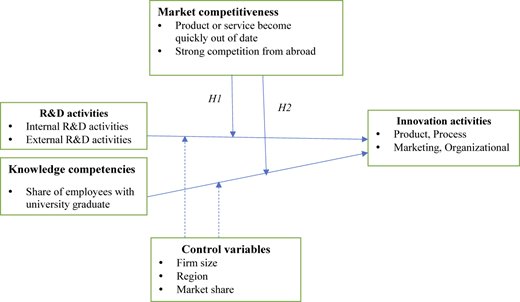
As it is frequently discussed in the literature, knowledge competencies and R&D activities have a positive effect on innovation activities. Concerning structure-related aspects, three variables are usually chosen at the firm level: knowledge competencies, R&D activities and innovation activities. The reason why these three variables are selected is their close relationship in the field of innovation in which firms operate. The analysis of the relationship between the structural variables and innovation activities may be extended by the incorporation of some external variables which embody the innovation activities by firms into the competitive environment faced. Hence, the market competitiveness variable may establish a linkage between knowledge competencies and R&D activities on the one hand and to firms' innovation activities on the other hand.
2.1 Literature review
In developing the research concept for the role of knowledge competencies, R&D activities as well as market competitiveness on innovation activities, this study draws on the relevant literature to formulate the conceptual model. Knowledge competencies and R&D activities are proposed to have a significant impact on innovation contingent on firms' market competitiveness.
2.1.1 Knowledge competencies
Human capital has a long history in being considered an essential component of economic growth theory (Storper and Scott, 2009). Romer (1990) argued that the enhanced stock of human capital would generate faster growth of an economy. Equally, the development of firms is positively related with the quality of their human capital and the specific investment in it (Santos-Rodrigues et al., 2010). Human capital is found an enabling element in innovation activities (Leiponen, 2005; Protogerou et al., 2017; You et al., 2021). Since at the firm level, most innovations are occurring as incremental innovation, human capital plays an important role in the generation, organizational change as well as diffusion of technology (Toner, 2011).
There is a great debate in the problem of measuring human capital or knowledge competencies (Soboleva, 2010), but one way of measuring knowledge competencies extensively adopted by the innovation literature is through the level of formal education or years of schooling (e.g. Romer, 1990; Cohen and Soto, 2007; Caloghirou et al., 2021). Higher education can affect innovation mainly in two ways: first, it directly evolves in developing new technologies. Second, the educated employee could serve as a second stage innovator mainly keeping the balance between technological change and regular business (Lundvall, 2008). However, Lund Vinding (2006), estimating the impact of skills on innovation activities at the firm level in Denmark, finds that the share of highly educated employees is not necessarily positively associated with the firm's capability to innovate.
The workforce that has a certain level of education can perform better than the less educated in terms of absorbing knowledge and exploiting opportunities (Cohen and Levinthal, 1990). Several studies considered formal education and years of schooling as a measure of knowledge competencies (Marvel and Lumpkin, 2007; Caloghirou et al., 2021). As frequently discussed in the literature, formal education is the main source of human capital (Schwerdt and Turunen, 2007), and it enables a person to obtain the required skills to recognize business opportunities (Arvanitis and Stucki, 2012). Similarly, You et al. (2021) as well as Benhabib and Spiegel (1994) suggest that education as a measure of human capital enhances the firm's capability to innovate. Robson et al. (2009) also introduce the level of higher education and find that it has a significant effect on some sorts of incremental innovation on the firm level, but not on product and services innovation that were new to the industry.
The discussion among scholars about the impact of knowledge competencies on innovation is mixed. An empirical study of manufacturing firms in Finland reveals that higher education or technical skills are the most important factors to profitable innovation (Leiponen, 2000). Similarly, Saridakis et al. (2008) expressed that the business owner (human capital measured as higher education) stimulates the survival of the firm. Further, scholars suggest that human capital has a positive impact on product breakthrough innovation (Tzabbar and Margolis, 2017) as well as on global innovation (Ling, 2013) and innovative performance (You et al., 2021; Alpkan et al., 2010).
However, Schneider et al. (2010), analyzing German manufacturing firms, show that a large share of highly skilled employees within and across manufacturing sectors do not significantly increase the probability of firms to innovate. Further, Subramaniam and Youndt (2005) argue that human capital has a negative impact on the radical innovative capability and no impact on the incremental innovative capability. Similarly, Kato et al. (2015) claim that a firm's founder holding a graduate school degree has no impact on achievements in a firm's innovation. Moreover, the most recent study by Oyinlola et al. (2021) argues that the level of human capital is not sufficient to enhance innovation activities and technological improvement in a particular region. Step ahead, Stuart and Abetti (1990) found a negative relationship between firm performance and the education level of their chief executive.
Nevertheless, highly educated and skilled workers perform efficiently towards new tasks; thus, they are the direct source for innovation (Blundell et al., 1999b). In other words, a new product or process innovation by a firm is associated with the creativity and knowledge of workers as well as the higher education of their skilled employees and not at all just associated with the achievement of the firm as the entire entity. As an important result, innovation can be brought about through the professional development or training of employees.
Most of the studies on estimating the impact of knowledge competencies have been limited to product, process and/or services innovation (DeWinne and Sels, 2010; Martín-de Castro et al., 2013; Kato et al., 2015; McGuirk et al., 2015; Tzabbar and Margolis, 2017; Barasa et al., 2017; Sun et al., 2020; You et al., 2021) as well as to incremental and radical innovation (Van Uden et al., 2017), but ignored its impact on marketing and organizational innovation as they are the important factors for enhancing a firm's performance.
As far as we can see, to date, the existing studies did not take into account the impact of knowledge competencies (measured as a share of highly educated employees) [3] on marketing and organizational innovation. Therefore, in this study, we try to incorporate all four types of innovation including marketing and organizational innovation, besides product and process innovation. In this sense, the present study proposes to estimate the contribution of knowledge competencies at the firm level in particular.
2.1.2 Research and development
R&D is another key variable for studying the innovation activities of firms. Most innovation studies consider R&D activities as a basic factor for innovation activities across the firm level (see Conte and Vivarelli, 2014; Mairesse and Mohnen, 2005). Literature shows that internal and external R&D activities are widely accepted as the key driver for the advancement of technology while R&D expenditures are recognized as an appropriate indicator for the capacity to innovate. For instance, many studies confirm that internal and external R&D activities are the most important factor for product and process innovation (see Stam and Wennberg, 2009; Hagedoorn and Wang, 2012; Muñoz-Bullón et al., 2020). Furthermore, some studies argue that R&D takes two main functions: first, it produces new knowledge via product or process innovation, and second, it enriches the firm's ability to exploit the existing knowledge from the external environment (Ceccagnoli et al., 2014; Stam and Wennberg, 2009).
2.2 Hypotheses development
Studies on the link between market competition and firms' innovation have often been discussed among economists, in particular, whether market competition raises the innovation activities of firms. Arrow (1962) expresses that in case of strong competition in the market, innovative firms benefit more from their innovation activities than others. Among the latter studies, Loury (1979) and Dasgupta and Stiglitz (1980) analyzed the market competition effect on firms' innovation activities and find that firms in the competitive market environment are more likely to invest too much in R&D activities. In the literature, the initial empirical studies paid attention to the particular issue of whether market power authorizes firms to make innovation profitable or whether firms acquired market power because of successful innovation (see Kamien and Schwartz, 1982; Acs and Audretsch, 1987; Van Dijk et al., 1997).
In this study, we take the view that market competition may force firms to enhance their capability to innovate for being able to stay in the market. Competition among firms in terms of products and services of similar kind is multilateral. In order to cope with new environments and expectations, firms are continuously in search of new varieties of products and improvements of existing ones (Ramadani et al., 2013; Kariv, 2010). In contrast, some studies reveal that competition does not matter for innovation (see Arvanitis and Hollenstein, 1996), and that the respective competition index is not correlated with the innovation performance of the public sector (Negassi and Hung, 2014), while Geroski (1990) and Damanpour (2010) argue that an increase in market competition favors innovation.
The role of the environment as a moderating factor for the relationship between a firm's organizational strategy and innovation activities has widely been discussed in the literature (April Chang and Chun Huang, 2005; Liao, 2005). Prior literature shows that the strategic environment has an influence on human resource management for increasing firm performance (e.g. Chandler et al., 2000; Lundvall and Kristensen, 1997). Furthermore, Lundvall and Kristensen (1997) argued that the competitive environment has increased the demand for skilled workers who have the capacity to acquire new knowledge and can perform a different kind of expertise as well as cooperate with individuals.
The existing organization of firms may not be suitable enough for new challenges in the competitive environment, and ultimately firm performance may suffer. Zahra (1993) observes the link between the firm external environment, corporate entrepreneurship and financial performance. He suggests that companies must find a novel way to innovate in new products as well as in processes when competition is intense. Further, companies must explore new markets and must assure how they can distinguish themselves from the competitors in a competitive environment. In order to remain as a competitor, firms are forced to undertake things differently from others to accomplish those levels of fit suitable to increase their performance (Donaldson, 2001). However, the moderating role of market competition for knowledge competencies and R&D activities has not been fully discussed yet. It remains to examine whether knowledge competencies and R&D intensity enhance innovation activities at the firm level in a particular competitive environment. This view takes us to the following hypotheses:
Market competitiveness positively moderates the effect of R&D activities (both internal and external) on product innovation.
Market competitiveness positively moderates the effect of R&D activities (both internal and external) on process innovation.
Market competitiveness positively moderates the effect of R&D activities (both internal and external) on marketing innovation.
Market competitiveness positively moderates the effect of R&D activities (both internal and external) on organizational innovation.
Market competitiveness positively moderates the effect of knowledge competencies on product innovation.
Market competitiveness positively moderates the effect of knowledge competencies on process innovation.
Market competitiveness positively moderates the effect of knowledge competencies on marketing innovation.
Market competitiveness positively moderates the effect of knowledge competencies on organizational innovation.
As an overview, Figure 1 may finally illustrate the conceptual model framework of the current research.
3. Data and variables
3.1 Data
The present study is intended to test the proposed hypotheses using firm-level data on German manufacturing and service firms from the Mannheim Innovation Panel (MIP). It covers the following data: waves 2011 (years 2008–2010), waves 2013 (years 2010–2012) and waves 2015 (years 2012–2014). The MIP is a German contribution to the European Community Innovation Survey (CIS), and most of the MIP questions are asked from the firms for a three-year period. For example, the MIP 2011 survey wave asks for any significantly improved products introduced in the period 2008–2010.
The German CIS is carried out by the Centre for European Economic Research (ZEW) on behalf of the German Ministry of Education and Research (BMBF). The purpose of this survey is to gather information about innovation and R&D activities from all firms in Germany with five or more employees in manufacturing and (selected) service industries. The MIP survey is based on the random stratified sample by firm size, operating region and industry classification inside Germany (see Peters and Rammer, 2013). It follows the recommendations for the measurement of innovation inputs, outputs, process and methodology that are explained in the Oslo Manual from the Eurostat and Ogranisation for Economic and Co-operation Development (OECD) (OECD, 2005). This CIS questionnaire is reliable, it leads to high-quality data and it is comparable to data in other countries (Laursen and Salter, 2006).
For this analysis, we consider the 2011, 2013 and 2015 surveys by the MIP to construct a three year panel dataset that includes both manufacturing and service sectors. As the questionnaire is outlined such that only innovative firms had to respond to the questions on product, process, marketing and organizational innovation activities, the analysis is restricted to firms with innovation activities. This is not a limitation to the present study as the study takes innovative firms into consideration only. The discussion on the relevant variables and their construction is detailed in Table 1.
3.2 Variables
As emphasized above, we are interested in the role of market competition, in particular in its indirect impact on innovation activities through induced acquisition of knowledge competencies and R&D intensity.
3.2.1 Dependent variables
The dependent variable is innovation activities by firms in its relation to product, process, marketing and organizational innovation. Specifically, the dependent variable can take the values “0–1”, and it takes the value “1” if a firm introduces a new or significantly improved innovation and “0” otherwise. This measure of innovation activities is based on previous studies such as Le and Jaffe (2016) and Ayyagari et al. (2011).
3.2.2 Independent variables
To examine the relationship between R&D, knowledge competencies and innovation activities, we use two independent variables. One variable is R&D activities, and it measures internal and external R&D as carried out by firms. This measure is chosen according to previous studies such as Laursen and Salter (2006), Stam and Wennberg (2009) and Hagedoorn and Wang (2012). The other variable is knowledge competencies, measured as the share of employees holding a university degree (see D'Este et al., 2014; Garrone et al., 2014; Abdul Basit and Medase, 2018). Further, the detailed definitions and measurements of the relevant variables are provided in Table 1.
3.2.3 Moderator
This study attempts to examine how market competition may affect the relationship between R&D activities, knowledge competencies and innovations at the firm level. Revised from Tang (2006), the present study uses two main indicators as new measures of market competition:
Outdated products and services due to the entry of competitors.
Strong competition from abroad.
These measures are favored because of firms' own perceptions in capturing the impact of competition specific to firms and in explaining why some firms innovate more than others (Tang, 2006).
3.2.4 Control variables
This study also uses a number of control variables that might have an effect on the dependent variables described above. First of all, we control for firm size, measured as the natural log of total permanent employees in the firm (Ayyagari et al., 2011; Cerulli et al., 2016). Second, we include the market share resulting from top-selling lines of products and services. Market share is considered an important market-based asset driver of brand and firm-level performance, and it is also the main indicator of market competitiveness (Farris et al., 2010; Blundell et al., 1999a). As the firms with higher market share tend to be more innovative than the firms with lower market share, we include market share as a control. Third, a dummy variable is included which takes the value “1” if the firm is located in East Germany and “0” otherwise. Eastern German firms got special benefits (i.e. financial support) from the government after the transition from a planned economy to a market economy in 1990 (Czarnitzki and Lopes-Bento, 2014). Table 1 provides a detailed description and definition of these variables used in the present study.
4. Empirical methodology
The empirical analysis is divided into three steps: the first step employs the relationship between the variables using Pearson's zero-order bivariate correlation. The second step investigates the direct effect of R&D, knowledge competencies and market competition on innovation activities at the firm level. The third step estimates how different types of market competition influence the relationship between R&D activities, knowledge competencies, and innovation activities. Finally, this study sets up a regression model and then provides a discussion of the empirical findings.
To analyze the stated hypothesis, IV binary treatment model is used because of the binary nature of the endogenous and instrumental variables. It is suitable and designed for estimating binary treatment models with heterogeneous response to treatment for observable as well as for unobservable selection. For the estimation, this study has followed the binary treatment model (called ivtreatreg) application developed by Cerulli (2012). Most importantly, the binary treatment model with heterogeneous treatment to response is also used to address the possible endogeneity concerns which might arise during the analysis.
In the following, Equations (1)–(3) denote the econometric setup and Equations (4)–(6) characterize the estimation equations.
where
For the data analysis, this study uses the Heckman sample selection model (Heckman, 1979) with a binary treatment model which supports the normality assumption. The general form of the selection model which is used presumes that fundamental regression association exists:
where the dependent variable for observation is observed when
stating that , and . The rule of thumb is suggesting that sample selection could be safely ignored when .
With respect to the estimation equations, Equation 4 denotes the direct effect estimation (individual effect). Equations (5) and (6) denote the interaction terms for different types of market competition with knowledge competencies and R&D activities, respectively.
5. Results
5.1 Descriptive statistics and correlations
Table 2 presents the descriptive statistics and Pearson correlations among the variables in the study. We notice that in the sample, 34% of firms introduced product innovation, 24% of firms introduced process innovation and 32% of firms introduced organizational and marketing innovation. Additionally, 26% of the firms perform internal R&D activities, and 11% of firms perform external R&D activities. Interestingly, in the sample, about 74% of firms employ more than 5% of their employees who hold a university degree. Furthermore, we observe that 58% of the firms' products and services became quickly out of date due to the entry of new products, and 60% of the firms face strong competition from abroad. Further, most correlation coefficients (r) show low to medium values for the variables. Hence, there should not be a major concern about a potential multicollinearity problem among the variables.
5.2 The effect of R&D activities, human capital and market competition on innovation activities (direct effect)
To analyze the individual effect of market competition, human capital and R&D activities on innovation, the present study performs an estimation including all firms, i.e. manufacturing and service firms in Germany. In order to cope with endogeneity issues, this study uses a binary instrumental treatment model with heckit (Heckman two-step selection model), which is suggested by Heckman (1979). The estimation results of all firms are illustrated in Table 3. The estimation results show that internal R&D activities have a positive significant effect on the product, process, marketing and organizational innovation. On the other hand, external R&D activities have also a positive significant effect on the product, process and organizational innovation while its effect is not significant in the case of marketing innovation [4]. These results are in line with the previous studies suggesting that internal and external R&D activities are the most important factor for product and process innovation (Stam and Wennberg, 2009; Hagedoorn and Wang, 2012).
Additionally, the results illustrate that graduate employees have a positive significant effect on all four types of innovation. The results are in line with the findings from previous studies (Leiponen, 2005; Haltiwanger et al., 1999), which state that graduate employees are an enabling element for innovation activities. Further, for market competition (in terms of outdated products and services due to the entry of new competitors), we find a positive significant effect on product, marketing and organizational innovation while its effect is not significant on process innovation. Moreover, the results also show that strong competition from abroad has a positive significant effect on product and marketing innovation while it has no significant effect on process and organizational innovation. This suggests that market competition has a positive impact on firm's innovativeness, which is consistent with Nickell (1996) and Aghion et al. (2005).
In Table 3, the empirical findings suggest that the model is a better fit since the p-value is 0.000 in all cases, and all variables are jointly significant. Moreover, the different rho is reported for all four types of innovation, and it indicates the fitness of the model.
5.3 Interaction of market competition with internal and external R&D activities
Table 4 provides the regression results for the instrument variable with heckit. We look for sectoral differences, and the estimation results for the full model with moderating effects are provided separately for both the manufacturing and service sector. The individual effect of internal R&D activities shows a significant positive relationship between the product, process, marketing and organizational innovation in the manufacturing sector while its shows a positive association with product, process and organizational innovation in the service sector. On the individual effect, the external R&D shows a positive significant effect on the process and organizational innovation only and indicates the negative significant effect for the product innovation in the manufacturing sector. On the other hand, external R&D shows a positive significant association with product and marketing innovation in the service sector.
Further, strong market competition from abroad shows a statistically positive significant relationship between product, marketing and organizational innovation in the manufacturing sector, and it indicates no significant effect in the service sector. This suggests that competition from abroad entails an increase in innovation activities in the manufacturing sector. Another type of competition is also observed, in case of outdated products or services due to entry of new competitors to the market. The individual effect of the outdated products shows a positive significant effect on the product, marketing and organizational innovation in manufacturing while it shows positively significant in association with all four types of innovation in the service sector.
Moreover, an important observation regarding the interaction effect of market competition between internal and external R&D activities needs to be emphasized. Table 4 illustrates the interaction effect of the outdated products with internal R&D activities, and the results show that internal R&D has a positive association with product innovation in service firms only, but no effect is observed in the manufacturing sector. This indicates that outdated products and services further reinforce the effect of internal R&D activities on the likelihood of product innovation in the service sector (H1a partly supported). This is in line with previous studies (Nickell, 1996; Aghion et al., 2005), which suggest that market competition is promoting the productivity and growth of firms.
Further, we observe the moderation effect of outdated products interacted by external R&D, which shows a positive significant relationship with product innovation only while the interaction also indicates a negative significant association with organizational innovation in the manufacturing sector. On the other hand, outdated products and services interacted with external R&D activities show a negative significant relationship with product innovation in service firms. This finding is in line with Aghion et al. (2018), who reveals that the competition effect is negative in low productivity firms. Similarly, the finding is consistent with Castellacci (2011), who finds that in Norway industries competition affects the impact of R&D on innovation output negatively.
Furthermore, internal R&D interacted with strong competition from abroad shows a negative significant effect on product and marketing innovation in manufacturing firms. Interestingly, we observe the sectoral difference across the manufacturing and service sectors. The result shows that strong competition interacted with internal R&D activities shows a positive significant effect on product innovation in service firms. This result shows that strong competition from abroad further reinforces the effect of internal R&D activities in exploring the technology opportunity for product innovation activities only in the service sector. Also, the results are consistent with previous studies that confirm the positive interaction between competition and equal level of R&D, e.g. Polder and Veldhuizen (2012) for Dutch firms; Peroni and Ferreira (2012) for Luxembourg firms and Peneder and Wörter (2014) for Swiss firms. On the other hand, strong competition interacted with external R&D show a significant positive effect on product and marketing innovation only (H1a and 1c partly supported) and also indicates the negative significant effect on process innovation in the manufacturing sector. Moreover, in the service sector, strong competition interacted with external R&D shows a negatively significant effect on product innovation, which is consistent with the study of Castellacci (2011). This indicates that strong competition declines the impact of external R&D on innovation activities in the service sector, and firms most likely focus on internal R&D for innovation activities.
Furthermore, in the estimation results, rho shows the correlation among the main regression equation error terms (i.e. the outcome equation reported in the analysis) with the selection equation model error term, which is calculated based on the probit estimate of the analysis. The joint probability of an independent probit model for the select equation and the regression model on the observed data against the treatment effect model is used for the ratio test in order to provide the consistent parameter estimates. Hence, the estimation results indicate that (ρ≠0), regardless of the sign, explaining that the treatment model is suitable for the analysis in the respective tables. According to Greene (2008, p. 885), we get both the direct and indirect effect of the predictor when (ρ≠0), and a predictor appears in both equations. For calculating the marginal effects in bivariate probit models, both effects should be taken into consideration. Further, we observe that the explanatory variables are statistically significant with the p-value at the 1% level of significance. Also, the p-value shows statistic significance at the 1% level, and it indicates that the estimation models are a better fit. Hence, since all the estimation results give Prob > χ2 = 0.000 in all models, the goodness of better fit of the joint significance of the models is shown. As the results show the prob χ2 = 0.00 in all models, we can draw a conclusion that the covariates used in the regression models are a better fit and at least one of the covariates has an effect which is not equal to 0.
5.4 Interaction of market competition with human capital
The estimation results are illustrated using the full model with individual and interaction effects of the estimation in Table 5, which includes control variables as well. The individual effect of the share of graduate employees is observed, and the results show that graduate employees are positively significant for product and process innovation in the manufacturing sector while in the service sector, it shows a positive significant effect on the process, marketing and organizational innovation. This finding is in line with studies of Leiponen (2005) and Haltiwanger et al. (1999) who suggest that graduate employees are an enabling element for innovation activities. Further, the individual effect of strong competition from abroad shows negatively significant with product and process innovation in manufacturing. A similar pattern is observed in the service sector, and it shows a negatively significant effect for all four types of innovation. This suggests that the individual effect of strong competition from abroad tend to decline the innovation activities in both the manufacturing and service sector. This finding is in line with the study of Castellacci (2011). Further, the outdated product and services (due to the entry of new competitors) show a positive significant association with product and process innovation in manufacturing firms, and it shows also a positive significant effect on the product, process, marketing and organizational innovation in service firms.
Furthermore, the important observation regarding the interaction effect of market competition with graduate employees is presented in Table 5. The outdated product and services (due to the entry of new competitors) interacted with graduate employees show a negative significant relationship with product and process innovation in manufacturing firms, and in service firms, it shows also a negative significant relationship with process, marketing and organizational innovation. This finding explains that outdated products and services tend to decline the effect of graduate employees on the innovation activities at the firm level. Similarly, the findings are consistent with Tang (2006) who reveals that competition in terms of highly perceived substitutability of products has a negative effect on product innovation in Canadian manufacturing firms. Most importantly, the strong competition from abroad interacted with graduate employees shows a positively significant association with product and process innovation in manufacturing firms (H2a and H2b supported). Also, a similar pattern is observed for the service firms; the strong competition from abroad interacted with graduate employees shows a positive relationship with all four types of innovation (H2a, H2b, H2c, H2d supported). Similarly, the finding is consistent with the study Bloom et al. (2016) who find that import competition has a positive relationship with innovation in Europe. In addition, findings are also in line with the study of Beneito et al. (2017) who reveal that competition has a positive relation with innovation in Spanish manufacturing firms. This employs that strong competition from abroad positively moderates the effect of graduate employees on the likelihood of innovation activities. We observe that the competition from abroad further reinforces the effect of graduate employees on types of innovation more in the service sector than in manufacturing.
6. Conclusions
The present study aims to contribute to the literature estimating the impact of market competition on innovation activities, indirectly through knowledge competencies and R&D activities. The main types of innovation are discussed: product, process, marketing and organizational innovation in both, the manufacturing and service sector. The empirical analysis is based on a three-year panel dataset of German manufacturing and service firms obtained from Mannheim Innovation Panel (MIP) and Community Innovation Surveys (CISs in 2011, 2013 and 2015). This study reveals a number of significant findings from the empirical analysis across German manufacturing and service firms.
6.1 Main findings
First, the direct effect of market competition on innovation activities is analyzed, along with R&D activities and knowledge competencies, albeit without any interaction terms. Previous research on this issue is mixed as mentioned above. In comparison, our findings show that R&D activities and human capital are positively related to innovation activities. Moreover, with respect to knowledge competencies, we find a positive impact on innovation activities for the main types in the manufacturing as well as in the service sector [5].
Concerning the direct effect of market competition, it can be shown that outdated product and services are positively correlated with innovation types, such as product, marketing and organizational innovation. Moreover, strong competition from abroad is positively correlated with product and marketing innovation. We observe that in a competitive environment, firms are more likely to undertake innovation activities in the presence of outdated products and services than in the presence of strong competition from abroad.
The moderation effect of market competition is of particular interest in our study. Here, we find a significant difference between the manufacturing and service sector. Obviously, the reason is given by firms' specific perceptions of the competitive environment which in turn is affecting R&D activities, and hence innovation activities. As an implication, the adoption of different strategies in the firms' innovation activities is suggested. In a competitive market, outdated product and services are more likely to enhance the effect of internal R&D for product innovation in service firms only. On the other hand, they are beneficial along with external R&D in the manufacturing sector. The effect on product innovation is positive while on organizational innovation it is negative.
Furthermore, strong competition from abroad reinforces the effect of internal R&D on product innovation in service firms while the opposite effect holds in manufacturing firms and is negatively associated with product and marketing innovation. The findings show that in the presence of strong competition from abroad, firms are more likely to undertake external R&D activities for product and marketing innovation in the manufacturing sector while a significantly declining effect is found for product innovation in the service sector.
Finally, the study contributes to the issue of the interaction effect of market competition with knowledge competencies. Most importantly, the findings reveal that strong competition from abroad further reinforces the effect of knowledge competencies on the likelihood of product and process innovation (apart from marketing and organizational innovation in the manufacturing sector). Interestingly, knowledge competencies can further strengthen and improve all four types of innovation activities in the service firms. Outdated products and services tend to decline the effect of knowledge competencies for some innovation types in both sectors. We also observe a positive and significant reinforcement effect on knowledge competencies. However, it is found more beneficial for service firms since they can employ more innovation strategies.
6.2 Policy implications
Nowadays, firms are constantly under pressure of new developments in their competitive environments and therefore in need of strategies for empowering their market presence as well as for holding up the market niches that may appear. In this respect, our study shows that in competitive environments firms follow different strategies to enhance innovation activities. Service firms rely more on internal R&D activities while manufacturing firms rely more on external R&D activities. Therefore, in general, managers need to emphasize internal and external R&D and knowledge competencies for insuring themselves against market competition as well as competitors' imitations.
On this issue, this study may provide some practical implications. It may provide proper guidance on how companies should perform better in innovation activities by using skilled labor and R&D activities. This, of course, ultimately calls for appropriate strategies in setting up programmes for the qualification of employees at the firm level as well as for public policies to enhance human capital in the R&D sector of the economy. For instance, the findings reveal the need to pay attention to regulation policies, which might affect different types of competition and of innovation activities at the firm level. Further, this study is in support of policies to strengthen government expenditures on education at all levels by creating a link between education and the innovation activities of industry, in particular, that should hold for university as well as higher education. Then, in the context of a competitive environment, firms with a strong focus on knowledge competencies and R&D activities will be induced to use resources more efficiently and perform better.
6.3 Limitations and future research
There are some issues left open to for future research since the scope of the present study naturally is limited. Further research is needed on the geographical patterns of innovation activities to conclude whether the results obtained here apply to other developed countries as well. In this regard, having the heterogeneity of countries with respect to the conditions for creating new products and services in mind, rich datasets from other developed countries with a variety in the competitive environments are required. Further, future research is also required for different kinds of market structures because the intensity of market competition may vary.
Notes
Explorative innovation: follow new knowledge and develop new products and services for emerging markets or customers (see Benner and Tushman, 2003).
Exploitative innovation: pursue on existing knowledge and extend existing products and services for the existing market or customer (see Benner and Tushman, 2003).
In this estimation, the following instruments are used for innovation activities: expenditures for professional development training and public subsidy.
In this respect, prior studies have been limited to estimate its impact on product and process innovation, e.g. DeWinne and Sels (2010), Martín-de Castro et al. (2013), Kato et al. (2015), McGuirk et al. (2015), Tzabbar and Margolis (2017), Barasa et al. (2017) and You et al. (2021).