Skip to article sections
Purpose

The purpose of the current study is to identify emergent collective leadership theories, compare these theories, capture the characteristics of each theory, and to identify the multilevel and multidimensional characteristics around these theories.

Design/methodology/approach

This study conducted a systematic literature review looking at current collective leadership theories. The leadership theories reviewed included collective leadership, adaptive leadership, agile leadership, complex adaptive leadership, complexity capacity, complexity leadership, sapient leadership, system leadership, distributed leadership, network leadership, relational leadership, shared leadership, and team leadership.

Findings

This study synthesized the literature and compared each theory by looking at its associated levels of analysis, epistemology, and how each is integrated with other theories or constructs. This study also highlighted four main levels of analysis (higher-level, team, psychological, leader) found in collective leadership theories. The current study introduced the collaboration, open systems, reflection, and empowerment (CORE) framework as a unifying model for understanding the multidimensional phenomenon of collective leadership.

Originality/value

This study synthesized collective leadership theories into multilevel, multidimensional characteristics and presented the CORE leadership framework. This framework connects disparate collective leadership theories into a dynamic, multilevel, holistic framework that better represents how leadership is practiced in the real world. This framework can serve as a guide for future research and for practitioners evaluating leadership within their organizations.

Traditional “Tayloristic” management techniques are not sufficient in today’s workplace. Some have even said that Taylor’s scientific management principles, while impactful during the industrial revolution (IR), have been destructive to today’s management practices: “Command-and-control has turned toxic for organizational performance and human/social advancement” (Pflaeging, 2014, p. 4). Much of the research on leadership grew out of these bureaucratic frameworks and formal settings, an approach (Uhl-Bien et al., 2007) tied to the electrification and mechanized mass production of the second industrial revolution (IR 2.0) and the electronics, computing, and automation of the third (IR 3.0; (Schwab, 2016). Industrial-era leadership takes a reductionistic approach, viewing organizations as closed systems (Dreier et al., 2019), compartmentalizing problems, and optimizing processes (Uhl-Bien et al., 2007). Nearly two decades after that observation, this logic has not disappeared, even with the advancements and integration of new technologies found in today’s fourth industrial revolution (IR 4.0), such as physical, digital, and biological systems found in in networked, data-driven, and cyber-physical work (Schwab, 2016). “Digital taylorism” and “algorithmic management” use platforms and analytics to direct, monitor, and control work on a global scale (Noponen et al., 2024). For collective leadership, this matters because such systems restructure control and surveillance in ways that can exclude the distributed, agent-to-agent influence on which collective forms of leadership depend (Noponen et al., 2024). In contrast, complexity takes a connectionist perspective, viewing organizations as open systems (Uhl-Bien et al., 2007), calling for requisite variety (Ashby, 2004; Gottfredson and Crane, 2025) and informal networks for problem-solving, while operating on the concept of satisficing (Simon, 2019).

In today’s IR 4.0, leadership must operate at a higher level of complexity (e.g. competitors, market; Gottfredson and Crane, 2025) to successfully address uncertainty arising form systems, organizations, and institutions that are entangled, interconnected globally, and driven by technological revolutions (Uhl-Bien et al., 2007). The case for treating leadership as a complex adaptive system (CAS) has itself been building for nearly two decades. Uhl-Bien and Marion (2009) first argued for shifting leadership “from the industrial age to the knowledge era,” (p. 631) and showed how complexity dynamics operate even whthin bureaucratic forms. More recently, Mahmud et al. (2026) examined how enabling leadership fosters organizational adaptability in complex systems. Across this period, the core claim remains, a leader is always in-control and capable of predicting outcomes for all systems (Sargut and McGrath, 2011). In viewing leadership from the perspective of CAS, leadership is better understood as being:

emergent, interactive dynamic–a complex interplay from which a collective impetus for action and change emerges when heterogeneous agents interact in networks in ways that produce new patterns of behavior or new modes of operating (Uhl-Bien et al., 2007, p. 299).

What has changed is the urgency of the call. The recognition that leaders must “learn new ways of operating” (Heifetz and Laurie, 1998, p. 171) was followed by more recent calls to think “anew and act anew” (Berger and Johnston, 2015, p. 7) and to “morph and shape their approach to the challenge in front of them” (Underwood, 2024, p. 3). Rethinking leadership entails structures and functions that provide leadership throughout an organization (Heifetz and Laurie, 1998) rather than concentrating authoritative expertise and resources at the top, in organizations that are multilevel and top-down (Toader and Martin, 2023).

Current leadership theories must effectively address complexity and uncertainty. Traditional leadership theories have been identified as being insufficient for navigating complexity (Uhl-Bien and Marion, 2009), with little understanding of how leadership emerges through social network systems (Acton et al., 2026). While collective forms of leadership have clearly emerged in the literature, the field remains fragmented and disconnected (Toader and Martin, 2023). Progress on how collective leadership actually emerges has been hindered by a proliferation of separate, largely untested instances (Acton et al., 2026). Much of what has been learned in the field of complexity has yet to be fully represented in today’s business schools (Sargut and McGrath, 2011). This is especially true when leadership takes place at the collective level of analysis, involving diverse agents continuously cultivating new perspectives. From this viewpoint, the epistemology of leadership is consistent with “connective, distributed, dynamic, and contextual views of leadership” (Uhl-Bien et al., 2007, p. 302). Current literature highlights leadership as being a collective construct in which agents have shared goals, identity, roles, perceptions and responsibilities (Schilpzand et al., 2026). This sharedness in the leadership process involves agents having a “shared vision among employees, commitment to achieving the common goal and collaboration and teamwork” (Azeem and Mataruna, 2019, p. 1331). Because these collective theories have emerged rapidly and largely in parallel, remaining uner-theorized and under-tested, there is a need to take stock of them. Using this collective/distributed view of leadership, the purpose of the current research was to identify the different collective leadership theories, compare these theories, capture the characteristics of each theory, and to identify the multilevel and multidimensional characteristics common to these theories. That is, the nested levels of analysis at which collective leadership operates and the dimensions through which it is enacted across the reviewed theories, regardless of the specific theory applied.

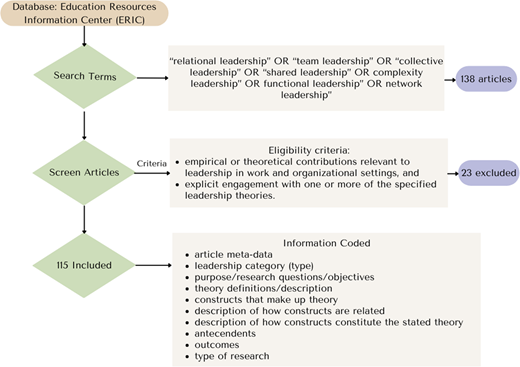
This study employed a systematic literature review to investigate collective leadership theories. This review followed the search, appraisal, literature review, synthesis and analysis (SALSA) framework as outlined by Booth et al. (2022) and adhered to the preferred reporting items for systematic reviews and meta-anaysis (PRISMA) 2020 guidelines (Page et al., 2021) to ensure transparency and rigor in reporting. The search and appraisal steps are described in the next section. These steps explain how the literature was searched and evaluated, and highlights the process used to identify the relevant literature for the current study. The literature review presents the data found in the relevant articles in the Findings section in the current article. Synthesis proceeded in two steps. First, literature was categorized by leadership theory, producing the 13 theory categories reported in the Findings. Second, through thematic synthesis across these categories, we derived the cross-cutting themes reported in the Discussion section. This included the four nested levels of analysis (see Table 4), the four collaboration, open systems, reflection and empowerment (CORE) dimensions (see Figure 4), and the distinctions among the theories (see Table 3). While the SALSA framework helps identify specific requirements for a literature review, the PRISMA guidelines provide reporting standards to assure transparency and replicability of studies. The PRISMA guidelines were used as our guide for the Methodology section. This practice, utilizing SALSA and PRISMA for a systematic literature review is common practice among scholars (Ángela Alameda and Rocío, 2025; Harraf and Talebzadehhosseini, 2025; Sim and Bierema, 2025). The five SALSA stages map onto the article as follows: Searh and Appraisal are reported in the Methodology, the literature review stage is reported in the Findings, and Synthesis and Analysis are reported in the Discussion.

A database search was conducted using Education Resources Information Center (ERIC) Database: ERIC, Education Source Ultimate, APA PsycInfo, Educational Administration Abstracts, Human Resources Abstracts, Business Source Ultimate, Academic Search Ultimate, Web of Science, ProQuest Dissertations and Theses Global on August 30, 2025. The database search was executed on this single date to provide a fixed snapshot of the literature; screening, full-text review, data extraction, and analysis were then carried out over the following six months (see Data Extraction and Review Process). To capture a comprehensive scope of literature, we used targeted search terms in the title field: TI “relational leadership,” OR TI “team leadership” OR TI “collective leadership,” OR TI “shared leadership,” OR TI “complexity leadership” OR TI “functional leadership” OR TI “network leadership.” The term functional leadership was included because collective leadership is often defined by leadership functions and work, one to many, rather than by formal roles (Eckert, 2019). Articles retrieved under this term were incorporated within the collective leadership category rather than forming a separate category. The initial search yielded 138 results. Following PRISMA 2020 reporting procedures, we screened all 138 studies. During this screening phase, we excluded 23 articles that did not meet the eligibility criteria, which focused on

  • empirical or theoretical contributions relevant to leadership in work and organizational settings and

  • explicit engagement with one or more of the specified leadership theories. This resulted in 115 studies that were reviewed.

All 115 included studies were reviewed and analyzed by the authors using a structured matrix for data extraction (Figure 1). The authors meet regularly with an estimated minimum of 12 h of meeting, roughly 60 manhours. Any conflicts or questions that arose were discussed and resolved during these meetings. The title-field search targeted seven collective-level leadership terms during the full-text review. The literature reviewed consistently engaged a broader family of related theories such as adaptive, agile, complex adaptive, complexity capacity, sapient, system, and distributed leadership. As these theories were coded, we organized them as additional categories that can be found in the Findings section. Because these adjacent theories surfaced from our review of the collective-leadership literature for the current study, rather than through a predetermined search of each field, several are represented mainly by their foundational or defining sources, this is noted among the study’s limitations.

The current review of the literature begins by discussing each of the leadership theories identified in the literature. The primary theories identified included collective leadership, adaptive leadership, agile leadership, complex adaptive leadership (CAL), complexity capacity, complexity leadership, sapient leadership, system leadership, distributed leadership, network leadership, relational leadership, shared leadership, and team leadership. Adaptive and agile leadership were retained because they recurred in the reviewed literature as accounts of distributed and shared responsed to complexity. Adaptive leadership locates leadership in mobilizing the collective’s adaptive work by “protecting voices of leadership from below” (Heifetz and Laurie, 1998, p. 4). Adaptvie leadership is also incorportated as the adaptive function within complexity leadership theory (Uhl-Bien and Arena, 2018; Uhl-Bien and Marion, 2009; Uhl-Bien et al., 2007). Agile leadership emphasized collective responsiveness to rapid, ambiguous change (Hall and Rowland, 2016).

Collective leadership theory takes an agency-structure perspective in which there is a recursive relationship between agency and structure. Ritchie et al. (2005) stressed that “there is no agency without structure, and no structure without agency” (p. 143), indicating that one does not exist without the other. Agency relates to the social actions taken by individuals, groups, and teams as they question, challenge, and make sense of their work environment and their role in it (Ritchie et al., 2005). Today, organizational success resides in its social assets (e.g. capacity to learn, resilience) more than its physical assets (Uhl-Bien et al., 2007). Likewise, structure refers to the “social arrangements, relations and practices that exert power and constraint over our lives” (Ritchie et al., 2005, p. 143).

Other views on collective leadership look at leadership defined by work rather than roles, defining leadership by functions (Eckert, 2019). Functional definitions involve work design/redesign and skill development components. Eckert (2019) presented a model for developing collective leadership for teacher leadership that included the “capacity of individuals to perform the leadership work” (p. 4). Their model is similar to Pino-Yancovic and Ahumada (2020) concept of “leading upwards.” Leading upwards challenges traditional leadership models by empowering those lower in the hierarchical ladder to lead. This concept requires agents to develop a network of partners that share in the leadership role, composed of internal and external agents, termed collaborative inquiry (Pino-Yancovic and Ahumada, 2020).

While there is no theory for collective leadership, this term is mainly used as a general term for the collective-level leadership theories, such as those reviewed in the current study. Collective leadership has been described as a sharing in decision-making (Bernhardt, 2013), where agents are “collectively participating in the distributed leadership role” (Azeem and Mataruna, 2019, p. 1319), involving the “shared responsibility of actors for the enactment of structures that afford agency to stakeholders” (Ritchie et al., 2005, p. 144). Collective leadership has also been described as having a power dynamic component. Ni et al. (2018) identified collective leadership as an organizational construct in which agents use task-relevant knowledge, resources, and power to exert influence.

Heifetz and Laurie (1998) identified six principles for leading adaptive work: getting on the balcony, identifying the adaptive challenge, regulating distress, maintaining disciplined attention, giving the work back to people, and protecting voices of leadership from below. These principles later became known as adaptive leadership. Identifying the adaptive challenge calls for followers and the leader to narrow down the problem to define the challenge. Regulating distress relates to how employees feel stressed when forced to change from the norm. Three fundamental tasks that leaders need to attend to include providing a holding environment (safe space); being responsible for direction, protection, orientation, managing conflict, and shaping norms; and having a presence (Heifetz and Laurie, 1998). Maintaining disciplined attention relates to leaders, and followers, considering differing perspectives than their own. Giving the work back to the people relates to giving the responsibilities to the workers while providing support and resources for them to do their jobs. Protecting voices of leadership from below focuses on giving a voice to everyone within the organization at all levels (Heifetz and Laurie, 1998).

Hall and Rowland (2016) highlighted that a gap exists between what business schools teach executives from what organizations expect. This gap is especially true in a volatility, uncertainty, complexity, ambiguity environment. The main point made by Hall and Rowland (2016) is best represented by the following from Hoffer (1973; see also Bennis, 2009): “In times of change, learners inherit the earth, while the learned find themselves beautifully equipped to deal with a world that no longer exists” (p. Section 32). Hall and Rowland (2016) used the “Nine Box” review method to assess individuals on performance and leadership agility. The nine-box method is a three-by-three matrix that has agility along the horizontal axis (low agility to high agility), and performance along the vertical axis (low performance to high performance). This research looked to identify any links between “management theory and practice with regards to both leadership and performance” (Hall and Rowland, 2016, p. 943). This study did not present a theory of “agile leadership,” but did describe agile leaders as those who “anticipate change and are able to initiate action in work situations that feature rapid change and/or ambiguity” (Hall and Rowland, 2016, p. 943).

CAL (Obolensky, 2014) views leadership as being adaptive, complex, and dynamic, involving everyone. This is best described by Obolensky (2014) in the following: “leadership of the many by the many” (p. 12). This theory has influences from situational leadership (Blanchard, 2008, 2010), complexity science, and the Cynefin framework (Snowden, 2021; Snowden and Boone, 2007). Obolensky (2014) developed the CAL Model to explain and develop leadership in organizations. This model consists of a two-by-two matrix with the vertical axis representing people focus (low, high) and the horizontal representing goal focus (low, high). CAL is prescriptive, like situational leadership. While it has not been tested empirically, it has been applied in practice for training. While it is a model rather than a theory of leadership, it is heavily influence by other leadership theories (e.g. situational leadership, followership, adaptive leadership). Another influence comes from Adair (1988) “task-team-individual” model. Obolensky (2014) modified Adair’s (1988) seven leadership functions (defining the task, planning, briefing, controlling, supporting, informing, reviewing) into four dynamic cyclical stages (define task, plan and brief, inform and control, support and review). These cyclical stages could be mapped onto Obolensky’s (2014)CAL model to identify leadership functions for each stage.

Omer (July 18, 2017) focused on developing complexity capabilities at both the individual (leader) and organizational (leadership) levels. To manage through complexity, Omer presented five capabilities: negative capability, imaginal capability, perspectival capability, autopoetic capability, and collaborative capability. Negative capability focuses on one being curious, open, and creative when facing unknowns. Imaginal capability utilizes imagination to make new linkages to potentialities, the past, the future, and one’s place in each. Perspectival capability relates to one’s ability to identify and make sense of conflicting perspectives. Autopoetic capability is one’s ability to constantly self-organize and collaborative capability views collaboration as sharing worlds and perspectives (Omer, July 18, 2017). Through transformative learning, leaders can improve their complexity capabilities while shifting their “perspective, perceptual lenses, core beliefs, schemas, mental models and mindsets” (Omer, July 18, 2017, p. 4).

Complexity leadership theory views leadership as taking place in the interactions between people, places, and ideas. This conceptualization comes from connectionist theory in which meaning is distributed over multiple layers, with some layers being hidden or unobservable (Hogue and Lord, 2007). It consists of an epistemology consistent with “connective, distributed, dynamic, and contextual views of leadership” (Uhl-Bien et al., 2007, p. 302). The premise of complexity leadership theory is that “managers should enable, rather than suppress or align, informal network dynamics” (Uhl-Bien et al., 2007, p. 302). As a core proposition for complexity leadership theory, Uhl-Bien et al. (2007) introduced the following proposition:

Much of leadership thinking has failed to recognize that leadership is not merely the influential act of an individual or individuals but rather is embedded in a complex interplay of numerous interacting forces (p. 302).

Complexity leadership theory identified leadership as being interactional across multiple levels.

Uhl-Bien et al. (2007) defined CLT as “the study of social interactions at multiple levels and their effects on innovation and emergent outcomes” (p. 472). This theory argues that there is a tension within organizations between exploring new ideas (innovation) and exploiting existing knowledge (production; Tsai et al., 2019). Leadership is perceived as being socially constructed, residing in agents (people, ideas, events; Uhl-Bien et al., 2007). This theory also distinguishes between leader and leadership with the former relating to individuals with influence and the latter relating to the process of leading and how it is relational and distributed throughout an organization. CLT recognized three types of leadership: administrative, enabling, and adaptive (Uhl-Bien and Marion, 2009; Uhl-Bien et al., 2007). Within each type, Schophuizen et al. (2022) associated specific roles for each type. The three types of leadership and their roles are presented in Table 1.

To sustain and support these three types of leadership within a single organization, Schophuizen et al. (2022) introduced four interventions for change: coordination, identification, reflection, and transformation. Coordination relates to standardized processes allowing for multiple practices to take place at any given time. Identification relates to existing practices that are recreated for different contexts or environments. Reflection is associated with perspective-making and perspective-taking practices. Finally, transformation involves existing practices working in parallel with new and novel practices. These interventions help to show how leaders make decisions and strategic choices in complex settings, aligning bottom-up with top-down processes (Schophuizen et al., 2022).

Aneel and Gutman (2020, October 29) identified that change in a post-COVID era was represented by three dimensions (3-D): perpetual (occurring all the time in an ongoing way), pervasive (unfolding in multiple areas of life at once), and exponential (accelerating at an increasingly rapid rate; p. 2). In researching the future or leadership, Aneel and Gutman (2020, October 29) identified what they called “sapient leadership,” described as a leader who is “wise, sagacious, and discerning in navigating change while also being humane in the face of change that can often feel alien” (p. 3).

In their research, Aneel and Gutman (2020, October 29) highlighted the four pillars of sapient leadership:

  • leader humility, authenticity, and openness instills trust and psychological safety;

  • trust and psychological safety empower individuals and teams;

  • continuously learning teams enable effective navigation of 3-D change; and

  • shared purpose and values enhance focus, cohesion, and resilience during 3-D change. (pp. 5–8).

Systems leadership has been defined as one who “catalyzes collective leadership in others” (Dreier et al., 2019, p. 13) and who “enable[s] and support[s] systems-level change” (Dreier et al., 2019, p. 13). The elements of systems leadership involve three levels of analysis: individual, community and system. These levels are described in Table 2.

Stuart (2018) described distributed leadership as leadership that is shared and distributed across an organization. This contrasts with traditional leadership theories or models that have leadership residing in an individual (Lindahl, 2008; Printy and Marks, 2006). Distributed leadership takes a constructivist perspective, viewing leadership as being socially constructed through relationships and interactions. Distributed leadership also takes an agentic perspective, viewing leadership as emphasizing the interdependencies (Printy and Marks, 2006) of organizational agents. If leadership is socially constructed and relational, then distributed leadership is the aggregated agency of an organization. Lumby (2009) hinted at this by describing “distributed leadership as the aggregation of many people’s efforts” (p. 320). This new perspective follows the three forms of “concretive action”:

  1. collaborative modes of engagement which arise spontaneously in the workplace;

  2. intuitive understanding that develops as part of the close working relationships; and

  3. structural relations and institutionalized arrangements. (Gronn, 2003, p. 35).

From this agentic or concretive action perspective, distributed leadership results in the combined influence exerted by several agents toward completion of a common/shared goal, including both formal and informal agents (Leithwood and Mascall, 2008). Distributed leadership is allocated through several leaders who have influence and competence, expressed through “shared responsibilities, peer collaboration, teamwork and so on” (Turchi et al., 2023, p. 122). It also emerges through the interplay of a leader’s thinking, behavior and context or situation (Lumby, 2009). Leadership is not viewed as coming from an individual, but as the composite of interactions and influence around goal achievement (Lumby, 2009, p. 319). While shared and distributed leadership could be viewed as being similar, they are different and are contextually separate. Lindahl (2008) identified shared leadership concentrating on roles and responsibilities (often of team members), while distributed leadership concentrates more on the practice/process of leadership distributed through an organization. The former is mostly a team-level theory (Khasawneh, 2011; Slantcheva-Durst, 2014) whereas the ladder is an organization-level theory. Turchi et al. (2023) differentiated these theories by identifying distributed leadership as having a stronger emphasis on the collective commitment and responsibility of the agents involved.

Network leadership is an emerging leadership approach that emphasizes interconnectedness, collective action and collaboration across organizations, institutions and sectors (Tremblay, 2012). Network leadership is defined as being collaborative (Browne-ferrigno and Bjork, 2018), dynamic, interconnected and self-organizing (Tremblay, 2012) while using collective ownership, participatory decision-making, social networks, shared leadership and teamwork (Poley, 1998; Tremblay, 2012). Tremblay (2012) positioned network leadership as an alternative to traditional hierarchical models, emphasizing intentional connectivity among leaders, organizations and stakeholders. This perspective is especially relevant in educational and social change contexts, where leadership increasingly hinges on collective efforts. Rather than focusing on personal authority and control, newer leadership theories concentrate on cultivating relationships, fostering collaborative decision-making and aligning efforts within a system (Poley, 1998). Network leadership transcends individual authority, prioritizing cooperation and shared responsibility (Poley, 1998; Tremblay, 2012).

As a collaborative model, network leadership marks a shift from hierarchical structures toward shared responsibility, systemic change and interdependence. Team-based leadership is becoming essential for navigating the complexities of modern educational institutions with more calls for relational and collaborative approaches to leadership (Browne-ferrigno and Bjork, 2018). Exploring emerging leadership structures in schools, Chrispeels et al. (1999) framed leadership as a distributed function for open systems that involved teachers, principals, superintendents and district administrators. Network leadership has also been conceptualized through swarm intelligence and social network theory. McNulty et al. (2018) described how decentralized systems develop collective intelligence from agent interactions. Bullington and Alford (2019) expanded this view by focusing on the structural features of networks. In both cases, the process of leadership is enhanced through the distributed flow of information across all agents (Bullington and Alford, 2019; McNulty et al., 2018).

Relational leadership focuses on relational processes rather than leader-follower interactions. Expanding upon Hollander’s (1958) work, Uhl-Bien (2006) looked at how leadership relationships are formed and evolved in the workplace. Relational leadership takes either an entity or a relational approach to leadership. Entity approaches look at the leader to follower, leader to team, leader to dyad dynamics and how one agent has influence over the others. The entity approaches look at relationships “lying in individual perceptions, cognition (e.g. self-concept), attributes and behaviors”(Uhl-Bien, 2006, p. 661). In contrast, relational approaches view leadership as being “constructed and constantly in the making” (Dachler and Hosking, 1995, p. 15). The entity approach takes on an objective reality while the relational approach takes on a social reality. Leadership is constructed through relations rather than attributes (Webb, 2021).

Other views on relational leadership highlight that individuals are not the containers of leadership (McCauley and Palus, 2021), rather influence emerges from relational interactions among agents. McCauley and Palus (2021) described relational leadership in the following:

Leadership is understood as an emergent property of relations-a view that decenters individuals. Individuals are still understood as active participants of leadership, but they are not the ‘containers’ of leadership […]. Leadership is not sometimes collective but is fundamentally collective. (p. 2).

This collective takes the form of groups, teams and organizations with shared processes, structures, beliefs and practices (McCauley and Palus, 2021).

Shared leadership views leadership as a dynamic and interactive process (Nazarpoori, 2017; Pieczka and Casteltrione, 2020), a collaborative phenomenon that emerges from team member interactions (Slantcheva-Durst, 2014) with a focus on shared goals (Pieczka and Casteltrione, 2020). Shared leadership is an emergent team property (Carson et al., 2007; Nazarpoori, 2017) compared to traditional leadership theories that focus primarily on leader-follower interactions (Kosterelioglu, 2017; Slantcheva-Durst, 2014). It divides roles and responsibilities among members which is different from vertical leadership that provides top-down models of leadership with centralized control (Darban, 2021). It also looks at higher levels of analysis and is viewed as a multi-level construct (Pieczka and Casteltrione, 2020). The most widely used definition for shared leadership comes from Pearce and Conger (2003), indicating that leadership is distributed to subsets of group members when needed rather than being based on distributing responsibilities across all members (Avolio et al., 2009; de Cruz, 2019). Other definitions counter this perspective, placing distributed and shared leadership as being synonymous, highlighting that it is based on shared responsibilities and not limited to just teams (Gibson et al., 2022).

The literature highlighted social learning theory and resource-based view (RBV) theory (Shoukat et al., 2023) as foundational theories for shared leadership. Social learning theory views team members engaging in social learning activities as they interact (Printy and Marks, 2006; Turchi et al., 2023) and observe one another (Shoukat et al., 2023). RBV highlights that teams are composed of human, relational and structural resources that should be used effectively to complete a team’s tasks (Shoukat et al., 2023). Researchers have identified distributed and shared leadership as being distinctively different from one another (Goksoy, 2016; Harris, 2014; Pan et al., 2023). Goksoy (2016) indicated that distributed leadership disseminates the practice of leadership (Spillane, 2006), whereas shared leadership distributes the role of leadership to agents with the requisite KSA for the given task (Goksoy, 2016; Schlechty, 2005). While shared leadership has been mostly associated with teams, distributed leadership has been associated with teams, groups and organizations (Goksoy, 2016). However, other researchers identified shared leadership as having similar and complimentary meanings with distributed leadership, coleadership and parallel leadership (Webber et al., 2024).

Characteristics of the team.

Shared leadership involves specific characteristics of the team: collaborative decision making, communication, teamwork, ownership and empowerment (Khasawneh, 2011, p. 623); shared purpose, social support and voice (Nazarpoori, 2017); shared responsibility, task interdependence and team empowerment (Pieczka and Casteltrione, 2020; Yammarino et al., 2012); accountability, equity, partnership and ownership (Cawthorne, 2010, p. 152). While the literature identified several characteristics for shared leadership, five common characteristics stood out: decision-making, knowledge sharing, organizational, team member characteristics and teamwork skills. For decision-making, characteristics included autonomy (Torres et al., 2020), commitment (Afful, 2015; Cawthorne, 2010), compromise (Slantcheva-Durst, 2014), decision-making (Alanezi, 2016; Bostanci, 2013; Brown, 1994; Khasawneh, 2011; Kosterelioglu, 2017; Smith, 2022; Torres et al., 2020), empowerment (Brown, 1994; de Cruz, 2019; Khasawneh, 2011; Pieczka and Casteltrione, 2020), goal-setting (Cawthorne, 2010; Gibson et al., 2022), trust (Afful, 2015; Brown, 1994; Cawthorne, 2010; de Cruz, 2019; Döös and Wilhelmson, 2020; Stark, 2016) and vision-mission (Çobanoglu and Bozbayindir, 2019).

Team leadership models are often focused on the individual leader rather than the team as a collective. Team leadership is defined as “an emergent team property that results from the distribution of leadership influence across multiple team members” (Carson et al., 2007, p. 1218). Teams often fail because they have ineffective leaders (Stewart and Manz, 1995). One recipe for a team’s failure is for the leader to burden team members with a “vague purpose, squishy deadlines and fuzzy success criteria” (Bolman and Deal, 2011, p. 36). Teams have been shown to provide enhanced decision-making and performance, greater productivity, better utilization of resources and better problem solving capabilities (Curry, 2014). Team learning has been identified as having characteristics of shared decision-making, collective accountability and emphasizes teamwork over independencies (Court, 2007). While the benefits of teams have been acknowledged in the literature, research on team leadership is lacking with calls from researchers to expand research in this area (Carson et al., 2007; Ensley et al., 2006; Hambley et al., 2007). Team leadership has been compared with shared and collaborative leadership. Court (2007) observed team leadership as a team model in which team members were “equally capable of exercising authority within the agreements for the shared leadership” (p. 616). Other perspectives viewed team leadership in which all team members were treated equally and anyone could take the lead at any time: “A team of equals sharing leadership” (Court, 2007, p. 617). Court (2007) highlighted that these different perspectives provide different ways of viewing leadership. By these definitions, team leadership is similar to shared leadership. However, the main difference is that an external leader operates as a team leader whereas shared leadership involves all team members in the leadership role.

Leadership occurs in two manners for team leadership, leadership of the team (external of the team) and leadership from the team (within the team; Hirschy, 2011). Most of the literature focuses on how an external leader can manage the team rather than how a team can lead as a collective entity (Carson et al., 2007). More research is needed to look at how teams can lead collectively. The importance of such research include the inability of a single leader to manage complex and ambiguous tasks and their inability to manage emergent processes such as teamwork (Carson et al., 2007). The characteristics of team members were broken down into two parts, individual characteristics and team-related characteristics. Individual characteristics include socio-demographic characteristics (e.g. age, gender), personality (e.g. Big five personality characteristics), other personal characteristics (e.g. values, norms) and knowledge (e.g. education, experience; Lattner and Strehmel, 2023). Team-related characteristics included tenure (time with team), process of induction, role, task, values and training (Lattner and Strehmel, 2023).

Although the field of study relating to collective leadership theories shows promise due to the number of conceptual and theoretical models available, much work is still needed to develop and test theories around the concept of collective leadership. Leadership is no longer confined to a single individual or hierarchical position but is instead a social, relational and adaptive process. However, there is still much confusion around these theories. This confusion not only involves misunderstandings about each of the individual theories (Kownacki et al., 2020), but it also includes a lack of understanding about the differences between each theory and when to apply one over the other (Toader and Martin, 2023; Underwood, 2024). Subtle distinctions across these theories are summarized in Table 3, which outlines their epistemological roots, levels of analysis and theoretical integrations.

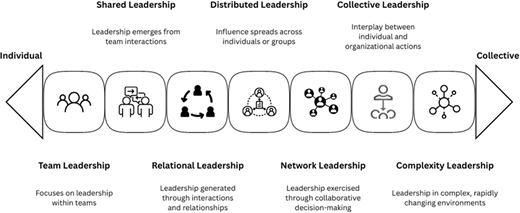
Theories were treated as falling under the collective leadership banner when they locate leadership in collective, shared, distributed or relational processes rather than in the traits or role of a single leader. Table 3 helps to identify the differences among the theories that fall under the collective leadership banner to help guide researchers and practitioners in their selection of the best leadership theory that meets their needs. Another tool that could be used to help guide researchers and practitioners is a diagram that shows these theories on a spectrum that ranges from mostly individual-focused to mostly collective-focused. Figure 2 presents a spectrum ranging from individual perspectives of leadership (leader) to collective perspectives of leadership (collective).

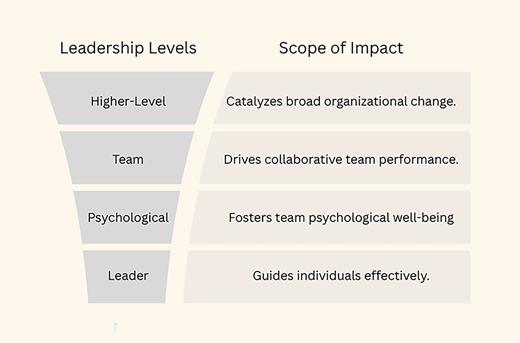
Collective leadership has been identified as a multilevel theory that spans across several levels within an organization. Examples of this include Gu et al. (2016) in their call for a multilevel model for shared leadership across the individual and team levels of analysis when looking at both individual and team creativity. In addition, because leadership is relational, Schilpzand et al. (2026) advocated for multilevel models to account for effects that are shaped by interactions across levels to mediate cross-level behaviors. As part of the synthesis of data from the current study, we found that the phenomenon of collective leadership operates across four nested levels of analysis: leader-specific, psychological, team and higher-level (Figure 3).

These four levels are expanded upon in more detail to provide evidence for each level from the data collected in the current study. Table 4 includes the characteristics for each level to show how collective leadership is has been represented as being inherently multilevel and emerges through interactions within and between individuals, team, and systems.

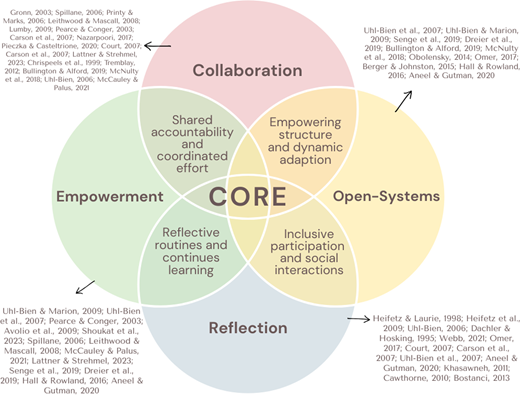
One way of analyzing the literature is to break it down into levels of analysis and to examine the characteristics at each level, as was shown in the previous section. Another way to analyze the literature is to develop a framework that shows the multidimensionality of collective leadership. Recognizing collective leadership as being multidimensional affords researchers with a better understanding of what is involved in collective leadership, regardless of the specific collective leadership theory that is being applied or studied. To integrate the diverse yet overlapping theories identified in this review, our study presents the CORE leadership framework, “collaboration,” “open systems,” “reflection” and “empowerment,” to show the multidimensionality aspects of collective leadership. This framework, shown in Figure 4, provides both a conceptual map for scholars and practitioners and a practical guide for organizations seeking to cultivate collective capacity.

Collaboration.

Collaboration forms the social foundation of collective leadership. It represents the interactive process through which individuals and teams coordinate, share purpose and align goals. Collaboration is central to distributed and shared leadership, where influence and decision-making are shared across formal and informal roles (Leithwood and Mascall, 2008; Pieczka and Casteltrione, 2020). In network and team leadership, collaboration extends across boundaries, fostering partnerships and joint accountability (Chrispeels et al., 1999; Tremblay, 2012). Effective collaboration depends on psychological safety, trust and open communication, relational conditions that enable joint sense-making and innovation (Paulus, 2023). Beyond these interpersonal dynamics, collaboration also reflects the structural arrangements that make cross-boundary engagement possible, such as shared governance systems, role fluidity and participatory mechanisms that invite diverse agents into leadership work (Zhang et al., 2025). Research consistently shows that collaborative practices are strengthened when teams possess high task interdependence and shared mental models, allowing members to anticipate one another’s actions and coordinate more effectively (Mcguier et al., 2023). Within collective leadership systems, collaboration is not simply a behavior, but a context-dependent capability shaped by organizational culture, incentive systems and the availability of relational resources.

Open systems.

Drawing on complexity, network and system leadership, the open-systems dimension recognizes that leadership unfolds within dynamic, interconnected contexts. Organizations function as CAS (Uhl-Bien et al., 2007) in which leadership arises from feedback loops and emergent patterns of interaction. Openness enables adaptability and learning, linking local actions to system-wide outcomes. System leadership, for instance, calls for leaders who can “see the larger system” and align diverse stakeholders (Senge et al., 2019), while network leadership emphasizes connectivity and information flow across institutions (Bullington and Alford, 2019). This open-systems view operates primarily at the higher level of analysis, where coordination, learning and innovation emerge through collective action. The open-systems orientation further acknowledges that leadership is shaped by external environmental pressures, technological shifts, policy changes, stakeholder expectations, which continuously reshape organizational priorities and interaction patterns. Such environments demand leaders who can recognize patterns across subsystems, navigate ambiguity and facilitate rapid recombination of ideas and resources (Uhl-Bien and Arena, 2018). Openness also involves the creation of permeable organizational boundaries that allow knowledge, talent and institutional learning to circulate freely across units and departments. This permeability increases the organization’s capacity for innovation by allowing previously disconnected groups to interact and generate novel solutions. Within complex leadership systems, open-system responsiveness becomes a strategic asset, enabling organizations to maintain alignment while embracing diversity of thought and practice.

Reflection.

Reflection captures the learning-oriented mechanisms that sustain adaptability. Grounded in relational, adaptive and complexity leadership theories, reflection involves sense making, perspective-taking and continuous learning. It operates at the psychological and team levels, where leaders and members engage in dialogue, feedback and iterative learning. Adaptive leadership emphasizes reflective practices such as getting on the balcony to observe patterns (Heifetz and Laurie, 1998), while complexity capacity frameworks underscore the role of curiosity and perspective sharing (Omer, 2017). Reflection transforms experience into collective insight, reinforcing learning cycles that enhance resilience and innovation. Within organizations, reflective practices serve as both diagnostic and generative tools, helping individuals and teams identify assumptions, evaluate interventions and refine their approaches over time. Reflection also facilitates emotional regulation and resilience by providing space for meaning-making amid uncertainty and change. Teams that engage in structured reflection, such as after-action reviews, debriefs and dialogue sessions, tend to develop stronger shared mental models, which in turn enhance performance and coordination (Tannenbaum and Cerasoli, 2013). These micro-level learning processes accumulate to influence system-wide adaptability, forming the foundation for organizational learning loops. At the psychological level, reflection builds individual capacity for critical thinking, empathy and self-awareness, which are essential attributes for navigating complex interpersonal dynamics. At the team level, reflective processes support mutual understanding, strengthen relational ties and foster a climate conducive to experimentation.

Empowerment.

Empowerment is the enabling condition that activates collaboration, reflection and openness. It refers to distributing authority, cultivating voice and creating conditions for autonomy. In Complexity Leadership Theory, empowerment corresponds to enabling leadership, bridging top-down structures with bottom-up adaptability (Uhl-Bien and Marion, 2009). Relational leadership involves mutual influence and coconstruction of meaning (McCauley and Palus, 2021). Empowerment spans all levels of analysis, promoting psychological safety at the individual level, shared accountability at the team level and inclusive governance at the system level. It turns collective potential into collective action. Empowerment is also a developmental process, requiring intentional investment in skills, confidence and role clarity so that individuals feel capable of contributing to leadership work. Research shows that empowered individuals are more likely to engage in proactive behaviors, voice concerns and initiate problem-solving activities, behaviors essential for emergent leadership (Yin, 2017). At the team level, empowerment fosters shared ownership of goals and results, encouraging members to take initiative and assume leadership roles based on expertise rather than position. When embedded in organizational culture, empowerment manifests in structures such as distributed decision-making, transparent information-sharing systems and participatory governance models. These structures reduce power distances and signal that leadership is a collective responsibility rather than a positional privilege. Empowerment further reshapes organizational identity by normalizing the idea that leadership can emerge from anywhere, making the organization more resilient and adaptive.

As highlighted in the beginning of the current article, organizations operating in today’s IR 4.0 environment can no longer rely on traditional “Tayloristic” command-and-control approaches to leadership (Pflaeging, 2014). The accelerating complexity of organizational systems due to technological revolutions, global interdependencies and the spread of digital Taylorism and algorithmic management (Noponen et al., 2024) demands that leadership functions as a CAS in which influence, decision-making and adaptability are distributed across agents at multiple levels (Mahmud et al., 2026). Yet, despite growing recognition of this need, collective leadership has emerged rapidly but remains under-theorized and under-tested, with limited understanding of how leadership emerges through relational systems (Acton et al., 2026; Toader and Martin, 2023). The current study responds to these challenges by systematically identifying collective leadership theories, comparing their characteristics and mapping their multilevel and multidimensional properties. The findings carry significant implications for researchers and practitioners seeking to understand, study and cultivate collective leadership.

For researchers, the identification of four nested level of analysis (Figure 3) provides a structured foundation for future empirical inquiry that has been largely absent from the fragmented collective leadership literature (Toader and Martin, 2023). These levels help to clarify that collective leadership is not a single-level construct but a cross-level, recursive process in which actions and interactions at one level shape conditions and outcomes at other levels (Schilpzand et al., 2026). Future research should employ multilevel methodologies such as hierarchical linear modeling, social network analysis or longitudinal case studies to examine further how leadership dynamics at the leader-specific and psychological-levels influence team-level processes. In addition, these effects will need to be studied to identify their impact on the higher-level organizational outcomes. This work would directly address the current deficit in understanding of how leadership emerges through networked and complex systems (Acton et al., 2026; Uhl-Bien and Marion, 2009).

The CORE leadership framework (Figure 4) offers researchers a common theoretical vocabulary and structure for comparing, testing and integrating the diverse collective leadership theories presented in the current study. By grounding each dimension in the empirical literature and aligning each with specific levels of analysis, this framework provides both a conceptual map and a set of testable propositions. Future research is encouraged to examine how these four dimensions interact across levels and contexts, particularly in organizations operating in IR 4.0.

For practitioners, the multilevel and multidimensional characterization of collective leadership provides actionable guidance that is directly responsive of the inadequacy of hierarchical structures found in today’s complex working environments. Rather than developing single leader competencies, organizations need to cultivate collective leadership capacity systematically across all four levels. At the leader-specific level, organizations should develop leaders who are adaptive, reflective and skilled at distributing authority. At the psychological level, leaders and teams must build psychological safety, trust and perspective-taking capabilities required for uncertainty (Heifetz and Laurie, 1998; Omer, July 18, 2017). At the team level, organizational design should emphasize shared purpose, task interdependence, collaborative decision-making and structures that enable teams to be self-organizing to allow for adaptability to rapid changes in the environment. At the higher-level, organizations could implement systemic structures such as participatory governance, cross-functional networks and transparent knowledge-sharing systems. These systemic structures would support collective action, coalition building and organizational learning (Dreier et al., 2019).

The CORE leadership framework further operationalizes the levels of practice. Implementing collaboration through shared governance and role fluidity and help create systems where leadership is distributed. Fostering open systems can allow organizations to remain responsive to external complexity and technological shifts. Embedding reflection through structured team debriefings and dialogue sessions can enhance collective sensemaking and organizational learning capabilities (Tannenbaum and Salas, 2021). Cultivating empowerment across all levels enable leadership to emerge from anywhere within the organization, increasing its utility and resiliency (Uhl-Bien et al., 2007).

Together, these implications position collective leadership as a multidimensional and multilevel phenomenon that must be intentionally designed and developed across all levels within an organization. As collective leadership develops further, it is essential that researchers and practitioners continue to work in tandem, using integrative frameworks such as the CORE leadership framework to help build organizational capacity in today’s IR 4.0.

Several limitations can be associated to the current study, pointing to future research opportunities. First, the systematic search scope included seven collective-level leadership terms in the title. After coding the literature, additional theories were identified, such as adaptive and agile leadership. These additional theories were captured but were not initiated as a keyword for the current study. Future research studies could search each theory identified in the current study directly to test the boundaries identified here. Second, the search captured a single snapshot of the literature as of August 30, 2025. The search criteria may have omitted relevant studies that do not name the theory in their titles. Follow-up research could be conducted by expanding this search to include these theories in an Abstract and full-text query. Third, the CORE leadership framework and the four nested levels of analysis, are integrative syntheses derived from the literature and have not been empirically tested at this time. We encourage future research to operationalize and test this framework. One potential study could include hierarchical linear modeling that accounts for the levels of analysis presented in the current study. Social network analysis and longitudinal studies could be incorporated to test the CORE framework, advancing our understanding of how collective leadership emerges and how it is structured within organizations. These recommended studies will help to increase our understanding and knowledge of collective leadership, helping to un-fragment research in this area.
Acton
,
B.P.
,
Foti
,
R.J.
,
Pape
,
A.D.
and
Lord
,
R.G.
(
2026
), “
How does collective leadership emerge? A dual-process theory formalized using agent-based modeling
”,
The Leadership Quarterly
, Vol.
37
No.
1
, p.
101912
, doi: .
Adair
,
J.
(
1988
),
The Action Centered Leader
, (
2nd ed.
),
Spiro Press
,
London
.
Afful
,
D.
(
2015
), “
Enhancing effective administration at faculty level through shared leadership
”,
Journal of Education and Practice
, Vol.
6
No.
11
, pp.
49
-
55
.
Alanezi
,
A.
(
2016
), “
The relationship between shared leadership and administrative creativity in Kuwaiti schools
”,
Management in Education
, Vol.
30
No.
2
, pp.
50
-
56
, doi: .
Aneel
,
C.
and
Gutman
,
R.
(
2020
), “
What it takes to lead through an era of exponential change
”,
Harvard Business Review
,
HRB.org
Ángela Alameda
,
H.
and
Rocío
,
J.-B.
(
2025
), “
Critical disclosure analysis and systemic functional linguistics in empirical research: a systematic literature review
”,
English Studies at NBU
, Vol.
11
, pp.
291
-
314
.
Ashby
,
R.W.
(
2004
), “
Principles of the self-organizing system
”,
Emergence: Complexity and Organization
, Vol.
6
Nos
1-2
, pp.
102
-
126
.
Avolio
,
B.J.
,
Walumbwa
,
F.O.
and
Weber
,
T.J.
(
2009
), “
Leadership: current theories, research, and future directions
”,
Annual Review of Psychology
, Vol.
60
No.
1
, pp.
421
-
449
, doi: .
Azeem
,
M.
and
Mataruna
,
L.
(
2019
), “
Identifying factor measuring collective leadership at academic workplaces
”,
International Journal of Educational Management
, Vol.
33
No.
6
, pp.
1316
-
1335
, doi: .
Bennis
,
W.
(
2009
),
On Becoming a Leader
,
Basic Books, New York
.
Berger
,
J.G.
and
Johnston
,
K.
(
2015
),
Simple Habits for Complex Times: Powerful Practices for Leaders
,
Stanford University Press, Stanford, CA
.
Bernhardt
,
B.
(
2013
),
Using Data to Improve Student Learning in Elementary School
,
Routledge, New York
.
Blanchard
,
K.
(
2008
), “
Situational leadership
”,
Leadership Excellence
, Vol.
25
No.
5
, p.
19
.
HR.com
Blanchard
,
K.
(
2010
),
Leading as a Higher Level: Blanchard on Leadership and Creating High Performing Organizations
, ( (Expanded ed.) ).
FT Press, Upper Saddle River, New Jersey
.
Bolman
,
L.G.
and
Deal
,
T.E.
(
2011
),
Reframing Organizations: Artistry, Choice and Leadership
,
Jossey-Bass, San Francisco, CA
.
Booth
,
A.
,
Martyn-St James
,
M.
,
Clowes
,
M.
and
Sutton
,
A.
(
2021
),
Systematic Approaches to a Successful Literature Review
,
Sage
,
Thousand Oaks, CA
.
Bostanci
,
A.B.
(
2013
), “
The prediction level of teachers’ organizational citizenship behaviors on the successful practice of shared leadership
”,
Eurasian Journal of Educational Research
, No.
51
, pp.
177
-
194
.
Brown
,
D.F.
(
1994
), “
Experiencing shared leadership: teachers’ reflections
”,
Journal of School Leadership
, Vol.
5
No.
4
, pp.
334
-
355
, doi: .
Browne-Ferrigno
,
T.
and
Bjork
,
L.G.
(
2018
), “
Reflections on education reform and team leadership
”,
Research in Educational Administration and Leadership
, Vol.
3
No.
2
, pp.
339
-
347
, doi: .
Bullington
,
T.S.
and
Alford
,
W.A.
(
2019
), “
Teaching network leadership: using collaborative structure and the remote associates test
”,
Journal of Leadership Education
, Vol.
18
No.
4
, pp.
150
-
155
, doi: .
Carson
,
J.B.
,
Tesluk
,
P.E.
and
Marrone
,
J.A.
(
2007
), “
Shared leadership in teams: an investigation of antecednent conditions and performance
”,
Academy of Management Journal
, Vol.
50
No.
5
, pp.
1217
-
1234
, doi: .
Cawthorne
,
J.E.
(
2010
), “
Leading from the middle of the organization: an examination of shared leadership in academic libraries
”,
The Journal of Academic Librarianship
, Vol.
36
No.
2
, pp.
151
-
157
, doi: .
Chrispeels
,
J.H.
,
Martin
,
K.J.
,
Harari
,
I.
,
Strait
,
C.C.
and
Rodarte
,
M.A.
(
1999
), “
Role conflict and role ambiguity: the challenges of team leadership at a middle school1
”,
Journal of School Leadership
, Vol.
9
No.
5
, pp.
422
-
453
, doi: .
Çobanoglu
,
N.
and
Bozbayindir
,
F.
(
2019
), “
A study on shared leadership and positive psychological capitals of teachers at primary and secondary schools
”,
Universal Journal of Educational Research
, Vol.
7
No.
5
, pp.
1265
-
1274
, doi: .
Court
,
M.
(
2007
), “
Changing and/or reinscribing gendered discourses of team leadership in education?
”,
Gender and Education
, Vol.
19
No.
5
, pp.
607
-
626
, doi: .
Curry
,
K.A.
(
2014
), “
Team leadership
”,
Journal of Cases in Educational Leadership
, Vol.
17
No.
2
, pp.
20
-
40
, doi: .
Dachler
,
H.P.
and
Hosking
,
D.M.
(
1995
), “The primacy of relations in socially constructing organizational realities”, In
Hosking
,
D.M.
,
Dachler
,
H.P.
and
GergenAnnunzio-Green
,
N.K.J.
(Eds),
Management and Organization: Relational Alternatives to Individualism
,
Avebury
,
England
, pp.
1
-
29
.
Darban
,
M.
(
2021
), “
Learning in virtual student teams: an examination of shared leadership
”,
Journal of Research on Technology in Education
, Vol.
54
No.
5
, pp.
736
-
753
, doi: .
de Cruz
,
N.P.
(
2019
), “
A conceptual overview of attaining, maintaining, and regaining shared leadership in high performing teams
”,
Journal of Leadership Education
, Vol.
18
No.
1
, pp.
213
-
226
, doi: .
Döös
,
M.
and
Wilhelmson
,
L.
(
2020
), “
Changing organizational conditions: experiences of introducing and putting function-shared leadership (FSL) into practice in schools and pre-schools
”,
Leadership and Policy in Schools
, Vol.
20
No.
4
, pp.
672
-
689
, doi: .
Dreier
,
L.
,
Nabarro
,
D.
and
Nelson
,
J.
(
2019
),
Systems Leadership for Sustainable Development: Strategies for Achieving Systemic Change
,
Harvard Kennedy School, Cambridge, MA
.
Eckert
,
J.
(
2019
), “
Collective leadership development: emerging themes from urban, suburban, and rural high schools
”,
Educational Administration Quarterly
, Vol.
55
No.
3
, pp.
477
-
509
, doi: .
Ensley
,
M.D.
,
Hmieleski
,
K.M.
and
Pearce
,
C.L.
(
2006
), “
The importance of vertical and shared leadership within new venture top management teams: implications for the performance of startups
”,
The Leadership Quarterly
, Vol.
17
No.
3
, pp.
217
-
231
, doi: .
Gibson
,
E.M.
,
Thompson
,
J.M.
,
Cook Sandifer
,
M.I.
and
Brant-Rajahn
,
S.N.
(
2022
), “
A culturally affirming shared leadership framework
”,
Professional School Counseling
, Vol.
26
No.
1c
, doi: .
Goksoy
,
S.
(
2016
), “
Analysis of the relationship between shared leadership and distributed leadership
”,
Eurasian Journal of Educational Research
, Vol.
16
No.
65
, pp.
295
-
312
,
available at:
Link to Analysis of the relationship between shared leadership and distributed leadershipLink to the cited article.
Gottfredson
,
R.
and
Crane
,
B.
(
2025
), “
Navigating complex environments requires complex leaders
”,
Business Horizons
, Vol.
69
No.
3
, pp.
419
-
432
, doi: .
Gronn
,
P.
(
2003
),
Education and Social Justice
,
University of Wales Press, Cardiff, Wales
.
Gu
,
J.
,
Chen
,
Z.
,
Huang
,
Q.
,
Liu
,
H.
and
Huang
,
S.
(
2016
), “
A multilevel analysis of the relationship between shared leadership and creativity in inter‐organizational teams
”,
The Journal of Creative Behavior
, Vol.
52
No.
2
, pp.
109
-
126
, doi: .
Hall
,
R.D.
and
Rowland
,
C.A.
(
2016
), “
Leadership development for managers in turbulent times
”,
Journal of Management Development
, Vol.
35
No.
8
, pp.
942
-
955
, doi: .
Hambley
,
L.A.
,
O’Neill
,
T.A.
and
Kline
,
T.J.B.
(
2007
), “
Virtual team leadership: the effects of leadership style and communication medium on team interaction styles and outcomes
”,
Organizational Behavior and Human Decision Processes
, Vol.
103
No.
1
, pp.
1
-
20
, doi: .
Harraf
,
A.
and
Talebzadehhosseini
,
S.
(
2025
), “
A systematic literature review on the application of big data analytics on businesses competitive advantage
”,
Journal of Managerial Issues
, Vol.
37
No.
3
, p.
215
,
available at:
Link to A systematic literature review on the application of big data analytics on businesses competitive advantageLink to the cited article.
Harris
,
A.
(
2014
),
Distributed Leadership Matters: Perspectives, Practicalities, and Potential
,
Corwin Press, Thousand Oaks, CA
.
Heifetz
,
R.A.
and
Laurie
,
D.L.
(
1998
), “
The work of leadership
”,
Harvard Business Review
,
HBR.org
, pp.
171
-
197
.
Hirschy
,
M.J.
(
2011
), “
Virtual team leadership: a case study in Christian Higher Education
”,
Christian Higher Education
, Vol.
10
No.
2
, pp.
97
-
111
, doi: .
Hoffer
,
E.
(
1973
),
Reflections on the Human Condition
,
Harper & Row
,
New York
.
Hogue
,
M.
and
Lord
,
R.G.
(
2007
), “
A multilevel, complexity theory approach to understanding gender bias in leadership
”,
The Leadership Quarterly
, Vol.
18
No.
4
, pp.
370
-
390
, doi: .
Hollander
,
E.P.
(
1958
), “
Conformity, status, and idiosyncrasy credit
”,
Psychological Review
, Vol.
65
No.
2
, pp.
117
-
127
, doi: .
Khasawneh
,
S.
(
2011
), “
Shared leadership and organizational citizenship behaviour in Jordanian public universities: developing a global workforce for the 21st century
”,
Educational Management Administration and Leadership
, Vol.
39
No.
5
, pp.
621
-
634
, doi: .
Kosterelioglu
,
M.A.
(
2017
), “
The effect of teachers’ shared leadership perception on academic optimism and organizational citizenship behaviour: a Turkish case
”,
International Journal of Leadership in Education
, Vol.
20
No.
2
, pp.
246
-
258
, doi: .
Kownacki
,
A.
,
Barker
,
D.
and
Arghode
,
V.
(
2020
), “
A grounded theory approach for exploring shared leadership: evidence from urban primary schools in Pennsylvania
”,
International Journal of Leadership in Education
, Vol.
26
No.
2
, pp.
201
-
222
, doi: .
Lattner
,
K.
and
Strehmel
,
P.
(
2023
), “
Pandemic-related challenges for team leadership in ECEC centres in Germany
”,
International Journal of Child Care and Education Policy
, Vol.
17
No.
1
, p.
20
, doi: .
Leithwood
,
K.
and
Mascall
,
B.
(
2008
), “
Collective leadership effects on student achievement
”,
Educational Administration Quarterly
, Vol.
44
No.
4
, pp.
529
-
561
, doi: .
Lindahl
,
R.
(
2008
), “
Shared leadership: can it work in schools?
”,
The Educational Forum
, Vol.
72
No.
4
, pp.
298
-
307
, doi: .
Lumby
,
J.
(
2009
), “
Collective leadership of local school systems
”,
Educational Management Administration and Leadership
, Vol.
37
No.
3
, pp.
310
-
328
, doi: .
McCauley
,
C.D.
and
Palus
,
C.J.
(
2021
), “
Developing the theory and practice of leadership development: a relational view
”,
The Leadership Quarterly
, Vol.
32
No.
5
, pp.
1
-
15
, doi: .
Mcguier
,
E.A.
,
Kolko
,
D.J.
,
Stadnick
,
N.A.
,
Brookman-Frazee
,
L.
,
Wolk
,
C.B.
,
Yuan
,
C.T.
,
Burke
,
C.S.
and
Aarons
,
G.A.
(
2023
), “
Advancing research on teams and team effectiveness in implementation science: an application of the exploration, preparation, implementation, sustainment (EPIS) framework
”,
Implementation Research and Practice
, Vol.
4
, doi: .
McNulty
,
E.J.
,
Dorn
,
B.C.
,
Goralnick
,
E.
,
Serino
,
R.
,
Grimes
,
J.O.
,
Flynn
,
L.B.
,
Cheers
,
M.
and
Marcus
,
L.J.
(
2018
), “
Swarm intelligence: establishing behavioral norms for the emergence of collective leadership
”,
Journal of Leadership Education
, Vol.
17
No.
2
, pp.
19
-
41
,
available at:
Link to Swarm intelligence: establishing behavioral norms for the emergence of collective leadershipLink to the pdf of the cited article.
Mahmud
,
Y.
,
Evaldsson
,
C.
,
Schmidt
,
M.
and
Kjellström
,
S.
(
2026
), “
Complexity leadership theory and fostering organizational adaptability: enabling leadership in complex systems change
”,
Leadership
, p.
1
, doi: . (
17427150
)
Nazarpoori
,
A.
(
2017
), “
A survey of the effect of leader’s social intelligence on employee’s perception of interpersonal justice: the mediating role of shared leadership [article]
”,
International Journal of Leadership in Education
, Vol.
20
No.
5
, pp.
618
-
631
, doi: .
Ni
,
Y.
,
Yan
,
R.
and
Pounder
,
D.
(
2018
), “
Collective leadership: principals’ decision influence and the supportive or inhibiting decision influence of other stakeholders
”,
Educational Administration Quarterly
, Vol.
54
No.
2
, pp.
216
-
248
, doi: .
Noponen
,
N.
,
Feshchenko
,
P.
,
Auvinen
,
T.
,
Luoma-Aho
,
V.
and
Abrahamsson
,
P.
(
2024
), “
Taylorism on steroids or enabling autonomy? A systematic review of algorithmic management
”,
Management Review Quarterly
, Vol.
74
No.
3
, pp.
1695
-
1721
, doi: .
Obolensky
,
N.
(
2014
),
Complex Adaptive Leadership: Embracing Paradox and Uncertainty
, ( (2nd ed.) ),
Routledge, London
.
Omer
,
A.
(
2017
), “
Imagination, emergence, and the role of transformative learning in complexity leadership
”,
Enlivening Edge
.,
available at:
Link to Imagination, emergence, and the role of transformative learning in complexity leadershipLink to the cited article.
Page
,
M.J.
,
McKenzie
,
J.E.
,
Bossuyt
,
P.M.
,
Boutron
,
I.
,
Hoffmann
,
T.C.
,
Mulrow
,
C.D.
,
Shamseer
,
L.
,
Tetzlaff
,
J.M.
,
Akl
,
E.A.
and
Brennan
,
S.E.
(
2021
), “
The PRISMA 2020 statement: an updated guideline for reporting systematic reviews
”,
British Medical Journal
, Vol.
372
, p.
n71
, doi: .
Pan
,
H.-L.W.
,
Wiens
,
P.D.
and
Moyal
,
A.
(
2023
), “
A bibliometric analysis of the teacher leadership scholarship
”,
Teaching and Teacher Education
, Vol.
121
, p.
103936
, doi: .
Paulus
,
P.
(
2023
), “
The role of psychological safety in team communication: implications for human resource practices
”,
Golden Ration of Mapping Idea and Literature Format
, Vol.
3
No.
2
, pp.
156
-
166
, doi: .
Pearce
,
C.L.
and
Conger
,
J.A.
(
2003
), “All those years ago: the historical underpinnings of shared leadership”, In
Pearce
,
C.L.
and
Conger
,
J.A.
(Eds),
Shared Leadership: Reframing the Hows and Whys of Leadership
,
Sage, Thousand Oaks, CA,
, pp.
1
-
18
.
Pflaeging
,
N.
(
2014
),
Organize for Complexity: How to Get Life Back into Work to Build the High-Performance Organization
,
BetaCodex, New York
.
Pieczka
,
M.
and
Casteltrione
,
I.
(
2020
), “
AlcoLOLs, re-thinking drinking: developing a shared leadership approach for alcohol education
”,
Health Education Journal
, Vol.
79
No.
3
, pp.
346
-
361
, doi: .
Pino-Yancovic
,
M.
and
Ahumada
,
L.
(
2020
), “
Collaborative inquiry networks: the challenge to promote network leadership capacities in Chile
”,
School Leadership and Management
, Vol.
40
Nos
2-3
, pp.
221
-
241
, doi: .
Poley
,
J.K.
(
1998
), “
Creating shared leadership environments in institutional and international settings
”,
American Journal of Distance Education
, Vol.
12
No.
2
, pp.
16
-
25
, doi: .
Printy
,
S.M.
and
Marks
,
H.M.
(
2006
), “
Shared leadership for teacher and student learning
”,
Theory Into Practice
, Vol.
45
No.
2
, pp.
125
-
132
, doi: .
Ritchie
,
S.M.
,
Mackay
,
G.
and
Rigano
,
D.L.
(
2005
), “
Individual and collective leadership in school science departments
”,
Research in Science Education
, Vol.
36
No.
3
, pp.
141
-
161
, doi: .
Sargut
,
G.
and
McGrath
,
R.G.
(
2011
), “
Learning to live with complexity
”,
Harvard Business Review
,
HRB.org
, Vol.
89
No.
9
, pp.
68
-
76
.
Schilpzand
,
P.
,
Nerona
,
R.
,
Li
,
Y.
,
Restubog
,
S.L.D.
and
Rofcanin
,
Y.
(
2026
), “
Leadership in layers: an integrative review on skip-level leadership and an agenda for future research
”,
The Leadership Quarterly
, Vol.
37
No.
1
, p.
101930
, doi: .
Schlechty
,
P.C.
(
2005
),
Shaking up the School House, Reestablishing Schools
,
Nobel Yayincilik, Ankara, Turkey
.
Schophuizen
,
M.
,
Kelly
,
A.
,
Utama
,
C.
,
Specht
,
M.
and
Kalz
,
M.
(
2022
), “
Enabling educational innovation through complexity leadership? Perspectives from four Dutch universities
”,
Tertiary Education and Management
, Vol.
29
No.
4
, pp.
471
-
490
, doi: .
Schwab
,
K.
(
2016
),
The Fourth Industrial Revolution
,
Crown Business, New York
.
Senge
,
P.
,
Hamilton
,
H.A.L.
and
Kania
,
J.
(
2019
), “
The dawn of system leadership
”,
Policy & Practice
, Vol.
77
No.
1
, pp.
12
-
19
.
Shoukat
,
M.H.
,
Shah
,
S.A.
and
Muneeb
,
D.
(
2023
), “
Shared leadership and team performance in health care: how intellectual capital and team learning intervene in this relationship
”,
The Learning Organization
, Vol.
30
No.
4
, pp.
426
-
445
, doi: .
Sim
,
E.
and
Bierema
,
L.
(
2025
), “
A systematic literature review of intersectional leadership in the workplace: the landscape and framework for future leadership research and practice to challenge interlocking systems of oppression
”,
Journal of Leadership and Organizational Studies
, Vol.
32
No.
1
, pp.
71
-
93
, doi: .
Simon
,
H.A.
(
2019
),
The Sciences of the Artificial.
[reissue of (3rd ed.) ].
The MIT Press, Cambridge, MA
.
Slantcheva-Durst
,
S.
(
2014
), “
Shared leadership as an outcome of team processes: a case study
”,
Community College Journal of Research and Practice
, Vol.
38
No.
11
, pp.
1017
-
1029
, doi: .
Smith
,
D.
(
2022
), “
More pivots than a centipede on ice skates: reflections on shared leadership in a post-secondary institution during COVID-19
”,
Canadian Journal of Educational Administration and Policy
, No.
200
, pp.
76
-
95
,
available at:
Link to More pivots than a centipede on ice skates: reflections on shared leadership in a post-secondary institution during COVID-19Link to the cited article.
Snowden
,
D.
(
2021
),
Cynefin: weaving Sense-Making into the Fabric of Our World
,
Cognitive Edge, Singapore
.
Snowden
,
D.J.
and
Boone
,
M.E.
(
2007
), “
A leader’s framework for decision making
”,
Harvard Business Review
, Vol.
85
No.
11
, pp.
68
-
76
,
available at:
Link to A leader’s framework for decision makingLink to the cited article.
Spillane
,
J.
(
2006
),
Distributed Leadership
,
Jossey-Bass, San Francisco, CA
.
Stark
,
R.
(
2016
), “
Cultivating shared leadership with docents and staff
”,
Journal of Museum Education
, Vol.
41
No.
1
, pp.
22
-
28
, doi: .
Stewart
,
G.L.
and
Manz
,
C.C.
(
1995
), “
Leadership for self-managing work teams: a typology and integrative model
”,
Human Relations
, Vol.
48
No.
7
, pp.
747
-
770
, doi: .
Stuart
,
K.
(
2018
), “
Value-based relational leadership practice in children’s centres: an action research project
”,
Educational Action Research
, Vol.
26
No.
5
, pp.
716
-
735
, doi: .
Tannenbaum
,
S. I.
and
Cerasoli
,
C. P.
(
2013
), “
Do team and individual debriefs enhance performance? A meta-analysis
”,
Human Factors: The Journal of the Human Factors and Ergonomics Society
, Vol.
55
No.
1
, pp.
231
-
245
, doi: .
Tannenbaum
,
S.
and
Salas
,
E.
(
2021
),
Teams That Work: The Seven Drivers of Team Effectiveness
,
Oxford University Press, New York
.
Toader
,
A.F.
and
Martin
,
R.
(
2023
), “
Bringing the cognitive revolution forward: what can team cognition contribute to our understanding of leadership?
”,
The Leadership Quarterly
, Vol.
34
No.
1
, p.
101619
, doi: .
Torres
,
A.C.
,
Bulkley
,
K.
and
Kim
,
T.
(
2020
), “
Shared leadership for learning in Denver’s portfolio management model
”,
Educational Administration Quarterly
, Vol.
56
No.
5
, pp.
819
-
855
, doi: .
Tremblay
,
C.W.
(
2012
), “
Network leadership: an emerging practice
”,
College and University
, Vol.
87
No.
4
, pp.
37
-
42
.
Tsai
,
Y.S.
,
Poquet
,
O.
,
Gašević
,
D.
,
Dawson
,
S.
and
Pardo
,
A.
(
2019
), “
Complexity leadership in learning analytics: drivers, challenges and opportunities
”,
British Journal of Educational Technology
, Vol.
50
No.
6
, pp.
2839
-
2854
, doi: .
Turchi
,
A.
,
Greco
,
S.
,
Morini
,
E.
and
Nencioni
,
P.
(
2023
), “
Participatory communication and shared leadership: The European Project Learning Leadership for Change (L2C)
”,
Research on Education and Media
, Vol.
15
No.
1
, pp.
120
-
129
, doi: .
Uhl-Bien
,
M.
(
2006
), “
Relational leadership theory: exploring the social processes of leadership and organizing
”,
The Leadership Quarterly
, Vol.
17
No.
6
, pp.
654
-
676
, doi: .
Uhl-Bien
,
M.
and
Arena
,
M.
(
2018
), “
Leadership for organizational adaptability: a theoretical synthesis and integrative framework
”,
The Leadership Quarterly
, Vol.
29
No.
1
, pp.
89
-
104
, doi: .
Uhl-Bien
,
M.
and
Marion
,
R.
(
2009
), “
Complexity leadership in bureaucratic forms of organizing: a meso model
”,
The Leadership Quarterly
, Vol.
20
No.
4
, pp.
631
-
650
, doi: .
Uhl-Bien
,
M.
,
Marion
,
R.
and
McKelvey
,
B.
(
2007
), “
Complexity leadership theory: shifting leadership from the industrial age to the knowledge era
”,
The Leadership Quarterly
, Vol.
18
No.
4
, pp.
298
-
318
, doi: .
Underwood
,
S.
(
2024
), “
Redefining leadership within NHS’ complex adaptive system
”,
Future Healthcare Journal
, Vol.
11
No.
1
, p.
3
, doi: .
Webb
,
O.D.
(
2021
), “
Enacting relational leadership through restorative practices
”,
Alberta Journal of Educational Research
, Vol.
67
No.
2
, pp.
159
-
177
, doi: .
Webber
,
C.F.
,
Jodi
,
N.
,
Sarah
,
H.
and
Braunberger
,
D.
(
2024
), “
Contextualised shared leadership: a Canadian case study
”,
School Leadership and Management
, Vol.
44
No.
3
, pp.
318
-
337
, doi: .
Yammarino
,
F.J.
,
Salas
,
E.
,
Serban
,
A.
,
Shirreffs
,
K.A.
and
Shuffler
,
M.L.
(
2012
), “
Collectivistic leadership approaches: putting the “we” in leadership science and practice
”,
Industrial and Organizational Psychology
, Vol.
5
No.
4
, pp.
382
-
402
, doi: .
Yin
,
R.
(
2017
),
Case Study Research and Applications: Design Methods
,
6th ed.
,
Sage
.
Zhang
,
P.
,
Dilliard
,
N.
and
Cavallo
,
T.
(
2025
), “
Navigating the limitations of algorithmic management: an integrative framework of sociotechnical systems theory (STS) and strategic HRD
”,
Human Resource Development Review
, Vol.
24
No.
3
, pp.
279
-
303
, doi: .
Ashby
,
W.R.
(
1962
), “Principles of the self-organizing system”, In
Von Foerster
,
H.
and
Zopf
,
G. W.
(Eds),
Principles of Self-Organization: Transactions of the University of IL Symposium
,
Pergamon Press
, pp.
255
-
278
.
Published by Emerald Publishing Limited. This article is published under the Creative Commons Attribution (CC BY 4.0) licence. Anyone may reproduce, distribute, translate and create derivative works of this article (for both commercial and non-commercial purposes), subject to full attribution to the original publication and authors. The full terms of this licence maybe seen at Link to the terms of the CC BY 4.0 licenceLink to the terms of the CC BY 4.0 licence.

Data & Figures

Figure 1.
A literature-review flowchart traces 138 Education Resources Information Center articles through screening, exclusion, inclusion, and information coding.The flowchart begins with the Education Resources Information Center database. The search terms are relational leadership, team leadership, collective leadership, shared leadership, complexity leadership, functional leadership, and network leadership, joined by OR. The search identifies 138 articles. Articles are screened using 2 eligibility criteria. They must provide empirical or theoretical contributions relevant to leadership in work and organisational settings. They must also explicitly engage with 1 or more of the specified leadership theories. Screening excludes 23 articles and includes 115 articles. The coded information comprises article metadata, leadership category or type, purpose or research questions or objectives, theory definitions or descriptions, constructs within each theory, relationships among constructs, how constructs constitute the stated theory, antecedents, outcomes, and type of research.

Systematic literature review search summary

Figure 1.
A literature-review flowchart traces 138 Education Resources Information Center articles through screening, exclusion, inclusion, and information coding.The flowchart begins with the Education Resources Information Center database. The search terms are relational leadership, team leadership, collective leadership, shared leadership, complexity leadership, functional leadership, and network leadership, joined by OR. The search identifies 138 articles. Articles are screened using 2 eligibility criteria. They must provide empirical or theoretical contributions relevant to leadership in work and organisational settings. They must also explicitly engage with 1 or more of the specified leadership theories. Screening excludes 23 articles and includes 115 articles. The coded information comprises article metadata, leadership category or type, purpose or research questions or objectives, theory definitions or descriptions, constructs within each theory, relationships among constructs, how constructs constitute the stated theory, antecedents, outcomes, and type of research.

Systematic literature review search summary

Close modal
Figure 2.
A continuum from individual to collective compares 7 leadership approaches through team, relational, distributed, network, collective, and complexity perspectives.The continuum runs from Individual to Collective and presents 7 leadership approaches. Team Leadership focuses on leadership within teams. Shared Leadership describes leadership emerging from team interactions. Relational Leadership describes leadership generated through interactions and relationships. Distributed Leadership describes influence spreading across individuals or groups. Network Leadership describes leadership exercised through collaborative decision-making. Collective Leadership describes the interplay between individual and organisational actions. Complexity Leadership describes leadership in complex, rapidly changing environments.

Relevance for research

Figure 2.
A continuum from individual to collective compares 7 leadership approaches through team, relational, distributed, network, collective, and complexity perspectives.The continuum runs from Individual to Collective and presents 7 leadership approaches. Team Leadership focuses on leadership within teams. Shared Leadership describes leadership emerging from team interactions. Relational Leadership describes leadership generated through interactions and relationships. Distributed Leadership describes influence spreading across individuals or groups. Network Leadership describes leadership exercised through collaborative decision-making. Collective Leadership describes the interplay between individual and organisational actions. Complexity Leadership describes leadership in complex, rapidly changing environments.

Relevance for research

Close modal
Figure 3.
A four-level leadership hierarchy links leader, psychological, team, and higher-level leadership to progressively broader scopes of impact.The diagram has the headings Leadership Levels and Scope of Impact. Leader leadership guides individuals effectively. Psychological leadership fosters team psychological well-being. Team leadership drives collaborative team performance. Higher-level leadership catalyses broad organisational change. The leadership levels are arranged from the narrower Leader level at the bottom to the broader Higher-Level category at the top.

Collective leadership levels

Figure 3.
A four-level leadership hierarchy links leader, psychological, team, and higher-level leadership to progressively broader scopes of impact.The diagram has the headings Leadership Levels and Scope of Impact. Leader leadership guides individuals effectively. Psychological leadership fosters team psychological well-being. Team leadership drives collaborative team performance. Higher-level leadership catalyses broad organisational change. The leadership levels are arranged from the narrower Leader level at the bottom to the broader Higher-Level category at the top.

Collective leadership levels

Close modal
Figure 4.
A four-circle Venn diagram links collaboration, empowerment, open-systems, and reflection, with their overlaps forming a central core.The diagram contains 4 overlapping circles labelled Collaboration, Empowerment, Open-Systems, and Reflection. The shared centre is labelled Core. The overlap between Collaboration and Empowerment is labelled Shared accountability and coordinated effort. The overlap between Collaboration and Open-Systems is labelled Empowering structure and dynamic adaption. The overlap between Empowerment and Reflection is labelled Reflective routines and continues learning. The overlap between Open-Systems and Reflection is labelled Inclusive participation and social interactions. References linked to Collaboration are Gronn, 2003; Spillane, 2006; Printy and Marks, 2006; Leithwood and Mascall, 2008; Lumby, 2009; Pearce and Conger, 2003; Carson et al, 2007; Nazarpoori, 2017; Pieczka and Casteltrione, 2020; Court, 2007; Carson et al, 2007; Lattner and Strehmel, 2023; Chrispeels et al, 1999; Tremblay, 2012; Bullington and Alford, 2019; McNulty et al, 2018; Uhl-Bien, 2006; and McCauley and Palus, 2021. References linked to Open-Systems are Uhl-Bien et al, 2007; Uhl-Bien and Marion, 2009; Senge et al, 2019; Dreier et al, 2019; Bullington and Alford, 2019; McNulty et al, 2018; Obolensky, 2014; Omer, 2017; Berger and Johnston, 2015; Hall and Rowland, 2016; and Aneel and Gutman, 2020. References linked to Empowerment are Uhl-Bien and Marion, 2009; Uhl-Bien et al, 2007; Pearce and Conger, 2003; Avolio et al, 2009; Shoukat et al, 2023; Spillane, 2006; Leithwood and Mascall, 2008; McCauley and Palus, 2021; Lattner and Strehmel, 2023; Senge et al, 2019; Dreier et al, 2019; Hall and Rowland, 2016; and Aneel and Gutman, 2020. References linked to Reflection are Heifetz and Laurie, 1998; Heifetz et al, 2009; Uhl-Bien, 2006; Dachler and Hosking, 1995; Webb, 2021; Omer, 2017; Court, 2007; Carson et al, 2007; Uhl-Bien et al, 2007; Aneel and Gutman, 2020; Khasawneh, 2011; Cawthorne, 2010; and Bostanci, 2013.

The CORE framework

Figure 4.
A four-circle Venn diagram links collaboration, empowerment, open-systems, and reflection, with their overlaps forming a central core.The diagram contains 4 overlapping circles labelled Collaboration, Empowerment, Open-Systems, and Reflection. The shared centre is labelled Core. The overlap between Collaboration and Empowerment is labelled Shared accountability and coordinated effort. The overlap between Collaboration and Open-Systems is labelled Empowering structure and dynamic adaption. The overlap between Empowerment and Reflection is labelled Reflective routines and continues learning. The overlap between Open-Systems and Reflection is labelled Inclusive participation and social interactions. References linked to Collaboration are Gronn, 2003; Spillane, 2006; Printy and Marks, 2006; Leithwood and Mascall, 2008; Lumby, 2009; Pearce and Conger, 2003; Carson et al, 2007; Nazarpoori, 2017; Pieczka and Casteltrione, 2020; Court, 2007; Carson et al, 2007; Lattner and Strehmel, 2023; Chrispeels et al, 1999; Tremblay, 2012; Bullington and Alford, 2019; McNulty et al, 2018; Uhl-Bien, 2006; and McCauley and Palus, 2021. References linked to Open-Systems are Uhl-Bien et al, 2007; Uhl-Bien and Marion, 2009; Senge et al, 2019; Dreier et al, 2019; Bullington and Alford, 2019; McNulty et al, 2018; Obolensky, 2014; Omer, 2017; Berger and Johnston, 2015; Hall and Rowland, 2016; and Aneel and Gutman, 2020. References linked to Empowerment are Uhl-Bien and Marion, 2009; Uhl-Bien et al, 2007; Pearce and Conger, 2003; Avolio et al, 2009; Shoukat et al, 2023; Spillane, 2006; Leithwood and Mascall, 2008; McCauley and Palus, 2021; Lattner and Strehmel, 2023; Senge et al, 2019; Dreier et al, 2019; Hall and Rowland, 2016; and Aneel and Gutman, 2020. References linked to Reflection are Heifetz and Laurie, 1998; Heifetz et al, 2009; Uhl-Bien, 2006; Dachler and Hosking, 1995; Webb, 2021; Omer, 2017; Court, 2007; Carson et al, 2007; Uhl-Bien et al, 2007; Aneel and Gutman, 2020; Khasawneh, 2011; Cawthorne, 2010; and Bostanci, 2013.

The CORE framework

Close modal
Table 1.

Three types of leadership in CLT

Leadership typeDescriptionRoles
Administrative leadershipThe actions of individuals and groups in formal managerial roles who plan and coordinate organizational activities (the bureaucratic function)
  • Top-down oriented

  • Formal with set patterns

  • Planning and coordination towards outcomes

  • Efficiency and effectiveness

  • Focus on alignment and control

  • Represented by hierarchical and bureaucratic functions

Adaptive leadershipAn emergent, interactive dynamic that is the primary source by which adaptive outcomes are produced in a firm
  • Bottom-up oriented

  • Informal and emergent

  • Adaptive

  • Creative learning actions that emerge from the actions of multiple agents in the organization

Enabling leadershipServes to enable (catalyze) adaptive dynamics and help manage the entanglement between administrative and adaptive leadership
  • Top-down catalyst for optimal conditions for bottom-up adaptive capacity

  • Leads entanglement between bureaucratic (i.e. administrative) and emergent (i.e. adaptive) forms of leadership

Note(s):

Leadership descriptions from (Uhl-Bien et al., 2007, p. 306). Roles from (Schophuizen et al., 2022, p. 473)

Table 2.

System leadership levels of analysis

Level of analysisDescription
The individualThe skills of collaborative leadership to enable learning, trust-building and empowered action among stakeholders who share a common goal
The communityThe tactics of coalition building and advocacy to develop alignment and mobilize action among stakeholders in the system, both within and between organizations
The systemAn understanding of the complex systems shaping the challenges to be addressed
(Dreier et al., 2019, p. 13)
Table 3.

Differences between collective theories

TheoryLevel of analysisEpistemologyIntegrated with
Collective leadershipLeader, organizationalDistributed, dynamicAgency, structure, function
Adaptive leadershipLeaderPrescriptiveEntrepreneurialism, interpersonal dynamics
Agile leadershipLeaderPrescriptiveLeader’s tasks
Complex adaptive leadershipLeaderAdaptive, dynamic. prescriptiveSituational leadership
Complexity capacityLeader, organizationalPrescriptiveTransformative learning
Complexity leadershipOrganizationalConnective, distributed, dynamic, contextualAdministrative, adaptive, enabling leadership
Sapient leadershipLeaderPrescriptiveLeader pillars
System leadershipLeader, community, systemPrescriptiveLeader capabilities
Distributed leadershipTeams, organizationsConstructivismConcertive action, shared leadership
Network leadershipTeam-based environments, organizationsCollective action, collective intelligence, interconnectednessSocial network theory, swarm intelligence
Relational leadershipLeader-follower, leader-team, leader-dyadConstructivismRelational (attributes, behaviors, cognitions, perceptions)
Shared leadershipTeam-basedDynamic, interactiveResource-based view (RBV), social learning theory
Team leadershipIndividual (leader-team), teamDistributed, sharedGroup dynamics, interpersonal relations, team climate/culture
Table 4.

Characteristics by levels of analysis

AdaptiveAccountabilityAuthenticBe curious
Leader specific characteristics
Brief/debriefCommunicationCompetentDecision making
Define tasksEmpowermentGoals (alignment)Humility
individualInfluentialInformLaissez faire
PlanProblem-solvingReflectiveRegulation
ReviewSupportUnderstand complex systems
Psychological characteristics
Be presentBuild cohesionBuild networksChange management
Conflict (manage)ContextEmotional supportEmpowered action
Enable learningFoster reflectionMake linkages to past, present and futurePerspective taking/sharing
Positive psychological capitalProtecting voices from belowProvide a safe spaceProvide direction
Psychological safetyRegulating distressSensemakingTrust-building
Trustworthiness
Teams characteristics
AccountabilityCocreating futureCollaborateCommunity
CommunicationCoordinateCreate (knowledge)Decision making (sharing in)
EquityInnovateInterdependentInterpersonal relations
OwnershipPartnershipPracticePsychological safety
Roles (distributed)Self-organizingShared responsibilitiesShared purpose
Social supportTask interdependenceTeam climateTeam culture
Team dynamicsTeam empowermentTeam historyTeam structure
TeamworkTrust
Higher-level characteristics
AdaptiveAdministrativeCapacity buildingChange
Coalition buildingCollective actionCollective communicationCollective ownership
CommunityContinuous learningCross-sector coordinationCultivating relationships
Decision makingEnablingEngage stakeholdersKnowledge sharing
Manage top-down and bottom-up processesMobilize actionNetworkOrganization learning
Participatory decision makingShared purposeSocial networksSystem

Supplements

References

Acton
,
B.P.
,
Foti
,
R.J.
,
Pape
,
A.D.
and
Lord
,
R.G.
(
2026
), “
How does collective leadership emerge? A dual-process theory formalized using agent-based modeling
”,
The Leadership Quarterly
, Vol.
37
No.
1
, p.
101912
, doi: .
Adair
,
J.
(
1988
),
The Action Centered Leader
, (
2nd ed.
),
Spiro Press
,
London
.
Afful
,
D.
(
2015
), “
Enhancing effective administration at faculty level through shared leadership
”,
Journal of Education and Practice
, Vol.
6
No.
11
, pp.
49
-
55
.
Alanezi
,
A.
(
2016
), “
The relationship between shared leadership and administrative creativity in Kuwaiti schools
”,
Management in Education
, Vol.
30
No.
2
, pp.
50
-
56
, doi: .
Aneel
,
C.
and
Gutman
,
R.
(
2020
), “
What it takes to lead through an era of exponential change
”,
Harvard Business Review
,
HRB.org
Ángela Alameda
,
H.
and
Rocío
,
J.-B.
(
2025
), “
Critical disclosure analysis and systemic functional linguistics in empirical research: a systematic literature review
”,
English Studies at NBU
, Vol.
11
, pp.
291
-
314
.
Ashby
,
R.W.
(
2004
), “
Principles of the self-organizing system
”,
Emergence: Complexity and Organization
, Vol.
6
Nos
1-2
, pp.
102
-
126
.
Avolio
,
B.J.
,
Walumbwa
,
F.O.
and
Weber
,
T.J.
(
2009
), “
Leadership: current theories, research, and future directions
”,
Annual Review of Psychology
, Vol.
60
No.
1
, pp.
421
-
449
, doi: .
Azeem
,
M.
and
Mataruna
,
L.
(
2019
), “
Identifying factor measuring collective leadership at academic workplaces
”,
International Journal of Educational Management
, Vol.
33
No.
6
, pp.
1316
-
1335
, doi: .
Bennis
,
W.
(
2009
),
On Becoming a Leader
,
Basic Books, New York
.
Berger
,
J.G.
and
Johnston
,
K.
(
2015
),
Simple Habits for Complex Times: Powerful Practices for Leaders
,
Stanford University Press, Stanford, CA
.
Bernhardt
,
B.
(
2013
),
Using Data to Improve Student Learning in Elementary School
,
Routledge, New York
.
Blanchard
,
K.
(
2008
), “
Situational leadership
”,
Leadership Excellence
, Vol.
25
No.
5
, p.
19
.
HR.com
Blanchard
,
K.
(
2010
),
Leading as a Higher Level: Blanchard on Leadership and Creating High Performing Organizations
, ( (Expanded ed.) ).
FT Press, Upper Saddle River, New Jersey
.
Bolman
,
L.G.
and
Deal
,
T.E.
(
2011
),
Reframing Organizations: Artistry, Choice and Leadership
,
Jossey-Bass, San Francisco, CA
.
Booth
,
A.
,
Martyn-St James
,
M.
,
Clowes
,
M.
and
Sutton
,
A.
(
2021
),
Systematic Approaches to a Successful Literature Review
,
Sage
,
Thousand Oaks, CA
.
Bostanci
,
A.B.
(
2013
), “
The prediction level of teachers’ organizational citizenship behaviors on the successful practice of shared leadership
”,
Eurasian Journal of Educational Research
, No.
51
, pp.
177
-
194
.
Brown
,
D.F.
(
1994
), “
Experiencing shared leadership: teachers’ reflections
”,
Journal of School Leadership
, Vol.
5
No.
4
, pp.
334
-
355
, doi: .
Browne-Ferrigno
,
T.
and
Bjork
,
L.G.
(
2018
), “
Reflections on education reform and team leadership
”,
Research in Educational Administration and Leadership
, Vol.
3
No.
2
, pp.
339
-
347
, doi: .
Bullington
,
T.S.
and
Alford
,
W.A.
(
2019
), “
Teaching network leadership: using collaborative structure and the remote associates test
”,
Journal of Leadership Education
, Vol.
18
No.
4
, pp.
150
-
155
, doi: .
Carson
,
J.B.
,
Tesluk
,
P.E.
and
Marrone
,
J.A.
(
2007
), “
Shared leadership in teams: an investigation of antecednent conditions and performance
”,
Academy of Management Journal
, Vol.
50
No.
5
, pp.
1217
-
1234
, doi: .
Cawthorne
,
J.E.
(
2010
), “
Leading from the middle of the organization: an examination of shared leadership in academic libraries
”,
The Journal of Academic Librarianship
, Vol.
36
No.
2
, pp.
151
-
157
, doi: .
Chrispeels
,
J.H.
,
Martin
,
K.J.
,
Harari
,
I.
,
Strait
,
C.C.
and
Rodarte
,
M.A.
(
1999
), “
Role conflict and role ambiguity: the challenges of team leadership at a middle school1
”,
Journal of School Leadership
, Vol.
9
No.
5
, pp.
422
-
453
, doi: .
Çobanoglu
,
N.
and
Bozbayindir
,
F.
(
2019
), “
A study on shared leadership and positive psychological capitals of teachers at primary and secondary schools
”,
Universal Journal of Educational Research
, Vol.
7
No.
5
, pp.
1265
-
1274
, doi: .
Court
,
M.
(
2007
), “
Changing and/or reinscribing gendered discourses of team leadership in education?
”,
Gender and Education
, Vol.
19
No.
5
, pp.
607
-
626
, doi: .
Curry
,
K.A.
(
2014
), “
Team leadership
”,
Journal of Cases in Educational Leadership
, Vol.
17
No.
2
, pp.
20
-
40
, doi: .
Dachler
,
H.P.
and
Hosking
,
D.M.
(
1995
), “The primacy of relations in socially constructing organizational realities”, In
Hosking
,
D.M.
,
Dachler
,
H.P.
and
GergenAnnunzio-Green
,
N.K.J.
(Eds),
Management and Organization: Relational Alternatives to Individualism
,
Avebury
,
England
, pp.
1
-
29
.
Darban
,
M.
(
2021
), “
Learning in virtual student teams: an examination of shared leadership
”,
Journal of Research on Technology in Education
, Vol.
54
No.
5
, pp.
736
-
753
, doi: .
de Cruz
,
N.P.
(
2019
), “
A conceptual overview of attaining, maintaining, and regaining shared leadership in high performing teams
”,
Journal of Leadership Education
, Vol.
18
No.
1
, pp.
213
-
226
, doi: .
Döös
,
M.
and
Wilhelmson
,
L.
(
2020
), “
Changing organizational conditions: experiences of introducing and putting function-shared leadership (FSL) into practice in schools and pre-schools
”,
Leadership and Policy in Schools
, Vol.
20
No.
4
, pp.
672
-
689
, doi: .
Dreier
,
L.
,
Nabarro
,
D.
and
Nelson
,
J.
(
2019
),
Systems Leadership for Sustainable Development: Strategies for Achieving Systemic Change
,
Harvard Kennedy School, Cambridge, MA
.
Eckert
,
J.
(
2019
), “
Collective leadership development: emerging themes from urban, suburban, and rural high schools
”,
Educational Administration Quarterly
, Vol.
55
No.
3
, pp.
477
-
509
, doi: .
Ensley
,
M.D.
,
Hmieleski
,
K.M.
and
Pearce
,
C.L.
(
2006
), “
The importance of vertical and shared leadership within new venture top management teams: implications for the performance of startups
”,
The Leadership Quarterly
, Vol.
17
No.
3
, pp.
217
-
231
, doi: .
Gibson
,
E.M.
,
Thompson
,
J.M.
,
Cook Sandifer
,
M.I.
and
Brant-Rajahn
,
S.N.
(
2022
), “
A culturally affirming shared leadership framework
”,
Professional School Counseling
, Vol.
26
No.
1c
, doi: .
Goksoy
,
S.
(
2016
), “
Analysis of the relationship between shared leadership and distributed leadership
”,
Eurasian Journal of Educational Research
, Vol.
16
No.
65
, pp.
295
-
312
,
available at:
Link to Analysis of the relationship between shared leadership and distributed leadershipLink to the cited article.
Gottfredson
,
R.
and
Crane
,
B.
(
2025
), “
Navigating complex environments requires complex leaders
”,
Business Horizons
, Vol.
69
No.
3
, pp.
419
-
432
, doi: .
Gronn
,
P.
(
2003
),
Education and Social Justice
,
University of Wales Press, Cardiff, Wales
.
Gu
,
J.
,
Chen
,
Z.
,
Huang
,
Q.
,
Liu
,
H.
and
Huang
,
S.
(
2016
), “
A multilevel analysis of the relationship between shared leadership and creativity in inter‐organizational teams
”,
The Journal of Creative Behavior
, Vol.
52
No.
2
, pp.
109
-
126
, doi: .
Hall
,
R.D.
and
Rowland
,
C.A.
(
2016
), “
Leadership development for managers in turbulent times
”,
Journal of Management Development
, Vol.
35
No.
8
, pp.
942
-
955
, doi: .
Hambley
,
L.A.
,
O’Neill
,
T.A.
and
Kline
,
T.J.B.
(
2007
), “
Virtual team leadership: the effects of leadership style and communication medium on team interaction styles and outcomes
”,
Organizational Behavior and Human Decision Processes
, Vol.
103
No.
1
, pp.
1
-
20
, doi: .
Harraf
,
A.
and
Talebzadehhosseini
,
S.
(
2025
), “
A systematic literature review on the application of big data analytics on businesses competitive advantage
”,
Journal of Managerial Issues
, Vol.
37
No.
3
, p.
215
,
available at:
Link to A systematic literature review on the application of big data analytics on businesses competitive advantageLink to the cited article.
Harris
,
A.
(
2014
),
Distributed Leadership Matters: Perspectives, Practicalities, and Potential
,
Corwin Press, Thousand Oaks, CA
.
Heifetz
,
R.A.
and
Laurie
,
D.L.
(
1998
), “
The work of leadership
”,
Harvard Business Review
,
HBR.org
, pp.
171
-
197
.
Hirschy
,
M.J.
(
2011
), “
Virtual team leadership: a case study in Christian Higher Education
”,
Christian Higher Education
, Vol.
10
No.
2
, pp.
97
-
111
, doi: .
Hoffer
,
E.
(
1973
),
Reflections on the Human Condition
,
Harper & Row
,
New York
.
Hogue
,
M.
and
Lord
,
R.G.
(
2007
), “
A multilevel, complexity theory approach to understanding gender bias in leadership
”,
The Leadership Quarterly
, Vol.
18
No.
4
, pp.
370
-
390
, doi: .
Hollander
,
E.P.
(
1958
), “
Conformity, status, and idiosyncrasy credit
”,
Psychological Review
, Vol.
65
No.
2
, pp.
117
-
127
, doi: .
Khasawneh
,
S.
(
2011
), “
Shared leadership and organizational citizenship behaviour in Jordanian public universities: developing a global workforce for the 21st century
”,
Educational Management Administration and Leadership
, Vol.
39
No.
5
, pp.
621
-
634
, doi: .
Kosterelioglu
,
M.A.
(
2017
), “
The effect of teachers’ shared leadership perception on academic optimism and organizational citizenship behaviour: a Turkish case
”,
International Journal of Leadership in Education
, Vol.
20
No.
2
, pp.
246
-
258
, doi: .
Kownacki
,
A.
,
Barker
,
D.
and
Arghode
,
V.
(
2020
), “
A grounded theory approach for exploring shared leadership: evidence from urban primary schools in Pennsylvania
”,
International Journal of Leadership in Education
, Vol.
26
No.
2
, pp.
201
-
222
, doi: .
Lattner
,
K.
and
Strehmel
,
P.
(
2023
), “
Pandemic-related challenges for team leadership in ECEC centres in Germany
”,
International Journal of Child Care and Education Policy
, Vol.
17
No.
1
, p.
20
, doi: .
Leithwood
,
K.
and
Mascall
,
B.
(
2008
), “
Collective leadership effects on student achievement
”,
Educational Administration Quarterly
, Vol.
44
No.
4
, pp.
529
-
561
, doi: .
Lindahl
,
R.
(
2008
), “
Shared leadership: can it work in schools?
”,
The Educational Forum
, Vol.
72
No.
4
, pp.
298
-
307
, doi: .
Lumby
,
J.
(
2009
), “
Collective leadership of local school systems
”,
Educational Management Administration and Leadership
, Vol.
37
No.
3
, pp.
310
-
328
, doi: .
McCauley
,
C.D.
and
Palus
,
C.J.
(
2021
), “
Developing the theory and practice of leadership development: a relational view
”,
The Leadership Quarterly
, Vol.
32
No.
5
, pp.
1
-
15
, doi: .
Mcguier
,
E.A.
,
Kolko
,
D.J.
,
Stadnick
,
N.A.
,
Brookman-Frazee
,
L.
,
Wolk
,
C.B.
,
Yuan
,
C.T.
,
Burke
,
C.S.
and
Aarons
,
G.A.
(
2023
), “
Advancing research on teams and team effectiveness in implementation science: an application of the exploration, preparation, implementation, sustainment (EPIS) framework
”,
Implementation Research and Practice
, Vol.
4
, doi: .
McNulty
,
E.J.
,
Dorn
,
B.C.
,
Goralnick
,
E.
,
Serino
,
R.
,
Grimes
,
J.O.
,
Flynn
,
L.B.
,
Cheers
,
M.
and
Marcus
,
L.J.
(
2018
), “
Swarm intelligence: establishing behavioral norms for the emergence of collective leadership
”,
Journal of Leadership Education
, Vol.
17
No.
2
, pp.
19
-
41
,
available at:
Link to Swarm intelligence: establishing behavioral norms for the emergence of collective leadershipLink to the pdf of the cited article.
Mahmud
,
Y.
,
Evaldsson
,
C.
,
Schmidt
,
M.
and
Kjellström
,
S.
(
2026
), “
Complexity leadership theory and fostering organizational adaptability: enabling leadership in complex systems change
”,
Leadership
, p.
1
, doi: . (
17427150
)
Nazarpoori
,
A.
(
2017
), “
A survey of the effect of leader’s social intelligence on employee’s perception of interpersonal justice: the mediating role of shared leadership [article]
”,
International Journal of Leadership in Education
, Vol.
20
No.
5
, pp.
618
-
631
, doi: .
Ni
,
Y.
,
Yan
,
R.
and
Pounder
,
D.
(
2018
), “
Collective leadership: principals’ decision influence and the supportive or inhibiting decision influence of other stakeholders
”,
Educational Administration Quarterly
, Vol.
54
No.
2
, pp.
216
-
248
, doi: .
Noponen
,
N.
,
Feshchenko
,
P.
,
Auvinen
,
T.
,
Luoma-Aho
,
V.
and
Abrahamsson
,
P.
(
2024
), “
Taylorism on steroids or enabling autonomy? A systematic review of algorithmic management
”,
Management Review Quarterly
, Vol.
74
No.
3
, pp.
1695
-
1721
, doi: .
Obolensky
,
N.
(
2014
),
Complex Adaptive Leadership: Embracing Paradox and Uncertainty
, ( (2nd ed.) ),
Routledge, London
.
Omer
,
A.
(
2017
), “
Imagination, emergence, and the role of transformative learning in complexity leadership
”,
Enlivening Edge
.,
available at:
Link to Imagination, emergence, and the role of transformative learning in complexity leadershipLink to the cited article.
Page
,
M.J.
,
McKenzie
,
J.E.
,
Bossuyt
,
P.M.
,
Boutron
,
I.
,
Hoffmann
,
T.C.
,
Mulrow
,
C.D.
,
Shamseer
,
L.
,
Tetzlaff
,
J.M.
,
Akl
,
E.A.
and
Brennan
,
S.E.
(
2021
), “
The PRISMA 2020 statement: an updated guideline for reporting systematic reviews
”,
British Medical Journal
, Vol.
372
, p.
n71
, doi: .
Pan
,
H.-L.W.
,
Wiens
,
P.D.
and
Moyal
,
A.
(
2023
), “
A bibliometric analysis of the teacher leadership scholarship
”,
Teaching and Teacher Education
, Vol.
121
, p.
103936
, doi: .
Paulus
,
P.
(
2023
), “
The role of psychological safety in team communication: implications for human resource practices
”,
Golden Ration of Mapping Idea and Literature Format
, Vol.
3
No.
2
, pp.
156
-
166
, doi: .
Pearce
,
C.L.
and
Conger
,
J.A.
(
2003
), “All those years ago: the historical underpinnings of shared leadership”, In
Pearce
,
C.L.
and
Conger
,
J.A.
(Eds),
Shared Leadership: Reframing the Hows and Whys of Leadership
,
Sage, Thousand Oaks, CA,
, pp.
1
-
18
.
Pflaeging
,
N.
(
2014
),
Organize for Complexity: How to Get Life Back into Work to Build the High-Performance Organization
,
BetaCodex, New York
.
Pieczka
,
M.
and
Casteltrione
,
I.
(
2020
), “
AlcoLOLs, re-thinking drinking: developing a shared leadership approach for alcohol education
”,
Health Education Journal
, Vol.
79
No.
3
, pp.
346
-
361
, doi: .
Pino-Yancovic
,
M.
and
Ahumada
,
L.
(
2020
), “
Collaborative inquiry networks: the challenge to promote network leadership capacities in Chile
”,
School Leadership and Management
, Vol.
40
Nos
2-3
, pp.
221
-
241
, doi: .
Poley
,
J.K.
(
1998
), “
Creating shared leadership environments in institutional and international settings
”,
American Journal of Distance Education
, Vol.
12
No.
2
, pp.
16
-
25
, doi: .
Printy
,
S.M.
and
Marks
,
H.M.
(
2006
), “
Shared leadership for teacher and student learning
”,
Theory Into Practice
, Vol.
45
No.
2
, pp.
125
-
132
, doi: .
Ritchie
,
S.M.
,
Mackay
,
G.
and
Rigano
,
D.L.
(
2005
), “
Individual and collective leadership in school science departments
”,
Research in Science Education
, Vol.
36
No.
3
, pp.
141
-
161
, doi: .
Sargut
,
G.
and
McGrath
,
R.G.
(
2011
), “
Learning to live with complexity
”,
Harvard Business Review
,
HRB.org
, Vol.
89
No.
9
, pp.
68
-
76
.
Schilpzand
,
P.
,
Nerona
,
R.
,
Li
,
Y.
,
Restubog
,
S.L.D.
and
Rofcanin
,
Y.
(
2026
), “
Leadership in layers: an integrative review on skip-level leadership and an agenda for future research
”,
The Leadership Quarterly
, Vol.
37
No.
1
, p.
101930
, doi: .
Schlechty
,
P.C.
(
2005
),
Shaking up the School House, Reestablishing Schools
,
Nobel Yayincilik, Ankara, Turkey
.
Schophuizen
,
M.
,
Kelly
,
A.
,
Utama
,
C.
,
Specht
,
M.
and
Kalz
,
M.
(
2022
), “
Enabling educational innovation through complexity leadership? Perspectives from four Dutch universities
”,
Tertiary Education and Management
, Vol.
29
No.
4
, pp.
471
-
490
, doi: .
Schwab
,
K.
(
2016
),
The Fourth Industrial Revolution
,
Crown Business, New York
.
Senge
,
P.
,
Hamilton
,
H.A.L.
and
Kania
,
J.
(
2019
), “
The dawn of system leadership
”,
Policy & Practice
, Vol.
77
No.
1
, pp.
12
-
19
.
Shoukat
,
M.H.
,
Shah
,
S.A.
and
Muneeb
,
D.
(
2023
), “
Shared leadership and team performance in health care: how intellectual capital and team learning intervene in this relationship
”,
The Learning Organization
, Vol.
30
No.
4
, pp.
426
-
445
, doi: .
Sim
,
E.
and
Bierema
,
L.
(
2025
), “
A systematic literature review of intersectional leadership in the workplace: the landscape and framework for future leadership research and practice to challenge interlocking systems of oppression
”,
Journal of Leadership and Organizational Studies
, Vol.
32
No.
1
, pp.
71
-
93
, doi: .
Simon
,
H.A.
(
2019
),
The Sciences of the Artificial.
[reissue of (3rd ed.) ].
The MIT Press, Cambridge, MA
.
Slantcheva-Durst
,
S.
(
2014
), “
Shared leadership as an outcome of team processes: a case study
”,
Community College Journal of Research and Practice
, Vol.
38
No.
11
, pp.
1017
-
1029
, doi: .
Smith
,
D.
(
2022
), “
More pivots than a centipede on ice skates: reflections on shared leadership in a post-secondary institution during COVID-19
”,
Canadian Journal of Educational Administration and Policy
, No.
200
, pp.
76
-
95
,
available at:
Link to More pivots than a centipede on ice skates: reflections on shared leadership in a post-secondary institution during COVID-19Link to the cited article.
Snowden
,
D.
(
2021
),
Cynefin: weaving Sense-Making into the Fabric of Our World
,
Cognitive Edge, Singapore
.
Snowden
,
D.J.
and
Boone
,
M.E.
(
2007
), “
A leader’s framework for decision making
”,
Harvard Business Review
, Vol.
85
No.
11
, pp.
68
-
76
,
available at:
Link to A leader’s framework for decision makingLink to the cited article.
Spillane
,
J.
(
2006
),
Distributed Leadership
,
Jossey-Bass, San Francisco, CA
.
Stark
,
R.
(
2016
), “
Cultivating shared leadership with docents and staff
”,
Journal of Museum Education
, Vol.
41
No.
1
, pp.
22
-
28
, doi: .
Stewart
,
G.L.
and
Manz
,
C.C.
(
1995
), “
Leadership for self-managing work teams: a typology and integrative model
”,
Human Relations
, Vol.
48
No.
7
, pp.
747
-
770
, doi: .
Stuart
,
K.
(
2018
), “
Value-based relational leadership practice in children’s centres: an action research project
”,
Educational Action Research
, Vol.
26
No.
5
, pp.
716
-
735
, doi: .
Tannenbaum
,
S. I.
and
Cerasoli
,
C. P.
(
2013
), “
Do team and individual debriefs enhance performance? A meta-analysis
”,
Human Factors: The Journal of the Human Factors and Ergonomics Society
, Vol.
55
No.
1
, pp.
231
-
245
, doi: .
Tannenbaum
,
S.
and
Salas
,
E.
(
2021
),
Teams That Work: The Seven Drivers of Team Effectiveness
,
Oxford University Press, New York
.
Toader
,
A.F.
and
Martin
,
R.
(
2023
), “
Bringing the cognitive revolution forward: what can team cognition contribute to our understanding of leadership?
”,
The Leadership Quarterly
, Vol.
34
No.
1
, p.
101619
, doi: .
Torres
,
A.C.
,
Bulkley
,
K.
and
Kim
,
T.
(
2020
), “
Shared leadership for learning in Denver’s portfolio management model
”,
Educational Administration Quarterly
, Vol.
56
No.
5
, pp.
819
-
855
, doi: .
Tremblay
,
C.W.
(
2012
), “
Network leadership: an emerging practice
”,
College and University
, Vol.
87
No.
4
, pp.
37
-
42
.
Tsai
,
Y.S.
,
Poquet
,
O.
,
Gašević
,
D.
,
Dawson
,
S.
and
Pardo
,
A.
(
2019
), “
Complexity leadership in learning analytics: drivers, challenges and opportunities
”,
British Journal of Educational Technology
, Vol.
50
No.
6
, pp.
2839
-
2854
, doi: .
Turchi
,
A.
,
Greco
,
S.
,
Morini
,
E.
and
Nencioni
,
P.
(
2023
), “
Participatory communication and shared leadership: The European Project Learning Leadership for Change (L2C)
”,
Research on Education and Media
, Vol.
15
No.
1
, pp.
120
-
129
, doi: .
Uhl-Bien
,
M.
(
2006
), “
Relational leadership theory: exploring the social processes of leadership and organizing
”,
The Leadership Quarterly
, Vol.
17
No.
6
, pp.
654
-
676
, doi: .
Uhl-Bien
,
M.
and
Arena
,
M.
(
2018
), “
Leadership for organizational adaptability: a theoretical synthesis and integrative framework
”,
The Leadership Quarterly
, Vol.
29
No.
1
, pp.
89
-
104
, doi: .
Uhl-Bien
,
M.
and
Marion
,
R.
(
2009
), “
Complexity leadership in bureaucratic forms of organizing: a meso model
”,
The Leadership Quarterly
, Vol.
20
No.
4
, pp.
631
-
650
, doi: .
Uhl-Bien
,
M.
,
Marion
,
R.
and
McKelvey
,
B.
(
2007
), “
Complexity leadership theory: shifting leadership from the industrial age to the knowledge era
”,
The Leadership Quarterly
, Vol.
18
No.
4
, pp.
298
-
318
, doi: .
Underwood
,
S.
(
2024
), “
Redefining leadership within NHS’ complex adaptive system
”,
Future Healthcare Journal
, Vol.
11
No.
1
, p.
3
, doi: .
Webb
,
O.D.
(
2021
), “
Enacting relational leadership through restorative practices
”,
Alberta Journal of Educational Research
, Vol.
67
No.
2
, pp.
159
-
177
, doi: .
Webber
,
C.F.
,
Jodi
,
N.
,
Sarah
,
H.
and
Braunberger
,
D.
(
2024
), “
Contextualised shared leadership: a Canadian case study
”,
School Leadership and Management
, Vol.
44
No.
3
, pp.
318
-
337
, doi: .
Yammarino
,
F.J.
,
Salas
,
E.
,
Serban
,
A.
,
Shirreffs
,
K.A.
and
Shuffler
,
M.L.
(
2012
), “
Collectivistic leadership approaches: putting the “we” in leadership science and practice
”,
Industrial and Organizational Psychology
, Vol.
5
No.
4
, pp.
382
-
402
, doi: .
Yin
,
R.
(
2017
),
Case Study Research and Applications: Design Methods
,
6th ed.
,
Sage
.
Zhang
,
P.
,
Dilliard
,
N.
and
Cavallo
,
T.
(
2025
), “
Navigating the limitations of algorithmic management: an integrative framework of sociotechnical systems theory (STS) and strategic HRD
”,
Human Resource Development Review
, Vol.
24
No.
3
, pp.
279
-
303
, doi: .
Ashby
,
W.R.
(
1962
), “Principles of the self-organizing system”, In
Von Foerster
,
H.
and
Zopf
,
G. W.
(Eds),
Principles of Self-Organization: Transactions of the University of IL Symposium
,
Pergamon Press
, pp.
255
-
278
.

Languages

or Create an Account

Close Modal
Close Modal