Upward feedback (UF) is a key and evidence-based mechanism for leadership development. When supervisors are confronted with gaps between self-views and team-ratings, developmental needs are specified and concrete adjustments follow. However, organisational constraints (e.g. low maturity) or individual factors (e.g. limited feedback orientation) can hinder its feasibility, creating implementation gaps. Despite its importance, the literature has largely overlooked this issue, and viable alternatives to UF are lacking. The purpose of this study, building on the established role of meta-cognition in leadership development, is to propose one of its core sub-dimensions (i.e. perspective-taking ability) as a potential substitute when UF is not available. The authors hypothesised that supervisors, engaged in a structured prediction exercise, would accurately estimate how their teams perceive their management style.
In a field training context, 44 supervisors first self-assessed their management competencies and then predicted how their teams would rate such behaviours; self-perception and predictions were compared with team-aggregate ratings from 233 employees. Agreement was assessed using Bland–Altman analyses controlling for systematic disagreement and practical limits of agreement of ≈±1 Likert point
Conversely to self-assessed competencies, supervisor predictions showed no systematic disagreement compared to team ratings, and the limits of agreement overall fell within the ≈±1 threshold.
This study offers a practice-ready, low-cost proxy for upward feedback in feedback-constrained settings. Supervisors’ perspective-taking, operationalised through a structured prediction exercise, emerges as a sustainable alternative for identifying developmental needs and as a catalyst for supervisors’ reflective thinking.
1. Introduction
The feedback mechanism was considered the most notable innovation of the 1990s for leadership development (Atwater and Waldman, 1998; McCarthy and Garavan, 1999). After 25 years, feedback remains one of the most widely used tools for training supervisors, and it is a pivotal topic in organisational science (Day et al., 2014; Lacerenza et al., 2017; Vogel et al., 2021; Anseel and Sherf, 2025). Conceptually, feedback elicits affective responses and serves as a catalyst for enhancing self-awareness and guiding competency improvement (Braddy et al., 2013; Alansari et al., 2024). The core strength of such a practice lies in allowing supervisors to be confronted with gaps between their self-perceptions and others’ views (e.g. teams and peers) on specific content, thereby allowing the identification of development needs to focus on for growth (London and Smither, 1995; Day et al., 2014). An assumption also supported by a recent meta-analysis by Lacerenza et al. (2017), which found that supervisors’ training incorporating feedback outperforms training without feedback, with comparable benefits whether the feedback is multisource (e.g. colleagues and teams) or strictly upward (only from subordinates).
However, merely assuming that giving a supervisor feedback will result in a behavioural change and, ultimately, organisational performance improvement is overly simplistic. Notably, several barriers limit the potential of feedback delivery in practice. On one hand, contextual factors (key determinants of effective interventions; Pankkonen et al., 2025) such as low organisational maturity or cultural resistance often constrain the use of feedback (Atwater and Waldman, 1998; Day et al., 2014; McCarthy and Garavan, 2006; Fleenor, 2021; Toderi et al., 2025). Moreover, because anonymity strongly influences the sincerity of raters (e.g. subordinates) confidentiality is challenging in very small teams where individual responses may be easily inferred (Macey and Barbara, 2019). Aligned with this, although supervisor-focused interventions can be cost-effective (Kelloway and Barling, 2010), gathering team or peers’ ratings in advance to deliver upward or multisource feedback adds logistical burden and is vulnerable to low participation.
On the other hand, because feedback acceptance is the engine for behaviour change, individual attributes that shape receptivity matter for development outcomes (London and Smither, 1995; Bracken and Rose, 2011; Raemdonck and Strijbos, 2013; Katz et al., 2023). In particular, feedback orientation (i.e. the tendency to seek, value and use feedback) influences supervisors’ reactions and downstream training effects (Braddy et al., 2013; Ellison et al., 2022). A further concern is the subgroup of over-estimators’ supervisors, who are especially prone to adverse reactions when confronted with discrepant (negative) feedback, thereby undermining feedback acceptance (Brett and Atwater, 2001; Atwater et al., 2000).
This raises a key question for research and practice:
What alternatives exist when feedback mechanisms are unavailable or impractical?
Surprisingly, leadership literature has largely neglected this issue, leaving a significant gap in designing effective development interventions in feedback-constrained settings. Paradoxically, these are often the very contexts that embed the highest development needs (Nielsen and Randall, 2013).
One promising avenue forward is meta-cognition, a multifaceted psychological construct increasingly recognised as central to leadership development (Day et al., 2014) because of its ability to personalise learning as needed and trigger reflective thinking (Hannah and Avolio, 2010; Lauzier and Bilodeau Clarke, 2024). By definition, meta-cognition involves the capacity to monitor, evaluate and regulate one’s own cognitive processes, as well as to infer and understand others’ mental states (Pedone et al., 2017). These latter abilities are naturally involved in feedback processes, which require recipients to interpret discrepancies between self-assessments and other assessments and adjust their behaviour accordingly (Lacerenza et al., 2017). Among meta-cognitive abilities, perspective-taking, defined as the capacity to adopt another person’s viewpoint cognitively (Siyal and Peng, 2018; Pedone et al., 2017), is particularly relevant in feedback-constrained environments. Indeed, even though work-related literature studies on perspective-taking have primarily focused on employees’ viewpoints, with almost no attention paid to supervisors (Grutterink and Meister, 2022), perspective-taking may help supervisors anticipate team members’ perceptions and enhance self-awareness in the absence of upward feedback.
1.1 The present study
To our knowledge, no study has assessed whether supervisors’ predictions align with their teams’ actual perceptions of their behaviours. If proven accurate, then such predictions could serve as a cost-effective alternative to upward feedback, helping to design developmental initiatives in feedback-constrained environments. Against this backdrop, the current study examines the level of agreement between supervisors’ predictions (of their own teams) and teams’ actual scores on supervisors’ management competencies. Our goal was twofold:
to determine whether systematic bias exists in supervisors’ predictions (i.e. whether they consistently over- or under-estimate their teams’ perceptions); and
to evaluate whether prediction accuracy falls within a meaningful and practically acceptable range.
As an additional validity check, using the same sample and content, we also test whether supervisors’ self-assessments are systematically inflated relative to their teams’ evaluations, indicating an overrating bias.
To test this, in a field training context, 44 supervisors first self-assessed their management style (e.g. workload/conflict management and interpersonal competencies) and then were asked to predict how their teams would evaluate them. Specifically, the management competencies that were the subject of the prediction exercise capture every day, role-related managerial behaviours – how supervisors communicate, organise and design work – that indirectly support employee well-being by shaping the psychosocial work environment (Yarker et al., 2022; Cioffi et al., 2025a). These self-perceptions and predictions were compared to actual team ratings using the Bland–Altman method, the recommended approach for assessing agreement between two measurement methods (Bland and Altman, 1999; Haghayegh et al., 2020). Unlike association indices (e.g. Pearson’s r and intraclass correlation coefficients) or simple mean comparisons, which may appear “appropriate” because they show whether people differ or converge, these alternatives can mask systematic (dis)agreement and are not suitable for evaluating measurement interchangeability (Haghayegh et al., 2020). Agreement analysis with Bland–Altman instead quantifies how far apart two methods are likely to be for an individual case (e.g. supervisor-team), decomposing error into bias (mean difference between measurement methods) and limits of agreement in the original units, precisely the criterion needed when deciding whether two scores can be substituted in practice (Menghini et al., 2021).
By doing so, this study makes a significant contribution to both theory and practice in the field of leadership development. First, by theorising the supervisors’ prediction-based reflection as a workable pathway when upward feedback is infeasible, this study answers recent calls to align feedback research with the complex realities of organisational life (Anseel and Sherf, 2025). Second, by using Bland–Altman analysis, we shift the evaluation criterion in self–other research from convergence to interchangeability (agreement), providing the decision-relevant test for whether supervisor predictions can stand in for team ratings, something association indices cannot establish (Haghayegh, et al., 2020). Third, we specify metacognition, especially perspective-taking, as a mechanism for leader development that can approximate (and prepare for) upward feedback. This integrates metacognitive theory into leadership development accounts and operationalises the often-recommended but seldom implemented reflective components of leadership development (Day, et al., 2014; Hannah and Avolio, 2010) by also responding to recent calls to study the unexplored potential of supervisors’ perspective-taking ability (Grutterink and Meister, 2022; Taylor et al., 2012). Additionally, by embedding an accuracy-and-agreement test inside an intervention, we respond to reviews urging tighter theory–practice links in leadership development and more rigorous evaluation logic for development tools (Lacerenza et al., 2017). Finally, from a practical point, possibly the main contribution of the study, we investigate innovative leadership development methods under real-world constraints to inform future organisational interventions and prioritise activities based on effort gain-balance (von Thiele Schwarz et al., 2021). Therefore, collectively, these implications position prediction-based reflection as an evidence-informed, scalable option for feedback-constrained settings, while preserving the evaluative rigour needed to judge when and how supervisor predictions can responsibly stand in for team ratings.
1.2 The hypothesis of accuracy
Self-enhancement motives systematically inflate leaders’ self-ratings, especially among certain subgroups, such as males, older managers and those at higher levels, limiting the developmental value of self-reports as stand-alone inputs (Fleenor et al., 2010; Lee and Carpenter, 2018). When supervisors are asked instead to predict how their teams would evaluate their behaviours, these motives may be attenuated, because the focus shifts from protecting one’s self-image and reputation (crucial for leaders) to inferring others’ perceptions (Taylor et al., 2012), an exercise grounded in perspective-taking (Pedone et al., 2017). Indirect field evidence is consistent with this shift: the degree to which leaders’ predictions align with follower evaluations of interpersonal competencies relates more strongly to externally judged managerial effectiveness than does conventional self–other convergence, suggesting that predictions capture a distinct, developmentally relevant facet of awareness (Taylor et al., 2012). Accordingly, we hypothesise that, on average, supervisors will accurately predict their direct teams’ evaluations of their management competencies, reflecting the attenuation of self-enhancement motives under prediction:
Supervisors will accurately predict direct teams’ evaluations of their management competencies.
2. Method
2.1 Participants and procedure
The full sample included 233 employees (approximately 70% of the baseline sample of 340) and their 44 supervisors, working in three italian public administrations including both regional and local government bodies. Recruitment was initiated through a cooperation agreement between University of Bologna and the participating public administrations. Internal staff within each organisation supported the dissemination of study invitations. Participation was voluntary for both supervisors and employees. Because of missing responses, the analytic sample for the supervisors’ self-assessment versus team ratings dyad comprised 43 supervisors and 231 employees. For the supervisors’ prediction versus team ratings dyad, the full sample was retained for all competencies except AAIA and SIMI, for which data were available for 42 supervisors and 221 employees. For transparency, all analyses used all available observations.
Participants were mainly drawn from administrative positions, with routine office tasks predominating. Supervisors held positions at middle management levels. No demographic information was asked because of privacy concerns. On average, employees were nested within teams of 7.73 members (SD = 6.10). Data stems from a wide organisational intervention project to promote employees’ well-being via supervisors’ development. Specifically, the intervention consisted in enhancing key stress-preventive management competencies of supervisors to improve teams’ psychosocial work environment (Cioffi et al., 2025a) using self-reflection, development needs identification and group discussion activities (Toderi et al., 2025).
Before starting with training programs, supervisors and employees filled an online questionnaire (with an attention check) collecting self-perception and teams’ perception of supervisors’ management style. Then, one week after, supervisors completed a structured prediction exercise following three preparation phases in a single training session:
a two-hour seminar introducing the content of the exercise (i.e. management competencies);
exercise’s goals explanation, such as to foster self-awareness (i.e. identifying development needs) and provide individual and confidential report in a subsequent training session; and
task instructions, inviting supervisors to adopt the team’s perspective and respond as they believed the team, on average, would rate the items.
All participants provided informed consent before the collection of data. This study was approved by the Institutional Bioethics Committee of the University of Bologna (Protocol Number 0128009, May 8, 2024).
2.2 The measures
Two validated instruments were used for the predictive task. The first instrument was the Stress Management Competencies Indicator Tool (Toderi and Sarchielli, 2016; Yarker et al., 2008), which allow the evaluation of four core supervisory competencies. Respectful and Responsible (RR) captures integrity, emotional regulation and respectful behaviour (e.g. “Acts calmly in pressured situations”). Managing and Communicating Existing and Future Work (MCW) reflects skills in workload structuring, problem-solving and autonomy enhancement (e.g. “Deals with problems as soon as they arise”). Reasoning and Managing Difficult Situations (RDS) assesses the ability to constructively resolve conflicts (e.g. “Acts as a mediator in conflict situations”), while Managing the Individual within the Team (MIT) focuses on availability and empathy (e.g. “Tries to see things from my point of view”).
The second measure, the Digital Stress-Preventive Management Competencies Indicator Tool (Cioffi et al., 2025b), assesses supervisors’ behaviours in ICT-mediated contexts. It includes two dimensions: Supportive ICT-Mediated Interaction (SIMI), referring to clear communication and timely support (e.g. “Provides necessary feedback to carry out work when working remotely”), and Avoidance of Abusive ICT Adoption (AAIA), which addresses the prevention of excessive digital practices and the safeguarding of work-life boundaries (e.g. “Sends messages/emails with work-related requests outside of working hours”).
All items were rated on a five-point Likert scale ranging from 1 (strongly disagree) to 5 (strongly agree). Descriptive statistics and reliability coefficients (Cronbach’s alpha) for each scale are presented in Table 1.
Acknowledging the team-based data structure, we calculated the agreement indices to justify aggregating employee ratings to the team level. As similar studies, we used the mean uniform within-group agreement index [rWG(j)] and the Intraclass correlation coefficient ICC(1) (Cioffi et al., 2025b; Zhao et al., 2024). Suggested interpretation thresholds are rWG(j) above 0.60 and ICC(1) above 0.12 (James, 1982). For Respectful and Responsible (RR), agreement was strong [rWG(j) = 0.90] and between-team clustering was substantive [ICC(1) = 0.166; F(43,189) = 2.053; and p < 0.001]. Managing and Communicating Work (MCW) showed similarly high consensus [rWG(j) = 0.87] with meaningful clustering [ICC(1) = 0.153; F = 1.945; and p = 0.001]. For Reasoning and Managing Difficult Situations (RDS), consensus remained high [rWG(j) = 0.89], while clustering was modest but statistically reliable [ICC(1) = 0.078; F = 1.447; and p = 0.049]. Managing the Individual within the Team (MIT) showed very strong consensus [rWG(j) = 0.91] and clear clustering [ICC(1) = 0.121; F = 1.727; and p = 0.007]. The digital competencies behaved similarly: Supportive ICT–Mediated Interaction (SIMI) showed high consensus [rWG(j) = 0.85] and significant clustering [ICC(1) = 0.109; F = 1.647; and p = 0.013]; Avoidance of Abusive ICT Adoption (AAIA), despite strong consensus [rWG(j) = 0.87], exhibited negligible between-team variance [ICC(1) = 0.013; F = 1.074; and p = 0.34]. Taken together, these indices indicate that all constructs meet conventional within-team consensus thresholds, supporting the formation of team-level composites, even if, for AAIA, caution is needed given its low ICC(1).
2.3 Statistical analysis
Agreement between supervisor data and team scores was assessed using the Bland–Altman method (Bland and Altman, 1999), which estimates:
the bias (mean difference between supervisor and team score), tested for significance against zero to identify systematic difference between measurement methods;
the means (or magnitude; that is, the average between the two measurement methods); and
the limits of agreement (LoA), calculated as bias ± 1.96 × SD of the differences, representing the 95% confidence range within which most prediction errors are expected to fall.
Before Bland–Altman analysis, the assumptions of normality of the differences (with the Shapiro–Wilk test and Q–Q plots), constant bias (regressing differences on means) and homoscedasticity (regressing the absolute values of the residuals obtained from the constant bias test on the magnitude) were assessed (Menghini et al., 2021). In cases of assumption violations, we applied the regression-based approach, modelling bias and LoA as functions of the measurement magnitude, as recommended (Menghini et al., 2021; Haghayegh et al., 2020). Then the first step was to assess the existence of systematic difference between the dyads supervisors’ self-assessment vs teams’ score and supervisors’ prediction vs teams’ score. Following this, the Bland–Altman plots were generated for the dyad (2), displaying the mean of the two scores on the x-axis and their difference on the y-axis, along with lines for the bias and upper/lower LoA. In the regression-based case, the mean value of the x-axis (i.e. the mean of the measurement means) was then substituted to compute an interpretable LoA at a representative level.
To evaluate practical significance, we pre-specified a tolerance of ± 1.00 on the 1–5 Likert scales (≈20% of range) as our smallest effect size of interest for formative substitution and used ± 1.10/±1.15 as sensitivity bands. In line with the Bland–Altman framework, acceptability of limits must be defined by the intended use, not by statistical significance; limits are “acceptable” only relative to decision needs (e.g. development needs diagnosis) (Bland and Altman, 1999). On five-point ordinal instruments, a one-category shift is the smallest interpretable unit in practice, and thus, a reasonable, anchor-based margin for judging whether leader predictions are close enough to team ratings to support reflection and action planning in low-stakes, feedback-constrained settings. We note that this standard is conservative given the team-level nature and cognitive complexity of the prediction task. However, rather than consistently reaching their LoA extremes, the observed differences between scores are distributed within these limits.
3. Results
Supervisor self-ratings are consistently higher than team ratings on every competency (e.g. RR: 4.27 vs 4.07; and MCW: 4.14 vs 3.83). By contrast, predictions are much closer to team scores (e.g. RR: 4.05 vs 4.05; and SIMI: 4.00 vs 4.00), aligning with the idea that perspective-taking attenuates self-enhancement. Internal consistencies are for some variable modest in self/prediction forms (e.g. SIMI α = 0.63) likely because of small sample size (Cioffi et al., 2025b); by contrast, employee-rated reliabilities are high. Overall, Table 1 previews a pattern in which predictions track teams more closely than self-ratings.
For the self-assessment versus team dyad, supervisors’ self-ratings were systematically higher than team ratings for RR, MCW, RDS, MIT and SIMI: in each case, the bias was positive and the 95% CI excluded zero, indicating reliable overestimation (from 0.19 to 0.30). For the prediction vs team dyad, no systematic bias was detected for RR, MCW, MIT and SIMI: bias estimates were close to zero and 95% CIs spanned zero, showing that supervisors’ predictions tracked team scores on average. See Table 2 for the test of systematic bias.
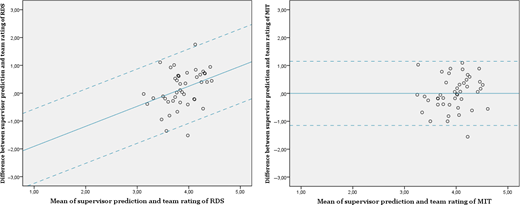
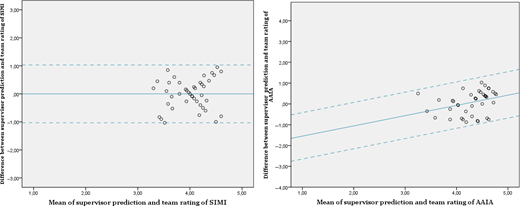
Proportional bias (i.e. differences varying with the score magnitude) emerged for AAIA in both dyads, self versus team (B = 1.49 and p = 0.001) and prediction versus team (B = 0.49 and p = 0.03) with also clear departures from normality of the differences (Shapiro–Wilk p = 0.01; Q–Q deviations). RDS showed proportional bias in the prediction versus team dyad (B = 0.72 and p = 0.02). Because fixed (constant) bias is not meaningful under proportional bias (Menghini et al., 2021), we estimated and reported regression-based, mean-dependent LoA rather than constant LoA; the fitted functions are provided in Table 2, following Bland–Altman’s extension for trends with magnitude and current reporting guidance (Bland and Altman, 1999). Nevertheless, the results show a clear dissociation between dyads: self-assessments exhibit a robust overrating tendency, whereas predictions generally align with team evaluations.
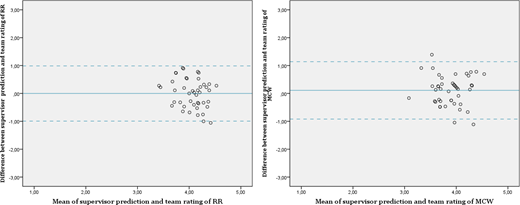
Bland–Altman plots for all variables are shown in Figures 1–3. The solid line represents the estimated bias (constant or regression-based), while the dotted lines depict the upper and lower limits of agreement. Specifically, RR LoA were −0.99 to 0.99, meeting the strictest predefined standard (±1.00). Practically, most prediction errors should remain within one response category, consistent with interchangeability for formative use. This trend is illustrated in Figure 2 (left), where the agreement limits exceed ± 1, whereas in Figure 1 (left), the limits for RR closely align with the ± 1 benchmark. MCW LoA were −0.92–1.14. Although the upper limit slightly exceeds ± 1.00, the pair lies within ± 1.10, supporting qualified acceptability for low-stakes development. MIT LoA were −1.15–1.15, exceeding ± 1.10 but within ± 1.15; this suggests borderline but usable agreement when facilitators explicitly acknowledge the wider error band. SIMI LoA were −1.03–1.03, narrowly missing ± 1.00 yet within ± 1.10; predictions approximate team views closely enough for formative diagnostics, with occasional deviations slightly over one category. Because for AAIA and RDS the bias varies with the average of the two methods, for clarity, we evaluated the limits at a representative value: the mean of the measurement means (4.29 and 3.86). Substituting this value for AAIA yields limits of agreement of −1.03–1.19. Interpreted against our practical bands, the lower limit meets the ± 1.10 sensitivity margin, while the upper limit slightly exceeds ± 1.15, yet as shown in Figure 3 (right panel), the agreement lines remain close to the bias line, indicating a relatively narrow error band. Conversely, for RDS this produces limits of −1.18–1.49, which exceed the ≈±1 threshold. Accordingly, interchangeability is not acceptable. Despite RDS and AAIA, the study hypothesis is supported considering the unsystematic bias of the prediction-team difference and practical useful limit of agreement for RR, MCW, MIT and SIMI. All limits LoA are presented in Table 3.
4. Discussion
This study examined whether supervisors’ perspective-taking predictions can approximate their teams’ evaluations of day-to-day management competencies when upward feedback is difficult to obtain or implement. Using an agreement test rather than association metrics or mean comparison, we found that prediction–team discrepancies were, on average, systematically unbiased conversely to self-assessment that tends to over-estimation. Additionally, for most competencies, such predictions fell within practice-relevant limits of agreement overall supporting the study hypothesis. Indeed, predictions met the tolerance (≈±1.00) for Respectful and Responsible (RR), Managing and Communicating Work (MCW), Supportive ICT-Mediated Interaction (SIMI) and Managing the Individual within the Team (MIT). In contrast, agreement for Reasoning and Managing Difficult Situations (RDS) and Avoidance of Abusive ICT Adoption (AAIA) did not reach acceptable thresholds, suggesting that team data substitution with supervisor prediction should be judged cautiously.
Taken together, the results provide field evidence that a structured prediction exercise can yield practically usable information for several supervisory competencies, while also delineating boundaries where substitution is not advisable. This adds a complementary angle to the self–other literature, which documents systematic inflation in leaders’ self-ratings, especially on interpersonal domains and among certain subgroups and only moderate convergence with subordinate views (Fleenor et al., 2010; Lee and Carpenter, 2018). By shifting the leader’s task from self-evaluation to inferring team perceptions, the exercise appears to attenuate the tendencies that typically undermine self-other alignment (Taylor et al., 2012), at least for competencies that are frequently observed and behaviourally concrete (e.g. RR, MCW and SIMI). At the same time, the poorer agreement for RDS and AAIA suggests that competencies involving conflict handling and complex social judgment as techno-invasion may be more difficult to predict accurately, possibly because they are episodic, high-stakes and more susceptible to attributional ambiguities. Overall, these findings suggest that prediction-based reflection can serve as a low-burden, evidence-informed adjunct to leadership development when upward feedback is limited, while maintaining an evaluative standard aligned with development decisions.
4.1 Implications for theory and practice
Theoretically, these findings contribute to leadership development literature by supporting the view that perspective-taking is a key ability for supervisors and of high scientific potential (Grutterink and Meister, 2022; Taylor et al., 2012). Our results suggest that when leaders are asked to infer team views – rather than to rate themselves – prediction–other agreement can reach tolerances consistent with formative use on several day-to-day managerial behaviours (e.g. respectful conduct and workload/communication structuring), whereas more episodic or attributionally complex domains (e.g. conflict handling) remain harder to approximate. This competency-specific pattern extends prior reviews by specifying where supervisor–team incongruence is likely to persist and where perspective-taking judgments may close the gap, thus sharpening theory about rater source, content observability and the conditions under which leader-generated information is developmentally diagnostic (Lacerenza et al., 2017). This study also integrates metacognition into leadership development theorising in a concrete, testable way. By operationalising a structured prediction task, it connects reflective, perspective-taking processes – often recommended but under-operationalised in development programs (Hannah and Avolio, 2010) – to observable agreement outcomes with follower data. In doing so, it offers field evidence that perspective-taking can be examined as a proximate mechanism for building self-insight when formal upward ratings are constrained, complementing broader accounts of developmental readiness and reflective learning in leader growth (Day et al., 2014; Taylor et al., 2012). Collectively, these implications contribute a theoretically coherent and methodologically transparent template for studying leader-generated information under real constraints: situating prediction–other alignment within the self–other tradition, embedding metacognitive mechanisms in development theory and privileging agreement over association when the research question concerns responsible substitution in practice (Haghayegh et al., 2020).
From a practical standpoint, when upward feedback is difficult to obtain because of anonymity risks in small teams, survey fatigue, low organisational readiness or limited resources, a structured prediction-team data comparison can offer a pragmatic way to keep development moving without suspending reflective work. Additionally, where upward data are available, comparing predictions with team aggregates and self-perceptions can further inform supervisors on development needs and the complex social dynamics of teams. Thus, to reduce defensiveness and increase learning value, implementing a low-threat calibration loop within the training workflow can be useful. For instance, begin with a brief self-assessment to make supervisors’ self-views explicit; then, collect the team-prediction exercise to prompt perspective-taking. When available, add the team data for comparison. Finally, guide a structured reflection that ends with one or two concrete, time-bound development commitments.
Where survey fatigue is a concern, use the prediction exercise early in a program cycle to prioritise which competencies warrant investment; collect upward ratings later and only for those priorities. Maximise transfer by scaffolding receptivity and use. A brief pre-brief on how to interpret discrepancies (and why they occur) can help prevent defensive attributions, especially among individuals who are likely to overestimate. Where possible, integrate the exercise into existing performance or talent routines (e.g. quarterly check-ins) so that prediction, reflection and progress review are not one-off events but part of a cadence leaders already recognise.
4.2 Limitations and strengths
Several limitations warrant a cautious interpretation of the findings. First, this study was conducted with 44 supervisors and their teams within three Italian public administrations, predominantly in administrative roles. This sampling frame, together with and the absence of demographic covariates (e.g. leader gender, age and hierarchical level), constrains generalizability and prevents testing known moderators of self–other dynamics and prediction accuracy. Second, although we specified a priori agreement thresholds to judge practical interchangeability, these bands are pragmatic rather than normative. Different stakes, scales or organisational uses may justify tighter or looser criteria; accordingly, our acceptance decisions should be viewed as context-specific and replicable, rather than universal. Third, the temporal design is near-contemporaneous: employees rated supervisors one week before leaders completed the prediction task after a preparatory seminar. This strengthens ecological validity but does neither establish whether prediction-based reflection improves subsequent behaviour or calibrates leaders over time nor does it rule out short-term priming effects from the training content on prediction strategies. Fourth, although aggregation of employee ratings to the team level was justified by within-team consensus and clustering, between-team variance was negligible for AAIA, suggesting that for this dimension, the team signal is weak and substitution decisions should be particularly conservative.
Balanced against these constraints, this study has several strengths. It provides field-based, multisource evidence on a theoretically motivated alternative to upward feedback, testing supervisors’ perspective-taking predictions against aggregated team ratings in a real training context rather than in vignette or laboratory settings. Analytically, it deploys a decision-relevant agreement framework, using Bland–Altman logic to quantify bias and limits of agreement in the original metric; this aligns the evaluative criterion with the practical question of whether predictions can stand in for upward ratings for specific competencies and score ranges. The design is transparent and reproducible, with clear diagnostics for normality and proportional bias and competency-level reporting that distinguishes where substitution is defensible (e.g. RR, MCW, SIMI and MIT under specified bands) and where it is not (RDS and AAIA). Substantively, this study examines every day, behaviourally grounded competencies that shape the psychosocial work environment, including digitally mediated behaviours, thereby extending the conversation beyond generic leadership traits. More broadly, the work offers a practical template for organisations operating under feedback constraints: a lightweight predict–compare–reflect loop embedded in training, coupled with explicit thresholds and competency-specific decisions, which preserves confidentiality and reduces burden while maintaining an evaluative standard suited to formative development.
5. Future research
Future research should examine whether prediction-based reflection merely approximates team views at a single point in time or can be calibrated through repeated cycles to improve accuracy and, critically, to drive behavioural change. Therefore, longitudinal and experimental designs, embedding multiple predict–compare–reflect iterations over months, focused to tests of within-leader change, as well as downstream transfer (e.g. employee well-being) are warranted. Experimental trials could compare a prediction-only pathway against standard upward feedback and hybrid protocols, isolating the additive or substitutive value and clarifying the conditions under which predictions can be used responsibly in place of team ratings.
A second priority is to map boundary conditions more precisely. The present competency-specific pattern suggests that some domains (e.g. respectful conduct and work organisation) may be more predictable than others (e.g. conflict management). Future studies should test moderators that theory and practice deem relevant, such as leaders’ feedback orientation or team size and features of the feedback environment (e.g. psychological safety); and contextual factors (public vs private sector). Where possible, collecting minimal demographics will enable tests of known self–other asymmetries across subgroups without compromising confidentiality.
Finally, future studies should integrate implementation and ethics questions that address the real-world uptake of these findings. Cost–benefit analyses can quantify when prediction protocols are preferable to other feedback mechanisms, and process data and qualitative reflections can illuminate how leaders interpret discrepancies.
6. Conclusion
This study examined whether supervisors’ perspective-taking predictions can serve as a viable proxy for upward feedback under the real constraints that often limit multi-source processes. Findings revealed no systematic bias between predictions and team ratings, and for most competencies, the limits of agreement fell within practice-relevant bands. These results indicate that a structured prediction exercise can generate developmentally useful information. In theoretical terms, the findings situate prediction–other alignment as a tractable construct within the self–other tradition and offer a concrete, metacognitively grounded pathway for building supervisors’ self-insight when upward data are not immediately attainable. In practical terms, they provide an implementable, low-burden protocol – self-assess, predict, (when available) compare and reflect – that help practitioners implement formative coaching.
The contribution is necessarily circumscribed: our thresholds are pragmatic rather than universal; prediction accuracy varied by competency; and the design did not test downstream behavioural change. Yet these constraints underscore the value of the present evidence as a field-based starting point. By specifying accuracy as interchangeability in the original metric and demonstrating feasibility in a training context, this study offers a scalable method for leadership development in feedback-constrained environments. Future work should extend this approach with longitudinal intervention studies, sharper boundary-condition tests and stronger outcome linkages; in the meantime, organisations can deploy prediction-based reflection to sustain learning momentum, protect confidentiality where needed and concentrate scarce resources where they are most likely to yield developmental gains.