Skip to article sections
Purpose

Ongoing debate surrounds the effects of the two dimensions of work–family conflict – Family Interference with Work (FIW) and Work Interference with Family (WIF) – on key work outcomes such as turnover intentions. According to the cross-domain perspective, FIW is expected to be the stronger predictor of turnover intentions, whereas the matching-domain perspective argues that WIF should have the greater influence. This review examines how tourism and hospitality research engages with this theoretical debate.

Design/methodology/approach

A systematic literature review was conducted using a multi-source search strategy, drawing on peer-reviewed studies identified in prior reviews, Scopus, and Google Scholar. The review process follows the PRISMA 2020 guidelines.

Findings

The review provides an up-to-date synthesis of empirical evidence, incorporating a substantial body of research published since the most recent reviews. The final dataset comprises 30 peer-reviewed studies published between 2006 and 2025 by 60 contributing authors.

Originality/value

The review highlights four key avenues for future research: (1) broaden empirical focus beyond frontline employees and beyond Middle Eastern and Asian contexts (contextual); (2) adopt a bidirectional conceptualisation of work–family conflict by examining both WIF and FIW (conceptual); (3) employ source attribution theory to better explain why WIF predicts turnover intentions while FIW often does not (theoretical); and (4) identify mechanisms that may mitigate the impact of work–family conflict on turnover intentions (practical).

Work–family conflict refers to the tension that arises when the demands of work and family roles are incompatible (Greenhaus and Beutell, 1985). Research grounded in role theory (Goode, 1960; Pleck, 1977) and later expanded through conservation of resources theory (Hobfoll, 1989) shows that individuals have limited time, energy, and cognitive capacity to meet expectations across both domains (Kappe et al., 2025; Wu and Perrigino, 2025). Work–family conflict is typically viewed as bidirectional: work can interfere with family (WIF), and family can interfere with work (FIW). Although interrelated, these types are conceptually distinct (Kobayashi et al., 2025).

A central debate concerns how WIF and FIW relate to different outcomes. Much existing research draws on the cross-domain perspective, which argues that conflict in one domain (e.g. FIW) has its strongest effects in the other, such as increased turnover intentions (Shockley and Singla, 2011; Nohe et al., 2015; Zhao et al., 2019). In contrast, the matching-domain perspective proposes that conflict has its greatest impact within the same domain. Accordingly, WIF should affect work-related outcomes, while FIW should shape family-related outcomes. Despite the relevance of this debate, tourism and hospitality research has paid limited attention to how these theoretical perspectives apply within the sector.

Turnover intentions remain a critical concern in tourism and hospitality. Although the industry provides substantial employment opportunities, it continues to experience high workforce instability. In the United Kingdom, for example, 41% of employees changed jobs in 2022–2023, and 12% left the labour market entirely, producing a turnover rate of 53% (CIPD, 2024). High turnover leads to significant costs, including recruitment and training expenses, as well as losses related to employee morale and service quality (De Vos et al., 2025). Even when employees do not leave, turnover intentions alone can reduce organisational effectiveness, as individuals who consider leaving often disengage or behave counterproductively (Ruiz-Palomino et al., 2021). Thus, understanding the factors that drive turnover intentions – including the influence of work–family conflict – is essential for achieving long-term organisational sustainability.

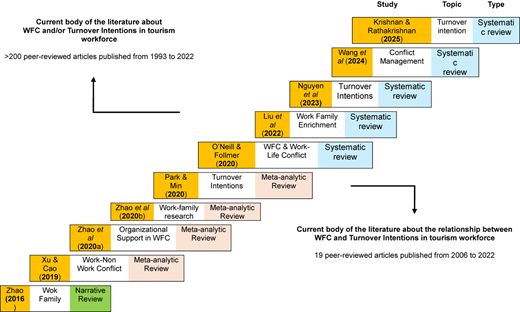
From an academic standpoint, Figure 1 shows how previous reviews have examined the relationship between work–family conflict and turnover intentions. Although more than 200 peer-reviewed articles on work–family conflict have been published since 1993, only 19 empirical studies (published between 2006 and 2022) focus specifically on this relationship within the tourism and hospitality sector. We argue that this represents an important but underexplored body of literature. To address this gap, the present article provides an up-to-date systematic review with two aims: (1) to synthesise the most recent empirical evidence, and (2) to identify the contextual, conceptual, theoretical, and practical limitations that should inform future research and practice.

To accomplish this aim and the related objectives, the review is driven by the following questions:

RQ1 (Contextual).

In what organisational and cultural contexts has prior research examined the relationship between work–family conflict and turnover intentions within the tourism and hospitality sector, and how do these contextual characteristics shape the nature of this relationship?

RQ2 (Conceptual).

How has work–family conflict been conceptualised in tourism and hospitality research – particularly regarding its bidirectional dimensions – and what implications do these conceptualisations have for understanding its link to turnover intentions?

RQ3 (Theoretical).

Which theoretical frameworks have been used to explain the relationship between work–family conflict and turnover intentions in the tourism and hospitality literature, and how do these theories inform or constrain current understanding?

RQ4 (Practical).

What mitigating mechanisms have been identified as effective in reducing its impact on turnover intentions?

By answering these questions, the review not only updates the evidence base but also examines whether the apparent dominance of WIF over FIW reflects a genuine theoretical pattern or is instead a consequence of how work–family conflict has been measured in the field.

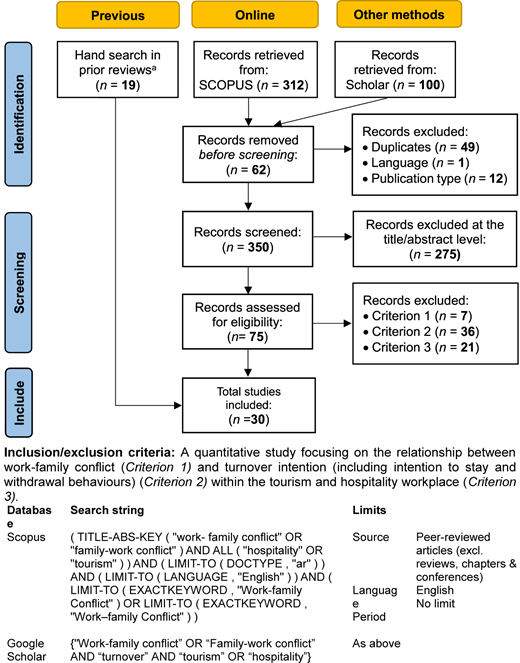
The review adhered to the Preferred Reporting Items for Systematic Reviews and Meta-Analyses (PRISMA, 2020) guidelines (Page et al., 2021), which included a 27-item checklist (Appendix A) and a flow diagram outlining the stages of identification, screening, and inclusion (Figure 2). Implementing the updated PRISMA 2020 guidelines enhanced transparency, supported replicability, and ensured consistency throughout the methodological process (e.g. Papavasileiou et al., 2025b; Sahoo and Sethi, 2025).

Only studies published in English in peer-reviewed journals were included. These studies had to quantitatively examine the relationship between work–family conflict (WIF and/or FIW) and turnover intentions – including intention to stay and withdrawal behaviours – within the tourism workforce. Guided by these eligibility criteria, we used a three-stage search strategy (Papavasileiou and Stergiou, 2025).

First, as noted in the introduction, we hand-searched the reference lists of earlier reviews relevant to the topic and identified 19 eligible studies. Second, we searched the Scopus database, following the approach recommended by Pakhalov et al. (2025, p. 3), who argued that Scopus-based searches reduce the likelihood of missing relevant studies published outside tourism and hospitality journals (e.g. in management, business ethics, or marketing outlets). Using keyword combinations in the “Title, Keywords, and Abstract” fields, this search produced 310 results (Figure 2). Third, we carried out a complementary search on Google Scholar using the same search string, following the recommendations of Sposato et al. (2025), and screened the first 100 results (Papavasileiou et al., 2025a).

The 412 retrieved records were first screened for duplicates and for relevance to language and publication type (i.e. English-language, peer-reviewed journal articles). This initial screening removed 62 records. The first and second authors then independently reviewed the titles and abstracts of the remaining 350 records, with any disagreements resolved by the third author.

This process led to the exclusion of 275 publications, with minimal risk of bias. We then conducted full-text screening of the remaining 75 publications using the eligibility criteria outlined in Appendix B. During this stage, 64 publications were excluded after closer examination. For instance, Rasheed et al. (2018) focused on female banking employees rather than tourism workers. Similarly, Mensah et al. (2023) examined work–leisure conflict, not work–family conflict, among hotel employees. Zhao et al. (2024) studied customer misbehaviour, work–family conflict, and withdrawal behaviours but did not evaluate the relationship between work–family conflict and turnover intentions.

The final set of 30 eligible studies was transferred into a Microsoft Excel document. Following Papavasileiou et al. (2025c), we used a standardised data extraction matrix consisting of four spreadsheets aligned with the four research questions guiding the review (Table 1). This ensured systematic organisation and analysis of contextual, conceptual, theoretical, and practical insights across the included studies.

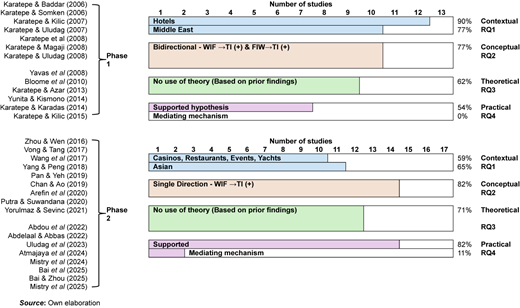
Figure 3 shows how the literature on work–family conflict and turnover intentions has developed over the past two decades in relation to the four review questions. During the first decade (2006–2015), 13 publications were identified. All but two studies – Blomme et al. (2010) and Yunita and Kismono (2014) – were authored by Osman Karatepe and his collaborators (n = 11). Contextually, (RQ1), most empirical evidence from this period focused on front-line hotel employees (93%), with only one study examining workers in travel agencies (Karatepe and Kiliç, 2015). Also, around 70% of studies originated from the Middle East, with a smaller number conducted in Romania (Karatepe and Karadaş, 2014), Indonesia (Yunita and Kismono, 2014), and Nigeria (Karatepe and Magaji, 2008). Conceptually and theoretically (RQ2 and RQ3), ten studies used bi-directional conceptualisations and hypothesised that both WIF and FIW would positively predict turnover intentions, based primarily on previous empirical findings. Half of these hypotheses were supported (e.g. Yavas et al., 2008). Three additional studies examined only WIF, and two reported significant positive associations with turnover intentions (e.g. Blomme et al., 2010). Importantly, none of the studies published during this first decade investigated potential mediating mechanisms (RQ4).

In the second decade (2016–2025), the number of publications increased considerably to 30, with contributions from a wider group of scholars (n = 50) and at least one study published each year. During this period, the research expanded contextually (RQ1) beyond hotels into other occupational settings such as casinos (e.g. Vong and Tang, 2017), restaurants (e.g. Atmajaya et al., 2024), events (e.g. Mistry et al., 2024), and yachts (e.g. Yorulmaz and Sevinc, 2021). Also, the literature shifted toward Asian contexts (59%), including studies conducted in Taiwan (Wang et al., 2017), Macau (e.g. Chan and Ao, 2019), Bangladesh (Arefin et al., 2020), China (e.g. Pan and Yeh, 2019), and Indonesia (e.g. Putra and Suwandana, 2020).

Conceptually (RQ2), most studies during this decade examined work–family conflict in only one direction. Fourteen studies operationalised the construct solely as WIF and theoretically (RQ3) hypothesised its positive association with turnover intentions, with most finding supportive evidence (e.g. Abdou et al., 2022). Three additional studies investigated both WIF and FIW based on conservation of resources theory, although two found no significant effects (e.g. Bai et al., 2025; Yang and Peng, 2018). Research on mediating mechanisms (RQ4) also began to emerge, with two studies identifying job satisfaction and organisational commitment as mediators (e.g. Yang and Peng, 2018; Chan and Ao, 2019).

The review shows that most studies on work–family conflict and turnover intentions originate from the same geographical regions – mainly the Middle East and Asia – and often focus on similar occupational settings, particularly hotel environments. This concentration limits the generalisability of existing findings. The analysis also indicates that much of the literature does not engage with the differences between the cross-domain and matching-domain perspectives. This gap reflects both conceptual constraints, especially the tendency to examine only one direction of conflict, and ongoing theoretical ambiguities in the field. In other words, the findings suggest that the observed pattern is driven more by measurement practices than by a purely theoretical rationale.

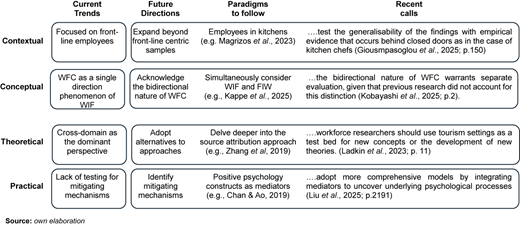
In addition, although there is broad agreement that work–family conflict is a strong predictor of turnover intentions, relatively little research has examined the mechanisms that might buffer or mitigate this relationship. Figure 4 outlines future research directions that address these limitations. These recommendations draw on relevant theoretical paradigms and align with recent calls for more comprehensive theoretical development.

The analysis shows that research in this area is concentrated within a narrow geographic scope – mainly the Middle East and Asia – which limits the broader applicability of existing findings. To improve generalisability, future research should expand the empirical base by incorporating evidence from more diverse cultural and occupational contexts. For example, Mistry et al. (2024) offer useful insights by examining members of an international event association in the United States. The review also highlights that most studies focus on frontline employees, a pattern previously noted by Magrizos et al. (2023). They observed that hospitality workforce research tends to prioritise front-line roles while overlooking back-of-house environments such as kitchens (p.2760). Extending research to underexplored occupational groups – such as chefs – would help address this imbalance and respond to recent calls by Giousmpasoglou et al. (2025, p. 150) to test the generalisability of existing findings using data gathered from “behind closed doors.”

The conceptual analysis shows that much of the recent literature does not differentiate clearly between the cross-domain and matching-domain perspectives. This is largely because work–family conflict is often operationalised in a unidirectional way, focusing only on WIF. This limitation has been noted by Nohe and Sonntag (2014), who argue that studies examining work–family conflict and turnover intentions frequently overlook the comparative value of assessing both WIF and FIW simultaneously. Although earlier studies by Karatepe and colleagues did examine both directions, they generally assumed that each would have uniformly positive effects, making it difficult to distinguish their unique contributions. To address this issue, future research should conceptualise work–family conflict as a genuinely bidirectional construct and test WIF and FIW concurrently (see Kappe et al., 2025). This approach also aligns with recent calls in social science and medical research, which emphasise that the bidirectional nature of work–family conflict requires separate evaluation because earlier studies did not adequately capture this distinction (Kobayashi et al., 2025, p. 2).

The review also shows that most hypotheses in the existing literature are based on earlier empirical findings rather than on strong theoretical reasoning. Among the few studies that used an explicit theoretical framework, conservation of resources (COR) theory was the most common. This theory aligns with the cross-domain perspective, which argues that demands and resource loss in one domain should primarily affect outcomes in the other. According to this logic, conflict originating in the family domain (FIW) should have the strongest influence on work-related outcomes such as turnover intentions. However, empirical studies consistently show the opposite pattern: WIF is the stronger predictor. This contradiction highlights an important theoretical gap.

To address this issue, we encourage scholars to consider the source attribution perspective (Zhao et al., 2019). Yang and Peng (2018, p. 441), for example, found that source attribution mechanisms explained the relationships between work–family conflict and job outcomes more effectively than resource depletion models. Using this alternative lens may provide a more coherent theoretical explanation and also aligns with Ladkin et al.’s (2023, p. 11) suggestion that tourism settings should serve as “a test bed for new concepts or the development of new theories.”

Despite broad agreement that work–family conflict is a strong predictor of turnover intentions, the literature shows limited interest in identifying mechanisms that could buffer or weaken this relationship. Shifting research attention toward such mitigating factors would allow future studies to move beyond merely documenting negative outcomes and instead identify strategies that reduce or prevent them. Only two studies in the current review – Yang and Peng (2018) and Chan and Ao (2019) – identify mediating mechanisms, showing that job satisfaction and organisational commitment may lessen the impact of WIF.

Future research should build on this work by examining additional mediators, including variables grounded in positive psychology such as work engagement and perceived organisational support. This direction aligns with Liu et al.’s (2025, p. 2191) call for more comprehensive workforce models that incorporate mediators to reveal the psychological processes underlying work–family conflict.

Emerging evidence also suggests that resilience-enhancing and flexibility interventions may be promising. For example, Amiri et al. (2026) found that an eight-session resilience training programme based on the Resiliency Wheel significantly reduced work–family conflict among nurses and their spouses, with no gender differences in effectiveness. Also, Tirrel et al. (2026) found that turnover intentions significantly decline when employees work flexibly. We encourage scholars to explore whether similar interventions could help reduce work–family conflict and turnover intentions among tourism employees and their partners.

The purpose of this study was to situate business research within the broader discourse on work–family conflict by examining its patterns and its implications in the workplace. To achieve this, we conducted a systematic literature review of the relationship between work-family conflict and turnover intentions in the tourism and hospitality industry. The review provides an updated and comprehensive synthesis of the empirical evidence, incorporating a substantial body of research published since the most recent reviews. In total, the dataset includes 30 peer-reviewed studies published between 2006 and 2025 by 60 contributing scholars.

By consolidating existing findings and identifying key contextual, conceptual, theoretical, and practical limitations, the review offers a strong foundation for advancing research on work-family conflict and workforce retention within the sector. The future research directions proposed here provide a clear and actionable agenda for addressing current gaps, aligning with calls for more rigorous, diverse, and contextually informed scholarship.

Beyond its substantive contributions, this study also raises methodological standards for systematic reviews in business research. Rather than relying solely on a traditional PRISMA flow diagram (Figure 2), the review fully adheres to the PRISMA 2020 checklist (Appendix A) and provides detailed documentation of how studies were evaluated against predefined eligibility criteria (Appendix B). In this way, it contributes to recent efforts to operationalise PRISMA 2020 within business-related research (e.g. Jalilvand and Ataei, 2026; Pakhalov et al., 2025; Truong et al., 2026), thereby strengthening transparency, credibility, and methodological rigour.

This study is not without limitations. Most notably, the review was limited to peer-reviewed articles published in English. This restriction may partly explain the absence of research from regions such as South America and France, where scholars often publish in Spanish, Portuguese, or French instead of English (Boncourt et al., 2022; Takahashi et al., 2025). Future reviews would benefit from multilingual search strategies to achieve broader and more representative coverage. Encouragingly, an emerging stream of tourism research has begun to integrate non-English scholarship – for example, studies written in Spanish, Portuguese, and French (e.g. Romera et al., 2024) – helping bring non-English tourism knowledge “out of the shadows” (Papavasileiou and Stergiou, 2025).

Despite these limitations, we encourage scholars to build on the literature identified in this review – especially studies that recognise the bidirectional nature of work-family conflict – and to undertake meta-analytic comparisons that contrast findings from tourism and hospitality with those from other sectors, such as nursing or education. Such work will deepen understanding of work-family conflict across occupational settings and contribute to the development of more effective workforce strategies in service-intensive industries.

The supplementary material for this article can be found online.
Abdelaal
,
M.
and
Abbas
,
T.
(
2022
), “
The impact of work-family conflict on hotel employees retention
”,
Research Journal of the Faculty of Tourism and Hotels Mansoura University
, Vol. 
11
No. 
1
, pp. 
217
-
255
.
Abdou
,
A.H.
,
Khalil
,
A.A.F.
,
Mahmoud
,
H.M.E.
,
Elsaied
,
M.A.
and
Elsaed
,
A.A.
(
2022
), “
The impact of hospitality work environment on employees' turnover intentions during COVID-19 Pandemic: the mediating role of work-family conflict
”,
Frontiers in Psychology
, Vol. 
13
, 890418, doi: .
Amiri
,
H.
,
Goodarzi
,
H.
,
Chatrodi
,
A.Z.
,
Farahmandnia
,
H.
and
Aminafshar
,
A.
(
2026
), “
Evaluating the impact of an educational intervention on reducing work–family conflict through resilience enhancement
”,
Scientific Reports
, Vol. 
16, 9052
, pp.
1
-
10
, doi: .
Arefin
,
M.S.
,
Alam
,
M.S.
,
Islam
,
N.
and
Molasy
,
M.
(
2020
), “
Organizational politics and work-family conflict: the hospitality industry in Bangladesh
”,
South Asian Journal of Business Studies
, Vol. 
9
No. 
3
, pp. 
357
-
372
, doi: .
Atmajaya
,
I.T.
,
Amerta
,
I.S.
,
Putra
,
I.U.
and
Dewi
,
I.A.
(
2024
), “
The influence of work-family conflict and job satisfaction on turnover intention with organizational commitment as a mediation variable in Bebek Tepi Sawah employees restaurant Ubud
”,
International Journal of Current Science Research and Review
, Vol. 
7
No. 
3
, pp. 
1503
-
1517
.
Bai
,
Y.
and
Zhou
,
J.
(
2025
), “
Coworker support, work-family conflict, job satisfaction, and turnover intention: female employees in post-organizational socialization
”,
Frontiers in Psychology
, Vol. 
16
, 1472977, doi: .
Bai
,
Y.
,
Zhou
,
J.
and
Ho
,
H.W.
(
2025
), “
How work–family conflict impacts turnover intention: sequential mediating of work stress and job satisfaction of young female employees in resorts in Macau
”,
Journal of Human Resources in Hospitality and Tourism
, Vol. 
24
No. 
4
, pp. 
742
-
764
, doi: .
Blomme
,
R.J.
,
Van Rheede
,
A.
and
Tromp
,
D.M.
(
2010
), “
Work-family conflict as a cause for turnover intentions in the hospitality industry
”,
Tourism and Hospitality Research
, Vol. 
10
No. 
4
, pp. 
269
-
285
, doi: .
Boncourt
,
T.
,
Holeindre
,
J.V.
,
Joana
,
J.
and
Mayer
,
N.
(
2022
), “
Political science communities challenged by internationalisation: the case of France
”,
European Political Science
, Vol. 
21
No. 
4
, pp. 
610
-
626
, doi: .
Chan
,
S.H.J.
and
Ao
,
C.T.D.
(
2019
), “
The mediating effects of job satisfaction and organizational commitment on turnover intention, in the relationships between pay satisfaction and work–family conflict of casino employees
”,
Journal of Quality Assurance in Hospitality and Tourism
, Vol. 
20
No. 
2
, pp. 
206
-
229
, doi: .
CIPD - Chartered Institute of Personnel and Development
(
2024
), “
Benchmarking employee turnover: what are the latest trends and insights?
”,
available at:
 Link to the website
De Vos
,
S.
,
Bockel-Rickermann
,
C.
,
Van Belle
,
J.
and
Verbeke
,
W.
(
2025
), “
Predicting employee turnover: scoping and benchmarking the state-of-the-art
”,
Business and Information Systems Engineering
, Vol. 
67
No. 
5
, pp. 
733
-
752
, doi: .
Giousmpasoglou
,
C.
,
Papavasileiou
,
E.F.
,
Marinakou
,
E.
,
Hall
,
K.
,
Kyritsis
,
T.
and
Radhakrishnan
,
N.
(
2025
), “
Unmasking the surface acting and emotional exhaustion of frontline employees in UK's fine dining sector
”,
International Journal of Spa and Wellness
, Vol. 
8
No. 
2
, pp. 
137
-
154
, doi: .
Goode
,
W.J.
(
1960
), “
A theory of role strain
”,
American Sociological Review
, Vol. 
25
No. 
4
, pp. 
483
-
496
, doi: .
Greenhaus
,
J.H.
and
Beutell
,
N.J.
(
1985
), “
Sources of conflict between work and family roles
”,
Academy of Management Review
, Vol. 
10
No. 
1
, pp. 
76
-
88
, doi: .
Hobfoll
,
S.E.
(
1989
), “
Conservation of resources: a new attempt at conceptualizing stress
”,
American Psychologist
, Vol. 
44
No. 
3
, pp. 
513
-
524
, doi: .
Jalilvand
,
M.R.
and
Ataei
,
J.
(
2026
), “
Using artificial intelligence in digital branding: a two-phase qualitative approach
”,
EuroMed Journal of Business
, pp. 
1
-
52
, doi: .
Kappe
,
K.
,
Urbig
,
D.
,
Lengsfeld
,
S.
,
Carr
,
J.C.
and
Rupietta
,
C.
(
2025
), “
When entrepreneurship and employment collide: conflicts of hybrid entrepreneurs and their impact on wage employment satisfaction
”,
Journal of Business Venturing Insights
, Vol. 
24
, e00564, doi: .
Karatepe
,
O.M.
and
Azar
,
A.K.
(
2013
), “
The effects of work–family conflict and facilitation on turnover intentions: the moderating role of core self-evaluations
”,
International Journal of Hospitality and Tourism Administration
, Vol. 
14
No. 
3
, pp. 
255
-
281
, .
Karatepe
,
O.M.
and
Baddar
,
L.
(
2006
), “
An empirical study of the selected consequences of frontline employees' work–family conflict and family–work conflict
”,
Tourism Management
, Vol. 
27
No. 
5
, pp. 
1017
-
1028
, doi: .
Karatepe
,
O.M.
and
Karadaş
,
G.
(
2014
), “
The effect of psychological capital on conflicts in the work–family interface, turnover and absence intentions
”,
International Journal of Hospitality Management
, Vol. 
43
, pp. 
132
-
143
, doi: .
Karatepe
,
O.M.
and
Kiliç
,
H.
(
2007
), “
Relationships of supervisor support and conflicts in the work–family interface with the selected job outcomes of frontline employees
”,
Tourism Management
, Vol. 
28
No. 
1
, pp. 
238
-
252
, doi: .
Karatepe
,
O.M.
and
Kiliç
,
H.
(
2015
), “
Does manager support reduce the effect of work–family conflict on emotional exhaustion and turnover intentions?
”,
Journal of Human Resources in Hospitality and Tourism
, Vol. 
14
No. 
3
, pp. 
267
-
289
, doi: .
Karatepe
,
O.M.
and
Magaji
,
A.B.
(
2008
), “
Work-family conflict and facilitation in the hotel industry: a study in Nigeria
”,
Cornell Hospitality Quarterly
, Vol. 
49
No. 
4
, pp. 
395
-
412
, doi: .
Karatepe
,
O.M.
and
Sokmen
,
A.
(
2006
), “
The effects of work role and family role variables on psychological and behavioral outcomes of frontline employees
”,
Tourism Management
, Vol. 
27
No. 
2
, pp. 
255
-
268
, doi: .
Karatepe
,
O.M.
and
Uludag
,
O.
(
2007
), “
Conflict, exhaustion, and motivation: a study of frontline employees in Northern Cyprus hotels
”,
International Journal of Hospitality Management
, Vol. 
26
No. 
3
, pp. 
645
-
665
, doi: .
Karatepe
,
O.M.
and
Uludag
,
O.
(
2008
), “
Affectivity, conflicts in the work–family interface, and hotel employee outcomes
”,
International Journal of Hospitality Management
, Vol. 
27
No. 
1
, pp. 
30
-
41
, doi: .
Karatepe
,
O.M.
,
Kiliç
,
H.
and
Isiksel
,
B.
(
2008
), “
An examination of the selected antecedents and outcomes of work-family conflict and family-work conflict in frontline service jobs
”,
Services Marketing Quarterly
, Vol. 
29
No. 
4
, pp. 
1
-
24
, doi: .
Kobayashi
,
Y.
,
Haseda
,
M.
and
Kondo
,
N.
(
2025
), “
Bidirectional work-family conflicts and work engagement: a longitudinal study
”,
Social Science and Medicine
, Vol. 
367
, 117707, doi: .
Krishnan
,
S.
and
Rathakrishnan
,
B.
(
2025
), “
Psychosocial factors contributing to turnover intention among employees in the hospitality industry: a systematic review
”,
Current Psychology
, Vol. 
44
No. 
7
, pp. 
1
-
22
, doi: .
Ladkin
,
A.
,
Mooney
,
S.
,
Solnet
,
D.
,
Baum
,
T.
,
Robinson
,
R.
and
Yan
,
H.
(
2023
), “
A review of research into tourism work and employment: launching the annals of tourism research curated collection on tourism work and employment
”,
Annals of Tourism Research
, Vol. 
100
, 103554, doi: .
Liu
,
T.
,
Wei
,
C.
and
Lee
,
Y.M.
(
2022
), “
A systematic review of work–family enrichment in the hospitality industry
”,
International Journal of Contemporary Hospitality Management
, Vol. 
34
No. 
8
, pp. 
2884
-
2913
, doi: .
Liu
,
C.W.
,
Zhuang
,
W.L.
,
Wu
,
S.C.
,
Huang
,
M.S.
,
Kao
,
Y.Y.
and
Huan
,
T.C.
(
2025
), “
Does chefs' perfectionism foster culinary creativity in Taiwan? Exploring the moderating role of turnover intention
”,
International Journal of Contemporary Hospitality Management
, Vol. 
37
No. 
6
, pp. 
2176
-
2196
, doi: .
Magrizos
,
S.
,
Roumpi
,
D.
and
Rizomyliotis
,
I.
(
2023
), “
Talent orchestration and boomerang talent: seasonally employed chefs' evaluation of talent management practices
”,
International Journal of Contemporary Hospitality Management
, Vol. 
35
No. 
8
, pp. 
2755
-
2772
, doi: .
Mensah
,
C.
,
Baah
,
N.G.
,
Nutsugbodo
,
R.Y.
and
Ankor
,
A.
(
2023
), “
Work leisure conflict, job stress, life satisfaction and turnover intention of hotel workers in Accra, Ghana
”,
Journal of Human Resources in Hospitality and Tourism
, Vol. 
22
No. 
3
, pp. 
396
-
416
, doi: .
Mistry
,
T.G.
,
Wiitala
,
J.
and
Clark
,
B.S.
(
2024
), “
Leadership skills and the glass ceiling in event management: a social role theory approach
”,
International Journal of Contemporary Hospitality Management
, Vol. 
36
No. 
9
, pp. 
3190
-
3210
, doi: .
Mistry
,
T.G.
,
Clark
,
B.S.
and
Wiitala
,
J.
(
2025
), “
The uneventful status of women in the events industry: a mixed methods approach
”,
International Journal of Contemporary Hospitality Management
, Vol. 
37
No. 
9
, pp. 
2941
-
2960
, doi: .
Nguyen
,
C.N.
,
Hoang
,
G.
and
Luu
,
T.T.
(
2023
), “
Frontline employees' turnover intentions in tourism and hospitality sectors: a systematic literature review and research agenda
”,
Tourism Management Perspectives
, Vol. 
49
, 101197, doi: .
Nohe
,
C.
and
Sonntag
,
K.
(
2014
), “
Work–family conflict, social support, and turnover intentions: a longitudinal study
”,
Journal of Vocational Behavior
, Vol. 
85
No. 
1
, pp. 
1
-
12
, doi: .
Nohe
,
C.
,
Meier
,
L.L.
,
Sonntag
,
K.
and
Michel
,
A.
(
2015
), “
The chicken or the egg? A meta-analysis of panel studies of the relationship between work–family conflict and strain
”,
Journal of Applied Psychology
, Vol. 
100
No. 
2
, pp. 
522
-
536
, doi: .
O'Neill
,
J.W.
and
Follmer
,
K.
(
2020
), “
A multilevel review of hospitality industry work–family conflict research and a strategy for future research
”,
Journal of Hospitality and Tourism Research
, Vol. 
44
No. 
1
, pp. 
3
-
44
, doi: .
Page
,
M.J.
,
McKenzie
,
J.E.
,
Bossuyt
,
P.M.
,
Boutron
,
I.
,
Hoffmann
,
T.C.
,
Mulrow
,
C.D.
and
Moher
,
D.
(
2021
), “
The PRISMA 2020 statement: an updated guideline for reporting systematic reviews
”,
BMJ
, Vol. 
372
.
Pakhalov
,
A.
,
Antonaras
,
A.
,
Efthymiou
,
L.
and
Memtsa
,
C.
(
2025
), “
Consumer perception of corporate social responsibility in tourism and hospitality: a systematic literature review
”,
EuroMed Journal of Business
, pp. 
1
-
24
, doi: .
Pan
,
S.Y.
and
Yeh
,
Y.J.
(
2019
), “
The crossover effect of work–family conflict among hotel employees
”,
International Journal of Contemporary Hospitality Management
, Vol. 
31
No. 
2
, pp. 
812
-
829
, doi: .
Papavasileiou
,
E.F.
and
Stergiou
,
D.
(
2025
), “
Millennials' identity in hospitality and tourism: a systematic review with qualitative framework synthesis
”,
Strategic Change
, Vol. 
34
No. 
2
, pp. 
105
-
118
, doi: .
Papavasileiou
,
E.F.
,
Papatheodorou
,
A.
and
Edmunds
,
J.
(
2025a
), “
Human operators in air transport: a decade of systematic reviews
”,
Journal of the Air Transport Research Society
, Vol. 
4
, 100059, doi: .
Papavasileiou
,
E.F.
,
Paraskevas
,
A.
and
Edmunds
,
J.
(
2025b
), “
eGates in airports: a systematic literature review and future research directions
”,
Journal of the Air Transport Research Society
, Vol. 
5
, 100076, doi: .
Papavasileiou
,
E.F.
,
Stergiou
,
D.P.
and
Dimou
,
I.
(
2025c
), “
Millennials' work values: a systematic review and synthesis of factors
”,
Anatolia
, Vol. 
36
No. 
1
, pp. 
123
-
137
, doi: .
Park
,
J.
and
Min
,
H.K.
(
2020
), “
Turnover intention in the hospitality industry: a meta-analysis
”,
International Journal of Hospitality Management
, Vol. 
90
, 102599, doi: .
Pleck
,
J.H.
(
1977
), “
The work-family role system
”,
Social Problems
, Vol. 
24
No. 
4
, pp. 
417
-
427
, doi: .
Putra
,
I.P.K.S.D.
and
Suwandana
,
I.G.M.
(
2020
), “
Effect of organizational commitment, job stress and work-family conflict to turnover intention
”,
International Research Journal of Management, IT and Social Sciences
, Vol. 
7
No. 
2
, pp. 
30
-
37
.
Rasheed
,
M.
,
Iqbal
,
S.
and
Mustafa
,
F.
(
2018
), “
Work-family conflict and female employees' turnover intentions
”,
Gender in Management: An International Journal
, Vol. 
33
No. 
8
, pp. 
636
-
653
, doi: .
Romera
,
F.
,
Le Bigot
,
E.
and
Khoo
,
C.
(
2024
), “
Heritage education towards sustainable development in tourism: an inclusive systematic literature review
”,
Tourism Recreation Research
, Vol. 
50
No. 
7
, pp. 
1
-
23
, doi: .
Ruiz-Palomino
,
P.
,
Martinez-Canas
,
R.
and
Banon-Gomis
,
A.
(
2021
), “
Is unethical leadership a negative for employees' personal growth and intention to stay? The buffering role of responsibility climate
”,
European Management Review
, Vol. 
18
No. 
4
, pp. 
535
-
549
, doi: .
Sahoo
,
A.K.
and
Sethi
,
M.
(
2025
), “
Cash flow sensitivity of cash: a systematic literature review and bibliometric analysis
”,
EuroMed Journal of Business
, pp. 
1
-
26
, doi: .
Shockley
,
K.M.
and
Singla
,
N.
(
2011
), “
Reconsidering work—family interactions and satisfaction: a meta-analysis
”,
Journal of Management
, Vol. 
37
No. 
3
, pp. 
861
-
886
, doi: .
Sposato
,
M.
,
Dittmar
,
E.C.
and
Vargas Portillo
,
J.P.
(
2025
), “
Redefining boundaries: a comparative analysis of human–AI collaboration dynamics in European healthcare and financial services
”,
EuroMed Journal of Business
, pp. 
1
-
21
, doi: .
Takahashi
,
B.
,
Amiden dos Santos
,
I.
and
Salas
,
M.F.
(
2025
), “
Building bridges: a narrative literature review of Spanish and Portuguese-language climate change communication scholarship from Latin America
”,
Environmental Communication
, Vol. 
19
No. 
5
, pp. 
1
-
15
, doi: .
Tirrel
,
H.
,
Kaufmann
,
H.R.
and
Winnen
,
L.
(
2026
), “
Development and validation of a scale for integrating technology in virtual leadership: technological requirements of virtual leadership
”,
EuroMed Journal of Business
, pp. 
1
-
23
, doi: .
Truong
,
Q.N.
,
Nguyen
,
P.V.
and
Hansen
,
U.E.
(
2026
), “
Global research trends in renewable energy technology transfer: implications for innovation policy and emerging economies
”,
EuroMed Journal of Business
, Vol. 
21
No. 
5
, pp. 
1
-
17
, doi: .
Uludag
,
O.
,
Olufunmi
,
Z.O.
,
Lasisi
,
T.T.
and
Eluwole
,
K.K.
(
2023
), “
Women in travel and tourism: does fear of COVID-19 affect Women's turnover intentions?
”,
Kybernetes
, Vol. 
52
No. 
7
, pp. 
2230
-
2253
, doi: .
Vong
,
L.T.N.
and
Tang
,
W.S.L.
(
2017
), “
The mediating effect of work–family conflict in the relationship between job stress and intent to stay: the case of tourism and hospitality workers in Macau
”,
Journal of Human Resources in Hospitality and Tourism
, Vol. 
16
No. 
1
, pp. 
39
-
55
, doi: .
Wang
,
I.A.
,
Lee
,
B.W.
and
Wu
,
S.T.
(
2017
), “
The relationships among work-family conflict, turnover intention and organizational citizenship behavior in the hospitality industry of Taiwan
”,
International Journal of Manpower
, Vol. 
38
No. 
8
, pp. 
1130
-
1142
, doi: .
Wang
,
Y.
,
Le
,
T.H.
,
Kwek
,
A.
and
Fu
,
M.
(
2024
), “
A systematic literature review of conflict management in hospitality: towards a multi-stakeholder resource-based conflict-management framework
”,
International Journal of Hospitality Management
, Vol. 
123
, 103937, doi: .
Wu
,
L.
and
Perrigino
,
M.B.
(
2025
), “
Supervisor‐directed anger as a link between work–family conflict and unethical pro‐family behaviours: an attributional perspective
”,
Journal of Occupational and Organizational Psychology
, Vol. 
98
No. 
1
, e12548, doi: .
Xu
,
S.
and
Cao
,
Z.C.
(
2019
), “
Antecedents and outcomes of work–nonwork conflict in hospitality: a meta-analysis
”,
International Journal of Contemporary Hospitality Management
, Vol. 
31
No. 
10
, pp. 
3919
-
3942
, doi: .
Yang
,
Y.
and
Peng
,
M.
(
2018
), “
Impacts of work–family conflict on female hospitality employees' job outcomes
”,
Journal of China Tourism Research
, Vol. 
14
No. 
4
, pp. 
428
-
444
, doi: .
Yavas
,
U.
,
Babakus
,
E.
and
Karatepe
,
O.M.
(
2008
), “
Attitudinal and behavioral consequences of work‐family conflict and family‐work conflict: does gender matter?
”,
International Journal of Service Industry Management
, Vol. 
19
No. 
1
, pp. 
7
-
31
, doi: .
Yorulmaz
,
M.
and
Sevinc
,
F.
(
2021
), “
Supervisor support and turnover intentions of yacht captains: the role of work–family conflict and psychological resilience during the COVID-19 pandemic
”,
International Journal of Contemporary Hospitality Management
, Vol. 
33
No. 
5
, pp. 
1554
-
1570
, doi: .
Yunita
,
P.I.
and
Kismono
,
G.
(
2014
), “
Influence of work-family conflict and family-work conflict on employees' turnover intentions with gender, social support and individual value as moderating effects
”,
Journal of Indonesian Economy and Business
, Vol. 
29
No. 
1
, doi: .
Zhao
,
K.
,
Zhang
,
M.
,
Kraimer
,
M.L.
and
Yang
,
B.
(
2019
), “
Source attribution matters: mediation and moderation effects in the relationship between work‐to‐family conflict and job satisfaction
”,
Journal of Organizational Behavior
, Vol. 
40
No. 
4
, pp. 
492
-
505
, doi: .
Zhao
,
X.
,
Wang
,
J.
,
Law
,
R.
and
Fan
,
X.
(
2020a
), “
A meta-analytic model on the role of organizational support in work-family conflict and employee satisfaction
”,
International Journal of Contemporary Hospitality Management
, Vol. 
32
No. 
12
, pp. 
3767
-
3786
, doi: .
Zhao
,
X.R.
,
Ghiselli
,
R.
,
Wang
,
J.
,
Law
,
R.
,
Okumus
,
F.
and
Ma
,
J.
(
2020b
), “
A mixed-method review of work-family research in hospitality contexts
”,
Journal of Hospitality and Tourism Management
, Vol. 
45
, pp. 
213
-
225
, doi: .
Zhao
,
X.
,
Wang
,
F.
,
Mattila
,
A.S.
,
Leong
,
A.M.W.
,
Cui
,
Z.
and
Yang
,
H.
(
2024
), “
The impact of customer misbehavior on frontline employees' work–family conflict and withdrawal behaviors
”,
International Journal of Contemporary Hospitality Management
, Vol. 
36
No. 
12
, pp. 
4011
-
4030
, doi: .
Zhou
,
X.
and
Wen
,
B.
(
2016
), “
An empirical study about the impact of work-family conflict on female staff's career development in hotels
”,
Journal of Sustainable Development
, Vol. 
9
No. 
5
, pp. 
100
-
109
, doi: .
Zhao
,
X.
(
2016
), “
Work-family studies in the tourism and hospitality contexts
”,
International Journal of Contemporary Hospitality Management
, Vol. 
28
No. 
11
, pp. 
2422
-
2445
, doi: .
Published by Emerald Publishing Limited. This article is published under the Creative Commons Attribution (CC BY 4.0) licence. Anyone may reproduce, distribute, translate and create derivative works of this article (for both commercial and non-commercial purposes), subject to full attribution to the original publication and authors. The full terms of this licence may be seen at Link to the terms of the CC BY 4.0 licence.

Supplementary data

Data & Figures

Figure 1

Evolution of literature reviews about work family conflict and turnover intentions in tourism research. Source: Own elaboration

Figure 1

Evolution of literature reviews about work family conflict and turnover intentions in tourism research. Source: Own elaboration

Close Figure 1
Figure 2

PRISMA 2020 flow diagram and search strategy for capturing studies about the relationship between work-family conflict and turnover intentions in tourism workforce. Note: Last search 22 August 2025; a Work-family conflict (Liu et al., 2022; O'Neill and Follmer, 2020; Wang et al., 2024; Xu and Cao, 2019; Zhao et al., 2020a, b) and turnover intentions (Krishnan and Rathakrishnan, 2025; Nguyen et al., 2023; Park and Min, 2020). Source: based on Page et al. (2021) 

Figure 2

PRISMA 2020 flow diagram and search strategy for capturing studies about the relationship between work-family conflict and turnover intentions in tourism workforce. Note: Last search 22 August 2025; a Work-family conflict (Liu et al., 2022; O'Neill and Follmer, 2020; Wang et al., 2024; Xu and Cao, 2019; Zhao et al., 2020a, b) and turnover intentions (Krishnan and Rathakrishnan, 2025; Nguyen et al., 2023; Park and Min, 2020). Source: based on Page et al. (2021) 

Close Figure 2
Figure 3

Empirical, conceptual, theoretical, and practical trends and gaps. Source: Own elaboration

Figure 3

Empirical, conceptual, theoretical, and practical trends and gaps. Source: Own elaboration

Close Figure 3
Figure 4

Current contextual, conceptual, theoretical and practical trends, future directions, paradigms and interdisciplinary calls. Source: Own elaboration

Figure 4

Current contextual, conceptual, theoretical and practical trends, future directions, paradigms and interdisciplinary calls. Source: Own elaboration

Close Figure 4
Table 1

Characteristics of the literature based on the review questions

StudyRQ1RQ2RQ3RQ4
CountrySectorWFCTheoryWIF→TIFIW→TI
Karatepe and Baddar (2006) JordanHotelsWIF and FIWEmpirical++
Karatepe and Sokmen (2006) TurkeyHotelsWIF and FIWEmpirical++
Karatepe and Kiliç (2007) N. CyprusHotelsWIF and FIWCOR+NS
Karatepe and Uludag (2007) N. CyprusHotelsOnly WIFEmpiricalNSN/A
Karatepe et al. (2008) N. CyprusHotelsWIF and FIWCOR+NS
Karatepe and Magaji (2008) NigeriaHotelsWIF and FIWEmpirical+NS
Karatepe and Uludag (2008) TurkeyHotelsWIF and FIWEmpirical++
Yavas et al. (2008) TurkeyHotelsWIF and FIWEmpirical++
Blomme et al. (2010) WorldwideHotelsOnly WIFEmpirical+N/A
Karatepe and Azar (2013) IranHotelsWIF and FIWScarcity theory++
Yunita and Kismono (2014) IndonesiaHotelsWIF and FIWEmpirical+NS
Karatepe and Karadaş (2014) RomaniaHotelsWIF and FIWCORNS+
Karatepe and Kiliç (2015) N. CyprusTravel agenciesOnly WIFEmpirical+N/A
Zhou and Wen (2016) ChinaHotelsOnly WIFEmpirical+N/A
Vong and Tang (2017) MacauMixedaOnly WIFEmpirical+N/A
Wang et al. (2017) TaiwanHotelsWIF and FIWCOR+NS
Yang and Peng (2018) ChinaHotelsWIF and FIWCOR and RDT+(JS)NS
Pan and Yeh (2019) ChinaHotelsOnly WIFEmpirical+N/A
Chan and Ao (2019) MacauCasinosOnly WIFRole theory+ (OC)N/A
Arefin et al. (2020) BangladeshHotelsOnly WIFCOR+N/A
Putra and Suwandana (2020) IndonesiaHotelsOnly WIFEmpirical+N/A
Yorulmaz and Sevinc (2021) TurkeyYacht captainsOnly WIFEmpirical+N/A
Abdou et al. (2022) EgyptHotelsOnly WIFEmpirical+N/A
Abdelaal and Abbas (2022) Saudi ArabiaHotelsOnly WIFEmpirical+N/A
Uludag et al. (2023) NigeriaTravel agenciesOnly WIFSpillover theory+N/A
Atmajaya et al. (2024) IndonesiaRestaurantsOnly WIFEmpirical+N/A
Mistry et al. (2024) USAEventsOnly WIFEmpirical+N/A
Bai et al. (2025) MacauCasinosOnly WIFEmpiricalNSNS
Bai and Zhou (2025) MacauCasinosWIF and FIWEmpirical+N/A
Mistry et al. (2025) USAEventsOnly WIFEmpiricalNSN/A

Note(s): Within parenthesis denotes mediator

a

Casinos, hotels, travel agencies, retail, FandB; COR = Conservation of resources; RDT = Resource depletion theory; N/A = Not Applicable; NS = Not supported; (+) = positive; WIF = Work-Family Interference; FIW = Family-Work Interference; JS = Job satisfaction; OC = Organizational Commitment

Supplements

Supplementary data

References

Abdelaal
,
M.
and
Abbas
,
T.
(
2022
), “
The impact of work-family conflict on hotel employees retention
”,
Research Journal of the Faculty of Tourism and Hotels Mansoura University
, Vol. 
11
No. 
1
, pp. 
217
-
255
.
Abdou
,
A.H.
,
Khalil
,
A.A.F.
,
Mahmoud
,
H.M.E.
,
Elsaied
,
M.A.
and
Elsaed
,
A.A.
(
2022
), “
The impact of hospitality work environment on employees' turnover intentions during COVID-19 Pandemic: the mediating role of work-family conflict
”,
Frontiers in Psychology
, Vol. 
13
, 890418, doi: .
Amiri
,
H.
,
Goodarzi
,
H.
,
Chatrodi
,
A.Z.
,
Farahmandnia
,
H.
and
Aminafshar
,
A.
(
2026
), “
Evaluating the impact of an educational intervention on reducing work–family conflict through resilience enhancement
”,
Scientific Reports
, Vol. 
16, 9052
, pp.
1
-
10
, doi: .
Arefin
,
M.S.
,
Alam
,
M.S.
,
Islam
,
N.
and
Molasy
,
M.
(
2020
), “
Organizational politics and work-family conflict: the hospitality industry in Bangladesh
”,
South Asian Journal of Business Studies
, Vol. 
9
No. 
3
, pp. 
357
-
372
, doi: .
Atmajaya
,
I.T.
,
Amerta
,
I.S.
,
Putra
,
I.U.
and
Dewi
,
I.A.
(
2024
), “
The influence of work-family conflict and job satisfaction on turnover intention with organizational commitment as a mediation variable in Bebek Tepi Sawah employees restaurant Ubud
”,
International Journal of Current Science Research and Review
, Vol. 
7
No. 
3
, pp. 
1503
-
1517
.
Bai
,
Y.
and
Zhou
,
J.
(
2025
), “
Coworker support, work-family conflict, job satisfaction, and turnover intention: female employees in post-organizational socialization
”,
Frontiers in Psychology
, Vol. 
16
, 1472977, doi: .
Bai
,
Y.
,
Zhou
,
J.
and
Ho
,
H.W.
(
2025
), “
How work–family conflict impacts turnover intention: sequential mediating of work stress and job satisfaction of young female employees in resorts in Macau
”,
Journal of Human Resources in Hospitality and Tourism
, Vol. 
24
No. 
4
, pp. 
742
-
764
, doi: .
Blomme
,
R.J.
,
Van Rheede
,
A.
and
Tromp
,
D.M.
(
2010
), “
Work-family conflict as a cause for turnover intentions in the hospitality industry
”,
Tourism and Hospitality Research
, Vol. 
10
No. 
4
, pp. 
269
-
285
, doi: .
Boncourt
,
T.
,
Holeindre
,
J.V.
,
Joana
,
J.
and
Mayer
,
N.
(
2022
), “
Political science communities challenged by internationalisation: the case of France
”,
European Political Science
, Vol. 
21
No. 
4
, pp. 
610
-
626
, doi: .
Chan
,
S.H.J.
and
Ao
,
C.T.D.
(
2019
), “
The mediating effects of job satisfaction and organizational commitment on turnover intention, in the relationships between pay satisfaction and work–family conflict of casino employees
”,
Journal of Quality Assurance in Hospitality and Tourism
, Vol. 
20
No. 
2
, pp. 
206
-
229
, doi: .
CIPD - Chartered Institute of Personnel and Development
(
2024
), “
Benchmarking employee turnover: what are the latest trends and insights?
”,
available at:
 Link to the website
De Vos
,
S.
,
Bockel-Rickermann
,
C.
,
Van Belle
,
J.
and
Verbeke
,
W.
(
2025
), “
Predicting employee turnover: scoping and benchmarking the state-of-the-art
”,
Business and Information Systems Engineering
, Vol. 
67
No. 
5
, pp. 
733
-
752
, doi: .
Giousmpasoglou
,
C.
,
Papavasileiou
,
E.F.
,
Marinakou
,
E.
,
Hall
,
K.
,
Kyritsis
,
T.
and
Radhakrishnan
,
N.
(
2025
), “
Unmasking the surface acting and emotional exhaustion of frontline employees in UK's fine dining sector
”,
International Journal of Spa and Wellness
, Vol. 
8
No. 
2
, pp. 
137
-
154
, doi: .
Goode
,
W.J.
(
1960
), “
A theory of role strain
”,
American Sociological Review
, Vol. 
25
No. 
4
, pp. 
483
-
496
, doi: .
Greenhaus
,
J.H.
and
Beutell
,
N.J.
(
1985
), “
Sources of conflict between work and family roles
”,
Academy of Management Review
, Vol. 
10
No. 
1
, pp. 
76
-
88
, doi: .
Hobfoll
,
S.E.
(
1989
), “
Conservation of resources: a new attempt at conceptualizing stress
”,
American Psychologist
, Vol. 
44
No. 
3
, pp. 
513
-
524
, doi: .
Jalilvand
,
M.R.
and
Ataei
,
J.
(
2026
), “
Using artificial intelligence in digital branding: a two-phase qualitative approach
”,
EuroMed Journal of Business
, pp. 
1
-
52
, doi: .
Kappe
,
K.
,
Urbig
,
D.
,
Lengsfeld
,
S.
,
Carr
,
J.C.
and
Rupietta
,
C.
(
2025
), “
When entrepreneurship and employment collide: conflicts of hybrid entrepreneurs and their impact on wage employment satisfaction
”,
Journal of Business Venturing Insights
, Vol. 
24
, e00564, doi: .
Karatepe
,
O.M.
and
Azar
,
A.K.
(
2013
), “
The effects of work–family conflict and facilitation on turnover intentions: the moderating role of core self-evaluations
”,
International Journal of Hospitality and Tourism Administration
, Vol. 
14
No. 
3
, pp. 
255
-
281
, .
Karatepe
,
O.M.
and
Baddar
,
L.
(
2006
), “
An empirical study of the selected consequences of frontline employees' work–family conflict and family–work conflict
”,
Tourism Management
, Vol. 
27
No. 
5
, pp. 
1017
-
1028
, doi: .
Karatepe
,
O.M.
and
Karadaş
,
G.
(
2014
), “
The effect of psychological capital on conflicts in the work–family interface, turnover and absence intentions
”,
International Journal of Hospitality Management
, Vol. 
43
, pp. 
132
-
143
, doi: .
Karatepe
,
O.M.
and
Kiliç
,
H.
(
2007
), “
Relationships of supervisor support and conflicts in the work–family interface with the selected job outcomes of frontline employees
”,
Tourism Management
, Vol. 
28
No. 
1
, pp. 
238
-
252
, doi: .
Karatepe
,
O.M.
and
Kiliç
,
H.
(
2015
), “
Does manager support reduce the effect of work–family conflict on emotional exhaustion and turnover intentions?
”,
Journal of Human Resources in Hospitality and Tourism
, Vol. 
14
No. 
3
, pp. 
267
-
289
, doi: .
Karatepe
,
O.M.
and
Magaji
,
A.B.
(
2008
), “
Work-family conflict and facilitation in the hotel industry: a study in Nigeria
”,
Cornell Hospitality Quarterly
, Vol. 
49
No. 
4
, pp. 
395
-
412
, doi: .
Karatepe
,
O.M.
and
Sokmen
,
A.
(
2006
), “
The effects of work role and family role variables on psychological and behavioral outcomes of frontline employees
”,
Tourism Management
, Vol. 
27
No. 
2
, pp. 
255
-
268
, doi: .
Karatepe
,
O.M.
and
Uludag
,
O.
(
2007
), “
Conflict, exhaustion, and motivation: a study of frontline employees in Northern Cyprus hotels
”,
International Journal of Hospitality Management
, Vol. 
26
No. 
3
, pp. 
645
-
665
, doi: .
Karatepe
,
O.M.
and
Uludag
,
O.
(
2008
), “
Affectivity, conflicts in the work–family interface, and hotel employee outcomes
”,
International Journal of Hospitality Management
, Vol. 
27
No. 
1
, pp. 
30
-
41
, doi: .
Karatepe
,
O.M.
,
Kiliç
,
H.
and
Isiksel
,
B.
(
2008
), “
An examination of the selected antecedents and outcomes of work-family conflict and family-work conflict in frontline service jobs
”,
Services Marketing Quarterly
, Vol. 
29
No. 
4
, pp. 
1
-
24
, doi: .
Kobayashi
,
Y.
,
Haseda
,
M.
and
Kondo
,
N.
(
2025
), “
Bidirectional work-family conflicts and work engagement: a longitudinal study
”,
Social Science and Medicine
, Vol. 
367
, 117707, doi: .
Krishnan
,
S.
and
Rathakrishnan
,
B.
(
2025
), “
Psychosocial factors contributing to turnover intention among employees in the hospitality industry: a systematic review
”,
Current Psychology
, Vol. 
44
No. 
7
, pp. 
1
-
22
, doi: .
Ladkin
,
A.
,
Mooney
,
S.
,
Solnet
,
D.
,
Baum
,
T.
,
Robinson
,
R.
and
Yan
,
H.
(
2023
), “
A review of research into tourism work and employment: launching the annals of tourism research curated collection on tourism work and employment
”,
Annals of Tourism Research
, Vol. 
100
, 103554, doi: .
Liu
,
T.
,
Wei
,
C.
and
Lee
,
Y.M.
(
2022
), “
A systematic review of work–family enrichment in the hospitality industry
”,
International Journal of Contemporary Hospitality Management
, Vol. 
34
No. 
8
, pp. 
2884
-
2913
, doi: .
Liu
,
C.W.
,
Zhuang
,
W.L.
,
Wu
,
S.C.
,
Huang
,
M.S.
,
Kao
,
Y.Y.
and
Huan
,
T.C.
(
2025
), “
Does chefs' perfectionism foster culinary creativity in Taiwan? Exploring the moderating role of turnover intention
”,
International Journal of Contemporary Hospitality Management
, Vol. 
37
No. 
6
, pp. 
2176
-
2196
, doi: .
Magrizos
,
S.
,
Roumpi
,
D.
and
Rizomyliotis
,
I.
(
2023
), “
Talent orchestration and boomerang talent: seasonally employed chefs' evaluation of talent management practices
”,
International Journal of Contemporary Hospitality Management
, Vol. 
35
No. 
8
, pp. 
2755
-
2772
, doi: .
Mensah
,
C.
,
Baah
,
N.G.
,
Nutsugbodo
,
R.Y.
and
Ankor
,
A.
(
2023
), “
Work leisure conflict, job stress, life satisfaction and turnover intention of hotel workers in Accra, Ghana
”,
Journal of Human Resources in Hospitality and Tourism
, Vol. 
22
No. 
3
, pp. 
396
-
416
, doi: .
Mistry
,
T.G.
,
Wiitala
,
J.
and
Clark
,
B.S.
(
2024
), “
Leadership skills and the glass ceiling in event management: a social role theory approach
”,
International Journal of Contemporary Hospitality Management
, Vol. 
36
No. 
9
, pp. 
3190
-
3210
, doi: .
Mistry
,
T.G.
,
Clark
,
B.S.
and
Wiitala
,
J.
(
2025
), “
The uneventful status of women in the events industry: a mixed methods approach
”,
International Journal of Contemporary Hospitality Management
, Vol. 
37
No. 
9
, pp. 
2941
-
2960
, doi: .
Nguyen
,
C.N.
,
Hoang
,
G.
and
Luu
,
T.T.
(
2023
), “
Frontline employees' turnover intentions in tourism and hospitality sectors: a systematic literature review and research agenda
”,
Tourism Management Perspectives
, Vol. 
49
, 101197, doi: .
Nohe
,
C.
and
Sonntag
,
K.
(
2014
), “
Work–family conflict, social support, and turnover intentions: a longitudinal study
”,
Journal of Vocational Behavior
, Vol. 
85
No. 
1
, pp. 
1
-
12
, doi: .
Nohe
,
C.
,
Meier
,
L.L.
,
Sonntag
,
K.
and
Michel
,
A.
(
2015
), “
The chicken or the egg? A meta-analysis of panel studies of the relationship between work–family conflict and strain
”,
Journal of Applied Psychology
, Vol. 
100
No. 
2
, pp. 
522
-
536
, doi: .
O'Neill
,
J.W.
and
Follmer
,
K.
(
2020
), “
A multilevel review of hospitality industry work–family conflict research and a strategy for future research
”,
Journal of Hospitality and Tourism Research
, Vol. 
44
No. 
1
, pp. 
3
-
44
, doi: .
Page
,
M.J.
,
McKenzie
,
J.E.
,
Bossuyt
,
P.M.
,
Boutron
,
I.
,
Hoffmann
,
T.C.
,
Mulrow
,
C.D.
and
Moher
,
D.
(
2021
), “
The PRISMA 2020 statement: an updated guideline for reporting systematic reviews
”,
BMJ
, Vol. 
372
.
Pakhalov
,
A.
,
Antonaras
,
A.
,
Efthymiou
,
L.
and
Memtsa
,
C.
(
2025
), “
Consumer perception of corporate social responsibility in tourism and hospitality: a systematic literature review
”,
EuroMed Journal of Business
, pp. 
1
-
24
, doi: .
Pan
,
S.Y.
and
Yeh
,
Y.J.
(
2019
), “
The crossover effect of work–family conflict among hotel employees
”,
International Journal of Contemporary Hospitality Management
, Vol. 
31
No. 
2
, pp. 
812
-
829
, doi: .
Papavasileiou
,
E.F.
and
Stergiou
,
D.
(
2025
), “
Millennials' identity in hospitality and tourism: a systematic review with qualitative framework synthesis
”,
Strategic Change
, Vol. 
34
No. 
2
, pp. 
105
-
118
, doi: .
Papavasileiou
,
E.F.
,
Papatheodorou
,
A.
and
Edmunds
,
J.
(
2025a
), “
Human operators in air transport: a decade of systematic reviews
”,
Journal of the Air Transport Research Society
, Vol. 
4
, 100059, doi: .
Papavasileiou
,
E.F.
,
Paraskevas
,
A.
and
Edmunds
,
J.
(
2025b
), “
eGates in airports: a systematic literature review and future research directions
”,
Journal of the Air Transport Research Society
, Vol. 
5
, 100076, doi: .
Papavasileiou
,
E.F.
,
Stergiou
,
D.P.
and
Dimou
,
I.
(
2025c
), “
Millennials' work values: a systematic review and synthesis of factors
”,
Anatolia
, Vol. 
36
No. 
1
, pp. 
123
-
137
, doi: .
Park
,
J.
and
Min
,
H.K.
(
2020
), “
Turnover intention in the hospitality industry: a meta-analysis
”,
International Journal of Hospitality Management
, Vol. 
90
, 102599, doi: .
Pleck
,
J.H.
(
1977
), “
The work-family role system
”,
Social Problems
, Vol. 
24
No. 
4
, pp. 
417
-
427
, doi: .
Putra
,
I.P.K.S.D.
and
Suwandana
,
I.G.M.
(
2020
), “
Effect of organizational commitment, job stress and work-family conflict to turnover intention
”,
International Research Journal of Management, IT and Social Sciences
, Vol. 
7
No. 
2
, pp. 
30
-
37
.
Rasheed
,
M.
,
Iqbal
,
S.
and
Mustafa
,
F.
(
2018
), “
Work-family conflict and female employees' turnover intentions
”,
Gender in Management: An International Journal
, Vol. 
33
No. 
8
, pp. 
636
-
653
, doi: .
Romera
,
F.
,
Le Bigot
,
E.
and
Khoo
,
C.
(
2024
), “
Heritage education towards sustainable development in tourism: an inclusive systematic literature review
”,
Tourism Recreation Research
, Vol. 
50
No. 
7
, pp. 
1
-
23
, doi: .
Ruiz-Palomino
,
P.
,
Martinez-Canas
,
R.
and
Banon-Gomis
,
A.
(
2021
), “
Is unethical leadership a negative for employees' personal growth and intention to stay? The buffering role of responsibility climate
”,
European Management Review
, Vol. 
18
No. 
4
, pp. 
535
-
549
, doi: .
Sahoo
,
A.K.
and
Sethi
,
M.
(
2025
), “
Cash flow sensitivity of cash: a systematic literature review and bibliometric analysis
”,
EuroMed Journal of Business
, pp. 
1
-
26
, doi: .
Shockley
,
K.M.
and
Singla
,
N.
(
2011
), “
Reconsidering work—family interactions and satisfaction: a meta-analysis
”,
Journal of Management
, Vol. 
37
No. 
3
, pp. 
861
-
886
, doi: .
Sposato
,
M.
,
Dittmar
,
E.C.
and
Vargas Portillo
,
J.P.
(
2025
), “
Redefining boundaries: a comparative analysis of human–AI collaboration dynamics in European healthcare and financial services
”,
EuroMed Journal of Business
, pp. 
1
-
21
, doi: .
Takahashi
,
B.
,
Amiden dos Santos
,
I.
and
Salas
,
M.F.
(
2025
), “
Building bridges: a narrative literature review of Spanish and Portuguese-language climate change communication scholarship from Latin America
”,
Environmental Communication
, Vol. 
19
No. 
5
, pp. 
1
-
15
, doi: .
Tirrel
,
H.
,
Kaufmann
,
H.R.
and
Winnen
,
L.
(
2026
), “
Development and validation of a scale for integrating technology in virtual leadership: technological requirements of virtual leadership
”,
EuroMed Journal of Business
, pp. 
1
-
23
, doi: .
Truong
,
Q.N.
,
Nguyen
,
P.V.
and
Hansen
,
U.E.
(
2026
), “
Global research trends in renewable energy technology transfer: implications for innovation policy and emerging economies
”,
EuroMed Journal of Business
, Vol. 
21
No. 
5
, pp. 
1
-
17
, doi: .
Uludag
,
O.
,
Olufunmi
,
Z.O.
,
Lasisi
,
T.T.
and
Eluwole
,
K.K.
(
2023
), “
Women in travel and tourism: does fear of COVID-19 affect Women's turnover intentions?
”,
Kybernetes
, Vol. 
52
No. 
7
, pp. 
2230
-
2253
, doi: .
Vong
,
L.T.N.
and
Tang
,
W.S.L.
(
2017
), “
The mediating effect of work–family conflict in the relationship between job stress and intent to stay: the case of tourism and hospitality workers in Macau
”,
Journal of Human Resources in Hospitality and Tourism
, Vol. 
16
No. 
1
, pp. 
39
-
55
, doi: .
Wang
,
I.A.
,
Lee
,
B.W.
and
Wu
,
S.T.
(
2017
), “
The relationships among work-family conflict, turnover intention and organizational citizenship behavior in the hospitality industry of Taiwan
”,
International Journal of Manpower
, Vol. 
38
No. 
8
, pp. 
1130
-
1142
, doi: .
Wang
,
Y.
,
Le
,
T.H.
,
Kwek
,
A.
and
Fu
,
M.
(
2024
), “
A systematic literature review of conflict management in hospitality: towards a multi-stakeholder resource-based conflict-management framework
”,
International Journal of Hospitality Management
, Vol. 
123
, 103937, doi: .
Wu
,
L.
and
Perrigino
,
M.B.
(
2025
), “
Supervisor‐directed anger as a link between work–family conflict and unethical pro‐family behaviours: an attributional perspective
”,
Journal of Occupational and Organizational Psychology
, Vol. 
98
No. 
1
, e12548, doi: .
Xu
,
S.
and
Cao
,
Z.C.
(
2019
), “
Antecedents and outcomes of work–nonwork conflict in hospitality: a meta-analysis
”,
International Journal of Contemporary Hospitality Management
, Vol. 
31
No. 
10
, pp. 
3919
-
3942
, doi: .
Yang
,
Y.
and
Peng
,
M.
(
2018
), “
Impacts of work–family conflict on female hospitality employees' job outcomes
”,
Journal of China Tourism Research
, Vol. 
14
No. 
4
, pp. 
428
-
444
, doi: .
Yavas
,
U.
,
Babakus
,
E.
and
Karatepe
,
O.M.
(
2008
), “
Attitudinal and behavioral consequences of work‐family conflict and family‐work conflict: does gender matter?
”,
International Journal of Service Industry Management
, Vol. 
19
No. 
1
, pp. 
7
-
31
, doi: .
Yorulmaz
,
M.
and
Sevinc
,
F.
(
2021
), “
Supervisor support and turnover intentions of yacht captains: the role of work–family conflict and psychological resilience during the COVID-19 pandemic
”,
International Journal of Contemporary Hospitality Management
, Vol. 
33
No. 
5
, pp. 
1554
-
1570
, doi: .
Yunita
,
P.I.
and
Kismono
,
G.
(
2014
), “
Influence of work-family conflict and family-work conflict on employees' turnover intentions with gender, social support and individual value as moderating effects
”,
Journal of Indonesian Economy and Business
, Vol. 
29
No. 
1
, doi: .
Zhao
,
K.
,
Zhang
,
M.
,
Kraimer
,
M.L.
and
Yang
,
B.
(
2019
), “
Source attribution matters: mediation and moderation effects in the relationship between work‐to‐family conflict and job satisfaction
”,
Journal of Organizational Behavior
, Vol. 
40
No. 
4
, pp. 
492
-
505
, doi: .
Zhao
,
X.
,
Wang
,
J.
,
Law
,
R.
and
Fan
,
X.
(
2020a
), “
A meta-analytic model on the role of organizational support in work-family conflict and employee satisfaction
”,
International Journal of Contemporary Hospitality Management
, Vol. 
32
No. 
12
, pp. 
3767
-
3786
, doi: .
Zhao
,
X.R.
,
Ghiselli
,
R.
,
Wang
,
J.
,
Law
,
R.
,
Okumus
,
F.
and
Ma
,
J.
(
2020b
), “
A mixed-method review of work-family research in hospitality contexts
”,
Journal of Hospitality and Tourism Management
, Vol. 
45
, pp. 
213
-
225
, doi: .
Zhao
,
X.
,
Wang
,
F.
,
Mattila
,
A.S.
,
Leong
,
A.M.W.
,
Cui
,
Z.
and
Yang
,
H.
(
2024
), “
The impact of customer misbehavior on frontline employees' work–family conflict and withdrawal behaviors
”,
International Journal of Contemporary Hospitality Management
, Vol. 
36
No. 
12
, pp. 
4011
-
4030
, doi: .
Zhou
,
X.
and
Wen
,
B.
(
2016
), “
An empirical study about the impact of work-family conflict on female staff's career development in hotels
”,
Journal of Sustainable Development
, Vol. 
9
No. 
5
, pp. 
100
-
109
, doi: .
Zhao
,
X.
(
2016
), “
Work-family studies in the tourism and hospitality contexts
”,
International Journal of Contemporary Hospitality Management
, Vol. 
28
No. 
11
, pp. 
2422
-
2445
, doi: .

Languages

or Create an Account

Close subscription notice
Close access options