In today’s digital age, technology plays a crucial role in shaping the workplace. Understanding the effects of technology on work engagement, decent work and job satisfaction is becoming increasingly crucial as technology advances. This study investigated the effects of technology-related factors such as technology-based autonomy, job overload and job monitoring on work engagement, decent work and job satisfaction in South Africa. The study also investigated the mediating role of decent work in the relationship between technology factors and work engagement.
A quantitative approach was followed wherein a sample of 306 employees was selected through a convenience sampling technique. A total of five organizations were contacted to participate in the survey, resulting in a sample of 306 employees. The sample size was calculated using Raosoft software, with a margin of error set at 5%. This approach helped ensure that our sample was statistically robust and representative of the South African public service sector. Confirmatory factor analysis, Harman’s single-factor test and the Hayes process macro were conducted using the Statistical Package for Social Sciences (SPSS). The Hayes process macro was used for the mediation analysis.
The study reveals that technology-based job autonomy enhances decent work and work engagement, while decent work mediates this relationship. However, technology-based job monitoring and job overload negatively impact engagement and decent work.
The study results also enrich the existing literature as it has explored the impact of emerging work trends (i.e. technology factors) in the open labour market by revealing such in the context of the South African public service.
1. Introduction
In recent years, technology has become an integral part of our work environment (Sinha and Sinha, 2020), significantly impacting work-related aspects such as job satisfaction, work engagement, and overall work experience (Chilunjika et al., 2022; Ngwimba et al., 2024). Technological evolution has facilitated flexible working, allowing individuals to allocate working time and location autonomously, and place flexibility even after working hours (Cousins and Robey, 2015; Diaz et al., 2012). However, the use of technology has both benefits and drawbacks (Ninaus et al., 2021). This has resulted in calls for continued research to focus on the impact of technology on employee and organisational well-being (Nguyen et al., 2023; Ogbonna et al., 2022).
Further, technological adoption has accelerated in developing countries, including South Africa (Chilunjika et al., 2022). Technology has been identified as essential for service delivery, particularly in the public sector (United Nations, 2021). In South Africa, the public sector has embraced information and communication enabled technologies to enhance and improve service delivery (Abrahams and Burke, 2021). Given the technological changes occurring in the workplace, organisations must ensure that employees attain the quality of employment that provides them with security and/or social security (Nizami and Prasad, 2017). The literature that explores the extent to which emerging work practices, i.e. technology-based changes, increase work autonomy and responsibilities remains scant (Timming, 2012). Most of such available literature focuses on how technology has heightened job insecurity and pressure on employees (Ghani et al., 2022; Sullivan and Baruch, 2009) as they fear their jobs may be automated.
Although academic literature has seen an increasing focus on the impact of technology in the workplace (Nguyen et al., 2023; Ghani et al., 2022; Sinha and Sinha, 2020), limited studies have explored how technology-based characteristics, such as job autonomy, job monitoring and job overload, impact employee engagement through the lens of decent work. Particularly in the South African public service. Thus, this paper’s first objective is to examine the impact of technology-based job autonomy, job monitoring and job overload on work engagement. The second objective of the study is to explore the mediating role of decent work in the relationship between these technology-based job characteristics and work engagement.
In this study, we applied the job demands-resources (JD-R) model (Bakker and Demerouti, 2007) to investigate technology-related factors, decent work, work engagement, and job satisfaction. The JDR model postulates that every job has demands and or resources that are critical to the role (Bakker and Demerouti, 2007). The technological changes in the world of work have brought both opportunities and or resources as well as challenges to employees (Chuang and Graham, 2018). Opportunities include the autonomy to find more opportunities in the global marketplace (Ashford et al., 2018). However, challenges such as technology overload should not be overlooked.
In this study, technology-related factors, as argued in the literature, consist of (1) technology-based job autonomy, (2) technology-based job overload, and (3) technology-based job monitoring (Mahlasela and Chinyamurindi, 2020). These technological factors are critical to organisational operations, particularly in the digital economy. We utilised an interdisciplinary approach, drawing from the existing literature, to provide insights into the potential impacts of these technology factors on work engagement, decent work, and job satisfaction. By understanding these relationships, organisations can foster a positive work environment to enable employees to reach their full potential (Chinyamurindi and Mashavira, 2024).
2. Theoretical background and hypotheses development
2.1 Job demands-resources (JD-R) model
The JD-R model is a theoretical framework that depicts the relationship between job demands, job resources, and employee well-being (Radic et al., 2020). This model focuses on the balance between job demands and job resources (Mazzetti et al., 2023; Wang et al., 2017). It implies that while excessive job requirements, such as a heavy workload and constant connectivity, can harm employees' well-being, resources provided by the employer, such as training and support, can mitigate these effects (Mazzetti et al., 2023; Bakker and van Wingerden, 2021). For instance, strategic HR support in high-technology environments may reduce the negative impact of technology-based overload by offering autonomy, thereby enhancing resources and stress management programs (Ruzungunde et al., 2024).
While the model offers insightful analyses of workplace dynamics, it has been criticised for failing to provide detailed information about the specific demands and resources that impact employee well-being (Schaufeli and Taris, 2014). Its generalizability has, however, allowed the model to be applicable across various industries, job settings, and national contexts, highlighting its relevance in diverse organisational research (Hui and Aye, 2018; Schaufeli and Taris, 2014). This adaptability subsequently makes it a vital tool for examining the complexities of modern work environments, including the interaction between technological job characteristics and employee outcomes (such as job satisfaction (Radic et al., 2020)).
This study, thus, draws from the JD-R and extends the model by integrating technology-related job characteristics and examining the moderating effect of decent work on the relationship between these technology-based characteristics and work engagement and job satisfaction. This also provides practical insights for organisations aiming to enhance work engagement and job satisfaction by leveraging supportive HR strategies (Kundu et al., 2023) (such as offering Decent Work) in technologically intensive work settings (Mazzetti et al., 2023).
2.2 Technology-based job autonomy, work engagement and decent work
One significant factor influenced by technology in the workplace is autonomy (Ma et al., 2023). Technology-based autonomy refers to the degree to which employees have control over how they carry out their tasks, utilising technological advancements (Mahlasela and Chinyamurindi, 2020). Empowering employees with greater autonomy can significantly impact their work engagement and foster a sense of decent work (Phuong et al., 2021). Several studies have found that higher levels of technology-based autonomy positively correlate with work engagement (Ma et al., 2023; Miglioretti et al., 2021; Sardeshmukh et al., 2012), as it allows employees to have more control over their work and fosters a sense of responsibility and ownership (Ma et al., 2023). In South Africa, companies offering their employees technological freedom have noticed enhanced engagement, increased productivity, and improved job satisfaction rates (Mahomed et al., 2023; Mahlasela and Chinyamurindi, 2020). A study by Kundu et al. (2023) also emphasises the importance of strategic HR practices (i.e. fostering an environment of trust) in influencing and improving organisational success (Maramura et al., 2024).
It is postulated that technology-based autonomy can positively impact decent work by enabling employees to control their work (Phuong et al., 2021). For instance, technology enables telecommuting or flexible work schedules to enhance work-life balance and job satisfaction, aligning with decent work principles (McIlveen et al., 2021). In addition, technology can also enhance productivity and create new job opportunities, thus adhering to the principles of decent work (Phuong et al., 2021).
2.3 Technology-based job monitoring, work engagement, and decent work
With the advancement of technology, employers now have the capability to monitor employees' work activities more closely (Kalischko and Riedl, 2021). This can include monitoring emails, computer usage, and online activities (Bhave, 2014). While this can lead to increased productivity and efficiency, it can also create feelings of being constantly watched and monitored (Moussa, 2015), which can negatively impact work engagement and job satisfaction (Bhave, 2014). Although certain levels of monitoring can be beneficial for quality control purposes, excessive surveillance through technology can negatively impact work engagement and job satisfaction (Carlson et al., 2017). It can generate feelings of mistrust and hinder employees' sense of autonomy, ultimately reducing job satisfaction and work engagement (Siegel et al., 2022).
In the context of the recent COVID-19 pandemic lockdown, technology-based monitoring tools have enabled many South African workers to engage in remote work, allowing for greater flexibility and work-life balance (Mahomed et al., 2023; Boston Consulting Group, 2021). Technology-based monitoring has also improved productivity by providing real-time insights into workflow and identifying areas of optimisation, thereby increasing efficient work processes (Mahomed et al., 2023).
This study specifically focuses on high levels of technology-based job monitoring, where employees experience constant surveillance of their tasks through digital tools and platforms, potentially leading to reduced job autonomy and work disengagement and or dissatisfaction (Chigbu et al., 2024).
2.4 Technology-based job overload, work engagement, and decent work
On one hand, technology can enhance work engagement by providing employees with tools, resources, and information to perform their jobs more effectively (Mahomed et al., 2023). On the other hand, technology can also decrease work engagement by contributing to distractions, interruptions, and feelings of overload (Sandoval-Reyes et al., 2021). This may be due to employees having to manage multiple communication channels, deal with increased workloads, and be constantly accessible (Rasool et al., 2022). This can lead to increased stress and burnout, resulting in lower work engagement. Studies have found that high levels of job overload negatively impact work engagement, hamper decent work, and lead to lower levels of job satisfaction (Rasool et al., 2022; Mahlasela and Chinyamurindi, 2020). Employees who constantly feel overwhelmed by technology-related demands may struggle to maintain a healthy work-life balance and experience a decline in their overall well-being (Mahomed et al., 2023). Technology-based overload can thus have a detrimental influence on decent work by contributing to stress, burnout, and reduced job satisfaction.
2.5 Decent work and work engagement
Decent work encapsulates the fundamental rights and principles in the workplace, including fair wages, job security, social protection, and opportunities for personal development (ILO, 2023). Prior studies have postulated that decent working conditions facilitate dignified living conditions, which makes individuals value their jobs and feel more attached to their work (Chada et al., 2022). It is thus reasonable to hypothesize that access to decent work fulfils the needs of an individual, eventually leading to a sense of satisfaction and work engagement. Likewise, precarious employment is likely to affect an employee’s well-being, work engagement, and performance, which subsequently negatively affects business results (Navajas-Romero et al., 2019). As such Kashyap et al. (2022) highlight that decent work is a critical job resource that should be implemented as a policy to improve work outcomes such as work engagement.
2.6 The mediating role of decent work
The mediating role of decent work in the relationship between technology-based factors and work engagement emphasises the importance of creating a supportive work environment that considers technology’s impact on employees' well-being and engagement (Braganza et al., 2021). Decent work practices, such as fair wages, reasonable working hours, and job security, can support and enhance autonomy. By reducing stress and promoting job satisfaction, these practices can help in creating an environment where employees feel valise and supported (ILO, 2023).
Koekemoer and Masenge (2024) emphasised that enhancing work conditions for workers is essential for achieving employee outcomes and broader organisational goals. Their study emphasised the relevance of decent work in fostering positive work attitudes and improving organisational commitment (Koekemoer and Masenge, 2024). Consequently, decent work practices can mitigate the negative effects of technology-based job overload by providing support mechanisms and clear boundaries (Aybas et al., 2022; Ferraro et al., 2018). Based on the available literature, this study postulates that when employees perceive that their work conditions are fair, respectful, and supportive, they are more likely to be engaged in their tasks, even in a technologically volatile world of work.
2.7 Work engagement and job satisfaction
Prior studies have confirmed a positive correlation between job satisfaction and work engagement (i.e. Lekgau and Tichaawa, 2022; Khusanova et al., 2021; Garg et al., 2018). Work engagement and job satisfaction have also been considered valuable topics given their proven link to employee performance (Khusanova et al., 2021). However, research on these concepts has mainly focused on the private sector rather than the public sector where organisational performance directly affects whether or not citizens get public services (Thokoa et al., 2021). This study thus also explored the relationship between work engagement and job satisfaction among public service employees.
Considering the presented literature, the following hypotheses are proposed:
Technology-based job autonomy positively affects work engagement.
Technology-based job overload negatively affects work engagement.
Technology-based job monitoring negatively affects work engagement.
Technology-based job autonomy positively affects decent work.
Technology-based job overload negatively affects decent work.
Technology-based job monitoring negatively affects decent work.
Decent work positively affects work engagement.
Decent work mediates the relationship between technology-based job autonomy and work engagement.
Decent work mediates the relationship between technology-based job overload and work engagement.
Decent work mediates the relationship between technology-based job monitoring and work engagement.
Work engagement positively affect job satisfaction.
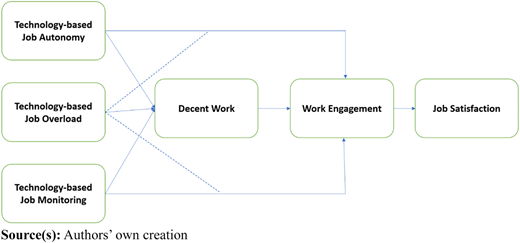
We present our research model reflecting on these established hypotheses as shown in Figure 1:
The conceptual model shown in Figure 1 illustrates the relationships between technology-related job characteristics (technology-based job autonomy, (2) technology-based job overload, and (3) technology-based job monitoring), decent work, work engagement and job satisfaction. The model is anchored in the JD-R theory, incorporating technology-based factors such as job demands and resources. These variables are explored in relation to their impact on Decent Work, which influences employee outcomes such as work engagement. The solid arrows indicate a direct relationship between variables, while the dotted arrows represent potential moderating or indirect relationships.
3. Methodology
3.1 Research context
The research adopted a positivist paradigm and used a quantitative survey design. The study population consisted of public service employees in Bisho, a provisional government hub and town located in the Eastern Cape province of South Africa. The 306 respondents who took part in the study were selected using the convenience sampling technique.
3.2 Research respondents
The biographical characteristics of the respondents are shown in Table 1.
The demographic information on the respondents reveals that women made up the majority (61%) while men made up 39%. Regarding work experience, 57% of the respondents have six to ten years of experience while 29% indicated that they had one to five years of experience. A total of 83% of respondents rated themselves knowledgeable about computers, 13% said they were experts, and 4% said they were novices. Similarly, most respondents (79%) claimed to be knowledgeable about the Internet, while 11% claimed to be experts and 10% to be novices.
The age distribution of the participants revealed that the majority (35%) were aged between 35–44 years, while 25% were aged between 25–34 years. Participants aged 45–54 and 55–64 accounted for 11% of the sample, while only 8% were aged 18–24, and 5% were over 65. Regarding educational qualifications, 47% of the participants held a Diploma or Advanced Diploma, 29% had a Bachelor’s Degree, 12% had an Honours Degree, 8% held a Masters or a PhD, and 5% held a Grade 12 Senior Certificate (high school completion).
3.3 Measuring instruments
The study employed a five-point Likert scale on scales adopted from previous studies. Decent work was measured using the decent work (DW) scale, which included 15 items developed by Duffy et al. (2016). The scale assesses five dimensions of decent work. An example item was: “All in all, I am satisfied with my job”. Work engagement (WE) was measured using a nine-item scale developed by Rothbard (2001). An example item was: “I pay a lot of attention to my work”. Job satisfaction (JS) was measured using a three-item scale (Cammann et al., 1979), with an example item being: “I am generally satisfied with the kind of work I do in this job”.
Technology-based job autonomy (TBJA) was captured with a three-item scale (Spreitzer, 1995). An example item was: “technology gives me significant autonomy in determining how I do my job”. Technology-based job monitoring was measured using a four-item scale (Moussa, 2015), with an example being: Through technology at work, I feel like I am being monitored to the degree that it violates my privacy”. Lastly, technology-based job overload (TBJO) was measured using a three-item scale (Boyar et al., 2007), and an example item was: “Due to the technology at my job, I feel like I have a lot to do at work”. The Cronbach alpha values for all measurement constructs were above the cut-off value of 0.70, indicating internal consistency (Hair et al., 2014).
4. Results
4.1 Confirmatory factor analysis (CFA)
Confirmatory factor analysis (CFA) was conducted to validate the measuring model and investigate the discriminant validity of these scales. Decent work (DW), technology-based job autonomy (TBJA), technology-based job overload (TBJO), technology-based job monitoring (TBJM), work engagement (WE), and job satisfaction (JS) were the considered variables. Ruzungunde et al. (2024) concluded that SRMR, RMSEA, CFI, and TLI are the commonly used fit indexes when reporting SEM fit indices. According to the measurement model fitted, the goodness fit indices obtained are as follows: CMIN/DF = 1.172, p = 0.130 > 0.01; CFI = 0.989; TLI = 0.985; NFI = 0.930, RMSEA = 0.024; and RMR = 0.060). It can be concluded that the data fitted well to the measurement model since all the goodness of fit indices (GFI, TLI, CFI, NFI, RMR, and RMSEA) met the minimum recommended values.
The descriptive statistics such as the mean, standard deviation (Std. Dev), and the standardised factor loadings (SFL) of each item were calculated and are presented in Table 2.
The standardised factor loading values presented in Table 2 are all exceed the threshold value of 0.50 the existence of convergent validity on the items (Hair et al., 2014). The remaining items were excluded due to low factor loadings during the confirmatory factor analysis, which indicated insufficient contribution to construct validity. The mean values ranged between 1.80 and 4.23 and the standard deviation values ranged between 0.74 and 1.29. The Cronbach’s alpha (CA), average variance extract (AVE), composite reliability (CR), and correlation values are presented in Table 3.
The findings in Table 3 confirm the validity and composite reliability of the instrument because every estimated value complied with the standards established by Hair et al. (2014). The Cronbach’s Alpha (CA) results demonstrate satisfactory internal consistency for the studied constructs. All variables DW, TBJA, TBJO, TBJM, WE, and JS exhibit CA values above the acceptable threshold of 0.7 (Hair et al., 2014). Specifically, WE has a CA of 0.761, JS has a CA of 0.727, TBJO has a CA of 0.709, TBJA has a CA of 0.748, DW has a CA of 0.743, and TBJM has a CA of 0.703. These values strongly suggest that the items within each construct reliably measure the intended concepts, thereby supporting the validity of the constructs for further analysis. The findings revealed a favourable relationship between JS and WE (r = 0.041, p > 0.10), TBJO and WE are positively related (r = 0.233, p < 0.0001), TBJO and JS are positively linked (r = 0.015, p > 0.10), TBJA and WE are positively correlated (r = 0.100, p > 0.10), TBJA and JS are positively related (r = 0.057, p > 0.10), and TBJA and TBJO are positively associated (r = 0.125, p > 0.10).
Furthermore, DW and WE are positively linked (r = 0.025, p > 0.10), DW and JS are negatively related (r = −0.015), DW and TBJO are negatively related (r = −0.192, p < 0.05), and DW and TBJA are negatively linked (r = −0.669, p < 0.001). It can be seen that TBJM and WE are positively associated (r = 0.528, p < 0.001), TBJM and JS are negatively linked (r = −0.051, p > 0.10), TBJM and TBJO are positively related (r = 0.512, p < 0.001), TBJM and TBJA are negatively related (r = −0.005, p > 0.10) and TBJM and DW are positively associated (r = 0.048, p > 0.10). The correlation values shown are not excessively high, indicating that the variables are not multicollinear. Harman’s single-factor test was used to assess common method variance (CMV), and the results revealed that the first component only explained 24.58% of the variation, indicating that CMV should not be a major concern in this study.
After the reliability had been established, the Hayes Process Macro was used for the mediation analysis, which included 5,000 bootstrap samples and 95% confidence intervals. The mediation was used to ascertain whether DW had a mediating impact on the link between TBJA and WE, TBJO and WE and TBJM and WE. Additionally, an analysis for each of the direct connections between WE and JS, TBJA and WE, TBJM and WE, and TBJO and WE was conducted.
4.2 Relationship between TBJA and WE and DW mediating the relationship between TBJA and WE
First, we looked at the connection between TBJA and WE and how DW affected that relationship between TBJA and WE. The findings of the mediation study are presented in Table 4.
According to Table 4, the results of the regression analysis show that the TBJA (independent variable) was a significant predictor of DW (β = 0.75, t = 12.75, p < 0.01). Next, while controlling for DW (mediator), the results of the second regression analysis show that TBJA (independent variable) was a significant predictor of WE (β = −0.20, t = −2.16, p < 0.05). The results of the indirect effect based on 5,000 bootstrap samples show a significant indirect negative relationship between TBJA and WE mediated by DW (β = 0.15, 95% CI = [0.01, 0.29]). The mediator, DW, accounted for approximately 35% of the total effect on WE [PM = (−0.11)/(−0.31)]. Conversely, there was a statistically significant direct effect between TBJA and WE (β = −0.20, t = 2.16, p < 0.05). In conclusion, the hypotheses H1, H4 and H8 are supported.
4.3 Relationship between TBJO and WE and DW mediating the relationship between TBJO and WE
The relationship between TBJO and WE as well as the function of DW in influencing that relationship was first looked at. The mediation analysis’s findings are shown in Table 5.
According to Table 5, the results of the regression analysis show that the TBJO (independent variable) was a significant predictor of DW (β = −0.08, t = −2.68, p < 0.05). After controlling for DW (mediator), the results showed that TBJO (independent variable) was a significant predictor of WE (β = −0.68, t = −16.86, p < 0.001). The results of the indirect effect based on 5,000 bootstrap samples show an insignificant indirect negative relationship between TBJO and WE mediated by DW (β = −0.02, 95% CI = [−0.12, 0.09]). The mediator, DW, accounted for approximately 1.5% of the total effect on WE [PM = (−0.01)/(−0.67)]. However, there was a statistically significant direct relationship between WE and TBJA (β = −0.68, t = −16.86, p < 0.001). In conclusion, the hypotheses H2, H5 are supported while H9 is not supported.
4.4 Relationship between TBJM and WE and DW mediating the relationship between TBJM and WE
First, it was looked at how TBJM and WE are related, as well as how DW influences how TBJM and We are related. The outcomes of the mediation analysis are shown in Table 6.
Table 6 findings demonstrate that the TBJM (independent variable) was an insignificant predictor of DW. (β = −0.01, t = −0.21, p > 0.05). After controlling for DW (mediator), the results showed that TBJM (independent variable) was a significant predictor of WE (β = 0.39, t = 6.67, p < 0.001). Based on 5,000 bootstrap samples, the indirect effect findings reveal a negligible indirect link between TBJM and WE that is mediated by DW (β = 0.001, 95% CI = [−0.01, 0.01]). The mediator, DW, accounted for approximately 2.5% of the total effect on WE [PM = (0.01)/(0.40)]. On the other hand, there was a statistically significant direct effect between TBJM and WE (β = 0.39, t = 6.67, p < 0.001). A significant relationship between WE and JS (β = 0.68, t = 21.57, p < 0.001) was noticed while the link between DW and WE (H7) (β = −0.10, t = −1.44, p > 0.05) was found to be insignificant. The results indicate that there is no significant relationship between these two constructs in the context of this study. The slightly negative coefficient suggests an inverse relationship, but it is not statistically significant. This finding implies that DW may not be a critical factor influencing WE in this sample, highlighting the need for further exploration of other potential influences. In conclusion, hypotheses H3 and H11 were supported, while hypotheses H6 and H10 were not supported.
5. Discussion
5.1 Discussion of findings
This study investigated the effects of technology-related factors (namely technology-based autonomy, technology-based job overload, and technology-based job monitoring) on work engagement, decent work, and job satisfaction among South African public service employees. Our empirical findings are consistent with the existing literature. The findings showed that technology-based job autonomy positively affects work engagement. This indicates that when employees have control over how they do their jobs, they are likely to be engaged in their work. Thus, the study results are aligned with previous studies (Ma et al., 2023; Sardeshmukh et al., 2012; Miglioretti et al., 2021; Mahlasela and Chinyamurindi, 2020), which concluded that technology-based autonomy positively correlates with work engagement. The findings also indicated that technology-based job overload negatively affects work engagement. This result aligns with previous studies (Mahomed et al., 2023 Rasool et al., 2022 Sandoval-Reyes et al., 2021; Mahlasela and Chinyamurindi, 2020), which reported that employees who constantly feel overwhelmed by technology-related demands and or job overload may struggle to maintain a healthy work-life balance and experience a decline in their overall well-being, resulting work disengagement. The findings also indicate that technology-based job monitoring negatively affects work engagement. This is attributed to the feelings of mistrust and lack of autonomy that is created by technology-based job monitoring. These findings are in line with the results of several researchers (Siegel et al., 2022; Bhave, 2014) who postulated that job monitoring negatively impacts work engagement.
Technology job-based autonomy was found to be positively associated with decent work. This implies that when technology is used to grant employees autonomy in their work, it can lead to positive outcomes associated with decent work. These findings are aligned with previous studies (McIlveen et al., 2021; Phuong et al., 2021), which reported that technology enables flexible work schedules to enhance work-life balance and job satisfaction, thus adhering to decent work principles. Further to this, this study indicates that technology-based job overload negatively affects decent work. This implies that when technology demands are excessive and unmanageable for employees, it negatively affects their well-being and overall working conditions aspects of decent work. These findings consociate with those by Rasool et al. (2022) and Mahlasela and Chinyamurindi (2020 who highlighted that technology-based job overload can have a detrimental influence on employees and productivity (e.g. decent work, job satisfaction).
The relationship between technology-based job monitoring and decent work was not supported. This suggests that technology-based job monitoring does not significantly affect the quality of work and or other aspects of decent work. Contrary to prior studies (Mahomed et al., 2023; Boston Consulting Group, 2021), which suggest that technology-based monitoring tools provided employees with greater flexibility during the COVID-19 lockdown, the results of this study indicate that technology-based job monitoring does not have a notable influence on the aspects of decent work.
Prior studies (Chada et al., 2022 Kashyap et al., 2022; Navajas-Romero et al., 2019) have reported positive associations between work engagement and decent work. The findings of this study, however, revealed that no statistically significant correlation was found between decent work and work engagement. This implies that the relationships between these variables possibly vary depending on the industry, and individual differences among employees.
The results of the study suggest that decent work mediates the relationship between technology-based job autonomy and work engagement. Consistent with existing literature (Aybas et al., 2022; Braganza et al., 2021), this implies that employees who have technology-based job autonomy and are treated fairly and well are more likely to be engaged in their work. Hypotheses nine and ten were however not supported, as the mediating pathways were non-significant. This suggests that the results of this study did not find significant evidence to support the notion that decent work mediates relationships between technology-based job overload and work engagement as well as between technology-based job monitoring and work engagement.
Finally, work engagement was found to be positively associated with job satisfaction. These findings extend those by other studies (Lekgau and Tichaawa, 2022; Khusanova et al., 2021; Garg et al., 2018). And further provides empirical evidence of these constructs among public service employees. This study thus reveals that when employees are engaged with their work it tends to lead to job satisfaction.
5.2 Implications
5.2.1 Theoretical implications
This study draws from the JD-R model and demonstrates its applicability to technological factors. The study investigated the impact of technology-related factors (namely technology-based autonomy, technology-based job overload, and technology-based job monitoring) on work engagement and decent work. Similar to the JD-R model, the findings support that excessive job requirements can harm employees' well-being and vice versa. The results of the study demonstrate how job demands (such as job monitoring job overload) can affect employees' engagement levels as well as how resources (such as job autonomy) positively affect employee well-being, work engagement, decent work, and job satisfaction. This study also responds to scholars who have criticised the JD-R model for failing to provide specific information about the demands and resources that impact employees. The study, therefore, enriches the literature that supports that the JD-R model can be applied in various research studies across different sectors and countries.
5.2.2 Managerial and practical implications
This study suggests that technology-based job autonomy promotes employee well-being, i.e. work engagement. Decent work was also found to mediate the relationship between technology-based job autonomy and work engagement. Work engagement was found to be positively associated with job satisfaction. In addition, the results suggest that technology-based job monitoring negatively affects work engagement and decent work. Technology-based job overload was also found to affect work engagement and decent work. The results suggest that employees should be supported with resources that allow them to conduct their work autonomously and that managers and practitioners need to find ways to eliminate job overload in order for employees and organisations to thrive.
The findings indicate that technology-based job characteristics significantly influence employee engagement, aligning with the JD-R model and emphasising job resources' importance. Organisations must implement strategic initiatives that allow employees to take on autonomous tasks through flexible work arrangements to enhance engagement. For instance, clear guidelines, objectives, and outcomes should be established that allow employees to manage their own tasks and foster open communication through regular feedback. These practices will promote autonomy and enhance overall job satisfaction, leading to a more engaged workforce. This study provides empirical evidence of decent work practices' importance in mitigating negative impacts of technology-based job overload. The results demonstrate that when organisations implement strategies to promote autonomy and reduce invasive monitoring, employees report higher levels of engagement. By integrating the concept of decent work within the JD-R model, the study enriches the understanding of how job resources can mitigate the negative effects of job demands, offering practical recommendations for organisations seeking to optimise employee outcomes in a technologically driven environment.
5.3 Limitations and suggestions for future research
Although this study proffers insights into the relationships between technology-related factors, work engagement, decent work, and job satisfaction in the South African context, it nevertheless still has some limitations, which may potentially open up avenues for future studies. Firstly, although our study conducted a quantitative analysis from a relatively large sample size, the study was conducted in a specific geographical area, thus, the generalisation of the findings is limited. Future studies should expand the survey to other industries, provinces, regions, and or countries to broaden the data for generalisations. Secondly, future research could also focus on comparatively exploring the variables under study in different contexts (i.e. public vs private sector employees) in order to present significant differences with respect to the South African labour market. Finally, future research could build from these findings and conduct a narrative analysis to explore the viewpoints of employees and provide depth and richness to the available data.