


This is a transnational research project meant to bring a global lens to literacy teacher education using children’s literature as a tool for building climate literacies. The research question that guided this inquiry was: In what ways do encounters among a transnational group of educators with children’s books spark dialogue, reflection, inquiry and action into themes of water justice? This study aims to focus on how a transnational collaborative inquiry into water justice through picturebooks emerged and transformed over the course of virtual inquiry sessions.
Based on the principles of critical participatory action research design, the project consisted of three virtual sessions with interactive translanguaging read-alouds and spaces for reflection and dialogue among four elementary in-service teachers from Colombia, nine in-service teachers from the USA and a group of teacher educators from both countries. Data sources included artifacts of teacher learning, virtual sessions recordings and materials from teaching, planning and debriefing. Data were analyzed using a critical discourse analysis of bilingual, multimodal, translanguaging transcripts of each session and other data sources.
This transnational critical inquiry collective project opened spaces for translingual and transnational meaning-making on water justice, extended the teachers’ and educators’ knowledge about glocal water problems and nurtured social actions to promote water justice across social and geographical contexts.
Most studies on climate literacies have examined learning about climate justice within a social context. This study expands this view by generating a translingual space to foster meaning-making on water justice across the Americas.
Introduction
As literacy educators from Colombia and the USA, we designed a collaborative project with a group of educators from both countries, focusing on building knowledge through inquiry using picturebooks about water justice. Our research question was: In what ways do encounters among a transnational group of educators with children’s books spark dialogue, reflection, inquiry and action into themes of water justice? Specifically, we centered on how our collaborative inquiry emerged and transformed over the course of three online sessions.
We were inspired by the collaborative inquiry undertaken by two literacy teacher educators and four in-service teachers in the Chicago, IL (USA) area, represented in the book Teaching Climate Change to Children: Literacy Pedagogy That Cultivates Sustainable Futures (Woodard and Schutz, 2024). Each of us was cultivating learning communities focused on climate justice in our own locales – Puerto Colombia and St. Louis – and wondered how the inquiry would deepen and expand if we brought these communities together.
Critical literacies in transnational teacher learning communities about climate justice
Critical literacies promote a pluriversal understanding of knowledge and advocate for plurilingual approaches that reflect learners’ linguistic realities (de Souza, 2019). Vasquez et al. (2019) point out that “critical literacies can be pleasurable and transformational as well as pedagogical and transgressive” (p. 300). Because of their pluriversal perspective, critical literacies are used to foster learning in collaborative learning communities among teachers. By engaging in critical reflection from a global lens, teachers can challenge “the taken-for-granted assumptions of teaching and schooling practices and imagin[e] alternatives to change conditions” (Achinstein, 2002, p. 6; Tillema and van der Westhuizen, 2006). When this occurs transnationally, teachers engage in translingual communication and pedagogies. Translanguaging offers a framework for viewing language use as dynamic, political and identity-forming (de Souza, 2019). Translanguaging, understood as a multilingual speaker’s full linguistic repertoire to make meaning and learn without separating languages into fixed boundaries (García and Wei, 2014), enables educators “to problematize monolingual English language beliefs, embrace ever-growing linguistic diversity and adopt pedagogies that can truly sustain […] dynamic meaning-making practices” (Deroo et al., 2020, p. 113). Translanguaging also creates opportunities for teachers from different geographical locations to address global issues.
Among the global problems that raise concern among teachers is climate change. Climate literacies can be defined as “an understanding of the climate emergency […] that centers on developing values, attitudes, and behavioral change aligned with how we should live to safeguard the Earth’s integrity in the present and for future generations” (Oziewicz, 2023, p. 34). In the context of education, climate literacies refer to the recognition that our ways of interacting, representing and being with language, texts and social practices matter and are interconnected with life on planet Earth. This approach emphasizes the ability to bridge disciplinary, sociocultural, analytical and ethical perspectives to respond to climate change and design sustainable and hopeful futures.
There is a growing number of teachers working together to educate themselves and their students about climate justice. For instance, Kennedy (2021) emphasizes the need to integrate climate justice into teacher professional development (TPD) to fulfill the UN Sustainable Development Goals. In Latin America, teacher education on climate change education (CEE) in Chile and Mexico has had a transformative impact (Reyes et al., 2024). Other efforts have been made to address climate anxiety through the intersection of climate justice education and hope-based pedagogy (Finnegan and d‘Abreu, 2024) and to reconceptualize climate justice as a transdisciplinary, justice-centered pedagogy (Singh, 2021). Studies suggest that TPD on climate justice and CEE empowers teachers and students to transcend awareness of the problem, overcome climate anxiety and take action.
Scholars have called for multi/interdisciplinary work in literacy teaching (Almasi, 2016), including climate justice and climate literacies. Although some challenges exist in preparing educators to engage with climate literacies, including inconsistent state standards, limited transdisciplinary training, feelings of pessimism, insufficient attention to environmental justice and limited use of case-based instruction, literacy can be a tool for integrating scientific, social, political and cultural understandings of climate change (Beach, 2023). Studies have used languaging, critical literacy and critical media analysis to analyze and confront climate-related texts and literature for fostering agency (Beach, 2023, 2025; Damico et al., 2023; Fletcher and Holyoke, 2025; Lathrop and Stockdell, 2024). Scholarship has increasingly shown that integrating climate justice and language and literacy education not only enriches students’ critical and communicative abilities but also environmental awareness, ecological identities and civic participation (Nur et al., 2022; Redmond, 2025).
Within this framework, children’s picturebooks hold great potential to mediate understandings of environmental issues despite language differences (Axelrod et al., 2020; Echterling, 2016; Honaker and Miller, 2022). The visual medium of picturebooks helps readers connect emotionally while developing cognitive awareness of climate justice (Yang, 2024). Oziewicz et al. (2025) argue, “Visual storytelling is a powerful tool to convey complex climate themes, especially for readers who may find these topics abstract” (p. 76). Scaffolded discussion around picturebooks promotes perspective-taking, inquiry and social action (Wells et al., 2022; Woodard and Schutz, 2024).
Picturebooks have been used to foster water justice and environmental awareness in education. Doerr-Stevens (2024) highlights the role of story in shaping relationships with water. Freitas et al. (2024) emphasize picturebooks’ impact on children learning about oceans and waterways, while Hardiyanti and Arif (2024) present how picturebooks supported young learners’ critical literacies on water justice. We Are Water Protectors/Somos Guardianes del Agua (Lindstrom, 2020) has become central in this scholarship, with analyses examining its rhetorical strategies (Hagen, 2024) and multimodal representations of human–water relationality (Yang, 2024). Studies have also analyzed how teachers learn together with picturebooks, as they hold “immense pedagogical potential” (Daly and Kelly-Ware, 2025, p. 26) for fostering advocacy and activism among teachers and deepening teachers’ learning on climate justice (Schutz et al., 2022).
In this study, we embraced the potential of critical climate literacies to investigate how children’s books can spark dialogue, reflection and inquiry into water justice within a transnational community of educators.
Methods
Research design
Based on the principles of critical participatory action research (CPAR) (Kemmis et al., 2014), we designed a transnational inquiry into a climate literacies project. It consisted of three virtual sessions with interactive translanguaging read-alouds and spaces for reflection and dialogue among educators from the USA and Colombia. This CPAR was grounded in the following principles: fostering collaborative and self-reflective inquiry, being inclusive and dialogical, aiming at transforming social and educational practices and being committed to changing unjust structures (Kemmis et al., 2014). As a group of critical teacher educators from two countries, we wanted to address a climate issue that was affecting local and global communities. We selected water justice because people in the Colombian Caribbean were facing a drought, while people in Missouri were affected by flooding and water pollution.
Participants: We invited four in-service teachers from Puerto Colombia, Atlantico, Colombia, nine in-service teachers from St. Louis, Missouri, USA, and a group of teacher educators from both countries (Table 1). Teachers from Puerto Colombia have participated in a three-year TPD program on critical literacy and peace education. Teachers in St. Louis were part of a graduate literacy clinic with a focus on evidence-based literacy instruction within an environmental framework. Following CPAR principles, participants investigated their local contexts and proposed focalized action.
Información de los participantes
| City/country | Participant names (pseudonyms) | Grade | |
|---|---|---|---|
| Teacher educators/research assistants | In-service teachers | ||
| Puerto Colombia (PC) Colombia | Educator C Educator T Dalton John Vera | Carolina Melissa Nancy Regina | 5th grade 4th grade 5th grade 2nd grade |
| St. Louis (ST) United States | Educator R | Aria Anika Anne Barry Bianca Carla Eloise Eva Kylie Marta Monica Summer | 6th–8th grade 6th–8th grade 6th–8th grade K–2nd grade 3rd–5th grade 3rd–5th grade K–2nd grade 3rd–5th grade K–2nd grade 6th–8th grade 6th–8th grade 3rd–5th grade |
Collective inquiry sessions
In the virtual sessions, teachers read children’s picturebooks about water: Agua, Agüita/Water, Little Water (written by Jorge Argueta and illustrator by Felipe Ugalde, 2020), Cazucá (written by Oscar Pantoja and illustrator by Flor Capella, 2020) and Somos Guardianes del Agua/We are Water Protectors (written by Lindstrom and illustrator by Garcia, 2011). To foster interlingual understanding, the books were bilingual, featured English and Spanish translations or were wordless. Since not all the teachers were bilingual, we used translanguaging, translation and interpretation in Spanish and English to foster wide participation among teachers. We engaged in “radical bilingualism,” or the practice of openly defying standard dominant monolingual conventions and comforts of monolingual English speakers (Garcia, 2011). An example of this was presenting information in Spanish first, then English [1].
The read-aloud was one kind of encounter with children’s literature that set in motion further inquiry. Other encounters included discussion, reflection, interaction with a Padlet and writing a pledge. Some activities were adjusted to cultural and communicative norms; while teachers from St. Louis preferred structure, teachers from Puerto Colombia preferred flexibility and space for creativity. Following CPAR, participants decided the ways they preferred to communicate and the local problems they wanted to address.
Each session was held over Zoom one week apart. First, teachers created De Dónde Soy/Where I Am From poesías and read poems from the other group of teachers. During the sessions, the Padlet was used as a canvas to share articles, questions, summaries of small group discussions, drawings, resources and photos.
Session 1.
First, we explained that our focus on building knowledge through inquiry around water justice was part of climate literacies. Following CPAR, we acknowledged the importance of teachers working together to educate young people about climate justice and how we care for ourselves, each other and our shared planet. Then, we presented a map of Colombia and the USA to reflect on the fact that we were joined by the Atlantic Ocean (Figure 1).
 The slide shows text and a map. The text reads Educator T colon So here we are. And here you can see Cuba, the Caribbean Sea, the Gulf of Mexico. The text then reads Educator T colon And you are here in Missouri. Les estoy mostrando cómo estamos conectados por el agua de alguna manera desde acá hasta allá. I do not know, Educator R. If you want to talk a little about if there is any river that comes from Missouri to the Gulf of Mexico. The map shows Mexico, Cuba, the Caribbean Sea, and the Gulf of Mexico with a pin near Puerto Colombia. The actions described state circles the Google pin around Puerto Colombia on So here we are, drags cursor up until under Cuba, underlines Cuba once with cursor, then circles both Caribbean Sea and Gulf of Mexico once while saying their names. Drags cursor north until Missouri enters frame, circles Missouri twice with cursor. Drags cursor from St. Louis along the Mississippi river to the Gulf of Mexico back to Puerto Colombia and back up to Gulf.
 Los facilitadores explican cómo el agua conecta dos comunidades
Source: Authors’ own work
The slide shows text and a map. The text reads Educator T colon So here we are. And here you can see Cuba, the Caribbean Sea, the Gulf of Mexico. The text then reads Educator T colon And you are here in Missouri. Les estoy mostrando cómo estamos conectados por el agua de alguna manera desde acá hasta allá. I do not know, Educator R. If you want to talk a little about if there is any river that comes from Missouri to the Gulf of Mexico. The map shows Mexico, Cuba, the Caribbean Sea, and the Gulf of Mexico with a pin near Puerto Colombia. The actions described state circles the Google pin around Puerto Colombia on So here we are, drags cursor up until under Cuba, underlines Cuba once with cursor, then circles both Caribbean Sea and Gulf of Mexico once while saying their names. Drags cursor north until Missouri enters frame, circles Missouri twice with cursor. Drags cursor from St. Louis along the Mississippi river to the Gulf of Mexico back to Puerto Colombia and back up to Gulf. Los facilitadores explican cómo el agua conecta dos comunidades
Source: Authors’ own work
In the second part, the group was divided into three breakout rooms. In each room, teachers shared social cartographies and news about the water issues impacting our local communities. At the end of the session, the group of teacher educators from Colombia presented a read-aloud cycle based on the principles of critical literacies, which would serve as the foundation for our sessions. The reading cycle included: planning the learning objectives; connecting with previous experiences; exploring our interpretations of the cover images and title; interacting and reading; reflecting and having a dialogue; and transforming by addressing local problems.
Session 2.
We started with a mindfulness activity to reflect on the importance of water in our lives. Then, teachers from the group volunteered to take turns reading pages of the bilingual book Agua, Agüita/Water, Little Water, projected on the screen in Spanish, then English. During the activity, everyone sketched the meanings they were making using paper, markers, colored pens or digital technologies. These meanings were shared in small groups and included in the Padlet. In the second part, we facilitated another collective experience of the wordless picturebook Cazucá. The teacher educators from Colombia provided context for the book because it tells the story of water scarcity in Cazucá, a neighborhood of Bogotá (Figure 4). To emphasize the interpretive possibilities of wordless picturebooks, participants from Puerto Colombia and St. Louis read a full-page spread and shared their interpretations.
Session 3.
We began the session with a centering practice of gratitude to water. This set the stage for hearing the book Somos Guardianes del Agua/We Are Water Protectors. This translingual read-aloud then segued into small group discussions. At the end of the session, we created a collective pledge with our commitments to protect water and take action toward climate change. We closed our collective inquiry by inviting the teachers to reflect on what they learned.
As we planned the CPAR project, we were excited about the possibilities afforded through online spaces to bring educators together from Puerto Colombia and St. Louis. However, there were also issues of power and privilege related to time, technological equity and the dominance of English. We should also recognize that while this collaboration was new, several members of the inquiry team have collaborated for many years. These relationships, formed in person and online, were of utmost importance.
Data sources [2]
Artifacts of teacher learning.
Before the first encounter, teachers created De Dónde Soy/Where I am From poesías/poems. The poems were translated into English/Spanish and exchanged among teachers from both countries. This allowed teachers to reflect on their personal identities and shared experiences. To foster reflection about their local problems, teachers made social cartographies and concept mapping of issues related to water in their local communities (Barragán-Giraldo et al., 2020). The educators also contributed to the Padlet and filled out a survey at the end of each session with questions such as “¿Qué te sorprendió en esta sesión?/What surprised me in today’s session?” and “Qué es algo sobre lo que te gustaría aprender más?/What is something that you would like to know more about?”
Recordings of inquiry sessions.
We video recorded each of the inquiry sessions (approximately 1:15 h each). All recordings were stored in a password-protected online folder and shared only among the research team.
Materials for teaching, planning and debriefing.
We gathered before and after the virtual sessions for planning and debriefing. We generated agendas, planning notes, bilingual presentations, written reflections and notes.
Data analysis
Our data analysis was grounded in critical discourse studies (Resende, 2018; Stibbe, 2014), which offer a framework for understanding meaning-making and power relationships. We created multimodal, translanguaging transcripts of each session. We captured screenshots from the video in the right-hand column to illustrate changes in speaker, activity, or text (Figure 1). We attended to the placement of modes without privileging spoken and written discourse using placement of modes, discourse, time stamps and other decisions to reflect assumptions about hierarchies in communication (Norris, 2002). The team captured screenshots from the video in the right-hand column to illustrate changes in speaker, activity or text (Figure 2).
 The slide shows text and a video frame. The text reads Educator T colon So este es el libro que teníamos para hoy, que hoy vamos a trabajar, que se llama Somos dos Guardianes del Agua. Open bracket, feedback, close bracket, Mm hmm. The text reads John colon So this is the book that we have for today. It is called We Are Water Protectors. In Spanish, Somos Guardianes del Agua. The text reads Educator T colon Vamos a hacer una lectura bilingüe. El audio va a estar en español y los subtítulos estarán en inglés. The text reads John colon So we are going to do a bilingual read aloud session. The audio is going to be in Spanish, but the subtitles are going to be in English. The video frame shows the title We Are Water Protectors and the book cover with the Spanish title Somos Guardianes del agua, along with names Carole Lindstrom and Michaela Goade. The text states Educator T introduces the book in Spanish. Sudden feedback from Carolina whose mic is unmuted interrupts until her video appears on screen then she mute her mic. John then introduces the book in English with the slide remaining the same. The text states Educator T cups her right hand around her ear and then points forward as if following subtitles.
 Un ejemplo de transcripción multimodal translingual
Source: Authors’ own work
The slide shows text and a video frame. The text reads Educator T colon So este es el libro que teníamos para hoy, que hoy vamos a trabajar, que se llama Somos dos Guardianes del Agua. Open bracket, feedback, close bracket, Mm hmm. The text reads John colon So this is the book that we have for today. It is called We Are Water Protectors. In Spanish, Somos Guardianes del Agua. The text reads Educator T colon Vamos a hacer una lectura bilingüe. El audio va a estar en español y los subtítulos estarán en inglés. The text reads John colon So we are going to do a bilingual read aloud session. The audio is going to be in Spanish, but the subtitles are going to be in English. The video frame shows the title We Are Water Protectors and the book cover with the Spanish title Somos Guardianes del agua, along with names Carole Lindstrom and Michaela Goade. The text states Educator T introduces the book in Spanish. Sudden feedback from Carolina whose mic is unmuted interrupts until her video appears on screen then she mute her mic. John then introduces the book in English with the slide remaining the same. The text states Educator T cups her right hand around her ear and then points forward as if following subtitles. Un ejemplo de transcripción multimodal translingual
Source: Authors’ own work
Next, descriptive comments were included in the right-hand column to describe paralinguistic dimensions of communication. Modally dense episodes were selected to create multimodal translanguaging transcriptions. Then, the research team reread the transcripts and artifacts from the inquiry sessions. We identified climate literacy encounters and analyzed each using a three-dimensional critical framework that included textual, institutional and societal dimensions (Fairclough, 1993). At the textual level, we examined interactional patterns and translanguaging practices in the inquiry meetings and in the Padlet (e.g., cohesive devices such as organizing moves of facilitators and modality). At the institutional level, we identified narratives about water justice that were shared and taken up by educators across the books and inquiry sessions (e.g., interconnectedness of humans and water across the globe; intergenerational impacts of water (in) justice; and working together to solve problems). At the social level, we coded the range and types of social actions discussed and enacted (e.g., pedagogical actions shared in the inquiry group and those actions taken by the inquiry group). After coding the transcripts for each dimension, we created analytic memos and narratives that included patterns of interactions, narratives and actions that answered our research question.
As a modally dense example of a climate literacy encounter, we further analyzed the Padlet to determine what type of learning opportunities were provided and the meanings represented. A timeline of interactions was reconstructed by generating a “thick description” of the Padlet (Albers, 2007; Christiansen, 2017, 2024). We coded the timeline and associated fieldnotes with a focus on both the participants’ interactions, thematic topics and narratives related to climate justice and the actions represented. Other coding analyzed discursive meanings, noting use of deictics such as pronouns, organizing moves from facilitators and use of literacies (multimodality, translanguaging or digital literacies) (Christiansen, 2017). Subsequently, tables were generated to analyze which participants participated most often, posts by geographic area, participant role and type of posting modalities.
Finally, the research team had a meeting to discuss the complex analysis and converged on the final themes and their significance.
Findings
This critical inquiry collective project opened spaces for translingual and transnational meaning-making about water justice, extended our understandings about glocal water problems and nurtured social actions to promote water justice. We discuss each of these findings below.
Creating translingual and transnational spaces for meaning-making about water justice
The inquiry sessions created a space for reflection and meaning-making about climate issues. During the sessions, educators spoke freely in Spanish, English or Spanglish; some translated while others interpreted in a flow of language that created a translingual and transnational tapestry of understandings around water justice.
Picturebooks offered narrative possibilities through poetic structure, oral tradition and visual storytelling. Available discourses in the books about water ranged from conservation and sustainability to justice. Some teachers were not bilingual, but the books fostered translanguaging, which supported the fluidity of interpretations about climate issues. In the case of Agua, Agüita/Water, Little Water, participation was horizontal and teachers took turns spontaneously, either unmuting and speaking or typing into the chat. In the case of Somos Guardianes del Agua/We are Water Protectors, we projected a video of the book in English with a voice reading it in Spanish (see Figure 2). This translanguaging process included a combination of languages and codes using text, audio and images (García and Wei, 2014). This use of technology allowed everyone to understand the story in their native language.
The Padlet was another space for translingual and transnational meaning-making (see Figure 3). In the Padlet, while English predominated the text, about half of the posts were translingual (see Table 2). For example, facilitators from the Colombian team posted their group’s summaries in Spanish and English. Vera posted about the parallels for issues of water justice faced by the communities in Puerto Colombia and St. Louis: “Acceso limitado al agua durante el día/Limited access to water during the day” (Colombia) and “People cannot pay their water bill, and their water is cut off/Las personas no pueden pagar las facturas del agua y les cortan el servicio” (USA). Another way participants made meaning together was by using multimodal resources. More than half of the posts were multimodal posts. The posting of drawings, student projects, photos and videos added visual elements that assisted meaning-making.
 The screen shows multiple posts about water issues. One post shows a drawing and text stating access to water from 5:00 a m to 12:00 p m and Solo hay agua de 5:00 a m. a 12:00 m. Another post states El agua es transportada por carro tanques and people who live above the hill throw garbage in the streams and pollute the water and Las personas que viven en el cerro tiran basura a las quebradas y contaminan el agua. A central post titled Similar problems related to water resources lists floods in rainy seasons in Colombia and Inundaciones cuando llueve en Puerto Colombia, floods when the river rises in Missouri and Inundaciones cuando se sube el río, limited access to water during the day in Colombia and Acceso limitado al agua durante el día, people cannot pay their water bill and their water is cut off in Missouri and Las personas no pueden pagar las facturas del agua y les cortan el servicio, and water contaminated by garbage in Colombia. Another post titled Radioactive Waste Poisons Bridgeton, M O community states radioactive waste from Manhattan Project buried in landfill and nearby creek could flood and spread radioactivity and clean up expected March 2024.
 Padlet como un espacio translingual y transnacional para construir significados sobre la justicia del agua
Source: Authors’ own work
The screen shows multiple posts about water issues. One post shows a drawing and text stating access to water from 5:00 a m to 12:00 p m and Solo hay agua de 5:00 a m. a 12:00 m. Another post states El agua es transportada por carro tanques and people who live above the hill throw garbage in the streams and pollute the water and Las personas que viven en el cerro tiran basura a las quebradas y contaminan el agua. A central post titled Similar problems related to water resources lists floods in rainy seasons in Colombia and Inundaciones cuando llueve en Puerto Colombia, floods when the river rises in Missouri and Inundaciones cuando se sube el río, limited access to water during the day in Colombia and Acceso limitado al agua durante el día, people cannot pay their water bill and their water is cut off in Missouri and Las personas no pueden pagar las facturas del agua y les cortan el servicio, and water contaminated by garbage in Colombia. Another post titled Radioactive Waste Poisons Bridgeton, M O community states radioactive waste from Manhattan Project buried in landfill and nearby creek could flood and spread radioactivity and clean up expected March 2024. Padlet como un espacio translingual y transnacional para construir significados sobre la justicia del agua
Source: Authors’ own work
Building knowledge about water justice as a glocal issue
At the beginning, teachers from both cities thought water issues were local problems. St. Louis teachers thought, “Why would Colombian teachers have water problems if they live near the river and the sea?” Similarly, teachers in Puerto Colombia thought, “Why would USA teachers have water problems if they live in a developed country?” However, problems related to water in both places included drought, flooding, water pollution and lack of access to drinkable water. Through the dialogue fostered at the sessions, educators realized that issues of water injustice were not only local problems but also shared global phenomena.
To start connecting the local context to global shared realities, one of the activities included the visualization on Google Maps of St. Louis and Puerto Colombia. The teacher educators asked: “Where are we?” The group reflected on how St. Louis and Puerto Colombia were connected through the flow of rivers (the Missouri River, the Mississippi River and Río Magdalena and the Atlantic Ocean (Figure 1).
In the case of Cazucá, the book addresses a local problem in Colombia where some neighborhoods do not have access to potable water. The Colombian team explained that Cazucá is a neighborhood in the capital, Bogotá. Educator T provided context about Cazucá in an extended English description displaying slides locating Cazucá on a map as well as photos of the neighborhood, noting that communities tend to be poorer in the south (see Figure 4). “And you may think, ‘Okay, maybe this is how Colombia is, or maybe this is how Bogotá looks, right?’” she continued, “This picture on the right is downtown Bogotá. That is more colonial. And this is the center and north part of Bogotá. So, you see modern buildings, it’s very different.” This contextual information supported the fluidity of understanding of the picturebook and the water issues faced by many Colombians.
 The slide shows text and a shared screen. The text reads Educator T colon We are going to stop there for a minute so that people can think about the questions that we have. Before that, we would like to share a little bit about Cazucá. Cazucá is a neighborhood located in Bogotá, the capital city of Colombia. So here you see the map, where you see Colombia. Here, this is Colombia. Sorry. This is Colombia. This is the state called Cundinamarca. And this, the white stain is Bogotá. The south part of Bogotá usually is the poorest areas. And you see that at the bottom is this is like the county and this here is Cazucá. Here, you can see a real picture of Cazucá. open bracket, 1:02:00, close bracket And you may think, Okay, maybe this is how Colombia is, or maybe this is how Bogotá looks like, right, question mark. The screen text states Vera stops sharing screen and instead, Educator T starts sharing screen. The slide shows a map of Colombia with marked regions and images of Cazucá. The text states Educator T appears on screen. She places the cursor on the right side of the slide in Colombia’s map and gives one circle. Then, while saying This is the state called Cundinamarca places the cursor on the second black shape. She circles with the cursor a white space in the center of the second black shape to locate Bogotá city. She gestures down with her hands to exemplify the location of the south. She places the cursor on the photo from the bottom to show how Cazucá looks in real life.
Contexto de los barrios de Bogotá
Source: Authors’ own work
The slide shows text and a shared screen. The text reads Educator T colon We are going to stop there for a minute so that people can think about the questions that we have. Before that, we would like to share a little bit about Cazucá. Cazucá is a neighborhood located in Bogotá, the capital city of Colombia. So here you see the map, where you see Colombia. Here, this is Colombia. Sorry. This is Colombia. This is the state called Cundinamarca. And this, the white stain is Bogotá. The south part of Bogotá usually is the poorest areas. And you see that at the bottom is this is like the county and this here is Cazucá. Here, you can see a real picture of Cazucá. open bracket, 1:02:00, close bracket And you may think, Okay, maybe this is how Colombia is, or maybe this is how Bogotá looks like, right, question mark. The screen text states Vera stops sharing screen and instead, Educator T starts sharing screen. The slide shows a map of Colombia with marked regions and images of Cazucá. The text states Educator T appears on screen. She places the cursor on the right side of the slide in Colombia’s map and gives one circle. Then, while saying This is the state called Cundinamarca places the cursor on the second black shape. She circles with the cursor a white space in the center of the second black shape to locate Bogotá city. She gestures down with her hands to exemplify the location of the south. She places the cursor on the photo from the bottom to show how Cazucá looks in real life.Contexto de los barrios de Bogotá
Source: Authors’ own work
During the read-aloud, teachers took turns in English and Spanish to offer interpretations. In one of the interactions, teacher Carla, from St. Louis, precisely described what the images were depicting, which the interpreters translated into Spanish. Next, Regina shared her interpretation of the images and added an example of her social context by describing neighborhoods in Colombia called comunas, “Lo colorido de las casas me hace pensar que es una comuna. En nuestro país se da esto de las casas muy juntitas. Uno se imagina que es un barrio de estrato bajo.” Here, Regina drew on her prior experiences and contextual knowledge to explain how social class influenced access to drinkable water, pointing out that informal settlements on the city’s mountains and outskirts often lacked formal utilities.
Teachers realized their local water issues were also global problems through sharing and noting the commonalities between their communities’ experiences, despite the geographic distance. In both communities, water has been polluted with toxic substances by chemical leaching from local mines. Puerto Colombia’s water is contaminated with garbage, while St. Louis’s water is contaminated with lead and radioactive waste from World War II. Both communities experience flooding from rain and a lack of access to drinkable water in schools.
Even though the circumstances were different, both cities experienced challenges accessing water. In Puerto Colombia, there was a drought, and, therefore, a lack of drinkable water because seawater had mixed with the river water due to a decrease in the river’s level. Nancy explained the negative health impact this has had on the children, “[Energy company] comenta que esa agua salada no hace daño al estómago, pero hemos visto que muchos niños siempre andan con dolor de estómago y vomitando. Dicen que es una virosis, pero el agua está afectando nuestra salud. Es desagradable estar tomando agua. Eso hace tres, cuatro meses.” Although the government denied that the salty water was responsible for stomachache, vomiting and other health problems, Nancy had seen the community’s health deteriorate since the water became salty, a phenomenon called saltwater intrusion. If the water treatment plant is not equipped to remove salt, higher concentrations of sodium chloride and other minerals in tap water can have health effects, such as high blood pressure, dehydration and kidney strain. About this, one educator from St. Louis remarked, “Hearing this [saltwater intrusion] in the news and confirmed by personal narratives is alarming.”
Meanwhile, in St. Louis, families may not be able to pay their water bill, and their water would be turned off. Carla described some families’ financial motivation to conserve water: “Again, that pressing need for some students is an economic factor where their parents teach them, ‘Hey, we want to conserve water to save on our water bill,’ versus we want to save water because it’s a global crisis.” Narratives became glocalized as educators intertwined the local realities with those narratives offered in the books and by their global colleagues.
As a group, we understood that water justice is not a Colombian or a USA problem; it is our shared problem–our actions affect us all.
Opening space for social actions to promote water justice
Reflection led to action on climate justice. The teachers shared in small group sessions and on the Padlet, pedagogical actions they had taken in between the inquiry sessions, including role-playing, creative activities, learning about the local wildlife, inviting experts and creating public service announcements (PSAs). For instance, in Colombia, Carolina visited the local mangroves with her students to carry out a beach cleaning project. Regina encouraged her students to participate in an Earth Day school event where they performed Agua, Agüita and read aloud poems they created to raise consciousness about water sustainability. Educator T shared pictures of the activity (Figure 5) while she explained that Regina’s students won a poem contest with their performance.
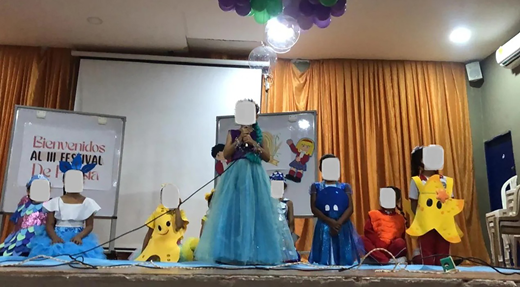
Foto de los estudiantes de Regina leyendo poemas sobre el agua
Source: Authors’ own work
Foto de los estudiantes de Regina leyendo poemas sobre el agua
Source: Authors’ own work
In the St. Louis group, several teachers shared about the public service announcements that they worked on with their students. On the Padlet, Kylie, Eloise and Barry shared slides from a presentation for teaching students about the importance of hydration, while Eloise shared a photo of the students’ poster designs for raising awareness about the importance of hydration. Another teacher examined the lengths of their showers, both in terms of how much water is being used and its cost. Marta, Monica, Anika and Anne’s students focused on informing the audience about flood preparedness in response to a novel they were reading about Hurricane Katrina, Finding Someplace by Denise Lewis Patrick. A teacher posted on the Padlet an informational poster example created by students about flooding.
During the breakout sessions around the question “How can our students and we become water protectors?”, a discussion ensued about the importance of finding children’s literature that meets children where they are in terms of their understanding of water justice. Teacher Carla asked the group, “Is the book Somos Guardianes del Agua more impactful because students in Puerto Colombia are experiencing a water crisis daily?” Teacher Melissa confirmed, “Yes, my students will tell me ‘We do not have access to water for four or five days,’ and, as a result, the water is more expensive. When my students read the book, the black pipes reminded them of contamination of their pipes and of the water.”
Collectively, we generated ideas for an action-oriented pledge. We took inspiration from the water pledge found in the back of Somos Guardianes del Agua/We are Water Protectors. Our pledge, called “Los educators como protectores del agua y la tierra” (see Supplementary Material), ends with a commitment to continue our education on climate literacies: “Haremos todo lo posible para continuar este trabajo de educarnos los unos a los otros para crear conciencia sobre la naturaleza interconectada del medio ambiente y las vidas humanas.” The inquiry through children’s literature led the group of educators to propose actions with a common purpose.
Discussion
In a time of climate crisis, learning to communicate across differences remains a pressing need (Roos and van der Sluijs, 2025). In this project, we learned how collective inquiry into a common environmental topic, water, can create space for creative and critical understandings across boundaries and borders: geographical, linguistic, space/place and ideologies.
Although this was a short collaborative process, our findings point to important practices that supported teacher learning. First, there was a willingness to move beyond spoken language to understand each other: sharing images, sketches, written responses, multiple languages and codes in written text, audio and images (García and Wei, 2014). Fortunately, there were experienced interpreters on the team who could provide real-time translation, which aided in the collaboration. Although the books we chose were not fully bilingual, the contexts and conditions we created around the books moved toward translingualism. A multilingual gaze is important for fostering climate literacies because knowledge from different perspectives, geographies and experiences is necessary to create hopeful futures.
Second, there was a mutual focus on building knowledge about water justice. Inequitable access to water was identified as a problem in both locations as teachers discussed their reflexive explorations of how water issues impact their students. Many of the teachers had engaged in literacy teaching about water justice and had examples from their practice to share with the group, strengthening the collaboration. This finding aligns with Woodard and Schutz’s (2024) work on how education on climate change grounded in literacy practices can cultivate understanding and meaningful action as part of a sustainable future. Becoming climate literate is an ongoing journey of understanding the Earth’s ever-changing ecological systems and recognizing the interconnectedness of humans and the environment. In this article, we centered children’s literature and critical literacies to build climate awareness. In each of the steps of the reading cycle, literacies of and about water justice were woven through our different perspectives: from building social-scientific knowledge about water justice to sharing emotional and perspectival experiences with water. There was increased motivation to overcome difficulties in communication and technology as we face a climate crisis that impacts everyone.
This collaborative, transnational inquiry acknowledges the transdisciplinary nature of climate change and water justice, as well as the role of literacies and languages in educating amid the climate crisis (Beach, 2025; Damico et al., 2023). Teachers experienced, first-hand, literacies as an instrument for the integration of the interdisciplinary dimensions of climate change (Beach, 2025). Their reflections evidenced learning, which included realizations of the need to incorporate climate knowledge into their professional development (Kennedy, 2021), as well as into their pedagogical practice. Water justice is, in the end, an issue of equity and social justice, a shared goal of all literacy work (Janks, 2014).
Third, in education, practice is social action. The educators were eager to share examples of how they and their students addressed water justice issues in their literacy teaching. These episodes of shared practice illuminated the complexities of local contexts and pedagogical practices that transcend boundaries. This echoes previous work on literacies as social action (de los Ríos, 2017; Fletcher and Holyoke, 2025; Nur et al., 2022; Pahl and Rowsell, 2020; Vasquez et al., 2019): from writing and performing poetry and writing a collective pledge together to cleaning mangroves and beaches and creating public service announcements (PSAs) about flooding preparedness, literacy practices were connected to social action.
This study offers important implications for research and practice on climate literacies. Climate literacy encounters among a transnational/multilingual group of educators with children’s books sparked dialogue, reflection, inquiry and action toward educational change. Picturebooks mediated understandings of climate literacies and water justice among teachers who otherwise might not have been able to learn from each other. Seeing, hearing and feeling water issues from different perspectives and from a participatory and horizontal approach fostered true dialogic encounters and cross-cultural collaboration. This multimodal and multisensory experience enhanced the comprehension of our position toward local and global climate issues and collaborative teacher learning, expanding on the contributions of similar work (Sobré-Denton, 2015).
As teacher educators, we are actively engaged in the process of inquiry into how teacher education can be reimagined within a global framework. This work represents not only a pedagogical commitment but also a journey of exploration and learning as educators. Our understandings of water justice were challenged and expanded as we collectively learned about water problems while reflecting on our own positionality on water justice. Our interactions, narratives and actions became glocalized as our local realities, literature and narratives intertwined across borders and boundaries.
The authors would like to acknowledge the teachers who participated in this study for their generosity, kindness, and collaborative spirit. Authors deeply appreciate their efforts to make the Earth a better place to live.
Erratum: It has come to the attention of the publisher that the article, Trigos-Carrillo L, Calle-Díaz L, Rogers R, Misra NR and Herrera Bustamante J (2026), “Collaborative reading and writing for glocal water justice: online teacher inquiry across the Americas”. English Teaching: Practice & Critique, Vol. ahead-of-print, No. ahead-of-print, Link to Collaborative reading and writing for glocal water justice: online teacher inquiry across the AmericasLink to the cited article, was published with an error in the affiliation of the third and fourth authors, Rebecca Rogers and Nicole R. Misra, respectively.
Rebecca Rogers and Nicole R. Misra’s affiliation was incorrectly presented as follows:
Department of College of Education, University of Missouri-St. Louis, Saint Louis, Missouri, USA
This has now been corrected to the following: College of Education, University of Missouri-St. Louis, Saint Louis, Missouri, USA
This error was introduced during the article publication process, for which the publisher apologises.
Notes
This manuscript also embraces a radical bilingualism approach by providing examples from the Colombian teachers in the original Spanish without offering translations.
This project was approved by the research board at both universities. All the educators gave consent to participate in the study and have their data presented in this article. We have changed the names of individuals to protect participants’ privacy.
References
Further reading
Supplementary material
The supplementary material for this article can be found online.

