


The purpose of this study is to identify the key labour-market skills, the challenges graduates face and recommendations for aligning higher education with employer expectations in Hungary, a Central European country. This study underscores the importance of soft skills, such as adaptability, problem-solving and independence, for graduates in the Hungarian labour market.
A cross-sectional survey was conducted among all students of a Hungarian university involved in work placements (n = 1,556). The research subjects were the organisations where undergraduate students from a Hungarian university completed their practical semester, and a total of 1,556 student evaluations were processed. The study analysed 15 distinct skills suggested by NACE and identified four factors: agility, professional knowledge, interpersonal skills and generic skills.
The study's findings indicate that agility, encompassing adaptability, problem-solving skills and independence, emerged as the paramount criterion in employers' evaluations. The findings indicate substantial disparities in the perceived significance and assessment of skills across diverse academic disciplines. The research findings show that, in the labour market, soft skills may be more significant than technical expertise. The subsequent development of the skills and competence measurement tool identified in the literature review is proposed, particularly with respect to the hard and soft skills of the field of study.
The main limitation of this research is the use of a non-validated measurement instrument developed for internal quality management, which may lack scientific rigour. Additionally, the application of a uniform competency framework across all disciplines prevents the study from capturing the specific skill nuances required by different professional fields.
Universities should move beyond simply adding soft skills modules and instead embed cognitive and interpersonal development across all curricula. Key mechanisms for this include structured industry partnerships, work-integrated learning and a shared competency framework that aligns academic content with specific labour-market expectations.
By addressing the skills mismatch, these findings foster a more efficient transition from education to employment, ultimately enhancing graduate career prospects. Recognising the hierarchical structure of skills, where technical knowledge is the baseline but agility and interpersonal skills drive advancement, helps society better prepare a workforce capable of long-term professional growth.
This study underscores the significance of soft skills in the Central European/Hungarian labour market context, offering direct evidence from employer evaluations of student work placements. The implications of this phenomenon extend to the need for educational reform that integrates soft skills training. Furthermore, there is a compelling need for enhanced collaboration between universities and employers. Additionally, policy adjustments are imperative to ensure the successful implementation of these changes. Aligning educational curricula with employer expectations can help mitigate the skills gap and stimulate economic growth in Central Europe.
1. Introduction
Graduate employability has become a central concern for higher education institutions worldwide, as employers increasingly emphasise both technical and non-technical skills in new graduates (Mahon et al., 2024; Bisschoff and Massyn, 2025; Miklós and Lukács, 2024). Across diverse sectors, employers highlight gaps in communication, problem-solving, adaptability, digital literacy, and professional attitudes, indicating a persistent mismatch between the skills developed at universities and those demanded by the labour market (Dicker et al., 2019; Damoah et al., 2021; Baird and Parayitam, 2019; Mohan et al., 2024). This global trend underscores the need for higher education institutions to integrate both vocational and generic competencies into curricula and to actively support students in developing the skills required to succeed in contemporary workplaces (Pujol-Jover et al., 2023; Vydrová, 2018).
In the Hungarian context, these challenges are particularly salient. According to the latest KSH data (KSH Oktatási adatok, 2022), approximately 1,852,000 students were enrolled across general, vocational, and higher education programs in 2022/2023. Among these, 78% had engaged in employment during their studies (DPR, 2024), with substantial proportions commencing work before graduation across fields such as business, agriculture, engineering, and social sciences (Table 1). Despite high levels of student employment, evidence suggests that graduates may still face skill gaps, particularly in socio-emotional and transversal competencies, which are critical for successful integration into the workforce (Deaconu et al., 2014; Gejdoš et al., 2021).
Data on graduate tracking in Hungary in 2024
| Status | * | Business (%) | Agriculture (%) | Engineering (%) | Social sciences (%) |
|---|---|---|---|---|---|
| Currently employed | HL | 35.58 | 44.23 | 40.74 | – |
| CL | 44.92 | 52.79 | 46.29 | 40.03 | |
| UL | 58.94 | 72.18 | 67.04 | 61.88 | |
| Worked in the final semester | HL | 34.62 | 54.56 | 18.52 | – |
| CL | 29.41 | 54.43 | 46.08 | 42.33 | |
| UL | 36.31 | 60.28 | 54.37 | 49.28 | |
| No further study | HL | 33.65 | 50.37 | 33.33 | – |
| CL | 53.07 | 62.95 | 46.54 | 53.32 | |
| UL | 77.93 | 90.31 | 83.35 | 81.66 | |
| Further studies in the same field | HL | 61.54 | 41.66 | 62.96 | – |
| CL | 33.24 | 31.8 | 43.16 | 23.08 | |
| UL | 7.26 | 1.87 | 2.94 | 2.23 | |
| Further studies in different field | HL | 4.81 | 7.97 | 3.7 | – |
| CL | 13.7 | 5.25 | 10.3 | 23.6 | |
| UL | 14.8 | 7.82 | 13.71 | 16.11 |
Note(s): * HL: higher-level vocational training, CL: college-level programme, UL: university-level programme
International research emphasises that employability depends on a combination of technical knowledge, cognitive abilities, and interpersonal skills, including communication, teamwork, problem-solving, creativity, and adaptability (El Hadad et al., 2014; Suleman, 2018; Makmee, 2023; Mohammed et al., 2024). However, discrepancies often exist between student perceptions and employer expectations, particularly regarding the prioritisation of technical versus soft skills (Klibi and Oussii, 2013; Lisá et al., 2019; Smith et al., 2024). This misalignment highlights the importance of aligning higher education curricula with labour-market requirements through competency-based education, experiential learning, and stronger collaboration between universities and employers (Henrich, 2016; Pujol-Jover et al., 2023; Bisschoff and Massyn, 2025). Against this backdrop, the present study focuses on Hungary to provide a detailed understanding of the graduate employability landscape in Central Europe. Specifically, the study addresses the following research questions.
What are the key skills in demand by the labour market in Hungary?
What challenges do graduates face in the labour market, and do these challenges vary by field of study (i.e. agriculture, business, engineering, and social sciences)?
The study aims to identify skill requirements, highlight gaps between university training and employer expectations, and offer evidence-based recommendations for aligning higher education programs with labour-market needs. Its novelty lies in the cross-disciplinary approach, the large-scale survey of students, and the focus on socio-emotional skills and agility, an often underemphasised aspect of employability. By examining differences across student groups and study programs, the study provides actionable insights to guide educational reform and foster closer collaboration between academia and industry.
The remainder of the paper is structured as follows: Section 2 reviews the literature on graduate employability, Section 3 outlines the methodology, Section 4 presents the empirical results, Section 5 discusses the findings, implications, limitations, and directions for future research and Section 6 summarises the main conclusion.
2. Theoretical background
This literature review is organised to highlight key conceptual frameworks, core competencies, and comparative evidence from both employer and student perspectives, with a particular focus on identifying gaps in graduate employability.
2.1 Graduate employability
The expectations of the labour market regarding graduate skills have been extensively examined across disciplines and national contexts (Jaiswal et al., 2024; Lapina et al., 2017). Despite variations in terminology and categorisation, prior research generally converges around three broad domains of employability: technical (vocational or professional) competencies, cognitive or methodological skills, and interpersonal or socio-emotional competencies. Hernández-March et al. (2009) distinguished between vocational competencies (theoretical and practical knowledge) and generic competencies, including communication, methodological skills (problem-solving, creativity, decision-making), and interpersonal abilities (teamwork, negotiation, leadership). Similarly, Klibi and Oussii (2013) identified technical, intellectual, interpersonal, and personal skills in accounting education. Across these frameworks, employability emerges as a multidimensional construct, combining knowledge, cognitive ability, and relational effectiveness rather than a single-dimensional skill set.
More recent conceptual developments, such as the Employability Capital framework (Bisschoff and Massyn, 2025), extend traditional human and social capital models by integrating psychological and ethical dimensions. By incorporating problem-solving (Human Capital), teamwork (Social Capital), psychological resilience (PsyCap), and integrity-based competencies (Zero-Harm Capital), this model emphasises that employability depends not only on technical knowledge and interpersonal skills but also on adaptability, resilience, and ethical commitment. This shift highlights the increasing recognition of employability as a holistic capability rather than a narrow competency model.
A central theme in employability literature concerns the relative importance of technical versus soft skills. Early studies often emphasised professional knowledge as the cornerstone of employability (Hernández-March et al., 2009). However, subsequent evidence highlights the decisive role of non-technical competencies. For example, Suleman (2018) reports a broad consensus among stakeholders that communication, teamwork, IT literacy, and analytical thinking are essential. Klibi and Oussii (2013) also found that while students perceive technical knowledge as the key to career success, employers prioritise non-technical attributes, illustrating a persistent perception gap between higher education outcomes and labour-market expectations.
At the same time, technical knowledge remains a threshold requirement: qualitative studies by Cárdenas et al. (2019) show that employers still regard technical competence as essential, especially as a minimum standard. Weaknesses in proactive attitudes and communication are frequently observed shortcomings among candidates. Comparative research across France, Germany, Spain, and the UK underscores the importance of communication, leadership, reliability, and IT skills (Branine and Avramenko, 2015). Overall, the literature suggests a hierarchical, interactive relationship: technical knowledge provides a foundation, while soft skills differentiate in employment outcomes.
2.2 Employer–student perspectives and regional evidence
A recurring theme in employability research is the mismatch between employer expectations and student self-assessments. Lisá et al. (2019) found that students tend to rate their own competencies more favourably than employers do. While students valued work experience, leadership, and domain knowledge, employers prioritised commitment, willingness to assume additional responsibilities, and professional attitude. This misalignment suggests that employability challenges may stem not only from skill deficits but also from differing interpretations of what constitutes labour-market readiness. Chan et al. (2024) further demonstrated that employers increasingly rely on holistic competency indicators in recruitment processes, such as work placements and extracurricular engagement. Their findings highlight the importance of documenting and demonstrating competencies effectively, suggesting that employability is shaped not only by skill possession but also by skill signalling. These studies collectively point to a structural disconnect between higher education training and employer expectations, reinforcing the need for alignment mechanisms, including feedback systems, industry partnerships, and experiential learning opportunities.
While substantial research exists in Western European contexts (Branine and Avramenko, 2015; Cárdenas et al., 2019), evidence from Central and Eastern Europe (CEE) highlights a growing focus on transversal competencies. Studies from Romania (Deaconu et al., 2014) and Slovakia (Gejdoš et al., 2021; Lisá et al., 2019) identify responsibility, teamwork, and adaptability as critical, though Slovak employers frequently report soft skill deficiencies. Furthermore, research in the Visegrad countries (Holienka et al., 2017; Tiberius and Weyland, 2024; Rámháp et al., 2026) underscores the rising importance of entrepreneurial and business-related knowledge (Pineda-Herrero et al., 2023; Plaza-Angulo and López-Toro, 2024; Shao et al., 2024).
Based on the literature review, seven core professional competencies, ranging from interpersonal communication to technical digital literacy, are extremely important in higher education (Barra et al., 2024). The framework emphasises the balance between functional skills, such as organisational planning and team collaboration, and cognitive abilities, such as analytical thinking and problem-solving. Each category is further defined by specific traits, underscoring the importance of personal attributes such as accountability and a proactive leadership mind-set (Figure 1).
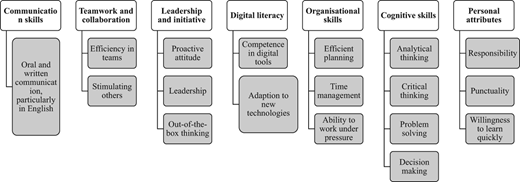
Employability skills based on literature review. Source: authors' own compilation
Employability skills based on literature review. Source: authors' own compilation
Despite these contributions, the CEE scholarly landscape remains fragmented, often restricted to single stakeholder perspectives or isolated disciplines. Crucially, few studies examine the structural relationships between these skills using multivariate approaches. This study addresses these limitations by providing a multidimensional investigation of employer expectations in Hungary across agriculture, business, engineering, and social sciences, thereby offering an integrated understanding of how diverse competency domains interact.
3. Methodology
The aim of this research is to identify key labour-market skills and the challenges graduates face, providing recommendations to better align higher education with employer expectations. As an integral component of the university's internal quality assurance system, this study utilises stakeholder feedback to ensure curriculum relevance. The data collection process was conducted in full compliance with the General Data Protection Regulation (GDPR) and local institutional ethical guidelines, guaranteeing participant anonymity and the ethical handling of institutional information.
To achieve these objectives, a cross-sectional census was conducted at a Hungarian university involving 1,556 bachelor students during their mandatory 12-week internships in the 2022/2023 academic year. As the population under consideration represents the same cohort of students who were enrolled in training programs during their last academic year, the sample in this case is complete, i.e. a census. The sample size was 1,556. The distribution of the sample is shown in Table 2.
Demographic composition of the sample (n = 1,556)
| Variable/Category | Percentage (%) |
|---|---|
| Form of training | |
| Full time | 70.9% |
| Part time | 26.8% |
| E-learning | 2.3% |
| Program level | |
| Higher-level vocational training | 11.5% |
| Training leading to a university degree (BA) | 62.3% |
| University-level programme (MA) | 26.2% |
| Discipline of science | |
| Engineering | 48.3% |
| Business studies | 27.2% |
| Agriculture | 10.7% |
| Social studies | 13.8% |
| Company's main area of activity | |
| Bank | 2.3% |
| Health | 1.1% |
| Economics | 13.5% |
| Public administration | 5.4% |
| Research and development | 4.0% |
| Engineering | 40.6% |
| Education | 5.2% |
| Other | 28.0% |
| Company’s type | |
| Micro | 12.1% |
| Small and medium | 30.4% |
| Large | 57.5% |
The study employed a dual-perspective survey design to capture a holistic view of graduate readiness. This targeted two distinct respondent groups: the students, who provided self-assessments of their proficiencies, and industry professionals, including HR specialists and managers, who evaluated graduates based on market expectations and observed performance. By comparing these perspectives, the research identifies potential competency gaps where student self-perceptions diverge from employer requirements, often referred to as the expectation-performance gap (Rainsbury et al., 2002).
The survey instrument was developed by the university, drawing on the competency dimensions established by the National Association of Colleges and Employers (NACE) (National Association of Colleges and Employers NACE, 2021). To avoid central tendency bias and ensure a definitive evaluation, a 6-point Likert-type scale was adopted (Chomeya, 2010), ranging from 1 (Poor/Lowest) to 6 (Excellent/Highest). A forced-choice Likert-type scale was used to eliminate central tendency bias (Chomeya, 2010). The measurement tools are shown in the Appendix.
The data were analysed using SPSS statistical program. Principal component analysis (PCA) was employed to identify the principal axes along which the competencies could be mapped and their interrelationships understood. Exploratory factor analysis (EFA) with Varimax rotation was conducted to extract the main competency categories, using the eigenvalue >1 criterion to determine the number of factors. The initial 15 variables included both hard skills (1) practical knowledge, (2) theoretical knowledge, (3) organisational and management knowledge, (4) language skills, and (5) IT skills, as well as soft skills (6) communication, (7) cooperation, (8) independence, (9) determination, (10) flexibility, (11) resilience, (12) critical thinking and problem-solving, (13) information processing, (14) self-reflection, and (15) creativity. The internal consistency of the variables was high (Cronbach's alpha = 0.892).
To examine differences in factor scores across fields of study, one-way ANOVA were conducted, providing statistical support for the conclusion that student evaluations varied significantly by discipline. This approach ensured that both the factor structure and cross-disciplinary comparisons were rigorously assessed.
4. Results
4.1 Skills required by companies
A review of the student evaluations reveals that the most important skills for companies are collaborative work, critical thinking, information processing and communication. In contrast, organisational and management skills, as well as language skills, were identified as the least important. This may be because these skills are now so basic that they do not require further emphasis (Figure 2).
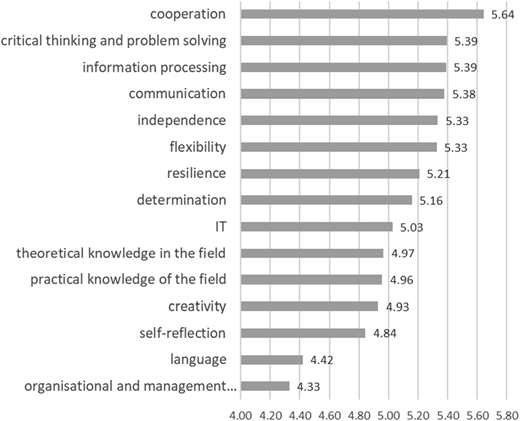
Importance of skills perceived by students (n = 1,556). Source: authors' own research
Importance of skills perceived by students (n = 1,556). Source: authors' own research
To identify the common content of the baseline variables and exploit the hypothesised relationship between them, factor analysis was conducted. Principal component analysis with Varimax rotation yielded four factors. The Kaiser-Meyer-Olkin (KMO) measure of sampling adequacy was 0.924, and the significance of the Bartlett test of sphericity was 0.000. The research identified four factors that influence companies' evaluations of students: agility, professional knowledge, interpersonal skills, and generic competence. The results showed that agility is the most important factor, accounting for 43.573% of the evaluation, while the other factors contribute 8.535%, 6.587%, and 5.614%, respectively. The study found significant differences in these factors among students from different fields of study, indicating that the field of study determines how students are evaluated.
The first factor accounts for 43.573% of the total variance. In this context, variables that are more likely to capture the individual's personal characteristics are grouped together. This factor included readiness to change, goal orientation, problem analysis and solution, creativity, self-reflection, flexibility, information processing and autonomy. Previous literature indicates that these competencies primarily belong to the category of participatory competencies (Deaconu et al., 2014). However, because soft skills are prevalent, this has been designated as agility. In each context, agility is defined by responsiveness, adaptability, and the capacity to operate effectively under varying conditions. The variables in the second factor correspond to the former, professional (specific) competences (Lisá et al., 2019), including theoretical and practical knowledge of the subject area, as well as organisational and management skills. This factor, designated as professional knowledge, accounts for 8.535% of the total variance. The third factor accounts for 6.587% of the total variance and encompasses interpersonal competence and communication skills. The fourth factor is entirely focused on generic competence and includes variables measuring language skills and IT skills. Based on the results, it can be concluded that material knowledge/generic competence accounts for 5.614% of the variance. Among the assessment variables, we identified factors that can improve the accuracy of student assessment (Table 3). As a result of the factor analysis, the variables of high importance to the companies were identified. In the ranking based on averages, the variables interpersonal competence (5.51) and agility (5.28) were the most important, followed by generic competence (5.11) and professional knowledge (4.92), and then by generic competence.
Results of the factor analysis (n = 1,556)
| Component 1 agility | Component 2 professional knowledge | Component 3 interpersonal competence | Component 4 generic competence | |
|---|---|---|---|---|
| Explained variance (%) | 43.573 | 8.535 | 6.587 | 5.614 |
| Variables and correlations | resilience (0.731) | practical knowledge in the field (0.858) | cooperation skills (0.797) | language skills (0.813) |
| determination (0.697) | theoretical knowledge of the field (0.805) | communication skills (0.792) | IT skills (0.681) | |
| critical thinking and problem solving (0.694) | organisational and management knowledge (0.566) | |||
| creativity (0.671) | ||||
| self-reflection (0.667) | ||||
| flexibility (0.637) | ||||
| information processing (0.610) | ||||
| independence (0.538) |
4.2 Challenges facing graduates in the labour market across disciplines
The results highlight key challenges that students encounter in the labour market, particularly in meeting employer expectations for various competencies. Across all fields of study, professional knowledge emerged as the most critical factor, followed by generic competence and social competencies. While agility was not identified as an area requiring further development, significant differences were observed between disciplines. Analysis of the original 15 competency variables revealed statistically significant differences (F statistics) in student performance across fields of study (Figure 3). Specifically, students in technical disciplines demonstrated below-average performance in several competencies, whereas students in other fields generally performed at or above the overall mean. These findings suggest that the challenges graduates face are not uniform and that discipline-specific gaps exist between the skills employers require and those students currently exhibit.
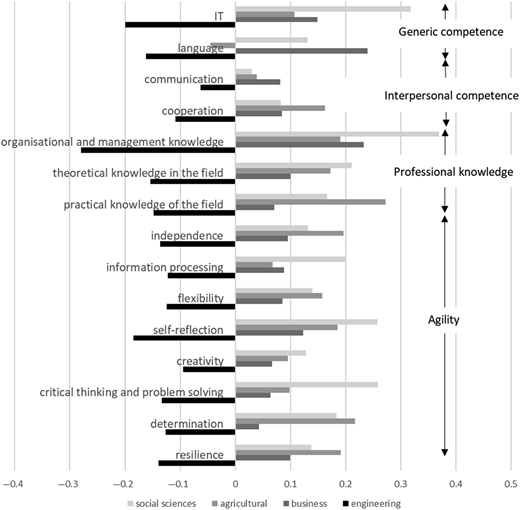
Importance of each skill perceived by companies based on the study program. Source: authors' own compilation
Importance of each skill perceived by companies based on the study program. Source: authors' own compilation
In each case, the discipline-based subsamples show notable discrepancies, with students from different disciplines performing differently on the tested skills. The areas of greatest concern are critical thinking and problem-solving (except for social science students, whose assessment was deemed less important), and information processing and independence. The areas requiring improvement are students' readiness in agriculture and business, except in business, where the focus is on cooperation. Communication is problematic across all disciplines, except engineering. Furthermore, the generic competence scores for social science students are particularly noteworthy.
The results were used to identify areas for improvement for the different sub-samples. For example, full-time students need strong development of professional skills, while social and interpersonal skills need to be developed in part-time or correspondence courses. Master's graduates have average subject knowledge and excellent professional knowledge, while Bachelor's graduates have below-average scores (Figure 4).
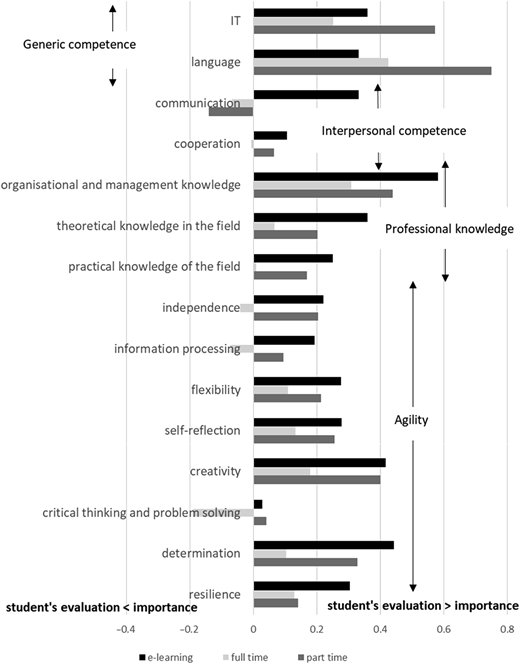
Importance of each skill perceived by companies based on the training program. Source: authors' Own compilation
Importance of each skill perceived by companies based on the training program. Source: authors' Own compilation
Upon examining the data by category, it was found that there was a statistically significant difference for 10 of the 15 variables examined regarding student ratings. It can be concluded that the relationships between language and communication, cooperation, flexibility, and resilience are independent, meaning that the differences in student ratings are not due to the variable under study. In contrast, for the remaining variables, a significant relationship is evident, indicating notable differences by category. In the present case, the issue is identified in the variable critical thinking and problem solving for day students, which is also evident to a lesser extent in the variables information processing and independence, and communication, for which the problem also arises for correspondence students. The discrepancy and disadvantage of full-time students in terms of the skills tested can be attributed to a lack of practice. For correspondence and distance learning students, it is evident that developing these skills can be facilitated by integrating them into their studies.
A comparison of student ratings by level of education reveals 9 significant differences. In the majority of cases, Master's students received higher marks, presumably because of their greater maturity. It is also important to highlight the high scores achieved by those in higher education, which may be explained in a further phase of the research. For those in initial education, areas for improvement are likely to relate to self-reflection and professional knowledge. These can be linked to the more practical nature of education and the acquisition of theoretical knowledge itself. A further analysis of the skills in relation to the aforementioned variables reveals that the differences also nuance the picture (Figure 5).
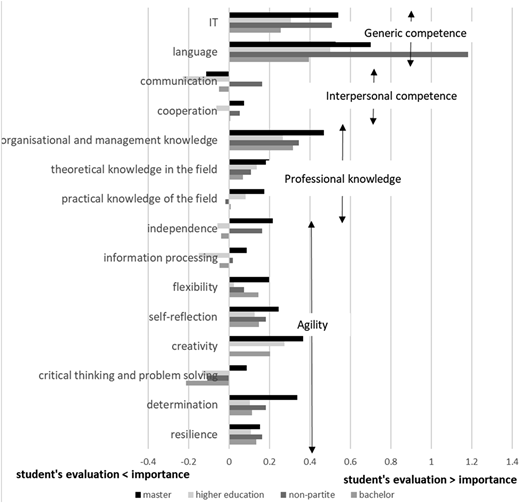
Importance of each skill perceived by students based on level of education. Source: authors' own compilation
Importance of each skill perceived by students based on level of education. Source: authors' own compilation
The ability to engage in critical thinking and problem-solving is also a challenge for students across all disciplines, except those pursuing a master's degree. Similarly, the capacity to process information, demonstrate independence, and collaborate effectively is a concern for many students. Another area in need of improvement is communication. A comparison of how student skills are assessed by company type reveals that micro-companies tend to rate their interns more highly, while large companies are more critical in the majority of cases.
The results for the relationship between importance and satisfaction by company size are shown in Figure 6. The capacity for critical thinking, problem solving and information processing is a challenge for all three types of firms. Nevertheless, communication is a more critical challenge for larger firms, including both small and medium-sized businesses, compared to micro companies.
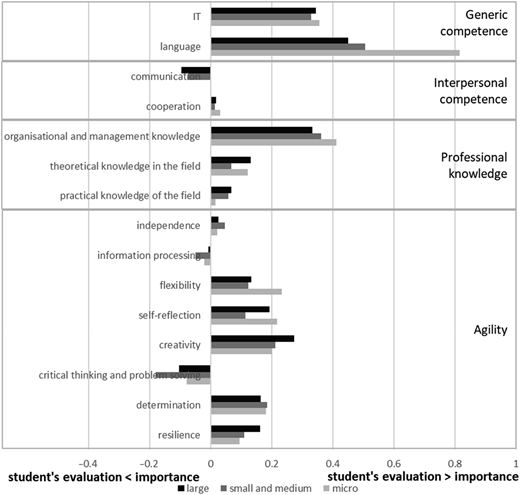
Importance of each skill perceived by students based on the size of the company. Source: authors' own compilation
Importance of each skill perceived by students based on the size of the company. Source: authors' own compilation
5. Discussion
The findings of the Hungarian university study broadly support the existing theoretical and empirical literature that emphasises the growing importance of soft skills in the labour market (Sujová et al., 2021; Suleman, 2018). However, the results also reveal important nuances, particularly regarding the relative weight of technical knowledge and the variability of skill assessment across disciplines. These findings suggest that, while the soft skills paradigm is well established, effective educational reform requires discipline-sensitive and context-specific approaches.
Consistent with Hernández-March et al. (2009), the present study highlights the centrality of critical thinking and communication as core generic competencies. Similarly, in line with Klibi and Oussii (2013), employers in this study placed greater emphasis on non-technical skills than students did. Students tended to prioritise technical and subject-specific knowledge, whereas employers valued interpersonal effectiveness, adaptability, and commitment. This divergence confirms earlier findings (Richardt et al., 2024) suggesting that students often overestimate their preparedness in areas that employers consider insufficiently developed.
At the same time, the study refines existing knowledge by demonstrating that although soft skills are prioritised in overall employer assessment, professional and subject knowledge remain critical threshold competencies. In other words, technical knowledge appears to function as a necessary but not sufficient condition for employability. While Cárdenas et al. (2019) identified solid technical knowledge as crucial, the Hungarian findings suggest that once a minimum professional standard is met, interpersonal skills and agility become decisive differentiators. This interpretation helps reconcile the apparent tension between the importance of professional knowledge and the dominance of soft skills in employer rankings.
The results also reinforce the importance of social competence, including responsibility and time management, as previously identified by Deaconu et al. (2014). In fact, social competence emerged as one of the strongest factors influencing employer evaluations. Similarly, the emphasis on commitment and willingness to assume additional responsibilities aligns with Lisá et al. (2019), underscoring that employers value proactive and responsible attitudes alongside competence.
From a structural perspective, principal component analysis identified four key dimensions shaping employer assessments: agility, subject knowledge, interpersonal skills, and generic skills. The ranking of these factors, with interpersonal skills and agility preceding generic skills and generic competence, indicates a shift toward adaptability-oriented models of employability. This reflects a labour market increasingly characterised by uncertainty, rapid technological change, and demands for organisational flexibility. In this context, resilience and agility become critical capabilities that extend beyond traditional competency frameworks.
The empirical results demonstrate that employers prioritise collaborative skills, critical thinking, information processing, and communication skills. Organisational, management, and language skills were rated as less decisive, possibly because they are perceived as baseline or expected competencies rather than distinguishing factors. Importantly, the analysis suggests that interpersonal skills and agility function as primary differentiators in employer assessment. These competencies enable graduates not only to perform tasks but also to integrate effectively into organisational environments. Thus, employability appears to be less about isolated technical proficiency and more about the capacity to apply knowledge collaboratively and adaptively (RQ1).
The findings reveal that while flexibility does not appear to be an immediate concern, professional knowledge, generic competence, and social skills are critical evaluation domains. Significant variability across fields of study suggests that employability challenges are not uniform. Students in technical disciplines tended to perform below average in several assessed areas, whereas students in other fields showed comparatively stronger results. These disciplinary discrepancies indicate that a one-size-fits-all educational reform strategy would be insufficient. Instead, targeted interventions tailored to the specific strengths and weaknesses of each academic field are necessary. In particular, enhanced development of interpersonal and communication competencies may be especially beneficial in engineering disciplines (RQ2).
The results highlight several priority areas for alignment between universities and employers. First, full-time students would benefit from strengthened professional skills development, while part-time and distance learners require enhanced support in social and interpersonal competencies. Second, the gap between Bachelor's and Master's graduates suggests the need for earlier and more systematic integration of competency-based training in undergraduate programs. Critical thinking, problem-solving, and information processing were identified as recurring areas of concern across sub-samples. The statistically significant differences in employer ratings across these competencies further justify the adoption of tailored training approaches rather than uniform curricular adjustments. Moreover, differences in ratings by company size, with micro-companies generally providing higher evaluations, suggest that organisational context influences skill expectations, further reinforcing the need for flexible alignment strategies.
The main limitation of this research lies in the measurement instrument, as the questionnaire developed within the university's quality management system has not undergone formal validation. Moreover, competencies were assessed according to a uniform framework across disciplines, which may not fully capture subject-specific variations. Future research should therefore focus on developing validated, discipline-sensitive measurement tools, ideally through collaboration between academic and industry experts. Given that international research highlights substantial variation in competency expectations across fields, constructing faculty-specific competency frameworks would represent a valuable next step.
5.1 Implications
The results highlight several priority areas for alignment between universities and employers. First, full-time students would benefit from strengthened professional skills development, while part-time and distance learners require enhanced support in social and interpersonal competencies. Second, the gap between Bachelor's and Master's graduates suggests the need for earlier and more systematic integration of competency-based training in undergraduate programs. Critical thinking, problem-solving, and information processing were identified as recurring areas of concern across sub-samples. The statistically significant differences in employer ratings across these competencies further justify the adoption of tailored training approaches rather than uniform curricular adjustments. Moreover, differences in ratings by company size, with micro-companies generally providing higher evaluations, suggest that organisational context influences skill expectations, further reinforcing the need for flexible alignment strategies.
The findings underscore the necessity of closer collaboration between higher education institutions and employers. Establishing a shared competency framework and a common language for curriculum content and labour-market expectations could reduce the observed mismatch. Competency-based education, experiential learning opportunities, and structured industry partnerships represent practical mechanisms for achieving this alignment.
The study contributes to the employability literature by refining the understanding of how soft and technical skills interact. Rather than positioning them as competing domains, the findings suggest a hierarchical structure: technical knowledge serves as a foundational requirement, while interpersonal skills and agility determine differentiation and career advancement potential.
In practice, the results indicate that enhancing employability requires not merely adding soft skills modules but embedding systematic cognitive and interpersonal skill development across curricula. Methodological innovation, interdisciplinary collaboration, and work-integrated learning may be particularly effective in this regard.
6. Conclusions
The findings indicate that while technical and subject-specific knowledge remain foundational, interpersonal and socio-emotional competencies increasingly function as decisive differentiators in the labour market. Employers appear to value communication, problem-solving, adaptability, creativity, and responsibility not as complementary attributes but as central determinants of employability. Technical knowledge alone is insufficient without the capacity to apply it effectively in collaborative and dynamic organisational environments. These results suggest that higher education should move beyond knowledge transmission toward a more systematic integration of competency-based education.
While focused on Hungary, these findings reflect global trends driven by the Fourth Industrial Revolution and the integration of national economies into global value chains. As AI and automation commoditize technical tasks, socio-emotional competencies, such as adaptability, creativity, and collaborative problem-solving have emerged as a universal ‘new currency' of employability. Consequently, the shift toward competency-based education in Hungary mirrors a broader international necessity to enhance graduate mobility and competitiveness in a rapidly evolving, standardised global labour market.
Emphasis should be placed on fostering analytical thinking, resilience, effective communication, and ethical accountability across all disciplines. Closer cooperation between universities and employers, particularly in curriculum design, experiential learning, and assessment, is essential to reduce the persistent mismatch between graduate capabilities and labour-market expectations. At the institutional level, embedding soft skill development throughout curricula, strengthening career services, and promoting lifelong learning pathways can further enhance graduate preparedness. Moreover, given that higher education institutions operate in an increasingly globalised environment, these measures help ensure that graduates are not only competitive within Hungary but also meet international standards and expectations, enhancing the global standing and competitiveness of their institutions4.
The authors would like to thank the university for providing the researcher with the results of the business assessments.
Appendix
The questionnaire
| Competency | Student question (Self-assessment) | Employer question (Graduate evaluation) |
|---|---|---|
| Practical knowledge | How would you rate your ability to apply field-specific knowledge in practice? | How would you rate the student's ability to apply field-specific knowledge in practice? |
| Theoretical knowledge | How would you rate your command of the theoretical foundations of your field? | How would you rate the student's command of the theoretical foundations of their field? |
| Org. and management | How proficient are you in organisational and management processes? | How proficient is the student in organisational and management processes? |
| Language skills | How would you rate your professional communication skills in a foreign language? | How would you rate the student's professional communication in a foreign language? |
| IT skills | How would you rate your proficiency in using industry-specific digital tools? | How would you rate the student's proficiency in using industry-specific digital tools? |
| Communication | How effective are your verbal and written professional communication skills? | How effective are the students' verbal and written professional communication skills? |
| Cooperation | How effectively can you collaborate within a professional team? | How effectively does the student collaborate within a professional team? |
| Independence | How capable are you of performing tasks autonomously without supervision? | How capable is the student of performing tasks autonomously without supervision? |
| Determination | How would you rate your persistence and goal-orientation in your work? | How would you rate the student's persistence and goal-orientation in their work? |
| Flexibility | How easily can you adapt to changing tasks or work environments? | How easily does the student adapt to changing tasks or work environments? |
| Resilience | How effectively do you maintain performance under high-pressure situations? | How effectively does the student maintain performance under high-pressure situations? |
| Critical thinking | How would you rate your analytical and problem-solving abilities? | How would you rate the student's analytical and problem-solving abilities? |
| Info processing | How proficient are you at selecting and organising relevant data? | How proficient is the student at selecting and organising relevant data? |
| Self-reflection | How capable are you of evaluating and learning from your own performance? | How capable is the student of evaluating and learning from their own performance? |
| Creativity | How effectively do you apply innovative or original ideas to your tasks? | How effectively does the student apply innovative or original ideas to their tasks? |
Note(s): Measurement: 6-point Likert scale from 1 (Poor/Lowest) to 6 (Excellent/Highest)

