The purpose of this paper is to investigate whether guests’ tipping motivations (i.e. server quality, social norm and food quality) and demographic characteristics (i.e. gender, age and income) influence loyalty to the server in a restaurant.
Based on a national online survey consumer panel comprised of 468 participants, the authors utilized decision tree using R statistical software. Predictor variables were tipping motivations and demographic characteristics (age, gender and income). Target variable was loyalty to the server.
The findings suggest that social norm, food quality and income influence customers’ loyalty toward the same server on future visits. Social norm turned out to be the strongest predictor. If consumers did not have high social norm on tipping, their loyalty toward a particular server was affected by the combination of determinants such as server quality, social norm, income and food quality.
Future research can identify or develop scales of tipping motivations with stronger reliabilities in the context of restaurants. Future research can also explore other demographic differences (e.g. ethnicity and sexual orientation) in tipping motivations and server loyalty.
Servers are indeed the primary contact point and they are in the most influential position with consumers. Overall, results of this study provide an interesting insight in that restaurant guests’ experience can be ruined by bad quality of food or can be mitigated by server quality. Thus, this research highlights a step-by-step process as to the actions that a server may perform and manage in order to enhance server loyalty.
Loyalty has been examined in the context of products, brands or service providers. This study focuses on loyalty toward a specific server, because the consideration of server–guest relationship provides both a compelling and timely area of study in that restaurants continue to look for unique ways to drive server–guest rapport and customer loyalty.
Introduction
The restaurant tipping literature has found that the service restaurant guests receive is the dominant reason guests tip their servers (Lynn and Sturman, 2010; Whaley et al., 2014; Wilson, 2019). Further, customer loyalty has been approached to a greater extent at the level of a firm rather than that of a particular person within the firm (Lee et al., 2009; Moore et al., 2005). While many companies use artificial intelligence increasingly, the server–guest relationship as a human factor remains central to a restaurant’s success. Restaurant service is labor-intensive and requires servers to display such human qualities as warmth or genuineness, which machines cannot duplicate. As fewer consumers patronize restaurants, the key to restaurant success is the server who functions as the business’ frontline marketer (Hwang et al., 2013). In fact, Mattila (2001) acknowledged that servers who build rapport with their guests may promote guest satisfaction and restaurant loyalty. However, the tipping literature has not examined which factors predict loyalty to a specific server.
In addition, research has suggested that restaurant tipping is a practice that largely depends on consumers who adhere to social norms (Azar, 2010), and many consumers tip 15–25 percent of the restaurant check regardless of server quality (Whaley et al., 2014). While it is a social custom, tipping may be more than remuneration for the service received; it is also a reward for the relationship that is formed between the server and the restaurant’s guests. Naturally, servers must make guests feel comfortable throughout the dining experience (Kang and Hyun, 2012). In the restaurant marketing literature, researchers have underscored the long-term relationship with the guests (Kim et al., 2001), because marketing costs for new restaurant guests are much higher than those for existing guests (Reichheld and Sasser, 1990).
Given that the employee turnover rate is very high in the restaurant industry, it is more critical than ever for restaurant owners and managers to find ways to reduce consumers’ tendency to switch restaurants (Ryu and Han, 2010). For example, if a restaurant server provides consistently high service quality to guests, s/he can motivate guests to return, thereby increasing customer retention and long-term loyalty. Furthermore, it is imperative for restaurateurs to cultivate customer loyalty, not only to the restaurant brand, but also to the servers who are the key in providing a level of relationship with the guest that the owners cannot control directly. Building rapport between the server and the guest can increase job satisfaction and ultimately reduce the turnover rate among the servers in the restaurant. Thus, consideration of the server–guest relationship provides both a compelling and timely area of study, in that restaurants continue to look for unique ways to increase server–guest rapport and customer loyalty.
Therefore, findings on the extent to which tipping motivations establish loyalty to the restaurant server can advance the tipping literature. Because loyalty to specific restaurants is declining, restaurants should look for competitive ways to reduce customers’ tendency to switch to other restaurants and lower customer acquisition costs thereby. Thus, this study posited that servers provide a logical asset to a restaurant as frontline ambassadors. Servers can influence the guests’ willingness to return in the future and recommend the servers to others. Moreover, researchers have found that loyal restaurant customers spend more money (Chen et al., 2008), and that guests who patronize a restaurant regularly do not switch establishments as often as infrequent users (Hyun, 2010).
Although researchers have identified restaurant service received (Bodvarsson and Gibson, 1997; Lynn and McCall, 2000) and servers’ behaviors (e.g. warmth, friendliness, touching and empathy: Jewell, 2008; Whaley et al., 2014) as tipping motivations, these factors are limited to loyalty to a restaurant rather than to a server. This study attempted to address this research gap. In addition, loyalty to a particular server or intention to revisit a restaurant with the same server in the future may depend on demographical characteristics such as a guest’s gender, age and income bracket. However, demographic characteristics’ influence in building the restaurant server–guest relationship has not been explored in previous studies. To this end, this study investigates whether guests’ tipping motivations (i.e. server and food quality and adherence to social norms) and demographic characteristics (i.e. gender, age and income) influence loyalty to the server. To accomplish this goal, the study employed a decision tree (DT) model.
Literature review
Server loyalty
In the service setting, production and consumption are simultaneous because the service provider cannot separate himself or herself from the exchange (Parasuraman et al., 1985). In fact, consumers form a relationship not only with a particular brand and its offerings (Lee et al., 2009; Moore et al., 2005), but also with the service personnel who represent the brand (Kim et al., 2019). According to Parasuraman et al. (1988), the way personnel provide the service is more critical than the kind of service they provide. The interactive bond between the service provider and the guest constitutes the relationship building construct, and leads to long-term loyalty (Brocato et al., 2015). Researchers have argued that influential causes of relationship building depend upon both humanistic and non-humanistic characteristics (Jin et al., 2017; Keh et al., 2013). The humanistic characteristics of building a relationship in a restaurant setting include attentiveness or compassion on the part of the service staff, while non-humanistic attributes include restaurants atmosphere, price and food quality (Jin et al., 2017).
When an individual displays gratitude in appreciation for the service received, it motivates the server to engage in a reciprocal, positive response (Fehr and Falk, 2002; Teng and Chang, 2013). The feeling of gratitude plays an important role in the restaurant server–guest relationship as many researchers have explored the extent to which emotion causes restaurant guests to tip (Lynn and McCall, 2000). Therefore, it can be posited that the factors that motivate guests’ tipping behavior are related to their level of gratitude and ultimately, their loyalty to a specific server.
Some consumers tip even when they receive poor service, reflecting their compliance with a pre-established social norm (Azar, 2004; Whaley et al., 2014), and thus, leave a tip, often as a thoughtless or pre-conditioned response. However, positive interaction, also referred to as rapport, provides a crucial consideration for inquiry if consumers want to return to the same server in the future. Rapport-building behaviors are essential in the retail business environment, as rapport enhances the relationship and leads to a high level of customer satisfaction and loyalty (Gremler and Gwinner, 2008). Indeed, restaurants’ long-term success depends on employees’ rapport with their customers (Ewing et al., 2001).
Servers use a variety of behaviors to help them establish a quick and decisive connection between themselves and the guests (Gremler and Gwinner, 2008). Those behaviors include attention, imitation, courtesy and finding common ground. Servers are expected to act as ambassadors on the restaurant’s behalf while developing personal relationships and connections with the guests (Kim et al., 2011). Ultimately, building relationships through rapport affects loyalty to a server, which is the key to creating a lasting relationship between the guest and the restaurant. Indeed, how much a guest tips a server can reflect several tipping motivations. Therefore, we believe that this relation between tipping motivations and the amount tipped can contribute to determining the level of the guest’s loyalty to the server.
Tipping motivations
By reviewing the literature, we identified tipping motivations as adherence to social norms, and server and food quality. The way each motivation predicts loyalty to a particular server is explained below.
Social norm
Social norms are individuals’ socially expected patterns of behavior subject to person-to-person or person-to-group interactions (Cialdini and Trost, 1998), and dictate the way in which they should behave in certain circumstances (Earley and Ang, 2003). For some, the act of tipping represents that of a moral economy, meaning that consumers tip because of concern or to do the right thing (Mulinari, 2016). The practice of tipping is a behavior expected of restaurant guests and many servers shun consumers who do not tip the amount appropriate for the bill. Tipping, in essence, is the right thing to do in a restaurant setting.
More than four decades ago, Pepitone (1976) reported that social norms become institutionalized when a significant portion of a group acts in accordance with the norm. Norms include not only rules that indicate the importance of the way an individual is to act (e.g. tipping restaurant servers) but also the way the individual is not to act (e.g. “stiffing” or not tipping restaurant servers). Clearly, restaurant tipping serves as an example of a socially driven practice, as restaurant guests have engaged in the behavior for more than a century.
Cultural differences may also exist in the social norm of tipping. The findings of Azar’s (2010) comparative study of consumer tipping behavior in the USA and Israel suggested that the two countries were similar in the number of respondents who tipped because of a feeling of gratitude to the server (approximately 68 percent of the respondents from each). However, the responses to the question about whether they tipped to conform with the social norm varied widely: almost 88 percent of respondents from the USA and approximately 40 percent from Israel indicated that they tipped to conform.
Research has also revealed that many individuals tip to acquire social approval or improve self-image (Lynn, 2009; Whaley et al., 2014). A guest’s enhanced self-image may lead to an affinity for the server, because of the positive server–guest interaction. On the other hand, failing to conform to others’ expectations may elicit negative emotions and strain the rapport (Pret and Carter, 2017). In this situation, the guest often does not complain, but simply refuses to return to the same restaurant or the same server (Soscia, 2007). Therefore, it can be assumed that the ongoing compliance with a social norm (i.e. tipping) can influence the level of rapport between individuals (i.e. guest and server). This rapport leads to a purely reinforced behavior that is valued and rewarded. For example, guests who are known as good tippers will receive a higher priority from restaurant servers and, in many instances, better service and the positive feedback attributable to the server–guest rapport may ultimately lead to loyalty to a specific server. The literature reveals that social norms are a major tipping motivation in the restaurant context; however, researchers have not examined whether they influence customers’ further loyalty to a specific server. Consequently, additional investigation is needed to determine whether, and to what extent, compliance with the social norm of tipping affects a guest’s intention to return to the same server in the future.
Server quality
Server quality depends on the positive interaction between the customer and the server, or positive personal connections (Ford et al., 2012). According to Bodvarsson and Gibson (1997), restaurant guests are sensitive to service quality, specifically, the server attributes of attentiveness, friendliness and promptness. In addition, they found that restaurant tips were more sensitive to poor service quality than good service quality. Lynn and Sturman (2010) also found that service contributed significantly the tip’s amount. For each one point increase in the participant’s rating on a five-point scale of service quality, a server’s tip increased two percentage points. This indicates that respondents left a larger tip when they received better service. These findings imply that server quality is a critical factor that influences guests’ tipping behavior and ultimately, their satisfaction with a restaurant or server.
The literature suggests that server quality is related closely to establishing rapport or building a relationship. Many researchers have found that establishing rapport is a result of a wide range of server behaviors such as friendliness (Lynn, 2001; Whaley et al., 2014), timeliness (Lynn, 2001; Whaley et al., 2014), empathy (Whaley et al., 2014), the light touch on the hand or shoulder (Jewell, 2008; Whaley et al., 2014), standing or squatting at the tableside (Lynn and Mynier, 1993; Whaley et al., 2014) and direct/indirect eye contact (Whaley et al., 2014). Because these behaviors are human-oriented intangible qualities that foster positive interpersonal relationships, they contribute to establishing rapport between a guest and server.
Food quality
Food is the core component of the restaurant experience (Hansen et al., 2005). Researchers have argued that high quality of food both entices and retains guests because it makes them feel appreciated and pleased, while food of marginal or lower quality causes guests to have negative experiences (Peri, 2006). Given food’s significance in the restaurant experience, its quality predicts customer value (Whaley et al., 2019), restaurant image (Ryu et al., 2012) and patronage (Hansen et al., 2005).
However, reports of the relation between food quality and tipping have been somewhat contradictory. For example, some researchers found that the assessment of food quality influences the perception of a server’s quality (Peri, 2006) and tipping (Azar, 2007), while others have concluded that the amount of the tip is related more strongly to server quality than food quality (Mok and Hansen, 1999). Nonetheless, food quality represents a leading indicator of the guest’s assessment of the quality of the restaurant experience overall, because food is a primary motive in restaurant selection. As a result, food quality may influence the amount of the tip a guest decides to leave, and thus affect the extent to which s/he is willing to return to the restaurant and request the same server on future visits.
Demographic characteristics
In addition to tipping motivations, demographic considerations need to be included to understand the server–guest relationship. Although limited research has been conducted on the association between guests’ demographic profiles and their loyalty to a server, previous studies have suggested that consumers respond differently to situations based on their age, gender and income.
Age
Age is an essential factor to consider when investigating restaurant tipping behavior. However, this factor may depend upon the individual’s life cycle (Slama and Tashchian, 1985). For example, younger and senior restaurant guests may choose the amount they will spend on food and tips based on discretionary income. These individuals may be on a limited or fixed income and thus weigh the amount of the tip they leave cautiously according to the level of service they received.
Further research has demonstrated that Millennials exhibit a strong sense of social justice, in which they believe that everyone should be treated fairly and equitably (Fox, 2012). According to Lynn (2017), Millennials dislike the social custom of tipping, as many of them like cheaper, communal and on-the-go kinds of meal experiences (Carmen, 2018). Other researchers have argued that younger consumers are less loyal to a brand or company and more difficult to retain for repeat purchases than are older consumers (Bush et al., 2004; Lazarevic, 2012). Accordingly, younger consumers switch brands more frequently than do older consumers.
Parment (2013) compared Generation Y and Baby Boomer consumers’ shopping behavior and buyer involvement. Baby Boomers start the purchase process with a retailer they trust, while Generation Y consumers begin the purchase process by choosing a product. This implies that older consumers are more likely to become loyal when they establish trust with a server than are younger consumers.
Gender
With respect to gender, research has demonstrated that women are more interdependent than men, strive to be connected to others, focus on maintaining relationships and wish to foster harmonious relations with others (Cross and Madson, 1997; Ndubisi, 2006). However, Melnyk et al. (2009) found that gender differences were context specific. Female consumers tend to be more loyal to individuals (e.g. individual service providers), while male consumers are more loyal to a group of people. The authors claimed that marketers must understand gender differences in loyalty to develop appropriate selling approaches and marketing programs for each gender. Because the restaurant server–guest relationship is an emotional and/or personal relationship, it may be presumed that female consumers are more likely to return to the same server in their future visits.
Income
Several studies have suggested that there is a link between income and loyalty (Homburg and Giering, 2001; Kasper, 1988), although some have found no associations between the two variables (East et al., 1995). For instance, Kasper (1988) found that less educated and middle-income consumers were more loyal than their counterparts. In Homburg and Giering’s (2001) study, product satisfaction was less important to people with high income, because the financial risk associated with purchasing a poor-quality product is lower for these consumers. Because income level is related closely to education level, it can be assumed that high-income consumers use more information cues before making a decision and feel more comfortable dealing with new information, while low-income consumers rely more on fewer information cues (Capon and Burke, 1980; Homburg and Giering, 2001). This implies that low-income consumers may be more willing to return to the same server rather than seek alternatives. Further, Alrubaiee and Al-Nazer (2010) found that income was associated inversely both with relationship marketing orientation (i.e. bonding, trust, communications and satisfaction) and customer loyalty, in that marketing orientation’s effect on loyalty was stronger among lower- than higher-income customers.
MacManus (2018) also stated that individuals with high incomes tend to be more conservative in their spending habits than those with lower incomes, who tend to be more liberal in their spending habits. This argument implies that low-income guests may tip a higher percentage of their bill compared to high-income guests. Although none of the findings described above address the relation between income and server loyalty directly, they suggest that lower-income consumers are more likely to be loyal to the same server than are those with higher incomes.
Research objectives
Based on the literature review on tipping motivations and demographic characteristics associated with server loyalty, this study had the following two objectives:
to determine the extent to which tipping motivations such as server quality, social norms and food quality predict loyalty to the restaurant server; and
to determine the extent to which demographic characteristics such as gender, age and income predict loyalty to the restaurant server.
Methods
Measures
Based on the literature review, a DT model was created with three tipping motivations (server quality, food quality and compliance with the social norm) and three demographic variables (income, age and gender) as predictors and loyalty to the server as the target variable. The measures of server and food quality and social norms were derived from Whaley (2011) and Whaley et al. (2014) who based their scale development on previous studies (Lynn, 2009; Lynn and Sturman, 2010).
Because research has shown that loyalty is associated closely with the intention to use the same product/firm/server and recommend it/him/her to others (Brady et al., 2005; Harris and Goode, 2004; Yim et al., 2008), loyalty to the server, the target variable, was measured by behavioral intentions to use the same server (BISS). BISS was operationalized as the mean of BISS 1 (asking for the same server on future visits) and BISS 2 (recommending the server to friends and family on future visits). A forced-choice questionnaire using a four-point Likert-type scale was used to reduce social desirability bias (Nederhof, 1985).
Sample and data collection
The questionnaire was developed with Qualtrics and was distributed to online consumer panel recruited via eRewards, an online market research firm. The survey contained questions on respondents’ current tipping practices (e.g. “Do you tip when dining out?” and “How much do you tip when dining out?”), tipping motivations, BISS (loyalty to the server) and demographic information. From a total of 600 surveys collected, the researchers used 468 respondents in the analysis after excluding 132 that were incomplete. The respondents’ demographic profiles are provided in Table I. The majority of the respondents (98.1 percent) tipped when dining out. The largest number of respondents tipped 15 percent (36.5 percent), followed by 20 percent (32.2 percent) and 10 percent (12.1 percent).
Analysis
To accomplish the research objectives, a DT model was designed using R statistical software. A DT model is a useful tool to achieve our research objectives because it can use both continuous and categorical variables simultaneously, in which classification and regression trees use a recursive partitioning algorithm for multivariate analysis (Hastie et al., 2009). The target variable, BISS, was split into a high group (⩾3) and low group (<3). A sampling strategy of 70/15/15 was employed by assigning 70 percent of the sample to the training set (n=327), 15 percent to the validation set (n=70) and 15 percent to the testing set (n=70: Song and Kim, 2016). We built the DT model first with the training set, then evaluated the predictive performance with the validation set. Finally, we tested whether the DT model predicted BISS using the testing set for cross-validation. Furthermore, the variables’ importance was computed by a random forest (RF) algorithm to confirm informative predictors in the DT model.
Results
Before running the DT model with the training set (n=327), we performed an exploratory factor analysis to determine the factors’ internal consistency with Cronbach’s α. Four factors (server quality, adherence to social norm, food quality and BISS) were identified that had Cronbach’s αs above 0.70. However, two items were deleted because of low factor loadings (<0.40): “I feel obligated to tip even when service is bad” (server quality) and “When server establishes a personal connection, it influences my tipping” (adherence to social norm). Next, a confirmatory factor analysis was performed to validate the measurement model and assess the construct validities (Table II). Convergent validity was supported by relatively high-standardized factor loadings (p<0.001), and satisfactory composite reliabilities ranging 0.734–0.801, above the benchmark of 0.7 (Nunnally and Bernstein, 1994). Discriminant validity was confirmed, as the correlation coefficients of the constructs were below the threshold of 0.85 (Kline, 2011).
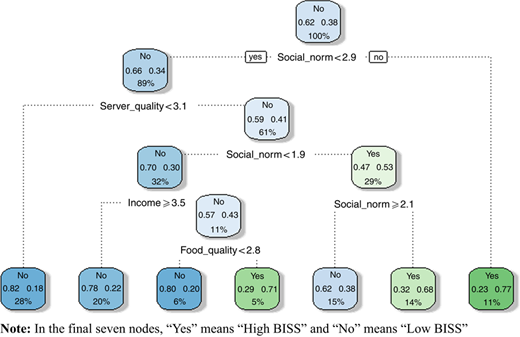
With BISS as the target variable, Figure 1 shows three high BISS groups (green) and four low BISS groups (blue) in the final nodes. The DT model revealed four influential variables according to the rank of their importance beginning from the root node: social norm, server quality, income and food quality. As shown in Figure 1, adherence to the social norm at the root node was the most important predictor because the data set was divided into groups by social norm first. Server quality as a second predictor then explained the remaining six groups (89 percent) under the pre-condition of adherence to social norm below 2.9.
The first high BISS group (11 percent of participants) was characterized only by its strong adherence to the social norm in tipping (social norm ⩾2.9) with a high node purity (prob=0.77). The other two high BISS groups were established when the second predictor, server quality, was high (server quality ⩾3.1). Second high BISS group (14 percent of participants) was characterized by moderate adherence to the social norm (1.9⩽social norm<2.1) under high server quality, and the third high BISS group (5 percent of participants) by lower levels of adherence to the social norm (social norm<1.9), while income level (income<3.5, approximately $39,000) was a factor when they rated food quality as high (food quality⩾2.8). All low BISS groups were identified first when their adherence to the social norm was low (social norm<2.9). Under this condition, the first low BISS group (28 percent of participants) was identified when server quality was not high (server quality<3.1) at a high node purity (prob=0.82). On the other hand, the other three low BISS groups showed more complex decision making by adherence to the social norm (15 percent, 2.1⩽social norm<2.9), by adherence to the social norm and income (20 percent, social norm<1.9, income ⩾3.5 (=approximately $39,000)), and by adherence to the social norm, income and food quality (6 percent, social norm<1.9, income<3.5, food quality<2.8).
Thus, the most important predictor of server loyalty (measured by BISS) was adherence to the social norm as the tipping motivation. When restaurant patrons adhered strongly to the social norm for tipping (social norm ⩾2.9), they were likely to request the same server on future visits and recommend the server to friends and family on future visits regardless of other factors related to tipping (e.g. server quality, food quality, age, gender and income). However, when they did not adhere strongly to the social norm (<2.9), other factors such as server quality, income and food quality influenced BISS. Specifically, when server quality was good (⩾3.1), people who adhered moderately to the social norm (2.1<social norm<2.9) were likely to ask for or recommend the server for future visits. Although the number was low (5 percent), those who tended to adhere to the social norm little (<1.9) were likely to develop high server loyalty if they evaluated the food quality (⩾2.8) highly under the condition of high server quality.
To reconfirm our influential predictors, we also measured the variables’ importance using RF. RF was employed with three parameters: mtry (=3), which indicates the number of variables to test at each split; nodesize (=1), which refers to the minimum size of terminal nodes; and ntree (=1,000), which indicates the number of trees to run (Kuhn and Johnson, 2013). The variables’ importance in RF was measured by the mean decrease accuracy (MDA). According to the MDA estimates for each variable, Table III illustrates the informative predictors of server loyalty based on the order of adherence to the social norm, server quality, food quality, income, age and gender. The results corresponded with those of the DT model, showing the relative importance of adherence to the social norm and server quality as tipping motivations.
Table IV shows the evaluation and comparison of our DT model. A confusion matrix and AUC, “the area under the receiver operating characteristic (ROC) curve,” were used to evaluate the model’s predictive performance with the cross-validation and testing data sets (Fielding and Bell, 1997). The ROC curve illustrates the true positive rate against the false positive rate (Fielding and Bell, 1997). The AUC measures the expected proportion that a positive instance drawn randomly will rank higher than a negative one drawn randomly (Fawcett, 2005). The result of the confusion matrix and AUC analyses on the validation set indicated an accuracy of 0.743, a precision rate of 0.579 and an AUC of 0.707, which demonstrates that the model had satisfactory prediction accuracy with a low misclassification rate. The results on the testing set showed an overall accuracy of 0.814, a precision rate of 0.714 and an AUC of 0.841. Thus, the DT model in this study yielded discriminant prediction results that both cross-validation and testing sets confirmed consistently.
Discussion and implications
Restaurant guests engage in tipping now more than ever as researchers continue to cite its growing economic impact (Wilson, 2019). As tipping has served as a unique financial axis of the restaurant industry, this study attempted to advance the understanding of tipping behavior, including a new association between tipping motivations and server loyalty.
This study investigated the extent to which server quality, adherence to the social norm, food quality and the demographic characteristics of age, gender and income predict a restaurant guest’s loyalty to the same server. The findings of the study revealed that the compliance with a social norm, as the primary driver of tipping motivations, influenced the guests’ decision to select the same server on future visits. Specifically, the results demonstrated that people who adhered strongly to the social norm in tipping are likely to ask for, and recommend the same server regardless of their income, age, gender, and a restaurant’s server and food quality. This first high BISS group consisted of approximately 10 percent of the population. This finding indicates that even after guests assess the server according to his or her delivery of service, social norms play a primary role in the relationship between the server and the guest. Because consumers are emotion driven, they are willing to pay for quality and enjoyable experiences. Prior studies show that some guests who do not tip sufficiently may experience feelings of guilt, because they do not conform to the social norm (Azar, 2010; Whaley et al., 2014). This result reinforces the role of social norm in forming rapport between the consumer and the server.
Other high BISS consumers did not adhere only to the social norm for tipping. Their loyalty to a particular server was affected by the combination of such determinants as server and food quality, social norm and income. In fact, while the literature has found that server quality explains tipping behavior largely (Lynn and Sturman, 2010; Whaley et al., 2014), our results also found that it was an important predictor of server loyalty. Servers should understand that many guests desire a personal interaction with them that leads them to develop loyalty to the servers. Thus, consumers who adhere only moderately to the social norm establish their loyalty to the server based on high server quality. Furthermore, consumers who adhere little to the social norm establish their BISS with the additional effects of their income and food quality under the condition of good service quality.
It is important to note a difference between two high BISS groups. The high BISS group with moderate social norm was influenced by server quality, whereas the high BISS group with low social norm was influenced by their income and food quality. In addition, among three demographic variables, income was the only important predictor of server loyalty. More interestingly, the consumer group with relatively lower income (<$39,000) had the tendency to request the same server, implying that low-income consumers are more likely to value a long-term relationship with the server than their counterpart. Furthermore, this study’s results provide another interesting insight, in that while poor food quality can ruin restaurant guests’ experience, server quality can mitigate the effect. Servers should maximize their rapport during the time with their guests and in doing so they must be strategic in their service delivery by recognizing which guests need more or less attention during the dining experience. Therefore, restauranteurs should consider the importance of server quality in influencing long-term loyalty to the same server, and ultimately to the restaurant. Because other important variables such as social norm and income were customer-intrinsic factors, server quality seems to be the factor that restauranteurs can control to enhance the level of relationship with the guest.
This research highlights a step-by-step process with respect to the actions that a server may perform and manage to enhance server loyalty. From a practical perspective, the question now becomes what kind of server do guests want? From the results of this study, servers should understand that promptness, timeliness and service quality tend to influence the guests’ willingness to visit them in the future or recommend them to others. On the other hand, some may ask that if tipping indeed is a social norm, what characteristics of the server–guest relationship likely would influence loyalty to a server? There is a definite need for further investigation into the behaviors that will influence those who have a preference for the same server beyond a normative behavior. With respect to food quality, helping servers realize that guests tip differently based on food quality would reduce a significant amount of emotional investment and, in turn, may help reduce their negative feelings toward guests who do not tip because food quality influences BISS under a certain condition (i.e. people who adhere little to the social norm and have incomes less than $39,000). While food quality is not under restaurant servers’ immediate control, delivering quality food and timeliness are crucial tasks for the restaurant. Nonetheless, servers play a key role in providing restaurant guests a quality experience. It is interesting to note that the DT analysis assigned more respondents to low BISS than high BISS. Clearly, restaurant managers should consider these findings, revisit their management and train their employees to provide guests with positive experiences, which ultimately will increase their loyalty to a particular server. Building rapport with guests would increase repeat customers, which, in turn, would enhance the servers’ job satisfaction and ultimately reduce the turnover rate.
Limitations and future research
While every effort was made to minimize shortcomings of this study, it does have limitations. Although the scales of tipping motivations used in this study showed reliabilities above the threshold (0.70), they were not high. Therefore, future research can identify or develop scales with stronger reliabilities in the restaurant context. In particular, a scale for server loyalty has never been developed and a special attention is required to develop this scale because of the increased importance of human factors and server–guest rapport in the restaurant industry (Hwang et al., 2013; Mattila, 2001). In addition, this study used four-point rating scales to reduce social desirability bias (Nederhof, 1985). Future studies may use six-point rating scales to achieve a better distribution of the data. Other interesting analyses can include structural equation modeling, with which tipping motivations can be used as antecedent variables that influence server loyalty with satisfaction with the service as a mediator. Future research can explore other demographic differences (e.g. ethnicity and sexual orientation) in tipping motivations and server loyalty. Finally, the study was limited because the particular restaurant type and the time of the respondents’ visit were not determined. Future research can examine the way in which restaurant type influences customers’ tipping behavior and loyalty to a particular server.