
Skip to Main Content
Purpose

This paper aims to critically explore how effectiveness, equity and efficiency (i.e. the “3Es”) are applied to evaluate service delivery across the hospitality, tourism and recreation fields. It addresses organizations’ and researchers’ tendency to work in silos, highlighting the need for a more integrated approach to performance measurement.

Design/methodology/approach

This paper adopts a comprehensive performance measurement system (CPMS) framework. Under this model, service delivery and staff commitment can be assessed based on three criteria: effectiveness – does the service deliver the intended benefits?; equity – are all stakeholders treated fairly?; and efficiency – how do inputs and outputs reflect effort, expense and/or waste? A review of the literature and contemporary empirical evidence informs this analysis.

Findings

Performance management systems have historically prioritized efficiency, often at the detriment of effectiveness and equity. This paper reveals sectoral variations: recreation emphasizes access and community outcomes; hospitality focuses on service quality; and tourism targets destination management. Rebalancing the 3Es is essential for delivering sustainable, inclusive outcomes.

Practical implications

Organizations in the visitor economy can use the 3Es framework to design performance systems that balance profitability with social fairness and environmental responsibility. More conscientious service delivery will follow.

Originality/value

By positioning the 3Es within the CPMS framework, this paper places a novel cross-sectoral lens on service delivery in the evolving visitor economy. It provides a structured yet refined foundation for promoting performance measurement that is equitable, effective and efficient.

Hospitality, tourism and recreation organizations devote substantial resources to creating and implementing performance measurement systems (PMSs) (Taheri et al., 2019). Early PMSs’ content tended to be narrow, linked to goals such as “quantifying the efficiency and effectiveness of action” (Neely et al., 1995, p. 80). Most evaluations used numerical ratios to operate efficiently. Intangible dimensions were far less prominent; they generally captured services’ effectiveness based on factors such as product or service quality, flexibility and customer satisfaction. Notably, nearly all assessment strategies disregarded the equitable treatment of staff, customers, or other stakeholders. Evaluations instead favored control-based efficiency measures to the neglect of outcomes tied to service impact, fairness and sustainability. The visitor economy comprises sectors that facilitate travel-related production and consumption: hospitality, tourism, recreation and associated services (e.g. events, attractions and transportation) (Taheri et al., 2021). The visitor economy is unique in several respects. It stresses experiential, intangible outcomes; relies on multi-stakeholder delivery systems; and is committed to visitor satisfaction as well as community well-being. These characteristics demand a performance measurement approach that goes beyond conventional output-driven (e.g. financial) metrics to consider social, environmental and experiential features. Customer-facing services often operate across public–private boundaries and serve both commercial and social purposes; service delivery appraisal therefore mandates a holistic lens (Waligo et al., 2013). This paper accordingly adapts a comprehensive performance measurement system (CPMS) framework to the visitor economy’s realities. Efficiency, effectiveness and equity (i.e. the “3Es”) provide a balanced foundation for assessment.

The visitor economy’s industries simultaneously pursue economic, social, cultural and environmental goals to optimize returns. Franzoni’s (2015) performance assessment model, developed for the tourism sector, offers a logical starting point: it outlines performance indicators across three tiers (i.e. community, tourist destination and organization) and multiple dimensions (i.e. social, competitive and economic). We take this framework as a guide, with our focal tiers being recreation, tourism and hospitality firms. Our dimensions of interest cover economic, socio-cultural and environmental aspects.

In this conceptual paper, we critically review the 3Es’ applications for evaluating service delivery in the hospitality, tourism and recreation sectors. Our core indicators encompass the 3Es (e.g. Glover, 1999). We explore these criteria from socio-cultural, economic and environmental angles. Each of the aforementioned sectors maintains its own focus on the visitor economy:

  • hospitality centers on how a destination treats visitors upon their arrival in a community;

  • in tourism, destinations seek to inspire people to leave home and to match attractions’ demand with long-term sustainability; and

  • recreation involves activities that encourage people to pursue enjoyment, relaxation, or personal enrichment.

More generally, individuals may travel for professional, social, or personal purposes. We examine leisure-driven visits in this paper. Relevant settings (e.g. parks, trails and cultural venues) are key to enhancing well-being and community vitality.

Regarding the 3Es, effectiveness refers in this case to whether a service delivers the intended benefits to its customers. Equity concerns the fairness of stakeholder treatment. Efficiency reflects how inputs and outputs relate to the effort, expense and/or waste involved in providing a service. Although efficiency is crucial to firms’ survival, fully prioritizing it over effectiveness and equity can undermine long-term business success. This conceptual paper draws on existing literature and insights from a cross-disciplinary academic colloquium to address how these three criteria apply to the economic, socio-cultural and environmental dimensions of recreation, tourism and hospitality. It highlights each criterion’s sector-specific nuances and underscores the value of an integrated approach to performance measurement. Our use of a structured framework and cross-sectoral lens is meant to enable more inclusive, sustainable and context-sensitive service performance evaluations in the visitor economy.

PMSs were largely rooted in organizational control theory until scholars identified a more appropriate viewpoint: these systems serve as vehicles for organizational learning (Davenport, 2006) and market-focused learning (Calantone et al., 2002). Homburg et al. (2012) considered PMSs to be CPMSs for evaluating suppliers, customers and competitors. Employee satisfaction measures were introduced as researchers realized that granting workers more autonomy fostered employees’ organizational trust and innovation (Dalir, 2024; Glover, 1999; Taheri et al., 2019). Here, we adapt the CPMS framework to appraise service delivery and staff commitment via the 3Es. Our paper is anchored in CPMS theory (e.g. Fatima and Elbanna, 2020; Neely et al., 1995; Sainaghi et al., 2017; Taheri et al., 2019) and a systematic synthesis of empirical evidence published between 2008 and 2025. Informal academic discussions contributed to the preliminary stages of framework development. Methodologically, our model features theoretical integration and validation based on studies conducted in diverse geographical and service settings (see  Appendix). The proposed framework aligns with established approaches to performance measurement, emphasizing knowledge integration rather than primary data collection. Service performance is assessed using three interrelated criteria:

  1. Effectiveness: Does the service deliver the benefits that it is intended to provide to customers?

  2. Equity: Are all stakeholders being treated fairly?

  3. Efficiency: How does the relationship between inputs and outputs reflect the amount of effort, expense and/or waste involved in delivering a service?

Only when the first two criteria have been fulfilled can firms address efficiency (i.e. is the service being delivered as cost-effectively as possible?). Many organizations within the visitor economy see efficiency as dominant; effectiveness and equity tend to be more latent and difficult to measure. The cliché relating to evaluation is “Expect what you inspect”: what gets measured gets done. Yet when efficiency measures prevail, service delivery’s effectiveness and equity can go ignored under the implicit – but usually false – assumption that they are strong. Moreover, if efficiency is the principal criterion, then personnel will likely interpret it as the managers’ priority and strive to meet it. The remaining two criteria are consequently neglected despite being more important.

Effectiveness can be assessed in four ways (Niavis and Tsiotas, 2019). First, many organizations consider unsolicited responses from clients and staff. Doing so is common but of limited utility: responses may not represent the entire customer base, and the absence of complaints does not necessarily indicate optimal customer satisfaction. Second, interactions between managers and their customers/staff may produce insights that enhance service delivery. As with unsolicited feedback, though, these observations are unlikely to apply to all clients. Third, unidimensional surveys can yield a probability-based sample: respondents use a standardized scale to rate different aspects of service delivery and employees’ benefits. This questionnaire format tends to evoke a positive bias, with answers clustering around the favorable end of the scale. When results convey little dissatisfaction, they provide few insights for refining service effectiveness or staff benefits.

The performance criterion of equity addresses the fundamental idea of fairness (Crompton and West, 2008). This notion reflects people’s value systems, which naturally vary but fall into main groups. Compensatory equity provides additional incremental resources (e.g. services) to groups, individuals or areas thought to be disadvantaged. Under equal opportunity, services and resources are available regardless of stakeholders’ needs or the amount of money paid. Market equity means that people who pay more (e.g. for premium services) get more or better services; for instance, a private tour may include greater access than a free group tour. Horizontal equity holds that clients/staff receiving the same level of services/resources should be treated equally.

Efficiency measures demonstrate the relationship between the work being conducted and the resources needed to perform it (Neely et al., 1995; Niavis and Tsiotas, 2019; Taheri et al., 2019). These measures can be grouped into two major categories. The first involves output/input ratios. Examples of output include the number of clients served, the number of trees trimmed and the number of complaints handled. These figures are then tied to the input resources needed to produce the output (e.g. the number of clients served per dollar or employee hour). However, this approach fails to address the effectiveness of service delivery and the fairness of staff treatment. The second category ties these ratios to effectiveness; that is, the above ratio would change to the number of clients scoring high on an effectiveness scale served per dollar or employee hour.

In summary, within the literature on performance measurement in tourism, hospitality and recreation, many authors have addressed these sectors independently and applied standalone metrics. Tourism research favors sustainability, destination competitiveness and the visitor experience (Franzoni, 2015; Hall et al., 2015; Taheri et al., 2021; Uysal and Sirgy, 2022). Most hospitality studies revolve around operational efficiency and brand outcomes (Taheri et al., 2019). The recreational literature primarily focuses on equity and community benefits (Glover, 1999; McCool, 2022). Few models have assumed a cross-sectoral view that captures the visitor economy’s complexity. We bridge that gap by incorporating these insights into an evaluative method grounded in CPMS and the 3Es. Efficiency is typically deemed essential for business survival; however, a laser focus on it can be counterproductive in service settings. CPMS frameworks call for a more balanced approach, particularly regarding the visitor economy; service delivery must be effective and equitable. Prioritizing efficiency without addressing these other elements can distort organizational objectives, erode service quality and diminish stakeholder trust. Sustainable performance thus requires a strategy that integrates all three criteria and uses inclusive, context-sensitive evaluation tools.

Figure 1 depicts how the CPMS framework operationalizes the 3Es across economic, socio-cultural and environmental dimensions of the visitor economy, including hospitality, tourism and recreation (Mihalic, 2016). This diagram portrays demand and supply perspectives. It also highlights shared principles, interdependencies and sectoral nuances in service delivery, staff engagement and stakeholder alignment (Waligo et al., 2013). Not all indicators can be adopted simultaneously; however, matching chosen measures to organizations’ missions and strategic priorities enables more sustainable, inclusive, outcome-oriented assessment. Table 1 complements Figure 1 by providing examples for each sector and performance dimension. The following sections discuss how the 3Es manifest in the visitor economy. We further describe how practitioners can adapt performance indicators to their needs.

The framework in Table 1 and Figure 1 is grounded in empirical evidence demonstrating the 3Es’ presence across the visitor economy. Contemporary studies have provided validation. For example, firms can optimize efficiency through behavioral funding mechanisms (Nowak and Heldt, 2023) and operational performance measurement (Singh et al., 2022). They can increase effectiveness by considering spatial equity (Zhang and Xu, 2023) and socio-cultural determinants (Bayrakcı and Ozcan, 2023). Moreover, firms may advance equity through comprehensive evaluation systems (Guo et al., 2024) and environmental justice models (Wong et al., 2021). The selected studies, with their numerous geographical contexts and methods, provide support for our framework’s conceptual distinctions.

As a pillar of the visitor economy, the hospitality sector offers a rich context for examining how the 3Es shape organizational performance. This sector functions as an input–output system: hospitality firms transform resources such as labor, capital and land into tourism services (Li et al., 2023). Artificial intelligence-enabled operations have transformed the industry by facilitating service processes and decision-making (Kim et al., 2024). Data-driven supply chain management has similarly strengthened efficiency by improving inventory control and demand forecasting (Cole et al., 2019). Brand portfolio management is another driver of economic performance: a strong portfolio fosters brand synergy, clarity and differentiation (Aaker, 2004; Taheri and Shaker, 2025). Brand portfolio characteristics (e.g. brand number, segmentation) have been empirically linked to several metrics: marketing effectiveness (e.g. loyalty, market share); efficiency (e.g. advertising-to-sales ratios); and financial performance (e.g. cash flow, Tobin’s q; Morgan and Rego, 2009). These insights can help hotel executives enhance their brand structures and resource allocation.

Maintaining superior service quality is paramount regardless of brand affiliation. Elements such as empathy, responsiveness and ambient service environments shape organizations’ long-term effectiveness. Using technology to augment, rather than replace, human service boosts personalization and customer engagement (Carvalho and Alves, 2023; Lai et al., 2023; Taheri and Shaker, 2025). Tools such as mystery shopping, brand audits and real-time data analytics support ongoing quality assessment and tailored guest experiences. Equity often goes underexamined but is nonetheless essential in the CPMS framework. Inclusive reservation systems and fair workplace practices increase accessibility and equality across diverse consumer and employee groups. Embracing horizontal equity principles promotes inclusive, responsible, sustainable performance amid shifting social and ethical expectations (Otterbring et al., 2025).

The socio-cultural dimension of hospitality performance pertains to service delivery, customer experience design and stakeholder inclusivity. Smart, data-driven pricing and service systems permit hyper-personalized experiences by accounting for factors such as social trends and events (Buhalis and Leung, 2018; Buhalis et al., 2023). Efficiency and effectiveness improve as a result. Service quality is rooted in empathy, responsiveness and the physical and social setting; it is indispensable to guests’ satisfaction and firms’ success. Sustainability-oriented practices (e.g. eco-friendly operations and positive reinforcement of pro-environmental behavior) align hospitality services with broader social values (Buhalis et al., 2023; Khalilzadeh et al., 2025). Artificial intelligence–enabled resource management and supply chain optimization increase efficiency through more precise forecasting and reduced waste (Kim et al., 2024). Meanwhile, mystery shoppers, brand audits and user-generated content support timely quality assessment and service refinement (O’Connor, 2020; Taheri and Shaker, 2025). Equity manifests through inclusive employment practices, wage fairness and cultural sensitivity toward guests and staff. Commitments to local sourcing and green building elicit community engagement and environmental stewardship. Collectively, these strategies foster socially responsible, inclusive, sustainable service performance that elevates guests’ well-being and hospitality firms’ long-term competitiveness.

Environmental concerns in hospitality should be assessed based on the 3Es to preserve local resources (Davis et al., 2013; Jones and Hillier, 2016). The CPMS framework (Homburg et al., 2012; Taheri et al., 2019) maintains that the demand (e.g. customers) and supply (e.g. management) sides must address environmental impacts responsibly. For instance, customers may engage in sustainable practices while traveling. Hospitality operations consume substantial resources such as land, water and scenic views; therefore, customers should ideally behave in an eco-friendly manner and opt for sustainable offerings such as eco-resorts (Warnken et al., 2005; Khalilzadeh et al., 2025).

Food waste represents another pertinent issue. Hotels and restaurants are being urged to promote waste prevention and resource-conscious dining (Filimonau et al., 2019; Teng et al., 2023; Khalilzadeh et al., 2025). Luxury resorts, many of which are resource-intensive, can foster environmental equity by requesting guest donations or donating a portion of revenue to local sustainability initiatives (Kerr and Wardana, 2020). Establishments such as Misool Resort, Papua Paradise Eco Resort and Kri Eco Resort in Raja Ampat, Indonesia, exemplify these efforts (Adrianto et al., 2021). Hospitality firms can contribute to environmental protection by implementing eco-friendly strategies, employee training, environment-oriented operations and recycling initiatives (Graves et al., 2013; Kim et al., 2016). Green design and environmentally conscious properties, as mapped via frameworks such as Hsiao et al.’s (2014) 67-point environmental management system, can guide sustainable management. Supporting local sourcing further promotes sustainability and community welfare by highlighting regional ingredients and cultural culinary experiences (Kuo et al., 2024; Otterbring et al., 2025). Our “Manager’s Takeaway” table (Table 2) serves as a reference in this regard: it summarizes strategies derived from our model, thus translating conceptual ideas into practice.

Tourism is one of the world’s most dynamic economic sectors (Konstantakis et al., 2017). From a consumer perspective, economic efficiency maximizes value and affordability (Xiang and Fesenmaier, 2017), optimizes experiences (Buhalis and Leung, 2018) and reduces unnecessary expenses (Gössling and Scott, 2018). Dynamic pricing represents a popular efficiency mechanism: prices are adjusted in real time based on market demand, competition and other factors. This approach is common in industries such as airlines and hotels, where short-term capacity adjustments are difficult and variable costs are low. Yet even though dynamic pricing increases revenues and supports inventory control, it can raise concerns about fairness. Firms need to consider the optics of their decisions. Perceived price manipulation can weaken consumer trust (Choi and Mattila, 2004). Transparent dynamic pricing instead accommodates budget-conscious and premium customers alike (Dolgui and Proth, 2010) if firms demonstrate objectivity and fairness.

Service effectiveness relates to whether the public benefits from a service as intended. Firms see positive impacts when outcomes align with customer expectations: their reputations become stronger; they attract more visitors; and their long-term performance improves. As with dynamic pricing, internet technologies have enabled dynamic packaging. Real-time trip customization enhances firms’ effectiveness by offering flexibility, choice and security (Ayazlar, 2014). Economic efficiency also depends on economies of scale, such that grander operations enjoy lower per-unit costs. Jenkins (1982) noted that large-scale tourism development is often inevitable because of global market forces; however, thoughtful pre-project plans can mitigate negative externalities. Both scale and scope economies appear vital for organizational competitiveness (Ma et al., 2015). Inefficiencies in cost management, such as those identified in Taiwan’s hotel sector (Lin and Liu, 2000), underline the persistent need for strategic planning and optimized resource use in tourism.

Integrating sustainability in tourism requires firms to balance their social, competitive and financial objectives. Franzoni (2015) proposed a performance measurement model for this sector that would enable sustainability evaluation across specific tiers (i.e. community, destination and organizational) and dimensions (e.g. social, competitive and economic). This framework’s tailored indicators promote sustainable development. Tourists’ backgrounds are known to influence service quality expectations and perceptions: Weiermair (2000) and Luk (1994) observed that cultural norms shape preferences, and Buhalis (2021) later found that cultural values inform service evaluations. Cultural festivals and events enrich tourism by delivering authentic experiences and safeguarding local traditions; destination image and tourism growth increase accordingly (Chang and Tsai, 2016; Richards, 2022).

Technological advancement has transformed socio-cultural engagement in tourism. Intelligent systems expedite information searches, decision-making and operational workflows via adaptive learning (Gretzel et al., 2015). Oktadiana and Pearce (2020) advocated for personalized applications that enhance travelers’ experiences. The evolution from Web 2.0 to Web 3.0 has intensified user–organization interaction and fueled smart tourism ecosystems’ rise, thanks in part to artificial and ambient intelligence. These innovations improve resource allocation, information sharing and service quality to ultimately augment customer satisfaction and organizational competitiveness. Equity is key in sustainable tourism as well. Accessible infrastructure fosters social inclusion along with economic performance (Cockburn-Wootten and McIntosh, 2020; Tomej, 2019); public interventions help ensure vulnerable groups’ equal participation (Thakur et al., 2023). Residents’ attitudes also affect tourism outcomes, namely, through community support and enduring success. Holistically combining economic, socio-cultural and environmental dimensions is essential for realizing the 3Es in sustainable tourism service delivery.

Following the CPMS framework (Taheri et al., 2019), tourists and destination management organizations (DMOs) share responsibility for addressing environmental concerns through sustainable attitudes and behavior (Ghazvini et al., 2020). Tourists can contribute by engaging in travel modes such as bicycle, slow, or ecotourism. Some visitors may decide to support conservation initiatives, choose organic menus and avoid unsustainable practices (Passafaro, 2020). Green consumption, such as buying eco-friendly tourism products instead of environmentally harmful ones, advances sustainability (Nekmahmud et al., 2022). Residents similarly deserve access to eco-conscious tourism opportunities (Cole, 2006). Bringing locals into the fold as active participants (e.g. “What should be done?”) rather than passive consultants (e.g. “What do you think?”) can inform environmental governance (Lawton and Weaver, 2015). On a larger scale, DMOs can collaborate with residents to co-create eco-villages. International examples include Sólheimar (Iceland), Arcosanti (Arizona, USA) and Taomi (Taiwan; Doğan, 2019; Lee, 2009; Prince, 2019).

In the same vein, DMOs can encourage sustainable resource use in multiple ways: by heightening environmental awareness through public campaigns, justifying past actions, prompting stakeholder dialogue and tracking progress via monitoring systems (Gasparini and Mariotti, 2023). For instance, Italian DMOs in Cagliari, Rome, Villasimius and Oristano have adopted the European Tourism Indicators System to assess sustainability outcomes (Modica et al., 2018). Social justice is another part of tourism development. Practices such as Aboriginal tourism foster cultural preservation, community pride and economic inclusion (Thimm, 2019). Successful cases can offer inspiration (Hipwell, 2007; Lemelin et al., 2015); the Tjapukai Aboriginal Cultural Park (Australia), Tanayiku Natural Ecology Park (Taiwan), and the Cree Village Eco Lodge (Canada) are illustrative. Our “Manager’s Takeaway” table (Table 1) again links relevant principles to sustainable destination management and visitor engagement.

Recreation services, especially those that are publicly or communally provided, must be appraised in light of economic efficiency, community effectiveness and equitable access (McCool, 2022). Economic efficiency involves strategic resource allocation and monitoring so that inputs (e.g. staffing, maintenance, capital expenditures) yield optimal community benefits. Several practices facilitate this aim. Cost-accounting systems and cost-recovery rates enable managers to assess actual resource use and make informed fiscal decisions. Measuring facility use relative to capacity can uncover inefficiencies and possible investment priorities. Minimizing regressive taxation keeps low-income populations from shouldering undue financial burdens. Complementary (vs competing) partnerships with private providers promote efficiency as well. For example, public agencies can collaborate with health-care centers, YMCAs, or hospitality firms to share facilities or sell excess capacity; such steps can improve space utilization and service reach. Diversifying revenue streams (e.g. through user fees, sponsorships or lease agreements) reduces dependency on tax revenues and increases financial resilience. Planned outsourcing or service adjustments can aid firms in adapting to fluid market demands.

Community effectiveness extends to workforce investment. Continuous training and retention programs help maintain skilled personnel. Lifecycle upkeep for infrastructure and equipment similarly supports safety, reliability and cost-effectiveness to reinforce public trust. Equitable access requires inclusive pricing and proactive measures to welcome low-income populations. For example, avoiding stigmatization while promoting fair participation in recreation aligns with community development and social justice objectives (Pitas et al., 2022). Overall, recreation services should emphasize community return on investment. This focus places collective well-being and economic vitality over profit.

Recreation’s socio-cultural value lies in its ability to strengthen well-being, social inclusion and community identity. To be effective, recreation providers must shift from simply delivering programs (outputs) to making sure that these programs have meaningful outcomes (e.g. a better quality of life, greater community cohesion and more cultural participation). Efficiency may be less quantifiable but can still be enhanced through various means. Strategic stakeholder communication, user-friendly outreach materials and feedback mechanisms that center community voices in program design and evaluation are all worthwhile efforts (Glover, 1999).

Introducing cultural narratives and heritage-based programming can preserve and celebrate community identity. Furthermore, nurturing a sense of ownership and engagement among users (e.g. via participatory planning, community boards or co-design initiatives) ensures that services remain responsive to cultural and recreational needs. Socio-cultural recreation becomes equitable once access barriers are removed (Crompton and West, 2008; Guo et al., 2024). For instance, community members should have equal access to information. Vulnerable groups should also be involved in planning, and regressive tax structures that unintentionally benefit more affluent users must be remedied. The JLC/Edouard model of resource supply offers an insightful framework for identifying differentiated access between the public and private sectors; it emphasizes fair resource allocation. In short, accessibility encompasses inclusive design that accommodates people of all ages, races, income levels and abilities.

Recreation services often occur in natural or semi-natural settings, with environmental stewardship being instrumental. Firms must prioritize their daily operations’ sustainability (e.g. water conservation, energy-efficient infrastructure, reinforcement of pro-environmental behavior). For example, reducing urban heat island effects and ecological externalities contributes to long-term community resilience. Yet effectiveness extends beyond building green infrastructure; it also involves creating walkable, trail-connected and sidewalk-accessible sites that benefit individuals’ health as well as the environment (Glover, 1999). Planners and managers must assess positive externalities (e.g. community green space, biodiversity support) and negative ones (e.g. erosion, overuse) through performance metrics.

Equity in environmental contexts requires that all communities (not only those that are affluent or centrally located) have access to clean, safe, ecologically sound recreational spaces. Systematically assessing tree canopies, water cleanliness, wildlife habitats and soil health provides a basis for ensuring environmental justice. Recreation providers are urged to think globally but act locally by putting climate-sensitive strategies into place. Full-soft vegetation covers, CO2 reduction plans and similar initiatives will benefit current and future generations (see Table 1 for related recommendations). The recreation, hospitality and tourism sectors should aim to balance the 3Es and inspire stakeholder participation: sustainability is at once an efficiency engine and an equity imperative (Guo et al., 2024; Gursoy and Maier, 2023; Singh et al., 2022; Wong et al., 2021; Zhang and Xu, 2023; Yousaf et al., 2025).

 Appendix synthesizes a set of studies on the 3Es in recreation, hospitality and tourism (Bramwell and Lane, 2011) across economic, socio-cultural and environmental dimensions. The selected nine papers, published between 2021 and 2025, affirm that the 3Es framework is prevalent in recent research. They comprise one conceptual study and eight empirical investigations. Their varied locations (e.g. Sweden, Singapore, China, India, Spain and Turkey) reflect the 3Es’ worldwide relevance in service-based contexts. A holistic framework that extends the CPMS perspective (e.g. Fatima and Elbanna, 2020; Neely et al., 1995; Sainaghi et al., 2017; Taheri et al., 2019) and consolidates these approaches nevertheless remains lacking. We have referenced the chosen studies to develop a model and applicable roadmap that can guide performance measurements in tourism and adjacent disciplines.

This conceptual paper makes several contributions to performance measurement theory and practice in the visitor economy. First, we found that PMSs have largely overemphasized efficiency at the expense of effectiveness and equity. The resulting measurement gaps undermine sustainable service delivery. Our analysis of the recreation, hospitality and tourism domains demonstrates that this bias fails to capture the experiential, social and environmental dimensions key to the visitor economy’s success.

Second, our cross-sectoral analysis uncovered commonalities and distinctions within the 3Es framework. Similarities include the challenge of balancing efficiency demands with effectiveness and equity goals, the importance of stakeholder engagement (irrespective of setting) and environmental sustainability’s growing popularity as an operational tenet and an equity determinant. Differences reflect sectoral priorities: recreation considers public access and community well-being through inclusive pricing and environmental justice initiatives; hospitality pursues service quality optimization via technology integration and workforce diversity; and tourism realizes destination management through dynamic pricing and cross-border collaboration (Dwivedi et al., 2025).

Third, we noticed that enhancing the CPMS framework with the 3Es yields more comprehensive performance evaluation than efficiency-focused models. Our approach allows organizations to appraise service delivery economically, socioculturally and environmentally while accounting for the supply side (management and communities) and the demand side (customers/visitors). This dual-perspective approach offers a nuanced understanding of performance trade-offs and stakeholder impacts. Fourth, evidence from nine studies (2021–2025) in varied geographical locations validates our framework’s utility. These papers indicate success in several forms: efficiency optimization through behavioral funding mechanisms, greater effectiveness through spatial equity considerations and equity advancement through multifaceted evaluation.

Finally, we observed that practitioners should look beyond siloed, sector-specific metrics in favor of assessments that include the 3Es to promote sustainable visitor economy performance. Organizations that focus solely on efficiency risk compromising stakeholder trust, service quality and community support. Firms that balance the 3Es tend to enjoy stronger operational resilience and more inclusive outcomes. Our multidimensional framework extends CPMS theory (e.g. Taheri et al., 2019) by incorporating the 3Es into hospitality, tourism and recreation. Our method is meant to spark debate on which aspects of performance should be measured, which metrics are most valuable and how they can shape service planning and delivery (Waligo et al., 2013).

Target metrics should match an organization’s mission, values and objectives. Assessments can therefore signal progress (or lack thereof) in accomplishing a firm’s strategic aims (Mihalic, 2016). Managers must contemplate which indicators will provide salient insights while being suited to operational realities (Cooper, 2016). A well-structured plan for data collection and stakeholder engagement is hence required to compile information from available resources. It will prevent data overload and promote clarity to spur the visitor economy’s improvement, accountability and sustainability.

This paper responds to calls for post-efficiency means of sustainability assessment. In exploring how the 3Es apply to the visitor economy’s supply and demand, our theoretical contributions transcend other performance measurement frameworks.

7.1.1 Supply–demand integration in performance measurement systems.

We have extended the 3Es’ performance management applications as proposed by Davis et al. (2013). In particular, we adhered to the CPMS to address our focal sectors’ demand and supply sides (Homburg et al., 2012; Taheri et al., 2019). Our framework displays how performance outcomes arise from the interaction between supply-side management decisions and demand-side stakeholder experiences (see  Appendix). This multidimensional approach to sustainable service evaluation covers economic, socio-cultural and environmental contexts.

7.1.2 Sector-specific applications and cross-sectoral patterns.

We identified universal and sector-specific applications across the visitor economy. The recreation sector’s effectiveness is reflected in user-friendly experiences as well as sustainable, community-centered environments. Equity emerges from inclusive access (e.g. for vulnerable populations), local engagement and fair labor practices. Efficiency supports rather than overrides these aims based on stakeholder collaboration, seasonal pricing and eco-service integration. The hospitality domain exhibits effectiveness by providing personalized, high-quality experiences informed by brand audits and data-driven service assessments. Equity is maintained via accessible payment options, workforce representation and support for local economies. Smart algorithms, dynamic pricing and integrated service systems enhance sectoral efficiency by complementing human labor instead of replacing it (Taheri and Shaker, 2025; Wang, 2025).

Customized travel packages and cultural engagement enable effective tourism. DMOs should strive to balance resources and encourage sustainability. Equity involves improving access for underserved populations and supporting inclusive labor. Local sourcing and business development should be promoted as well. Dynamic pricing, intuitive infrastructure and environmental initiatives (e.g. revegetation and eco-services) render tourism more efficient. Although efficiency is important for financial survival, service providers must also attend to the other two Es for the sake of long-term viability and stakeholder satisfaction.

7.1.3 Cross-sectoral integration and framework novelty.

To the best of the authors’ knowledge, this paper is one of the first to present a conceptual model situating the 3Es in a cross-sectoral visitor economy context. It expands the sustainability literature beyond industry boundaries. In addition, we have shed more light on sustainability practices; our suggestions hold particular value for parks and recreation (Cerveny, 2022; Perry et al., 2022), green hotels and restaurants (Hu et al., 2010; Lee et al., 2010) and sustainable tourism (Rasoolimanesh et al., 2023; Tanguay et al., 2013).

Furthermore, this paper represents a pioneering effort to deliberately apply the 3Es within the visitor economy. We have explored their potential to bring together the supply and demand sides by considering numerous sectors. Our framework, which draws on CPMS theory, offers a wider view of performance management. It can therefore enhance business operations and sustainability efforts in visitor-oriented industries (Homburg et al., 2012; Taheri et al., 2019).

Hospitality, tourism and recreation practitioners should adapt the 3Es to their organizations’ goals while accounting for stakeholders’ needs and resource constraints (Mihalic, 2016). Firms that conduct tailored performance evaluations, instead of relying on fragmented or legacy metrics, can more easily meet their strategic objectives and identify progress or shortcomings (Waligo et al., 2013). Choosing relevant metrics accelerates decision-making and prevents data overload. As noted, a defined plan for data collection and stakeholder engagement is necessary: information can then be gathered efficiently as operations allow (Bramwell and Lane, 2011). By moving away from efficiency-only models, practitioners can create more inclusive performance dashboards – ones that capture stakeholders’ values, community well-being and firms’ ambitions. Our “Manager’s Takeaway” table (Table 1) supports this mission. It also narrows the gap between conceptual frameworks and day-to-day business.

We would like to offer three vignettes to further illustrate our framework’s utility. In hospitality, a mid-sized eco-hotel in the US state of Oregon implemented dynamic pricing to enhance operational efficiency; provided inclusive service training and fair wages to promote equity; and administered guest surveys to improve service effectiveness, thereby boosting return bookings and fairness ratings. In tourism, a rural DMO in Slovenia adopted a visitor flow system (efficiency), co-created inclusive tour packages (effectiveness) and launched training programs for marginalized groups (equity). These efforts prompted longer visitor stays and stronger community support. In recreation, the Colorado Parks Department introduced fee waivers for low-income users (equity), installed solar lighting and rainwater systems (efficiency) and redesigned trails using public health feedback (effectiveness). The department’s actions led to increased facility use, operational cost savings and greater community well-being. These examples indicate how the 3Es can guide real-world service improvements across the visitor economy (Taheri et al., 2019).

Outside higher quality service delivery, balancing the 3Es has tangible organizational benefits. Inclusive workforce practices and responsive guest engagement in hospitality enhance guests’ experiences while reducing staff turnover and increasing morale. Revenue and brand equity rise as a result. Equitable workforce development and community-led service design in tourism foster local buy-in and destination loyalty; effective services lengthen visitors’ stays and diversify revenue streams. In recreation, equitable access initiatives and health-focused design encourage broader facility use, community trust and resilient funding. Efficiency improvements (e.g. innovative resource management) minimize waste and operational costs across all sectors (Mihalic, 2016). Organizations can monitor such gains through integrated metrics that align service quality with strategic performance. Pertinent measures include guest satisfaction scores, staff retention rates, resource optimization data and stakeholder sentiment indicators. The 3Es thus function as an evaluation framework and a compass linking service design and delivery with sustainable success in the visitor economy.

At national and local levels, we recommend that countries’ federal and regional governments apply our framework to devise tourism, hospitality and recreation regulations that bolster the visitor economy. Public agencies worldwide can partner with tourism and hospitality scholars to propose legal protections for the planet’s limited resources. To raise awareness of sustainable development, government agencies should host annual award ceremonies to honor companies, DMOs, organizations, or individuals for their outstanding performance in balancing the 3Es. The recognized parties should also receive government sponsorship for international visits to share their experiences and learn from foreign role models.

This paper is not without limitations. First, our model should be empirically validated in real-world settings. A lack of primary data and case studies currently limits findings’ applicability. Additionally, we mainly focused on theoretical constructs and may not have fully captured regional variations in sustainability practices. Scholars should test our concepts in a variety of cultural, economic and environmental contexts. We also challenge others to further develop our “inter-silo” model. This paper is meant to ignite debate about which aspects should be assessed and how, which performance measures are most useful and how metrics might inform service planning and delivery. By fostering dialogue, we hope to contribute to sustainability practices’ evolution in tourism, hospitality and recreation.

Aaker
,
D.A.
(
2004
),
Brand Portfolio Strategy: Creating Relevance, Differentiation, Energy, Leverage and Clarity
,
Free Press
.
Adrianto
,
L.
,
Kurniawan
,
F.
,
Romadhon
,
A.
,
Bengen
,
D.G.
,
Sjafrie
,
N.D.M.
,
Damar
,
A.
and
Kleinertz
,
S.
(
2021
), “
Assessing social-ecological system carrying capacity for urban small island tourism: the case of tidung islands, jakarta capital province, Indonesia
”,
Ocean and Coastal Management
, Vol.
212
, p.
105844
.
Ayazlar
,
R.A.
(
2014
), “
Dynamic packaging applications in travel agencies
”,
Procedia - Social and Behavioral Sciences
, Vol.
131
, pp.
326
-
331
.
Bramwell
,
B.
and
Lane
,
B.
(
2011
), “
Critical research on the governance of tourism and sustainability
”,
Journal of Sustainable Tourism
, Vol.
19
Nos
4-5
, pp.
411
-
421
.
Buhalis
,
D.
(
2021
), “Drivers of e-tourism”, in
Handbook of e-Tourism
,
Springer International Publishing
,
Cham
, pp.
1
-
17
.
Buhalis
,
D.
and
Leung
,
R.
(
2018
), “
Smart hospitality–interconnectivity and interoperability towards an ecosystem
”,
International Journal of Hospitality Management
, Vol.
71
, pp.
41
-
50
.
Buhalis
,
D.
,
O’Connor
,
P.
and
Leung
,
R.
(
2023
), “
Smart hospitality: from smart cities and smart tourism towards agile business ecosystems in networked destinations
”,
International Journal of Contemporary Hospitality Management
, Vol.
35
No.
1
, pp.
369
-
393
.
Buhalis
,
D.
,
Taheri
,
B.
, and
Rahimi
,
R.
(
2023
),
Smart Cities and Tourism: Co-Creating Experiences, Challenges and Opportunities
,
Goodfellow Publication
,
UK
.
Calantone
,
R.J.
,
Cavusgil
,
S.T.
and
Zhao
,
Y.
(
2002
), “
Learning orientation, firm innovation capability, and firm performance
”,
Industrial Marketing Management
, Vol.
31
No.
6
, pp.
515
-
524
.
Carvalho
,
P.
and
Alves
,
H.
(
2023
), “
Customer value co-creation in the hospitality and tourism industry: a systematic literature review
”,
International Journal of Contemporary Hospitality Management
, Vol.
35
No.
1
, pp.
250
-
273
.
Cerveny
,
L.K.
(
2022
), “
Sustainable recreation and tourism: Making sense of diverse conceptualizations and management paradigms
”,
Journal of Outdoor Recreation and Tourism
, Vol.
38
, p.
100520
.
Chang
,
F.H.
and
Tsai
,
C.Y.
(
2016
), “
Influences of the cultural implications and tourism attractiveness of festival tourism on tourist loyalty
”,
Journal of Business and Management Studies
, Vol.
2
No.
1
, pp.
1
-
10
.
Choi
,
S.
and
Mattila
,
A.S.
(
2004
), “
Hotel revenue management and its impact on customers’ perceptions of fairness
”,
Journal of Revenue and Pricing Management
, Vol.
2
No.
4
, pp.
303
-
314
.
Cockburn-Wootten
,
C.
and
McIntosh
,
A.
(
2020
), “
Improving the accessibility of the tourism industry in New Zealand
”,
Sustainability
, Vol.
12
No.
24
, p.
10478
.
Cole
,
R.
,
Stevenson
,
M.
and
Aitken
,
J.
(
2019
), “
Blockchain technology: implications for operations and supply chain management
”,
Supply Chain Management: An International Journal
, Vol.
24
No.
4
, pp.
469
-
483
.
Cole
,
S.
(
2006
), “
Information and empowerment: the keys to achieving sustainable tourism
”,
Journal of Sustainable Tourism
, Vol.
14
No.
6
, pp.
629
-
644
.
Cooper
,
D.I.A.
(
2016
), “The impact of generational change on future demand for tourism experiences”, In
Cauthe
,
Blue Mountains International Hotel Management School
,
Sydney
, pp.
278
-
292
.
Crompton
,
J.L.
and
West
,
S.T.
(
2008
), “
The role of moral philosophies, operational criteria and operational strategies in determining equitable allocation of resources for leisure services in the United States
”,
Leisure Studies
, Vol.
27
No.
1
, pp.
25
-
58
.
Dalir
,
S.
(
2024
), “
Innovative strategies to tackle seasonality issue in hospitality and tourism industry
”,
International Journal of Contemporary Hospitality Management
, Vol.
36
No.
5
, pp.
1690
-
1709
.
Davenport
,
T.H.
(
2006
), “
Competing on analytics
”,
Harvard Business Review
, Vol.
84
No.
1
, p.
98
.
Davis
,
P.
,
Milne
,
B.
,
Parker
,
K.
,
Hider
,
P.
,
Lay-Yee
,
R.
,
Cumming
,
J.
and
Graham
,
P.
(
2013
), “
Efficiency, effectiveness, equity (E3): evaluating hospital performance in three dimensions
”,
Health Policy
, Vol.
112
Nos
1-2
, pp.
19
-
27
.
Doğan
,
M.
(
2019
), “
Ecological ideals, sustainable tourism and the heritage concept of an eco-village: the case of arcosanti, USA
”,
Journal of Heritage Tourism
, Vol.
14
No.
4
, pp.
371
-
381
.
Dolgui
,
A.
and
Proth
,
J.M.
(
2010
), “
Pricing strategies and models
”,
Annual Reviews in Control
, Vol.
34
No.
1
, pp.
101
-
110
.
Dwivedi
,
Y.K.
,
Helal
,
M.Y.I.
,
Elgendy
,
I.A.
,
Albashrawi
,
M.A.
,
Hughes
,
L.
,
Shawosh
,
M.
,
Dutot
,
V.
and
Jeon
,
I.
(
2025
), “
Artificial intelligence agents and agentic systems in hospitality and tourism: challenges, opportunities and research agenda
”,
International Journal of Contemporary Hospitality Management
, doi: .
Fatima
,
T.
and
Elbanna
,
S.
(
2020
), “
Balanced scorecard in the hospitality and tourism industry: past, present and future
”,
International Journal of Hospitality Management
, Vol.
91
, p.
102656
.
Filimonau
,
V.
,
Fidan
,
H.
,
Alexieva
,
I.
,
Dragoev
,
S.
and
Marinova
,
D.D.
(
2019
), “
Restaurant food waste and the determinants of its effective management in Bulgaria: an exploratory case study of restaurants in Plovdiv
”,
Tourism Management Perspectives
, Vol.
32
, p.
100577
.
Franzoni
,
S.
(
2015
), “
Measuring the sustainability performance of the tourism sector
”,
Tourism Management Perspectives
, Vol.
16
, pp.
22
-
27
.
Gasparini
,
M.L.
and
Mariotti
,
A.
(
2023
), “
Sustainable tourism indicators as policy making tools: Lessons from ETIS implementation at destination level
”,
Journal of Sustainable Tourism
, Vol.
31
No.
7
, pp.
1719
-
1737
.
Ghazvini
,
S.A.M.
,
Timothy
,
D.J.
and
Sarmento
,
J.
(
2020
), “
Environmental concerns and attitudes of tourists towards national park uses and services
”,
Journal of Outdoor Recreation and Tourism
, Vol.
31
, p.
100296
.
Glover
,
T.
(
1999
), “
Propositions addressing the privatization of public leisure services: Implications for efficiency, effectiveness, and equity
”,
Journal of Park and Recreation Administration
, Vol.
17
No.
2
, pp.
1
-
27
.
Gössling
,
S.
and
Scott
,
D.
(
2018
), “
The decarbonisation impasse: Global tourism leaders’ views on climate change mitigation
”,
Journal of Sustainable Tourism
, Vol.
26
No.
12
, pp.
2071
-
2086
.
Graves
,
L.M.
,
Sarkis
,
J.
and
Zhu
,
Q.
(
2013
), “
How transformational leadership and employee motivation combine to predict employee proenvironmental behaviors in China
”,
Journal of Environmental Psychology
, Vol.
35
, pp.
81
-
91
.
Gretzel
,
U.
,
Sigala
,
M.
,
Xiang
,
Z.
and
Koo
,
C.
(
2015
), “
Smart tourism: foundations and developments
”,
Electronic Markets
, Vol.
25
No.
3
, pp.
179
-
188
.
Guo
,
R.
,
Diehl
,
J.A.
,
Zhang
,
R.
and
Wang
,
H.
(
2024
), “
Spatial equity of urban parks from the perspective of recreational opportunities and recreational environment quality: a case study in Singapore
”,
Landscape and Urban Planning
, Vol.
247
, p.
105065
.
Gursoy
,
D.
and
Maier
,
T.
(
2023
), “
Diversity, equity and inclusion in hospitality: Value centered leadership as a conduit for change
”,
Journal of Hospitality Marketing and Management
, Vol.
32
No.
4
, pp.
445
-
453
.
Hall
,
C.M.
,
Gössling
,
S.
, and
Scott
,
D.
(
2015
), “The evolution of sustainable tourism: Emerging issues and future challenges”,
Routledge Handbook of Tourism and Sustainability
,
Routledge
,
Abingdon
, pp.
509
-
521
.
Hipwell
,
W.T.
(
2007
), “
Taiwan aboriginal ecotourism: Tanayiku natural ecology park
”,
Annals of Tourism Research
, Vol.
34
No.
4
, pp.
876
-
897
.
Homburg
,
C.
,
Artz
,
M.
and
Wieseke
,
J.
(
2012
), “
Marketing performance measurement systems: does comprehensiveness really improve performance?
”,
Journal of Marketing
, Vol.
76
No.
3
, pp.
56
-
77
.
Hsiao
,
T.Y.
,
Chuang
,
C.M.
,
Kuo
,
N.W.
and
Yu
,
S.M.F.
(
2014
), “
Establishing attributes of an environmental management system for green hotel evaluation
”,
International Journal of Hospitality Management
, Vol.
36
, pp.
197
-
208
.
Hu
,
H.-H.
,
Parsa
,
H.
and
Self
,
J.
(
2010
), “
The dynamics of green restaurant patronage
”,
Cornell Hospitality Quarterly
, Vol.
51
No.
3
, pp.
344
-
362
.
Jenkins
,
C.L.
(
1982
), “
The effects of scale in tourism projects in developing countries
”,
Annals of Tourism Research
, Vol.
9
No.
2
, pp.
229
-
249
.
Jones
,
P.
, and
Hillier
,
D.
(
2016
), “Environmental sustainability and the hospitality industry: Best practice”, in
Routledge Handbook of Hospitality Management
,
Routledge
,
Abingdon
, pp.
221
-
236
.
Kerr
,
G.
and
Wardana
,
L.W.
(
2020
), “
“community-based tourism and corporate social responsibility: a systematic literature review
”,
Tourism Management Perspectives
, Vol.
36
, p.
100754
.
Khalilzadeh
,
J.
,
Kromidha
,
E.
and
Taheri
,
B.
(
2025
), “
Anatomy of a CSR discourse system: Entrepreneurship and tourism domains
”,
Tourism Management
, Vol.
110
, p.
105195
.
Kim
,
H.
,
So
,
K.K.F.
,
Shin
,
S.
and
Li
,
J.
(
2024
), “
Artificial intelligence in hospitality and tourism: Insights from industry practices, research literature, and expert opinions
”,
Journal of Hospitality and Tourism Research
, Vol.
49
No.
2
, p.
10963480241229235
.
Kim
,
Y.J.
,
Palakurthi
,
R.
and
Hancer
,
M.
(
2016
), “
The environmentally friendly programs in hotels and customers’ intention to stay: an online survey approach
”,
International Journal of Hospitality and Tourism Administration
, Vol.
13
No.
3
, pp.
195
-
214
.
Konstantakis
,
K.N.
,
Soklis
,
G.
and
Michaelides
,
P.G.
(
2017
), “
Tourism expenditures and crisis transmission: a general equilibrium GVAR analysis with network theory
”,
Annals of Tourism Research
, Vol.
66
, pp.
74
-
94
.
Kuo
,
T.M.
,
Liu
,
C.-R.
,
Wang
,
Y.-C.
and
Chen
,
H.
(
2024
), “
Sensory experience at farm-to- table events (SEFTE): conceptualization and scale development
”,
Journal of Hospitality Marketing and Management
, Vol.
33
No.
2
, pp.
169
-
189
.
Lai
,
M.
,
Leung
,
W.
,
Tse
,
F.
and
Taheri
,
B.
(
2023
), “
Driving destination brand engagement: the role of traveler participation
”,
International Journal of Tourism Research
, doi: .
Lawton
,
L.J.
and
Weaver
,
D.B.
(
2015
), “
Using residents’ perceptions research to inform planning and management for sustainable tourism: a study of the gold Coast schoolies week, a contentious tourism event
”,
Journal of Sustainable Tourism
, Vol.
23
No.
5
, pp.
660
-
682
.
Lee
,
J.-S.
,
Hsu
,
L.-T.
,
Han
,
H.
and
Kim
,
Y.
(
2010
), “
Understanding how consumers view green hotels: how a hotel’s green image can influence behavioural intentions
”,
Journal of Sustainable Tourism
, Vol.
18
No.
7
, pp.
901
-
914
.
Lee
,
T.-H.
(
2009
), “
A structural model for examining how destination image and interpretation services affect future visitation behavior: a case study of taiwan’s taomi eco-village
”,
Journal of Sustainable Tourism
, Vol.
17
No.
6
, pp.
727
-
745
.
Lemelin
,
R.H.
,
Koster
,
R.
and
Youroukos
,
N.
(
2015
), “
Tangible and intangible indicators of successful aboriginal tourism initiatives: a case study of two successful aboriginal tourism lodges in Northern Canada
”,
Tourism Management
, Vol.
47
, pp.
318
-
328
.
Li
,
X.
,
Wu
,
J.
and
Huang
,
L.
(
2023
), “
Green technology innovation and tourism development: evidence from Chinese provinces
”,
Journal of Hospitality and Tourism Management
, Vol.
54
, pp.
125
-
137
.
Lin
,
B.H.
and
Liu
,
H.H.
(
2000
), “
A study of economies of scale and economies of scope in Taiwan international tourist hotels
”,
Asia Pacific Journal of Tourism Research
, Vol.
5
No.
2
, pp.
21
-
28
.
Luk
,
H.M.
(
1994
),
Stein’s Method for the Gamma Distribution and Related Statistical Applications
,
University of Southern CA
.
McCool
,
S.F.
(
2022
), “
Thinking like a system in the turbulent world of outdoor recreation management
”,
Journal of Outdoor Recreation and Tourism
, Vol.
38
, p.
100484
.
Ma
,
M.
,
Weng
,
J.
and
Yu
,
L.
(
2015
), “
Market size, scale economies, and tourism market structure: a case of historic water town tourism in China
”,
Tourism Management
, Vol.
49
, pp.
119
-
137
.
Mihalic
,
T.
(
2016
), “
Sustainable-responsible tourism discourse: towards ‘responsustable’ tourism
”,
Journal of Cleaner Production
, Vol.
111
, pp.
461
-
470
.
Modica
,
P.
,
Capocchi
,
A.
,
Foroni
,
I.
and
Zenga
,
M.
(
2018
), “
An assessment of the implementation of the european tourism indicator system for sustainable destinations in Italy
”,
Sustainability
, Vol.
10
No.
9
, p.
3160
.
Morgan
,
N.A.
and
Rego
,
L.L.
(
2009
), “
Brand portfolio strategy and firm performance
”,
Journal of Marketing
, Vol.
73
No.
1
, pp.
59
-
74
.
Neely
,
A.
,
Gregory
,
M.
and
Platts
,
K.
(
1995
), “
Performance measurement system design: a literature review and research agenda
”,
International Journal of Operations and Production Management
, Vol.
15
No.
4
, pp.
80
-
116
.
Nekmahmud
,
M.
,
Ramkissoon
,
H.
and
Fekete-Farkas
,
M.
(
2022
), “
Green purchase and sustainable consumption: a comparative study between European and non-European tourists
”,
Tourism Management Perspectives
, Vol.
43
, p.
100980
.
Niavis
,
S.
and
Tsiotas
,
D.
(
2019
), “
Assessing the tourism performance of the mediterranean coastal destinations: a combined efficiency and effectiveness approach
”,
Journal of Destination Marketing and Management
, Vol.
14
, p.
100379
.
Nowak
,
M.
and
Heldt
,
T.
(
2023
), “
Financing recreational trails through donations: Testing behavioural theory in Mountain biking context
”,
Journal of Outdoor Recreation and Tourism
, Vol.
42
, p.
100603
.
Ochonogor
,
D.I.
and
Amah
,
E.
(
2021
), “
Managerial resourcefulness and quality service delivery: the place of information sharing in public sector organizations
”,
Business, Management and Economics Research
, Vol.
7
No.
73
, pp.
101
-
107
.
O’Connor
,
P.
(
2020
), “
Online tourism and hospitality distribution: a perspective paper
”,
Tourism Review
, Vol.
75
No.
1
, pp.
290
-
295
.
Oktadiana
,
H.
and
Pearce
,
P.L.
(
2020
), “
Losing touch: Uncomfortable encounters with tourism echnology
”,
Journal of Hospitality and Tourism Management
, Vol.
42
, pp.
266
-
276
.
Otterbring
,
T.
,
Malodia
,
S.
,
Taheri
,
B.
and
Dhir
,
A.
(
2025
), “
Activating green airport actions: Promoting Eco-Friendly choices for sustainable travel through commitment and consistency
”,
Journal of Travel Research
, doi: .
Park
,
S.
,
Kim
,
J.
and
Lee
,
S.
(
2022
), “
A hybrid model of airline reservation cancellations using machine learning algorithms
”,
Journal of Air Transport Management
, Vol.
84
, p.
101763
.
Passafaro
,
P.
(
2020
), “
Attitudes and tourists’ sustainable behavior: an overview of the literature and discussion of some theoretical and methodological issues
”,
Journal of Travel Research
, Vol.
59
No.
4
, pp.
579
-
596
.
Perry
,
E.E.
,
Xiao
,
X.
,
Iretskaia
,
T.A.
,
Li
,
P.
,
Manning
,
R.E.
,
Valliere
,
W.A.
and
Reigner
,
N.P.
(
2022
), “
A review of digitalization and sustainability in parks and recreation indicators and thresholds research
”,
Journal of Outdoor Recreation and Tourism
, Vol.
39
, p.
100550
.
Pitas
,
N.A.
,
Powers
,
S.L.
and
Mowen
,
A.J.
(
2022
), “
Neoliberal conservation and equity in the context of local parks and recreation: Stakeholder perceptions on public-non-profit partnerships
”,
Journal of Leisure Research
, Vol.
53
No.
3
, pp.
473
-
491
.
Prince
,
S.
(
2019
), “
Volunteer tourism and the eco-village: Finding the host in the pedagogic experience
”,
Hospitality and Society
, Vol.
9
No.
1
, pp.
71
-
89
.
Rasoolimanesh
,
S.M.
,
Ramakrishna
,
S.
,
Hall
,
C.M.
,
Esfandiar
,
K.
and
Seyfi
,
S.
(
2023
), “
A systematic scoping review of sustainable tourism indicators in relation to the sustainable development goals
”,
Journal of Sustainable Tourism
, Vol.
31
No.
7
, pp.
1497
-
1517
.
Richards
,
G.
(
2022
), “
Cultural tourism: a review of recent research and trends
”,
Journal of Hospitality and Tourism Management
, Vol.
51
, pp.
1
-
9
.
Sainaghi
,
R.
,
Phillips
,
P.
and
Zavarrone
,
E.
(
2017
), “
Performance measurement in tourism firms: a content analytical meta-approach
”,
Tourism Management
, Vol.
59
, pp.
36
-
56
.
Singh
,
R.
,
Charan
,
P.
and
Chattopadhyay
,
M.
(
2022
), “
Evaluating the hotel industry performance using efficiency and effectiveness measures
”,
International Journal of Hospitality and Tourism Administration
, Vol.
23
No.
2
, pp.
408
-
431
.
Taheri
,
B.
, and
Shaker
,
H.
(
2025
),
Marketing Communications: An Advertising, Promotion and Branding Perspective
, (2nd ed.)
Goodfellow Publication
,
UK
.
Taheri
,
B.
,
Bititci
,
U.
,
Gannon
,
M.J.
and
Cordina
,
R.
(
2019
), “
Investigating the influence of performance measurement on learning, entrepreneurial orientation and performance in turbulent markets
”,
International Journal of Contemporary Hospitality Management
, Vol.
31
No.
3
, pp.
1224
-
1246
.
Taheri
,
B.
,
Prayag
,
G.
and
Muskat
,
B.
(
2021
), “
Consumer experience management and customer journeys in tourism, hospitality and events
”,
Tourism Management Perspectives
, Vol.
40
, p.
100877
, doi: .
Tanguay
,
G.A.
,
Rajaonson
,
J.
and
Therrien
,
M.-C.
(
2013
), “
Sustainable tourism indicators: selection criteria for policy implementation and scientific recognition
”,
Journal of Sustainable Tourism
, Vol.
21
No.
6
, pp.
862
-
879
.
Teng
,
C.-C.
,
Wang
,
Y.-C.
,
Cheng
,
Y.-J.
and
Wang
,
S.-N.
(
2023
), “
Religious beliefs and food waste prevention practices: mechanisms of divine and environmental awareness
”,
Journal of Hospitality Marketing and Management
, Vol.
32
No.
4
, pp.
530
-
554
.
Thakur
,
P.
,
Khoo
,
C.
,
Mura
,
P.
,
Je
,
J.S.
and
Yang
,
M.J.H.
(
2023
), “
Envisioning an inclusive tourism for an equitable future
”,
Tourism Recreation Research
, Vol.
48
No.
6
, pp.
1035
-
1043
.
Thimm
,
T.
(
2019
), “
Cultural sustainability–a framework for aboriginal tourism in British Columbia
”,
Journal of Heritage Tourism
, Vol.
14
No.
3
, pp.
205
-
218
.
Tomej
,
K.
(
2019
), “Accessible and equitable tourism services for travelers with disabilities: from a charitable to a commercial footing”,
Corporate Sustainability and Responsibility in Tourism: A Transformative Concept
, pp.
65
-
78
.
Uysal
,
M.
and
Sirgy
,
M.J.
(
2022
), “
Quality-of-life research in tourism and hospitality: a systematic review
”,
Journal of Travel Research
, Vol.
61
No.
4
, pp.
878
-
896
.
Waligo
,
V.M.
,
Clarke
,
J.
and
Hawkins
,
R.
(
2013
), “
Implementing sustainable tourism: a multi-stakeholder involvement management framework
”,
Tourism Management
, Vol.
36
, pp.
342
-
353
.
Wang
,
C.J.
(
2025
), “
Unlocking service excellence: the hierarchical impact of high-performance human resource practices
”,
International Journal of Contemporary Hospitality Management
, Vol.
37
No.
2
, pp.
502
-
521
.
Warnken
,
J.
,
Bradley
,
M.
and
Guilding
,
C.
(
2005
), “
Eco-resorts vs. mainstream accommodation providers: an investigation of the viability of benchmarking environmental performance
”,
Tourism Management
, Vol.
26
No.
3
, pp.
367
-
379
.
Weiermair
,
K.
(
2000
), “
Tourists’ perceptions towards and satisfaction with service quality in the cross‐cultural service encounter: implications for hospitality and tourism management
”,
Managing Service Quality: An International Journal
, Vol.
10
No.
6
, pp.
397
-
409
.
Wong
,
I.A.
,
Lu
,
M.V.
,
Ou
,
J.
,
Hu
,
R.
and
Wang
,
H.
(
2021
), “
Destination green equity and its moderating role of travel satisfaction
”,
Journal of Vacation Marketing
, Vol.
27
No.
3
, pp.
287
-
298
.
Xiang
,
Z.
, and
Fesenmaier
,
D.R.
(
2017
), “Big data analytics, tourism design and smart tourism”,
Analytics in Smart Tourism Design: concepts and Methods
,
Springer International Publishing
,
Cham
, pp.
299
-
307
.
Yousaf
,
A.
,
Taheri
,
B.
,
Dwesar
,
R.
and
Gannon
,
M.J.
(
2025
), “
The past, present, and future of travel and tourism literature: insights from a bibliometric review
”,
Tourism and Hospitality Management
, Vol.
32
No.
2
, p.
2026
.
Zhang
,
J.
and
Xu
,
E.
(
2023
), “
Investigating the spatial distribution of urban parks from the perspective of equity-efficiency: evidence from chengdu, China
”,
Urban Forestry and Urban Greening
, Vol.
86
, p.
128019
.
Hall
,
C.M.
(
2001
), “
Trends in ocean and coastal tourism: the end of the last frontier?
”,
Ocean and Coastal Management
, Vol.
44
Nos
9-10
, pp.
601
-
618
.
Khoshkam
,
M.
,
Marzuki
,
A.
and
Al-Mulali
,
U.
(
2016
), “
Socio-demographic effects on Anzali wetland tourism development
”,
Tourism Management
, Vol.
54
, pp.
96
-
106
.
Lin
,
H.
,
Wang
,
S.
and
Liu
,
S.
(
2023
), “
Does AI adoption affect hotels’ performance? Moderating role of competition in China’s hospitality industry
”,
International Journal of Hospitality Management
, Vol.
114
, p.
103547
.
Park
,
K.S.
and
Jang
,
S.
(
2023
), “
Digital transformation and performance in the hospitality industry: the moderating role of competitive intensity
”,
International Journal of Hospitality Management
, Vol.
114
, p.
103567
.

Abrate, G., Nicolau, J.L. and Viglia, G. (2019), “The impact of dynamic price variability on revenue maximization”, Tourism Management, Vol. 74, pp. 224–233.

Arbelo, A., Arbelo-Pérez, M., De Vera, V., and Bilgihan, A. (2025). “Green premiums: assessing the revenue impact of eco-certification in the hospitality sector”, International Journal of Contemporary Hospitality Management, Vol. 37 No. 13, pp. 64–83.

Ayazlar, R.A. (2014), “Dynamic packaging applications in travel agencies”, Procedia-Social and Behavioral Sciences, Vol. 131, pp. 326–331.

Bayrakcı, S., and Ozcan, C. C. (2023). “The socio-cultural determinants of tourism: The case of Turkey”, Journal of Hospitality and Tourism Insights, Vol. 6 No. 1, pp. 222–245.

Buhalis, D. and Leung, R. (2018), “Smart hospitality—Interconnectivity and interoperability towards an ecosystem”, International Journal of Hospitality Management, Vol. 71, pp. 41–50.

Cole, R., Stevenson, M. and Aitken, J. (2019), “Blockchain technology: implications for operations and supply chain management”, Supply Chain Management: An International Journal, Vol. 24 No. 4, pp. 469–483.

Cole, S. (2006), “Information and empowerment: The keys to achieving sustainable tourism”, Journal of Sustainable Tourism, Vol. 14 No. 6, pp. 629–644.

Crompton, J.L. and West, S.T. (2008), “The Role of Moral Philosophies, Operational Criteria and Operational Strategies in Determining Equitable Allocation of Resources for Leisure Services in the USA”, Leisure Studies, Vol. 27 No. 1, pp. 25–58.

Franzoni, S. (2015), “Measuring the sustainability performance of the tourism sector”, Tourism Management Perspectives, Vol. 16, pp. 22–27.

Gasparini, M.L. and Mariotti, A. (2023), “Sustainable tourism indicators as policy making tools: Lessons from ETIS implementation at destination level”, Journal of Sustainable Tourism, Vol. 31 No. 7, pp. 1719–1737.

Glover, T. (1999), “Propositions addressing the privatization of public leisure services: Implications for efficiency, effectiveness, and equity”, Journal of Park and Recreation Administration, Vol.17, No.2, pp. 1–27.

Guo, R., Diehl, J. A., Zhang, R., and Wang, H. (2024), “Spatial equity of urban parks from the perspective of recreational opportunities and recreational environment quality: A case study in Singapore”, Landscape and Urban Planning, Vol. 247, p. 105065.

Gursoy, D., and Maier, T. (2023), “Diversity, equity and inclusion in hospitality: Value centered leadership as a conduit for change”, Journal of Hospitality Marketing and Management, Vol. 32 No. 4, pp. 445–453.

Hsiao, T. Y., Chuang, C. M., Kuo, N. W., and Yu, S. M. F. (2014), “Establishing attributes of an environmental management system for green hotel evaluation”, International Journal of Hospitality Management, Vol.36, pp. 197–208.

Kerr, T., and Wardana, A. (2020), “Utopian resort living: islands of reclamation and benvironmental resistance in Bali and Western Australia”, Journal of Tourism and Cultural Change, Vol. 18 No.6, pp. 629–642.

Kim, H., So, K.K.F., Shin, S. and Li, J., (2024), “Artificial intelligence in hospitality and tourism: Insights from industry practices, research literature, and expert opinions, Journal of Hospitality and Tourism Research, p. 10963480241229235.

Kim, Y. J., Palakurthi, R., and Hancer, M. (2016), “The environmentally friendly programs in hotels and customers’ intention to stay: An online survey approach”, International Journal of Hospitality and Tourism Administration, Vol.13, No.3, pp.195–214.

Kuo, T. M., Liu, C.-R., Wang, Y.-C., and Chen, H. (2024), “Sensory Experience at Farm-to- Table Events (SEFTE): conceptualization and scale development”, Journal of Hospitality Marketing and Management, Vol.33, No.2, pp. 169–189.

McCool, S. F. (2022), “Thinking like a system in the turbulent world of outdoor recreation management”, Journal of Outdoor Recreation and Tourism, Vol.38, p. 100484.

Modica, P., Capocchi, A., Foroni, I., and Zenga, M. (2018), “An assessment of the implementation of the European Tourism Indicator System for sustainable destinations in Italy”, Sustainability, Vol.10, No.9, p. 3160.

Nekmahmud, M., Ramkissoon, H., and Fekete-Farkas, M. (2022), “Green purchase and sustainable consumption: A comparative study between European and non-European tourists”, Tourism Management Perspectives, Vol.43, 100980.

Nowak, M., and Heldt, T. (2023), “Financing recreational trails through donations: Testing behavioural theory in mountain biking context”, Journal of Outdoor Recreation and Tourism, Vol. 42, p. 100603.

O’Connor, P. (2020), “Online tourism and hospitality distribution: A perspective paper”, Tourism Review, Vol.75, No.1, pp. 290–295.

Park, S., Kim, J. and Lee, S. (2022), “A hybrid model of airline reservation cancellations using machine learning algorithms”, Journal of Air Transport Management, Vol. 84, p. 101763.

Passafaro, P. (2020), “Attitudes and tourists’ sustainable behavior: An overview of the literature and discussion of some theoretical and methodological issues”, Journal of Travel Research, Vol.59, No.4, pp. 579–596.

Pitas, N. A., Powers, S. L., and Mowen, A. J. (2022), “Neoliberal conservation and equity in the context of local parks and recreation: Stakeholder perceptions on public-non-profit partnerships” Journal of Leisure Research, Vol.53, No.3, pp. 473–491.

Singh, R., Charan, P., and Chattopadhyay, M. (2022), “Evaluating the hotel industry performance using efficiency and effectiveness measures”, International Journal of Hospitality and Tourism Administration, Vol. 23 No. 2, pp. 408–431.

Wong, I. A., Lu, M. V., Ou, J., Hu, R., and Wang, H. (2021). “Destination green equity and its moderating role of travel satisfaction”, Journal of Vacation Marketing, Vol. 27 No. 3, pp. 287–298.
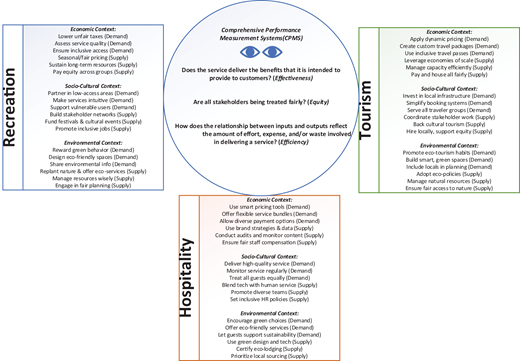
Published by Emerald Publishing Limited. This article is published under the Creative Commons Attribution (CC BY 4.0) licence. Anyone may reproduce, distribute, translate and create derivative works of this article (for both commercial and non-commercial purposes), subject to full attribution to the original publication and authors. The full terms of this licence maybe seen at Link to the terms of the CC BY 4.0 licenceLink to the terms of the CC BY 4.0 licence.

Data & Figures

Figure 1.
Diagram showing a C P M S framework linking recreation, tourism, and hospitality across economic, socio-cultural, and environmental contexts.The conceptual framework for Comprehensive Performance Measurement Systems, C P M S, has a central circle explaining three evaluation criteria: effectiveness, which asks whether services deliver their intended benefits to customers; equity, which considers whether all stakeholders are treated fairly; and efficiency, which examines the relationship between inputs, outputs, costs, and waste in service delivery. Surrounding this center are three sector-specific panels Recreation on the left, Tourism on the right, and Hospitality at the bottom each divided into economic, socio-cultural, and environmental contexts. Within each context, the diagram lists demand-side actions, such as inclusive access, dynamic or fair pricing, service quality, and customer-focused sustainability initiatives, alongside supply-side actions, including long-term resource management, stakeholder coordination, fair labour practices, local hiring, capacity management, eco-friendly design, and environmental stewardship.

Bringing the 3Es to life: visualizing the 3Es in service evaluation across hospitality, tourism, and recreation using the CPMS lens

Source: Developed by the authors

Figure 1.
Diagram showing a C P M S framework linking recreation, tourism, and hospitality across economic, socio-cultural, and environmental contexts.The conceptual framework for Comprehensive Performance Measurement Systems, C P M S, has a central circle explaining three evaluation criteria: effectiveness, which asks whether services deliver their intended benefits to customers; equity, which considers whether all stakeholders are treated fairly; and efficiency, which examines the relationship between inputs, outputs, costs, and waste in service delivery. Surrounding this center are three sector-specific panels Recreation on the left, Tourism on the right, and Hospitality at the bottom each divided into economic, socio-cultural, and environmental contexts. Within each context, the diagram lists demand-side actions, such as inclusive access, dynamic or fair pricing, service quality, and customer-focused sustainability initiatives, alongside supply-side actions, including long-term resource management, stakeholder coordination, fair labour practices, local hiring, capacity management, eco-friendly design, and environmental stewardship.

Bringing the 3Es to life: visualizing the 3Es in service evaluation across hospitality, tourism, and recreation using the CPMS lens

Source: Developed by the authors

Close modal
Table 1.

Evaluating efficiency, effectiveness and equity in economic, socio-cultural and environmental contexts within recreation, hospitality and tourism

SectorPerspectiveOptimization of the three components in service delivery: efficiency, effectiveness, equitySupporting literature
Economic contextSociocultural contextEnvironmental context
RecreationDemand (customers)Efficiency: Minimize regressive taxationEfficiency: Collaboration with private providers in underserved areasEfficiency: Incentives for sustainable behaviorCrompton and West (2008); Glover (1999); Guo et al. (2024); McCool (2022); Nowak and Heldt (2023); Pitas et al. (2022); Zhang and Xu, (2023) 
Effectiveness: Service quality evaluationEffectiveness: User-friendly, intuitive service accessEffectiveness: Design of recreation-friendly environments
Equity: Inclusive and accessible service optionsEquity: Accessibility for vulnerable populationsEquity: Community engagement and access to environmental information
Supply (management and local community)Efficiency: Differential pricing (e.g. seasonality, residency)Efficiency: Stakeholder collaboration networksEfficiency: Natural revegetation and provision of eco-servicesGuo et al. (2024); McCool (2022); Nowak and Heldt, (2023); Pitas et al. (2022); Zhang and Xu (2023) 
Effectiveness: Long-term resource sustainabilityEffectiveness: Support for local festivals and cultural programsEffectiveness: Balanced and sustained resource use
Equity: Wage equityEquity: Public–private partnerships and inclusive workforce representationEquity: Environmental justice and participation in planning
HospitalityDemand (customers)Efficiency: Smart algorithms for dynamic pricing and preference matchingEfficiency: High service quality (empathy, responsiveness and servicescape design)Efficiency: Incentives for eco-friendly guest behaviorArbelo et al. (2025); Buhalis and Leung (2018); Cole et al. (2019); Gursoy and Maier (2023); Hsiao et al. (2014); Kerr and Wardana (2020); Kim et al. (2016); Singh et al. (2022); Wang (2025) 
Effectiveness: Flexible service packagesEffectiveness: Continuous service quality assessmentEffectiveness: Environmentally responsible service options
Equity: Flexible payment and reservation optionsEquity: Equal treatment across guest profilesEquity: Opportunities to support local sustainability initiatives (e.g. donations)
Supply (management and local community)Efficiency: Use of representative samples, brand portfolio strategies, vertical integrationEfficiency: Technology integration that augments rather than replaces human labourEfficiency: Pro-environmental business strategyArbelo et al. (2025); Gursoy and Maier (2023); Hsiao et al. (2014); Kim et al. (2024); Kuo et al. (2024); O’Connor (2020); Singh et al. (2022) 
Effectiveness: Brand audits, mystery shoppers, and online content monitoringEffectiveness: Workforce diversity and cultural inclusionEffectiveness: Implementation of green buildings and certified eco-lodging
Equity: Wage equity across all demographic groupsEquity: Inclusive policies that support all individualsEquity: Prioritization of local sourcing (e.g. food, materials)
TourismDemand (tourists)Efficiency: Dynamic pricing mechanismsEfficiency: Investment in basic infrastructure for underdeveloped communitiesEfficiency: Encouragement of sustainable tourist behaviorsAbrate et al. (2019); Ayazlar (2014); Bayrakcı and Ozcan, (2023); Buhalis and Leung (2018); Franzoni (2015); Nekmahmud et al. (2022); Park et al. (2022); Passafaro (2020); Wong et al. (2021) 
Effectiveness: Customizable and flexible travel packagesEffectiveness: Simplified, accessible service interfacesEffectiveness: Smart resource use in destination design
Equity: Use of multi-access passes for broad inclusionEquity: Inclusive access for marginalized and underserved travelersEquity: Community participation and access to environmental planning
Supply (management and local community)Efficiency: Economies of scale in operationsEfficiency: Coordinated stakeholder networks and service quality assuranceEfficiency: Pro-environmental policies and use of natural eco-servicesBayrakcı and Ozcan (2023); Cockburn-Wootten and McIntosh (2020); Cole (2006); Franzoni (2015); Gasparini and Mariotti (2023); Modica et al. (2018); Ochonogor and Amah (2021); Park et al. (2022); Wong et al. (2021) 
Effectiveness: Capacity management (social and environmental)Effectiveness: Support for cultural tourism initiativesEffectiveness: Sustainable resource management
Equity: Inclusive wages and accommodation for people with disabilitiesEquity: Local hiring, representation and promotion of underrepresented businessesEquity: Equitable access to environmental benefits and protections
Source(s): Developed by the authors
Table 2.

Manager’s takeaway: applying the 3Es in hospitality, tourism and recreation

SectorEfficiencyEffectivenessEquityInsight
Hospitality• Use artificial intelligence-driven tools for inventory, pricing and staffing optimization• Focus on empathetic, responsive service and personalized guest experiences• Offer flexible booking and payment options for diverse guestsManagers should balance short-term cost efficiency with long-term brand equity, employee satisfaction and sustainability goals. A holistic approach to the 3Es strengthens firms’ competitive positioning and societal value
• Ensure wage equity and inclusive hiring practices
• Maintain high service standards via mystery shopping, real-time feedback and brand strategy
• Streamline service delivery through smart supply chains and stakeholder collaboration
• Source locally and support green building initiatives to promote community well-being
• Encourage sustainability through smart nudges and tailored packages
• Conduct regular brand audits and quality checks
Tourism Transparently implement dynamic pricing to optimize demand and revenue Personalize experiences using real-time data and dynamic packaging• Prioritize accessibility for vulnerable populations through inclusive infrastructure and servicesTourism managers should align technological innovation with cultural sensitivity and environmental care. A 3Es-driven approach fosters resilient, inclusive destinations that hold lasting value for visitors and host communities
• Leverage economies of scale and smart packaging tools for resource efficiency• Invest in cultural events and local storytelling to deepen visitor engagement
• Engage residents in tourism planning and benefit-sharing
• Integrate smart tourism technologies to enhance destination responsiveness• Support indigenous and community-based tourism to preserve cultural heritage and expand participation
• Use intelligent systems to streamline operations and manage tourist flows
Recreation• Implement cost accounting systems and track facility use to optimize resource allocation• Design services to deliver meaningful community outcomes, not just program outputs•Develop inclusive pricing strategies to serve economically vulnerable groupsRecreation managers should view their work not just as service provision but as a vehicle for community well-being and environmental stewardship. By embedding the 3Es into planning, funding and programming, recreation leaders can advance inclusion, resilience and shared public value
• Ensure accessible design and program participation across age, ability, race and income
• Integrate heritage programming and participatory planning to foster engagement
• Build partnerships with private-sector providers to increase reach and reduce redundancy
• Promote environmental practices that enhance public health and ecosystem resilience
• Prioritize environmental justice by tracking and addressing disparities in recreational access and landscape quality
• Diversify revenue sources through sponsorships, leases and user fees
Source(s): Developed by the authors
Table A1.

Sample studies assessing the 3Es in recreation, hospitality and tourism

SectorOptimization of the three components in service delivery: efficiency, effectiveness and equity
Economic contextSocio-cultural contextEnvironmental context
RecreationAuthors:Nowak and Heldt (2023)Title: Financing recreational trails through donations: Testing behavioural theory in Mountain biking context Location: Rörbäcksnäs, Sweden Method: Experimental design Results: The authors found that voluntary contribution schemes, driven by normative messages, can effectively support funding strategies for recreational, nature-based trailsAuthors:Zhang and Xu (2023)Title: Investigating the spatial distribution of urban parks from the perspective of equity-efficiency: Evidence from chengdu, China Location: Chengdu, China Method: Multisource big data and GIS technology Results: The authors concluded that strengthening the construction of small urban parks and green spaces, designing park facilities to match the diverse social needs of citizens and improving the attractiveness of parks and green spaces are necessaryAuthors:Guo et al. (2024)Title: Spatial equity of urban parks from the perspective of recreational opportunities and recreational environment quality: a case study in Singapore Location: Singapore Method: Case study Results: For park recreational services, the author proposed a comprehensive evaluation system
HospitalityAuthors:Singh et al. (2022)Title: Evaluating the hotel industry performance using efficiency and effectiveness measures Location: India Method: Two-phase evaluation model with panel data Results: The authors found that while no significant correlation was found between efficiency and effectiveness scores, there was a strong positive correlation between effectiveness scores and overall hotel performanceAuthors:Gursoy and Maier (2023)Title: Diversity, equity and inclusion in hospitality: Value centred leadership as a conduit for change Location: N/A Method: Conceptual paper Results: Based on transformational leadership principles, the authors proposed a value-centered leadership framework comprising four domains: mission, inclusivity, people and taskAuthors: Arbelo et al. (2025) Title: Green premiums: Assessing the revenue impact of eco-certification in the hospitality sector Location: Canary Islands, Spain Method: Stochastic frontier Bayesian model Results: The authors found that in some tested hotels, eco-certification can significantly improve their revenue efficiency, enabling these hotels to charge premium prices
TourismAuthors:Park et al. (2022)Title: A model for cross-border tourism governance in the greater Bay area Location: Guangdong–Hong Kong–Macao, China Method: Institutional analysis and development (IAD) framework Results: The authors identified the key elements and mechanisms of cross-border collaboration in tourism and investigated evaluative criteriaAuthors: Bayrakcı and Ozcan (2023) Title: The socio-cultural determinants of tourism: the case of Turkey Location: Turkey Method: Panel unit root, panel cointegration tests and cointegration estimator methods Results: The testing results showed that, in addition to economic variables, socio-cultural variables also contributed significantly to positive effects on tourism demandAuthors:Wong et al. (2021)Title: Destination green equity and its moderating role of travel satisfaction Location: China Method: Moderation model Results: The authors found that a place’s green equity moderates the effects of food and transportation satisfaction on the overall destination satisfaction
Source(s): Developed by the authors

Supplements

References

Aaker
,
D.A.
(
2004
),
Brand Portfolio Strategy: Creating Relevance, Differentiation, Energy, Leverage and Clarity
,
Free Press
.
Adrianto
,
L.
,
Kurniawan
,
F.
,
Romadhon
,
A.
,
Bengen
,
D.G.
,
Sjafrie
,
N.D.M.
,
Damar
,
A.
and
Kleinertz
,
S.
(
2021
), “
Assessing social-ecological system carrying capacity for urban small island tourism: the case of tidung islands, jakarta capital province, Indonesia
”,
Ocean and Coastal Management
, Vol.
212
, p.
105844
.
Ayazlar
,
R.A.
(
2014
), “
Dynamic packaging applications in travel agencies
”,
Procedia - Social and Behavioral Sciences
, Vol.
131
, pp.
326
-
331
.
Bramwell
,
B.
and
Lane
,
B.
(
2011
), “
Critical research on the governance of tourism and sustainability
”,
Journal of Sustainable Tourism
, Vol.
19
Nos
4-5
, pp.
411
-
421
.
Buhalis
,
D.
(
2021
), “Drivers of e-tourism”, in
Handbook of e-Tourism
,
Springer International Publishing
,
Cham
, pp.
1
-
17
.
Buhalis
,
D.
and
Leung
,
R.
(
2018
), “
Smart hospitality–interconnectivity and interoperability towards an ecosystem
”,
International Journal of Hospitality Management
, Vol.
71
, pp.
41
-
50
.
Buhalis
,
D.
,
O’Connor
,
P.
and
Leung
,
R.
(
2023
), “
Smart hospitality: from smart cities and smart tourism towards agile business ecosystems in networked destinations
”,
International Journal of Contemporary Hospitality Management
, Vol.
35
No.
1
, pp.
369
-
393
.
Buhalis
,
D.
,
Taheri
,
B.
, and
Rahimi
,
R.
(
2023
),
Smart Cities and Tourism: Co-Creating Experiences, Challenges and Opportunities
,
Goodfellow Publication
,
UK
.
Calantone
,
R.J.
,
Cavusgil
,
S.T.
and
Zhao
,
Y.
(
2002
), “
Learning orientation, firm innovation capability, and firm performance
”,
Industrial Marketing Management
, Vol.
31
No.
6
, pp.
515
-
524
.
Carvalho
,
P.
and
Alves
,
H.
(
2023
), “
Customer value co-creation in the hospitality and tourism industry: a systematic literature review
”,
International Journal of Contemporary Hospitality Management
, Vol.
35
No.
1
, pp.
250
-
273
.
Cerveny
,
L.K.
(
2022
), “
Sustainable recreation and tourism: Making sense of diverse conceptualizations and management paradigms
”,
Journal of Outdoor Recreation and Tourism
, Vol.
38
, p.
100520
.
Chang
,
F.H.
and
Tsai
,
C.Y.
(
2016
), “
Influences of the cultural implications and tourism attractiveness of festival tourism on tourist loyalty
”,
Journal of Business and Management Studies
, Vol.
2
No.
1
, pp.
1
-
10
.
Choi
,
S.
and
Mattila
,
A.S.
(
2004
), “
Hotel revenue management and its impact on customers’ perceptions of fairness
”,
Journal of Revenue and Pricing Management
, Vol.
2
No.
4
, pp.
303
-
314
.
Cockburn-Wootten
,
C.
and
McIntosh
,
A.
(
2020
), “
Improving the accessibility of the tourism industry in New Zealand
”,
Sustainability
, Vol.
12
No.
24
, p.
10478
.
Cole
,
R.
,
Stevenson
,
M.
and
Aitken
,
J.
(
2019
), “
Blockchain technology: implications for operations and supply chain management
”,
Supply Chain Management: An International Journal
, Vol.
24
No.
4
, pp.
469
-
483
.
Cole
,
S.
(
2006
), “
Information and empowerment: the keys to achieving sustainable tourism
”,
Journal of Sustainable Tourism
, Vol.
14
No.
6
, pp.
629
-
644
.
Cooper
,
D.I.A.
(
2016
), “The impact of generational change on future demand for tourism experiences”, In
Cauthe
,
Blue Mountains International Hotel Management School
,
Sydney
, pp.
278
-
292
.
Crompton
,
J.L.
and
West
,
S.T.
(
2008
), “
The role of moral philosophies, operational criteria and operational strategies in determining equitable allocation of resources for leisure services in the United States
”,
Leisure Studies
, Vol.
27
No.
1
, pp.
25
-
58
.
Dalir
,
S.
(
2024
), “
Innovative strategies to tackle seasonality issue in hospitality and tourism industry
”,
International Journal of Contemporary Hospitality Management
, Vol.
36
No.
5
, pp.
1690
-
1709
.
Davenport
,
T.H.
(
2006
), “
Competing on analytics
”,
Harvard Business Review
, Vol.
84
No.
1
, p.
98
.
Davis
,
P.
,
Milne
,
B.
,
Parker
,
K.
,
Hider
,
P.
,
Lay-Yee
,
R.
,
Cumming
,
J.
and
Graham
,
P.
(
2013
), “
Efficiency, effectiveness, equity (E3): evaluating hospital performance in three dimensions
”,
Health Policy
, Vol.
112
Nos
1-2
, pp.
19
-
27
.
Doğan
,
M.
(
2019
), “
Ecological ideals, sustainable tourism and the heritage concept of an eco-village: the case of arcosanti, USA
”,
Journal of Heritage Tourism
, Vol.
14
No.
4
, pp.
371
-
381
.
Dolgui
,
A.
and
Proth
,
J.M.
(
2010
), “
Pricing strategies and models
”,
Annual Reviews in Control
, Vol.
34
No.
1
, pp.
101
-
110
.
Dwivedi
,
Y.K.
,
Helal
,
M.Y.I.
,
Elgendy
,
I.A.
,
Albashrawi
,
M.A.
,
Hughes
,
L.
,
Shawosh
,
M.
,
Dutot
,
V.
and
Jeon
,
I.
(
2025
), “
Artificial intelligence agents and agentic systems in hospitality and tourism: challenges, opportunities and research agenda
”,
International Journal of Contemporary Hospitality Management
, doi: .
Fatima
,
T.
and
Elbanna
,
S.
(
2020
), “
Balanced scorecard in the hospitality and tourism industry: past, present and future
”,
International Journal of Hospitality Management
, Vol.
91
, p.
102656
.
Filimonau
,
V.
,
Fidan
,
H.
,
Alexieva
,
I.
,
Dragoev
,
S.
and
Marinova
,
D.D.
(
2019
), “
Restaurant food waste and the determinants of its effective management in Bulgaria: an exploratory case study of restaurants in Plovdiv
”,
Tourism Management Perspectives
, Vol.
32
, p.
100577
.
Franzoni
,
S.
(
2015
), “
Measuring the sustainability performance of the tourism sector
”,
Tourism Management Perspectives
, Vol.
16
, pp.
22
-
27
.
Gasparini
,
M.L.
and
Mariotti
,
A.
(
2023
), “
Sustainable tourism indicators as policy making tools: Lessons from ETIS implementation at destination level
”,
Journal of Sustainable Tourism
, Vol.
31
No.
7
, pp.
1719
-
1737
.
Ghazvini
,
S.A.M.
,
Timothy
,
D.J.
and
Sarmento
,
J.
(
2020
), “
Environmental concerns and attitudes of tourists towards national park uses and services
”,
Journal of Outdoor Recreation and Tourism
, Vol.
31
, p.
100296
.
Glover
,
T.
(
1999
), “
Propositions addressing the privatization of public leisure services: Implications for efficiency, effectiveness, and equity
”,
Journal of Park and Recreation Administration
, Vol.
17
No.
2
, pp.
1
-
27
.
Gössling
,
S.
and
Scott
,
D.
(
2018
), “
The decarbonisation impasse: Global tourism leaders’ views on climate change mitigation
”,
Journal of Sustainable Tourism
, Vol.
26
No.
12
, pp.
2071
-
2086
.
Graves
,
L.M.
,
Sarkis
,
J.
and
Zhu
,
Q.
(
2013
), “
How transformational leadership and employee motivation combine to predict employee proenvironmental behaviors in China
”,
Journal of Environmental Psychology
, Vol.
35
, pp.
81
-
91
.
Gretzel
,
U.
,
Sigala
,
M.
,
Xiang
,
Z.
and
Koo
,
C.
(
2015
), “
Smart tourism: foundations and developments
”,
Electronic Markets
, Vol.
25
No.
3
, pp.
179
-
188
.
Guo
,
R.
,
Diehl
,
J.A.
,
Zhang
,
R.
and
Wang
,
H.
(
2024
), “
Spatial equity of urban parks from the perspective of recreational opportunities and recreational environment quality: a case study in Singapore
”,
Landscape and Urban Planning
, Vol.
247
, p.
105065
.
Gursoy
,
D.
and
Maier
,
T.
(
2023
), “
Diversity, equity and inclusion in hospitality: Value centered leadership as a conduit for change
”,
Journal of Hospitality Marketing and Management
, Vol.
32
No.
4
, pp.
445
-
453
.
Hall
,
C.M.
,
Gössling
,
S.
, and
Scott
,
D.
(
2015
), “The evolution of sustainable tourism: Emerging issues and future challenges”,
Routledge Handbook of Tourism and Sustainability
,
Routledge
,
Abingdon
, pp.
509
-
521
.
Hipwell
,
W.T.
(
2007
), “
Taiwan aboriginal ecotourism: Tanayiku natural ecology park
”,
Annals of Tourism Research
, Vol.
34
No.
4
, pp.
876
-
897
.
Homburg
,
C.
,
Artz
,
M.
and
Wieseke
,
J.
(
2012
), “
Marketing performance measurement systems: does comprehensiveness really improve performance?
”,
Journal of Marketing
, Vol.
76
No.
3
, pp.
56
-
77
.
Hsiao
,
T.Y.
,
Chuang
,
C.M.
,
Kuo
,
N.W.
and
Yu
,
S.M.F.
(
2014
), “
Establishing attributes of an environmental management system for green hotel evaluation
”,
International Journal of Hospitality Management
, Vol.
36
, pp.
197
-
208
.
Hu
,
H.-H.
,
Parsa
,
H.
and
Self
,
J.
(
2010
), “
The dynamics of green restaurant patronage
”,
Cornell Hospitality Quarterly
, Vol.
51
No.
3
, pp.
344
-
362
.
Jenkins
,
C.L.
(
1982
), “
The effects of scale in tourism projects in developing countries
”,
Annals of Tourism Research
, Vol.
9
No.
2
, pp.
229
-
249
.
Jones
,
P.
, and
Hillier
,
D.
(
2016
), “Environmental sustainability and the hospitality industry: Best practice”, in
Routledge Handbook of Hospitality Management
,
Routledge
,
Abingdon
, pp.
221
-
236
.
Kerr
,
G.
and
Wardana
,
L.W.
(
2020
), “
“community-based tourism and corporate social responsibility: a systematic literature review
”,
Tourism Management Perspectives
, Vol.
36
, p.
100754
.
Khalilzadeh
,
J.
,
Kromidha
,
E.
and
Taheri
,
B.
(
2025
), “
Anatomy of a CSR discourse system: Entrepreneurship and tourism domains
”,
Tourism Management
, Vol.
110
, p.
105195
.
Kim
,
H.
,
So
,
K.K.F.
,
Shin
,
S.
and
Li
,
J.
(
2024
), “
Artificial intelligence in hospitality and tourism: Insights from industry practices, research literature, and expert opinions
”,
Journal of Hospitality and Tourism Research
, Vol.
49
No.
2
, p.
10963480241229235
.
Kim
,
Y.J.
,
Palakurthi
,
R.
and
Hancer
,
M.
(
2016
), “
The environmentally friendly programs in hotels and customers’ intention to stay: an online survey approach
”,
International Journal of Hospitality and Tourism Administration
, Vol.
13
No.
3
, pp.
195
-
214
.
Konstantakis
,
K.N.
,
Soklis
,
G.
and
Michaelides
,
P.G.
(
2017
), “
Tourism expenditures and crisis transmission: a general equilibrium GVAR analysis with network theory
”,
Annals of Tourism Research
, Vol.
66
, pp.
74
-
94
.
Kuo
,
T.M.
,
Liu
,
C.-R.
,
Wang
,
Y.-C.
and
Chen
,
H.
(
2024
), “
Sensory experience at farm-to- table events (SEFTE): conceptualization and scale development
”,
Journal of Hospitality Marketing and Management
, Vol.
33
No.
2
, pp.
169
-
189
.
Lai
,
M.
,
Leung
,
W.
,
Tse
,
F.
and
Taheri
,
B.
(
2023
), “
Driving destination brand engagement: the role of traveler participation
”,
International Journal of Tourism Research
, doi: .
Lawton
,
L.J.
and
Weaver
,
D.B.
(
2015
), “
Using residents’ perceptions research to inform planning and management for sustainable tourism: a study of the gold Coast schoolies week, a contentious tourism event
”,
Journal of Sustainable Tourism
, Vol.
23
No.
5
, pp.
660
-
682
.
Lee
,
J.-S.
,
Hsu
,
L.-T.
,
Han
,
H.
and
Kim
,
Y.
(
2010
), “
Understanding how consumers view green hotels: how a hotel’s green image can influence behavioural intentions
”,
Journal of Sustainable Tourism
, Vol.
18
No.
7
, pp.
901
-
914
.
Lee
,
T.-H.
(
2009
), “
A structural model for examining how destination image and interpretation services affect future visitation behavior: a case study of taiwan’s taomi eco-village
”,
Journal of Sustainable Tourism
, Vol.
17
No.
6
, pp.
727
-
745
.
Lemelin
,
R.H.
,
Koster
,
R.
and
Youroukos
,
N.
(
2015
), “
Tangible and intangible indicators of successful aboriginal tourism initiatives: a case study of two successful aboriginal tourism lodges in Northern Canada
”,
Tourism Management
, Vol.
47
, pp.
318
-
328
.
Li
,
X.
,
Wu
,
J.
and
Huang
,
L.
(
2023
), “
Green technology innovation and tourism development: evidence from Chinese provinces
”,
Journal of Hospitality and Tourism Management
, Vol.
54
, pp.
125
-
137
.
Lin
,
B.H.
and
Liu
,
H.H.
(
2000
), “
A study of economies of scale and economies of scope in Taiwan international tourist hotels
”,
Asia Pacific Journal of Tourism Research
, Vol.
5
No.
2
, pp.
21
-
28
.
Luk
,
H.M.
(
1994
),
Stein’s Method for the Gamma Distribution and Related Statistical Applications
,
University of Southern CA
.
McCool
,
S.F.
(
2022
), “
Thinking like a system in the turbulent world of outdoor recreation management
”,
Journal of Outdoor Recreation and Tourism
, Vol.
38
, p.
100484
.
Ma
,
M.
,
Weng
,
J.
and
Yu
,
L.
(
2015
), “
Market size, scale economies, and tourism market structure: a case of historic water town tourism in China
”,
Tourism Management
, Vol.
49
, pp.
119
-
137
.
Mihalic
,
T.
(
2016
), “
Sustainable-responsible tourism discourse: towards ‘responsustable’ tourism
”,
Journal of Cleaner Production
, Vol.
111
, pp.
461
-
470
.
Modica
,
P.
,
Capocchi
,
A.
,
Foroni
,
I.
and
Zenga
,
M.
(
2018
), “
An assessment of the implementation of the european tourism indicator system for sustainable destinations in Italy
”,
Sustainability
, Vol.
10
No.
9
, p.
3160
.
Morgan
,
N.A.
and
Rego
,
L.L.
(
2009
), “
Brand portfolio strategy and firm performance
”,
Journal of Marketing
, Vol.
73
No.
1
, pp.
59
-
74
.
Neely
,
A.
,
Gregory
,
M.
and
Platts
,
K.
(
1995
), “
Performance measurement system design: a literature review and research agenda
”,
International Journal of Operations and Production Management
, Vol.
15
No.
4
, pp.
80
-
116
.
Nekmahmud
,
M.
,
Ramkissoon
,
H.
and
Fekete-Farkas
,
M.
(
2022
), “
Green purchase and sustainable consumption: a comparative study between European and non-European tourists
”,
Tourism Management Perspectives
, Vol.
43
, p.
100980
.
Niavis
,
S.
and
Tsiotas
,
D.
(
2019
), “
Assessing the tourism performance of the mediterranean coastal destinations: a combined efficiency and effectiveness approach
”,
Journal of Destination Marketing and Management
, Vol.
14
, p.
100379
.
Nowak
,
M.
and
Heldt
,
T.
(
2023
), “
Financing recreational trails through donations: Testing behavioural theory in Mountain biking context
”,
Journal of Outdoor Recreation and Tourism
, Vol.
42
, p.
100603
.
Ochonogor
,
D.I.
and
Amah
,
E.
(
2021
), “
Managerial resourcefulness and quality service delivery: the place of information sharing in public sector organizations
”,
Business, Management and Economics Research
, Vol.
7
No.
73
, pp.
101
-
107
.
O’Connor
,
P.
(
2020
), “
Online tourism and hospitality distribution: a perspective paper
”,
Tourism Review
, Vol.
75
No.
1
, pp.
290
-
295
.
Oktadiana
,
H.
and
Pearce
,
P.L.
(
2020
), “
Losing touch: Uncomfortable encounters with tourism echnology
”,
Journal of Hospitality and Tourism Management
, Vol.
42
, pp.
266
-
276
.
Otterbring
,
T.
,
Malodia
,
S.
,
Taheri
,
B.
and
Dhir
,
A.
(
2025
), “
Activating green airport actions: Promoting Eco-Friendly choices for sustainable travel through commitment and consistency
”,
Journal of Travel Research
, doi: .
Park
,
S.
,
Kim
,
J.
and
Lee
,
S.
(
2022
), “
A hybrid model of airline reservation cancellations using machine learning algorithms
”,
Journal of Air Transport Management
, Vol.
84
, p.
101763
.
Passafaro
,
P.
(
2020
), “
Attitudes and tourists’ sustainable behavior: an overview of the literature and discussion of some theoretical and methodological issues
”,
Journal of Travel Research
, Vol.
59
No.
4
, pp.
579
-
596
.
Perry
,
E.E.
,
Xiao
,
X.
,
Iretskaia
,
T.A.
,
Li
,
P.
,
Manning
,
R.E.
,
Valliere
,
W.A.
and
Reigner
,
N.P.
(
2022
), “
A review of digitalization and sustainability in parks and recreation indicators and thresholds research
”,
Journal of Outdoor Recreation and Tourism
, Vol.
39
, p.
100550
.
Pitas
,
N.A.
,
Powers
,
S.L.
and
Mowen
,
A.J.
(
2022
), “
Neoliberal conservation and equity in the context of local parks and recreation: Stakeholder perceptions on public-non-profit partnerships
”,
Journal of Leisure Research
, Vol.
53
No.
3
, pp.
473
-
491
.
Prince
,
S.
(
2019
), “
Volunteer tourism and the eco-village: Finding the host in the pedagogic experience
”,
Hospitality and Society
, Vol.
9
No.
1
, pp.
71
-
89
.
Rasoolimanesh
,
S.M.
,
Ramakrishna
,
S.
,
Hall
,
C.M.
,
Esfandiar
,
K.
and
Seyfi
,
S.
(
2023
), “
A systematic scoping review of sustainable tourism indicators in relation to the sustainable development goals
”,
Journal of Sustainable Tourism
, Vol.
31
No.
7
, pp.
1497
-
1517
.
Richards
,
G.
(
2022
), “
Cultural tourism: a review of recent research and trends
”,
Journal of Hospitality and Tourism Management
, Vol.
51
, pp.
1
-
9
.
Sainaghi
,
R.
,
Phillips
,
P.
and
Zavarrone
,
E.
(
2017
), “
Performance measurement in tourism firms: a content analytical meta-approach
”,
Tourism Management
, Vol.
59
, pp.
36
-
56
.
Singh
,
R.
,
Charan
,
P.
and
Chattopadhyay
,
M.
(
2022
), “
Evaluating the hotel industry performance using efficiency and effectiveness measures
”,
International Journal of Hospitality and Tourism Administration
, Vol.
23
No.
2
, pp.
408
-
431
.
Taheri
,
B.
, and
Shaker
,
H.
(
2025
),
Marketing Communications: An Advertising, Promotion and Branding Perspective
, (2nd ed.)
Goodfellow Publication
,
UK
.
Taheri
,
B.
,
Bititci
,
U.
,
Gannon
,
M.J.
and
Cordina
,
R.
(
2019
), “
Investigating the influence of performance measurement on learning, entrepreneurial orientation and performance in turbulent markets
”,
International Journal of Contemporary Hospitality Management
, Vol.
31
No.
3
, pp.
1224
-
1246
.
Taheri
,
B.
,
Prayag
,
G.
and
Muskat
,
B.
(
2021
), “
Consumer experience management and customer journeys in tourism, hospitality and events
”,
Tourism Management Perspectives
, Vol.
40
, p.
100877
, doi: .
Tanguay
,
G.A.
,
Rajaonson
,
J.
and
Therrien
,
M.-C.
(
2013
), “
Sustainable tourism indicators: selection criteria for policy implementation and scientific recognition
”,
Journal of Sustainable Tourism
, Vol.
21
No.
6
, pp.
862
-
879
.
Teng
,
C.-C.
,
Wang
,
Y.-C.
,
Cheng
,
Y.-J.
and
Wang
,
S.-N.
(
2023
), “
Religious beliefs and food waste prevention practices: mechanisms of divine and environmental awareness
”,
Journal of Hospitality Marketing and Management
, Vol.
32
No.
4
, pp.
530
-
554
.
Thakur
,
P.
,
Khoo
,
C.
,
Mura
,
P.
,
Je
,
J.S.
and
Yang
,
M.J.H.
(
2023
), “
Envisioning an inclusive tourism for an equitable future
”,
Tourism Recreation Research
, Vol.
48
No.
6
, pp.
1035
-
1043
.
Thimm
,
T.
(
2019
), “
Cultural sustainability–a framework for aboriginal tourism in British Columbia
”,
Journal of Heritage Tourism
, Vol.
14
No.
3
, pp.
205
-
218
.
Tomej
,
K.
(
2019
), “Accessible and equitable tourism services for travelers with disabilities: from a charitable to a commercial footing”,
Corporate Sustainability and Responsibility in Tourism: A Transformative Concept
, pp.
65
-
78
.
Uysal
,
M.
and
Sirgy
,
M.J.
(
2022
), “
Quality-of-life research in tourism and hospitality: a systematic review
”,
Journal of Travel Research
, Vol.
61
No.
4
, pp.
878
-
896
.
Waligo
,
V.M.
,
Clarke
,
J.
and
Hawkins
,
R.
(
2013
), “
Implementing sustainable tourism: a multi-stakeholder involvement management framework
”,
Tourism Management
, Vol.
36
, pp.
342
-
353
.
Wang
,
C.J.
(
2025
), “
Unlocking service excellence: the hierarchical impact of high-performance human resource practices
”,
International Journal of Contemporary Hospitality Management
, Vol.
37
No.
2
, pp.
502
-
521
.
Warnken
,
J.
,
Bradley
,
M.
and
Guilding
,
C.
(
2005
), “
Eco-resorts vs. mainstream accommodation providers: an investigation of the viability of benchmarking environmental performance
”,
Tourism Management
, Vol.
26
No.
3
, pp.
367
-
379
.
Weiermair
,
K.
(
2000
), “
Tourists’ perceptions towards and satisfaction with service quality in the cross‐cultural service encounter: implications for hospitality and tourism management
”,
Managing Service Quality: An International Journal
, Vol.
10
No.
6
, pp.
397
-
409
.
Wong
,
I.A.
,
Lu
,
M.V.
,
Ou
,
J.
,
Hu
,
R.
and
Wang
,
H.
(
2021
), “
Destination green equity and its moderating role of travel satisfaction
”,
Journal of Vacation Marketing
, Vol.
27
No.
3
, pp.
287
-
298
.
Xiang
,
Z.
, and
Fesenmaier
,
D.R.
(
2017
), “Big data analytics, tourism design and smart tourism”,
Analytics in Smart Tourism Design: concepts and Methods
,
Springer International Publishing
,
Cham
, pp.
299
-
307
.
Yousaf
,
A.
,
Taheri
,
B.
,
Dwesar
,
R.
and
Gannon
,
M.J.
(
2025
), “
The past, present, and future of travel and tourism literature: insights from a bibliometric review
”,
Tourism and Hospitality Management
, Vol.
32
No.
2
, p.
2026
.
Zhang
,
J.
and
Xu
,
E.
(
2023
), “
Investigating the spatial distribution of urban parks from the perspective of equity-efficiency: evidence from chengdu, China
”,
Urban Forestry and Urban Greening
, Vol.
86
, p.
128019
.
Hall
,
C.M.
(
2001
), “
Trends in ocean and coastal tourism: the end of the last frontier?
”,
Ocean and Coastal Management
, Vol.
44
Nos
9-10
, pp.
601
-
618
.
Khoshkam
,
M.
,
Marzuki
,
A.
and
Al-Mulali
,
U.
(
2016
), “
Socio-demographic effects on Anzali wetland tourism development
”,
Tourism Management
, Vol.
54
, pp.
96
-
106
.
Lin
,
H.
,
Wang
,
S.
and
Liu
,
S.
(
2023
), “
Does AI adoption affect hotels’ performance? Moderating role of competition in China’s hospitality industry
”,
International Journal of Hospitality Management
, Vol.
114
, p.
103547
.
Park
,
K.S.
and
Jang
,
S.
(
2023
), “
Digital transformation and performance in the hospitality industry: the moderating role of competitive intensity
”,
International Journal of Hospitality Management
, Vol.
114
, p.
103567
.

Languages

or Create an Account

Close Modal
Close Modal
