This study aims to investigate how different dimensions of anthropomorphism (physical, behavioral, cognitive and emotional) influence social presence and parasocial relationships and how these, in turn, affect users’ behavioral intentions and word-of-mouth (WOM) toward a hotel brand endorsed by a virtual influencer in the hospitality industry.
A quantitative research design was used, along with an online survey administered to participants who were exposed to different Instagram posts featuring a virtual influencer promoting a hospitality brand. Partial least squares-structural equation modeling was used to analyze the relationships among the variables and test mediation effects.
The results reveal that social presence acts as a full mediator in the relationship between physical and behavioral anthropomorphism and parasocial relationship, while it partially mediates the effect of emotional anthropomorphism. Both social presence and parasocial relationship mediate the impact of anthropomorphism on brand-related outcomes. Notably, behavioral anthropomorphism emerged as the strongest predictor, whereas cognitive anthropomorphism did not exhibit a significant effect.
The study offers insights for virtual influencer designers, managers and communication strategists in the hospitality sector. Strategies for selecting or developing effective virtual influencers in hospitality contexts are discussed.
This paper sheds light on the roles of different components of anthropomorphism in shaping social presence and parasocial relationships. Furthermore, to the best of the authors’ knowledge, this study is the first to explore how these psychological mechanisms drive behavioral intentions and positive WOM toward a brand endorsed by a virtual influencer within the context of hospitality management.
1. Introduction
Social media influencing has become an increasingly important marketing tool in the hospitality sector (Buhalis et al., 2023; Chen et al., 2024; Liu et al., 2025). Brands increasingly engage influencers to promote accommodations and travel experiences by leveraging their credibility and social networks. As this practice continues to evolve, a novel form has emerged in the shape of Virtual Influencers (VIs), enabled by recent advances in computer graphics and the rapid growth of generative artificial intelligence (Gen-AI). VIs are digital personas created using computer graphics software and deployed on social media platforms for the purpose of influence (Belanche et al., 2024). VIs are particularly promising in the hospitality sector, which is highly influenced by word-of-mouth (WOM) and social media marketing. Most importantly, brands value VIs for enabling extensive customization and control over both aesthetic design and content strategy, ranging from hyper-realistic figures such as Shudu (@shudu.gram on Instagram), who resembles a high-fashion model with consistent luxury positioning across posts, to playful and surreal characters such as Nobody Sausage (@nobodysausage on Instagram), an animated sausage with glitchy limbs whose appeal lies in humorous formats.
While this variety offers strong creative potential, it also introduces uncertainty, as brands must determine how VIs should be designed in terms of appearance as well as behaviors, emotions and social interactions. As a result, determining the optimal level and type of anthropomorphism needed to foster effective engagement with target audiences remains challenging today, leaving brands to navigate this space largely through experimentation rather than established best practices (Influencer Marketing Hub, 2024). Confident in their potential, hospitality brands and destination marketing organizations (DMOs) continue to invest in these channels, experimenting with diverse strategies despite these uncertainties. For example, Postillion Hotels partnered with Esther Olofsson, a hyper-realistic Dutch VI, to boost brand engagement and provide digital travel recommendations to guests (Vinoi et al., 2024). Similarly, the Italian Ministry of Tourism introduced a virtual version of Botticelli’s Venus to promote national tourism (Hernández-Méndez et al., 2024).
The academic literature on VIs has only begun to offer some guidance in this regard, as the field remains in its infancy and warrants much deeper investigation (Ameen et al., 2024; Xie-Carson et al., 2023, 2024). What has already emerged from prior studies is that three psychological mechanisms play a central role in shaping the effectiveness of VIs in hospitality: the tendency for individuals to attribute human characteristics to VIs (anthropomorphism; e.g. Liu and Wang, 2025; Xie-Carson et al., 2024; Zhang et al., 2025), the extent to which a virtual agent is perceived as “present” within the mediated communication (social presence; e.g. Casaló et al., 2025; Lei et al., 2021) and the emotional bond formed with the VI (parasocial relationships; e.g. Ku, 2024; Liu et al., 2024; Yu et al., 2025). However, while previous research has examined the link between anthropomorphism and social presence (Kim et al., 2025; Kim and Park, 2024; Zourrig et al., 2025) and between anthropomorphism and parasocial relationships (PSRs) (Dabiran et al., 2024; Lee and Kim, 2025; Liu and Wang, 2025; Mrad et al., 2025; Vinoi et al., 2024) in isolation, the interrelationships among these three constructs remain unexplored. Furthermore, although anthropomorphism has largely been examined from an appearance-based perspective, recent research acknowledges its multidimensional nature. Focusing only on one dimension is limiting because it fails to capture the full complexity of how individuals perceive and interact with VIs, potentially underestimating their impact on engagement and consumer responses. Moreover, although the effects of anthropomorphism have been explored in different fields, few attempts have been made to examine its impact on behavioral intentions in the context of tourism and hospitality (Hernández-Méndez et al., 2024; Meng et al., 2025; Yu et al., 2025).
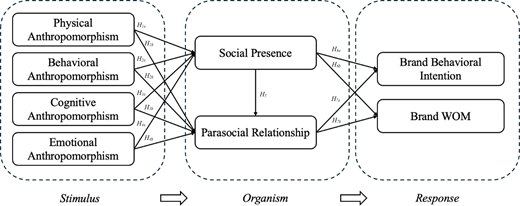
To address these relevant research gaps, this study investigates how different components of anthropomorphism (physical, emotional, cognitive and behavioral) influence social presence and PSRs and, in turn, how these variables affect behavioral intentions and WOM toward the sponsored hospitality brand. By drawing on the well-established framework of the Stimulus–Organism–Response (S-O-R) model (Mehrabian and Russell, 1974) and the theoretical perspective of PSR theory, we develop and empirically test a conceptual model through survey methodology. In doing so, we aim to contribute to the recently growing literature on VIs in the field of hospitality management (Ameen et al., 2024; Liu et al., 2025; Meng et al., 2025; Yu et al., 2025) by offering novel insights into the role of anthropomorphism in shaping behavioral intentions and the psychological processes explaining this persuasive effect.
2. Theoretical framework
2.1 The Stimulus–Organism–Response framework
One of the most widely adopted frameworks for understanding consumer behavior is the S-O-R model. According to this model, sensory variables in the environment act as stimuli (S) that influence the organism (O), in terms of consumers’ cognitive and emotional experiences, which in turn shape their behavioral responses (R) toward the environment (Mehrabian and Russell, 1974). In this perspective, we conceptualize the physical, behavioral, cognitive and emotional components of anthropomorphism as distinct stimuli (S) within the S–O–R framework. Moving to the second stage of the model, the organism (O) captures individuals’ internal emotional reactions to the environment. In this study, those are reflected through users’ perceptions of social presence and the development of PSRs with the VI. Finally, the response (R) component in our study is represented by brand-related behavioral intentions, including users’ attitudes toward the sponsored hospitality brand and their likelihood of engaging in positive WOM behavior.
2.2 Anthropomorphism as a multidimensional construct
Anthropomorphism is described as “the attribution of a human form, human characteristics, or human behavior to non-human things such as robots, computers, and animals” (Bartneck et al., 2009, p. 74). This concept has attracted considerable attention in the field of psychology and is grounded in the principle that humans are more likely to trust entities perceived as similar to themselves. Furthermore, attributing human traits to a social robot can help users maintain a sense of predictability and control, as humanizing the robot allows individuals to interpret and make sense of its behaviors (David et al., 2022). Previous studies have explored the impact of anthropomorphism on perceived humanness and value creation (Cai et al., 2022; Khan et al., 2024; Pizzi et al., 2023), service robot adoption (Cai et al., 2022; Singh et al., 2021) and service quality (Yoganathan et al., 2021). In the fields of hospitality management, human-likeness has been recognized by previous studies as an important factor in evaluating the effectiveness of virtual agents (Ben Saad, 2024; Liu and Wang, 2025; Yao et al., 2025; Zheng et al., 2024).
Interestingly, the attribution of human-like features can extend beyond the aesthetic appearance of a virtual character. Focusing on virtual agents, David et al. (2022) recently extended the traditional conceptualization of anthropomorphism by distinguishing between its physical, cognitive, emotional and behavioral components. Physical anthropomorphism involves evaluating whether a robot or virtual agent displays visible features, sounds, scents or tactile qualities that resemble those of humans. Behavioral anthropomorphism includes characteristics such as movement, verbal and non-verbal expressions and the ability to interact socially. Cognitive anthropomorphism concerns how well a robot can simulate human thinking and mirror cognitive functions typically associated with people. Finally, emotional anthropomorphism captures the extent to which robots are perceived as capable of expressing emotions through verbal or non-verbal cues (David et al., 2022).
2.3 Effects of anthropomorphism on social presence
Social presence has often been adopted as a key interpretative lens to describe the impact of anthropomorphic agents on users’ individual experiences. Social presence is defined as “the degree to which a person is perceived as a ‘real person’ in mediated communication” (Gunawardena, 1995, p. 151). Although the relationship between anthropomorphism and social presence has been examined in a few studies within the domain of VIs, these papers mainly focused on the construct of physical anthropomorphism alone, consistently acknowledging its significant impact on social presence. For instance, Zourrig et al. (2025) identified a positive association between anthropomorphism and social presence. A similar finding was found by Kim et al. (2025) specifically for hotel bar bartender robots. Jin and Youn (2023) found that the human-likeness of AI chatbots is a positive predictor of perceived social presence. However, the remaining anthropomorphic dimensions have received limited scholarly attention. Kim and Park (2024) recently investigated digital human endorsers as alternatives to traditional celebrities in digital marketing, finding no significant relationship between a combined metric of cognitive and emotional anthropomorphism and social presence. One possible explanation for this finding could be related to the aggregation of different dimensions of anthropomorphism into a single construct, overlooking the fact that physical, behavioral, cognitive and emotional cues may trigger distinct psychological mechanisms.
Human-like gestures, movements or interaction patterns (behavioral anthropomorphism) can actually provide dynamic social cues simulating natural human communication (Salem et al., 2013). Moreover, when VIs demonstrate the ability to “understand” and “respond” meaningfully and autonomously (cognitive anthropomorphism), consumers tend to infer mind-like qualities (Epley et al., 2007). Emotional responsiveness is also crucial in fostering intimacy and warmth in human interactions. Virtual agents that disclose emotions facilitate the process of generating social presence for users interacting with them (Lee et al., 2023). Therefore, VIs that display or simulate emotions (emotional anthropomorphism) can foster stronger affective bonds and enhance the feeling that a real social partner is present. Building on this premise, we expect physical, behavioral, cognitive and emotional components of anthropomorphism to exert a direct, positive influence on social presence. Therefore, we propose the following hypotheses:
Physical anthropomorphism positively influences the perception of social presence of VIs.
Behavioral anthropomorphism positively influences the perception of social presence of VIs.
Cognitive anthropomorphism positively influences the perception of social presence of VIs.
Emotional anthropomorphism positively influences the perception of social presence of VIs.
2.4 Effects of anthropomorphism on parasocial relationships
While social presence captures users’ immediate perceptions during communication, PSRs represent a further, more long-term-oriented concept that is crucial to understanding user responses to VIs. A PSR is a one-sided relationship that an audience develops with a media personality, including VIs (Dabiran et al., 2024). Although frequently conflated with parasocial interaction (PSI), the two represent theoretically distinct constructs (Dibble et al., 2016). PSR refers to a generalized cognitive and emotional involvement with a media persona that extends beyond specific moments of media interaction, whereas PSI captures the immediate reactions that occur during a single episode of media exposure.
Individuals are naturally drawn to others who exhibit traits they perceive as similar, even when these similarities are merely perceived or involve non-human entities, such as VIs (Mrad et al., 2025). The literature has already demonstrated that human likeness in appearance has a positive impact on users’ parasocial responses toward VIs (Dabiran et al., 2024; Ku, 2024; Stein et al., 2024). However, other components of anthropomorphism remain relatively underexplored and present conflicting findings. Specifically, recent evidence suggests that moral virtue and cognition have a positive impact on PSRs (Dabiran et al., 2024), indicating that cognitive anthropomorphism can play a significant role in this context. Nevertheless, they also found that conscious emotionality has no effect on parasocial bonds, while behavioral anthropomorphism has yet to be systematically investigated to date.
Emotions play a fundamental role in the development of PSRs (Lotun et al., 2024). When a virtual agent effectively mirrors the user’s emotions, it can transform and reinforce the user’s affective state, thereby nurturing feelings of intimacy and closeness. Moreover, AI agents that display affective cues have been shown to stimulate user engagement (Chandra et al., 2022), which represents a central mechanism in fostering parasocial attachment. Similarly, behavioral anthropomorphism can create the illusion of reciprocal engagement and interaction, thereby fostering a sense of relational closeness (Labrecque, 2014). For instance, chatbots with higher conversational skills have been found to be perceived as more engaging than less skilled ones (Schuetzler et al., 2020). Based on the idea that as virtual avatars become more human-like, they become more relatable to users, facilitating the development of PSRs (Liu and Wang, 2025), we expect that each of these components will have a positive influence on PSRs. Based on the discussion presented above, we offer the following hypotheses:
Physical anthropomorphism positively influences the perception of PSR intensity toward VIs.
Behavioral anthropomorphism positively influences the perception of PSR intensity toward VIs.
Cognitive anthropomorphism positively influences the perception of PSR intensity toward VIs.
Emotional anthropomorphism positively influences the perception of PSR intensity toward VIs.
2.5 Relationship between social presence and parasocial relationships
The concept of PSR is particularly relevant in influencer marketing, as social media platforms create an environment where followers can develop a heightened sense of intimacy with the influencers they engage with (Farivar et al., 2020). PSRs with influencers and other media figures tend to be experienced as real relationships, shaped by the same psychological mechanisms that govern real-life social bonds. Notably, proximity-seeking behaviors, such as frequent exposure, direct engagement and perceived accessibility, serve to heighten the perception of closeness and familiarity, making followers feel as though they truly “know” the influencer (Hudders et al., 2022).
As social presence depends on perceived salience, immediacy and realness of a media personality within a mediated environment (Biocca et al., 2003), we expect it to play a key role in the development of PSRs with VIs. Prior empirical evidence supports this link, showing that greater perceived presence consistently translates into stronger parasocial experiences across various mediated contexts. Kim et al. (2019) observed that social media interactions with influencers strengthen PSRs, which in turn increase perceptions of source trustworthiness and brand credibility. More directly, Kim (2022) tested a model in which social presence significantly increased parasocial interaction, and this effect carried over to key behavioral outcomes such as purchase intent and self-efficacy, underscoring PSR’s role as a psychological bridge between presence and persuasion. Extending this reasoning to the context of VIs in hospitality marketing, we argue that the higher the perception of social presence with the VI, the stronger the parasocial bond audiences are likely to form. Thus, we propose the following hypothesis:
Social presence is positively related to PSR intensity toward VIs.
2.6 Effects of social presence on brand behavioral intentions and brand word-of-mouth
Brand behavioral intention reflects the traveler’s likelihood of choosing the target hotel brand in the future. Brand WOM captures the traveler’s intention to recommend the brand to others. General evidence in marketing literature suggests that social presence may play a pivotal role in shaping consumer responses. In a broader investigation of VIs, Zourrig et al. (2025) identified an indirect relationship between social presence and purchase intention toward the brand endorsed by the VI, mediated by consumers’ willingness to follow the influencer’s recommendations. Moreover, social presence fosters trust (Jiang et al., 2019) and customer engagement (Song et al., 2019), two key mechanisms known to stimulate not only purchase intentions but also consumers’ willingness to recommend the brand to others.
Despite growing scholarly interest in VIs, to the best of our knowledge, no existing study has explicitly examined the role of social presence in shaping brand-related outcomes within the hospitality domain. Social presence can increase the perceived salience and immediacy of the communicator, which strengthens users’ feelings of connection and trust (Lu et al., 2016). These relational appraisals may reduce psychological distance and uncertainty, thereby providing the motivational basis for approach responses such as purchase intention and positive WOM. Building on the well-established consensus in marketing research regarding the positive impact of social presence on consumer behavior, we argue that social presence engendered by the interaction with a VI in the hospitality field is a crucial driver of both behavioral intention and positive WOM toward the advertised brand. Therefore, we advance the following hypotheses:
Social presence of VIs has a positive influence on (a) brand behavioral intentions and (b) brand WOM generation.
2.7 Effects of parasocial relationships on brand behavioral intentions and brand word-of-mouth
Focusing on PSR, the literature on influencer marketing suggests that consumers’ perceived closeness to influencers plays a crucial role in shaping their attitudes toward brands and their purchase decisions (Lee and Watkins, 2016). A strong PSR with an influencer can enhance the persuasiveness of their messages, leading followers to engage with and act upon the influencer’s recommendations (e.g. Farivar et al., 2020; Sokolova and Kefi, 2020). PSI generated with real and VIs has an impact on potential visit intention (Asheq et al., 2025). Prior research further suggests that PSRs reduce cognitive effort in decision-making, leading followers to process influencer messages heuristically (Zheng et al., 2024). Instead of engaging in systematic evaluation, consumers are more likely to accept and internalize influencer recommendations, particularly in contexts involving purchase decisions or brand-related actions. Drawing on the previous discussion, we propose the last two hypotheses:
PSR toward VIs positively influences (a) brand behavioral intentions and (b) brand WOM generation.
The proposed model is depicted in Figure 1.
3. Methodology
3.1 Research design and stimuli
To empirically test the proposed hypotheses, we developed a survey-based investigation using Qualtrics (Qualtrics.com). The research was conducted in compliance with the institutional regulations of the authors’ affiliated Department. Prior to participation, all respondents were provided with clear information about the purpose of the study and the nature of their involvement. Informed consent was obtained electronically before accessing the questionnaire. Participants were informed that their participation was voluntary, that they could withdraw at any time without consequences, and that their responses would be collected anonymously. No personally identifiable information was gathered.
The questionnaire was anonymous and structured into three distinct parts. In the first part, participants were introduced to the study’s objectives, and respondents were provided with a formal definition of VIs accompanied by illustrative images. The second part exposed participants to the VI’s Instagram posts. They were instructed to take as much time as needed to view the posts and were required to view all posts before proceeding to the next section. In the final part, two attention check questions were shown (“What is the name of the virtual influencer?” and “Which city did the virtual influencer visit?”). Additionally, this section included validated measurement scales to assess the constructs involved. Demographic information for participant profiling was also collected in this section.
To enhance ecological validity, the survey was optimized for mobile devices and was accessible exclusively via smartphones. This design choice ensured that participants interacted with the content through a scrolling mechanism, replicating the typical user experience on Instagram. The stimulus comprised a simulated Instagram feed consisting of nine posts replicating real content from a widely recognized VI, Lil Miquela. The posts covered 11 days (August 22 to September 2) and documented Lil Miquela’s vacation in Barcelona, Spain. Of the nine posts, six were purely editorial and showed the VI exploring and enjoying the city of Barcelona. However, they did not feature any brand sponsorship. Three posts constituted a branded promotion for an international hospitality chain called Moxy. In the branded posts, the VI was depicted in selfies or images taken within the hotel environment. In particular, one post showed the VI inside the hotel bar, engaging with the lively atmosphere of the venue; another depicted the VI taking a selfie in a hotel room, presenting a casual moment of relaxation during the vacation; and a third featured the VI in front of the hotel entrance. The accompanying captions reinforced these visual cues by emphasizing themes such as memorable experiences, relaxation, sociability and the uniqueness of the stay, aligning the narrative of the posts with the brand’s positioning.
The captions provided descriptive information about the hotel and included direct links to the brand’s official Instagram page. In line with previous research, Lil Miquela was selected as the focal influencer because of her high level of recognition, consistent visual style and established presence across various branded collaborations, which enhances the realism and credibility of the scenarios (Ameen et al., 2024).
3.2 Measures
All self-reports (except the social presence scale) were measured using a seven-point Likert scale, ranging from 1 (Strongly disagree) to 7 (Strongly agree). All scales were adapted from previously validated scales found in the literature, with modifications made to fit the context of the current study. Anthropomorphism was adapted from David et al. (2022), with three items for each dimension (cognitive, behavioral, physical and emotional). In line with Lee et al. (2006), social presence was assessed using a combination of 10-point semantic differential scales and independent 10-point rating scales. The decision to adopt this different scale was theoretical, as Lee et al. (2006) provide one of the most validated measures of social presence in computer-mediated environments. Since different scale formats were used to measure social presence and the other constructs involved in the study (e.g. 1–10 vs 1–7 Likert scales) to minimize potential common method bias, robustness checks with rescaled items (all in 1–7 Likert scales) were conducted in partial least squares-structural equation modeling (PLS-SEM). The results confirmed that model estimates were not affected by significant differences in scale format. PSR was assessed using seven items from Aw et al. (2023). Four items were adapted from the Behavioral Engagement Scale (Flavián et al., 2021) to target the intention to recommend the brand to others after exposure to sponsored content. Behavioral intention toward the brand was adapted from Grewal et al. (1998). All the items used in the study are reported in Appendix 1 (Supplementary Materials).
A pretest involving eight participants was conducted prior to the full-scale administration of the survey. Its purpose was to verify participants’ understanding of the items and estimate the overall completion time to ensure it was sufficiently short to prevent respondent fatigue. As no issues emerged, no modifications were required, and the survey was subsequently administered in its original form.
4. Results
4.1 Sample
The target population for our study consisted of young Instagram users aged 18–30 years old. Consistent with previous studies (Ameen et al., 2024), this approach used purposive sampling, targeting the digital-savvy segment of young users. A total of 293 respondents participated in the survey. Eight responses were excluded from the analysis because they failed to pass one of the attention checks. The final sample comprised 285 respondents (62.8% female, Mage = 24.08, SDage = 2.67), which aligns with previous research suggesting that young women tend to have a greater interest in traveling (Ameen et al., 2024) and represent the largest age group of users on Instagram (Zourrig et al., 2025). Demographic information on the sample is reported in Appendix 2 (Supplementary Materials). To establish the adequacy of the sample size for our study, we conducted an ex-post analysis using the inverse square root method (Kock and Hadaya, 2018). To reach a minimum significance level of 0.05, a minimum sample of 268 respondents was required for this study. Furthermore, the sample size was deemed appropriate in comparison with previous investigations in the field (Liu et al., 2025).
4.2 Test of the measurement model
Data analysis was conducted using PLS to test our hypotheses using RStudio (v. 4.4.3) and the SEMinR package (Hair et al., 2021). Additional details on the procedural remedies and measurement items used to mitigate common method bias are reported in Appendix 3 (Supplementary Materials). A confirmatory factor analysis was conducted to confirm the suitability of our measurement model. We used indicators and internal consistency reliability, convergent validity and discriminant validity, as shown in Appendix 1 (Supplementary Materials). All indicator loadings exceeded the minimum threshold of 0.5, with a minimum value of 0.613. Internal consistency was supported by Cronbach’s alpha and Composite Reliability (CR), with all values above 0.70 (Hair et al., 2020). Additionally, the average variance extracted (AVE) for each construct surpassed the recommended threshold of 0.5, confirming adequate convergent validity (Hair et al., 2020). Discriminant validity was assessed using the Heterotrait–Monotrait (HTMT) criterion (Appendix 3 – Supplementary Materials). All HTMT values respected the conservative threshold of 0.85–0.90 for conceptually similar constructs, confirming adequate discriminant validity across the constructs.
4.3 Test of the structural model
Variance inflation factor (VIF) values were assessed for all the predicting variables, which were below 3 (VIFphys_antro = 1.479; VIFbehav_antro = 1.447; VIFcogn_antro = 2.355; VIFemo_antro = 2.451; VIFsocialpres = 1.850, VIFpsr = 1.850). Hence, multicollinearity was not an issue in our model. The results reported in Table 1 highlight that physical (β = 0.212, p < 0.001), behavioral (β = 0.369, p < 0.001) and emotional anthropomorphism (β = 0.238, p < 0.01) all had a significant positive impact on social presence, supporting H1a, H2a and H4a, respectively. Only cognitive anthropomorphism did not show a significant effect (β = 0.123, p > 0.05), leading to the rejection of H3a. Interestingly, none of the anthropomorphism dimensions, except emotional, significantly affected PSR. Physical (β = 0.004, p > 0.05), behavioral (β = 0.050, p > 0.05) and cognitive anthropomorphism (β = −0.169, p > 0.05) all showed non-significant effects, resulting in the rejection of H1b, H2b and H3b. Emotional anthropomorphism, instead, showed a significant positive association with PSR (β = 0.195, p < 0.01), confirming H4b. As expected, social presence emerged as a strong predictor of PSR (β = 0.624, p < 0.001), confirming H5. Finally, both social presence and PSR significantly influenced behavioral intentions (β = 0.253, p < 0.001; β = 0.320, p < 0.001) and WOM (β = 0.333, p < 0.001; β = 0.323, p < 0.001), supporting H6a, H6b, H7a and H7b.
Furthermore, we examined whether social presence mediates the relationship between anthropomorphism and PSR. The indirect effect analysis indicated that physical (β = 0.132, T = 3.58, p < 0.001), behavioral (β = 0.230, T = 5.60, p < 0.001) and emotional anthropomorphism (β = 0.148, T = 3.19, p < 0.005) all exert significant indirect effects on PSR through social presence. The analysis also showed that physical, behavioral and emotional anthropomorphism exert a significant indirect effect via the sequential mediation of social presence and PSR on behavioral intentions (β = 0.042, T = 2.63, p < 0.001; β = 0.074, T = 3.25, p < 0.001; β = 0.048, T = 2.53, p < 0.001) and WOM (β = 0.043, T = 2.78, p < 0.001; β = 0.074, T = 3.61, p < 0.001; β = 0.048, T = 2.65, p < 0.001). In contrast, cognitive anthropomorphism did not produce significant indirect effects on either outcome (β = 0.025, T = 1.46, p > 0.05 for behavioral intentions; β = 0.025, T = 1.50, p > 0.05 for WOM). Physical, behavioral and emotional anthropomorphism also exerted influence on brand-related outcomes through an indirect path mediated by social presence only (β = 0.053, T = 2.36, p < 0.001; β = 0.093, T = 3.01, p < 0.001; β = 0.060, T = 2.21, p < 0.01 for behavioral intentions; β = 0.070, T = 2.91, p < 0.001; β = 0.123, T = 4.07, p < 0.001; β = 0.079, T = 2.61, p < 0.05 for WOM), while PSR alone only mediated the relationship between emotional anthropomorphism and behavioral intentions (β = 0.062, T = 2.06, p < 0.01) and WOM (β = 0.062, T = 2.15, p < 0.01).
The analysis of Cohen’s f2 (see Table 1) revealed that significant relationships exhibit from small to large effects, in line with the threshold suggested by Cohen (2013). Specifically, physical anthropomorphism, emotional anthropomorphism, social presence on behavioral intentions, social presence on WOM and PSRs on both behavioral intentions and WOM exhibited approximately small effect sizes. A moderate effect emerged for behavioral anthropomorphism on social presence. Notably, the relationship between social presence and PSRs exhibited a large effect. The model showed an acceptable approximate fit, with SRMR = 0.062, which is below the conservative threshold of 0.08. Details of the exploratory multi-group analysis on gender and age are reported in Appendix 4 (Supplementary Materials).
5. Conclusion and discussion
5.1 Conclusion
The findings reveal that different dimensions of anthropomorphism have varying effects on social presence. In particular, behavioral anthropomorphism emerges as the most influential predictor, followed by physical and emotional components. Interestingly, cognitive anthropomorphism does not appear to have a significant impact on social presence or PSR. Furthermore, social presence emerges as a mediator between certain components of anthropomorphism and PSR. While emotional anthropomorphism shows a partial mediation, the effect is fully mediated in the case of both physical and behavioral anthropomorphism. Finally, the study demonstrates that different dimensions of anthropomorphism trigger varying levels of social presence, which in turn generate stronger behavioral intentions and WOM toward the sponsored brand.
5.2 Theoretical implications
The current research makes several theoretical contributions. Our results provide compelling evidence that both physical (H1a) and emotional (H4a) anthropomorphism have a positive effect on social presence. These findings align with those of Zourrig et al. (2025) and Kim et al. (2025), who demonstrated that physical anthropomorphism fosters social presence and positive behavioral outcomes, as well as with Casaló et al. (2025), who showed that emotional AI is particularly effective in eliciting a sense of social presence. Consistent with previous works in the field of AI agents (Chandra et al., 2022), our results also indicate that merely perceiving machines as capable of logical reasoning is insufficient to generate social presence. Indeed, we found no effect of the cognitive dimension on social presence (H3a), offering a potential explanation also for Kim and Park’s (2024) lack of significant effects on social presence when using a combined measure of cognitive and emotional anthropomorphism. Moreover, while the behavioral component of anthropomorphism has been largely overlooked in prior research, its positive and significant effect on social presence (H2a) aligns with findings from studies on chatbots (Konya-Baumbach et al., 2023), where anthropomorphism primarily manifests through their capacity for social interaction, thus reflecting the behavioral dimension of the construct.
Our work demonstrates, for the first time, that social presence positively influences PSR formation toward VIs (H5). This finding extends prior work in the broader marketing literature (Kim et al., 2019) to the virtual influencer context within hospitality services. Moreover, while perceived interactivity drives PSR development with human influencers (Aw et al., 2023), our results suggest that social presence serves an analogous function for VIs, functioning as a key mechanism through which consumers develop stronger bonds with these digital entities. This confirms Stein et al.’s (2024) suggestion that, although parasocial responses toward virtual and human influencers do not significantly differ, the underlying psychological processes diverge.
Focusing on the influence of anthropomorphism dimensions on PSRs, our findings extend prior research that has centered mainly on PSIs (e.g. Stein et al., 2024) and advance Dabiran et al.’s (2024) work by uncovering the underlying mediating mechanisms. While our findings confirmed that physical (H1b) and emotional (H4b) anthropomorphism both enhance PSR, we found these effects to be fully and partially mediated by social presence, respectively. Contrary to Dabiran et al. (2024), we found that the cognitive dimension had no significant effect on PSR (H3b), an outcome that may be explained by the specific context of our study. Operating within the hospitality sector, an experience-driven domain where emotional connection and sensory engagement often outweigh purely rational evaluations, the impact of cognitive cues may be limited. Among all the analyzed stimuli, behavioral anthropomorphism emerges as the primary driver of VIs’ effectiveness, exerting its influence through social presence rather than PSR (H2b). This represents a notable theoretical contribution, as this specific facet of anthropomorphism has been largely overlooked in prior work and, to the best of our knowledge, examined only indirectly in studies on chatbots.
Finally, our results indicate that social presence positively influences brand behavioral intentions (H6a) and WOM generation (H6b). This result aligns with previous research showing that social presence enhances users’ feelings of trust (Lu et al., 2016), which plays a crucial role in the process of generating WOM. Not only social presence but also PSR was found to enhance travelers’ likelihood of choosing the advertised hotel brand in the future (H7a) and to increase brand WOM generation (H7b). Although the positive effects of PSR on consumers’ willingness to follow human influencers’ recommendations are well established (e.g. Farivar et al., 2020; Sokolova and Kefi, 2020), our findings confirm that this effect also extends to VIs within the hospitality sector.
5.3 Practical implications
Previous works have questioned the effectiveness of virtual agents, suggesting that employing human influencers may be more beneficial for marketing purposes. By contrast, our paper indicates that VIs also have the potential to contribute meaningfully to behavioral intentions while also going beyond prior accounts by explaining which specific anthropomorphic components enable this effectiveness. The most effective configuration for VIs in hospitality appears to be the integration of a sufficiently human-like physical appearance with rich behavioral and emotional cues. For managers, this translates into a design and selection priority. Focusing on expressiveness, non-verbal signals, gestures, conversational style and the ability to convey emotions appears to be more effective than maximizing informational density or relying on purely rational explanations. Put differently, in hospitality, a VI should function as a recognizable character that embodies the ambiance and personality of the experience, rather than as a mere informational spokesperson. Hospitality marketers should then collaborate with VIs capable of simulating authentic interactions through affective storytelling, emotional disclosure and responsive communication.
The strong association between PSR and WOM further suggests that VIs with dense, cohesive communities can serve as powerful vehicles for spreading and reinforcing brand awareness. Using the same character as a narrative thread across touchpoints can enhance perceived familiarity and warmth, thereby facilitating the formation of parasocial bonds and, as the findings indicate, increasing the likelihood that guests and followers will speak positively about the brand. This always-on, relationship-building role can be effectively complemented by discrete activations with human influencers, such as seasonal campaigns or one-off collaborations, so that the VI sustains long-term community engagement while human influencers generate tactical peaks of reach and visibility.
While our findings provide actionable insights for enhancing VI deployment in the hospitality industry, it is equally important to reflect on the ethical implications, particularly in relation to consumer well-being. Social media use can increase reliance on social approval and negatively influence self-image, and VIs with high physical anthropomorphism may amplify these effects when portraying perfectly curated and unattainable beauty ideals (Sands et al., 2022). Moreover, given our evidence that users may form PSRs with virtual entities, it becomes essential to communicate clearly the artificial nature of these influencers. In hospitality contexts, this underscores the need for transparent disclosure of a VI’s non-human identity and the adoption of responsible emotional design and data safeguards to ensure that VI–user relationships remain ethically sustainable.
5.4 Limitations and future research
This study is not without limitations, which also offer avenues for future research. First, the analysis focused on a single VI. Future studies should replicate and extend these findings using a broader set of VIs to enhance the generalizability of the results. Second, we did not experimentally manipulate the different dimensions of anthropomorphism in a controlled environment. Future studies employing experimental designs could disentangle the causal effects of physical, behavioral, cognitive and emotional anthropomorphic cues, thereby offering a deeper understanding of their relative influence on consumer responses. Third and finally, a potential limitation of this research lies in the age composition of the sample, as influencer marketing is increasingly being adopted to target older consumer groups as well. Future research may expand the sample by incorporating older consumer groups to explore possible differences in terms of emotional, cognitive and conative responses.
The authors thank Giulia Del Tredici for her support during the early stages of this research.
Funding
This research did not receive any specific grant from funding agencies in the public, commercial, or not-for-profit sectors.
References
Supplementary material
The supplementary material for this article can be found online.